

Crypto World
BNP Paribas warns inflation threat could trigger three Fed hikes

BNP Paribas has forecast three Federal Reserve rate hikes beginning in December, citing stronger-than-expected U.S. employment data and rising inflation pressures that the bank links in part to the ongoing U.S.-Iran conflict.
Summary
- BNP Paribas expects the Fed to deliver three rate hikes starting in December as inflation risks rise.
- Strong U.S. jobs data boosted market expectations for tighter monetary policy.
- Polymarket and CME FedWatch data show traders increasingly pricing in the possibility of higher rates.
According to a Markets 360 analysis from BNP Paribas, the bank has abandoned its previous expectation for stable policy and now expects the Fed to reverse the three interest rate cuts delivered in 2025 through a series of hikes at consecutive Federal Open Market Committee meetings starting at the end of this year.
The bank said policymakers may need to remove some monetary stimulus as inflation risks intensify while labor market conditions remain firm. BNP Paribas also projected that the unemployment rate could gradually fall to 4% by year-end, a level that would give the central bank more room to focus on price pressures.
Fresh labor market data released this week appears to support the bank’s view that the economy remains resilient. U.S. nonfarm payrolls increased by 172,000 last month, far exceeding economists’ forecasts of 85,000. The unemployment rate remained unchanged at 4.3%.
Markets are increasingly pricing in higher rates
Following the jobs report, prediction markets and interest-rate traders moved toward a more hawkish outlook.
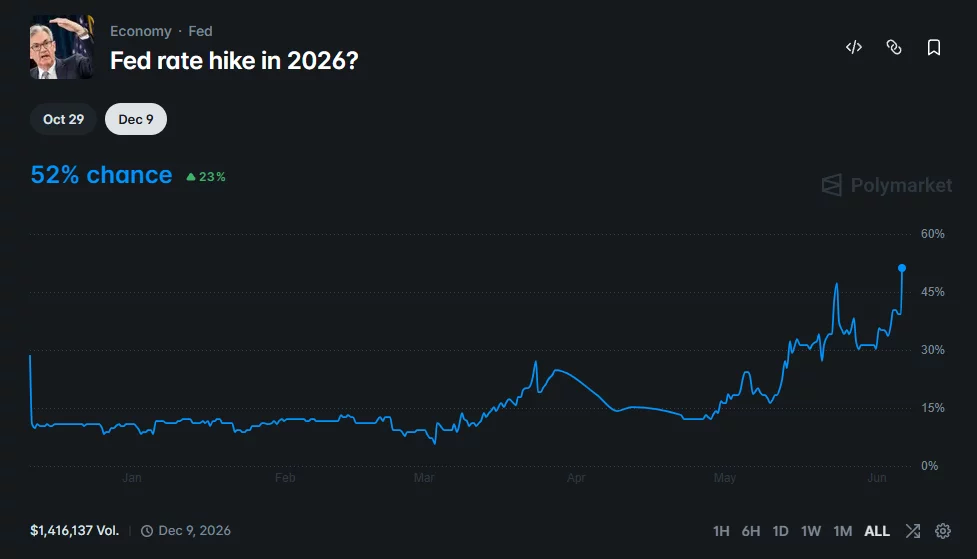
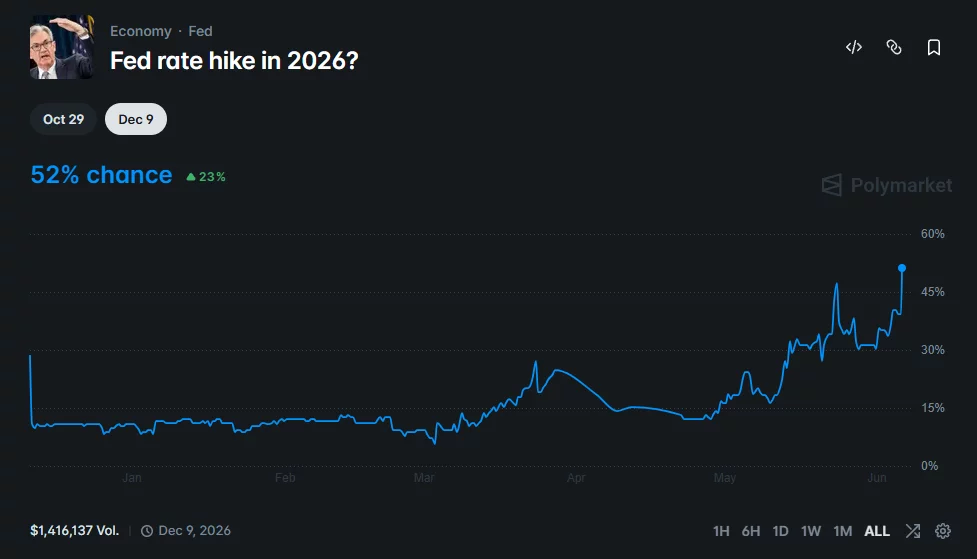
Data from Polymarket now shows a 52% probability that the Federal Reserve will raise rates before the end of the year. The odds reached their highest level so far after the stronger-than-expected payroll figures were published.
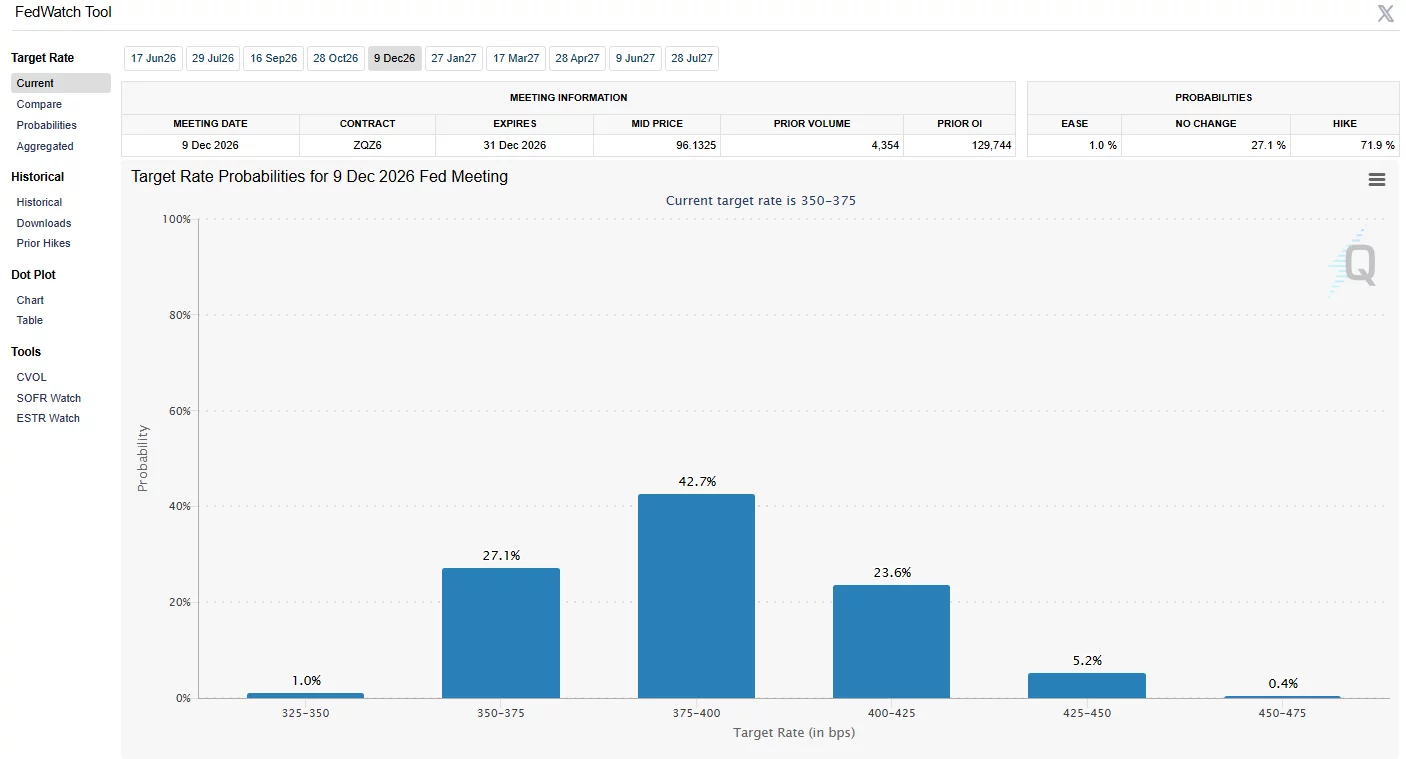
At the same time, CME FedWatch data indicates a 42.7% chance that rates will be higher by December this year. Futures traders continue to expect policymakers to leave rates unchanged for most of the year, while assigning only a limited probability to additional cuts.
Those expectations have emerged as inflation remains above the Federal Reserve’s long-term target and geopolitical tensions raise concerns about fresh price increases.
Fed officials and former policymakers remain divided
While BNP Paribas expects tighter monetary policy, some current Federal Reserve officials have continued to argue for patience.
Recent remarks from Mary Daly highlighted a more cautious approach. According to a summary of her comments reported by crypto.news last week, Daly said restoring price stability remains essential but warned that the Fed cannot achieve that objective by damaging the economy.
Daly has also argued in previous speeches that policymakers are in a position to wait for more data before making major policy changes.
Her stance contrasts with concerns raised by former New York Fed President Bill Dudley, who has repeatedly warned that the central bank risks undermining its credibility if inflation remains above its 2% target for too long.
In recent commentary and interviews, Dudley argued that inflation has exceeded the Fed’s objective for more than five years, yet policymakers have increasingly discussed rate cuts. He has also maintained that the neutral interest rate, often referred to as r*, is likely higher than officials currently assume, suggesting monetary policy may not be as restrictive as it appears.
According to Dudley, the bigger danger lies in inflation expectations becoming entrenched. He has cautioned that households and financial markets could begin treating inflation in the 3% to 5% range as normal if price growth stays elevated for an extended period. In his view, bringing inflation back to target under those conditions could eventually require much more aggressive action from the Federal Reserve.



Decentralized artificial intelligence network DGrid AI generated $20 million in revenue in its first six months, giving the project a paid-user base ahead of its planned DGAI token launch.
Revenue came through the Genesis premium program, which has attracted more than 13,000 paid users with an average revenue per user of $1,580.
DGrid also reports 50,000 daily active users and 500,000 monthly active users across its ecosystem.
DGrid is building a decentralized smart network for AI, connecting users, developers, models, and agents through a marketplace, smart routing system, and Proof of Quality verification for AI services.
Genesis Premium Program Builds Early Revenue
Genesis is currently DGrid’s revenue engine, with members paying for network access and receiving benefits connected to AI usage, hardware, monthly token credits, AI model services, and membership NFTs.
Under DGrid’s economic model, those NFTs are linked to 25% of total DGAI emission rights over ten years.
The model combines usage-led demand with token-linked participation before the token generation event.
Some members use Genesis for AI model access and lower usage costs, while others focus on future DGAI distribution connected to the membership NFT. The program gives DGrid cash flow and committed community activity before launch.
AI Arena Adds BNB Chain Activity
DGrid’s onchain activity has grown through Arena for Agent, launched on BNB Chain. The product has supported more than 10,000 agent deployments through ERC-8004 and attracted over 200,000 participants, while adding more than 5,000 daily onchain active users to BNB Chain.
Arena asks two AI models to answer the same prompt anonymously, after which users choose the stronger response and earn points tied to future DGAI distribution. Their selections help train DGrid’s smart routing system, turning model evaluation into a recurring onchain activity with a low technical barrier for users.
Arena also gives DGrid visible user activity before launch while collecting comparison data for its routing system.
Products Focus on AI Access, Routing, and Agent Deployment
DGrid’s product suite includes AI Gateway, Dori, and DClaw, each aimed at a different part of AI access and deployment. Here’s a detailed breakdown of each:
Product
Main Function
Who is it for?
Key Benefit
AI Gateway
Provides a single access point for multiple AI models.
Developers, businesses, and users who need model access without managing separate integrations.
Simplifies AI model access and supports payments in USDT, USDC, and BNB.
Dori
Helps developers choose the right AI model for specific use cases.
Developers testing or deploying AI tools.
Reduces the time and cost of manually comparing multiple models.
DClaw
Lets users launch personal AI agents across Telegram, Discord, WeChat, and Feishu.
Users and teams that want AI agents inside messaging and community platforms.
Makes AI agents easier to deploy across familiar communication channels.
Model Marketplace
Allows model providers to list AI services and earn revenue through AI Gateway.
AI model providers, developers, and enterprise users.
Creates a marketplace for AI model access, monetization, and service discovery.
Proof of Quality
Verifies model performance, pricing, and delivery standards.
Marketplace users, model providers, and developers.
Adds trust and transparency to model selection.
A Note on Research
DGrid’s academic work adds depth to its product plan. The network cites published research on Proof of Quality, optimistic TEE rollups, and cost-aware proofs, all of which relate to service verification, model performance, and cost control.
The team includes Ph.D.-level members from institutions such as Stony Brook University. Founder and CEO Alex has more than 10 years of experience in blockchain project operations, 5 years in machine learning, and over 3 years in large language model training and fine-tuning.
DGAI Token Launch is One to Watch
DGrid enters its token launch phase with paid membership revenue, BNB Chain activity, AI products, marketplace plans, and research already in place.
After six months, the project has built a user and revenue base around Genesis, expanded Arena participation, and prepared the foundations for a model marketplace powered by DGAI.
The post DGrid AI Reports $20 Million in Revenue Ahead of Token Launch appeared first on BeInCrypto.

Crypto exchange Kraken is giving customers access to the upcoming SpaceX initial public offering through xStocks, a tokenized equities platform, highlighting the growing convergence between crypto infrastructure and traditional capital markets.
Kraken announced Friday that SpaceX will be the first public offering available through xStocks IPO Access, which allows eligible users to participate in the offering through tokenized equity instruments.
To participate, users must have a verified Kraken account on the Kraken mobile app and submit an application for IPO access. The offering is not available through Kraken Pro or the company’s desktop platform.
According to Kraken, IPO Access is available across the European Economic Area (EEA) and more than 110 international markets, though participation is restricted in the United States, Canada, Australia and the United Kingdom due to regulatory limitations.

Source: Kraken
Eligible users can register interest in purchasing SpaceX shares before the company begins public trading. Investors who receive an allocation will be issued SPCXx, a tokenized representation of SpaceX equity backed 1:1 by the underlying shares. The tokens can be traded 24/7 on Kraken and other participating xStocks platforms.
Related: Kraken’s xStocks tops $25B in volume with more than 80K onchain holders
SpaceX targets $1.8 trillion valuation, record debut
SpaceX is expected to begin trading publicly on June 12, giving investors their first opportunity to own shares in Elon Musk’s rocket and satellite company.
According to Bloomberg, demand for the offering has already exceeded the number of shares available, with SpaceX seeking to raise roughly $75 billion at a valuation of at least $1.8 trillion. If achieved, the listing would be the largest IPO ever, exceeding Saudi Aramco’s $29.4 billion deal in 2019, Bloomberg said.
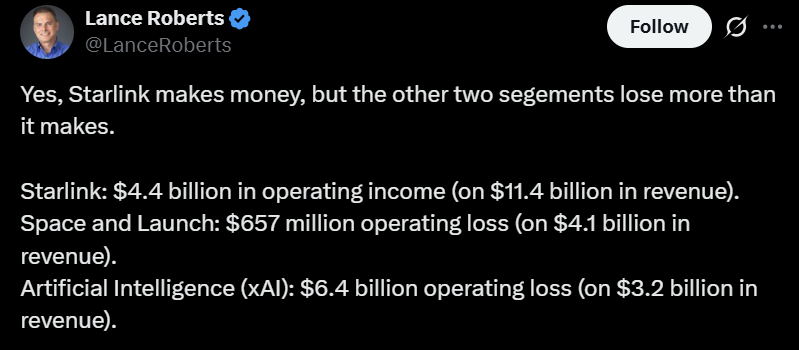
The company’s growth story is largely tied to Starlink, its satellite internet business, which has become a major source of revenue and profitability.
However, SpaceX’s capital-intensive launch and space exploration operations continue to incur high costs, raising questions about how investors will value the company once it begins trading on the public market.
Source: Lance Roberts
Related: SpaceX reveals larger-than-expected Bitcoin holdings in IPO filing
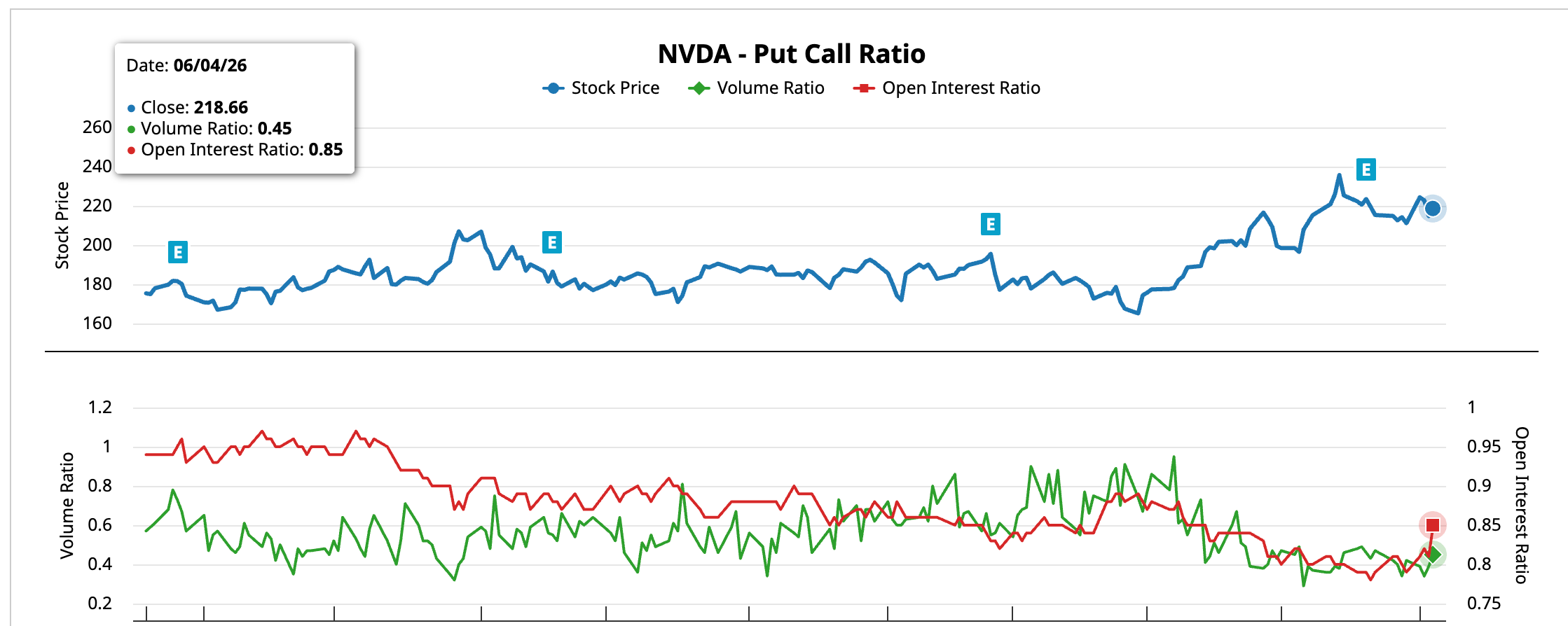
Nvidia (NVDA) stock is up just 15% in 2026 while the rest of the chip sector races ahead, and one flow signal helps explain why the market’s former leader is being left behind.
The split from the sector is the surface story. Beneath it, options bets, perpetual traders, and institutional flows are pulling in different directions, and only one of them resolves the puzzle.
The Chip Rally Is Leaving Nvidia Stock Behind
Nvidia and the Semiconductor Index have moved in opposite directions on about half of all trading sessions over the past 50 days, near the highest rate since the 2022 bull market began. That frequency has more than quadrupled since the start of April.
Want more insights like this? Sign up for Editor Harsh Notariya’s Daily Newsletter here.
The performance gap is just as wide. The Nvidia stock price is up roughly 15% on the year, while Broadcom (AVGO) has gained about 20% and AMD has climbed far higher.
Through 2024 and 2025, Nvidia drove the sector and outran its peers. The rally has since broadened to include chips other than Nvidia’s, leaving one question open. If the sector is soaring without it, where is the money that used to favor Nvidia going?
Bearish Options Bets on Nvidia Stock Are Building
The first place to look is the options market. The put-call ratio for Nvidia, which weights bearish put contracts against bullish call contracts, has tilted toward puts since the company’s last earnings report.
On earnings day, the volume ratio sat near 0.46 and the open interest ratio near 0.79. Those readings have since moved to about 0.45 and 0.85, with the open interest ratio climbing toward puts.

A higher open interest ratio means traders are adding downside bets or protection. The shift is small, yet it matches the performance lag and hints that conviction in Nvidia shares is fading.
Options point one way, but they are a single venue. Another market is betting the opposite, which deepens the puzzle rather than solving it.
On Hyperliquid, Traders Still Favor Nvidia Stock
On the perpetual futures platform Hyperliquid, the tokenized NVDA contract shows traders leaning long. The smart money and public-figure groups both hold net long positions, while the larger whale group sits net short, but only slightly.

That stance stands out against AMD and Broadcom on the same platform, where positioning skews more heavily short, at least across two cohorts, as opposed to NVDA’s whale-only cohort.

Even as it splits from the sector, Nvidia remains a favorite here.

Volatility helps explain the pull. Nvidia carries the highest 30-day annualized volatility among the megacap names at about 33%, second only to Tesla and well above the broad market.
Bigger swings attract traders who want to trade on movement, a common tendency on platforms like Hyperliquid.

Broadcom’s earnings on June 3 also kept the sector’s attention on Nvidia’s rivals. So the venues disagree. Options lean bearish, perpetual traders lean long, and neither settles the question on its own. One last signal breaks the tie.
The One Signal: Institutional Money Is Exiting
That signal is the Chaikin Money Flow (CMF), an indicator that tracks institutional money flow into or out of a stock. Nvidia’s CMF has dropped back below zero.
A reading under zero points to net selling from institutions, the largest and slowest-moving money in the market. This is what the headline numbers hide. Over the past five days, Nvidia’s stock is up about 2%, yet the flow has turned negative beneath that flat price.

AMD’s CMF, on the other hand, is aggressively positive at press time.

The divergence ties the whole picture together. Institutions stepping back explains the lagging year-to-date return and the rising put interest, while the Hyperliquid longs look like shorter-term traders chasing volatility rather than a lasting bid.
The CMF is now testing a rising trendline drawn from early January. A break below it would deepen the outflow and confirm the sector has moved on without its leader.
A recovery back above the line and fresh inflows would show the selling was only a pause. For now, institutional flow is the signal explaining why the chip rally is soaring even as Nvidia stock lags.
The post The AI Chip Sector Is Soaring Without Nvidia, and the Money Flow Explains Why appeared first on BeInCrypto.

Bitcoin has moved beyond being a narrow technical experiment or niche monetary protest, according to Strategy Chairman Michael Saylor. He believes the crypto asset is now the dominant digital monetary network and is a global asset with wide implications for individuals, institutions, corporations, banks, capital markets, and nation-states.
As Bitcoin expands, Saylor said that the community is naturally splitting into four overlapping ideologies that shape how people think about its future development, adoption, and protection, even though all share a belief in Bitcoin’s importance.
Four Ideological Camps
In his latest post on X, Saylor identified these groups as Maximalists, Capitalists, Technologists, and Fundamentalists, each emphasizing a different priority in how the world’s largest crypto asset should evolve.
Bitcoin Maximalists, for one, see BTC as the dominant monetary network and a breakthrough in digital scarcity. They focus on its role as incorruptible money, a long-term store of value, protection against inflation and monetary instability, and a “moral and civilizational advance” in economic systems, while stressing “there is no second best,” though they risk being unclear on how BTC integrates into broader financial systems.
Bitcoin Capitalists, on the other hand, view BTC as digital capital that should integrate deeply into global markets including banks, corporations, securities, credit instruments, and sovereign systems, emphasizing institutional adoption, custody, lending, and capital market products. But this group faces risks of “reckless financialization” and added complexity.
Meanwhile, Bitcoin Technologists focus on the continuous improvement of the protocol, including scalability, privacy, usability, and security. They believe that “responsible protocol improvement is not corruption.” They are of the view that BTC must keep evolving to remain useful, though they risk introducing harmful changes if base-layer modifications undermine stability.
Bitcoin Fundamentalists focus on preservation of BTC’s core properties such as decentralization, self-custody, immutability, censorship resistance, and permissionless access. They warn against institutional capture or protocol dilution. However, Saylor said that they may risk limiting broader adoption if they reject too much integration or change.
Saylor explained these ideologies are not mutually exclusive, but different forces serving distinct roles in the ecosystem: Maximalists provide conviction, Capitalists drive adoption, Technologists enable innovation, and Fundamentalists safeguard core principles.
The central tension lies in balancing these perspectives since each can become problematic if taken to extremes. In Saylor’s view, the healthiest path forward is a synthesis.
“The strongest path forward is not reckless change, institutional capture, or isolationist purity. It is disciplined expansion. Bitcoin’s power comes from the fact that it can serve many constituencies without belonging to any one of them.”
Bitcoin’s Ideological Battles
Over time, Bitcoin’s internal camps have often clashed over how the network should evolve. Maximalists frequently resisted changes they see as unnecessary or harmful to Bitcoin’s core design. This tension became especially clear during the scaling and block size debates, where different groups pushed competing visions for BTC’s future.
Even major upgrades were difficult to agree on. For example, the SegWit upgrade was proposed in late 2015 but activated after years of debate following the block size wars.
The post Bitcoin’s Future Is Now a Four-Way Ideological Battle, According to Michael Saylor appeared first on CryptoPotato.
Crypto World
Security experts warn advanced AI is about to spark a hacking crisis for both crypto and banks


A major bug found in the top privacy network Zcash, using artificial intelligence, may be a warning sign that similar undiscovered flaws exist across crypto and banking software.
What’s worrying the crypto community is that the bug, which had existed in the network for 4 years, was only found recently by Shielded Labs, a nonprofit developer on the privacy token system, using Anthropic’s newly released Opus 4.8 AI model. The vulnerability, which Zcash said “has been remediated,” if left undetected, could have allowed an attacker to print unlimited counterfeit tokens.
The disclosure had already caused panic among the crypto community and took the Zcash token down nearly 38% in the last 24 hours. Some even said on social media that “Crypto is dead. We should have pivoted to AI.”
Now, the question everyone is asking is: with AI getting better and the world bracing for the release of Anthropic’s newest Mythos model, which is supposed to be much more capable of identifying and chaining together weaknesses across systems, is the crypto industry’s security in jeopardy?
However, the prominent crypto venture capital firm Dragonfly (an early investor in Zcash) and its Managing Partner, Haseeb Qureshi, have a slightly different take on AI and crypto’s security. In his view, AI finding vulnerabilities is a good thing as it will only make the code better.
“While AI found this bug, AI will also deliver the fix for the whole category: formal verification. I’m very bullish on this as the path to harden all software across the industry,” he said on a X post.
While Haseeb’s firm continues to hold Zcash and is bullish on AI’s role in crypto security, Ben Goertzel, the CEO of AI firm SingularityNET, told CoinDesk that similar vulnerabilities aren’t just limited to crypto security, but are likely hiding in the traditional banking system as well.
“Other cryptocurrencies are not vulnerable to this specific bug, which was a simple logic error in the Zcash implementation,” Goertzel said, explaining that other cryptocurrencies are “certainly very much likely to possess similar vulnerabilities, which are likely to be found by AI tools in the coming weeks and months.”
Moreover, Goertzel said that “software infrastructures of banks and other centralized institutions are also very likely to embody serious bugs to be found by AI tools in the near future as well.”
‘Formal verification’
So what is an actual solution for this AI threat?
Both Qureshi and Goertzel said that cryptographical code and global software infrastructure must transition to “formal verification.”
The process is essentially “writing proofs of mathematical theorems in such a way that these theorems can be checked automatically,” as Ethereum’s co-founder Vitalik Buterin explained. He noted that AI-assisted formal verification could become one of the most important tools for cybersecurity, as increasingly advanced AI systems make it easier to discover software vulnerabilities.
And Qureshi echoed that sentiment.
“Formally verified cryptography can’t have implementation bugs by construction,” he said. “Right now AI is surfacing vulnerabilities across all our software–browsers, OSes, and blockchains are no exception,” he added, noting that formally verified software would be the “only path forward for mission-critical software,” which Zcash has made its focus on its roadmap.
Goertzel, meanwhile, explained why developers aren’t already using this formal verification process to make their software ironclad.
He argued that while the “Rust” programming language used by Zcash can be formally verified, developers rarely do it because it requires extra work. Furthermore, Goertzel noted that core Rust libraries often use “unsafe” constructs that are difficult to verify.
However, rewriting them to be safe would make the software slower: A problem, he stated, that could be fixed by using advanced techniques such as “supercompilation” to boost performance.
An asymmetric security war
But implementing those protections is easier said than done, CEO and co-founder of security firm CertiK, Ronghui Gu, told CoinDesk.
Defending against these threats has become an unequal battle, Gu said.
“We’re currently seeing an AI token consumption war in which hackers are highly motivated by profit, he said. “To find an exploit, they can burn a massive number of AI tokens on a single target, such as a project or smart contract.”
Gu explained that profit-driven hackers are currently engaged in a token consumption war, burning massive amounts of computing power to target individual smart contracts. Because security firms must protect hundreds of clients simultaneously, they cannot allocate the same concentrated resources to a single target without incurring significant capital costs.
To shield from this asymmetric risk, Gu said security firms must integrate automated scanners directly into daily development workflows through smaller, on-demand sessions, while relying on mathematical proofs to guarantee that contracts satisfy key security properties.
For Gu, the challenge is no longer simply finding bugs before attackers do; rather, it’s about scaling defenses against these vulnerabilities quickly enough to keep pace with increasingly powerful AI systems.
While the debate over how to stay ahead of such vulnerabilities will likely continue, as AI gets better, faster and smarter, the question for all developers is how to ensure such incidents never happen again.
Perhaps ZODL CEO Josh Swihart (former CEO of Electric Coin Company, a key developer of Zcash) put it aptly:
“The more interesting question is how we ensure that vulnerabilities never happen again. The best answer is formal verification,” Swihart said in his X article, titled “Never Again.“

TLDR
- Michael Saylor says Bitcoin should balance purity and adoption.
- Bitcoin traded below $61,000 and fell over 25% in a month.
- Saylor outlined four ideologies shaping Bitcoin’s future.
- Strategy sold 32 BTC worth about $2.5 million this week.
- The firm still holds more than 844,700 BTC on its balance sheet.
Bitcoin hovered near two-year lows as Michael Saylor published a new essay on the network’s direction. He argued that Bitcoin should balance competing visions instead of choosing one path. The comments came as BTC traded below $61,000 and extended monthly losses beyond 25%.
Bitcoin Ideologies Clash as Prices Slide
Saylor outlined four Bitcoin ideologies in a Friday post on X. He named maximalists, capitalists, technologists, and fundamentalists as core camps shaping the network.
He wrote, “The mission is not to choose between purity and adoption, or between innovation and stability.” He added, “The mission is to ensure that Bitcoin remains Bitcoin while the world builds on it.”
He described the base layer as “sacred infrastructure” that must remain stable. However, he said Bitcoin, the asset, should integrate with companies, banks, and nation-state reserves.
The essay addressed tensions tied to Bitcoin’s deeper ties with traditional finance. Corporate treasuries, exchange-traded funds, and capital markets now influence demand patterns. BTC traded at $60,717 on Friday and showed a 5.35% daily decline.
The asset has dropped more than 50% from its October 2025 high of $126,000. It has also recorded one of its steepest pullbacks since the 2022 bear market. The downturn has intensified debate over Bitcoin’s direction and market structure.
Strategy’s Bitcoin Moves Draw Scrutiny
Strategy has expanded preferred stock offerings to finance additional Bitcoin purchases. The firm holds more than 844,700 BTC on its balance sheet. However, it disclosed the sale of 32 BTC for about $2.5 million earlier this week.
The sale represents a small fraction of total holdings. Still, critics questioned whether larger sales could follow. CNBC host Jim Cramer responded to a video by Strive CEO Matt Cole and said, “Saylor murdered Bitcoin.”
Strategy has not announced further disposals since the disclosure. The company continues to position Bitcoin as a treasury reserve asset. Meanwhile, BTC price weakness has shaped investor and analyst commentary.
Analysts Debate Path to a Sustainable Bottom
Grayscale Head of Research Zach Pandl said Strategy faces limits at current share prices. He stated that further accumulation may require new sources of demand. He said the market needs broader participation to find a “sustainable bottom.”
Standard Chartered Head of Digital Assets Research Geoffrey Kendrick offered a different view. He said Bitcoin’s low is “almost in” based on steady spot ETF holdings. He also suggested Strategy could repurchase more BTC than it recently sold.
Kendrick said renewed buying would signal that the worst of the selloff has passed. For now, Bitcoin remains under pressure as analysts assess demand conditions. BTC last traded below $61,000, down more than 25% over the past month.


SEC Commissioner Hester Peirce has reopened debate over DeFi developer liability after saying open-source blockchain developers should not face federal securities registration rules just because others use their software. Her remarks at the IC3 Blockchain Camp at Princeton University argued that regulators should separate code publication from market conduct.
According to Peirce, the core issue concerns who actually performs the regulated act and that securities violations should fall on unlawful actors, not on developers who publish public software. The SEC staff’s April guidance on crypto user interfaces also frames the issue around interface providers, wallet tools, and transaction flows rather than the blockchain code alone.
Peirce Draws a Line Between Code and Conduct
Peirce said the SEC’s traditional categories fit intermediaries such as brokers, dealers, exchanges, and clearinghouses. She warned that extending those labels too far could place blockchain developers inside rules built for centralized finance. She also said open-source publication counts as protected speech, repeating the view that the SEC should not require approval for code that others later use.
Blockchains serve many purposes beyond securities transactions, and it matters because DeFi developer liability can expand quickly when regulators assume every on-chain tool exists to facilitate securities activity. Regulators should thus focus on conduct, not on proximity to conduct.
Staff Guidance Keeps the Interface Debate Open
The SEC staff statement issued on April 13, 2026, addressed “Covered User Interface Providers” that create or operate interfaces used to prepare crypto asset securities transactions. The staff said it would not object to broker-dealer registration relief in limited cases where providers meet detailed conditions.
The statement describes interfaces that convert user-selected transaction details into blockchain-legible commands, display market data, and provide educational material. It also limited the relief to providers that do not solicit specific transactions, do not take custody, and do not execute or settle trades. That framework makes DeFi developer liability a narrower question than many public debates suggest.
Crypto Task Force Pushes for Clearer Boundaries
The SEC’s Crypto Task Force says it aims to clarify how federal securities laws apply to crypto assets, protocols, and market infrastructure. The agency created the task force to draw clearer regulatory lines and recommend practical policy measures.
Peirce leads the task force and has pushed for clearer legal boundaries for crypto firms and developers. As the SEC reviews its approach, the dispute over DeFi developer liability remains central to how far securities rules should reach in decentralized systems.
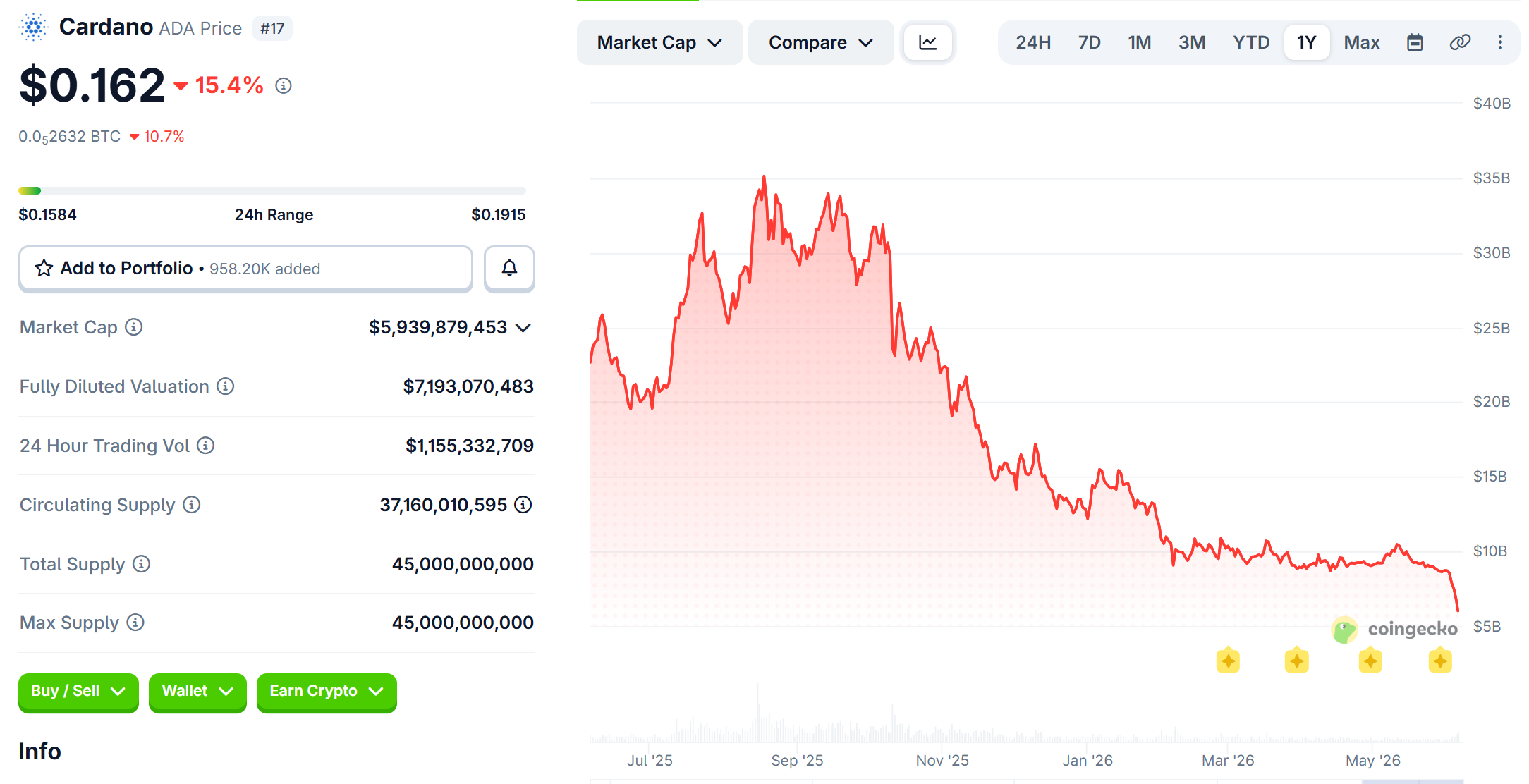
Cardano (ADA) fell about 15% in 24 hours to near $0.16 on Friday, its lowest level since late 2020, extending a selloff that has erased roughly 30% of its value in a week.
The drop left ADA ranked 17th by market value, with its market capitalization slipping below $6 billion. Cardano Foundation CEO Frederik Gregaard urged investors to look past short-term price action, but can they?

ADA Price Slide Deepens as Crypto Market Sells Off
The token exchanged hands near $0.16, down about 15% on the day and roughly 30% over the past week.
That marked its weakest level since late 2020 and left ADA close to 95% below the $3.09 record it set in September 2021.
The fall tracked a wider risk-off move across digital assets. Trading volume topped $1.1 billion as sellers pressured the price. Search interest in the term ADA price also spiked sharply as the decline accelerated.
However, some on-chain signals stayed firm. Reports show active addresses rising during the dip, even as the token printed fresh lows.

Follow us on X to get the latest news as it happens
Cardano Foundation CEO Defends Long-Term Building
Gregaard, the Foundation’s first chief executive since 2020 and a former PwC banking executive, separated market sentiment from network progress.
He pointed to governance running at scale, expanding DeFi projects, and real-world asset work across several regions.
“What matters long term is not short-term market sentiment, but whether an ecosystem continues to build meaningful infrastructure and attract real adoption,” Gregaard stated.
He framed that progress as verifiable and auditable on-chain, highlighting decentralized voting under the network’s on-chain governance framework, treasury activity, and identity work, including a program tied to 20,000 farmers in India.
Ecosystem Faces Leadership Strain
The defense arrived during a difficult stretch for Cardano. Analytics platform TapTools said on June 3 it would wind down within two weeks after losing five senior executives this year, including both co-founders.
That closure followed the shutdown of the leading NFT marketplace JPG.Store in May, part of a broader wave of project shutdowns.
Founder Charles Hoskinson also stepped back from public engagement, citing online toxicity. A failed community vote earlier canceled the 2026 summit.
Amid all these controversies, investor interest in the “ADA price” is surging, rising 73% since late May.

The coming weeks will test whether Gregaard’s focus on fundamentals can steady confidence, or whether falling prices keep driving the story.
The post Cardano CEO Urges Calm as ADA Crashes to 2020 Lows appeared first on BeInCrypto.

Stablecoin growth poses a conditional risk to U.S. banks, S&P says
S&P Global Ratings this week published a Credit FAQ detailing how broader use of U.S. dollar-pegged stablecoins could alter the economics of the U.S. banking sector. The analysis, focused on stablecoins that would operate under the GENIUS Act framework, finds that while the current threat to domestic deposits and payment rails is limited, regulatory and market shifts could change that picture materially.
The report’s evidence base: stablecoin issuance exceeded $300 billion as of May 2026, with the two largest issuers accounting for roughly 85%–90% of the total. Most dollar-backed demand today originates outside the U.S., and stablecoins remain heavily concentrated in crypto trading and settlement. Still, S&P flags several scenarios under which stablecoins could become a more direct competitor to banks for payment fees and deposit balances.
How stablecoins could affect banks’ revenue and funding
S&P identifies three primary channels by which stablecoins could influence banks. First, competition for payment flows: as stablecoins are used for merchant remittances or commercial payments, banks could lose fee income that contributes to noninterest revenue. Second, deposit composition: funds converted into stablecoins can change the mix between retail and wholesale deposits, raising funding volatility if holdings concentrate in larger, uninsured balances. Third, lending capacity and pricing: if deposit elasticities change or deposit yields rise to retain customers, banks could face margin pressure and higher funding costs, which would feed into loan pricing.
Reserve management is pivotal. Whether stablecoin issuers hold reserves as bank deposits, Treasuries or money-market instruments will determine where flows ultimately land. If reserves are primarily bank deposits, overall system deposits could be preserved even as individual banks lose share. If reserves sit in Treasuries or at the Fed via so-called “skinny” master accounts, the banking system could see a net outflow of deposits.
Regulatory guardrails will shape outcomes
The GENIUS Act, enacted in July 2025, created a statutory pathway for permitted payment stablecoin issuers and set strict requirements, including a 1:1 reserve ratio denominated in highly liquid assets, segregated accounts and prohibition on rehypothecation. Important implementation details remain under rulemaking by agencies such as the OCC and the FDIC. Proposed rules address licensing, reserve composition, governance, transparency and capital requirements.
Two provisions stand out as particularly consequential for banks. The first is the statutory ban on paying interest directly to stablecoin holders; the second is how regulators treat “pass-through” deposit insurance for reserves held at banks. S&P notes that even with a direct interest ban, economic incentives may still be routed indirectly — for example, through exchange fees or third-party arrangements — complicating the competitive landscape.
Risks highlighted by S&P
S&P’s FAQ lists practical risks regulators and banks must weigh. Rapid redemption pressures could force issuers to liquidate reserves at inopportune times, while nonbank issuers lack central-bank access to liquidity. There are also monetary policy considerations: a larger role for privately issued dollar-like tokens could complicate interest rate transmission. Consumer protection is another area of concern; stablecoins do not carry deposit insurance and holders may be exposed to counterparty or operational risks.
S&P recalls precedents where market stress impacted stablecoins — including a price shock to a major dollar token after a U.S. regional bank failure — underscoring the need for liquidity and redemption safeguards.
How banks are responding and what could mitigate downside
Many banks have not issued stablecoins but are experimenting with tokenized deposit products and pilot projects. Examples include bank-led pilots on public blockchains and state-level initiatives. S&P argues that banks which integrate tokenization and programmable payment features into regulated deposit products will be better positioned to retain client relationships and revenue streams.
Tokenized deposits differ from stablecoins. They remain within the regulated banking perimeter, carry existing liquidity frameworks and—where eligible—FDIC coverage. That regulatory alignment reduces certain systemic risks but limits fungibility with permissionless ecosystems that large public stablecoins currently serve.
Implications for investors and ratings
At present S&P does not incorporate stablecoin risks into bank ratings broadly, citing the early stage of adoption and the continued dominance of traditional deposits. However, the agency warns it will monitor developments closely: idiosyncratic deposit outflows or higher funding costs at individual banks could prompt rating actions. Conversely, banks that capture new business from stablecoin custody, issuance or settlement services could benefit.
Bottom line
S&P’s FAQ frames stablecoins as a technology and market development whose ultimate effect on U.S. banks depends on three levers: issuer behaviour, reserve composition, and regulatory implementation. With the GENIUS Act in place but agency rules and complementary legislation still being finalised, the near-term balance of risks and opportunities remains unsettled. For banks, the prudent course is to accelerate experimentation within compliance boundaries and to prepare funding and liquidity plans for scenarios that shift deposit composition or payment flows.
For policymakers, the trade-off is clear: rules must allow innovation that improves payment efficiency while limiting risks from liquidity mismatches, redemption runs and fragmentation of prudential safeguards.

Solana-based memecoin launchpad Pump.fun introduced a new open bounty platform where users have posted crypto rewards for bizarre promotional tasks, such as tattooing the ticker symbols of memecoins, quitting their current job live on camera or skydiving into a World Cup match.
Pump.fun introduced the new platform on Thursday, positioning it as an open marketplace to “complete bounties for ANY task and leverage the power of humans & money across the globe.” The submissions are reviewed by Pump.fun while funds are in escrow. If accepted, the bounty is paid out to the submitter.
Pump.fun said that bounties that “may be deemed as spam by X are not allowed” in its Terms and Conditions document.
Some of the highest-paid tasks included a bounty of about $57,000 to skydive into a World Cup match in a memecoin mascot, a $25,000 bounty to interview the family of Henry Nowak’s killer, and $3,000 to quit your job live on camera.
Some listings reviewed by Cointelegraph offered thousands of dollars for risky or degrading promotional acts, raising questions about moderation, safety and legal exposure
“This is a horrible market. It’s like playing with poor people’s lives and paying them to entertain you,” commented X user Old Hawk. “Yep, reminds me of Squid Game,” wrote crypto investor Fabiano.sol in response.

Source: Pump.fun
Users can rank open bounties by highest reward, time left, or those that have received the most submissions so far.
Open bounties are launched with an expiration date and include descriptions of the exact deliverables needed to fulfill the task and qualify for the payout.

Bounty to interview Henry Nowak’s Killer’s family. Source: Pump.fun
At the time of writing, the platform showed an unclaimed pool of $115,000 across 225 live bounties and 509 total bounty submissions.
Related: South Korea police probe Polymarket users over illegal gambling claims: Report
Crypto rewards fund viral stunts
The new bounty platform has already attracted listings seeking to fund unusual memecoin marketing stunts.
One task offered a $3,572 bounty to spray paint the ticker symbol “$memecoin” on a car and set it alight, with 29 days left to complete the challenge while wearing a memecoin mascot and filming the entire process.

Bounty to spray a $memecoin car & explode or set it alight. Source: Pump.fun
Another task offered a $2,630 bounty for users to tattoo the ticker symbol “$boutywork” on their foreheads, requesting video proof of the action. So far, the task has received four submissions with people completing the tattoo.

Bounty to tattoo memecoin ticker symbol on the forehead. Source: Pump.fun
Magazine: Polymarket seeks Japan entry, Harvard dumps entire ETH position: Hodler’s Digest, May 17 – 23

FF Global Holdings Pursues U.S. IPO On Excessive Valuation

DGrid AI Reports $20 Million in Revenue Ahead of Token Launch

Union leaders support Ash Field Academy strikers



-

 Business4 days ago
Jade Biosciences, Inc. (JBIO) Discusses Positive Interim Results From JADE101 Phase I Healthy Volunteer Study and Development Plans Transcript
-
 Tech6 days ago
SpaceX just won a second Golden Dome contract. This one is $4.16 billion.
-

 News Videos7 days ago
SHE IS KILLING XRP!!! WATCH URGENT AND ACT FAST
-

 Sports3 days ago
French Open 2026 results: Alexander Zverev beats Rafael Jodar and will play Jakub Mensik in semi-finals
-
 NewsBeat7 days ago
FIRST NIGHT REVIEW: Take That bring the Circus back to life in spectacular sun-soaked style
-

 Business6 days ago
Is the Spurs Phenom Already Better Than Prime Diesel?
-

 Tech3 days ago
CryZENx Releases Fresh Playable Content Deep Inside Jabu-Jabu for His Ocarina of Time Remake
-

 Politics6 days ago
The House | Inside Andy Burnham’s Makerfield Campaign: “Nobody Thinks This Is In The Bag”
-
Crypto World9 hours ago
LBank Surpasses 25 Million Users Worldwide as AFA Partnership Continues to Drive Global Growth
-
 Business3 days ago
Trump Taps Housing Chief Bill Pulte as Acting Intelligence Director After Gabbard Exit
-
 Entertainment7 days ago
Bruce Willis’ Generosity Resurfaces Amid His Dementia
-
 Entertainment7 days ago
Weak ‘Supergirl’ Box Office Tracking Amid Milly Alcock Backlash
-
 Entertainment6 days ago
One of the Greatest Sitcoms of All Time Shoots Up Apple TV’s Charts 11 Years Later
-

 Business6 days ago
Demand Conditions Improve In Chemicals Sector In April 2026
-
 Crypto World7 days ago
MicroStrategy Moves $30 Million in BTC to Coinbase Prime: Is the Bitcoin Sell-Off Already Here?
-
 Crypto World3 days ago
Seagate (STX) Stock Surges to Record High on AI Boom and Legal Settlement
-
 NewsBeat6 days ago
Everything you need to know as Cambridge’s Strawberry Fair returns after cancelled year
-
 Entertainment6 days ago
Britney Spears Shares Troubling Update After Hard Year
-
Crypto World3 days ago
EU AI Data Center Project Faces Delays as Funding Gaps Grow
-
 Business7 days ago
US-led AI investments risk capital destruction: Chris Wood
You must be logged in to post a comment Login