
Crypto World
BTC narrows big early losses, rallying back above $64,000



Bitcoin pushed back above $64,000 in early U.S. trading Tuesday, tracking a broader rebound in risk assets after several sessions of turbulence.
Trading recently at $64,200, bitcoin was still lower by 0.75% over the past 24 hours, but nicely above the morning’s low of $62,500. Ether (ETH) and solana (SOL) also narrowed big early losses.
Crypto’s tight correlation with technology stocks remained evident, with software shares — as represented by the iShares Software Sector ETF (IGV) — bouncing 1.7% after recent heavy losses on concerns that artificial intelligence (AI) tools will destroy their business models.
The gains came as some companies, including Intuit and DocuSign, announced partnerships with AI firm Anthropic, signaling that incumbents might be able to adapt rather than being displaced.
Meanwhile, traditional safe havens lost ground. Gold fell 1.5% on the session, while crude oil slipped 0.5% as geopolitical tensions eased. Reports cited Iran’s deputy foreign minister Majid Takht-Ravanchi saying the country “is ready to take any necessary step to reach a deal with the U.S.,” tempering fears of an imminent military strike.
The tech-heavy Nasdaq 100 traded 1.1% higher, while the broad-market S&P 500 was up 0.8%.
High-performance computing firms and bitcoin miners — increasingly tied to AI data center infrastructure — joined the move higher. Bitdeer (BTDR), Cipher Mining (CIFR), Hut 8 (HUT) and TeraWulf (WULF) led gains, rallying 6%-10%.
Much of the rest of the crypto-related sector was modestly lower, with Coinbase (COIN), MARA Holdings (MARA) and Strategy (MSTR) among those showing losses of 0.5%-1%.

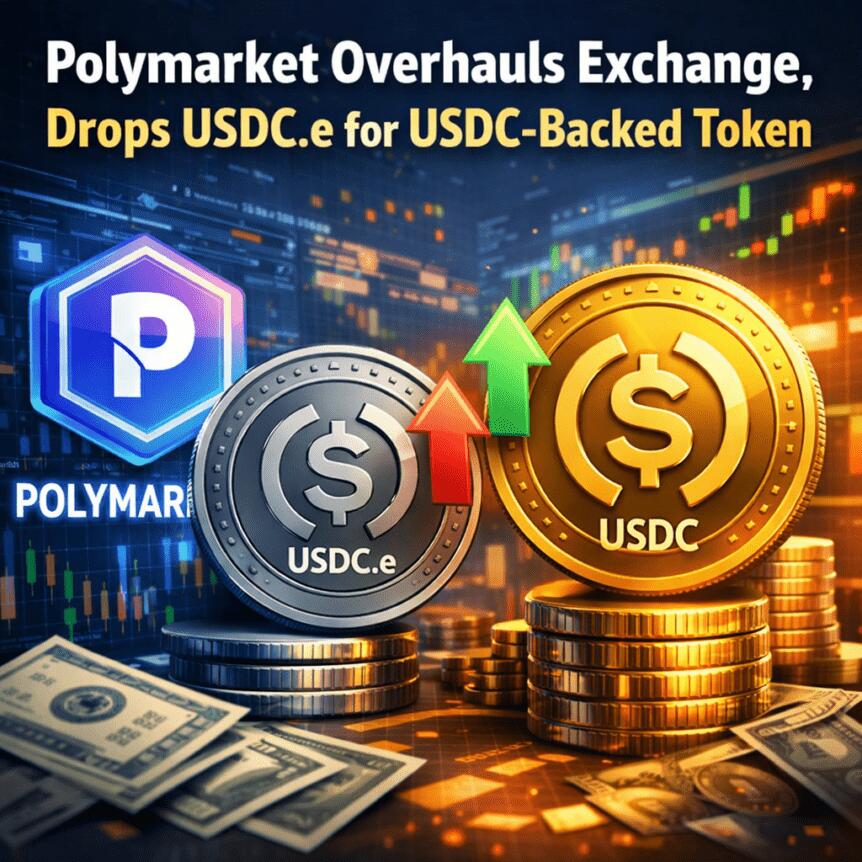
Polymarket is overhauling its exchange infrastructure in the coming weeks, introducing a new collateral token and an upgraded trading engine that give the platform tighter control over settlement and risk as it moves toward closer alignment with US regulatory expectations.
In a Monday announcement, Polymarket said it will deploy new exchange contracts—Version 2—designed to simplify how orders are structured and matched. The upgrade aims to boost trading efficiency and make it easier for developers to connect apps and trading bots to the platform.
The upgrade also expands on-chain compatibility by adding support for EIP-1271, the Ethereum standard that allows smart contract wallets, including multisigs and automated trading systems, to sign transactions, broadening support beyond traditional externally owned wallets.
A central feature is the introduction of Polymarket USD, a new collateral token that will replace USDC.e, Polymarket’s bridged version of USDC. The new token is fully backed 1:1 by USDC, giving Polymarket greater direct control over its settlement layer and reducing reliance on bridged assets.
For most users, the transition will be automatic through the platform’s interface, requiring only a one-time approval. The rollout is expected to unfold over the coming weeks, though Polymarket did not provide a precise date.
Key regulatory backdrop and market implications
The upgrade comes as Polymarket continues to adapt to evolving US regulatory expectations, including efforts to curb manipulation and insider-trading risks as it seeks to strengthen market integrity and align more closely with US standards.
In November, Polymarket won approval from the Commodity Futures Trading Commission to operate an intermediated trading platform in the United States, clearing the way for its return after previously exiting the market. Following that approval, Polymarket said it plans to onboard brokers and customers directly and facilitate trading through regulated US venues.
Interest in prediction markets has continued to grow, with users increasingly trading real-world outcomes tied to politics, markets, and policy. Industry data have shown Polymarket’s fee revenue rising in recent weeks after a pricing overhaul, underscoring the demand for these platforms.
Market data provider DeFiLlama tracks Polymarket’s revenue indicators and has highlighted the platform’s uptick as it expands fee-based income alongside its technological upgrade.
Beyond the user-facing changes, the upgrade is designed to strengthen the platform’s connective tissue for developers and automated traders, while giving Polymarket enhanced control over its settlement pipeline and a more cohesive collateral framework to manage risk.
What this means for users and developers
For everyday users, the transition should be largely seamless: the one-time approval triggers the automatic switch to the new system, and existing accounts will be supported by the updated interface. Traders and developers can anticipate easier integration with external apps and bots thanks to the simplified order structure and standardized settlement flow.
Polymarket’s ongoing push toward regulatory-aligned operation could attract more traditional market participants, brokers, and liquidity providers, potentially broadening the range of real-world events offered for trade.
Looking ahead, observers will watch how quickly the new infrastructure gains traction among users and whether regulatory clarity translates into faster onboarding of US participants via regulated venues.
As Polymarket advances its technical overhaul, the timing of regulatory milestones, the pace of onboarding, and the robustness of the new collateral approach will be key determinants of the platform’s next phase of growth.

Key Takeaways
- First-quarter earnings from UnitedHealth (UNH) scheduled for April 21, 2026
- Consensus estimates point to $6.69 EPS, reflecting an 8% year-over-year drop, alongside $109.58 billion in revenue
- Raymond James raised its rating to Outperform, establishing a $330 target price
- Shares climbed approximately 1.2% in response to the analyst action
- Derivatives markets suggest a potential ~9% swing following the earnings announcement
UnitedHealth Group prepares to unveil its first-quarter financial performance on April 21, with market participants paying close attention following a challenging beginning to 2026.
UnitedHealth Group Incorporated, UNH
Shares have tumbled approximately 17% year-to-date, weighed down by disappointing forward guidance and persistent challenges within its Medicare Advantage segment. This selloff has pushed the stock beneath the entry point established by Berkshire Hathaway, igniting discussion about potential value at current levels.
The Street anticipates adjusted earnings per share of $6.69 for the quarter, representing an 8% decline compared to the prior-year period. Revenue projections stand at $109.58 billion, essentially unchanged from last year’s figure.
Options activity suggests traders are bracing for approximately 9% volatility in either direction once results are published — indicating heightened uncertainty surrounding the upcoming release.
On April 1, Raymond James elevated UNH from Market Perform to Outperform, assigning a $330 price objective. Analyst John Ransom contended that the market is overlooking the company’s earnings capacity, especially regarding operational efficiency gains.
The rating change propelled shares higher by roughly 1.2% during the April 2 session, with the stock touching $279.04 before closing at $277.30.
Ransom highlighted administrative expense optimization as a crucial catalyst. His analysis suggests that each 100-basis-point reduction in general and administrative costs could contribute approximately $3.80 to per-share earnings.
Optum Health Under the Microscope
Raymond James noted enhanced transparency around Optum Health’s margin profile. While current-year margins may appear stable, the firm believes the underlying trajectory is favorable as UnitedHealth divests from loss-making assets.
The healthcare giant has already shuttered or divested multiple unprofitable clinic locations. This rationalization effort should alleviate margin compression moving forward.
Optum’s fee-for-service operations, generating approximately $33 billion annually, currently operate at single-digit profitability. Analysts identify substantial improvement potential through enhanced operational discipline.
The collective Wall Street sentiment toward UNH skews positive. According to TipRanks analytics compiled April 1, the stock carries a “Strong Buy” rating based on 17 Buy recommendations, 3 Hold ratings, and no Sell calls.
The consensus 12-month price objective stands at $366.47, suggesting approximately 35% appreciation potential from current trading levels. The most optimistic forecast envisions UNH at $440, while the most conservative projection sits at $311.
Potential Headwinds Persist
Some analysts maintain caution. Leerink identified Risk Adjustment Data Validation (RADV) audits — Medicare Advantage payment reconciliations — as a significant challenge.
An upcoming Ninth Circuit Court decision regarding UnitedHealth’s preemption argument could broaden legal exposure should the ruling prove unfavorable.
Institutional investors control approximately 87.9% of outstanding shares. Major stakeholders include Norges Bank, Capital Research Global Investors, Berkshire Hathaway, and Dodge & Cox, which substantially increased its holdings in the previous year.
Notwithstanding the 2026 downturn, UNH recently secured a position among the top 10 holdings within the Schwab U.S. Dividend Equity ETF. The corporation distributes an annual dividend of $8.84 per share, currently yielding about 3.2%.
The most recent quarterly report showed a modest earnings beat — $2.11 EPS against the $2.09 Street estimate — accompanied by $113.73 billion in revenue, reflecting 12.3% year-over-year growth.
First-quarter financial results will be released prior to the market opening on April 21.

China’s Cyberspace Administration has ordered Apple to pull Jack Dorsey’s Bitchat from its China App Store, citing regulations that require apps with “social mobilization” capabilities to pass a government security assessment before launch.
Summary
- The Cyberspace Administration of China told Apple to remove Bitchat from its China App Store and TestFlight beta, effective February 2026, a ban Dorsey disclosed publicly on April 5
- The CAC cited Article 3 of its regulations governing apps with “public opinion or social mobilization capabilities,” which require a mandatory security review before deployment
- Bitchat, which runs entirely over Bluetooth mesh networks with no internet required, has surpassed three million downloads globally and was widely used by protesters in Iran, Uganda, Nepal, and Indonesia to bypass government shutdowns
Block CEO Jack Dorsey confirmed on X that his decentralized messaging app, Bitchat, was pulled from China’s App Store in February 2026 at the direct request of the Cyberspace Administration of China. As crypto.news reported, the CAC cited Article 3 of its regulations covering online services with “public opinion or social mobilization capabilities,” a provision that has been in force since 2018 and requires a state security assessment before any such platform can launch. Both the App Store listing and the TestFlight beta version are now unavailable in China, though the app remains accessible in all other markets.
Bitchat’s core design is what put it on Beijing’s radar. The app operates entirely over Bluetooth and mesh networks, requiring no internet connection. That architecture makes it functionally immune to conventional government filtering and firewall blocking — the same tools China relies on to manage digital communication.
That design has given Bitchat an outsized role during political unrest. Protesters in Iran used it to communicate as authorities attempted to restrict connectivity during the ongoing conflict. As crypto.news documented, Bitchat also surged in Uganda ahead of the 2026 general elections, where opposition leader Bobi Wine actively urged supporters to download it in preparation for expected internet blackouts. Authorities in Nepal, Madagascar, and Indonesia have also seen surges in Bitchat adoption during periods of restricted connectivity.
Apple’s review team delivered a pointed message to Dorsey alongside the removal notice: “We know this stuff is complicated, but it is your responsibility to understand and make sure your app conforms with all local laws.”
Three Million Downloads and Still Climbing
Despite the ban, Bitchat’s global reach continues to expand. Chrome download statistics show the app has surpassed three million total downloads, with over 92,000 recorded in the past week alone. The Google Play Store reports more than one million installs. Regional breakdowns are not publicly available.
Dorsey first launched Bitchat in beta via Apple’s TestFlight in July 2025, framing it as a weekend experiment in Bluetooth mesh networking. The app encrypts messages using AES-256, stores all data only in device memory rather than on central servers, and supports Bitcoin transactions natively. Billionaire fund manager Bill Ackman publicly called it a practical tool for censored environments like Iran.
The App Store as the Only Lever
What makes China’s move notable is the mechanism chosen. Bitchat has no central servers to pressure, no user accounts to surveil, and no phone number requirement. Its decentralized design gives regulators virtually no conventional chokepoint to target. Forcing an App Store removal is one of the few available tools — and it does not affect the app’s operation for users who already have it installed or access it through other means.
Circle’s Layer-1 blockchain Arc will launch at mainnet with an opt-in post-quantum signature scheme protecting users’ wallets from day one, as the USDC issuer warns that Q-Day could arrive by 2030 or sooner.
Summary
- Arc will debut with a post-quantum signature scheme at mainnet launch, giving users the option to create quantum-resistant wallets without a forced network-wide migration
- Circle warned that adversaries may already be stockpiling encrypted data to decrypt later, and that Q-Day could arrive by 2030 or sooner, citing recent research from Google and Caltech
- The blockchain has been running on public testnet since October 2025, with USDC serving as the native gas currency; the quantum roadmap covers wallets, private state, validators, and infrastructure
Circle’s Layer-1 blockchain Arc will debut at mainnet with an opt-in post-quantum signature scheme, making it one of the first blockchains designed from the ground up to withstand quantum computing threats. The announcement accompanied a detailed security roadmap published to the Arc blog this week.
Arc has been live on public testnet since October 2025, with Circle’s USDC as the native gas currency. USDC carries a market cap of roughly $77.5 billion, second only to Tether among stablecoins, and is the asset at the center of Arc’s institutional positioning.
At mainnet, users will be able to choose a signing method that future quantum computers cannot break, according to the Arc roadmap. The approach is deliberately opt-in, meaning no forced migration, no network-wide reset, and no assumption that every wallet or software stack will need to adapt immediately. Circle framed this as a practical path for institutions to begin protecting assets now, without disrupting existing developer tooling.
“Quantum resilience cannot live only in research papers, exploratory pilots, or distant roadmap slides. It has to show up in the infrastructure,” Circle said in its announcement.
Arc’s sub-second block finality also limits the attack window. In a so-called short attack, a quantum computer would need to derive a private key during the brief period between when a public key is exposed during a transaction broadcast and when the transaction is finalized. At under one second per block, that window is narrow.
A Three-Phase Plan Covering the Entire Stack
Circle’s post-quantum plan covers more than wallet-level protections. The near-term phase introduces quantum-resistant signatures at mainnet launch. The mid-term phase extends those protections to private balances, confidential payments, and recipient data, ensuring institutional financial activity stays shielded as quantum capabilities advance. The long-term phase targets validator authentication and off-chain infrastructure, including cloud servers, hardware security modules, and encrypted connections between nodes.
As crypto.news reported, Google recently moved its own post-quantum encryption deadline forward to 2029, citing faster hardware progress and improved error correction. Researchers from Google and the California Institute of Technology have warned that functional quantum computers capable of breaking existing cryptographic standards may arrive sooner than previous estimates suggested.
The Risk Is Already Partially Here
Circle pointed to two converging threats driving the urgency. The first is the eventual ability of quantum systems to forge transaction signatures directly. The second is already active: NIST has flagged “harvest now, decrypt later” tactics, where adversaries collect and store encrypted data today, intending to crack it once sufficient quantum capability exists.
“Long-term cryptographic durability is a baseline requirement that must be accounted for in infrastructure decisions being made today,” Circle said, directing its message explicitly at banks, fintechs, and enterprise platforms building on stablecoin infrastructure.
Algorand’s ALGO token has gained roughly 50% this month, climbing from $0.079 to $0.126, after Google’s Quantum AI team cited the blockchain 32 times in a landmark paper on quantum threats to cryptocurrency.
Summary
- ALGO has risen about 50% in April, pushing its market cap above $1 billion, after Google’s quantum AI research paper repeatedly referenced Algorand as the live benchmark for post-quantum blockchain security
- Google’s paper highlighted Algorand’s FALCON signature scheme and State Proofs as practical examples of working post-quantum infrastructure, a stark contrast to Bitcoin and Ethereum, which are still debating migration paths
- Additional tailwinds include the SEC and CFTC classifying ALGO as a digital commodity, Revolut launching ALGO staking, and derivatives open interest surging from $38 million to $81 million
As crypto.news reported, Algorand (ALGO) rallied to an 11-week high of $0.126 on April 6, bringing its market cap near $1.1 billion. The primary catalyst was Google’s quantum AI research paper, “Securing Elliptic Curve Cryptocurrencies against Quantum Vulnerabilities,” published on April 1, which cited Algorand 32 times as a real-world case study for post-quantum blockchain security. ALGO is up more than 7% on April 6 alone, as broader crypto markets rallied on ceasefire headlines.
The Google paper, co-authored with researchers from UC Berkeley, Stanford, and the Ethereum Foundation, focused on how future quantum computers could break the elliptic curve cryptography securing most blockchains. In that context, Algorand stood out as a network that has already deployed practical defenses.
Google highlighted three features: Algorand’s use of FALCON digital signatures, a lattice-based scheme selected by NIST for post-quantum standardization; its State Proofs, which generate post-quantum secure certificates every 256 rounds to attest to ledger integrity; and its native rekeying function, which allows users to rotate private keys without changing a public address. Algorand executed its first post-quantum secured transaction in 2025, a milestone that most larger networks have yet to reach.
Not Just Quantum: Three Tailwinds at Once
The quantum narrative did not act alone. US regulators, the SEC and CFTC, jointly classified ALGO as a digital commodity in March and early April 2026. Algorand Foundation CEO Staci Warden called it “bedrock regulatory clarity” that aligns ALGO with traditional asset classes and reduces the compliance barriers that have kept institutional capital cautious.
Revolut, with more than 70 million users, launched ALGO staking during the same period, reducing circulating supply and expanding retail access. Swiss bank PostFinance separately enabled ALGO trading and custody, opening a regulated entry point for European institutional investors. Algorand also commands an estimated $425 million in tokenized real-world assets on-chain.
Derivatives Market Reflects the Shift
ALGO derivatives open interest surged from $38 million at the end of March to $81 million by April 4, more than doubling in under a week. As crypto.news noted, the quantum-resistant blockchain narrative has been gaining commercial traction industry-wide, with developers and institutions increasingly treating post-quantum readiness as a baseline requirement rather than a roadmap aspiration.
ALGO remains heavily discounted from its all-time highs, and technicals show overbought conditions in the short term. Whether the rally holds depends on whether the quantum security narrative sustains its momentum or gets overtaken by near-term macro developments.
Crypto World
Oklo (OKLO) Stock: Top Execs Dump $21M in Shares Amid Cramer Criticism and Earnings Disappointment

Key Takeaways
- On April 1, Oklo’s leadership team—including CEO Jacob DeWitte and COO Caroline Cochran—liquidated more than $21M in company shares through pre-scheduled trading arrangements.
- DeWitte’s selling spree dates back to January, with transactions executed at prices ranging from approximately $50 to $100 per share.
- CNBC’s Jim Cramer expressed skepticism about Oklo’s commercial viability, stating the company has minimal near-term revenue potential.
- The nuclear energy startup disappointed investors with a quarterly loss of $0.27 per share, significantly worse than Wall Street’s -$0.17 forecast.
- Despite remaining nominally bullish, Wall Street analysts have trimmed their price objectives, with the current consensus target at $84.30.
Oklo’s executive leadership executed substantial stock sales totaling north of $21 million on April 1, 2026, all conducted through previously established Rule 10b5-1 trading arrangements.
Chief Executive Jacob DeWitte liquidated shares at average prices spanning $48.41 to $51.20, generating proceeds of $10,069,852. Following these transactions, DeWitte maintains direct ownership of 691,533 Class A shares while controlling over 20 million additional shares through indirect holdings.
Co-founder and Chief Operating Officer Caroline Cochran executed similar transactions, also totaling $10,069,852, with sale prices fluctuating between approximately $47.99 and $51.79 per share. Her remaining direct stake stands at 658,039 shares.
Chief Financial Officer Richard Bealmear participated as well, selling 16,342 shares at $51.08 each for total proceeds of $834,749. His current direct holdings amount to 386,008 Class A shares.
While all three executives utilized 10b5-1 trading plans—designed to demonstrate predetermined selling schedules rather than opportunistic timing—the transactions raise eyebrows given their magnitude and timing.
DeWitte’s selling activity extends well beyond the April 1 transactions. Since January, the CEO has consistently offloaded shares at various price points, including sales near $112, $75, and $63. These cumulative transactions have generated tens of millions in personal proceeds during recent months.
The April 1 sale specifically involved 200,000 shares executed across two separate transactions, shrinking DeWitte’s direct ownership stake by 17.58%.
Cramer Questions Commercial Prospects
The executive stock sales coincide with harsh criticism from CNBC’s Jim Cramer. During a recent broadcast, Cramer delivered a blunt assessment: “Oklo, while not a science project, has very little prospects for making any money any time in the future that we think is important for a stock.”
This wasn’t Cramer’s first critique of the nuclear startup. Back in January, he characterized Oklo as lacking true commercial operations, suggesting that established players like GE Vernova represent superior investment opportunities in the nuclear sector despite Oklo’s technological promise.
Financial Performance Falls Short
The company’s operational results haven’t helped its case. Oklo disclosed a quarterly loss of $0.27 per share in its latest earnings report, substantially missing analyst expectations of a -$0.17 loss—a negative variance of $0.10 per share.
Despite this disappointment, Wall Street analysts haven’t abandoned the stock entirely, though enthusiasm has clearly cooled. UBS slashed its price target from $95 down to $60 while adopting a neutral stance. Needham made an even steeper cut from $135 to $73, and Canaccord reduced its target from $175 to $125. Cantor Fitzgerald maintained an overweight recommendation with a $122 price objective.
The analyst community’s average price target currently registers at $84.30, accompanied by a “Moderate Buy” consensus rating. The breakdown includes two Strong Buy recommendations, nine Buy ratings, six Hold positions, and two Sell ratings.
Oklo’s shares have experienced significant volatility over the past year, trading within a 12-month range of $17.42 to $193.84. The stock’s 50-day moving average currently sits at $64.62, well below its 200-day moving average of $93.16.

TLDR
- JPMorgan placed blockchain inside its core competitive and operational strategy in the April 6 shareholder letter.
- Jamie Dimon grouped blockchain-based firms with fintech competitors such as Block, Revolut, and Stripe.
- The letter described stablecoins, smart contracts, and tokenization as emerging competitive categories.
- Dimon stated that JPMorgan must roll out its own blockchain technology to stay competitive.
- The bank continues to operate its Kinexys platform for blockchain-based payment settlements.
JPMorgan released its annual shareholder letter on April 6 and outlined blockchain within its core strategy. CEO Jamie Dimon placed digital assets inside competitive planning and growth priorities. The document shows integration of blockchain across operations, payments, and investment banking.
JPMorgan Integrates Blockchain Into Competitive Planning
Dimon referenced blockchain competitors within the bank’s competitive threat framework. He wrote that “a whole new set of competitors is emerging based on blockchain.” He grouped stablecoins, smart contracts, and tokenization alongside Block, Revolut, and Stripe.
He placed these firms next to fintech companies JPMorgan has tracked for years. That grouping signals direct competition within payments and financial services. The letter avoids a standalone crypto section and embeds blockchain across strategy discussions.
Dimon stated that JPMorgan must “roll out its own blockchain technology” to remain competitive. He framed blockchain as a requirement rather than an experiment. The language reflects operational execution rather than research.
The bank already operates its Kinexys platform for blockchain-based settlements. It also developed JPMD, a tokenized deposit for institutional transactions. Both systems support faster settlement for large clients and operate at scale.
Digital Assets Named as Growth Priority in CIB
Dimon addressed blockchain again within the Commercial & Investment Bank section. He listed digital assets alongside global payments and private markets as growth areas. That placement ties blockchain to the bank’s institutional revenue engine.
The Commercial & Investment Bank handles global mandates and capital markets services. By naming digital assets there, Dimon linked blockchain to core institutional services. The letter connects custody, settlement, and tokenized instruments to expansion plans.
Dimon also addressed his personal stance on crypto assets. He stated in late 2025 that “blockchain is real, stablecoins are real, and tokenization is real.” However, he maintained reservations about Bitcoin as a speculative asset.
The letter reflects the separation between infrastructure and public cryptocurrencies. JPMorgan builds permissioned networks and tokenized deposits for institutional clients. It does not position Bitcoin within its operational strategy.
JPMorgan reported a drop in Q1 inflows while issuing the letter. The document still positioned blockchain within competitive and operational planning. It embedded digital assets across threat analysis, execution plans, and growth targets.
The shareholder letter represents the bank’s formal communication to investors. It presents blockchain as part of core business activity. The April 6 publication outlines blockchain across multiple divisions within JPMorgan.


Canton Network’s rise as a permissioned, institution-first blockchain is forcing crypto to decide whether the future of tokenized finance belongs to open rails like Ethereum or fenced-off, privacy-gated stacks for banks and asset managers.
Summary
- Canton Network’s pitch as a “real” institutional blockchain is colliding head‑on with Ethereum’s cypherpunk ethos.
- Wintermute’s Evgeny Gaevoy backs Ethereum while questioning whether either Ethereum or Canton has a durable moat.
- Big banks are already running real transactions on Canton, forcing crypto to confront whether privacy‑gated chains can still count as blockchains.
Canton Network, the enterprise blockchain built by Digital Asset and backed by major TradFi players, is once again in the crosshairs after The Chopping Block devoted its latest episode to the question: is Canton a real blockchain or just TradFi LARPing in crypto clothes. The debate has sharpened as Canton processes tokenized repo and bond flows for large financial institutions and pushes daily volumes into the hundreds of billions of dollars, with one French‑language industry deep dive estimating over $350 billion in tokenized value moving across the network per day in 2026. In parallel, the Canton (CC) token is trading near $0.14, with a market capitalization around $5.3 billion, placing it firmly in the upper tier of real‑world‑asset layer‑1s by size.
On the show, panelists ask bluntly whether Canton “counts as a real blockchain” or is effectively “just a ledger with marketing,” pointing to its permissioned validator set, privacy‑gated subnets, and institutional compliance tooling. That architecture is precisely what has attracted banks: Digital Asset’s own releases describe live cross‑border intraday repo flows on Canton using tokenized gilts, executed with a consortium of global institutions. As crypto.news has reported in a recent story, Visa has even stepped in as a Canton “super validator,” underscoring how deeply the network is embedding itself into regulated payment and settlement rails. In a separate crypto.news story, S&P Dow Jones Indices and Kaiko are also bringing the iBoxx U.S. Treasuries index on‑chain via Canton, alongside DTCC’s tokenized Treasuries, to support new index‑linked products.
That brings to its tension with Ethereum, which observers say is no longer theoretical. A recent Fortune piece asks whether Ethereum is “good enough for Wall Street,” noting that firms such as JPMorgan and Visa are experimenting with Canton for privacy‑preserving workflows, while the crypto community champions ZKsync, an Ethereum‑based privacy and scaling layer, as the purer alternative. On The Chopping Block, this plays out as a philosophical split: one segment, labeled “Ethereum’s Cypherpunk Crossroads,” frames the choice as open, credibly neutral rails like Ethereum and its rollups versus fenced‑off institutional stacks such as Canton. Canton backers argue that permissioning and fine‑grained privacy are features, not bugs; critics counter that if only a handful of regulated entities can validate, the system looks more like a consortium database than a blockchain.
Evgeny Gaevoy, CEO of Wintermute and a recurring voice in this debate, embodies the ambivalence. In March, he warned that neither Ethereum nor Solana has a “sticky moat” against new competitors, even as Ethereum still dominates DeFi with roughly $56 billion in total value locked. Yet in other comments flagged by Binance’s news desk, Gaevoy stressed that the Ethereum Foundation remains “essential” to preserving what he calls the “cyberpunk dream” and said he continues to hold ETH, even as more market participants adopt a wait‑and‑see stance. That paradox—cheering Ethereum’s ideals while questioning its defensibility—is exactly what The Chopping Block leans into when it jokes that Gaevoy is “absolutely cheering Ethereum on” amid yet another existential crisis.
Underneath the memes, real capital is choosing sides. Crypto.news has chronicled Canton’s institutional march in multiple stories, from a $135 million funding round led by Goldman Sachs and Citadel to YZi Labs backing Temple Digital to build the network’s first native trading platform. At the same time, Ethereum‑aligned infrastructure like ZKsync keeps scaling open networks, with ZKsync Era alone previously crossing $500 million in total value locked on Ethereum. Whether Canton ultimately looks more like a transitional bridge for TradFi or a durable parallel stack, the argument no longer turns on definitions; it turns on where trillions of tokenized dollars, euros, and Treasuries actually settle—and at what price in terms of openness, verifiability, and control.
TLDR
- Several staff members overseeing financial crime monitoring and sanctions checks have left Binance, according to Bloomberg.
- Chief Compliance Officer Noah Perlman is discussing a possible departure and may leave this year or next.
- Binance said it has no set timeline for Perlman’s exit and has not selected a successor.
- The company agreed to a $4.3 billion US settlement over Bank Secrecy Act and sanctions violations.
- Binance reported a 96% reduction in illicit exposure between January 2023 and June 2025.
Binance faces renewed compliance questions as senior staff leave key monitoring teams. Chief Compliance Officer Noah Perlman is discussing a possible departure. The developments follow the company’s $4.3 billion US guilty plea.
Bloomberg reported that several employees overseeing financial crime surveillance and sanctions checks have exited Binance. The report said Perlman is weighing his own departure and may leave this year or next. Binance said it has no set timeline and has not chosen a successor.
Binance Compliance Team Changes Draw Scrutiny
Perlman joined Binance in January 2023 to lead a global compliance overhaul. He took the role after Binance admitted US law violations. The company agreed to pay $4.3 billion to resolve charges.
US authorities said Binance breached the Bank Secrecy Act and sanctions rules. The settlement included $2.5 billion in forfeiture and a $1.8 billion criminal fine. Then Attorney General Merrick Garland said the penalty “sends an unmistakable message” to the crypto industry.
Bloomberg reported that staff turnover has affected financial crime monitoring and sanctions compliance units. The report said Perlman is discussing “future departure matters” with management. It added that he may leave as soon as this year or next.
Binance responded that Perlman “remains focused on his current work” overseeing compliance. The company said it “currently has no departure timeline and has not determined a successor.” However, the report has intensified attention on its compliance framework.
Post-plea Oversight and Internal Metrics Under Focus
Binance has sought to ease US oversight tied to its plea agreement. The Wall Street Journal reported that executives have lobbied to remove an independent US monitor. Authorities installed that monitor to supervise anti-money-laundering controls.
The company has highlighted increased compliance investment since 2023. Binance said it expanded compliance staff by more than 30%. It also said it reduced direct exposure to illicit activity by 96% between January 2023 and June 2025.
In March, Perlman said a 96% reduction shows progress. He stated that “a 96% reduction in illicit exposure is a testament” to compliance systems. He added that the system “doesn’t just react to threats, it anticipates them.”
Binance reported that sanctions-related exposure fell from 0.284% in January 2024 to 0.009% in July 2025. The company described this as a 96.8% decline. It also said it processed over 71,000 law enforcement requests.
The company said it helped facilitate about $131 million in confiscations linked to illicit activity. However, a Financial Times investigation challenged these claims. The FT reported that suspicious accounts tied to terror financing remained active after the plea.
The investigation said hundreds of millions of dollars in suspect flows moved through the platform. It stated that those flows occurred despite promised monitoring upgrades. Binance has not publicly detailed specific responses to the FT findings.
US regulators have collected over $32 billion from crypto firms in recent years. Binance’s $4.3 billion settlement represents one of the largest single components. Treasury Secretary Janet Yellen previously accused the exchange of allowing funds to reach terrorists and cybercriminals while it “turned a blind eye” to basic AML duties.


The XRP price CLARITY Act connection has never been tighter: with the Senate Banking Committee targeting a late April markup and Senator Bernie Moreno warning that failure to pass by May effectively kills the bill for 2026, the next three weeks in Washington are the most consequential period XRP has faced this year.
Summary
- The Senate returns from Easter recess on April 13 with a CLARITY Act Banking Committee markup targeted for the second half of the month; if the bill does not reach the Senate floor by May, Senator Moreno warns it will not move again before the 2026 midterms
- If the CLARITY Act advances through committee, analysts project $4 to $8 billion in additional XRP ETF inflows, which could push XRP above $1.60 and toward its prior highs; if the bill stalls, XRP risks falling below $1.20 and potentially toward $0.82 if Bitcoin simultaneously breaks $60,000
- XRP posted its worst quarter in eight years in Q1 2026, falling 27% despite a string of regulatory wins including SEC/CFTC commodity classification and $1.44 billion in ETF inflows since last year’s launches
The XRP (XRP) price CLARITY Act deadline is now a matter of weeks, not months. XRP is trading around $1.34 on April 6, up 2.2% on ceasefire-related risk-on sentiment, but still down more than 63% from its July 2025 peak of $3.65. According to 24/7 Wall St., Q1 2026 was XRP’s worst quarter in eight years, with its market cap shrinking by nearly $29 billion despite the SEC and CFTC jointly classifying XRP as a digital commodity on March 17.
The problem, analysts argue, is that regulatory clarity alone is not enough. Banks and large asset managers need the CLARITY Act to become federal law before they will commit capital at scale, because the current commodity classification is an interpretive release rather than legislation, and a future administration could reverse it.
The Senate returns from Easter recess on April 13. The Banking Committee markup is targeted for the second half of April. That is the window. As crypto.news reported, the long-running stablecoin yield dispute between banks and crypto firms appears to be entering its endgame, with Senators Tillis and Alsobrooks having reached a compromise in principle on March 20 that bans passive yield on stablecoin balances but permits activity-based rewards tied to payments and platform use.
Polymarket currently gives the CLARITY Act roughly a 63 to 66% probability of being signed into law in 2026. But Senator Moreno has stated publicly that if the bill does not reach the full Senate floor by May, midterm election dynamics will push it off the calendar for the rest of the year. Ripple CEO Brad Garlinghouse has already pushed his own expected passage timeline from end of April to end of May.
The Bullish Scenario: $1.60 and Beyond
If the Senate Banking Committee advances the bill in late April, analysts project the development would unlock $4 to $8 billion in additional XRP ETF inflows, according to Standard Chartered’s Geoffrey Kendrick. Seven US spot XRP ETFs already pulled in $1.44 billion since launching between September and December 2025 without the CLARITY Act as law. With it, the institutional capital currently on the sidelines would have permanent legal cover. That scale of inflows would lock hundreds of millions of XRP tokens in custody, tightening circulating supply and, according to the 24/7 Wall St. analysis, providing the momentum needed to push XRP above $1.60 and potentially toward its prior cycle high.
The Bearish Scenario: Below $1.20
As crypto.news noted, the CLARITY Act enters the Senate Banking Committee with broad support but a narrowing clock and almost no room for further substantive revision. If the bill stalls past May, Standard Chartered’s 2026 XRP price target falls to $2.80 at best, the forecast already cut from $8 when delays first materialized. Without the bill, XRP would likely follow Bitcoin’s direction in a market where BTC is currently range-bound between $65,000 and $73,000 with the Fed holding rates through at least December. A stall combined with Bitcoin breaking below $60,000 could see XRP drop toward $0.82, according to the 24/7 Wall St. analysis.
“April is the narrowest window XRP has had for that to change,” 24/7 Wall St. wrote. “If the CLARITY Act advances through the Banking Committee before May, Q2 starts with something Q1 never had.”

Lincoln City: The story behind the Imps’ quiet and steady rise from non-league to the Championship
Grewal Harpreet, Penumbra director, sells $32,822 in stock

Polymarket Overhauls Exchange, Drops USDC.e for USDC-Backed Token

Smart energy pays enters the US market, targeting scalable financial infrastructure

Why Israel is blocking foreign journalists from entering

Bitcoin: We’re Entering The Most Dangerous Phase

Vrishabh rashi walon ke liye April ka financial update.#MoneyPrediction #ZodiacTips

Cara Urus Duit Gaji Untuk Jadi Kaya #financial #kewangan

HOW MUCH XRP IS ENOUGH? – THIS IS ALL COMING ONTO THE XRPL – TRUMP SAYS INVEST IN AI – XRP NEWS
-

 NewsBeat4 days ago
Steven Gerrard disagrees with Gary Neville over ‘shock’ Chelsea and Arsenal claim | Football
-

 Business4 days ago
No Jackpot Winner and $194 Million Prize Rolls Over
-

 Fashion3 days ago
Weekend Open Thread: Spanx – Corporette.com
-

 Crypto World5 days ago
Gold Price Prediction: Worst Month in 17 Years fo Save Haven Rock
-

 Business1 day ago
Three Gulf funds agree to back Paramount’s $81 billion takeover of Warner, WSJ reports
-
Crypto World7 days ago
Dems press CFTC, ethics board on prediction-market insider trades
-

 Sports2 days ago
India men’s 4x400m and mixed 4x100m relay teams register big progress | Other Sports News
-

 Business5 days ago
Login and Checkout Issues Spark Merchant Frustration
-

 Tech7 days ago
EE TV is using AI to help you find something to watch
-

 Sports6 days ago
Tallest college basketball player ever, standing at 7-foot-9, entering transfer portal
-
Tech7 days ago
Daily Deal: StackSkills Premium Annual Pass
-

 Tech7 days ago
Flipsnack and the shift toward motion-first business content with living visuals
-

 Tech7 days ago
How to back up your iPhone & iPad to your Mac before something goes wrong
-
Crypto World7 days ago
Valinor raises $25m to put private credit on-chain
-

 Tech7 days ago
What Are The Biggest Limitations Of Supercomputers?
-

 Crypto World6 days ago
Bitcoin enters the public bond market as Moody’s gives a first-of-its-kind crypto deal a rating
-

 Politics7 days ago
‘Out of touch, smug and overpaid’
-

 Politics7 days ago
Transform Your Space with Stunning Small Works
-

 Politics6 days ago
Starmer’s centre has collapsed, and the left was right all along
-
Crypto World6 days ago
Bitcoin stalls below key resistance as technical signals skew bearish
You must be logged in to post a comment Login