
Crypto World
Can CLARITY ride a year-end bill?



The Senate shelved crypto’s market-structure bill for Russia sanctions and a nominations package. September lands weeks from a midterm election.
Summary
- The Senate set the CLARITY Act aside this week to process a nominations package and a Russia sanctions bill, with Majority Leader John Thune declining to schedule floor action before the recess that begins August 8.
- Prediction markets repriced immediately, with passage odds falling to roughly 34%, down from above 80% in February, and Galaxy’s head of research describing the calendar as no longer an obstacle but the enemy.
- September offers about three weeks of floor time before members leave to campaign, and any Senate-passed version must return to a House that has been running on Republican infighting.
- That leaves one surviving 2026 route: attaching the bill to must-pass year-end legislation, a possibility trade press reports lobbyists have floated and no senator has confirmed on the record.
- The mechanics of that route are specific and largely unexamined: which vehicles exist, what riding one does to a text still missing a bipartisan ethics deal, and why the strategy has a mixed record for contested financial legislation.
That leaves one path nobody has examined: attaching CLARITY to must-pass legislation in December. Here is what that route actually requires, what it would cost the text, and why lobbyists float it while no senator will confirm it.
Bills do not usually die. They get postponed until postponement becomes death, and the distinction is only visible afterward. The Digital Asset Market Clarity Act reached that ambiguous condition this week. The Senate did not vote it down, did not file cloture, and did not schedule floor time. It processed a package of federal nominations, turned to a Russia sanctions bill dedicated to a recently deceased senator, and left crypto’s central policy effort sitting on the Legislative Calendar where it has sat since June. The chamber’s procedures generally permit one contested bill at a time, and the queue will not clear before members leave on August 8. Prediction markets did the arithmetic within hours, marking passage down to roughly a third. What remains is a September window of about three weeks, wedged against a midterm campaign, followed by the only route anyone has left to suggest: bolt the bill onto something Congress cannot afford to fail. That route gets mentioned constantly in trade press and examined almost nowhere. This piece examines it.
What just happened, precisely
The sequence matters because it explains the nature of the delay, and the nature of the delay determines whether the year-end route is realistic or a face-saving story.
The Senate returned from its July 4 recess with roughly three usable weeks. The Majority Leader initiated cloture proceedings on a bundle of federal nominations, then moved toward a Russia sanctions package imposing measures on Russian officials and tariffs on trading partners. Memorial services for a senator who died this month occupied floor time across two days. Against that, the market-structure bill required two full cloture sequences under Senate Rule XXII, each capable of consuming most of a legislative week. That is the procedure that ran out of time.
Thune’s own framing has been consistent and unencouraging. Days before the shelving he told reporters he did not expect the bill to reach a floor vote before recess, adding that he would like to at least get it started and see where the votes are. The White House crypto adviser pushed back publicly, arguing the first week of August remains open and that he was perplexed by the leader’s pessimism, which is the sort of exchange that happens when an administration and a chamber disagree about whether a thing is dead.
Underneath the scheduling sits the substantive problem that scheduling was masking. Senate Republicans released updated text on July 22 containing the ethics provision negotiated with the White House, and Democrats rejected it within hours. Seven Democrats who had been negotiating issued a joint statement calling the text insufficient. One of the only two Democrats who voted the bill out of committee called the current version not a serious effort. Without roughly seven Democratic votes, cloture fails, and the bill was never ready for the floor time it did not get.
So the delay is procedural in form and substantive in cause, which is the worst combination for the year-end theory, because a vehicle solves a calendar problem and not a votes problem.
What the year-end route actually means
The strategy is old, unglamorous, and reasonably well understood by anyone who has watched Congress handle contested financial legislation.
Every December, Congress faces legislation it cannot allow to fail: appropriations to keep the government funded, the annual defense authorization, and periodically a debt-limit measure or a tax extenders package. Those bills attract riders, because a provision that cannot pass on its own merits can sometimes pass as a passenger on something that must move. The mechanism is a straightforward exploitation of leverage: opposing the rider means opposing the vehicle, and opposing the vehicle carries costs most members will not pay.
The crypto industry’s version would attach the market-structure framework, or some negotiated subset of it, to whatever December vehicle is moving. Trade press has reported lobbyists floating exactly this, and the reporting is consistent on one point: no senator has confirmed it. That absence is itself information. Riders of this size are typically pre-negotiated between leadership offices well in advance, and a strategy that lives entirely in lobbyist conversations is a hope, not a plan.
Two features of the approach deserve emphasis because they cut in opposite directions. It genuinely does solve the floor-time problem, which is the constraint that killed the summer window; a rider consumes no separate cloture sequence. And it does nothing whatsoever about the votes problem, because members who object to the ethics provision object to it inside a vehicle just as they do outside one, and objections inside a must-pass bill become leverage instead of obstacles. A senator willing to let market-structure legislation die is a senator willing to demand its removal as the price of a defense authorization.
What riding a vehicle would cost the text
Legislation that travels as a rider arrives smaller and stranger than legislation that passes on its own, and the specific costs here are predictable.
Scope shrinks. Vehicles carry passengers, not cargo. A three-hundred-page market-structure framework with new registration regimes, a certification process, jurisdictional allocation, and a developer shield is not a rider; it is a second bill. What rides is a subset, and the subset is chosen by whoever controls the vehicle. The likeliest survivors are the provisions with the least opposition, which in this case means the classification and grandfather language, and the likeliest casualties are the contested ones, which means the ethics provision the entire summer was spent negotiating.
Leverage inverts. In a standalone bill, the industry needs Democrats to reach sixty. In a must-pass vehicle, opponents need only threaten the vehicle to extract removal, and leadership generally protects the vehicle. That is why controversial riders more often die at the last moment than pass quietly.
Scrutiny falls, and so does durability. Provisions enacted as riders receive less committee attention, less floor debate, and less of the legislative record that courts and agencies later use to interpret them. For a statute whose entire purpose is supplying definitions that agencies will spend years operationalizing, a thin record is a real defect rather than a procedural footnote. Our guide to what passage would and would not change covers how much of this bill’s effect depends on rulemaking, and rulemakings built on ambiguous statutory language take longer and litigate worse.
And the House problem persists regardless. Anything the Senate passes, in any form, must clear a House that passed the original 294 to 134 but has since been consumed by internal Republican conflict. A rider negotiated in the Senate returns to that chamber as part of a package, which helps, but the package still has to move.
The precedents, honestly read
The strategy has a record, and it is genuinely mixed and not uniformly discouraging.
Financial legislation has ridden year-end vehicles successfully before, particularly where the provisions were technical, broadly supported, and pre-cleared by both parties’ leadership. Provisions on securities technicalities, tax treatment, and regulatory adjustments have moved this way for decades precisely because nobody wanted a floor fight over them.
The failures share a profile too, and it is closer to this bill’s. Contested provisions with organized opposition, high public salience, and a partisan valence tend to get stripped in conference or dropped when the vehicle’s managers decide the fight is not worth the delay. Market-structure legislation currently has all three: an ethics dispute that reaches the president’s family business, a New York attorney general publicly arguing it would gut state authority to prosecute crypto fraud, and a bill whose passage odds trade publicly on prediction markets.
The honest read is that CLARITY’s least contested pieces could plausibly ride, and the piece the whole negotiation has been about probably could not. Which raises the question the industry has not answered publicly: whether a classification framework without the ethics provision is worth passing, given that the ethics provision exists to buy the Democratic votes that a standalone bill needs. As a rider, those votes matter less, which is the strategy’s real attraction and the reason its critics will name it plainly.
What happens if nothing moves
Set the vehicle aside and the base case deserves its own accounting, because it is not the status quo.
The industry’s American legal position would rest, into 2027, on the joint SEC-CFTC interpretive release naming sixteen digital assets and placing staking, mining, and airdrops outside securities law. That document is agency policy. A future commission can withdraw it by vote, commissioners serve at presidential pleasure under current removal jurisprudence, and the entire arrangement was constructed by two chairmen whose alignment no statute requires. That is the framework in the meantime.
Beneath it sits the stablecoin statute, which is real law and is not market structure, and whose own implementing agencies missed their one-year rulemaking deadline this month. That is the fallback: one enacted statute covering one product category, plus an interpretive document covering everything else, plus agency initiatives that a change of administration could unwind. It is also the fallback regime, examined.
Meanwhile the comparison the industry has made all year becomes testable. Europe’s MiCA regime reached full enforcement across all twenty-seven member states on July 1, with hundreds of authorized service providers operating under a single framework. The competitiveness argument was always that the United States would cede ground by failing to legislate. In 2026 it did not legislate.
The industry’s own position
One party to this has been unusually quiet about the year-end route, and its silence is worth reading.
The crypto sector spent this cycle building the most expensive political operation of any industry in America, a subject this publication examined in detail: a super PAC network entering the midterms with roughly $193 million, contributions from the largest firms measured in tens of millions each, and a share of total corporate election spending exceeding a third. That machine was built to produce exactly this legislation. It has not produced it. That is the money behind the push.
The strategic problem the year-end route creates for that operation is specific. A rider passes without a public roll call attributable to individual senators, which is precisely what makes it attractive procedurally and precisely what makes it useless as leverage. An industry whose theory of influence rests on the threat of a funded primary challenge needs recorded votes to run against. A provision that appears in a conference report has no votes attached to it.
That tension explains something otherwise puzzling about the current moment: the industry’s public posture remains focused on a standalone Senate vote even as the calendar closes, and its lobbyists reportedly float the vehicle route in private. Both behaviours are rational. The public campaign preserves accountability and therefore leverage into November. The private conversation preserves an outcome if the campaign fails.
Watch which one dominates after the recess. If the sector’s public messaging shifts toward year-end attachment, it will have concluded that passage matters more than accountability, and the November spending will be aimed at 2027 rather than at this bill. If it holds the line on a standalone vote, the calculation is the reverse, and the industry will have decided that a bill passed invisibly is worth less than a fight that identifies its opponents.
What to watch
Whether preliminary action happens in the first week of August. Thune left the door open to getting the bill started, and the White House adviser is pressing for it. Beginning the floor process before recess would carry procedural progress into September rather than restarting from nothing.
Any senator confirming the year-end strategy. The single most informative development available. Lobbyist chatter is not a plan; a leadership office confirming a vehicle is. Watch appropriations and defense authorization negotiations for the first crypto-adjacent language.
Whether the ethics provision moves. Every route, standalone or rider, runs through the same dispute over whether the Justice Department should be the sole enforcer. A hybrid enforcement mechanism remains the visible landing zone, and its appearance would signal the negotiation is alive.
The September calendar. About three weeks of floor time against appropriations deadlines and campaign travel. If market-structure legislation does not get scheduled in that window, the year-end vehicle stops being one option and becomes the only one.
The opponents got louder
One development in the past week has been read as noise and is closer to a structural problem for every route described above.
New York’s attorney general came out publicly against the bill, arguing it would undermine the capacity of state and municipal authorities to prosecute cryptocurrency fraud. That intervention is different in kind from the ethics dispute. The ethics fight is about the president and is therefore partisan, which means it can be settled by a negotiated provision. A state law enforcement objection about preemption of fraud authority is institutional, it travels across party lines, and it aligns with a broader concern several Democratic senators have already raised in demanding that state prosecutors be able to enforce the ethics provision instead of leaving enforcement solely with the Justice Department.
That objection is also the hardest to satisfy inside a year-end vehicle. Ethics language can be renegotiated in a conference room. Federal preemption of state enforcement authority is a structural feature of the bill’s design, running through the jurisdictional allocation that the whole framework rests on, and it cannot be trimmed without unpicking the thing the industry wants most.
The bill’s sponsors have been countering with a different frame, pitching CLARITY as a national security instrument. The lead sponsor has argued it would close financial loopholes exploited by North Korea’s Lazarus Group, citing Treasury estimates of at least $3.4 billion stolen since 2007, and pointing to new sanctions authority and a safe harbour permitting exchanges to freeze suspicious assets. That repositioning is worth noting on its own: a bill sold for two years on regulatory certainty and American competitiveness is now being sold on sanctions enforcement, and that shift generally happens when the original argument has stopped moving votes.
Frequently asked questions
What happened to the CLARITY Act this week?
The Senate set it aside. Majority Leader Thune moved a package of federal nominations and then a Russia sanctions bill, and declined to schedule floor action on the market-structure bill before the recess beginning August 8. No cloture motion was filed and no vote occurred. Prediction market odds for 2026 passage fell to roughly 34%.
Why could the Senate not do both?
Procedure. The chamber generally handles one contested bill at a time, and Senate Rule XXII requires two full cloture sequences to advance legislation past a filibuster, each capable of consuming most of a legislative week. With nominations and sanctions ahead of it in the queue, and memorial services occupying two days, the calendar did not contain another contested bill.
What is the year-end vehicle strategy?
Attaching the legislation, or part of it, to a bill Congress cannot allow to fail, such as appropriations or the annual defense authorization. The mechanism uses leverage: opposing the rider means opposing the vehicle. Trade press reports that lobbyists have floated this route, and no senator has confirmed it on the record.
Would that actually work?
It solves the floor-time problem and not the votes problem. A rider needs no separate cloture sequence, which is what killed the summer window. But members objecting to the ethics provision can demand its removal as the price of supporting the vehicle, and leadership generally protects vehicles. Contested, high-salience provisions have a poor record of surviving as riders.
What would the bill lose as a rider?
Scope, most likely. A full market-structure framework is too large to ride, so a subset would travel, chosen by whoever manages the vehicle. The least contested provisions, principally classification and the grandfather clause, are the likeliest survivors; the ethics provision that consumed the entire negotiation is the likeliest casualty. Riders also generate a thinner legislative record, which matters for a statute agencies must interpret.
What is the fallback if nothing passes in 2026?
The joint SEC-CFTC interpretive release classifying sixteen digital assets, plus the stablecoin statute, plus agency initiatives. The interpretive document is agency policy that a future commission can withdraw by vote, with commissioners serving at presidential pleasure, which is precisely the impermanence the legislation was meant to fix.
Does September offer a real chance?
A narrow one. Congress returns for roughly three weeks before members leave to campaign for November midterms, competing with appropriations deadlines, and legislators historically avoid complex financial votes close to elections. Any Senate passage would also need House concurrence from a chamber consumed by internal Republican conflict.
What should market participants take from this?
That the timeline moved, not that the framework changed. Nothing about the current operating environment shifted this week; the agency framework governing classification and enforcement is the same one that governed it last month. What changed is the probability that the arrangement becomes permanent law in 2026, and that probability now trades near a third. This is educational analysis, not investment advice.
Disclaimer: This article is for information and educational purposes only and does not constitute financial, investment, or legal advice. It describes pending legislation and legislative strategy whose outcomes are unknown and subject to change at any time. Nothing here predicts any legislative result. Always do your own research. Information is accurate as of July 29, 2026.


Crypto exchange Luno is reportedly cutting about 20% of its workforce as it restructures operations and reallocates resources toward institutional clients, financial infrastructure, and business-to-business services. The move, first reported by Bloomberg, reflects a broader cost-and-efficiency push in the crypto industry amid pressured growth expectations and tighter budgets.
According to the report, Luno CEO James Lanigan said the company’s previous investments in automation and operational upgrades have changed what it needs to run the business. Alongside further cost trimming aligned with market conditions, Luno plans to continue investing in areas including compliance, core infrastructure, and retail products—suggesting the reorganization is intended to reduce burn without abandoning key regulatory and product priorities.
Key takeaways
- Luno is reportedly cutting roughly 20% of global staff as it shifts resources toward institutional and infrastructure-focused lines of business.
- Company leadership attributes the reduction to automation and operational improvements that have reduced the resources needed to run day-to-day activities.
- In addition to cost cuts, Luno plans to keep investing in compliance, core infrastructure, and retail offerings.
- Luno’s layoffs fit a wider industry pattern: job cuts across crypto companies have increasingly been linked to efficiency drives and automated operations.
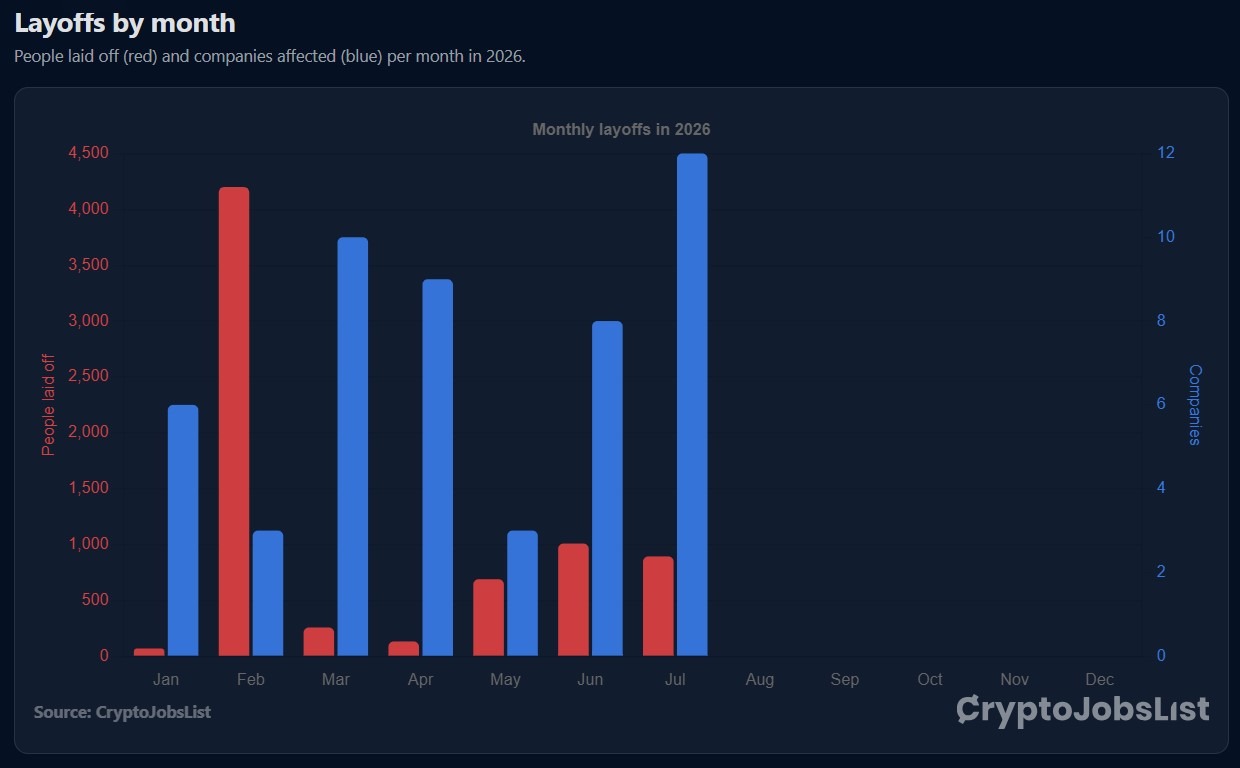
- CryptoJobsList data shows July restructuring activity across multiple firms, though the dataset includes crypto-adjacent tech and is skewed by some very large reductions.
Luno’s restructuring: fewer people, different priorities
Luno, founded in South Africa and owned by Digital Currency Group, serves about 16 million users across Africa and the Asia-Pacific region. While the exchange has historically been associated with retail trading, the firm has broadened its business into crypto infrastructure and institutional services—areas that can demand different operating capabilities than consumer exchange support.
Bloomberg reports that the latest job cuts are part of that operational pivot. Lanigan reportedly said the company invested in automation and broader changes to how work is performed, which altered staffing needs. The company will also trim costs while investing in compliance and core infrastructure, according to the same account.
For investors and market observers, the key point is that the cuts are not presented as a retreat from regulation-heavy infrastructure or core product development. Instead, Luno appears to be aiming for a more scalable operational model—one that can support institutional and business-to-business customers without matching headcount growth to revenue expectations.
Not Luno’s first workforce reduction
Luno’s reported 20% cut follows earlier staffing actions. In January 2023, the exchange cut 35% of its staff, affecting nearly 330 employees, as turbulence across the technology and crypto sectors weighed on its growth and revenue. That earlier round was covered by Cointelegraph, highlighting that Luno has already been navigating a challenging environment for crypto companies seeking consistent expansion.
Taken together, the two waves suggest Luno is actively recalibrating its cost structure rather than treating layoffs as a one-off response. This matters because repeated restructuring can change how quickly an exchange adapts to market shifts—particularly when compliance requirements and infrastructure demands continue to rise even when retail activity becomes more cyclical.
Crypto layoffs in July: a pattern of efficiency-driven cuts
Luno’s move aligns with broader industry downsizing and reorganization efforts. CryptoJobsList, a tracker of crypto and related job changes, recorded layoffs or restructurings at 12 crypto and crypto-adjacent companies during July. Disclosed figures in that period total 894 jobs affected.
The data is useful as a high-level indicator, but CryptoJobsList also notes that it includes financial-technology adjacent companies and that the figures can be skewed by large reductions. For example, Block’s 4,000-person reduction in February—also tracked in CryptoJobsList’s reporting—means some months can look unusually severe even when the rest of the sector is less affected. Earlier coverage from Cointelegraph has also described how AI, automation, and operational efficiency have become recurring explanations behind staff reductions across crypto.
Earlier in July, crypto wallet company Exodus announced plans to cut 25% of its staff while reorganizing around a full-stack card-issuance and stablecoin-payments platform. Exodus said the plan could generate between $10 million and $13 million in annual operating savings, according to Cointelegraph reporting.
Separately, blockchain infrastructure developer Gnosis reportedly took steps linked to its consumer-facing Gnosis App. On Tuesday, it invited companies to contact it for introductions to former employees affected by a recent restructuring. The company said on July 17 that it had reduced its workforce after reviewing the Gnosis App, as referenced by a report on the Gnosis forum.
Why this matters: the industry is shifting labor toward infrastructure
Luno’s layoffs are framed not just as belt-tightening, but as a response to changed operational requirements. In practice, that often means fewer roles tied to manual processes and more emphasis on areas like compliance and core infrastructure—especially where institutional clients and regulated financial partners are involved.
At the same time, the pattern visible across July reporting suggests companies across crypto are treating headcount as a variable they can re-engineer through automation, AI-enabled workflows, and redesigned products. The uncertain part for employees and the market is how these efficiency moves translate into sustainable growth: cost reductions can stabilize budgets, but they may also reflect caution about near-term demand.
Looking ahead, readers should watch whether Luno’s institutional and infrastructure focus delivers measurable traction in new partnerships and service expansion, and whether the broader wave of restructurings continues to concentrate around automation-led operating models rather than a broader collapse in activity.
Crypto exchange Luno is reportedly cutting about 20% of its global workforce as it restructures operations and shifts more resources toward institutional clients, financial infrastructure and business-to-business services.
According to a Bloomberg report on Tuesday, Luno CEO James Lanigan said the company had invested in automation and broader operational improvements that changed the resources needed to run the business. Luno will also trim costs in line with market conditions while investing in compliance, core infrastructure and retail products.
Luno has previously made larger workforce reductions. In January 2023, the exchange cut 35% of its staff, affecting nearly 330 employees, as turbulence across the technology and crypto sectors weighed on its growth and revenue.
Founded in South Africa and owned by Digital Currency Group, Luno serves about 16 million users across Africa and the Asia-Pacific region. The company has expanded beyond retail trading into infrastructure and institutional services, including providing crypto infrastructure for banks and fintech firms.
Luno’s rationale for the layoffs reflects a wider industry trend, with several crypto companies citing AI, automation and operational efficiency when cutting staff.
Related: BitGo cuts 15% of staff to sharpen focus on AI, stablecoins
Crypto layoffs spread across industry
Jobs tracker CryptoJobsList recorded layoffs or restructurings at 12 crypto and crypto-adjacent companies in July, with disclosed figures totaling 894 jobs affected. CryptoJobsList has tracked more than 7,254 disclosed job cuts across 47 companies in 2026, with market conditions cited most often as the reason.
The data serves as a broad industry indicator rather than a definitive crypto-only total, as it includes adjacent financial technology companies and is heavily skewed by Block’s 4,000-person reduction in February.
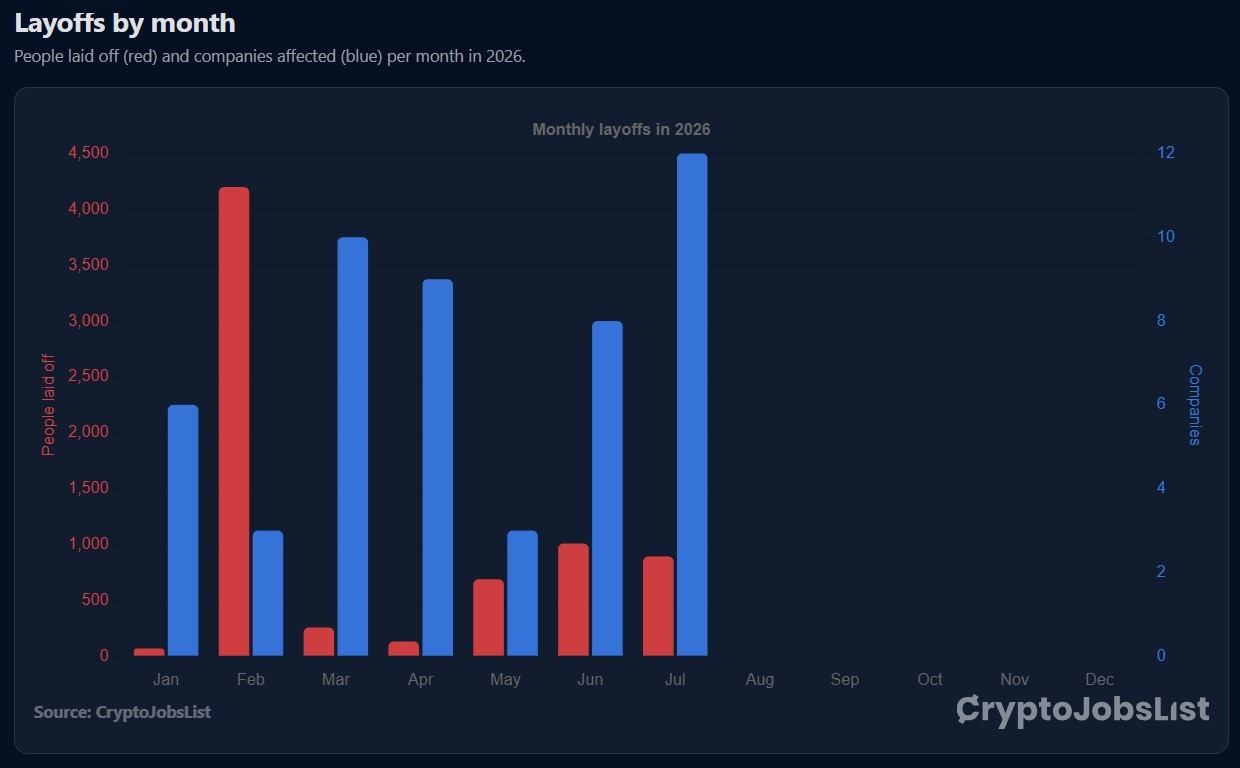
Layoffs by month. Source: CryptoJobsList
Earlier in July, crypto wallet company Exodus announced plans to cut 25% of its staff while reorganizing around a full-stack card-issuance and stablecoin-payments platform. Exodus said the move could produce between $10 million and $13 million in annual operating savings.
On Tuesday, blockchain infrastructure developer Gnosis invited companies hiring across engineering, product, design, marketing, developer relations and customer relations to contact it for introductions to former employees affected by a recent restructuring. The company said on July 17 that it had reduced its workforce following a review of its consumer-facing Gnosis App.
Magazine: Ethereum risks losing No. 2 spot as stablecoins gain ground

Bitcoin (BTC) could climb to between $380,000 and $450,000 from March 2028, according to crypto analyst Sykodelic, whose latest market outlook has sparked a heated debate on X over whether the current bear market is actually a mid-cycle correction.
The forecast stands out because it argues that BTC has not yet completed its broader bull cycle, even with many traders believing that the market topped in October 2025.
Analyst Says Bitcoin Is Still in the Middle of a Larger Cycle
In a July 29 newsletter preview shared on X, Sykodelic said the current bear market is a mid-cycle correction and not the end of the cycle, comparing it to stretches from 2011 to 2013 and 2019 to 2021. With that in mind, the analyst predicted the OG cryptocurrency will reach between $380,000 and $450,000 starting in March 2028.
His price target leans on two tools: the 200-week simple moving average multiplied by five and a quantile-95 statistical band already sitting near $330,000.
“Every cycle top has hit the 200w SMA x5. That already sits at $320,000,” he wrote. “As price moves higher that will go up.”
The market watcher pointed out that from BTC’s current price level to $380,000 is only a 5.5x move, way smaller than the asset’s 23x run from $3,000 to $69,000 in 2020, meaning such a jump isn’t just possible but quite probable.
At the time of writing, the asset was changing hands above $64,000 after recovering modestly over the past day. That recent weakness was linked to several factors, including investor caution ahead of the US Federal Reserve’s policy decision, weakness across broader financial markets, and continued outflows from spot Bitcoin exchange-traded funds.
Naysayers Dig In
That forecast drew immediate criticism. One of the doubters, X user Bitcoin Daily, who identified themselves as a data scientist, said they ran Sykodelic’s own 890-day spacing rule backward from the October 2025 high and landed in spring 2023, which, by his own framework, would make October 2025 the top, not the midpoint.
They also noted that Sykodelic’s chart had entirely skipped the 2015 to 2017 cycle. Furthermore, his two reference rallies measured different things, with June 2011 being a full cycle top followed by an 89% drop, while June 2019 was a bear market rally high that fell 55%.
Another thing Bitcoin Daily highlighted was that the last three cycle tops landed 525, 546, and 534 days after their halving. Meanwhile, March 2028 falls 38 days before next year’s halving, meaning Sykodelic’s $380,000 top would come in a period where such an event has never happened before.
“No Bitcoin top has ever arrived before a halving,” the data scientist stated.
Additionally, running the 890-day spacing from four other local highs since June 2024 produced targets spanning May 2027 to October 2028, a 17-month window that, according to Bitcoin Daily, shows Sykodelic’s March 2028 date was chosen and not calculated.
Sykodelic dismissed those objections, questioning the claim that spring 2023 could be considered a mid-cycle high only months after the November 2022 bear market low. He also said that he didn’t include the period between 2013 and 2019 since it never experienced a mid-cycle correction.
The post Bitcoin Could Hit $380K-$450K by March 2028, Says Analyst appeared first on CryptoPotato.
Pi Network (PI) saw a modest rise as the Pi Core Team began rolling out Protocol 26, the first of two remaining upgrades to its Mainnet.
Node operators have until August 11 to finish the update to maintain their connection to the Mainnet.
Pi Network Sets an August 11 Deadline for Node Operators
The Pi Core Team announced the rollout on Wednesday and directed operators to its node page for instructions.
“This migration is straightforward and should complete in under 5 minutes; in rare cases, restarts may take longer—please allow them to finish. Do not perform it to all of your nodes at the same time,” the instructions read.
Protocol 26 is the ninth protocol upgrade Pi has shipped over the past few months. Protocol 27 will close the current sequence.
The team stated that together, the two releases will bring the Mainnet up to date with the network’s latest protocol features and functionality.
Follow us on X to get the latest news as it happens
Upgrade News Lifts PI Price, but Rallies Keep Fading
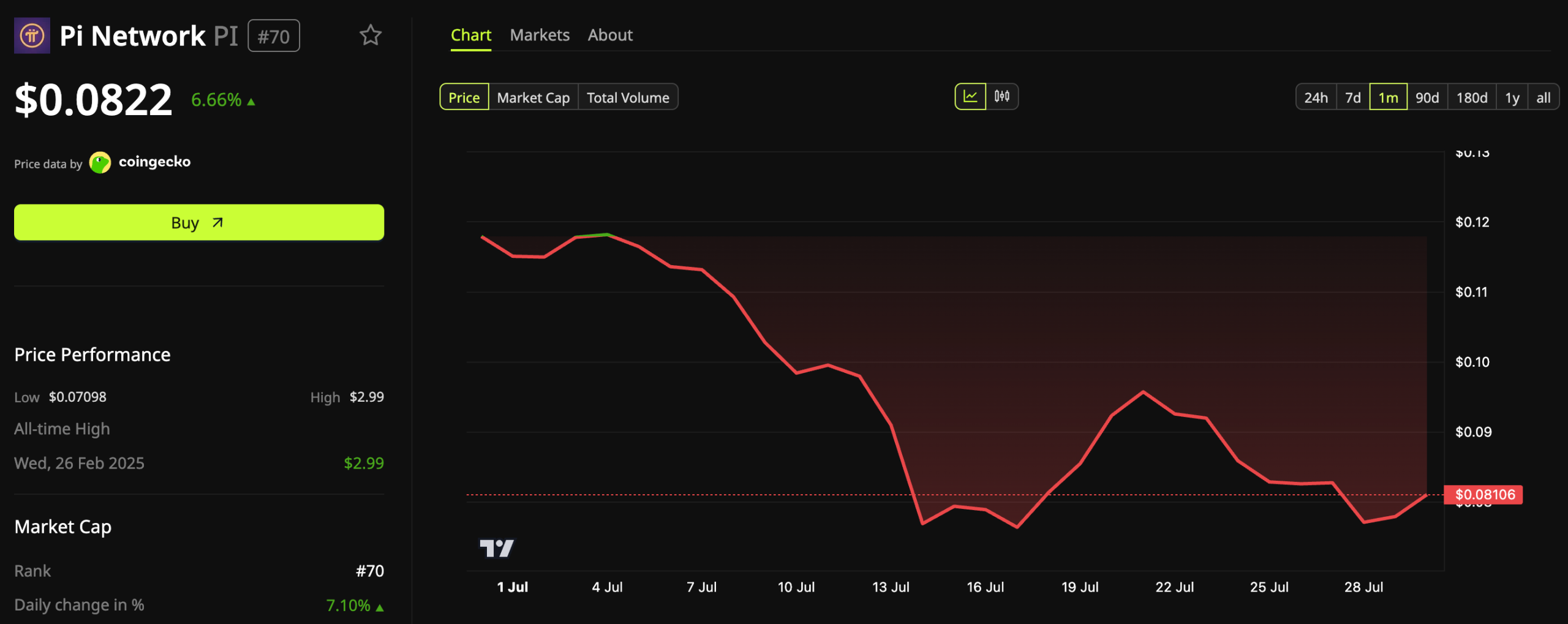
Meanwhile, PI price ticked higher on the upgrade development. The token was up 6.66% to $0.0822 over 24 hours, outpacing the broader crypto market’s 0.71% gain.

A similar reaction followed the network’s product work. PI gained more than 3.5% in mid-July when Pi redesigned its mining app menu and profile page.
The rebound remains narrow, however. PI trades down 11.7% over the past 7 days and 29% over the past 30 days.
Earlier upgrades produced the same pattern. Pi activated Protocol 25 on July 22, and PI briefly tagged $0.103 days earlier before losing the $0.10 level.
Supply explains part of that ceiling. PiScan data showed roughly 4.25 million PI unlocking each day, with about 1.71 billion scheduled to enter circulation over 12 months.
The August 11 cutoff hands traders another dated catalyst. Prior deadlines delivered short bounces rather than a durable trend, and the upcoming upgrades will test whether that changes.
Subscribe to our YouTube channel to watch leaders and journalists provide expert insights
The post Pi Network Begins Ninth Protocol Upgrade Ahead of Final Version 27 appeared first on BeInCrypto.
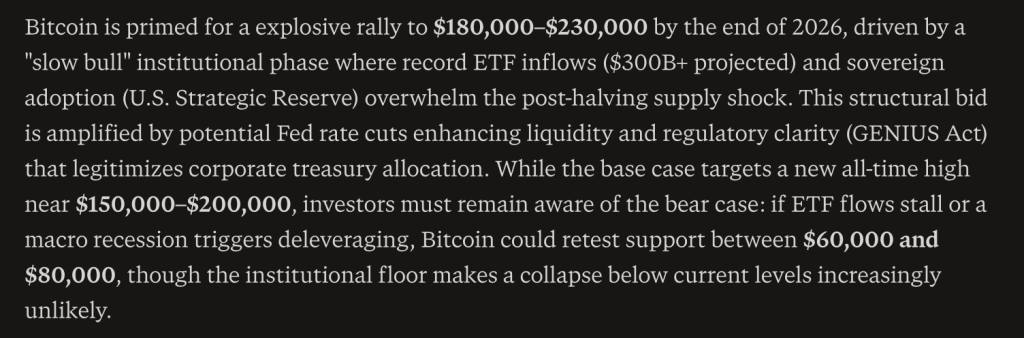
Perplexity AI predicts an explosive rally for Bitcoin, and this Bitcoin price prediction does not hold back on the number. The call is $180,000 to $230,000 by the end of 2026, a target built on what the model calls a slow bull institutional phase rather than a sharp speculative spike.
Record ETF inflows are projected to top $300 billion, layered against sovereign adoption through a US Strategic Reserve. That combination is framed as overwhelming the post-halving supply shock entirely, meaning demand simply outpaces the reduced flow of new coins hitting the market.
Potential Fed rate cuts add a second structural bid on top of that. Enhanced liquidity tends to push capital toward risk assets, and Bitcoin has historically been a major beneficiary of exactly that kind of environment.
Regulatory clarity through the GENIUS Act rounds out the case. Perplexity frames this as the piece that legitimizes corporate treasury allocation, effectively giving more companies permission to hold Bitcoin on their balance sheets the way a handful of early movers already have.
Even the base case here is aggressive. A new all time high near $150,000 to $200,000 is treated as the expected outcome rather than the stretch scenario.
The bear case is not dismissed though. If ETF flows stall or a macro recession triggers deleveraging, Perplexity sees Bitcoin retesting support between $60,000 and $80,000.
The model still frames a collapse below current levels as increasingly unlikely, arguing the institutional floor beneath this market has genuinely strengthened compared to prior cycles.

Bitcoin Price Prediction: BTC Has Spent Six Months Retracing The Same 20,000 Dollar Range
Price closed at $63,835, up 0.22%, in a session ranging between $62,684 and $64,035. That modest green day sits inside a chart that has been repeating itself since spring.
Zoom out and the shape is unmistakable. Bitcoin topped near $128,000 in October 2025, then broke down hard through January, gapping from above $96,000 to under $72,000 in a matter of weeks.
Since that crash, price built a rounded recovery through spring that peaked near $82,000 in May, then rolled over into a sharp flush back to $60,000 in June. The climb since that June low has been steady, and it has now pushed BTC price back to almost exactly where the May rally first started.
Support sits at $60,000, the level defended through June. Below that, $52,000 marks the last major shelf from earlier in the cycle.
Resistance stacks at $66,000, then $70,000, then the heavier May ceiling near $82,000 that has already rejected one full rally attempt this year. Momentum here is mildly positive but not extended, consistent with a market grinding sideways rather than breaking out in either direction.
For Perplexity’s base case to gain real traction, Bitcoin needs to clear $82,000, a level this exact chart has already failed at once this year. Until that happens, this remains the same range it has been trading since May, just retraced from a different direction.
Don’t Miss Out on Our $1,000 USDT Airdrop on ByBit
Here is What Perplexity AI Predicts About LiquidChain
The rotation has already happened. Most people will realize it too late.
Large caps are boxed in. Bitcoin, Ethereum, and XRP keep testing the same ceilings with nothing giving way. Every macro catalyst has a new date. Every institutional wave arrives next quarter. Waiting on someone else’s timeline is not a trade.
A capital that has navigated enough cycles moves before the destination has a name.
Small market cap infrastructure plays on different physics entirely. A modest rotation that vanishes as noise at Bitcoin’s scale can reprice an undiscovered project by multiples. The returns live in the gap between what something is genuinely worth and what the market has assigned it. That gap closes permanently the moment discovery happens.
Multi-chain fragmentation bleeds DeFi every single day. Bitcoin, Ethereum, and Solana run as completely isolated systems. Every user crossing those boundaries pays in fees, slippage, and failed transactions. Every single time.
Perplexity AI predicts LiquidChain fixes that will entirely fix it. All 3 networks inside one execution layer. One deployment. Zero cross-chain tax anywhere.
The presale is at $0.01454 with just over $900,000 raised. The market has not found this yet. That is exactly the point.
Execution is unproven. Adoption is unknown. LiquidChain is an entry point that disappears the moment the market looks up.
The post Perplexity AI Just Dropped a Bitcoin Predicts That Has Traders Worried appeared first on Cryptonews.

The dominant Ripple bull case, that processing SWIFT-scale payment flows alone could justify a $100 token price, is mathematically flawed, according to crypto analyst xrpl_Adam. Because XRP settles transactions within seconds, the same tokens can be reused repeatedly throughout the day, limiting the amount of capital that needs to remain in circulation. Under that model, payment volume by itself does not create the scarcity needed to support extreme valuations.
$1,000 ripple:native is a $100 trillion asset. Is there a thesis to this or just influencer garbage? — xrpl_Adam (@xrpl_adam) July 28, 2026
Payment volume doesn't get you there. A coin that settles in seconds gets reused all day
Only one thing in finance makes institutions hold an asset they can't spend. 
In a July 29 thread on X, xrpl_Adam argued that “volume doesn’t set the price. Idle inventory does.” He compared XRP to gold, whose value comes largely from long-term holdings, collateral, and reserve status rather than transaction throughput. The argument is that XRP would need to become an asset institutions hold as collateral instead of simply using it for settlement if it were ever to reach triple-digit prices.
XRP has a maximum supply of 100 billion tokens, with roughly 59 to 60 billion currently in circulation, while the remainder is largely held in escrow under Ripple’s release schedule. At a $100 price, XRP’s fully diluted valuation would approach $10 trillion, while a $1,000 price would imply around $100 trillion. Those figures far exceed what a payment utility alone could reasonably support, making institutional reserve demand the central requirement behind the thesis.
Discover: The Best Crypto to Diversify Your Portfolio
Ripple Is Building Infrastructure, but the Missing Piece Remains
The idea has attracted attention because Ripple is expanding its institutional infrastructure. The company completed its $1.25 billion acquisition of Hidden Road, giving it control of a global prime brokerage business that provides clearing, financing, and collateral services to institutional clients. Prime brokers play a key role in determining which assets qualify as eligible collateral across financial markets.
Ripple has also strengthened Hidden Road’s institutional profile. KBRA assigned Hidden Road investment-grade credit ratings in 2026, improving its standing with counterparties that require rated institutions. However, neither Hidden Road nor Ripple has publicly listed XRP as eligible collateral under any published margin or collateral framework. Brad Garlinghouse has discussed that possibility as a long-term objective rather than an existing feature.

XRP is currently trading around $1.06, so replace this with your API data. Likewise, remove the references to $1.09, 2% daily gains, 5% weekly losses, and the claim that XRP remains 70% below its all-time high of $3.65 unless your live pricing supports them. The all-time high should also be verified before publication.
Trade XRP on Bybit and Get a Chance to Win Our $1,000 USDT Airdrop
Collateral, Not Payment Volume, Is the Key Question
Institutional interest in XRP continues to expand through products such as spot ETFs, although ETF ownership and collateral lockups are fundamentally different. ETF investors can buy and sell shares freely, whereas collateral pledged against institutional positions remains encumbered until those positions are closed. That distinction is central to xrpl_Adam’s argument that idle inventory, rather than payment activity, would be the real driver behind a sustained supply shock.

The broader trend toward tokenized collateral is also gaining momentum as traditional finance adopts more on-chain infrastructure. That could eventually strengthen the case for XRP, but no major institution has formally recognized the token as eligible collateral. Until that changes, payment volume alone is unlikely to justify a $100 XRP valuation, making collateral adoption the milestone investors should watch most closely.
Discover: The Best Token Presales
The post XRP at $100 Requires Collateral Lock-Up, Not Payment Flow, Analyst Shows appeared first on Cryptonews.


Robinhood Markets reported record second-quarter revenue on July 29, as growth in event contracts, options and equities offset another decline in cryptocurrency trading.
Summary
- Robinhood’s Q2 revenue rose 32% to a record $1.31 billion, while net income climbed 48%.
- Event contract revenue reached $156 million, rising more than 10x and overtaking cryptocurrency transaction revenue.
- Crypto revenue fell 38% to $100 million despite $40 billion in reported quarterly trading volume.
According to its Q2 earnings release, total net revenue rose 32% year over year to $1.31 billion for the quarter ended June 30.
Net income increased 48% to $573 million, while diluted earnings per share reached $0.62. However, Robinhood said net income included $129 million of gains mainly tied to the deconsolidation of Robinhood Ventures Fund I. Those gains added $0.14 to diluted EPS.
The wider revenue mix also expanded. Net interest revenue rose 9% to $389 million, while other revenue increased 54% to $143 million. Robinhood attributed the latter increase mainly to Trump Account service revenue and higher Gold subscription revenue.
Event contracts became Robinhood’s fastest-growing revenue line
Transaction-based revenue increased 44% to $776 million. Event contract revenue reached $156 million, more than 10 times the year-earlier level, while event contracts traded rose above 13.6 billion. Options revenue climbed 29% to $342 million, and equities revenue rose 95% to $129 million.
Robinhood Chief Financial Officer Shiv Verma said “the business is firing on all cylinders,” a management assessment rather than a reported metric. The company also said Rothera, its CFTC-licensed exchange and clearinghouse joint venture with Susquehanna, had processed more than 3.5 billion contracts since launching in June. Robinhood has explored adding more prediction-market suppliers as competition grows.
Cryptocurrency transaction revenue dropped 38% to $100 million. Robinhood reported $40 billion in crypto notional volume, including $18 billion on its main app and $22 billion through Bitstamp. App-based crypto volume fell 35% from a year earlier, showing that the acquired exchange supplied more than half of the quarter’s reported crypto activity.
Even so, Robinhood continued building its digital-asset business. The company launched Robinhood Chain’s public mainnet, introduced Stock Tokens for eligible users in more than 120 countries and debuted Robinhood Earn, its first decentralized lending product inside the app. In related coverage, crypto.news explained how Robinhood Chain uses an Ethereum layer-2 network for tokenized assets and decentralized finance.
Robinhood also completed its WonderFi acquisition during the quarter, marking its formal entry into Canada. As crypto.news reported, the deal added regulated platforms including Bitbuy and Coinsquare. International funded customers surpassed one million, although Robinhood did not separate WonderFi’s quarterly revenue contribution. The company said it “plans to launch crypto offerings in the UK,” but provided no launch date.
Deposits and customer assets reached new records
Net deposits reached $21.7 billion, equal to a 28% annualized growth rate relative to first-quarter platform assets. Total platform assets increased 32% to $369 billion, while funded customers rose 7% to 28.4 million. Investment accounts increased 9% to 29.9 million.
Robinhood Gold subscribers grew 39% to 4.8 million, and average revenue per user increased 24% to $187. The company also repurchased $414 million of Class A shares during the quarter at an average price of about $94.
Costs rose alongside the expansion. Operating expenses increased 33% to $734 million because of marketing, growth spending, restructuring charges and costs linked to Rothera and other new businesses. Adjusted EBITDA, a non-GAAP measure, increased 35% to $741 million.
HOOD shares slipped as investors weighed the revenue mix
Robinhood shares closed Wednesday at $89.84, down about 3.4% before the earnings release. Reuters reported that the stock fell another 0.8% in extended trading, even after adjusted earnings exceeded analysts’ average estimate.
Investors will now watch whether event-contract activity remains durable and whether crypto trading recovers. Robinhood lowered its 2026 adjusted operating expense and share-based compensation outlook to between $2.675 billion and $2.775 billion, from a previous range of $2.7 billion to $2.825 billion. However, that forecast excludes some credit-loss, acquisition, restructuring and regulatory costs.
Regulation remains a central risk for the company’s fastest-growing product. Robinhood warned that enforcement actions or changes in federal and state law could prevent it from offering some event contracts. Meanwhile, its UK crypto launch and future Singapore brokerage services remain forward-looking plans without confirmed start dates.
Crypto World
Crypto News, July 29: Morgan Stanley Launches Ethereum and Solana ETPs, Paul Atkins Pushes Clarity Act, Bitcoin Price Bounces

The crypto market rarely stays still for long. This Wednesday, the Clarity Act, Morgan Stanley, Bitcoin, and Ethereum price are driving the conversation as investors prepare for the Federal Reserve’s policy decision. Like an ecosystem sensing a change in season, traders are watching carefully before making their next move.
Recent volatility has done little to quiet institutional interest. While short-term sentiment remains cautious, large financial firms continue expanding their presence in digital assets. That contrast is becoming one of crypto’s defining themes this year.
Meanwhile, regulators are working to reshape the landscape from another direction. Clearer rules and broader institutional access may not remove volatility, but they could change how capital flows through the market over time.
Discover: The Best Crypto to Diversify Your Portfolio
Morgan Stanley Expands Access as Bitcoin and Ethereum Price Stabilize
Here we see another step in crypto’s gradual evolution. Morgan Stanley has launched Ethereum and Solana exchange-traded products, giving investors broader exposure through familiar investment vehicles. The move signals growing confidence that digital assets are becoming a lasting part of traditional finance rather than a temporary experiment.
The firm’s Ethereum Trust and Solana Trust debuted with competitive fees and staking features from launch. Investors receive most staking rewards, while validator services are handled by Figment. Instead of simply tracking the assets, the products offer an additional source of returns without requiring investors to manage staking themselves.
The launch builds on Morgan Stanley earlier Bitcoin investment product, which already attracted substantial assets. At the same time, European banks continue expanding blockchain infrastructure for tokenized settlements. Together, these developments show established financial institutions steadily adapting to blockchain technology rather than resisting it.
Despite Tuesday’s market weakness, the Bitcoin price has recovered after briefly slipping below recent support. Ethereum price has also regained stability following the broader selloff. The recovery remains measured, reflecting cautious positioning ahead of the Federal Reserve rather than renewed market optimism.
Trade Bitcoin and Ethereum on Bybit and Get a Chance to Win Our $1,000 USDT Airdrop
Clarity Act Gains Support as ETH Chart Reflects Institutional Confidence
Attention is also turning toward Washington. SEC Chair Paul Atkins has renewed his support for the Clarity Act, arguing that durable legislation offers greater certainty than temporary regulatory guidance. His comments reinforce the growing belief that long-term investment depends on clearer rules.
The Clarity Act aims to define responsibilities between the SEC and CFTC, reducing years of uncertainty for crypto businesses. Congress faces a limited legislative window before the August recess. Even so, Atkins has pledged technical assistance to help move the proposal forward.
The growing involvement of Morgan Stanley highlights why regulatory clarity matters. As more established firms enter the market, consistent oversight becomes increasingly important for both institutions and investors. The Clarity Act could provide that foundation if lawmakers reach an agreement.
For now, Bitcoin price remains steady while Ethereum price trades within a relatively stable range after recent volatility. Investors continue monitoring key support and resistance levels, but the Federal Reserve’s decision will likely determine near-term direction across digital assets.
A less hawkish outcome could strengthen Bitcoin price and encourage renewed demand for risk assets. Likewise, Ethereum price may benefit as institutional products attract additional interest. Markets often reward patience during periods of uncertainty, and this week appears no different.
The next chapter will depend on both policy and participation. Morgan Stanley continues expanding institutional access, while the Clarity Act promises a clearer regulatory framework. Whether those developments immediately lift the market remains uncertain, but together they reflect an industry steadily maturing rather than standing still.
Discover: The Best Token Presales
The post Crypto News, July 29: Morgan Stanley Launches Ethereum and Solana ETPs, Paul Atkins Pushes Clarity Act, Bitcoin Price Bounces appeared first on Cryptonews.


The agreement covers tokenized securities, blockchain-based market infrastructure and the potential use of USDT as a settlement layer.
Crypto World
China threatens retaliation against U.S. humanoid robot ban, says it ‘severely damages’ relations

A humanoid robot from Robostore joins CNBC’s Power Lunch on Dec. 30, 2025.
CNBC
BEIJING — The U.S. Federal Communications Commission has repeatedly ignored Beijing’s restrained stance on product bans, China’s commerce ministry said Thursday, threatening retaliation.
The FCC on Tuesday said due to cybersecurity concerns, it added foreign-made advanced robotic devices, including humanoids, to a list restricting imports to the U.S. The statement did not specify a country, and said retailers could still import models the FCC has previously approved.
As the FCC keeps escalating restrictions on Chinese goods, it “severely damages China-U.S. economic and trade stability,” China’s commerce ministry said in an online statement Thursday. That’s according to a CNBC translation of Mandarin.
The ministry urged the U.S. to withdraw the decision, and threatened countermeasures if it failed to do so.
“This is bad news for Chinese humanoid producers planning their IPOs in the coming months,” said Marc Einstein, a research director at Counterpoint Research. “The two major cards China can play are to further restrict rare earth sales to American companies and further restricting Chinese market access for American companies like Tesla and NVIDIA.”
The commerce ministry’s statement comes as U.S. President Donald Trump is scheduled to host Chinese President Xi Jinping in September. Tensions over the tech race have meanwhile intensified, with U.S. Treasury Secretary Scott Bessent saying the U.S. could sanction China over AI model “theft.”
Trump on Thursday indicated in public comments that the U.S. might take a more cautious stance on AI controls in order to maintain American tech leadership over China.
Chinese companies Agibot, Unitree and UBTech accounted for the top-three humanoid companies by installation market share last year, according to Counterpoint. Tesla’s Optimus ranked fifth.
Hong Kong-listed UBTech shares briefly fell more than 6% in Thursday morning trading. Unitree and Agibot have filed to go public.
Robostore, a distributor of Chinese humanoid robots in North America, has been preparing by expanding its U.S.-based capabilities, CEO Teddy Haggerty said in a statement to CNBC. He did not elaborate on details.
—CNBC’s Matthew Tan contributed to this report.

10 Most Perfect Sci-Fi Shows of the Last 10 Years

David Miliband said no when asked to be Education Secretary… and Lucy Powell’s angry at Deputy PM snub
Earnings call transcript: Redington Q1 2027 profit jumps as stock rises 10%


-

 Fashion5 days ago
Weekend Open Thread: Brooks Brothers
-
 Sports3 days ago
Commonwealth Games boxing: Jadumani Singh seals dominant 5-0 win over Pakistan’s Sumama Rehman to enter quarter-finals | Commonwealth Games News
-

 Tech3 days ago
Intel is reversing course and bringing hyper-threading back to its server chips
-

 Business9 hours ago
Why Trees Belong on the Risk Register
-

 Politics3 days ago
Luke Littler dismantles Gerwyn Price to retain title in Blackpool
-

 Crypto World4 days ago
Ripple bought a bank in pieces. The $4 billion audit
-
 Entertainment6 days ago
A New Post-Apocalyptic Gundam Anime Series Blasts Into SDCC
-

 News Videos3 days ago
BITCOIN JUST ENTERED THIS CRITICAL ZONE…
-

 Politics2 days ago
The Part of the Electric Transition Nobody Wants to Discuss
-

 Fashion6 days ago
16 Dresses for the High Summer Event
-

 Sports6 days ago
2026 3M Open leaderboard: Scottie Scheffler finds putter in Round 1, sits three back
-

 News Videos6 days ago
The Peugeot Family: How 200 Years of an “Old Money” Dynasty Died in A Boardroom
-

 Business24 hours ago
Major shareholder moves on Canyon
-

 Crypto World4 days ago
XRP Ledger adds $2.6B as RWA inflows rank second
-

 Politics4 days ago
Spain sweeps the board at 2026 World Cup with individual awards
-

 Crypto World7 days ago
Uniswap (UNI) pushes deeper into tokenized RWAs with permissioned trading pools
-
 Entertainment1 day ago
‘Stargate’ Creator’s New Sci-Fi Series Returns for Season 3 Tomorrow
-
Crypto World7 days ago
SEC Agrees to Overhaul Recordkeeping After Settling Coinbase Lawsuit Over Gensler’s Lost Texts
-

 Tech5 days ago
Anthropic launches Claude Opus 5, a cheaper AI model for coding, agents and enterprise workflows
-

 Entertainment4 days ago
Sara Gilson Killed By Husband After Viral “Pedophile” TikTok Video
You must be logged in to post a comment Login