
Crypto World
Capital City Bank Group (CCBG) Stock: Q1 2026 Profit Jumps 15% on Deposit Strength and Cost Controls


Key Highlights
- Q1 2026 earnings per share climb to $0.92, reflecting strong sequential momentum
- Deposit base expands while operational costs decrease across the organization
- Net income reaches $15.8 million despite modest contraction in loan portfolio
- Asset quality metrics remain solid with controlled charge-off levels
- Return on equity improves to 11.30% as efficiency measures take hold
Capital City Bank Group (CCBG) delivered impressive first-quarter 2026 results characterized by strengthening deposits and enhanced cost discipline. Trading at $47.18, the stock advanced 0.74% following an initial surge before settling into a consolidation pattern. The financial institution demonstrated resilience through profitability growth even as loan volumes experienced downward pressure and interest rate dynamics shifted.
Capital City Bank Group, Inc., CCBG
Profitability Metrics Advance Through Operational Excellence
The banking institution posted net income of $15.8 million during the opening quarter of 2026, marking sequential improvement. Earnings per diluted share achieved $0.92, representing an advance from the previous quarter’s $0.80. Year-over-year comparisons showed a modest decrease from $0.99 in the corresponding 2025 period.
Profitability ratios demonstrated meaningful enhancement as return on assets climbed to 1.45% while return on equity reached 11.30%. These improvements stemmed from rigorous operational discipline and expense management initiatives implemented throughout the organization. Net interest income on a tax-equivalent basis registered $42.9 million, experiencing a slight reduction from the preceding quarter attributable to calendar day differences.
The net interest margin compressed modestly to 4.24%, influenced by declining overnight interest rates and reduced lending volumes. Nevertheless, enhanced yields from the securities portfolio provided partial compensation for margin pressure. As a result, the institution preserved strong earnings quality amid evolving interest rate environments.
Asset and Liability Mix Shows Strategic Repositioning
Customer deposits demonstrated robust expansion throughout the reporting period, underscoring continued franchise strength. Average deposit balances grew by $43.5 million, while period-end deposits surged by $89.3 million. The increase primarily originated from public sector relationships and core retail deposit channels.
Loan portfolios experienced contraction as average balances decreased by $29.8 million and period-end totals fell by $27.7 million. The reduction spanned residential mortgages, commercial real estate holdings, and consumer lending categories. Home equity products exhibited moderate expansion, providing partial counterbalance to broader portfolio declines.
Earning assets advanced modestly to $4.09 billion, supported by increased investment securities positions. Management deployed surplus liquidity into securities while preserving robust funding flexibility. Furthermore, liquidity resources remained substantial with more than $1.6 billion in accessible funding capacity.
Asset Quality Stability Accompanies Expense Discipline
Credit quality indicators remained steady as net charge-offs registered 10 basis points of average loan balances. The allowance for credit losses relative to total loans improved incrementally to 1.23%, demonstrating prudent reserve positioning. Nonperforming assets elevated to $13.0 million, primarily reflecting increased nonaccrual loan classifications.
Credit loss provisions decreased to $0.7 million compared with $2.0 million in the prior quarter. This reduction mirrored stable portfolio characteristics and minimal deterioration across risk categories. Classified loan exposures remained well-managed despite normal quarterly variations.
Noninterest expenses declined by $1.5 million, benefiting from reduced compensation expenses related to lower incentive compensation accruals. Conversely, noninterest income experienced slight weakness stemming from softer wealth management revenues and deposit service charges. Nevertheless, rigorous expense control supported profit expansion and strengthened balance sheet fundamentals.




Bitcoin traded at $75,733 on Tuesday morning, up 1.5% over 24 hours, as Iran signaled it will send a team to Pakistan talks and Brent crude slipped ahead of the Wednesday ceasefire deadline.

Coinbase-backed x402 has unveiled Agentic.market, a dedicated marketplace aimed at increasing the usefulness of AI agents by aggregating thousands of apps and services that agents can access without any API keys. The rollout positions the platform as a central hub for agents to discover, evaluate, and deploy capabilities across a standardized payments layer.
Coinbase product lead Nick Prince described Agentic.market in a video posted on X as a storefront for discovering, comparing, and using x402 services. The marketplace is designed to give both humans and their AI agents access to a wide range of tools—from data feeds to consumer apps—without the friction of managing API credentials.
A storefront for discovering, comparing, and using x402 services. Thousands of services. Zero API keys. Powered by x402.
Prince added that the market offers a web interface for humans to browse and assess services, alongside a programming layer that lets AI agents autonomously search, filter, and integrate new capabilities at runtime without human intervention. Each AI agent is equipped with “skills”—the code that defines how to use a service—and a wallet that enables it to buy and sell services within the marketplace.
The launch comes as the x402 protocol, introduced by Coinbase in May 2025, enables AI agents to conduct internet payments using stablecoins and has begun to gain broad industry support. The broader ecosystem envisions a growing flow of autonomous commerce as more companies recognize the potential for AI-powered agents to operate across digital services and platforms.
Key takeaways
- Agentic.market consolidates thousands of x402-enabled services into a single storefront, removing API-key frictions for AI agents and human users.
- The marketplace features a dual interface: a consumer-friendly web frontend and a programming layer that empowers agents to autonomously extend their capabilities at runtime.
- Backing and governance for the x402 framework have grown beyond Coinbase, with major tech and financial players signaling support and participation.
- x402’s core proposition—AI agents transacting with stablecoins—aims to accelerate the shift toward an “agent economy” where autonomous services perform on-chain payments at scale.
- Industry attention is rising as hundreds of thousands of AI agents reportedly transact in hundreds of millions of dollars in volume, signaling real-world usage beyond experimental deployments.
Backing, governance, and the broader ecosystem
The x402 initiative has drawn notable interest from major technology and payments players. In a broader push to formalize an AI-agent payments fabric, Google, Microsoft, and Amazon Web Services backed the creation of the x402 Foundation to govern the protocol. Alongside this governance push, a broad coalition of firms signaled initial intent and support, including American Express, Mastercard, Visa, Cloudflare, Shopify, Stripe, Circle, Base, Polygon Labs, the Solana Foundation, Thirdweb, and KakaoPay. The combined support underscores a growing belief within the industry that AI-driven commerce will rely on interoperable, on-chain payments and standardized agent capabilities.
Coinbase CEO Brian Armstrong has framed the development as an inflection point for online transactions, noting that “there will be more AI agents transacting online than humans very soon.” The sentiment echoes earlier comments from Circle CEO Jeremy Allaire about billions of AI agents potentially transacting on blockchains within a few years.
The market’s governance and ecosystem-building efforts were highlighted in coverage of big-tech backing for the x402 protocol. Prior reporting noted that major firms were aligning around the idea of standardized, agent-enabled payments and a framework to manage governance and interoperability across services.
Why the Agentic market matters for builders and users
Agentic.market could materially lower the cost of integrating AI agents with external services. By providing a centralized catalog and a runtime-capable programming layer, developers can more readily enable agents to perform tasks that require real-time data, booking, or account actions without developers building bespoke connectors for each service. For investors, the marketplace also represents a signal that the agent economy is moving from concept to execution, with concrete storefronts and programmable workflows delivering measurable transaction volume.
For users and enterprises, the marketplace promises increased transparency and comparability: agents can be evaluated against a catalog of services, with standardized interfaces and a shared payments layer. This could accelerate adoption by reducing technical debt and giving buyers and sellers clearer paths to interoperability and monetization.
That said, the shift toward autonomous, on-chain payment flows will invite scrutiny over security, governance, and the reliability of agents operating without a human in the loop. The coming months will reveal how the ecosystem manages trust, fraud prevention, and service quality across thousands of partners in a single platform.
What to watch next
Key questions for the coming period include how rapidly enterprises formalize usage of x402-enabled services, whether Agentic.market expands its catalog to include more partners such as data providers or e-commerce tools, and how regulators respond to broader autonomous-payment activity on-chain. The size and pace of actual transaction volume via AI agents will be a telling gauge of the market’s momentum beyond pilot deployments.
As developers and investors assess the trajectory, the continued alignment between large tech platforms, payment rails, and AI-service providers will be crucial to turning the agent-economy thesis into sustained, scalable adoption.
Watch for further updates on how the Agentic.market catalog evolves, how AI agents demonstrate governance-compatible behavior at scale, and which new services become first-class citizens in the x402 ecosystem.


OpenGradient’s AI‑focused OPG token will launch via an exclusive Binance Wallet and PancakeSwap TGE on April 21, with access gated by Binance Alpha points.
Summary
- Binance Wallet and PancakeSwap will co‑host an exclusive Token Generation Event for OpenGradient (OPG) on April 21, 2026, from 9:00–11:00 UTC.
- Eligible users must spend Binance Alpha points to subscribe, with OPG trading scheduled to open at 11:00 UTC on the same day.
- OpenGradient, a “verifiable AI” computation layer, has raised $9.5 million and set a 1 billion OPG token supply, with 4% allocated to an airdrop and 6% to liquidity and launch.
Binance Wallet will jointly launch the exclusive Token Generation Event for OpenGradient with PancakeSwap on April 21, 2026, positioning the AI‑focused blockchain project as the next test case for Binance’s Alpha points launch model. In an announcement on Binance Square, the team said the event, billed as the “46th exclusive TGE,” will run from 9:00 to 11:00 UTC, with token claims and trading set to open at 11:00 UTC.
According to Binance Wallet, “eligible participants are required to use Binance Alpha points to join,” making OPG’s launch effectively a loyalty‑driven sale rather than a traditional public ICO. OpenGradient has already deployed its OPG token contract on BNB Smart Chain, with one Binance post noting that “99% [of the supply is] listed on Binance Alpha” ahead of the April 21 issuance.
OpenGradient describes itself as a decentralized “computational layer for verifiable AI,” built as a dedicated co‑processor network that provides model inference via GPU and trusted execution environment (TEE) nodes for applications, blockchains and agents. The project says each inference is accompanied by “cryptographic verification proofs for each inference,” allowing external parties to independently verify models, inputs and outputs in a bid to solve the black‑box problem in AI.
In a recent funding announcement, OpenGradient disclosed that it has raised a total of $9.5 million from investors including a16z crypto, Coinbase Ventures, SV Angel and Foresight Ventures. A separate tokenomics post on Binance Square states that OPG will have a fixed supply of 1 billion tokens, distributed across ecosystem (40%), foundation (15%), core contributors (15%), investors and advisers (10%), staking rewards (10%), liquidity and token launch (6%) and airdrop (4%).
The team says 10% of the ecosystem allocation will unlock at TGE, with the remaining 30% linearly released over 60 months, while foundation tokens see 33.33% unlocked at TGE and the rest vesting over 48 months. Core contributors and investor tranches carry a 12‑month cliff followed by 36 months of linear unlocking, and both the 6% liquidity/token‑launch slice and 4% airdrop are “fully unlocked at TGE.”
OpenGradient has also opened an OPG airdrop registration portal that remains live until April 20, with claims beginning on April 21 alongside the Binance Wallet and PancakeSwap event. In a Binance Square post, the team said its network “currently serves over 2 million users, processing over 2 million verifiable inferences and generating more than 500,000 proofs,” framing the TGE as a way to decentralize ownership around an already active AI infrastructure layer.
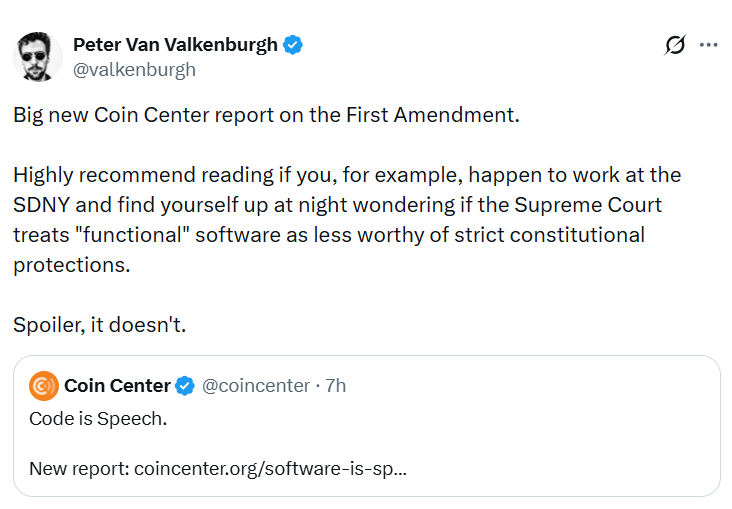
Crypto lobby Coin Center has expanded on its argument that software code is free speech and should be protected under the First Amendment of the US Constitution, amid continued uncertainty over whether crypto developers could be liable for how their inventions are used.
In a report published Monday, Coin Center Executive Director Peter Van Valkenburgh and Director of Research Lizandro Pieper said writing and publishing crypto software code is the same as writing a book or publishing a recipe.
The pair argued that the First Amendment, which protects individuals’ freedom of speech and expression, offers strict constitutional protection for developers who only publish and maintain software.
“They are speakers and inventors, not agents, custodians, or fiduciaries. Extending pre-registration or licensing requirements to this speech activity drops the historical logic of financial oversight and imposes a classic prior restraint on activities that are primarily speech and expression—which is almost always unconstitutional,” they added.

Crypto software developers have been seeking legal protections to shield themselves from criminal liability over the software they create. Last year saw several high-profile convictions of crypto developers based on how their software was used, including the trial of Tornado Cash developer Roman Storm.
Regulation applies when devs interact directly with users
Van Valkenburgh and Pieper said the paper is aimed at providing a framework for courts and regulators to distinguish between protected software publication and a developer’s professional conduct.
They argued that a developer crosses into regulatable conduct when controlling user assets, executing transactions for users or making decisions on users’ behalf.
“Lower court confusion over the distinction between conduct and speech naturally found in software publishing has fueled the development of what might be called a functional code theory of diminished First Amendment protection,” they said.

“Some courts have suggested that because software can be executed to produce real-world effects, it resembles conduct rather than speech,” they added.
“We argue that such activities are pure speech and that the Supreme Court’s existing jurisprudence insists on this interpretation even if some lower courts have gone astray.”
They cited the 1985 case of Lowe v. SEC, in which the Supreme Court found that a publisher that does not hold assets on behalf of a client or take action on the client’s behalf is protected by free speech and does not count as practicing a regulated profession.
Crypto developers can’t be used as scapegoats
In some cases, crypto software has eliminated certain traditional middlemen, with self-custody and peer-to-peer transactions removing the need for a central authority to send funds or hold them.
Traditionally, financial institutions acting on a user’s behalf as intermediaries are regulated by governments and required to hold licenses.
Related: Coin Center urges Senate not to axe crypto developer protection bill
Van Valkenburgh and Pieper said that while it is challenging to build regulatory frameworks around new technology, declaring software developers to be middlemen for “administrative convenience” is not the answer either.
“Crypto software does not necessitate the invention of new legal doctrines or novel carveouts. It requires the faithful application of settled First Amendment principles to a new technological context,” they added.
“In the age of computers, where software is the primary means for expressing ideas and organizing economic life, those principles matter more, not less. Writing and publishing code is speech. And in a free society, speech cannot be licensed into silence.”
Storm was convicted last year on charges of conspiracy to operate an unlicensed money-transmitting business, but his lawyers have been working on a motion to dismiss using the Supreme Court case, Cox Communications Inc. v. Sony Music Entertainment, to argue he had no intent to participate in the crimes of which he is accused
The co-founders of privacy-focused Bitcoin wallet Samourai Wallet were also found guilty on the same charge and were sentenced to between four and five years in prison.


Arbitrum’s Security Council has frozen 30,766 ETH on Arbitrum One tied to the recent KelpDAO exploit.
The council said that it acted after coordinating with law enforcement on the identity of the exploiter.
Arbitrum Council Moves Funds to a Wallet-Only Governance Can Unlock
BeInCrypto reported that attackers drained roughly 116,500 rsETH, worth about $292 million, from KelpDAO on April 18. The attacker then supplied the stolen rsETH as collateral on Aave V3 and borrowed a large volume of WETH against it.
“KelpDAO appears to have had $280M+ stolen one hour ago on Ethereum and Arbitrum. The attack addresses were funded via Tornado Cash,” ZachXBT wrote on Telegram.
Now, the Arbitrum Security Council transferred the 30,766 ETH to an intermediary frozen wallet shortly before midnight ET on April 20, according to the team’s statement. Thus, the original address holding the funds can no longer access them.
Follow us on X to get the latest news as it happens
Only further governance action can move the ETH from its new location. Arbitrum said that the process will be coordinated with the relevant parties.
“After significant technical diligence and deliberation, the Security Council identified and executed a technical approach to move funds to safety without affecting any other chain state or Arbitrum users,” the team said.
The Security Council is a 12-member body elected by the Arbitrum DAO. It is responsible for making time-sensitive decisions and emergency measures to safeguard the DAO, its members, and the wider Arbitrum community. Today’s action is a notable use of those emergency powers.
The KelpDAO hack marked the largest Decentralized Finance (DeFi) exploit of 2026. LayerZero attributed the attack based on preliminary evidence to North Korea’s Lazarus Group, most likely its TraderTraitor subunit.
The post Arbitrum Security Council Blocks KelpDAO Hacker From 30,766 ETH appeared first on BeInCrypto.


On-chain sleuth ZachXBT has raised fresh questions over MemeCore’s M token, urging the project to justify its multibillion-dollar valuation and clarify claims that insiders control more than 90% of the supply.
Summary
- ZachXBT questions MemeCore’s valuation and asks for proof supporting its multibillion-dollar market cap.
- Blockchain data shows a large share of M token supply held by a few wallets, including a Binance deposit address.
- Scrutiny follows the recent RAVE token collapse, with investigators flagging similar price patterns across several tokens.
According to posts on X, on-chain investigator ZachXBT has publicly pressed MemeCore to explain how its M token reached a multibillion-dollar valuation while a large share of supply appears concentrated among a few holders.
“Please provide a single data point to support your $6B mkt cap at a top 20 token and why insiders hold >90% of supply,” ZachXBT wrote on Monday, responding to the project’s claims of building a layer–1 blockchain for the “Meme 2.0 economy.”
The remarks arrive at a time when the token has surged in price, drawing attention to how its market value is being calculated across platforms. CoinMarketCap placed the token at No. 21 with a valuation of $4.33 billion, while CoinGecko ranked it No. 20 at roughly $5.97 billion, pointing to a gap in reported figures across trackers.
Blockchain data has added another layer to the discussion around distribution. Data from Bubblemaps shows that the Binance deposit address is the largest holder, controlling about 41.3% of the supply.
The second-largest wallet, identified as “0x8b8,” holds 50 million M tokens worth around $178 million, accounting for 21.77% of the total supply.
Bubblemaps analyst 0xToolman said the pattern “looks like team holdings,” suggesting that a portion of the supply may not yet be circulating in the open market. No on-chain evidence has been shared so far to confirm the claim that insiders control more than 90% of the token supply, though ZachXBT said he would continue examining the data.
RAVE collapse adds context to fresh scrutiny
The latest questions around MemeCore follow a sharp fallout tied to another token that recently drew attention from the same investigator.
“Other projects with highly questionable price action recently include: SIREN, MYX, COAI, M, PIPPIN, RIVER,” ZachXBT wrote in a separate post over the weekend, adding that he plans to review these tokens to identify potential manipulation.
Rave DAO’s token became a focal point after it surged from $0.25 to nearly $28 within days before losing more than 80% of its value. ZachXBT alleged that the move carried signs of a coordinated pump-and-dump, pointing to concentrated holdings and unusual exchange flows.
RaveDAO has rejected the accusation, maintaining that it was not involved in the price spike or the subsequent crash. Binance and Bitget have both said they are reviewing the situation.
Market data shows the RAVE token has fallen 92% over the past week and was trading above $0.69 as of 12:46 p.m. UTC on Monday, according to CoinMarketCap.

A New York state assemblymember and congressional candidate has proposed an artificial intelligence dividend program for US citizens to address potential job losses stemming from advances in AI technology.
In an X post on Sunday, New York lawmaker Alex Bores outlined a plan to prepare the US and its citizens for the “potential large-scale displacement of human labor by artificial intelligence.”
“Today, I’m proud to announce the AI Dividend, my plan to prepare for the AI economy with direct payments to Americans funded by tax reform that simultaneously incentivizes hiring humans instead of AI,” he said.
Bores’ move comes amid growing concerns that AI could eventually drive mass unemployment. According to a recent Goldman Sachs report, AI adoption has resulted in the loss of about 16,000 jobs per month over the past year.

The proposed program would be funded through avenues such as a tax on AI use, equity stakes in leading AI companies, and tax reforms to the “treatment of labor and capital.”
Bores is currently touting the policy as part of his run for a seat in Congress, and its progress in getting off the ground may be dependent on the success of his campaign.
Alongside paying dividends to US citizens, the funds would also go toward investments in “workforce transition, training and education” and establishing oversight and safety infrastructure.
Related: One year under Paul Atkins, SEC’s crypto stance shows break with past
“At its core, the AI Dividend is simple: if AI dramatically increases productivity and concentrates wealth, the American people have a stake in those gains,” the dividend plan read.
“The AI Dividend is a direct payment program that kicks in when and if AI meaningfully displaces American workers. It is not a punishment for innovation — it is an insurance policy.”
High-profile US tech giants such as Amazon, Meta, Intel and Microsoft have either already laid off thousands of workers or have reportedly planned to, due to efficiencies created by AI.
However, global investment banking firm Morgan Stanley released a report on April 14 on AI job displacement, noting that the impact on the labor market has been “modest so far.”
Morgan Stanley argued that there has been limited evidence of widespread job losses and that, historically, new waves of technology can help expand employment over time, even as they displace some roles. It did, however, acknowledge that AI could defy this historical precedent.
Crypto World
Best Crypto Presale in April 2026 as Morgan Stanley Bitcoin Trust Pulls $120M in 6 Days and Pepeto Nears Binance Listing
Picking the best crypto presale right now decides who walks away with the biggest wins of 2026. Morgan Stanley’s Bitcoin Trust pulled $120 million in six days per Blockonomi, spot Bitcoin ETFs rolled up $1 billion in weekly inflows, and MicroStrategy now holds over 300,000 BTC.
Bitcoin prints near $77,000, Ethereum holds $2,314, Solana sits at $85.40, and the best crypto presale that raised $9.29 million while majors chopped carries real room between today’s entry and the listing next.
Morgan Stanley Bitcoin Trust Hits $120M in 6 Days Putting the Best Crypto Presale on a Live Countdown
Morgan Stanley’s new Bitcoin Trust cleared $120 million in assets inside six days of opening, spot Bitcoin ETFs absorbed $1 billion in weekly inflows (strongest week since January per Blockonomi), and short sellers gave up $762 million in liquidations. JPMorgan projects institution-led flows topping 2025’s $130 billion record as the Clarity Act heads to Senate Banking markup late this month.
That wall of capital lands in BTC first, then rotates outward. When it spills into altcoins, every best crypto presale that already shipped a product and sealed a Binance listing reprices before most traders clock the move.
ETH, SOL, Pepeto, and the Only Presale Already Running While Every Other Pitch Is on a Roadmap
Pepeto
Most presales today are pitch decks attached to a wait list. This best crypto presale runs a live dashboard already, priced at $0.0000001865, and the entry never repriced against what ships underneath.
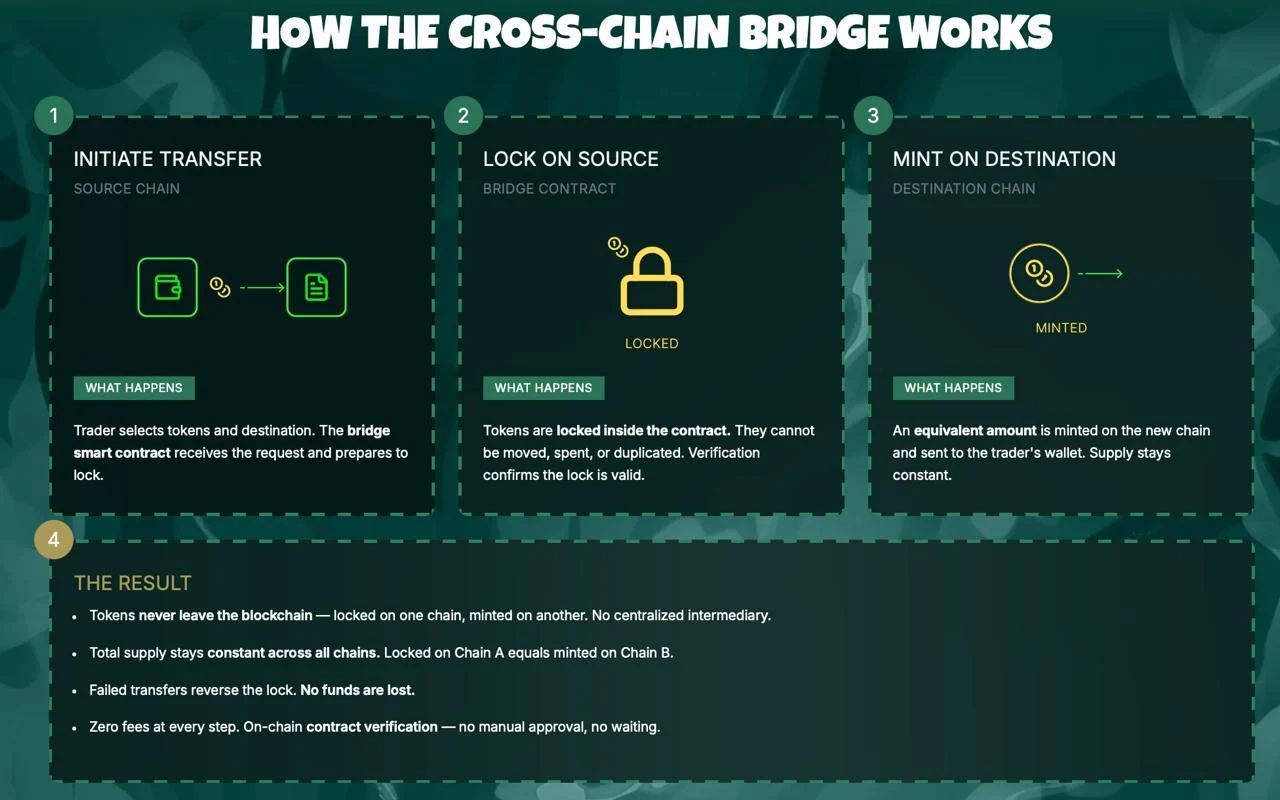
Every trade clears a scanner first, reading the contract for drain functions, honeypot traps, and fake supply before any signature lands, delivering the readout in simple English. PepetoSwap executes at zero cost. The bridge sends tokens across Ethereum, BNB Chain, and Solana without skimming.
Before any capital entered, the full codebase cleared a SolidProof audit line by line. The cofounder from the original Pepe (the token that hit $11 billion on 420 trillion supply) built this platform with a Binance veteran responsible for listings on crypto’s deepest order book.
Holders compound at 181% APY through every stage. The best crypto presale toolset was built end-to-end by the operator behind Pepe’s $11 billion cycle on 420 trillion supply.
Five thousand dollars committed at today’s rate buys 26.8 billion tokens. On identical supply, Pepe traded up to $0.00002803. Hitting that print from this entry returns $750,000 on a 150x move. Staking at 181% APY compounds daily. Once Binance fires, this best crypto presale window closes for good.
Ethereum (ETH) Price at $2,314 as ETF Flows Stay Bid and Foundation Wallets Hold 100K+ ETH
Ethereum (ETH) trades at $2,314 per CoinMarketCap, up 8.8% on the week as spot ETH funds pulled $187 million across the prior seven days and on-chain usage cleared 3.6 million daily transactions. Foundation wallets hold over 100,000 ETH off staking per Arkham.
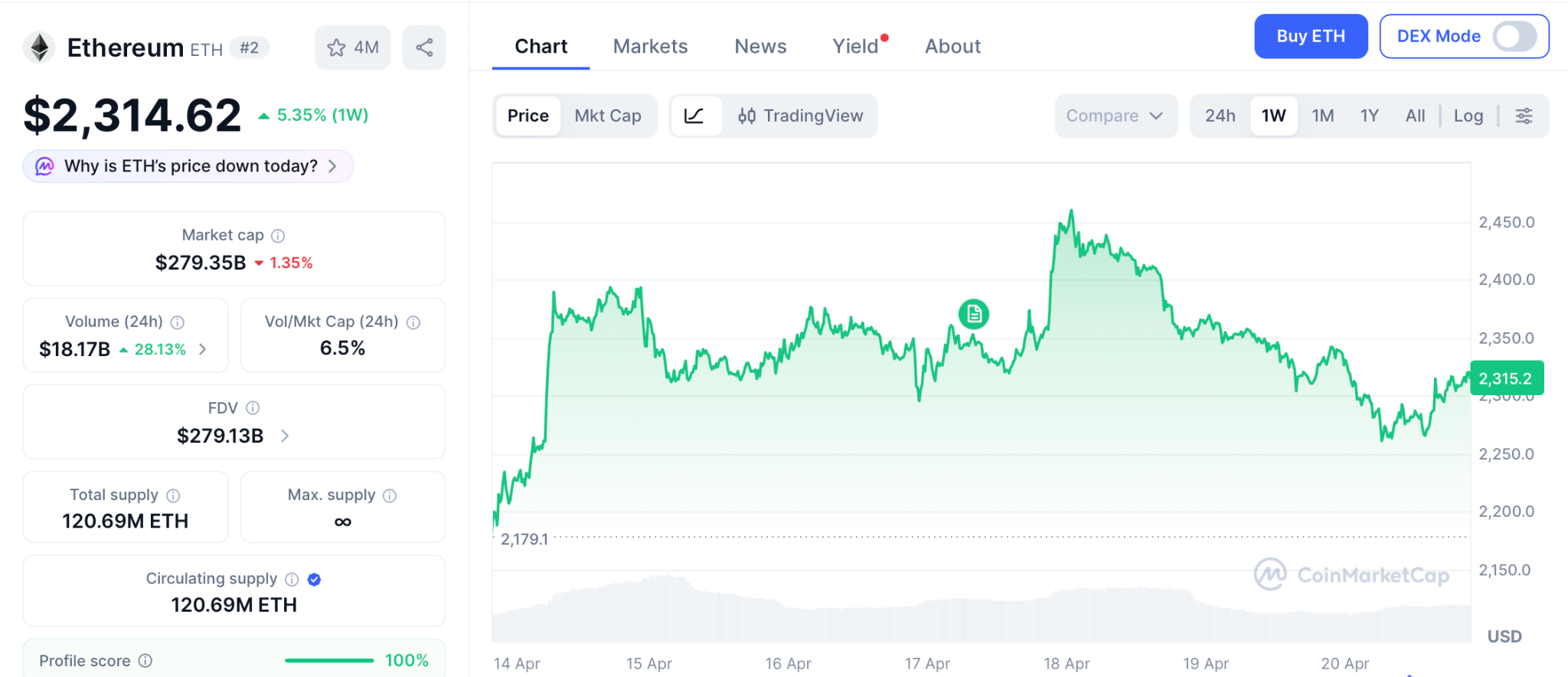
Support holds at $2,200, Standard Chartered targets $7,500 by late 2026, roughly 211% upside across months. A presale at $0.0000001865 chasing 150x from one listing is a different equation, which keeps Pepeto the best crypto presale standing today.
Solana (SOL) Price at $85.40 as Institutional Products Scale and 167M Holders Mark New High
Solana (SOL) trades at $85.40 per Bybit, down 3.1% on the day inside a $49 billion cap, with Bitwise’s BSOL spot ETF leading eight U.S. sponsors holding $812 million in combined net assets. Solana cleared 167 million unique SOL holders this month, 8% above late 2025.
Support sits at $83, resistance $93, CoinPedia models $200 for 2026 (134% upside). Yet Pepeto at presale pricing closes that multiple in one event, the best crypto presale running while SOL waits on rotation.
Conclusion:
Morgan Stanley’s Trust cleared $120 million in six days and $1 billion in weekly ETF flows confirm institutional capital pouring back into crypto, but portfolio-rewriting returns never come from the top of the board.
The best crypto presale is the one already built, audited, live on CoinMarketCap, and priced below what institutional money stepped on. Pepeto is the obvious best crypto presale call for 2026, the must-hold for portfolios chasing multiples that flip life outcomes, not another 2x on assets every wallet already owns.
This is the rare setup that turns small money into generational money, and it only pays wallets in before Binance opens. Which side of that line you finish on gets decided now, and the best crypto presale window closes in days.
Click To Visit Pepeto Website To Enter The Presale

FAQs
Why is Pepeto the best crypto presale in April 2026 as ETH and SOL wait on rotation?
Pepeto is the best crypto presale in April 2026 because the exchange ships live on CoinMarketCap, the SolidProof audit is signed, and 181% APY staking compounds every stage. The presale crossed $9.29 million at $0.0000001865 with a confirmed Binance listing closing in.
Is Ethereum (ETH) at $2,314 a better buy than Pepeto at presale pricing right now?
Ethereum (ETH) targets $7,500 from Standard Chartered by late 2026, roughly 211% across months. Pepeto at $0.0000001865 chases 150x from one Binance listing event on verified exchange infrastructure already running.
Disclaimer: This is a Press Release provided by a third party who is responsible for the content. Please conduct your own research before taking any action based on the content.
Crypto World
Tom Lee Doubles Down on Crypto Winter Call as Bitmine Makes Biggest ETH Purchase of 2026
Bitmine Immersion Technologies (BMNR) acquired 101,627 Ethereum (ETH) tokens last week. This marked its largest weekly purchase of 2026.
The latest acquisition increased the company’s total ETH holdings to 4.976 million tokens. Its combined crypto and cash position reached $12.9 billion, according to the April 20 announcement.
Tom Lee Crypto Winter Call Comes Amid Bitmine’s Largest ETH Buy
The purchase was accompanied by a statement from Chairman Tom Lee arguing that the crypto downturn is closer to ending than most expect.
“While many believe the crypto winter may last through the Fall of 2026, our view remains that the crypto winter is much closer to ending,” he said.
Subscribe to our YouTube channel to watch leaders and journalists provide expert insights
Lee pegged his winter-ending call to historical market patterns. He explained that, since 2015, previous crypto bear markets have typically coincided with equity drawdowns of at least 20%.
The 2025 crypto decline aligned with a roughly 20% drop in the S&P 500. By contrast, the 2026 equity pullback has been relatively modest, at around 8%.
The divergence suggests the current crypto downturn lacks the macro backdrop that has historically sustained prolonged bear markets, implying a shorter duration and earlier recovery.
On-Chain and ETF Signals Align
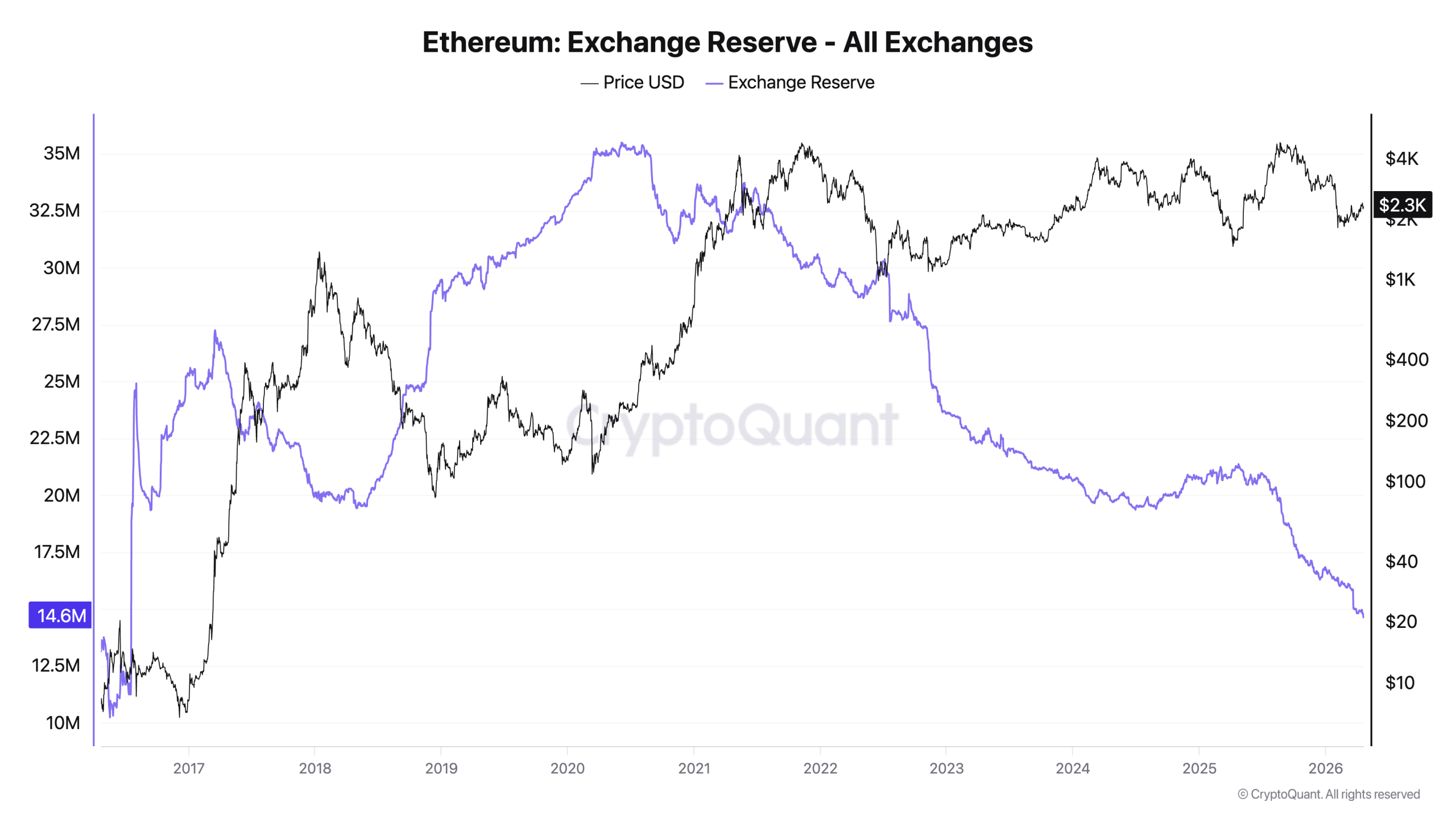
Meanwhile, on-chain signals and rebounding exchange-traded fund (ETF) flows also paint a bullish picture for Ethereum. Ethereum exchange reserves across all platforms fell to roughly 14.6 million ETH this week.
That marks the lowest level since 2016, per CryptoQuant. Falling exchange balances reduce sell-side liquidity available to traders.
Follow us on X to get the latest news as it happens
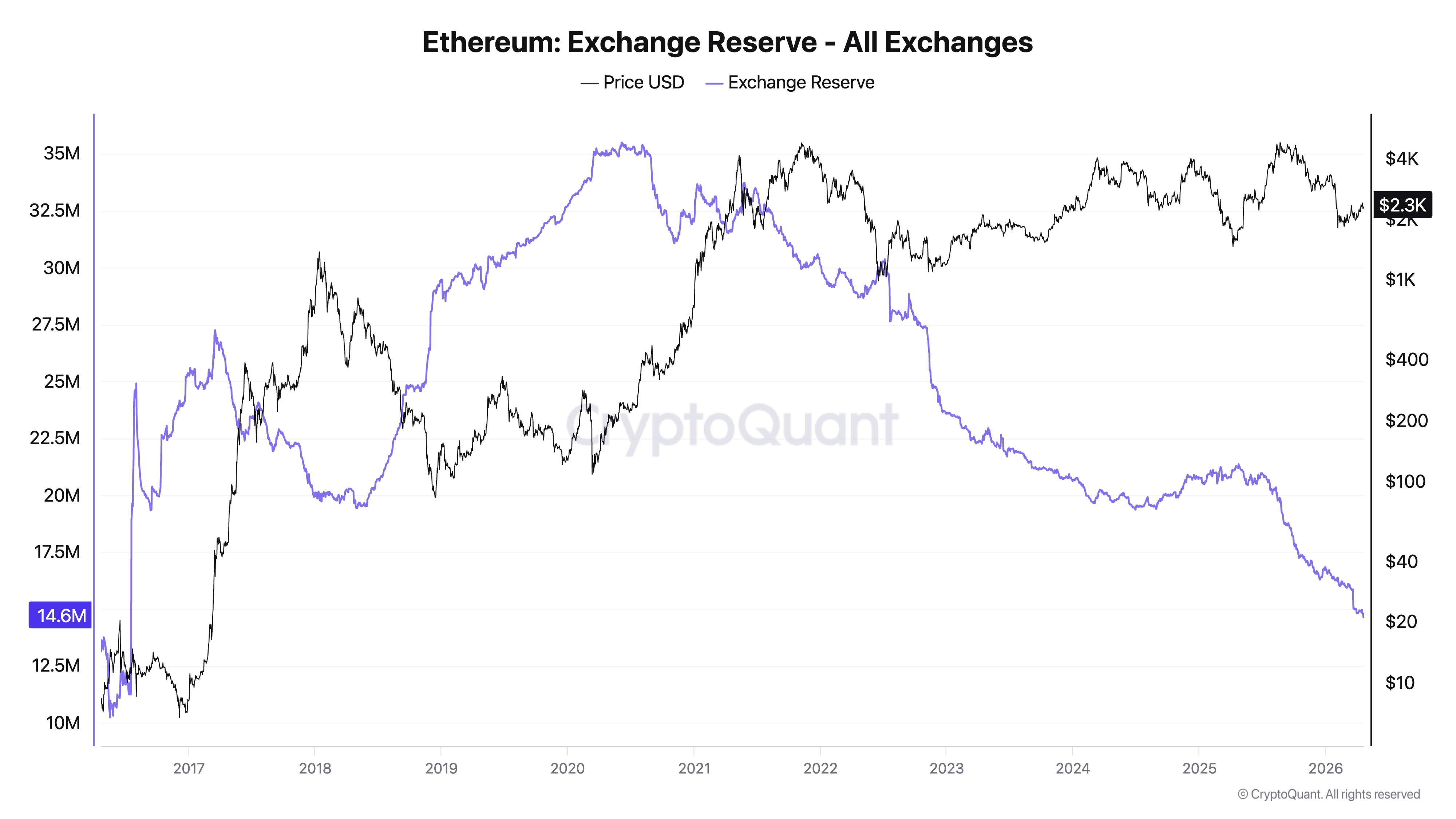
Spot Ethereum ETFs also posted their strongest weekly inflow since mid-January. The funds drew $275.83 million for the week ending April 17.
Adding to this view, one analyst highlighted that the count of Accumulating Addresses has edged past Stable Whales, 2,434 versus 2,410. This crossover suggests institutions are no longer sitting on the sidelines but are actively building positions.
“Whales do not just have capital ready; they are actively executing orders and moving assets to cold custody,” the post read.
Despite these tailwinds, ETH still trades near $2,306, roughly 53% below its August 2025 all-time high.
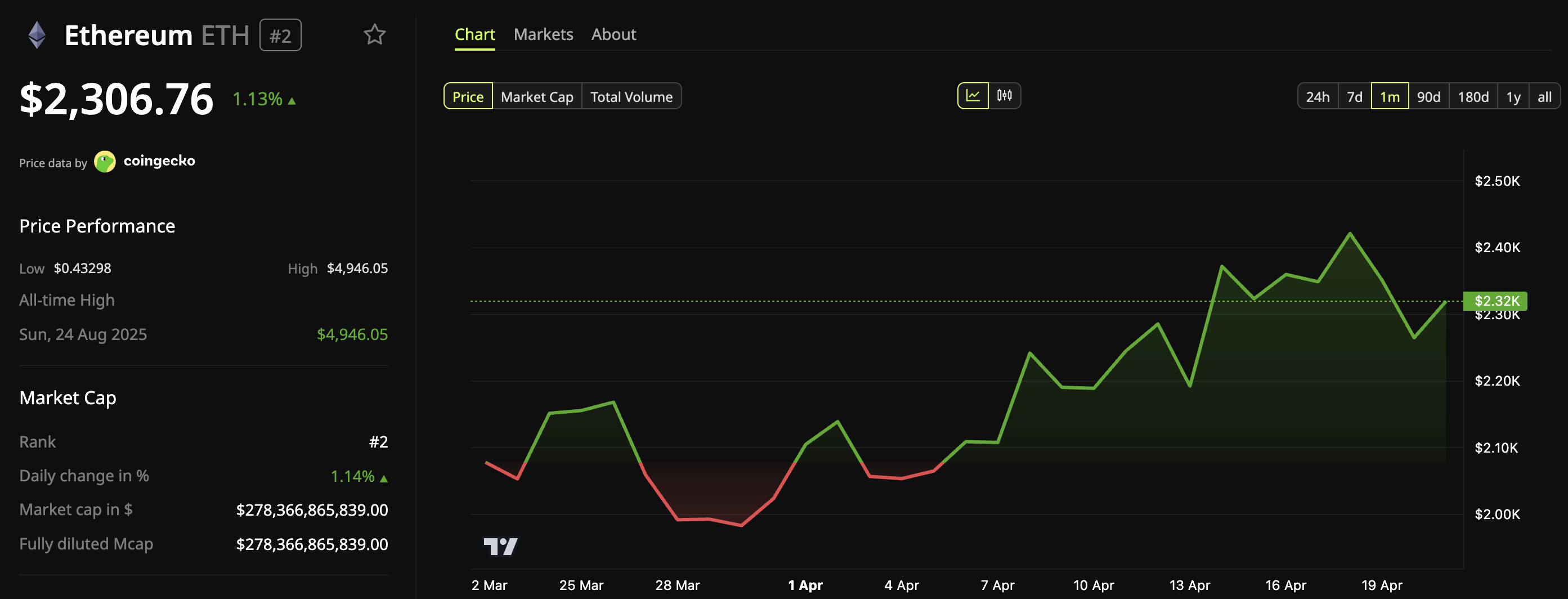
Whether Bitmine’s pace and Lee’s framework hold up depends on sustained demand and broader market conditions.
The post Tom Lee Doubles Down on Crypto Winter Call as Bitmine Makes Biggest ETH Purchase of 2026 appeared first on BeInCrypto.


April has already seen over $600m stolen across DeFi, bridges and wallets, turning security from a protocol‑level concern into a full‑blown market risk premium.
Summary
- Crypto protocols have already lost more than $600m to hacks in April, led by $292m stolen from KelpDAO and $285m from Drift Protocol.
- Exploits now cut across smart contracts, infrastructure and social‑engineering attacks, including AI‑driven campaigns against wallets like Zerion.
- Between 11:00 and 13:00 UTC, mid‑cap DeFi names saw capitulation‑style selloffs as derivatives markets priced in a persistent “security risk premium.”
Fresh aggregate figures show that crypto protocols have already lost over $606m to hacks in the first 18 days of April, making it the worst month for exploits since February 2025 and pushing 2026’s year‑to‑date haul above $770m. According to data from DefiLlama at least 13 protocols have been compromised this month, with KelpDAO and Drift Protocol alone accounting for around 95% of April’s losses and roughly 75% of 2026’s total.
KelpDAO, an Ethereum liquid‑staking protocol, suffered an attack on April 18 that drained about 116,500 rsETH, valued at roughly $292m, after an attacker forged cross‑chain messages to trick a LayerZero EndpointV2 bridge contract into releasing reserves. Drift, Solana’s largest decentralized perpetuals exchange, was hit on April 1 in what regional media called a “sophisticated” exploit, losing about $285m in what is now the second‑largest security breach in Solana’s history after the $326m Wormhole hack in 2022.
The latest wave of hacks is not confined to smart‑contract bugs or restaking primitives. Incidents have hit routing and infrastructure layers such as Hyperbridge as well as front‑end and DevOps providers like Vercel, where attackers accessed internal systems and are allegedly shopping stolen data for $2m to fuel “global supply chain attacks.”
On the human side, wallet provider Zerion disclosed that it was targeted by North Korean hackers who used AI‑powered, long‑horizon social‑engineering campaigns to compromise hot‑wallet keys, stealing about $100,000 while leaving user funds and core infrastructure intact. The Security Alliance (SEAL) has identified at least 164 malicious domains tied to the DPRK‑linked group UNC1069, describing its playbook as defined by “patience, precision, and the deliberate weaponization of existing trust relationships.”
Industry data from earlier episodes, such as the $70m hot‑wallet exploit at Singapore‑based exchange Phemex in 2025, had already highlighted North Korea‑linked actors’ tendency to quickly convert stolen USDT and USDC into ETH to evade blacklists, a pattern authorities say continues in 2026.
Market structure reacted in real time as April’s hacks piled up. Between 11:00 and 13:00 UTC on key news days, order books in weaker mid‑cap DeFi names showed classic “capitulation” signatures: single‑session drawdowns of roughly 5–8%, thin bids and a visible rotation into protocols with cleaner security track records. Derivatives venues saw basket funding for DeFi tilt mildly negative while spot liquidity drained, the kind of configuration desks associate with a broad “security tax” on risk assets rather than isolated idiosyncratic shocks.
For traders, that has turned security into an explicit factor: fading leveraged DeFi beta on exploit headlines, staying long centralized venues and volatility‑monetizing infrastructure, and keeping dry powder for forced sellers once bad debt and write‑downs are fully recognized on‑chain.

Your essential guide to running the TCS London Marathon 2026

Tim Scott says Warsh will restore Fed independence Powell lacked

Bitcoin reclaims $75,000 as Iran ceasefire talks advance, equities rally resumes



-

 NewsBeat7 days ago
Trump and Pope Leo: Behind their disagreement over Iran war
-

 Fashion3 days ago
Weekend Open Thread: Theodora Dress
-

 News Videos6 days ago
Secure crypto trading starts with an FIU-registered
-

 Sports4 days ago
NWFL Suspends Two Players Over Post-Match Clash in Ado-Ekiti
-

 Business2 days ago
Powerball Result April 18, 2026: No Jackpot Winner in Powerball Draw: $75 Million Rolls Over
-

 Crypto World3 days ago
Russia Pushes Bill to Criminalize Unregistered Crypto Services
-

 Politics3 days ago
Palestine barred from entering Canada for FIFA Congress
-

 Politics9 hours ago
Gary Stevenson delivers timely reminder to register to vote as deadline TODAY
-
 Business4 days ago
Creo Medical agree sale of its manufacturing operation
-

 Politics2 days ago
Zack Polanski demands ‘council homes not luxury flats for foreign investors’
-

 Tech2 days ago
Auto Enthusiast Scores Running Tesla Model 3 for Two Grand and Turns It Into Bare-Bones Go-Kart
-

 Tech5 days ago
‘Avatar: Aang, The Last Airbender’ Leaked Online. Some Fans Say Paramount Deserves the Fallout
-

 Crypto World3 days ago
Russia Introduces Bill To Criminalize Unregistered Crypto Services
-

 Tech6 days ago
Microsoft adds Windows protections for malicious Remote Desktop files
-

 Crypto World6 days ago
X Launches New Cashtag Feature for Stocks and Crypto: X
-

 Sports7 days ago
Younger Than Sachin Tendulkar: Vaibhav Sooryavanshi Set To Make Historic India Debut
-

 Entertainment6 days ago
Prince Carter Brings Fans Front Row and Backstage at Boys 4 Life Tour
-
 Entertainment6 days ago
Dave Portnoy Slams Dianna Russini: ‘Makes Zero Sense’
-

 Sports5 days ago
British climbers complete new route in Swiss Alps
-

 Crypto World6 days ago
Global recession inevitable if Strait of Hormuz stays shut
You must be logged in to post a comment Login