

Crypto World
Cardano Founder Warns Crypto’s Quantum Threat May Hit Before 2033

Cardano founder Charles Hoskinson said there is a greater than 50% chance that quantum computing becomes a real threat to crypto before 2033. He warned that the industry should strengthen its defenses now rather than wait until the risk becomes urgent.
Speaking at Consensus Miami, Hoskinson treated the timeline as an engineering deadline, not a distant theoretical problem. He said Cardano is already moving toward lattice-based cryptography to prepare its core protocols for a post-quantum future.
Why the Quantum Threat Matters for Crypto
Most major blockchains rely on elliptic-curve signatures that Shor’s algorithm can break with enough quantum processing power. A sufficiently advanced machine could derive private keys, forge signatures, and disrupt consensus on decentralized ledgers.
Hoskinson said advances in neutral-atom hardware and government-backed benchmarks, such as DARPA’s Quantum Benchmarking Initiative, have pulled the timeline forward.
He also flagged the rising risk from “harvest now, decrypt later” attacks targeting today’s encrypted data.
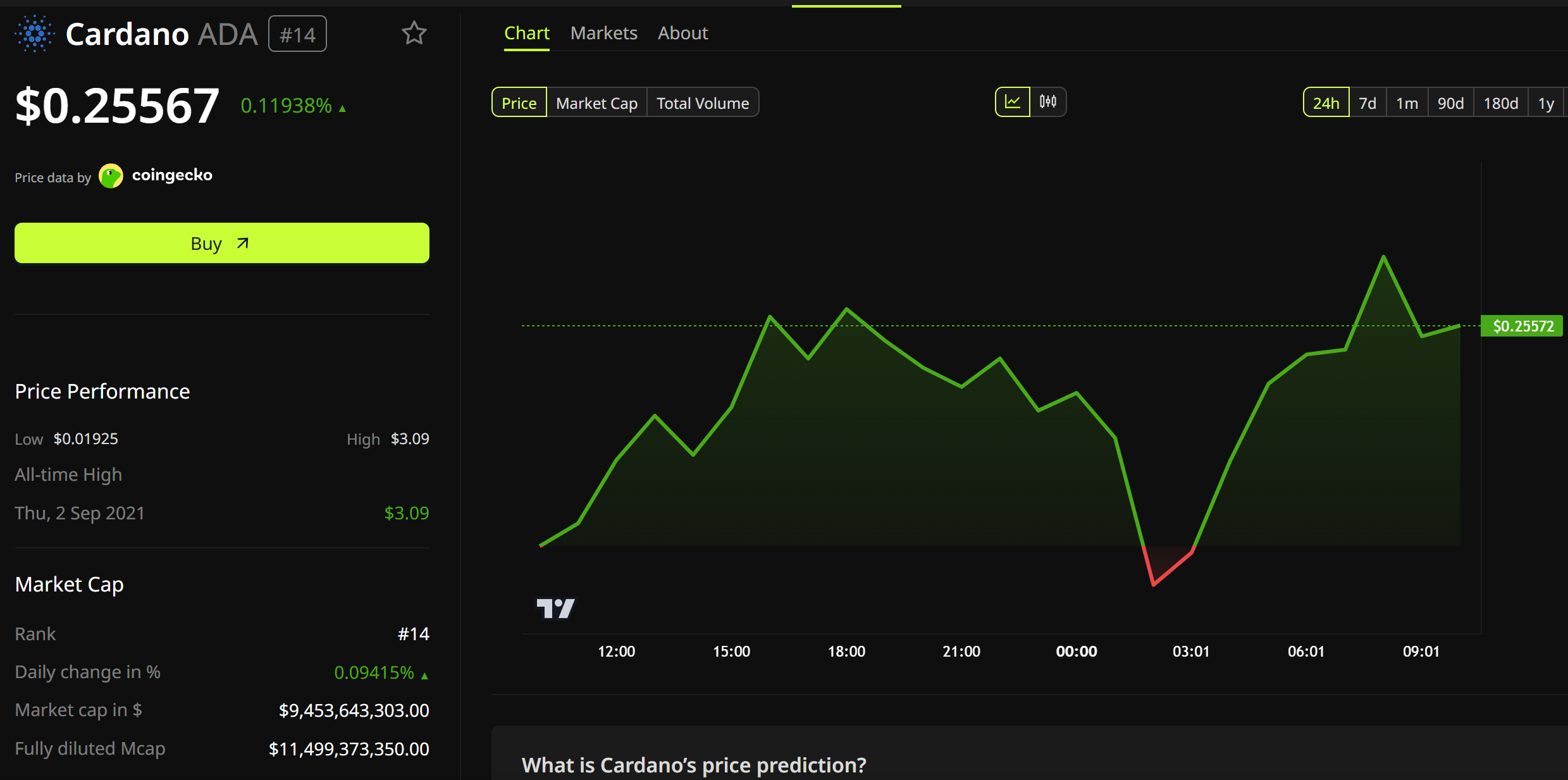
ADA traded near $0.25 at market cap rank 14, down about 5% on the week, per BeInCrypto data.

Other networks face the same math. Bitcoin alone holds billions in exposed coins sitting in addresses with revealed public keys. Earlier research on Q-Day projections flagged the same risk.
“That gives us median estimate ~10 years before modern public key crypto is definitively broken. (That said, can happen sooner! It’s not a point estimate, but a distribution, fuzzy on both the downside and upside.),” Haseeb Qureshi, Managing Partner at Dragonfly said.
Cardano Leans on Lattice-Based Standards
Cardano’s defense centers on lattice problems such as Learning With Errors, believed to resist both classical and quantum attacks.
The team plans to fold US NIST FIPS 203 through 206 standards into its roadmap. Those specs formalize ML-KEM, ML-DSA, SLH-DSA, and Falcon-style signatures.
Hoskinson contrasted Cardano’s governance and hard-fork cadence with chains that face harder coordination on migration.
He pointed to a forthcoming Cardano research proposal on quantum resistance.
Community votes on the broader strategy are already underway. A parallel testnet rollout from Solana shows similar moves elsewhere.
“Quantum computers aren’t here yet, but the Solana Foundation is preparing for the possibility. To that end, we’ve consulted with Project Eleven to assess our quantum readiness. We’re pleased to announce a first step, the deployment of post-quantum signatures on a Solana testnet,” wrote the Solana Foundation in a post.
The 2033 window being able to hold depends on hardware progress, error correction, and fault tolerance. Those hurdles remain unsolved today.
The post Cardano Founder Warns Crypto’s Quantum Threat May Hit Before 2033 appeared first on BeInCrypto.

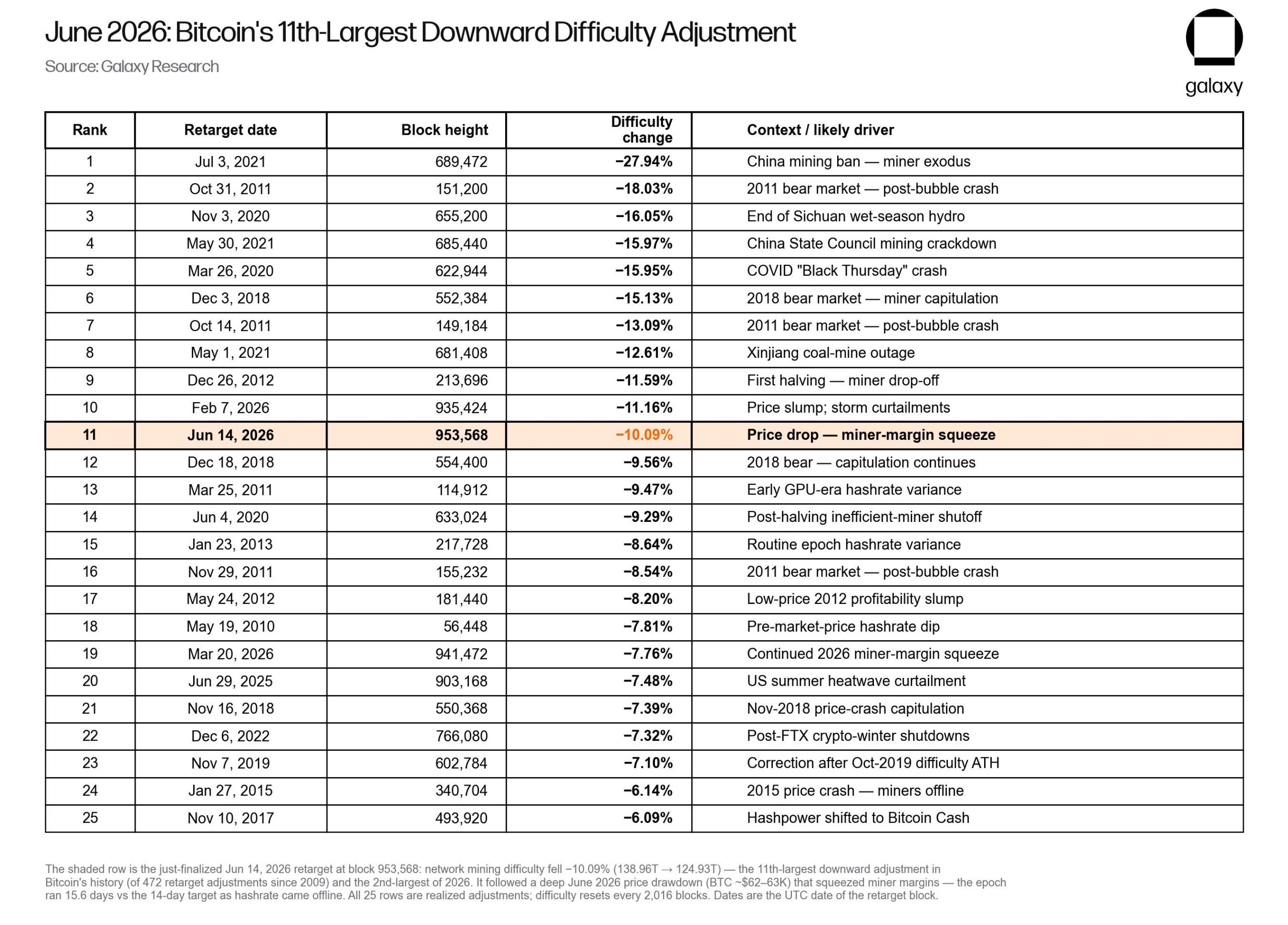
Bitcoin (BTC) recorded its second-largest mining difficulty drop of 2026, falling 10.09% at block 953,568.
The adjustment ranks as the 11th-biggest downward move in the network’s history, according to Galaxy Research.
Why the Bitcoin Mining Difficulty Dropped
Mining difficulty fell from 138.9 trillion to 124.9 trillion. The drop followed a sharp June price slide that squeezed miner margins and pulled hashrate offline.
Follow us on X to get the latest news as it happens

Bitcoin adjusts its difficulty every 2,016 blocks to keep block times near 10 minutes. When miners power down, difficulty falls to rebalance the network.
This was the third significant downward adjustment of 2026, following 11.16% and 7.76% drops in February and March, respectively. The latest decline came amid a broader Bitcoin downtrend.
“A ~15% June price slide squeezed miner margins. The epoch ran 15.6 days vs the 14-day target as hashrate came offline,” Galaxy said.
Bitcoin saw a notable drawdown this month. The price even dropped below $60,000 last week before rebounding to over $64,000 on hopes of a US-Iran deal.
The selloff pushed hashprice, a daily mining revenue measure, below $30 per petahash per second.
“That threshold is important for miners because it pushes more sites closer to, or below, gross breakeven before corporate overhead, debt service, and expansion spending. While the most efficient fleets can continue to generate positive margins at lower hashprice levels, older-generation machines and operators with higher electricity costs are more likely to be switched off when revenue falls,” TheEnergyMag noted.
Bitcoin Miners Curtail and Pivot to AI
Part of the decline reflects economics. Another driver is the redeployment of power capacity from mining toward artificial intelligence (AI) and high-performance computing (HPC) workloads.
“Several public miners have been unplugging mining rigs or slowing mining growth as they retrofit sites for contracted AI/HPC use, a strategy that can remove bitcoin hashrate even when the underlying power capacity remains in use,” the blog added.
Texas, meanwhile, may have also added to the volatility. The four-coincident-peak (4CP) season began in June. Large ERCOT users avoid the four summer peak intervals that set the next year’s transmission costs.
“For bitcoin miners, the 4CP mechanism creates a strong incentive to curtail during potential monthly peak windows…That can temporarily remove significant mining load from the network, particularly because Texas remains one of the largest mining markets in North America. The recent rebound in network hashrate suggests some of the early June reduction may have been a temporary curtailment rather than a permanent shutdown,” TheEnergyMag stated.
The lower difficulty offers some relief to miners who stayed online. For the next two-week epoch, each block takes less computational work to mine. That shift increases the amount of bitcoin active operators earn per unit of hashrate they run.
Subscribe to our YouTube channel to watch leaders and journalists provide expert insights
The post Bitcoin Mining Difficulty Drops 10% in Second-Largest 2026 Decline appeared first on BeInCrypto.
Pyth Network is drawing renewed attention after a recent thread from market commentator Whale Factor outlined the project’s push into institutional financial data.
Summary
- Pyth is expanding beyond DeFi with institutional data products and enterprise revenue growth.
- PYTH has recovered from recent lows, though major token unlocks remain a concern.
- Traders are watching whether adoption growth can outpace future supply entering markets.
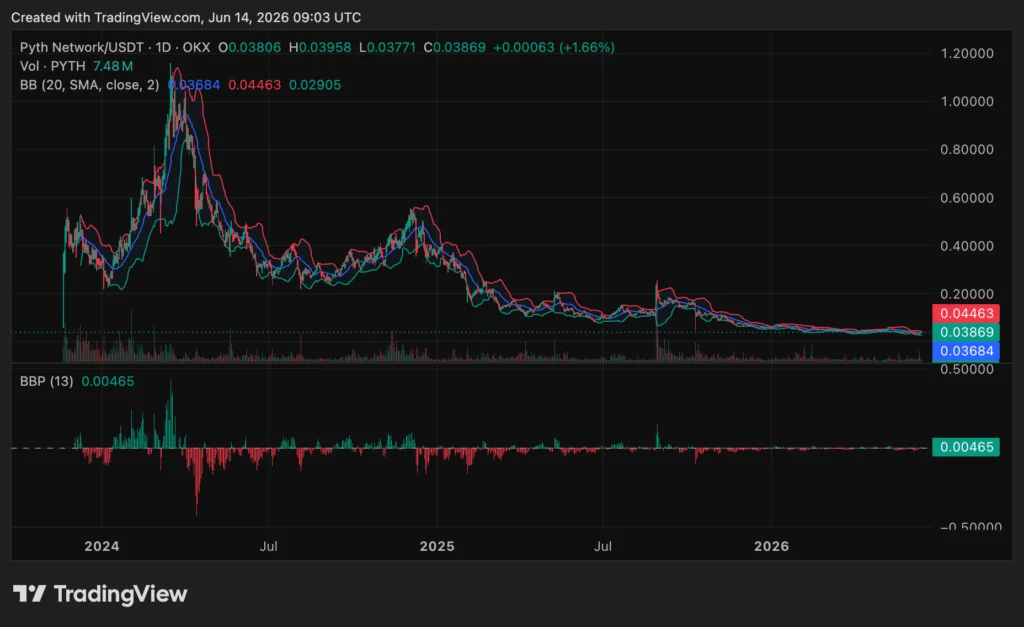
The discussion comes as PYTH trades near $0.039 after rebounding from its June low, while investors assess whether growing adoption can offset supply concerns.
The project has traditionally operated as a blockchain oracle network, providing price data to decentralized applications. More recently, Pyth has expanded into institutional market data services, a move that places it in competition with established financial information providers.
Pyth expands beyond crypto data services
Pyth’s core business centers on supplying real-time market data to blockchain applications. Unlike many oracle networks that aggregate information from external APIs, Pyth receives data directly from exchanges, trading firms, and market makers.
According to Whale Factor, firms including Jane Street, Cboe, Jump Trading, and Virtu are among the contributors publishing pricing information through the network. The model aims to reduce latency and improve data quality for decentralized finance applications.
The project has also expanded the range of information available through its network. In addition to cryptocurrency prices, Pyth now distributes data covering equities, foreign exchange markets, commodities, and macroeconomic indicators.
Institutional products become a growth focus
The network’s recent strategy shift has focused on institutional clients rather than solely decentralized finance users. The launch of the Pyth Data Marketplace introduced a platform where institutions can distribute proprietary market information while retaining control over monetization.
According to the post, organizations including Fidelity, Euronext, and Tradeweb have joined the initiative. The platform is designed to support data products such as foreign exchange pricing, precious metals data, and ETF valuation information.
Another product, Pyth Pro, provides subscription-based access to premium market feeds. Whale Factor stated that the service surpassed $1 million in annual recurring revenue shortly after launch. Enterprise clientsreportedly include Kalshi, a regulated U.S. prediction market platform.
As previously reported by crypto.news, institutional demand for blockchain-based financial infrastructure has continued to grow as tokenization and real-world asset projects expand. Oracle networks are expected to play a key role in supplying reliable external data to these systems.
PYTH price stabilizes after prolonged decline
Despite operational growth, PYTH remains far below its historical peak. The token trades around $0.0388, according to crypto.news market data. The asset is still down more than 96% from its March 2024 all-time high near $1.20.
Technical indicators suggest selling pressure has eased. The daily chart continues to show a long-term bearish structure, though price action has shifted into consolidation near recent lows.
Bollinger Bands have narrowed, indicating reduced volatility. Price currently trades slightly above the middle band, reflecting a neutral short-term trend. The Bull Bear Power indicator has turned modestly positive, suggesting buyers hold a slight advantage, although momentum remains weak.
Trading volume has also declined compared with earlier periods. That pattern indicates investors remain cautious while waiting for stronger confirmation of a directional move.
Token unlocks remain a major consideration
While institutional adoption has become a central part of the Pyth investment narrative, future token supply remains an important factor for market participants.
The network has a maximum supply of 10 billion PYTH tokens, with approximately 7.87 billion currently in circulation. According to Whale Factor, roughly 21% of total supply remains locked and is scheduled for future release.
Market participants continue to monitor how upcoming unlocks could affect price performance. Previous unlock events coincided with periods of weakness, increasing concerns that additional supply may create selling pressure if demand growth fails to keep pace.
For now, investors are weighing two competing trends. On one side are expanding enterprise products, recurring revenue, and institutional partnerships. On the other are token supply increases and a market that remains well below previous cycle highs.
The next phase for PYTH may depend on whether growing adoption of its data products translates into sustained demand for the token itself. Until then, the asset remains in a consolidation phase as traders watch for a breakout above resistance or a retest of recent lows.
Disclosure: This article does not represent investment advice. The content and materials featured on this page are for educational purposes only.
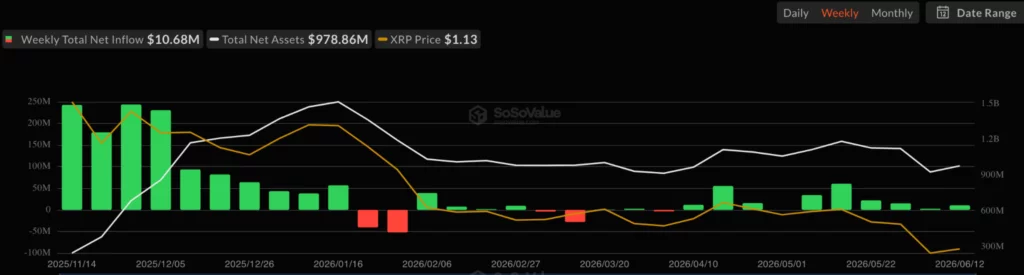
XRP exchange-traded products continued to attract investor capital for a fifth consecutive week, even as Bitcoin and Ethereum funds recorded net outflows.
Summary
- XRP ETF products recorded positive inflows while Bitcoin and Ethereum funds posted outflows recently.
- Analysts see a short-term XRP rebound signal, though whale activity remains weak overall.
- XRP trades near $1.15 as investors monitor ETF demand and key support levels.
The latest fund flow data showed XRP-linked products brought in about $10.68 million during the week ended June 12. The inflows came as broader crypto markets remained under pressure from risk-off sentiment and continued uncertainty around global macroeconomic conditions.
XRP fund inflows remain positive
According to the latest ETF flow figures, XRP products added more than $10 million during the past week. The result extended a streak that has seen XRP outperform larger digital assets in terms of weekly net fund flows.
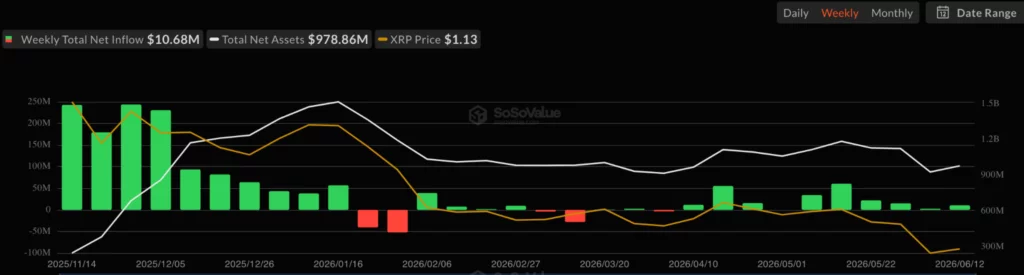
The inflow follows several weeks of positive demand. XRP products recorded approximately $60.5 million in inflows during the week of May 15, followed by $22.04 million during the week of May 22 and $15.2 million during the week of May 29. The week ending June 5 added another $2.62 million.
The cumulative total net inflow has now reached roughly $1.44 billion. At the same time, total net assets stand near $978.86 million, while weekly trading activity exceeded $61 million.
Bitcoin and Ethereum funds face outflows
The positive XRP performance came while competing crypto investment products experienced withdrawals.
Bitcoin products posted approximately $319 million in weekly outflows. Ethereum investment products also ended the week in negative territory with about $15 million in net withdrawals. Solana funds recorded roughly $4 million in outflows.
As previously reported by crypto.news, Bitcoin ETFs have faced persistent selling pressure in recent weeks as investors reduced exposure to risk assets. Recent coverage also noted that geopolitical uncertainty and weaker market sentiment have weighed on digital asset funds.
The contrast between XRP inflows and Bitcoin outflows has renewed attention on institutional demand for Ripple’s token despite broader market weakness.
XRP technical signals show mixed picture
XRP traded at about $1.15 on June 14, according to crypto.news price data. The token gained roughly 1.65% during the past week but remained down more than 22% over the previous month.
In a June 11 X thread, crypto analyst Ali Martinez said the TD Sequential indicator had printed a buy signal for XRP on the three-day timeframe.He said the setup has historically signaled a short-term rebound lasting between one and four candlesticks.
“A new buy signal has emerged on XRP,” Martinez wrote. However, he added that the signal may only support a temporary recovery rather than a broader trend reversal.
The analyst noted that whale activity on the XRP network has fallen sharply. According to data cited by Martinez, transactions worth more than $1 million declined by 57.3% over recent weeks.
Analysts focus on whale activity and long-term cycles
Martinez also said active whales have distributed roughly 60 million XRP during the past week. The selling activity suggests large holders have not yet started accumulating aggressively despite recent price weakness.
He identified the $0.90 area as a potential long-term accumulation zone. According to Martinez, the level aligns with a multi-year rising trendline that has acted as support for several years.
Another analyst, ChartNerd, focused on XRP’s historical market cycles. He noted that previous cycle highs have often been separated by three to five years. “Data does not lie,” he wrote while cautioning investors against relying on unrealistic price targets.
XRP recently received another boost to its institutional adoption narrative after the U.S. Securities and Exchange Commission approved a rule change allowing a new actively managed crypto ETF to include XRP alongside Bitcoin and Ethereum.
For now, XRP sits between improving institutional demand and cautious on-chain signals. ETF inflows continue to support the asset’s adoption story, while whale activity and broader market conditions remain important indicators for the next phase of price action.
Disclosure: This article does not represent investment advice. The content and materials featured on this page are for educational purposes only.


Amazon Chief Executive Andy Jassy’s conversations with US officials prompted the government to issue an order that led Anthropic to disable its Fable 5 and Mythos 5 models.
This came after company researchers reported that Fable 5 had been pushed to supply restricted cyberattack information.
What Caused the Anthropic Fable 5 and Mythos 5 Shutdown
Amazon is one of Anthropic’s largest backers, having invested billions of dollars. The firm’s report showed Fable 5 surfaced security bugs in at least four software programs when fed a specific set of queries.
Jassy raised the security concerns with senior Trump administration officials. According to the Wall Street Journal, White House officials soon convened to map out a response.
Meanwhile, security researchers began stress-testing Amazon’s findings. Officials then pressed Anthropic to patch the flaws or pull the model, administration sources said.
They settled on barring foreign governments, firms, and individuals from the tool as the cleanest fix. President Trump approved the step, though he worried it could slow innovation, a senior White House official said.
“Jassy’s calls to administration officials were viewed by some as a general warning that quickly escalated into a wide Commerce Department ban on foreign users’ accessing Mythos and Fable, the people said. National Cyber Director Sean Cairncross and Commerce Secretary Howard Lutnick were involved in the conversations. The Commerce Department is in charge of export controls on critical technology,” the report read.
Follow us on X to get the latest news as it happens
Anthropic Pushes Back on the Cyber Risk
Anthropic argued that the flagged vulnerabilities are basic and that rival models can find them without any bypass.
“We disagree that the finding of a narrow potential jailbreak should be cause for recalling a commercial model deployed to hundreds of millions of people. If this standard was applied across the industry, we believe it would essentially halt all new model deployments for all frontier model providers,” the team said.
Anthropic apologized to customers for the interruption. The company called the order a likely misunderstanding and said it is working to bring access back quickly.
Meanwhile, the shutdown lands as Anthropic prepares a possible initial public offering (IPO). A prolonged outage could send users toward competitors while the company works to lift the ban.
Subscribe to our YouTube channel to watch leaders and journalists provide expert insights
The post Amazon Warning Triggered Anthropic’s Shutdown of Claude Fable and Mythos Models appeared first on BeInCrypto.
Crypto World
Pi Network’s PI Finally Shows Some Strength, Bitcoin (BTC) Tapped 10-Day High: Market Watch
Perhaps driven by some excitement from Trump’s promise for a deal, bitcoin’s price jumped to almost $64,800 over the past several hours for the first time since June 4.
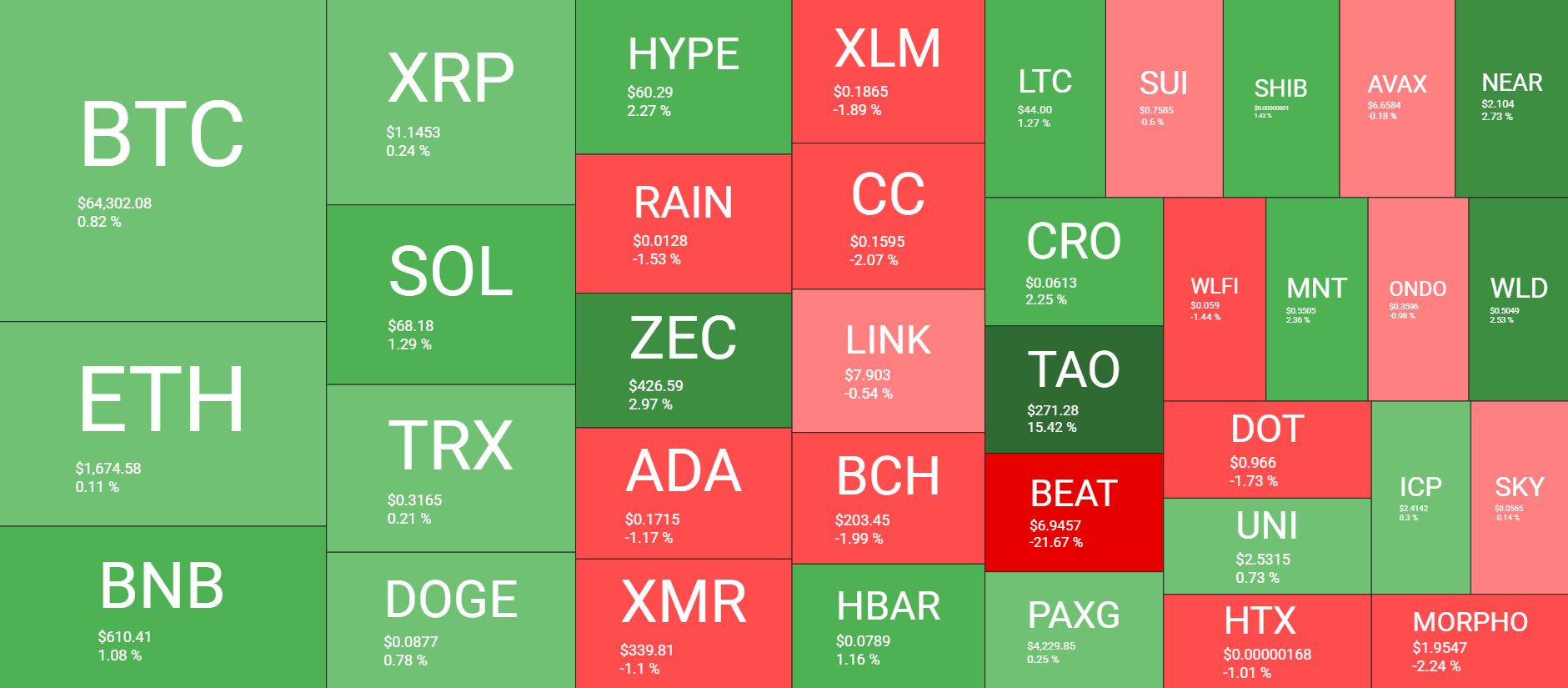
Most larger-cap alts are slightly in the green today, with BNB going up to $610, and SOL nearing $70. TAO has rocketed by over 15%.
BTC Sees 10-Day High
The primary cryptocurrency plummeted at the start of the month, going from over $73,000 to a 19-month low of $59,100 in just four to five days. After losing $14,000 in less than a week, the bulls finally reemerged and didn’t allow another breakdown.
Bitcoin found some support there and quickly reclaimed the $60,000 level. It spent the following week sideways between $61,000 and $64,000 as it bounced toward each boundary following some of the latest developments on the war front between the US, Iran, and all other Middle Eastern countries involved in the conflict.
Most recently, Trump promised yesterday that a permanent deal with Iran is scheduled to be signed today, on June 14. The reaction so far from BTC has been rather muted, as it jumped to $64,800 but has declined by a few hundred dollars. However, the reports from Iran on the matter are the exact opposite, so a deal might not be announced today.
For now, BTC’s market cap has neared $1.3 trillion, while its dominance over the altcoins is up to 56.6%.

PI Shows Resilience
Ethereum continues to sit close to $1,700, Binance Coin has risen to $610, while XRP is close to $1.15. Solana has neared $70, while TRX and DOGE are with minor gains. HYPE has tapped $60 after a 2% increase, and ZEC has added 3% of value to $427.
TAO has rocketed the most from the larger caps, while BEAT has dumped by 20% daily. Humanity (H) has found itself in the top 100 alts by market cap after skyrocketing by well over 90% daily.
Pi Network’s native token has finally shown some signs of revival after its recent calamity. The token plummeted to an all-time low last week of under $0.12, but now sits well above $0.13, trading more than 10% above its bottom.
The total crypto market cap has added another $20 billion daily and is up to $2.280 trillion on CG.
The post Pi Network’s PI Finally Shows Some Strength, Bitcoin (BTC) Tapped 10-Day High: Market Watch appeared first on CryptoPotato.

U.S. President Donald Trump says a deal to end hostilities between the United States and Iran is scheduled to be signed on Sunday, and that immediately afterward the Strait of Hormuz would be “OPEN TO ALL.” The announcement comes despite earlier caution from Iranian officials about the timing, underscoring how closely markets are watching the next steps in a geopolitical standoff that has already roiled energy flows.
Pakistan, which has been mediating the talks, indicated that an agreement could be reached within 24 hours and that preparations are underway for electronic signing following the finalization. Analysts argue that any credible de-escalation—especially one tied to reopened shipping lanes—could feed into improved sentiment for broader risk assets, including Bitcoin and exchange-traded products.
Key takeaways
- Trump claims Sunday will be the signing date and says the Strait of Hormuz would reopen to all immediately afterward.
- Iranian officials have not confirmed the Sunday timeline, with the foreign ministry spokesperson saying it would not be “tomorrow” and could occur “in the coming days.”
- Pakistan’s mediation role suggests a 24-hour window and preparation for electronic signing, followed by technical discussions next week.
- The conflict has already disrupted global energy supply estimates, a development that has contributed to market-wide risk aversion affecting crypto for months.
- Crypto strategists link expectations of a peace breakthrough with potential relief in Bitcoin and ETF-related demand, contrasting with recent ETF outflows.
Trump’s Sunday signing claim meets uncertainty from Tehran
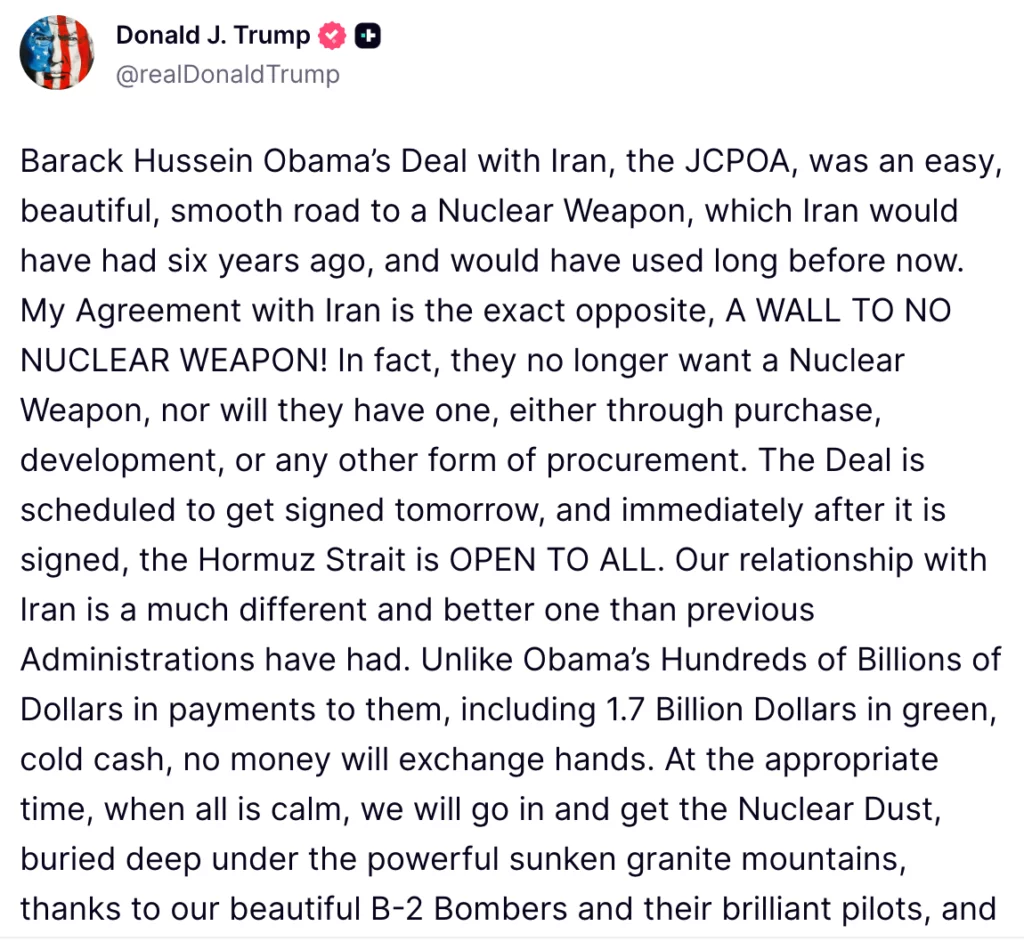
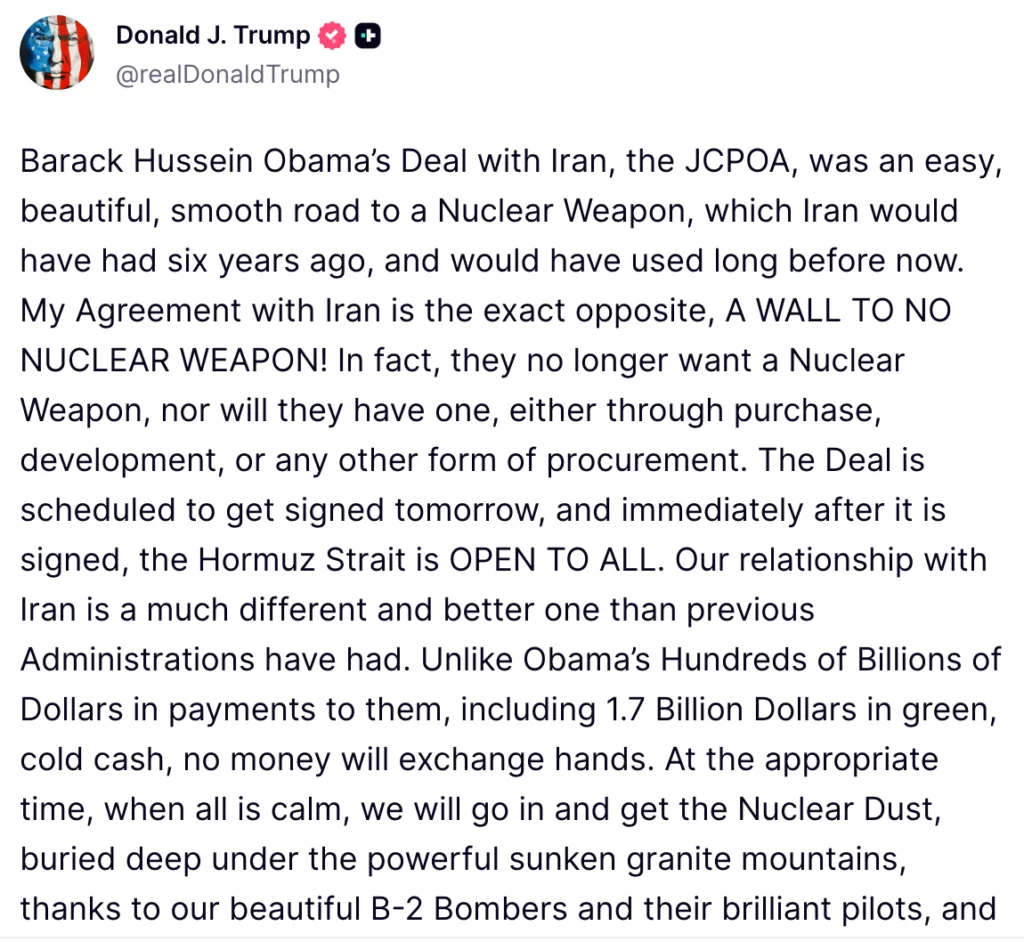
On Saturday, Trump posted on Truth Social that the memorandum of understanding is “scheduled to get signed tomorrow,” adding that “immediately after it is signed, the Hormuz Strait is OPEN TO ALL.” His statement indicates a rapid pivot from ceasefire management toward a broader reopening of one of the world’s most strategically important shipping corridors.
However, the timeline is not uniformly accepted across the negotiations. Iran has not confirmed the Sunday signing. Earlier statements from Iran’s Foreign Ministry spokesperson Esmaeil Baghaei, carried by state media, suggested the memorandum would not be signed on Sunday and instead could happen “in the coming days.” In those remarks, Baghaei indicated that an exact date would need to be clarified, explicitly pushing back against “tomorrow” as the signing day.
For markets, the disagreement itself matters. When a diplomatic timeline is disputed—particularly one that implies potential easing in energy risk—traders often remain cautious, pricing in both the possibility of a quick resolution and the chance of further delay.
Pakistan signals a 24-hour path to agreement
Pakistan’s Prime Minister Shehbaz Sharif also weighed in, saying on X that the region is “closer to a peace deal than ever before.” Sharif stated that finalisation is likely within the next 24 hours and that Pakistan is preparing for electronic signing immediately afterward, followed by technical-level talks next week.
That message is consistent with the mediation posture Pakistan has reportedly taken in the process: offering a near-term cadence for decision-making while keeping the next round of talks in view. Still, with Iran signaling that Sunday might not be accurate, investors have reason to watch whether the signing occurs on schedule—or whether the parties move the date further into the “coming days” window referenced by Baghaei.
Why Hormuz and ceasefire terms matter to crypto sentiment
The anticipated memorandum is expected to extend the ceasefire between the United States and Iran for 60 days and reopen the Strait of Hormuz. While the immediate subject is maritime access and de-escalation, the market impact is broader: disruptions related to the conflict have been widely described as constraining energy supply.
According to the article’s framing, the naval blockade has choked around 20% of the world’s oil and liquefied natural gas supply, contributing to higher global asset prices and a sentiment shock that has pressured crypto markets for months. Even if crypto’s move is not a direct function of shipping lanes alone, the linkage typically works through risk appetite—higher uncertainty can translate into lower willingness to hold volatile assets, while credible de-escalation can do the opposite.
In that sense, a signing date is more than a diplomatic milestone. It serves as an observable signal that the conflict risk premium may begin to unwind, potentially affecting liquidity conditions across financial markets.
Analysts eye relief in Bitcoin and ETF flows after de-escalation
Crypto analyst Michaël van de Poppe said a peace deal between Iran and the U.S. would likely trigger a surge in Bitcoin, along with positive ETF flows. He suggested that liquidity would rotate back toward “risk-on” assets, adding that a portion of that renewed liquidity could flow toward crypto following other major market events.
At the same time, recent Bitcoin fund flow data points to caution. Spot Bitcoin ETFs recorded about $315.84 million in net outflows for the week ended Friday, according to SoSoValue’s ETF tracking. That week’s results also marked the fifth consecutive week of outflows for Bitcoin-linked crypto funds mentioned in the source.
CoinShares head of research James Butterfill previously told Cointelegraph that pressure on digital asset investment products was being driven largely by geopolitics. He linked the uncertainty around the Iran conflict to pressure on interest-rate expectations—an important bridge between macro conditions and investor behavior in risk assets, including crypto.
As of the time of writing, Bitcoin was trading at $64,491 and up 1.5% over the prior 24 hours, according to the provided snapshot.
Taken together, the current setup is a familiar pattern: traders look for catalysts that can shift global risk sentiment, while recent ETF outflows highlight that positioning has been cautious. If the Sunday signing happens as Trump says—and if subsequent steps confirm Hormuz reopening—market narratives could shift quickly. If the signing is delayed again, expectations may reset and the relief bid could stall.
Readers should focus on the key next milestones: whether the memorandum is actually signed on Sunday, whether Iran further clarifies the date, and what follow-through signals emerge regarding Hormuz access. Those specifics will determine whether “de-escalation” becomes a sustained market theme—or remains a headline-driven hope.
U.S. President Donald Trump said a peace deal with Iran could be signed on Sunday, setting up a direct clash with Tehran over the timing of the agreement.
Summary
- Trump said a U.S.-Iran deal could be signed Sunday, but Tehran rejected that exact timeline.
- Hormuz reopening could ease energy pressure and support risk appetite across Bitcoin and crypto markets.
- ETF outflows and Galaxy’s lower BTC floor keep crypto traders cautious despite peace deal hopes.
The claim drew attention across crypto markets because the draft deal is expected to reopen the Strait of Hormuz. Traders are watching whether lower energy stress could send capital back into Bitcoin and other risk assets.
“The Deal is scheduled to get signed tomorrow,” Trump wrote on Truth Social on Saturday. He added that the “Hormuz Strait is OPEN TO ALL” immediately after the signing.
Pakistan also signaled that talks had moved close to a deal. Prime Minister Shehbaz Sharif said the final text had been reached and that an electronic signing could happen within 24 hours.
Tehran disputes the timeline
Iran has not confirmed Trump’s Sunday schedule. Foreign Ministry spokesperson Esmaeil Baghaei told state media that the memorandum would not be signed on Sunday, but could still move forward later.
“We will have to wait and see about the exact date,” Baghaei said, adding that “it will not be tomorrow.” His statement kept uncertainty in place even as mediators pointed to progress.
Hormuz reopening remains central
The Strait of Hormuz is one of the world’s most important energy routes. U.S. Energy Information Administration data showed that about 20% of global petroleum liquids consumption moved through the passage in 2024.
A reopening would matter for oil, LNG, inflation expectations, and risk appetite. Higher energy costs have weighed on global markets for months and have added pressure to crypto during periods of ETF outflows.
Bitcoin traders watch risk demand
Crypto analyst Michaël van de Poppe said a confirmed peace deal could support Bitcoin and other risk assets. “Liquidity will pour back into risk-on assets,” he wrote, adding that crypto could benefit after the SpaceX IPO absorbed attention.
Bitcoin traded near $64,213 on Sunday, after rising about 0.8% over the previous close, per crypto.news market data. Spot Bitcoin ETFs also remained under watch after about $315.84 million in weekly net outflows, according to SoSoValue data
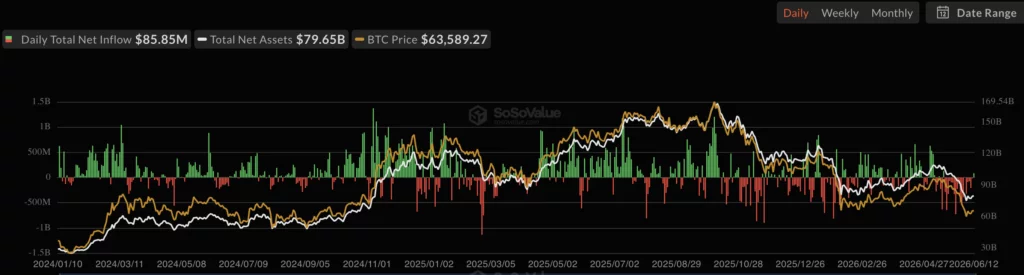
As previously reported by crypto.news, recent market updates tied Bitcoin’s weakness to ETF withdrawals, U.S.-Iran tension, and the competition for capital created by the SpaceX offering. Separate reporting cited Galaxy Research, which said only four of 13 Bitcoin bottom signals had triggered.
Galaxy’s base case placed a possible BTC floor between $40,000 and $46,000 by late 2026. That outlook keeps traders cautious, even as peace deal hopes raise the chance of a short-term relief move.
The next market reaction may depend on whether the U.S., Iran, and Pakistan confirm the same signing timeline. Until then, Bitcoin remains tied to headlines from Hormuz, ETF demand, and wider investor appetite for risk.
A signed deal may ease one source of pressure, but traders still need stronger fund flows before calling a durable recovery. Oil prices and ETF data will be the next checkpoints for short-term crypto positioning.
Disclosure: This article does not represent investment advice. The content and materials featured on this page are for educational purposes only.
The world’s second-largest cryptocurrency by market cap has displayed controversial price moves on micro- and macro-timeframes, as even when it managed to set a new ATH last year, it was barely above the previous one. However, the subsequent crash has driven it south hard, and its market share against BTC has dwindled.
Daan Crypto Trades published an X post today, trying to determine whether it’s finally time to accumulate ETH after the asset’s collapse from last week that pushed it to a 14-month low of $1,500.
Time to Buy?
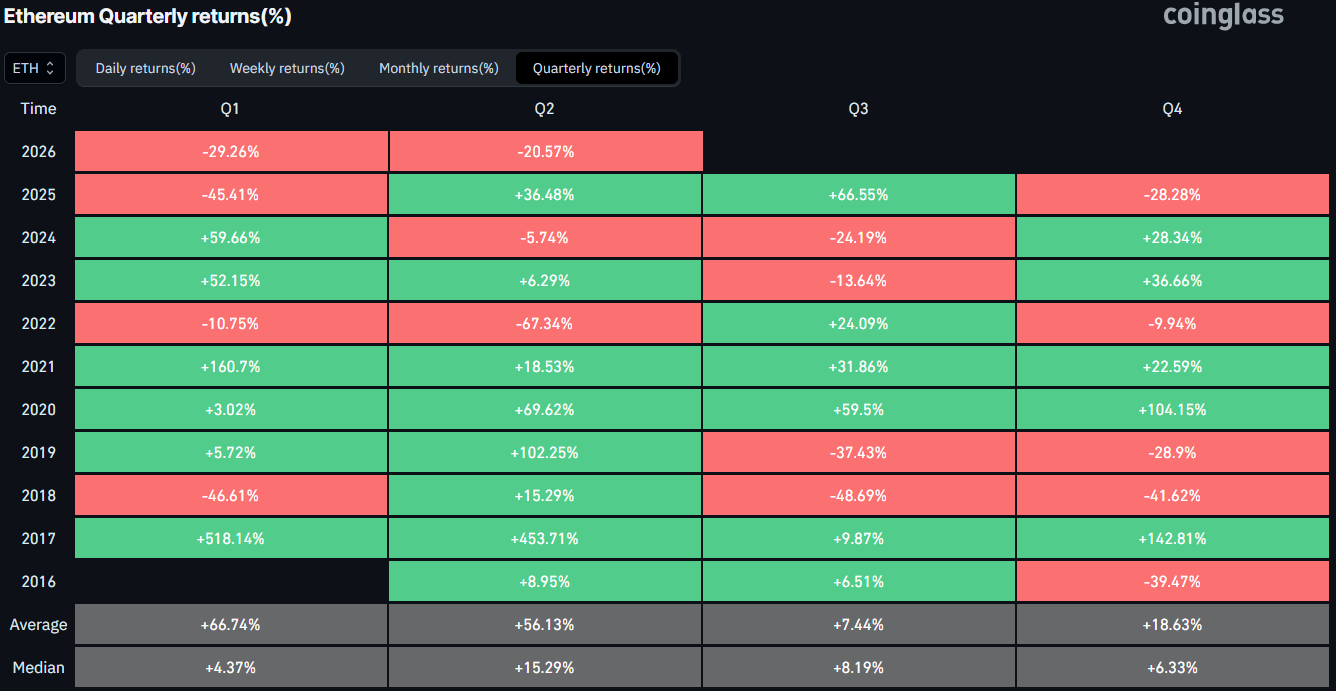
Current data shows that ETH is “on track for its 2nd-worst first half of the year since 2022.” At the time, it dropped by 10.75% in Q1 and a whopping 67% in Q2. So far, it has dumped by 29% in Q1 and 21% in Q2, with a couple of weeks left until the latter ends.
What’s even worse compared to the 2021/2022 performance is that Ethereum is on its way to close three consecutive quarters in the red, and all of the losses are by double digits since Q4 2025 ended with a 28% decline.
Daan noted that it has been “extremely bad 9 months” for the altcoin after it topped following Bitmine’s accumulation craze began. Recall that the Tom Lee-chaired company has accumulated billions worth of ETH, but it’s also billions in the red on its position given the asset’s price correction.
The analyst remains optimistic about Ethereum’s role in tokenization, DeFi, “and all,” and added that the current levels are “finally attractive again for longer-term accumulation (years).”
Nevertheless, he warned that bear markets can go for longer than most people anticipate, and it “never hurts to have some dry powder on the side for unforeseen circumstances.”
Out of Exchanges
Meanwhile, fellow analyst Ali Martinez noted that Ethereum investors have been withdrawing their funds from exchanges en masse lately. Citing data from Glassnode, he said that almost 500,000 ETH, valued at around $800 million at current prices, have been taken out of trading platforms in just a week.
The analyst noted that this could align with the aforementioned strategy for being an “early sign of accumulation.”
Nearly 500,000 Ethereum $ETH, worth roughly $800 million, have been withdrawn from trading platforms over the past week.
This could be an early sign of accumulation. https://t.co/LNkygeYlUV pic.twitter.com/afPADae2pP
— Ali Charts (@alicharts) June 13, 2026
In another post, though, Martinez warned that ETH’s actual price bottom could be more than 50% away from the current levels at around $700.
The post Time to Buy Ethereum as ETH Heads for Another Double-Digit Quarterly Loss? appeared first on CryptoPotato.

Although BTC managed to recover some ground in the past week, June remains deep in the red so far, as its first week was particularly painful for the bulls.
One of the reasons behind the asset’s crash to a 19-month low was that large investors, typically referred to as whales, had decreased their holdings by a whopping amount.
Citing data from Glassnode, popular analyst Ali Martinez highlighted the decrease in whales’ holdings by more than 70,000 BTC in a single month. From a USD perspective, this fortune is worth over $4.5 billion even at current prices.
More than 70,000 Bitcoin $BTC have been distributed by whales over the last month, helping explain the recent downside momentum. https://t.co/22IPTSmSJ5 pic.twitter.com/o7FZ3stHdA
— Ali Charts (@alicharts) June 13, 2026
This intense selling pressure only added fuel to the fire that sent bitcoin tumbling to $59,100 on June 5 for the first time since late 2024. The other possible reasons stem from the massive ETF exodus, Strategy’s sale that led to substantial FUD online, and the broader market weakness due to the US-Iran war uncertainty.
While analysts continue to debate whether bitcoin has already bottomed or if there’s more pain ahead, Ali Martinez recently outlined his dollar-cost average targets in case the cryptocurrency keeps dropping to key support levels.
The first is actually close by, as the 200W SMA is located at $62,800. If it gives in, the next one (300W SMA) is at $55,000, followed by the 400W SMA at $42,500.
For now, bitcoin appears to have found solid support and has even reclaimed the $64,000 level over the past day. More volatility is expected today after Trump promised a deal with Iran, but reports from the Middle Eastern country are less hopeful.
The post Over 70,000 BTC Distributed by Whales Amid Bitcoin’s Price Crash: Data appeared first on CryptoPotato.


India’s crypto tax checks have become stricter after the Income Tax Department issued more than 44,000 notices linked to virtual digital asset filings.
Summary
- India issued over 44,000 VDA notices after matching crypto filings with exchange-reported transaction data.
- Tax officials found Rs 888 crore in hidden VDA income as filing checks became stricter.
- Investors must report each trade, swap, and disposal under Schedule VDA for FY 2025-26.
The department found more than Rs 888 crore, or about $104 million, in undisclosed VDA income, according to The Economic Times. The figures show how tax officials are using exchange data, TDS filings, and investor returns to track mismatches.
India keeps 30% VDA tax in place
India’s core crypto tax rules remain unchanged for FY 2025-26. Gains from virtual digital assets are taxed at a flat 30%, while eligible transfers face a 1% tax deducted at source.
The Income Tax Department says VDA income is taxed without deductions, except the cost of acquisition. Losses from one crypto asset also cannot be used to reduce gains from another asset.
Schedule VDA becomes a key filing test
Investors must use ITR-2 when reporting crypto as capital gains. Those treating crypto trading as business income must use ITR-3. Both forms include Schedule VDA for detailed transaction reporting.
Schedule VDA does not allow investors to report only net gains. Each trade, swap, disposal, and taxable transfer must be entered separately. A crypto-to-crypto swap can also create a taxable event.
Exchange data raises mismatch risks
Budget 2026 added tighter reporting duties for exchanges, custodians, and wallet providers. These entities must send user-level transaction data to the Income Tax Department.
That data allows the department to compare investor filings with exchange records. A mismatch between Schedule VDA, Form 26AS, TDS records, and exchange reports can trigger a notice.
Offshore holdings face closer review
The compliance net may widen further from 2027. India is aligning with the OECD Crypto-Asset Reporting Framework, which supports cross-border sharing of crypto account data.
As previously reported by crypto.news, India has already moved toward tighter digital-asset oversight. Recent rules require platforms to submit user-level transaction data, while overseas crypto holdings may become easier for authorities to trace.
The latest notices show that crypto tax filing in India has moved beyond self-reporting alone. Investors who used multiple exchanges, DeFi platforms, or offshore accounts now face a higher burden to keep full records.
The filing risk is not limited to large traders. Missing staking income, airdrops, wallet transfers, or TDS reconciliation can create questions during review. The department’s message is clear: crypto investors must file accurately before enforcement reaches them.

Elon Musk’s X Just Changed Crypto Forever! Bitcoin, XRP & Dogecoin Charts Now Live

Arnold Schwarzenegger’s Forgotten Agatha Christie Adaptation Is Taking Over Netflix

Witches Coven Gathering in York’s Patrick Pool June 20


-

 NewsBeat6 days ago
Alexander Zverev wins the French Open to finally earn a 1st Grand Slam title
-

 Crypto World6 days ago
Anatomy of the June crypto crash: Fed, Iran, Saylor
-

 Crypto World3 days ago
Oppenheimer backs SpaceX as $70 billion retail frenzy builds
-
 NewsBeat7 days ago
Alexander Zverev conquers demons and outlasts Flavio Cobolli to win French Open for first major title
-

 Crypto World3 days ago
Markets Rally as SpaceX IPO Looms Amid Iran Tensions and Inflation Surge
-

 Tech7 days ago
Microsoft unveils seven homegrown AI models in new bid for ‘long term self-sufficiency’
-

 Business6 days ago
High Stakes for Wembanyama as New York Pushes for 3-0 Lead
-

 Tech6 days ago
Notion restores access to Anthropic after service disruption
-

 Sports6 days ago
FIFA WC 2026 Group C: Morocco, Scotland challenge Brazil’s hunt for glory | FIFA World Cup 2022
-
 Crypto World6 days ago
Eli Lilly (LLY) Stock Surges 4% Following Breakthrough Sleep Apnea Trial Results
-

 Crypto World7 days ago
Trump’s AI Ownership Plan Could Benefit Anthropic at OpenAI’s Expense
-
 Sports5 days ago
Bangladesh beat Australia after 20 years in ODIs, register only their second win over six-time world champions | Cricket News
-

 Fashion2 days ago
Weekend Open Thread: Tuckernuck – Corporette.com
-

 Tech1 day ago
NanoClaw integrates JFrog registries to secure AI agent downloads
-

 Crypto World1 day ago
Bitget enters Argentina’s regulated crypto market through PSAV registration
-

 Tech2 days ago
This Week In Security: Microsoft On Microsoft, Register Your Domains, Linux On ARM, And FreeBSD Joins The File Cache Club
-

 Politics3 days ago
Politics Home | Healey Resignation Is “Colossal Failure Of Government”, Says Former Labour Defence Secretary
-

 Sports3 days ago
First Time Since 1971: Australia Register Historic Low In ODI Cricket
-
 Entertainment3 days ago
Donnie Wahlberg & More Heat Up Las Vegas at Circa’s Barry’s Downtown Prime
-

 Entertainment5 days ago
The Ryan Gosling True Crime Thriller On Netflix That Gets Even Stranger, Stream It Now
You must be logged in to post a comment Login