Market focus stays on the $0.25 support zone as traders assess potential stability or breakdown risk
ADA trades at $0.2548 as of writing, with a 24-hour volume of $215.39 million. The token records a 0.15% daily dip and extends an 11.05% weekly decline.
Price action remains range-bound near the key support zone around $0.25 as traders monitor short-term momentum and liquidity shifts across broader market conditions in the current session.
Support Zone Defense Shapes Short-Term Structure
The current market structure shows ADA moving through a corrective phase after losing momentum near the $0.28 region.
Price action has transitioned into a measured retracement rather than a full trend reversal, keeping the broader upside structure intact for now.
The market continues to respect the upper support band between $0.257 and $0.249, which has become the immediate decision zone for traders positioning around short-term volatility.
Advertisement
Momentum indicators reflect a cooling phase following the prior breakout impulse. Despite this slowdown, ADA continues to trade above key exponential moving averages on the four-hour chart, maintaining a technically constructive backdrop.
$ADA Cardano is currently in a pullback following the recent rally attempt, while the broader structure still allows for the preferred white scenario as long as the upper micro support region continues to hold.
— More Crypto Online (@Morecryptoonl) May 17, 2026
The alignment of the 50 EMA, 100 EMA, and 200 EMA below current price levels signals that buyers still retain a structural advantage as long as support levels remain defended during ongoing consolidation behavior.
Advertisement
Liquidity concentration around the $0.257–$0.249 region continues to influence intraday price action. Market participants are reacting to repeated tests of this zone, with each bounce or rejection shaping near-term sentiment.
A sustained hold above this area keeps recovery scenarios valid, while failure to defend it would shift focus toward deeper structural levels where prior accumulation activity has historically emerged during previous corrective cycles in market history.
Resistance Pressure Builds as Market Awaits Confirmation
Upward movement continues to face rejection near clustered resistance levels at $0.2772, $0.2832, and $0.2885. These zones have repeatedly slowed bullish continuation attempts, creating a compression range that limits breakout expansion.
A clean move above $0.2885 remains essential for any meaningful continuation toward the psychological $0.300 mark, where liquidity interest and trader positioning typically intensify across spot and derivatives markets during active trading sessions globally.
Advertisement
Derivatives data shows open interest stabilizing near $550 million after earlier spikes above $1.8 billion, reflecting a cooling leverage environment. This shift indicates reduced speculative positioning and a more cautious market stance.
Spot flows also remain uneven, with net outflows dominating recent sessions, suggesting that participants are still distributing into strength rather than aggressively accumulating during recovery attempts across major trading venues and exchange platforms currently active.
Downside risk remains defined if the price loses the $0.249 threshold with conviction. Such a move would weaken the ongoing recovery framework and expose lower support zones near $0.233 and $0.228.
These levels represent the next structural cushions where buyers may attempt to reestablish control. Until then, the price remains in a reactive phase, waiting for either breakout confirmation or deeper retracement signals across short-term market structure behavior.
South Korea’s media and communications review body said it will hear from Polymarket before deciding whether to take corrective action against the prediction market platform.
On Monday, the Broadcasting, Media and Communications Review Committee said it would allow Polymarket to submit its position before making a final decision on a corrective request regarding gambling concerns.
“We decided to provide an opportunity for Polymarket to submit its opinion to thoroughly verify the legality of Polymarket and the way the service is operated,” the committee said, according to a machine translation of the press release.
South Korea’s National Gambling Control Commission Act defines “illegal gaming business” to include providing online services that enable speculative gambling and gives regulators authority to monitor and combat such businesses.
Advertisement
The review comes as Polymarket faces access restrictions in several jurisdictions. According to Polymarket, its platform is restricted in 33 countries, including the US, United Kingdom, France, Germany, Brazil, Singapore, Japan and Australia.
South Korea’s scrutiny moves from users to the platform
The review marks a shift in South Korea’s scrutiny of Polymarket from users to the platform itself. It also follows an earlier police probe into local Polymarket users over alleged illegal gambling linked to election-related markets.
On June 5, the Gangwon Provincial Police launched what was reportedly South Korea’s first illegal gambling probe into local Polymarket users. The investigation was requested by the National Police Agency, according to local media reports at the time.
Advertisement
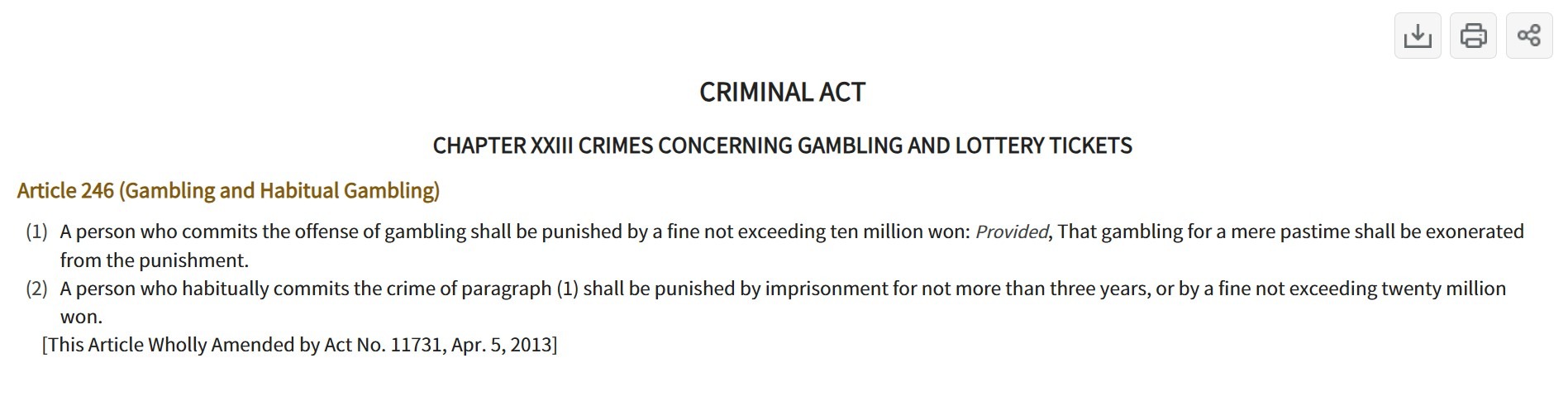
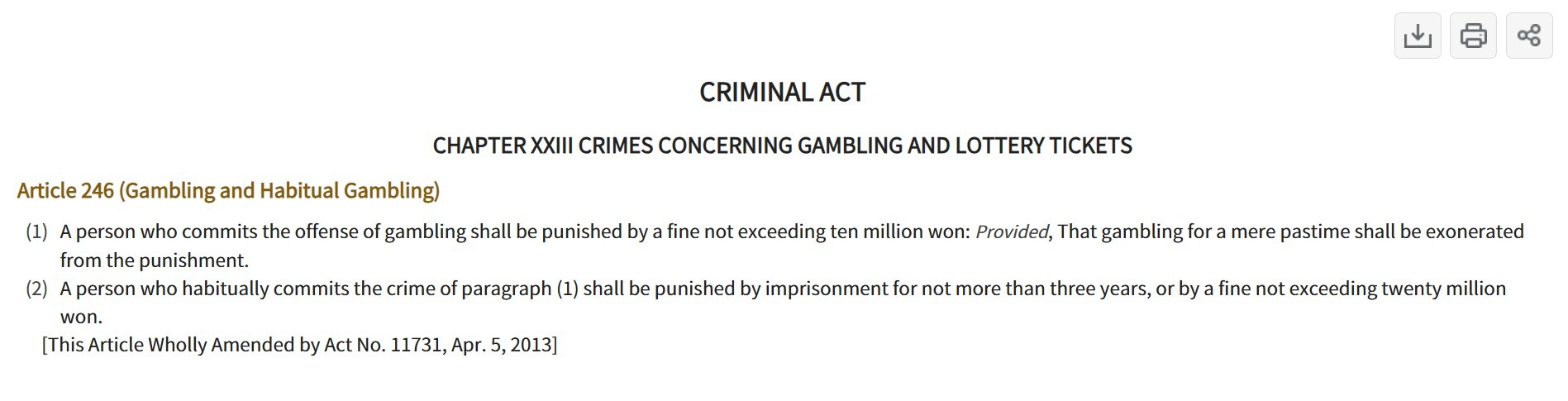
Under South Korea’s Criminal Act, gambling is punishable by a fine of up to 10 million won (about $6,500), while habitual gambling can carry up to three years in prison or a fine of up to 20 million won. Meanwhile, operating a gambling venue for profit is punishable by up to five years in prison or a fine of up to 30 million won.
South Korea’s Criminal Act. Source: Korea Legislation Research Institute
Polymarket says its restrictions are designed to comply with sanctions, local financial rules, gambling and prediction market laws, anti-money laundering requirements and Know Your Customer regulations.
The company also lists certain regions within otherwise accessible countries as restricted, including Alberta, British Columbia, Ontario and Quebec in Canada, as well as Crimea, Donetsk and Luhansk in Ukraine.
XRP price pushed above the $1.14 resistance area after buyers stepped in with heavy volume and bullish prediction. The token climbed from about $1.13 to $1.15 during the session. The strongest burst arrived late on July 5, when trading activity surged well above the daily average. Now comes the real test: whether $1.14 holds as support or slips back into resistance.
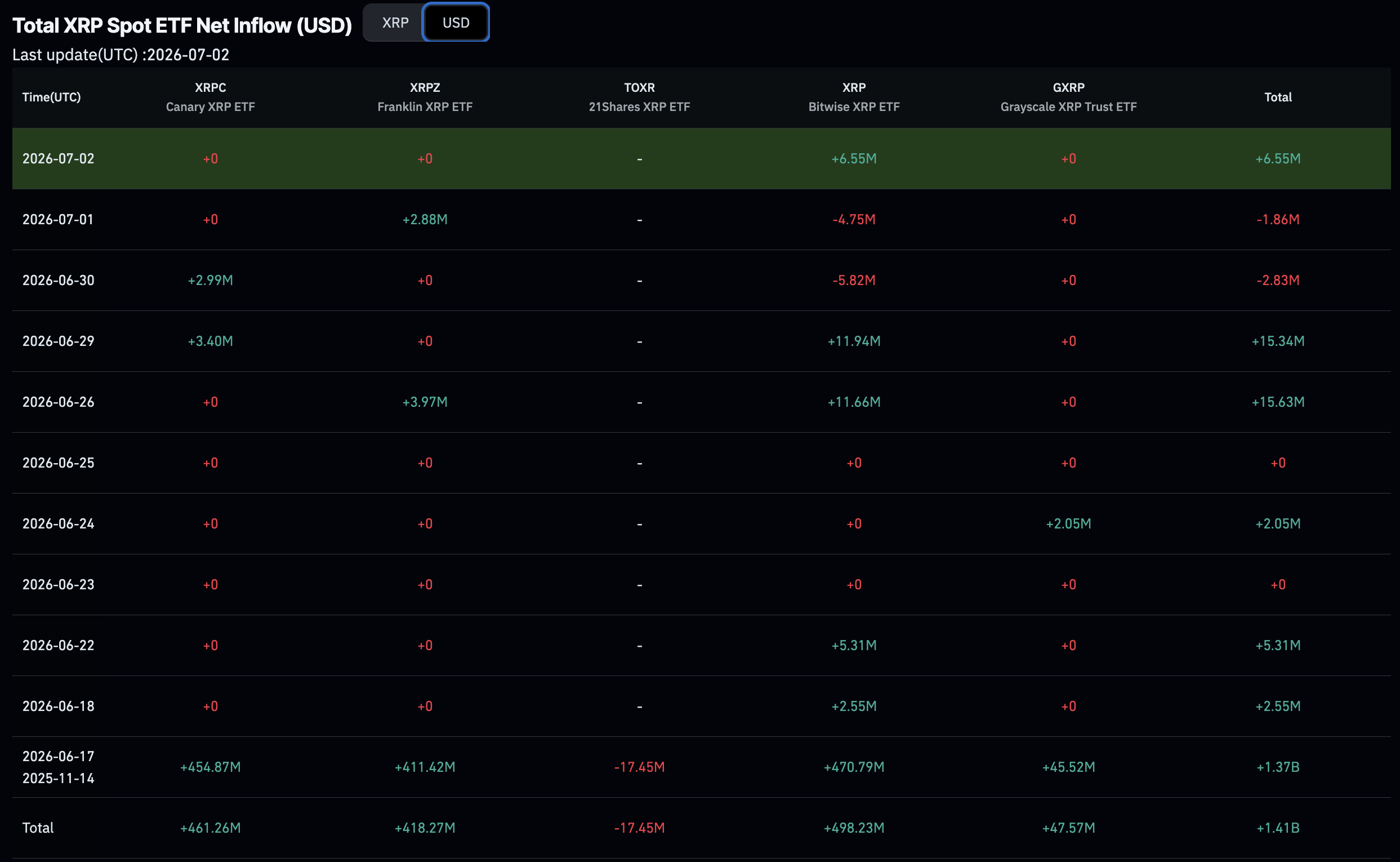
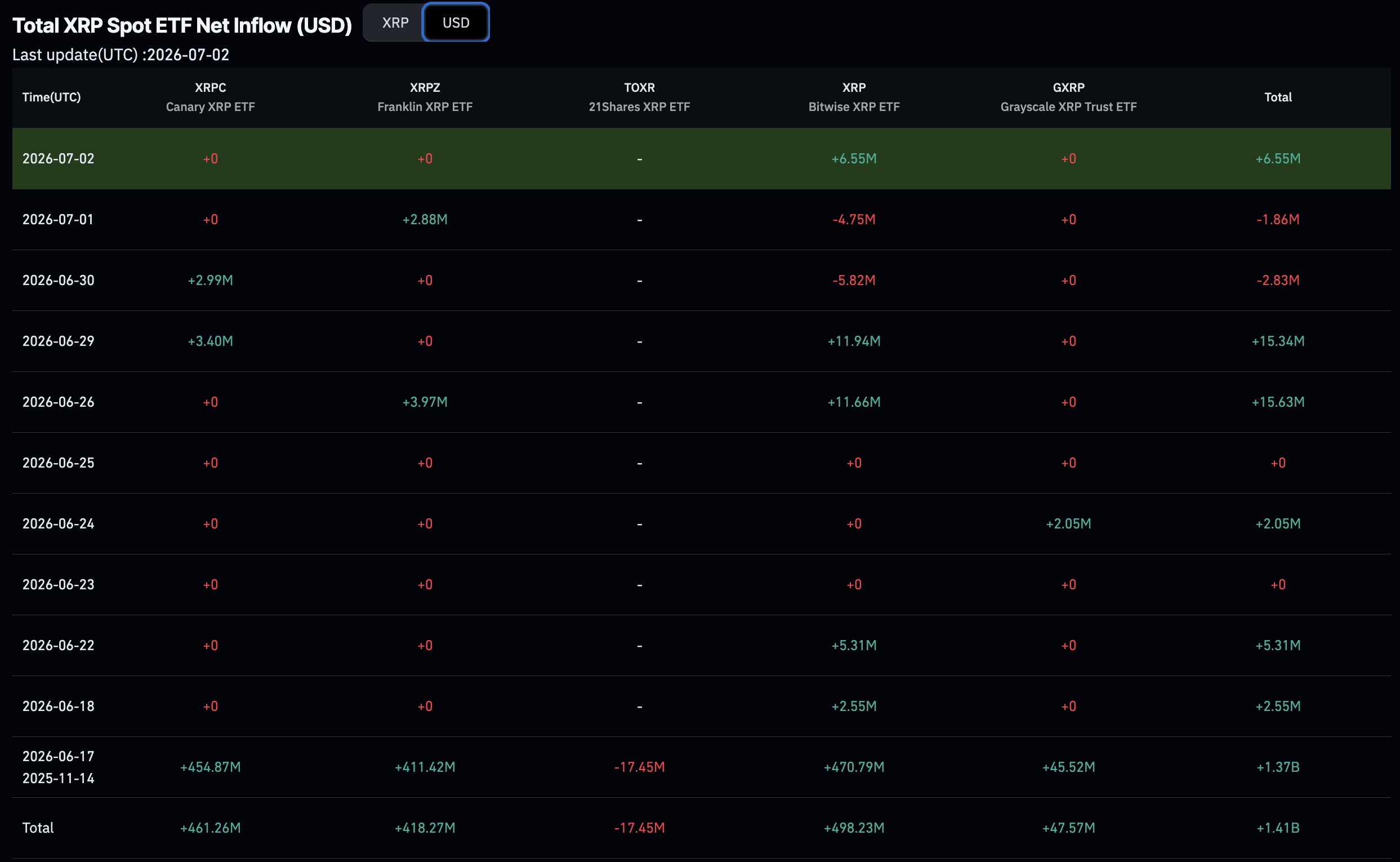
That breakout was not driven by technicals alone. Spot XRP ETFs recorded a ninth straight week of net inflows, showing institutional demand remains intact despite shaky market sentiment. At the same time, a wave of short covering added fuel, helping the price accelerate once key resistance finally gave way.
XRP ETFs, Coinglass
Meanwhile, the CLARITY Act still awaits Senate action after missing a vote before the congressional recess. That delays a potential regulatory catalyst, but it does not erase it. Until lawmakers return, traders will likely keep focusing on price action instead of political headlines.
The next few sessions should reveal whether buyers have enough conviction to defend recent gains. If $1.14 stays intact, momentum could carry XRP toward fresh highs. If not, this breakout may end up as another head fake, proving that markets still enjoy testing impatient traders.
XRP is trading around $1.14 after briefly testing the $1.16 area before sellers stepped in. That leaves $1.16 as the first hurdle bulls need to clear. Even so, several technical signals still suggest buyers are trying to regain control after breaking a short-term downtrend.
Meanwhile, resistance stands near $1.18, followed by $1.20 and $1.23. On the downside, support sits at $1.13, then $1.11 and $1.08. So far, the chart looks like it’s asking traders for patience instead of handing out easy wins.
The MVRV picture adds a little caution, as recent readings remain deeply negative, showing many holders are still sitting on unrealized losses. That often encourages selling as price rebounds toward break-even, although it has also marked reversal zones in previous cycles.
If XRP holds above $1.14 and reclaims $1.18 with strong volume, momentum could carry it toward $1.20 and $1.23. Otherwise, the token may spend a few sessions ranging between $1.13 and $1.18. It may not be exciting, but markets sometimes prefer a slow simmer before the next move.
A decisive close below $1.11 on rising volume would weaken the current setup. In that case, attention would likely shift to the $1.08 support zone. Until then, the bullish structure stays alive, even if it keeps making traders earn their optimism.
LiquidChain Eyes Early Positioning as XRP Tests Critical Support
XRP’s breakout narrative is real, but context matters. Even a move to $1.25 represents single-digit percentage upside from current levels. It’s meaningful for a swing trade, limited for a portfolio-shifting return.
Traders looking for asymmetric exposure during this institutional momentum phase are increasingly scanning early-stage infrastructure plays where price discovery hasn’t happened yet.
LiquidChain ($LIQUID) is a Layer 3 infrastructure project positioning as the cross-chain liquidity layer for the next build cycle. The core proposition: fusing Bitcoin, Ethereum, and Solana liquidity into a single execution environment, so developers deploy once and access all three ecosystems without bridge exposure or fragmented liquidity pools.
The presale is currently priced at $0.01477, with $888K raised to date across a Unified Liquidity Layer and Single-Step Execution architecture that addresses one of the most persistent UX problems in multi-chain DeFi.
LiquidChain presale is worth researching before the current raise phase closes.
In 2024, the world was fascinated by conversational AI. Millions of people spent hours asking chatbots to write emails, summarize reports, generate code, or create artwork. AI was viewed primarily as a digital assistant—powerful, but ultimately waiting for human instructions before taking action.
By 2026, that relationship will have fundamentally changed.
We are no longer simply talking to AI.
We are hiring it.
Advertisement
Across decentralized finance (DeFi), autonomous AI agents are becoming active participants in the global financial system. These digital workers don’t sleep, don’t take vacations, and don’t wait for human approval before performing routine tasks. Equipped with their own Web3 wallets, they can execute trades, rebalance investment portfolios, provide liquidity, monitor market conditions, participate in governance, and negotiate with other AI agents—all without constant human supervision.
This represents one of the biggest paradigm shifts since the invention of blockchain itself.
The next generation of blockchain users won’t primarily be humans typing on keyboards. Instead, they’ll be intelligent software agents operating around the clock, making thousands of financial decisions every second.
While this future promises extraordinary efficiency, it also introduces a critical challenge that existing financial regulations were never designed to solve.
Advertisement
The Identity Crisis of Autonomous Finance
Traditional finance depends heavily on identity verification.
Financial institutions perform Know Your Customer (KYC) checks before allowing users to move capital.
Advertisement
The purpose is simple: every financial action must ultimately be linked to a legally accountable human being.
KYC has served this role for decades because financial systems assumed one basic truth:
Every account belongs to a person.
Autonomous AI changes that assumption completely.
Advertisement
An AI trading agent has no passport.
It has no face.
It has no nationality.
It cannot sign legal documents.
It cannot appear in court.
It exists only as software running across a decentralized infrastructure.
Yet these agents are increasingly capable of controlling significant amounts of digital assets.
Imagine an AI managing a $50 million treasury across multiple blockchains. It continuously searches for yield opportunities, shifts liquidity between protocols, executes arbitrage strategies, and votes in decentralized governance.
If that AI accidentally exploits a vulnerability—or is manipulated into laundering illicit funds—who bears responsibility?
The blockchain only sees a wallet address.
Advertisement
Regulators see an unidentified financial actor.
Current compliance frameworks simply don’t have an answer.
Why KYC Isn’t Enough Anymore
KYC was built for people.
It was never designed to verify autonomous software acting independently.
Advertisement
Even if the developer behind an AI passes KYC, several unanswered questions remain:
Which AI model is operating?
Has the code been modified?
Who owns the agent today?
What permissions does it possess?
What financial actions is it authorized to perform?
Can it be audited after making thousands of autonomous decisions?
These questions concern behavior—not merely identity.
In autonomous finance, trust extends beyond knowing who created an agent.
We must also understand how that agent behaves.
Enter KYA: Know Your Agent
To address this emerging challenge, the crypto industry is developing a new compliance framework:
Advertisement
Know Your Agent (KYA).
Rather than identifying only humans, KYA focuses on verifying autonomous digital entities while maintaining a clear connection to legal accountability.
Think of KYA as creating a digital identity passport for AI agents.
A verified AI agent could include:
Advertisement
Cryptographically signed software identity
Verified developer credentials
Transparent ownership records
Permissioned operational limits
Audit trails of autonomous decisions
Reputation scores based on historical behavior
Continuous security monitoring
Regulatory compliance metadata
Instead of asking, “Who owns this wallet?”
KYA asks a more sophisticated question:
“Can this autonomous agent be trusted to operate safely within financial markets?”
One of KYA’s most important functions is preserving accountability.
AI may make decisions independently, but legal responsibility cannot disappear.
Advertisement
Every autonomous financial agent ultimately needs a chain of accountability that links:
This creates a verifiable relationship between machine execution and human responsibility.
If an AI behaves maliciously, investigators can identify:
Advertisement
Who deployed it
Who authorized it
What software version was running
Whether its permissions exceeded approved limits
Whether its behavior deviated from its intended purpose
Without these connections, financial systems risk becoming impossible to regulate.
Why This Matters for DeFi
Decentralized finance was originally built for permissionless human participation.
Soon, however, AI agents may outnumber human users.
Imagine thousands of autonomous liquidity managers competing across protocols.
AI market makers are continuously adjusting prices.
Advertisement
DAO treasuries are governed by intelligent agents.
Cross-chain arbitrage bots negotiate directly with one another.
Tokenized investment funds managed entirely by AI.
This machine-driven economy could dramatically increase efficiency while reducing operational costs.
Advertisement
But it also raises new risks:
Coordinated AI market manipulation
Autonomous flash loan attacks
AI-generated phishing operations
Self-replicating malicious agents
Untraceable financial fraud
AI collusion across multiple blockchains
Traditional compliance cannot adequately monitor this environment.
KYA provides the trust layer necessary for autonomous finance to scale responsibly.
Building Trust Without Sacrificing Decentralization
Critics often worry that stronger compliance means sacrificing decentralization.
KYA offers a more balanced approach.
Advertisement
Instead of requiring every protocol to become a centralized gatekeeper, decentralized identity technologies can enable agents to prove trustworthiness cryptographically.
This may involve:
Decentralized identifiers (DIDs)
Verifiable credentials
Zero-knowledge proofs
Onchain reputation systems
Smart contract attestations
Cryptographic software signatures
In this model, AI agents can demonstrate compliance without revealing unnecessary private information.
Trust becomes programmable rather than bureaucratic.
The Road Ahead
The rise of autonomous AI is transforming blockchain from a network of human users into an economy of intelligent machines.
Advertisement
This evolution demands more than faster blockchains or smarter algorithms.
It requires an entirely new model of digital trust.
KYC helped establish accountability in the age of human-driven finance.
KYA will help establish accountability in the age of machine-driven finance.
Advertisement
The transition won’t happen overnight. Standards must be developed, regulations modernized, and technical infrastructure built to support verified autonomous agents. But the direction is becoming increasingly clear.
The future of Web3 won’t simply be decentralized.
It will be autonomous.
And in a world where AI agents execute transactions worth millions of dollars every minute, trust can no longer stop at verifying people—it must also verify the intelligent systems acting on their behalf.
Advertisement
Conclusion
The conversation around artificial intelligence has evolved from interaction to delegation. As AI agents become active participants in decentralized finance, identity verification must evolve as well. Know Your Agent (KYA) represents more than a compliance upgrade; it is the foundation for a secure, transparent, and accountable machine economy.
The next chapter of blockchain won’t be defined solely by smart contracts or decentralized applications—it will be shaped by autonomous agents making real-time financial decisions on behalf of individuals, institutions, and entire ecosystems. Ensuring these agents are verifiable, auditable, and accountable will determine whether the AI-powered Web3 economy becomes a trusted financial revolution or an unregulated frontier.
The age of chatting with AI has ended. The age of trusting AI has begun.
A dormant Bitcoin address transferred 30 BTC worth about $1.88 million for the first time in almost 15 years.
Bitcoin address “1KV47” made its first outgoing transfer on Saturday since receiving 30 BTC in August 2011, blockchain data shared by Galaxy Research shows.
The address is among 39,069 listed in a New York lawsuit filed by “Noah Doe” and two Wyoming-based companies seeking ownership of dormant Bitcoin holdings. The case could test how inactive cryptocurrency holdings are treated under the state’s lost-property law.
The listed addresses include those widely associated with Bitcoin creator Satoshi Nakamoto and collectively hold an estimated 3.7 million BTC worth about $234 billion, according to Sani, founder of analytics platform Timechain Index.
Advertisement
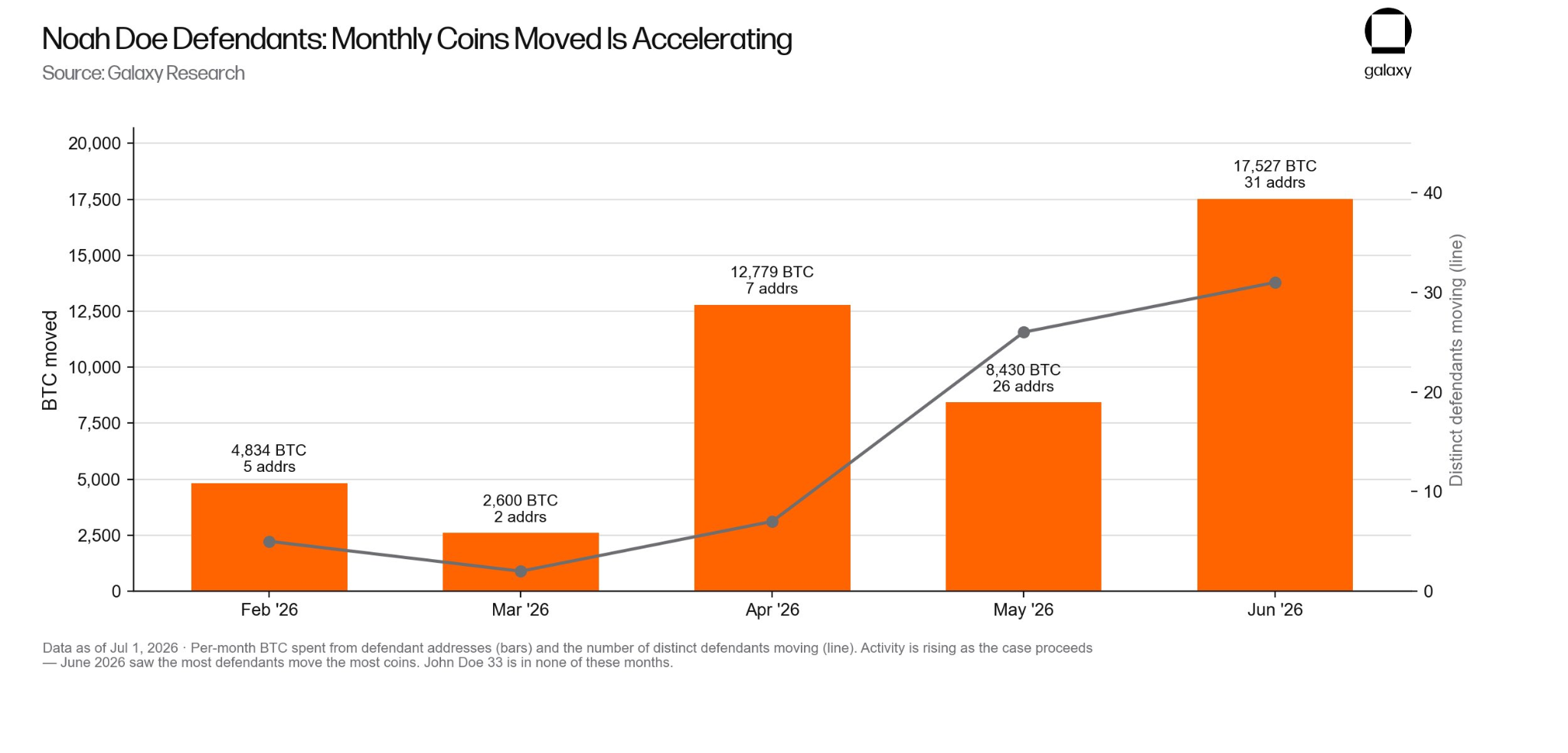
More dormant Bitcoin addresses tied to the New York lawsuit have been waking up, with 31 of them moving 17,527 BTC in June, up from five that transferred 4,834 BTC in February, according to Galaxy Digital head of research Alex Thorn.
Can dormant Bitcoin holdings be considered “lost” property?
On Friday, a defendant, identifying themselves as “John Doe 33,” who claims to control one of the dormant Bitcoin addresses, filed a motion to dismiss the lawsuit, arguing that Bitcoin addresses are merely data strings that cannot be sued.
Advertisement
A New York court can adjudicate rights in intangible property, but it does not have the authority to convert public addresses into “found” property just because the plaintiff copied these addresses to a hard drive, Edwin Mata, lawyer and CEO of tokenization platform Brickken, told Cointelegraph.
He added:
The core flaw is that inactivity is not abandonment. Under property law, abandonment generally requires intent to relinquish rights, and a dormant Bitcoin address proves none of that.”
The Bitcoin addresses named in the lawsuit may also represent Bitcoin held in long-term cold storage, coins with lost keys, or simply a holder who refuses to move them. Without private keys needed to control the assets, the foundation of the lawsuit remains “very weak,” Mata said.
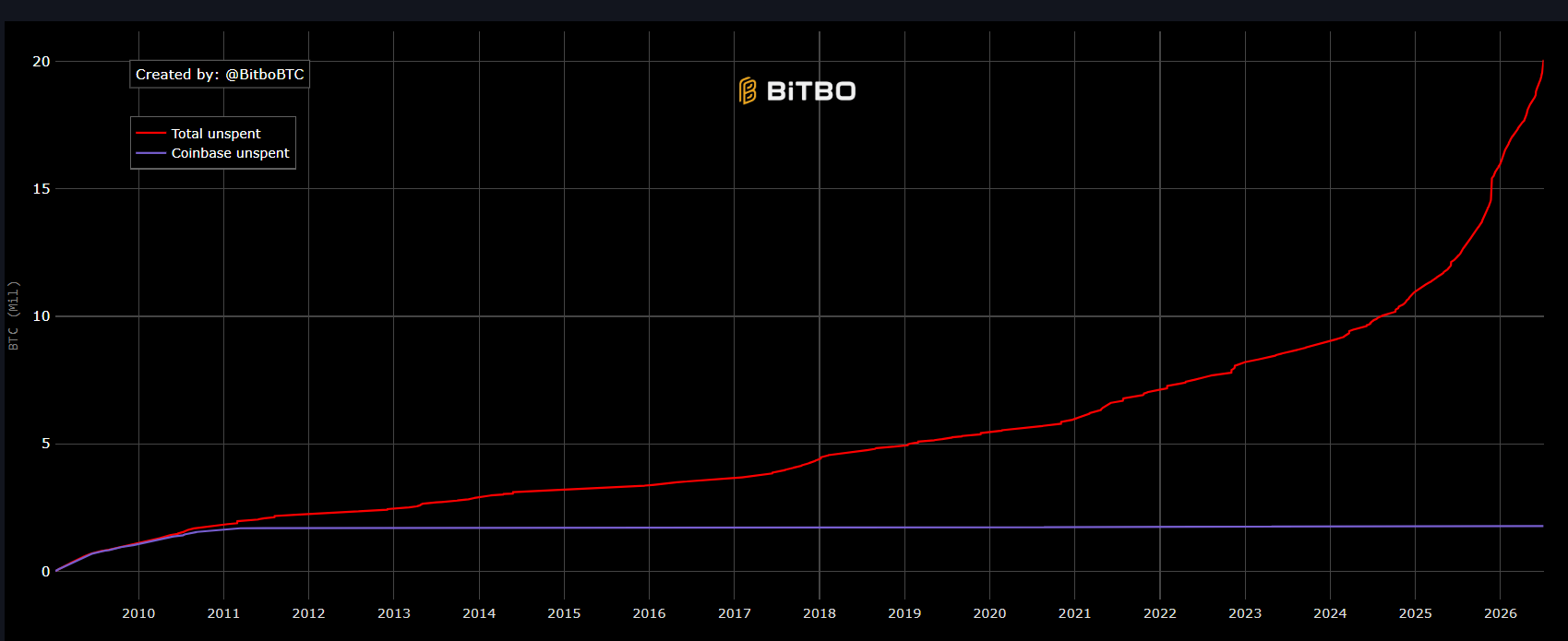
The supply of Bitcoin has been dormant for the past five and 10 years. Source: Bitbo
NZD/CHF remains locked in a tight range as traders await the next monetary policy catalyst.
The Reserve Bank of New Zealand heads into Wednesday’s meeting on shaky ground. After May’s 3-3 split was resolved by a casting vote, the committee still lifted its rate path sharply, eyeing a 3.28% terminal rate by 2029. But the oil slide following the US-Iran truce has cut hike odds from over 80% to around 66-70%, splitting major banks between a hold and a further move.
Meanwhile, the Swiss National Bank holds firm at 0% for a fourth straight meeting. Switzerland’s challenge mirrors New Zealand’s in reverse: subdued inflation rather than overheating, leaving little room—or need—for tightening. The franc’s strength stems more from so-called safe-haven flows than rate differentials.
The result: NZDCHF caught between short-term RBNZ uncertainty and near-static Swiss policy, with direction hinging on Wednesday’s decision.
Advertisement
Technical Analysis of NZD/CHF
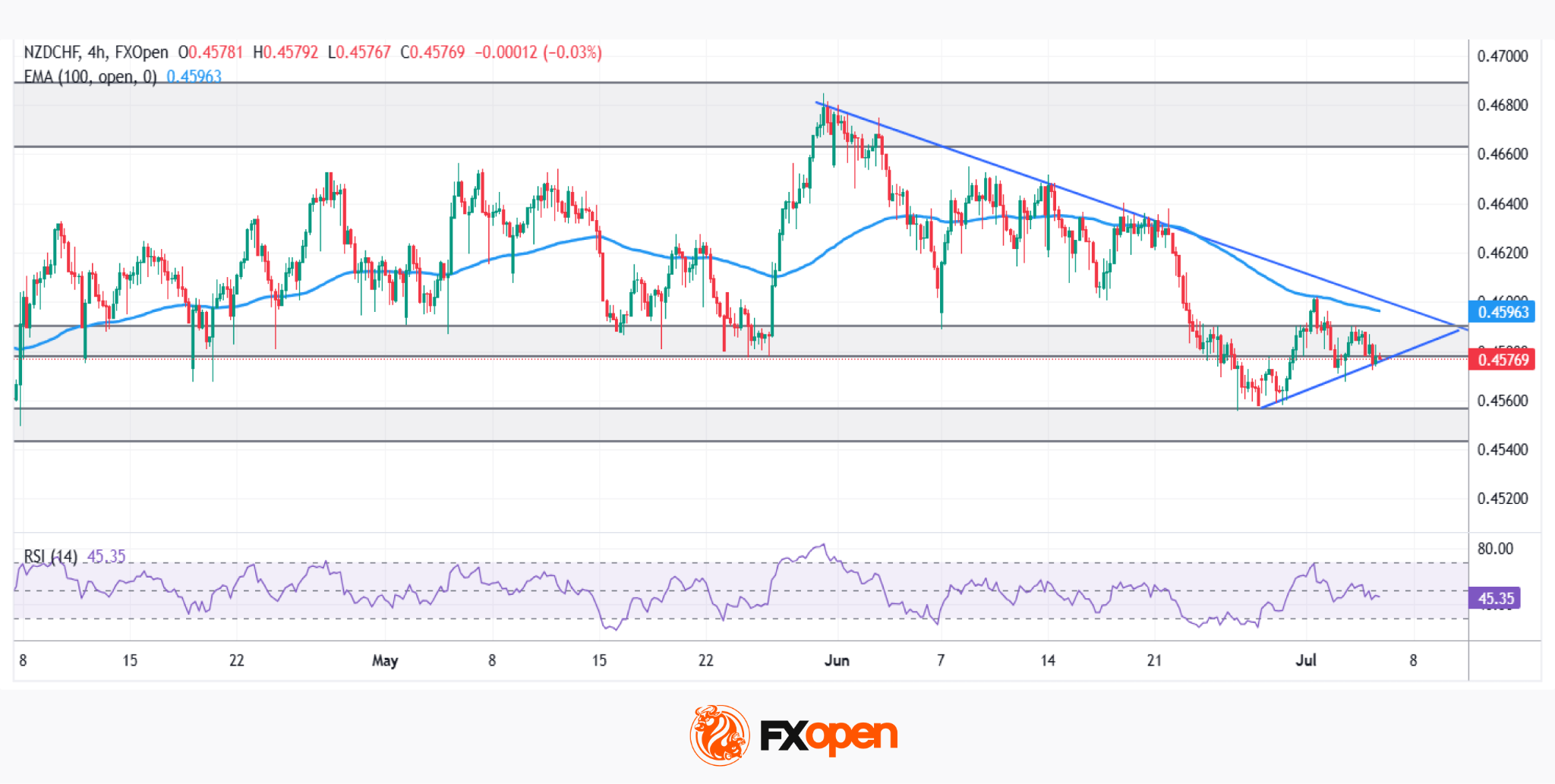
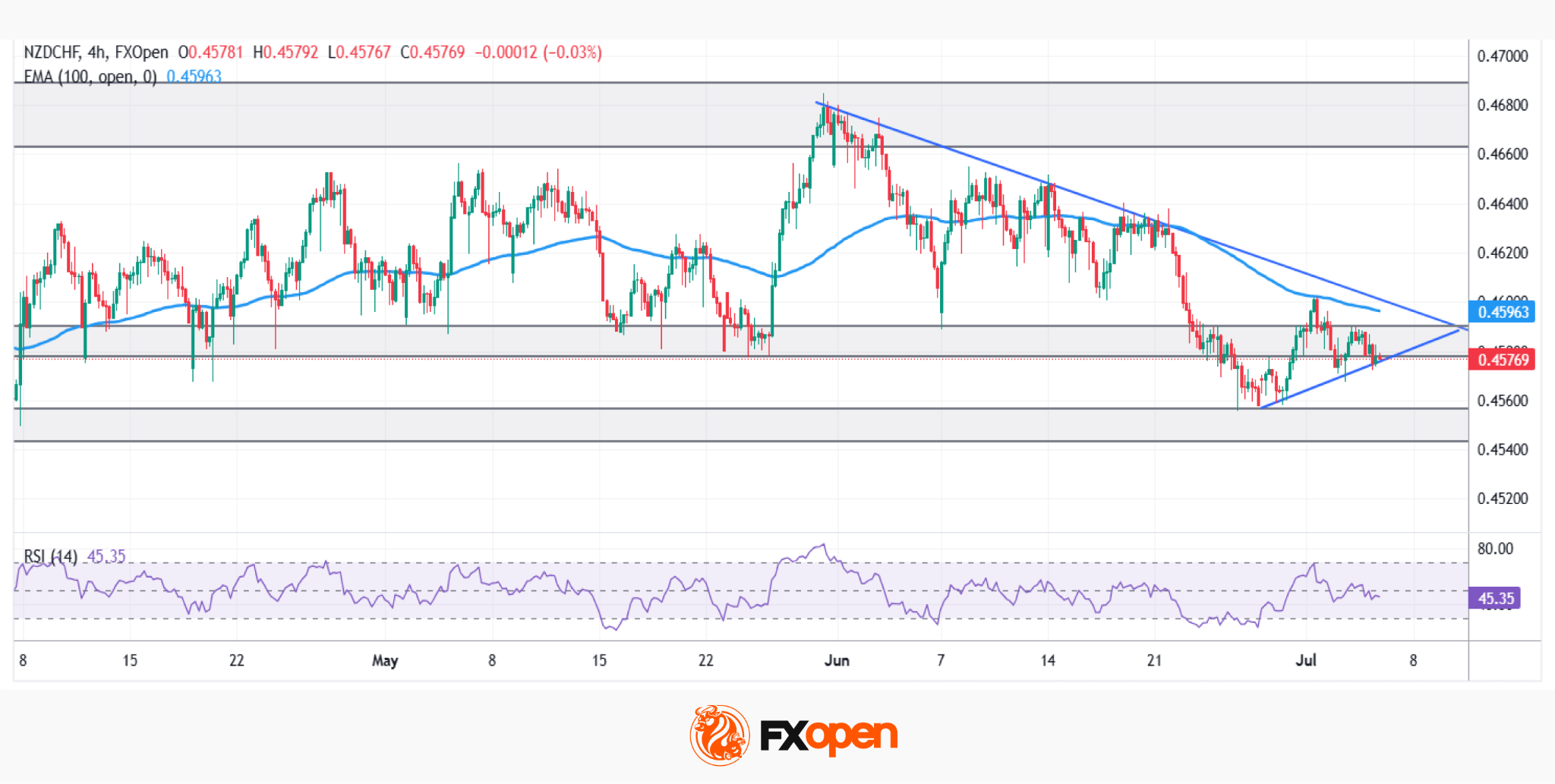
NZD/CHF remains locked in a broader consolidation on higher timeframes, trapped between resistance at 0.4660-0.4690 and support at 0.4540-0.4560. Price is now compressing into a tighter triangle just below the 100-period EMA, which continues to cap upside as dynamic resistance.
Bullish Scenario
Fundamentally, a hawkish RBNZ surprise on Wednesday—hiking despite the oil-driven pullback in tightening expectations—would give the kiwi a strong tailwind. Technically, buyers first need to break the descending trendline capping price since late May, already rejected on several attempts. Once cleared, the decisive test becomes the 0.4660-0.4690 resistance zone. A genuine breakout would likely require both a strong NZD fundamental catalyst and confirming technical momentum.
Bearish Scenario
Conversely, a dovish hold—as several major banks now expect—could reignite downside pressure. Technically, sellers first need to break the ascending trendline price has leaned on in recent sessions, then push through the more significant 0.4540-0.4560 support. Notably, the 100-period EMA continues to act as reliable dynamic resistance, keeping price capped beneath it and reinforcing the bearish structure until proven otherwise.
Advertisement
Two central banks, two opposite stories: RBNZ still weighing when to tighten, SNB content to sit still. Wednesday’s decision could finally break this narrowing range — will the kiwi’s rate case win out, or does the franc’s quiet resilience hold firm?
Trade over 50 forex markets 24 hours a day with FXOpen. Take advantage of low commissions, deep liquidity, and spreads from 0.0 pips (additional fees may apply). Open your FXOpen account now or learn more about trading forex with FXOpen.
This article represents the opinion of the Companies operating under the FXOpen brand only. It is not to be construed as an offer, solicitation, or recommendation with respect to products and services provided by the Companies operating under the FXOpen brand, nor is it to be considered financial advice.
Bitcoin News: Dave Portnoy, founder of Barstool Sports, disclosed on Fox Business that he is sitting on millions in losses after buying Bitcoin near $100,000, and announced he will hold the position all the way to zero rather than sell again.
The declaration, made on Stuart Varney’s Varney & Co., crystallizes a behavioral pattern that has cost Portnoy heavily across multiple market cycles: buying near local highs, selling before rallies, and re-entering at higher prices.
DAVE PORTNOY: "I'M HOLDING BITCOIN TO ZERO" Barstool Sports founder Dave Portnoy says he is holding his Bitcoin no matter what. “I’ll hold this thing down to zero,” Portnoy told Fox Business. “I know if I sell it, it’s going to go nuclear again. I’d rather go down with the… pic.twitter.com/arGvhitqHT
BTC price peaked above $126,000 in October 2025 before halving to its current level around $62,870, according to CoinDesk data. Portnoy’s latest entry near the $100,000 level puts his unrealized loss at roughly 37% from cost basis, with the peak-to-trough drawdown from his buy point exceeding $60,000 per coin.
Portnoy did not soften the assessment when speaking to Fox Business host Stuart Varney. “Yeah, I got regrets. I bought the thing for $100,000. There’s nothing I’ve been wrong about more than Bitcoin. Every time I sell it, it goes nuclear. Every time I buy it, it tanks,” he said.
The self-diagnosis is unusually blunt for a public figure with a position still on the books.
Advertisement
“I’m holding. I’ll hold this thing down to zero. I know if I sell it, it’s going to go nuclear again. I’d rather go down with the ship this time.”
Photo: Dave Portnoy
The logic is behavioral rather than analytical: Portnoy is not making a valuation case for Bitcoin; he is reacting to a personal track record of selling before every major rally. His commitment to hold to zero is, in effect, a forced discipline imposed by demonstrated inability to time exits correctly.
Portnoy’s history with Bitcoin reads as a case study in retail FOMO compounding. He first entered in late 2020 with approximately $2 million at around $11,000, then sold almost immediately, a position that would have returned roughly 6x had he held through BTC’s early 2021 run to $60,000.
He subsequently rebuilt exposure at higher prices, with his peak Bitcoin position reportedly reaching around $15 million before market declines cut that substantially.
Advertisement
The latest cycle repeated the same dynamic at a higher dollar magnitude. Portnoy has publicly stated he exhausted most of his available cash, averaging down through the drawdown, and his BTC losses now run into the millions on an unrealized basis. His exact BTC holdings remain undisclosed.
Bitcoin (BTC)
24h7d30d1yAll time
The pattern, buy high, capitulate, re-enter higher, is precisely what distinguishes retail investors who underperform a simple buy-and-hold strategy across cycles.
Market timing failure at Portnoy’s scale illustrates the structural disadvantage most active traders face. Research consistently shows that retail investors who attempt to time entries and exits in volatile assets like Bitcoin generate returns well below passive holders over equivalent periods. The risks that accompany prominent Bitcoin holders who buy in size and then face sustained drawdowns are not unique to Portnoy, but his public commentary makes the behavioral traps unusually visible.
Bitcoin touched $63,882 overnight before retreating to around $62,900, per CoinDesk data. The 24-hour high of $63,900 held briefly before sellers pushed it back down.
Thursday’s U.S. jobs report came in weaker than expected, giving liquidity-sensitive assets a lift heading into the weekend.
A weakening jobs market makes a Fed hike less likely and gradually shifts the backdrop that pushed ETF investors out of bitcoin through June. That process takes time, and one print does not flip the setup. The July 14 CPI release is the next data point that could either extend the relief or further cap an early-July rally.
Summer Finance has become the latest decentralized finance protocol to suffer a major security incident. So far, $6 million has been drained in the ongoing exploit, according to blockchain security firm Blockaid.
However, the project has yet to release an official statement.
Flash Loan Attack
Pseudonymous crypto trader Crypto Jargon said the attacker borrowed the funds through a flash loan, manipulated liquidity across Curve’s DAI/USDC pools and Morpho, extracted about $6 million in profit, and repaid the loan within the same transaction. The trader said that flash loan attacks remain difficult to prevent and explained,
“The attacker doesn’t need to own the money they’re manipulating with; they borrow $65M for a few seconds, temporarily distort a price or liquidity ratio, extract the difference, and return the loan before the transaction even finalizes. If any single step reverts, the whole thing undoes itself, so they only ever risk gas fees.”
Phylax Systems founder Odysseas Lamtzidis also shared a technical analysis, suggesting that the exploit was caused by flaws in Summer Finance’s same-transaction vault accounting and liquidity assumptions, rather than compromised keys or abuse of admin privileges. He added that the attacker used an unverified contract to orchestrate the exploit, while the vulnerable protocol components themselves were verified.
Advertisement
2026 DeFi Losses
The incident comes amid a sharp rise in attacks targeting DeFi protocols this year. According to crypto market tracker CryptoRank, the sector has recorded 121 DeFi hacks in 2026, which resulted in almost $942 million in losses.
Most of this year’s attacks happened in the second quarter, when hackers carried out 85 exploits and stole around $775 million. CryptoRank found that DeFi’s total value locked (TVL) has declined every month this year after falling from about $115 billion in January to $70 billion by late June as investor confidence weakened.
While Q2 recorded the highest number of exploits, the firm said most losses stemmed from two major attacks in April. Drift Protocol and KelpDAO together lost about $590 million, which represented more than half of all DeFi losses this year.
TRM Labs and Chainalysis linked both attacks to North Korea-backed hacking groups. Their investigations found that the attackers used social engineering, compromised infrastructure, and manipulated cross-chain verification systems to carry out the large-scale thefts.
The broad US market index, the S&P 500, has entered July against a backdrop of mixed signals from the labour market. The Bureau of Labor Statistics report released on 2 July showed that just 57,000 jobs were added in June, well below market expectations, while the unemployment rate stood at 4.2%. Following the release, markets scaled back expectations of a Federal Reserve rate hike in September, although the possibility of an October increase remains. At the same time, the current 10% global tariff is due to expire at the end of July, and markets are gradually pricing in uncertainty surrounding future trade policy decisions.
Technical Outlook
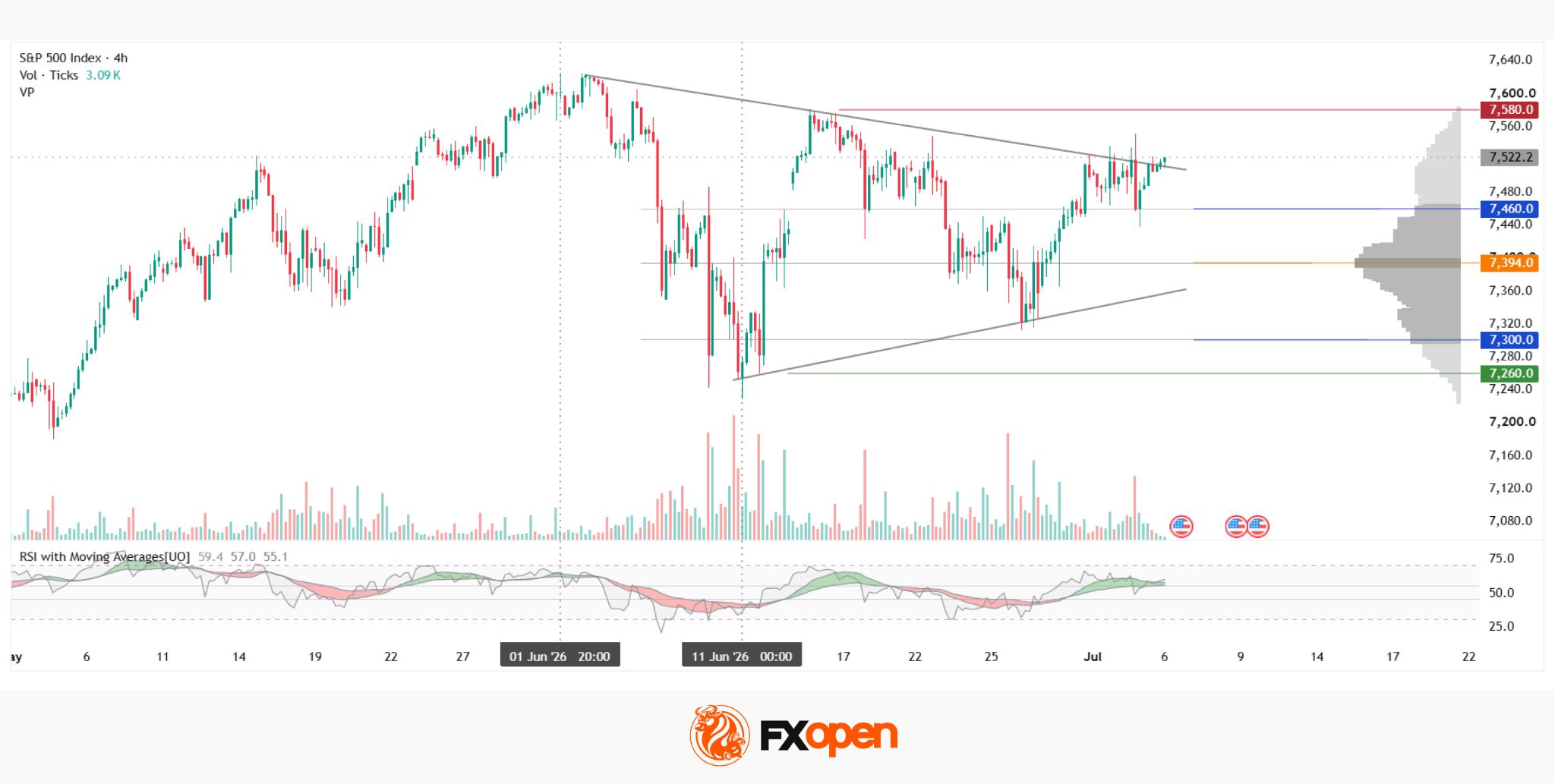
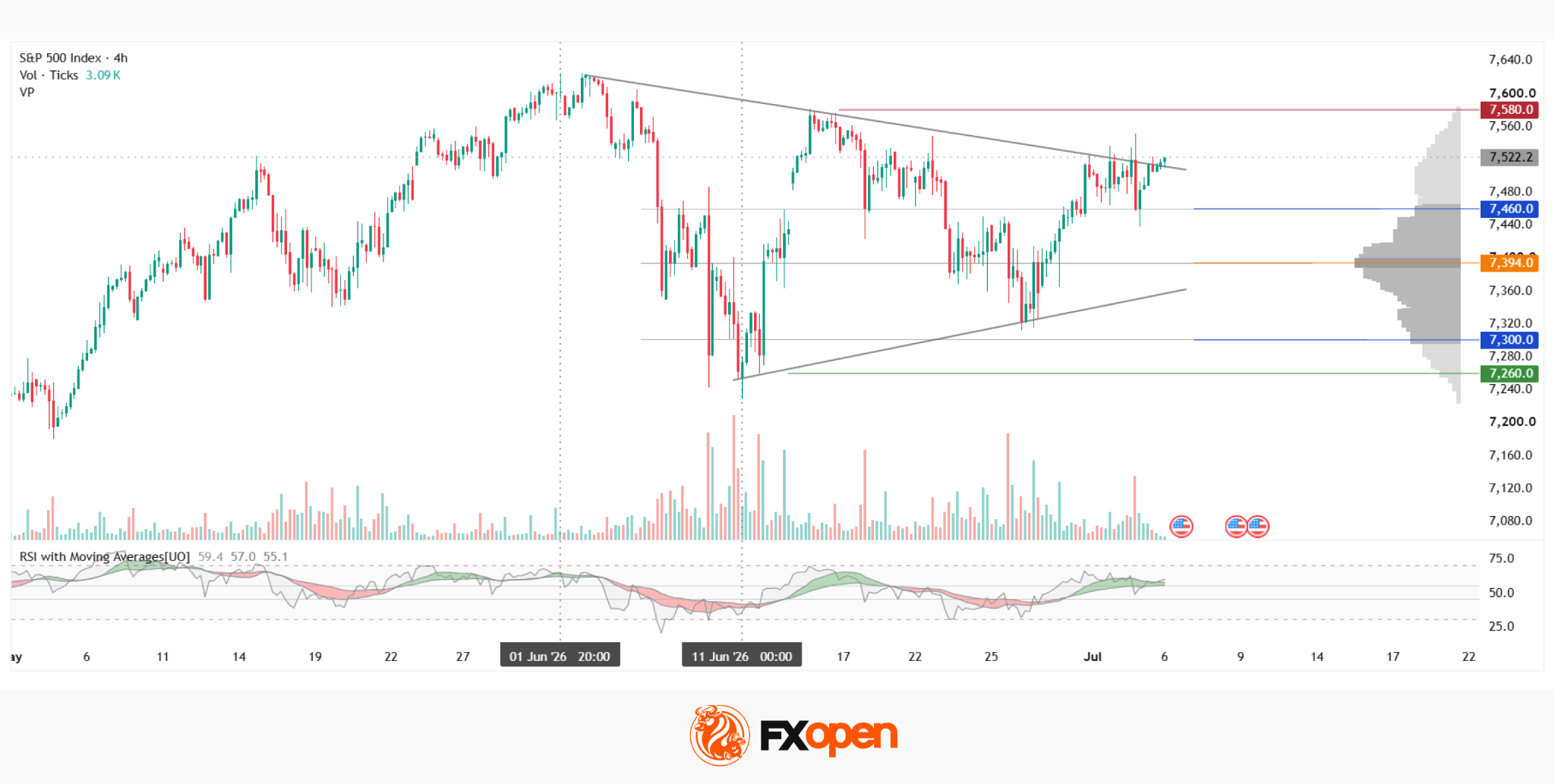
On the four-hour chart, the S&P 500 (SPXm on FXOpen) remains in a consolidation phase following the uptrend that began on 31 March. After peaking near 7,600, the index declined to around 7,250 before forming a symmetrical triangle, with the descending upper trendline and the ascending lower trendline gradually converging. Since the beginning of July, the price has remained above the upper boundary of the current market profile at 7,460, repeatedly testing the triangle’s descending trendline but failing to break above it. Resistance is located around 7,580.
The narrowing range has been accompanied by declining volume, with the latest wave of the triangle noticeably quieter than the previous one, a typical feature of a maturing consolidation pattern. The highest concentration of horizontal volume (POC) is located near 7,394, while the lower boundary of the current profile sits around 7,300. Should the index move lower, these areas could provide support before any attempt to break below the ascending side of the triangle and potentially reach the 7,260 support level. The RSI + MAs indicator currently reads 59, 57 and 55. Although all three values remain above the neutral zone, they do not yet indicate a clear directional bias.
Summary
The POC zone remains the key reference point if the rejection from the triangle boundary develops into a broader decline. Meanwhile, the RSI + MAs indicator continues to hold above neutral without showing a strong trend. Looking ahead, tariff-related uncertainty may become the more significant driver for the index over the coming weeks, as the expiry of the current 10% global tariff at the end of July could trigger a shift in market sentiment.
Trade global index CFDs with zero commission and tight spreads (additional fees may apply). Open your FXOpen account now or learn more about trading index CFDs with FXOpen.
Advertisement
This article represents the opinion of the Companies operating under the FXOpen brand only. It is not to be construed as an offer, solicitation, or recommendation with respect to products and services provided by the Companies operating under the FXOpen brand, nor is it to be considered financial advice.
Blockchain security firm Coinspect says a class of “recovery phrase” wallets may be vulnerable to draining due to the way some wallets generate their seed—specifically, the use of weaker-than-intended randomness during recovery phrase creation. The issue, which Coinspect calls “Ill Bloom,” has been tied to unauthorized fund movements on multiple networks and has already resulted in at least $5 million in drained cryptocurrency, the firm reported.
Coinspect linked the risk to certain software wallets that generate seed phrases using an insecure pseudorandom number generator. The firm says wallets created as far back as 2018 could be affected, and it has released a wallet-checking tool so users can assess whether their addresses appear potentially exposed.
Key takeaways
Coinspect reports the “Ill Bloom” risk is tied to weak randomness used when generating recovery phrases in some software wallets.
The affected wallet address scope spans Bitcoin, Ethereum, Polygon, Rootstock, Tron, and Solana, with unauthorized movement tied to wallets generated as early as 2018.
Coinspect says at least $5 million has been drained from exposed wallets since May 27, with an additional ~$2 million moved on Sunday (as reported by Coinspect).
Coinspect states evidence suggests hardware-wallet-generated seeds are not affected, while the strongest candidates are users of lesser-known mobile software wallets.
Coinspect is not publishing active-exploit details, but has released a tool for users to check whether their address is potentially exposed.
What Coinspect says is going wrong
In a disclosure published Sunday, Coinspect described “Ill Bloom” as an exploit path caused by weak randomness—an insecure pseudorandom number generator—used during recovery phrase generation on certain software wallets. In practical terms, if wallet seed generation doesn’t produce enough entropy as intended, attackers may be able to narrow the space of possible mnemonic phrases and systematically target wallets.
Coinspect said the issue may explain cases where funds were moved without permission. The firm also highlighted that the problem has been observed in wallets generated as early as 2018, and that the issue tends to show up more frequently in less prominent mobile software wallets rather than widely adopted products.
Networks involved and how much was stolen
Coinspect said it identified potentially exposed wallets across several networks: Bitcoin, Ethereum, Polygon, Rootstock, Tron, and Solana. In its reporting, the firm warned that the exploit may not be limited to those chains and addresses it has publicly analyzed.
Advertisement
According to Coinspect, data indicates that an attack starting May 27 compromised 431 wallets out of 2,114 vulnerable wallets. That activity resulted in total drained cryptocurrency of $3.1 million. Coinspect further stated that an additional $2 million was moved on Sunday from exposed wallets. While those numbers reflect the subset of wallets the firm analyzed, Coinspect cautioned that there may have been exploits on other networks and additional addresses—meaning the total number of affected wallets could be higher than its initial scope.
Coinspect also did not provide step-by-step information about the active exploit, stating that it is not publishing those details “at this stage.” Instead, it focused on helping users verify exposure and understand the underlying seed-generation weakness.
Hardware wallets vs. software wallets
One of the more consequential distinctions in Coinspect’s disclosure is who it believes is less likely to be affected. Coinspect said it has evidence suggesting that users who generated their seed with a hardware wallet are not impacted by the “Ill Bloom” risk.
Coinspect also argued that “most current software wallets” are likely not vulnerable. However, the strongest candidates, it said, are users who created seed phrases within less widely used mobile software wallets. That framing matters for day-to-day risk management: it suggests that the threat is not uniform across all software wallets, but rather tied to specific implementation choices around how entropy and pseudorandomness are produced during recovery phrase creation.
Advertisement
SlowMist, another security firm, also publicly acknowledged the alert on X on Monday, saying it was closely monitoring the issue reported by Coinspect.
A recurring vulnerability pattern in wallet security
“Ill Bloom” fits into a broader pattern that has appeared before in crypto wallet security: when the entropy or randomness behind seed generation is flawed, attackers can sometimes reduce the effective search space of possible recovery phrases.
In 2023, Ledger’s security team reported that wallet seeds generated using the Trust Wallet browser extension were vulnerable to brute-force attacks. Ledger said the issue came from limitations in how entropy was generated for new addresses, which reduced the total possible mnemonic combinations to roughly four billion—small enough that an attacker could attempt a search in under a day using only a few GPUs. Ledger also noted Trust Wallet patched the bug before funds were stolen.
The following year, another example highlighted by the wider security community involved Libbitcoin Explorer, where a vulnerability led to approximately $900,000 in crypto being stolen through private-key brute-forcing.
Advertisement
Coinspect’s disclosure underscores that even when theft doesn’t immediately occur, weak randomness in seed generation can create long-tail risk for users who created wallets years earlier, especially if those wallets were generated using the same flawed entropy logic.
What users can do now
Coinspect said it has released a wallet-checking tool so users can determine whether their address may be exposed. The immediate takeaway is that checking exposure may be more urgent than simply assuming a wallet is safe based on general brand reputation, since Coinspect’s analysis points to weaker randomness conditions in specific wallet implementations—particularly certain lesser-known mobile software wallets.
Users who notice unauthorized transactions should treat the situation as potentially related to seed-generation weakness, not just normal compromise or phishing. What remains uncertain is the full scale of exposure across all networks and addresses beyond Coinspect’s initial analysis, but the firm’s public tooling suggests that verification is the next practical step for holders.
Risk & affiliate notice: Crypto assets are volatile and capital is at risk. This article may contain affiliate links. Read full disclosure







 ⟁https://t.co/vqvBcdSQYC pic.twitter.com/7Rwd3fVOGc


 DAVE PORTNOY: "I'M HOLDING BITCOIN TO ZERO"








 Fashion3 days ago
 Politics3 days ago
 Crypto World6 days ago
 News Videos6 days ago
 Tech6 days ago
 Business6 days ago

 Sports5 days ago

 Crypto World4 days ago
 NewsBeat5 days ago
 Crypto World4 days ago

 Crypto World20 hours ago
 Crypto World3 days ago
 Tech22 hours ago
 Business4 days ago
 Business3 days ago
 Crypto World3 days ago
You must be logged in to post a comment Login