
Crypto World
Cardano’s Hoskinson Bets Big on AI as Midnight City Development Pushes Forward



Charles Hoskinson is making a stronger case for artificial intelligence as work on Midnight City progresses. The Cardano founder now treats agents as the backbone of how the network communicates and scales.
Below is a breakdown of his recent remarks, plus a closer look at what Midnight City is actually trying to prove.
How Hoskinson Frames AI’s Role in Cardano’s Next Phase
AI agents act autonomously, trading, posting, and coordinating without a human behind the keyboard. Hoskinson is leaning into that definition after fielding pushback over recent experiments tied to Cardano’s official channels.
The complaints centered on a synthetic influencer that surfaced on the Input Output account. Followers were not impressed.
However, Hoskinson defended the move as a transparent trial-and-error, arguing that the team is showing what these tools can do rather than hiding behind polished output.
He also pointed to OpenClaw, an open-source agent project he sees gaining traction at a remarkable speed. For Hoskinson, that growth is a signal. The future of crypto communication will not be carried by a handful of community managers tweeting in real time.
“We’re going to need agents and AI to be able to organize and sort all that out and broadcast on a regular basis what’s going on in Midnight City,” Hoskinson said. As a result, AI is now treated as core infrastructure for the entire Cardano ecosystem.
Follow us on X to get the latest news as it happens.
His reasoning is structural. A blockchain community that grows from thousands to millions cannot be supported by linear hiring. As a result, automation has to take over the routine layer of reporting, moderation, and outreach across every channel that matters.
Hoskinson sketched out what comes next in stronger terms. He talked about AI chief marketing officers, broadcasting tools that feel lifelike, and a long bet on integrating every emerging standard. The shift, in his view, will redefine how protocols introduce themselves to new users.
Why Midnight City Is Becoming the Showcase for That Vision
Midnight City is a live demonstration of what Hoskinson describes. Running on the Midnight Network, it is a digital environment populated by autonomous characters that transact, talk, and behave according to the memory and personality assigned to each.
Visitors can switch the lens they look through. The default view shows only what is committed openly to the chain. An auditor’s view, by contrast, reveals selective information to anyone with the right cryptographic clearance, mirroring how compliance might work in practice.
A third layer, sometimes called God mode, lifts the curtain on each agent’s internal state. Users can see goals, memory, and history that would normally stay private. The point is to teach observers how selective disclosure actually behaves, not just describe it in a white paper.
“It’s why it’s one of our most important projects and we’re leaning into it and integrating every single AI standard,” Hoskinson said. The Cardano founder added that the team will keep experimenting with how the technology evolves across the coming quarters.
The infrastructure underneath is built for volume. Shielded transactions are first wrapped in zero-knowledge proofs. Furthermore, batches are run in Trusted Execution Environments before being anchored back to the base layer via cryptographic checks.
Hoskinson sees real growth potential beyond the demo. Agentic trading and affiliate-style relationships, he argues, could pull millions of fresh users into Midnight as the simulation evolves. That is why he describes the project as one of the most important on Cardano’s plate.
The wider context also explains the urgency. Crypto is moving on two fronts at once: privacy-preserving computation and the rise of on-chain agents that coordinate economic activity.
Subscribe to our YouTube channel to watch leaders and journalists provide expert insights.
The post Cardano’s Hoskinson Bets Big on AI as Midnight City Development Pushes Forward appeared first on BeInCrypto.

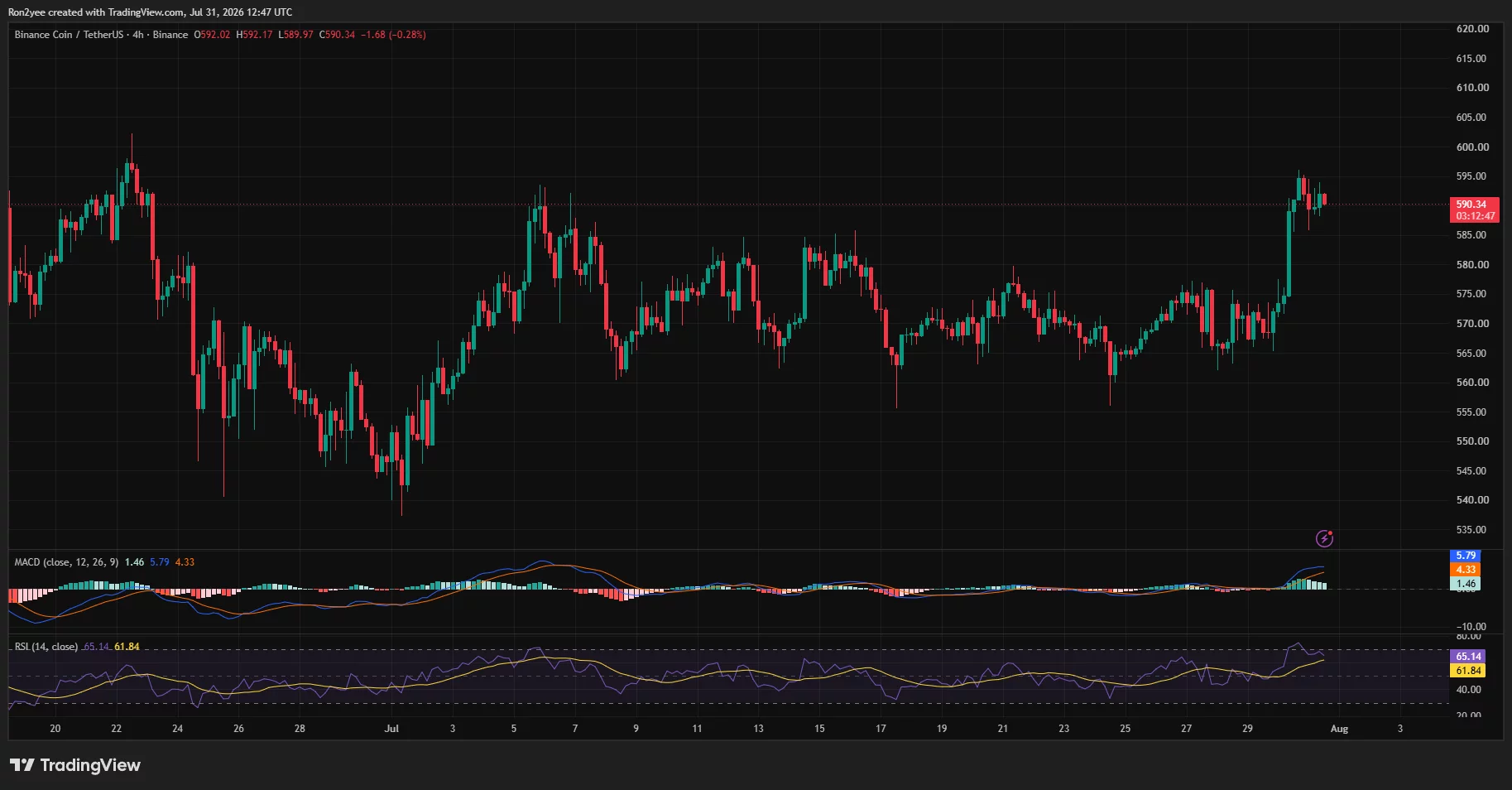
BNB price rallied more than 5% before sellers halted the advance near $600, leaving the token at about $590 on July 31 as traders assessed whether its breakout can hold.
Summary
- BNB price climbed above $590 after breaking a descending trendline that had capped price for about 45 days.
- The daily price moved above the Bollinger Band’s $587.85 upper boundary, signaling strong but stretched momentum.
- A 3-day liquidation heatmap shows major liquidity clusters near $580 and $605–$610.
- 4-hour RSI remains bullish at 65.14, while the MACD continues to favor buyers.
BNB price action today
According to data from crypto.news, BNB (BNB) price surged from the $570 area and reached an intraday high near $595 before easing to approximately $590 at the time shown on the charts. The move carried the token out of the narrow range that had controlled trading during the second half of July.
The 4-hour chart shows a sharp breakout candle above $575, followed by an extension toward $595. Buyers have since defended the $586–$590 region, although several upper wicks near $595 show that sellers remain active below the psychological $600 level.
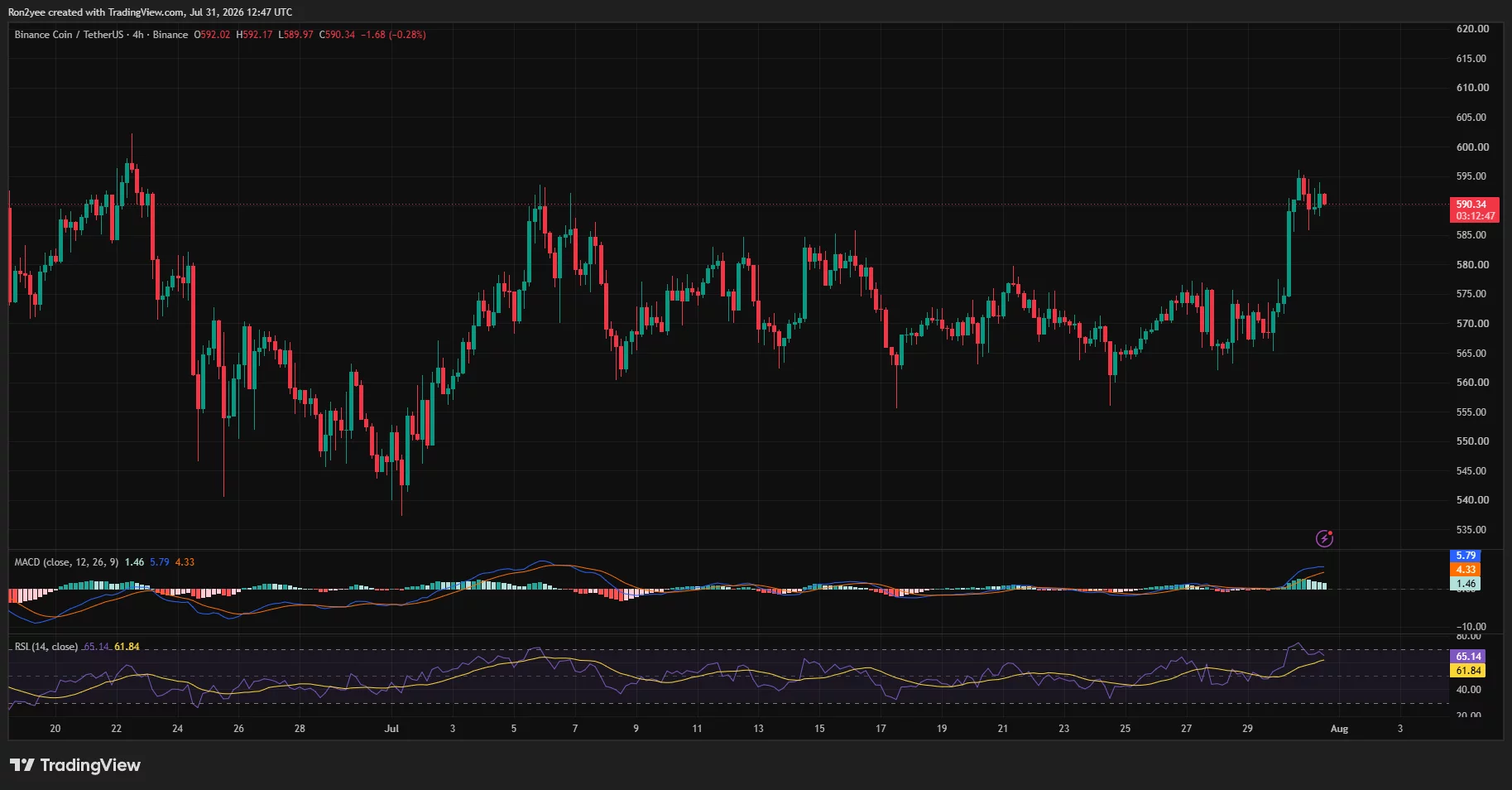
BNB has tested this broader resistance area several times since June. Price reached nearly $598 on June 22 and approached $594 in early July, but neither attempt produced a sustained move above $600.
The latest breakout is stronger than the previous tests because it followed a period of higher lows around $560–$570. However, BNB must still close above $600 to confirm that the wider consolidation has ended.
What is driving the BNB move?
Technical positioning appears to be the immediate driver. BNB broke above a descending resistance line that had connected lower highs since the token traded near $632 in mid-June.
Analyst Hanah described the move as a possible change in short-term momentum after 45 days of downward pressure.
“If BNB can hold above the breakout level, it could pave the way for a stronger bullish continuation.”
Network activity has also provided a fundamental backdrop for the recovery. BNB Chain reportedly processed about $19 billion in weekly decentralized exchange volume, placing it ahead of Ethereum and Solana during the measured period. Network utilization also rose from roughly 17% to nearly 30%.
SilentSwap’s integration added another use case by bringing private cross-chain swaps to the ecosystem. Rising transactions and gas usage may support demand for BNB, which users need to pay fees across BNB Chain.
Still, those developments do not guarantee that price will clear $600. The immediate rally remains heavily influenced by technical positioning and liquidity concentrated around nearby resistance.
BNB indicators favor buyers but show stretched conditions
BNB closed near $590.15 on the daily chart, above the Bollinger Band’s upper boundary at $587.85. The middle band sits at $573.53, while the lower band is near $559.21.
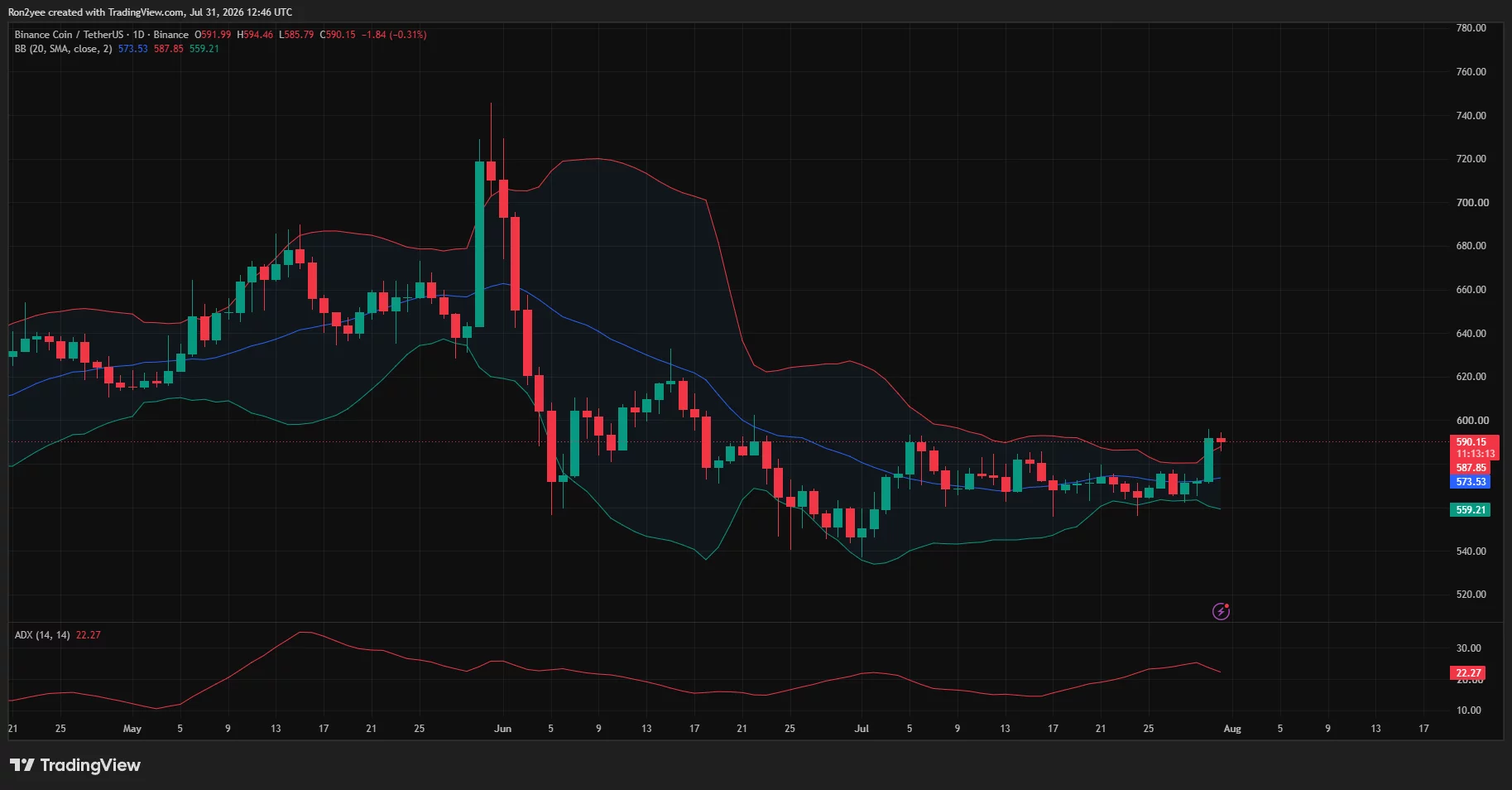
A move above the upper band reflects strong buying pressure, but it can also precede a short-term pullback when price rises too quickly. A daily close back inside the band would put $573.53 in focus as the first mean-reversion target.
The Average Directional Index stands at 22.27. That reading suggests the developing trend has moderate strength but has not yet reached the levels normally associated with a powerful directional move.
Momentum is clearer on the 4-hour timeframe. The relative strength index is at 65.14, above its moving average of 61.84 but below the overbought threshold of 70. This leaves room for another advance while warning that buyers are approaching stretched territory.
The 4-hour MACD line stands at 5.79, above the 4.33 signal line, with a positive histogram reading of 1.46. The configuration remains bullish, although the shrinking histogram bars suggest that the initial burst of momentum is beginning to cool.
Key BNB levels to watch
The 3-day liquidation heatmap identifies a dense pool of leveraged positions around $605–$610. That cluster could attract price if BNB clears $600, but it may also increase volatility as short liquidations and profit-taking occur in the same region.
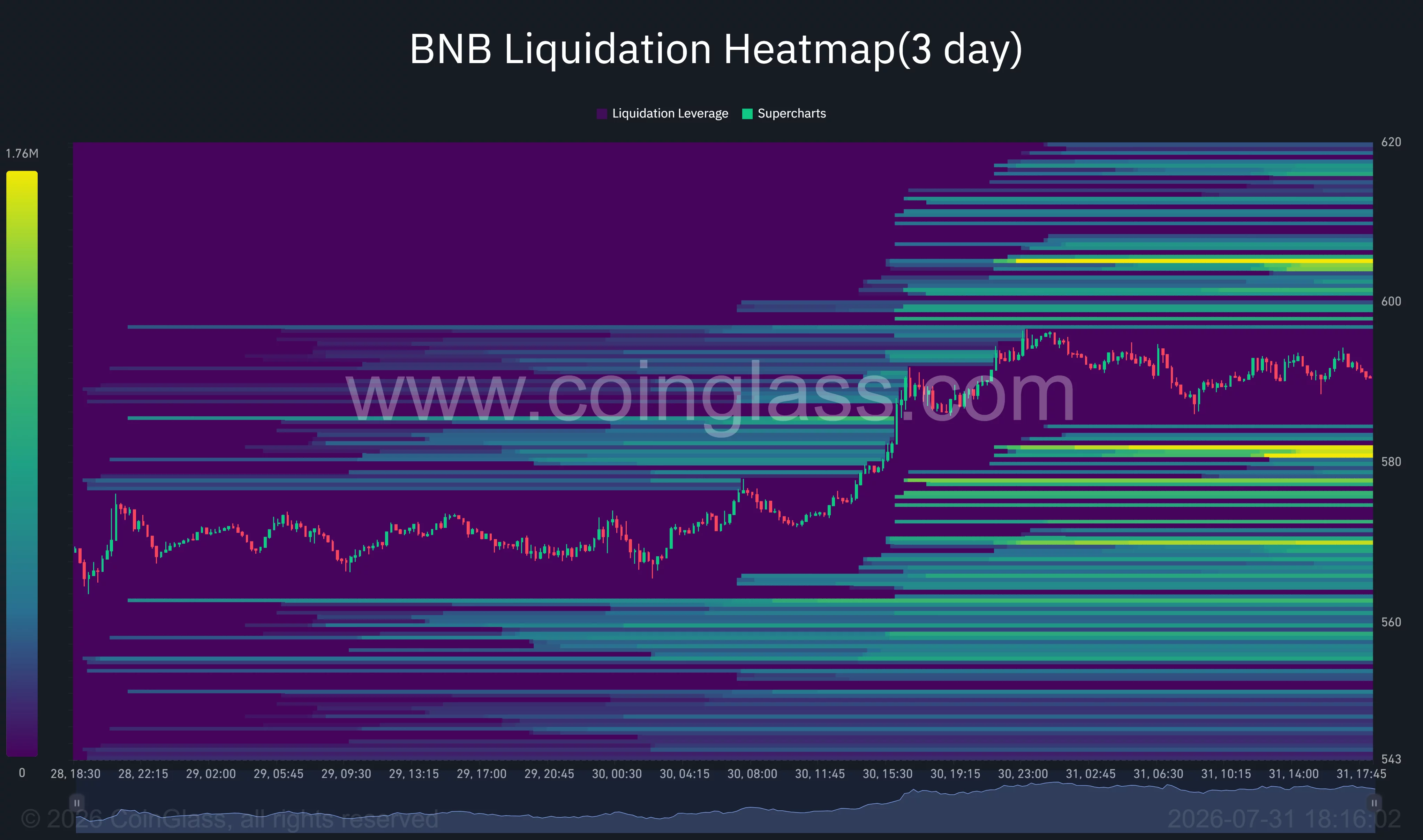
A decisive close above $610 would strengthen the breakout and open a route toward the former $620–$632 supply zone. The latter marks the high from which the descending trendline began.
Immediate support sits between $587 and $580. The heatmap shows the brightest nearby liquidity concentration around $580–$582, making that area a possible downside target if the rally loses momentum.
Below $580, the Bollinger midline near $573.53 becomes the next technical support. Losing that level would weaken the breakout and expose $559–$560, where the daily lower band aligns with July’s established demand zone.
US market context could limit the breakout
US investors are also watching broader risk appetite as geopolitical tensions and elevated energy prices keep inflation concerns in focus. Higher oil prices can complicate the Federal Reserve’s policy outlook by raising the risk that inflation remains above target.
A more restrictive interest-rate environment generally reduces liquidity available for speculative assets, including altcoins. BNB may therefore struggle to sustain an independent rally if Bitcoin and US technology stocks weaken as investors reduce risk.
The near-term setup remains constructive while BNB holds above $580. A confirmed break through $600–$610 would favor continuation, while a retreat below $573 would suggest the latest move was another failed breakout within the wider range.
Disclosure: This article does not represent investment advice. The content and materials featured on this page are for educational purposes only.
Crypto World
Strategy Posts $8.33 Billion Operating Loss As Downturn Pushes Bitcoin Below Acquisition Cost
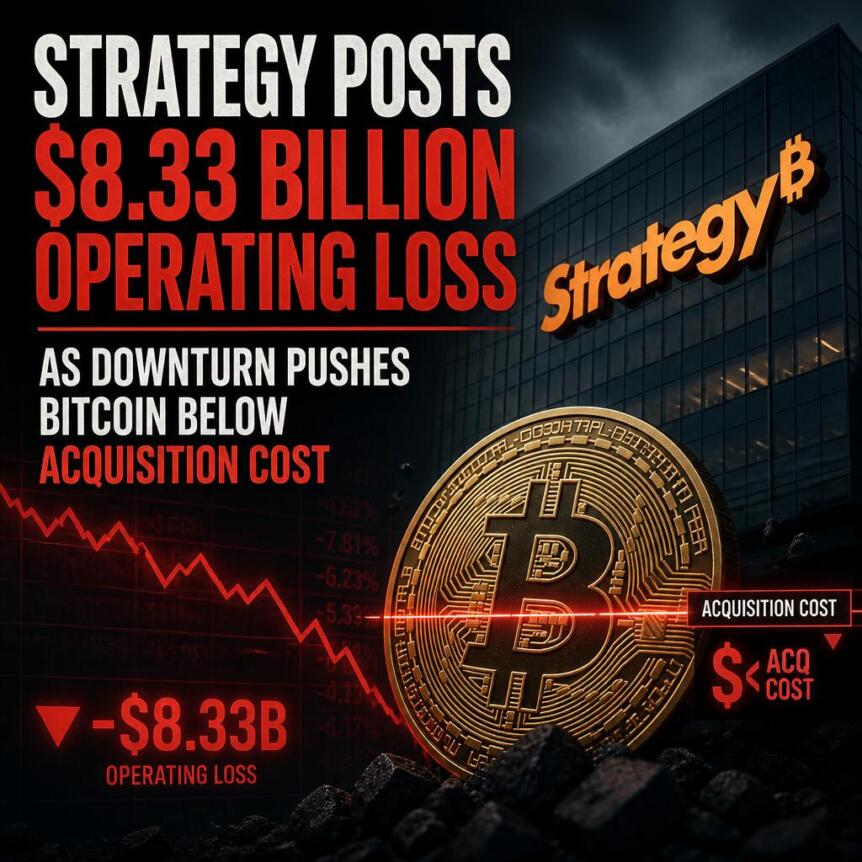
Bitcoin treasury company Strategy has reported a second-quarter operating loss of $8.33 billion, largely due to an unrealized loss of $8.32 billion on its Bitcoin (BTC) holdings. The company currently holds 843,775 BTC, worth $54.77 billion, significantly lower than the $63.69 billion acquisition cost.
Strategy has created a $3.75 billion cash reserve as part of its BTC monetization program to support interest and dividend obligations.
Strategy Losses Deepen
Strategy has reported an operating loss of $8.33 billion in Q2 as unrealized losses on its Bitcoin holdings climbed to $8.32 billion after Bitcoin prices declined substantially. The flagship cryptocurrency traded around $88,400 at the end of 2025 and was near $64,700 when Strategy announced its quarterly earnings. The decline pushed the value of Strategy’s Bitcoin holdings below their aggregate purchase cost of $63.69 billion.
The company recorded an operating loss of $8.33 billion, and a net loss of $8.22 billion, working out to $24.45 per diluted common share. In comparison, Strategy’s net income stood at $10.00 billion during Q2 2025. The quarterly earnings report did not have much impact on Strategy (MSTR) shares. MSTR rose 4.7% during regular trading hours before registering a marginal decline following the report.
Meanwhile, Strategy’s core software business reported quarterly revenue of $122.4 million, a 6.9% increase from a year earlier, and gross profit stood at $81.6 million.
Bitcoin Bet Weighs Heavy
Strategy’s Bitcoin holdings stood at 843,775 BTC as of July 26, with an acquisition cost of $63.69 billion. The company’s Bitcoin holdings are currently valued at $54.77 billion, putting them $8.92 billion underwater. However, this loss is unrealized and reflects the change in BTC’s market value rather than an actual loss from selling the position. Strategy has also sold a small portion of its Bitcoin holdings to fund its dividend obligations, as the company continues to monetize its portfolio when necessary.
Strategy Building Dollar Reserve
Strategy’s capital markets programs have helped raise $17.06 billion this year while reporting a Bitcoin yield of 4.5%. The company also repurchased $1.5 billion of its senior convertible notes at an 8% discount, cutting its convertible debt to $6.71 billion. The move reduces Strategy’s debt burden after declining Bitcoin prices put substantial pressure on its balance sheet. Strategy also expanded its US Dollar Reserve by $525 million to $3.75 billion. The company stated that the reserve can cover dividend obligations for 2.1 years under its current policy. However, it conceded that it cannot guarantee payments under changing or adverse market conditions.
Strategy has also initiated repurchase programs for its common shares and digital credit securities, giving the company the option to buy back securities without using the entire authorized amount.
Strategy Must Maintain Liquidity Phong Le
Strategy CEO Phong Le stressed the importance of maintaining liquid US Dollars to fund dividend obligations during the company’s earnings call. Le stated:
“We thought that liquid Bitcoin would be important, but what Mike [Michael Saylor] mentioned earlier is that the people who are holding these preferreds don’t look at Bitcoin the way they look at U.S. dollars.”
Le stressed that ensuring a Dollar reserve to cover two to three years of dividend obligations is a prudent strategy.
Market Impact
Strategy is the largest publicly traded holder of Bitcoin, giving US investors indirect exposure to the flagship cryptocurrency. The company’s shares reflect fluctuations in Bitcoin’s price and also respond to equity issuance, debt costs, preferred dividends, and any change to its capital structure.
Strategy’s cash reserve and lower convertible debt give the company some financial flexibility. However, the value of its Bitcoin holdings must recover above the acquisition cost. A further decline in Bitcoin prices could deepen unrealized losses and increase pressure on the company.
Disclaimer: This article is provided for informational purposes only. It is not offered or intended to be used as legal, tax, investment, financial, or other advice.

New York has filed a lawsuit against prediction market platform Kalshi, accusing the company of running an illegal, unlicensed gambling operation in the state. The case centers on Kalshi’s event contracts tied to outcomes such as sports results and elections.
In its filing, New York seeks an order stopping Kalshi’s alleged gambling activity, along with forfeiture of “illegal gains,” restitution to users, and civil penalties reportedly set at three times the amount of those gains. Attorney General Letitia James said prediction markets like Kalshi are gambling “plain and simple,” adding that the state is acting to enforce its laws and protect residents.
Key takeaways
- New York is pursuing injunctive relief and financial remedies against Kalshi, framing event contracts as unlicensed gambling.
- The lawsuit follows a cease-and-desist order from the New York State Gaming Commission issued in October 2025.
- Kalshi has challenged the regulator in federal court, but a judge denied its bid for a preliminary injunction in July 2026.
- The dispute escalates a wider fight over whether federally regulated prediction markets can be blocked under state gambling laws.
- Regulators have been increasingly scrutinizing the prediction market sector as it expands—both in mainstream visibility and blockchain-based infrastructure.
New York challenges Kalshi’s business model
The lawsuit targets Kalshi’s offering of contracts whose settlement depends on real-world outcomes, including sports and election-related events. New York’s position is that these products function as gambling and therefore require appropriate state licensing and compliance.
While Kalshi operates as a prediction market platform, New York’s complaint does not treat the platform as merely financial speculation. Instead, it argues that calling the contracts “prediction” does not change their practical nature as wagers on future results.
This action arrives after the New York State Gaming Commission issued a cease-and-desist order in October 2025. Kalshi responded by suing the regulator in federal court, and the immediate conflict has moved through multiple procedural steps.
Earlier this year, a judge denied Kalshi’s request for a preliminary injunction in July. An appeals court later rejected Kalshi’s attempt to halt enforcement while the appeal continues, meaning New York’s efforts can proceed even as the legal battle plays out.
Kalshi’s legal fight intersects with CFTC’s federal oversight
The New York case is part of a broader jurisdictional tug-of-war over prediction markets—specifically whether state gambling laws can restrict products that a federal regulator treats as within its own regulatory scope.
Just before New York filed, the U.S. Commodity Futures Trading Commission (CFTC) submitted an emergency motion in court seeking to block New York’s enforcement efforts. The CFTC argued that the state’s action interferes with the agency’s “exclusive authority” under the Commodity Exchange Act to regulate designated contract markets such as Kalshi.
The CFTC’s approach has been consistent in similar disputes involving other states. In those arguments, the commission has warned that if states can independently ban event contracts listed by federally regulated exchanges, it would create conflicting rules—undermining a uniform federal commodities framework.
That position has been cited in enforcement disputes the CFTC has taken against at least nine states, according to reporting that highlights how the agency frames state restrictions as a threat to federal oversight of commodities markets.
Prediction markets keep attracting mainstream attention
Prediction markets are built on a simple premise: users trade contracts tied to the outcome of future events, and the price of those contracts is intended to reflect market-implied probabilities. In theory, that mechanism helps participants aggregate information about what is likely to happen.
But as the sector grows, regulators across jurisdictions have increasingly treated certain prediction market products as gambling—especially when settlement depends on outcomes and participation mirrors typical wager-based behavior. The resulting legal uncertainty has encouraged closer scrutiny of how platforms structure their offerings and what regulatory category they fall under.
Kalshi is not the only high-profile operator to face regulatory pressure. Its competitor, Polymarket, has also encountered scrutiny from regulators abroad, with some authorities restricting or investigating operations over licensing and gambling-related concerns.
Beyond the regulatory front, prediction markets have also expanded technologically. Kalshi began broadening into blockchain-based infrastructure in December 2025, launching tokenized prediction markets on Solana and later adding support for multiple blockchain networks. That shift mirrors a wider trend in crypto markets, where trading venues seek faster settlement, greater programmability, and broader distribution.
Crypto analytics point to rapid growth in on-chain prediction activity
While the legal battles unfold, on-chain prediction markets have shown signs of growing participation. According to analytics firm Chainalysis, blockchain-based prediction markets processed about $20 billion in trading volume tied to the 2026 FIFA World Cup, with more than 400,000 wallets participating.
The implication for investors and builders is that even as regulators debate classification—commodities regulation versus gambling law—the user demand for outcome-trading continues to show up in measurable on-chain activity. That activity can raise the stakes for platforms that want to operate at scale without running afoul of differing legal interpretations.
For market participants, the tension is straightforward: platforms may market prediction markets as probability markets or informational tools, but regulators may focus on the wager-like economic structure and licensing requirements. The New York lawsuit against Kalshi is a direct test of how far state enforcement can go when a federal agency argues for exclusive jurisdiction under the Commodity Exchange Act.
What to watch next is whether the CFTC’s federal arguments continue to constrain or defeat New York’s enforcement, and whether Kalshi’s appeal of the preliminary-injunction denial changes the immediate timeline. The outcome could shape how other states pursue enforcement against prediction markets—and how platforms design their products to manage regulatory risk.
Japan’s central bank kept interest rates unchanged at 1.0% on Friday, according to a Bank of Japan (BoJ) statement issued after its policy decision. The meeting outcome landed in line with market expectations, even as the yen had just swung sharply following reports of intervention.
The BoJ’s decision came shortly after the Japanese currency strengthened quickly against the US dollar—moving up as much as 3.5% overnight, based on TradingView data—an advance many traders linked to coordinated or related foreign-exchange actions involving the yen. With Japan also flagging inflation pressures later in the year, investors are now watching how currency policy, yields, and global risk appetite intersect for crypto markets.
Key takeaways
- The BoJ held the uncollateralized overnight call rate at around 1.0% after an outcome supported by eight of nine Policy Board members.
- Recent yen volatility reportedly coincided with currency intervention activity involving Japan and South Korea, as the JPY briefly jumped versus the USD.
- The BoJ warned that CPI inflation may accelerate to clearly above 2% from the second half of fiscal 2026.
- Since the yen carry trade unwind in 2024, JPY moves have continued to influence Bitcoin and altcoin risk sentiment.
BoJ holds rates steady after yen turbulence
In its latest statement, the BoJ said it would “encourage the uncollateralized overnight call rate to remain at around 1.0 percent,” confirming a broadly shared view among officials for keeping policy unchanged. The decision was passed by eight of nine members of the Policy Board, with Hajime Takata the only dissenting vote, proposing a 0.25% rate hike.
Markets had largely expected this result ahead of the meeting, according to earlier coverage referenced by Cointelegraph. The policy decision also arrived just hours after the yen’s brief surge—an FX move that coincided with speculation about official action. While the BoJ did not comment directly on the reported intervention, the timing is likely to keep FX traders attentive to any future shifts in the currency’s direction.
Reported Japan–Korea involvement raises the stakes
Several reports tied the yen’s sharp move to intervention efforts. The BoJ did not confirm the details, but commentary in regional media pointed to alignment between Japan and South Korea’s policy priorities. At the time, the South Korean won was reportedly rising as well, suggesting traders were reacting to developments across both currencies.
Analyst Lee Min-hyuk of KB Kookmin Bank, as quoted by Straits Times, argued that cooperation could amplify the impact because the won and yen are closely linked. Separate reporting also noted that the US had conducted “rate checks”—a softer form of intervention that can precede stronger operations—during Thursday’s session, fueling speculation about a wider, multi-country FX response.
Traders typically treat intervention expectations as a constraint on how far a currency can move in either direction. If intervention remains a credible backstop, it can affect not only FX markets but also broader capital flows—an important link for assets like Bitcoin that have repeatedly shown sensitivity to liquidity conditions and global risk changes.
BoJ turns to inflation headwinds for fiscal 2026
Beyond the rate decision, the BoJ’s outlook for prices may carry longer-term significance. In its quarterly Outlook for Economic Activity and Prices, the central bank said the year-on-year rate of increase in the consumer price index (CPI) “is likely to accelerate to a level clearly above 2 percent from the second half of fiscal 2026.”
In the same report, the BoJ pointed to additional drivers of inflation such as durable goods prices. It also referenced the “waning of the effects of high crude oil prices,” tying this shift to factors including the ongoing US–Iran war and the closure of the Strait of Hormuz oil-transit route—elements that can influence energy costs and therefore the inflation trajectory.
For investors, this matters because inflation expectations can eventually pressure policymakers toward tighter conditions, or at minimum change the path of interest-rate expectations. Even though Friday’s decision was unchanged, the direction of the BoJ’s CPI outlook can affect longer-dated yields and, by extension, currency dynamics and carry-trade behavior.
Why yen moves still matter for crypto
FX volatility has remained a meaningful input for crypto traders since the “unwinding” of the yen carry trade in August 2024, when yen funding pressures and related liquidity shifts coincided with significant downside across Bitcoin and other major tokens. Since then, Japan-related rates and the yen’s direction have continued to serve as a proxy for risk conditions—especially when changes in JPY funding costs trigger broader adjustments in global portfolios.
Earlier this year, Arthur Hayes, former CEO of crypto exchange BitMEX, suggested that a weak yen combined with rising Japanese bond yields could encourage some investors to rotate away from low-yielding US bond exposures. In his framing, central bank liquidity interventions and related yield dynamics can flow through to crypto demand by shifting broader risk and liquidity availability.
Hayes also previously argued that USD/JPY could rise significantly—he predicted in December 2025 that the pair might reach as high as 200. While Friday’s BoJ decision does not validate that forecast on its own, the ongoing interplay between FX moves, yields, and policy signals remains central to how traders map macro conditions onto digital-asset positioning.
With the BoJ holding rates steady, the immediate question for markets is whether recent yen strength proves durable or fades—particularly given reports of intervention-linked volatility and the central bank’s warning that inflation pressures could strengthen later in fiscal 2026. Crypto traders will likely watch for follow-through in JPY/USD and Japanese yield expectations, because those variables continue to shape liquidity assumptions that underpin risk appetite.
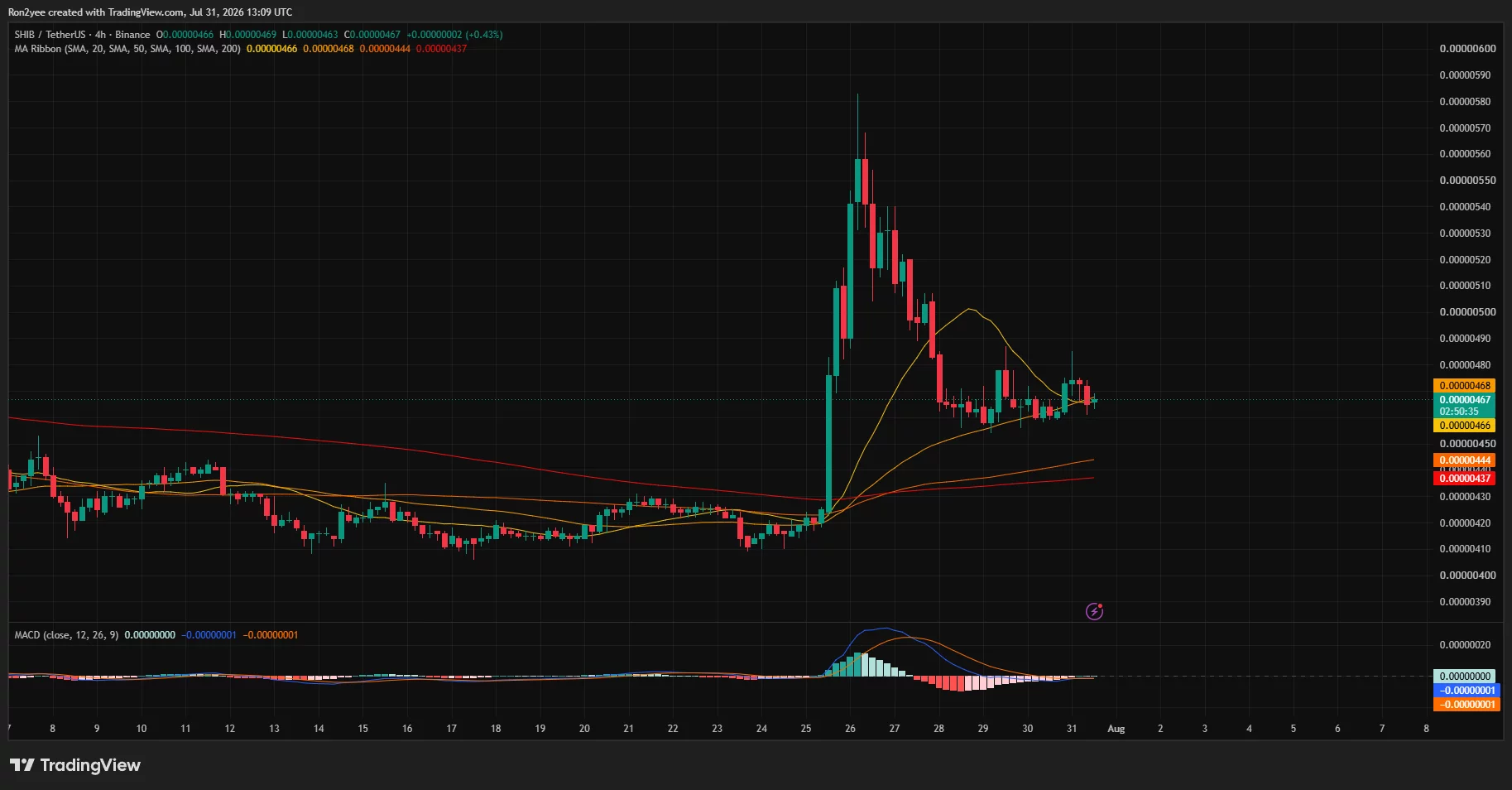
Shiba Inu price surrendered much of its 40% breakout after sellers rejected the meme coin near $0.0000058, leaving bulls to defend a newly established support zone around $0.0000045.
Summary
- SHIB price surged nearly 40% before retreating to approximately $0.0000047.
- Daily ADX climbed to 31.03, confirming that volatility has developed into a stronger directional trend.
- The 4-hour chart places immediate support between $0.00000444 and $0.00000466.
- Liquidation data shows dense leverage near $0.0000045, raising the risk of another volatility spike.
SHIB price rally loses momentum
According to data from crypto.news, SHIB price traded near $0.00000468 on July 31 after its vertical rally encountered heavy selling above $0.0000054. The token briefly reached approximately $0.0000058 during the breakout, marking a gain of nearly 40% from its pre-rally base around $0.0000041.
However, the long upper wick on the 4-hour chart showed that sellers quickly absorbed demand near the peak. SHIB subsequently formed a series of lower highs before stabilizing between $0.0000046 and $0.0000048.
The pullback leaves SHIB roughly 20% below its intraday peak, although the token remains above the range that contained its price through most of July. That distinction matters because the move has not yet completed a full round trip to its breakout point.
South Korean retail activity, a sharp increase in token burns and renewed whale participation reportedly accompanied the rally. However, the rapid reversal suggests that some traders used the sudden liquidity expansion to take profits rather than build longer-term positions.
Four-hour chart shows bulls defending support
SHIB’s 4-hour structure has shifted from a vertical advance into tight consolidation.
The token is trading around its 20-period and 50-period simple moving averages, located near $0.00000466 and $0.00000468, respectively. Holding this area would allow buyers to establish a higher base after the breakout.
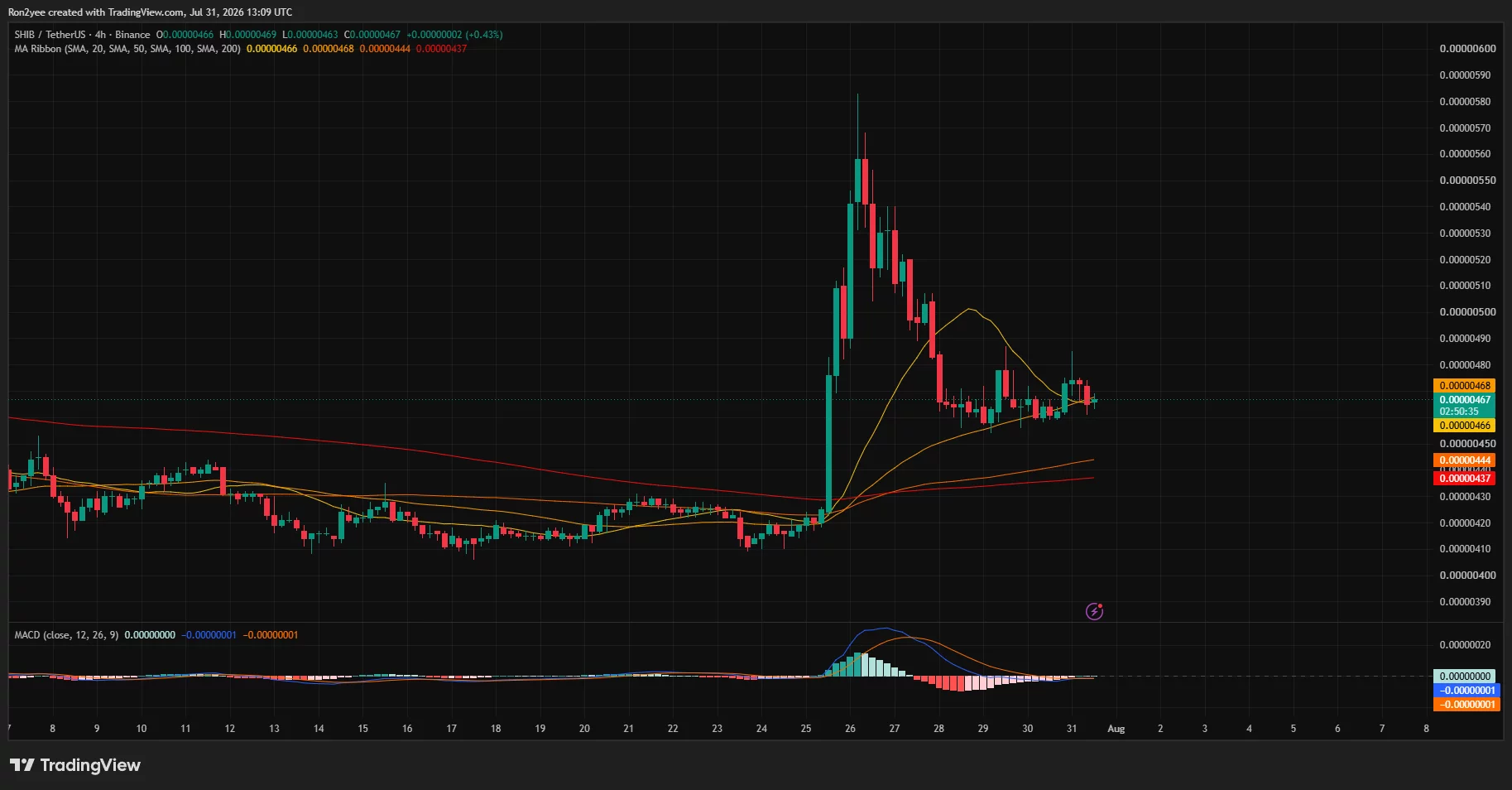
Stronger support sits at the 100-period SMA near $0.00000444 and the 200-period SMA around $0.00000437. Both averages are rising, and SHIB continues to trade above them, preserving the short-term recovery structure.
The moving average convergence divergence indicator is less decisive. Its MACD and signal lines have converged near zero after the earlier bullish impulse faded. This shows that selling momentum has slowed, but buyers have not yet regained enough strength to start another sustained advance.
A 4-hour close above $0.0000048 would be an early bullish signal. SHIB would then face resistance at $0.0000050, followed by the post-breakout supply zone between $0.0000052 and $0.0000054.
SHIB liquidation map warns of a sweep toward $0.0000045
The 3-day liquidation heatmap shows that SHIB is trading between two notable leverage clusters.
The largest nearby concentration sits below the market around $0.00000450 to $0.00000452. This bright liquidity band could attract price if SHIB loses the $0.0000046 floor, potentially triggering leveraged long liquidations.
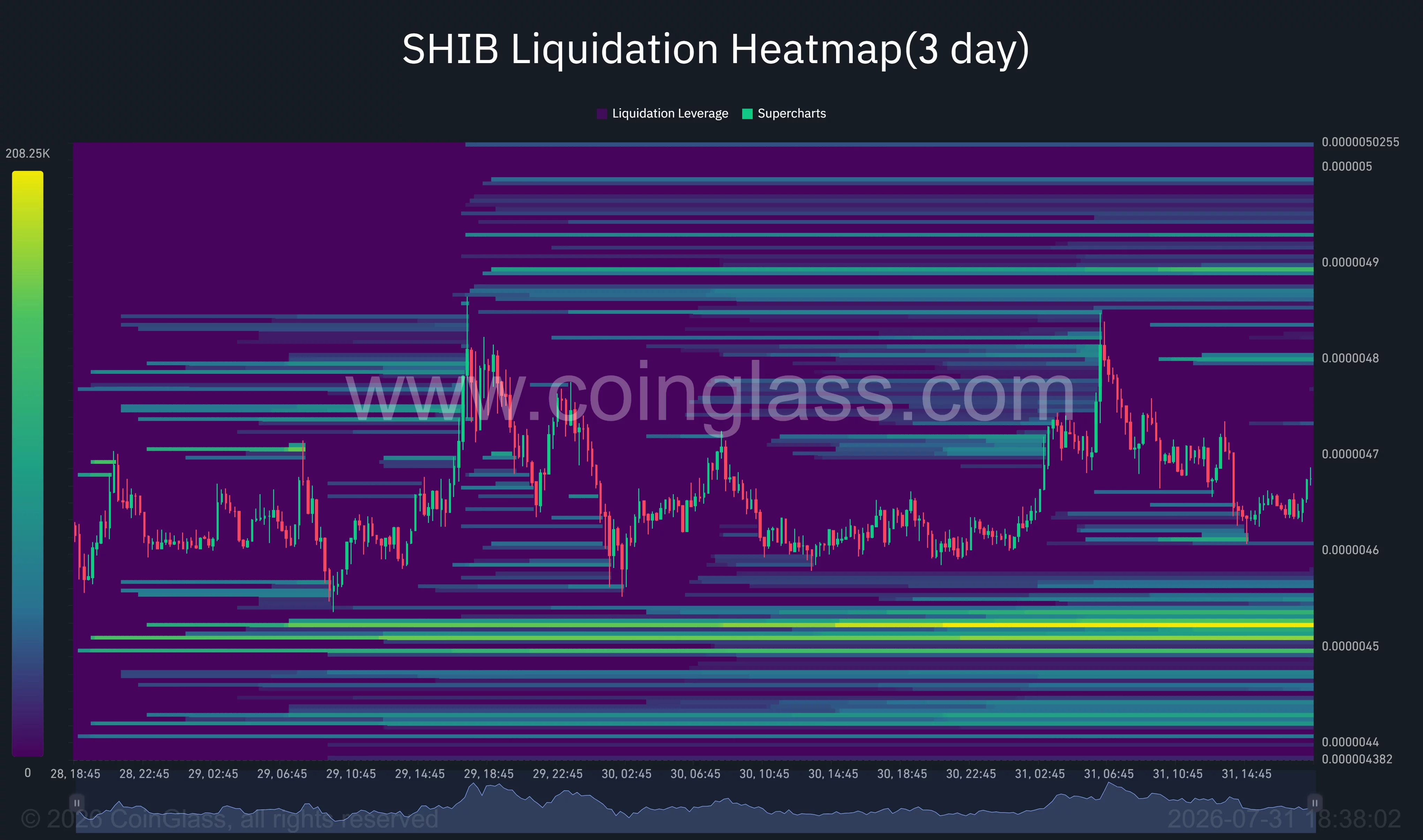
Below that area, additional liquidity appears around $0.0000044. A drop through both zones would erase most of the breakout and expose the July base near $0.0000041.
Upside liquidity is comparatively scattered. The first meaningful bands appear near $0.0000048 and $0.0000049, with another cluster around $0.0000050. Clearing these positions could produce a short squeeze, but SHIB must first overcome the moving-average congestion on its 4-hour chart.
The liquidation structure therefore favors continued volatility. A sweep toward $0.0000045 could occur before either side establishes control.
Daily indicators preserve SHIB’s recovery attempt
Despite the rejection, SHIB’s daily chart contains one constructive development that is price remains above the Supertrend support at approximately $0.00000444.
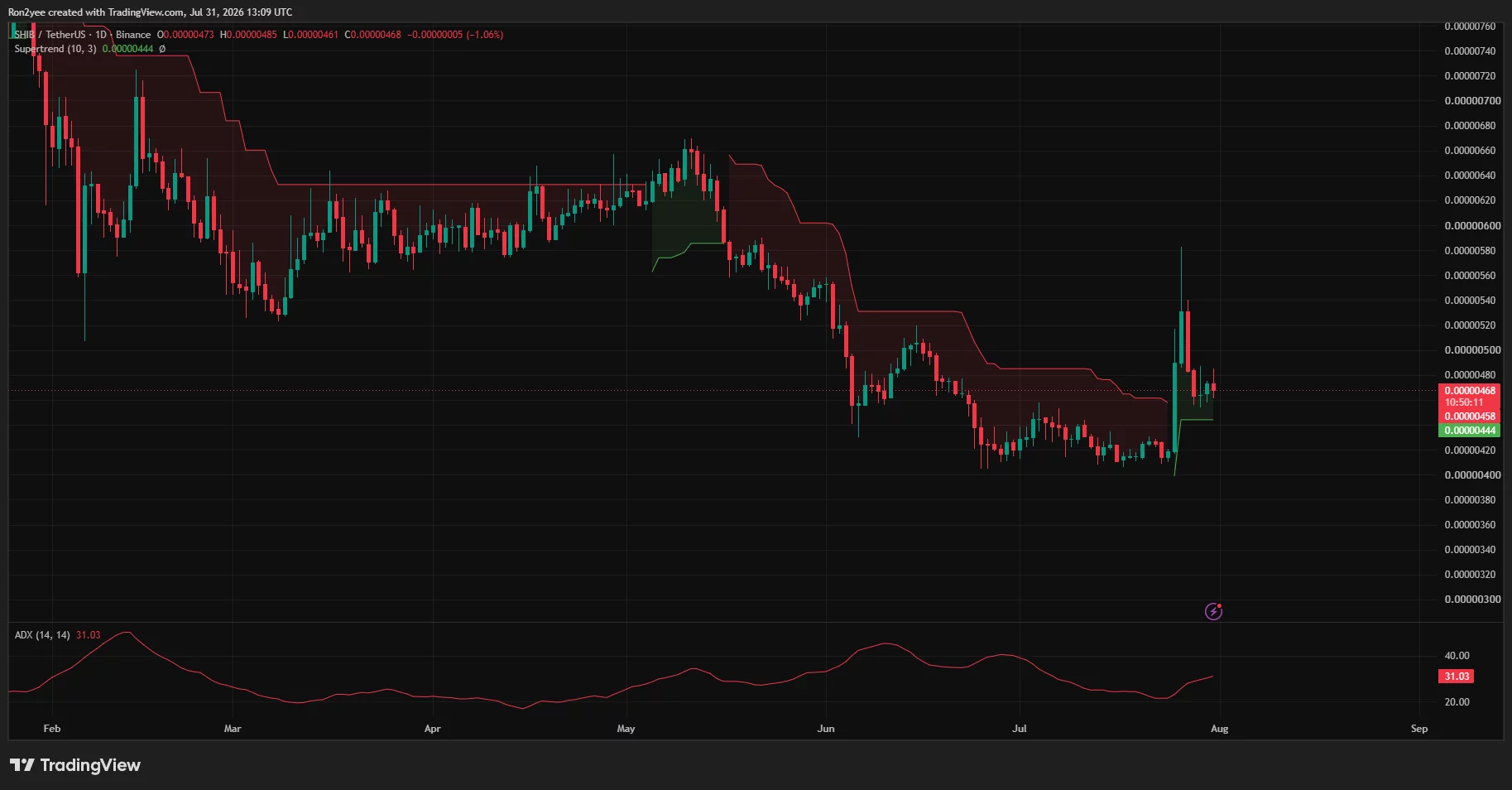
The indicator recently flipped from bearish to bullish following the breakout. Losing that level on a daily closing basis would reverse the improvement and increase the chance of a decline toward $0.0000042.
Average Directional Index, or ADX, has risen to 31.03 from below 20. An ADX reading above 25 generally points to a strengthening trend, although the indicator does not determine whether that trend will remain bullish or turn bearish.
For bulls, the next confirmation would require a move above $0.0000049, followed by a successful recovery of $0.0000052. Breaking the rally peak near $0.0000058 would reopen the path toward $0.0000060 and the May resistance zone around $0.0000064.
Commenting on SHIB’s broader structure, pseudonymous analyst SHIBMortal said:
“The floor seems to be holding (so far). We are not out of the woods yet.”
The analyst described the bounce as promising but said SHIB was still testing resistance through weekly price action and relative strength.
What the setup means for US traders
SHIB’s next move may also depend on wider risk appetite during US trading hours. Meme coins generally carry higher volatility than Bitcoin and large-cap altcoins, making them more sensitive to changes in interest-rate expectations and geopolitical risk.
The immediate setup remains neutral above $0.00000444 and turns more constructive if SHIB reclaims $0.0000049. A daily close below $0.00000444 would invalidate the short-term bullish structure and place the July lows back in focus.
Bulls have preserved part of the breakout, but the failed move above $0.0000054 shows that another rally will require stronger and more persistent demand.
Disclosure: This article does not represent investment advice. The content and materials featured on this page are for educational purposes only.


Circle has secured a New York trust charter to expand its state regulatory footprint.
Summary
- Circle has received a New York trust charter from the NYDFS for Circle New York Trust.
- The approval follows Circle’s recent federal trust bank authorization from the U.S. OCC under a separate regulatory framework.
- Circle said the charter strengthens oversight for its USDC business and extends its decade long relationship with the NYDFS.
According to an announcement from Circle on Friday, the stablecoin issuer has received a limited-purpose trust charter from the New York Department of Financial Services for Circle Internet Trust Company LLC, doing business as Circle New York Trust.
The approval gives Circle another regulatory authorization in New York, where the company says its global headquarters is located. Circle said the charter reinforces its compliance framework and builds on a relationship with the state regulator that began in 2015, when it became the first company to receive a BitLicense from the NYDFS.
The new authorization comes less than a month after Circle secured final approval from the U.S. Office of the Comptroller of the Currency to establish a federally supervised trust bank. While both approvals involve trust entities, they serve different regulatory roles within the U.S. financial system.
New York approval complements Circle’s federal trust bank
Earlier this month, the OCC approved the formation of First National Digital Currency Bank, N.A., which will operate as Circle National Trust under federal supervision for fiduciary digital asset custody. At the time, Circle said management of USDC reserves would remain outside the bank during its initial phase, with reserve activities expected to move later as the institution develops.
The New York charter follows a separate path. Circle had previously indicated that issuance of USDC would continue through a New York limited-purpose trust company rather than its federally chartered bank, making the latest approval an important part of its existing stablecoin structure.
In the official announcement, Circle co-founder, chairman and chief executive Jeremy Allaire said obtaining a New York trust charter had been a long-term objective because of the regulatory clarity associated with the state’s framework.
Allaire also described the NYDFS as an international standard setter for digital asset regulation and said the approval places USDC within what he called a strong and respected regulatory framework as digital dollars become more important in global finance.
Circle deepens decade-long relationship with NYDFS
Circle’s latest approval extends a regulatory relationship with the NYDFS that spans more than a decade.
The company noted that it became the first recipient of a BitLicense in 2015, making New York one of the earliest jurisdictions to supervise its digital asset business. The newly granted trust charter adds another license under the same regulator as Circle continues operating regulated stablecoin services.
Unlike the federal OCC approval, which established a national trust bank, the New York authorization is issued at the state level and governs Circle New York Trust under NYDFS oversight.
The two approvals together expand Circle’s regulatory footprint without replacing one another, as each operates under a different legal framework.
Circle continues expanding infrastructure around USDC
The trust charter arrives during a period of continued expansion across Circle’s payments and blockchain infrastructure.
As crypto.news previously reported, Circle announced on July 27 that it had acquired more than 680 IBM patent families covering nearly 1,000 issued patents worldwide. According to the company, the portfolio spans blockchain infrastructure, banking, payments, enterprise systems, insurance, supply-chain verification and secure cloud operations, with intended support for products including USDC, Circle Payments Network and Arc.
Circle did not disclose financial terms for the patent acquisition or identify which patents directly relate to stablecoin issuance or payment infrastructure.
Earlier in July, Circle also signed separate memorandums of understanding with South Korea’s Kakao Group and fintech operator Toss to explore blockchain payments, cross-border settlement and stablecoin infrastructure. According to the companies, the discussions include possible connections between future KRW-denominated digital assets, USDC and existing financial networks, although no commercial launch has been announced.
Circle has also said it does not plan to issue its own won-denominated stablecoin, instead positioning USDC as infrastructure that could connect local digital currencies with international payment networks.
The latest New York approval adds another regulatory milestone as Circle continues building its stablecoin and payments business across both U.S. regulatory frameworks and overseas partnerships.


Disclosure: This article does not represent investment advice. The content and materials featured on this page are for educational purposes only.
QuantPilot aims to simplify crypto market research by combining fragmented on-chain, market, and DeFi data into AI-assisted analysis workflows.
Summary
- QuantPilot brings AI research agents to crypto markets, combining live data, code execution, and automated analysis.
- Th platform uses AI agents and live data integrations to automate crypto market research and recurring analysis.
- QuantPilot expands AI-powered crypto research with live data connectors and scheduled analytics for traders.
Ask a crypto trader what they lack, and almost nobody says data. They have CoinGecko open in one tab, a Dune dashboard in another, DefiLlama for TVL, a Telegram channel for flow, Glassnode or CryptoQuant for on-chain, and a news feed they mostly skim. The raw material is abundant, and much of it is free.
Say someone wants to answer a fairly ordinary question: over the past two years, did stablecoin balances moving onto exchanges tend to precede rallies in mid-cap DeFi tokens, and did that relationship hold during the drawdowns? Every input needed to answer that exists publicly. Getting to an answer still means pulling exchange stablecoin flows from one API, TVL and token price history from another, aligning timestamps across sources that disagree on what a day is, deciding what counts as a mid-cap, running a correlation, and then checking whether the result survives outside the window you happened to pick.
QuantPilot, the platform 3Commas launched in April 2026 has built its crypto market research layer specifically around it. Whether the approach holds up is worth examining closely, because “AI for crypto research” is a phrase that has covered a lot of nonsense over the past two years.
Agents are not chatbots, and the difference is the whole point
A chatbot receives a question and produces text. Ask a general-purpose model about stablecoin flows, and it will write something fluent from training data that may be eighteen months stale, and it will do so with complete confidence. That is the failure mode that has made experienced traders rightly skeptical of AI research claims.
An agent works differently. It takes a goal, breaks it into steps, executes those steps against live tools, looks at what came back, and adjusts. QuantPilot’s research agents plan a task, create their own to-do lists, write and run code, work with files, and build charts. Applied to the stablecoin question above, that means the agent is not recalling anything. It is fetching current data, writing the analysis code, running it, and showing you the chart it produced.
The output is checkable. That matters more than any capability claim, because a research process you cannot audit is worthless in a market where being confidently wrong costs money.
The data layer is the part that determines quality
An agent with no data access is a chatbot with extra steps. What makes the research layer usable is what it can reach, and QuantPilot connects to its sources through MCP servers, an open standard for giving models structured access to external tools and data.
The current connectors cover CoinMarketCap for price and coin-level information, DefiLlama for DeFi metrics, CryptoQuant for on-chain Bitcoin and stablecoin data, CryptoNews API for current and historical news, and Tavily for agent-driven web search. The team has said more are being added.
The choice of MCP over bespoke integrations is a quiet but meaningful detail. It means adding a new data source is a connector, not a rebuild, which is the difference between a platform whose coverage grows and one that ships with a fixed list and stays there. If you have watched analytics tools in this space launch with impressive integrations and then stagnate, you will recognize why the architecture matters more than the launch-day feature list.
The practical effect is cross-source questions. Not “what is Bitcoin’s price”, which any tool answers, but questions that span data types. Did protocol revenue on a given chain track its token price, or diverge? Do news sentiment spikes lead or lag on-chain accumulation? Which DeFi protocols grew TVL while their token underperformed? These are the questions where an edge might actually live, precisely because they are annoying enough to compute that most people do not bother.
Scheduled research changes the shape of the work
One feature deserves more attention than it has received. QuantPilot supports scheduled automated research, so an agent can run a defined research task on a recurring basis and deliver findings without you being present.
Consider what that replaces. Most traders’ research is reactive. Something moves, they go look, they form a view, and by then the move is largely done. Scheduled research inverts that: a trader defines what they want monitored, and the analysis runs whether or not they are watching. The output arrives as a finding rather than a raw alert, which is the difference between “TVL on this protocol dropped 12%” and a note explaining that the drop tracks a single wallet’s exit rather than broad outflows.
Price alerts have existed forever and mostly train people to react to noise. A recurring analytical task is a different instrument. Whether traders actually use it well is another matter, since the discipline to define good monitoring questions is rarer than the tooling to answer them.
The line between research and a testable claim
Research that stops at “interesting” is entertainment. The reason QuantPilot’s research product sits alongside its strategy engine is that a finding can be handed to the backtesting side and turned into something with numbers attached.
That pipeline runs from an observation, to a hypothesis, to a strategy expressed in plain language, to a backtest with statistical metrics, to an optimization pass that checks whether the result holds across different market conditions, and finally to deployment. QuantPilot compiles strategies into QuantScript and deploys them to supported venues, with Hyperliquid as the first execution integration. Anyone tracking the growth of Hyperliquid and on-chain perpetuals generally will understand why that venue was chosen first.
It is worth separating this from the automated trading bots most traders already know. A DCA or grid bot is a template with parameters, and it executes a strategy someone else designed. The research pipeline is upstream of that. It is concerned with whether the trader’s particular idea has ever worked, not with running a standard pattern efficiently. Both have their place, and confusing them is how people end up running a grid bot into a trend and wondering why it bleeds.
The value of the pipeline is not automation. It is that it makes the honest step, testing the idea before risking money on it, the path of least resistance. Most retail losses come from skipping that step entirely.
Disclosure: This content is provided by a third party. Neither crypto.news nor the author of this article endorses any product mentioned on this page. Users should conduct their own research before taking any action related to the company.

US Treasury yields have been rising for months, and the market’s latest move has pushed 30-year rates to their highest level since 2007. While mainstream coverage has largely pinned the sell-off on inflation concerns tied to higher energy prices, analysis of inflation-protected bonds suggests the more important driver is the climb in real yields—an outcome that can be especially challenging for assets that don’t pay investors along the way, including Bitcoin.
The shift is also changing the trade-offs between traditional fixed-income strategies and crypto exposure. According to Glassnode’s latest research, government bond investments have become more profitable than certain cash-and-carry style trades in crypto markets for the first time since 2019.
Key takeaways
- 30-year Treasury yields have surged to the highest levels since 2007 amid a multi-month sell-off in government debt.
- Market pricing for a September rate hike is elevated, with CME FedWatch placing the probability at 63%.
- Treasury Inflation-Protected Securities point to falling five-year inflation expectations (around 2.2% and trending down since May), even as nominal yields rise.
- Data indicates the nominal yield increase is driven more by rising real yields than by higher inflation expectations—typically a headwind for non-yielding assets.
- Multiple potential transmission channels to crypto exist, but the direction is generally bearish if higher real rates reflect weaker growth or tighter liquidity.
Why Treasuries are selling off again
After US government debt yields hit local lows in early March, Treasuries have entered a prolonged period of selling. Following the most recent FOMC meeting, 30-year Treasury yields made headlines by reaching levels not seen since 2007. Within the same window, the two-year yield climbed by 76 basis points, and markets increasingly price another Fed move: a September rate hike is currently weighted at 63% according to CME FedWatch.
The higher the yield environment becomes, the more investors compare alternatives across asset classes. Glassnode’s research—published in its “The Week Onchain” series—notes that, for the first time since 2019, returns from government bond investments have become more attractive than cash-and-carry style trades involving crypto futures.
Inflation fears are loud, but TIPS tell a different story
Many observers have connected the bond sell-off to rising commodity and energy prices. The timing overlaps with the start of the Iran war and the resulting closure of the Strait of Hormuz, and the daily moves in oil and interest rates have tracked each other since March. In that framing, stronger crude prices feed directly into inflation expectations, pushing yields higher.
However, inflation-protected securities complicate that narrative. Treasury Inflation-Protected Securities (TIPS) are designed so their principal—and therefore their coupon payments—are adjusted to reflect the Consumer Price Index. Because TIPS exist alongside regular Treasuries of similar maturity, comparing their yields allows investors to estimate the market’s implied inflation path through the breakeven rate.
According to data referenced from FRED, the five-year breakeven inflation rate has dropped sharply since May and is currently around 2.2%. That figure suggests the market expects the Fed to achieve its 2% inflation target over the medium term. More importantly, the breakeven rate has been moving in the opposite direction to nominal Treasury yields: while nominal yields rise, the inflation component implied by TIPS declines.
In the dataset cited, a 33-basis-point increase in the five-year nominal yield is paired with an 84-basis-point rise in the real yield, partially offset by a 51-basis-point decline in expected inflation. In other words, the market’s “real yield” story is changing—and it is the real rate that appears to be doing the heavy lifting.
What higher real yields can mean for Bitcoin and other non-yielding assets
In general, when real returns on traditional investments rise—after adjusting for CPI—investors may prefer assets that offer carry rather than those that do not. Bitcoin is typically treated as a non-yielding asset in this framework, so the direction of travel in real rates can matter.
Still, the impact on crypto depends on why real yields are moving higher. The analysis outlines several mechanisms that can coexist, with different implications for liquidity and demand.
1) FX or reserve liquidation pressures: unclear for crypto
One possible explanation involves global currency and funding dynamics. Higher oil prices can worsen trade balances for energy importers in Asia because oil is priced and settled in US dollars. That can lead to pressure in offshore US-dollar funding markets and force central banks to intervene to defend exchange rates.
The discussion cites Cointelegraph coverage of yen defense and Bloomberg reporting on interventions involving the Philippine peso and Indian rupee. It also notes that these interventions can be funded by selling US Treasury reserves, which can increase upward pressure on yields. In this scenario, the bond sell-off may reflect external funding strain rather than a direct verdict on the dollar or inflation.
As a result, the direct implications for crypto are not automatic: if the driver is more about FX mechanics than about deteriorating growth expectations, crypto’s reaction could be muted or different from the classic “rates up, risk assets down” story.
2) Demand destruction and recession risk: bearish setup
Another pathway is growth damage. If an oil shock persists long enough, the argument goes, it stops being merely inflationary and begins to suppress economic output. Neuberger Berman’s fixed-income outlook—referenced in the analysis—suggests investors may be underpricing how sustained energy costs could hit output.
That matters because a recessionary environment typically tightens liquidity. In such conditions, both equities and Bitcoin can face pressure as credit conditions worsen and risk appetite declines. The analysis also points to the expectation of widening credit spreads as a sign that credit could deteriorate.
It further references Cointelegraph reporting on early signals of stress, connected to rising costs to insure AI-linked debt amid an Asian semiconductor pullback. While that example is specific, it underscores the broader theme: if credit markets begin to price higher risk, non-yielding and speculative assets often struggle.
3) Capital competition from AI issuance: another headwind
A third channel is that higher real rates may be tied to expected growth and capital demand—especially from the AI sector. The analysis argues that as corporate bond issuance, including from major AI-related players, becomes unusually large, government issuance competes more directly for investor capital.
Goldman Sachs Research is cited projecting roughly $755 billion of AI capex in 2026 and about $920 billion in 2027. UBS is also cited as raising its 2026 investment-grade issuance forecast to $1.8 trillion, with technology supply lifted to $360 billion based on hyperscaler guidance. In that environment, investors’ willingness to allocate incremental capital to crypto could be constrained, not necessarily because crypto is “bad,” but because the fundraising pipeline elsewhere is intense.
What to watch next
For crypto investors, the critical question is whether TIPS-implied breakevens stabilize while real yields remain elevated—or whether the market reinterprets the move as a growth scare. Watching the evolution of TIPS breakevens and real-yield dynamics, alongside credit conditions such as spreads, may provide the clearest signal on whether this bond sell-off turns into a sustained liquidity headwind or fades as a temporary funding/energy-driven episode.

Disclosure: This article does not represent investment advice. The content and materials featured on this page are for educational purposes only.
XRP ETF inflows surpass $1.5 billion as investors explore alternative digital asset strategies, including cloud mining and DeFi yield platforms.
Summary
- Rising XRP ETF inflows are boosting interest in EX DeFi as investors explore cloud mining and yield opportunities.
- As XRP ETF inflows top $1.5 billion, EX DeFi highlights cloud mining as an alternative way to earn on XRP holdings.
- Institutional demand lifts XRP ETF inflows past $1.5 billion, while EX DeFi promotes long-term crypto yield solutions.
The XRP-backed ETF has just surpassed a significant milestone in inflows, further boosting institutional investor confidence. Simultaneously, a growing number of investors are turning their attention to ex-DeFi, hoping to explore more long-term yield opportunities beyond simply waiting for XRP prices to rise.

The continued inflows into the XRP ETF further demonstrate the growing demand for XRP from institutional investors. While retail investors remain cautious due to market volatility and price uncertainty, institutional funds continue to allocate XRP through regulated financial products, keeping it one of the most watched mainstream digital assets in the market.
As the regulatory environment and funding conditions continue to improve, many investors are beginning to consider a practical question: are there more efficient and sustainable ways to participate in the long-term returns of XRP besides waiting for prices to rise?
The milestone of XRP ETF inflows surpassing $1.5 billion is significant.
As of the closing on July 29, the XRP spot ETF market has reached a significant milestone. According to data released by the analytics platform uToday, driven by continuous net inflows, XRP-related exchange-traded funds (ETFs) have seen cumulative inflows exceeding $1.5 billion.
Meanwhile, the overall market liquidity has continued to improve. Although secondary market trading activity has slowed somewhat, and retail investor sentiment remains relatively cautious, institutional investor allocation demand has remained stable, resulting in net inflows on most trading days.
A new option for XRP investors: The yield growth path of EX DeFi
In light of this trend, more and more XRP investors are turning their attention to EX DeFi, exploring more stable and sustainable yield models through cloud mining and yield aggregation mechanisms.
Compared to more volatile futures trading or ETF investment, EX DeFi offers a more intuitive and convenient way to participate in digital assets, helping users improve the efficiency of digital asset utilization while participating in the development of the XRP ecosystem. For users with a certain amount of capital, this model is expected to offer higher daily return potential.
About EX DeFi
EX DeFi is headquartered in the UK and operates within European regulatory frameworks such as MiCA and MiFID II, continuously improving its transparency, operational standards, and user protection mechanisms.
The platform employs a multi-layered security architecture, including:
- PwC’s annual financial and security compliance audit;
- Lloyd’s of London digital asset custody insurance;
- Cloudflare enterprise-grade network protection and McAfee® security system;
- Multi-layered encryption architecture, AI-powered intelligent risk control, and 2FA verification protection.
Currently, EX DeFi supports multiple mainstream digital assets such as XRP, BTC, ETH, USDT, USDC, DOGE, LTC, and SOL, providing users with a more flexible and convenient digital asset service experience.
Start earning daily yields easily in just three steps:
1. Register an account
Visit the EX DeFi official website and register using an email address to receive a $17 trial bonus.
2. Choose a Mining Package
Based on a person’s budget and needs, choose a cloud mining contract that suits their needs and start mining with one click.
3. Start Earning Profits
After the contract is activated, the system will automatically allocate computing power, and profits will be automatically settled 24 hours a day. Users can withdraw profits at any time or continue participating as needed, achieving long-term asset compounding.
Example DeFi Popular Contracts
BTC (Beginner Trial Contract): Investment of $100, Term: 2 days, Daily Yield: $4, Total Profit: $100 + $8
DOGE (Golden Shell Mini Dogecoin Pro): Investment of $500, Term: 6 days, Daily Yield: $6.5, Total Profit: $500 + $39
BTC (Canaan-Avalon-A1466): Investment of $1000, Term: 10 days, Daily Yield: $13.4, Total Profit: $1000 + $134
LTC (Bitmain Antminer L7): Investment of $5,000, Term: 20 days, Daily Yield: $73.5, Total Profit: $5,000 + $1,470
BTC (Bitmain S19K-Pro): Investment of $10,000, Term: 30 days, Daily Yield: $161, Total Profit: $10,000 USD + $4,830
For more details on the program, please visit the EX DeFi official website.
Summary
The continued inflow of funds into the XRP ETF, coupled with the improving regulatory environment, further reflects XRP’s gradual integration into the mainstream financial system. EX DeFi provides XRP investors with more diversified participation methods, shifting from “simply relying on price fluctuations” to “price growth and yield generation in parallel.”
As a new market cycle develops, investors are no longer just focused on price increases and decreases, but are paying more attention to stable and sustainable asset management strategies. This trend also reflects the maturing development of digital asset investment.
Still hesitating? Join EX DeFi now and earn daily passive income from digital assets.
Disclosure: This content is provided by a third party. Neither crypto.news nor the author of this article endorses any product mentioned on this page. Users should conduct their own research before taking any action related to the company.
A study from the Bank of Italy has challenged a common argument for crypto payments: that stablecoin-based remittances automatically deliver lower costs and faster settlement than traditional money transfer rails. After testing remittances funded and settled with USDC across multiple corridors, the researchers found that most of the expense and delay came from fiat conversion and payment-rail frictions—factors that blockchain networks alone do not control.
The findings are based on experiments moving 200 USDC across 10 bidirectional corridors connecting Italy with Brazil, Argentina, Japan, the United Arab Emirates, and South Africa. The study compared the end-to-end cost and settlement time to traditional remittance services, concluding that crypto network fees made up only a small portion of overall costs.
Key takeaways
- Fiat on- and off-ramp frictions dominated remittance costs: exchange fees and currency conversion accounted for most expenses, while blockchain transaction fees were comparatively minor.
- Speed depended on local payment rails: transfers settled in under 20 minutes where instant payment systems were available, but took one to two business days when they weren’t.
- Cost advantages were corridor-specific: total costs across stablecoin remittances ranged from 0.3% to nearly 9%, with savings versus some benchmarks not universal.
- Regulatory design influenced user behavior and efficiency: overly restrictive rules increased operational complexity, while prohibitionist approaches pushed users toward offshore and unregulated options.
Stablecoins don’t eliminate the biggest frictions
The Bank of Italy’s experiment was designed to isolate where the money-transfer pipeline spends time and money. Researchers reported that, across the stablecoin remittances tested, exchange fees and currency conversion were the primary cost drivers. By contrast, blockchain transaction fees were only a small share of total costs—meaning the core bottlenecks for cross-border transfers largely sit outside the chain.
In practical terms, the corridor matters because stablecoin remittances often still require converting value into local currency at the sending and receiving ends. Even when the transfer occurs on-chain, users may face fees and processing delays at the interfaces where fiat enters or leaves the system.
Costs and settlement times vary by corridor
According to the study, total costs for the stablecoin remittances ranged from 0.3% to nearly 9%, depending on the corridor. This wide spread underscores that stablecoin-based transfers are not a single “set it and forget it” alternative to traditional remittances; rather, they are shaped by the quality and pricing of the surrounding payment infrastructure.
Settlement times showed an even clearer relationship with local payment systems. The researchers found transfers were typically completed in less than 20 minutes when instant payment networks were available. Where those systems were not in place, settlement stretched to one to two business days.
To frame the results against a broader global benchmark, the study used the World Bank’s reported global average remittance cost of 6.65%. On that basis, stablecoin transfers were cheaper in most corridors examined. However, they were less expensive than Wise in only three of seven corridors where direct comparisons were possible—suggesting that established digital remittance providers can still outperform stablecoin routes in certain environments.
Why infrastructure investment matters more than token choice
The Bank of Italy argues that improving the competitiveness of stablecoin-based cross-border payments depends heavily on payment-rail upgrades—particularly domestic instant payment infrastructure. In other words, the study’s central implication is that stablecoin settlement can be fast only if the start and end points of the transfer process are equally efficient.
The authors also emphasized an important structural point: the potential benefits expand if stablecoins can be used in the real economy without repeated reconversion into local fiat. They wrote that:
If stablecoins could be spent directly in the real economy, for goods and services, rents, or school fees, without reconversion into local fiat currency, the economic advantages of stablecoin-based transfers would be substantially higher.
This framing highlights a key asymmetry in many cross-border use cases today. Even if blockchain rails reduce settlement friction, remittance economics can remain constrained when end users ultimately need local currency access and the process requires multiple conversions.
Regulation can either enable or complicate real-world use
The study also found that regulatory design plays a decisive role in shaping remittance efficiency. According to the authors, prohibitionist regimes have not fully eliminated stablecoin demand; instead, they can push users toward offshore platforms and other unregulated channels. Conversely, overly restrictive frameworks may increase operational complexity for retail users.
The analysis arrives as policy frameworks for crypto assets and stablecoins are taking shape in major jurisdictions. The European Union has implemented the Markets in Crypto-Assets (MiCA) framework, while the United States has enacted the GENIUS Act, which governs crypto assets and payment stablecoins, respectively.
In terms of broader market momentum, the stablecoin market has grown to about $307 billion, up roughly 16% over the past year, according to DefiLlama data on stablecoins.
That growth provides context for why regulators and payment operators are increasingly focused on remittance and tokenized payments. But the Bank of Italy’s results suggest that the route to efficiency is not purely about allowing stablecoin settlement—it’s also about aligning regulatory expectations with workable payment flows and infrastructure.
What readers should watch next
The study implies that the next meaningful improvements in stablecoin remittances will likely come from upgrades to instant payment rails and from reducing the need for repeated fiat conversion at either end of the transfer. Investors and builders should monitor how policy changes under MiCA in Europe and the GENIUS framework in the US translate into compliant on- and off-ramp experiences—because, according to the Bank of Italy, that’s where most of the cost and delay still lives.

BNB price breaks 45-day downtrend, can it clear $600?

2026 Rocket Classic Saturday tee times: Round 3

Questyle QCC Dongle Pro2 Brings Bluetooth 6.1 and Hi-Res Audio to iPhone, Mac, PCs and Consoles

Renter of Home in Anne Heche Crash Denies Settlement With Son

No Jackpot Winner as $257 Million Prize Rolls Over to $269 Million Monday Draw

Weekend Open Thread: Staud – Corporette.com

Crypto Trading LIVE: BTC Live Trading Bitcoin Analysis | 28 JULY #crypto #bitcoin #btc

Financial Mistake Most People Make Watch the Full : https://youtu.be/0Kn9TDPAHFc?si=7FP6D0OmsE1hi0uM

The Income Problem Nobody Wants to Talk About #finances #real
-
 Sports5 days ago
Commonwealth Games boxing: Jadumani Singh seals dominant 5-0 win over Pakistan’s Sumama Rehman to enter quarter-finals | Commonwealth Games News
-

 Business2 days ago
Why Trees Belong on the Risk Register
-

 Tech5 days ago
Intel is reversing course and bringing hyper-threading back to its server chips
-

 Fashion7 hours ago
Weekend Open Thread: Wit & Wisdom
-

 Politics3 hours ago
Meta enters AI-training agreement with far-right ‘propaganda rag’ Newsmax
-

 Crypto World6 days ago
Ripple bought a bank in pieces. The $4 billion audit
-

 Politics5 days ago
Luke Littler dismantles Gerwyn Price to retain title in Blackpool
-

 Politics4 days ago
The Part of the Electric Transition Nobody Wants to Discuss
-

 News Videos5 days ago
BITCOIN JUST ENTERED THIS CRITICAL ZONE…
-
 Entertainment3 days ago
‘Stargate’ Creator’s New Sci-Fi Series Returns for Season 3 Tomorrow
-

 Crypto World6 days ago
XRP Ledger adds $2.6B as RWA inflows rank second
-

 Business3 days ago
Major shareholder moves on Canyon
-

 Politics5 days ago
Spain sweeps the board at 2026 World Cup with individual awards
-

 News Videos2 days ago
Bitcoin Enters the 3rd Stage of the Bear Market
-

 Entertainment6 days ago
Sara Gilson Killed By Husband After Viral “Pedophile” TikTok Video
-

 Crypto World3 days ago
Kraken Enables Retail Access to Jersey Mike’s IPO via Tokenized Shares
-

 Tech7 days ago
Anthropic launches Claude Opus 5, a cheaper AI model for coding, agents and enterprise workflows
-

 Tech4 days ago
New macOS Sequoia & Sonoma security updates for older Macs
-

 News Videos3 days ago
Claude: Build Financial Dashboards in Minutes (2026)
-

 Politics1 day ago
Luke Littler’s dominance sparks GOAT debate
You must be logged in to post a comment Login