

Crypto World
Casino Zoccer account verification guide



Getting Started with Casino Zoccer
Casino Zoccer has quickly become a familiar name on the Irish gambling scene, offering a mix of slots, live tables and a full‑fledged sportsbook. The platform is built on a modern interface that works well on both desktop and mobile devices, meaning you can dip into a game while waiting for the bus or settle in at home for a longer session. For newcomers, the first thing to check is whether the site accepts players from the Republic of Ireland – it does, and it holds a licence from a reputable European regulator. If you’re wondering how to begin, the following steps walk you through registration, verification and the first deposit.
Because the brand aims to be beginner‑friendly, the sign‑up process is stripped down to the essentials: email address, password and a choice of currency. Once you confirm your email, the system will prompt you for a few more details to satisfy KYC (Know Your Customer) requirements – typically a proof of identity and a recent utility bill. This extra step might feel a little formal, but it protects you and ensures that all transactions are secure and compliant with Irish law.
Registration and Account Setup
The registration page on casino zoccer is straightforward. After entering your personal details you will receive a verification email; click the link inside to activate your account. The next screen asks you to set your preferred payment method – you can pick from Visa, Mastercard, Skrill, Neteller or direct bank transfer. Irish players will be pleased to see that many local banks are supported, making deposits feel familiar and safe.
Once your account is live, you can customise your profile, set deposit limits and opt into responsible gambling tools. These features are tucked under the “My Account” menu and are easy to adjust at any time. The platform also offers a two‑factor authentication (2FA) option for added security, which you can enable via a text message or an authenticator app.
Bonuses, Welcome Offers and Wagering Requirements
One of the biggest draws of casino zoccer is its welcome package. New players are greeted with a match bonus on the first deposit – typically 100% up to €200 – plus a batch of free spins on selected slot titles. The bonus comes with a wagering requirement of 35x the bonus amount, which is fairly standard for Irish online casinos.
Beyond the initial welcome, Zoccer runs regular promotions such as reload bonuses, cash‑back on losses, and a loyalty programme that awards points for every euro wagered. These points can be exchanged for bonus credit or even tournament entry tickets. Always read the fine print before you claim a bonus, as some promotions exclude certain game categories like high‑variance slots or live roulette.
Payment Methods and Withdrawal Speed
Depositing funds into casino zoccer is quick and usually processed instantly, especially when you use e‑wallets like Skrill or Neteller. Bank transfers may take a few hours, but the platform often sends a confirmation email as soon as the money hits the casino’s vault. Irish players also appreciate the inclusion of PayPal, which adds another layer of convenience for those who already have a PayPal balance.
When it comes to withdrawals, Zoccer aims for “instant payouts” on e‑wallets, with most requests settled within 24 hours. Bank transfers are a bit slower, typically 2‑3 business days, while credit‑card withdrawals may take up to 5 days due to card network processing. The casino does not charge any hidden fees for withdrawals, though a small administrative fee may apply for certain methods.
Game Selection: Slots, Live Casino and Sports Betting
The catalogue at casino zoccer is built around three pillars: slots, live dealer tables and a sports betting hub. Slot lovers will find everything from classic three‑reel titles to the newest high‑RTP video slots with megaways and progressive jackpots. Each game lists its volatility and RTP (return to player) percentages, helping you choose whether you prefer frequent small wins or the chance of a big payout.
Live casino enthusiasts can join professional dealers for blackjack, baccarat, roulette and poker, streamed in high definition. The live section uses a mix of Evolution Gaming and Pragmatic Play providers, ensuring smooth video and reliable game fairness. Sports betting covers a full range of Irish and international events, from Gaelic games to the Premier League, with competitive odds and in‑play betting options.
Mobile App and Desktop Experience
Irish gamers often switch between devices, and casino zoccer delivers a responsive website that works well on smartphones and tablets without needing a dedicated download. However, for those who prefer a native app, the platform offers iOS and Android versions that can be found in the respective app stores. The app mirrors the desktop layout, giving you quick access to your favourite games, deposit methods and the latest promotions.
The mobile experience is optimised for both portrait and landscape modes, which is handy when you’re on a commute or lounging on the couch. Push notifications can be turned on to alert you about bonus expiries, new game releases or live match starts, keeping you in the loop without constantly checking the site.
Security, Licensing and Responsible Gambling
Casino Zoccer operates under a licence from the Malta Gaming Authority, a regulator respected across the European Union for its strict oversight. Encryption technology (SSL 256‑bit) protects all personal data and financial transactions, meaning your details are safe from prying eyes. The platform also employs independent auditors to verify game fairness, with results posted regularly on the site.
Responsible gambling tools are built into the user dashboard. You can set daily, weekly or monthly deposit limits, self‑exclude for a chosen period, or even opt for a permanent ban if you feel you need it. Links to organisations such as GambleAware Ireland are provided for anyone seeking external help.
Customer Support and Frequently Asked Questions
If you run into an issue, casino zoccer offers several channels for assistance. The live chat feature is available 24/7 and typically answers queries within a couple of minutes. For more detailed concerns you can raise a ticket via the “Help Centre,” and an email response will follow within 24 hours. Phone support is also provided for Irish callers, with a dedicated local number that operates during regular business hours.
Below are the most common questions new players ask:
- How long does it take to verify my identity?
- What are the minimum and maximum deposit limits?
- Can I claim a bonus if I use a PayPal account?
- Are there any fees for withdrawing my winnings?
Answers to these queries are easy to find on the FAQ page, but you can always ask a support agent for clarification. For a deeper dive into the specifics of the site, see the detailed Zoccer casino review Ireland.
Quick Comparison Table
| Feature | Details |
|---|---|
| Licence | Malta Gaming Authority (MGA) |
| Welcome Bonus | 100% up to €200 + 50 free spins (35x wagering) |
| Payment Methods | Visa, Mastercard, Skrill, Neteller, PayPal, Bank Transfer |
| Withdrawal Speed | E‑wallets instant, bank 2‑3 days, card up to 5 days |
| Game Variety | 2000+ slots, live casino, sports betting |
| Mobile Access | Responsive web + native iOS & Android apps |
| Customer Support | Live chat 24/7, email, phone (local Irish number) |
| Responsible Gambling | Deposit limits, self‑exclusion, links to Irish support groups |



MEV-focused extraction bot JaredFromSubway.eth front- and back-ran an Ethereum trade by Vitalik Buterin, getting away with about two-thousandths of an ether (ETH).
Ethereum founder Buterin was selling a token airdrop, DigitalBits, when he fell victim to the garden-variety sandwich attack.
The name “JaredFromSubway” refers to Jared Fogle who lost nearly 250 pounds while earning a TV sponsorship from Subway. After his weight loss fame faded, however, the world learned of Fogle’s sexual misconduct involving minors, including a criminal conviction.
He remains imprisoned with an expected release date of 2029.
Crypto, of course, has a dark sense of humor, and despite his legal troubles, someone decided to name a maximum extractable value (MEV)-focused extraction bot after him. Fogle, who has limited internet access in prison, doesn’t control the bot.
The trader bearing an ENS name with Fogle’s brand extracted value from Buterin’s transaction inside Ethereum block 24993038.
Read more: Your L2 transaction fees are higher because of MEV spam, report
Another sandwich attack by JaredFromSubway.eth
Buterin routed 26,544 DigitalBits (XDB) tokens through the Uniswap V2 router with his slippage parameter amountOutMin set to zero. That setting accepted any non-zero output.
Buterin received 0.00197 ETH, worth a little under $5 at the time.
JaredFromSubway.eth, watching the public mempool, noticed Buterin’s unprotected swap and inserted itself onto both sides of his transaction.
In the position immediately before Buterin, the bot dumped a pile of XDB into the same Uniswap V2 pool. That depressed the exchange rate Buterin would receive.
In the position immediately after, it bought XDB back at the depressed price and rotated the inventory through a third liquidity pool to close the loop.
After gas fees, Jared gained nothing except the satisfaction of making a priceless joke at Buterin’s expense.
The punchline is that a sandwich bot on Ethereum — named after the world’s most famous sandwich spokesperson — still tricked a careless Buterin out of fees on his own blockchain.
Read more: Vitalik Buterin’s $1B crypto donation to India will be worth just $400M
Buterin suffered the sandwich attack because his swap order carelessly accepted any output. Setting amountOutMin to zero was Uniswap’s maximally permissive setting.
In essence, Buterin told his order router to fill his trade no matter how badly the price moved based on his supply.
MEV bots scanning Ethereum’s mempool salivate for exactly that type of laziness.
Buterin has a habit of dumping unsolicited airdrops and donating the proceeds.
Because almost all of his personal net worth derives from his pre-mined allocation of ETH, he’s happy to donate extra coins that he receives. In this case, his donation went to an unintended recipient.
Got a tip? Send us an email securely via Protos Leaks. For more informed news and investigations, follow us on X, Bluesky, and Google News, or subscribe to our YouTube channel.
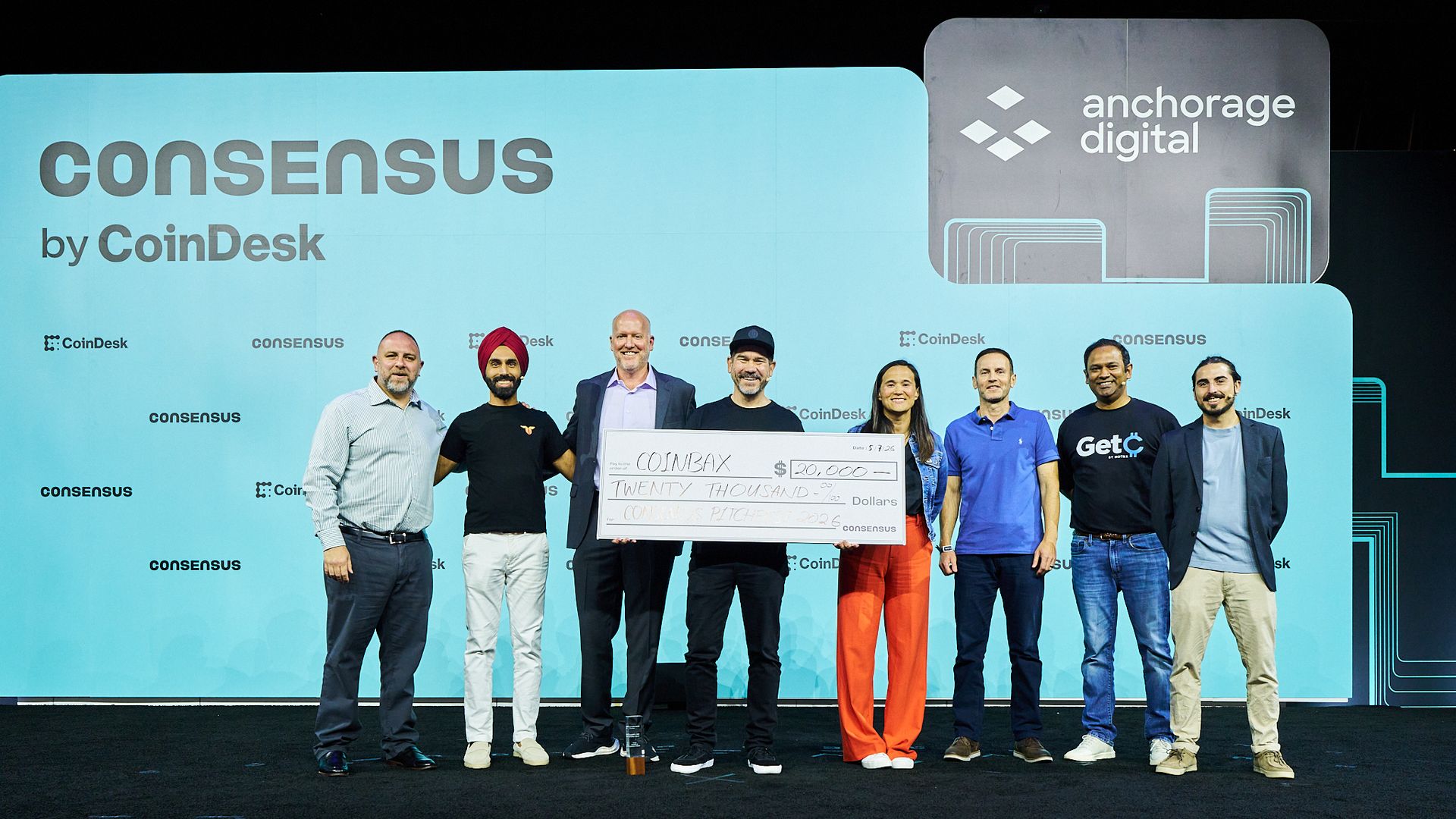
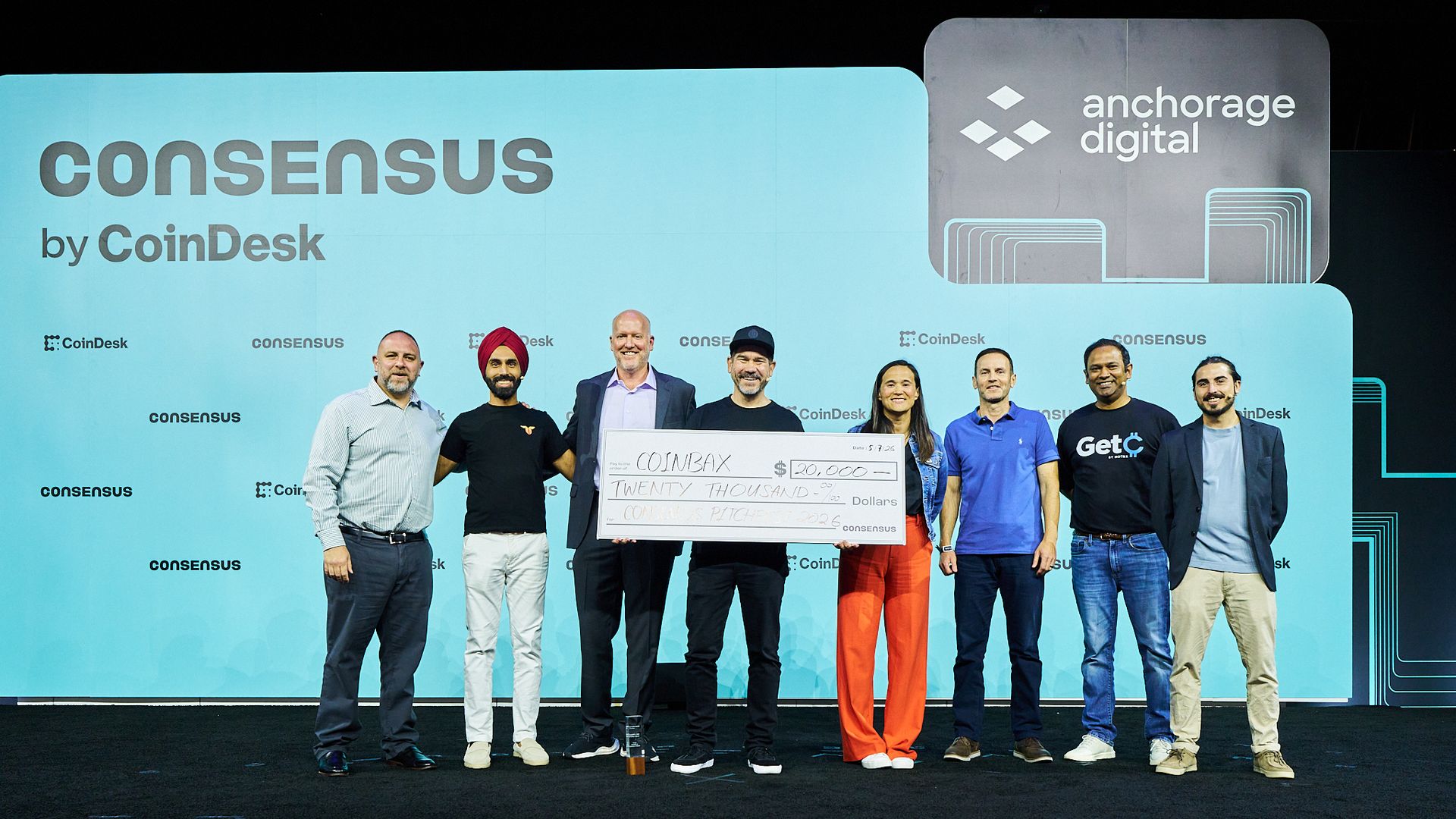
MIAMI – Coinbax won the $20,000 grand prize at Consensus Miami’s PitchFest after pitching a system designed to help banks and financial firms manage compliance for stablecoin payments.
The company, founded by former Jack Henry executive Peter Glyman, builds programmable escrow infrastructure that adds controls to wallet-to-wallet crypto transactions. The software is meant to reduce the risks financial institutions face when moving funds onchain.
“Banks want to use stablecoins for payments, but they need to get their compliance people comfortable with the idea of moving money onchain,” Glyman said during his presentation.
He described a future where “wallet addresses [are] associated with every bank account,” with transactions moving between banks, fintech firms and self-custody wallets. In that environment, he argued, compliance checks need to happen directly onchain rather than only through traditional banking intermediaries.
Coinbax uses smart contracts to hold funds in escrow while third-party services verify identity, sanctions screening and transaction risk. Funds settle only after conditions are met.
“We provide a trust layer,” Glyman said. “We provide programmable escrow that adds the control layer to these payments.”
The startup launched in October, closed a seed round in December and is already live on Base mainnet, according to Glyman. He said the company is working with banks, custody firms and wallet providers on pilot programs.
Second place went to Tashi, a decentralized infrastructure project focused on coordinating and managing AI systems across distributed networks.
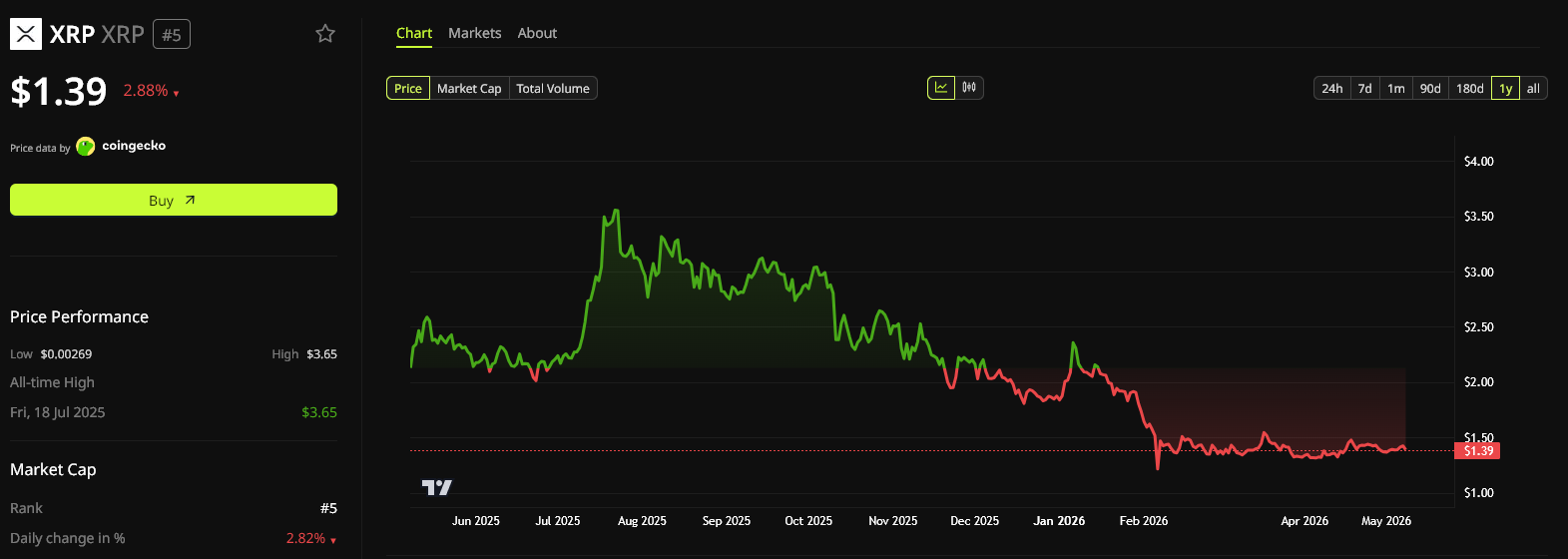
As of May 2026, XRP is trading near $1.41, fueling new expectations of quick profits among small investors interested in cryptocurrencies and global institutional adoption.
Current calculations, however, point to more moderate scenarios, even though there are still catalysts capable of sustaining meaningful growth throughout the year.

How Much XRP Is Needed to Become Rich?
Becoming rich through XRP in 2026 is mathematically possible, although the current numbers paint a far more demanding picture than many investors expect.
As of May 2026, XRP trades around $1.41, with an approximate market capitalization of $87 billion and more than 61.8 billion tokens in circulation.
That market size changes expectations completely. XRP is no longer a small cryptocurrency capable of delivering 100x gains within a few months.
For that reason, the real question is no longer whether XRP can rise, but how much capital an investor would need today to reach one million dollars before the end of the year.
The most commonly cited calculations present a sobering outlook:
- If XRP reaches $5, an investor would need approximately 200,000 XRP. At current prices, that represents an investment of roughly $282,000.
- If XRP climbs to $10, 100,000 XRP would still be required. Purchasing that amount today would cost around $141,000.
- Under Standard Chartered’s scenario of XRP reaching $2.80, an investor would need about 357,000 XRP. That would require an estimated investment of roughly $503,000.
For most small retail investors, these figures represent a considerable barrier.
Those who entered the market during previous cycles and accumulated large holdings at much lower prices could more easily come closer to that goal.
The challenge becomes more evident for investors starting with modest portfolios. An investment below $10,000 would require XRP to reach extremely aggressive levels, possibly above $20 or even $50.
At present, those projections are not part of the mainstream consensus among banks, analytics platforms, or artificial intelligence models.
ETFs Boost Expectations, But Also Caution
The institutional narrative surrounding XRP has changed significantly in recent months. Spot ETFs tied to the asset recorded positive inflows in 13 of the first 19 weeks of 2026, bringing this year’s total to nearly $157 million.
According to SoSoValue data, assets under management already stand near $3.87 billion.

Institutional growth has also been supported by new financial products. Coinbase enabled Trade at Settlement operations for XRP futures, while GraniteShares confirmed the launch of 3x leveraged XRP ETFs on Nasdaq.
Ripple also continues expanding partnerships related to financial infrastructure and international payments.
These developments strengthen the perception of legitimacy within the market.
However, they still do not guarantee an explosive rally. Recent forecasts also help temper expectations: Standard Chartered projects XRP near $2.80 by the end of 2026, while Motley Fool warns of possible pullbacks toward $1.
Artificial intelligence systems broadly agree on a relatively contained scenario. ChatGPT projects XRP around $2.15 by December under medium-probability conditions.
Meanwhile, Grok estimates a range between $2 and $3.50 depending on ETF growth, while Claude considers a scenario near $3.15 possible if the Federal Reserve cuts interest rates.

To justify prices above $5, the market would likely require extraordinary conditions, including:
- Final approval of the CLARITY Act.
- Institutional inflows far exceeding current levels.
- Bitcoin quickly reclaiming the $100,000 mark.
- Public adoption of XRP by a Tier-1 bank.
XRP Looks More Like a Wealth Builder Than a Lottery Ticket
The numbers point to a fairly clear conclusion. XRP still maintains growth potential and a strong institutional narrative, but it is unlikely to turn small investments into instant fortunes during 2026.
That does not mean the asset lacks appeal. XRP continues positioning itself as one of the altcoins with the strongest institutional presence within the international financial sector.
In addition, the development of ETFs and regulated financial products could support gradual appreciation over the coming years.
The key difference lies in expectations. Many investors still imagine moves similar to those seen during the early crypto cycles, when smaller assets multiplied in value quickly.
Today, XRP operates in a much more mature, competitive, and regulator-scrutinized market.
For investors who already accumulated large positions at low prices, 2026 could still become an important year. However, for new investors with limited capital, reaching $1 million in less than twelve months appears unlikely under realistic conditions.
The post XRP Could Create New Rich People, But Not in the Way Many Would Like appeared first on BeInCrypto.


Crypto traders are keeping their fingers crossed for another global pandemic amid predictions that an outbreak of hantavirus from a cruise ship could spur on a so-called “memecoin supercycle.”
X user “@jeetassassin,” who features a badge of the Solana-based crypto exchange Moonshot on their account, claimed that the hantavirus “will spark another memecoin supercycle.”
Hours later, Moonshot claimed that it had “verified” Pump Fun-created token hantavirus (HANTA), which features an AI-generated image of a virus and a rat, on its site.
Read more: Your $1,200 COVID stimulus could be worth $14,700 in bitcoin
Nansen CEO Alex Svanevik claimed that during the coronavirus (COVID-19) pandemic in 2020, it was the year of “DeFi summer.” Now he’s proposing that the hantavirus could herald an “agentic summer.”
Indeed, various other crypto users on X have noted that memecoin traders are praying for a potential pandemic so that their hantavirus-themed crypto holdings “go 100x.”
One user noted, “memecoin traders want the world to go into a full on global pandemic so there $500 in ‘handavirus’ coin goes up.”
Another memecoin trader brandishing a Pump Fun-affiliated badge asked, “What if the Hantavirus shuts down everything and we enter a memecoin supercycle.”
Read more: Paranoid anti-vaxxers are buying fake COVID passes for bitcoin
The display of apathy on show from a lot of memecoin traders shows their indifference to global issues as they participate in an addictive, online lifestyle of gambling with cryptocurrencies.
As one trader put it, “If a pandemic is what it takes to bring traders & vol back then so be it.”
Another claimed that, despite not wanting a pandemic to push the world into lockdown again, “If it somehow does end up spreading and gets COVID-level exposure, crypto volume would probably go absolutely crazy.”
Sorry memecoin traders, hantavirus doesn’t spread like COVID-19
Hantavirus is the name given to a group of various viruses that are carried by rodents. In this case, the Andes hantavirus was detected on a cruise ship departing Argentina last month.
The virus is reported to have infected five passengers, and is suspected to have spread to three more. Three passengers have died as a result, and those suspected of being infected are being treated and isolated.
Despite memecoin traders’ eagerness for a global pandemic, the World Health Organization (WHO) has stressed that the Andes hantavirus is not as contagious as COVID-19, and that the risk to the public is low.
WHO infectious disease epidemiologist Dr. Maria van Kerkhove said at a conference today that, “This is not Covid, this is not influenza, it spreads very, very differently.”
The health body stressed that the virus requires intimate, prolonged contact with people in order to spread.
The Andes hantavirus has spread before, but never reached pandemic status. It’s also not a new strain of virus like COVID-19 that required an international effort to produce a vaccine.
However, the hantavirus itself is still quite deadly and can cause the respiratory disease hantavirus cardiopulmonary syndrome which has a mortality rate of up to 50%.
Got a tip? Send us an email securely via Protos Leaks. For more informed news and investigations, follow us on X, Bluesky, and Google News, or subscribe to our YouTube channel.
Crypto World
Markets Stumble As US Military Reportedly Attacks an Iranian Oil Tanker in the Strait of Hormuz
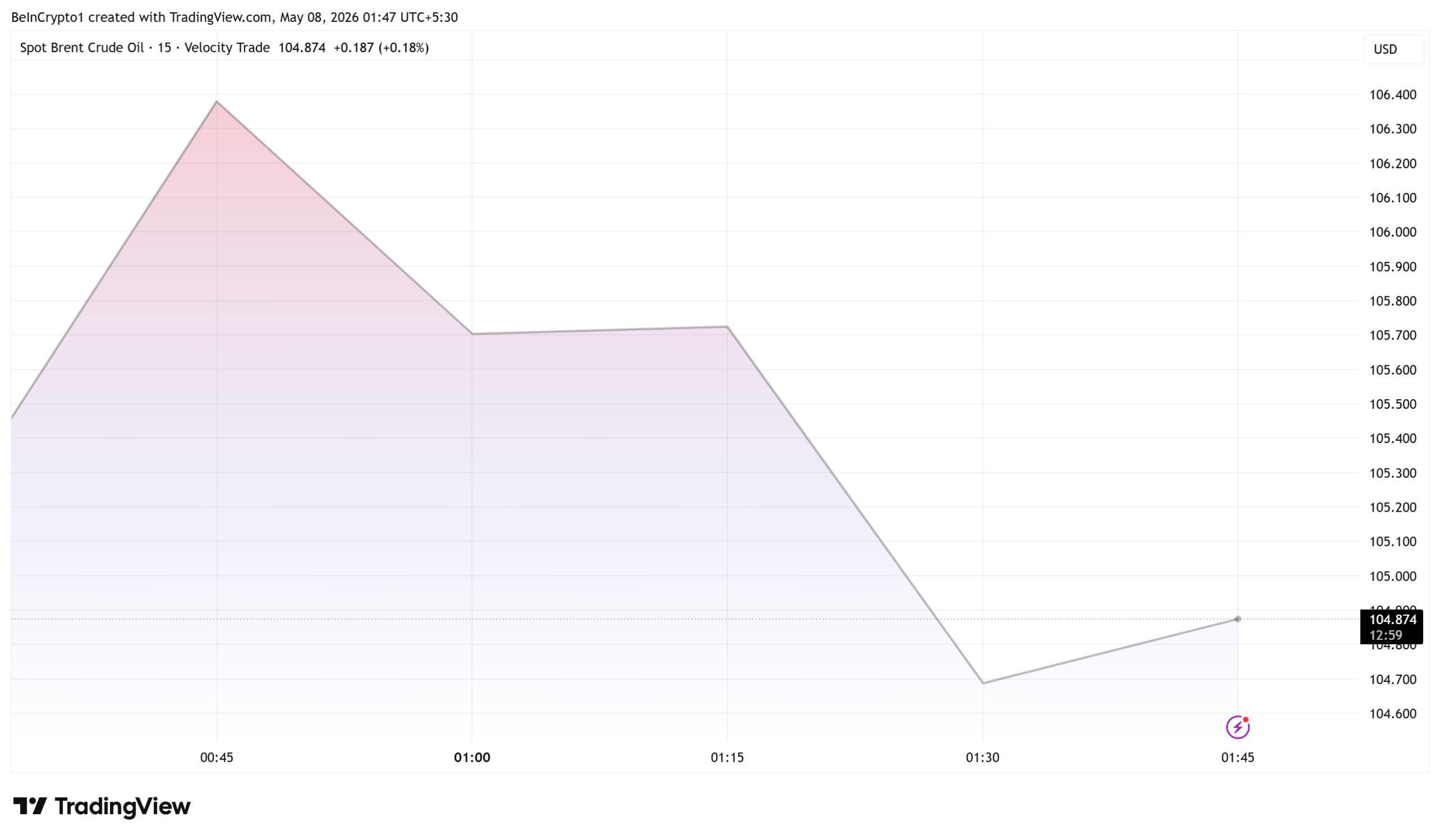
Oil prices tumbled Thursday after reports emerged that US forces fired on an Iranian oil tanker near the Strait of Hormuz, escalating fears of a wider Middle East conflict while triggering sharp volatility across crypto markets.
Iranian state media claimed the US military attacked an Iranian-flagged tanker and that Iranian forces retaliated by launching missiles at US naval units operating near the Strait of Hormuz. US officials confirmed an encounter with an Iranian tanker but denied reports that American warships were struck.
US-Iran Escalation Rattles Global Markets
According to Iranian outlets including IRIB and Fars News Agency, Iranian missiles targeted US naval vessels after the tanker incident. Tehran described the move as retaliation against what it called American aggression in regional waters.
Meanwhile, US Central Command confirmed American forces fired warning shots and later disabled the tanker after it allegedly ignored orders and attempted to breach a naval blockade tied to the ongoing US-Iran conflict.
The Strait of Hormuz remains one of the world’s most important energy chokepoints, carrying roughly 20% of global oil and LNG shipments. Any disruption immediately impacts energy prices, inflation expectations, and broader investor sentiment.
Bitcoin Volatility Surges Alongside Oil
The geopolitical shock quickly spilled into digital assets. Bitcoin and major altcoins initially dropped as traders reduced exposure to risk assets amid fears of broader military escalation.
However, crypto markets stabilized after oil prices reversed sharply lower, with some analysts viewing the selloff as temporary positioning rather than a long-term demand shock.

Oil traders also began reassessing whether the latest confrontation would materially disrupt shipping flows or remain a contained military standoff.
The quick decline in crude prices surprised some analysts who had expected immediate supply fears to drive another energy spike.
Traders are now closely monitoring further statements from Tehran, Washington, and US Central Command for signs of escalation or de-escalation.
Any confirmed disruption to shipping activity in the Strait of Hormuz could reignite volatility across oil, equities, and crypto markets.
The post Markets Stumble As US Military Reportedly Attacks an Iranian Oil Tanker in the Strait of Hormuz appeared first on BeInCrypto.
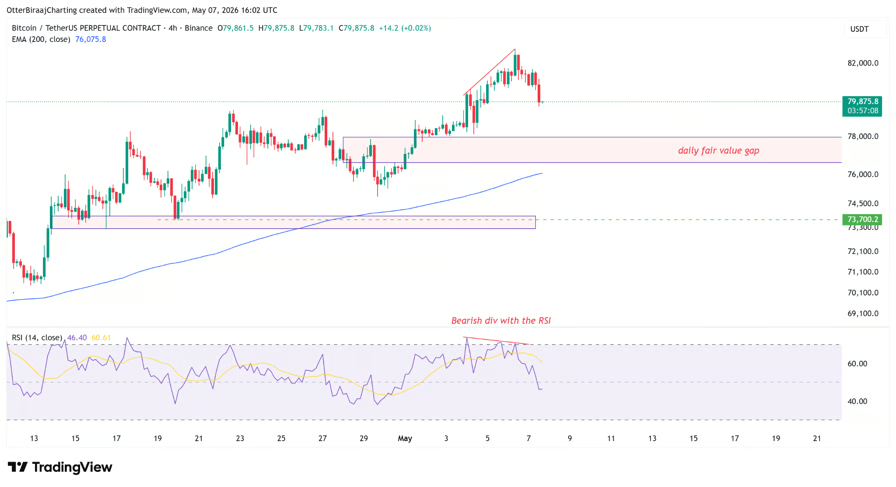
Bitcoin (BTC) price dropped to $79,800 on Thursday after being rejected at a key dynamic resistance level. The pullback occurred despite the weekly spot Bitcoin exchange-traded fund (ETF) inflows surging past $1 billion for the first time since January, but technical data suggests the correction may be short-lived.
Bearish divergences point to where BTC price may go
Bitcoin’s dip below $80,000 came amid a bearish divergence in the relative strength index (RSI) on the one-hour and four-hour charts. A bearish divergence occurs when BTC forms higher highs while the RSI weakens across lower timeframes, signaling fading buying momentum during a rally.
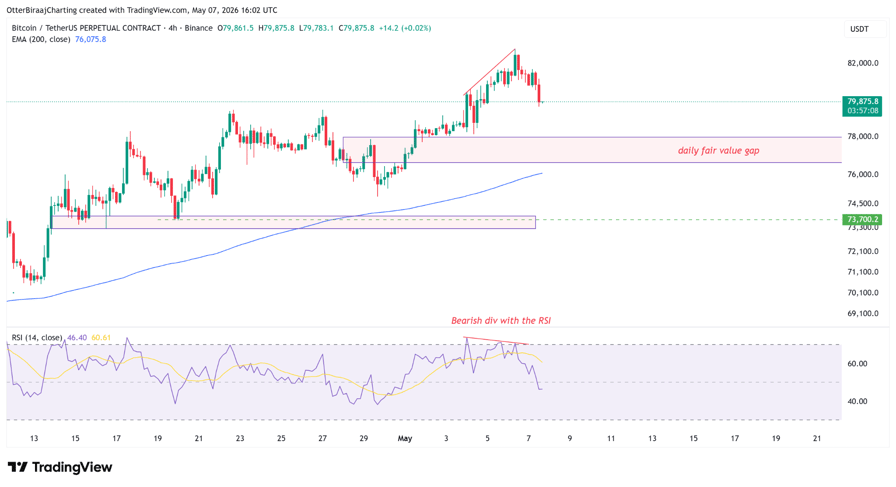
BTC/USDT, four-hour chart. Source: Cointelegraph/TradingView
A hold above the weekly open at $78,500 could stabilize the short-term price action. The key technical support range remains between $76,000 and $78,000, where the daily fair value gap (FVG) aligns with Bitcoin’s 200-day exponential moving average (EMA). If the correction continues, BTC could retest the FVG zone before attempting another rebound above its recent high at $82,800.
A fair value gap marks an area where a sharp price movement previously occurred with limited trading activity, leaving an imbalance that often becomes a liquidity zone during retracements.
Crypto trader Jelle said the “200-day MA/EMA cluster” was acting as resistance, while also identifying $78,000 as the first major support area. According to Jelle, a 200-day moving average retest could allow Bitcoin to retest higher price targets.
Meanwhile, crypto trader Killa XBT identified the $76,300 to $74,700 range as a deeper support zone if selling pressure continues. The trader pointed to the weekly open near $78,500 as the main short-term level that bulls are attempting to defend.
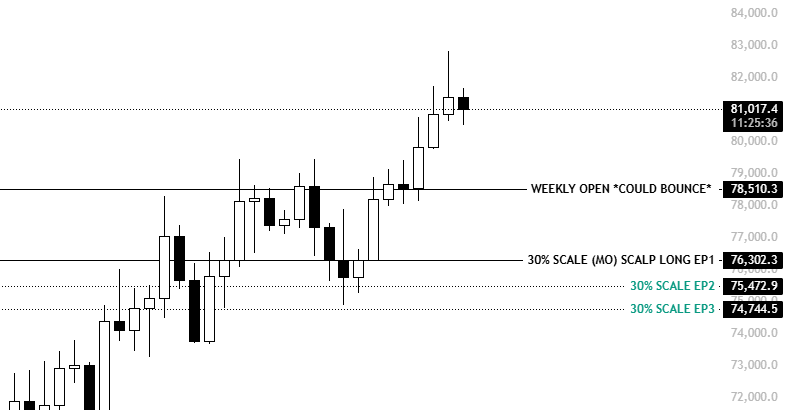
BTC one-day chart analysis by Killa. Source: X
Related: Bitcoin analysts say this level must break for BTC price to confirm bottom
Can spot ETF inflows offset price weakness?
Spot Bitcoin ETF demand strengthened sharply this week. Net inflows reached $1.05 billion, marking the strongest weekly intake since the third week of January. A positive close on Friday would confirm the largest weekly ETF inflow return in nearly four months.
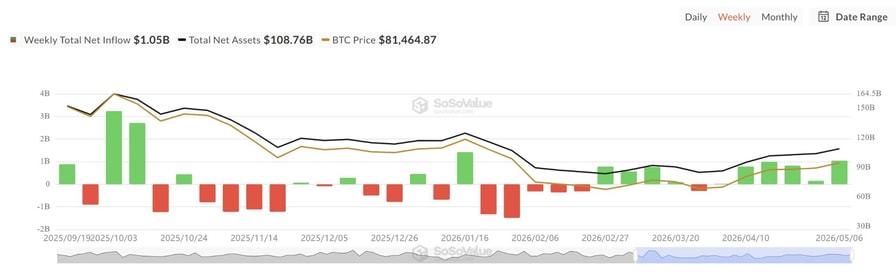
Spot BTC ETF net inflows. Source: SoSoValue
Meanwhile, Swissblock data shows that the Bitcoin Risk Index has reset to near zero, while ETF net flows turned positive again at roughly 3,000 BTC. Historically, elevated risk readings aligned with the ETF outflows and heavier selling pressure across the market.
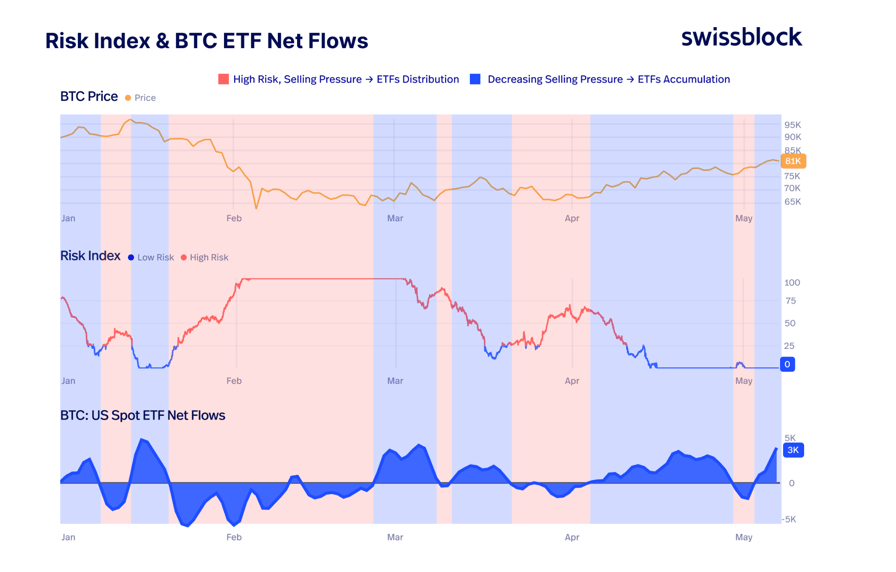
Risk index and BTC ETF net flows. Source: Swissblock/X
The resets into the low-risk zone often coincided with renewed accumulation near the major support clusters. The analysis added,
“That synchronization is still in place. Even when the Risk Index ticked slightly higher last week, ETF selling appeared briefly, but accumulation quickly resumed. That tells us ETF demand is absorbing selling pressure. This remains a flow-driven breakout.”
Related: Bitcoin market dominance moves above 61%: Will altcoins follow?
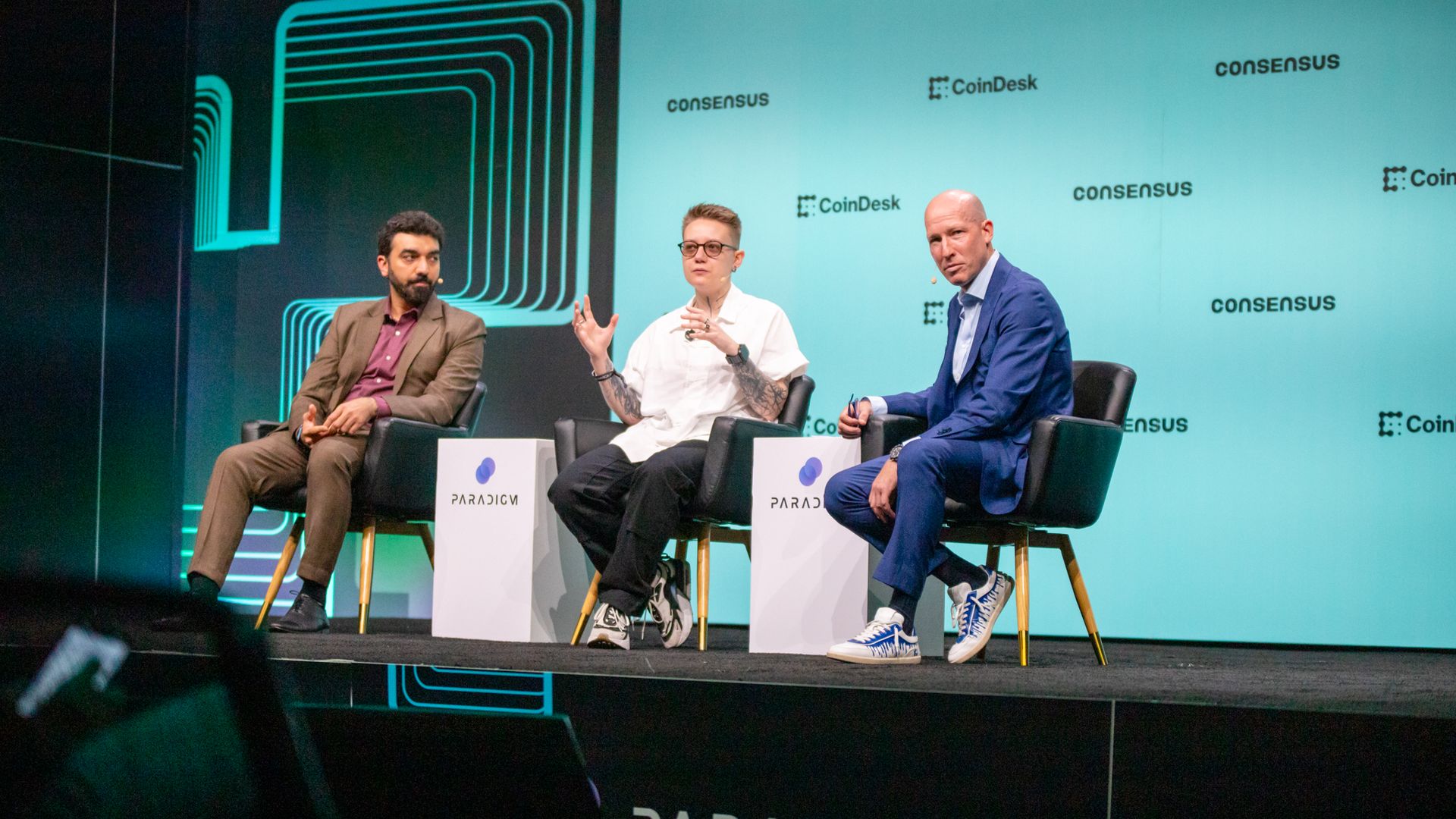
Public blockchains make transactions transparent enough to trace, audit and police, but that visibility can come at the expense of user privacy. Traditional compliance systems often address accountability by identifying people, but that can undermine one of crypto’s original promises: the ability to transact without exposing personal identity by default.
According to panelists at CoinDesk’s Consensus Miami conference earlier this week, those tensions are increasingly solvable through an onchain “intelligence layer” that combines hybrid blockchain architecture with wallet-address-level monitoring.The idea is to split the work across different parts of the system. Private permissioned networks can give institutions the accountability and credibility they need, while public permissionless chains can provide liquidity, and blockchain-forensics tools can help platforms screen transactions at the wallet-address level without automatically tying every user to a real-world identity.
Rajeev Bamra, global head of strategy for digital economy at Moody’s Ratings, said the conventional intelligence layer answers three questions: “Who is it? What are they doing? And can I trust the record?” Those have been addressed in traditional finance by banks, custodians, clearinghouses and credit-rating agencies, he said.
Bamra estimated the institutional digital-finance market at roughly $35 billion today, against more than $200 trillion in annual clearing-house flows in conventional finance, with growth of “over 100 or 150%” in the past 18 months. Blockchain architecture, he predicted, will not be uniformly public or private but a hybrid. “Private permission networks are going to offer the accountability, the credibility aspect,” he said, while “the public permissionless brings the liquidity which the private permissions don’t.”
Pauline Shangett, chief strategy officer at the non-custodial exchange ChangeNOW, firmly sided with the user-side argument. “Bitcoin at its core, at its origin was a semi-anonymous digital cash,” she said.
ChangeNOW, which does not enforce KYC by default, works with AML providers and blockchain forensics firms to monitor flows at the wallet-address level. “All of this blockchain forensics infrastructure allows us to not map people who are passing funds through our system, but instead map their addresses,” Shangett said.
When law-enforcement agencies come to ChangeNOW, Shangett said, the company provides transaction data without doxing the person behind the transaction. She said that compromise allows the platform to provide registration-free swaps while still maintaining internal accounting systems and working with authorities when illegitimate funds move through the service.
On regulation, Bamra said cross-border frameworks like the European Union’s Markets in Crypto-Assets Regulation and the U.S. GENIUS Act ask the same fundamental questions about asset quality, segregation and liability, but diverge sharply at the specifications layer. “We think there is regulatory convergence in intention, but there’s fragmentation in reality or in execution,” he said.
Shangett ended with a regulatory-liability framing, which she suggested cuts to the heart of where responsibility should actually sit.
“The agents who should be held liable for the regulatory frameworks and the adoption thereof are agents who are dealing with emission and not transmission,” she said.
Coinbase (COIN) posted first-quarter 2026 revenue of $1.41 billion, missing Wall Street estimates as crypto trading volumes contracted. Revenue fell 31% year-over-year, and the exchange recorded a $394.1 million net loss, or $1.49 per share.
Transaction revenue of $755.8 million and subscription and services revenue of $583.5 million both came in below sell-side projections. Total crypto market capitalization fell more than 20% during the quarter, weighing on retail order flow.
Trading Slump Drives Coinbase Q1 Loss
Transaction revenue dropped 23% quarter-over-quarter, slightly outperforming the 28% decline in industrywide crypto trading volume. Spot trading on the platform fell 37% as Bitcoin and Ether prices retraced through the quarter.
Consumer transaction revenue came in at $567 million, while institutional transaction revenue fell 27% to $136 million.
The company recorded a $482.4 million unrealized loss on crypto held for investment. Peer holders such as MicroStrategy posted larger markdowns, with a $12.5 billion Q1 loss tied to its bitcoin treasury.

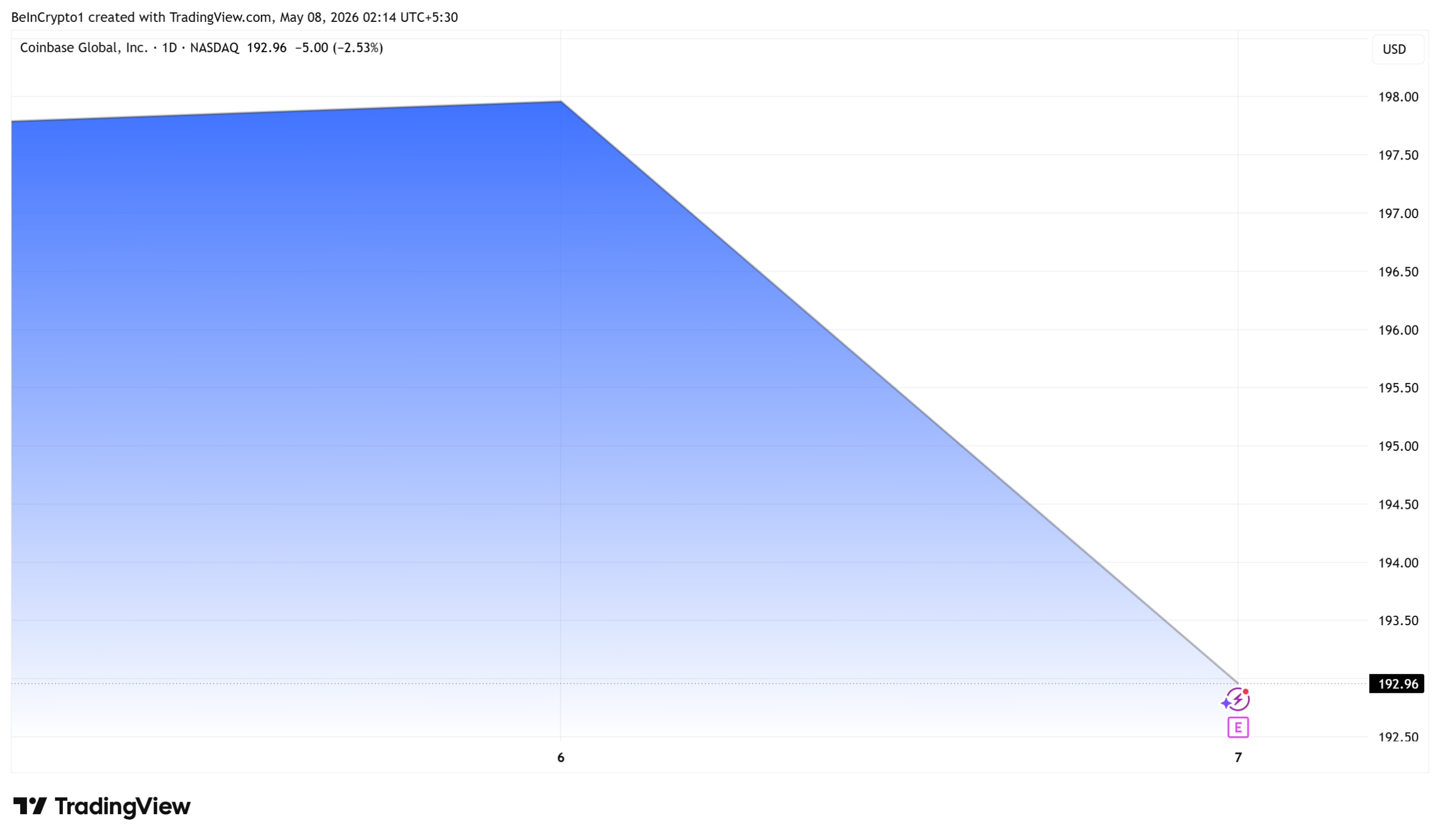
Coinbase’s COIN stock tumbled following the news, falling to $192.96 as of this writing.
Still, Coinbase reported a 13th consecutive quarter of positive adjusted EBITDA at $303.3 million, though the figure declined 46% sequentially.
Crypto trading market share reached an all-time high of 8.6% in the quarter.
Subscription Business Cushions the Blow
Subscription and services revenue accounted for 44% of net revenue, a record mix. The company has positioned the segment as a buffer against trading volatility. Stablecoin revenue contributed $305 million as USDC reached $80 billion in market cap.
Average USDC held in Coinbase products hit $19 billion, up 55% year-over-year, supporting stablecoin economics.
Management guided second-quarter subscription and services revenue between $565 million and $645 million.
The outlook also includes $50 million to $60 million in restructuring charges tied to a 14% workforce reduction.
The headline miss highlights how dependent Coinbase remains on crypto market activity, even as recurring revenue grows.
The post Coinbase Q1 2026 Revenue Falls 31% to $1.41 Billion in Major Wall Street Miss appeared first on BeInCrypto.
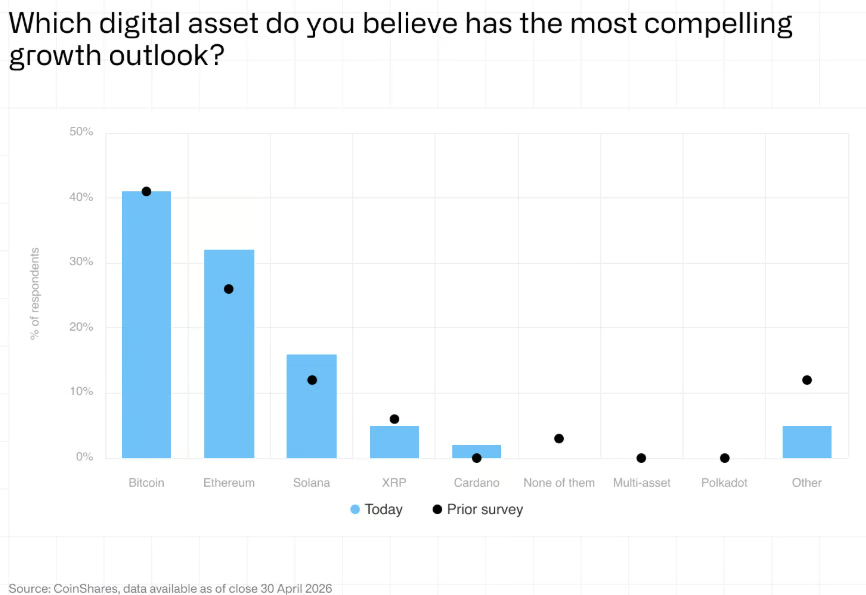
Fund managers are warming back up to digital assets, with Bitcoin continuing to dominate allocation preferences even as broader crypto sentiment improves, according to a new survey by CoinShares.
The April survey gathered responses from 26 institutional investors overseeing a combined $1.3 trillion in assets under management. Allocations to digital assets remain relatively modest, at around 1%, reflecting what CoinShares described as “typical entry sizing” in the current de-risking environment.
“Bitcoin remains the digital asset with the most compelling growth outlook,” CoinShares head of research James Butterfill wrote in the report. Sentiment toward Ether (ETH) and Solana (SOL) also improved modestly compared with previous quarters.
According to the survey, around 32% of respondents have already invested in Bitcoin (BTC) and 25% have already allocated to Ether.
The findings suggest institutional investors are gradually increasing exposure to crypto amid improving market sentiment, growing adoption of exchange-traded funds (ETFs) and a more favorable regulatory backdrop.
At the same time, respondents identified internal restrictions and regulatory uncertainty as the main barriers preventing broader adoption. The survey also pointed to a shift away from “legacy altcoins” and toward newer decentralized finance protocols and emerging blockchain sectors.
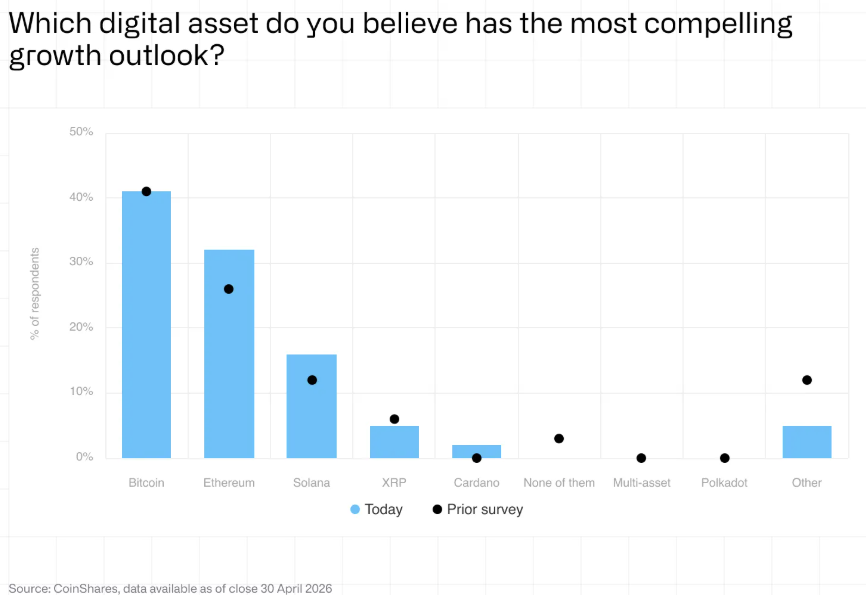
Fund managers identified Bitcoin as having the strongest growth outlook among digital assets, followed by Ether and Solana. Source: CoinShares
Related: Bernstein cites $4T tokenized credit opportunity for Figure Technology stock
Institutional inflows continue to build as sentiment improves
The survey’s upbeat tone aligns with broader institutional flow trends. CoinShares data recently showed digital asset investment products recording several consecutive weeks of inflows, led primarily by Bitcoin demand.
Crypto exchange-traded products attracted $1.2 billion in inflows through April 27, marking the fourth straight week of gains and bringing total inflows during that stretch to $3.9 billion.
The momentum has extended into early May. US spot Bitcoin ETFs recorded nearly $1 billion in net inflows this week as BTC climbed back above $80,000, according to SoSoValue data.

Bitcoin ETF inflows have risen since last Friday. Source: SoSoValue
The inflow trend also aligns with a recent survey by Coinbase and EY-Parthenon, which found that 73% of institutional investors plan to increase their digital asset exposure this year, with most expecting crypto prices to rise over the next 12 months.
The launch of spot Bitcoin ETFs in the United States in January 2024 has been widely viewed as a turning point for institutional adoption. The ETF structure has also helped reduce operational friction for institutions by offering regulated exposure to Bitcoin without requiring direct custody of digital assets.
Related: Crypto Biz: Capital has no consensus

TLDR
- Nvidia stock rose about 3% to $213.53 in early trading after gaining 5.8% in the previous session.
- Goldman Sachs reaffirmed a Buy rating on Nvidia and maintained a $250 price target.
- The bank expects a beat-and-raise quarter based on current supply and demand trends.
- Major technology companies increased their 2026 capital expenditure forecasts to support AI infrastructure.
- Combined spending by Alphabet, Amazon, Meta Platforms, and Microsoft could reach $725 billion in 2026.
Nvidia shares (NVDA) extended their advance on Thursday as semiconductor stocks moved higher. Nvidia stock gained about 3% to $213.53 in early trading after a 5.8% rise on Wednesday. The move pushed the shares back above $200 ahead of the company’s earnings report later this month.
Nvidia Stock Rises as Goldman Backs $250 target
Goldman Sachs reaffirmed its Buy rating on Nvidia and kept a $250 price target on the shares. The bank said demand for data center products continues to support upside potential. It also stated that investors may focus on the possible upside to Nvidia’s $1 trillion data center guidance.
The firm expects a “beat-and-raise” quarter based on current supply and demand trends. However, it said expectations remain high, setting a strong bar for further gains. Goldman added that valuation could improve if hyperscalers show stronger profitability and broader enterprise adoption increases.
The bank also cited opportunities linked to agentic systems and server central processing units. It said these trends could expand Nvidia’s reach beyond traditional large-scale buyers. The company will release its quarterly earnings results later this month.
AI Spending Plans Support Nvidia Stock Outlook
Large technology companies recently increased capital expenditure forecasts for 2026. Alphabet, Amazon, Meta Platforms, and Microsoft raised combined spending projections to about $725 billion. Analysts at Bank of America and Evercore estimate total capital expenditure could exceed $1 trillion by 2027.
This level of spending supports continued demand for Nvidia’s graphics processing units. These chips remain central to artificial intelligence workloads in cloud data centers. As a result, sustained infrastructure investment provides a steady revenue backdrop for Nvidia.
Despite this support, Nvidia stock has trailed several semiconductor peers in recent weeks. Over the past month, Advanced Micro Devices rose about 90%, and Micron Technology gained roughly 76%. In comparison, Nvidia stock increased about 19% during the same period.
Since late April, Nvidia shares have traded mostly flat while Intel and Micron have climbed more than 30%. Advanced Micro Devices also advanced about 20% during that stretch. Market updates highlighted supply constraints in memory chips and progress in internal chip development.
Alphabet continues to develop its tensor processing units for internal use. Amazon advances its Trainium chips to support its cloud operations. These in-house solutions improve efficiency for hyperscalers while introducing competition for external suppliers.
Some analysts now describe Nvidia as a broader proxy for the artificial intelligence sector. They say the market treats the company less as a single chipmaker and more as a sector benchmark. Nvidia will report earnings later this month, providing updated financial details.


Foreign Office warns Brits cruise ship disease now ‘health concern’
IMF warns of 'inevitable' AI-powered threats to world

JaredFromSubway.eth sandwich attacked Vitalik Buterin

Manchester United reach agreement with Casemiro over contract clause amid transfer speculation

US brings back mandatory military draft registration

Steven Gerrard disagrees with Gary Neville over ‘shock’ Chelsea and Arsenal claim | Football


-

 NewsBeat4 days ago
Channel 5 – All Creatures Great and Small series 7 new post
-

 Crypto World13 hours ago
Upbit adds B3 Korean won pair as Base token gains Korea access
-
 Tech6 days ago
Trump’s 25% EU auto tariff breaches Turnberry Agreement that also covers semiconductors and digital trade
-
 NewsBeat15 hours ago
NCP car park operator enters administration putting 340 UK sites at risk of closure
-
 Sports6 days ago
Paul Scholes issues Marcus Rashford reality check as agreement emerges over Man United star
-

 Entertainment6 days ago
Met Gala 2026 Rumored Guest List Is Turning Heads
-

 Business7 days ago
Strait of Hormuz Blockade Persists Amid US-Iran Standoff, Sending Oil Prices Soaring
-
Entertainment6 days ago
New on Prime Video in May 2026 — Full List of Movies and Shows
-

 Entertainment6 days ago
Kylie Jenner Hit With Second Lawsuit From Ex-Housekeeper
-

 Sports6 days ago
Cavaliers vs. Raptors Game 6 live score, updates, highlights from 2026 NBA playoffs first-round series
-

 Tech6 days ago
Meta ends Sama contract after Kenyan workers report seeing intimate footage from Ray-Ban smart glasses users
-
 Sports6 days ago
David Benavidez responds to team Canelo saying the fight will never happen
-
 Sports6 days ago
IPL 2026: ‘Love you darling’- Hardik Pandya’s reaction to MS Dhoni steals the show |Watch | Cricket News
-
Entertainment5 days ago
New Netflix Movies in May 2026 — My Top 3 Picks to Stream
-

 Entertainment6 days ago
Young and the Restless Next Week: Cane Arrested & Matt’s Deadly New Scheme!
-

 Business5 days ago
Luka Doncic Injury Update: Doncic’s Hamstring Recovery Slows Lakers’ Hopes Against Thunder: Can He Run Yet?
-

 Sports6 days ago
What Preity Zinta Said After Punjab Kings’ First Defeat Of IPL 2026
-
 Crypto World5 days ago
Pi Network Mandates Protocol 23 Upgrade for All Mainnet Nodes Before May 15 Deadline
-

 Entertainment5 days ago
Melissa Joan Hart and More Stars Attend 2026 Kentucky Derby
-

 Tech7 days ago
Infinix Introduces GT 50 Pro for Gamers with Improved Cooling and Control Features
You must be logged in to post a comment Login