
Crypto World
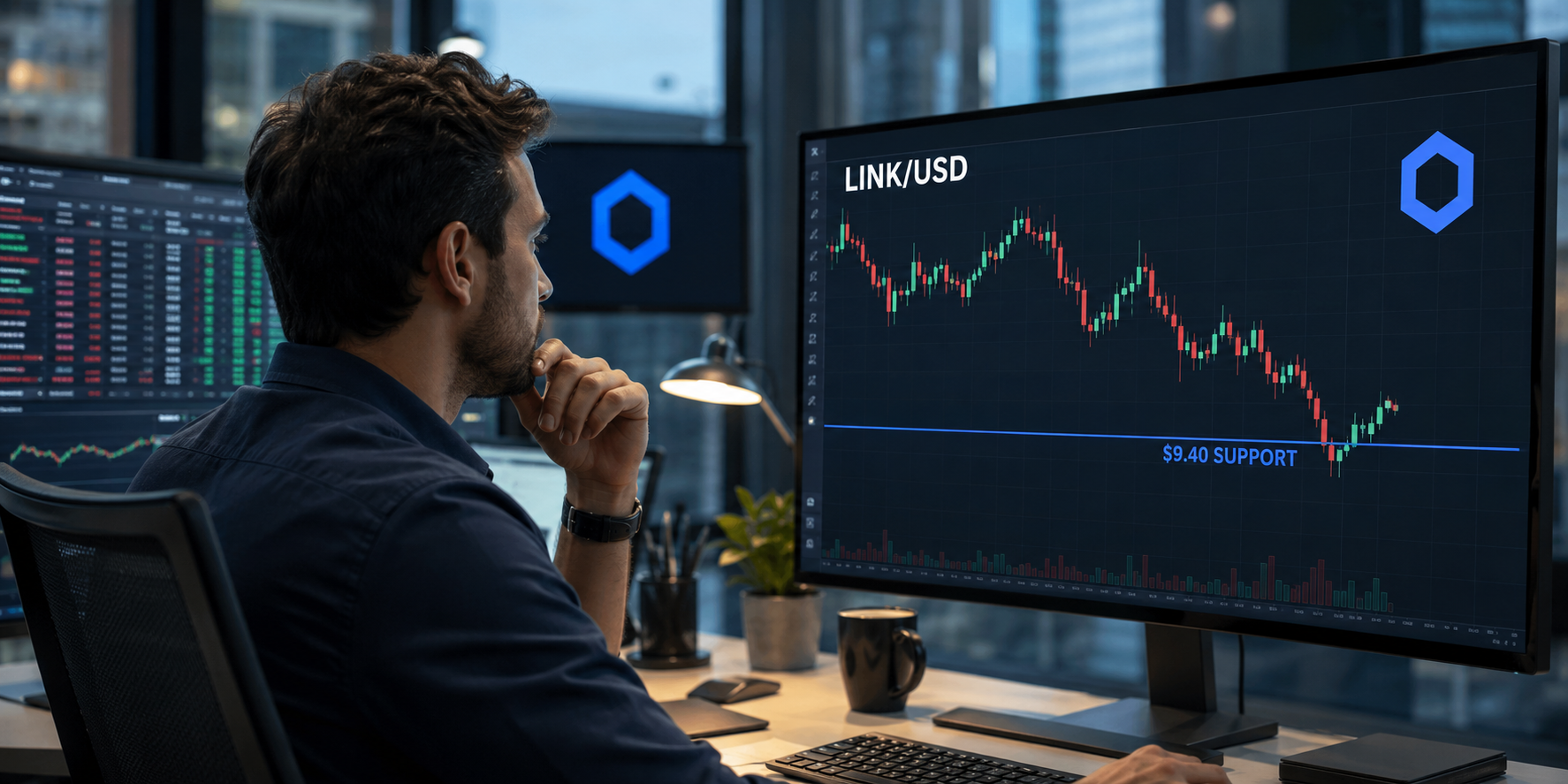
Chainlink pauses near $9.56 as ETF inflows support breakout hopes


Key takeaways
- Chainlink trades around $9.42 after gaining more than 14% last week.
- A long-to-short ratio of 0.76 and negative funding point to weakening derivatives sentiment.
- Spot LINK ETFs attracted $2.07 million on Monday, their largest daily inflow since July 22.
- Losing support at $9.39 could trigger a pullback toward $8.94 and the $8.60–$8.50 region.
Chainlink (LINK) is struggling to overcome resistance near $9.56 on Tuesday, pausing after rallying more than 14% during the previous week.
Weakening derivatives indicators suggest that bullish momentum may be losing strength. However, renewed institutional demand through spot LINK exchange-traded funds could support another attempt to move higher.
Derivatives traders adopt a bearish stance
CoinGlass data shows early signs of weakening sentiment in Chainlink’s derivatives market.
LINK’s long-to-short ratio stands at 0.90 on Tuesday, close to its lowest level in a month. A reading below one indicates that short positions outnumber long positions, suggesting more traders expect the price to decline.
Chainlink’s funding rate also turned negative, falling to minus 0.0050%. Negative funding means short-position holders are paying traders with long exposure, reflecting a bearish imbalance in the perpetual futures market.
Together, the indicators suggest that derivatives traders are becoming more cautious after LINK’s double-digit weekly rally.
However, heavily bearish positioning could also increase the possibility of a short squeeze if Chainlink breaks through its nearby resistance levels.
Institutional demand showed improvement at the beginning of the week. Data from SoSoValue shows that spot Chainlink ETFs recorded $2.07 million in net inflows on Monday. This represented the products’ largest single-day inflow since July 22.
The increase suggests that institutional investors are rebuilding exposure to LINK following its recent recovery.
Continued ETF inflows could help absorb profit-taking and provide the demand needed for Chainlink to overcome the 200-day Exponential Moving Average. However, a single day of positive flows is insufficient to establish a lasting trend.
A sustained series of inflows throughout the week would provide stronger confirmation of renewed institutional interest.
Chainlink price outlook: LINK tests the 200-day EMA
Chainlink trades around $9.42 on Tuesday and remains above its 50-day and 100-day EMAs, positioned at $8.50 and $8.60, respectively.
Holding above these moving averages supports a mildly bullish medium-term outlook. However, LINK remains below the 200-day EMA at $9.56, which is limiting the current recovery.
The token has reclaimed the 61.8% Fibonacci retracement at $9.39, establishing this level as immediate support.
Momentum indicators remain constructive but show that LINK may be approaching stretched conditions. The Relative Strength Index is near 67, just below the overbought threshold of 70, while the Moving Average Convergence Divergence indicator remains positive.
These readings suggest that buyers retain control but may encounter increasing resistance following last week’s sharp rally.
A decisive daily close above the 200-day EMA at $9.56 would strengthen Chainlink’s bullish outlook and bring the horizontal resistance at $9.92 into focus.

Clearing both barriers could allow LINK to test the 78.6% Fibonacci retracement at $10.04. Beyond that, the cycle-high region around $10.87 represents the next major bullish objective.
On the downside, the 61.8% Fibonacci level at $9.39 provides the first line of support. A break below this area could trigger a pullback toward the 50% retracement at $8.94.
Stronger support is concentrated between the 100-day EMA at $8.60 and the 50-day EMA at $8.50. Holding this zone would preserve the medium-term recovery structure, while a decisive breakdown could return control to sellers.


South Korean crypto exchanges Upbit and Bithumb have seen revenues plummet in the first half of the year amid a wider downturn for crypto companies in the country. Meanwhile, South Korea has also banned prediction market Polymarket after concluding that its operations constitute illegal gambling.
The Block reports that Bithumb recorded an operating profit of 14.9 billion won ($11 million), down 83% from last year’s profit of 90.1 billion won ($64 million).
Its operating revenue this year is 168.8 billion won ($120 million), down almost 49% from last year’s 329.2 billion won ($233 million).
It also suffered a net loss this year of 108.7 billion won ($77 million).
Crypto firms hit by poor global market
Upbit parent company Dunamu reported a similar drop in operating revenue. It made 408.1 billion won ($289 million) in the first half of this year, a drop of 49% from last year’s 801.9 billion won ($568 million).
Its operating profits were 111.5 billion won ($79 million), an almost 80% drop from 549.1 billion won ($389 million) last year.
Dunamu said, “The recent decline in performance is attributed to a contraction in liquidity across the global digital asset market, which has led to a weakening of investor sentiment.”
South Korea finds Polymarket is a gambling firm
Meanwhile, crypto-based Polymarket has been banned after South Korea’s Media and Communications Commission concluded the platform’s operations constitute illegal gambling.
The regulator claimed Polymarket crossed an information threshold that is classed as gambling under the Criminal Act and National Sports Promotion Act.
It found that Polymarket’s use of yes-or-no contracts encourages speculative behavior where winnings are reliant on events out of users’ control.
Read more: American Indian tribes want Kalshi and Polymarket off their land
Polymarket argued that it doesn’t manage user funds, that it removed Korean-language services, and that it doesn’t support South Korea’s won fiat currency.
However, the commission said, “Technical features or service methods cannot exempt a platform from domestic legal compliance. Since Polymarket provides a real illegal gambling environment to domestic users, access blocking is unavoidable to protect them.”
Got a tip? Send us an email securely via Protos Leaks. For more informed news and investigations, follow us on X, Bluesky, and Google News, or subscribe to our YouTube channel.
Many projects, he said, raised enormous rounds despite having little revenue and no realistic path to profitability, leaving them dependent on becoming multibillion-dollar businesses simply to justify another financing.
Crypto’s fundraising culture made matters worse.
Unlike most industries, announcing a large raise could boost a project’s token and generate retail attention, creating incentives to present financing in the most flattering possible light.
The headline number could also obscure how firm the financing actually was. Kirkley said Global Settlement Network experienced investors failing to ultimately fund signed commitments, illustrating how announced rounds can differ from cash actually received.
Token governance meets reality
Another experiment now being tested is decentralized governance.
Token ownership did not necessarily translate into active participation, Kirkley said, while governance votes could make it harder for struggling protocols to pivot quickly. “Token holders do not mean active participants in your ecosystem,” he said.
The result is a market increasingly deciding what crypto actually needs.
Kirkley points to stablecoins, neobanks and institutional-grade wallet and settlement infrastructure as emerging winners, while areas including social tokens, memecoins and parts of Web3 gaming face a harsher reckoning.
Bitcoin faces a key support test
The shakeout could intensify if bitcoin breaks its next major support zone.
Kirkley described the market as a “soft bear market,” but sees support at $61,200 as critical.
Japan is losing three financial battles at once as its currency, bond, and debt defenses fail together. The yen has erased most of a rare US-backed rescue, and Bitcoin (BTC) traders are bracing for the yen shock.
Tokyo raised rates, spent an estimated $88 billion in two days, and brought in the US Treasury. Three weeks later, the market has beaten all three defenses.

Battle One Was the Yen, and America’s Help Is Fading
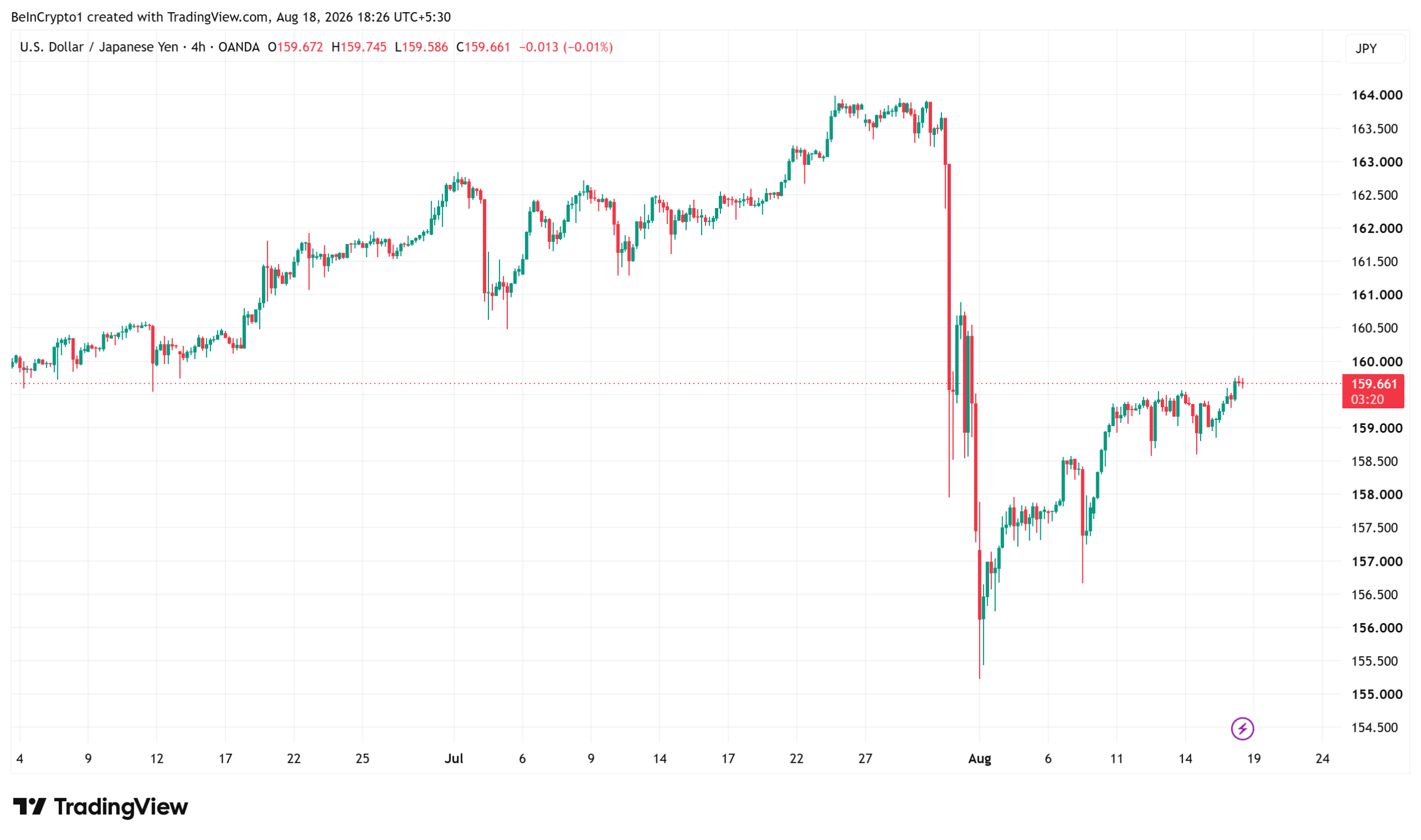
Japan’s Ministry of Finance sold dollars on July 30 as USD/JPY pushed toward 164, the yen’s weakest in decades. A day later, US Treasury Secretary Scott Bessent joined the fight, selling euros to buy yen.
Washington had not stepped in to support the yen since 1998, during the Asian financial crisis. That history shows how seriously both governments took the slide.
The rescue worked for about a week. USD/JPY dropped to around 157, then climbed back near 159. The market has taken back roughly half of what two governments bought. BeInCrypto covered how the intervention gains faded last week, and the pressure has not let up since.
The reason is simple math. US rates sit at 3.5% to 3.75% while Japan’s sit at 1%. That gap pays traders to sell yen every single day, and no one-off intervention changes it.
Goldman Sachs argues Tokyo still holds a $1 trillion war chest for further action. Yet the first $88 billion bought less than a month of relief.
“The causes of yen weakness remain intact, Fortune reported, citing David Meier, economist at Julius Baer.
Follow us on X to get the latest news as it happens
Battles Two and Three Opened in the Bond Market
While the currency defense unraveled, a second battle opened at home. Japan’s 10-year bond yield touched 2.945% on Tuesday, its highest since September 1996. The 30-year yield now sits above 4.1%.

Higher yields would normally help a currency. In Japan, they signal distress. Government debt tops 200% of GDP, the heaviest load in the developed world. Every basis point makes that mountain more expensive to carry.
The economy offers no cover. Growth ran at an annualized 1.1% in the second quarter, missing forecasts. Household spending shrank for the first time in eight quarters.
The third battle is over Japan’s own war chest. Official Treasury data released Monday showed Japan sold $26.4 billion in US Treasuries during June, the largest cut of any country. China shed a similar amount, shrinking its pile to $633.4 billion, and the top three foreign holders dumped $61 billion in one month.
Those reserves are the ammunition for every yen defense. Selling them lifts US yields, widens the rate gap, and weakens the yen further. Each battle Japan fights makes the next one harder.
Will Bitcoin Feel the Yen Shock?
Bitcoin trades near $64,136, up 0.9% in 24 hours. It has held steady while Tokyo burned billions. History suggests that calm can end fast.

The yen is the world’s favorite funding currency. Traders borrow it cheaply and buy assets that pay more, including crypto. This strategy, the carry trade, works until it suddenly does not.
August 2024 showed what the ending looks like. A surprise Bank of Japan (BOJ) rate hike forced carry traders to unwind at once. Tokyo stocks fell 12% in a single day. Bitcoin lost up to 20%, according to the BIS, the bank for central banks.
The same trigger is now loaded. DBS analysts expect the BOJ to hike in September, then every three to four months after that. Faster hikes squeeze carry traders on the funding side while record Japanese yields pull money home.
There is a counterargument. BeInCrypto analysis found the yen squeeze explanation covers less of Bitcoin’s behavior than commonly assumed. Gold, not crypto, has absorbed most of the flight from government debt stress this year.
Still, the risk points one way. Markets have beaten Japan’s intervention, its rate hikes, and its American backup in three weeks.
If USD/JPY breaks 160, Japan must choose between a bigger defense and a public defeat. Both paths shake global liquidity, and Bitcoin rarely sits out that kind of storm.
The next tests come quickly. Japan publishes its official intervention totals at the end of August, and the BOJ meets in September. Traders should watch which battle breaks first.
The post 3 Battles Japan Is Losing at Once, Will Bitcoin Feel the Yen Shock? appeared first on BeInCrypto.
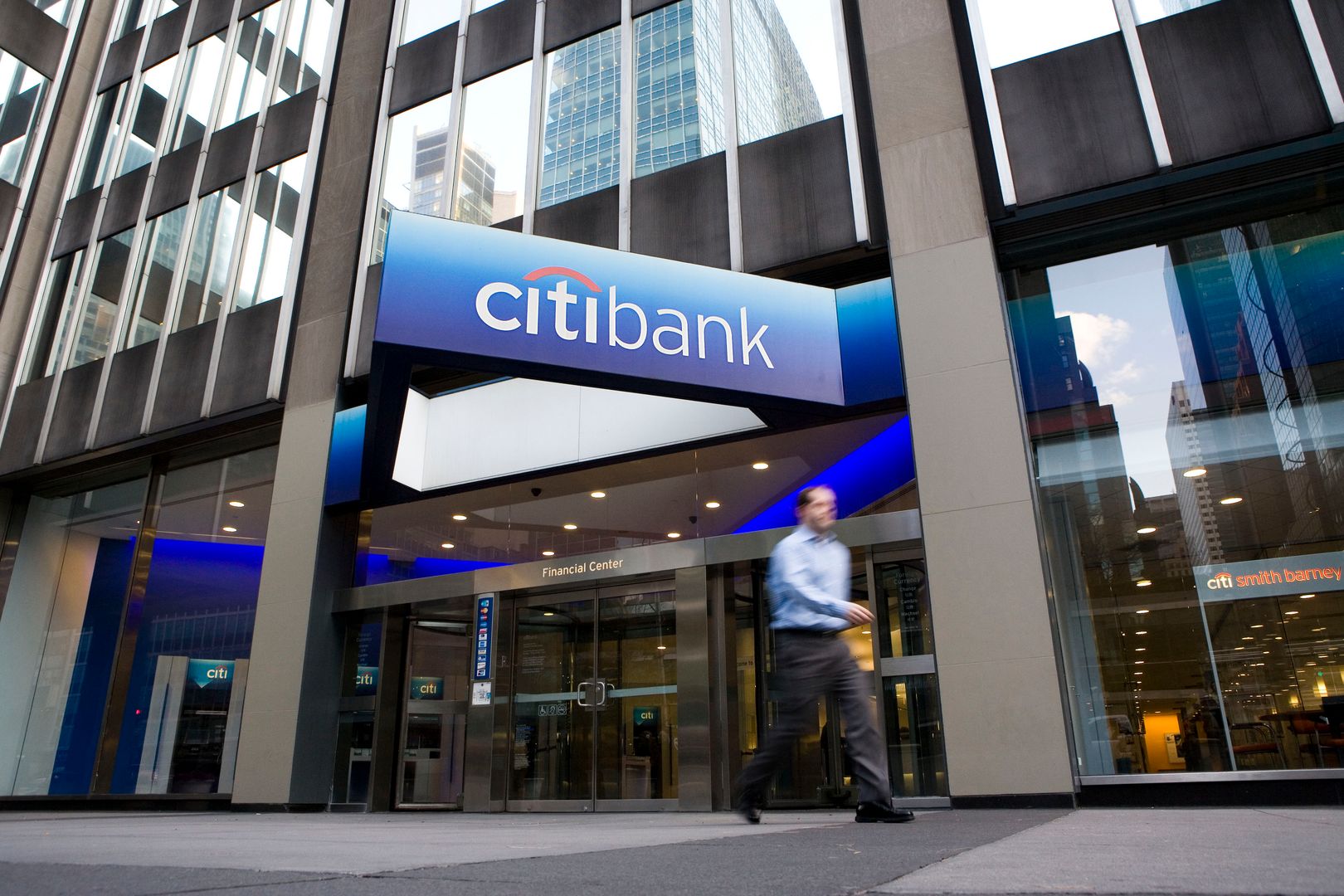
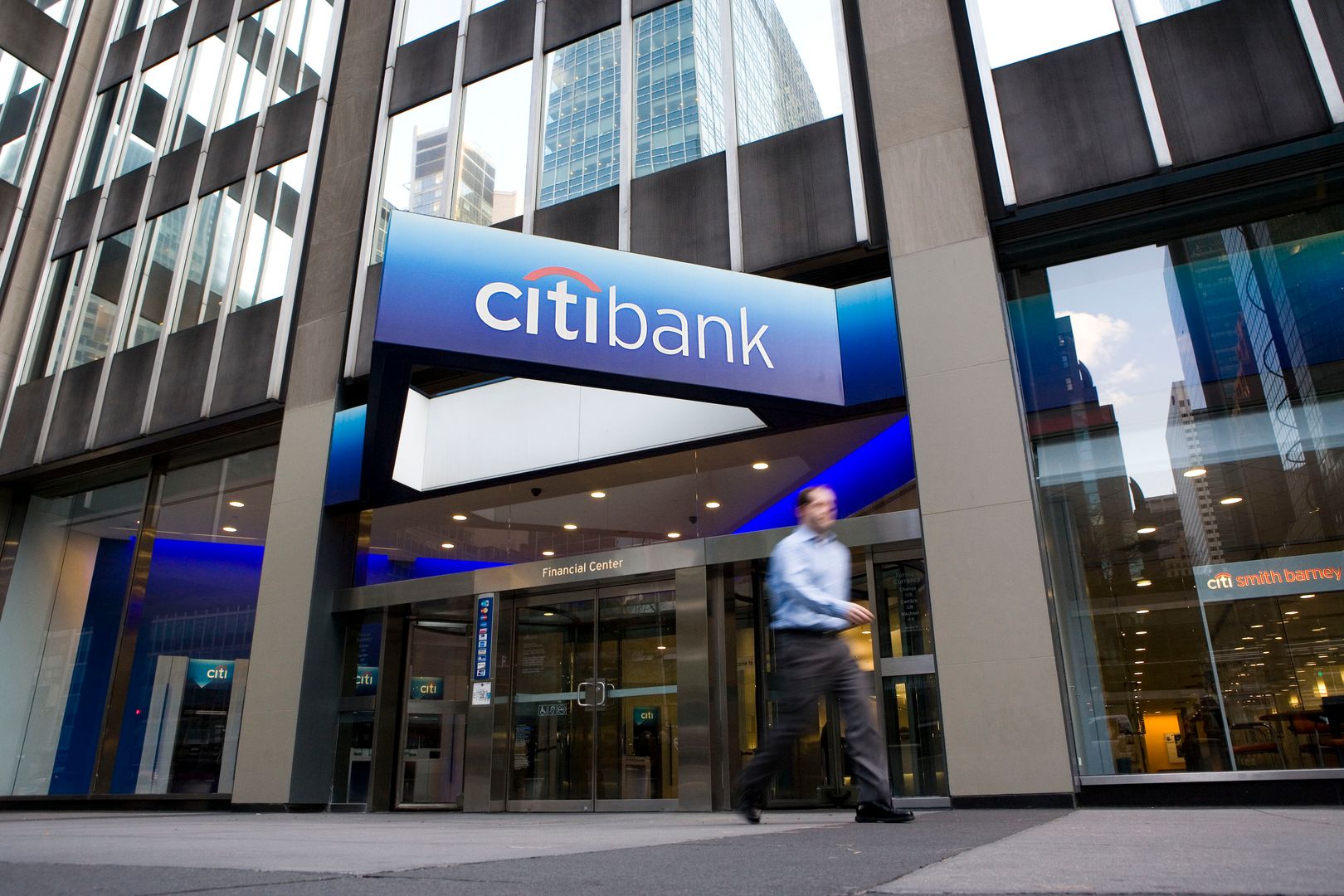
Citigroup plans to begin offering bitcoin custody later this year, bringing crypto into the same infrastructure it uses to safeguard traditional assets for institutional investors.
On Tuesday, the bank’s institutional infrastructure arm announced the launch of Custody+, a suite of services designed to make custody, settlement, foreign exchange and cash management faster.
The service, which does not yet have a launch date, will start with bitcoin and give clients access to traditional and crypto custody through the same framework.
Citi’s custody operation serves clients in more than 100 markets, including 62 markets where it runs its own custody network. By adding bitcoin custody, those clients could keep their bitcoin with the same bank that holds their stocks and bonds, making it easier for some institutions to invest in bitcoin without using a separate crypto custodian.
“Custody+ is the product of a multi-year commitment to building infrastructure that matches the speed of our clients’ strategies,” Amit Agarwal, head of custody at Citi Investor Services, said in a statement.


The Latam Digital Assets Conf will take place Aug. 20-21, bringing together banks, fintechs, regulators and investors to discuss stablecoins, tokenization and digital finance regulation across Latin America.
The event arrives as major financial institutions deepen their push into digital assets. JPMorgan launched its own institutional digital currency in late 2025, BlackRock’s tokenized fund has surpassed $2 billion in assets, and the DTCC has launched a tokenization service with dozens of financial firms.
Stablecoins already account for more than 60% of crypto activity in Argentina, and six in ten new corporate clients onboarded by Bitso Business in 2026 were banks or traditional financial institutions. A recent study by EY and Taquion found that one in two Argentines want traditional banks to offer digital asset services. Argentina’s regulatory framework has kept pace: Decree 475/2026 aligned crypto tax treatment with other financial activity, and the National Securities Commission (CNV) now oversees a registry of virtual asset service providers and a growing tokenization regime.
The two-day conference will cover digital asset regulation, stablecoins, payments, tokenization and institutional decentralized finance through panels and public-private working sessions.
“Latin America is crossing a threshold. Our institutions are no longer debating whether to enter the onchain ecosystem, they’re building the future of finance, and Argentina holds a privileged place in that movement,” said Santiago Cristóbal, Managing Director of Crecimiento.
Confirmed speakers include congress member Martín Yeza; Buenos Aires city legislator Darío Nieto; Pablo Moauro (ADEBA); Gonzalo Pascual Merlo (BYMA Digital); Rafael Soto (MODO); Gastón Irigoyen (Pomelo); Manuel Beaudroit (belo); Julián Colombo (Bitso); Rafael D’Ambrosi (Twin); Eduardo Novillo Astrada (Agrotoken); Borja Martel (Roxom); Sarina Gowland (Fireblocks); Kyle Rojas (Ethereum Foundation) and Hanna Schiuma (Lucero), among others. The full lineup is announced on our official event website.
About Crecimiento
Crecimiento is a foundation that drives Argentina’s tech ecosystem to position the country as a global innovation hub. Since 2024 it has connected startups, developers, investors, companies, and public actors through conferences, hackathons, acceleration programs, and a sustained regulatory agenda. Along the way it has brought together more than 15,000 people across its initiatives, supported more than 1,000 startups, and built more than 200 partnerships with companies and communities in the industry.
About Aleph Week
The Latam Digital Assets Conf is part of Aleph Week, which from August 17 to 23 brings together banks, protocols, builders, and regulators in Buenos Aires. In the days following the conference, the Aleph Hackathon will also take place, among other events to be announced in the coming weeks.
The post Latam Digital Assets Conf to Bring Financial Institutions to Buenos Aires appeared first on BeInCrypto.
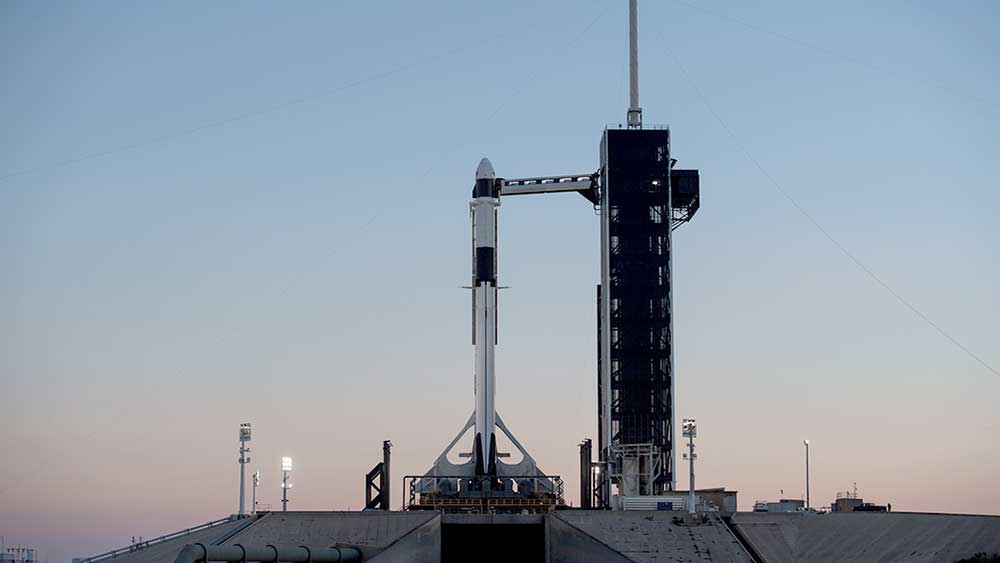
NASA on Monday awarded payload services contracts to Blue Origin, Firefly Aerospace, L3Harris and All Points Logistics for future missions. SpaceX prepares for another Starlink launch tonight. SPCX shares slid on a test of resistance early Tuesday. Space stocks trended lower early Tuesday. NASA on Monday selected All Points Logistics, Firefly Aerospace (FLY), L3Harris (LHX) and Blue Origin, the space…
Copyright ©2026 Investor’s Business Daily, LLC. All rights reserved. 87990cbe856818d5eddac44c7b1cdeb8
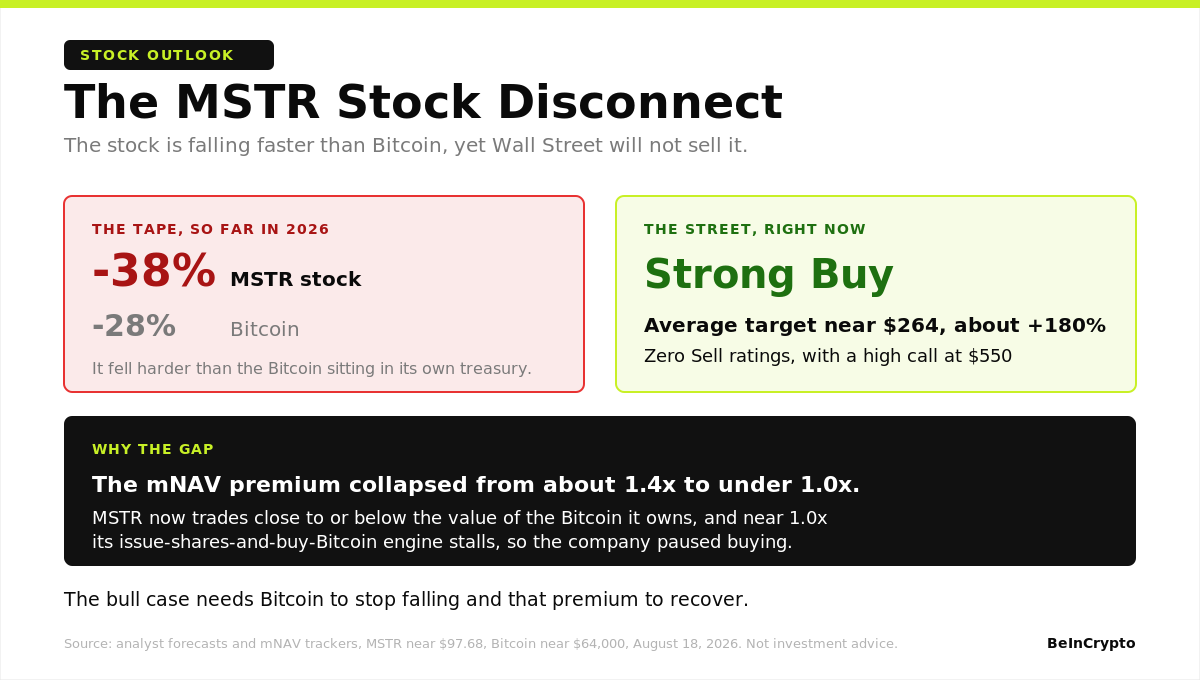
Strategy (MSTR) stock is climbing back toward $100, closing Monday near $97.68 after a 5% jump, even though the Bitcoin behind it has barely moved near $64,000.
The stock is down about 38% in 2026, a steeper fall than Bitcoin’s 28% slide. Yet almost every analyst covering MSTR stock still rates it a Strong Buy. Three forces explain that gap, and they all trace back to one number, a premium called mNAV.

MSTR Stock Has Fallen Faster Than Bitcoin
First, the damage. MSTR has dropped roughly 38% so far in 2026, while Bitcoin, the asset that fills its treasury, is down about 28%. The stock fell harder than the thing it owns.

That is the opposite of what buyers signed up for. Strategy was built to act as leveraged Bitcoin, rising more in rallies, so trailing the coin in a slump is the puzzle the bull case has to solve. But MSTR can still do it without Bitcoin’s help, and 3 reasons explain how.
Reason One, a Premium That Can Rebound
The recovery starts with mNAV, the one number that drives the stock. MSTR is worth the Bitcoin it holds, its net asset value, times a premium investors pay on top, a multiple you can track live. When sentiment runs hot, the premium swells. When it sours, the premium shrinks.
Right now it has shrunk hard. Strategy holds 840,447 BTC, worth about $54 billion at today’s price, yet it paid roughly $63 billion for them, leaving the stack around $9 billion underwater.

The premium that once reached 1.4 times of Bitcoin has since collapsed, and here the math splits in two. On a basic basis, which counts only the common stock, mNAV slipped under 1 to about 0.7, so the shares were worth less than the Bitcoin behind them.

Trackers that also fold in Strategy’s preferred shares and convertible debt read higher, closer to 1.05, which is why you will see both numbers quoted.
That discount is the setup. If sentiment steadies and the premium re-rates back toward 1.5, the stock could climb by half with Bitcoin doing nothing at all.
Want more insights like this? Sign up for Editor Harsh Notariya’s Daily Newsletter here.
How can that premium rise while Bitcoin holds still? Because it is a demand multiple, not a fixed amount, so it swells when more money wants MicroStrategy as a convenient, leveraged Bitcoin bet than wants the coin itself. Index buying, share buybacks that shrink the supply, or a simple return of risk appetite can each lift it.
Reason Two, Strategy Buys Back Its Own Stock
The second reason is what the company now does with its cash. When the premium sat above 1, Strategy could sell new shares at a markup, buy Bitcoin, and hand holders more Bitcoin per share. Near 1, that accretion engine stalls, so the buying stopped.
Strategy’s last Bitcoin purchase came in mid-June, and it has since gone about eight weeks without adding a coin. Instead, it funnels cash into its STRC preferred stock, a share class that pays a rich dividend and is built to trade near $100, buying it back to defend that price.
The move is deliberate.

Retiring stock below its value lifts the Bitcoin behind each remaining share, so holders can gain even while Bitcoin sits flat.
Reason Three: The Sellers Have Quit
The third reason sits on the chart. MSTR has traded inside a rising channel since late June, carving higher lows while Bitcoin drifted sideways. Monday’s 5% candle bounced off the lower edge near $92.

The volume seals it. Trading is down about 63% from June, and since early August, the selling has thinned while buyers have crept back to July levels. Tired sellers and steadier buyers point to seller exhaustion, not fresh mania.
What the Price Action Says Now
All three reasons now meet at one line, $100. A clean break above the round number exposes $101.96, and clearing it opens $104.73 and then $108.26.
The bigger signal sits higher. A push above $118.46 would give the stock room to run toward $134.95 and even $151.44. That zone only reaches the low end of Wall Street’s target range, and the average target sits far above even that.

Below the action, $98.07 and $95.66 are the first supports, and a daily close under $91.77 breaks the channel and voids the case.

Analyst’s View: So the bullish case for the MSTR stock is possible but conditional. MSTR stock only rewards the Strong Buy if Bitcoin steadies. And also if the premium heals and the price clears $118, the upper trendline of the bullish channel.
The post 3 Reasons MicroStrategy (MSTR) Stock Could Climb While Bitcoin Remains Flat appeared first on BeInCrypto.
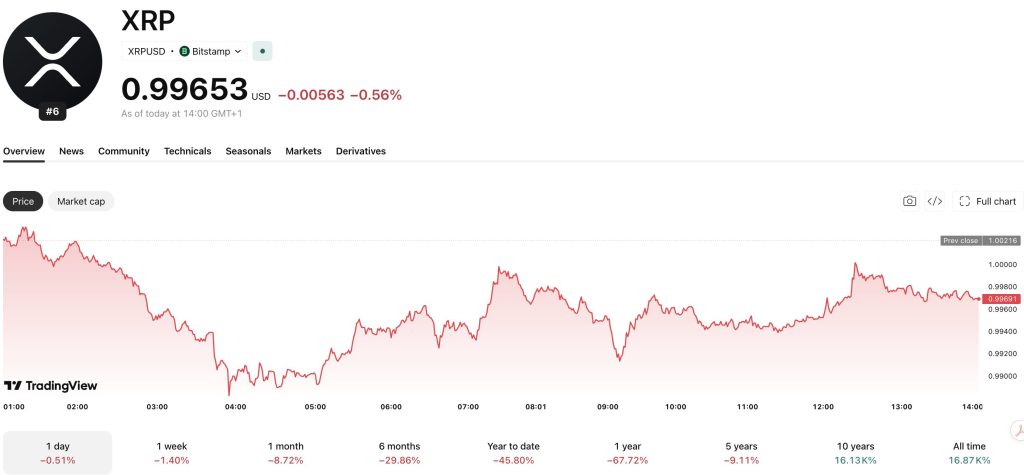
XRP enters the second half of 2026 in an unusual position: legally cleared, institutionally adopted, and yet stuck near the same $1 level it has hovered around for months. We put the question to Claude, asking it ‘AI predicts XRP’, and it gave a measured and interesting response.
As of mid-August 2026, XRP trades around $1.00, down roughly -72% from its July 2025 all-time high near $3.65. Daily trading volume for Ripple is currently at $728M, up from $680M yesterday.

Understanding where it might go from here means combining technical data, macro catalysts, and, crucially, the real money being wagered on prediction markets like Kalshi.
Check out Claude AI’s response below on where it believes XRP will end up over the remainder of 2026. Ripple bulls may not be too happy with the answer, but there is a good amount of data to back up its claims.
Claude AI Predicts XRP Price in 2026
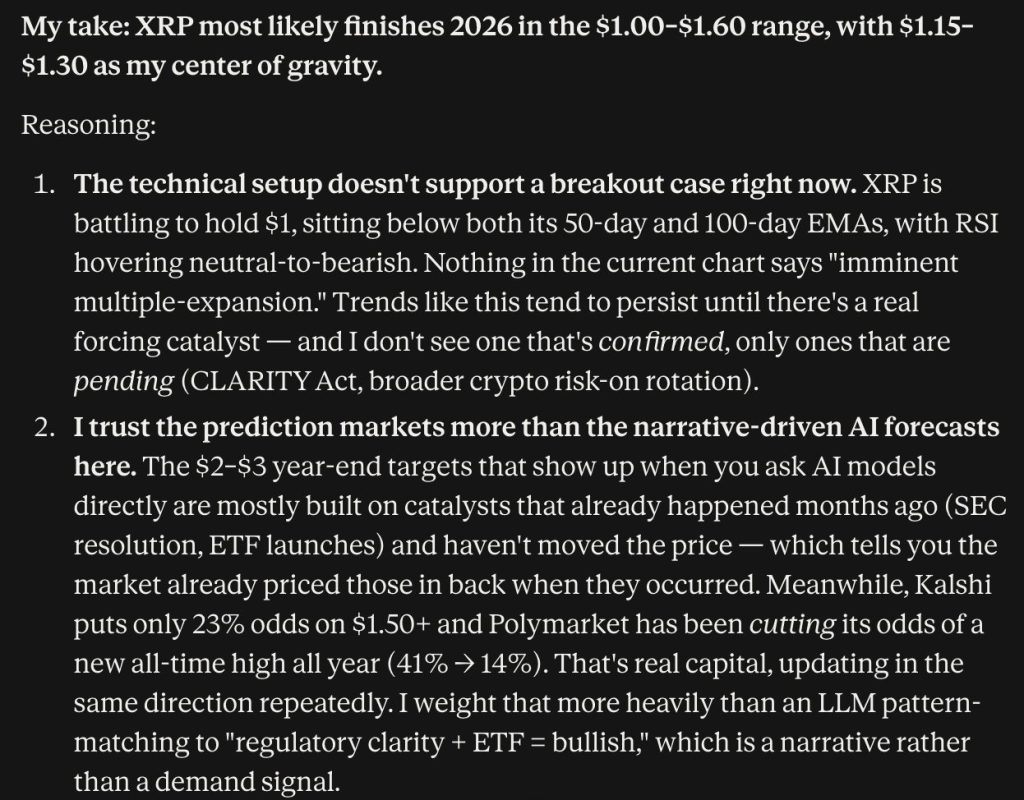
When asking Claude AI to predict the XRP price through the remainder of the year, this is what it had to say:
The technical setup doesn’t support a breakout case right now. XRP is struggling to hold $1, sitting below both its 50- and 100-day EMAs, with RSI hovering between neutral and bearish.
Nothing in the current chart says “imminent multiple-expansion.” Trends like this tend to persist until there’s a real forcing catalyst, and I don’t see one that’s confirmed, only pending ones (CLARITY Act, broader crypto risk-on rotation)
I trust the prediction markets more than the narrative-driven AI forecasts here. The $2–$3 year-end targets that show up when you ask AI models directly are mostly based on catalysts that happened months ago (SEC resolution, ETF launches) and haven’t moved the price, which suggests the market already priced them in when they occurred.
Meanwhile, Kalshi puts only 23% odds on $1.50+, and Polymarket has been cutting its odds of a new all-time high all year (from 41% to 14%). That’s real capital, updating in the same direction repeatedly.
I weigh that more heavily than an LLM pattern-matching to “regulatory clarity + ETF = bullish,” which is a narrative rather than a demand signal.
What would change my mind: sustained ETF inflows breaking meaningfully above the recent ~$2M/week pace, XRP reclaiming and holding the 100-day EMA, or a genuine macro risk-on move dragging the whole crypto market up together. Absent one of those, I don’t see the setup for XRP to run.
Downside case: if $0.99 support fails decisively, $0.85–$0.95 is plausible before finding new footing, but I don’t think a collapse toward the $0.50 zone is likely; liquidity and ETF structural demand act as a floor.
So my honest single number, if forced: XRP ends 2026 at around $1.20, with meaningfully more probability mass below $1.50 than above.
Trade Ethereum on Bybit and Get a Chance to Win Our $1,000 USDT Airdrop
What Kalshi and the Prediction Markets Are Saying
Aside from ‘AI predicts XRP’ and other prediction markets, Kalshi’s annual contract on XRP has a target of closing above $1.50 by the end of 2026 and has been climbing, recently moving from 18% to 23%, a sign that some traders are warming to a stronger back half of the year.
A smaller but notable 10% of bettors are pricing in XRP reaching $2.50, a scenario that would likely require multiple bullish catalysts to align at once, such as broader crypto market strength and further regulatory clarity in Washington.
At the same time, a separate Kalshi market has indicated a 59% probability that XRP will drop below $1 before year-end — underscoring genuine uncertainty rather than consensus.
Shorter-dated Kalshi contracts, which settle in as little as two weeks, have shown roughly 66% odds of XRP closing above $1.35 in the near term, though that probability fell to 43% for the $1.37 threshold, a reminder that short-term sentiment can shift quickly and shouldn’t be read as a year-end forecast.
Polymarket data tells a more cautious story on the high end: the probability of XRP setting a new all-time high before January 2027 has fallen sharply over the year, from around 41% to just 14%, while the odds of XRP even reaching $3 sit near 23%. That’s a notably wider gap than many analysts’ price targets, which have historically clustered at higher levels.
Discover: Trade the odds on Kalshi and get a free $25
The post AI Predicts XRP: Claude Makes a Prediction that May Anger the Ripple Maxis appeared first on Cryptonews.
Satoshi Bitcoin scaling quotes prove nothing, Adam Back argues, because the pseudonymous creator contradicted himself repeatedly and was sometimes simply wrong.
The Blockstream CEO fired back this week at a viral thread citing old forum posts as proof that Satoshi Nakamoto always wanted bigger blocks.
What the Satoshi Bitcoin Scaling Quotes Actually Say
The fight reopened after a developer interview drew criticism on X. Big-block advocates recirculated two Satoshi lines they treat as settled doctrine, starting with this one from BitcoinTalk.
“We can phase in a change later if we get closer to needing it.”
Satoshi Nakamoto, BitcoinTalk, October 3, 2010
The context complicates that reading. Satoshi wrote it while urging users to reject a patch that raised the block size limit.
A December 2009 post predicted Moore’s Law would soon outgrow the chain. That rule of thumb holds that computing power roughly doubles every two years.
Consequently, advocates argue, the design always assumed rising capacity.
Back answered with one word. He wrote “no,” then explained why the archive cuts both ways.
Why Back Wants First Principles Instead
Back traces those Satoshi Bitcoin quotes to a defensive exchange with critic James A. Donald, who argued in 2008 that the design would never scale. Satoshi’s answer that November pointed away from bigger blocks entirely.
“as the network grows beyond a certain point, it would be left more and more to specialists with server farms of specialized hardware”
Satoshi Nakamoto, Cryptography Mailing List, November 2008
There sits the contradiction. One Satoshi tells users the chain can simply grow, while another hands the load to specialists and lightweight clients.
The Moore’s Law claim aged worse still. Satoshi expected download times to peak within eight months, yet the chain kept outrunning hardware. It now spans about 744 gigabytes.
Back reads those later remarks as an early case for second layers, which settle payments off-chain.
The Blockstream founder has spent 2026 attacking similar appeals to authority. In July, he ridiculed the BIP-110 fork fight, a failed push to rewrite consensus rules through miner signaling.
He later called the case for lifting Bitcoin’s 21 million cap a trap. Back has also argued that Bitcoin was discovered, not invented, weakening any author’s claim to the roadmap.
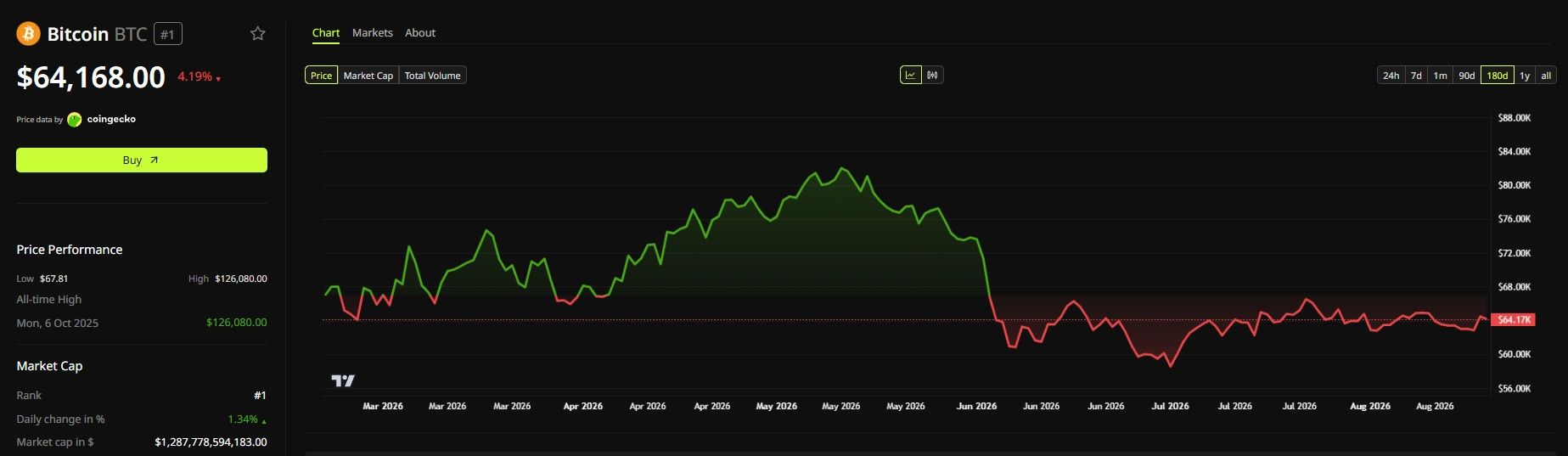
Meanwhile, the market offers little comfort. Bitcoin (BTC) trades near $64,168, roughly 49% below the record of $126,080 set in October 2025.

The argument resurfaces because both sides need Satoshi. Coinbase CEO Brian Armstrong recently claimed stablecoins, not Bitcoin, delivered Satoshi’s payments vision.
Craig Wright pushed the opposite line in his Bitcoin governance critique, insisting the base layer must never change.
Back lands somewhere between them. Old Satoshi Bitcoin posts can inform the debate; however, they cannot end it.
His conclusion abandons the archive. Developers should reason from first principles themselves, he argues, rather than mine a decade-old forum for permission.
The post Adam Back Rejects Satoshi Nakamoto as Bitcoin’s Final Word appeared first on BeInCrypto.


XRP price prediction has it trading at $0.9956, down -0.3% over the past 24 hours after swinging between $0.9897 and $1.0044, a range tight enough to make even patient bulls nervous. The token’s remarkable 635-session streak of closing above $1 nearly snapped twice this month, and today’s print puts it right back on the edge. What happens if that streak finally breaks?
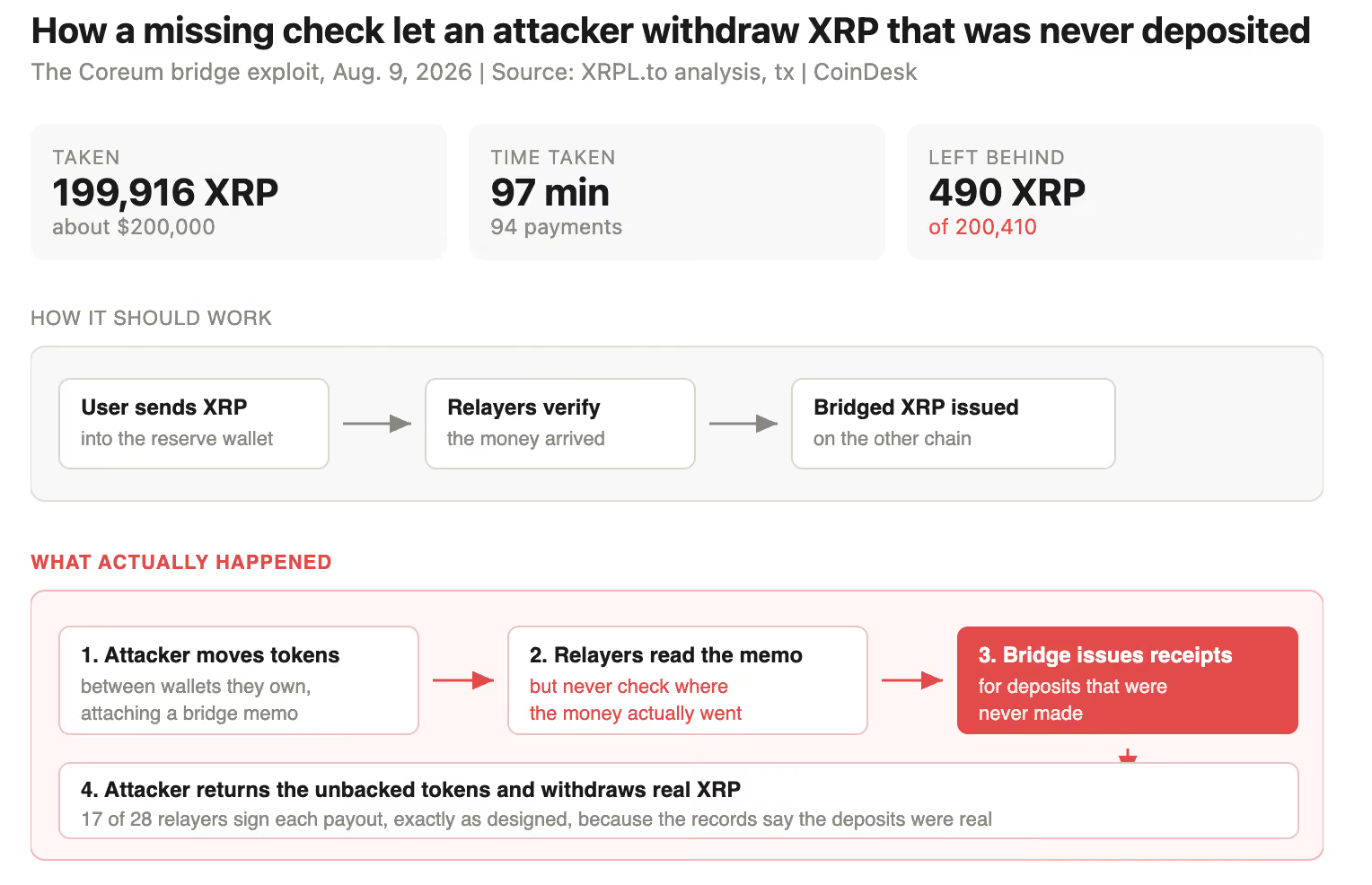
A bridge exploit that drained roughly $200,000 via a connection between the TX Chain and XRP Ledger briefly pushed XRP under $1 on August 11 and again on August 14.
Buyers stepped in both times before the daily close, but the technical damage lingers: XRP’s 50-day EMA now sits below its 200-day EMA, a death cross that confirms sellers have controlled the short to medium-term trend for weeks.
Meanwhile, Wall Street posted a completely different Monday, with the S&P 500 and Nasdaq hovering near highs on AI-driven momentum, a divergence that’s left crypto looking increasingly isolated from broader risk appetite.
Institutional flows tell a more nuanced story, though: recent XRP ETF activity from major players like Jane Street suggests some smart money isn’t fully bailing on the setup, even as retail sentiment sours.
XRP Price Prediction: Can Ripple Hit $1.06 This Week?
At $0.9956, XRP sits almost exactly on its most contested psychological level in a year. The $1.00 zone has functioned as the primary demand area since November 2024, and price has spent most of August oscillating between $1.00 and $1.18, with no decisive break in either direction. Bollinger lower bands cluster around $0.99–$1.01, reinforcing that this is where buyers have consistently shown up.
Bull case: A reclaim of $1.04–$1.06 opens the door to the 50-day EMA zone near $1.09–$1.11, with $1.18 as the next real test.
Base case: continued chop between $0.99 and $1.06 as the market waits for a catalyst.
Bear case: a clean daily close below $1.00 invalidates the floor entirely, with FXLeaders analysis pointing toward $0.80 as the next technical magnet.
Ripple CEO Brad Garlinghouse’s appearance at the Wyoming Blockchain Symposium adds a wildcard; any regulatory clarity commentary could move price fast in either direction.
Traders watching for confirmation should track whether XRP can close above $1.06 on volume before committing to the bull thesis; some analysts have also floated more aggressive 2026 targets, citing whale accumulation and shrinking exchange supply.
Bitcoin Hyper Targets Early Mover Upside as XRP Tests Key Levels
XRP price prediction shows a death cross on the chart and repeated sub-$1 scares, which isn’t confidence-inspiring for anyone holding through this chop. A token that’s already spent two years compounding needs a genuinely new catalyst to break its current range.
And even a clean bounce to $1.18 only recovers ground lost; it doesn’t create new upside. That’s the math pushing traders toward earlier-stage infrastructure plays where the ceiling isn’t already priced in.
Bitcoin Hyper ($HYPER) is positioning itself as the first Bitcoin Layer 2 with full SVM integration, aiming to process transactions faster than Solana itself while inheriting Bitcoin’s underlying security.
The presale has raised $33,032,316.79 at a current token price of $0.0136848, with staking rewards offered at a high APY (exact rate undisclosed).
Its Decentralized Canonical Bridge targets one of Bitcoin’s core limitations, the total absence of programmable smart contracts, without routing through custodial intermediaries.
Visit the Bitcoin Hyper Presale Website Here.
This article is not financial advice. Crypto markets are highly volatile and unpredictable. Always conduct independent research before making investment decisions.
The post XRP Price Prediction: Can $1 Be Reclaimed This Week? appeared first on Cryptonews.
Jeff Bezos: Amazon founder’s consortium bought close to 40% of Liverpool

Jefferies raises Belrise Industries target price, sees 18% upside on strong demand, business expansion

Crypto firms are struggling in South Korea





-

 Fashion4 days ago
Weekend Open Thread: Ann Taylor
-
 NewsBeat7 days ago
Communication cards help banking customers access services or report scams
-
 Sports5 days ago
This U.S. Amateur is a glimpse into golf’s future in more ways than you think
-
 NewsBeat3 days ago
Myanmar says over 300,000 Rohingya refugees verified for repatriation as exodus enters ninth year
-

 Sports3 days ago
Birmingham 2026: Day 6 Timetable for Irish Athletes
-

 Politics3 days ago
SEQ Code: The Three Letter Boarding Pass Code That Could Give You The Worst Seat
-
 Tech4 days ago
11 Ways to Rank Your Videos
-
 Entertainment6 days ago
Keke Palmer Subtly Hints At Sean Evans Drama With Cryptic Post
-

 Fashion7 days ago
Coffee Break: The Fonteyn Jane Flat
-

 Tech7 days ago
Zoom Screen-Sharing Bug Let People Fully Take Over Other Devices On A Call
-

 Fashion7 days ago
Should you refinance your debt? Pros, cons, and real numbers
-

 Fashion7 days ago
Claire Life: Kicking Off MVAAFF With the C Suite Luncheon Featuring Phylicia Rashad, Letoya Luckett, and More!
-
 Crypto World6 days ago
XRP bridge drained after software mistook fake deposits for real ones
-

 Sports6 days ago
DeQuan Jones in ‘high spirits’ after successful leg surgery
-

 Tech5 days ago
DeepSeek Harness launches as open source rival to Claude Code, alongside V4-Pro on API with higher prices
-
 Crypto World6 days ago
Perplexity AI Predicts an XRP Scenario Few Analysts Are Discussing
-

 Tech6 days ago
SpaceXAI’s Grok Bot turns agents into persistent digital coworkers that can operate your apps for $120-per-month
-

 Politics6 days ago
How Average Are You In The UK?
-
 Entertainment6 days ago
2026’s Most Ambitious Fantasy Movie Officially Scores Sequel Update
-

 Politics7 days ago
In the Chris Kaba case, the police watchdog capitulated to the mob
You must be logged in to post a comment Login