

Crypto World
Chainlink Settles the World Cup but Markets Won’t Settle LINK

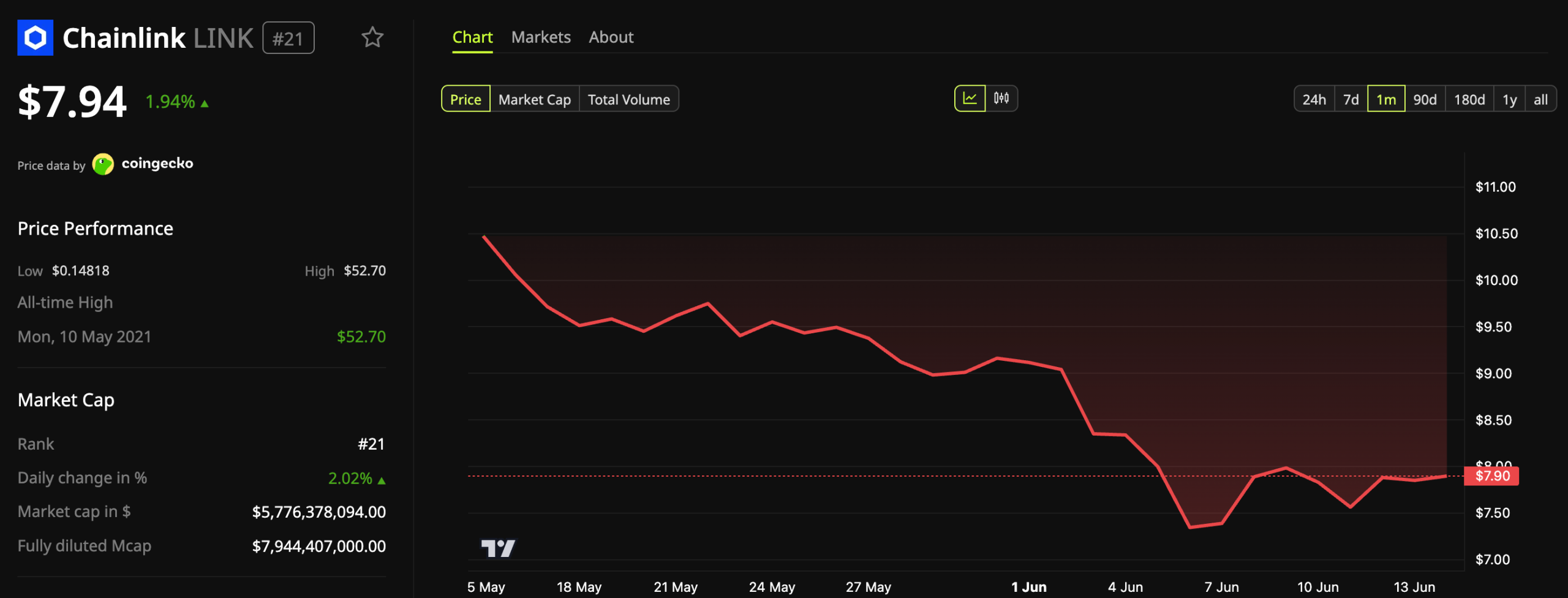
Chainlink (LINK) now powers the betting markets behind the 2026 World Cup. Yet, its token trades near $7.94, close to 90-day lows.
The disconnect highlights a familiar pattern in crypto. Real-world use of Chainlink’s network is rising, while LINK’s price remains tied to sentiment across the wider market.
Chainlink Powers the World Cup’s Betting Rails
Chainlink provides oracle infrastructure that feeds real-world data, such as match results, onto blockchains. Prediction markets use that data to automatically settle bets.
ADI Predictstreet became the tournament’s first official prediction-market partner, and it runs on Chainlink oracles. Myriad, backed by Tom Lee and ConsenSys, settles more than 75 World Cup contracts the same way.
On Polymarket, the World Cup Winner market alone has attracted close to $2.2 billion in bets. The platform also runs fast crypto markets that resolve every 5 or 15 minutes.
Those markets use Chainlink Data Streams and cover hundreds of token pairs. Chainlink says the markets have processed more than $7 billion in a matter of months.
“No mania behind it either: social volume is running at its May average, not above it. The adoption stack isn’t crowd hype,” Santiment said.
Follow us on X to get the latest news as it happens
LINK Price Stays Tied to the Macro
Despite the adoption, LINK trades about 23% below its May highs. The token has followed a broad June risk-off across crypto and other risk assets.
Bitcoin’s weakness has weighed on the wider market, and altcoins like LINK tend to amplify those moves. Lower risk appetite has capped any rebound.

Chainlink’s daily active addresses surged to 5,679 on June 5, marking the busiest day in the quarter. That same day, LINK printed its 90-day low. Higher usage has not raised prices.
“The tournament runs on its rails. The token trades on the macro,” Santiment added.
Analysts Watch for a LINK Bottom
Despite the weakness, Joao Wedson, founder of analytics firm Alphractal, says LINK is “entering the accumulation zone.” He noted that large holders have resumed accumulating. At the same time, the altcoin trades below its realized price, the average cost basis of holders.
“There is another lower level that has acted as a historical price base. A true accumulation phase. BTC may still drop further, but LINK already looks like it is forming a bottom,” Wedson forecasted.
Santiment’s read offers the counterweight. Its data shows the price moving on macro, not adoption, which leaves the bottom unconfirmed for now.
Chainlink’s infrastructure keeps expanding while its token waits on the macro. The coming weeks of the tournament will test whether rising usage eventually pulls LINK off its lows.
Subscribe to our YouTube channel to watch leaders and journalists provide expert insights
The post Chainlink Settles the World Cup but Markets Won’t Settle LINK appeared first on BeInCrypto.

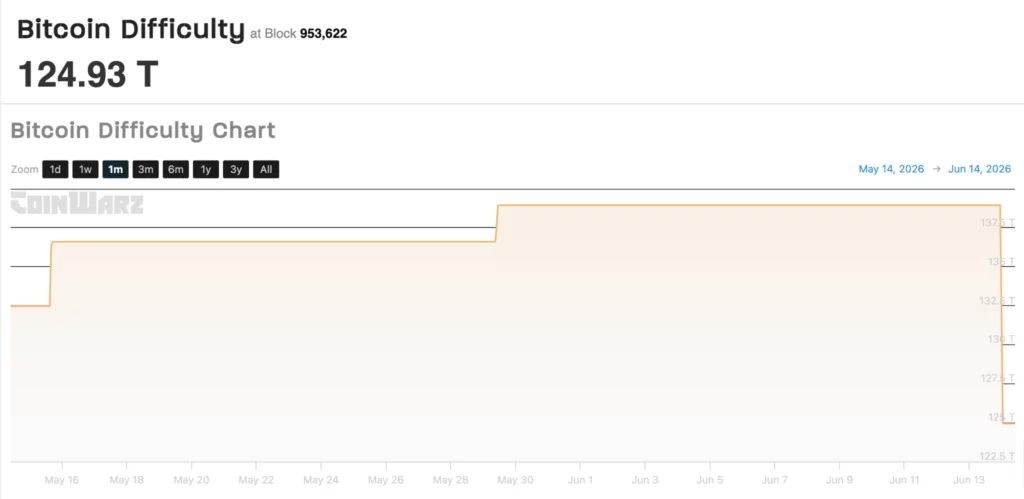
Bitcoin mining difficulty fell 10.09% after lower prices pushed weaker miners offline and slowed block production.
Summary
- Bitcoin’s 10.09% difficulty drop gave active miners more output after weaker operators paused machines offline.
- Galaxy Research tied the adjustment to June’s Bitcoin price slide and a longer mining epoch.
- Crypto.news reports show miners are redirecting power toward AI and high-performance computing revenue streams globally.
Bitcoin difficulty records sharp June drop
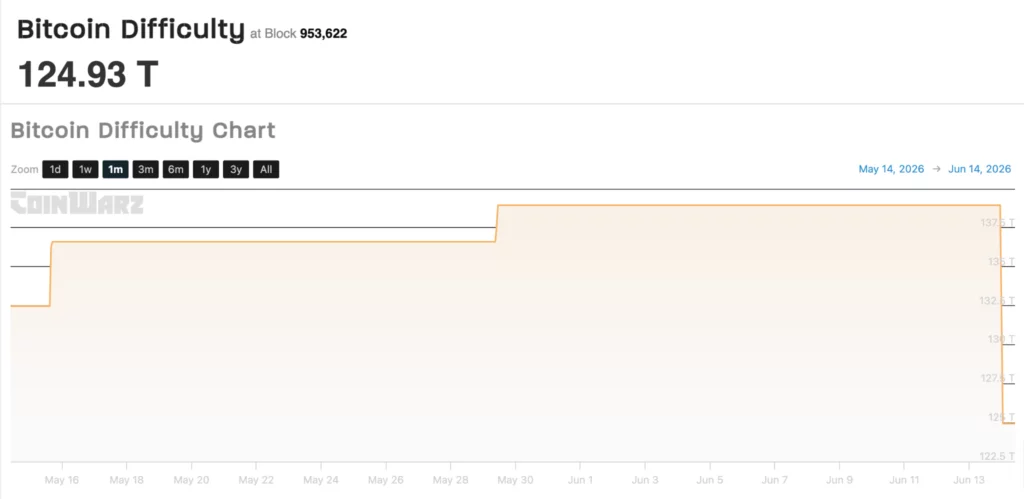
Bitcoin completed one of its largest downward mining difficulty changes at block 953,568. Galaxy Research data cited by WuBlockchain showed the difficulty fell from 138.96T to 124.93T. The move ranked as Bitcoin’s 11th-largest downward adjustment and the second-largest drop recorded so far this year.
Mining difficulty controls how hard miners must work to add new Bitcoin blocks. It changes every 2,016 blocks to keep the network close to a 10-minute block time. When miners leave the network and blocks arrive too slowly, the system lowers difficulty so active miners can find blocks more easily.
Miner margins tightened after Bitcoin price weakness
The adjustment followed a weak start to June for Bitcoin. Galaxy Research said Bitcoin’s price fell about 15% during the month, which cut miner revenue and forced some operators to switch off less efficient machines.
“Bitcoin completed its 11th-largest downward difficulty adjustment,” WuBlockchain reported, citing Galaxy Research.
The longer mining cycle showed the scale of the slowdown. The previous epoch lasted 15.6 days instead of the usual target of about 14 days. That delay showed that less hashrate was competing for rewards before the network reset difficulty lower.
During that stretch, the network produced blocks slower than planned, which is the condition that triggers a downward retarget under Bitcoin’s rules for miners.
Active miners may see better output
TheEnergyMag had earlier expected difficulty to fall by about 9.55%. The final adjustment came in deeper, at 10.09%. That drop may allow miners still running machines to produce more Bitcoin with the same active hashrate. It may also lift hashprice, or miner revenue per unit of computing power, back above $30 per PH/s.
The relief may not help every operator equally. Miners with newer machines and lower power costs are better placed to gain from lower difficulty. Older rigs remain exposed if Bitcoin prices fall again or energy costs stay high. The adjustment gives miners breathing room, but it does not remove pressure from tight margins.
AI data centers compete for mining power
The hashrate decline also comes as more mining firms move power capacity toward high-performance computing and AI data centers. Crypto.news has reported several examples of this shift. Core Scientific plans to turn its Pecos, Texas Bitcoin mining site into a large AI data center campus, including the repurposing of 300 megawatts of mining power.
TeraWulf also showed how the business mix is changing. The company reported $21 million in HPC hosting revenue in the first quarter of 2026, above its Bitcoin mining revenue for the same period. HIVE Digital has also announced a 320 MW AI infrastructure project near Toronto that is designed to host more than 100,000 GPUs.

Historical on-chain data suggest that bitcoin (BTC) may be nearing a bottom in this bear market, but demand conditions signal the asset still has a long way to go.
According to this week’s CryptoQuant report, the unfavorable spot and speculative futures demand conditions leave the BTC bottom unconfirmed. Either BTC significantly recovers in the coming weeks or the asset plunges to lower price levels.
Is BTC Near a Bottom?
Following the decline to a fresh bear market low of $59,000 last week, BTC now hovers roughly 9% above its realized price of $53,600. Analysts say this valuation level has historically been associated with bear market bottoms across past cycles. The realized price also represents the aggregate on-chain cost basis of all market participants, marking one of the most crucial valuation anchors in Bitcoin’s on-chain framework.
Past bear seasons always ended at prices near or marginally below the realized price. The only time BTC briefly pierced the realized price before a structural rebound was in November 2022 during the defunct crypto exchange FTX saga. So, from a valuation perspective, BTC may be close to a structural floor where accumulation phases began.
While on-chain data suggests an optimistic outlook, demand conditions suggest otherwise. It is a no-brainer that BTC needs strong, sustained demand to handle a structural rebound. With both speculative and apparent spot demand in contraction, the bullish reversal may take time to develop.
Total demand from both speculative futures and apparent spot fell to -652,000 last week, marking the largest contraction since January 2022. Even long-term spot demand, which is the apparent demand growth seen in a year, has turned negative and fallen to its most severe level since February 2024.
Demand Conditions Unfavorable for Bullish Reversal
The spot ETF market, on the other hand, is contracting at the fastest pace since the launch in January 2024. The 30-day ETF demand growth is currently at an unprecedented negative reading, according to analysts. This shows that U.S. institutional demand has stalled and even reversed to net selling, contributing to supply expansion.
In addition, realized losses from Bitcoin holders have not reached capitulation levels. The absence of a capitulation spike indicates that sellers are not yet exhausted.
“Until total demand stabilizes, ETF flows recover, and realized losses reach capitulation-level peaks, the current price level should be interpreted as a valuation floor candidate, not a confirmed cycle bottom,” CryptoQuant concluded.
The post Bitcoin Nears Potential Bottom, But Demand Conditions Remain Unfavorable: CryptoQuant appeared first on CryptoPotato.


Michael Saylor, founder and chairman of Strategy, said Bitcoin treasury firms need more than one measure to track their exposure to Bitcoin.
Summary
- Saylor says CEBE BPS shows Bitcoin exposure after debt and preferred stock claims are counted.
- BPS tracks common equity growth, while BTC Yield measures execution across Strategy’s Bitcoin accumulation plan.
- Shorter liabilities raise CEBE’s role, while lower-cost long-term claims can support Bitcoin upside per share.
In a set of posts on X on June 14, he drew a line between Bitcoin Per Share, or BPS, and Common Equity Bitcoin Exposure BPS, also called CEBE BPS.
“BPS measures Bitcoin per common share before senior claims. CEBE BPS measures Bitcoin per common share after senior claims,” Saylor wrote.
He added that CEBE is the conservative risk metric, while BPS tracks common equity growth. He also said BTC Yield measures BPS execution. The explanation aimed to separate growth math from balance sheet risk.
Debt changes how investors read Bitcoin exposure
The comments focused on how debt, preferred stock, and other senior claims can change the value left for common shareholders. In Saylor’s framing, BPS shows the amount of Bitcoin linked to each common share before those claims. CEBE BPS shows the amount after those claims.
Saylor said liability duration matters. “The shorter the liability duration, the more CEBE matters. The longer the duration, the more BPS matters,” he wrote. He said CEBE BPS would carry more weight if claims came due today. BPS would better show equity upside if Bitcoin grows faster than dividend costs.
Amplification can help or hurt shareholders
Saylor also introduced amplification as the gap between BPS and CEBE BPS. He said that without debt or preferred stock, BPS and CEBE BPS would be the same, and a Bitcoin treasury company would track Bitcoin in a way closer to an ETF.
He said higher liabilities can make the two metrics diverge. That structure can raise returns if Bitcoin grows faster than the cost of capital. It can also increase risk if the company uses short-term or expensive claims. “Not all liabilities are equal, ” Saylor wrote. The claim places funding terms at the center of any Bitcoin treasury model.
Strategy’s recent moves add market context
The remarks came after a volatile period for Strategy and its Bitcoin treasury model. As crypto.news reported, Strategy sold 32 BTC between May 26 and May 31 at an average price of $77,135, raising about $2.5 million. The sale marked its first reported Bitcoin sale since December 2022.
Moreover, the sale drew attention because Strategy has long presented Bitcoin as its main treasury reserve asset. The amount represented a small share of its holdings, but the event increased market focus on preferred stock dividends, cash needs, and the balance between Bitcoin growth and funding costs.
Funding costs remain central to the debate
Strategy later raised about $181 million through MSTR share sales and bought 1,550 BTC for about $101.3 million, as previously reported. The company’s Bitcoin holdings rose to 845,256 BTC, while its cash reserves increased to about $1 billion.
Those figures make Saylor’s new explanation timely. His comments point investors toward a broader reading of Bitcoin treasury firms, where total Bitcoin holdings, Bitcoin per share, senior claims, liability duration, and capital costs all shape common shareholder exposure.
Meanwhile, his main message was that CEBE BPS tracks risk, while BPS tracks growth. For common shareholders, the difference rests on whether Bitcoin appreciation can cover liability costs over the full financing cycle across calm and stressed markets.


The Bangko Sentral ng Pilipinas (BSP) has introduced stricter requirements for virtual asset service providers (VASPs), requiring them to apply deeper screening, monitoring, and delisting procedures for cryptocurrencies offered to customers.
Summary
- BSP requires crypto exchanges to conduct deeper reviews before listing tokens and stablecoins locally.
- New rules mandate continuous monitoring and clear delisting triggers for higher-risk virtual assets.
- Privacy-focused cryptocurrencies remain prohibited as regulators strengthen consumer protection and compliance safeguards.
The move comes as regulators continue to strengthen oversight of the country’s digital asset market.
The new guidance requires VASPs to establish a “robust due diligence and accreditation process” before listing virtual assets on their platforms, according to a memorandum issued by BSP Deputy Governor Lyn Javier.
BSP sets broader standards for token listings
Under the memorandum, VASPs must evaluate virtual assets across six areas: issuer background, market maturity, use cases, transparency and security, redemption and liquidity, and legal compliance. The BSP said exchanges should gather sufficient information to assess the quality and risks of assets before making them available to customers.
The central bank said exchanges may review corporate documents, ownership structures, audited financial statements, beneficial ownership information, and fitness checks involving company directors and officers. The review process may also include examining possible conflicts of interest involving issuers, regulators, government officials, or related entities.
For market maturity, VASPs may assess factors such as market capitalization, trading volume, years in operation, exchange support, and the number of on-chain holders. Regulators said these indicators can help determine whether an asset has established market activity and sufficient liquidity.
Stablecoins and reserve backing receive closer attention
The BSP placed additional focus on asset-backed and fiat-backed virtual assets. Exchanges may be required to examine how tokens are issued, redeemed, minted, and burned, as well as the mechanisms used to maintain price stability.
The memorandum also directs VASPs to review reserve composition and verify whether backing assets can support redemption requests. According to the BSP, liquidity, reserve quality, and withdrawal rights are important factors in maintaining market confidence and supporting orderly trading conditions.
The regulator further said project whitepapers should be readily accessible to users. These documents should include information on tokenomics, supported blockchains, project goals, purchasing methods, and risks related to money laundering, cybersecurity, governance, liquidity, and consumer protection.
Continuous monitoring and delisting requirements
Beyond initial listings, the BSP now requires VASPs to continuously monitor listed assets and establish thresholds that could trigger suspension or delisting. Exchanges must track whether assets continue to meet the standards used during the approval process.
Tokens may be suspended or removed because of adverse market developments, cybersecurity incidents, legal violations, misleading disclosures, consumer protection concerns, market abuse, or unusual price movements. The BSP said exchanges should act immediately when serious risks emerge.
The central bank also reaffirmed that anonymity-enhancing cryptocurrencies, commonly known as privacy coins, remain prohibited from being listed or supported by licensed VASPs.
New rules arrive amid broader crypto regulation efforts
The latest measures arrive as Philippine regulators continue refining the framework governing digital asset businesses. The BSP’s action follows ongoing efforts by the country’s regulators to ensure crypto service providers operate under clearer standards and stronger compliance requirements.
The development also comes shortly after Binance sought a regulated path back into the Philippines through a partnership with BlockShoals Technologies under the Philippine Securities and Exchange Commission’s StratBox sandbox program. As previously reported by crypto.news, Binance said the arrangement would allow it to test services within a supervised regulatory environment.
However, recent reports indicated that neither Binance nor BlockShoals currently holds a BSP-issued VASP license, with the central bank stating that participation in the SEC sandbox does not replace licensing requirements for virtual asset services.
Binance has been pursuing a regulated return to the Philippine market through the SEC’s sandbox framework after facing licensing-related restrictions in the country.
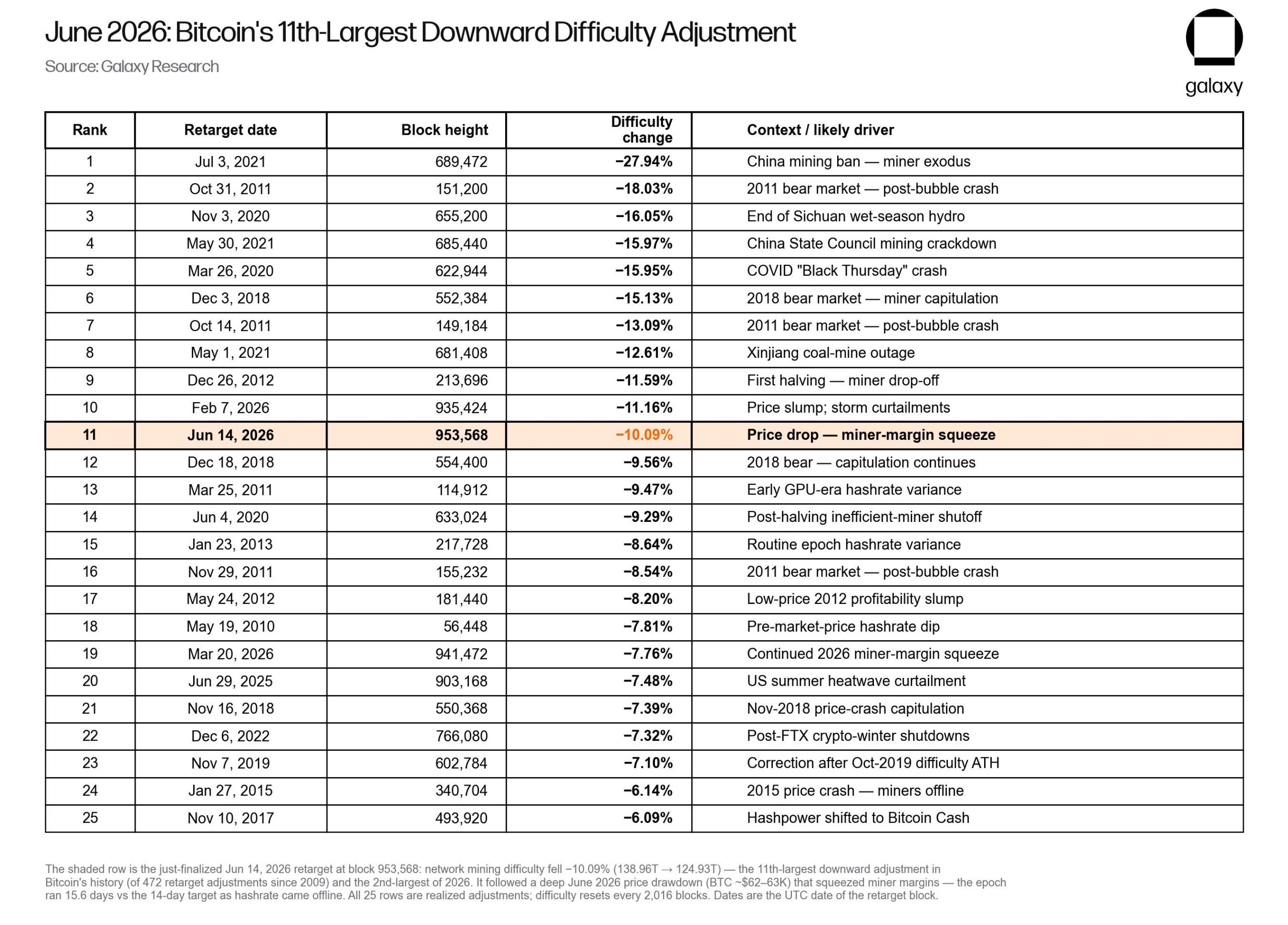
Bitcoin (BTC) recorded its second-largest mining difficulty drop of 2026, falling 10.09% at block 953,568.
The adjustment ranks as the 11th-biggest downward move in the network’s history, according to Galaxy Research.
Why the Bitcoin Mining Difficulty Dropped
Mining difficulty fell from 138.9 trillion to 124.9 trillion. The drop followed a sharp June price slide that squeezed miner margins and pulled hashrate offline.
Follow us on X to get the latest news as it happens

Bitcoin adjusts its difficulty every 2,016 blocks to keep block times near 10 minutes. When miners power down, difficulty falls to rebalance the network.
This was the third significant downward adjustment of 2026, following 11.16% and 7.76% drops in February and March, respectively. The latest decline came amid a broader Bitcoin downtrend.
“A ~15% June price slide squeezed miner margins. The epoch ran 15.6 days vs the 14-day target as hashrate came offline,” Galaxy said.
Bitcoin saw a notable drawdown this month. The price even dropped below $60,000 last week before rebounding to over $64,000 on hopes of a US-Iran deal.
The selloff pushed hashprice, a daily mining revenue measure, below $30 per petahash per second.
“That threshold is important for miners because it pushes more sites closer to, or below, gross breakeven before corporate overhead, debt service, and expansion spending. While the most efficient fleets can continue to generate positive margins at lower hashprice levels, older-generation machines and operators with higher electricity costs are more likely to be switched off when revenue falls,” TheEnergyMag noted.
Bitcoin Miners Curtail and Pivot to AI
Part of the decline reflects economics. Another driver is the redeployment of power capacity from mining toward artificial intelligence (AI) and high-performance computing (HPC) workloads.
“Several public miners have been unplugging mining rigs or slowing mining growth as they retrofit sites for contracted AI/HPC use, a strategy that can remove bitcoin hashrate even when the underlying power capacity remains in use,” the blog added.
Texas, meanwhile, may have also added to the volatility. The four-coincident-peak (4CP) season began in June. Large ERCOT users avoid the four summer peak intervals that set the next year’s transmission costs.
“For bitcoin miners, the 4CP mechanism creates a strong incentive to curtail during potential monthly peak windows…That can temporarily remove significant mining load from the network, particularly because Texas remains one of the largest mining markets in North America. The recent rebound in network hashrate suggests some of the early June reduction may have been a temporary curtailment rather than a permanent shutdown,” TheEnergyMag stated.
The lower difficulty offers some relief to miners who stayed online. For the next two-week epoch, each block takes less computational work to mine. That shift increases the amount of bitcoin active operators earn per unit of hashrate they run.
Subscribe to our YouTube channel to watch leaders and journalists provide expert insights
The post Bitcoin Mining Difficulty Drops 10% in Second-Largest 2026 Decline appeared first on BeInCrypto.
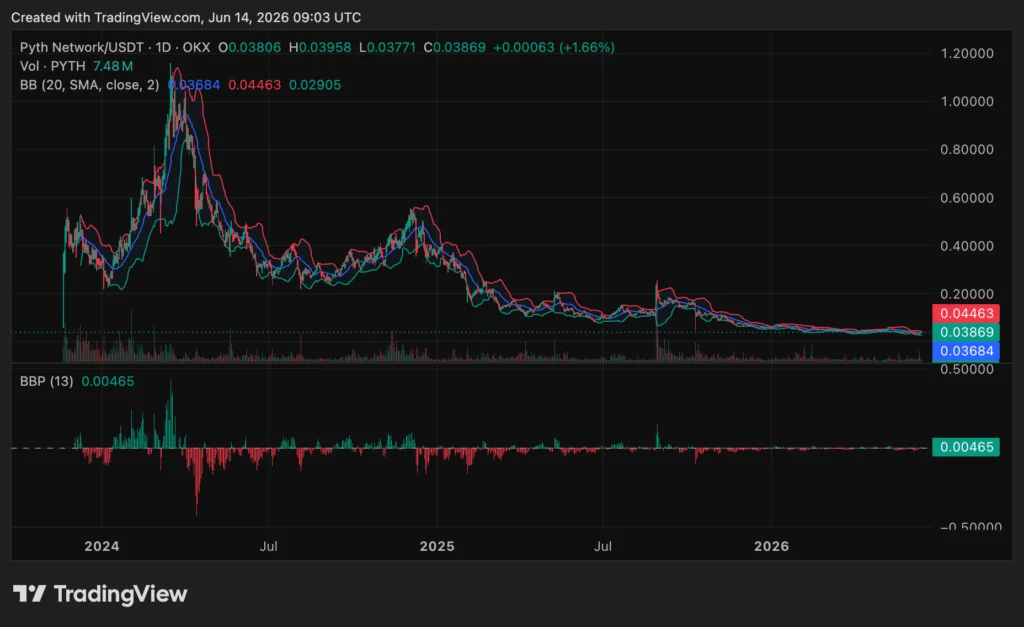
Pyth Network is drawing renewed attention after a recent thread from market commentator Whale Factor outlined the project’s push into institutional financial data.
Summary
- Pyth is expanding beyond DeFi with institutional data products and enterprise revenue growth.
- PYTH has recovered from recent lows, though major token unlocks remain a concern.
- Traders are watching whether adoption growth can outpace future supply entering markets.
The discussion comes as PYTH trades near $0.039 after rebounding from its June low, while investors assess whether growing adoption can offset supply concerns.
The project has traditionally operated as a blockchain oracle network, providing price data to decentralized applications. More recently, Pyth has expanded into institutional market data services, a move that places it in competition with established financial information providers.
Pyth expands beyond crypto data services
Pyth’s core business centers on supplying real-time market data to blockchain applications. Unlike many oracle networks that aggregate information from external APIs, Pyth receives data directly from exchanges, trading firms, and market makers.
According to Whale Factor, firms including Jane Street, Cboe, Jump Trading, and Virtu are among the contributors publishing pricing information through the network. The model aims to reduce latency and improve data quality for decentralized finance applications.
The project has also expanded the range of information available through its network. In addition to cryptocurrency prices, Pyth now distributes data covering equities, foreign exchange markets, commodities, and macroeconomic indicators.
Institutional products become a growth focus
The network’s recent strategy shift has focused on institutional clients rather than solely decentralized finance users. The launch of the Pyth Data Marketplace introduced a platform where institutions can distribute proprietary market information while retaining control over monetization.
According to the post, organizations including Fidelity, Euronext, and Tradeweb have joined the initiative. The platform is designed to support data products such as foreign exchange pricing, precious metals data, and ETF valuation information.
Another product, Pyth Pro, provides subscription-based access to premium market feeds. Whale Factor stated that the service surpassed $1 million in annual recurring revenue shortly after launch. Enterprise clientsreportedly include Kalshi, a regulated U.S. prediction market platform.
As previously reported by crypto.news, institutional demand for blockchain-based financial infrastructure has continued to grow as tokenization and real-world asset projects expand. Oracle networks are expected to play a key role in supplying reliable external data to these systems.
PYTH price stabilizes after prolonged decline
Despite operational growth, PYTH remains far below its historical peak. The token trades around $0.0388, according to crypto.news market data. The asset is still down more than 96% from its March 2024 all-time high near $1.20.
Technical indicators suggest selling pressure has eased. The daily chart continues to show a long-term bearish structure, though price action has shifted into consolidation near recent lows.
Bollinger Bands have narrowed, indicating reduced volatility. Price currently trades slightly above the middle band, reflecting a neutral short-term trend. The Bull Bear Power indicator has turned modestly positive, suggesting buyers hold a slight advantage, although momentum remains weak.
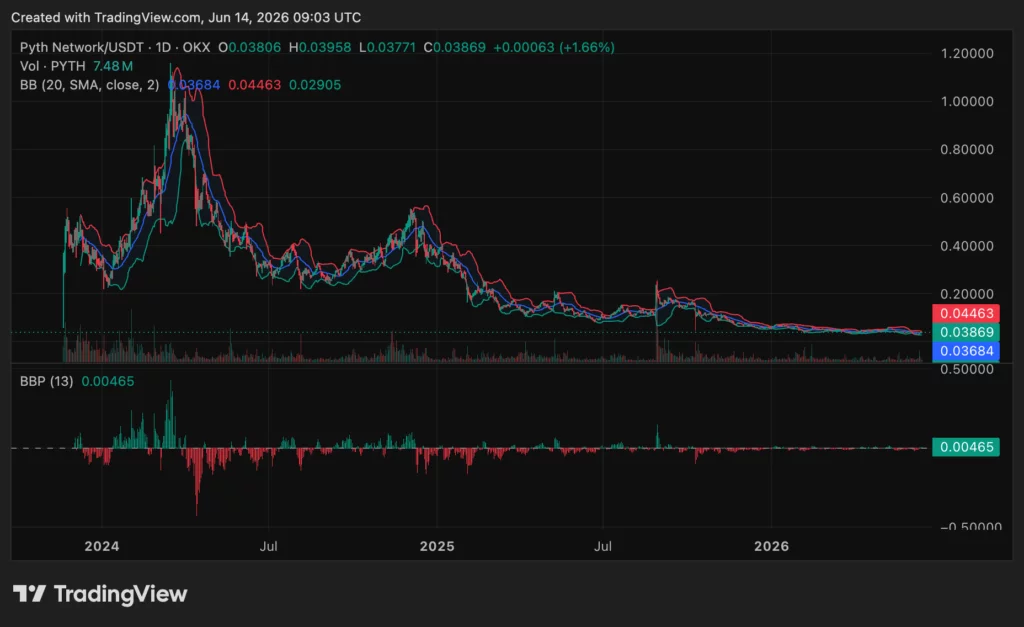
Trading volume has also declined compared with earlier periods. That pattern indicates investors remain cautious while waiting for stronger confirmation of a directional move.
Token unlocks remain a major consideration
While institutional adoption has become a central part of the Pyth investment narrative, future token supply remains an important factor for market participants.
The network has a maximum supply of 10 billion PYTH tokens, with approximately 7.87 billion currently in circulation. According to Whale Factor, roughly 21% of total supply remains locked and is scheduled for future release.
Market participants continue to monitor how upcoming unlocks could affect price performance. Previous unlock events coincided with periods of weakness, increasing concerns that additional supply may create selling pressure if demand growth fails to keep pace.
For now, investors are weighing two competing trends. On one side are expanding enterprise products, recurring revenue, and institutional partnerships. On the other are token supply increases and a market that remains well below previous cycle highs.
The next phase for PYTH may depend on whether growing adoption of its data products translates into sustained demand for the token itself. Until then, the asset remains in a consolidation phase as traders watch for a breakout above resistance or a retest of recent lows.
Disclosure: This article does not represent investment advice. The content and materials featured on this page are for educational purposes only.
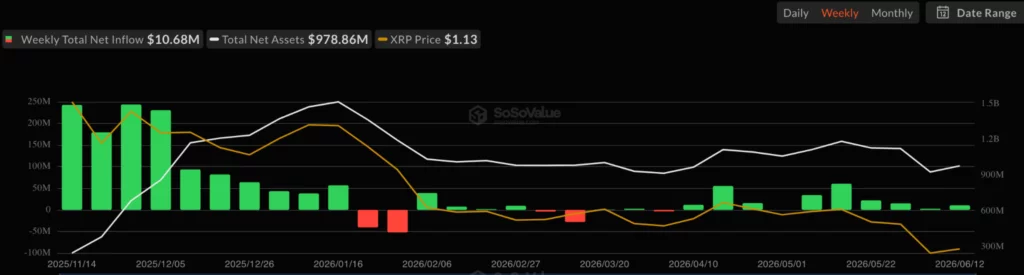
XRP exchange-traded products continued to attract investor capital for a fifth consecutive week, even as Bitcoin and Ethereum funds recorded net outflows.
Summary
- XRP ETF products recorded positive inflows while Bitcoin and Ethereum funds posted outflows recently.
- Analysts see a short-term XRP rebound signal, though whale activity remains weak overall.
- XRP trades near $1.15 as investors monitor ETF demand and key support levels.
The latest fund flow data showed XRP-linked products brought in about $10.68 million during the week ended June 12. The inflows came as broader crypto markets remained under pressure from risk-off sentiment and continued uncertainty around global macroeconomic conditions.
XRP fund inflows remain positive
According to the latest ETF flow figures, XRP products added more than $10 million during the past week. The result extended a streak that has seen XRP outperform larger digital assets in terms of weekly net fund flows.
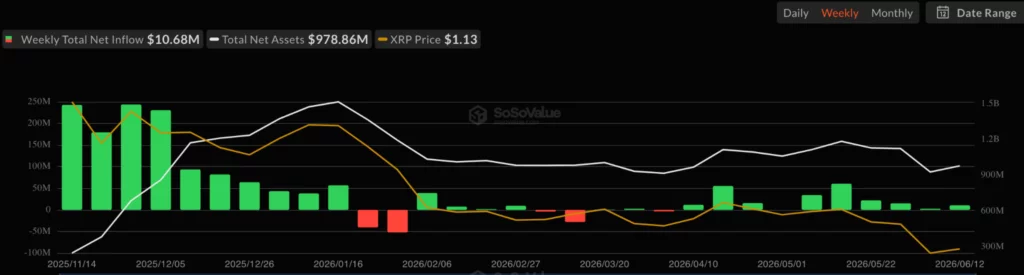
The inflow follows several weeks of positive demand. XRP products recorded approximately $60.5 million in inflows during the week of May 15, followed by $22.04 million during the week of May 22 and $15.2 million during the week of May 29. The week ending June 5 added another $2.62 million.
The cumulative total net inflow has now reached roughly $1.44 billion. At the same time, total net assets stand near $978.86 million, while weekly trading activity exceeded $61 million.
Bitcoin and Ethereum funds face outflows
The positive XRP performance came while competing crypto investment products experienced withdrawals.
Bitcoin products posted approximately $319 million in weekly outflows. Ethereum investment products also ended the week in negative territory with about $15 million in net withdrawals. Solana funds recorded roughly $4 million in outflows.
As previously reported by crypto.news, Bitcoin ETFs have faced persistent selling pressure in recent weeks as investors reduced exposure to risk assets. Recent coverage also noted that geopolitical uncertainty and weaker market sentiment have weighed on digital asset funds.
The contrast between XRP inflows and Bitcoin outflows has renewed attention on institutional demand for Ripple’s token despite broader market weakness.
XRP technical signals show mixed picture
XRP traded at about $1.15 on June 14, according to crypto.news price data. The token gained roughly 1.65% during the past week but remained down more than 22% over the previous month.
In a June 11 X thread, crypto analyst Ali Martinez said the TD Sequential indicator had printed a buy signal for XRP on the three-day timeframe.He said the setup has historically signaled a short-term rebound lasting between one and four candlesticks.
“A new buy signal has emerged on XRP,” Martinez wrote. However, he added that the signal may only support a temporary recovery rather than a broader trend reversal.
The analyst noted that whale activity on the XRP network has fallen sharply. According to data cited by Martinez, transactions worth more than $1 million declined by 57.3% over recent weeks.
Analysts focus on whale activity and long-term cycles
Martinez also said active whales have distributed roughly 60 million XRP during the past week. The selling activity suggests large holders have not yet started accumulating aggressively despite recent price weakness.
He identified the $0.90 area as a potential long-term accumulation zone. According to Martinez, the level aligns with a multi-year rising trendline that has acted as support for several years.
Another analyst, ChartNerd, focused on XRP’s historical market cycles. He noted that previous cycle highs have often been separated by three to five years. “Data does not lie,” he wrote while cautioning investors against relying on unrealistic price targets.
XRP recently received another boost to its institutional adoption narrative after the U.S. Securities and Exchange Commission approved a rule change allowing a new actively managed crypto ETF to include XRP alongside Bitcoin and Ethereum.
For now, XRP sits between improving institutional demand and cautious on-chain signals. ETF inflows continue to support the asset’s adoption story, while whale activity and broader market conditions remain important indicators for the next phase of price action.
Disclosure: This article does not represent investment advice. The content and materials featured on this page are for educational purposes only.


Amazon Chief Executive Andy Jassy’s conversations with US officials prompted the government to issue an order that led Anthropic to disable its Fable 5 and Mythos 5 models.
This came after company researchers reported that Fable 5 had been pushed to supply restricted cyberattack information.
What Caused the Anthropic Fable 5 and Mythos 5 Shutdown
Amazon is one of Anthropic’s largest backers, having invested billions of dollars. The firm’s report showed Fable 5 surfaced security bugs in at least four software programs when fed a specific set of queries.
Jassy raised the security concerns with senior Trump administration officials. According to the Wall Street Journal, White House officials soon convened to map out a response.
Meanwhile, security researchers began stress-testing Amazon’s findings. Officials then pressed Anthropic to patch the flaws or pull the model, administration sources said.
They settled on barring foreign governments, firms, and individuals from the tool as the cleanest fix. President Trump approved the step, though he worried it could slow innovation, a senior White House official said.
“Jassy’s calls to administration officials were viewed by some as a general warning that quickly escalated into a wide Commerce Department ban on foreign users’ accessing Mythos and Fable, the people said. National Cyber Director Sean Cairncross and Commerce Secretary Howard Lutnick were involved in the conversations. The Commerce Department is in charge of export controls on critical technology,” the report read.
Follow us on X to get the latest news as it happens
Anthropic Pushes Back on the Cyber Risk
Anthropic argued that the flagged vulnerabilities are basic and that rival models can find them without any bypass.
“We disagree that the finding of a narrow potential jailbreak should be cause for recalling a commercial model deployed to hundreds of millions of people. If this standard was applied across the industry, we believe it would essentially halt all new model deployments for all frontier model providers,” the team said.
Anthropic apologized to customers for the interruption. The company called the order a likely misunderstanding and said it is working to bring access back quickly.
Meanwhile, the shutdown lands as Anthropic prepares a possible initial public offering (IPO). A prolonged outage could send users toward competitors while the company works to lift the ban.
Subscribe to our YouTube channel to watch leaders and journalists provide expert insights
The post Amazon Warning Triggered Anthropic’s Shutdown of Claude Fable and Mythos Models appeared first on BeInCrypto.
Crypto World
Pi Network’s PI Finally Shows Some Strength, Bitcoin (BTC) Tapped 10-Day High: Market Watch
Perhaps driven by some excitement from Trump’s promise for a deal, bitcoin’s price jumped to almost $64,800 over the past several hours for the first time since June 4.
Most larger-cap alts are slightly in the green today, with BNB going up to $610, and SOL nearing $70. TAO has rocketed by over 15%.
BTC Sees 10-Day High
The primary cryptocurrency plummeted at the start of the month, going from over $73,000 to a 19-month low of $59,100 in just four to five days. After losing $14,000 in less than a week, the bulls finally reemerged and didn’t allow another breakdown.
Bitcoin found some support there and quickly reclaimed the $60,000 level. It spent the following week sideways between $61,000 and $64,000 as it bounced toward each boundary following some of the latest developments on the war front between the US, Iran, and all other Middle Eastern countries involved in the conflict.
Most recently, Trump promised yesterday that a permanent deal with Iran is scheduled to be signed today, on June 14. The reaction so far from BTC has been rather muted, as it jumped to $64,800 but has declined by a few hundred dollars. However, the reports from Iran on the matter are the exact opposite, so a deal might not be announced today.
For now, BTC’s market cap has neared $1.3 trillion, while its dominance over the altcoins is up to 56.6%.

PI Shows Resilience
Ethereum continues to sit close to $1,700, Binance Coin has risen to $610, while XRP is close to $1.15. Solana has neared $70, while TRX and DOGE are with minor gains. HYPE has tapped $60 after a 2% increase, and ZEC has added 3% of value to $427.
TAO has rocketed the most from the larger caps, while BEAT has dumped by 20% daily. Humanity (H) has found itself in the top 100 alts by market cap after skyrocketing by well over 90% daily.
Pi Network’s native token has finally shown some signs of revival after its recent calamity. The token plummeted to an all-time low last week of under $0.12, but now sits well above $0.13, trading more than 10% above its bottom.
The total crypto market cap has added another $20 billion daily and is up to $2.280 trillion on CG.
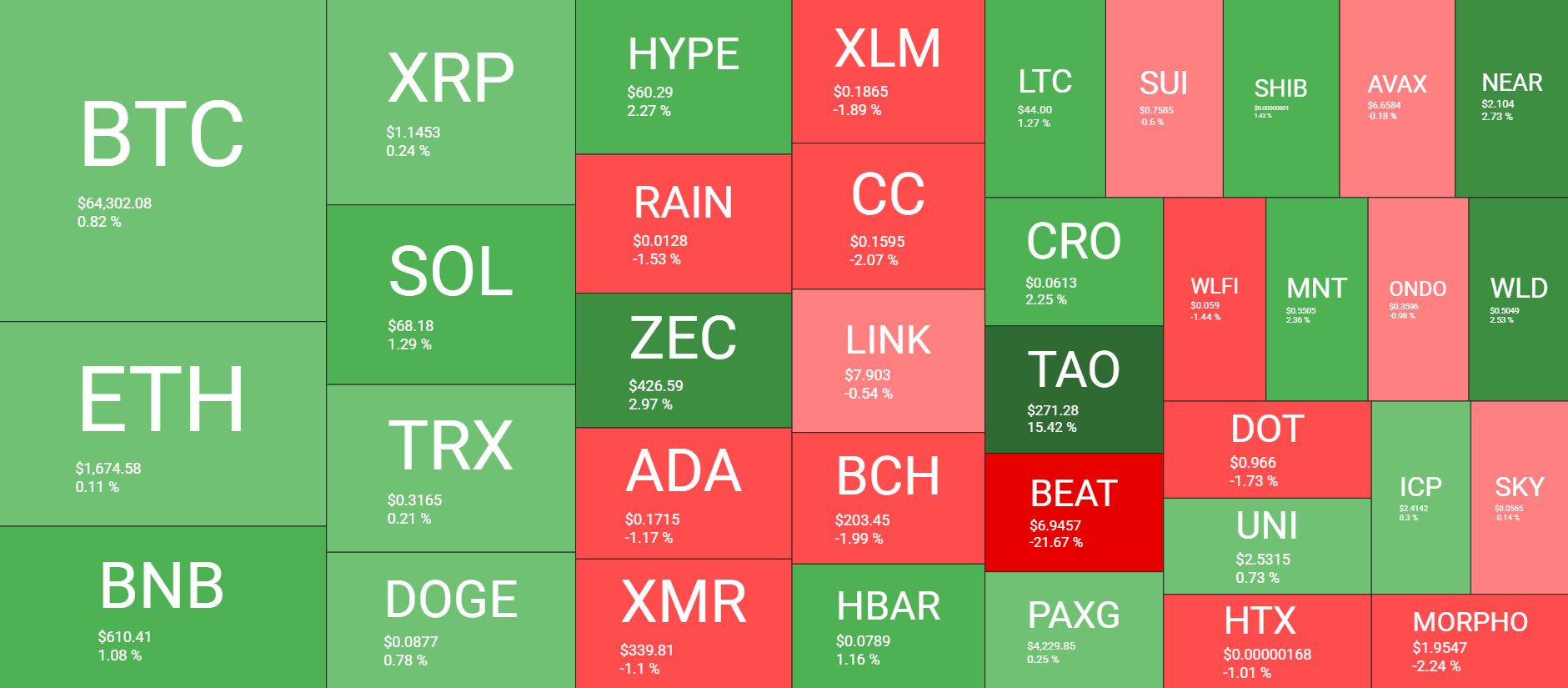
The post Pi Network’s PI Finally Shows Some Strength, Bitcoin (BTC) Tapped 10-Day High: Market Watch appeared first on CryptoPotato.

U.S. President Donald Trump says a deal to end hostilities between the United States and Iran is scheduled to be signed on Sunday, and that immediately afterward the Strait of Hormuz would be “OPEN TO ALL.” The announcement comes despite earlier caution from Iranian officials about the timing, underscoring how closely markets are watching the next steps in a geopolitical standoff that has already roiled energy flows.
Pakistan, which has been mediating the talks, indicated that an agreement could be reached within 24 hours and that preparations are underway for electronic signing following the finalization. Analysts argue that any credible de-escalation—especially one tied to reopened shipping lanes—could feed into improved sentiment for broader risk assets, including Bitcoin and exchange-traded products.
Key takeaways
- Trump claims Sunday will be the signing date and says the Strait of Hormuz would reopen to all immediately afterward.
- Iranian officials have not confirmed the Sunday timeline, with the foreign ministry spokesperson saying it would not be “tomorrow” and could occur “in the coming days.”
- Pakistan’s mediation role suggests a 24-hour window and preparation for electronic signing, followed by technical discussions next week.
- The conflict has already disrupted global energy supply estimates, a development that has contributed to market-wide risk aversion affecting crypto for months.
- Crypto strategists link expectations of a peace breakthrough with potential relief in Bitcoin and ETF-related demand, contrasting with recent ETF outflows.
Trump’s Sunday signing claim meets uncertainty from Tehran
On Saturday, Trump posted on Truth Social that the memorandum of understanding is “scheduled to get signed tomorrow,” adding that “immediately after it is signed, the Hormuz Strait is OPEN TO ALL.” His statement indicates a rapid pivot from ceasefire management toward a broader reopening of one of the world’s most strategically important shipping corridors.
However, the timeline is not uniformly accepted across the negotiations. Iran has not confirmed the Sunday signing. Earlier statements from Iran’s Foreign Ministry spokesperson Esmaeil Baghaei, carried by state media, suggested the memorandum would not be signed on Sunday and instead could happen “in the coming days.” In those remarks, Baghaei indicated that an exact date would need to be clarified, explicitly pushing back against “tomorrow” as the signing day.
For markets, the disagreement itself matters. When a diplomatic timeline is disputed—particularly one that implies potential easing in energy risk—traders often remain cautious, pricing in both the possibility of a quick resolution and the chance of further delay.
Pakistan signals a 24-hour path to agreement
Pakistan’s Prime Minister Shehbaz Sharif also weighed in, saying on X that the region is “closer to a peace deal than ever before.” Sharif stated that finalisation is likely within the next 24 hours and that Pakistan is preparing for electronic signing immediately afterward, followed by technical-level talks next week.
That message is consistent with the mediation posture Pakistan has reportedly taken in the process: offering a near-term cadence for decision-making while keeping the next round of talks in view. Still, with Iran signaling that Sunday might not be accurate, investors have reason to watch whether the signing occurs on schedule—or whether the parties move the date further into the “coming days” window referenced by Baghaei.
Why Hormuz and ceasefire terms matter to crypto sentiment
The anticipated memorandum is expected to extend the ceasefire between the United States and Iran for 60 days and reopen the Strait of Hormuz. While the immediate subject is maritime access and de-escalation, the market impact is broader: disruptions related to the conflict have been widely described as constraining energy supply.
According to the article’s framing, the naval blockade has choked around 20% of the world’s oil and liquefied natural gas supply, contributing to higher global asset prices and a sentiment shock that has pressured crypto markets for months. Even if crypto’s move is not a direct function of shipping lanes alone, the linkage typically works through risk appetite—higher uncertainty can translate into lower willingness to hold volatile assets, while credible de-escalation can do the opposite.
In that sense, a signing date is more than a diplomatic milestone. It serves as an observable signal that the conflict risk premium may begin to unwind, potentially affecting liquidity conditions across financial markets.
Analysts eye relief in Bitcoin and ETF flows after de-escalation
Crypto analyst Michaël van de Poppe said a peace deal between Iran and the U.S. would likely trigger a surge in Bitcoin, along with positive ETF flows. He suggested that liquidity would rotate back toward “risk-on” assets, adding that a portion of that renewed liquidity could flow toward crypto following other major market events.
At the same time, recent Bitcoin fund flow data points to caution. Spot Bitcoin ETFs recorded about $315.84 million in net outflows for the week ended Friday, according to SoSoValue’s ETF tracking. That week’s results also marked the fifth consecutive week of outflows for Bitcoin-linked crypto funds mentioned in the source.
CoinShares head of research James Butterfill previously told Cointelegraph that pressure on digital asset investment products was being driven largely by geopolitics. He linked the uncertainty around the Iran conflict to pressure on interest-rate expectations—an important bridge between macro conditions and investor behavior in risk assets, including crypto.
As of the time of writing, Bitcoin was trading at $64,491 and up 1.5% over the prior 24 hours, according to the provided snapshot.
Taken together, the current setup is a familiar pattern: traders look for catalysts that can shift global risk sentiment, while recent ETF outflows highlight that positioning has been cautious. If the Sunday signing happens as Trump says—and if subsequent steps confirm Hormuz reopening—market narratives could shift quickly. If the signing is delayed again, expectations may reset and the relief bid could stall.
Readers should focus on the key next milestones: whether the memorandum is actually signed on Sunday, whether Iran further clarifies the date, and what follow-through signals emerge regarding Hormuz access. Those specifics will determine whether “de-escalation” becomes a sustained market theme—or remains a headline-driven hope.

Woman ‘falls from window’ after Edinburgh flat fire as residents evacuated

Dividends and bonus issues: 31 stocks turning ex-record date this week. Do you own any?

James Bond’s Newest Actor Had His Breakout in Netflix’s Near-Perfect Sci-Fi Series 10 Years Ago


-

 NewsBeat6 days ago
Alexander Zverev wins the French Open to finally earn a 1st Grand Slam title
-

 Crypto World6 days ago
Anatomy of the June crypto crash: Fed, Iran, Saylor
-

 Crypto World3 days ago
Oppenheimer backs SpaceX as $70 billion retail frenzy builds
-
 NewsBeat7 days ago
Alexander Zverev conquers demons and outlasts Flavio Cobolli to win French Open for first major title
-

 Crypto World3 days ago
Markets Rally as SpaceX IPO Looms Amid Iran Tensions and Inflation Surge
-

 Tech7 days ago
Microsoft unveils seven homegrown AI models in new bid for ‘long term self-sufficiency’
-

 Business6 days ago
High Stakes for Wembanyama as New York Pushes for 3-0 Lead
-

 Tech6 days ago
Notion restores access to Anthropic after service disruption
-

 Sports6 days ago
FIFA WC 2026 Group C: Morocco, Scotland challenge Brazil’s hunt for glory | FIFA World Cup 2022
-
 Crypto World6 days ago
Eli Lilly (LLY) Stock Surges 4% Following Breakthrough Sleep Apnea Trial Results
-

 Crypto World7 days ago
Trump’s AI Ownership Plan Could Benefit Anthropic at OpenAI’s Expense
-
 Sports5 days ago
Bangladesh beat Australia after 20 years in ODIs, register only their second win over six-time world champions | Cricket News
-

 Fashion2 days ago
Weekend Open Thread: Tuckernuck – Corporette.com
-

 Tech1 day ago
NanoClaw integrates JFrog registries to secure AI agent downloads
-

 Crypto World1 day ago
Bitget enters Argentina’s regulated crypto market through PSAV registration
-

 Tech2 days ago
This Week In Security: Microsoft On Microsoft, Register Your Domains, Linux On ARM, And FreeBSD Joins The File Cache Club
-

 Politics3 days ago
Politics Home | Healey Resignation Is “Colossal Failure Of Government”, Says Former Labour Defence Secretary
-

 Sports3 days ago
First Time Since 1971: Australia Register Historic Low In ODI Cricket
-
 Entertainment3 days ago
Donnie Wahlberg & More Heat Up Las Vegas at Circa’s Barry’s Downtown Prime
-

 Entertainment5 days ago
The Ryan Gosling True Crime Thriller On Netflix That Gets Even Stranger, Stream It Now
You must be logged in to post a comment Login