

Crypto World
Charles Hoskinson’s $250M clinic to close after buying up NFTs and robots


A $250 million medical clinic launched by Cardano creator Charles Hoskinson is shutting down after scaling too quickly and burning through cash left it “no longer financially sustainable.”
When the Hoskinson Health and Wellness Clinic opened in Wyoming in 2023, Hoskinson claimed it would become the “Mayo Clinic of the West,” where a wide variety of specialised healthcare would be available to locals from the rural region.
However, despite the fanfare, in December 2025, two concreting firms created by Hoskinson, which were helping to expand the clinic, announced 136 layoffs. The clinic itself then announced a further 40 job cuts in January.
The clinic, which was decorated with some of Hoskinson’s favourite knicknacks, including talking robots, space NFTs, and Roman coins, subsequently admitted that it had scaled too quickly and was burning through cash.
Hoskinson said at the time, “The blame for growing too fast falls on the Hoskinson family. We moved too quickly because we wanted to say ‘yes’ to every request for help.”
Five months on, the Cowboy State Daily reports that the clinic’s leaders informed staff on Friday that the clinic would shut down on July 31.

Read more: Cardano crisis: senior dev quits after Hoskinson calls in the feds
A spokesperson said, “We have reached the difficult conclusion that the organization is no longer financially sustainable in its current form.”
The clinic posted on Facebook, “We set out to create something very ambitious: a place where patients in our rural community could access advanced care, specialty providers, prevention programs, and modern medical technology without having to leave the region.”
Patients, staff, and the community will supposedly see “an orderly, compassionate, and responsible transition.”
“Our last day of patient appointments is July 31, 2026. Between now and then, our full team remains committed to your care. We strongly encourage you to establish care with a new provider before our closing date so there is no interruption to your healthcare,” it posted.
Hoskinson leaves patients and doctors scrambling for help
Hoskinson claims that his clinic was serving between 18,000 and 20,000 patients. Cowboy State Daily spoke with some of these patients who will be impacted by the closure.
Shawnna Langdon, who lives with aggressive rheumatoid arthritis, relied on the clinic’s vicinity to her home to help with her pain. The next nearest clinic is in South Dakota.
She planned to transfer all her rheumatology care to the clinic this summer, but is now rushing to find new doctors and reschedule surgery that was cancelled.
Other patients took to online forums to express their sadness over the closure. Doctors who were slated to start work at the firm in January were also hung out to dry and told there was no job for them.
One anonymous doctor claimed they completed their background check and fulfilled all the relevant requirements before their offer was withdrawn.
They said, “When I asked them why the offer was withdrawn, they told me it’s a business organization decision. The team decided not to open the position.”
“This has been extremely difficult for me, like right now, personally and professionally,” they claimed, adding that they were preparing to relocate for the job.
“It’s a very hard time for me now,” the doctor added.
The clinic housed Roman coins, NFTs, and robots
Cowboy State Daily describes the clinic as a “personal museum of Charles Hoskinson’s globe-trotting life.”
Dotted throughout the clinic are Hoskinson’s favourite works of art, Roman coins, a replica of the Book of the Dead, and an NFT that was “flown” into space, all on display.
The waiting room is modeled on his favorite Swedish hotel, there’s an “infinity room” that uses mirrors to display your reflection an infinite number of times, and another infinity statue in the waiting room.
There were replica robots from the sci-fi series Lost in Space and The Forbidden Planet, and plans to install several exotic fish and dart frog enclosures.


Read more: Cardano whale slams Charles Hoskinson, calls for voting revolt
The building was also going to include a private “napatorium” where Hoskinson could sleep. The room was inspired by Thomas Edison and his attempts to enter a semi-lucid state where he could come up with creative ideas.
Hoskinson’s mum, Patricia Hoskinson, claimed when showing reporters the clinic that, “He takes power naps, OK, and so that’s where he gets all these brilliant ideas.”
Plans for the clinic also included hanging dinosaur fossils from the ceiling and the inclusion of Godzilla and Mothra figures.
The decision to fill the facility with oddities left some Cardano supporters angry at Hoskinson’s decisions to torch billions of his ADA on a “vanity clinic.”
The X account belonging to former Cardano crypto project Meshnet Capital said, “Talking robots, a napatorium, space NFTs, Roman coins on the walls. Now closing. His bailout token flopped because he already burned the community. Cardano was the slow rugpull.”
Other users complained that Hoskinson spent millions on “personal pet projects,” while some compared him to a “snake oil salesman.”
One former Cardano supporter who goes by the X username “@thecardanotimes,” said yesterday that they devoted their life to the project, and that they’ll “never forgive Charles Hoskinson for his greed, his ego, and now his desperation.”
Read more: Cardano has lost $15B since Trump reneged on Strategic Reserve promise
Hoskinson has yet to address the clinic’s closure on his X account.
He has, however, suggested how to reset the project’s governance structure and put himself forward as a DRap, someone who can vote on governance proposals on behalf of others.
Last November, one of Hoskinson’s senior developers, Roman Kireev quit Input | Output after Hoskinson expressed his support for an FBI investigation into a staking pool operator who “accidentally broke” the network while “vibe coding.”
Protos has reached out to the Hoskinson Health and Wellness Clinic for comment and will update this piece should we hear anything back.
Got a tip? Send us an email securely via Protos Leaks. For more informed news and investigations, follow us on X, Bluesky, and Google News, or subscribe to our YouTube channel.


Stand With Crypto UK is urging its 286,000 members to challenge British banks restricting transfers to cryptocurrency exchanges, arguing that blanket limits on transactions to regulated platforms are restricting access to digital assets.
The advocacy group cites a report from the UK Cryptoassets Business Council that found 40% of crypto transactions are blocked or restricted by UK banks. The group argues that many of the restrictions apply to transfers involving exchanges registered with the country’s Financial Conduct Authority and do not account for individual customer risk profiles.
According to the report, one exchange recorded nearly £1 billion in declined transactions over a one-year period due to bank-side rejections, while 80% of surveyed platforms reported an increase in blocked or restricted transfers.
Stand With Crypto said members can submit complaints through a tool on its website that generates letters challenging transfer restrictions, with responses from banks expected to inform the campaign’s next steps.
“Your money. Your choice.” is the tag line of Stand With Crypto UK’s advocacy campaign.
Mark Fairless, CEO of UK clearing bank ClearBank, told Cointelegraph that banks should take a risk-based approach to crypto-related payments rather than imposing broad restrictions across the sector.
“Interventions should be targeted and proportionate, as broad blocks risk undermining competition and the ability of regulated firms to operate effectively in the UK,” Fairless said.
Related: EU proposes ban on 11 crypto platforms in Russia sanctions push
Bank transfer restrictions and regulatory response
The campaign underscores a broader regulatory conversation about access to crypto markets and the role of banks in enforcing anti-money-laundering regimes. Analysts note that difficulty moving funds into regulated, FCA-registered exchanges can complicate onboarding for institutional and retail investors alike, potentially pushing activity toward non-compliant or offshore venues if constraints persist. Regulators have emphasized that the UK framework must balance consumer protection with competitive access to regulated crypto services.
UK stablecoins and market policy trajectory
The push around transfers sits within a wider UK policy debate over stablecoins and the infrastructure required to support a domestic market. In early May, a House of Lords committee examined proposed stablecoin regulations, with lawmakers questioning industry executives on bank-run risks, AML controls and the potential impact on traditional banking. Later in May, the Bank of England signaled it was reconsidering proposed caps on stablecoin holdings and reserve requirements as part of its review of pound-denominated stablecoins.
The policy objective is to foster a domestic stablecoin market while ensuring financial stability and access to banking for regulated issuers. DefiLlama data show the global stablecoin market cap, with non-dollar tokens comprising a relatively small share of overall liquidity.
In June, a House of Lords committee urged regulators to avoid measures that could inhibit the growth of GBP-denominated stablecoins, warning that reserve and holding rules could limit viability. The committee urged regulators to balance oversight with the ability of the sector to scale.
Broader digital-asset regulation and market infrastructure
Beyond stablecoins, UK regulators have advanced broader digital-asset initiatives. In May, the Bank of England proposed extending operating hours for the country’s settlement infrastructure to support tokenized markets. In June, the Financial Conduct Authority proposed allowing certain retail-focused investment funds to allocate up to 10% of their portfolios to crypto exchange-traded products, signaling a move toward broader institutional access while maintaining risk controls.
These developments occur in the context of ongoing efforts to align supervisory frameworks with evolving market structures, including settlement resilience, asset tokenization, and investor protection rules. The regulation-focused stance aims to shore up financial stability, while enabling compliant actors to participate in a growing digital-asset ecosystem.
As policymakers refine the UK’s approach, observers will monitor how banks implement risk-based decisioning for crypto-related payments and how draft stablecoin rules translate into licensing, custody, and liquidity requirements for regulated issuers.
Closing perspective: The UK’s stance on bank-partnered access to crypto markets and the pace of stablecoin regulation will shape the viability of domestic players and international cooperation on cross-border standards. Market participants should watch for further regulatory guidance, bank responses to complaints, and updates to the overarching digital-asset framework.


Anthropic has proposed new AI policy frameworks as advanced systems gain stronger capabilities.
Summary
- Anthropic proposed new AI policy frameworks covering frontier model safety and economic preparation.
- The framework calls for government powers to block or deter dangerous AI deployments.
- Anthropic wants independent testing, stronger security rules, and resilience plans for AI-related risks.
The company wants governments to set rules for frontier models and prepare workers for AI’s economic impact. Its plan covers dangerous deployments, independent testing, cybersecurity, and public resilience.
Anthropic seeks stronger AI safety powers
Anthropic introduced two proposals under its “Policy on the AI Exponential” plan. The Advanced AI Framework focuses on powerful models, while the Economic Policy Framework addresses workers and shared financial benefits. The company argued that AI now moves faster than current policymaking systems. It also said governments need authority to block or deter dangerous model deployments.
Under the plan, civil penalties would tie to global annual revenue. Repeat violations would bring higher penalties, based on the proposed framework. The framework also calls for frontier developers to test models before release. Developers would publish summaries, safety frameworks, and system cards for powerful AI systems.
Independent evaluators would review model tests and risk reports. Anthropic also wants developers to maintain strong security programs for model weights and training systems. The proposal supports transparency laws in states such as California and New York. However, the company argued that public disclosure alone no longer matches the speed of AI development.
The framework targets catastrophic AI risks
The proposed rules would apply only to the most advanced AI systems. Anthropic set the threshold at models trained above 10²⁵ floating-point operations. The framework would also cover companies earning more than $500 million in AI-related revenue. Firms spending more than $1 billion on AI research and development would also fall under it.
Anthropic named four main risk areas in the proposal. These include biological risk, cyber risk, loss of control, and automated AI research. For biological risk, the company warned that unsafe systems could help attackers develop harmful viruses. It also noted that similar AI tools can support drug discovery.
For cyber risk, frontier models can find serious software flaws at large scale. Anthropic said those capabilities raise concerns for hospitals, energy grids, and other key systems. The company also highlighted risks from systems acting outside developer control. Automated AI research could increase biological, cyber, and control risks if safeguards fail.
Developers face testing and security duties
Anthropic wants frontier developers to publish regular risk reports. These reports would describe the developer’s overall risk posture and model safety work. The framework also calls for at least one qualified independent evaluator. That evaluator would review company evaluations and publish findings on model risk reports.
Governments and industry would also set standards for those evaluators. The proposal says evaluators need funding and access to frontier models. Security rules form another major part of the framework. Developers would protect their full development environment from outside attackers and insider threats.
Companies would describe their security programs publicly at a high level. They would also share more details with a designated government agency when requested. Anthropic said policymakers could start with lighter rules and adjust them over time. The framework says regulation should follow model capabilities and evaluation standards.
The proposal includes resilience measures
The second part of the framework focuses on public resilience. Anthropic recommended stronger planning for biological, cyber, and control-related AI risks. For biology, the proposal includes gene synthesis screening and early-warning biosurveillance. It also mentions protective equipment stockpiles and tools to reduce airborne transmission.
For cyber, the framework calls for stronger internet software and support for critical infrastructure operators. It also recommends replacing legacy systems in essential infrastructure. Governments should also track frontier cyber capabilities through a dedicated function. Anthropic proposed joint work between government and industry on model safeguards.
The company said work on loss-of-control and automated research risks remains less developed. It called for better tools to detect, contain, or shut down unsafe systems. Anthropic urged policymakers to act as model capabilities continue improving. The company said AI governance must keep pace with the technology.


Binance's direct stock-trading platform drew more than 80% of its first-week volume from emerging markets, according to data the company published this morning. The figures position the June 1 launch as a distribution play for underserved retail users, with a 2% share of TradFi-referenced… Read the full story at The Defiant


Decentralized exchange Raydium has reportedly suffered a $1.3 million exploit that saw attackers drain the firm’s old liquidity pools.
Crypto investigator “Specter” spotted what they believed to be a Raydium exploit at 3pm GMT+1, claiming that the funds have been bridged to Ethereum and are now being laundered via Tornado Cash.
They also shared what they believe to be the attacker’s addresses:
- 0x0EaBAAb9a56011c6158D4aA7f2E49A82fB34E609
- 4WnPebowR4HHfumvNPaDjG6Pa5Hi1jxLm6xmmBq33QVk.
Since Specter’s post, Raydium official “Infra” has revealed that the firm is aware of the exploit and is conducting a security review to determine what happened.
Infra says, “No current users of Raydium are affected by this exploit or would have been able to interact with these pools through the UI since their deprecation.”
They claim that after an initial review, 150,177 RAY, 5,603 SOL, and 893,700 USDC have been stolen. Together, the stolen funds are worth roughly $1.34 million.
Read more: One laptop: How poor security ruined Humanity Protocol
The cause of the attack has been attributed to a vulnerability associated with “insufficient validation of the LP mint,” and an exploit with Raydium’s legacy AMM V3 program that was phased out in 2021.
Infra said, “Because the program did not properly verify the LP mint address, an attacker was able to create a new mint and use it as the LP token, bypassing the intended proportion checks.”
It added that all other Raydium mainnet programs avoid this vulnerability as they use a “virtual supply mechanism for proportion checks and correctly verify the LP mint along with all other relevant account information.”
Infra ruled out any key compromise or authority-level issue, and claimed that the attack was caused “by a self-contained logic flaw.”
According to Infra, affected users will be fully compensated by Raydium’s treasury.
Got a tip? Send us an email securely via Protos Leaks. For more informed news and investigations, follow us on X, Bluesky, and Google News, or subscribe to our YouTube channel.
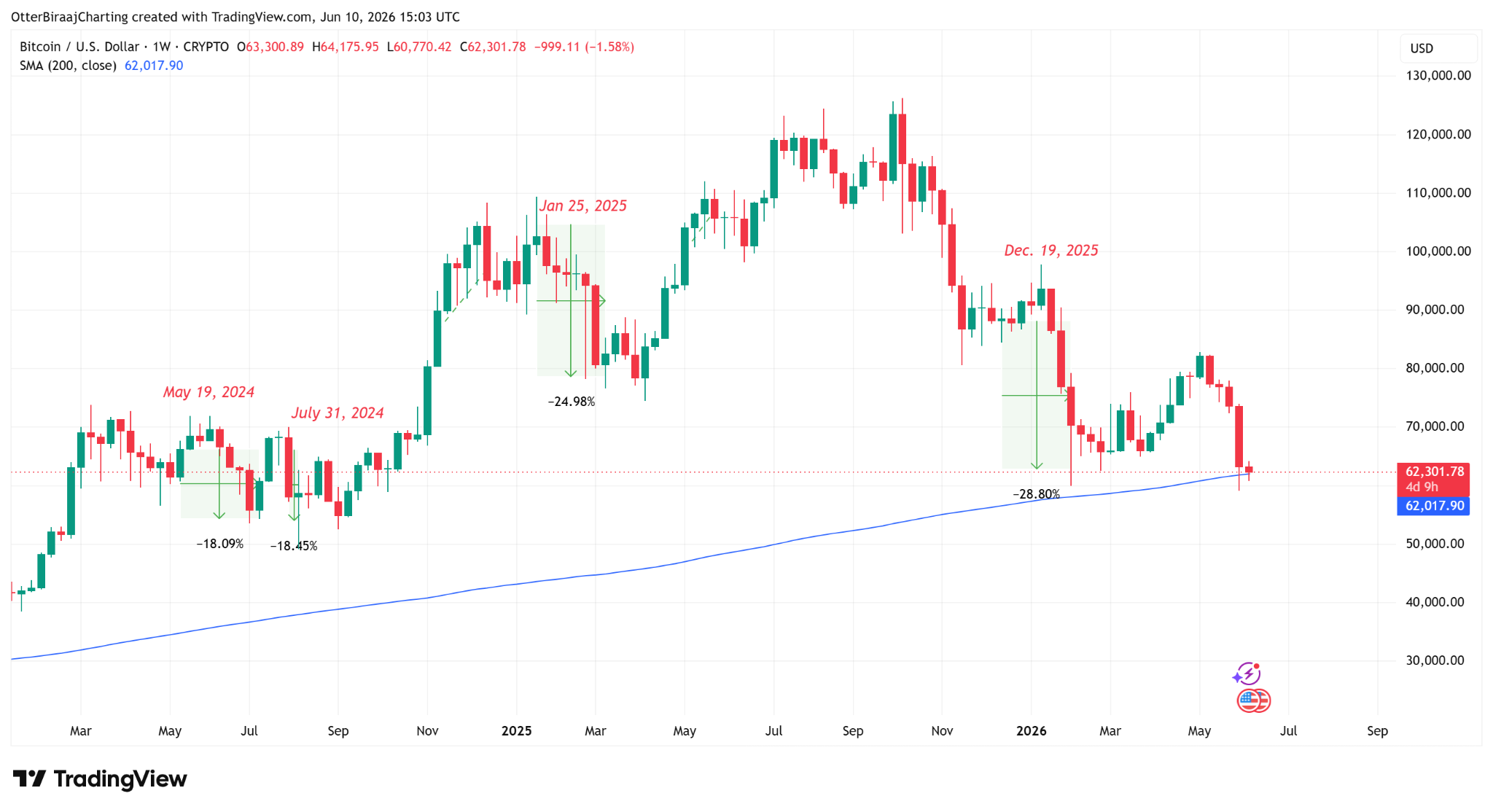
Since 2024, Bitcoin (BTC) has posted four major corrections after interest rate hikes by the Bank of Japan (BOJ), with declines ranging from 18% to 28%. This dynamic places renewed attention on the BOJ’s June 16 policy decision.
Data currently point to a variety of pressures on BTC, with BTC whale distribution and exchange inflows possibly carrying more weight than Japanese monetary policy.
BOJ hikes and Bitcoin drawdowns: Will history repeat?
The relationship between BOJ policy and Bitcoin has gained attention because each rate increase since Japan ended its negative interest rate policy has been followed by a sizable correction.
Following the March 19, 2024, hike, Bitcoin corrected by 18%. The July 31, 2024, increase preceded a 18.5% decline.
After the Jan. 24, 2025, hike, Bitcoin fell nearly 25%, while the Dec. 19, 2025, decision was followed by a 28% drawdown.
Across the four events, Bitcoin’s average decline was 22.4%.
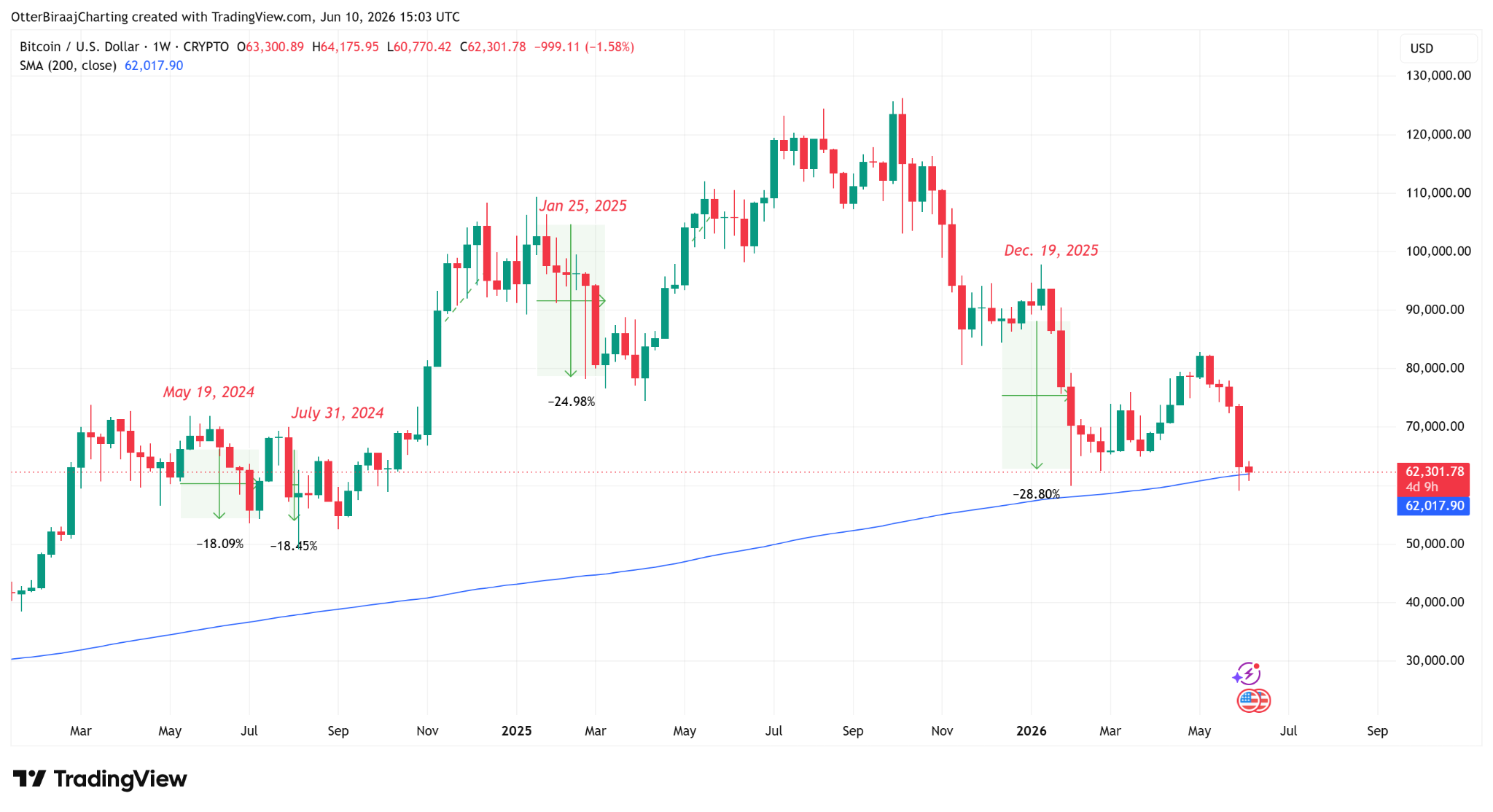
BTC/USD, one-week chart. Source: Cointelegraph/TradingView
The sell-offs did not occur under identical conditions. The March 2024 correction followed Bitcoin’s breakout to new all-time highs during the spot Bitcoin exchange-traded fund (ETF) cycle. The July 2024 decline followed months of consolidation below peak levels and coincided with the sharp unwind of the yen carry trade, which affected global markets.
The January and December 2025 drawdowns followed extended rallies and periods of contraction for both BTC spot and futures 30-day demand.
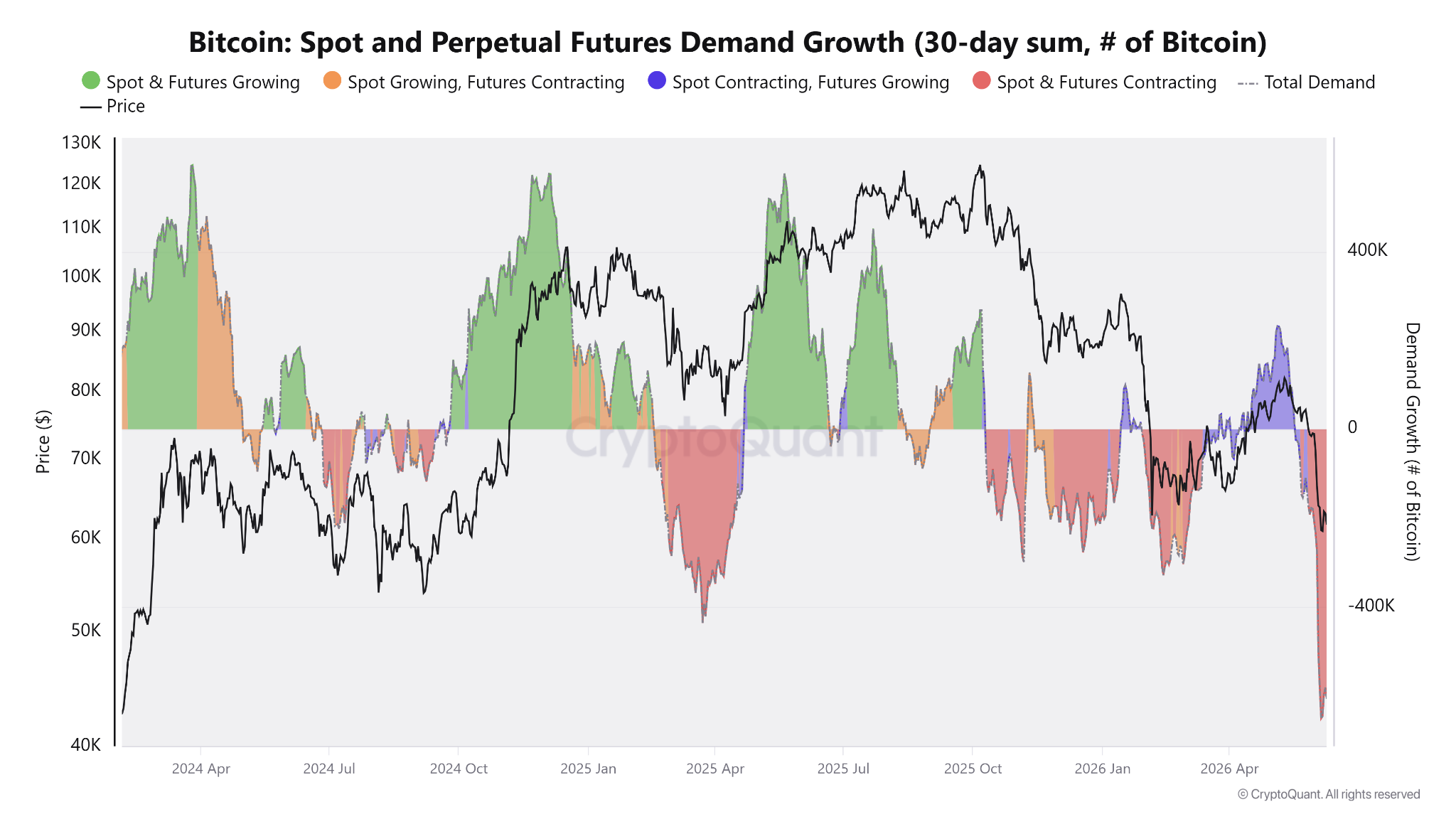
BTC: spot and perpetual futures demand growth contraction. Source: CryptoQuant
The relationship between BOJ policy and Bitcoin is often linked to the yen carry trade. For years, investors borrowed yen at low rates and deployed that capital into higher-yielding assets, including stocks and cryptocurrencies.
When the BOJ raises rates, some of those positions can be reduced, weighing on risk assets. The July 2024 hike coincided with one of the largest carry-trade unwinds in recent years and a sharp sell-off across global markets, not only BTC.
The influence of that particular condition appears smaller today. The BOJ has already raised rates to 0.75% from -0.1% in March 2024, while Japan’s 10-year government bond yield climbed to 2.68% from 0.63% over the same period.
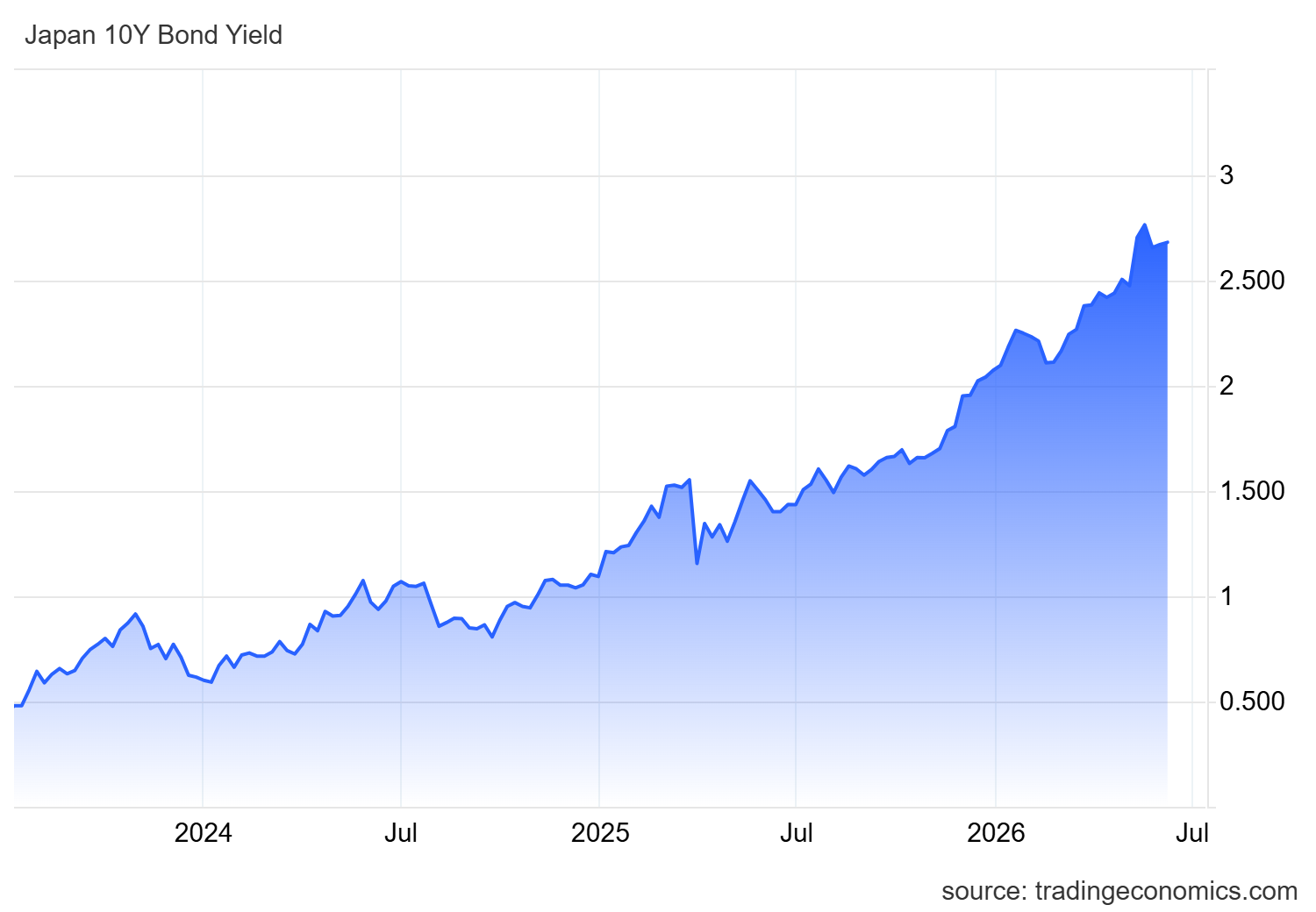
Japan’s 10-year bond yield increase since 2024. Source: TradingEconomics
With Japan’s borrowing costs already higher than during the negative-rate era, each additional hike represents a smaller policy shift than the BOJ’s initial move away from ultra-loose monetary policy. The June 16 meeting would extend an existing tightening cycle rather than introduce a new one.
Likewise, market analyst Cryptic Trades noted that concerns about a renewed yen carry-trade unwind are overblown, arguing that Japan has effectively moved away from its deflationary policy framework in 2024. The analyst added,
“The Yen Carry Trade has been dead ever since 2024. It is also a BIG nothing burger for the markets.”
Related: Bitcoin price may slide toward $30K as institutions dump 450% of daily BTC supply
BTC whales add to the pressure
While the BOJ meeting is a macro event that traders may monitor, onchain data points to a more immediate source of pressure.
Crypto analyst MorenoDV noted that Binance has recorded rising BTC inflows from wallets holding 100–1,000 BTC and 1,000–10,000 BTC since the sell-off began in early June. As a result, the exchange’s 30-day whale inflow sum has climbed to $6.6 billion.
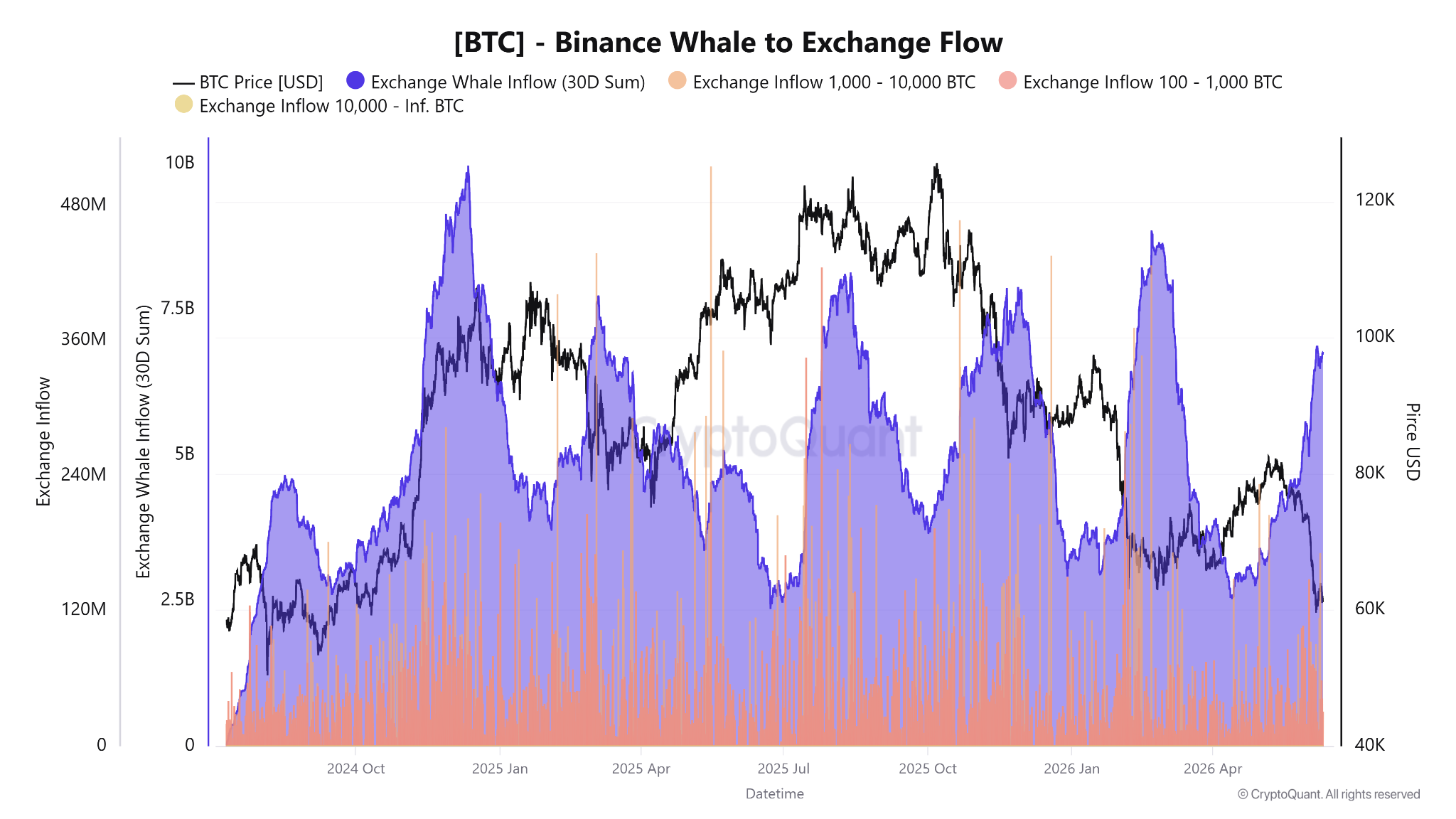
Bitcoin whale to exchange flow. Source: CryptoQuant
The pressure is already visible in realized activity. Short- and long-term whales have collectively locked in more than $2.5 billion in losses during the decline, indicating that some large holders have actively reduced exposure.
Short-term whales appear particularly vulnerable. The cohort is carrying roughly $16 billion in unrealized losses after briefly returning to profit for around 10 days in early May. Those positions now sit close to break-even levels, creating a potential source of supply during rebounds. MorenoDV said,
“Taken together, these three readings describe the stress profile of a late-stage bear market: capitulating whales, distribution into weakness, and a fragile short-term cohort with its finger on the trigger.”
Related: Bitcoin may act as a ‘canary in the coal mine’ as risk-off pressure spreads: Bitwise
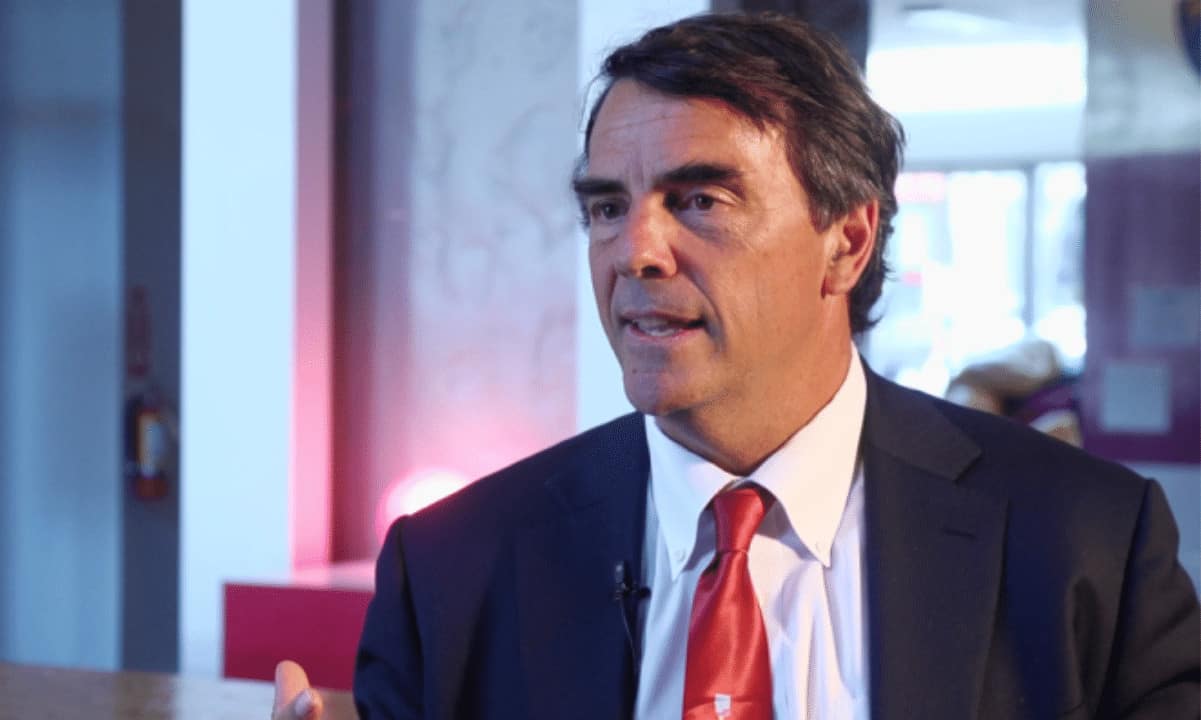
Venture capitalist Tim Draper says fears that quantum computing will break Bitcoin (BTC) are misplaced, arguing that traditional banks and the dollars held within them face a bigger security risk.
In comments published by Benzinga and amplified in an X post on June 9, Draper said he considers his BTC holdings safer than cash sitting in a bank account.
Draper Says Banks Face Greater Quantum Risk Than Bitcoin
Responding to concerns that quantum computers could eventually crack BTC’s cryptography, Draper pointed out that financial institutions rely on older infrastructure that would be easier to compromise than the Bitcoin network.
“Quantum will crack the banks long before it touches the blockchain,” he wrote on X. “Everyone’s panicking about quantum breaking Bitcoin’s encryption while banks are running on legacy infrastructure that makes Bitcoin look like Fort Knox.”
He also argued that even if something did happen to the Bitcoin network, full node operators could roll back to the last secure block. Banks, as he put it, “don’t have that option.”
The rollback point is worth examining carefully. While that type of fork is technically feasible, it needs consensus from many node operators and miners, and it is usually only resorted to in extreme circumstances. Additionally, it would contradict Bitcoin’s claim of immutability, a tension that Draper did not address.
BTC investor Lark Davis backed Draper’s broader framing, saying that if people used “basic security hygiene,” then their holdings would be safer than cash in the bank, unless their keys got stolen. He also insisted that quantum technology will break all legacy security, so people need to stop singling out the cryptocurrency.
Draper also repeated a long-held prediction that Bitcoin will one day eclipse the dollar. He broke down the mechanism for that in a Crunchbase interview earlier in the year, where he said a time will come when retailers will “only take Bitcoin,” and were that to happen, he believes there would be a run on the dollar. Such is his confidence in the asset that in April this year, he reiterated an old bet that BTC could hit $250,000, this time giving it 18 months to do so.
A More Complicated Picture From Security Researchers
The quantum threat to Bitcoin has been analyzed in detail by several researchers, including on-chain analyst James Check, who in April argued that the commonly cited figure of 6.3 million BTC with exposed public keys overstates the actual risk.
According to him, active institutions such as exchanges and custodians, which face most of that exposure, are already working on solutions to mitigate that risk, meaning the genuinely high-risk portion is the roughly 1.716 million BTC in early-era Pay-to-Public-Key addresses, most of which he said are assumed to be permanently lost coins from Bitcoin’s earliest blocks.
Meanwhile, Draper’s infrastructure argument is directly counter to security expert Jameson Lopp’s. According to the Casa co-founder, who co-authored the BIP-361 proposal to freeze quantum-vulnerable addresses, banks can upgrade to counter quantum threats “orders of magnitudes faster” than Bitcoin, given that the cryptocurrency needs broad decentralized consensus before any protocol change can be made.
He estimated that it could take as much as a decade for a full Bitcoin upgrade to quantum-resistant cryptography, and that is the core difference. Draper is betting that banks will fail first, but Lopp thinks that Bitcoin’s slowness to upgrade will be the harder problem to solve.
The post Tim Draper Explains Why Bitcoin Is Safer Than Banks in the Quantum Era appeared first on CryptoPotato.
Crypto World
Mastercard prepares agentic commerce platform for a future where AI agents make payments


Mastercard (MA) is betting that AI agents will soon become active participants in the economy and wants its payments network to sit at the center of that shift.
The payments giant on Tuesday unveiled Agent Pay for Machines (AP4M), a service enabling AI agents and software systems to make payments to each other securely and at scale. The platform supports automated transactions across cards, bank accounts and stablecoins, while providing identity verification, spending controls and guaranteed settlement through Mastercard’s network.
The service comes as companies across technology, payments and crypto race to build infrastructure for what many are calling agentic commerce, where AI systems complete tasks, purchase services and coordinate transactions on behalf of users. Agents could be involved in trillions of dollars worth of transactions by the end of the decade, according to some estimates.
“We are already seeing a number of services and agents popping up to provide a range of products and services,” Raj Dhamodharan, Mastercard’s executive vice president of blockchain and digital asset products and partnerships, told CoinDesk. Those services range from booking travel and building websites to creating artwork and completing other digital tasks.
Dhamodharan said the next challenge is creating trust between those systems.
Businesses and consumers need confidence that agents are interacting with legitimate counterparties and operating within authorized spending limits. Service providers, meanwhile, need assurance that they will be paid.
“These are problems that we’ve solved before in the B2B world and the carded world for decades,” Dhamodharan said. “We’re bringing the same level of trust and ability to find the right set of agents, ability to convey that you’re actually going to complete the payment and to make sure that people can get paid.”
The platform is designed to address those concerns through credentialing, permissioning and settlement services. The company said the system can authenticate agents, enforce spending rules and settle payments across multiple payment methods, including stablecoins.
More than 30 companies have joined the initiative, including Coinbase (COIN), Stripe, Adyen, Checkout.com, Cloudflare, RippleX, Polygon Labs, Solana Foundation and OKX. Mastercard said permissions and credentials associated with AI agents will initially be recorded on the Polygon, Solana and Base blockchains.
Although large-scale machine-to-machine commerce remains nascent, Dhamodharan said Mastercard is already seeing signs of demand. He pointed to increasing activity around HTTP 402, an emerging internet payment standard, where automated transactions often fail because no payment method is available.
“There are already transactions happening,” he said. “There are already many declines happening because there is no payment option available. That is a leading indicator in our view.”
Mastercard said it plans to expand access to Agent Pay for Machines later this year.
If bitcoin and Ethereum had been invented on the same day, nobody would have heard of bitcoin. I sold every bitcoin Bit Digital held and deployed the proceeds into Ethereum. I have built one of the largest corporate Ethereum treasury positions in the world and said, on the record, that we will never sell it. People have asked me to articulate the single strongest argument for that conviction. On March 30, 2026, that argument arrived. Last month, Citi confirmed it.
In a research note published on May 18, Citi analysts warned that quantum computing advances have shortened the timeline for practical attacks on digital assets, and reached a conclusion that should give every institutional bitcoin holder pause: bitcoin faces significantly greater quantum risk than Ethereum, and the gap between them comes down not just to technology but to governance.
That finding echoes the landmark paper released in late March by Google Quantum AI in collaboration with Stanford University and the Ethereum Foundation, which found that the computing resources required to break bitcoin’s foundational cryptography are approximately 20 times lower than previously estimated. A sufficiently advanced quantum computer, operating with fewer than 500,000 physical qubits, could derive a bitcoin private key from its public key in roughly nine minutes. That machine does not exist today. But the window to act responsibly is narrowing faster than most institutions realize. When Google raises the alarm, and Citi confirms it in the same quarter, this is no longer a fringe concern. This is the silver bullet. And it points directly at bitcoin.
Why bitcoin is exposed
Bitcoin’s security rests on elliptic curve digital signature algorithms. When you spend bitcoin, your public key is briefly exposed onchain. Under classical computing, reversing that to obtain a private key is infeasible. Quantum computers running Shor’s algorithm can, in principle, do exactly that during the brief window a transaction is broadcast. The Google paper doesn’t merely confirm this theoretically; it quantifies it with a precision that removes comfortable ambiguity.
Nic Carter, co-founder of Coin Metrics and one of the sharpest minds in digital assets, has been sounding this alarm for months. In a series of essays beginning in October 2025, Carter called quantum computing “the biggest long-term risk to bitcoin’s core cryptography” and accused developers of “sleepwalking towards collapse.” He estimates a quantum computer could meaningfully break elliptic curve cryptography as early as 2028. Approximately 6.9 million BTC could be vulnerable at a sufficient quantum scale, including legacy wallets and Taproot outputs, which already represented more than 21% of all bitcoin transactions in 2025.
Bitcoin’s governance problem
One might ask: can’t bitcoin simply upgrade? Yes, in theory. In practice, this is where the risk compounds.
Bitcoin’s governance is intentionally conservative and consensus-driven, which makes it extraordinarily slow. SegWit took roughly 8.5 years from conception to widespread adoption. Taproot took approximately 7.5 years. The current quantum proposals, BIP-360 and BIP-361, are still at the draft or early testnet stage as of 2026. A full base-layer transition to post-quantum signatures would be the most contentious change bitcoin has ever attempted. As Carter documented, most bitcoin Core developers have expressed limited concern about urgency, a disposition that is, at minimum, a serious governance liability for any institution holding bitcoin in treasury. A quantum breakthrough does not politely wait for committee consensus.
Ethereum has already acted
This is where the picture diverges sharply. Ethereum’s approach to quantum resistance is not a reactive scramble. It is a structured road map already in execution, built on the NIST post-quantum cryptography standards finalized in August 2024.
The Pectra upgrade, which shipped on Ethereum mainnet in May 2025, introduced EIP-7702, a critical stepping stone toward full account abstraction. Rather than requiring a single network-wide hard fork, Ethereum’s architecture allows individual accounts to choose their own signature verification and switch to quantum-safe signatures voluntarily. The upcoming Hegotá hard fork, planned for the second half of 2026, embeds this further at the protocol level. The Ethereum Foundation has set structured milestones targeting completion of core post-quantum infrastructure by approximately 2029, with active interop devnets already running across multiple clients.
The contrast with bitcoin’s governance paralysis could not be more stark. Ethereum was designed, in ways bitcoin simply was not, to accommodate exactly this kind of foundational upgrade. That is not an accident. It is architecture.
The institutional calculus
For corporate treasurers and sovereign wealth managers, quantum risk is no longer a tail scenario to be footnoted and dismissed. Governments are already treating it as operational. U.S. federal agencies faced an April 2026 deadline to submit post-quantum cryptography transition plans under National Security Memorandum 10. The EU has set a 2030 quantum-resistance target for critical infrastructure. The G7 Cyber Expert Group published a coordinated financial sector road map in January 2026. This compliance architecture will, over time, extend to digital asset treasury holdings.
The question for any institution holding bitcoin is whether they are comfortable with an asset whose quantum-resistance road map is still in draft, whose governance moves at geological speed, and whose developer community is divided on whether urgency is even warranted.
The question for any institution considering Ethereum is whether they want the asset with a structured, transparent, and already in motion upgrade path.
Ethereum is the more adaptive, more capable, and more durable asset. I have put the balance sheet of a Nasdaq-listed company behind that conviction. The Google paper is what finally gives that conviction a single, undeniable, technically grounded answer to the hardest question in digital asset treasury strategy: which asset is built to last?
Ethereum is not a perfect asset. No asset is. But in the context of quantum risk, it is the asset whose architecture was built to survive what is coming. If Carter and Google are right, that distinction will matter enormously, and sooner than most people expect.

TLDR
- RippleX launched the XRP Ledger AI Starter Kit on June 10.
- The kit enables autonomous payments for AI agents on XRP Ledger.
- XRPL now supports the X402 protocol for web-based software payments.
- AI agents can pay for APIs, model inference, and digital services using XRP and RLUSD.
- Ripple-backed startup t54 helped integrate XRPL into X402.
Ripple Labs moved to link blockchain payments with the fast-growing AI economy through a new developer release. The company introduced the XRP Ledger AI Starter Kit on June 10 to support autonomous transactions. The rollout aligns with efforts to connect software agents with direct web payments.
XRP Ledger integrates X402 for autonomous web payments
RippleX launched the XRP Ledger AI Starter Kit to help developers build agent-powered applications. The first phase supports tools that enable autonomous payments on the XRP Ledger network. RippleX said the network design supports fast settlement and predictable costs.
“The XRP Ledger was built with many of these qualities in mind,” the announcement stated. It added that agentic payments now require speed and low transaction fees. The release supports X402, an open protocol that enables software to send payments without human approval.
Through support from t54, XRPL now operates as a supported chain on X402. Ripple backed t54 during a seed funding round to expand payment infrastructure. As a result, AI agents can use XRP and RLUSD for web-based transactions.
The system allows AI agents to pay for API calls and model inference services. It also enables payments for other digital services across web platforms. Developers can integrate these features into applications that require automated billing.
The starter kit also provides tooling for AI coding agents. A dedicated Model Context Protocol server supports queries to XRPL documentation. Clients, including Claude Code, Claude Desktop, and Cursor, can access the documentation directly.
XRP and RLUSD power Mastercard’s agent payment framework
The launch occurred on the same day Mastercard Inc. introduced Agent Pay for Machines. Mastercard designed the framework to support autonomous payments across digital services. More than 30 partners joined the initiative, including Ripple and t54.
RippleX senior vice president Markus Infanger outlined the role of XRPL and RLUSD. He said the network provides a settlement layer that clears in seconds. He added that the system offers predictable costs and built-in compliance.
“XRPL and RLUSD give Mastercard’s framework a settlement layer that clears in seconds,” Infanger said. He also referenced programmable compliance and a full audit trail. Mastercard listed Ripple as one of the core blockchain partners.
The framework supports high-volume and low-value transactions between software agents. It enables machine-to-machine settlements without manual approval. RippleX confirmed that XRP and RLUSD serve as payment rails within the system.
Ripple Labs continues to expand infrastructure through RippleX initiatives. The XRP Ledger AI Starter Kit now rolls out in stages across developer channels. The company released the tools on June 10, alongside Mastercard’s AP4M framework.

The past few weeks have been devastating for the cryptocurrency market, with Solana (SOL) being hit especially hard.
And while some analysts expect further losses in the near future, certain indicators signal that a much-needed recovery could be knocking on the door.
Buy Now?
Earlier this month, SOL collapsed to around $60, the lowest level since the end of 2023. As of this writing, it trades at roughly $63 (according to CoinGecko), which is a 33% monthly drop, while its market capitalization has fallen well below $40 billion.
According to Ali Martinez, though, the current bottom might present an excellent opportunity for investors to jump on the bandwagon. He revealed that the TD Sequential indicator has flashed a buy signal on SOL, meaning the price could soon head north to $77.
Another technical analysis tool that suggests a resurgence might be on the way is Solana’s Relative Strength Index. Its ratio (on a daily scale) recently dipped to approximately 15, its lowest mark ever. The index ranges from 0 to 100, and readings below 30 indicate that the asset is oversold and on the verge of a potential rebound. On the other hand, anything above 70 is a warning for a possible pullback ahead.

X user Henry supported the optimistic outlook. They noted SOL’s recent decline but argued that it looks “absolutely bullish” at the moment, predicting a W-shaped recovery beyond $88, assuming bulls reclaim $79.9. At the same time, the analyst warned that losing the major support level at $60 could be catastrophic.
More Pain Ahead?
Despite the positive signals, the bearish market conditions remain an obstacle, with some industry participants expecting a further price crash for SOL. X user cyclop envisioned a short-term plunge to the $30-$40 range, a level last visited in October 2023. Nevertheless, the analyst is optimistic for the long term, forecasting a pump to $300 in the next 1-2 years.
Lately, many investors have transferred their holdings from self-custody to centralized exchanges: a development that intensifies fears of an additional correction by increasing immediate selling pressure.

Another worrying factor is the waning interest from institutional investors. Over the past few days, outflows from spot SOL ETFs have exceeded inflows, indicating that pension funds, hedge funds, and other market players have reduced their exposure to the asset. This, in turn, has required the products’ issuers, including Bitwise, Fidelity, Grayscale, Invesco, and others, to sell real SOL to properly back the shares.

The post Solana (SOL) Bleeds Heavily, Yet Key Indicator Flashes a Buy Signal: Details appeared first on CryptoPotato.

Apple got parental controls right but it does not matter
Soluna Holdings officer disposes of $71,280 in preferred stock

Campaign Against Bank Crypto Limits Triggers UK Regulatory Debate



-

 Fashion5 days ago
Weekend Open Thread: Evereve – Corporette.com
-
 Crypto World5 days ago
Jensen Huang Approves Samsung, SK Hynix, and Micron for NVIDIA (NVDA) HBM4 Memory Supply
-

 Crypto World3 days ago
Anatomy of the June crypto crash: Fed, Iran, Saylor
-
 Entertainment4 days ago
The Best Mystery Series of All Time Is Surging on Streaming 30 Years After It Ended
-

 NewsBeat3 days ago
Alexander Zverev wins the French Open to finally earn a 1st Grand Slam title
-

 Tech5 days ago
Suspicious Polyfill login prompts pop up on Toshiba, Muji websites
-
Crypto World4 days ago
Senator Cynthia Lummis Calls CLARITY Act the Most Consequential Financial Legislation of This Generation
-

 Tech6 days ago
Microsoft launches MXC, an OS-level sandbox for AI agents, with OpenAI and Nvidia already on board
-

 Tech3 days ago
Microsoft unveils seven homegrown AI models in new bid for ‘long term self-sufficiency’
-

 Business5 days ago
(VIDEO) Justin Bieber Delivers Surprise Happy Birthday Serenade to Diners at Los Angeles Mexican Restaurant
-
 Business4 days ago
The Pain Points Taking a Fragile Tech Rally Down a Notch
-
 Crypto World2 days ago
Eli Lilly (LLY) Stock Surges 4% Following Breakthrough Sleep Apnea Trial Results
-
Crypto World5 days ago
LBank Surpasses 25 Million Users Worldwide as AFA Partnership Continues to Drive Global Growth
-

 Tech5 days ago
Von der Leyen’s AI envoy pick draws conflict-of-interest fire
-

 Crypto World3 days ago
Trump’s AI Ownership Plan Could Benefit Anthropic at OpenAI’s Expense
-

 Tech5 days ago
Meta steals a tactic from Tesla and builds data centers in tents
-
 Sports1 day ago
Bangladesh beat Australia after 20 years in ODIs, register only their second win over six-time world champions | Cricket News
-

 Business3 days ago
High Stakes for Wembanyama as New York Pushes for 3-0 Lead
-

 Tech5 days ago
Hackers now exploit SolarWinds Serv-U flaw to crash servers
-

 Tech3 days ago
Notion restores access to Anthropic after service disruption
You must be logged in to post a comment Login