

Crypto World
Circle Launches Agent Marketplace for DeFi-Native Service Discovery and Integration

Circle introduced Agent Marketplace as part of its Agent Stack, enabling autonomous agents to discover and pay for trusted services through programmable, usage-based economic models.



Elon Musk’s rocket and satellite company has accelerated plans for its blockbuster public offering, with trading expected to begin as early as June 12 after a faster-than-expected SEC review.
An anonymous address sold 250 wrapped Bitcoin worth $20.3 million on-chain, on-chain data showed on May 15.
Summary
- An anonymous wallet offloaded 250 wrapped Bitcoin for approximately $20.3 million in a single on-chain transaction on May 15.
- The sale adds fresh sell-side pressure as BTC trades near $80,400 amid rising Treasury yields and inflation fears.
- On-chain analysts have tracked a broader pattern of large-holder distribution throughout 2026.
Whale offloads $20.3m in wrapped Bitcoin
“A chain address sold 250 WBTC worth $20.3 million,” on-chain data aggregated by KuCoin’s flash news desk showed on May 15, without identifying the seller or their entry price.
Bitcoin was trading near $80,400 at the time of the transaction, down roughly 2% on the day. The broader market was already under pressure from surging Treasury yields and a fresh inflation print that pushed the 10-year note to 4.54%, its highest level since May 2025.
The wrapped Bitcoin sale compounds that pressure. WBTC operates as a 1:1 Bitcoin-backed ERC-20 token used across Ethereum DeFi protocols. Unlike native BTC movements through centralised exchanges, on-chain WBTC disposals bypass traditional order books and are harder to anticipate from exchange flow data alone.
The move fits a wider pattern of large-holder activity flagged across 2026. Crypto.news reported that CryptoQuant analysts rejected wider dump fears following a separate dormant whale movement in early May, noting no confirmed exchange inflows from that wallet.
Prior to that, a long-dormant OG Bitcoin address offloaded 1,000 BTC as selling pressure intensified, extending its total transfers to 3,500 BTC since November 2024. Separate data showed whales collectively adding 61,568 BTC even as price slipped, pointing to divergence between large-holder groups.
Whether the $20.3 million WBTC sale reflects coordinated distribution or isolated profit-taking remains unclear without further wallet history. Short-term price action continues to depend heavily on macro catalysts, particularly Federal Reserve policy expectations heading into the second half of 2026.
Grok’s autonomous stock portfolio has built a sizable lead over Claude’s newer fund on the Autopilot mirror-trading platform. The result exposes a widening performance gap between two AI agents picking real-money trades.
The two X accounts, @grkportfolio and @theaiportfolios, run separate experiments by AI Finance Labs. The wider lineup of AI-managed strategies on Autopilot holds roughly $150 million in mirrored capital.
Grok Builds a Multi-Quarter Lead in AI Stock Picking
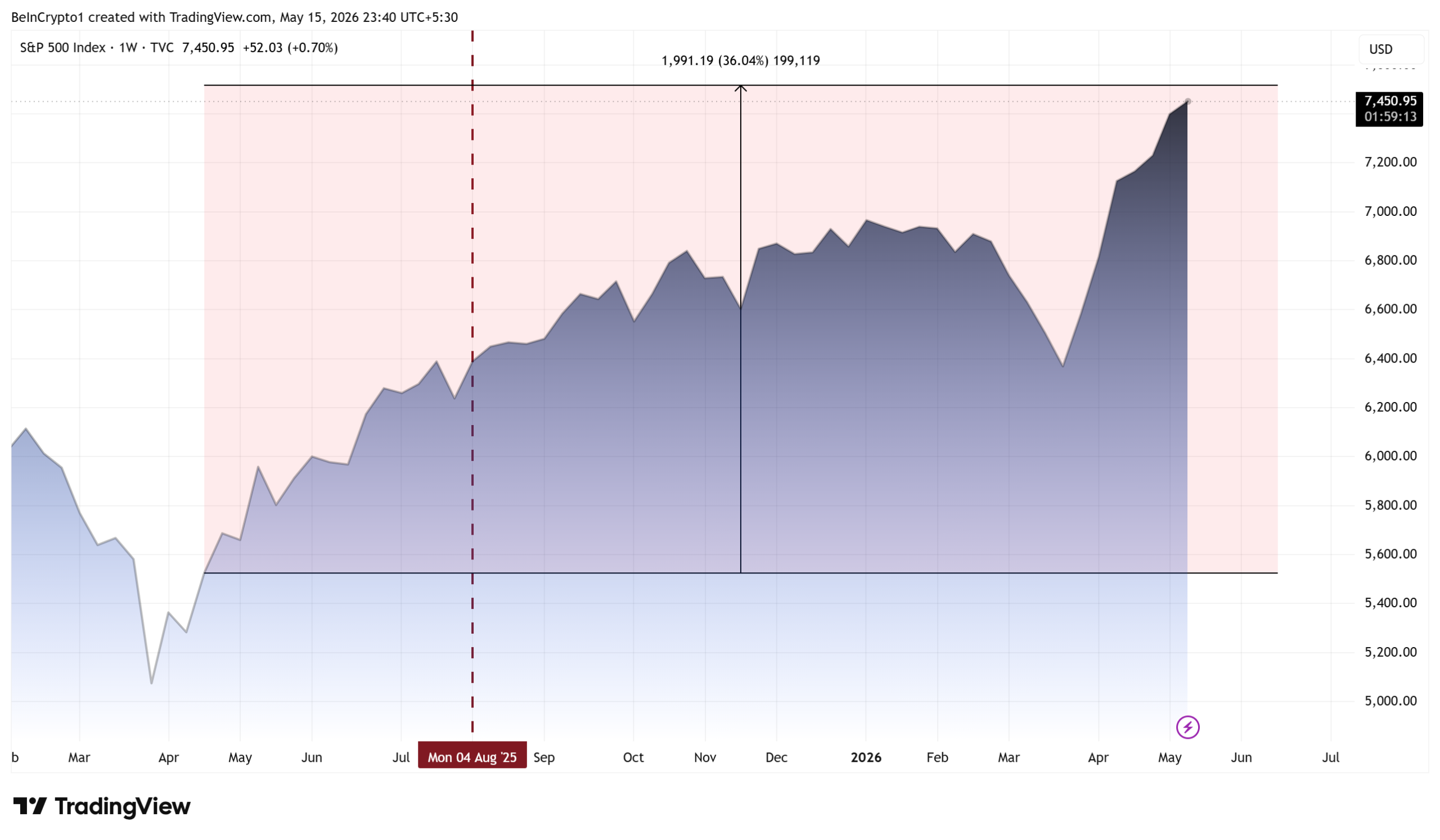
Grok’s portfolio has returned 59% over its first nine months, according to publicly available Autopilot data, with $17 million currently invested. The S&P 500 climbed 36% in the same window.

Over the past three months, the agent added another 12.6%, against the SPY’s 9.75%. The performance has stayed concentrated in AI infrastructure and energy names.
Heavy positions in semiconductor and memory stocks captured the hyperscaler capital expenditure cycle. Defense and power exposure provided ballast during macro shocks earlier in 2026.
The hardware bet aligns with the broader pattern documented across coverage of AI agents now moving billions in real markets. The xAI-branded portfolio operates without human override, according to its public posts.
Follow us on X to get the latest news as it happens
Claude’s Defensive Tilt Misses the AI Rally
Claude’s portfolio launched in April 2026 with $50,000 in seed capital. Every decision runs through the agent with no human override.
Recent posts show the fund rotated into ServiceNow (NOW) and Zeta Global (ZETA) while trimming Microsoft (MSFT).
The agent justified each trade through probability-weighted scenarios, kill conditions, and forward catalysts.
The discipline has not produced the same headline returns. Operators have acknowledged in public posts that the fund trails the S&P 500. The gap covers several points across its first two months on the platform.
“It’s now been about two months since Claude’s AI agents started picking stocks So far, they’ve underperformed the market SPY: +8.3% Claude: 2.6%,” they said.
Claude leaned into second-order AI plays such as enterprise software, fintech, and power. That tilt missed parts of the mega-cap rally that lifted direct semiconductor names.
Outside the experiment, independent traders have used Anthropic’s models to power Polymarket bots that reportedly cleared millions in profit.
What the Gap Means for AI-Driven Investing
The headline numbers tell only part of the story. Grok has roughly a year of public history. Claude’s track record covers weeks.
Live AI-led trading carries real risks. Anthropic recently received legal warnings about how its name appears on retail products.
Market professionals have also questioned the value of retail AI trading bots.
“They lack real intelligence, so expecting them to trade and consistently beat humans in a reasonable timescale doesn’t make sense,” highlighted Raullen.eth, an AI builder and popular user on X.
Anyone mirroring either agent faces fees and concentration risk. Strong recent returns may not repeat once the cycle turns.
The two portfolios offer a rare public test of how different AI models translate market data into trades. Still, events such as earnings and sector rotations could reveal whether aggressive infrastructure bets or hedged software exposure hold up better.
The post Grok Outpaces Claude AI in Stock Trading With 60% Profit appeared first on BeInCrypto.
Key points:
- Bitcoin is struggling to reach the $84,000 level, but a minor positive is that the bulls have not allowed the price to skid to the $76,000 support.
- Select major altcoins have turned down from their overhead resistance levels, indicating that the bears remain in control.
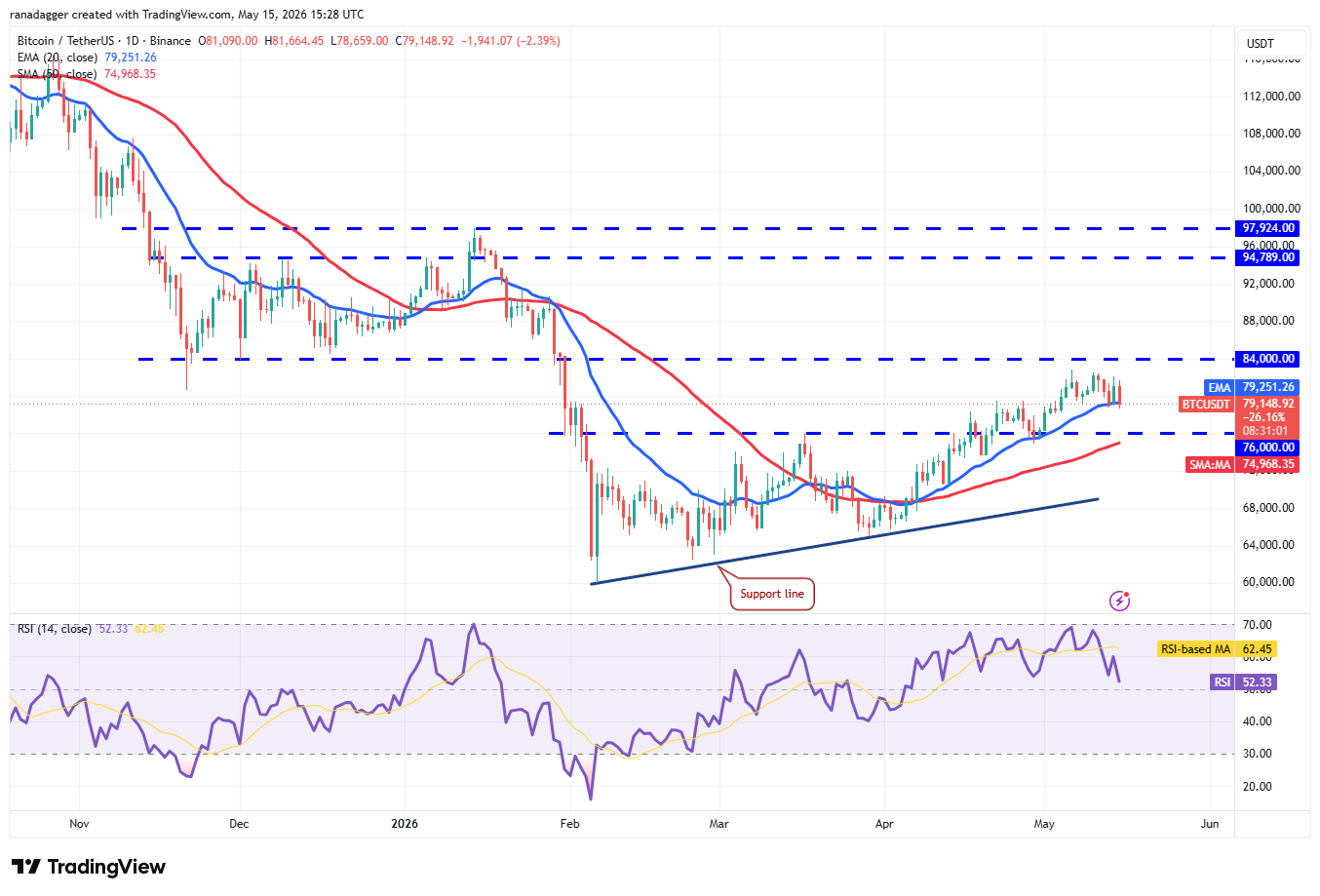
Bitcoin’s (BTC) recovery above $82,000 on Thursday was short-lived, as bears sold at higher levels and pulled the price back to the $79,000 level. Glassnode said in its Week On-chain report that several investors bought BTC between November 2025 and February near the $86,900 level. These holders may sell near their entry price after experiencing large drawdowns, creating a barrier for BTC’s continued rally.
Another negative view came from crypto analytics firm CryptoQuant, which said in a recent report that BTC has hit its major resistance at the 200-day moving average near $82,400. In 2022, BTC had resumed its downtrend after failing to cross above the 200-day SMA. BTC may get into trouble if history repeats itself.
In a bear phase, it is not uncommon for the price to hit a wall at the major resistance and pull back. However, a positive sign in favor of the bulls is that they have not allowed the price to dip back below the short-term breakout level of $76,000. That suggests the bulls are not hurrying to close their positions as they anticipate another leg higher.
Could BTC and the major altcoins hold on to their support levels? Let’s analyze the charts of the top 10 cryptocurrencies to find out.
Bitcoin price prediction
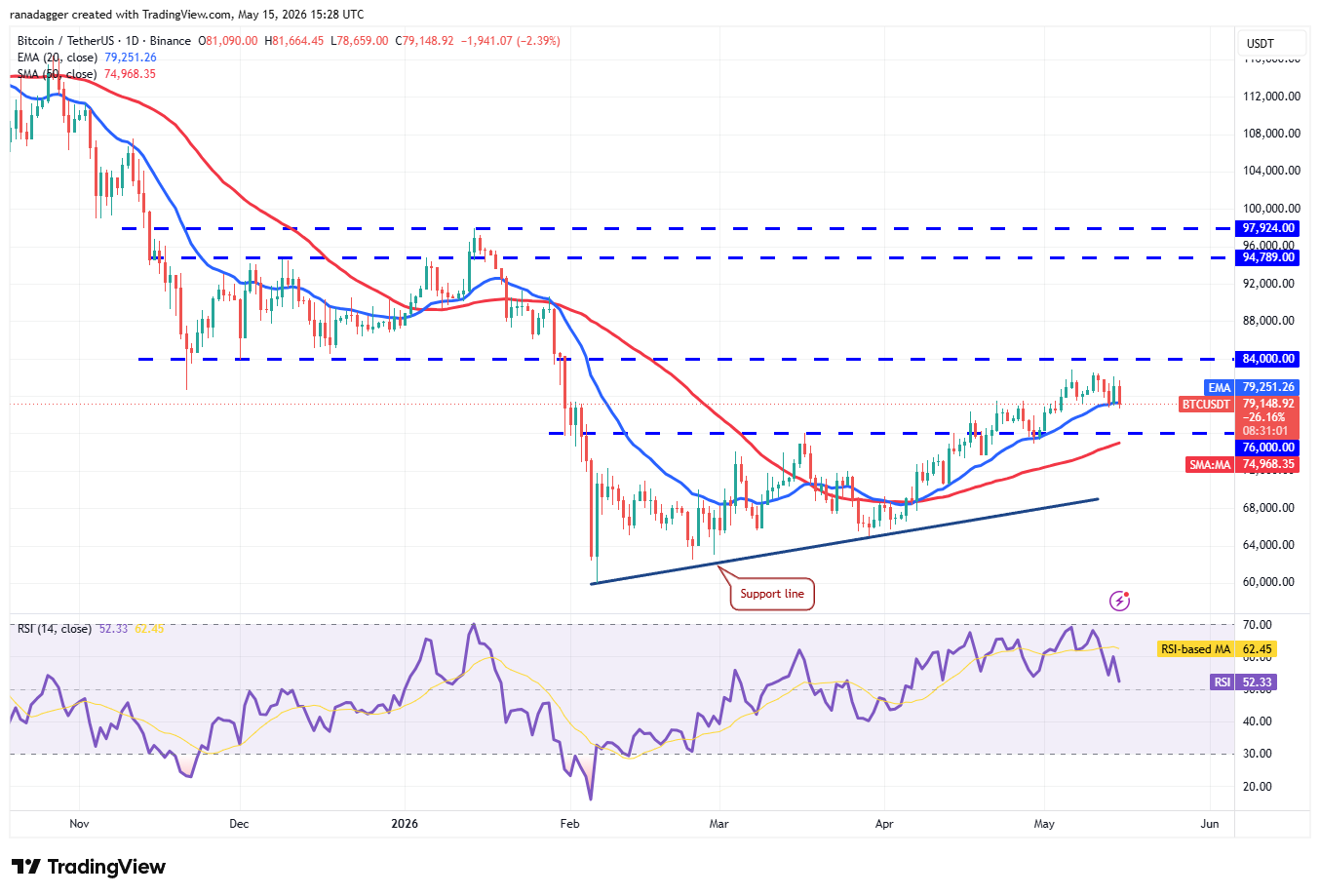
BTC rebounded off the 20-day exponential moving average ($79,251) on Thursday, but the bears sold the relief rally.
BTC/USDT daily chart. Source: Cointelegraph/TradingView
The BTC price has dipped back to the 20-day EMA, which is a crucial level for the bulls to defend if they want to retain the advantage. If the price turns up from the 20-day EMA with force, the bulls will again strive to push the BTC/USDT pair to $84,000. A break and close above $84,000 clears the path for a rally to $92,000.
On the contrary, if the price sustains below the 20-day EMA, it suggests that the bears are attempting a comeback. The pair may then tumble to the 50-day SMA ($74,968), which is again likely to attract buying by the bulls.
Ether price prediction
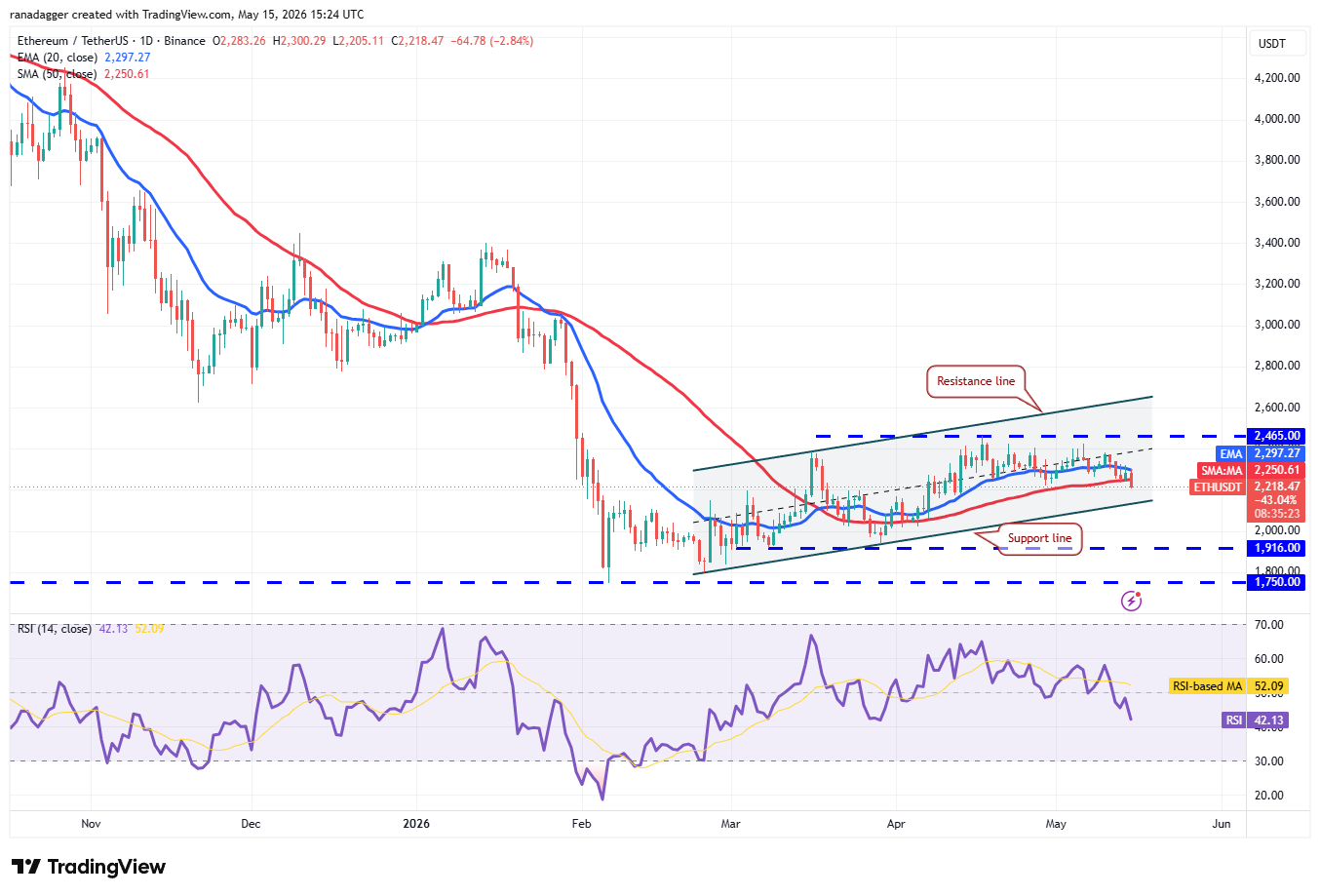
Ether (ETH) turned down from the 20-day EMA ($2,297) and has broken below the 50-day SMA ($2,250), indicating an advantage to sellers.
ETH/USDT daily chart. Source: Cointelegraph/TradingView
The ETH/USDT pair may plunge to the support line of the ascending channel pattern, which is a crucial level for the bulls to defend. The failure to do so may sink the ETH price to $1,916.
Instead, if the price turns up from the support line and breaks above the 20-day EMA, it signals buying at lower levels. The pair may then climb to $2,465, which is expected to behave as solid resistance. If buyers overcome the barrier, the pair may rally to the resistance line.
BNB price prediction
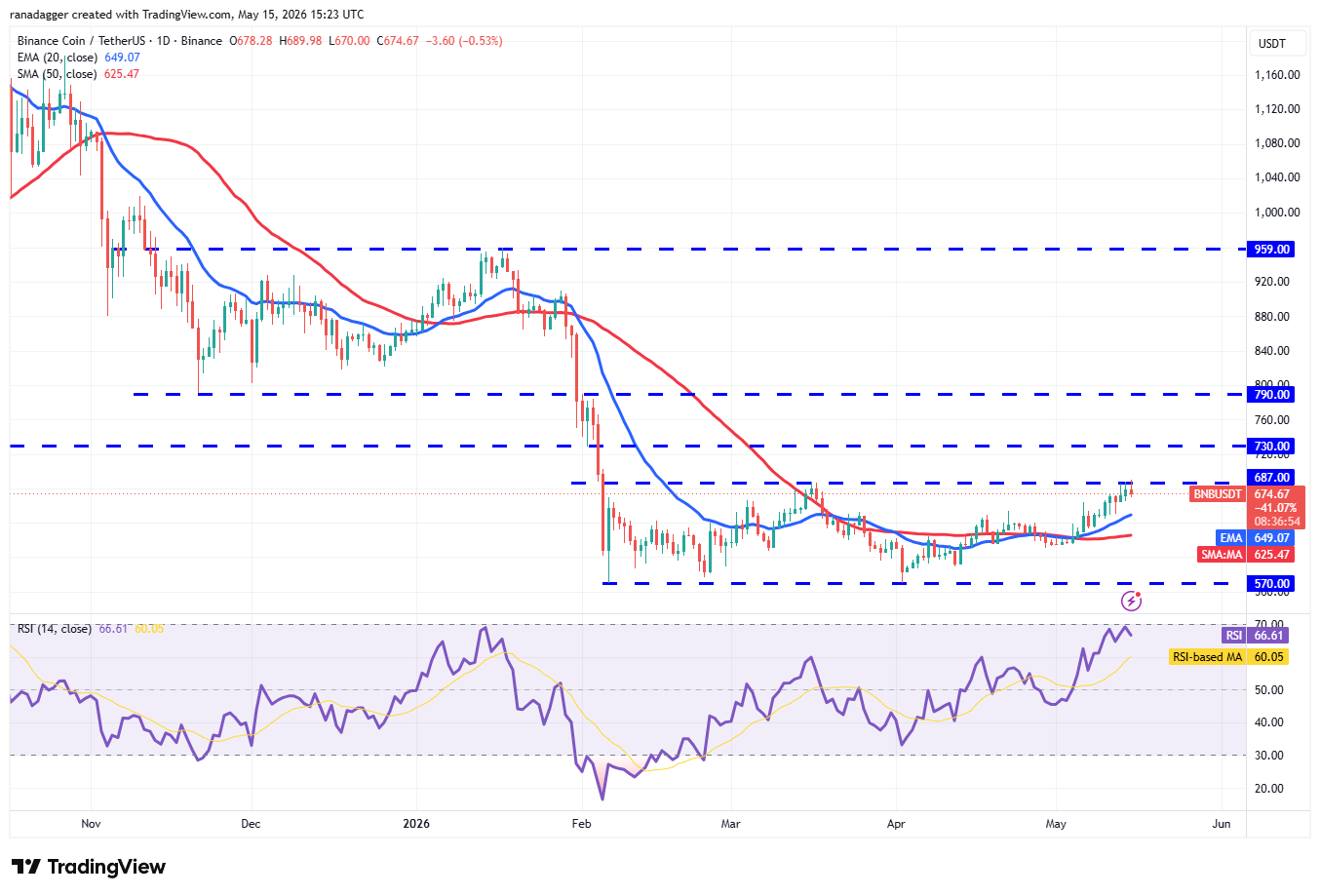
Sellers have successfully defended the $687 level in BNB (BNB), but the bulls continue to exert pressure.
BNB/USDT daily chart. Source: Cointelegraph/TradingView
The upsloping 20-day EMA ($649) and the RSI near the overbought zone signal that the path of least resistance is to the upside. If buyers clear the $687 hurdle, the BNB/USDT pair may soar to $730 and later to $790.
This bullish view will be invalidated in the short term if the BNB price turns down sharply from the current level and breaks below the 20-day EMA. That suggests the pair may remain inside the $687 to $570 range for some more time.
XRP price prediction
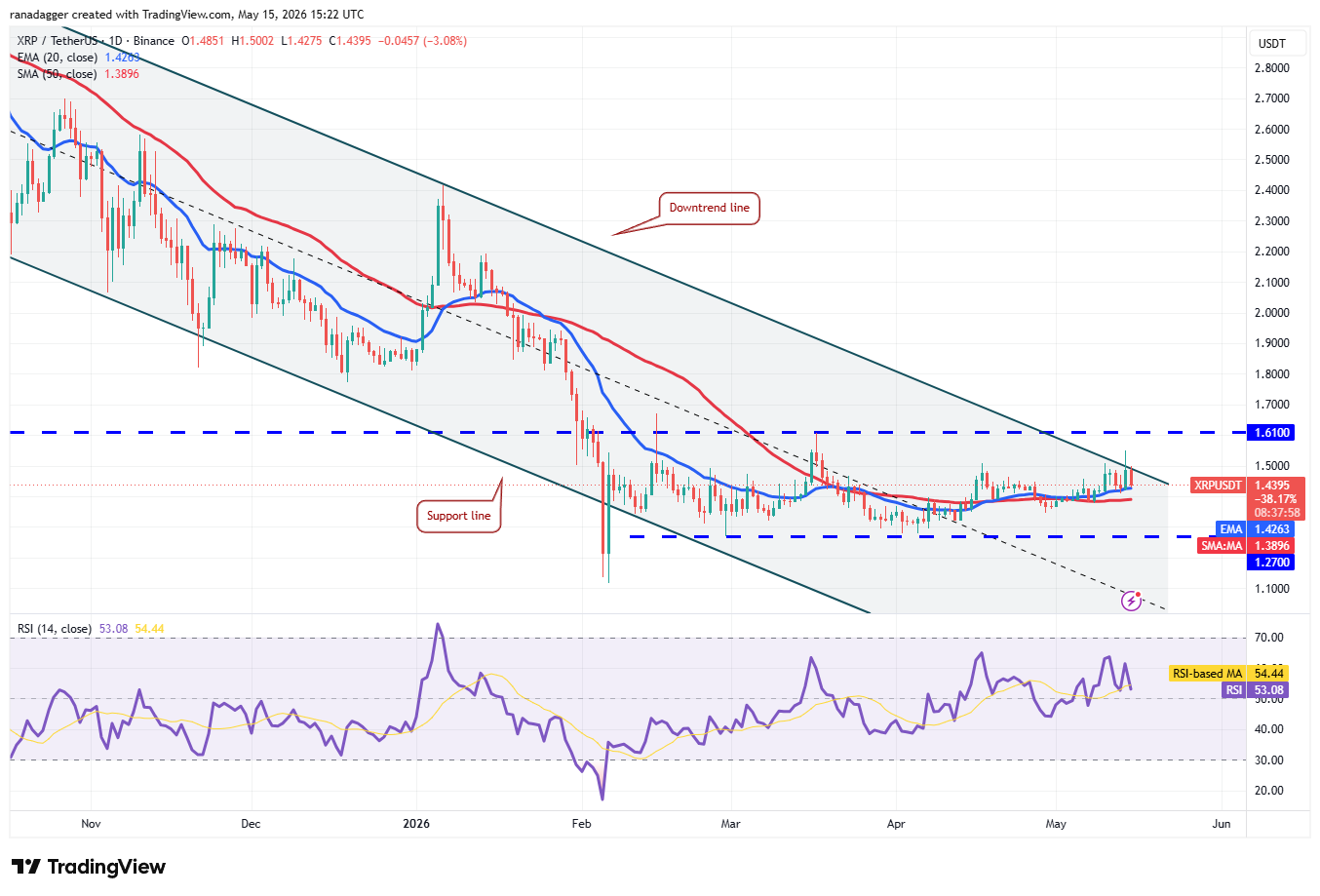
XRP (XRP) rose from the 20-day EMA ($1.42) on Thursday and broke above the downtrend line of the descending channel pattern.
XRP/USDT daily chart. Source: Cointelegraph/TradingView
However, the bulls failed to achieve a close above the downtrend line, indicating that the bears are fiercely defending the level. Sellers will attempt to trap the aggressive bulls by pulling the XRP price below the moving averages. If they can pull it off, the XRP/USDT pair may plummet to $1.27.
Buyers are likely to have other plans. They will attempt to quickly push the price back above the downtrend line. If they do that, the likelihood of a break above the $1.61 resistance increases. The pair may then start a new up move to $2.
Solana price prediction
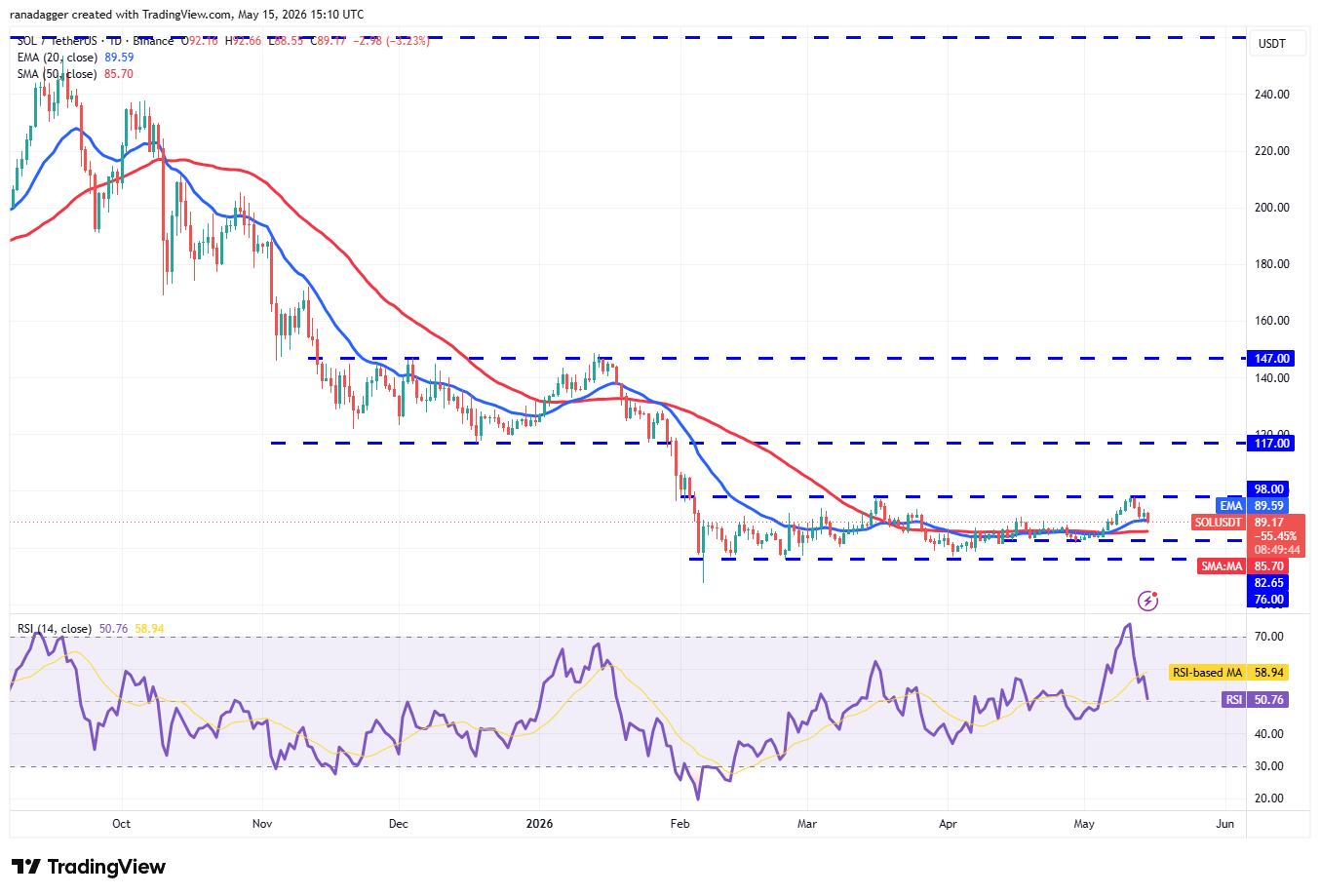
Solana (SOL) bounced off the 20-day EMA ($89) on Thursday, but the bears sold at higher levels.
SOL/USDT daily chart. Source: Cointelegraph/TradingView
The SOL price has turned down and broken below the 20-day EMA. If the price maintains below the 20-day EMA, the SOL/USDT pair may continue to oscillate between $76 and $98 for a few more days.
Buyers will have to swiftly push the price back above the 20-day EMA to signal strength. The pair may then reach the $98 level, which is the critical overhead resistance to watch out for. A close above $98 clears the path for a rally to $106 and subsequently to $117.
Dogecoin price prediction
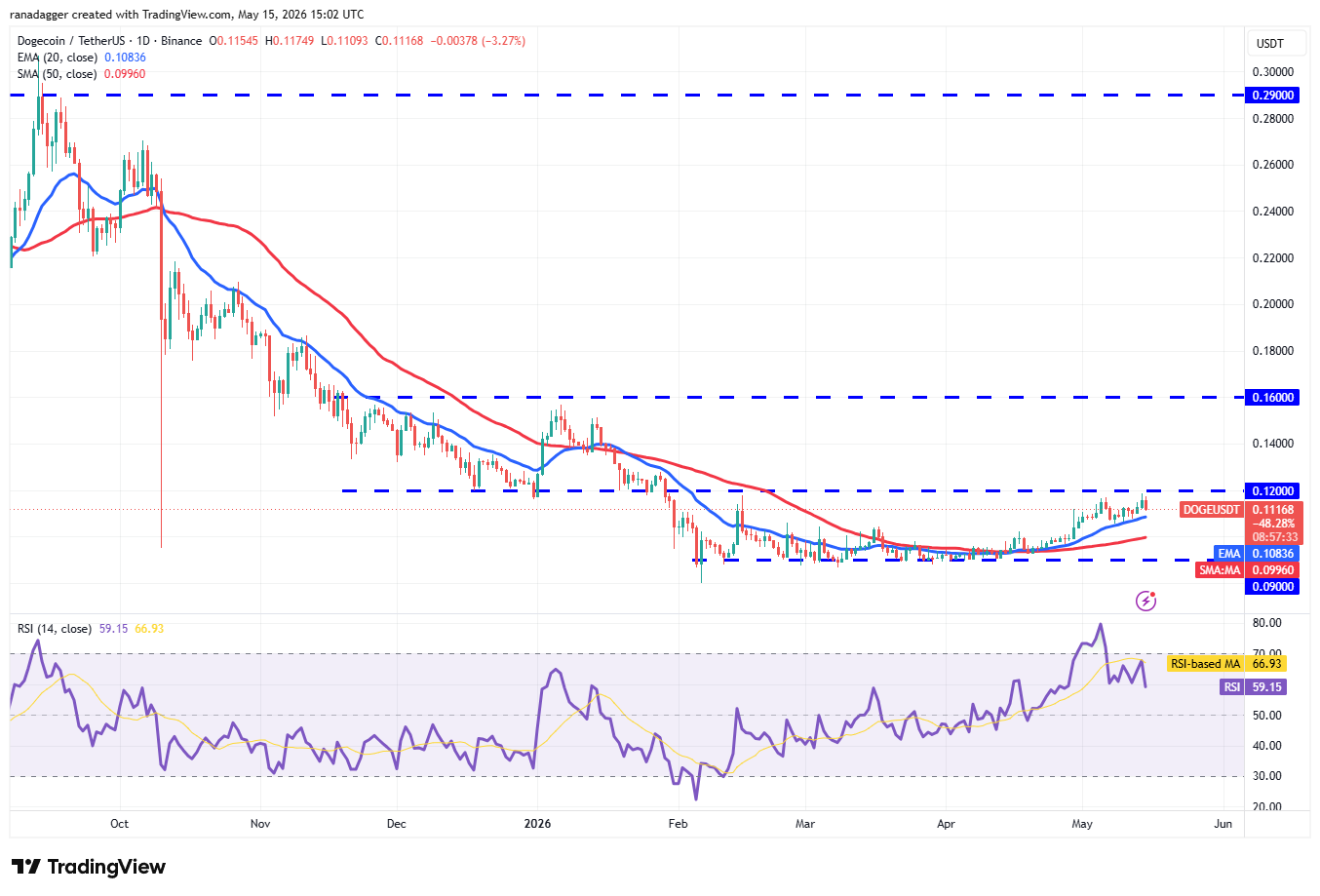
Dogecoin (DOGE) reached the $0.12 level on Thursday, where the bears are posing a stiff challenge to the bulls.
DOGE/USDT daily chart. Source: Cointelegraph/TradingView
If the DOGE price continues lower and breaks below the 20-day EMA ($0.11), it suggests that the traders are booking profits. That may keep the pair stuck between $0.09 and $0.12 for a while longer.
On the other hand, a solid bounce off the 20-day EMA signals that the bulls remain in control. That improves the prospects of an upside breakout. If that happens, the DOGE/USDT pair may surge to $0.14 and later to $0.16.
Hyperliquid price prediction
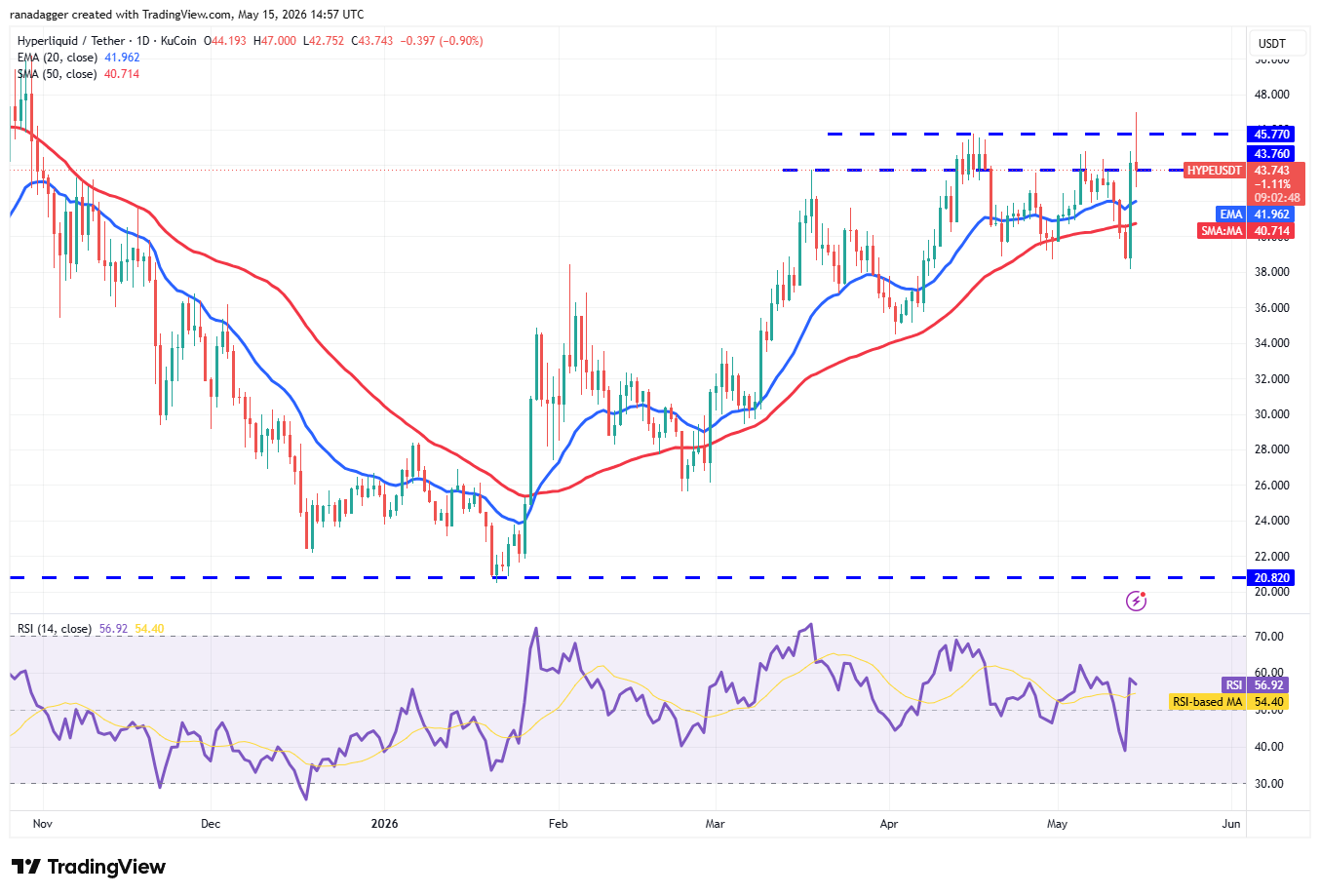
Hyperliquid (HYPE) made a solid comeback from the $38 level on Thursday, indicating aggressive buying at lower levels.
HYPE/USDT daily chart. Source: Cointelegraph/TradingView
The bulls continued their run on Friday and pushed the HYPE price above the $45.77 resistance. However, the long wick on the candlestick shows selling at higher levels. The bears will have to pull the price below the 20-day EMA ($41.96) to weaken the bullish momentum. The HYPE/USDT pair may then form a range between $38 and $47.
Contrary to this assumption, if the price turns up from the current level or the 20-day EMA and breaks above $47, it signals the resumption of the up move. The pair may then skyrocket toward the $50 to $51.43 zone.
Related: Bitcoin stalls above $80K despite CLARITY Act pass: What will trigger a breakout?
Cardano price prediction
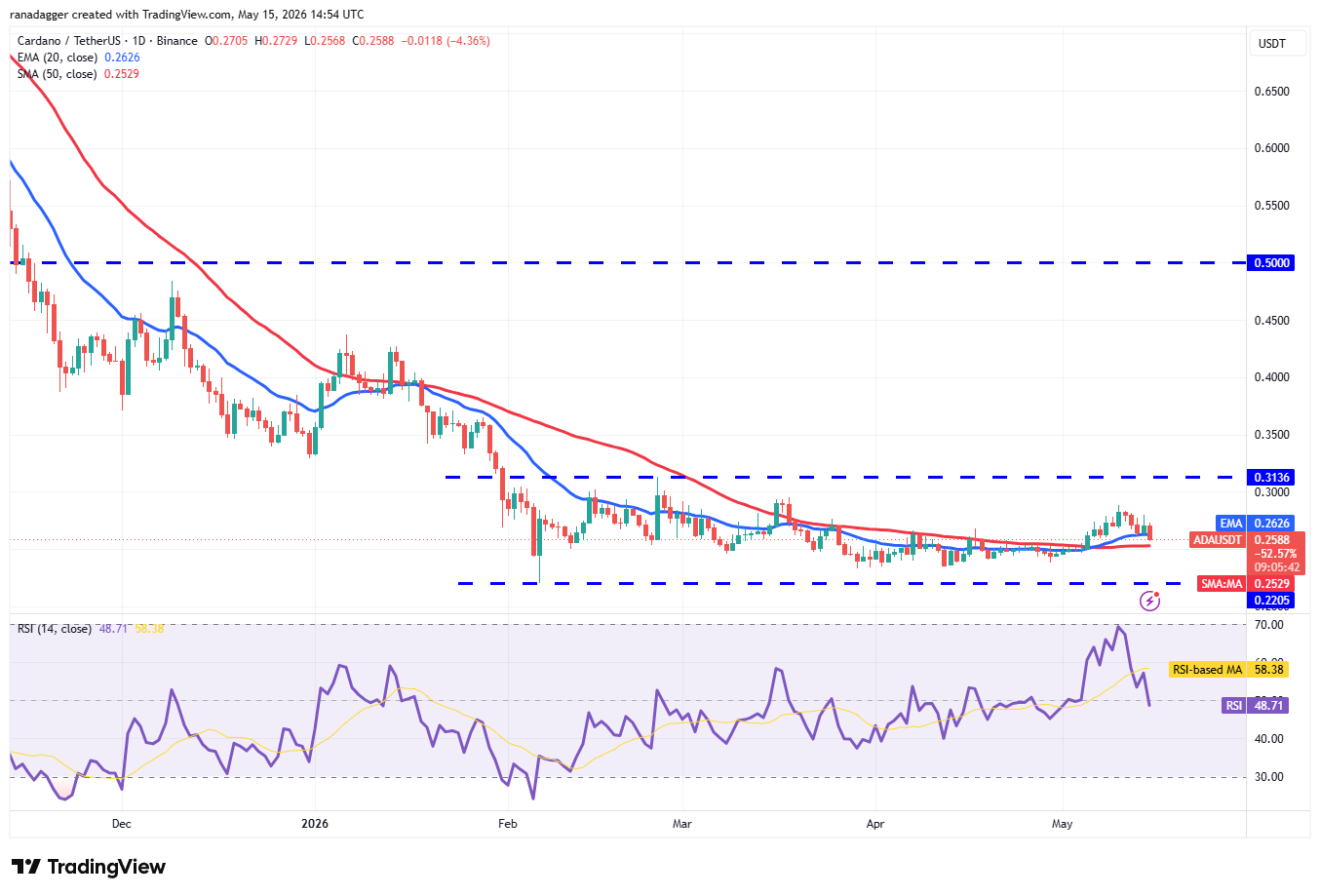
Cardano (ADA) bounced off the 20-day EMA ($0.26) on Thursday, but the bulls could not sustain the higher levels.
ADA/USDT daily chart. Source: Cointelegraph/TradingView
Sellers are attempting to strengthen their position by pulling the ADA price below the moving averages. If they manage to do that, the ADA/USDT pair may extend its stay inside the $0.22 to $0.31 range for some more time.
On the other hand, if the price turns up from the moving averages and breaks above $0.29, it suggests an advantage to buyers. The pair may then rise to $0.31, which is likely to attract sellers.
Zcash price prediction
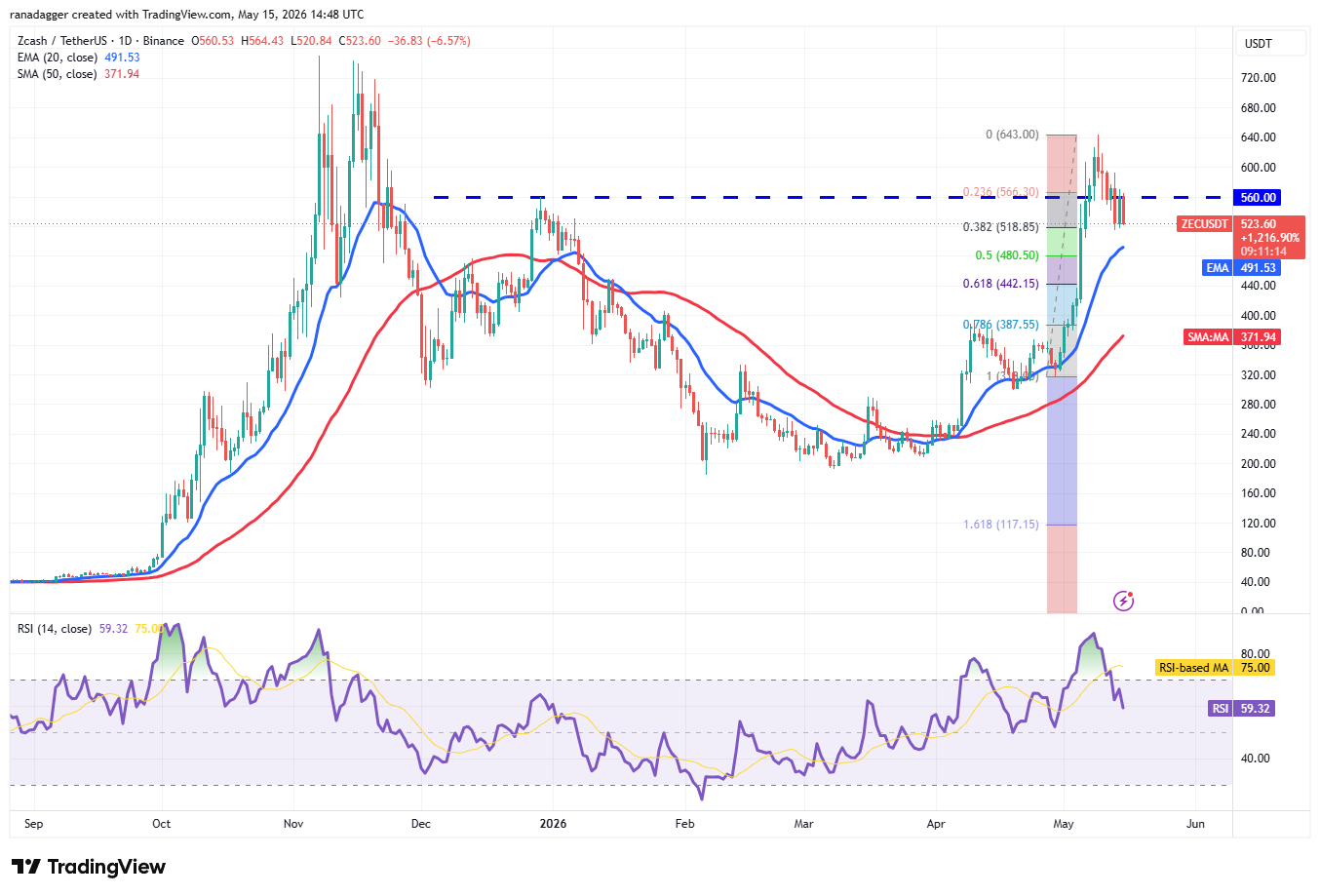
Zcash (ZEC) turned up from the 38.2% Fibonacci retracement level of $518 on Thursday, but the bulls could not clear the $560 hurdle.
ZEC/USDT daily chart. Source: Cointelegraph/TradingView
The bears are attempting to pull the ZEC price below the $518 level and deepen the pullback to the 20-day EMA ($491). Buyers are expected to vigorously defend the 20-day EMA, as a close below it may sink the ZEC/USDT pair to the 61.8% retracement level of $442.
Contrarily, if the price rebounds off the 20-day EMA with force, it indicates a positive sentiment. The bulls will then attempt to drive the pair to $560 and eventually to $643.
Bitcoin Cash price prediction
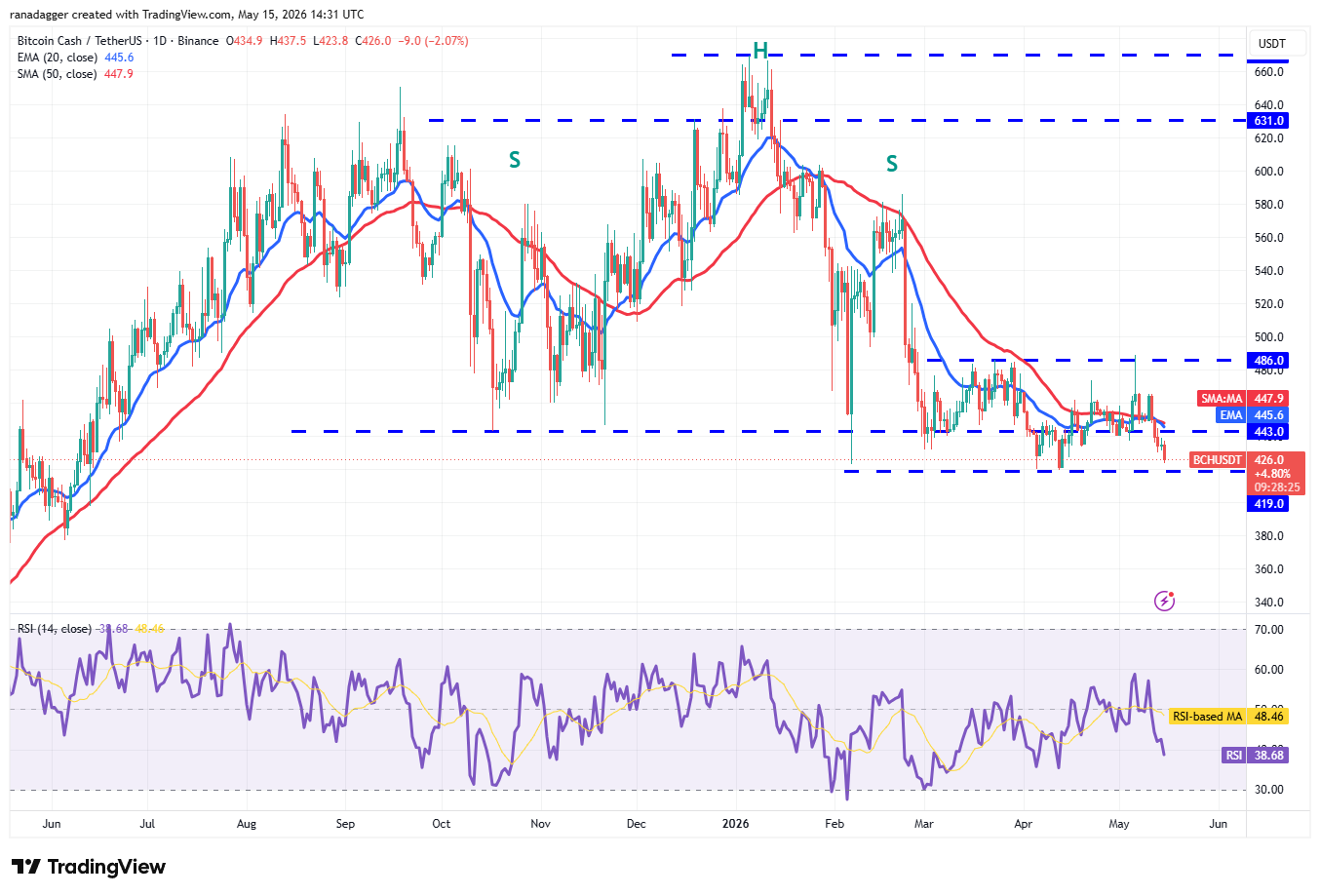
Bitcoin Cash (BCH) has been trading inside the $419 to $486 range, signaling buying near the support and selling close to the resistance.
BCH/USDT daily chart. Source: Cointelegraph/TradingView
The moving averages have started to turn down, and the RSI is in the negative territory, indicating that the bears have the upper hand. Sellers will attempt to strengthen their position by pulling the BCH price below the $419 support. If they succeed, the BCH/USDT pair may resume the downtrend toward $375.
Buyers are likely to have other plans. They will attempt to defend the $419 level and push the price back above the moving averages. If they do that, the pair may remain inside the range for a few more days.

Augustus Bank N.A. has secured conditional approval from the U.S. Office of the Comptroller of the Currency to charter the first clearing bank designed for an AI-enabled, fully reserved stablecoin regime. The move, backed by the GENIUS Act framework, seeks to create a federal structure for payment stablecoins while clarifying how banks and select nonbank entities can issue and integrate dollar-pegged tokens under federal oversight. Augustus disclosed the conditional approval in a PR Newswire release and now aims to launch a Dallas, Texas–based national bank centered on AI-driven compliance and highly automated back-office operations.
Founder Ferdinand Dabitz told Cointelegraph that the institution is “a couple of months” from full approval and launch, though final clearance remains contingent on pre-opening conditions. The claim underscores Augustus’ belief that the current clearing ecosystem—dominated by large, legacy banks—needs a wholesale rebuild rather than a retrofit of existing cores. “The clearing bank bond is truly broken,” Dabitz asserted, arguing there is a path to rethink it as an application and deliver something substantially better.
Augustus’ genesis traces back to Berlin in 2021, where it started as Ivy, a euro-clearing fintech offering a transaction banking platform for non-U.S. institutions, fintechs and crypto firms. The bank already handles euro payments and instant settlement for clients, including Kraken, and now plans to extend that footprint with a full national charter focused on fully reserved stablecoins and AI-powered operations. Dabitz contends that incumbent banks can re-platform some systems, but cannot fundamentally rewire a core designed for humans to operate under AI-driven, tokenized money flows. “I’ve come to the conclusion it’s impossible to re-platform a bank,” he said.
Central to Augustus’ strategy is a three-layer stablecoin model designed to serve as a funding rail, a treasury and liquidity tool, and an interface layer for AI agents interacting directly with money. Dabitz describes the funding rail as the backbone for payments, while the treasury function would target the release of what he estimates as trillions of dollars in idle capital that sit idle due to outdated liquidity management. The third layer envisions AI agents leveraging stablecoins to conduct and monitor transactions in real time, potentially elevating AI from a peripheral capability to a primary user of the bank’s services. In practical terms, Augustus envisions real-time treasury optimization and automated liquidity management with human oversight rather than manual execution at every step.
Key takeaways
- The OCC granted conditional approval for Augustus Bank N.A. to charter a national bank under the GENIUS Act, paving the way for AI-enabled, fully reserved stablecoins and federal oversight of their use.
- Augustus aims to replace large segments of the traditional clearing network, arguing that legacy cores and weekend closures hinder true modernization; the bank contends it can move faster by building AI and stablecoin workflows into its operating model from the ground up.
- The proposed three-layer model positions stablecoins as a payments rail, a treasury/liquidity tool to unlock idle capital, and an interface layer for AI agents to interact with money in real time.
- Industry context shows massive incumbents investing heavily in AI and clearing infrastructure, with JPMorgan citing annual tech spend in the vicinity of $18 billion and Citi reporting significant clearing-related revenue in the first quarter; Augustus argues it can gain speed by starting with an AI-first design rather than retrofitting existing systems.
- Regulatory engagement will be critical as Augustus seeks to balance rapid automation with appropriate checks, balances and risk controls—an area the founder says will feature close collaboration with regulators and established banking leaders.
Rethinking clearing through AI and tokenized money
A founding premise for Augustus is that the traditional clearing network has grown too dependent on human workflows and decades-old core systems. The company argues that the true bottleneck is not the presence of digital assets or AI per se, but the inability of legacy platforms to reconfigure themselves around programmable money and automated compliance. The aim is to embed AI-driven processes into the bank’s day-to-day operations from the outset, rather than layering automation onto an already rigid core.
July’s regulatory pathway for Augustus is framed by the GENIUS Act, which established a federal framework for stablecoins and clarified how banks and certain nonbank entities can issue and integrate dollar-pegged tokens under federal oversight. Augustus’ plan to leverage this framework in a national clearing bank aligns with broader policy conversations about stablecoins, cross-border settlement, and the role of banks as trusted rails for tokenized assets.
In practical terms, Dabitz says the model would enable AI systems to perform tasks such as liquidity management and transaction monitoring on behalf of corporates, with humans supervising the process rather than manually handling every exception. The vision is to compress a set of operational tasks—like transaction monitoring and case handling—from hours to minutes, making compliance and settlement faster and more scalable while preserving safety and oversight. Critics, however, caution about model risk, explainability, and the potential for operational failures as AI takes on a larger share of regulated tasks. Augustus counters that its safety framework will involve rigorous checks and balances and ongoing regulator engagement.
The bank has already demonstrated a practical foothold in European and crypto markets, running euro payments and instant settlement for Kraken. This history, Dabitz says, provides a proving ground for the heavier automation and AI-backed workflows Augustus plans to scale under a national charter. The ambition is not merely to digitize existing processes but to reframe how clearing and settlement work in a world where tokenized money interacts with AI agents and real-time financial data streams.
Industry dynamics: incumbents, regulators, and the path forward
The push to modernize clearing sits against a backdrop of large-scale investments by traditional banks in AI and technology. JPMorgan Chase, for instance, publicly states it invests more than $18 billion annually in technology, including AI initiatives, while Citi reported substantial clearing-related revenue in the first quarter, underscoring the profitability and importance of the clearing business for incumbents. Augustus’ pitch is that its speed-to-market—built around an AI-first design and a fully reserved stablecoin framework—could enable it to outpace incumbents on building new, end-to-end workflows rather than retrofit old ones.
Still, the path to a full operating bank is likely to involve continued regulatory scrutiny, risk management evaluations, and a delicate balance between innovation and safety. Augustus says it will work closely with regulators and banking executives to ensure that “the checks and balances and the harness for the AI to operate in a safe and sound manner” guide its rollout. The broader trajectory of AI-enabled banking will hinge on how effectively new entrants can demonstrate reliability, transparency and resilience alongside the speed and efficiency benefits that automation promises.
The Dallas-based plan reflects a broader trend of US policymakers and financial institutions exploring stablecoins as a settlement mechanism and potential backbone for programmable money within a regulated framework. Augustus’ approach—combining a national charter, a fully reserved model, and AI-driven compliance—could influence how other innovators structure clearance, settlement, and money movement if its approvals proceed as envisioned.
The question readers will watch next is whether pre-opening conditions can be satisfied to deliver a full charter, and how regulators will respond to an institution designed explicitly around AI-powered processes and tokenized money. If Augustus achieves a successful launch, it could mark a meaningful inflection point for the modernization of clearing infrastructure in the digital age.
Readers should monitor forthcoming regulatory milestones and any updates from Augustus on its phased rollout, as well as potential partnerships with corporates and fintechs seeking AI-enabled settlement capabilities under a federally supervised framework.


Key takeaways
- Ripple (XRP) tests support at $1.43 amid selling pressure from the $1.50 supply zone.
- Institutional ETF inflows rebound to $1.37B, while futures open interest rises to $3.09B, signaling cautious optimism.
Ripple (XRP) is grinding lower on Friday, testing key support at $1.43 after being capped by strong selling from the $1.50 supply range since Monday.
Despite the US Senate Banking Committee advancing the Digital Asset Market Clarity Act of 2025 (Clarity Act) on Thursday, overall market sentiment remains constrained amid a cautious recovery outlook.
XRP addresses in profit tick up
The proportion of XRP addresses with unrealized profit rose to approximately 65% on Thursday, up from 63% the previous day, coinciding with the token’s test of $1.50 resistance.
This reflects a modest increase in risk-on sentiment, though traders should remain wary of potential profit-taking in a fragile technical environment.
Institutional flows into XRP spot ETFs rebounded sharply, with nearly $19 million in fresh inflows on Thursday. Cumulative ETF inflows now total $1.37 billion, while average net assets under management rose to $1.25 billion from $1.14 billion.
Retail participation in XRP derivatives also continues to grow. Futures Open Interest (OI) averaged $2.97 billion on Friday, up from $2.90 billion, signaling rising conviction among traders in XRP’s potential to extend an upward trajectory.
Technical outlook: consolidation within the corrective phase
The XRP/USD 4-hour chart is bearish and efficient as XRP has lost lost 2.5% of its value in the last 24 hours. XRP trades at $1.43, holding a neutral to mildly constructive bias.
It is trading above the 50-day Exponential Moving Average (EMA) at $1.42 while remaining capped beneath the 100-day EMA at $1.49 and the 200-day EMA at $1.70. This configuration suggests an ongoing consolidation within a broader corrective phase.
If the bears stay in control, immediate support will emerge at the 50-day EMA around $1.42, with a rising trendline near $1.39 providing a stronger floor. A daily close below $1.39 could expose deeper losses.
However, if the bulls push harder, they would encounter initial resistance at the 100-day EMA at $1.49. A sustained break above this level would open the path toward the 200-day EMA near $1.70, where broader bearish pressure would be challenged.

The momentum indicator suggests that the bears are slowly regaining control. The Relative Strength Index (RSI) is at 51, and the MACD histogram is slightly positive, indicating limited directional conviction rather than a strong impulsive move.
XRP’s price action suggests ongoing consolidation within a corrective phase, with both buyers and sellers vying for control around critical EMA levels.


Explosive debate: after one of DeFi’s biggest attacks left Aave facing bad debt, DeFi United raised more than $300M to stop the contagion. But did the ecosystem prove its strength – or expose hidden trust assumptions, opaque risk, and the need for a real DeFi backstop?

South Korea’s Financial Services Commission (FSC) is accelerating the drafting of a formal framework for tokenized securities, with a detailed rule package slated for release in July as the country choreographs a 2027 transition of blockchain-based securities into its capital markets regime. The measures are expected to outline a roadmap for tokenizing assets such as stocks, bonds and money market funds, and may contemplate adjustments to over-the-counter trading limits as well as the pooling of similar underlying assets through fractional investment products. The FSC disclosed the plan at the second meeting of its public-private tokenized securities council, created in March to design issuance, trading, infrastructure and settlement rules ahead of the framework’s 2027 rollout.
“The goal is to make an announcement in July,” stated FSC Vice Chairman Kwon Dae-young, underscoring that the forthcoming rules will serve the “institutionalization” of tokenized securities. The July package will serve as a critical test of how far South Korea is willing to open regulated capital markets to distributed ledger technology while maintaining existing investor-protection standards.
The announcement comes on the heels of broader developments signaling regulatory readiness and institutional interest in tokenized finance. In a separate public address, Bank of Korea Governor Hyun-Song Shin voiced support for tokenized deposits. The remarks were reported as part of ongoing coverage on the sector’s policy trajectory. In a related move, the Ministry of Economy and Finance announced a pilot project to use tokenized deposits for government operational spending, with a full rollout earmarked for the fourth quarter of 2026.
FSC accelerates tokenized regulation efforts ahead of 2027 rollout
The accelerated rulemaking aligns with the amended Capital Markets Act and Electronic Securities Act, which are scheduled to take full effect on February 4, 2027. When enacted, the reforms will inaugurate South Korea’s first regulated environment for issuing, distributing and trading tokenized securities on distributed-ledger technology. The framework is designed to bring tokenized assets under the FSC’s jurisdiction, transitioning them from an experimental phase into formalized market infrastructure.
In January 2026, the FSC announced amendments to the legislation, establishing a one-year preparatory period for lawmakers and market participants. This timeline places significant emphasis on governance, disclosure, and investor protection as tokenized instruments move from pilots to regulated products. As the regulatory architecture evolves, the government intends to provide clear registries, compliance standards and oversight mechanisms that can accommodate diverse tokenized asset classes while preserving the integrity of traditional capital markets.
For market participants, the transition implicates a broad set of compliance requirements. Banks, securities firms, exchanges and asset managers will need to adapt their risk controls, KYC/AML procedures, and reporting capabilities to a hybrid environment where blockchain-ledgers function as recognized securities registries. The process also raises questions about cross-border recognition, interoperability with EU-style regimes such as MiCA, and the alignment of Korean rules with international standards for custody, settlement finality and asset custodianship.
Policy and market structure implications for participants
Key regulatory levers under consideration include the scope of tokenized trading on regulated venues, the treatment of OTC transactions involving tokenized assets, and the framework governing fractional investment products that pool multiple underlying assets. Officials have signaled a careful balance: regulatory certainty and investor protection must be preserved, even as the market tests the efficiency gains of blockchain-based settlement and programmable asset terms. The contemplated changes could affect a wide range of actors, including conventional securities exchanges, licensed broker-dealers, banks engaging in custody or settlement services, and institutional investors exploring tokenized exposure to baskets of assets.
From a compliance perspective, the regime is expected to emphasize robust AML/KYC controls, clear disclosure obligations, and centralized or delegated supervisory oversight to monitor tokenized issuance, distribution and trading. The design aims to reduce counterparty risk and settlement risk while ensuring that tokenized instruments remain within the protective perimeter of existing securities laws. The broader regulatory posture also matters for cross-border activity, as Korea’s approach will influence financial institutions that operate in Asian and global markets, and could shape discussions with international standard-setters about the treatment of tokenized assets within a harmonized framework.
Government use-cases and public-finance integration
In parallel with private-sector regulation, Seoul is exploring how tokenized assets can support public-finance and government operations. The pilot program announced by the Ministry of Economy and Finance will deploy tokenized deposits to execute government spending, with a full rollout anticipated in late 2026. Bank of Korea Governor Shin’s expressed support for tokenized deposits signals a policy openness to integrating digital-asset rails into public finance and central-bank–fiscal coordination, potentially influencing how future government payments, procurement and cash management are conducted within a regulated, ledger-based infrastructure. While the work remains in pilot form, observers note that tokenized public-finance mechanisms could offer benefits in transparency, traceability and efficiency, provided appropriate risk controls and regulatory guardrails are in place.
This convergence of regulatory reform and public-finance experimentation occurs within a global context of evolving central-bank digital-currency (CBDC) discourse and tokenized-asset regulation. Authorities have emphasized that tokenized securities will be treated as true securities under existing investor-protection regimes, avoiding a treatment that would place them outside the framework governing traditional assets. The Korean path may offer a blueprint for jurisdictions weighing similar transitions, balancing innovation with compliance obligations that are central to institutional trust and market stability.
Related reporting underscores Korea’s broader ambition to test real-world utility for distributed-ledger infrastructure in both financial and fiscal domains. As Korea positions its regime ahead of 2027, the interplay between securities tokenization, custody solutions, and government-led use cases will be a focal point for policymakers, market participants and international observers assessing the maturation of crypto-enabled capital markets.
Regulatory path and international context
The forthcoming regime situates Korea within a growing global wave toward formalizing tokenized assets. While MiCA in the European Union provides a comprehensive framework for crypto-assets and related services within the EU’s single market, Korea’s approach focuses on incorporating tokenized securities into the established capital markets architecture, with explicit recognition of blockchain-ledgers as valid securities registries. This alignment with traditional securities oversight—coupled with a parallel push to harness blockchain-based settlement and issuance—signals a policy stance that prioritizes investor protection and market integrity while gradually expanding the regulatory perimeter to include tokenized instruments.
Industry observers will be watching several regulatory and operational touchpoints: the precise definitions of tokenized securities under the amended acts; the treatment of cross-border trading and custody; the adequacy of AML/KYC controls for tokenized offerings; and the readiness of financial institutions to integrate ledger-based settlement with existing clearing infrastructures. The government’s public-private council remains a key mechanism for ironing out technical standards, interoperability requirements and enforcement expectations as the 2027 milestone approaches.
Closing perspective
South Korea’s tokenized-securities initiative reflects a deliberate policy evolution that prioritizes clear regulatory guardrails while pursuing the efficiencies of distributed-ledger technology. The July rule package and the 2027 implementation timeline establish a concrete roadmap for institutional participants, with implications for licensing, compliance programs, and cross-border cooperation. As government pilots advance and the private sector adapts, the central question will be how seamlessly tokenized assets can be integrated without diluting investor protections or market integrity. Watch for ongoing policy clarifications, interoperability standards, and enforcement guidance as Korea moves from pilots toward a regulated, ledger-based capital markets environment.
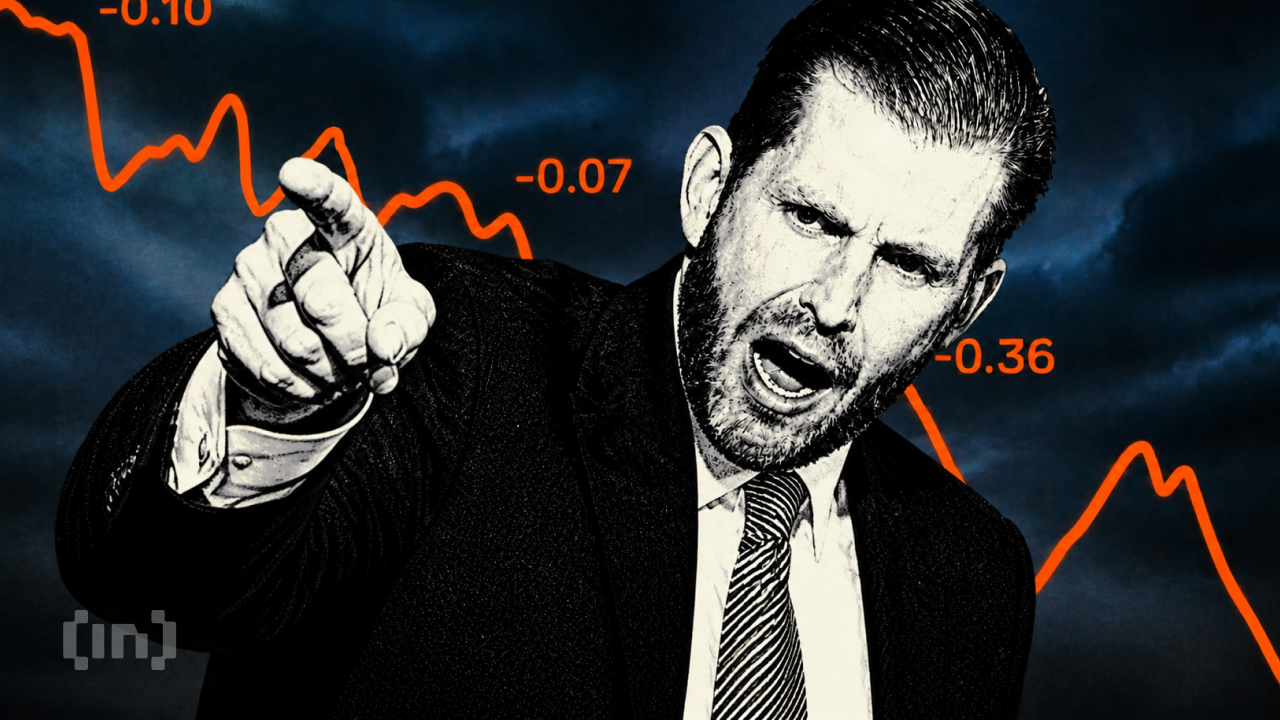

Eric Trump rejected Senator Elizabeth Warren’s claim that his father directs individual Nvidia (NVDA) stock trades. Warren tied recent buys to eased US AI chip exports to China.
Reports flagged a January 6 purchase worth up to $1 million in Trump-tied accounts. The Commerce Department updated AI chip export rules one week later.
Trump Family Pushes Back on Conflict Claim
Eric Trump challenged that all family assets sit in a blind trust managed by major financial institutions. The structure favors broad market indexes over individual stock picks.
All of our assets are invested in a blind trust by the largest financial institutions in broad market indexes. To suggest that individual stocks are being bought or sold, at the discretion of any member of the Trump family, would be a lie and blatantly false,” articulated Eric Trump, executive vice president of the Trump Organization.
The Trump Organization has said the family holds assets in fully discretionary accounts. Donald Trump Jr. and Eric Trump oversee the trust with third-party institutions and receive no advance notice of trades.
Warren Links Nvidia Stake To China Trip
Warren cited a January 6, 2026 Nvidia purchase of up to $1 million in Trump-tied accounts. The Commerce Department then revised rules for chips like Nvidia’s H200 on January 13.
She called the timing a national security risk.
“Trump brought the NVIDIA CEO on his trip to China to lobby Xi Jinping to buy advanced AI chips, even though it would create a U.S. national security threat. It turns out Trump also bought millions in NVIDIA’s stock. The President’s corruption is a national security disaster,” she wrote in a post.
Indeed, President Donald Trump brought Nvidia chief executive Jensen Huang on his May 12 to 15 Beijing visit. The trip covered trade and AI talks with President Xi Jinping.
Huang has previously confirmed Trump asked him to join the delegation. The group included other US business leaders pushing tech and aviation deals.
Disclosure Norms Test Blind Trust Standard
The dispute surfaced through Trump’s Q1 2026 OGE Form 278-T filing. The document logged 3,642 stock transactions in the first three months of the year. Related coverage of the filing has detailed the breadth of holdings.
Critics say the volume and timing of individual trades sit outside the qualified blind trust template. Presidents from Jimmy Carter through Joe Biden used that template to avoid conflict claims.
The 2012 STOCK Act requires disclosure of executive trades but does not bar them. Federal authorities have not announced an investigation.
Treasury Secretary Scott Bessent has backed a congressional single-stock trading ban. The proposal has drawn renewed attention this week.
Whether ethics committees pursue formal review may shape how future administrations structure presidential portfolios.
The post Eric Trump Pushes Back at Warren Over Nvidia Stake Tied to China Trip appeared first on BeInCrypto.

Business intelligence software giant, Strategy, announced that it has entered into privately negotiated agreements with certain holders of its outstanding 0% Convertible Senior Notes due 2029 to repurchase approximately $1.5 billion in aggregate principal amount of the notes.
The company said the estimated aggregate cash repurchase price is around $1.38 billion, although the final amount remains subject to adjustment based partly on the daily volume-weighted average price of Strategy’s Class A common stock during an agreed measurement period.
According to the official document released by the Michael Saylor-founded company, the actual cash amount paid could change depending on movements in the stock price during that period.
Strategy said it plans to fund the repurchases using available cash reserves, proceeds from sales of securities under its at-the-market offering program, and potentially proceeds from Bitcoin (BTC) sales.
The transactions are expected to settle on or around May 19th, subject to customary closing conditions.
Following completion of the repurchases, Strategy also revealed that it intends to cancel the repurchased notes. After the cancellation, around $1.5 billion aggregate principal amount of the 2029 convertible notes will remain outstanding.
The latest development comes days after Strategy reported a $12.5 billion first-quarter loss tied largely to Bitcoin’s price decline. Earlier this week, the company purchased another 535 BTC for $43 million. Its total holdings now stand at 818,869 BTC acquired for nearly $62 billion.
The post Strategy Plans Major Note Repurchase While Leaving Door Open to Bitcoin Sales appeared first on CryptoPotato.

SpaceX targets June 11 IPO pricing, picks Nasdaq for historic market debut

The 10 Classic Movies Everyone Should See At Least Once

Mother and three children forced to live in their car for six months due to south London council failures

Manchester United reach agreement with Casemiro over contract clause amid transfer speculation

US brings back mandatory military draft registration

Steven Gerrard disagrees with Gary Neville over ‘shock’ Chelsea and Arsenal claim | Football


-

 Fashion4 days ago
Coffee Break: Travel Steam Iron
-

 Politics7 days ago
Politics Home Article | Starmer Enters The Danger Zone
-

 Fashion5 days ago
What to Know Before Buying a Curling Wand or Curling Iron
-

 Politics4 days ago
What to expect when you’re expecting a budget
-

 Tech6 days ago
Auto Enthusiast Carves Functional Two-Stroke Engine from Solid Metal
-
 Business6 days ago
Ignore market noise, India’s long-term story intact, say D-Street bulls Ramesh Damani and Sunil Singhania
-

 Tech5 days ago
GM Agrees To Pay $12.75 Million To Settle California Lawsuit Over Misuse Of Customers’ Driving Data
-

 Crypto World5 days ago
CZ says US crypto rivals tried to block Trump pardon
-

 Crypto World6 days ago
PROS explodes 48% as Upbit and Bithumb listings ignite demand
-

 Tech4 days ago
GM agrees to $12.75M California settlement over sale of drivers’ data
-

 Crypto World7 days ago
Kraken Parent Seeks OCC Charter, Signaling Regulated Banking Access
-
Crypto World3 days ago
Bitcoin Suisse expands with Digital Asset License and Investment Business Act Registration Approval in Bermuda
-

 Crypto World2 hours ago
E-Estate Announces 1 Year Live: Washington DC Summit as Real Estate Tokenization Enters Its Next Phase
-

 Entertainment7 days ago
Bethenny Frankel Says She Loves ‘Torturing’ Men
-

 Sports7 days ago
After Waka Waka, Shakira now drops first teaser for FIFA WC 2026 song | FIFA World Cup 2022
-
 Crypto World7 days ago
Solana UFO Meme Coins Surge After Pentagon Reveals Alien Files
-

 Politics3 days ago
Pakistan to enter Chinese capital market as war inflation bites
-

 Fashion2 hours ago
Weekend Open Thread: Theory – Corporette.com
-

 Entertainment7 days ago
Young and the Restless Next Week: Cane & Matt Both Arrested in Shocker!
-
 Crypto World7 days ago
Pi Network Hits 421K Mainnet Nodes Ahead of Protocol 23 Smart Contract Launch
You must be logged in to post a comment Login