

Crypto World
CLARITY Act: Banking Lobby Targets Stablecoin Bill in Crypto Policy War


Five of the most powerful banking trade groups in the United States are allegedly running a coordinated campaign to kill the CLARITY Act. This is likely happening even as Senate lawmakers lock in a committee markup for the week of May 11, which targets President Trump’s desk before July 4.
The American Bankers Association, the Bank Policy Institute, the Consumer Bankers Association, the Financial Services Forum, and the Independent Community Bankers of America issued a joint rejection of the Tillis-Alsobrooks stablecoin compromise language. The same compromise their representatives helped negotiate over months of closed-door talks.
— Coin Bureau (@coinbureau) May 5, 2026
 BANKS STILL OPPOSE THE CLARITY ACT STABLECOIN COMPROMISE
Major U.S. bank trade groups say the new stablecoin yield fix “falls short,” even after senators signaled the deal is likely final.
The latest deal would ban crypto firms from paying interest or yield just for holding… pic.twitter.com/BNtZZf18KV
The TradFi vs DeFi fault line running through crypto policy has never been more visible. With the CLARITY Act advancing through the Senate and institutional capital watching every procedural move, the banking lobby’s last-ditch push to stall stablecoin regulation is setting up a defining confrontation in American financial policy.
Banks Claim a 20% Capital Drain, But…
The banking coalition’s stated objection centers on Section 404 of the CLARITY Act, which governs yield restrictions on payment stablecoins. The coalition argues the Tillis-Alsobrooks language contains loopholes, specifically that digital asset exchanges can still distribute rewards tied to customer tenure, account balances, and duration, even if those rewards aren’t technically labeled as interest.
It is reported that banks’ internal research claims yield-bearing stablecoin alternatives could siphon enough liquidity to reduce available capital for consumer, small-business, and agricultural loans by as much as 20%.
The American Bankers Association escalated beyond lobbying on May 6, launching targeted Washington, D.C., media ads, funded by over 3,000 member banks at an estimated $2.5 million budget, framing stablecoin yield mechanisms as “unregulated deposit theft.” A planned Capitol Hill fly-in with 200 bank CEOs on May 9 is designed to apply direct pressure on Senate offices before amendments close on May 10.
LATEST:
Joint statement from Sen. Thom Tillis and Sen. Angela brooks on the stablecoin yield compromise signals the deal is likely FINAL amid pushback from banking trades:
"Our compromise also allows crypto companies to offer other forms of customer rewards. Most… pic.twitter.com/pWN5p1jhOp— Coin Bureau (@coinbureau) May 5, 2026
The coalition also points to a 2026 OCC report estimating $300 billion in deposit flight risk by 2028 if Section 404 loopholes go unaddressed, and Federal Reserve data showing $120 billion in crypto stablecoin reserves already mirroring money market fund yields.
Senator Tillis, who co-authored the compromise, pushed back directly, stating that traditional financial stakeholders had a seat at the negotiating table for months, that the current text explicitly prohibits stablecoin rewards from functionally mimicking bank deposit interest. The senator also noted that certain factions may simply oppose any passage of the CLARITY Act, using the stablecoin yield debate as a mechanism to stall the bill indefinitely.
Discover: The best crypto to diversify your portfolio with
Crypto Industry Sees $1 Trillion on the Line, and CLARITY Act Obstruction in Plain Sight
The crypto industry’s read on the banking lobby’s strategy is blunt. Alex Thorn, head of research at Galaxy Digital, noted that Senator Tillis absorbed significant criticism from the digital asset sector specifically for bringing banks into the negotiation in the first place, and that the coalition’s rejection of the resulting concessions exposes an underlying strategy of obstruction rather than constructive amendment.
Galaxy Digital analysts also project that CLARITY Act passage could unlock $1 trillion in institutional inflows by establishing the regulatory certainty that has kept major capital on the sidelines.
Coinbase CEO Brian Armstrong called the banks’ tactics “anti-competitive sabotage”, arguing that yield restrictions would stifle user incentives for 15 million U.S. stablecoin holders already accustomed to real-world stablecoin utility in payments and settlements.
Coinbase CEO Brian Armstrong:
“Banks are quietly working behind the scenes to sabotage President Trump’s pro-crypto agenda
all to protect their own massive profit margins.”
They’re choosing Wall Street profits over everyday Americans’ financial freedom.
The fight for real money pic.twitter.com/TQ8SQCgXVc— Trump Supporterr
(@Trump401k) April 6, 2026
White House Crypto Czar David Sacks sharpened the administration’s position, stating that “banks’ greed or ignorance is blocking America’s digital future” and confirming Trump administration backing for the bill.
Senator Cynthia Lummis, chair of the Senate Banking Subcommittee on Digital Assets, issued the starkest call yet:
“The digital asset industry has waited long enough. Businesses are making decisions where to build RIGHT NOW, and without clear rules, too many will go overseas. We must get Clarity done now. America’s financial future depends on it.”
The banking lobby is not fighting a loophole. It is fighting a bill that works.
Discover: The best pre-launch token sales
The post CLARITY Act: Banking Lobby Targets Stablecoin Bill in Crypto Policy War appeared first on Cryptonews.

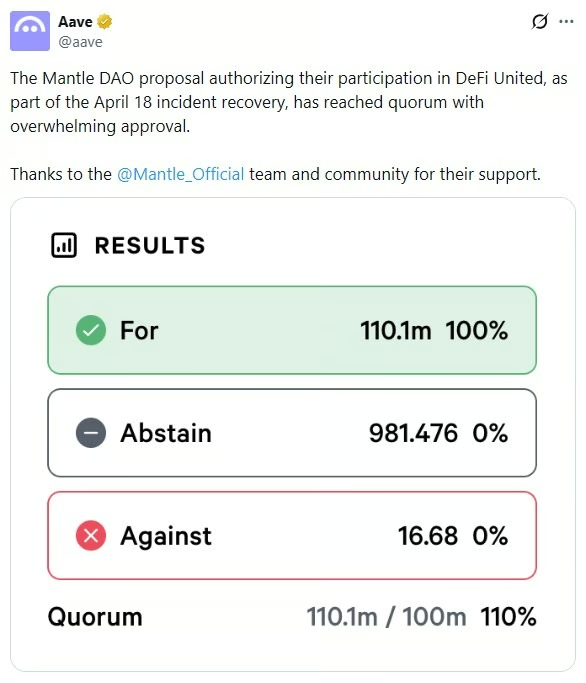
Mantle tokenholders backed a proposal authorizing a credit facility of up to 30,000 Ether (ETH), worth about $68 million, for Aave DAO, advancing remediation tied to bad debt from the April rsETH exploit.
The proposal, MIP-34, passed in a seven-day Snapshot vote that ended Friday, according to DAO governance platform Snapshot. The measure authorizes the Mantle Foundation to negotiate and execute definitive agreements with Aave DAO for a loan from the Mantle Treasury, though the facility remains subject to Aave implementing its recovery plan and the parties finalizing terms.
The credit facility is intended to help address the impact of the rsETH incident on Aave V3. The proposal said the attacker deposited 89,567 unbacked rsETH on Aave and borrowed about $190 million in WETH, wstETH and stablecoins, creating potential bad debt estimated at between $123.7 million and $230.1 million.
The vote comes as the fallout from the rsETH exploit has moved beyond the initial liquidity shock into a broader remediation phase, with Mantle positioning its treasury as a backstop while Aave works to address bad debt and restore confidence in its lending markets.

Source: Aave
Aave WETH market cools after post-exploit squeeze
The Mantle credit facility would address the shortfall that also created liquidity stress across Aave’s lending markets.
Galaxy Research said in a Thursday report that the rsETH exploit pushed Aave’s Wrapped Ether (WETH) market into a prolonged squeeze, with WETH utilization staying above 99% for 12.7 days after the incident.
“Across the full analysis horizon, WETH utilization stayed structurally elevated and close to the 100% ceiling, with an average around 99.6% and only easing to about 98.47% by the end of the snapshot period,” Galaxy said.
Related: Aave asks Arbitrum to send 30K ETH from Kelp exploiter to ‘DeFi United’
High utilization means most of the supplied asset has already been borrowed, leaving little idle liquidity available for immediate withdrawals. In Aave’s case, Galaxy said the WETH market remained strained because supply contracted faster than borrows declined, keeping utilization near full capacity even after the initial shock.

30-day WETH utilization rate chart. Source: Aavescan
The market has since cooled from the near-100% levels described in Galaxy’s analysis. Aavescan data showed Aave’s Ethereum V3 WETH market at about 91.6% utilization on Friday, with roughly 2.02 million WETH supplied and 1.85 million WETH borrowed.
Magazine: North Korea denies crypto hacks, Upbit’s bank tests Ripple: Asia Express


BlackRock has filed a comment letter with the U.S. Office of the Comptroller of the Currency, backing the agency’s proposed regulatory framework for payment stablecoin issuers under the GENIUS Act.
The world’s largest asset manager submitted seven recommendations, urging the OCC to permit broader reserve eligibility and adopt flexible compliance rules. BlackRock said the GENIUS Act framework can support real-time settlement and stronger payment system standards.
BlackRock Backs Principles-Based Framework
The OCC proposal, published on March 2, sets requirements for permitted payment stablecoin issuers (PPSIs) under the Guiding and Establishing National Innovation for U.S. Stablecoins (GENIUS) Act. It addresses reserve assets, diversification, concentration, capital, and supervisory standards.
BlackRock said it prefers the agency’s “Option A,” which pairs a principles-based approach with an optional quantitative safe harbor. That harbor carries 10% daily and 30% weekly liquidity thresholds, a 40% concentration limit, and a 20-day weighted average maturity cap.
The firm wants same-day settling government money market funds (GMMFs) counted toward the weekly liquidity floor, citing more than $6.2 trillion held in such funds. It also asked the OCC to confirm that qualifying ETFs receive equal treatment. Robert Mitchnick, BlackRock’s Head of Digital Assets, was among five executives who signed the letter.
“With the right regulatory framework in place, stablecoins can improve the payments system and drive new forms of financial utility, including real-time settlement.”
BlackRock, X
Push to Drop 20% Cap on Tokenized Reserves
BlackRock urged the OCC not to impose extra quantitative limits on tokenized forms of eligible reserves. The proposal had floated a 20% cap on tokenized assets, which the firm argues penalizes form over substance rather than risk.
The asset manager also wants U.S. Treasury Floating Rate Notes (FRNs) with up to two-year maturities added as eligible reserves. It called for separately managed accounts to remain available for professional reserve management. CEO Larry Fink has previously framed tokenization as a fresh asset class for institutional portfolios.
The framework arrives as stablecoins move further into mainstream payments use, even as BlackRock’s spot Bitcoin ETF flows have shown signs of cooling this quarter.
The comment period gives U.S. regulators a first chance to align stablecoin policy with institutional reserve standards. BlackRock’s letter signals where major asset managers want the line drawn before final rules take effect.
The post BlackRock Backs GENIUS Act Stablecoin Framework, Pushes 7 Recommendations appeared first on BeInCrypto.
Ether’s (ETH) price has retraced by over 5.6% to $2,275 after being rejected by resistance at $2,400. Now, multiple data points suggest ETH/USD may drop below $2,000.
Key takeaways:
- Low network activity signals declining usage and reduced onchain demand for ETH.
- Coinbase Premium remains negative as spot Ethereum ETF outflows returned, reflecting strong US-driven sell pressure.
- Ether’s falling wedge pattern targets $1,830.
Ether’s total value locked hits 12-month lows
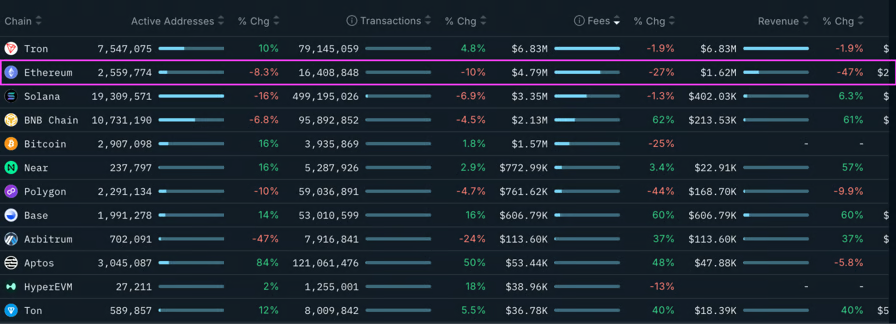
Ethereum’s network fundamentals are weakening, with weekly average transactions dropping by 10% to 4.79 million, per data from Nansen. Active addresses dropped by 8% to 2.5 million over the same period.
Related: Three reasons why Ether price rallies fizzle near $2.4K
Network fees also dropped by approximately 27%, leading to a 47% reduction in onchain revenue over the last seven days.

Blockchain comparison: Daily transactions, active addresses and network fees. Source: Nansen
Additional data from DefiLlama shows that the weekly DEX volumes dropped to $1.64 billion on May 8, a 46% drop over the last three weeks.
Low transaction count, a drop in active addresses and declining DEX volumes reflect reduced ecosystem usage. As a result, the total value locked (TVL) in Ethereum’s DeFi protocols has dropped to $124.7 billion, levels last seen in May 2025.

Total value locked on Ethereum. Source: DefiLlama
This subdued network activity signals weak user conviction, affecting Ether’s ability to sustain upside price momentum.
Ether’s exit queue jumps 72,000%
Ethereum’s unstaking queue jumped by approximately 72,000% within two weeks to 530,985 ETH on May 2.
As of Friday, over 202,000 ETH were queued for redemption, with a wait time of around three days.

Number of Ether queued for exit. Source: Validator Queue
The surge comes after a series of significant DeFi hacks, reflecting investor caution. April 2026 saw DeFi platforms suffer a record $625 million in monthly losses following 30 separate attacks, including a $292 million loss from the KelpDAO bridge hack, leading to over $15 billion in deposits withdrawn from the Aave platform.
These incidents have prompted investors to unstake ETH to regain liquidity, signaling flight from perceived risk.
“The exit queue went from ~700 ETH to ~500K ETH in 2 weeks,” analyst Pete said in a recent post on X, adding:
“DeFi yield on Ethereum is getting crushed by hacks, exploits and increasingly nasty attack surfaces.”
Despite the sharp surge in outflow pressure, 3.6 million ETH remains queued for staking entry (7x exit volume), pushing total staked ETH to 38.6 million (31.72% of supply) despite 45-day wait times.
Ether’s Coinbase Premium remains negative
The Ethereum Coinbase Premium Index, which tracks the price difference between ETH on Coinbase and Binance, has stayed negative since April 27.
A negative premium confirms that the selling pressure is originating heavily from US entities. As long as US investors are selling at a discount compared to the global market, downside momentum will likely accelerate.

Ethereum Coinbase Premium Index. Source: CryptoQuant
Additionally, US-based spot Ethereum ETFs snapped a four-day inflow streak with $103 million in net outflows on Thursday, the largest withdrawal since mid-March.

Spot Ethereum ETFs flows chart. Source: SoSoValue
Coupled with more than $81.6 million in outflows from global Ethereum investment products last week, this points to institutional selling, adding to Ether’s headwinds.
Meanwhile, ETH taker buy volume dropped to as low as -$25 million on Binance in recent days, indicating a “sharp increase in aggressive market sell orders,” CryptoQuant analyst BorisD said in a Quicktake note on Friday, adding:
“This structure raises the risk of short-term volatility and a support retest for ETH price action.”

ETH taker buy volume on Binance. Source: CryptoQuant
Ether’s rising wedge breakdown is underway
The daily chart shows the ETH/USD pair validating a rising wedge pattern after the price lost support at the pattern’s lower trend line at $2,300.
Bulls are now fighting to keep the price above $2,150-$2,200, where the 100-day and 50-week simple moving averages (SMAs) are, respectively.
Another key line of defense is the $2,000 psychological level, which, if breached, would clear the path for Ether’s drop toward the measured target of the wedge at $1,830, about 20% below the current price.

ETH/USD daily price chart. Source: Cointelegraph/TradingView
As Cointelegraph reported, the ETH price may descend to $1,750-$1,850 if support at $2,300 is not reclaimed in the short term.

- Zcash plans to launch quantum recoverable wallets within about a month.
- The system is designed to protect user funds during future cryptographic shifts.
- Full quantum-resistant security is targeted for rollout by 2027.
Zcash is preparing a major upgrade aimed at protecting users from one of the long-term risks facing modern cryptography: quantum computing.
The network is set to introduce “quantum recoverable wallets” within the next month, according to development updates shared by its core contributors at Consensus Miami on Thursday.
The broader goal is to move the protocol toward full quantum resistance by 2027.
The move comes as blockchain projects increasingly assess how future advances in quantum computing could impact existing encryption systems.
Most cryptocurrencies today rely on elliptic-curve cryptography to secure private keys.
While this system remains safe under current computing capabilities, theoretical breakthroughs in quantum computing could eventually weaken or break it.
Zcash is attempting to address that concern in stages rather than waiting for a single full replacement of its cryptographic base.
A transition layer instead of a full overhaul
The upcoming “quantum recoverable wallets” are not designed to make Zcash instantly quantum-proof. Instead, they act as a protective transition mechanism.
The idea is to give users a recovery path in a scenario where current cryptographic methods are no longer reliable in the distant future.
In simple terms, these wallets are meant to ensure that users do not permanently lose access to their funds if the underlying cryptography becomes vulnerable.
Instead of locking users into today’s encryption model, the system is being built with migration pathways that can shift funds into stronger post-quantum security systems when needed.
The rollout timeline for this first stage is relatively short, with implementation expected within approximately one month.
This places it among the earliest real deployments of quantum-aware wallet infrastructure in a major privacy-focused blockchain.
Zcash developers have framed this as a preparatory step rather than a final solution.
The architecture is being designed so that future upgrades can be layered on without forcing users to abandon their wallets or migrate manually under pressure.
Zcash is targeting to be quantum-resistant by 2027
Beyond the initial wallet release, the longer-term objective is to achieve what the team refers to as “quantum-proof” infrastructure by 2027.
This would involve integrating post-quantum cryptographic systems that are resistant to attacks from advanced quantum machines.
The timeline shows a phased approach: deploying quantum-recoverable wallets as a safety and migration layer in a month, followed by continued development of post-quantum cryptographic systems and wallet upgrades, and then a full transition to quantum-resistant security standards within the protocol set for 2027.
This approach is significant because it avoids a sudden shift in cryptographic systems, which could be disruptive for users and developers.
Instead, Zcash is building backward compatibility into its future security model.
The urgency behind this roadmap is driven by increasing attention in the cryptography and blockchain sectors to quantum risk scenarios.
While there is no operational quantum computer capable of breaking current blockchain encryption today, the pace of research has led many projects to begin preparing early rather than reacting later.
Crypto World
Recent Bitcoin Price Predictions, Shiba Inu’s Latest Achievement, and More: Bits Recap May 8

The primary cryptocurrency has experienced intense volatility over the past few days, with numerous analysts suggesting the bulls may soon regain momentum.
Meanwhile, the popular meme coin Shiba Inu hit a new record in terms of total holders, while Ethereum (ETH) is showing signs of potential weakness.
Up and Down for BTC
Bitcoin had an eventful week, with its valuation reaching nearly $83,000 on May 6, the highest level since the end of January. However, the bears intercepted the upward trajectory and suppressed the price to the current $79,800 (according to CoinGecko).
Despite the push south, many industry participants remain optimistic that the overall resurgence would continue. X user CW, for instance, noted that BTC is “rising smoothly, forming a bullish engulfing candle.
“According to candlestick pattern theory, the May candle will close with a bigger bullish candle than the April,” they added.
John Bollinger – the creator of the well-known indicator Bollinger Bands – also chipped in recently. He revealed that his fund’s “Tactica” program has opened a fresh position and is now “fully invested” in BTC after the trend model turned positive.
It is important to note that some think the bear market is far from being over. X user Chiefy described the latest revival as “the biggest Bitcoin bull trap of this cycle,” forecasting a crash to as low as $42,000.
Shiba Inu’s Record
The self-proclaimed Dogecoin killer has also taken center stage recently after its team unveiled some significant ecosystem updates. It disclosed that the total number of SHIB holders has surged by 1,100 in a single day, hitting a new all-time high of 1,585,022.
In addition, the burn rate has spiked sharply, accompanied by a noticeable rise in daily active addresses and trading volume, signaling growing network engagement.
Despite the progress, SHIB continues to struggle, and its price has fallen 53% over the past year. Moreover, it has lost its position as the second-largest meme coin, with MemeCore (M) rapidly climbing to take that spot.
Incoming Crash for ETH?
Ethereum’s price surpassed $2,400 on May 6, but that uptick was short-lived, and it now trades below $2,300. Some analysts, such as Ted, believe a further downfall could be in the cards.
He claimed that ETH has lost its “parabola,” adding that if it doesn’t soon reclaim the $2,350 level, “things could get ugly.” The whale activity reinforces the bearish scenario. According to Ali Martinez, large investors have reduced their total holdings from a peak of 15.95 million ETH in October last year to the current 12.52 million units.
This reflects weakening confidence in the asset and could trigger fear within the community, prompting smaller players to follow suit and cash out as well.
On the other hand, earlier this week, Martinez noted a formation of a so-called golden cross on ETH’s price chart, a pattern that occurred in the final days of April. This is a bullish sign that could set the stage for a potential comeback.
The post Recent Bitcoin Price Predictions, Shiba Inu’s Latest Achievement, and More: Bits Recap May 8 appeared first on CryptoPotato.

Consensus 2026 concluded its final day with a strong focus on artificial intelligence, tokenization, stablecoin infrastructure, and institutional blockchain adoption, as major crypto, fintech, and infrastructure companies unveiled new products and initiatives shaping the next phase of the digital asset industry.
The final day of the conference featured high-profile appearances, including a surprise live appearance by Changpeng Zhao, alongside keynote discussions involving Donald Trump Jr., Charles Hoskinson, and several executives focused on AI, payments, and tokenized infrastructure.
Crypto.com Expands Into Travel and Rewards Infrastructure
Crypto.com announced the launch of Crypto.com Travel, a new in-app booking platform powered by Bookit that allows eligible users to earn cashback rewards in CRO tokens on travel-related purchases.
The platform provides access to:
- hotels
- flights
- cruises
- car rentals
- entertainment experiences
The initiative represents a continued push toward integrating crypto rewards and digital assets into mainstream consumer services and real-world spending.
Midnight Foundation Introduces “Collateral Warehouse” Concept
Midnight Foundation also revealed plans for a new “Midnight Collateral Warehouse,” an open-source infrastructure model designed to help institutions manage and mobilize collateral across both traditional finance and blockchain networks.
According to the project, the system aims to improve institutional collateral management while maintaining financial privacy and interoperability between multiple financial environments.
The initiative reflects growing institutional interest in tokenized financial infrastructure and programmable settlement systems.
AI and Blockchain Convergence Accelerates
Several announcements throughout the day highlighted the rapidly growing intersection between blockchain infrastructure and artificial intelligence.
BioMatrix introduced what it describes as a “Human Participation Network” designed to connect real users with AI-generated content, tasks, and economic opportunities.
Meanwhile, Inveniam Capital Partners announced the launch of NVNM Chain, a Layer 2 blockchain designed specifically to provide verifiable records and attestation systems for AI agents.
The platform aims to help enterprises and regulators verify:
- source data
- AI decision-making processes
- accountability structures
- compliance records
as AI systems become increasingly integrated into finance and enterprise operations.
Healthcare Infrastructure Tokenization Gains Attention
Healthcare tokenization also emerged as a major topic during the final day of Consensus.
Medimint announced a blockchain platform designed to tokenize healthcare infrastructure assets, including:
- medical equipment
- hospital infrastructure
- diagnostic facilities
The company says the platform could enable fractional ownership and broader access to healthcare infrastructure investment opportunities.
The concept reflects the growing expansion of real-world asset tokenization beyond traditional sectors such as real estate and private credit.
Consensus 2026 Reflects Industry Shift Toward Real-World Infrastructure
Across all three days of Consensus Miami, one of the clearest themes was the industry’s continued shift away from speculative narratives toward infrastructure, payments, enterprise adoption, AI integration, and tokenized real-world systems.
Topics dominating discussions throughout the event included:
- stablecoins
- AI infrastructure
- tokenized assets
- payments
- enterprise blockchain adoption
- institutional settlement systems
- real-world utility
As the conference concluded, many of the announcements reflected a broader effort across the crypto industry to position blockchain technology as foundational infrastructure for finance, commerce, energy, healthcare, and AI-driven systems rather than purely speculative markets.

Key Highlights
- Datadog achieved a historic milestone with over $1 billion in quarterly revenue for Q1 2026, representing revenue expansion exceeding 32% and surpassing analyst projections by more than 500 basis points.
- Shares of DDOG rocketed approximately 30% during premarket hours following the May 7, 2026 earnings announcement.
- Management elevated both second-quarter and full-year projections, highlighting robust operational momentum and accelerating agentic AI adoption.
- The firm secured FedRAMP High authorization, unlocking access to expanded government contracting opportunities.
- Wall Street analysts maintain measured bullishness, with updated price targets positioning DDOG beyond $200, suggesting possible record highs ahead.
The exceptional Q1 2026 performance from Datadog has effectively challenged the recent bearish narrative that drove shares to extended lows. DDOG had suffered significant pressure as market participants worried artificial intelligence would erode traditional SaaS business models. Thursday morning’s results painted a dramatically different picture.
The monitoring and analytics specialist posted revenue expansion exceeding 32%, demolishing Wall Street expectations by over 500 basis points while crossing the billion-dollar quarterly threshold for the first time in company history. Premarket trading showed shares surging approximately 30% following the announcement.
Profitability metrics proved equally impressive. Adjusted operating income climbed 34%, while GAAP net income more than doubled year-over-year. Adjusted earnings crushed consensus forecasts by over 1,750 basis points.
Executives didn’t merely celebrate a strong quarter—they upgraded forward guidance across both the upcoming quarter and full fiscal year, attributing the optimism to sustained business strength and emerging agentic AI deployment trends.
Revenue Growth Catalysts
Expansion across the customer base proved instrumental, with the company’s largest accounts growing by 21%. Enhanced service adoption rates and fresh product introductions—particularly around artificial intelligence and data center monitoring capabilities—provided additional momentum.
Datadog’s core platform enables organizations to observe and evaluate their technology infrastructure with real-time precision. As artificial intelligence workloads expand, this functionality becomes increasingly critical rather than obsolete.
The FedRAMP High certification represents one of the most rigorous security standards for cloud service providers working with federal agencies. This designation positions Datadog to pursue substantially more government business while simultaneously validating its security posture for enterprise clients.
The balance sheet reflects financial strength with $4.8 billion in cash and liquid assets, while shareholder equity stands at nearly twice total liabilities. Leadership indicated this financial positioning could enable capital return programs within several years.
Insider transaction activity has drawn attention, with approximately $109.1 million in stock sales recorded over the previous three months against zero reported purchases. This dynamic remains a consideration for investors weighing the otherwise positive fundamental outlook.
Wall Street’s Response
Financial analysts greeted the quarterly results with tempered enthusiasm. Multiple firms highlighted the exceptional revenue performance and upgraded forecasts as significant positive indicators.
Current consensus price targets place DDOG near the upper boundary of its established trading corridor, though recent revisions are pressing above the $200 threshold—territory that would mark new all-time peaks.
Institutional investors control approximately 80% of outstanding shares and have been net distributors over the trailing twelve months. Following a 30% single-session advance, some portfolio rebalancing appears likely.
The valuation reflects a P/E multiple of 608x, illustrating the substantial future expansion investors are currently pricing into shares. DDOG carries a GF Score of 84 out of 100, featuring a maximum 10/10 growth ranking offset by a 4/10 profitability assessment.
Market observers have suggested that a decisive move to record highs could transform technical resistance into support, potentially establishing a baseline projection around $220 over the coming 12 to 18 months.

Fundamental Background
The structural deficit in the silver market has now persisted for a sixth consecutive year. According to forecasts by the Silver Institute, the gap between supply and demand in 2026 is expected to reach 67 million ounces, forcing the market to rely on accumulated reserves. However, the demand picture remains uneven.
Industrial consumption continues to decline, primarily due to the photovoltaic sector, where solar panel manufacturers are actively reducing the amount of silver used per cell in response to elevated prices. Against this backdrop, investment demand remains resilient: global ETP holdings have reached approximately 1.31 billion ounces, while silver lease rates in London have climbed to record highs amid a growing physical shortage.
Technical Picture
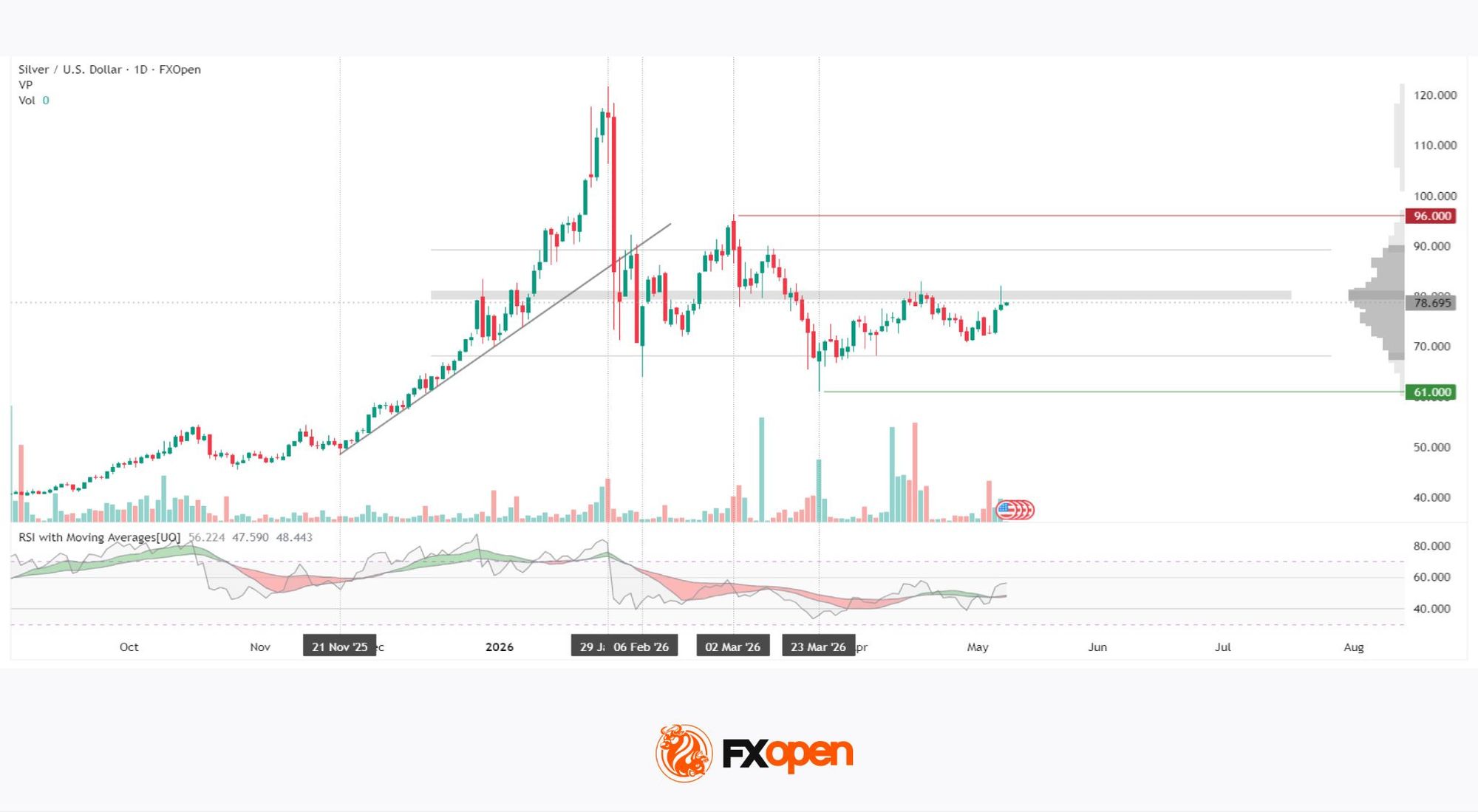
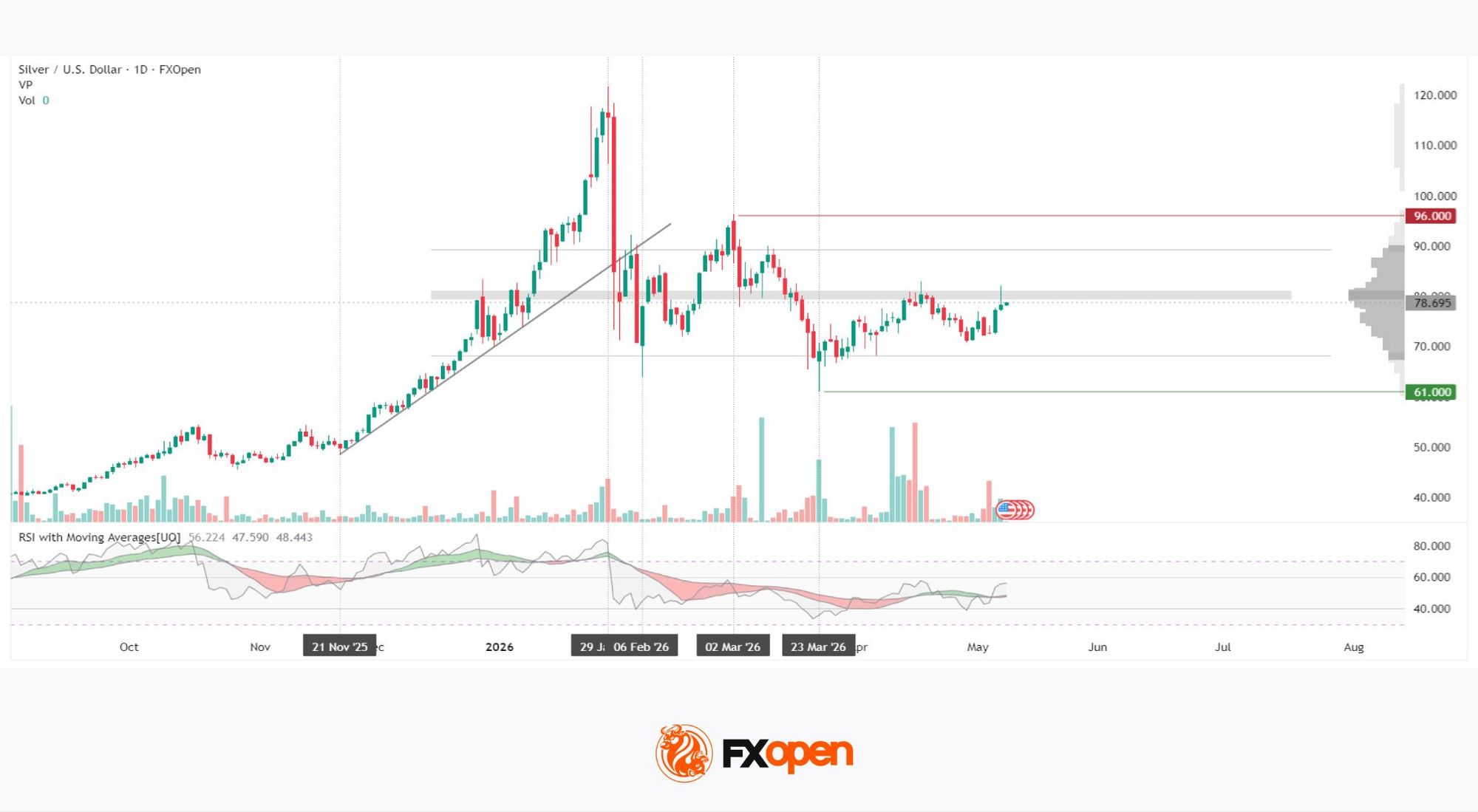
On the daily chart of XAG/USD, a two-phase structure is visible. From 21 November 2025, the instrument formed a strong upward impulse along an ascending trend line, reaching a peak on 29 January 2026. This was followed by a sharp collapse and a break below the trend line, with the low recorded on 6 February near the 64 level. A rebound then followed, and on 2 March a local recovery high was established — this area now corresponds to resistance around 96. A retest of the lows took place on 23 March 2026.
The horizontal volume profile spans the 68.300–89.000 range, with the point of control (POC) concentrated between 79.100 and 81.000. The price is currently trading below the lower boundary of this zone and remains under selling pressure. The nearest support lies at 68.300, followed by stronger support at 61.000, corresponding to the February crash low.
The RSI + MAs indicator shows readings of 55, 47 and 47. RSI remains above both moving averages; however, all indicators are within neutral territory, with no strong directional momentum currently visible.
Key Takeaways
The silver market continues to be influenced by two opposing fundamental forces: a structural supply deficit supported by investment demand, and weakening industrial consumption from the photovoltaic sector. The resolution of this imbalance is likely to determine the future direction and character of the market.
Start trading commodity CFDs with tight spreads (additional fees may apply). Open your trading account now or learn more about trading commodity CFDs with FXOpen.
This article represents the opinion of the Companies operating under the FXOpen brand only. It is not to be construed as an offer, solicitation, or recommendation with respect to products and services provided by the Companies operating under the FXOpen brand, nor is it to be considered financial advice.
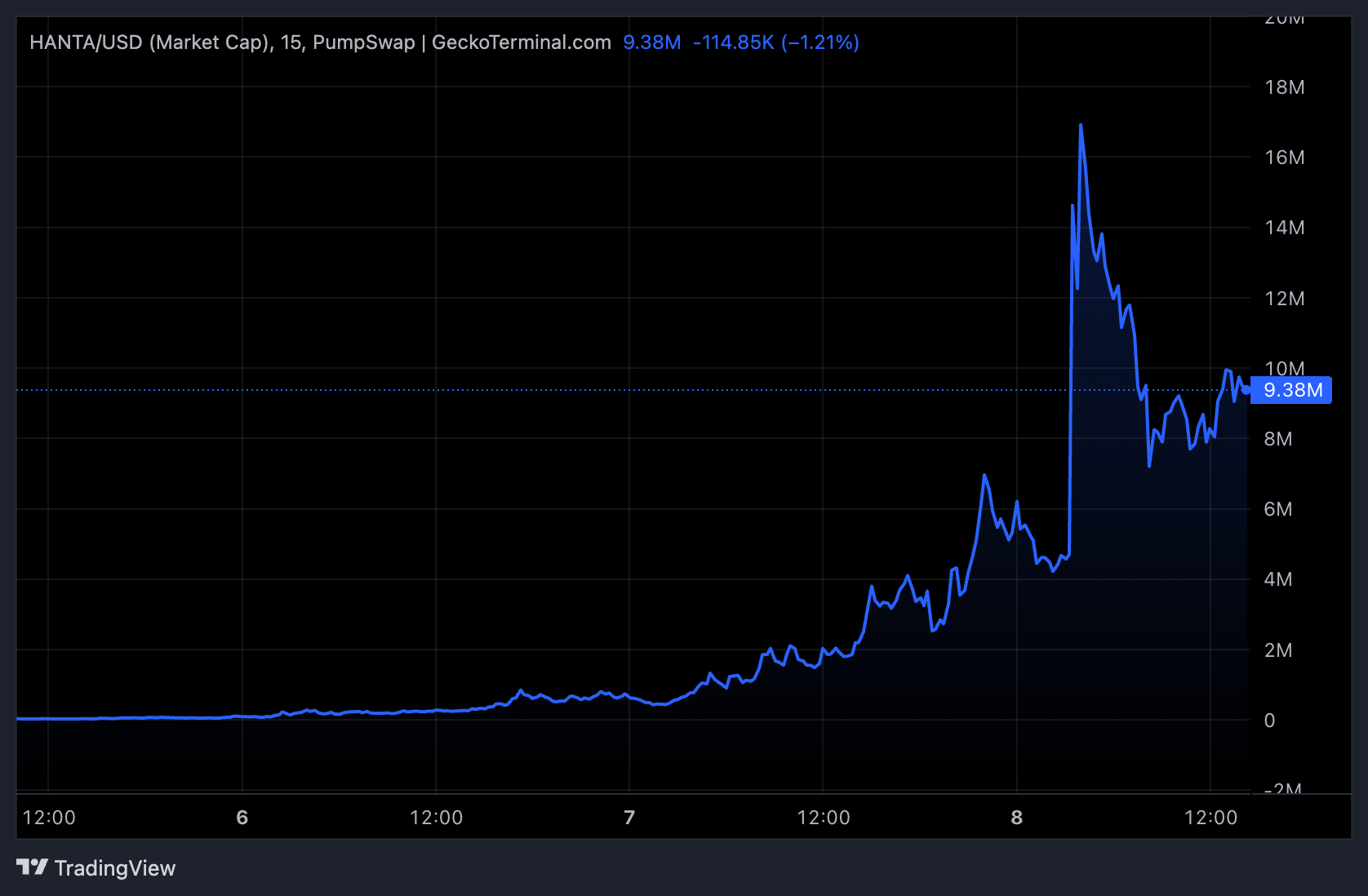
Hantavirus-themed tokens posted triple-digit gains on Friday, with the leading Hantavirus (HANTA) token surging 315.69% over 24 hours.
The rally tracks an MV Hondius cruise ship outbreak that has produced three deaths and five confirmed cases, pushing traders toward speculative tokens tied to the unfolding health story.
Follow us on X to get the latest news as it happens
Hantavirus Outbreak Sparks Meme Coin Trading Frenzy
The HANTA token (2tXpgu…7hzs9y) was launched in early May. Its market cap surged to a record high above $18 million today before adjusting to $9.38 million. Solscan data showed the token’s holder base jumping from 2,640 to 17,589 within a single day.

The rally extended across more than half a dozen similar issuances. A separate HANTA token rose 251% to a market cap of $193,190. A Hanta-Kun variant climbed 261.87%, while two Hantavirus listings on Meteora DAMM V2 added 399% and 246%.

It is important to exercise caution with speculative tokens. History shows hype-linked meme coins are likely to collapse sharply once attention shifts, leaving late buyers exposed to steep drawdowns.
Meme Coin Playbook Repeats
The launch of meme tokens around viral news events is a recurring pattern. A wave of Dogefather tokens followed an Elon Musk post on X in February 2025.
Some launches have drawn sharp criticism. Tokens tied to the killings of activist Charlie Kirk and Iryna Zarutska were branded “despicable” by traders who accused creators of exploiting human grief.
Meanwhile, comparisons with the 2020 pandemic have surfaced. However, the WHO noted that while more Hantavirus cases are likely, a COVID-19-level pandemic remains improbable, citing no evidence of a broad transmission risk.
Subscribe to our YouTube channel to watch leaders and journalists provide expert insights
The post Hantavirus Meme Coins Rally as Outbreak Headlines Drive Speculation appeared first on BeInCrypto.

Ethereum just fall below $2,300, and Fundstrat’s Tom Lee called it cheap, making news publicly, on stage, with a $22,000 price target attached. Speaking at the Consensus conference in Miami, Lee laid out a data-driven case for a 7x rally driven by tokenization, agentic AI, and institutional supply absorption that is already tightening the float.
— BMNR Bullz (@BMNRBullz) May 7, 2026
TOM LEE: “ETHEREUM’S CHEAP.”
At $2,300,
ETH is trading well below where the math says it should be. If $BTC hits $250K fair value, the ETH/BTC ratio puts ETH at $22,000. Long-term avg ratio: 0.048 2021 high ratio: 0.087 Implied ETH: $22K Crypto spring = ETH lags… pic.twitter.com/ucvnJy2MWG
Lee anchored it to Ethereum’s historical ETH/BTC ratio of 0.048, which spiked to 0.087 during the 2021 bull cycle, applied against his $250,000 Bitcoin fair value projection. The math lands at $22,000, and that’s his base case. Lee had already declared crypto spring earlier this month, and his Consensus appearance doubles down on that conviction with hard numbers.
Discover: The best pre-launch token sales
Forget the News, $22,000 Ethereum is Not A Pipe Dream
Ethereum has spent nearly five years consolidating after its last major rally, a historically long compression window. On-chain data shows ETH held on exchanges has dropped to multi-year lows, with a significant portion locked in staking contracts or deployed as DeFi collateral. When demand spikes against a supply this thin, price moves fast.
Current resistance sits just above $2,400. A clean break and weekly close above that level opens a path toward $3,200, the next meaningful structural zone. But a close below $2,100 reopens the $1,900 support shelf and delays the thesis materially.
Lee’s on-chain data read is frankly striking. BitMine, which Lee chairs, now controls more than 4% of Ethereum’s circulating supply and stakes roughly 85% of those holdings, generating over $300 million in annualized staking revenue.
“Ethereum is a scarce settlement layer,” Lee said. “It has never had downtime.”
The tokenization narrative underpins the longer-range targets. Tokenized real-world assets on Ethereum have already crossed $8 billion in U.S. Treasuries alone, and Lee cited industry projections that put the total addressable market for tokenized assets in the hundreds of trillions of dollars.
Stablecoin transaction volumes have already surpassed Visa payment volumes, a milestone Lee flagged as proof that blockchain finance is no longer a thesis, it’s infrastructure.

Beyond $22,000, Lee outlined two higher-conviction scenarios: $62,000 if the ETH/BTC ratio reaches 0.25, and $250,000 in a full tokenization-dominance scenario where Ethereum captures the majority of global settlement volume.
Those above numbers are long-duration bets, but the $22,000 base case has a defined trigger. Bitcoin closing above $90,000 and sustaining that level would, in Lee’s framing, confirm the cycle is on.
Discover: The best crypto to diversify your portfolio with
The post Ethereum News: Tom Lee Sets $22,000 Ethereum Target appeared first on Cryptonews.
Mantle Tokenholders Back Aave Credit Facility After rsETH Exploit

A Year After Trump’s Scolding, It Turns Out Zelenskyy Has All Kinds Of Cards

Brewers’ rejuvenated offense takes aim at Max Fried, Yankees

Manchester United reach agreement with Casemiro over contract clause amid transfer speculation

US brings back mandatory military draft registration

Steven Gerrard disagrees with Gary Neville over ‘shock’ Chelsea and Arsenal claim | Football


-

 NewsBeat5 days ago
Channel 5 – All Creatures Great and Small series 7 new post
-

 Crypto World1 day ago
Upbit adds B3 Korean won pair as Base token gains Korea access
-
 NewsBeat1 day ago
NCP car park operator enters administration putting 340 UK sites at risk of closure
-
 Crypto World3 hours ago
HarrisX Poll Found 52% of Registered Voters Support the CLARITY Act
-
 Tech7 days ago
Trump’s 25% EU auto tariff breaches Turnberry Agreement that also covers semiconductors and digital trade
-
 Sports7 days ago
Paul Scholes issues Marcus Rashford reality check as agreement emerges over Man United star
-

 Entertainment7 days ago
Met Gala 2026 Rumored Guest List Is Turning Heads
-
Entertainment7 days ago
New on Prime Video in May 2026 — Full List of Movies and Shows
-

 Entertainment7 days ago
Kylie Jenner Hit With Second Lawsuit From Ex-Housekeeper
-

 Tech4 days ago
Image AI models now drive app growth, beating chatbot upgrades
-

 Sports7 days ago
Cavaliers vs. Raptors Game 6 live score, updates, highlights from 2026 NBA playoffs first-round series
-
 Sports6 days ago
David Benavidez responds to team Canelo saying the fight will never happen
-
Entertainment6 days ago
New Netflix Movies in May 2026 — My Top 3 Picks to Stream
-

 Entertainment5 days ago
Melissa Joan Hart and More Stars Attend 2026 Kentucky Derby
-
 Sports6 days ago
IPL 2026: ‘Love you darling’- Hardik Pandya’s reaction to MS Dhoni steals the show |Watch | Cricket News
-

 Entertainment6 days ago
Young and the Restless Next Week: Cane Arrested & Matt’s Deadly New Scheme!
-

 Tech7 days ago
Mother’s Day 2026 Gift Guide: Audio to Upgrade Mom’s Lifestyle
-
 Crypto World6 days ago
Pi Network Mandates Protocol 23 Upgrade for All Mainnet Nodes Before May 15 Deadline
-

 Business5 days ago
Luka Doncic Injury Update: Doncic’s Hamstring Recovery Slows Lakers’ Hopes Against Thunder: Can He Run Yet?
-

 Business6 days ago
Can Victor Wembanyama Bring the NBA Ring to Spurs in 2026? Historic Playoff Run Fuels Title Dreams
You must be logged in to post a comment Login