

Crypto World
CLARITY Act timeline: the two-month window, mapped



Crypto’s market structure bill cleared committee with votes to spare and a calendar working against it.
Summary
- The CLARITY Act cleared the Senate Banking Committee 15-9, but floor support still depends on unresolved disputes.
- The bill must merge Banking and Agriculture Committee text before any Senate floor vote can begin.
- Conflict-of-interest language, stablecoin yield rules, illicit finance provisions, and floor time remain the key risks.
- A pre-recess passage is possible but difficult, while a fall slip remains the most likely scenario.
Eleven months after the House passed it and one year after the GENIUS Act proved Congress could legislate on crypto at all, the Digital Asset Market Clarity Act stands closer to law than any market structure bill in American history, and closer to a familiar death. On May 14, 2026, the Senate Banking Committee advanced the bill by a vote of 15 to 9, with all thirteen Republicans joined by two Democrats. The crypto industry celebrated for roughly a day before the second half of the sentence sank in: both Democratic votes came with explicit warnings that committee support did not guarantee floor support, the bill still has to merge with a separate committee’s text, and the Senate calendar between now and the August recess is a traffic jam of expiring deadlines that have nothing to do with crypto.
The bill’s own advocates now describe the window in weeks. Negotiators have said the remaining disputes must be settled if the Senate is to have a chance of passing the bill in the next two months, a framing that puts the decisive period between mid-June and the recess. What follows is a map of that window: how the bill got here, what is actually in it, the procedural steps remaining, the disputes that could still kill it, the calendar it competes against, and the probability tree at the end.
How the bill reached this point
Legislative history matters here because it explains both the momentum and the fragility. The House passed its CLARITY Act in July 2025 with a bipartisan margin, handing the Senate a finished framework for dividing crypto oversight between the SEC and the CFTC. The Senate, as the Senate does, declined to take the House text and began building its own. Senators Tim Scott and Cynthia Lummis released a discussion draft in July 2025; the Banking Committee followed with a 182-page draft of its Responsible Financial Innovation Act in September; twelve Senate Democrats published their own framework days later, staking out the minority’s price.
January 2026 brought a 278-page draft with the first version of the stablecoin yield prohibition, and the Agriculture Committee, which owns the CFTC’s jurisdiction, published its companion Digital Commodity Intermediaries Act the same month. Decisive text landed on May 12: a 309-page bill containing the compromises that made the markup vote possible. Two days later the committee advanced it. The names have blurred along the way, CLARITY in the House, RFIA in Senate drafts, but correspondents covering the process have been explicit that these are the same legislation wearing different titles, and this piece uses CLARITY throughout.
One more piece of history shapes everything: the GENIUS Act precedent. Stablecoin legislation passed in July 2025 by assembling roughly the same coalition this bill needs, proving the votes exist for crypto law when the irritants are sanded off. Every actor in the current fight is consciously replaying that playbook, and every dispute below is, at bottom, an argument about which irritants must be sanded and which are load-bearing.
One refinement to that history changed the bill’s internal politics and belongs on its own line. The September 2025 Democratic framework was not an obstruction document; it was a price list, and the majority has spent eight months paying it line by line, from illicit finance to insolvency protections. Reading the bill’s drafts in sequence is watching a negotiation conducted through legislative text, with each new version longer than the last because each one bought votes with pages. The 309-page May text is 127 pages heavier than September’s draft, and nearly all the added weight is purchased consensus.
What is actually in the 309 pages
The May 12 text repays a closer read, because several of its provisions have received almost no coverage relative to their consequences. At the bill’s core remains the jurisdictional settlement: a framework deciding which digital assets fall to the CFTC as commodities, which remain securities under the SEC, and how assets move between categories as their networks decentralize. Around that core, the May text added four things. A compromise on stablecoin yield prohibits platforms from paying interest on idle stablecoin balances while permitting activity-linked rewards, language the banking lobby immediately attacked as inadequate.
The American Bankers Association argued the text fails to stop interest-like rewards in practice. A framework for DeFi trading protocols appears for the first time, sketching how decentralized front ends and protocols fit a regime built for intermediaries. An insolvency safe harbor for digital commodity transactions addresses the FTX-shaped hole in bankruptcy law, clarifying customer claims when a platform fails. A strengthened illicit finance section answers the issue Democrats have pressed hardest from the beginning.
What the text pointedly does not contain is the provision everyone is arguing about. The conflict-of-interest section restraining government officials from profiting on crypto sits outside the Banking Committee’s jurisdiction and must enter the bill later in the process. That absence is not an oversight; it is a deferred fight, and it is large enough to merit its own treatment. For the purposes of the map, it is the bill’s single most dangerous open item.
The GENIUS playbook, step by step
Because everyone in the building is consciously rerunning the stablecoin play, the play itself bears study, both for what transfers and for what does not. GENIUS succeeded on a specific sequence. The bill survived an early failed procedural vote that forced negotiators back to the table, paid the minority’s price in consumer protection and anti-evasion language through weeks of painful redrafting, picked up a bloc of Democratic votes large enough to clear cloture comfortably, and reached the President’s desk in July 2025 as the first major crypto statute in American history.
Three features of that run mattered most: the subject was narrow enough that the irritants could be enumerated and paid one by one, the industry coalition stayed unified behind a single text instead of fragmenting across preferences, and the ethics fight never fully attached. A stablecoin bill could be framed as plumbing rather than as a referendum on anyone’s portfolio. Map those features onto CLARITY and the transfer is two out of three. The irritant-payment machinery is working, as the May 12 compromises show, and the industry coalition has held.
What does not transfer is the third feature, and its absence is the whole story of the current stall. A market structure bill that decides the legal status of assets the President’s orbit holds cannot be framed as plumbing, which is why the ethics question attached to this bill and not the last one. The GENIUS playbook, faithfully executed, carries CLARITY to the doorstep of the same coalition and leaves it standing there. It is waiting on the one fight the playbook never had to win.
The vote math, read closely
Fifteen to nine sounds comfortable. The Senate floor arithmetic is anything but, and reading the committee vote correctly is the difference between optimism and analysis. Sixty votes are needed to clear a filibuster, which means roughly seven Democrats beyond unified Republican support. The two committee Democrats who voted yes attached the same caveat publicly: their support on the floor depends on further progress on outstanding issues.
Their votes are best read as an option, not a commitment, purchased by the majority with the May 12 compromises and exercisable only if the remaining disputes resolve. The September 2025 framework from twelve Senate Democrats remains the best guide to the minority’s full asking price: illicit finance enforcement with teeth, consumer protections, and the ethics provision. The illicit finance question has progressed furthest, with industry groups now running events aimed at law enforcement audiences to argue the bill strengthens rather than weakens their tools. That campaign’s existence tells you the votes it targets are not yet secured.
Two structural facts help the bill’s chances. Crypto market structure polls as bipartisan in a way most of this Congress’s agenda does not, and the GENIUS coalition exists as a proof of concept with most of the same members. Two structural facts hurt it. Election-year floor time is the scarcest commodity in Washington, and any single senator determined to extract a price can burn days the bill does not have.
What the agencies do while Congress decides
The window matters more because of what fills the vacuum if it closes, and the past year offers the preview. In the absence of statute, crypto’s legal status in America is being set by agency posture, and posture is reversible. The SEC of this administration has settled or dropped the enforcement docket of the last one, blessed waves of spot products, and governs by exemption and inaction. The CFTC claims digital commodities it has limited statutory tools to police, and the banking regulators have opened the charter gates, as the trust bank approvals of the past year show.
Markets have priced this regime as if it were permanent, and it is one election from review. That is the deep stake in the CLARITY window that day-to-day coverage misses: the bill does not create the current friendly environment, which already exists, but it is the only instrument that can make any part of it survive a change of administration. A vacuum filled by posture serves the industry right up until the posture changes. Everyone negotiating this summer knows which years the next posture would be set in.
The same logic explains why some sophisticated industry actors quietly prefer a slipped bill to a weakened one. Statute is forever, or close to it; a CLARITY Act passed with hollow definitions or a poisoned amendment would lock in flaws that posture could otherwise have papered over. The window is real, but it is a window for the right bill. The actors who remember how long securities law lasts are negotiating accordingly.
The merge nobody is watching
Before any floor vote, a procedural step with real substance has to happen: the Banking Committee’s text must be unified with the Agriculture Committee’s CFTC provisions into a single package. The two committees split crypto the way Congress splits everything, by agency, with Banking owning the SEC and illicit finance pieces and Agriculture owning the digital commodity regime that the CFTC would run. Merges of this kind are where quiet drafting fights happen, because the seam between the two texts is exactly the seam between the two agencies. Every definitional choice at that seam moves real assets between regulators.
The Agriculture side has been the less contentious throughout, with its January draft attracting bipartisan participation, but the merge consumes time even when it goes well. The floor process cannot formally begin until the unified text exists. Anyone handicapping the window should treat the merge as a two-to-four week tax on the calendar before the procedural clock even starts. That tax matters because the bill is already running against a crowded pre-recess schedule.
The calendar war
Now the traffic jam. The Senate’s pre-recess window must also accommodate, at minimum, a Foreign Intelligence Surveillance Act renewal carrying a hard deadline this month, a fight that has gone badly enough to consume extra floor time and that crypto has managed to entangle itself in through an attempted ban on central bank digital currencies inserted into the surveillance negotiations. A major housing package is competing for the same weeks, with leadership attention attached. Appropriations season looms behind both, with last autumn’s 43-day government shutdown still fresh as the example of what happens to every secondary priority when funding fights consume the chamber.
Every one of these items outranks a regulatory framework bill in deadline pressure, because none of crypto’s problems explodes on a date certain, and the Senate triages by explosion. Procedural math compounds the squeeze. A bill of this size needs floor time measured in days even with cooperation: a motion to proceed, debate, an amendment process that leadership must either open, inviting hostile amendments on ethics and consumer issues, or close, angering the very Democrats whose votes are needed, and final passage. Then the House must act on whatever the Senate produces, either swallowing the Senate text whole or forcing a conference that pushes everything past the recess.
The two-month window, examined closely, is more like four to five weeks of plausible floor access, shared with everything else. That is why the committee vote, while real progress, is only the beginning of the time problem. The bill must not merely have support; it must have support at exactly the moment floor time is available. In the Senate, those are different things.
The pressure campaign
Around the formal process, the influence machinery is running at full capacity, and its shape says a great deal about where the bill’s sponsors think the risk sits. The Blockchain Association staged an online town hall in early June aimed explicitly at law enforcement audiences, with Senator Lummis among those assuring police and prosecutors that the bill provides tough crypto powers. Industry groups do not spend June persuading constituencies they have already won, which locates the live anxiety precisely: the bad-actor and illicit finance provisions remain the gating issue for the Democratic votes that matter. On the other flank, the banking lobby keeps pressure on the yield compromise.
The banking lobby keeps pressure on the yield compromise, with the ABA urging senators to close what it calls a loophole letting exchanges pay interest-like rewards, an argument that doubles as a wedge to slow the bill if it cannot reshape it. Above the whole field hangs the White House, which has signaled it will accept broad ethics rules and reject anything reading as targeted at the President. That position simultaneously keeps the bill alive and keeps its hardest problem unsolved. The pressure campaign is therefore not noise around the bill; it is a map of which votes are still in play.
The House problem at the far end
Even a Senate triumph leaves one more chamber, and the endgame mechanics there belong on any complete map. The House passed its CLARITY in July 2025; the Senate product, after a year of drafting, differs from it in scope and detail. The yield compromise, DeFi framework, and insolvency provisions did not exist in the House text. When the Senate passes a different bill, the House faces the standard choice: swallow the Senate version whole and send it to the President, or insist on its own and force a conference that consumes months the calendar no longer contains.
The political gravity strongly favors swallowing, since the House’s crypto majority wants a law more than it wants authorship, and leadership on both sides has signaled flexibility. But the choice belongs to House leadership at a moment, late summer or fall, when every floor day is contested. The bill’s opponents understand that a conference demand is the cheapest possible way to run out the clock while voting yes on everything. The practical upshot for the map is to add two to six weeks to any Senate passage scenario before a signing ceremony, with the short end requiring the House to accept the Senate text unamended.
The probability map
Handicapping legislation invites false precision, so the honest format is scenarios with reasoning instead of decimal points. A pass-before-recess outcome requires nearly everything to break right: the merge finishing this month, the illicit finance language closing the last Democratic holdouts, an ethics compromise that survives Gillibrand’s red line and the White House’s, and leadership choosing to spend a week of jammed floor time on a bill with no deadline. Each is individually plausible. Their conjunction inside five weeks is demanding, and the FISA fight has already shown this Senate’s tendency to let deadline items eat the calendar.
The slip scenario is the modal outcome: the bill misses the recess with momentum intact and returns in the fall, where it collides with appropriations and an intensifying election season. Fall passage of bipartisan economic legislation has precedent, and the GENIUS coalition proved durable across similar delays, but every month closer to the election raises the cost of any Democrat handing the administration a signing ceremony. The ethics fight gets harder in election light, not easier. Death requires no dramatic event, only the continuation of stalemate on the conflict-of-interest section until the clock runs out, sending the whole effort into the next Congress to restart from drafts.
A reasonable distribution across the three, given everything above: the slip is more likely than the other two combined, the pre-recess pass is a real but minority chance, and death by calendar is the tail that grows with every week the ethics section stays unwritten. Readers should weight the map by one rule of thumb that has governed this bill all year. Progress has come exactly as fast as the Democratic asks have been paid, and no faster. That remains the best shorthand for the next two months.
What each scenario does to which assets
A map for traders should end with exposure, because the three scenarios do not price evenly across the asset class, and the differences are tradable. Bitcoin is the least exposed asset in every branch. Its commodity status is the one classification nobody disputes, its ETFs exist regardless, and its price has spent the year trading macro rather than legislation; CLARITY’s fate moves it least. The large non-Bitcoin majors sit at the other extreme, because the ancillary asset framework is, functionally, a law about them.
Tokens like XRP, SOL, and ADA gain a permanent statutory home in the passage scenarios and return to litigation-and-posture limbo in the death scenario, with everything that implies for exchange listings, institutional mandates, and the ETF pipeline behind the first wave. The middle of the market, DeFi tokens, gains something new in the May text and therefore has the most asymmetric exposure of all. The DeFi framework exists in no current law, so for that cohort the difference between passage and death is the difference between a defined regime and none. Stablecoins, oddly, are the calmest corner, since GENIUS already governs them, but the yield compromise inside CLARITY adjusts their competitive economics at the margin.
The bank lobby’s continued assault on that language is worth watching as a tell: the ABA fights hardest over provisions it expects to become law. Position accordingly, and date every position, because each checkpoint on this map has a window attached. The windows are the trade. For majors outside Bitcoin, the bill is not merely a policy story; it is a market-access story.
What to watch, in order
All of it reduces to a short checklist with dates attached. Watch for the unified Banking-Agriculture text, the precondition for everything, expected if the process is alive in the coming weeks. Watch the FISA endgame, because its resolution releases or consumes the floor time the bill needs. Watch for movement on the conflict-of-interest language, the single highest-information signal in the whole process; any reported framework there upgrades every scenario at once.
Watch the named Democratic holdouts on illicit finance, whose public statements will move before their votes do. Watch the recess date itself, the bright line that converts the slip scenario from possibility to fact. For crypto markets, the practical guidance is to trade the checkpoints, not the chatter. The committee vote was real progress and was priced as such; the next genuine repricing events are the merged text, an ethics deal, and cloture, in that order.
Everything between them is noise with a press release attached, and this summer will produce more press releases per week of actual progress than any stretch of the bill’s life so far. Keep the map open and the checkpoints marked. The CLARITY Act has a two-month window, but the window is not one thing. It is a sequence of gates, and the bill must pass through every one before the calendar closes.
As of June 11, 2026. Legislative status changes weekly; verify the current state of play before relying on this map. This article is information, not investment advice.


TLDR:
- LG Electronics is piloting an onchain ad network on Arbitrum to record verifiable delivery data.
- The pilot ran in Japan with Hakuhodo, testing real-user engagement and operational performance live.
- WARC projects global ad spend at $1.3 trillion in 2026, raising pressure for provable performance.
- LG targets fraud, tightening privacy rules, and falling engagement as the three core ad problems.
LG Electronics is testing an onchain advertising network built on the Arbitrum blockchain. Developed by the company’s Blockchain Research Lab, the pilot runs in Japan alongside advertising firm Hakuhodo.
The project records ad delivery data in a verifiable, tamper-resistant format. It targets three persistent problems in digital advertising: fraud, privacy, and declining engagement. Results from the live trial are currently under evaluation.
LG Electronics and Arbitrum Take On Digital Ad Fraud
LG Electronics Arbitrum pilot addresses one of digital advertising’s most enduring problems. The industry measures impressions, clicks, and conversions inside closed systems.
Settlement arrives weeks later through processes neither advertiser nor publisher can inspect. Disputes ultimately come down to contracts and third-party audits rather than shared evidence.
WARC forecasts global advertising spend at $1.3 trillion in 2026. At that scale, the gap between reported performance and provable performance shapes where budgets flow.
LG’s Blockchain Research Lab designed its system to record ad delivery as evidence — who served an advertisement, when, and how.
The lab identified fraud as one core pressure point. Advertising is bought and sold automatically at high volume. Bot-generated traffic blends with genuine performance and gets counted the same way.
The onchain system makes that data difficult to alter after the fact, creating a record both sides can reference.
Samuel Byungsun Park, Blockchain Research Department Leader at LG Electronics, described the project’s dual focus.
“We are exploring how blockchain technology can help improve transparency in advertising workflows while supporting a privacy-conscious approach to consumer data,” Park said.
“We are also evaluating whether this approach can deliver meaningful value to advertisers, publishers, and audiences.”
The third factor driving the pilot is audience engagement. Ad volume keeps rising while response rates fall. Performance metrics explain less on their own.
The Japan trial with Hakuhodo put the system in front of real users to assess whether interacting with the advertising felt natural and whether the operational model held together under live conditions.
Programmable Infrastructure Shapes the Advertising Market
The case for public blockchain infrastructure in advertising comes down to ownership of the scoreboard. If the layer that proves performance belongs to one participant, every number it produces carries that participant’s interests. A measurement system controlled by one of the teams convinces no one on the other side.
Arbitrum’s role in the pilot reflects that logic. LG’s Blockchain Research Lab can configure the execution environment, fee structure, and governance to match its objectives.
At the same time, the network runs on public infrastructure that no single company controls. Steven Goldfeder, Co-Founder and CEO of Offchain Labs, connected that structure to the broader market shift.
“Advertising has long been measured by how many impressions are served. The industry is shifting toward verifiable performance and blockchain is the architecture built for it,” Goldfeder said.
“This is the programmable economy applied to advertising — markets and transactions running automatically in software, with cryptographic proofs every participant can verify.”
Harry Kalodner, CTO of Offchain Labs, noted that large enterprises consistently seek the guarantees of public infrastructure without surrendering control of their own environment. “Arbitrum was built to support exactly this kind of work, where new categories emerge because the underlying infrastructure is finally ready for them,” Kalodner said.
LG’s published strategy keeps the system alongside the demand-side and supply-side platforms already in use. Verification arrives as an addition to the existing stack rather than a replacement. Switching costs stay low, and existing relationships between advertisers and publishers remain intact.
Brendan Ma, Head of Investment Strategy at the Arbitrum Foundation, pointed to growing enterprise interest across sectors. “Since the launch of Arbitrum, we have seen rising demand from leading enterprises and publicly listed partners across global markets, from trading and finance to now the global advertising industry, the largest media market in the world,” Ma said.
LG has outlined continued deployment in live advertising environments as its next step, along with work toward technical standards covering data reliability, privacy-conscious operation, and cost efficiency.



Ripple is trying to put XRP and RLUSD into the market for AI-agent payments in an environment that is still mostly paying in the dollar-pegged USDC stablecoin.
The company introduced the XRPL AI Starter Kit earlier this week, a set of developer tools for building AI agents that can send payments on the XRP Ledger, per a release shared with CoinDesk.
This kit includes XRPL documentation access through an MCP server (which connects a service’s AI tools to external data sources), Claude skills for wallet creation, balance checks and payments, and support for x402 payments using XRP and Ripple USD, Ripple’s dollar-backed stablecoin.
The pitch is that if AI agents are going to buy API access, pay for model inference, settle invoices or move value between services, they need payment rails that are cheap, fast and easy to trigger without a human clicking approve each time.
Ripple says XRPL can do that with three-to-five-second settlement, predictable fees, native payments, escrow, multisig and a built-in decentralized exchange.
But turning that into actual usage is where challenges lie, with the novel x402 system in focus.
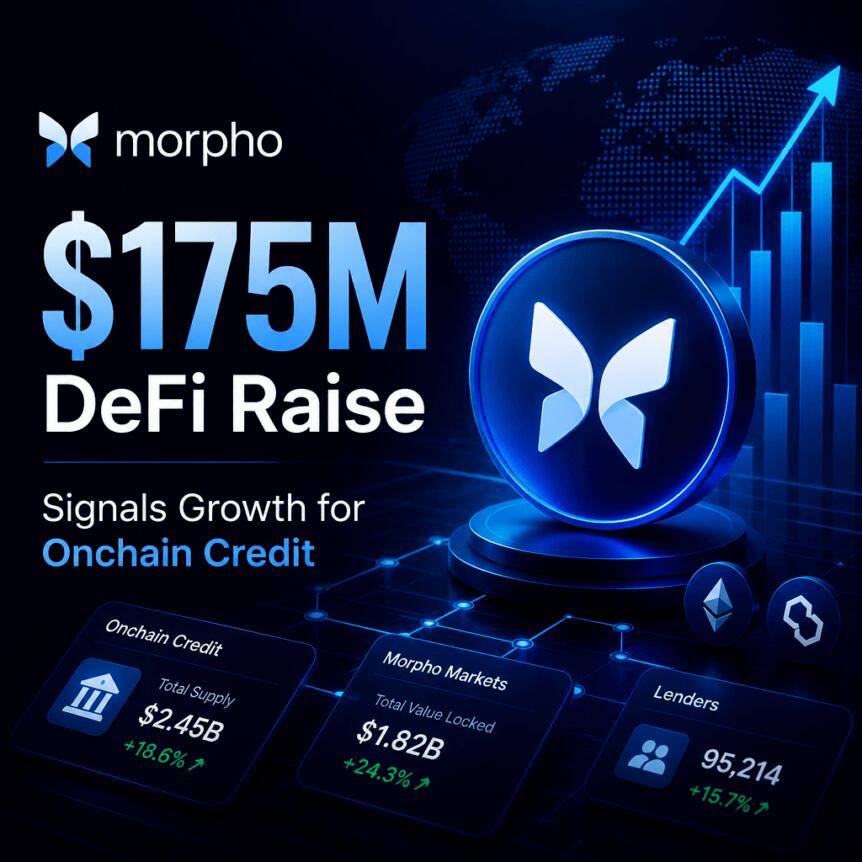
Investors are showing renewed interest in “onchain credit” and stablecoin-linked financial infrastructure, signaling a shift away from decentralized finance (DeFi) lending as a standalone retail product. That backdrop is helping a well-known lending protocol, Morpho Labs, raise fresh capital and frame its next phase as credit infrastructure for institutions.
According to Cointelegraph, Spark CEO Sam MacPherson said stablecoin growth is pushing the market to treat credit as a core layer in the onchain financial stack. He pointed to Morpho’s latest funding as an example of capital flowing toward stablecoin-enabled lending and credit tooling.
Key takeaways
- Morpho announced a $175 million funding round led by Paradigm, with participation from a16z Crypto and Ribbit Capital.
- The company positions Morpho not only as a DeFi lending protocol, but as credit infrastructure for banks, asset managers, and fintechs.
- DeFiLlama data cited in the report puts Morpho at $6.72 billion in TVL and about $3.47 billion in active loans.
- Sentora highlights Morpho smart contract usage—citing Coinbase activity—to argue institutional-grade credit workflows are taking shape.
- CryptoRank data indicates late-stage crypto funding has surged sharply, while seed and pre-seed funding has declined.
Morpho’s pitch: from lending protocol to credit infrastructure
Morpho announced Tuesday that it raised $175 million in a round led by Paradigm, with a16z Crypto and Ribbit Capital also named as lead participants. While Morpho is already associated with DeFi lending, the company is using this round to pursue a broader role: becoming a credit infrastructure layer for more traditional finance players.
The concept centers on onchain credit markets—systems that let borrowers, lenders, and deploying institutions use blockchain-based assets to originate credit. In this framing, stablecoins and tokenized financial products provide the asset rails, while credit infrastructure provides the lending and deployment logic.
MacPherson, speaking to Cointelegraph, argued that as stablecoins scale, “credit becomes one of the most important pieces of infrastructure in the stack.” The implication for investors is straightforward: if tokenized money becomes more widely used, demand for the associated lending and credit services tends to follow.
Onchain lending depth and institutional use cases
One reason Morpho’s funding drew attention is the reported scale of its lending activity. The article cites DeFiLlama data showing Morpho with $6.72 billion in total value locked (TVL) and about $3.47 billion in active loans.
Sentora, in a Friday newsletter, interpreted these figures as evidence of “significant liquidity depth,” a point that matters because liquidity is often a key constraint for credit markets. Without sufficient borrowing and lending depth, credit products can struggle to scale in real-world conditions, particularly when institutions require consistent counterparties and stable execution.
Sentora also pointed to Coinbase’s use of Morpho smart contracts to originate more than $2.17 billion in corporate USDC loans. The underlying argument is that Morpho is increasingly being used for credit workflows that look more like institutional lending infrastructure than a purely retail DeFi application.
In that view, the shift isn’t isolated to crypto-native lending. Sentora said exchanges, custodians, and asset managers are actively evaluating blockchain-based lending systems to support credit products, while protocols compete to become the “underlying infrastructure” enabling business-to-business integrations.
How Morpho plans to measure success
Beyond raising capital, Morpho’s leadership said the real test will come from integration-driven growth over the next year to 18 months. Co-founder Merlin Egalite told Cointelegraph that the company aims to expand integrations with banks, asset managers, and large platforms, bring in more institutional capital, and roll out features inspired by traditional credit markets.
Egalite characterized the goal as building infrastructure rather than trying to replace existing competitors. “The problem we are trying to solve is less about replacing competitors and more about establishing ourselves as the credit infrastructure layer that banks, asset managers and fintechs build on,” he said in the report.
Late-stage VC momentum and changing funding patterns
The timing of Morpho’s raise also reflects broader venture market dynamics. The article notes that venture capital is increasingly concentrating on a smaller set of established crypto infrastructure projects.
It cites CryptoRank’s Q1 2026 crypto fundraising report, which reported that capital allocated to Series C and later-stage rounds surged 1,020% year over year and 320% quarter over quarter. Those later-stage deals accounted for 28.4% of venture funding across nine deals, while seed and pre-seed funding fell 38.1% year over year and represented only 5.2% of total capital.
Against that backdrop, Egalite said he is not concerned about capital concentration, aligning with the thesis that durable infrastructure—protocols with measurable liquidity, integrations, and institutional usage—may be attracting disproportionate attention as the market matures.
For investors and builders watching onchain credit, the key question now is whether Morpho’s funding translates into sustained institutional integrations and repeatable credit origination. The next signal to track will be whether the protocol’s liquidity depth and contract-driven credit usage continue to grow alongside stablecoin adoption, and how quickly traditional finance partners operationalize blockchain-based lending at scale.
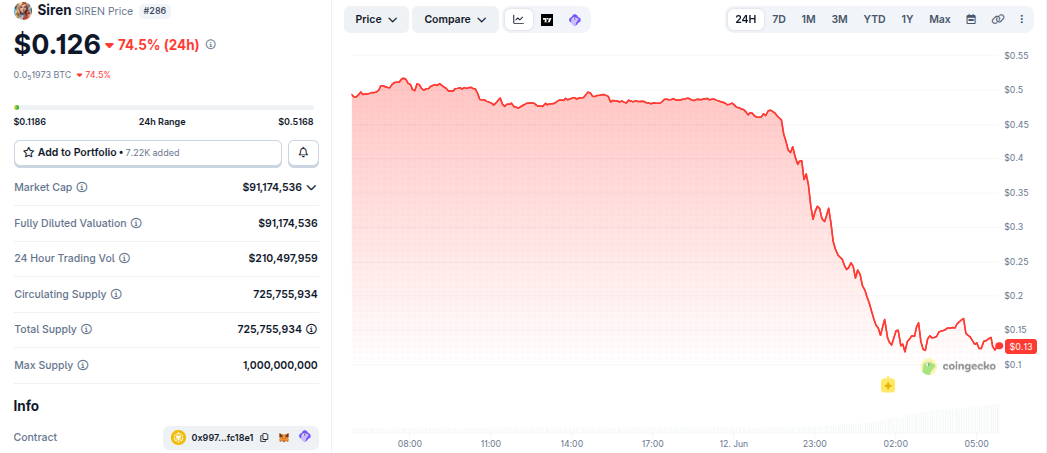
SIREN, the BNB Chain token tied to meme and AI-agent narratives, crashed roughly 75% in 24 hours on Saturday, sliding from highs near $0.520 to lows around $0.126 after its top holder began dumping the portfolio.
The collapse wiped out hundreds of millions in market value and triggered over $2.4 million in long liquidations across global exchanges.

What the SIREN Whale Dump Reveals
A whale dump is when a large token holder sells a significant portion of their position in a short period, often triggering cascading liquidations and panic selling. In this case, blockchain data shows SIREN’s top holder behind a coordinated and aggressive sell-off.
According to Lookonchain, the top holder has already received over $7.5 million in USDT from SIREN sales. Furthermore, the dumping process continues, as the entity continues to hold approximately 595.7 million SIREN tokens.
Follow us on X to get the latest news as it happens
That position represents roughly 82% of the circulating supply, worth around $92 million at the time of the alerts. Such heavy concentration creates a structural risk that has now materialized across the entire SIREN market.
Additional monitoring from several traders flagged transfers exceeding $10 million in some estimates. Substantial volumes were routed to exchanges, including Bitget, intensifying sell-side pressure across spot and derivatives markets.
As a result, trading volume surged dramatically to over $191 million in 24 hours. The spike reflects heightened panic and significant retail exit liquidity as small holders rushed to unload positions ahead of further potential downside.
SIREN now trades near $0.126 with a market capitalization of approximately $94.7 million and a similar fully diluted valuation, according to BeInCrypto Markets data. The token is ranked around 286 by market cap, given its nearly fully circulating supply relative to the 1 billion maximum.
Why SIREN Has Become a Repeat Volatility Story
This crash fits a recurring pattern for SIREN. Since early 2026, the token has experienced multiple sharp pumps and subsequent dumps, repeatedly shaking retail confidence across BNB Chain’s meme and AI-agent trading communities.
At its peak in recent sessions, SIREN had rallied roughly 200% in about 10 days, briefly inflating its market value by more than $600 million. That momentum reversed abruptly once on-chain data revealed aggressive selling from concentrated wallets.
Analysts have repeatedly flagged extreme supply concentration as the key risk factor. At times exceeding 90% in linked wallets, such dynamics amplify both upside momentum during accumulation phases and brutal downside cascades when distribution finally begins.
While some observers note the project’s meme appeal and presence in AI-agent discussions, the heavy reliance on a single dominant holder has left retail participants particularly vulnerable.
Confidence rebuilds slowly after such cascading liquidation events.

The decline also comes amid broader market volatility across meme and AI-themed tokens. SIREN’s 24-hour activity highlights its highly speculative nature, with significant depth across Gate.io, KuCoin, and various decentralized exchanges on BNB Chain.
For now, traders remain wary of additional downside. The whale’s remaining holdings could exert continued pressure, while any relief rally may face heavy resistance if more selling materializes from the same concentrated wallet cluster.
The post SIREN Token Crashes 75% as Whale Triggers a Massive Sell-Off appeared first on BeInCrypto.


Google has sued an organized cybercrime network it calls the “Outsider Enterprise,” accusing the China-based group of running AI-powered text scams.
The company is pursuing the case alongside the FBI, which is preparing its own enforcement actions, and is working with AT&T, T-Mobile, and Verizon to block the messages.
How the AI-Driven Scam Operation Worked
The network coordinated via Telegram and sold phishing kits that let criminals blast fake text campaigns impersonating Google and other brands, according to Google’s blog. Hundreds of thousands of victims lost a combined total in the millions.
Follow us on X to get the latest news as it happens
Investigators tied the group to 9,000 fake websites and more than 1 million fraudulent URLs. Android users flagged 55,000 spam texts in May alone. The Enterprise sent 2.5 million messages over that same period.
The case matters beyond text fraud. AI now lets attackers scale convincing scams that once required manual effort. BeInCrypto has tracked this shift across attacker tools, DeFi risks, and AI exploit pipelines that give attackers a structural edge over defenders.
The Wider Crackdown
Google paired the litigation with policy advocacy. The company is backing seven bipartisan bills, including the National Strategy for Combating Scams Act and the Stop SCAMS Against Seniors Act.
It also pointed to its own defenses. Google said its messaging tools now intercept more than 10 billion malicious messages each month. Android scam detection flags suspicious calls and contacts in real time.
The FBI framed the action as a model for shared defense against transnational fraud.
“Criminals increasingly use AI to make fraud like this more convincing and harder to detect,” Brett Leatherman, FBI Cyber Division, said.
Subscribe to our YouTube channel to watch leaders and journalists provide expert insights
The post Google Files Lawsuit to Dismantle AI-Powered Text Scam Operation appeared first on BeInCrypto.
Zcash has undergone a follow-up security audit using Anthropic’s Mythos system, which, according to founder Zooko Wilcox, found no additional serious vulnerabilities in the protocol after the recent Orchard flaw disclosure.
Summary
- Anthropic’s Mythos audit found no additional serious vulnerabilities in the Zcash protocol following the recent Orchard flaw disclosure.
- The review followed emergency upgrades that fixed a vulnerability that could theoretically have enabled unlimited counterfeit ZEC creation.
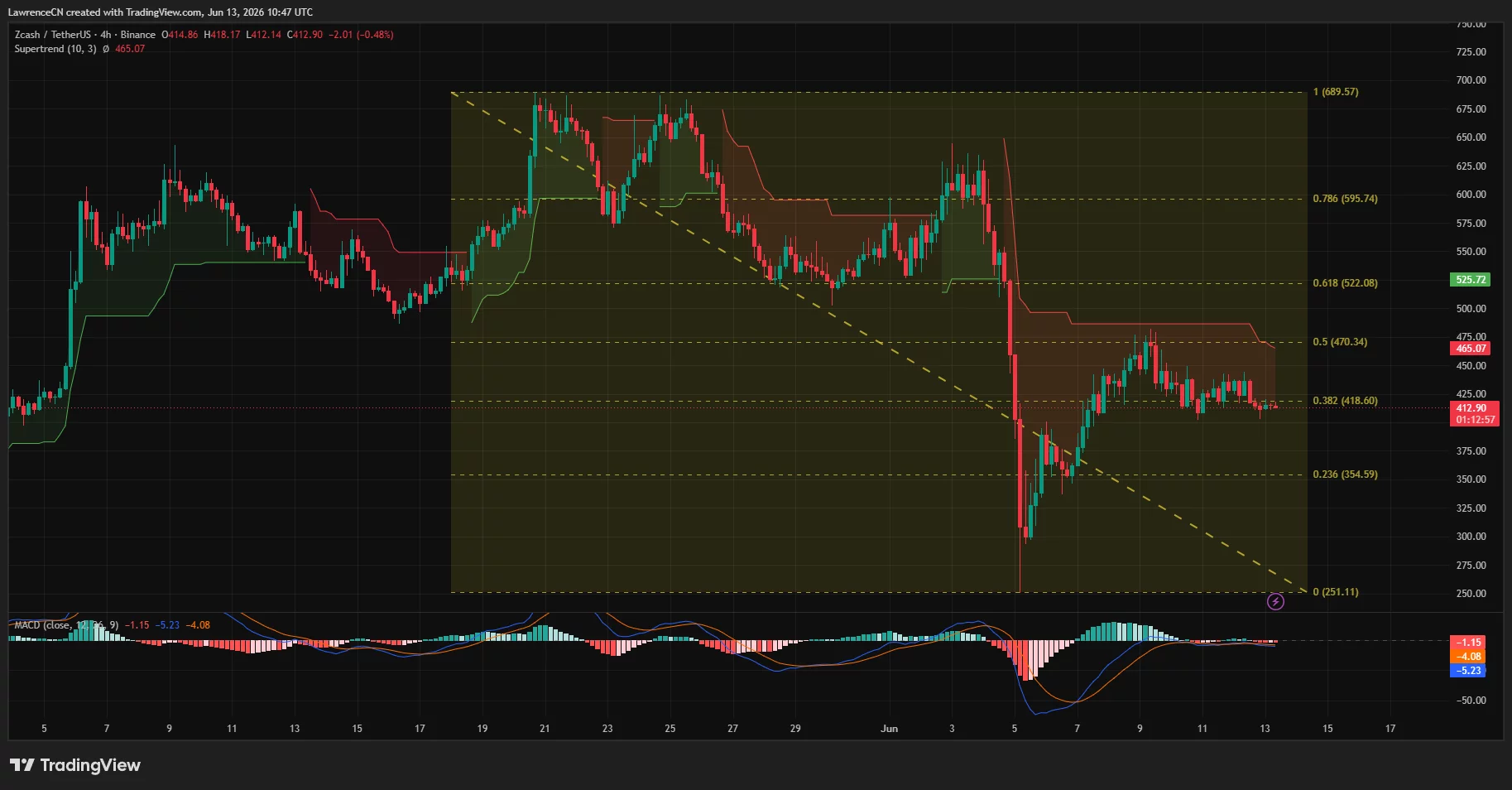
- ZEC has pulled back to around $417 after a sharp rebound, while technical indicators suggest resistance remains near the $465 level.
According to Wilcox, Anthropic carried out the audit at the request of Shielded Labs following the discovery of a vulnerability that could theoretically have allowed unlimited creation of counterfeit ZEC.
In a June 13 post on X, Wilcox thanked Anthropic for helping protect Zcash users and said the review did not identify any other serious bugs in the network.
The result comes little more than a week after the Zcash ecosystem rushed to contain a flaw in Orchard, the blockchain’s primary shielded transaction pool.
According to Shielded Labs, the defect could theoretically have enabled an attacker to create an unlimited amount of counterfeit ZEC. The organization said previous exploitation appeared unlikely, while acknowledging there is no cryptographic proof showing the vulnerability was never used.
Work on fixing the issue began before the flaw became public. According to Zcash Open Development Lab founder Josh Swihart, developers first deployed a soft fork that temporarily disabled Orchard transactions while technical details remained confidential.
A second upgrade, the NU6.2 hard fork, went live on June 3 and removed the vulnerability before Orchard transactions were re-enabled.
Emergency measures contained the Orchard flaw
Details released earlier by Wilcox showed the original vulnerability was identified on May 29 by security researcher Taylor Hornby during a targeted audit using Anthropic’s Opus 4.8 model. Hornby reported the issue to Zcash Open Development Lab, which coordinated a response across ecosystem participants before the fix was deployed.
Following the fix, Wilcox said teams across the Zcash ecosystem continued reviewing the protocol for additional risks. According to his June 13 update, Shielded Labs and other contributors are now focused on further security-hardening measures and plan to release additional updates as that work progresses.
Several organizations remain involved in the effort, including the Zcash Foundation, Tachyon Group, Valar Group, Shielded Labs, and Zcash Open Development Lab, according to Wilcox.
Ironwood proposal focuses on supply verification
Alongside the audit findings, Wilcox has continued promoting the proposed Ironwood upgrade, which he said would allow users to independently verify Zcash’s circulating supply by aggregating balances held across active pools once the upgrade is activated.
According to Wilcox, Ironwood would introduce a new location for holding shielded ZEC, place restrictions on transactions that could involve counterfeit coins, and incorporate additional security measures, including AI-assisted audits. He said the timeline for activation remains uncertain and will depend on further development work and community discussions.
The Orchard disclosure triggered a sharp sell-off in ZEC. The token lost more than 50% of its value between June 4 and June 5 before rebounding to $478.70 on June 9. ZEC has since fallen back to around $417 as investors reduced exposure to risk assets amid escalating tensions between the United States and Iran.
Technical indicators also show that the post-crash recovery is facing resistance. On the four-hour chart, ZEC has fallen back below the 38.2% Fibonacci retracement level at $418.60 after failing to hold gains near $478.70 earlier this week. The token also remains below the Supertrend resistance at roughly $465, which continues to cap upside attempts.
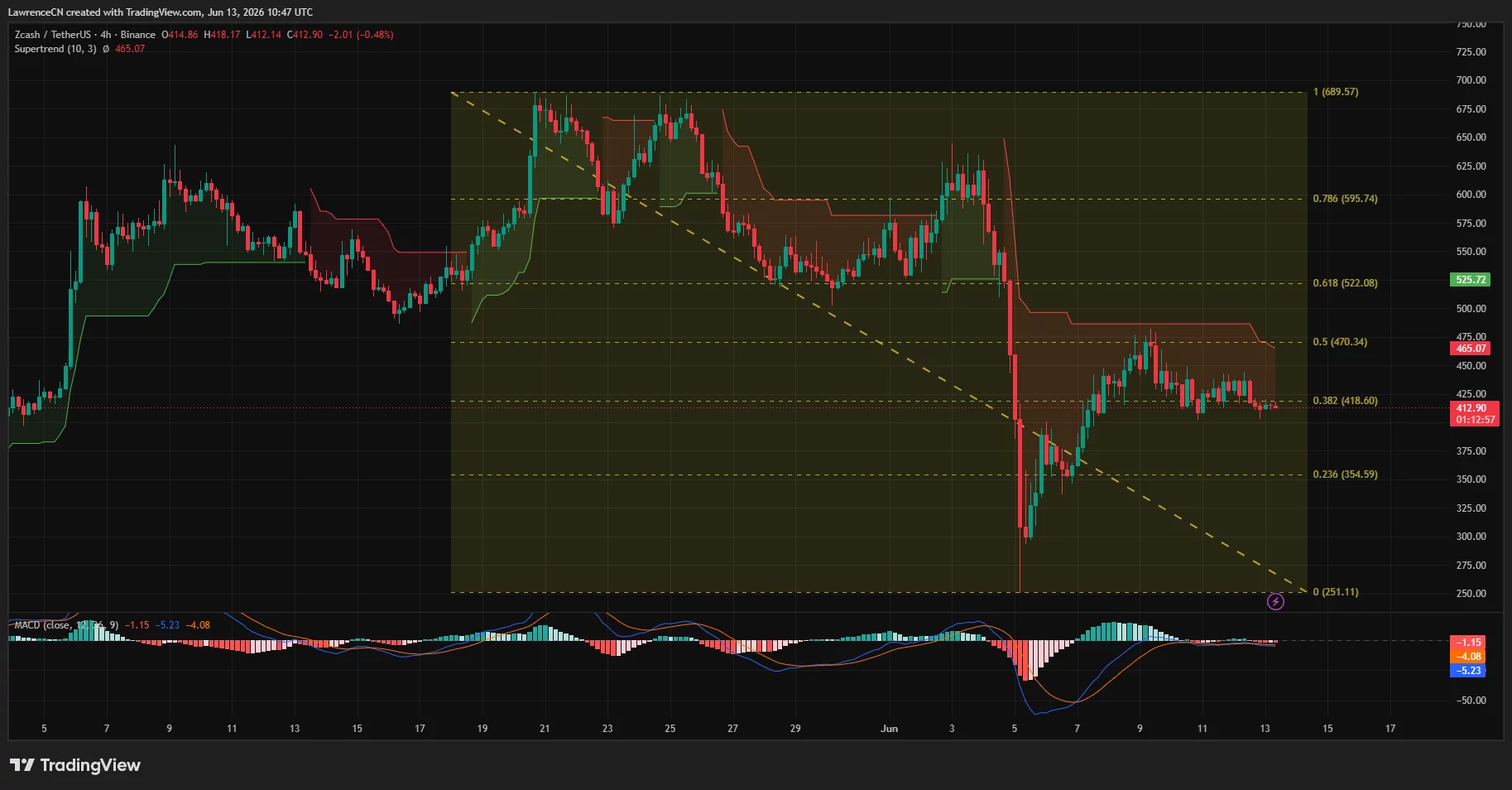
Unless buyers reclaim the $465-$470 area, the chart points to a possible retest of support near $355, which marks the 23.6% Fibonacci retracement level. Meanwhile, the MACD histogram has slipped back into negative territory after briefly turning positive during the recovery rally, indicating that buying pressure has weakened since the June 9 peak.
Key Takeaways
- Geoffrey Kendrick from Standard Chartered identifies Bitcoin’s cycle bottom at $59,000, reached on June 5
- Outflows totaling $5.72 billion from Bitcoin ETFs since mid-May linked to investor positioning for SpaceX’s public debut
- SpaceX commenced Nasdaq trading at $150 per share, currently up approximately 26%, potentially ending crypto liquidation pressure
- Progress on U.S.-Iran diplomatic negotiations and declining oil prices reducing macroeconomic headwinds for digital assets
- Year-end forecasts remain intact: $100,000 for Bitcoin and $4,000 for Ethereum
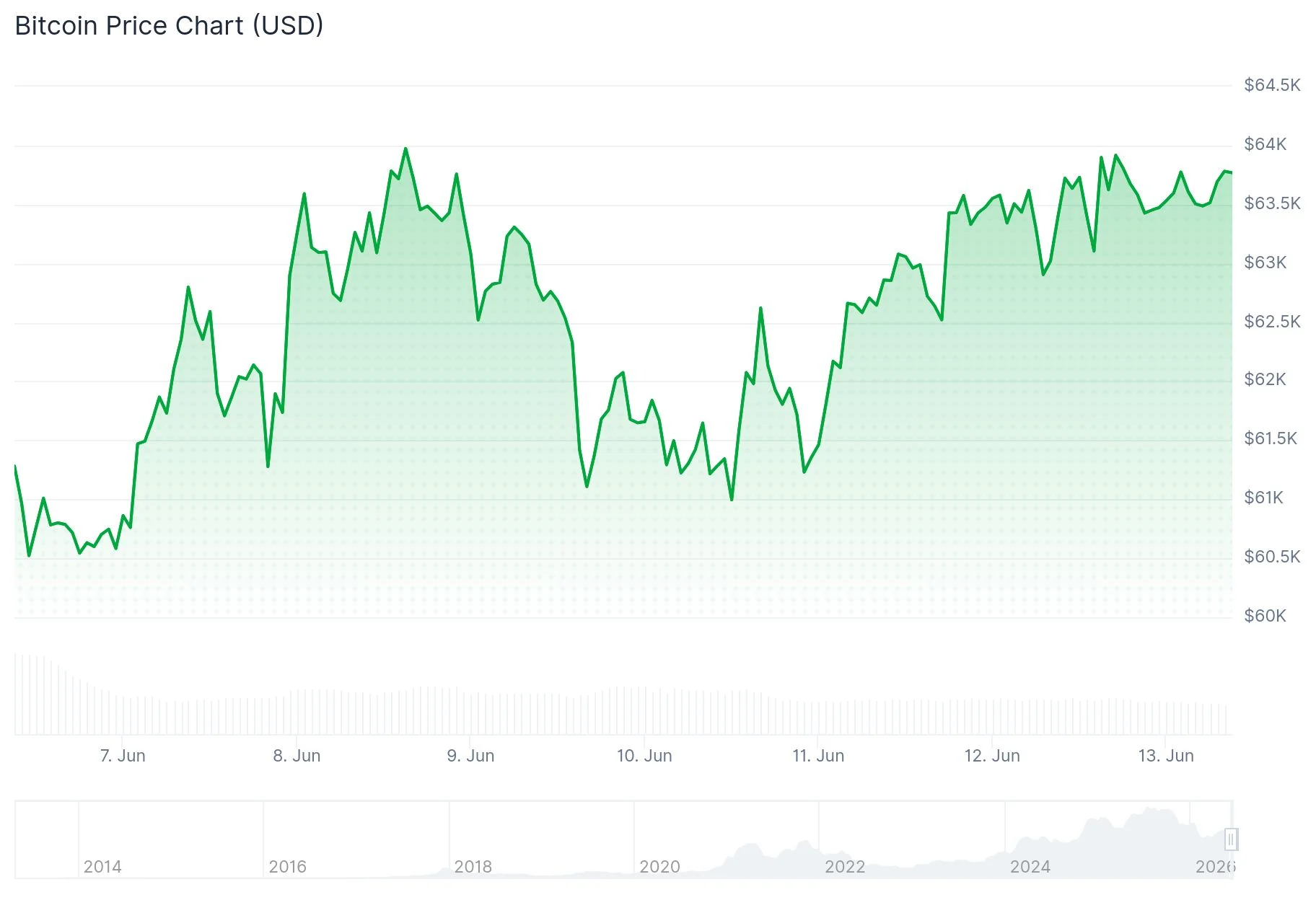
Bitcoin reached a low of $59,375 on June 5, 2026, based on CoinDesk pricing data. Geoffrey Kendrick, a digital asset analyst at Standard Chartered, has identified this level as the conclusive cycle bottom for the leading cryptocurrency.
“Winter is over. Welcome back to crypto Spring,” Kendrick declared in his Friday research note.
As of this writing, Bitcoin was changing hands just under $64,000, showing significant recovery from its recent trough.
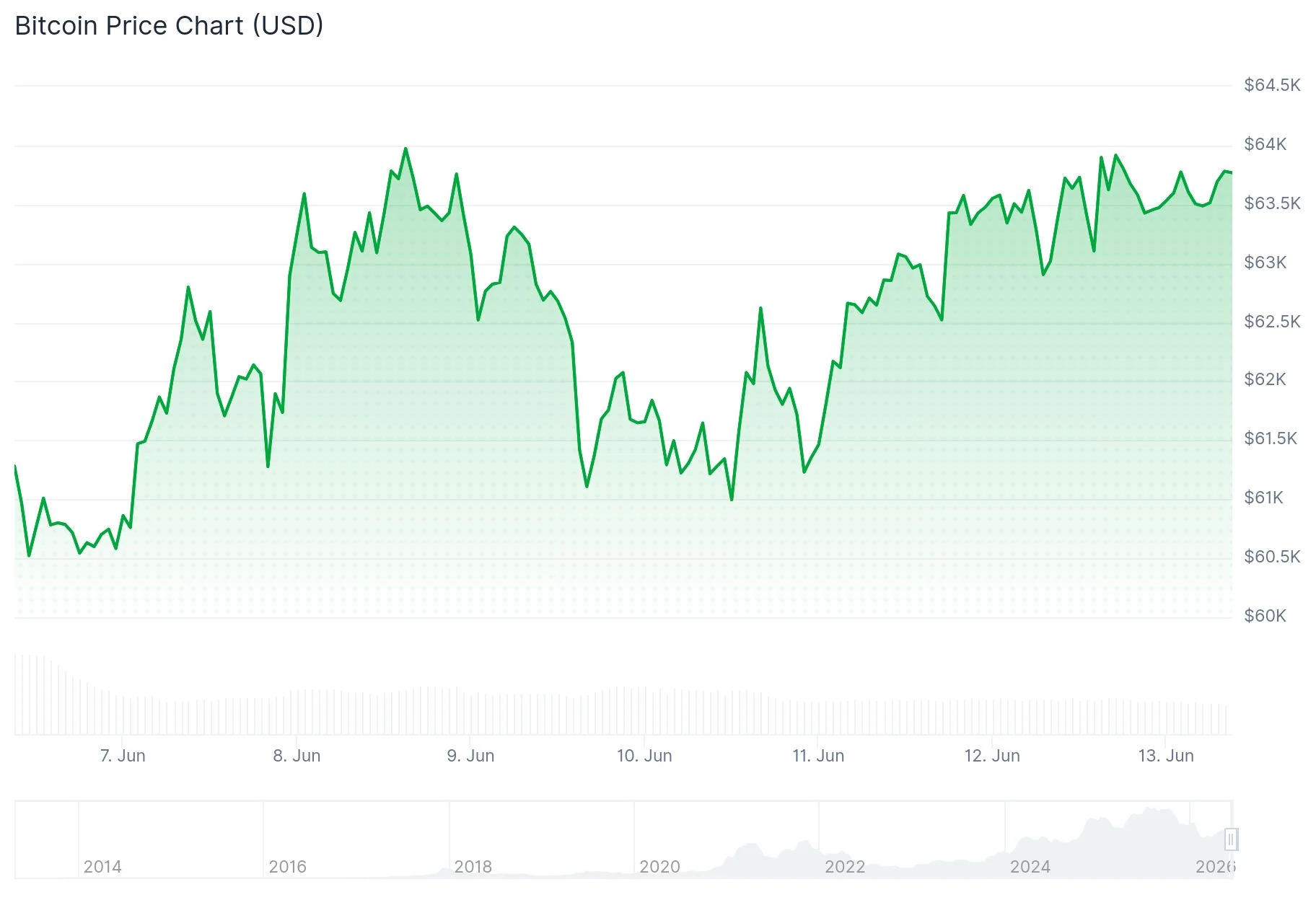
The cryptocurrency’s descent from its record peak of $126,000 on October 6 to the $59,000 level constitutes a 53% drawdown.
SpaceX Public Offering Triggered Digital Asset Liquidation
Kendrick attributes much of the recent downward pressure to the SpaceX public offering. Market participants allegedly liquidated Bitcoin ETF positions to raise capital for participation in the highly anticipated IPO.
U.S.-listed spot Bitcoin exchange-traded funds experienced aggregate net redemptions of $5.72 billion beginning in the second week of May. This outflow magnitude ranks among the most severe since these investment vehicles launched.
SpaceX equity started trading on Nasdaq Friday morning at approximately $150 per share. Current trading levels show gains of roughly 26% above the initial offering price. Kendrick suggests this successful IPO may eliminate that particular source of selling pressure.
On decentralized exchange Hyperliquid, SpaceX derivative contracts were experiencing substantial trading activity, implying a company valuation reaching $2.4 trillion.
Declining Energy Prices and Middle East Diplomacy Bolster Outlook
The secondary catalyst Kendrick highlighted involves a prospective U.S.-Iran diplomatic agreement under discussion at the G7 summit. Should this materialize, it could prevent further escalation in global oil prices.
Reduced oil prices would alleviate upward pressure on U.S. Treasury yields. As yields decline, risk assets like Bitcoin typically experience renewed investor interest.
Brent crude retreated to approximately $87 per barrel, with West Texas Intermediate trading near $85, following President Trump’s comments about a probable peace agreement. Trump subsequently clarified on Truth Social that the publicly disclosed terms did not reflect what was actually negotiated, urging Iranian leadership to “get their act together.”
Three Confirmation Metrics for Market Bottom
Kendrick outlined three specific indicators he’s monitoring to validate the market floor thesis.
First, he anticipates Strategy, under Michael Saylor’s leadership, will reveal another Bitcoin acquisition on the upcoming Monday.
Second, he seeks sustained net-positive daily flows returning to U.S.-listed spot Bitcoin ETFs.
Third, he’s observing whether crude oil pricing maintains its downward trajectory.
Kendrick maintains his year-end projections: Bitcoin reaching $100,000 and Ethereum hitting $4,000. He additionally forecasts Ethereum will deliver superior returns compared to Bitcoin over the coming months.
For investors who established positions near the $59,000 bottom, achieving Kendrick’s $100,000 year-end projection would yield approximately 70% returns.
Crypto World
Ripple CEO Accused Jamie Dimon of Lying About CLARITY Act And Called Out $20Bn Reason Why

Ripple CEO Brad Garlinghouse went directly at JPMorgan chief Jamie Dimon on Fox Business Wednesday, accusing him of ‘intentional misrepresentation’ over the CLARITY Act, the pending Senate legislation that would establish a comprehensive regulatory framework for U.S. crypto markets.
The charge is specific: Garlinghouse says Dimon is distorting the bill’s compliance implications to protect JPMorgan’s payments business, which generates roughly $20 billion in annual revenue and over $5 billion in profit.
The confrontation follows Dimon’s late-May Fox Business interview with host Maria Bartiromo, where he called the CLARITY Act inadequate on AML and BSA grounds and labeled Coinbase co-founder and CEO Brian Armstrong, the bill’s most vocal corporate champion, ‘full of shit.’ Garlinghouse used the same platform, the same host, to fire back.
The flashpoint is one specific provision: whether crypto exchanges like Coinbase can offer stablecoin yield to users holding stablecoin balances on their platforms. That single clause has drawn the full force of the banking lobby, and, Garlinghouse argues, Dimon’s personal opposition.
Discover: The Best Crypto to Diversify Your Portfolio
Garlinghouse vs. Dimon: What the CLARITY Act Fight Is Actually About
Garlinghouse’s accusation is direct. ‘What Jamie Dimon did a disservice around… is that he’s representing that this reduces compliance concerns, that it makes it easier to do bad things,’ he told Bartiromo.
‘That’s just not true. It’s either intentional misrepresentation or even negligent to try to make support for the Clarity Act go away.’
Dimon’s stated position, that the CLARITY Act weakens anti-money-laundering and Bank Secrecy Act protections, gets one sentence of steel-manning: banks have a legitimate structural interest in ensuring crypto products carry equivalent compliance burdens.
— Coin Bureau (@coinbureau) June 12, 2026
 NEW: RIPPLE'S BRAD GARLINGHOUSE GOES OFF ON JP MORGAN-CHASE CEO
"Jamie Dimon has been dismissing this industry for a DECADE. He’s called it a Ponzi scheme, he’s called Bitcoin a pet rock.”
"JP Morgan generates $20 BILLION of revenue from their payments business.. So its clear… pic.twitter.com/v6QUeRlsDw
The problem, per Garlinghouse, is that the bill doesn’t actually reduce those burdens. It creates a framework where none currently exists.
The dispute centers on one provision: stablecoin yields offered on crypto exchanges. Armstrong threatened to pull Coinbase’s support for any draft that excluded the clause.
Dimon framed Armstrong as ‘the only one’ pushing for it, spending ‘hundreds of millions of dollars in Washington.’
Garlinghouse acknowledged Armstrong is representing Coinbase’s interests specifically, but added that ‘the industry wants clarity, and wants regulation.’
That distinction matters structurally: the fight over stablecoin yield is Coinbase’s hill, but the broader crypto regulation framework behind the CLARITY Act has wide industry support.
JPMorgan’s $20B Payments Business: Why Dimon Has a Dog in This Fight
$20 billion in annual revenue. $5 billion in profit. That is JPMorgan’s payments empire, and it is the number that makes Garlinghouse’s accusation land as analysis rather than rhetoric.
Stablecoin yields on exchanges directly threaten that business model. If users can park stablecoins on Coinbase or a Ripple-adjacent platform and earn yield, deposits migrate away from bank accounts.
JPMorgan’s custody and payments revenue depends on controlling that liquidity. Allowing crypto exchanges to replicate a core banking function, interest-bearing balances, chips at the foundation of that moat.

‘Jamie Dimon also should be clear he is trying to protect and dig a deeper moat for a business that’s extremely profitable for them,’ Garlinghouse said plainly.
JPMorgan has its own blockchain projects, JPM Coin and the Onyx platform, but critics including Garlinghouse have argued those are closed, permissioned systems designed to preserve JPMorgan’s control rather than enable open competition.
Dimon opposing the CLARITY Act while running a proprietary token network is the contradiction Garlinghouse is pointing at. Meanwhile, other major banks like Citi are moving deeper into tokenization, a divergence that exposes Dimon’s opposition as strategic, not principled.
Discover: The Best Token Presales
The post Ripple CEO Accused Jamie Dimon of Lying About CLARITY Act And Called Out $20Bn Reason Why appeared first on Cryptonews.

For the fifth consecutive week, the spot exchange-traded funds tracking the world’s largest cryptocurrency have ended in the red with more outflows than inflows.
However, the numbers are nowhere near as painful as they were during the previous week, and Friday was actually in the green.
5 in a Row
CryptoPotato has repeatedly reported in the past few weeks the poor performance of the spot Bitcoin ETFs, especially during the previous business week (the first for June). At the time, investors pulled out over $1.7 billion from the funds, making it the second-worst in the ETFs’ history.
Four out of the five business days last week were also in the red. The net withdrawals were $91.37 million on Monday, $77.44 million on Tuesday, $213.85 million on Wednesday, and $19.03 million on Thursday. The first silver lining is that net inflows finally dominated on Friday, with $85.85 million, according to data from SoSoValue.
Nevertheless, the week still ended in the red, with total net outflows of almost $316 million. The second silver lining, if it could be described as such, was the fact that the net withdrawals were nowhere near the billions recorded during the previous four weeks. However, the negative streak continues, as the ETFs have bled out over $5.7 billion since the week that ended on May 15.
The cumulative net inflows have declined even further, going from $59.34 billion on May 8 to $53.62 billion on June 12.
ETH ETFs in Red, Too
The landscape with the spot Ethereum ETFs is quite similar and painful. SoSoValue shows that the funds have been in the red for five consecutive weeks as well, but the last one was not as crushing as many of the previous.
In fact, Monday was a highly positive day, with investors inserting $82.37 million into the funds. However, the trend changed in the following days, with $40.85 million in net outflows on Tuesday, $35.59 million on Wednesday, $15.89 million on Thursday, and $4.95 million on Friday.
Consequently, the week ended with just under $15 million in net outflows, which is significantly lower than the $173 million withdrawn during the previous week.
The cumulative total net inflows dropped to under $11.20 billion on Friday after peaking at $12.09 billion on May 8.
The post Bitcoin ETFs Extend Major Red Streak, But There Is a Light at the End of the Tunnel appeared first on CryptoPotato.

Crypto markets may still be buffeted by macro news and uneven regulatory signals, but tokenization continues to look like the sector’s most durable theme. This week’s developments underscored that shift: Binance Research data points to accelerating demand for tokenized real-world assets (RWAs), while Kraken expanded tokenized access to SpaceX’s IPO via its xStocks platform.
Beyond tokenization, blockchain activity is also evolving. Prediction markets have now outpaced onchain gambling by volume for the first time, according to TRM Labs, and former FTX CEO Sam Bankman-Fried has filed a formal request for a U.S. presidential pardon.
Key takeaways
- Binance Research reports active tokenized RWAs rose 589% since early 2025, with tokenized bonds and money market funds adding $6.5 billion and tokenized stocks up 422%.
- Kraken says eligible users in more than 110 markets can access the SpaceX IPO through xStocks, receiving an allocation that maps 1:1 to tokenized shares.
- TRM Labs data shows prediction markets generated $36.6 billion in Q1 2026 volume versus $14 billion for onchain gambling—an inflection point after both surpassed $50 billion annually in 2025.
- Sam Bankman-Fried has formally applied for a presidential pardon through the U.S. DOJ Office of the Pardon Attorney, alongside ongoing appeals tied to his 2023 fraud conviction.
Tokenized RWAs keep expanding as asset mix broadens
Even as the broader crypto tape has been less cooperative, tokenized RWAs have continued to gain traction. According to Cointelegraph’s coverage citing Binance Research, the market for active tokenized RWAs has climbed 589% since early 2025.
Within that growth, Binance Research highlights meaningful contributions from multiple asset classes. Tokenized bonds and money market funds accounted for $6.5 billion in added value, while tokenized stocks increased by 422%. The message for investors is straightforward: tokenization demand is not confined to a single category—it’s spreading across products that resemble traditional fixed income and equity exposures.
The sector’s expansion also appears to be getting more diversified in terms of what investors can access. Platforms such as Ondo Global Markets have contributed to momentum in tokenized equities, while tokenized precious metals reportedly added $1.5 billion amid earlier demand for safe-haven exposure.
Meanwhile, traditional market infrastructure is also moving deeper into blockchain-related initiatives. Developments range from Apex Group’s tokenized fund services to The Clearing House’s planned tokenized deposit network, reflecting a wider industry push beyond purely crypto-native experiments. While these efforts differ in execution and maturity, taken together they point to a broader acceptance of tokenization as an infrastructure direction—not just an asset-narrative fad.
Kraken brings SpaceX IPO exposure to xStocks users in 110+ markets
One of the most immediate real-world catalysts this week came from Kraken, which rolled out tokenized access to the SpaceX IPO for eligible customers through its xStocks product. Cointelegraph previously reported on Kraken’s plan to provide access in more than 110 markets.
Kraken states that investors who received an allocation will be issued SPCXx, a tokenized representation backed 1:1 by the underlying equity. The exchange also says SPCXx can be traded 24/7 across participating platforms—an operational detail that matters for users comparing tokenized IPO access with traditional allocation and settlement timelines.
The rollout is also arriving at a moment when tokenized equities are benefiting from IPO-level demand. SpaceX reportedly targeted a $75 billion raise in its Nasdaq debut, and the offering was reported as oversubscribed by roughly four times ahead of public trading. If realized, this would align SpaceX with the “high-interest” characteristics that often draw participation into new issuance formats—whether through conventional retail channels or tokenized access.
For investors, the practical question is not only whether tokenization enables broader access, but also how liquidity and trading behavior work after allocation. Kraken’s promise of 24/7 tradability could be a differentiator, but market participants will still want to watch custody, trading venues, and how post-IPO pricing converges with the underlying shares across platforms.
Prediction markets overtake onchain gambling in Q1 2026
While tokenization expands into markets that look increasingly like traditional finance, speculative activity is also shifting. TRM Labs data shows that prediction markets surpassed onchain gambling for the first time in the first quarter of 2026.
According to Cointelegraph’s coverage of TRM Labs, prediction markets recorded $36.6 billion in volume in Q1 2026, compared with gambling’s $14 billion. The milestone follows a period where both categories exceeded $50 billion in annual volume in 2025, reinforcing that this is not a one-off seasonal swing.
Importantly, onchain gambling has not stalled. TRM Labs attributes gambling’s resilience to a loyal and growing user base, with quarterly wagering volume remaining near record highs despite broader market pullbacks. High rollers still dominate betting volume—TRM notes that these users averaged $13,558 per bet and $378,000 in lifetime gambling volume—yet the fastest growth is reportedly coming from casual bettors and daily participants, suggesting an opening of the market beyond a narrow set of whales.
For builders and traders, this change in relative volume has implications for product focus and liquidity. Prediction markets may increasingly attract more capital flow, but gambling’s continued user expansion implies both segments are likely to remain competitive. Watching which category sustains growth once the initial attention cycle fades will be key to understanding where the next wave of onchain engagement concentrates.
Sam Bankman-Fried files pardon request as appeals continue
Legal processes remain a live variable for crypto’s mainstream narrative. Former FTX CEO Sam Bankman-Fried has formally applied for a presidential pardon from U.S. President Donald Trump, according to reporting that ties the request to the U.S. Department of Justice Office of the Pardon Attorney.
The request appears on the DOJ’s Office of the Pardon Attorney’s list of pending clemency applications. The pardon effort is occurring alongside ongoing legal attempts to overturn his conviction—Bankman-Fried continues to appeal his 2023 fraud conviction and the 25-year prison sentence, while an additional request for a new trial was denied per Cointelegraph’s coverage.
Separately, recent months have also seen Bankman-Fried posting messages that appear increasingly aligned with Trump, even though the president has previously said he did not plan to pardon him. That tension highlights why the next steps matter: a pardon request may keep the issue in public view, but it does not change the underlying posture of an active appeal process.
Readers should watch how the DOJ process proceeds and whether any legal updates arrive that alter the timeline. In the meantime, the broader crypto industry will likely continue treating executive-level legal outcomes as an important—if unpredictable—risk factor for regulatory and reputational dynamics.

LandBridge: The Landlord Quietly Cashing In On Oil, Water And Data Centers (NYSE:LB)
LG Electronics Launches Onchain Advertising Pilot on Arbitrum to Fix Digital Ad Fraud

King’s Birthday Honours – business acadmic Nigel Coates awarded MBE

BloFin War of Whales 2026 Grand Prix opens registration for $5M trading championship

Blockchain.com files with SEC for U.S. IPO

Israel says it has killed new Hamas military leader in Gaza City airstrikes

What is Bitcoin & Cryptocurrency? How to earn and invest? Easy explanation by Him eesh Madaan

Loan collection Finance Life #finance #video#viral #collection #motivation @Financelife-o5h

BITCOIN IS CRASHING, STOCKS FALLING FAST ON THIS NEWS!
-

 NewsBeat5 days ago
Alexander Zverev wins the French Open to finally earn a 1st Grand Slam title
-
 Entertainment6 days ago
The Best Mystery Series of All Time Is Surging on Streaming 30 Years After It Ended
-

 Crypto World5 days ago
Anatomy of the June crypto crash: Fed, Iran, Saylor
-

 Crypto World2 days ago
Oppenheimer backs SpaceX as $70 billion retail frenzy builds
-

 Crypto World2 days ago
Markets Rally as SpaceX IPO Looms Amid Iran Tensions and Inflation Surge
-
Crypto World7 days ago
Senator Cynthia Lummis Calls CLARITY Act the Most Consequential Financial Legislation of This Generation
-
 NewsBeat6 days ago
Alexander Zverev conquers demons and outlasts Flavio Cobolli to win French Open for first major title
-

 Tech6 days ago
Microsoft unveils seven homegrown AI models in new bid for ‘long term self-sufficiency’
-

 Business5 days ago
High Stakes for Wembanyama as New York Pushes for 3-0 Lead
-

 Tech5 days ago
Notion restores access to Anthropic after service disruption
-
 Business6 days ago
The Pain Points Taking a Fragile Tech Rally Down a Notch
-
 Crypto World5 days ago
Eli Lilly (LLY) Stock Surges 4% Following Breakthrough Sleep Apnea Trial Results
-
 Business6 days ago
The investment to transform historic St Helen’s ground in Swansea
-

 Crypto World6 days ago
Trump’s AI Ownership Plan Could Benefit Anthropic at OpenAI’s Expense
-
 Sports4 days ago
Bangladesh beat Australia after 20 years in ODIs, register only their second win over six-time world champions | Cricket News
-

 Tech10 hours ago
NanoClaw integrates JFrog registries to secure AI agent downloads
-

 Crypto World5 hours ago
Bitget enters Argentina’s regulated crypto market through PSAV registration
-

 Tech21 hours ago
This Week In Security: Microsoft On Microsoft, Register Your Domains, Linux On ARM, And FreeBSD Joins The File Cache Club
-

 Politics2 days ago
Politics Home | Healey Resignation Is “Colossal Failure Of Government”, Says Former Labour Defence Secretary
-

 Sports2 days ago
First Time Since 1971: Australia Register Historic Low In ODI Cricket
You must be logged in to post a comment Login