

Crypto World
CME and NYSE Push US Scrutiny on Hyperliquid as HYPE Holds Gains


TLDR:
- Hyperliquid briefly pushed near $44 after reports tied CME and NYSE to regulatory pressure
- Critics questioned Hyperliquid’s HLP vault structure and trader loss-linked protocol revenue
- CoinGecko data showed $HYPE trading near $43.61 with nearly $887 million daily volume
- ZachXBT raised questions after NYSE-linked criticism targeted Hyperliquid instead of Polymarket
Hyperliquid entered fresh regulatory discussions after reports linked CME Group and NYSE to concerns around the platform’s operations. Claims spread across crypto markets after social accounts highlighted alleged pressure on US regulators to review Hyperliquid.
The debate centered on market manipulation risks, sanctions evasion concerns, and Hyperliquid’s internal liquidity structure. Meanwhile, Hyperliquid’s native token $HYPE briefly approached $44 before stabilizing near $43.61.
Hyperliquid Faces Regulatory Debate Over Market Structure
Posts shared by Zoomer on X pointed to Bloomberg reporting that CME and NYSE want closer oversight of Hyperliquid. The focus remains on the platform’s decentralized perpetual futures trading model.
Hyperliquid has grown rapidly during the past year. The protocol now reportedly handles billions in daily trading volume across crypto and tokenized asset markets.
The exchange also reportedly holds more than $1.5 billion in locked value. Its round-the-clock trading model has attracted traders searching for lower fees and faster execution.
The discussion intensified because Hyperliquid continues attracting users from jurisdictions with trading restrictions. Some market participants claimed users still access the platform despite geoblocking efforts.
CoinGecko data showed Hyperliquid traded at $43.61 during publication. The token also recorded nearly $887 million in daily trading volume.
The market reaction remained relatively controlled despite the headlines. $HYPE rose nearly 5% during the past 24 hours and added 2.78% weekly gains.
Hyperliquid HLP Model Draws Criticism From Crypto Traders
A separate discussion emerged after X user Sweep criticized Hyperliquid’s revenue structure. The post argued that Hyperliquid operates differently from traditional exchanges like CME and NYSE.
According to the thread, Hyperliquid’s internal vault, called HLP, actively takes trading positions. The vault also performs liquidations, market making, and liquidity provision functions.
Sweep claimed the protocol profits when traders lose positions. The thread also described HLP revenue as directly tied to trader losses and liquidation activity.
The same post estimated Hyperliquid generates roughly $65 million in monthly fee revenue. Sweep further claimed most protocol revenue routes toward $HYPE token buybacks through the Assistance Fund.
Critics argued that structure differs from traditional exchange models. CME and NYSE primarily generate fees from transaction flow instead of directional exposure.
The debate expanded after blockchain investigator ZachXBT referenced NYSE-linked concerns around Hyperliquid. His X post questioned why similar criticism had not targeted prediction market platform Polymarket.
Neither CME nor NYSE publicly released detailed statements in the shared posts. However, the online debate fueled broader discussion around DeFi regulation, perpetual futures trading, and token-linked revenue systems.
The latest developments arrive as regulators globally increase attention on decentralized trading venues. Hyperliquid now sits at the center of a growing conversation around crypto market structure and compliance standards.



Justin Sun’s made-up country Liberland has given Ethereum founder Vitalik Buterin a star-shaped medal, “its highest state distinction,” for his technical blockchain achievements.
The “First Class Order of Merit of the Star of Liberland” was given to Buterin during ETHPrague 2026, where he attended a Network State event sponsored by the micronation.
Liberland said the medal recognizes Buterin’s “extraordinary technical achievements,” and, “his role in advancing new ideas about how societies can organize themselves.
Additionally, Buterin was praised for the attention he has given to “pop-up cities, decentralized societies, and network states.”

Read more: Justin Sun is now prime minister of Liberland, an entirely made-up country
The medal’s name appears to have been inspired by the Commonwealth’s Order of Merit, a 100-year-old award that recognises the distinguished services of people such as Florence Nightingale.
Someone who hasn’t received Liberland’s highest distinction is Tron founder Justin Sun. The crypto billionaire was, however, elected prime minister of the region back in October 2024.
Sun has been re-elected seven times.
When he first applied for the role, Sun emphasized the need to maintain a strong relationship with the US and boasted about his investments in Trump-linked crypto firm World Liberty Financial (WLFI).
He also praised US Middle East Envoy Steve Witkoff as an ally.
These statements haven’t aged well, however, as Witkoff’s son and WLFI co-founder, Zach Witkoff, is now claiming that Sun is attempting to “torch” the firm as WLFI and Sun launch lawsuits against each other.
Read more: WLFI investor offers to help Justin Sun to avoid ‘lengthy litigation’
Protos is also pretty sure that Sun hasn’t set foot in Liberland yet.
Other than courting crypto execs, Liberland has recently publicised how it wasn’t affected by a 4.1 magnitude earthquake that struck the Donbas region.
Its president, Vít Jedlička, noted, “Every structure we build in Liberland is designed with events like this in mind.”
These structures include a tent beach bar and a treehouse.
Got a tip? Send us an email securely via Protos Leaks. For more informed news and investigations, follow us on X, Bluesky, and Google News, or subscribe to our YouTube channel.

Myanmar’s military government released the text of an Anti-Online Fraud Bill, signaling a hardening stance against digital currency scams and other online-fraud schemes as regional crime networks continue to evolve. The measure would impose severe penalties on those convicted of online fraud and, in particular, “digital currency fraud,” underscoring the regime’s resolve to curb fintech-enabled crime.
The bill, made public this week, sets out lengthy prison terms for offenders—ranging from a minimum of ten years to life imprisonment—with the death penalty a possible outcome in certain circumstances. It also lays out conditions under which the death sentence could be applied, notably for those implicated in scam centers and for cases in which victims are coerced or exploited into participating in fraudulent activities.
According to a government notice, the Pyidaungsu Hluttaw, Myanmar’s parliament, could consider the draft law during its first session in June, following elections the authorities say will proceed under the current framework. The government’s notice indicates that lawmakers may take up the bill in the first week of June as part of broader security and sovereignty efforts. The development comes amid a broader context in which Myanmar’s political trajectory remains controversial after the 2021 coup, and observers have questioned the fairness of recent elections.
Key takeaways
- The Anti-Online Fraud Bill would punish digital currency fraud with 10 years to life in prison, and it allows the death penalty for particular offenses, including those tied to scam centers and harm to victims.
- The bill is slated for consideration in June by Myanmar’s Pyidaungsu Hluttaw, according to a government notice, as the country navigates a fragile political environment post-coup.
- The move sits within a broader regional and international push to dismantle scam centers that operate across Southeast Asia, including high-profile actions in China and the United States.
- An FBI report released in April found Americans lost more than $11 billion to crypto-related scams in 2025, with online fraud totaling more than $20 billion overall, highlighting rising cross-border crime risk for crypto users and platforms. The White House cited a March executive order aimed at combating cybercrime and scam centers.
Myanmar’s draft law and the fight against online crime
Advertisements, romance scams, and “pig butchering” schemes have exposed crackdowns across Southeast Asia, prompting authorities to pursue harsher legal tools. The proposed law frames digital currency fraud as a distinct offense within the broader category of online fraud, signaling an intent to target crypto-enabled scams as aggressively as traditional cybercrime.
Among the most consequential provisions is the potential for capital punishment in circumstances tied to scam centers or where victims are coerced into fraud activities. The bill’s wording also emphasizes accountability for those who operate or manage scam centers, placing responsibility on organizers who orchestrate online fraud operations and profit from them.
China’s reaction to Myanmar-linked scam activity has been recently stark. State media reports cited by outlets such as Al Jazeera indicate that Beijing ordered the execution of 11 individuals connected to Myanmar scam networks that had trafficked Chinese nationals. The case underscores the international dimension of scam-center operations and the intensified pressure on regional governments to dismantle such networks. For readers seeking contemporary coverage, see the report linked to by Al Jazeera.
Global crackdown context: how the world is responding
The Myanmar bill arrives amid a broad pattern of cross-border enforcement against crypto scams and scam centers. In the United States, a coordinated crackdown has featured prominently in policy discussions. An FBI report released in April documented that Americans’ losses from crypto-related scams had reached more than $11 billion in 2025, with total losses from online fraud exceeding $20 billion. The report also notes that a coordinated effort—described as the Scam Center Strike Force—focuses on dismantling the worst scam compounds in Southeast Asia and pursuing leaders, including Chinese-affiliated crime networks operating in Cambodia, Laos, and Burma.
The executive branch has signaled a willingness to empower law enforcement to pursue these threats more aggressively. In March, President Donald Trump issued an executive order directing federal agencies to intensify their efforts against scam centers and cybercrime, a move cited by the White House as part of a broader crackdown on fraud in the digital economy. Details of the order indicate a comprehensive mandate to strengthen investigations and penalties for cyber-enabled fraud.
Analysts note that the current wave of enforcement reflects a reshaped risk landscape for crypto users and for developers building compliant, security-minded platforms in Southeast Asia. As lawmakers in Yangon weigh the new bill, investors and operators will scrutinize how enforcement priorities align with consumer protection, due process, and the region’s evolving regulatory framework for digital assets.
Myanmar’s political backdrop and what it means for crypto policy
The political environment in Myanmar remains unsettled after the 2021 coup, with governance continuity and electoral legitimacy contested by many observers. A CFR assessment described the country’s elections as “neither free nor fair,” underscoring the fragile legitimacy of parliamentary steps taken by authorities. The government has indicated that the June session could consider the new anti-online-fraud legislation, signaling that the regime intends to push forward policy initiatives despite ongoing political tensions.
For market participants and developers, the key takeaway is that regulatory risk around online fraud and crypto-enabled crime is intensifying in the region. The bill’s passage would likely bolster penalties for digital-asset-related scams, potentially shaping compliance expectations for exchanges and wallet providers operating in or serving Myanmar and neighboring markets. It also highlights the need for robust identity verification, transaction monitoring, and cross-border information sharing to support enforcement efforts.
As the Pyidaungsu Hluttaw convenes in the coming weeks, observers will watch not only the bill’s text but how the government implements enforcement, safeguards due process, and coordinates with international partners to dismantle scam networks that routinely transcend borders. The interwoven nature of crypto fraud, trafficking, and cybercrime means policy developments in Myanmar will be read as part of a larger regional and global struggle to secure the digital economy from criminal exploitation.
Readers should stay tuned for updates on the bill’s advancement in June, as well as new data from enforcement agencies and regulators on cross-border crypto scams. The coming months are likely to reveal how much policy sentiment in Yangon has shifted toward punitive deterrence and how that shift might affect the broader crypto regulatory landscape in Southeast Asia.

Key Highlights
- Michael Pokorny, Chief Accounting Officer, offloaded approximately $3.5 million in shares; Director Necip Sayiner sold roughly $870,300 on May 8.
- Shares of SNDK have skyrocketed 465% throughout 2026, propelled by robust financial performance and surging AI infrastructure demand for NAND flash storage.
- Fiscal Q3 2026 saw revenue climb 251% compared to the same period last year, with adjusted earnings per share reaching $23.41.
- The memory maker is transitioning toward long-term supply contracts, securing guaranteed revenue streams from major hyperscale cloud providers.
- Executives project approximately $8 billion in Q4 revenue alongside an 80% gross profit margin.
Two senior executives at Sandisk offloaded a total of $4.4 million worth of company shares recently, capitalizing on what has become one of 2026’s most spectacular stock rallies.
Michael Pokorny, the company’s Chief Accounting Officer, divested 2,446 shares this past Tuesday at a price of $1,426.18 per share, generating proceeds of approximately $3.5 million. Following this transaction, Pokorny maintains direct ownership of 22,375 shares, currently valued at roughly $31 million using Thursday’s closing price of $1,382.72.
Meanwhile, Board Director Necip Sayiner disposed of 579 shares on May 8 at an average selling price of $1,503.11, totaling $870,300 in proceeds. Post-sale, Sayiner retains ownership of 2,900 shares worth approximately $4 million.
Sandisk stock has climbed an extraordinary 465% during 2026, and approximately 3,640% since its spinoff from Western Digital completed in February 2025 at an initial public offering price of $38.50. Shares currently hover around the $1,400 mark.
By comparison, the Nasdaq 100 has advanced just 15% during the identical timeframe, underscoring the magnitude of Sandisk’s outperformance.
Forces Powering the Explosive Growth
The primary catalyst behind this remarkable ascent is NAND flash memory technology. Sandisk’s storage solutions have become essential components for AI-focused data centers, where requirements for high-capacity, non-volatile memory have exploded as hyperscale operators rapidly expand their computational infrastructure.
Technology giants including Amazon, Microsoft, Alphabet, and Meta have collectively allocated approximately $700 billion toward infrastructure investments in 2026. Sandisk has positioned itself as a direct beneficiary of this unprecedented capital deployment.
The company’s fiscal Q3 2026 financial results mirrored this explosive demand. Revenue surged 97% from the previous quarter and jumped 251% year-over-year. Adjusted earnings per share reached $23.41, a substantial increase from $5.15 in the preceding quarter.
Revenue generated from data center customers specifically increased 233% during the quarter. Chief Executive David Goeckeler has characterized hyperscale operators as “higher-value customers,” representing a strategic evolution from the company’s historically diverse and fragmented client portfolio.
Industry-wide memory supply constraints have additionally driven pricing upward, creating a favorable pricing environment that complements strong volume expansion.
Strategic Shift in Commercial Approach
Sandisk has been pivoting from transactional spot market sales toward structured, multiyear supply commitments. The corporation executed three such agreements during Q3, with two additional contracts already secured in Q4. This framework ensures predictable revenue for Sandisk while guaranteeing critical storage capacity for major customers.
Looking toward Q4, company leadership projects revenue of approximately $8 billion—representing a 321% increase versus the prior year—coupled with an 80% gross margin, modestly exceeding the 78.4% achieved in Q3.
Industry competitors have similarly experienced strong performance this year. Western Digital, Seagate, and Micron have all witnessed share price appreciation exceeding 100% during 2026.
At present valuations, Sandisk trades at approximately 16 times trailing-twelve-month revenue, elevated from roughly 4.5x at the beginning of the year. This expanded valuation multiple increases the stock’s vulnerability to any disappointing developments, whether company-specific execution issues or broader macroeconomic headwinds.
These recent insider transactions represent the most current SEC-disclosed sales from Sandisk leadership as the stock continues trading near record levels.
The Clarity Act cleared the Senate Banking Committee with bipartisan support, setting up a potential full Senate vote within weeks.


The latest conflict involving Iran has produced an unexpected proving ground for financial infrastructure, and an unlikely winner has emerged, argues Huang.


The shift comes after the Kelp DAO exploit drained $292 million from its LayerZero-powered bridge, increasing concerns over the security of cross-chain infrastructure.


DeFi is approaching a breaking point.
After a wave of hacks and growing concerns around smart contract risk, liquidity risk, and hidden dependencies, the biggest question in crypto is no longer just how much yield you can earn, but whether that yield is actually worth the risk.
Circle introduced Agent Marketplace as part of its Agent Stack, enabling autonomous agents to discover and pay for trusted services through programmable, usage-based economic models.
Crypto World
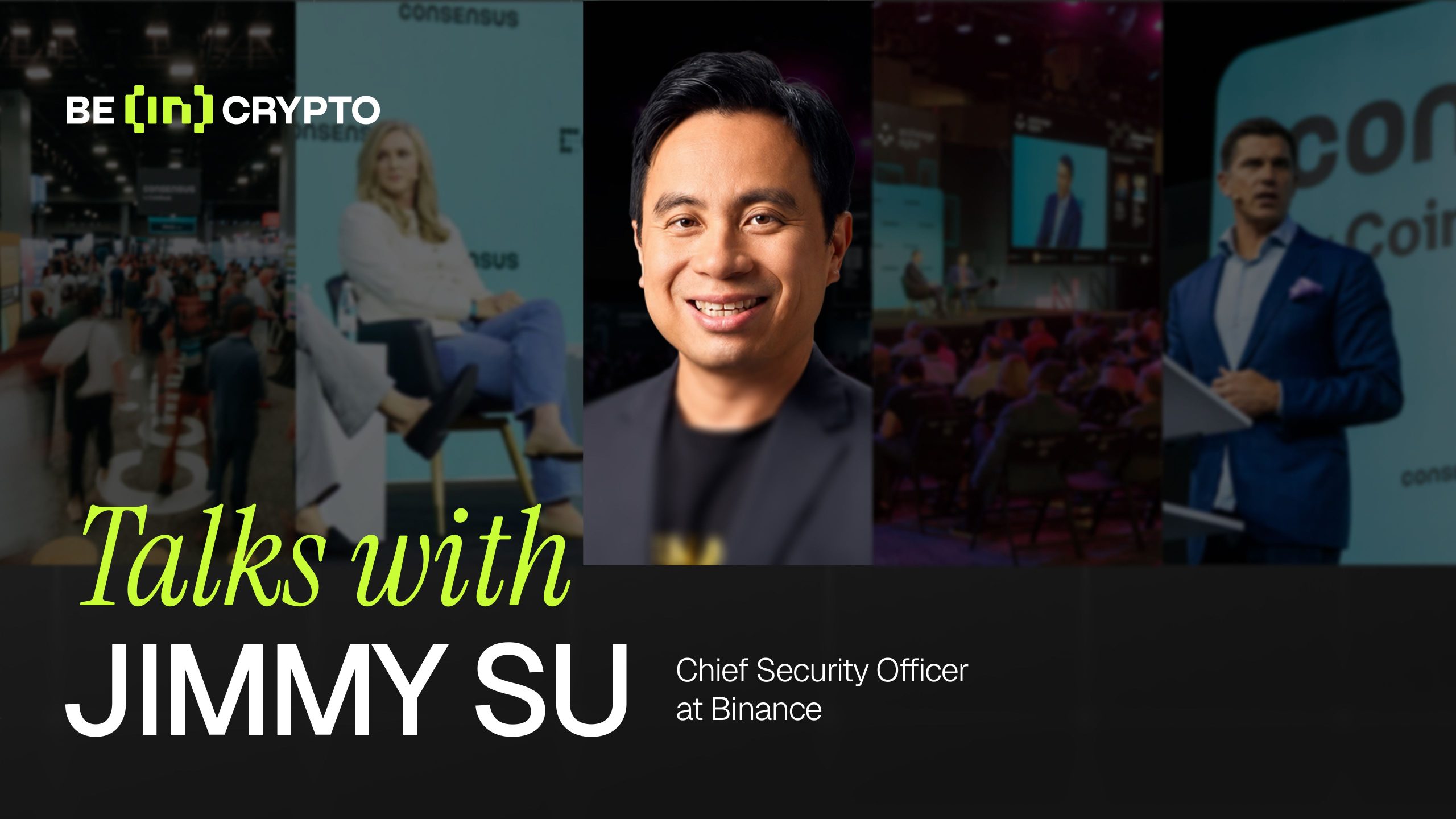
Crypto Adoption Meets AI Security: A Discussion with Binance Chief Security Officer Jimmy Su

From its early, rapid-growth stages, Binance has become the largest global player in the cryptocurrency brokerage space.
That position has given Binance a clear, pro-crypto voice worldwide as countries look to regulate and adapt to the growth and implementation of cryptocurrency assets.
At Consensus 2026 in Miami Beach, BeInCrypto met up with Jimmy Su, Chief Security Officer at Binance. We discussed the crypto market, Binance’s latest tools, and how it is adapting to institutionalization by traditional financial companies.
The 30,000 Foot View
In recent weeks, news broke that the US Senate would move on the Clarity Act. This legislation would create the regulatory rails to enable adoption by large financial institutions.
That helped to push cryptocurrencies higher in May, although prices are still well off of last year’s peak.
According to Su, even though crypto prices are trending higher over time, the real story is in increasing adoption itself:
“I don’t pay too much attention to the day-to-day market movements, but I do see more adoption in crypto, more rural use of crypto, like RWA, tokenizing different rural assets. Those are all moving in the right direction.
We have a five to ten year window and longer horizon within the assets, and I think it’s going well. We’re seeing a lot of the tradfi solution products and the crypto products moving into the same arena in the middle, where you are seeing crypto companies providing access to stock tokens, commodity tokens. And then you are seeing on the other side, tradfi providing more crypto services.”
Crypto Meets Oil
Binance has recently added significant new features to its platform.
One of the more interesting features is the addition of contracts to trade oil prices. That’s a sign that crypto companies are moving towards the middle, with features that trend towards tradfi. More tradfi features are likely to be added to the platform in the months ahead.
While that may mean less overall focus, it can also mean that cryptocurrency brokerages like Binance can grab a bigger market share:
“We are expanding into areas where we are attracting new interest in trading. That moves us into a place where we’re moving from crypto, there are more tradfi trading products so our competitor pool is getting bigger.”
Crypto Security In the Age of AI
As the Chief Security Officer of Binance, Su has been at the forefront of protecting user data and developing new tools to guard against the ever-increasing sophistication of criminals seeking to gain access.
Both the white hats and the black hats are increasingly turning to AI tools to identify threats – or create them.
Looking at the attacker side of things, AI tools are speeding up the size and scale of attacks. Per Su:
“Over the last six months, the adoption of AI has been expanding, not just in security, but all over our business. But especially in security, we see that it has both the advantages for the attacker and the defender.
On the attacker point of view, using the AI tools, they’re able to scale much faster.
What used to be needing a team of five or six red teamers to find vulnerability, now can be done with one person from my AI tool over a span of a weekend. So the time between the exploit and actually the coin attack is decreasing.”
AI Can Be Used Defensively Too
Typically, attackers in the security space can have a first-mover advantage. AI tools can speed that up. But defenders have access to similar tools as well. And the speed and sophistication of defensive AI tools can continue to thwart attacks.
AI may even be able to identify attack vectors and plug holes before they’re exploited, or recognize the start of an attack well before a human can see the pattern at play.
“On the defensive side, we see AI as a partner, as a SOC team member that we can partner with. It’s able to synthesize signals from different areas, different logs, email network on the endpoint device. So that helps us on the defensive side as well, so that we can look at the logs more broadly and more in depth and make it up just using our SOC team.”
Security Threat #1: Check Your Links
Regarding recent specific security threats, Su noted that malicious links in search engine results have soared, and the malware from those links could create a security breach:
“Recently, we’ve seen a lot of distribution of AI tools. Many of the searches that you see on the search engine actually return ad results that has been poisoned. And sometimes when the user is not careful, they’re looking just in the top of the screen. The ads are not so obvious, and they might be installing a malicious AI tool.
So that’s what we have caught in recent weeks. we have seen that users are actually installing AI tools that have malware in it, which would expose their credentials, including private keys, account credentials. So that’s a trend that we’ve seen.”
Security Threat #2: Wrench Attacks
Even if a crypto wallet is digitally secure, other threats exist. One is a so-called wrench attack, which involves physical violence to give up a digital wallet.
While such an attack may not be completely avoidable, it can be possible to lock a wallet and ensure that even if some information is compromised, your crypto holdings aren’t:
“We released a feature called Withdrawal Protection. This helps our users to have a control to specify the freeze for a certain amount of time in their withdrawal.
This is at the moment, the crypto withdrawal is at the highest risk. Because many times when you withdraw crypto, it’s irreversible. Let’s say you were doing ACH on Jack and Young, that’s much more reversible.
So we introduced this as a control, as a layer approach where the user gets to control when their withdrawal is frozen, so they get more time to recover in case they get into that potential.”
From Security to a Streamlined User Experience
AI tools can help balance security and protection with a seamless user experience. Binance’s growth and continued success has come from astutely managing this balance.
Su sees ways to further streamline the experience with AI tools:
“We are always looking for ways to balance the user experience with user protection. So sometimes the improvement you see is actually what you don’t see in the workflow.
For example, we are adding more AI in terms of learning about the context of our users, so that when either they are logging in or doing withdrawal, if we know they are on a trusted device, and the behavior of the user matches what they had before, then we will introduce fewer challenges so that the experience is smoother.
But the AI can also help us to spotlight users that have high-risk behavior, and that’s when we step up our challenges, such as using 2FA or biometrics or face recognition.”
Looking Ahead
Although Binance has added some significant features recently, there’s much more work that it can do.
And they’re not resting on their laurels, instead looking for more ways to streamline the user experience, keep systems secure, and do so with fewer resources thanks to AI. One area with some improvement ahead? Faster and better coding thanks to AI tools:
“We are using cloud code. So I think what we see is that from just being a tool to write code faster, test code faster, it seems to have a step up in this AI capability, where it’s able to synthesize the entire queue chain of an attack.
So that’s very promising. Because that would mean that from discovering vulnerability to all the way deploying in the real world, AI can do that independently. So in that case, it’s not just a tool, but it’s a very capable Red Team member that we can have as a partner.”
The post Crypto Adoption Meets AI Security: A Discussion with Binance Chief Security Officer Jimmy Su appeared first on BeInCrypto.

Asset manager Bitwise is set to launch an exchange-traded fund tracking Hyperliquid’s native HYPE token.
The ETF will start trading on May 15 under the ticker BHYP on the New York Stock Exchange (NYSE).
Capitalizing on Hyperliquid’s Growth and Dominance
Bitwise said that BHYP is the first HYPE ETF to use an in-house staking infrastructure, with the firm adding that the fund was designed to give investors a convenient and low-cost way to participate in Hyperliquid’s growth. Reacting to the development, Galaxy’s head of DeFi, Marc Antonio, wrote, “Damn Matt Hougan and Bitwise are cooking.”
DeFi Llama data shows that Hyperliquid makes up about 60% of global on-chain perpetual DEX open interest, with the network being capable of processing up to 200,000 orders per second while maintaining a strong reliability track record. Bitwise believes that because of this, the platform is on the road to becoming one of the biggest beneficiaries as capital markets continue moving on-chain.
Matt Hougan, Chief Investment Officer at Bitwise, said the chain proved its relevance during a period of geopolitical tensions earlier this year, when traditional markets were closed, and traders turned to it for price discovery.
“Hyperliquid has emerged as one of the most compelling investment opportunities in crypto today,” said Hougan.
Additionally, Hype has risen to become the tenth largest crypto asset in the world since launching two years ago, with a market cap of over $11 billion.
“Hyperliquid’s token is explicitly designed so that rising trading activity on the Hyperliquid platform directly benefits token holders. This has translated into historically strong returns,” he added.
Bitwise Shares Fees
The fund’s prospectus shows that BHYP carries a 0.34% sponsor fee, which Bitwise plans to waive for the first month on the first $500 million in assets. The company also clarified that the product hasn’t been registered as an investment firm, meaning it doesn’t have the same protections as ETFs and mutual funds.
Earlier in the week, 21Shares launched a similar product tracking HYPE dubbed THYP, which pulled about $1.8 million in trading volume on its first day, a feat described by analyst James Seyffart as “nothing too crazy.”
It has since racked up $7.42 million in cumulative net inflow, with data from SoSoValue showing that yesterday’s flow alone came in at nearly $5 million.
The post Bitwise Set to Launch Hyperliquid (HYPE) ETF appeared first on CryptoPotato.

Referee John Beaton put under police surveillance after penalty controversy in Celtic win over Motherwell, say SFA

Justin Sun’s Liberland has given Vitalik Buterin a medal

Dave Allen weighs lightest in 7 years to produce ‘biggest upset in British boxing history’ against Hrgovic

Manchester United reach agreement with Casemiro over contract clause amid transfer speculation

US brings back mandatory military draft registration

Steven Gerrard disagrees with Gary Neville over ‘shock’ Chelsea and Arsenal claim | Football


-

 Fashion4 days ago
Coffee Break: Travel Steam Iron
-

 Fashion5 days ago
What to Know Before Buying a Curling Wand or Curling Iron
-

 Politics4 days ago
What to expect when you’re expecting a budget
-

 Tech6 days ago
Auto Enthusiast Carves Functional Two-Stroke Engine from Solid Metal
-

 Politics6 days ago
Politics Home Article | Starmer Enters The Danger Zone
-
 Business6 days ago
Ignore market noise, India’s long-term story intact, say D-Street bulls Ramesh Damani and Sunil Singhania
-

 Tech4 days ago
GM Agrees To Pay $12.75 Million To Settle California Lawsuit Over Misuse Of Customers’ Driving Data
-

 Crypto World5 days ago
CZ says US crypto rivals tried to block Trump pardon
-

 Crypto World6 days ago
PROS explodes 48% as Upbit and Bithumb listings ignite demand
-

 Tech4 days ago
GM agrees to $12.75M California settlement over sale of drivers’ data
-

 Entertainment7 days ago
YNW Melly Denied Bond Again Ahead Of Double Murder Retrial
-

 Crypto World7 days ago
Kraken Parent Seeks OCC Charter, Signaling Regulated Banking Access
-

 Sports7 days ago
Why Nathan Mackinnon Remains the Hart Trophy Favourite over Connor McDavid and Nikita Kucherov | NHL
-
Crypto World3 days ago
Bitcoin Suisse expands with Digital Asset License and Investment Business Act Registration Approval in Bermuda
-

 Entertainment7 days ago
Bethenny Frankel Says She Loves ‘Torturing’ Men
-

 Sports7 days ago
After Waka Waka, Shakira now drops first teaser for FIFA WC 2026 song | FIFA World Cup 2022
-
 Crypto World7 days ago
Solana UFO Meme Coins Surge After Pentagon Reveals Alien Files
-

 Politics3 days ago
Pakistan to enter Chinese capital market as war inflation bites
-

 Entertainment7 days ago
Young and the Restless Next Week: Cane & Matt Both Arrested in Shocker!
-
Crypto World7 days ago
Pi Network Hits 421K Mainnet Nodes Ahead of Protocol 23 Smart Contract Launch
You must be logged in to post a comment Login