

Crypto World
Coinbase USDF launch gives Flipcash a stablecoin edge



Coinbase and Flipcash have launched USDF, a Solana-based custom stablecoin fully backed by USDC, as Coinbase expands its branded stablecoin infrastructure business.
Summary
- Coinbase powers USDF on Solana, giving Flipcash a USDC-backed settlement asset for app currencies now.
- Flipcash chose Coinbase for reserves, onchain settlement, fiat access, and scalable USDC-linked rewards for users.
- Custom Stablecoins puts Coinbase deeper into branded dollar rails as stablecoin payment competition grows fast.
Coinbase said on May 20 that USDF was created through its Custom Stablecoin platform. The token is issued on Solana and fully backed by USDC. Coinbase described the launch as part of its effort to make stablecoin issuance easier for businesses.
Flipcash will use USDF inside its app, where users can create fixed-supply digital currencies. Each currency on the platform will be priced and settled in USDF, giving the app a single dollar asset for buying, selling, and using those currencies.
Coinbase targets branded stablecoin demand
Coinbase’s Custom Stablecoins product lets companies launch branded digital dollars without building the full blockchain, reserve, and settlement system themselves. The company says the product allows partners to issue stablecoins backed 1:1 by USDC and other dollar stablecoins.
The product page says Coinbase manages issuance, reserves, smart contracts, and onchain operations. It also says custom stablecoins are redeemable 1:1 with USDC, while partners can use the tokens for payments, treasury, rewards, and DeFi use cases.
“We launched USDF with Coinbase because they delivered everything we needed,” Flipcash founder and CEO Ted Livingston said in a quote published on Coinbase’s Custom Stablecoins page. He said Coinbase helped support the consumer experience Flipcash wanted to build.
Coinbase expands USDC use across payments and settlement
Related crypto.news coverage in December reported that Coinbase’s Custom Stablecoins service allows businesses to issue branded, USDC-backed tokens through Coinbase Business. That report said the service covers issuance, custody, and compliance support for participating companies.
Coinbase has also been growing USDC use in payments and settlement. Separate crypto.news coverage said Nium integrated Coinbase infrastructure to support USDC-based cross-border payments across more than 190 countries. That setup allows businesses to fund payouts in USDC and settle in stablecoins or local currencies.
Stablecoin infrastructure competition grows
USDF comes as more companies build stablecoin payment and settlement products. Coinbase is not only offering a stablecoin asset. It is offering the infrastructure that lets other companies place their own brand on a dollar-backed token.
The model places Coinbase in a growing market for white-label stablecoin tools. Businesses can use these systems to issue branded digital dollars while relying on larger providers for custody, reserves, access to fiat rails, and onchain operations.
For Flipcash, USDF gives the app a dollar unit for its user-created currencies. For Coinbase, the launch adds another live example of its stablecoin infrastructure strategy as companies test branded digital dollars for consumer apps, payments, and settlement.

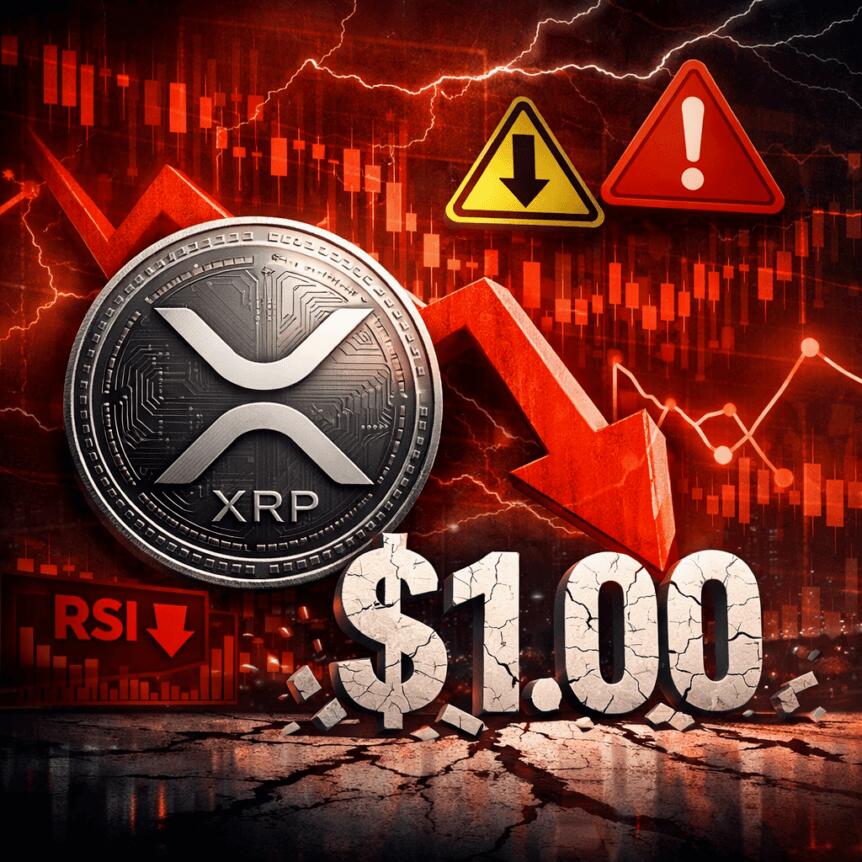
XRP’s price action has cooled into a setup that several traders are watching for a potential return below the $1 level. On the four-hour chart, a classic head-and-shoulders pattern and a parallel-bear flag are emerging, pointing to a sub-$1 downside scenario if selling pressure intensifies.
Analysts note that bullish arguments are not as compelling at the moment, with momentum gauges suggesting limited upside unless XRP can clear key resistance. At the same time, on-chain metrics are flashing caution, implying that holders could be sitting on limited profits and that weak demand might precede a renewed price dip.
Key takeaways
- XRP appears to be forming a head-and-shoulders pattern on the four-hour chart, with a neckline near $1.09. A confirmed breakdown could target roughly $0.99, about a 10% slide from current levels.
- Another bearish signal comes from a bear-flag formation on the same timeframe, with a measured target near $0.94 if the price breaks below the lower trendline around $1.10.
- The relative strength index hovers around 43, indicating tepid momentum that could leave XRP vulnerable to further downside unless buyers step in above key thresholds.
- On-chain activity supports a cautious stance: MVRV pricing bands point to the lower green zone near $0.96 as a potential magnet in past downturns, suggesting room for downside before a material reversal materializes.
Head-and-shoulders: a looming neckline test and risk of a sub-$1 scan
Since the first days of June, XRP has displayed the characteristics of a head-and-shoulders pattern on shorter timeframes. The setup features a central peak (the head) flanked by two lower peaks (the shoulders) and a common neckline that has been near the $1.09 area on the latest observations. In classic technical analysis, a decisive break below the neckline serves as a bearish confirmation and typically sets a target equivalent to the pattern’s height projected downward from the breakdown point. In this case, the implied downside targets hover around the $0.99 mark, translating to roughly a 10% drop if the pattern resolves as predicted.
On the upside, a sustained move above the right shoulder—roughly at $1.12—could invalidate the pattern, especially since that level aligns with the 20-period exponential moving average on the four-hour chart. A clear break above that resistance would open the door to a potential rebound toward the next moving-average hurdle near $1.15, which is close to the 50-period EMA and could offer a short-term rally catalyst.
Overall, traders watching the H&S formation see a clear bifurcation: a breakdown below $1.09 could usher in a sub-$1 test, while a bullish reclaim above near-term resistance could revive the case for a measured move toward the next EMA cluster around $1.15 to $1.20.
Bear flag adds to the sub-$1 downside case and key levels to monitor
Complicating the near-term outlook is a bear flag pattern on the same four-hour window. After a sharp initial sell-off, XRP appears to be consolidating within a rising channel, with the lower boundary currently flirting with $1.10. A sustained weekly close below this line would reinforce the bearish narrative and suggest that the prior downtrend could resume.
Applying the standard target rule for bear flags, the consolidation breakout could point toward around $0.94, representing a roughly 15% decline from current readings. The move comes with confirmation risk: a close above the upper boundary of the flag—around $1.18 to $1.20—would reframe the outlook toward a renewed attempt at higher levels, particularly if momentum accelerates through the region near the 50-period EMA.
The current momentum picture mirrors a cautious stance: the RSI sitting in the low 40s underscoring a lack of bullish conviction. Yet the chart structure leaves room for a shift if buyers reclaim the area just over $1.12, potentially stalling the bear-flag downside and pushing XRP back toward the higher end of the immediate range.
On-chain signals align with a cautious stance, pointing toward $0.96 in store if selling intensifies
Beyond price pattern analysis, on-chain data adds texture to the risk assessment. The MVRV (Market-Value-to-Realized-Value) framework indicates where holders may be sitting relative to the price at which coins last moved on-chain. The bands show that while XRP has rooms to fall, the next meaningful downside target sits near the lower green zone around $0.96. Historically, this band has acted as a magnet during major downturns, with XRP dipping toward or below this level in prior cycles before finding a more definitive base.
In practical terms, if market participants do encounter weakness that leads to a test of the $0.96 area, it could be accompanied by weaker transaction demand and selling pressure as holders re-assess risk versus potential longer-term relief rallies. By contrast, a sustained push below this band could invite further downside, while a decisive move back above the upper green boundary would be a signal that buyers are re-entering the market with more conviction.
For traders looking for corroboration, the latest pattern readings line up with other market signals. Earlier coverage highlighted that XRP’s transaction demand had cooled, underscoring a broader narrative of cautious participation as traders focus on key support zones. See related coverage discussing how demand dynamics around sub-$1 and $0.65 zones have influenced sentiment and liquidity dynamics in recent sessions.
All told, the confluence of price-pattern warnings, momentum readings, and on-chain stress signals reinforces a cautious stance toward XRP in the near term. The major near-term milestones remain the $1.09 neckline, the $1.12–$1.15 cluster of resistance, and the lower-bound targets near $0.96 to $0.99 depending on how the price reacts to the immediate supports and moving averages.
Where the market goes next will hinge on the balance between sellers pressing toward the neckline and buyers defending the critical thresholds above. If buyers manage to sustain a break above the $1.15 zone and clear the $1.20 area, the path could tilt toward a more constructive setup; otherwise, the bears will likely test the suspected sub-$1 levels in the near term.
What to watch next: monitor the neckline around $1.09 for a potential breakdown or a sticky hold, the 20- and 50-period EMA levels near $1.12–$1.15 for early validation or invalidation of the patterns, and the lower MVRV band near $0.96 as a potential magnet for price weakness. Investors should also keep an eye on on-chain demand signals to gauge whether capitulation or renewed buying interest could accompany any technical break.
For context on related dynamics, previous reporting highlighted XRP’s evolving on-chain demand and its impact on sentiment around critical support levels, offering a reminder that price action on the charts often aligns with shifts in on-chain activity and market participation.
As the week unfolds, traders will be weighing the immediate risk of a breakdown through the neckline against the possibility of a bounce that could reframe XRP’s short-term trajectory. The coming sessions will be telling for whether the sub-$1 narrative holds, or if the market finds footing above resistance and reopens room for a corrective move higher.
Elon Musk Grok AI just looked at a Bitcoin chart down more than 50% and predicts it’s a classic accumulation zone, targeting $150,000 to $225,000 by the end of 2026.
With BTC price trading around $62,800 right now, that is a 2.5x to 3.5x call built on the idea that the worst of the pain is also the best of the opportunity.
The core thesis is structural scarcity meeting relentless demand. The read is that Bitcoin is not just dipping, it is setting up a supply and demand supercycle.
The post-halving supply shock chokes new issuance while spot ETFs, corporate treasuries, and potential Strategic Bitcoin Reserve momentum all pull on a shrinking float.
When supply tightens, and demand intensifies at the same time, price tends to rise violently to the upside. That is the engine behind the whole call.
The bull case stacks those catalysts into a recovery. Post-halving scarcity, relentless institutional demand through spot ETFs, accelerating corporate treasury adoption, and pro-crypto regulatory tailwinds drive a strong recovery and new highs.
The target lands at $150,000 to $225,000 by the end of 2026, a 2.5x to 3.5x move as liquidity improves and nation-state and corporate buying intensifies. This is the scenario where the dip gets remembered as the last cheap entry before maturation.

The bear case is mild by comparison. Prolonged macro headwinds could keep BTC range-bound between $50,000 and $75,000 into late 2026. But the institutional floor and repeating cycle patterns make a deep bear market unlikely from here.
That is the key distinction. This reads like a correction inside a bigger uptrend, not the start of a multi-year winter. Overall, the setup strongly favors bulls, and the dip looks like a prime buying opportunity.
Discover: The best pre-launch token sales
Bitcoin Price Prediction: A Supply Shock Meeting A Demand Supercycle
Now the chart. BTC is on the weekly and price sits at $62,857 after a sharp drop from the $126,000 all-time high set in October 2025.
The structure is a deep correction, more than 50% off the top, with price now sliding into a major prior accumulation shelf. Pattern-wise, this is a return to the wide $55,000 to $70,000 band that served as the launchpad before the last big leg up.
Key support sits at $60,000, with the next floor near $55,000 and deeper demand around $50,000. Resistance stacks at $70,000, then $80,000, and the heavier ceiling at $90,000.
RSI is reading 33.97 with its signal line at 40.40. So momentum is sitting well below its average and pressing toward oversold on the high timeframe.
That wide gap of about 6.4 points shows real selling pressure short term, but on the weekly, this kind of stretch has marked major cycle lows before.
When RSI curls back above that 40.40 signal, it flips the long-term read bullish again. Tie it together, and the chart is sitting right on the accumulation zone that has historically launched the next leg.
Hold this $55,000 to $70,000 band and the path back toward six figures, and that $150,000 to $225,000 target opens up exactly like the prediction lays out.
Discover: The best pre-launch token sales
You Might Like What Grok AI Predicts About LiquidChain
Large caps are not in trouble. They are just out of the room. Bitcoin, Ethereum, and XRP have been testing the same ceilings for weeks with nothing breaking through.
Every macro catalyst has a new arrival date. Every institutional wave has a new quarter attached to it. Holding assets where the next leg depends entirely on someone else’s decision is not a trade. It is a waiting room.
The money that wins cycles never announces where it is going.
The capital that actually moves in cycles relocates before the destination has a name.
Small market cap infrastructure plays operate on physics that large caps simply cannot replicate. A rotation that would not register as a rounding error at Bitcoin’s scale can reprice an undiscovered project by multiples.
The opportunity lies in the distance between what something is genuinely worth and what the market has assigned it so far. That distance shrinks to zero the moment discovery happens. Before that moment, it is fully capturable.
Multi-chain fragmentation is one of the most consistently expensive problems in DeFi, and it has never been solved. Bitcoin, Ethereum, and Solana exist as completely isolated systems. No shared architecture. No native interoperability. Every time value moves between them, the disconnection extracts its cost in fees, slippage, and failed transactions. That cost hits every single crossing every single time.
LiquidChain makes the crossing free as Grok AI predicts. All 3 networks inside one execution environment. Single deployment. Complete ecosystem access. No tax on any interaction.
The presale is at $0.01454 with just over $830,000 raised. Early and undiscovered.
Execution is unproven. Adoption is unknown. Established assets offer predictability toward a ceiling that the market already sees. LiquidChain is an entry point that does not exist once the market finds it.
Explore the LiquidChain Presale
The post Most Traders Will Scroll Past This Grok AI Bitcoin Predicts, Big Mistake appeared first on Cryptonews.
Crypto World
Exclusive: Cardano Foundation Recasts Itself as Active Adoption Driver as Hoskinson Pulls Back
The Cardano Foundation is stepping out from behind the blockchain's technical curtain to actively push adoption and seed its decentralized finance markets, a reversal of the supporting role it held for most of the network's history, Chief Executive Officer Frederik Gregaard said. "We believe that… Read the full story at The Defiant
Crypto World
Canton Network developer Digital Asset raises $355 million to bring capital markets onchain


Digital Asset, the development firm behind the Canton Network (CC) blockchain used by major banks and trading firms, said Thursday it closed a $355 million fundraising round to back its efforts to bring capital markets onchain.
The investment was led by a16z, with the participation of global institutions including ABN Amro, Apollo Funds, BNP Paribas, Citadel Securities, HSBC, SBI Group and the Abu Dhabi Investment Authority through a subsidiary.
The amount raised beat the target of $300 million at a $2 billion valuation that was reported last month.
The investment comes as traditional financial firms increasingly back blockchain infrastructure built specifically for regulated markets. Tempo, the payments chain developed by Stripe and Paradigm, reportedly raised $500 million last year at a $5 billion valuation. Circle Internet (CRCL), the stablecoin issuer behind USDC, raised $222 million for its Arc blockchain at a $3 billion valuation, drawing backing from BlackRock, Apollo Funds, a16z crypto and ARK Invest.


GameStop no longer owns the keys to the bitcoin (BTC) that its shareholders celebrate as one of its coolest and most valuable assets.
According to its latest quarterly SEC filing, CEO Ryan Cohen has pledged all 4,709 BTC to Coinbase Credit.
Workers employed by Coinbase CEO Brian Armstrong, not Cohen, now have rights to “rehypothecate, commingle, or unilaterally sell the pledged BTC” worth approximately $300 million at current prices.
GameStop, the videogame retailer-turned-meme stock and digital asset treasury company, bought 4,710 BTC for $500 million in mid-2025, at an average cost above $106,000 per coin.
For context, BTC was trading at $62,000 today.
As its BTC holdings declined in value by hundreds of millions of dollars, GameStop got creative.
In late 2025, the company pledged all 4,709 of those coins to Coinbase Credit as collateral for a covered-call options strategy. It was a way to squeeze out some premium income out of an otherwise idle treasury asset.
The catch to selling a call, however, is that you sell the right to call away your collateral, as the name suggests quite obviously.
Even worse than a typical covered call
Although a typical stockholder retains stock in their brokerage account after selling an out-of-the-money covered call, Coinbase’s terms are far more aggressive. GameStop has already transferred its BTC to Coinbase’s subsidiary.
BTC, unlike a stock, is a strict bearer asset. Whoever possesses private keys controls the coins outright.
Therefore, in the fine print, Coinbase now has the right to reuse, mix, or sell the pledged coins at will, with GameStop legally disclosing that “control of the pledged BTC transferred to the counterparty.”
Accounting rules then forced the company to wipe the BTC off its books and replace it with a digital assets “receivable,” a contractual IOU for an equivalent amount of BTC in the future.
Read more: Is a Gamestop-style gamma squeeze fueling bitcoin’s rally?
Worth it
GameStop insists that none of this really matters all that much. As recently as May 2 it told investors, “economic exposure is consistent with direct ownership of the underlying BTC.”
After all, it’s not like BTC would ever quickly rally above the call option’s strike price and be called away from GameStop, right?
When GameStop first disclosed its covered call strategy, the strike prices for its covered calls ran between $105,000 and $110,000. By May 29, the strike price for the same 4,709 coins had collapsed to a far riskier $80,000 — much closer to the actual price of BTC and therefore more likely to become exercisable.
By sheer luck, BTC didn’t happen to be trading above $80,000 through May 29, so GameStop’s call options expired worthless, allowing Cohen to keep his premiums.
The cash flow “strategy” is working.
Even though GameStop’s 4,710 coins are worth roughly $200 million less than the company paid to initially acquire them, Cohen got lucky with BTC staying below $80,000 by May 29, and collected a little bit of options premium.
GameStop renewed its covered call options with Coinbase after its May 29 win, so its BTC is still subject to similar rehypothecation and unilateral liquidation provisions by Coinbase today.
Got a tip? Send us an email securely via Protos Leaks. For more informed news and investigations, follow us on X, Bluesky, and Google News, or subscribe to our YouTube channel.

Quick Summary
- SpaceX prepares for potential IPO with approximately $1.75 trillion valuation, possibly becoming history’s largest market debut
- Oracle (ORCL) shares tumbled following announcement of substantial AI infrastructure investments and financing plans
- Headline inflation in the United States surged past 4%, primarily fueled by escalating energy costs
- Crude oil prices climbed amid escalating geopolitical tensions with Iran, intensifying inflation worries
- OpenAI submitted confidential IPO paperwork, potentially transforming investor access to artificial intelligence companies
Today delivered multiple significant developments that forced investors to reassess positions across AI infrastructure, inflation trends, and upcoming public offerings.
SpaceX Pursues Unprecedented Public Offering
The SpaceX initial public offering has become the focal point of financial discussions. Market watchers anticipate the aerospace giant will debut with an approximate $1.75 trillion price tag, positioning it as the most valuable IPO ever executed.
Investor appetite appears robust. Reports indicate some retail traders have liquidated holdings specifically to allocate capital toward this anticipated listing.
Skepticism exists, however. Certain market observers are raising red flags regarding potential insider transactions and whether the astronomical valuation already incorporates multiple years of projected expansion.
Previous high-profile technology IPOs have frequently underperformed following initial trading sessions. The SpaceX market entry is poised to become a landmark financial moment in 2026, though post-listing trajectory remains uncertain.
Oracle (ORCL) Shares Tumble Despite Strong Contract Wins
Oracle delivered impressive operational results and secured significant artificial intelligence partnerships. Nevertheless, shares experienced a substantial decline.
The culprit: ambitious capital expenditure plans. Oracle disclosed intentions to deploy tens of billions toward AI infrastructure buildout. The company also announced plans to secure considerable debt and equity financing for these initiatives.
Market participants responded unfavorably. While artificial intelligence enthusiasm persists, mounting pressure exists for corporations to demonstrate that substantial capital outlays will translate into meaningful profitability.
Oracle’s stock decline signals that Wall Street is increasingly scrutinizing AI investment returns rather than merely celebrating contract announcements.
Inflation Surges Past 4% Threshold
U.S. headline inflation jumped beyond 4%, surprising market participants.
Energy price increases drove the acceleration. This development suggests interest rates may remain at elevated levels longer than previously anticipated by investors.
This carries implications for equities, particularly technology and growth-oriented companies, which demonstrate heightened sensitivity to rate trajectory expectations. Inflation data has emerged as a critical variable influencing market movements on a weekly basis.
Crude Prices Jump on Geopolitical Uncertainty
Escalating geopolitical tensions centered on Iran propelled oil prices upward during trading. Climbing energy expenses compound inflationary pressures while generating broader economic growth concerns.
Energy sector equities benefited from the price movement. Conversely, industries with significant fuel dependencies, including transportation and manufacturing, confront challenges if elevated pricing persists.
Sustained oil price strength could influence Federal Reserve monetary policy deliberations.
OpenAI Submits Confidential IPO Documentation
News surfaced today that OpenAI has filed confidential paperwork for a public offering. Anthropic may pursue a comparable strategy.
Combined, these public listings could provide investors with direct artificial intelligence company exposure for the first time, eliminating reliance on indirect investments through Nvidia, Microsoft, or Alphabet.
Certain analysts anticipate this development could spark sector rotation within technology, with investment capital shifting from established AI stocks toward newly public entities.
An OpenAI IPO would rank among the most substantial technology market debuts in history should it proceed.

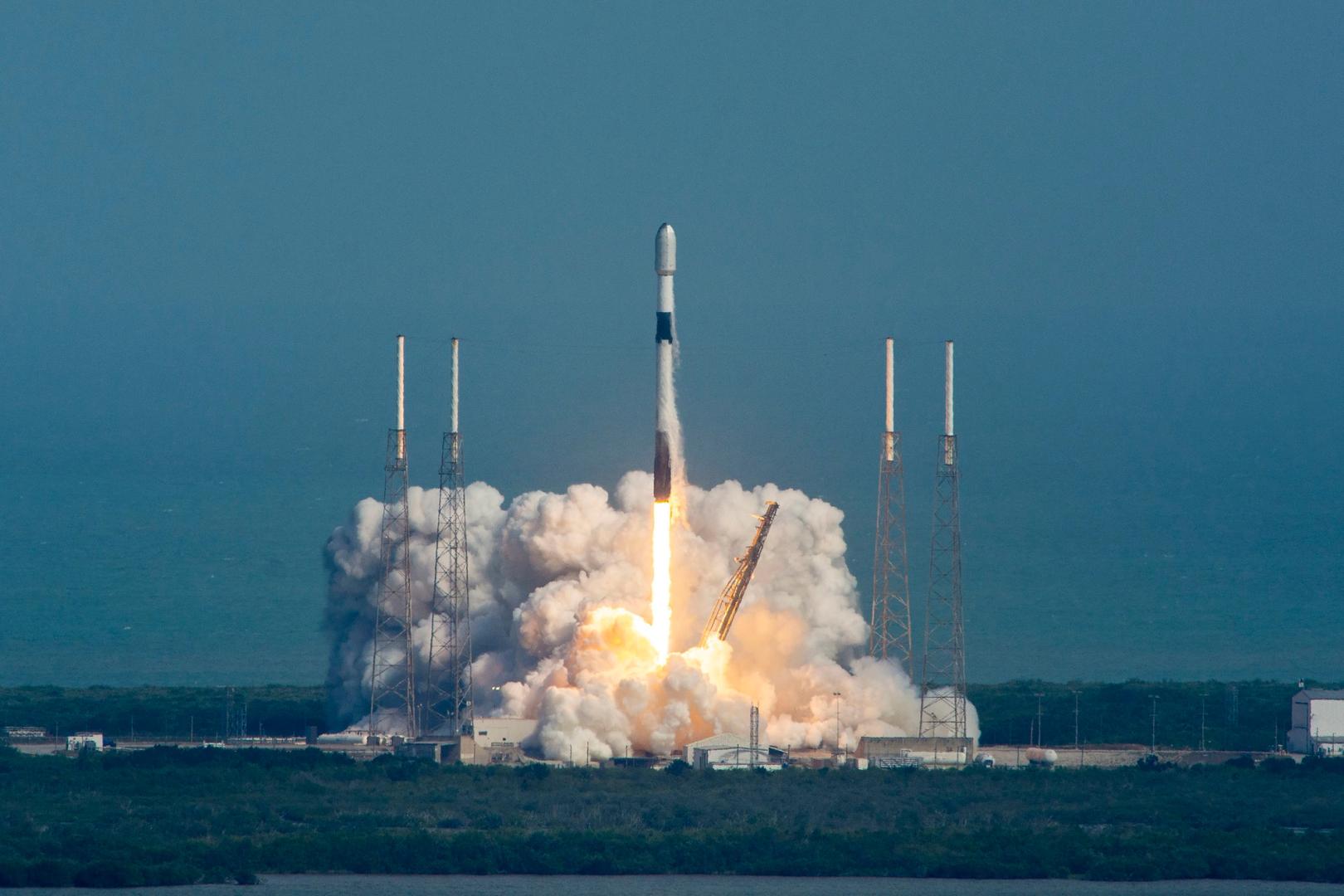
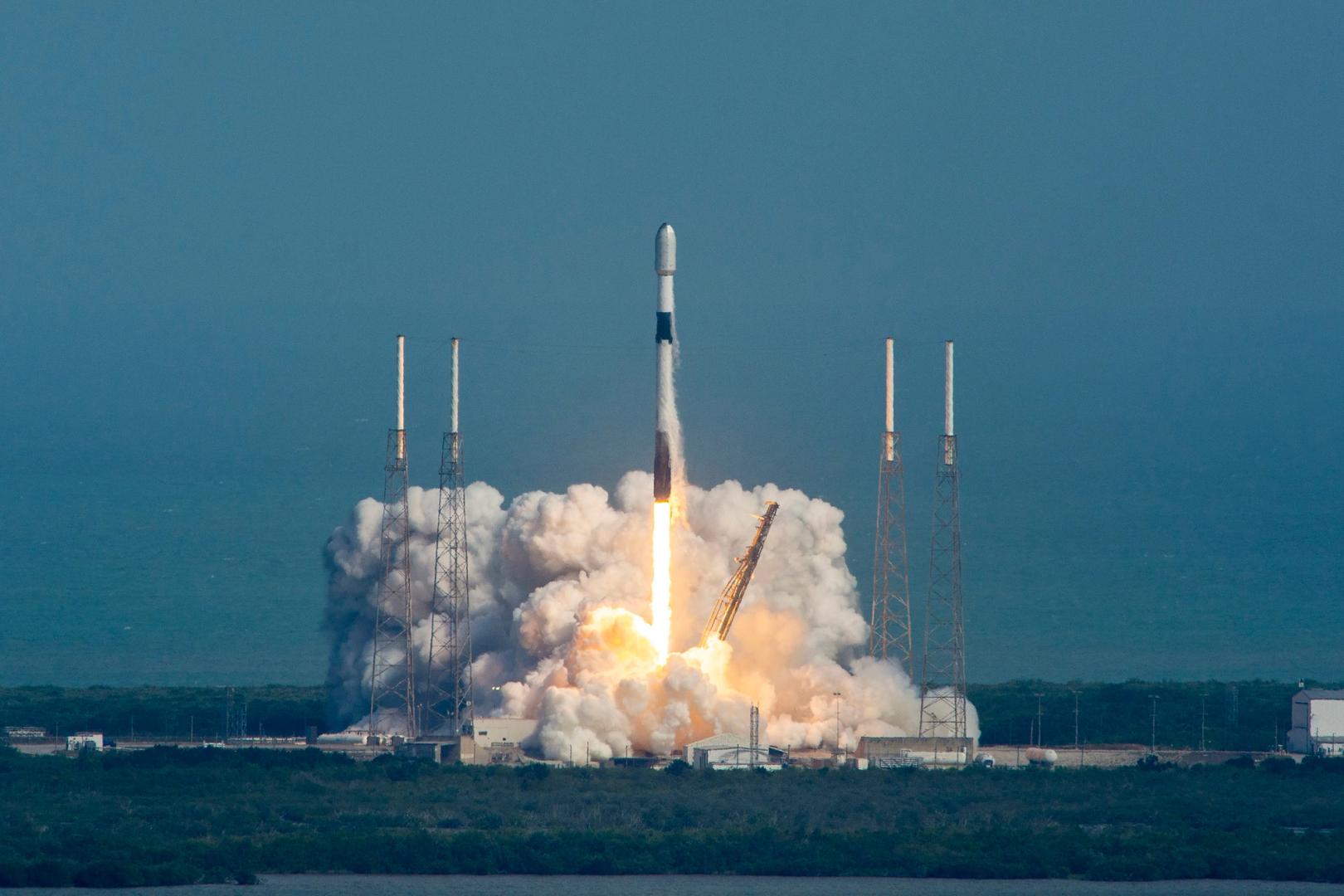
SpaceX (SPCX) shares will begin trading on Solana the same day the company is expected to list on Nasdaq, according to Sunrise, a tokenization infrastructure provider, and Backpack Securities, a regulated brokerage and crypto trading platform, which are launching a tokenized version of the stock called SPCX.
The token, issued by Backpack, represents ownership of underlying SpaceX shares and can be redeemed for those shares through Backpack’s brokerage platform. The firms say eligible shares can also be converted back into tokens, creating a bridge between traditional brokerage accounts and blockchain-based markets.
The launch attempts to bring newly listed U.S. equities onchain from day one. Backpack says SPCX holders will have a direct redemption path to the underlying security.
SPCX will trade on Solana around the clock, including outside traditional market hours. The token can be held in self-custody wallets and traded across supported Solana-based venues.
The announcement comes as interest in tokenized real-world assets continues to grow across the crypto industry. Stablecoins have become one of blockchain’s most successful use cases, and several firms are now betting that equities could follow a similar path if tokenized shares can be made accessible to a global investor base.
Crypto World
Big banks are ditching private blockchains to build tokenized cash networks on public infrastructure


Banks are focusing on pulling stablecoins and tokenized forms of more traditional financial instruments into one integrated package to meet growing institutional demand for multi-asset flexibility.
Rather than waiting for a single winner to emerge, large asset managers and corporate treasuries are demanding a multi-instrument setup in which stablecoins, tokenized bank deposits and tokenized money market funds all run on the same infrastructure.
“The demand from institutional clients is consistent: they are not waiting for any single instrument to prevail,” Thomas Eichenberger, chief strategy officer and deputy group CEO at Swiss-based digital asset bank Sygnum, told CoinDesk on Thursday in an email.
“They are asking how tokenized deposits, regulated stablecoins, and tokenized money market funds can be combined and made interoperable, so a treasury function can move between them — permissioned settlement, 24/7 cross-border flows, yield with on-demand liquidity — under one regulatory framework they already trust,” he added.
Sygnum, which describes itself as the world’s first digital assets bank, partnered late last year with Swiss banking powerhouse UBS and PostFinance, a subsidiary company of the state-owned Swiss Post, to test blockchain payments between institutions on Ethereum.

Hong Kong-based fintech Reap has partnered with identity verification and anti-fraud platform Sumsub to strengthen its onboarding and compliance infrastructure as the company expands into new international markets.
The collaboration will allow Reap to automate Know Your Customer (KYC) and verification processes for both business clients and end cardholders, helping the company maintain regulatory compliance while delivering a seamless user experience across jurisdictions.
Reap, which specializes in stablecoin-powered cards, cross-border payments, and financial infrastructure for businesses, has been rapidly expanding beyond the Asia-Pacific region. As regulatory requirements continue to evolve across different markets, the company is seeking scalable compliance solutions that can support global growth.
According to Reap’s Head of Legal, Risk and Compliance, Darryl Wan, onboarding plays a critical role in customer experience and must remain both efficient and compliant regardless of where users are located.
Through Sumsub’s API-first compliance platform, Reap can configure onboarding workflows based on customer type, geographic location, and risk profile. The system enables localized verification requirements while maintaining consistent compliance standards across all markets.
One of the key components of the partnership is Sumsub’s Reusable KYC technology. The feature allows users who have previously completed verification through Sumsub to avoid repeating the same identity checks and document submissions when onboarding with new services using the platform.
The approach is designed to reduce friction while preserving compliance with anti-money laundering (AML) and counter-terrorist financing regulations.
Sumsub’s infrastructure supports verification of more than 14,000 identity document types from over 220 countries and territories. Combined with its liveness detection technology, the platform enables identity verification within seconds, helping businesses streamline onboarding without sacrificing security.
Penny Chai, Vice President APAC at Sumsub, said the partnership reflects the growing need for trusted digital identity solutions capable of operating across fragmented regulatory environments.
As Reap continues expanding its stablecoin-based financial services globally, the company plans to further automate onboarding and verification processes, ensuring its compliance framework can support long-term growth and new product launches.
Founded in Hong Kong, Reap employs approximately 300 people worldwide and focuses on bridging traditional finance and digital assets through stablecoin-native financial infrastructure. The company reported processing billions of dollars in stablecoin-funded transaction volume during 2025.
The partnership highlights the increasing importance of scalable identity verification and compliance technologies as stablecoin-powered financial services continue to gain traction globally.
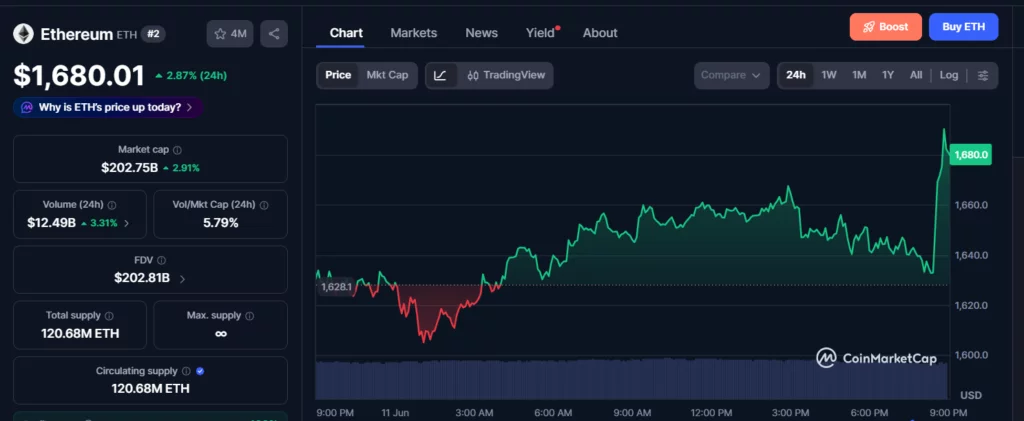
During today’s Asian trading session, Ethereum opened at $1628.
Summary
- Ethereum price climbed 2.87% to $1,680 after a late-session rally.
- CryptoQuant data shows exchange supply fell to 14.5M ETH.
- Staking, private wallets, and treasury holdings reduced exchange balances.
The opening price was at lower levels before the channel turned and traced an upward trend of highs and lows. This opening price has made market participants weigh in on the next targets as exchange supply hits low levels.
Ethereum price jumps 2.87% as late rally lifts price to $1,680
Tracking the ongoing price trend at the time of press, CoinMarketCap data reveals that Ethereum traded at $1,680.01, posting a 2.87% gain over the past 24 hours. The chart showed a volatile session that developed into a broader upward trend. Price activity remained under pressure during the early hours, with Ethereum falling below the $1,620 region before finding support and stabilizing. After that decline, the market gradually recovered and reclaimed lost ground through a steady sequence of higher moves.
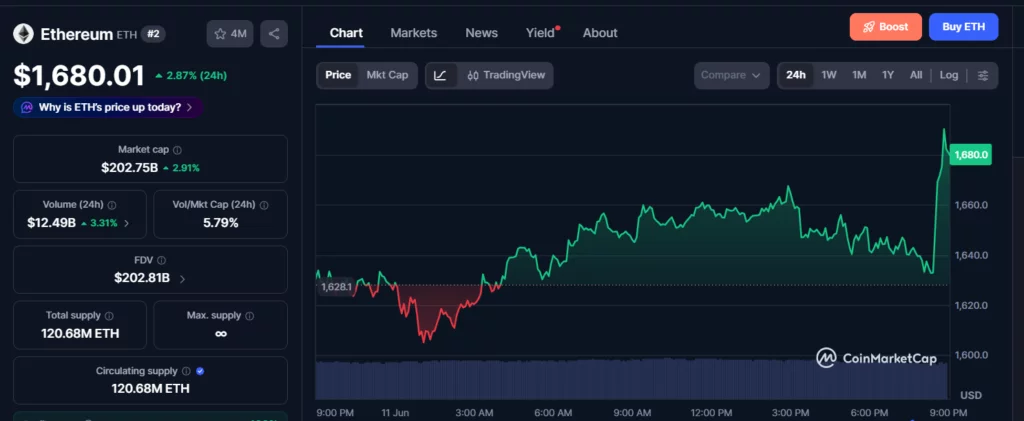
Source: CoinMarketCap
Momentum strengthened during the morning period as Ethereum pushed above $1,640 and continued climbing. The advance extended through several intraday swings, with price maintaining a generally positive structure despite short pullbacks. By midday, Ethereum price traded near the $1,660 area and held most of its gains. The trend remained constructive throughout the afternoon, although price movements became more uneven and ranged within a relatively narrow band.
Later in the session, the Ethereum price briefly retreated from local highs and moved lower toward the mid-$1,630s. The decline proved temporary as the market reversed sharply near the end of the period. A strong late-session rally lifted the Ethereum price above previous intraday levels and drove a rapid breakout toward $1,690. Price then eased slightly from that peak and settled around $1,680, ending the session near its highest levels of the day.
Ethereum exchange supply drops to a record low at 14.5 million ETH
The ongoing Ethereum price trend comes at a time when Ethereum exchange reserves have fallen to a record low of 14.5 million ETH, according to CryptoQuant data. The decline began around July 2025 and has continued without a sustained recovery. The drop came as investors moved coins into staking contracts and private wallets. CryptoQuant data shows exchange balances stayed near 20 million ETH through most of 2024.
However, withdrawals accelerated in July 2025 and pushed reserves lower. CryptoQuant commentary stated that “exchange reserves continue to decline at a fast pace.” The metric tracks ETH held on trading platforms and available for immediate trading. Data shows outflows from major platforms, including Binance and Coinbase. As a result, the visible supply on exchanges dropped to its lowest recorded level.
Investors also moved more ETH into staking contracts during the same period. These locked balances remain outside immediate trading activity. Therefore, staking reduced the amount of Ethereum available on exchanges. Corporate treasury activity added to the decline in exchange holdings. BitMine expanded its ETH position after a $250 million capital raise in 2025. Market reports show BitMine holds over 5.5 million ETH. SharpLink also holds 868,699 ETH in its treasury structure.

Politics Home Article | Armed Forces Minister Resigns Over Defence Spending

Alleged Girlfriend’s Post Sparks Reactions

Money ? #trendingshorts #viralshort #loyalty #tag #money #ytshorts #shortvideo



-

 Fashion6 days ago
Weekend Open Thread: Evereve – Corporette.com
-
 Crypto World6 days ago
Jensen Huang Approves Samsung, SK Hynix, and Micron for NVIDIA (NVDA) HBM4 Memory Supply
-

 Crypto World4 days ago
Anatomy of the June crypto crash: Fed, Iran, Saylor
-
 Entertainment5 days ago
The Best Mystery Series of All Time Is Surging on Streaming 30 Years After It Ended
-

 NewsBeat4 days ago
Alexander Zverev wins the French Open to finally earn a 1st Grand Slam title
-

 Tech6 days ago
Suspicious Polyfill login prompts pop up on Toshiba, Muji websites
-
Crypto World5 days ago
Senator Cynthia Lummis Calls CLARITY Act the Most Consequential Financial Legislation of This Generation
-

 Tech4 days ago
Microsoft unveils seven homegrown AI models in new bid for ‘long term self-sufficiency’
-

 Tech6 days ago
Microsoft launches MXC, an OS-level sandbox for AI agents, with OpenAI and Nvidia already on board
-

 Business6 days ago
(VIDEO) Justin Bieber Delivers Surprise Happy Birthday Serenade to Diners at Los Angeles Mexican Restaurant
-
 Business5 days ago
The Pain Points Taking a Fragile Tech Rally Down a Notch
-

 Business4 days ago
High Stakes for Wembanyama as New York Pushes for 3-0 Lead
-
 Crypto World3 days ago
Eli Lilly (LLY) Stock Surges 4% Following Breakthrough Sleep Apnea Trial Results
-

 Tech6 days ago
Von der Leyen’s AI envoy pick draws conflict-of-interest fire
-

 Tech6 days ago
Meta steals a tactic from Tesla and builds data centers in tents
-
Crypto World6 days ago
LBank Surpasses 25 Million Users Worldwide as AFA Partnership Continues to Drive Global Growth
-

 Tech6 days ago
Hackers now exploit SolarWinds Serv-U flaw to crash servers
-
 NewsBeat4 days ago
Alexander Zverev conquers demons and outlasts Flavio Cobolli to win French Open for first major title
-

 Crypto World4 days ago
Trump’s AI Ownership Plan Could Benefit Anthropic at OpenAI’s Expense
-
 Sports2 days ago
Bangladesh beat Australia after 20 years in ODIs, register only their second win over six-time world champions | Cricket News
You must be logged in to post a comment Login