
Crypto World
Corporate chain land grab: Base, Tempo, Robinhood Chain



On July 1, Robinhood launched its own blockchain, joining Coinbase, Stripe, Circle, and Tether in the fastest-moving infrastructure race in crypto: giant consumer companies building their own rails instead of renting someone else’s. The land grab has a clear logic, clear winners, and one uncomfortable question about what happens to the neutral chains everyone used to build on.
Summary
- Robinhood has joined Coinbase, Stripe, Circle, and Tether in building its own blockchain, accelerating the corporate race to own crypto infrastructure instead of relying on public networks.
- Corporate chains promise higher margins, greater product control, and built-in user distribution, making infrastructure ownership an increasingly attractive strategy for major financial platforms.
- The shift raises long-term questions about the future of neutral blockchains, as corporate-controlled networks compete for developers, liquidity, and the value once captured by open ecosystems.
For most of crypto’s history, the deal between companies and blockchains was simple: the chains were public infrastructure, and companies were tenants. Coinbase listed tokens on other people’s networks. Stripe processed payments over other people’s rails. Robinhood gave customers a buy button for assets that lived somewhere else. The chains were roads; the companies drove on them.
That arrangement is ending in real time. On July 1, at an event in London called “The World is Flat”, Robinhood launched the public mainnet of Robinhood Chain, its own layer 2 network, and moved its tokenized stock business onto rails it controls.
The launch slots into a pattern that has become the defining infrastructure story of this cycle: Coinbase built Base and turned it into a revenue machine. Stripe incubated Tempo and shipped it in March with half of global finance as design partners. Circle is building Arc. Tether has backed its own settlement chains. In the span of 2 years, nearly every large company that touches crypto has concluded the same thing: owning the road beats paying tolls on it.
The speed of the shift is easy to miss because each launch arrived dressed as a product announcement. Assemble the timeline instead: Base in 2023, the first proof that a corporate chain could scale. The stablechain wave forming through 2025 as the GENIUS Act clarified the rules. Tempo’s testnet in December with Visa and Mastercard already inside, its mainnet in March, Robinhood Chain’s testnet in February and mainnet in July.
What took the neutral ecosystems a decade of grant programs and hackathons, bootstrapping users, liquidity, and developer attention, the corporations are compressing into quarters by shipping the users and liquidity pre-attached. The chains did not get easier to build. The distribution finally showed up owning the builders.
Robinhood’s version is the most retail-facing yet, and the most aggressive about what it puts on-chain. This is the map of the land grab: who is building what, why the economics are irresistible, and what the corporatization of blockspace does to the industry that invented it.
What Robinhood actually launched
The July 1 announcement bundled a full product offensive, but the chain is the center of gravity. Robinhood Chain is an Ethereum layer 2 built on Arbitrum technology, running 100-millisecond block times, live on public mainnet after a testnet that opened in February. The company describes it as AI-native and purpose-built for real-world assets, and unlike the walled gardens skeptics expected, it is permissionless: anyone can deploy contracts, and users can interact through self-custody wallets without touching Robinhood’s brokerage at all.
The anchor tenant is Robinhood’s own tokenized equity business. Stock Tokens, the company’s tokenized shares, are live through Robinhood Wallet in more than 120 countries, with the tokenized United States stocks and ETFs that previously lived on Arbitrum migrating to the new network. The design goal is straightforward: equities that trade around the clock and plug into decentralized finance as collateral, the same premise the SpaceX listing just stress-tested across the whole industry.
Around the anchor, Robinhood assembled a launch ecosystem that reads like a checklist of what a chain needs on day one. Uniswap is deploying a dedicated automated market maker as the primary public liquidity venue, with Pleiades running a separate platform for proprietary trading. Alchemy, BitGo, Chainlink, and 0x shipped day-one infrastructure support.
Robinhood Earn gives United States users an estimated 7% yield lending the USDG stablecoin through Morpho from a self-custody wallet. Perpetual futures arrive through an integration with the decentralized exchange Lighter, sweetened with an $11 million token rewards program, while Agentic Accounts let eligible users wire AI models directly into Robinhood’s trading infrastructure.
The market’s verdict was immediate: HOOD jumped 8% toward $108 on launch day, with Cantor Fitzgerald having already raised its target to $130 on the product pipeline. The enthusiasm has context worth keeping. Robinhood’s crypto transaction revenue fell 47% year over year in the first quarter to $134 million; the company cut 10% of its workforce weeks before the launch, and the stock remains roughly 30% below its October record.
The chain is not a victory lap. It is a bet that owning infrastructure smooths out a revenue line that trading fees alone cannot, backed by the $51 billion in crypto custody assets and the Bitstamp exchange acquisition the company already sits on. Our news desk covered the launch mechanics when they landed; the bigger story is the pattern the launch completes.
The strategic sequencing is worth noticing too, because it shows how deliberately the ladder was climbed. Robinhood spent 2025 acquiring the pieces: Bitstamp for exchange infrastructure, WonderFi for Canadian licensing, tokenized SpaceX and OpenAI products in Europe as a proof of concept. It spent early 2026 testing the chain quietly while expanding perpetuals in Europe, where crypto derivatives became one of its fastest-growing products.
The July launch assembled everything into a single architecture: assets tokenized on its own network, traded through its own wallet, leveraged through partnered perpetuals, yielding through integrated lending, and increasingly operated by customers’ AI agents through its own trading interface. Each layer feeds the others, and every layer that used to belong to a partner now belongs to the platform. Vlad Tenev has called tokenized stocks inevitable; the chain is the claim that the inevitability should run on his rails.
The pattern: everyone builds now
Put the corporate chains side by side, and the strategy differences sharpen.
Base is the template and the proof. Coinbase launched its Ethereum layer 2 in 2023, and it became the fastest-scaling network of its generation, generating sequencer revenue, anchoring the exchange’s on-chain strategy, and proving the core economics: a company with a large user base can route those users onto its own chain and capture value at the infrastructure layer that it previously leaked to others. Base also showed the failure mode this June, suffering 2 outages within hours from a sequencer bug, a reminder that corporate chains concentrate operational risk in exactly one place.
Tempo is the payments-native version. Incubated by Stripe with Paradigm and launched to mainnet in March, it is a layer 1 built purely for stablecoin settlement: gas payable in any major stablecoin instead of a native token, ISO 20022 compatibility for bank back offices, and a Machine Payments Protocol co-developed with Stripe that lets AI agents authorize and stream payments autonomously.
The design-partner list, including Visa, Mastercard, Deutsche Bank, Standard Chartered, Revolut, Nubank, Shopify, OpenAI, and Anthropic, signals the ambition: not a crypto chain with payments features, but a settlement standard for the $190 trillion cross-border market, launched by the company that processed $1.9 trillion in payments last year. crypto.news covered the mainnet launch in March, and the venture’s $500 million raise at a $5 billion valuation says the capital markets take the ambition literally.
Circle’s Arc and the Tether-aligned settlement chains extend the same logic to issuers: if your product is a dollar token, the chain it settles on is your cost structure and your regulatory perimeter, so own it. Even the consortium behind Open USD chose a launch chain, Solana, as one of its first architectural decisions, because in 2026 the question of where this settles is inseparable from who captures the value.
Robinhood Chain adds the missing archetype: the retail brokerage chain, where the asset being brought on-chain is not a stablecoin or an exchange’s order flow but the entire traditional portfolio, stocks, ETFs, and eventually whatever else the securities rulebook allows.
The stablechain sub-race deserves its own map
Within the broader land grab, the payments-specific chains have become a category with its own name, stablechains, and its own competitive logic, because the prize they contest is the largest: the settlement layer for a stablecoin market above $300 billion today and projected by Citi to reach $4 trillion by 2030.
Tempo’s design choices show what purpose-built means in practice. The chain has no native gas token at all; transaction fees settle in any major stablecoin through an integrated exchange mechanism, removing the token-price volatility that makes enterprise finance departments allergic to blockchain cost accounting. Its ISO 20022 compatibility means bank reconciliation systems can read its messages natively, and its throughput targets are set against payments workloads instead of trading ones.
The venture also declined to issue a token at launch, citing regulatory clarity, a decision that separates the stablechains philosophically from the token-financed networks they compete with: Tempo’s backers monetize through the businesses the chain enables, not through a coin.
The competitive set is filling in fast. Circle’s Arc approaches from the issuer side, Stable and the Plasma-style ventures approach from the Tether ecosystem, and the incumbent general-purpose chains are retrofitting payments features to defend the flows they already host. Solana’s counterargument is that a fast general-purpose chain with existing liquidity beats a specialized newcomer, and winning the Open USD launch was a material point in that argument.
Ethereum’s counterargument is that corporate layer 2s like Base and Robinhood Chain keep settling on it anyway, making it the quiet beneficiary of every corporate launch that chooses the rollup route. The stablechain race is therefore also a proxy war over whether the future of payments settlement is specialized or general, and no result so far is decisive.
What every contestant shares is the same tell: the serious money in crypto has concluded that payments, not speculation, is the volume that matters next, and that whoever operates the rails for it collects the most durable fees in the industry. Stripe processing $1.9 trillion a year off-chain is the number every stablechain pitch deck opens with, because capturing even single-digit percentages of flows like that on-chain would dwarf the fee revenue of everything DeFi has ever built.
The market Tempo names explicitly the $190 trillion in annual cross-border payments still moving through correspondent banking with 1-3 day settlement, is the largest unclaimed territory in finance, and stablecoin volumes doubling to $400 billion last year with 60% of it business-to-business says the migration has started without waiting for anyone’s permission.
The developer calculus nobody says out loud
The land grab’s quietest constituency is developers, and their private math will decide more than the launch events do.
Building on a corporate chain offers what neutral chains historically could not: distribution. A protocol deploying on Robinhood Chain is one integration away from tens of millions of funded retail accounts; on Base, from the largest United States exchange’s user base; on Tempo, from the merchant internet. For consumer applications that die of user-acquisition costs, that proximity is worth real sovereignty concessions, which is why Uniswap, Morpho, Aave, and the rest of blue-chip DeFi keep showing up as day-one partners on chains owned by corporations. The protocols are not confused about the trade; they are pricing it.
The concessions are real, though, and developers enumerate them privately. A corporate chain’s sequencer is a single counterparty that can reorder, delay, or censor whatever the roadmap promises about future decentralization. Its owner is a regulated company that will comply with orders neutral infrastructure might resist, and that can change fee structures, partnership terms, or strategic direction with a quarterly earnings cycle’s notice.
Most subtly, the owner is frequently a future competitor: a lending protocol thriving on a brokerage’s chain is a product demo for the brokerage’s own lending desk, and the platform history of the internet says the demo gets copied. Every developer choosing a corporate chain is betting they can extract the distribution before the platform extracts them, a bet with a long and mostly losing history outside crypto.
The equilibrium forming looks like a barbell. Applications that need users deploy where the users are and accept platform risk; infrastructure that needs neutrality, stablecoin issuers, bridges, oracles, deploys everywhere and belongs nowhere; and the neutral chains compete to be the settlement layer underneath both. It is a more corporate industry than the one the whitepapers described, and also a much larger one, which is the trade the whole cycle keeps making.
Why the economics are irresistible
The land grab is not fashion. Three economic forces make it close to inevitable for any company at this scale.
The first is margin capture. A company routing millions of users through public infrastructure pays for blockspace, market making, and settlement in fees that flow to someone else’s token holders and validators. The same company running its own chain converts those costs into revenue: sequencer fees, ecosystem deals, and the option to monetize every layer of the stack. Base proved the number is large; every subsequent chain is chasing it.
The second is product control. On a rented chain, an outage, a fee spike, or a governance fight is your product problem and someone else’s decision. Robinhood offering a 7% yield product and 24-hour stock trading to mainstream customers cannot outsource reliability to a network it does not operate, or so the reasoning goes; June’s Base outages cut both ways, showing both why companies want control and how controlling it concentrates the blame.
The third is distribution leverage, and it is the one that changes the competitive map. Chains historically fought for users app by app. A corporate chain arrives with the users pre-installed: Robinhood brings tens of millions of funded accounts, Stripe brings the merchant internet, Coinbase brought the largest United States exchange. The scarce resource in crypto was never blockspace; it was distribution, and the companies that own distribution have realized they can vertically integrate backward into infrastructure far more easily than infrastructure can integrate forward into distribution.
There is a fourth, quieter force: the regulatory clock. The GENIUS Act settled stablecoin rules, tokenized equities are inching through frameworks in Europe and Asia, and market structure legislation is grinding through the Senate. Companies are racing to have the rails built before the rules that legitimize the traffic are finished, because the standards that exist at legalization tend to become the standards, period.
What it means for the neutral chains
The uncomfortable question underneath the land grab is what happens to the ecosystems the corporations are building on top of, and around.
In the short run, the answer looks symbiotic. Robinhood Chain and Base both settle on Ethereum and pay for its security; Arbitrum licenses its technology into Robinhood’s stack; Solana hosts the consortium stablecoin and much of the tokenized asset flow. The corporate chains are customers of the neutral infrastructure, and their arrival validates the underlying platforms, which is precisely how Ethereum bulls frame every such launch in the ongoing argument over which L1 is actually winning.
The longer-run answer is less comfortable, because value and attention migrate to where activity lives, and activity increasingly lives one layer up from the neutral base. Some Ethereum layer 2 tokens have sunk to record lows this year even as corporate layer 2 activity grew, a divergence that shows the economics of the model concentrating with the operators rather than the ecosystems.
A world where the dominant consumer chains are owned by Coinbase, Stripe, Robinhood, and the issuers is a world where crypto’s neutral, credibly permissionless middle gets squeezed between corporate rails above and commodity security below. The industry spent a decade arguing that the point of this technology was infrastructure nobody controls. The fastest-growing infrastructure of 2026 has a specific someone in control of every layer that touches the customer, and the sharpest version of the critique says the industry is speed-running the history of the internet, open protocols first, walled platforms winning.
There is a measurable version of the squeeze already on the tape. The market rewards the operators: Coinbase’s stock carries Base in its valuation, HOOD rallied 8% on its chain launch, and Tempo’s $5 billion private valuation prices a network with months of history. The market punishes the middleware: several Ethereum layer 2 tokens printed record lows this year while the corporate chains built on identical technology thrived, because the corporate versions replaced the token with equity and the community with a customer base. The technology stack is winning while the token stack attached to its neutral versions loses, and that divergence, more than any philosophical debate, is what will pull the next 100 corporate chains into existence.
The optimistic rebuttal has real weight too. These chains are permissionless in the ways that matter mechanically: self-custody works, external developers can deploy, assets can exit. Robinhood explicitly built exit rights into its design, and a corporate chain that abuses its position faces the one discipline the old walled gardens never did: users who can bridge away with their assets in minutes.
The bet embedded in the whole land grab is that companies can capture infrastructure economics without triggering that exit, and the bet has not been seriously tested yet, because no corporate chain has yet faced the moment where its interests and its users’ interests point in opposite directions with real money on the line.
The pattern also has a stablecoin-shaped shadow: the same week Robinhood launched its chain, Circle watched 140 of its partners unveil a replacement for its business model, a reminder that in shared infrastructure, today’s platform owner is tomorrow’s disintermediation target.
The scoreboard from here
The metrics that will decide the race are unglamorous. Total value locked and developer migration on Robinhood Chain, against the built-in advantage of $51 billion in custodied assets. Whether Tempo converts its design-partner list into settlement volume that dents correspondent banking. Whether Base’s outages stay anecdotes or become a pattern that costs it the reliability argument.
Whether any corporate chain attracts meaningful third-party development, the thing that separates a platform from a product. And, hovering over all of it, whether regulators treat brokerage-operated blockchains as innovation to charter or vertical integration to unwind.
The regulatory question deserves the last stretch of attention, because it is the one variable none of the builders controls. A brokerage that operates the venue where its customers’ tokenized securities settle, lends against them, runs the wallet, and sells the order flow has reassembled, on new rails, precisely the vertical integration that a century of securities law spent itself disassembling. The companies know it, which is why the launches emphasize permissionlessness and self-custody, features that double as legal arguments.
Regulators know it too, and the pending market structure legislation will decide whether the corporate chain is a licensed product category or a conflict of interest with a block explorer. Europe has already shown, through its handling of exchange licensing, that a framework with teeth can lock the largest player out of a continent; the corporate chains are being built at maximum speed partly to be too integrated to unwind by the time an American framework grows the same teeth.
What is already settled is the direction. The era when serious consumer companies rented their crypto infrastructure lasted about a decade, and it ended without a single dramatic moment, just a sequence of launch events in London and San Francisco where, one by one, the tenants announced they had bought the building. Robinhood was not the first and will not be the last. The land grab has plenty of land left, and everyone with a user base now knows the price of not claiming any.
Disclaimer: This article is for informational purposes only and does not constitute investment advice. Digital asset markets are volatile, and you can lose your entire investment. Always do your own research. Information current as of July 4, 2026.

SpaceX earnings land Tuesday, August 4, marking the first since the company went public. The June listing already paid Morgan Stanley bankers about $100 million in fees.
That fee was the small part. IPOs led by SpaceX sent more than $74 billion to the bank’s wealth arm. Now SpaceX has to show the numbers behind it.
How the SpaceX IPO Built Morgan Stanley’s $10 Trillion Quarter
SpaceX sold 555,555,555 shares at $135 each on June 11. That raised $75 billion. It is the biggest IPO ever, more than double the $29.4 billion Saudi Aramco raised in 2019.
Ten banks ran the deal. Goldman Sachs, Morgan Stanley, BofA Securities, Citigroup and J.P. Morgan led them. They all shared the fee pool.
Only one of those banks also ran SpaceX employee stock plans. That is what set Morgan Stanley apart.
Here is why it matters. When staff get rich on IPO day, the money lands wherever their stock plan already lives.
Morgan Stanley’s wealth arm took in $148.1 billion of new client money last quarter. A year ago the figure was $59.2 billion.
Just over half came from IPOs of stock plan clients, its earnings release shows. That is more than $74 billion in three months. Bloomberg reported a large share came from SpaceX.
The bank calls this unit Workplace. It bought Solium Capital in 2019 and E*Trade in 2020 to build it. Both deals pushed the firm deeper into steady fee income after the 2008 crisis.
Workplace now serves over half the S&P 500. It also covers about 70% of the 100 biggest private companies worth more than $1 billion. Total client assets passed $10 trillion.
Jed Finn runs Morgan Stanley’s wealth business. He sees the IPO as a start, not a payday.
“It would be a mistake to think about the IPO as a one-off event for asset capture. These are opportunities with multiple phases, with shares that get unlocked and new shares issued.”
Follow us on X to get the latest news as it happens
Here is the catch. Most of that money is not earning fees yet.
Morgan Stanley charges a fee once clients move cash into managed accounts. Only 26% of the new money went that way last quarter. A year earlier it was 72%.
Bloomberg puts the yearly revenue from SpaceX-linked money above $100 million. Getting it depends on shares that are still locked.
What SpaceX Earnings Have to Prove on August 4
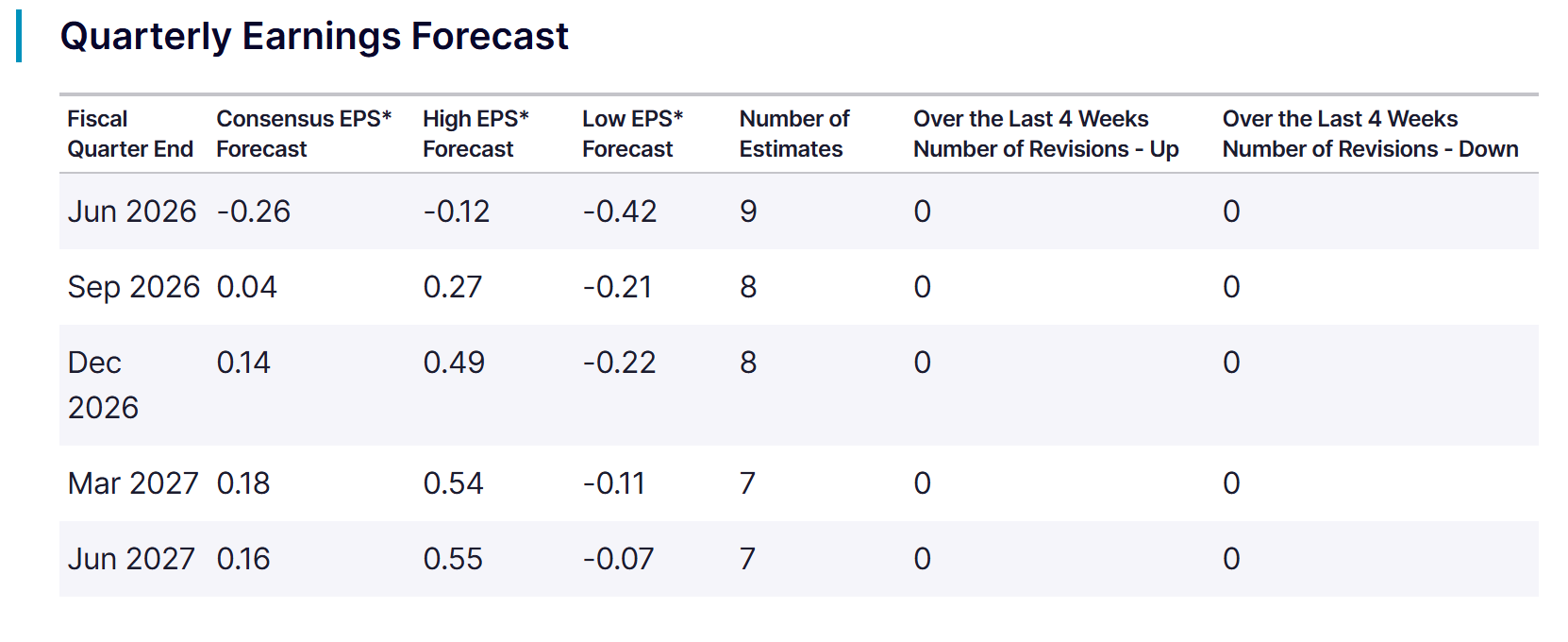
Results come after the close on Tuesday. Analysts expect a loss of 26 cents a share. Nine of them filed forecasts, per Zacks.

This is the first real look inside the business. Investors want launch numbers, Starlink revenue, and the split between government and commercial work.
The stock has not waited. SPCX closed at $108.37 on July 31. That is 20% below the $135 offer price and 33% below its $161 first-day close. It hit a record low last week.

Contracts have not helped either. Shares still fell after SpaceX won $1.6 billion in Space Force launch work through 2027.
Then comes August 6. About 911.5 million locked shares become free to sell, two trading days after earnings.
At Friday’s price that is close to $99 billion of stock. It is more than the IPO itself raised. Meta’s 2012 unlock is the closest thing to a warning here.
Morgan Stanley has already been paid. It raised its dividend 15 cents to $1.15 and approved $20 billion in share buybacks. SpaceX investors are still waiting.
The post SpaceX IPO Paid Wall Street $100 Million: Will It’s First Earnings Repay Investors? appeared first on BeInCrypto.

White House teleprompter operator Gabriel Perez is no longer employed by the federal government after being placed on unpaid leave over allegations that he used insider knowledge to bet on President Donald Trump’s speeches, according to another official.
Speaking on condition of anonymity, the official said that Perez had left his government job but did not say whether he resigned or was fired.
Inside the Allegations
The White House had suspended Perez earlier this month following an ABC News report that alleged he made more than $100,000 through bets on the online prediction market Kalshi. The report said the wagers were based on advance knowledge of what Trump would say during major speeches, including the State of the Union address earlier this year.
The allegations drew a sharp response from the White House. Press secretary Karoline Leavitt described the reported insider trading as “deeply unfortunate and, frankly, a disgrace.” Kalshi also responded after the report was published.
Robert Denault, the company’s lawyer and head of enforcement, said in a post on X that its surveillance team detected the trades, investigated them, and referred the matter to the US Commodity Futures Trading Commission (CFTC). Denault’s statement did not identify Perez by name.
Legal Battles
Kalshi has faced legal hurdles this year in Massachusetts, Michigan, Nevada, and Washington. At the same time, it has also tightened its own rules. In April, the prediction market suspended three political candidates for betting on elections they were contesting after determining that the trades amounted to political insider trading under its CFTC-approved rules.
An insider trading case on Polymarket also surfaced that same month. Federal prosecutors charged US soldier Gannon Ken Van Dyke with allegedly betting on whether former Venezuelan President Nicolás Maduro would be removed from power. Authorities said Van Dyke, who worked on the operation targeting Maduro, made about $400,000 from the trades.
The legal battle over prediction markets has also taken a new turn. This week, a federal judge temporarily blocked Minnesota from enforcing a new law that would have banned prediction markets in the state. The ruling gave a temporary win to Kalshi, Polymarket, and the CFTC as the case moves forward.
Judge Katherine Menendez said the law is likely preempted by the federal Commodity Exchange Act because many event contracts may qualify as federally regulated swaps. The law, signed by Governor Tim Walz in May, was set to take effect on Saturday. The judge said the injunction could later be narrowed if needed.
The post Teleprompter Operator Accused in Kalshi Betting Case Is No Longer a Federal Employee appeared first on CryptoPotato.


President Donald Trump reshared a White House post on Sunday about restarting California’s Sable Pipeline. The same day, OPEC+ agreed to pump more oil from September.
Both moves add oil to the market. Neither has helped drivers yet. Californians paid $5.49 a gallon in late July, the highest price in the country.
Why Trump Revived a March Order Now
Gas is expensive, and Trump knows it.
US drivers paid about $4.10 a gallon in the week to July 27, federal data shows. That is 97 cents more than a year ago.
In June, Trump told fuel retailers to cut prices to $2.50. They have not.
California hurts most at $5.49 a gallon. That is roughly $1.39 above the national average, which makes the state an obvious target.
On March 13, Trump signed an order giving Energy Secretary Chris Wright emergency powers. The law behind it, the Defense Production Act, lets Washington direct private companies during a crisis.
Wright told Sable Offshore Corp. to reopen the Santa Ynez Pipeline. It had sat unused since a 2015 oil spill.
Oil flowed the next day. Sable aimed to sell about 50,000 barrels daily from April 1, a company filing shows. The line can carry 200,000.
Courts keep pushing back. On June 17, a California appeals court blocked Sable’s coastal work, backing state regulators in a published opinion.
OPEC+ Supply Hike Opens One Tap, Not All
Seven countries agreed to pump 188,000 more barrels a day from September. Saudi Arabia and Russia account for most of that, at about 62,000 barrels each.
The move finishes one round of cuts. The group had held back 1.65 million barrels a day since April 2023. That batch is now fully back.
A second cut from November 2023 stays in place. So the taps are not fully open.
OPEC says it can still speed up, pause, or reverse, according to its July statement.
Harder talks come in 2027, when the group sets new limits for each member. Iraq already wants a bigger share.
What This Means for Crypto
More oil has not made oil cheaper.
Brent crude sat near $87 on July 20. US crude was close to $84. Those are the latest daily figures from the Energy Information Administration.
Wars in Iran and Ukraine explain the gap. They block exports, so the extra barrels stay stuck on paper.
That matters for Bitcoin. Costlier fuel pushes inflation higher, and energy costs pressure Bitcoin by making rate cuts less likely.
Cheaper fuel does the opposite. It gives the Federal Reserve room to cut, which has lifted risk assets before, such as after the Fed held rates steady.
The question now is simple. Will September’s barrels reach buyers, or stay stuck?
The post Trump’s Oil Order Meets OPEC+ Supply Hike: Why California Gas Costs $5.49 appeared first on BeInCrypto.

Data shared by Lookonchain earlier today suggests that Trump Media, the entity behind the Truth Social media platform, majority-owned by the Donald J. Trump Revocable Trust, has sold over $165 million worth of bitcoin.
This was the second substantial sale made by the entity in recent months after it had splashed over $1 billion at prices near the top last year to accumulate 11,542 units.
The on-chain analytics company noted that the latest offload was for 2,628 BTC after it had transferred the stash to crypto.com. This continued a streak that began earlier this year.
Previously, the entity had spent $1.37 billion to acquire 11,542 BTC at an average price of $118,522. Since its entry level was very close to bitcoin’s very top marked just under a year ago, this automatically means that its sales have been completed at prices well below that.
CryptoPotato reported the previous BTC disposal in May, when wallets linked to Trump Media sold another substantial batch of 2,650 BTC for $205 million.
Lookonchain’s data concurs that the entity has sold a total of 7,281 BTC since it began disposing of its assets, at an average price of under $75,000. This means that its total losses have grown to $555 million.
It looks like Trump Media sold another 2,628 $BTC($165.07M).
Trump Media bought 11,542 $BTC($1.37B) at an average price of $118,522, then started selling 7 months ago, selling a total of 7,281 $BTC ($545M) at an average price of $74,855.
Trump Media is now down a total of $555M… pic.twitter.com/9xx0MTbweg
— Lookonchain (@lookonchain) August 2, 2026
Aside from the continuous controversial decisions toward the crypto industry from the POTUS-linked companies, this move builds on a recent worrisome trend about BTC treasury firms deciding to sell during times of distress.
As we reported last week, several public companies have shifted their strategies, with some selling BTC holdings while others have paused buying the asset indefinitely.
The post Trump Media Sells Another $165M in Bitcoin, Booking a Fresh Loss appeared first on CryptoPotato.
After two consecutive painful months in which they lost billions of dollars, the spot Bitcoin ETFs finally turned the page in July, but inflows were still modest.
Meanwhile, the exchange-traded funds tracking the performance of the largest altcoin enjoyed the month more, attracting over 2x more fresh capital.
Bitcoin ETFs in July
March and April were quite bullish for the spot BTC ETFs as the financial vehicles attracted well over $3 billion. However, the trend changed violently in May when they lost $2.43 billion. June became the worst month on record, as investors pulled out just over $4.5 billion. In total, the net outflows for May and June stood at nearly $7 billion, and the cumulative total flows dropped from over $58 billion to $51 billion.
July started more positively, with almost $200 million in net inflows during the first full week. Another $76 million followed during the second, and a more modest $34 million in the third. The trend was obvious as the initial high numbers gradually declined, aligning with the underlying asset’s controversial and sporadic price performance and ultimately leading to a very modest increase throughout the month.
The last week in July was once again in the red, with investors pulling $61.53 million out of the funds. Friday was the most painful day, as the total net outflows stood at over $265 million. As such, the month ended with $172.42 million. On one hand, green finally overcame the red wave, but on the other, the number was nowhere near enough to offset some of the recent losses.
ETH ETFs Do Better
The Ethereum ETFs entered July after a similarly painful two-month streak, in which they lost $541 million in May and another $529 million in June. However, investors were more persistent, and the actual net inflows for July were at a more respectable $365.17 million, thus outpacing the BTC ETF flows by over 2x.
Moreover, the ETH ETFs closed all four full weeks of July in the green, including the last one, which saw only one day in the red. Perhaps this investor behavior is among the reasons behind the underlying asset’s major resurgence in July. As reported earlier, ETH ended the month with a substantial 20% increase, making it the best in precisely a year.
All eyes are now on August, which hasn’t been ETH’s most favorable month historically, but there are some major double-digit exceptions.
The post Bitcoin vs. Ethereum ETF Battle: Who Won July? appeared first on CryptoPotato.
The developers pushing Bitcoin’s BIP-110 rule change have called off its launch. They blamed the industry response to a Coldcard wallet flaw that left user funds easier to steal.
Udi Wertheimer announced the delay, urging anyone running BIP-110 software to switch back to a normal Bitcoin (BTC) node. He gave no new date.
Why BIP-110 Activation Was Paused
BIP-110 is a temporary rule change, known as a soft fork. It would limit how much data people can pack into Bitcoin transactions.
Supporters say that data crowds out ordinary payments. Critics say Bitcoin should not police what users store.
The limits would last one year. Developer Dathon Ohm wrote the rules, and Bitcoin Knots software ships them.
Miners started voting on December 1, 2025. The Bitcoin blockspace spam debate had already split the community.
Then a separate problem landed.
Coinkite disclosed the bug on July 30. Its COLDCARD wallets built seed phrases, the master key behind a wallet, using far less randomness than promised. Roughly 72 bits instead of 128.
That gap makes a seed vastly easier to guess. Wallets running firmware released since March 2021 were hit hardest.
Updating the device does not fix a seed it already made. Coinkite is telling owners to move their money.
Thieves had already drained wallets tied to the flaw. The company has not said how much was lost.
Wertheimer called the delay a matter of timing, not doubt.
“…due to the coldcard incident, BIP-110 community leaders have decided to DELAY ACTIVATION. a new activation date will be announced at a later time,” he wrote.
Follow us on X to get the latest news as it happens
The Math Was Already Settled
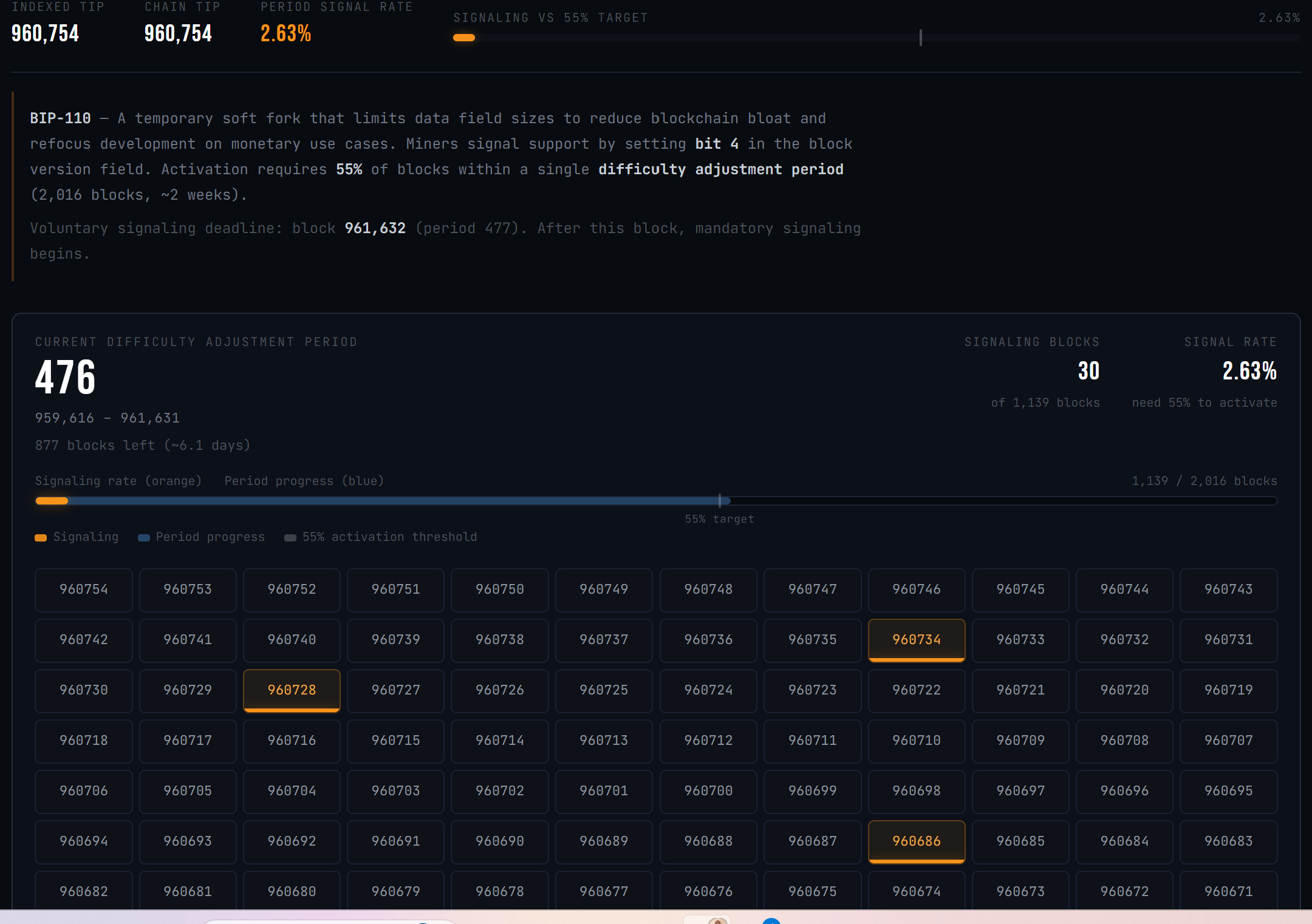
Miners back a rule change by flagging their blocks. BIP-110 needed 55% of blocks in a two-week stretch. That means 1,109 blocks. The live monitor counted 30.

That is 2.63% of 1,068 blocks mined this period. It is the best BIP-110 has ever managed. It is still more than 20 times short.
Every earlier two-week stretch since December finished below 1.3%. Only 948 blocks are left. Even if every one voted yes, the total would reach about 48%. It could not pass this round.
That was already true days before anyone announced a delay.
Michael Saylor has warned about Bitcoin neutrality for weeks. He says almost every yes vote comes from one mining pool. Blockstream chief executive Adam Back has flagged chain split risk, calling the 55% bar too low to be safe.
A second phase was due at block 961,632, about six days away. It would reject any block that did not vote yes.
Nodes still running BIP-110 would enforce that on their own. That is why the warning to switch back matters.
No one owns Bitcoin’s rules. Nobody can flip a switch to start or stop a soft fork. This was a request, not a command.
Whether operators listen will say more about BIP-110’s support than any vote counter has.
The post BIP-110 Activation Frozen After Coldcard Exploit: Is the Soft Fork Dead? appeared first on BeInCrypto.
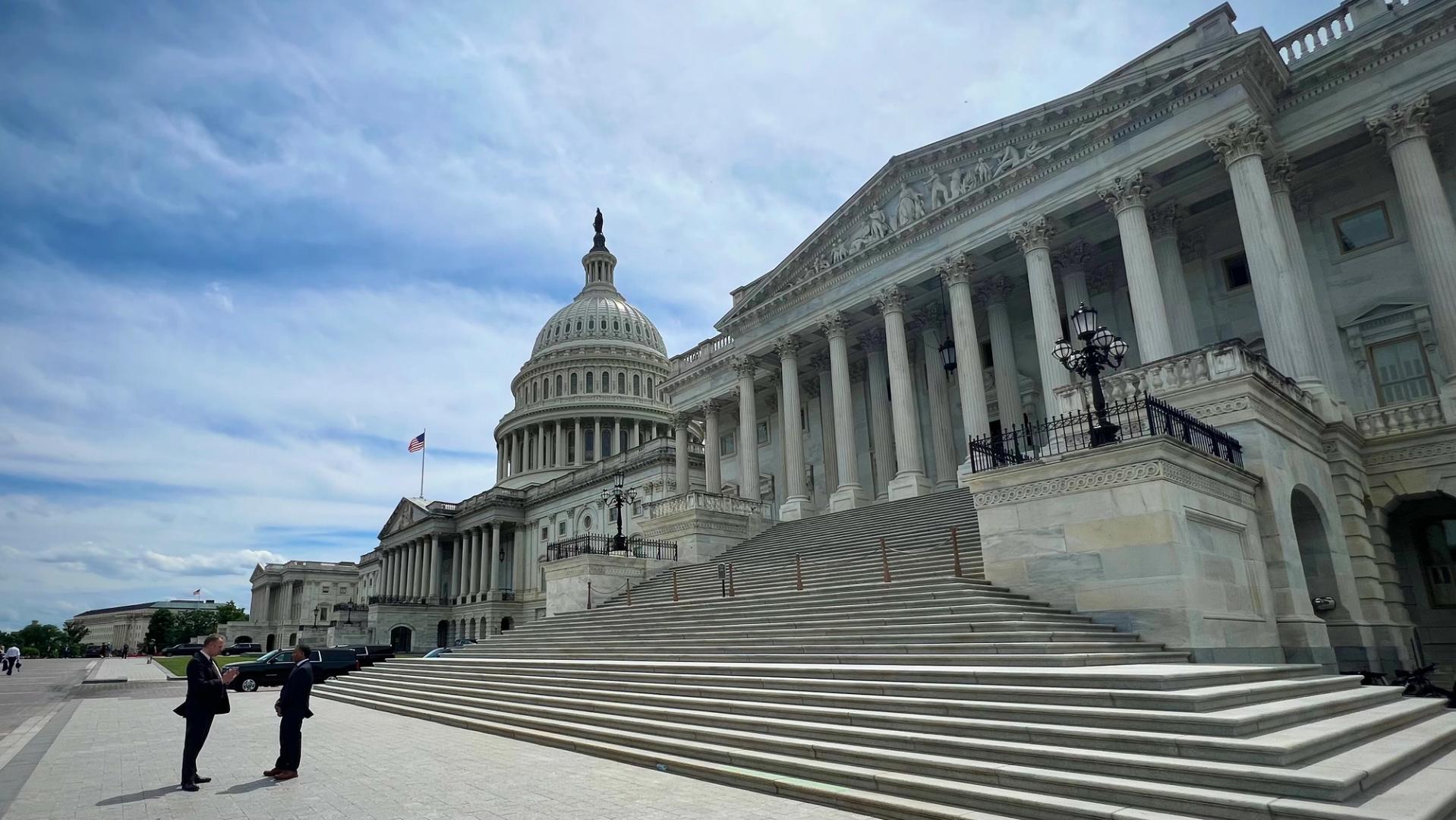
Senators Ruben Gallego and Thom Tillis sent a proposed revised ethics provision to the White House on Thursday, after drafting the compromise the day before, an industry source familiar with the talks told CoinDesk. As of midafternoon on Friday, the White House had not officially responded to the proposal.
Ethics remains the biggest outstanding issue to be resolved before the Clarity Act can advance. There are ongoing negotiations around other issues, including stablecoin reserves and yield, law enforcement authorities and some of the Agriculture Committee provisions addressing the Commodity Futures Trading Commission’s total remit, but these are relatively uncomplicated compared to ethics, two industry sources said. One added that they expected those other issues to be resolved relatively quickly should negotiators come to a deal on ethics.
If the White House signs off on the counter-proposal from Tillis and Gallego, that could speed the way to at least the first part of the cloture process, the other source told CoinDesk. The Senate would still need to follow the cloture process laid out in last week’s edition of this newsletter, but the timelines involved mean that it would be difficult to get the bill all the way through by the end of the week. Still, getting through that first procedural vote would be a visible win for the crypto industry, should it happen.


Strategy Inc. kept the annual dividend rate on its STRC preferred stock at 12% for August 2026, even though the Nasdaq-listed security ended July more than 10% below its $100 stated amount.
Summary
- 12% annualized dividend remains unchanged for August despite STRC closing July at $89.46 per share.
- $3.75 billion reserve covers roughly 2.1 years of preferred dividends and debt interest payments currently.
- Strategy repurchased 288,930 STRC shares below par while retaining $975 million in remaining authorization capacity.
The company’s official STRC information page confirms that the variable annualized rate for record dates beginning in August remains 12%. Executive Chairman Michael Saylor promoted the product on Aug. 1 as a way to “stretch your income,” emphasizing its twice-monthly payment schedule.
STRC closed at $89.46 on July 31, down $0.25 during the session. At that price, the $12 annualized payout based on the security’s $100 stated amount produces an effective yield of about 13.41%. Because Saylor announced the unchanged rate during the weekend, no post-announcement market reaction will be available until Nasdaq trading resumes.
Strategy’s STRC dividend no longer rises automatically
Strategy raised STRC’s annual dividend from 11.5% to 12% for record dates beginning in July. The increase followed a sharp June decline that took the shares as low as $71.25 and moved them far below the $100 level the company wants to maintain.
However, the company changed its rate-setting policy on June 29. Under the revised framework, management considers STRC’s market price, credit spreads, competing yields, Bitcoin volatility, cash-reserve coverage and the wider capital structure. The filing specifically states that Strategy will not necessarily raise the dividend solely because STRC trades below its stated amount.
That policy explains why July’s discount did not produce another 50-basis-point increase. Strategy instead said during its second-quarter results that it would maintain the 12% rate until STRC shows “sustained, healthy trading” near $100. The language describes management’s objective and does not guarantee that the shares will return to par.
The decision also prevents Strategy’s cash obligations from rising further while the company attempts to repair demand through other measures. Every additional 50 basis points would increase the annual cash cost across more than $10.46 billion in outstanding STRC stated value.
Buybacks now carry more of the price-support burden
Strategy has shifted part of its response from dividend increases to preferred-share repurchases. Between July 20 and July 26, the company bought back 288,930 STRC shares for approximately $25 million, paying an average of $86.53 per share. The purchase represented a 13.47% discount to the shares’ stated amount.
About $975 million remains under Strategy’s $1 billion preferred-securities repurchase authorization. Management said it intends to purchase more STRC at deeper discounts and reduce its activity as the security approaches $100. The authorization does not require Strategy to spend the remaining amount and has no fixed expiry date.
Repurchasing shares below par reduces the number of preferred shares requiring future cash distributions. It also lets Strategy retire $100 of stated value for less than $100. However, buybacks use capital that could otherwise remain available for dividends, debt interest or Bitcoin purchases.
As previously reported, Strategy funded its first $25 million STRC repurchase while increasing its U.S. dollar reserve and keeping Bitcoin purchases paused. The company raised much of that liquidity through sales of MSTR common stock rather than new STRC issuance.
The $3.75 billion reserve supports the 12% payout
Strategy reported a $3.75 billion U.S. dollar reserve as of July 26. The company said that amount covers approximately 2.1 years of expected preferred-stock dividends and interest on outstanding debt. The reserve can only be used for those obligations unless the board approves another purpose.
The cash cushion has become more important because Strategy’s preferred-stock commitments have expanded. The company recorded $400.7 million in preferred dividends during the second quarter, compared with $49.1 million one year earlier. It has paid or declared more than $1 billion in cumulative preferred distributions.
Strategy also reported an $8.22 billion second-quarter net loss, driven mainly by an $8.32 billion unrealized loss on its Bitcoin holdings. The accounting loss did not represent an equivalent cash outflow, but the preferred dividends must be paid in U.S. dollars.
The company has therefore authorized Bitcoin sales to refill the reserve, cover dividends and interest, or finance approved security repurchases. Strategy had sold approximately $218.4 million of Bitcoin during 2026 through July 26 to fund part of its preferred obligations.
As crypto.news reported, Strategy held 843,775 BTC at an average acquisition cost of about $75,476 as of July 26. The company valued that position at $54.77 billion using Bitcoin’s July 27 market price, compared with its $63.69 billion original cost.
STRC holders receive two payments each month
STRC moved from monthly to semi-monthly distributions after shareholders approved the change in June. Record dates now fall on the 15th and final day of each month, with payments generally following around 15 days later.
Strategy has already declared a payment of $0.50 per share for Aug. 15 to investors recorded as shareholders on July 31. The company’s website lists the 12% rate for August record dates, but future cash distributions still require board or committee approval and are not guaranteed.
For U.S. federal tax purposes, Strategy expects the current payments to be treated as returns of capital to the extent of an investor’s tax basis. That is the company’s expectation rather than a guarantee of each shareholder’s treatment, and Strategy advises investors to seek tax guidance based on their own circumstances.
STRC is also unsecured. Strategy states that its preferred securities are not collateralized by its Bitcoin holdings and only hold a preferred claim on the company’s residual assets. The company further warns that STRC is not a bank deposit, is not FDIC-insured and does not carry the same protections as Treasury securities or money-market funds.
What happens next for STRC and Strategy
Chief Executive Phong Le said management’s objective is for STRC to trade between $99 and $100 “over time.” Strategy has not provided a deadline for reaching that range, and the shares’ $89.46 closing price shows that the market continues to demand a yield above the stated 12% rate.
The next confirmed event is the Aug. 15 distribution. Investors will then watch Strategy’s next monthly rate decision, further STRC repurchases and weekly SEC disclosures covering common-stock sales, Bitcoin transactions and changes to the dollar reserve.
Saylor separately posted “Bitcoin Drive engaged” on Aug. 2 alongside the company’s treasury chart. The message may fuel expectations of a new purchase disclosure, but the post does not confirm that Strategy bought Bitcoin or reversed its recent pause. An SEC filing or company announcement would be needed to verify any transaction.
As of then, Strategy is relying on its existing 12% rate, twice-monthly payments, cash reserves and discounted repurchases rather than offering STRC investors another dividend increase.
The spot exchange-traded funds tracking Ripple’s cross-border token continue with their impressive performance in times of market uncertainty, and saw only one day of no reportable action in the past week, unlike the previous ones.
July also ended in the green for the funds, meaning that only one out of the nine months they have been active was in the red.
The Good Weekly and Monthly
Data from SoSoValue shows that Monday and Wednesday were quite modest in terms of net inflows. On both days, the ETFs attracted just under $600,000. However, the green streak continued and accelerated at the end of the business week, with $6 million in net inflows on Thursday and another $7.7 million on Friday.
Thus, the week ended with $14.86 million in the green, making it the best since the one that ended on July 2, when the funds attracted $17.19 million. On a monthly scale, investors poured in $27.29 million into the spot XRP ETFs.
What’s even better is that the funds have reached another all-time high in terms of cumulative total net inflows, at over $1.5 billion as of Friday’s close. Bitwise’s XRP has extended its lead over Canary Capital’s XRPC, with $511 million in net inflows compared to $467 million for the latter.
The Bad
Although July indeed ended in the green, the actual net inflows were not all that impressive. The $27.29 million places July as just the second-worst month, beating only January when investors inserted $15.59 million into the funds.
In contrast, June was a lot more positive, with the net inflows standing close to $60 million. May was even better, with almost $132 million. The all-time high from November at $666.61 million remains untouchable.
The Ugly
Although this improved at the end of the month, July saw the most days with no reportable action in terms of net flows. Precisely half of the trading days (11 out of the 22) saw no flows, according to SoSoValue, which, aligned with the more modest $27.29 million in net inflows, suggests dwindling interest in the funds.
Separately, the underlying asset’s price performance continues to disappoint despite the numerous positive developments in the broader Ripple ecosystem. Although it managed to defend the $1.05 support during the weekend, XRP is still below $1.10, and it’s down by more than 3% on a monthly scale. What’s even more worrisome is the fact that August has been a particularly painful month for the asset historically.
The post Ripple (XRP) ETF Monthly Recap: The Good, The Bad, and the Ugly appeared first on CryptoPotato.
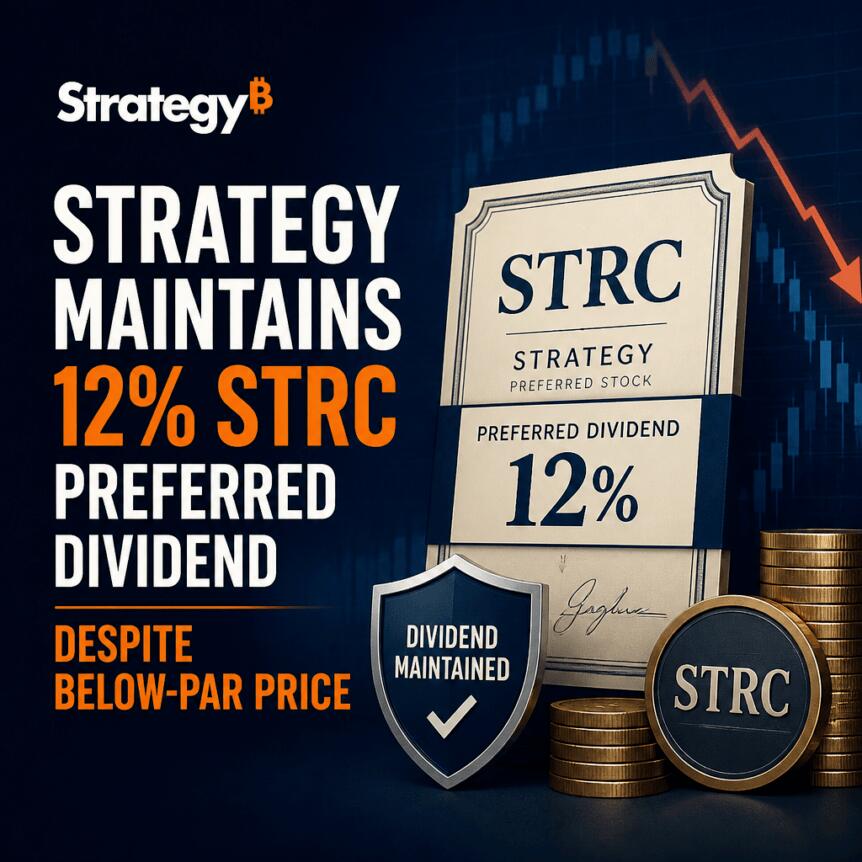
Strategy’s preferred stock tracker, STRC, ended July trading well below its $100 par value, but management signaled that the company’s next preferred dividend rate will not rise. Executive chairman Michael Saylor said the August dividend will remain at 12%, continuing a payout level that was set after a June performance dip.
In a Saturday post on X, Saylor confirmed the dividend will hold at 12% for August. He also noted the company will keep its semi-monthly payment cadence for the second straight month after shareholders approved that change in June, following the earlier decision to increase the dividend by 50 basis points to 12%.
Key takeaways
- Strategy’s executive chairman said the August STRC dividend will remain at a 12% rate, not increase.
- STRC has continued to trade below its $100 par value throughout July, despite a monthly price rebound that began after the June dividend hike.
- Management reiterated a longer-term objective for STRC to trade near $99–$100, without specifying a timeline.
- Strategy reported building a large cash reserve—cited as $3.75 billion—to support preferred stock payouts and related obligations.
Dividend holds at 12% as preferred shares stay below par
Although STRC shares did not reach par in July, the stock did gain momentum over the month. The shares closed at $89.46 on Friday, up 5.42% for the month that started with the dividend adjustment.
Earlier, management had lifted the dividend rate in response to weak performance in June—raising it by 50 basis points to 12%. After that change, Strategy’s preferred payout strategy moved toward semi-monthly distributions, a structure that takes effect for the second month in August after the June shareholder vote.
Trading activity on Friday was also notably lighter than typical: volume was about two-thirds of the Nasdaq-listed shares’ daily average, according to the figures referenced in the report. That detail matters because it suggests the month’s rebound did not coincide with a surge in participation, even as investors processed the dividend update.
Management’s $99–$100 target meets a lower-than-par reality
Even as the next dividend stays flat, Strategy’s leadership continues to frame STRC around a valuation target. On Friday, CEO Phong Le reiterated that management’s “corporate objective” is for STRC to trade at $99–$100 over time, without adding specifics on when that goal might be reached.
That position is important to read in context: shareholders were told the dividend rate would not increase in August, even after the company adjusted payouts earlier in the quarter. Investors looking for signals that STRC might close the gap toward par have therefore had to balance two competing inputs—management’s longer-term pricing objective and the near-term decision to keep the dividend at the same level.
Cash reserve and buybacks aimed at supporting payouts
While the dividend rate message was unchanged, Saylor’s social-media activity pointed to continued capital management efforts tied to Strategy’s Bitcoin treasury strategy. On Sunday, he posted “Bitcoin Drive engaged,” accompanied by a familiar chart of Strategy’s BTC buying activity as tracked by Saylortracker.com.
The emphasis on liquidity and coverage aligns with what Strategy disclosed in its latest reporting. The company recently reported an $8.22 billion second-quarter net loss, driven primarily by an $8.32 billion unrealized loss on its Bitcoin holdings as the cryptocurrency’s price declined during the quarter.
Against that backdrop, Strategy said it has built a $3.75 billion cash reserve intended to support preferred stock payouts following the launch of its BTC monetization program. In the same vein, the company described a $3.75 billion U.S. dollar reserve sufficient to cover more than two years of preferred dividend payments and related interest obligations.
Strategy also disclosed that it repurchased $25 million of its STRC preferred shares at a discount to par and said it intends to keep buying the securities while they trade below $100. For investors, the practical takeaway is straightforward: management is pairing a coverage plan with an active buyback strategy, presumably to reduce pressure on valuation while the preferred shares trade under par.
However, the gap between par value and the prevailing market price remains the key issue. Management’s stated intent to buy more when the shares trade below $100 suggests the company believes the market offers an entry point—but without a near-term dividend increase, investors will likely focus on whether buybacks and reserve policy can translate into sustained movement toward the $99–$100 trading range.
What to watch next for STRC holders
With the August dividend rate confirmed at 12% and STRC still trading below $100 par, the next signal for holders will likely come from any further updates on Strategy’s Bitcoin treasury actions and whether cash-reserve coverage and buybacks continue at a pace that supports improving market pricing. Investors should also watch whether management provides clearer timing around its $99–$100 objective, since it currently remains framed as a long-term goal rather than a defined schedule.

India secure top-four finish at 2026 Commonwealth Games after historic 39-medal campaign | Commonwealth Games News

The James Webb Telescope Is Changing Astronomers’ Understanding of the Ancient Cosmos

Jadon Sancho transfer statement released as Man United flop takes drastic action


-

 Business4 days ago
Why Trees Belong on the Risk Register
-

 Fashion2 days ago
Weekend Open Thread: Wit & Wisdom
-

 Tech7 days ago
Intel is reversing course and bringing hyper-threading back to its server chips
-

 Politics2 days ago
Meta enters AI-training agreement with far-right ‘propaganda rag’ Newsmax
-

 Politics6 days ago
Luke Littler dismantles Gerwyn Price to retain title in Blackpool
-

 Crypto World1 day ago
MicroStrategy Post-Earnings CLARITY Act Push Could Add New Catalyst for Its Stock
-

 Politics5 days ago
The Part of the Electric Transition Nobody Wants to Discuss
-
 Entertainment5 days ago
‘Stargate’ Creator’s New Sci-Fi Series Returns for Season 3 Tomorrow
-

 News Videos7 days ago
BITCOIN JUST ENTERED THIS CRITICAL ZONE…
-

 Business5 days ago
Major shareholder moves on Canyon
-

 News Videos3 days ago
Bitcoin Enters the 3rd Stage of the Bear Market
-

 Crypto World2 days ago
XRP Ledger v3.3.0 brings five institutional features
-

 Crypto World5 days ago
Kraken Enables Retail Access to Jersey Mike’s IPO via Tokenized Shares
-

 Tech6 days ago
New macOS Sequoia & Sonoma security updates for older Macs
-

 News Videos5 days ago
Claude: Build Financial Dashboards in Minutes (2026)
-

 Politics3 days ago
Luke Littler’s dominance sparks GOAT debate
-

 Business5 days ago
Johnson & Johnson agrees to $5.5B settlement over talc cancer claims
-

 Sports3 days ago
Seema Kaliramna Wins Discus Throw Bronze, Takes India’s CWG Medals Tally To 17
-

 Crypto World11 hours ago
Crypto PAC spending tops $2M in Michigan House race
-

 Business2 days ago
Trump Announces Hamas Disarmament Agreement as Iran Strikes Kuwait Air Base and US Attacks Pause Overnight
You must be logged in to post a comment Login