

Crypto World
Crypto Hacks Drop 47% in H1, but Smart-Contract Risks Persist: CertiK

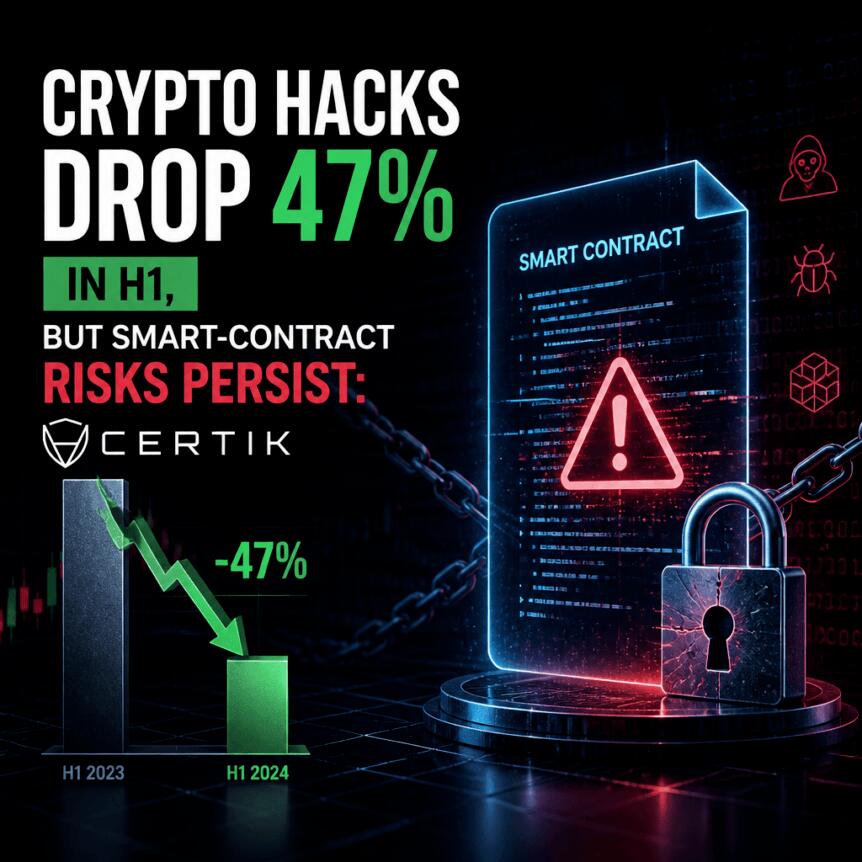
Crypto losses from hacks and scams dropped in the first half of 2026, according to new figures cited by CertiK. In the period, overall losses fell 46.8% year-on-year to $1.32 billion—yet the security firm argues the headline decline is deceptive, pointing to a shift toward more targeted and destructive attacks.
CertiK’s report breaks the half-year down by quarter: phishing drove $508.2 million in losses in Q1, while wallet compromises became the dominant threat in Q2 with $807.5 million attributed to that attack vector. The firm also highlighted that more than 70% of Q2 losses came from two major incidents—KelpDAO and Drift Protocol—events tied to North Korean state-sponsored hacking activity.
Key takeaways
- First-half 2026 crypto losses fell 46.8% year-on-year to $1.32 billion, but CertiK says the reduction does not indicate a safer ecosystem.
- Attack dynamics shifted: phishing dominated Q1 ($508.2M), while wallet compromises were the largest driver in Q2 ($807.5M).
- Over 70% of Q2 losses were linked to the KelpDAO and Drift Protocol hacks, which are believed to involve North Korean state-sponsored actors.
- CertiK warns attackers are becoming more “targeted and more financially destructive per event,” even if total dollars stolen appear lower.
- TRM Labs reported a sharp rise in the number of incidents in H1 2026 (83 to 207), reinforcing that volume—not just dollar totals—matters.
Why “losses down” may be the wrong signal
At first glance, the year-on-year decline looks encouraging. CertiK, however, cautions against interpreting the data as evidence that security has improved. The firm told Cointelegraph that a “headline reading” of losses down nearly 50% could mislead readers because the prior-year comparison was distorted by an exceptionally large theft.
CertiK specifically referenced the $1.4 billion Bybit hack as the type of outlier that can skew year-over-year comparisons. In the same reporting, CertiK noted that such comparisons can mask underlying changes in attacker behavior—particularly as threat actors adapt tactics and select targets more precisely.
This is where the firm’s analysis becomes investor- and operator-relevant: if the ecosystem is seeing fewer total dollars stolen but more attacks that are more damaging per incident, then risk is not actually decreasing. Traders may feel this first as volatility tied to exploit headlines, but the deeper impact lands on protocols, custodians, and institutions that must continually adjust defensive controls.
Phishing vs. wallet compromise: Q1 and Q2 split
CertiK’s quarterly breakdown shows how different attack categories shaped the first half of the year. In Q1, phishing was responsible for the bulk of losses, totaling $508.2 million. By Q2, the picture changed significantly: wallet compromises contributed $807.5 million, making that category the largest single driver of losses during the quarter.
For market participants and builders, that shift matters because it points to different failure modes. Phishing typically targets human behavior—seed phrases, approvals, and credentials—while wallet compromise often reflects deeper weaknesses around key custody, multisignature operations, signing procedures, and operational security. The change in the dominant vector suggests defenders cannot rely on improvements in one area alone; they have to treat the security stack as layered.
North Korean hacking remains central, and volume may be rising
CertiK’s report places disproportionate emphasis on state-linked activity during Q2. More than 70% of the losses in the quarter came from the KelpDAO and Drift Protocol hacks. Cointelegraph previously reported on both incidents, including coverage of KelpDAO being exploited and the Drift Protocol hack raising questions about the protocol’s response.
Beyond the immediate losses, the incidents also intersect with government-level discussion. The attacks reportedly even prompted a late-month meeting between US, Japanese and South Korean authorities focused on mitigating North Korea’s cyber activity and illicit revenue generation. Officials also acknowledged that North Korean IT workers are increasingly using AI to improve their schemes—an issue cybersecurity leaders believe can increase the scale, speed, and sophistication of protocol exploitation.
CertiK’s broader warning aligns with another dataset. TRM Labs, in its H1 2026 reporting, argued that declining total dollars stolen should not be mistaken for a safer environment. In TRM’s analysis, the number of incidents more than doubled from 83 to 207 in the first half of 2026, the highest number TRM has recorded across a six-month period. TRM also found that smart contract exploits accounted for 125 incidents—about 60% of all events—in H1.
That juxtaposition is important: even if fewer dollars are being stolen than in a year with record outliers, the ecosystem can still be exposed to a higher frequency of attacks. More incidents mean more operational disruptions, more incident response overhead, and more opportunities for failures—especially in fast-moving DeFi environments.
Private key management: the “most consequential” security surface
CertiK singled out private key handling as the area most likely to determine outcomes for attackers. According to the firm, private keys and multisignature wallet management remain the “most consequential security surface” for exploitation—particularly because weaknesses there can enable large transfers even when other controls appear in place.
To address this, CertiK urged protocols and institutions holding significant onchain assets to harden every layer of private key management. The recommendations span hardware security, multisignature governance, and even the geographic distribution of signers. The core argument is that defenses should be designed to reduce the chance that a single point of compromise results in irreversible loss.
CertiK also framed security investment as asymmetric: it said this is an area where spending on the right controls can produce unusually large risk reduction relative to the cost. That theme echoes long-standing guidance from hardware wallet providers. For example, Ledger has previously warned users to keep seed phrases offline and never share them, emphasizing that basic operational discipline remains one of the most effective barriers to phishing-driven theft.
While these recommendations may sound familiar, the data behind them—especially Q2’s wallet compromise losses—underscores that key management is not a “set it and forget it” task. Attackers often shift tactics toward whatever control surface shows the most leverage, and wallet compromise outcomes suggest that leverage is still available to criminals and state-linked groups.
Looking ahead, the key question is whether the first-half pattern persists: phishing-heavy losses in the first quarter followed by wallet compromises and concentrated state-linked incidents in the next. Readers should watch not only aggregate loss totals, but also incident frequency, which TRM’s reporting suggests is rising—an indicator that the threat environment may be intensifying even when dollar figures temporarily fall.

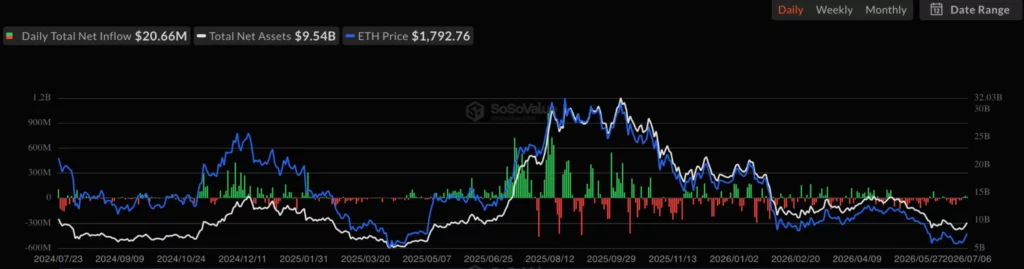
Ethereum traded near $1,777.49 at the time of writing, up 0.5% in the past 24 hours, according to crypto.news market data.
Summary
- Ethereum must close above $1,800 to strengthen the short-term bullish setup, analysts say.
- Binance liquidity has improved, but rising exchange reserves still pose selling pressure near $2,000 resistance.
- MACD and RSI support recovery, while $1,750 remains the key level for bullish invalidation.
The token had a 24-hour low of $1,732.10 and a high of $1,819.88, while daily trading volume stood near $17.08 billion.
The move kept ETH close to the $1,800 area, which traders now view as the main short-term resistance zone. The token has recovered from the sharp June selloff after buyers defended the $1,500 to $1,600 area.
The current setup has turned attention to a daily close above $1,800. Analysts say that level could decide whether ETH builds a stronger recovery or stays trapped in a range above $1,700.
Ethereum climbed about 12% from July 1 as weaker U.S. jobs data and renewed spot ETF inflows brought buyers back into the market. According to SoSoValue data, on July 6, Ethereum spot ETFs recorded a total net inflow of USD 29.082 million, led by BlackRock’s ETHA with USD 29.742 million in single-day net inflows.
Analysts watch $1,800 and $1,844
Analyst Ali Charts said Ethereum is testing the 0.8 MVRV Pricing Band near $1,796. He said the same area aligns with the TD Sequential resistance trendline, making it a key technical level for traders.
Ali said a daily close above $1,796, followed by a hold as support, would strengthen the bullish case. He added that a move through the TD risk line at $1,816 could open the way for a test of the channel resistance near $1,844.
“A break above both $1,796 and $1,816 could trigger a bullish breakout,” Ali said in his Ethereum setup. He placed Ethereum’s realized price target near $2,245 if buyers clear those levels and hold momentum.
Daan Crypto Trades also pointed to $1,800 as the level that matters most on the current timeframe. “If bulls can get a daily close over $1,800, that’d be the first sign of strength for me,” he said in an X post.
The lower level remains clear. Daan and Ali both pointed to $1,750 as the support that bulls must defend. A loss of that level would weaken the current setup and could return focus to the $1,700 area.
Indicators support short-term recovery
The ETH/USDT daily chart shows a recovery from the June low. ETH bounced from the $1,500 to $1,600 range and moved toward $1,800 before cooling slightly.
Momentum indicators support the rebound. The MACD histogram is positive near 31.83, while the MACD line sits near -4.67 and above the signal line near -36.50. This shows improving momentum, though the MACD line still needs to move above zero to confirm a stronger trend shift.
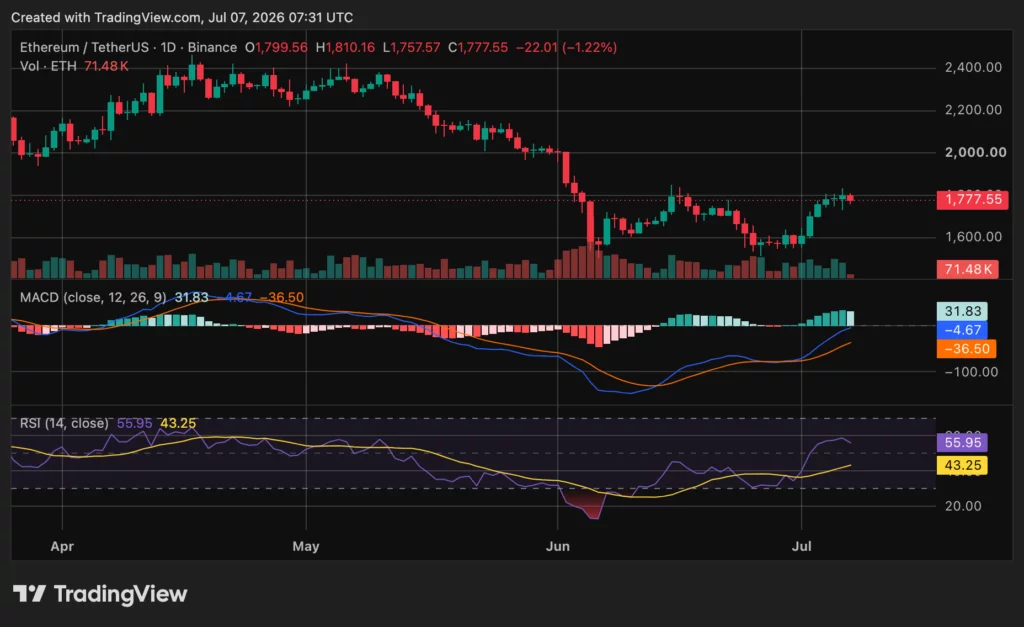
The RSI is also improving. It sits near 55.95, above its moving average near 43.25. That places RSI above the neutral 50 level, which shows buyers have short-term control without pushing the token into overbought territory.
As previously reported, Ethereum had already shown a rare TD buy signal while spot Ethereum ETF inflows returned.
Binance liquidity improves, but reserves raise risk
On-chain data gives a mixed view. CryptoQuant analyst Arab Chain said the ETH Binance 30-day exchange liquidity ratio rose to about 5.22. The reading was based on about 20.32 million ETH in 30-day trading volume and around 3.8 million ETH in Binance reserves.
That means each ETH held on Binance turned over more than five times during the period. The reading points to active trading and better use of available exchange liquidity. It also suggests that Binance can support strong ETH trading activity without a large rise in reserves.
Still, rising exchange supply remains a risk. CryptoQuant analyst BorisD said Binance held about 3.893 million ETH, while Bitfinex held 2.2 million ETH, OKX held 1.18 million ETH, and Bybit held 314,000 ETH. He said ETH inflows into Binance and OKX could add selling pressure if demand fails to absorb the extra supply.
Moreover, Binance users had already increased their ETH balances by 10.17% to about 4.14 million ETH in its June proof-of-reserves snapshot. Larger user balances can reflect deposits, purchases, internal transfers, or account activity, so the data does not show one clear reason.
The next test sits near $1,800. A clean daily close above that level could push ETH toward $1,844, then $2,060 and $2,245. A rejection, or a break below $1,750, would keep Ethereum in a choppy range and raise the risk of another move toward $1,700.
Disclosure: This article does not represent investment advice. The content and materials featured on this page are for educational purposes only.

Key Takeaways
- Sixteen months have passed since Trump’s executive order establishing a Strategic Bitcoin Reserve, yet implementation remains stalled
- A jurisdictional battle between Treasury and Commerce departments has created operational paralysis
- DOJ involvement seeks to clarify which agency possesses legitimate legal oversight
- Two congressional bills—the BITCOIN Act and ARMA Act—aim to provide statutory framework for the reserve
- America’s current Bitcoin holdings total 328,372 BTC, valued at approximately $21 billion
A bureaucratic turf war between federal agencies has thrown a wrench into the Trump administration’s ambitious plan to establish a Strategic Bitcoin Reserve.
In March 2025, President Trump issued an executive order designating the Treasury Department as the custodian for this digital asset reserve. The directive also called on additional federal entities to contribute to the stockpile through confiscated assets.
However, more than a year later, the initiative has yet to materialize. According to a Bloomberg report, the Commerce Department has now positioned itself as an alternative candidate for managing the cryptocurrency holdings.
The central dispute revolves around regulatory jurisdiction. Concerns have surfaced regarding Treasury’s legal capacity to manage Bitcoin, with some citing the cryptocurrency’s inherent price fluctuations as a complicating factor.
The Department of Justice has entered the fray, collaborating with both competing agencies to determine viable legal pathways forward.
The White House has maintained neutrality in this inter-agency conflict. Press Secretary Liz Huston stated the administration is “continuing to evaluate the best structure” for implementing the reserve.
Legislative Efforts to Establish Legal Framework
Congressional lawmakers have introduced two separate bills designed to provide statutory legitimacy to the reserve concept. Both the BITCOIN Act and the ARMA Act, filed in May, propose accumulating up to one million Bitcoin over a five-year timeline using fiscally neutral mechanisms.
White House cryptocurrency advisor Patrick Witt characterized ARMA as “Version 2” of the BITCOIN Act. He noted that significant White House resources have been dedicated to examining the legal complexities surrounding reserve establishment.
ARMA includes provisions requiring any Bitcoin deposited into the reserve to remain untouched for a minimum of two decades, with the sole exception being sales to offset the national debt, which is nearing $40 trillion.
Neither bill has advanced to passage. Should Republicans forfeit their House majority in upcoming midterm elections, the probability of legislative success would diminish substantially.
America’s Existing Bitcoin Position
The US government presently controls 328,372 Bitcoin, with a market value hovering around $21 billion. This position establishes the United States as the world’s largest sovereign Bitcoin holder.
That said, segments of these holdings have been liquidated periodically through judicially mandated sales.
At the time Trump signed his initial executive order, Bitcoin was trading near $93,000. The price has subsequently declined to approximately $64,000, representing a roughly 33% decrease.
Despite the delays and price volatility, some industry observers maintain optimism. Tim Kotzman, host of the Bitcoin Treasuries Podcast, suggested the reserve legitimizes “an entirely new category of capital allocation.”
On a global scale, 15 nation-states maintain Bitcoin holdings. El Salvador stands alone as the only country to have formally institutionalized a Bitcoin reserve program with regular acquisition protocols.
According to his latest financial disclosure documents, Trump personally holds Bitcoin assets exceeding $50 million.

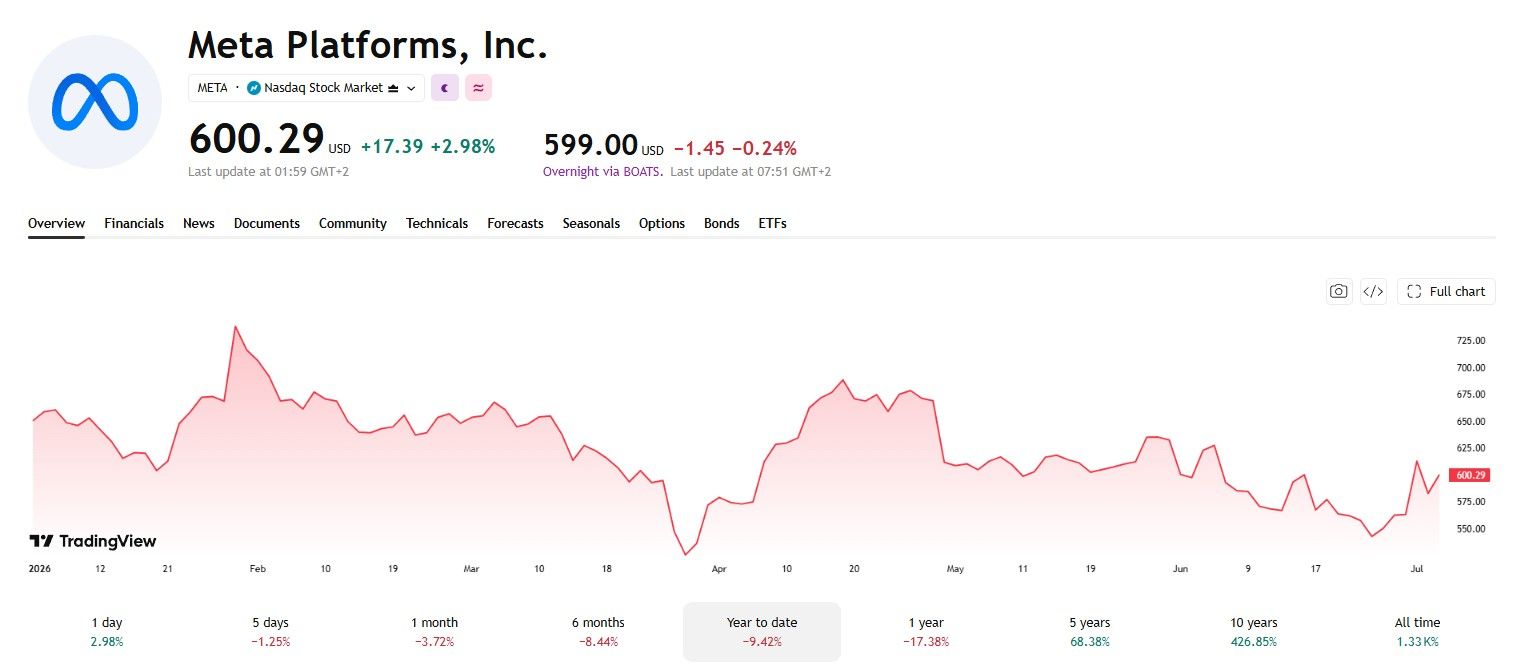
Meta Platforms disclosed that four US states want $1.4 trillion in penalties over claims it built Facebook and Instagram to addict teenage users.
California, Colorado, Kentucky, and New Jersey filed the demand ahead of a federal trial in Oakland this August. Meta called the figure unsupported by the evidence.
A Penalty That Nearly Matches Meta’s Market Cap
The demand sits just below Meta’s market capitalization of roughly $1.5 trillion. In other words, the four states want almost everything the company is worth.
The tech giant revealed the number in a court filing that responded to the states’ proposed penalty math. The company argued that no consumer protection case in US history comes close.
“A sanction of that size has no analog in the history of consumer protection enforcement.”
The disclosure caps a bruising year. The stock already saw $175 billion wiped off its market capitalization in one April session after a $145 billion AI spending outlook rattled shareholders.
How the States Calculated the Fine
The states’ filings remain sealed. However, they told the court in June that they multiplied estimated violations against young users by fine amounts set in state law.
The August trial covers far more than four states. Overall, 29 states accuse Meta of collecting children’s data without parental consent under the Children’s Online Privacy Protection Act (COPPA).
Judge Yvonne Gonzalez Rogers rejected Meta’s bid to cancel the trial last month. Meanwhile, the teen mental health debate around the company keeps growing louder.
Meta denies the claims. It argues that social media addiction is not an established psychiatric condition, so its safety statements could not mislead anyone.
A further 14 states will press similar claims at a second trial in February. Therefore, the Oakland case only opens a much longer legal fight.
Meta Stock Shrugs Off the Trillion-Dollar Threat
The stock closed near $600 on July 6, up almost 3% on the day. Investors clearly treat the $1.4 trillion figure as an opening bid rather than a likely outcome.

Still, the shares have dropped about 10% in 2026, and large funds keep rotating into Google stock. Polymarket traders also bet on rising tech layoffs as Meta employee morale craters.
New Mexico offers a warning, though. A jury there ordered Meta to pay $375 million in March for misleading consumers about child safety.
The Oakland verdict will show how far state consumer laws can stretch against Big Tech. Meta also faces a separate class action over data sharing, so its courtroom calendar stays full into 2027.
The post Meta Faces $1.4 Trillion Penalty Demand in US Youth Safety Lawsuit appeared first on BeInCrypto.
Gold is attempting to break its medium-term trend, with the latest US labour market data acting as the main catalyst. The US employment report released on 2 July came in noticeably weaker than expected, with the pace of hiring slowing to its lowest level in several months. This may have dampened expectations of a near-term Federal Reserve rate hike, while the minutes of the Fed’s June meeting, due to be released on 8 July, could provide further insight into how long this pause in the central bank’s rhetoric is likely to last. For now, markets are pricing in a more dovish scenario, supporting safe-haven assets such as gold.
Technical Analysis
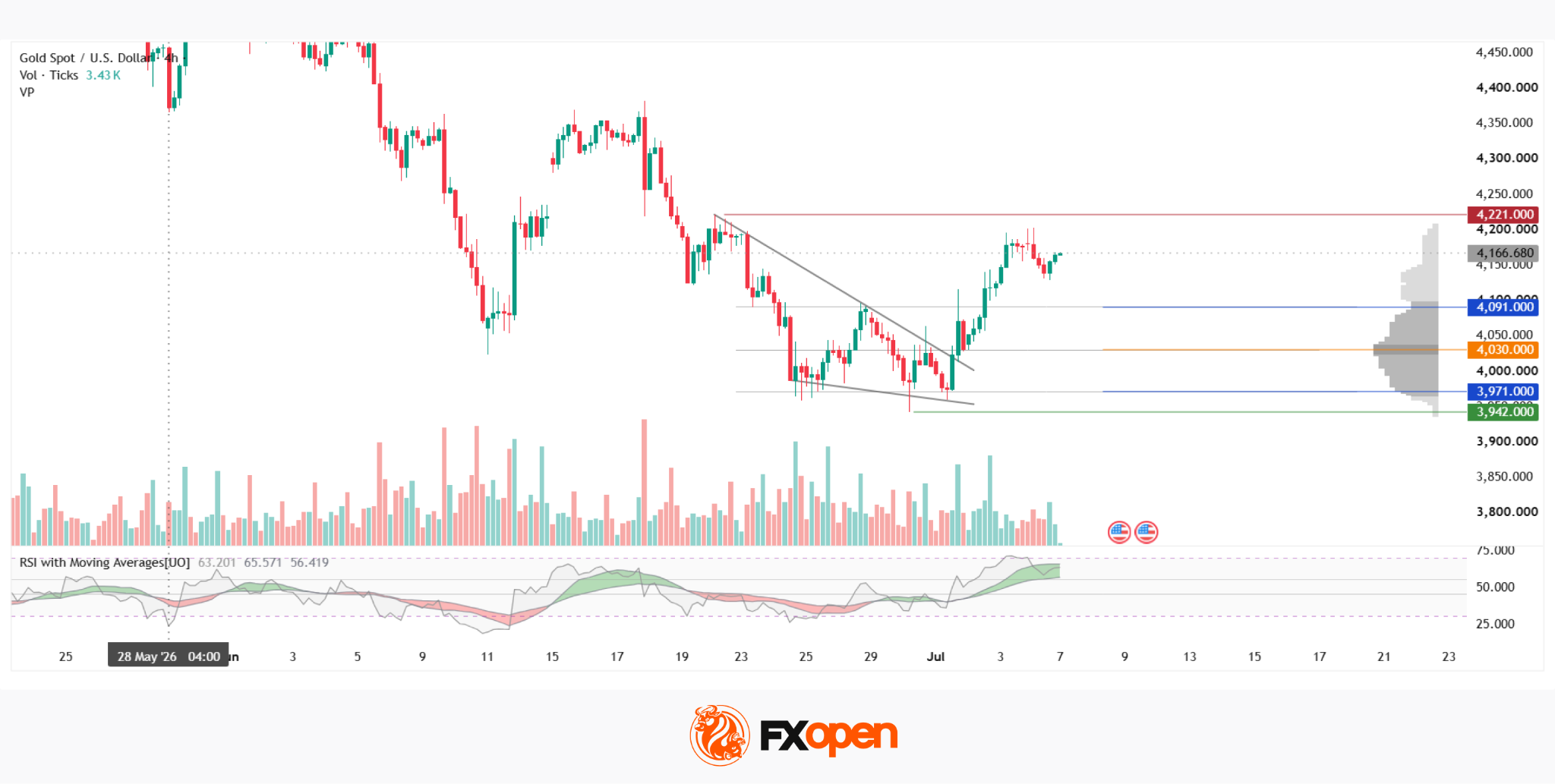
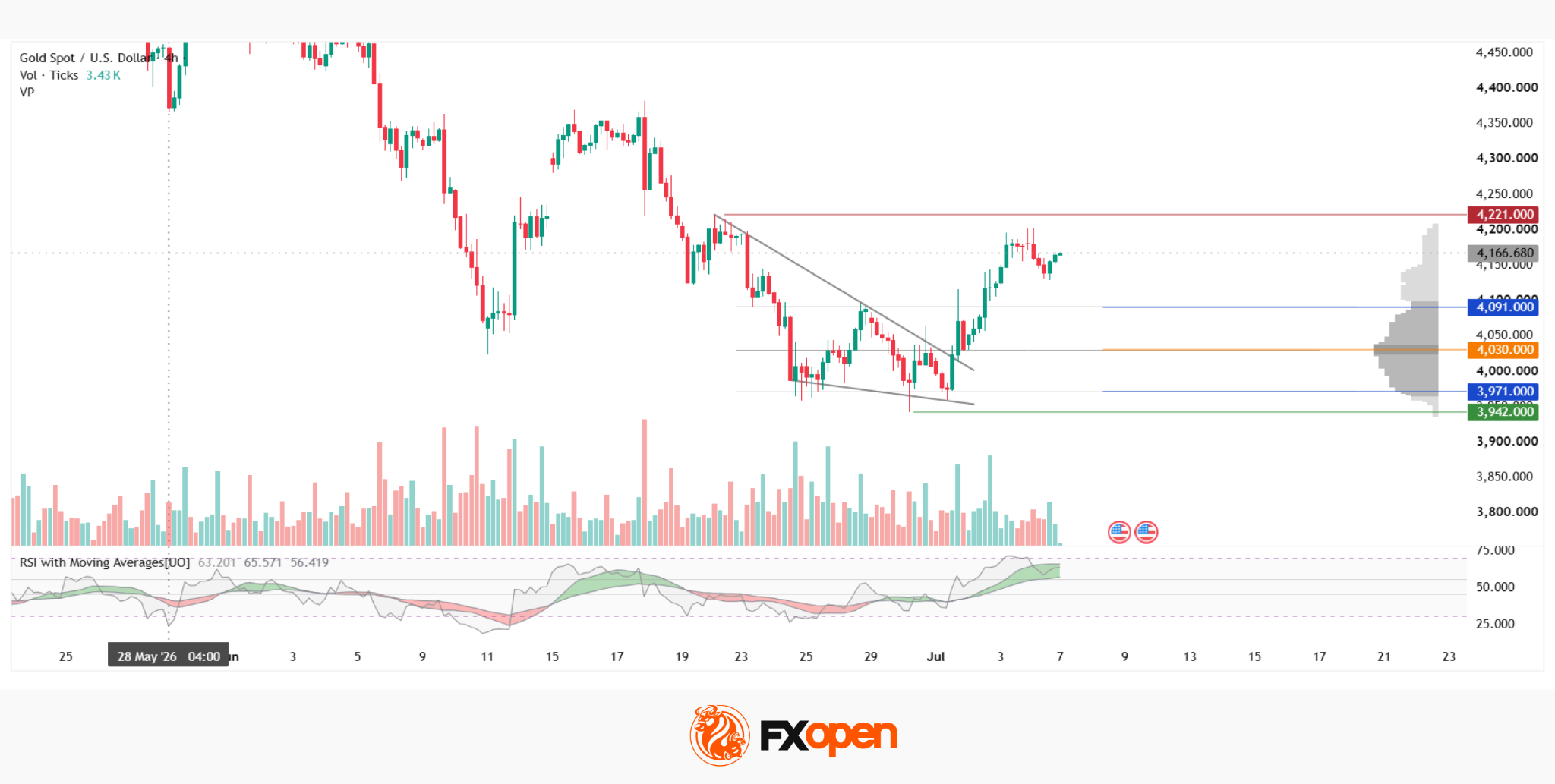
On the four-hour chart, XAU/USD declined from the $4,221 area in late June to around $3,942, where a recovery began. The decline formed a descending wedge, with its lower boundary attracting strong buying interest. This resulted in a sharp rebound, accompanied by a decisive breakout above both the pattern and the current market profile.
On 2 July, price closed above the upper boundary of the market profile at $4,091 and, if the rally continues, could target the base of the wedge. Should the market reverse, price is likely to retest the profile’s high-volume area, while the Point of Control (POC) at $4,030 and the lower profile boundary at $3,971 could provide support for buyers.
The RSI + MAs indicator currently stands at 62, 65 and 55. All three lines remain above the neutral level and continue to point higher, while the moving averages are still signalling bullish momentum. However, it is worth noting that the RSI has already entered overbought territory, suggesting that expectations for a substantial continuation of the rally should remain cautious.
Key Takeaways
The breakout from the descending wedge may have been interpreted by market participants as the beginning of a local trend reversal. However, a move towards the red resistance zone and a test of that area remain highly uncertain, particularly ahead of the release of the Federal Reserve’s June meeting minutes, which could significantly reshape market expectations.
Trade over 50 forex markets 24 hours a day with FXOpen. Take advantage of low commissions, deep liquidity, and spreads from 0.0 pips (additional fees may apply). Open your FXOpen account now or learn more about trading forex with FXOpen.
This article represents the opinion of the Companies operating under the FXOpen brand only. It is not to be construed as an offer, solicitation, or recommendation with respect to products and services provided by the Companies operating under the FXOpen brand, nor is it to be considered financial advice.
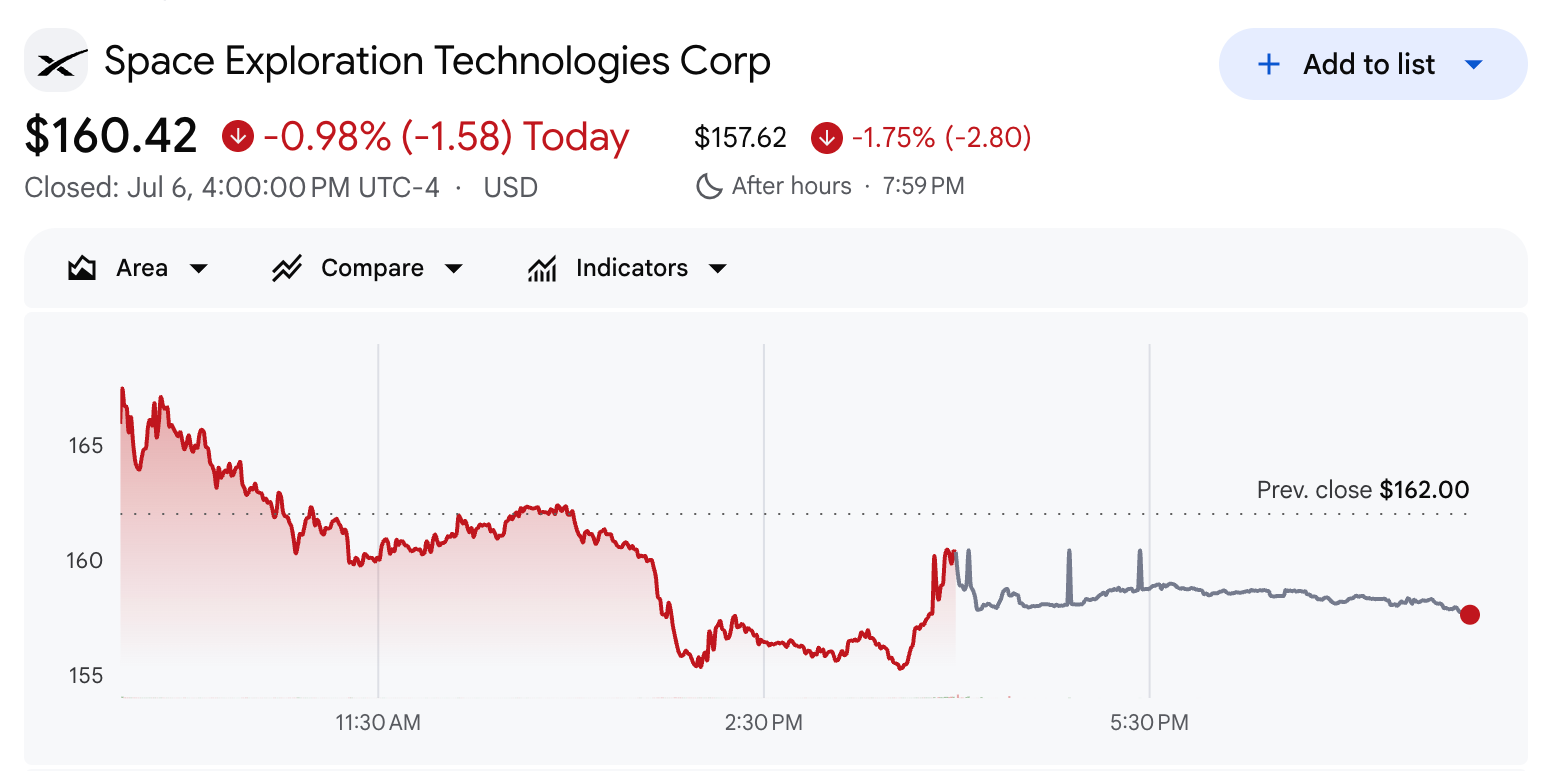
SpaceX stock (SPCX) enters the Nasdaq-100 before US markets open on Tuesday. The move lands as SPCX trades roughly 29% below its recent peak.
Nasdaq confirmed on June 26 that SPCX would join, less than a month after its June 12 listing.
SPCX Stock Gives Back Its Post-IPO Gains
Space Exploration Technologies Corp went public on June 12, reaching a valuation of nearly $2 trillion. The shares opened near $150, well above the $135 IPO price.
The initial rally carried the SPCX stock to an all-time high of $225.64. However, the stock has since retreated sharply.
SPCX has fallen roughly 29% over the past few weeks. The stock closed at $160.42 on Monday, down -0.98%.

What the Inclusion Means for SPCX
Index-tracking funds must buy SPCX to match the benchmark. That demand can lift a stock, though the effect depends on its weight.
Follow us on X to get the latest news as it happens
JPMorgan estimates SpaceX will carry about a 1.3% weight, ranking near 21st, behind names like Nvidia, Walmart, Intel, and Tesla.
“But the smaller the percentage weighting within the index that any given constituent holds, the less stock anybody trying to track that index is going to have,” Mike Khouw, chief strategist at OpenInterest.PRO, told CNBC. “Make no mistake, this is still very high volatility.”
Volatility also remains a concern. JJ Kinahan, senior vice president at Cboe, urged caution over near-term swings.
“We know volatility is high. There’s a sense volatility may increase. Are you comfortable with a $20 expected move over the next 11 days?” he said.
Meanwhile, expiring lockups could work against the buying. Insider restrictions lift in tranches between 70 and 135 days after the June 12 IPO. Shares held by Elon Musk and other large backers stay locked for 366 days.
Susquehanna analyst Charles Minervino called the schedule a near-term overhang for the stock, since fresh supply may hit just as index demand builds. The next sessions will test whether index buying can offset that overhang.
Subscribe to our YouTube channel to watch leaders and journalists provide expert insights
The post SpaceX Joins Nasdaq-100 Tuesday as SPCX Drops Roughly 29% appeared first on BeInCrypto.
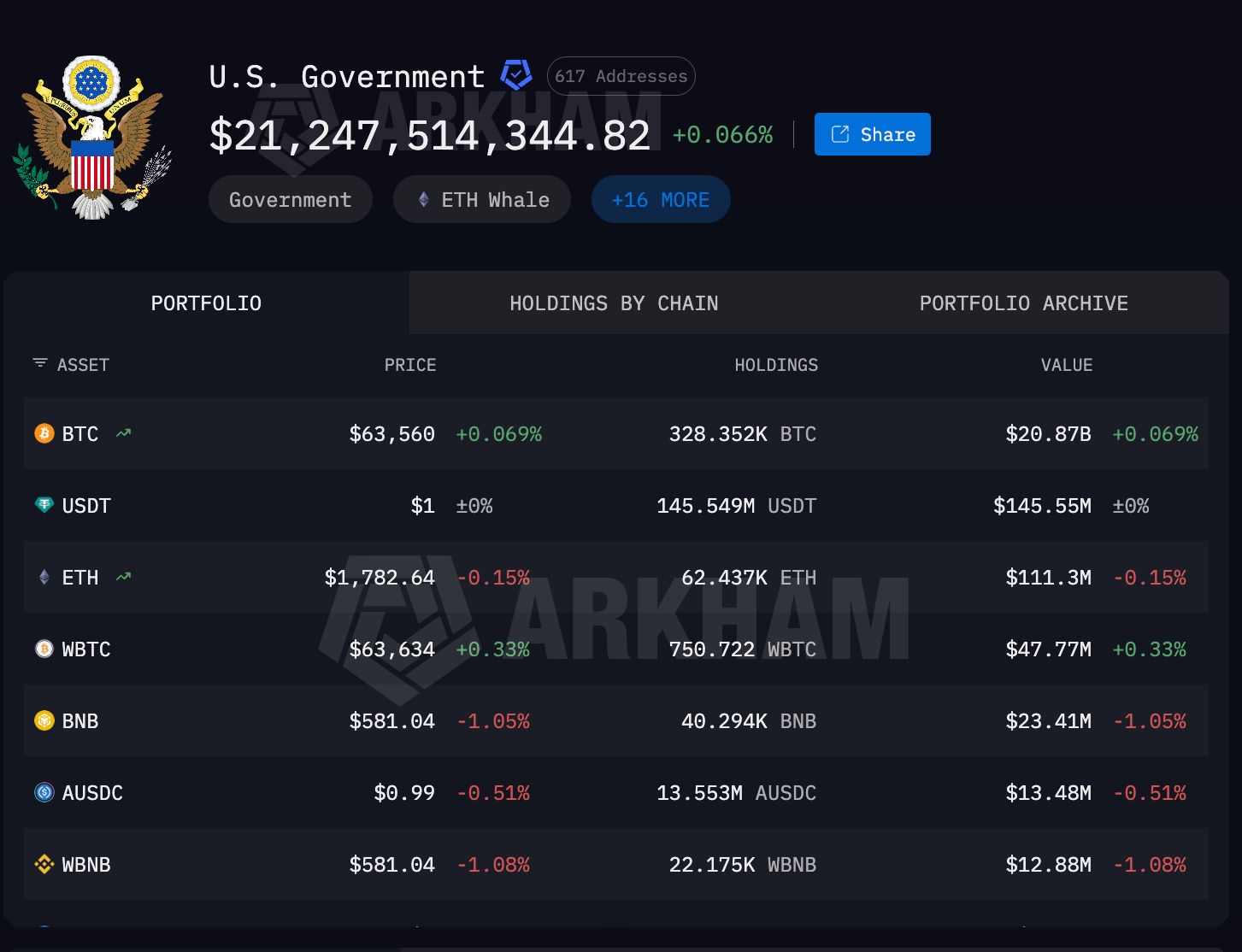
Legal questions over which federal department can lawfully manage a national crypto trove have complicated President Donald Trump’s Strategic Bitcoin Reserve, more than a year after he ordered its creation.
Trump directed the reserve into existence last year as part of his pledge to make the United States “crypto capital of the world.” The plan has since run into a structural problem.
Which Agency Can Legally Hold America’s Bitcoin Remains Unresolved
The order intended the reserve to sit inside the Treasury Department. Bitcoin (BTC) would come from federal asset seizures. The order also empowered the Treasury and Commerce secretaries to design budget-neutral ways to buy more Bitcoin, provided the purchases cost American taxpayers nothing.
Concerns then surfaced over whether Treasury could legally manage the assets, Bloomberg reported, citing people familiar with the matter. Housing the reserve inside the Commerce Department is now one option.
Another open question is whether Bitcoin can be held indefinitely, as the order intended, given its price swings.
Follow us on X to get the latest news as it happens
The Justice Department’s Office of Legal Counsel is working with both departments to “determine legally available options to accomplish the president’s policy of establishing a strategic Bitcoin reserve.”
White House spokesperson Liz Huston addressed the matter in a statement shared with BeInCrypto. She said the administration was still working out the right setup for the reserve.
“President Trump campaigned on a vision of cementing America as the global capital of cryptocurrency and other cutting-edge technologies,” Huston said. “To deliver on the president’s vision, the Trump administration continues to evaluate the best structure for a Strategic Bitcoin Reserve and U.S. Digital Asset Stockpile.”
The US government ranks among the largest holders of Bitcoin worldwide. Its holdings exceed $20 billion at current prices, according to Arkham Intelligence.

How the administration resolves the authority question will determine whether one of its signature crypto commitments takes shape or stays on paper.
Subscribe to our YouTube channel to watch leaders and journalists provide expert insights
The post Whose Bitcoin Is It? The Legal Fight Stalling Trump’s $20 Billion Reserve appeared first on BeInCrypto.


Naver Financial has postponed the completion of its all-stock share swap with Dunamu for a second time, extending the closing date to Dec. 31 as regulatory approvals remain pending.
Summary
- Naver Financial and Dunamu have delayed their planned share swap for a second time, with completion now expected on Dec. 31.
- The deal remains subject to multiple regulatory approvals and could face further delays or cancellation if those processes are not completed.
- Dunamu said South Korea’s proposed Digital Asset Basic Act could still influence the structure or outcome of the transaction.
According to a regulatory filing disclosed by Dunamu, the planned comprehensive share exchange with Naver Financial has been rescheduled from Sept. 30 to Dec. 31, following an earlier postponement that moved the timeline from June 30 to September.
Share swap awaits regulatory approvals
The filing kept the exchange ratio unchanged at 2.5422618 Naver Financial shares for every one Dunamu share. It also repeated that completion of the transaction depends on approvals from South Korea’s Fair Trade Commission, clearance for changes in major shareholders under the Credit Information Act, and notifications required under the Act on Reporting and Use of Specific Financial Transaction Information.
Dunamu said in the filing that delays in those approval processes could push the schedule back further or even prevent the share exchange from being completed. The company also noted that ongoing discussions around South Korea’s proposed Digital Asset Basic Act could affect the transaction depending on the final form of the legislation once it is enacted and implemented.
The latest delay comes after Naver Financial previously postponed the transaction in March, when it moved the expected completion date from late June to Sept. 30 while citing regulatory approval procedures and legal developments.
At the time, the company said the deal remained subject to several government approvals and could face additional delays or cancellation depending on the outcome of those reviews.
Merger continues under regulatory scrutiny
Regulatory oversight has also intensified since the transaction was first announced. In April, South Korea’s Financial Supervisory Service ordered Dunamu to correct omissions in its disclosure related to the merger after identifying missing or inaccurate information concerning future corporate restructuring plans and other matters important to investors.
The regulator’s review came as lawmakers continued debating the Digital Asset Basic Act, with local reports indicating that proposed limits on major shareholders of virtual asset exchanges could affect Naver Financial’s plan to acquire full ownership of Dunamu. Dunamu has previously stated that it intends to proceed with the transaction despite the legislative uncertainty.
The all-stock deal, confirmed in late 2024, values Dunamu at around $10 billion and is expected to bring the operator of Upbit under Naver Financial. The companies have also outlined plans to cooperate on digital asset services, including the development of the Silk Pocket stablecoin wallet alongside blockchain investment firm Hashed and the Busan Digital Exchange.


U.S. spot bitcoin ETFs pulled in $265.69 million on Monday, the largest daily inflow in over a month and the second in three sessions after July 2 broke a long run of outflows, per SoSoValue data. Ether ETFs added $20.66 million the same day, led by BlackRock’s ETHA at $23.29 million.
BlackRock’s IBIT absorbed $209.40 million of the bitcoin total, with ARKB taking in $32.98 million and Grayscale’s mini BTC fund adding $42.25 million. GBTC shed $44.45 million, the only fund in the red.
The daily turn has not fixed the weekly picture yet. Spot bitcoin ETFs still lost a net $526.6 million over the shortened holiday week, an eighth straight week of negative flows. Ether ETFs lost $13.7 million on the week.
Total bitcoin ETF assets climbed back to $77.32 billion from a June 30 low of $70.95 billion, helped by both the price recovery and the returning bid. Bitcoin traded near $63,200 as the data landed, per CoinDesk data.
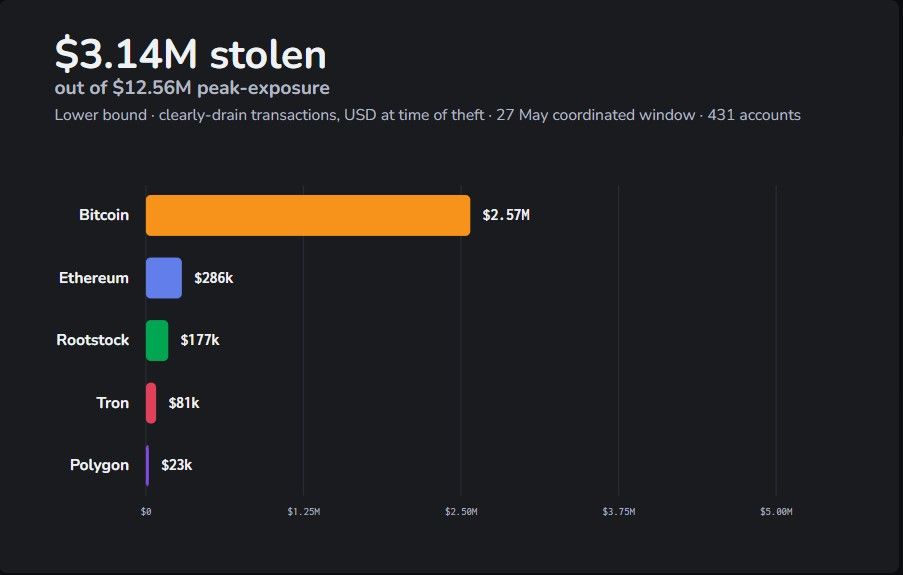
Coinspect has disclosed the Ill Bloom vulnerability, a crypto wallet flaw that created weak recovery phrases on multiple blockchains. Attackers exploited the weakness on May 27, draining 431 wallets for about $3.1 million.
Coinspect traced the flaw to an insecure pseudorandom number generator used during wallet creation. The weakness spans multiple chains, including Bitcoin (BTC), Ethereum (ETH), and Solana (SOL).
How the Ill Bloom Vulnerability Breaks Crypto Wallets
According to Coinspect, the faulty generator produced recovery phrases with far less cryptographic strength than intended. As a result, attackers can regenerate the whole range of possible phrases and sweep any funded address.
The researchers reproduced the attack end-to-end. They derived every address the weak phrases could produce and matched them against funded wallets on public blockchains. Affected addresses date back to 2018, and most trace to lesser-known mobile crypto wallets.
Users are asked to review their historical wallet addresses. Hardware wallet users remain unaffected. Earlier this year, Binance issued a critical iOS alert for mobile users.
Coordinated May 27 Sweep Drained 431 Wallets
According to Coinspect’s analysis, the monitored set contains 2,114 funded addresses across Bitcoin, Ethereum, Tron, Rootstock, and Polygon. On May 27, drained accounts sent their balances to a handful of shared collector addresses within hours.
Bitcoin absorbed the biggest hit at $2.57 million, and one account alone lost over $1.1 million. Historically, the exposed set held up to $12.56 million at its April 2022 peak.
The firm calls the $3.1 million figure a lower bound because new affected accounts keep surfacing. The sweep also adds to heavy crypto theft losses this year, which topped $400 million in January alone.
Compromised keys drain value fast, as the recent private key breach at Humanity Protocol showed. Notably, earlier incidents such as Milk Sad stemmed from the same class of weak randomness.

How Crypto Users Can Protect Their Funds
Coinspect published a checker that compares public addresses against the known vulnerable dataset. However, a negative result does not guarantee safety because the dataset remains incomplete.
Matched users should create a brand-new crypto wallet and migrate funds to its addresses. In contrast, importing the old phrase into another app leaves the money exposed.
Meanwhile, scammers exploit scares like this one, as a recent fake airdrop drain on Hyperliquid showed. Coinspect stressed it will never request secrets.
“We will never ask for seed phrases, private keys, signatures, or approvals, or ask users to send funds to ‘recover’ or protect a wallet”
Wallet vendors keep pushing safer defaults, including Ethereum’s new Clear Signing standard. Still, the coming days should reveal which apps generated the weak phrases. Until then, moving crypto off flagged addresses remains the only reliable fix.
The post Ill Bloom Vulnerability Drains $3.1 Million From Crypto Wallets: Are You Exposed? appeared first on BeInCrypto.
Strategy’s $216 million Bitcoin sale on Monday should be seen as a positive development for the price of Bitcoin and as a move that renews confidence in STRC, according to analysts.
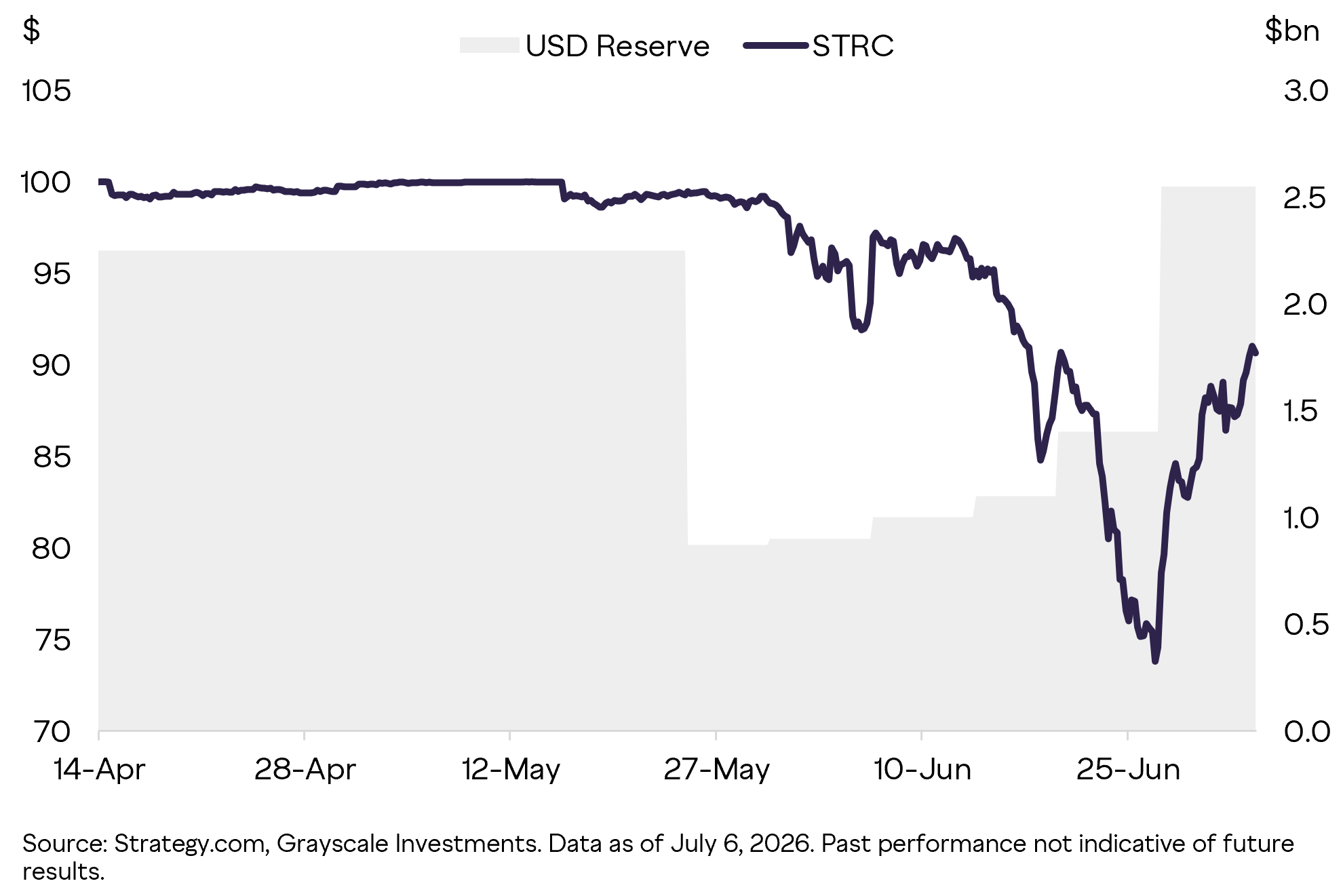
The sale of 3,588 BTC to fund preferred stock dividend payments and replenish cash has boosted Strategy’s dollar reserves to cover 17 months of dividend payments. “The rebound in STRC suggests investors are responding positively to this decision,” Grayscale Research said Monday.
Andri Fauzan Adziima, research lead at Bitrue Research Institute, told Cointelegraph that Strategy’s recent sale was a “smart, stabilizing move that actually strengthens the setup for Bitcoin.”
Zach Pandl, Grayscale’s head of research, said Strategy’s actions should “restore market confidence” in its financing structure, and may help Bitcoin’s price “find a more durable bottom,” as it relieves the pressure of further BTC sales from Saylor’s company.
Strategy’s announcement that it sold Bitcoin caused the asset to drop 2.4% in a matter of hours. However, both Bitcoin and Strategy’s yield-bearing STRC product rebounded soon after, suggesting that investor concern was short-lived.
Restoring market confidence
There is nothing wrong with Strategy’s balance sheet, and the company clearly has sufficient financial resources to service its debt and dividend obligations, Pandl said.
“Nevertheless, shifting market conditions created uncertainty about how Strategy would balance competing priorities.”
Related: Strategy will be ‘less important’ in Bitcoin after STRC incident: Bitwise
Strategy clarified in late June that it would issue shares and sell Bitcoin as needed to maintain sufficient US dollar reserves to cover its dividend obligations.
Strategy’s dollar reserves now total $2.55 billion, or the equivalent of about 17 months of dividend cover. Meanwhile, the rebound in the price of STRC — which topped $91 for the first time in three weeks on Monday — “suggests investors are now more confident about the instrument,” Pandl said.
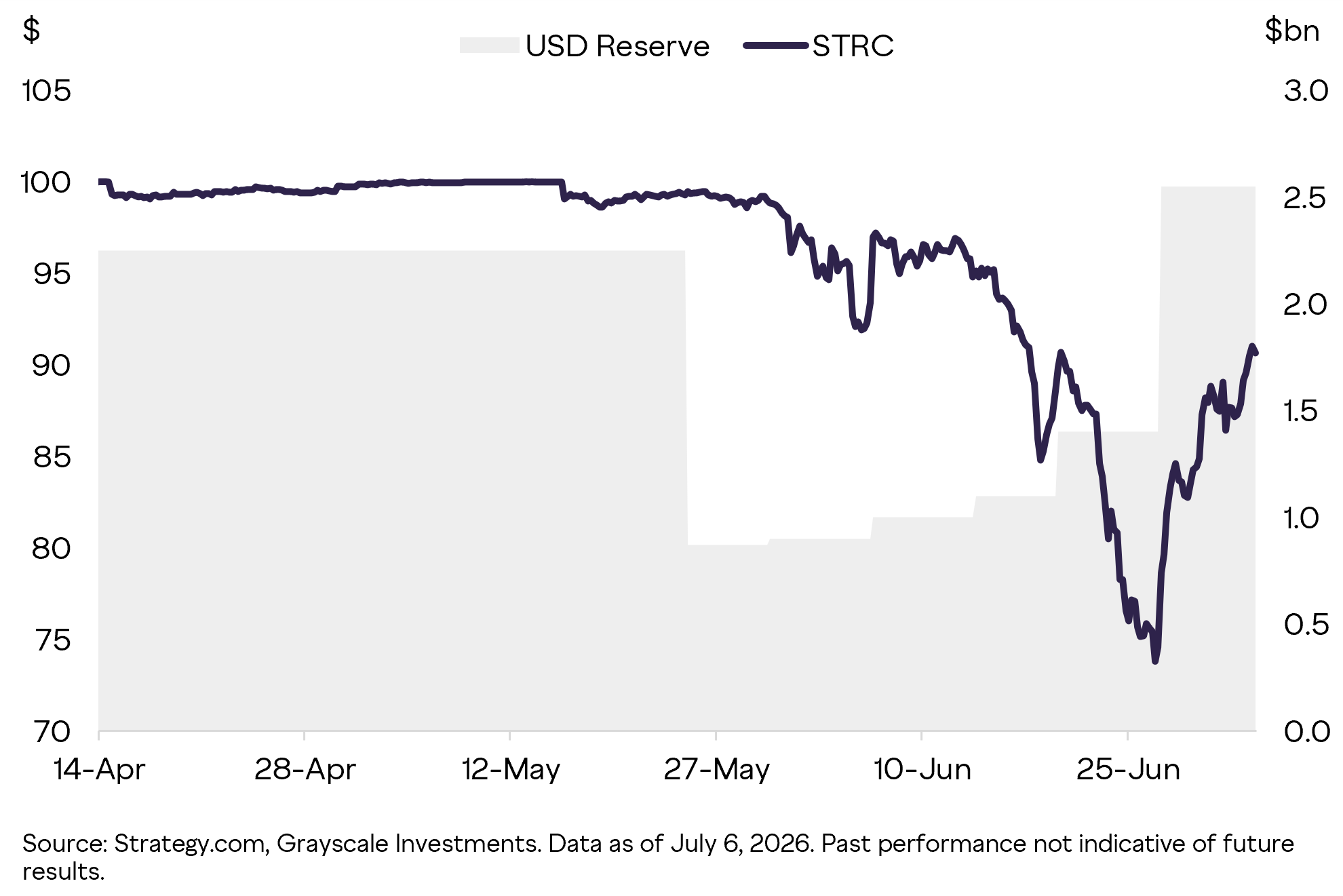
Bitcoin sales funded Strategy’s USD Reserve and bolstered investor confidence. Source: Grayscale
The sale reduces forced-selling risks
“By using the proceeds to pad cash reserves for roughly 17 months of STRC dividends, they’ve cut near-term financing pressure and overhang, which helped spark Bitcoin’s quick recovery above $64k while lifting STRC near $90,” Adziima said.
“In my view, this reduces forced-selling risks, rebuilds confidence in their structure and paves the way for a more durable bottom as other buyers step in, prudent balance-sheet management rather than any kind of capitulation.”
BTC recovered to reach $64,400 in late trading on Monday, but had dipped to $63,120 at the time of writing.
Magazine: AI is banking the unbanked in Africa… faster than crypto

Did this Ashish Kacholia-backed multibagger stock really crash 81% in one day? Here’s how the bonus math works

Ethereum price setup turns bullish, but $1,800 still blocks rally

Obsession’s Destruction Of Marvel And DC Is Another Sign Superhero Movies Are Done


-

 Fashion4 days ago
Weekend Open Thread: High Hopes
-

 Politics4 days ago
The House | “Reframing the debate from a binary discussion of winners and losers”: Yuan Yang reviews ‘We Are Not Machines’
-

 Fashion16 hours ago
Open Thread: What Great Books Have You Read Recently?
-
 NewsBeat2 days ago
Taylor Swift and Travis Kelce wedding staffer hilariously struggles to keep her cool while checking in megastars
-

 News Videos7 days ago
How to Build INSANE Live Financial Dashboards With Claude
-
Crypto World6 days ago
Airdrop Registration Becomes Key Focus For Remittix As RTX Launch Updates Approach
-

 Sports6 days ago
Broncos roster: OL Ben Powers (No. 74) entering final year of contract
-

 Crypto World5 days ago
Binance stock trading tops $1B in first month after launch
-

 NewsBeat6 days ago
Presenter Caroline Flack’s brother Paul Flack dies aged 55
-

 Crypto World5 days ago
Alibaba-affiliate Ant Group enters the humanoid robot market with 12 deals
-

 Crypto World4 days ago
Standard Chartered Secures MiCA License as ESMA Adds 37 New Crypto Firms
-

 Crypto World2 days ago
South Africa proposes crypto tax guidance under existing rules
-

 News Videos17 hours ago
Best Time to Enter Small Caps Right Now? Another Bull Run? | Financially Free
-

 Business5 days ago
Meta Platforms Stock Jumps 7% Today as Bloomberg Reports Company Plans to Enter the Cloud Business
-
 NewsBeat5 days ago
New exhibition reflects five decades of movement between island of Ireland and GB
-

 Tech2 days ago
Lenovo laptops are now shipping with YMTC SSDs, a sign of Chinese NAND entering the mainstream
-

 Business4 days ago
What a 10 Percent Drop Means for Buyers, Sellers and Renters
-

 Crypto World4 days ago
Binance Re-Enters Philippines As EU MiCA Rules Restrict Access
-

 News Videos19 hours ago
Avoid entering in FOMO #bitcoin #cryptocurrency #trading #scalping
-

 News Videos4 hours ago
Whats Hidden Inside This Cash Register? #treasure #reselling #money
You must be logged in to post a comment Login