

Crypto World
Crypto News, July 10: Regulation Overtakes Geopolitics as Bitcoin and Ethereum Price Hold Firm


For us, who spent the past month glued to oil charts, the screens have changed. Now we’re refreshing congressional calendars instead. Crypto regulation, not missiles nor crude price, is becoming the biggest talking point as Bitcoin and Ethereum price continue to hold steady. Policy has become the market’s new obsession.
Although Middle East headlines still grab attention, crypto is now spending more time debating legislation, SEC guidance, and CFTC oversight. For now, politics in Washington seems to matter more than politics in the Gulf.
Don’t Miss Out on Our $1,000 USDT Airdrop on ByBit
Bitcoin Price Holds Up as Markets Await Policy Clarity

Bitcoin price is holding at the mid-$63,000 range after recovering from June’s selloff. Softer U.S. economic data and easing energy prices have helped improve risk sentiment, while ETF flows remain mixed. Buyers continue stepping in on dips, as institutions remain willing to accumulate despite short-term uncertainty.
Attention is already turning to upcoming inflation data and the Federal Reserve’s next meeting. A cooler CPI reading could give the Bitcoin price another push, but many traders believe Washington will ultimately have the bigger say.
That is because crypto regulation is moving unusually fast. Congress continues debating the CLARITY Act, while regulators are working toward clearer rules on digital assets after years of uncertainty. The SEC and CFTC have already issued joint guidance aimed at defining how crypto assets should be treated under federal law.
Discover: The Best Token Presales
Ethereum Price Finds Support Beyond ETF Headlines

Ethereum price remains under pressure compared with earlier this year, but the network itself grows. Layer 2 activity, tokenized assets, and decentralized finance are all expanding even while ETH trades sideways.
ETF flows have swung between inflows and outflows, yet developers have largely ignored the day-to-day noise. Instead, they remain focused on scaling Ethereum and attracting more onchain activity. It is not exactly headline-grabbing, but builders rarely care whether traders are having a good week.

Robinhood Chain may not move the Ethereum price overnight, but it could quietly strengthen the network over time. Built as an Ethereum Layer 2 using Arbitrum Orbit, the chain settles transactions back to Ethereum and uses ETH for gas. This brings activity and ultimately feeds into Ethereum’s ecosystem.
The Ethereum price could also benefit if lawmakers deliver clearer rules for decentralized finance. Several industry groups continue urging regulators to create frameworks tailored to DeFi instead of squeezing it into decades-old financial rules. It’s looking bright for Ethereum price.
Discover: The Best Crypto to Diversify Your Portfolio
Crypto Regulation Is the Market’s New Catalyst
The biggest shift is psychological. A few weeks ago, people jumped at every geopolitical headline. Now they are dissecting committee schedules, regulatory guidance, and draft legislation with the same intensity.
That helps explain why Bitcoin and Ethereum price have held relatively resilient despite ongoing global tensions. Investors increasingly believe clearer rules could encourage fresh institutional capital, especially if Congress finally delivers long-awaited market structure legislation.
— Crypto Banter (@crypto_banter) July 9, 2026
 LAWMAKERS PREPARING REVISED CLARITY ACT FOR POSSIBLE INTRODUCTION NEXT WEEK!
U.S. negotiators are working on a new or updated version of the Digital Asset Market Clarity Act, which could be introduced as soon as next week, CoinDesk reports.
This comes as Congress returns from… pic.twitter.com/rYp5feGoM8
It’s becoming more obvious now, crypto regulation has replaced geopolitics as market’s conversation, and both the Bitcoin and Ethereum price are taking their cues from Washington more than the latest oil headline.
Don’t Miss Out on Our $1,000 USDT Airdrop on ByBit
The post Crypto News, July 10: Regulation Overtakes Geopolitics as Bitcoin and Ethereum Price Hold Firm appeared first on Cryptonews.



Vitalik Buterin has called on Elon Musk to reshape X into a platform where ordinary users can help coordinate global AI governance instead of leaving key decisions to governments and large institutions.
Summary
- Vitalik Buterin urged Elon Musk to turn X into a platform for global AI governance coordination.
- Buterin proposed predefined AI slowdown triggers while backing open participation over centralized control.
- The proposal comes as SpaceXAI prepares Grok 4.5 and OpenAI readies GPT-5.6 for release.
According to a July 11 thread published by Ethereum co-founder Vitalik Buterin on X, the social media platform could become a place where people participate in major AI policy discussions through open coordination rather than relying solely on governments, major AI laboratories, or nonprofit organizations.
X could become a coordination layer for AI policy
In the thread, Buterin argued that X is well positioned to help people negotiate what he described as “grand win-win deals” on AI governance. Addressing Musk directly, he wrote that if he were running the platform, he would redesign it to help identify agreements that give more people influence over decisions instead of concentrating power among governments, technology companies, and leading institutions.
The proposal builds on ideas Buterin has discussed before. In earlier posts, he praised X’s Community Notes system and prediction markets as two of the most important social technologies for improving public knowledge.
At the same time, he has also warned that the platform could become a tool for coordinated harassment if its incentives move in the wrong direction, making governance changes increasingly important in his view.
Buterin’s proposal comes as the AI race accelerates after SpaceXAI released Grok 4.5 and OpenAI rolled out GPT-5.6. Ahead of Grok 4.5’s public launch, Musk described it on X as an “Opus-class model” that is faster, more token-efficient, and lower cost following positive beta feedback.
Crypto tools could benefit if X adopts the model
Beyond proposing changes to X, Buterin outlined what he sees as the biggest disagreement in the AI debate. According to his post, one group believes artificial superintelligence could emerge around 2040 unless development slows dramatically, while another treats AI as a continuation of previous technological progress and dismisses warnings about existential risks and centralized control.
Although Buterin said he remains uncertain about AI timelines, he argued in favor of establishing predefined conditions that could temporarily slow AI development. His examples included the emergence of super-pandemics, unemployment rising above 25%, or autonomous lethal drones becoming widely deployed.
Those proposals are consistent with Buterin’s defensive acceleration, or d/acc, framework, which prioritizes technologies such as cryptography, formal verification, secure open hardware, pandemic preparedness, and stronger public information systems. The same philosophy has also influenced Ethereum’s technical roadmap, where Buterin has repeatedly supported privacy-focused infrastructure through what has become known as the Lean Ethereum vision.
For crypto markets, Buterin’s proposal points toward a larger role for decentralized infrastructure if X evolves into a coordination platform. Prediction markets could be used to verify whether agreed AI trigger events have occurred, while zero-knowledge technologies and on-chain governance systems could receive additional attention if institutions adopt more transparent decision-making processes.
Even so, Buterin stopped short of calling for new AI regulation. Instead, his thread argued for coordination between participants with different views, presenting a framework that attempts to balance open participation with safeguards against high-risk AI outcomes.


The stablecoin market has lost about $10 billion since reaching a record high in May 2026. Total supply fell by $7.7 billion during June to about $312 billion, marking the largest monthly decline in dollar terms since the TerraUSD collapse in May 2022. The decrease equaled roughly 2.4% for June and about 3% from the May peak.
Summary
- Stablecoin supply lost $10 billion since May as USDT and USDC redemptions reduced crypto liquidity.
- June recorded the largest monthly dollar decline since Terra, but the market contracted only 3%.
- Transaction volumes remained strong while tokenized assets expanded, showing blockchain finance activity continued despite redemptions.
Current DefiLlama data places the market near $312.23 billion. The dashboard shows Tether’s USDT at about $184.15 billion and Circle’s USDC at roughly $73.41 billion. USDT still controls close to 59% of the market, leaving the sector heavily dependent on its two largest dollar-backed tokens.
USDT and USDC lead the supply reduction
USDT fell from about $190 billion in May, cutting roughly $6 billion from its circulating value. USDC declined from a March peak near $80 billion, losing almost $7 billion over four months. Together, those changes account for most of the retreat, although smaller regulated issuers continued expanding during the same period.
Paul Howard, senior director at trading firm Wincent, described the decline as “a relatively small pullback in what we believe is a long-term growth market.” The current drawdown remains far below the 26% stablecoin contraction recorded across the 2022 bear market. That earlier decline followed the Terra failure, lender collapses, and the failure of FTX.
Lower supply points to thinner crypto liquidity
Traders use stablecoins as settlement assets and quote currencies across exchanges and decentralized markets. A falling supply can show that users redeemed tokens for bank dollars or moved capital outside crypto. It can also reduce the amount of dollar-linked buying power available for Bitcoin, Ether, and other digital assets.
The reduction arrived during a weak month for crypto investment products.Crypto.news reported that U.S. spot Bitcoin exchange-traded funds lost more than $4 billion in June, their worst monthly outflow since launch. The parallel declines show that institutional fund demand and on-chain dollar liquidity both weakened as digital asset prices remained under pressure.
Activity did not fall at the same pace as supply. The adjusted stablecoin transaction volume reached a record $1.78 trillion in June. USDC processed about $1.21 trillion, while USDT handled $573 billion. USDT still recorded more individual transfers, showing that fewer tokens can continue supporting heavy payment and trading activity.
Tokenized assets grow while stablecoins retreat
Tokenized real-world assets moved in the opposite direction. However, their on-chain value crossed $30 billion during 2026, led by tokenized Treasury products, funds, and private credit. CoinDesk Research also recorded a 145% rise in tokenized equity volume during June to a record $3.86 billion.
Regulation and new issuers continue reshaping the stablecoin market. The U.S. GENIUS Act created a federal framework for payment stablecoins, while regulators are drafting customer identification, sanctions, and reserve rules. Crypto.news has also tracked new reserve products from Fidelity and State Street designed for regulated issuers.
The latest supply figures point to a pause in market expansion rather than a Terra-style collapse. USDT and USDC remain near their dollar pegs, transaction activity remains high, and the total market retains most of its recent growth. Further monthly contractions would provide clearer evidence that crypto liquidity is leaving the system rather than moving between issuers or on-chain products.
Investors will now watch July issuance, redemption data, exchange volumes, and ETF flows for signs that demand is returning or weakening further.


Empery has sold 1,400 Bitcoin for about $87.1 million since May, using the proceeds to reduce debt, fund acquisitions, cover legal costs, and strengthen its cash position while scaling back part of its Bitcoin treasury.
Summary
- Empery sold 1,400 BTC for $87.1 million to reduce debt and fund operations.
- The company now holds 1,514 BTC and about $73.9 million in cash.
- Capital B and Nakamoto are pursuing different Bitcoin treasury strategies through financing and refinancing.
Bitcoin sales have strengthened Empery’s balance sheet
According to Empery, the Nasdaq-listed company sold the 1,400 BTC between May 7 and July 10 at an average price of $62,200 per Bitcoin. The transactions generated approximately $87.1 million in gross proceeds, leaving the company with 1,514 BTC and roughly $73.9 million in cash as of July 10.
Company filings show the proceeds are being allocated across several financial obligations rather than additional Bitcoin purchases. Empery said the funds are being used to repay debt, finance a previously announced property acquisition, cover legal expenses related to ongoing stockholder litigation and support general operations.
As part of those efforts, Empery disclosed that it repaid $10 million of outstanding debt on July 7. Even after that payment, the company said about $45 million remains outstanding under its debt facility.
The latest disposal follows an earlier round of Bitcoin sales this year. In its annual report, Empery disclosed that it sold 722 BTC for approximately $50 million between Jan. 1 and March 25, 2026, while also warning investors that future Bitcoin sales could affect both its financial results and overall financial condition.
Earlier treasury expansion has given way to liquidity needs
The latest sales stand in contrast with the company’s Bitcoin accumulation strategy announced last year. In August 2025, when the company still operated under the Volcon name, Empery said it held more than 4,018 BTC and described its strategy as becoming a low-cost, capital-efficient Bitcoin aggregator.
Recent treasury decisions by other publicly traded Bitcoin holders show that companies are taking different approaches depending on their balance sheet needs. As previously reported by crypto.news, Nakamoto Inc. reduced outstanding debt by about $45 million after selling roughly 600 BTC and using Bitcoin-related derivative positions, generating around $48 million in net proceeds.
The company also refinanced most of its remaining borrowings into 2027, lowered financing costs, and retained approximately 4,467 BTC worth more than $280 million, according to company figures.
Capital B has moved in the opposite direction by seeking additional funding to expand its Bitcoin holdings rather than selling existing reserves. As previously reported by crypto.news, shareholders approved a financing framework in June authorizing up to €5 billion in new equity issuance and €100 billion in credit instruments.
According to Alexandre Laizet, Capital B’s board director of Bitcoin Strategy, the proposal would allow the French Bitcoin treasury company to issue up to 125 billion new shares at their current nominal value alongside a substantial pool of debt and credit instruments to finance further Bitcoin purchases.
Unlike Capital B’s capital-raising strategy or Nakamoto’s refinancing plan, Empery’s latest disclosures show that the company is relying on Bitcoin sales to meet immediate financial obligations while maintaining a smaller digital asset treasury on its balance sheet.
Strategy Executive Chairman Michael Saylor has renewed speculation about the company’s next Bitcoin transaction. In a July 12 post, he shared Strategy’s familiar acquisition chart and wrote, “Orange dots tell only part of the story.” The chart marks past Bitcoin purchases, but the message did not say whether Strategy had bought, sold, or taken no action during the latest reporting period.
Summary
- Saylor’s orange-dot post leaves Strategy’s next Bitcoin move unclear after last week’s major corporate sale.
- Strategy sold 3,588 BTC for $216 million, funding preferred dividends and rebuilding its dollar reserve.
- MSTR remains bearish near support, while weak momentum keeps the buy-or-sell question open for investors.
Saylor has often posted the chart before Strategy publishes a Monday filing. Traders once treated those posts as signals of another purchase. That pattern became less reliable after the company began selling Bitcoin in 2026. The latest message therefore leaves two possible readings: Strategy may have resumed accumulation, or Saylor may be pointing to a wider capital plan that now includes selective sales.
Strategy has not confirmed any transaction for the week ending July 12. Its public tracker still shows 843,775 BTC as the latest reported balance. The company generally discloses treasury activity through SEC filings, so social posts alone do not establish that a trade occurred or reveal its actual direction.
Strategy’s recent sale changes the signal
Strategy disclosed on July 6 that it sold 3,588 BTC for about $216 million between June 29 and July 5. The company sold 1,363 BTC at an average price of $59,256, then sold another 2,225 BTC at an average price of $60,773. The transactions reduced its holdings to 843,775 BTC, acquired for an average price of $75,476. The details appear in Strategy’s July 6 filing.
The filing said Strategy used the proceeds to fund preferred stock distributions and restore money taken from its dollar reserve. That reserve stood at $2.55 billion on July 5. Strategy also said its separate Bitcoin monetization program still had capacity to raise up to $1.25 billion. The company reported no common stock sales or share repurchases during the same week.
Crypto.news tracks a broader capital shift
Crypto.news described the July disposal as the end of Strategy’s simple “never sell” era. The report said the company now treats Bitcoin as part of a larger capital structure that includes preferred shares, dividends, debt, cash reserves, and possible buybacks. Strategy’s first 2026 sale involved only 32 BTC and was later described by chief executive Phong Le as a systems test.
The later 3,588 BTC sale carried more weight because Strategy used the funds for recurring financial duties. Another report cited Grayscale research warning that weak STRC and MSTR prices could raise dividend pressure and reduce Strategy’s ability to finance fresh Bitcoin purchases. Other analysts still expect the company to resume buying when market and funding conditions improve.
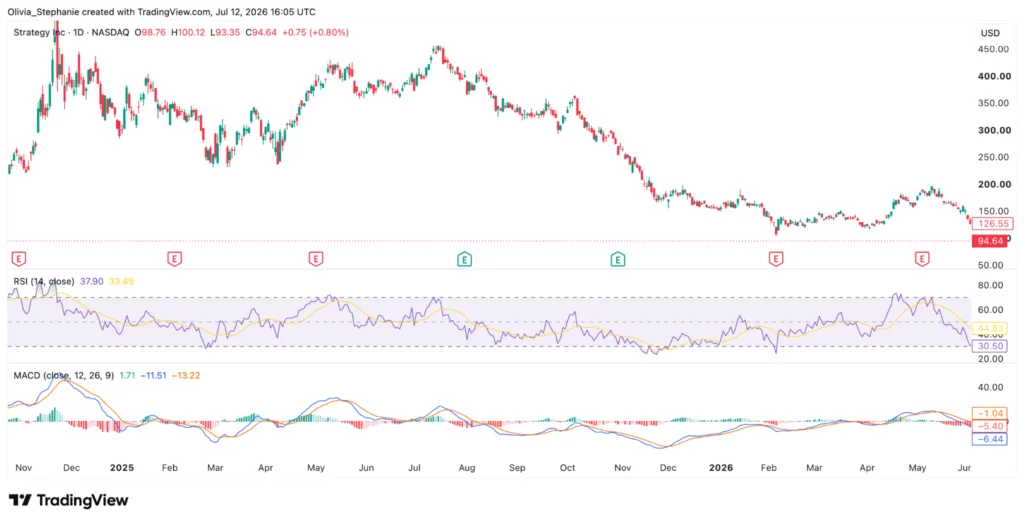
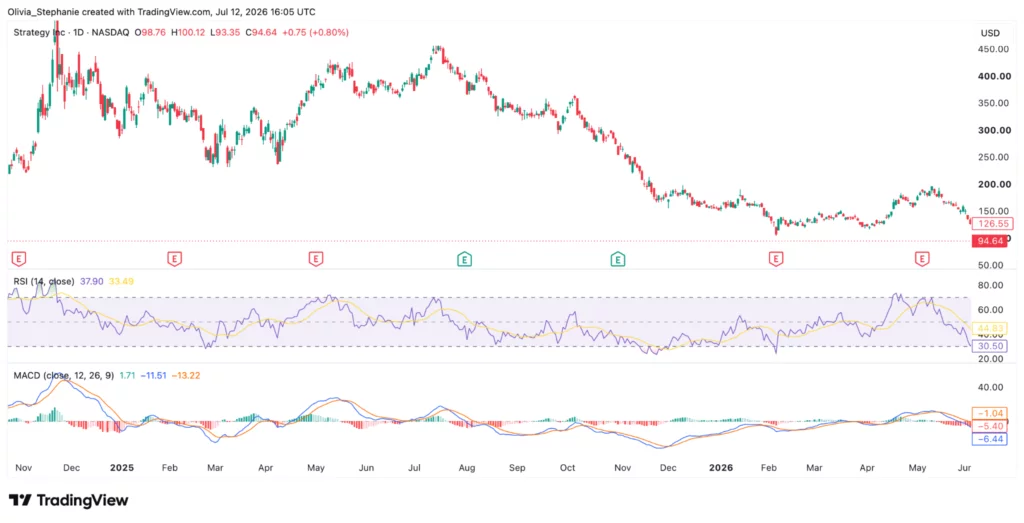
MSTR chart remains under pressure
MSTR closed near $94.64 after forming lower highs and lower lows since its July 2025 peak near $450. The stock remains below the $126.55 area, which now acts as resistance. Its relative strength index sits near 30.5, showing strong negative momentum and near-oversold conditions. That reading can support a short rebound but does not confirm a trend reversal.
Source: TradingView
The MACD line remains below its signal line and both sit under zero, keeping the broader setup bearish. Immediate support lies around $90 to $95. A break below that area would weaken the structure further. Recovery would require a move above $125 to $130, followed by stronger momentum. Strategy’s next filing should clarify whether Saylor’s orange dots marked a purchase, another sale, or a different balance-sheet move.


Hedera’s native token HBAR has fallen more than 2% after blockchain security researchers reported that a suspected exploit had moved more than $5.8 million in assets from the Hedera network to Ethereum.
Summary
- Suspected Hedera exploit moved more than $5.8 million in assets to Ethereum, according to blockchain security researchers.
- Specter and PeckShield said the attacker bridged funds through LayerZero before swapping WBTC for ETH.
- HBAR fell more than 2%, trading near $0.069 as the reported exploit unfolded.
According to blockchain security researcher Specter, the suspected attacker had already bridged more than $3.7 million worth of assets from Hedera to Ethereum before continuing to move additional funds.
Specter said the stolen assets were being swapped from Wrapped Bitcoin (WBTC) into Ether (ETH) after crossing chains through LayerZero. The researcher also published two wallet addresses believed to be linked to the incident.
At the time of writing, CryptoBull360 reported that the wallet’s estimated value had increased to roughly $5.8 million, indicating that more assets had reached Ethereum after the initial transfers. The shared wallet data showed holdings of about 3,203 ETH, representing nearly 80% of the portfolio, alongside roughly 20% in WBTC.
According to data from crypto.news, Hedera (HBAR) price traded around $0.069, down more than 2% following the reports of the suspected exploit.
Cross-chain transfers have continued after the initial breach
As additional transactions appeared on-chain, blockchain security firm PeckShield said the suspected exploit had already transferred approximately $5.25 million from the Hedera mainnet to Ethereum. The firm added that the wallet held around 2,360 ETH, valued at roughly $4.25 million, and 15.58 WBTC, worth about $1 million, at the time of its analysis.
PeckShield also reported that the wallet had originally been funded with 1 ETH from Tornado Cash, citing on-chain transaction history. The observation identifies the source of the wallet’s initial funding but does not establish who controls the address or who carried out the alleged attack.
The wallet screenshots shared by both Specter and PeckShield showed a series of inbound transfers arriving within a short period before the assets were converted into ETH.
Investigation remains ongoing as official details are limited
Neither Specter nor PeckShield identified the party responsible for the suspected exploit, and no official estimate of the total losses had been released at the time of writing. The reported value of the stolen assets continued to change as additional funds were observed moving through the wallet.
The incident is still developing, with blockchain security researchers continuing to monitor the addresses and publish updates as new transactions appear on-chain. Meanwhile, market participants are watching for an official statement from the Hedera team regarding the reported exploit and any measures taken to contain its impact.
The Hedera incident comes amid a series of security-related developments reported by crypto.news in recent weeks. Blockaid recently said it detected an active exploit targeting Summer.fi, estimating losses of about $6 million at the time of its alert.
Separately, Ctrl Wallet announced it will permanently shut down after a security exploit affecting some Cardano wallets, giving users until Aug. 3 to withdraw their assets. Meanwhile, crypto.news also reported that Secret Network has proposed migrating SCRT from Cosmos to Arbitrum, with the team citing security risks, weaker liquidity, and an aging codebase in its July 7 governance proposal.
For weeks and weeks, the spot Ripple ETFs, alongside HYPE and sometimes SOL, dominated all cryptocurrency-related exchange-traded funds, while the market leaders suffered.
However, this trend has finally changed as the financial vehicles tracking the performance of the cross-border token turned red in the past week for the first time in over two months.
Streak Broken
Although the actual numbers were not as impressive as they were back in October, November, and December last year when the XRP ETFs launched, they were still in the green for nine consecutive weeks. Moreover, the only week that broke that streak saw a minor $35.21K (not millions) in net outflows, so it doesn’t really count. Within this timeframe, the total net inflows rose from under $1.29 billion to a new all-time high of $1.49 billion as of July 2.
However, the tides finally turned in the past five business days. Interestingly, though, only one day was in the red, with $7.29 million leaving the funds on July 8. A minor $107.38K entered the funds on Friday, while the other three trading days saw no reportable action, according to SoSoValue data.

This is rather concerning as XRP has seen similar net inflow-free days in the past, but that wasn’t the case in the last few months. Now, though, investors appear to have turned their attention away from Ripple’s token and back to the market leaders. As reported yesterday, both the Bitcoin and Ethereum ETFs recorded their first green week in two months, with net inflows of almost $200 million and $84 million, respectively.
XRP Price Stalls
Despite the major net inflows for nine weeks, Ripple’s native coin failed to capitalize and record any substantial gains in that time. However, the net ouflows in the past week seem to have harmed it, as current data from CoinGecko shows a 3.2% decline over the past week.
XRP challenged the $1.15 resistance earlier this week, but it was halted there, and the subsequent rejection pushed it south to under $1.10. Although it has rebounded to that level now, the uncertainty continues as many analysts expect a major move ahead.
The direction, as usual, is unknown, but the overall belief within the crypto community is that XRP has reached a decision point and it could either head below $1.00 soon or rocket toward new local peaks.
The post The End of a Ripple Era: XRP ETFs Record First Red Week In Months appeared first on CryptoPotato.


Pakistan Virtual Assets Regulatory Authority Chairman Bilal bin Saqib has called for continued discussion on digital assets under Islamic law. His statement followed a meeting with scholar Mufti Taqi Usmani on July 11. Saqib said both sides shared one aim: protecting Pakistanis from fraud, exploitation, and financial harm.
Summary
- Pakistan’s crypto chief seeks technical and Shariah reviews instead of one broad digital asset ruling.
- Mufti Taqi Usmani’s ruling rejects crypto purchases because tokens allegedly lack recognised Shariah wealth status.
- Pakistan continues licensing crypto firms while religious concerns add another layer to its regulatory rollout.
In his public statement, Saqib said blockchain, stablecoins, tokenized real-world assets, and other digital assets cover different technologies and uses. He said they require “careful technical assessment alongside rigorous Shariah examination” instead of one broad judgment. He also called for further engagement among scholars, regulators, and industry specialists.
Religious ruling rejects purchases made with crypto
The meeting followed an Islamic legal ruling issued by Darul Ifta at Jamia Darul Uloom Karachi. Mufti Usmani and five other scholars signed the ruling, dated June 10, 2026. It said purchases made with cryptocurrency, including USDT, were not permitted under their reading of Islamic law.
According to Dawn’s report, the scholars said current research did not establish crypto as recognised property or wealth. The ruling described it as “merely the recording of fictitious numbers in an account.” Saqib did not directly reject that finding. He instead asked for separate reviews of different digital asset categories.
Pakistan continues building a licensed crypto market
The exchange comes as Pakistan moves ahead with a regulated virtual asset sector. The Virtual Assets Act 2026 created PVARA as the body responsible for licensing and supervising virtual asset service providers. PVARA also opened a public consultation on rules covering exchanges, custodians, brokers, token issuers, and other providers.
On April 15, the State Bank of Pakistan allowed banks to open accounts for firms licensed by PVARA. The central bank circular requires banks to verify licences, perform due diligence, monitor accounts, and keep customer money separate from company funds. Banks cannot use their own capital or customer deposits to trade or hold virtual assets.
A previous report shows that the policy ended an eight-year restriction on banking services for regulated crypto firms. The report said banks must still follow foreign exchange, anti-money laundering, and counterterrorism financing rules. Suspicious activity must be reported to Pakistan’s Financial Monitoring Unit.
Stablecoins and tokenization remain part of policy plans
Pakistan has also explored stablecoins and tokenized assets through agreements with international companies. In December 2025, the government signed a nonbinding agreement with Binance to study the tokenization of up to $2 billion in state assets. Crypto.news coverage linked the plan to government bonds, Treasury bills, and commodity reserves.
A separate January 2026 agreement involved studying the use of the USD1 stablecoin in cross-border payments. Crypto.news reported that the work would involve Pakistan’s finance ministry and central bank. These projects remain subject to regulation, technical review, and formal approval.
The dispute over crypto payments now adds a religious review to Pakistan’s regulatory process. PVARA has not announced any change to licensing rules after the meeting. Saqib’s statement leaves the discussion open while the regulator continues drafting operating standards. The ruling did not change state licensing rules, while licensed firms remained bound by the Virtual Assets Act and central bank controls.

Empery Digital’s shares jumped after the company disclosed it has been steadily trimming its Bitcoin treasury to support new funding needs. According to an 8-K filing with the U.S. Securities and Exchange Commission, the NASDAQ-listed company sold nearly half of its Bitcoin holdings over the past two months and used the proceeds to back an AI data center project and reduce debt.
The news lands at a time when some investors appear increasingly skeptical of corporate “treasury” strategies that treat Bitcoin as a long-term balance-sheet asset without an obvious liquidity plan. Empery’s decision—and the market’s initial reaction—highlights how quickly corporate crypto strategies can shift when capital priorities change.
Key takeaways
- Empery Digital sold 1,400 Bitcoin at an average price of $62,200 per coin, raising about $87.1 million, per its SEC 8-K filing.
- The company said proceeds were used partly for its 25% stake in a Hunt Properties-affiliated venture targeting an industrial site conversion into an AI data center.
- Empery also allocated about $10 million of the proceeds to pay down outstanding debt.
- The sale reduced Empery’s Bitcoin holdings by about 48% to 1,514 BTC, according to the disclosure.
- Shareholders who had pressured Empery to change its Bitcoin strategy previously demanded leadership resignations tied to its treasury approach.
What Empery disclosed in its SEC filing
Empery Digital said it sold 1,400 BTC over the past two months. In the filing referenced by the company, the sales were executed at an average price of $62,200 per Bitcoin, resulting in gross proceeds of roughly $87.1 million.
The company linked that liquidity move to two key corporate priorities. First, it directed part of the funding toward an equity position: Empery said it used proceeds to maintain a 25% stake in a venture affiliated with Hunt Properties. That venture, according to the disclosure, is acquiring an industrial site intended to be converted into an AI data center.
Second, Empery indicated that it used proceeds to strengthen its balance sheet by paying off $10 million in outstanding debt. While the filing’s focus is primarily on the capital allocation, the combined effect is clear: the firm treated Bitcoin holdings as a source of funding rather than solely a long-duration investment.
Shares react as the Bitcoin treasury thesis faces scrutiny
Following the disclosure, Empery shares rose early in Friday’s trading. The article notes that the stock gained about 4.2% to $3.95 within the first 35 minutes and later narrowed to a $3.86 close, up roughly 1.58% for the day.
That initial upside suggests investors interpreted the sale as a pragmatic adjustment—one that may reduce the risk of capital being locked up in a treasury asset while the business pursues other needs. The timing also matters. The move comes amid broader pressure on corporate Bitcoin holders, where some investors have questioned whether “hold and never sell” approaches are realistic when companies must fund operations, pay debts, or finance new growth initiatives.
For Empery, the filing also shows how much of the Bitcoin position was affected. The company’s sales trimmed its holdings by about 48%, leaving it with 1,514 BTC. At current prices referenced in the report, that remaining position is described as worth about $97 million.
Pressure from a major shareholder preceded the sales
Empery’s Bitcoin reduction did not occur in a vacuum. Earlier reporting highlighted a shareholder dispute involving Tice P. Brown, who holds nearly 10% of the company. According to earlier coverage from Cointelegraph, Brown urged Empery to abandon its Bitcoin-buying strategy and called for changes in leadership, demanding the CEO and the board resign.
Cointelegraph’s prior account described Empery’s pivot to a Bitcoin-centric treasury plan that began around mid-2025, when Bitcoin was rallying toward its all-time high of $126,080 set in October. The latest disclosure indicates that—at least for now—the company is shifting away from adding to that position at the same pace, and instead monetizing part of it to fund other priorities.
Empery previously held a peak of 4,081 BTC before offloading some holdings in March and April. The Friday disclosure therefore appears to be part of a broader trend rather than a one-off sale.
The wider corporate Bitcoin pattern: Strategy’s earlier exit adds context
Empery’s actions echo a larger corporate debate about whether Bitcoin should be treated as an operational liquidity tool or as a purely long-term reserve. Earlier this month, Cointelegraph reported that Strategy—described as the largest corporate Bitcoin holder—sold 3,588 Bitcoin, worth about $216 million, after having taken the market-facing stance of “never sell your Bitcoin.” The company’s rationale, per the report, was tied to funding dividend payments for investors in its top perpetual preferred stock offering, Stretch (STRC).
That sale came as investors were already watching signals that Strategy’s dividend structure could be under stress. Cointelegraph referenced that STRC had broken below its $100 par value and was trading below $75 last month, raising concerns about the sustainability of the dividend model. In that context, Strategy’s willingness to sell some Bitcoin—despite its earlier messaging—illustrates how quickly capital management decisions can override long-held narratives when cash needs and investor obligations intensify.
In practical terms, Empery’s disclosure reinforces the same theme: when companies face debt payments or new investment opportunities, Bitcoin can function as a financial source rather than only a hedge against market cycles. The difference is that Empery’s stated end uses are directly tied to an AI data center initiative and debt reduction—two needs that investors often view as tangible business drivers rather than passive treasury management.
Going forward, market watchers will likely focus on whether Empery pauses further Bitcoin trimming or continues to rebalance toward cash-generating projects. The next tell will be how much of its remaining 1,514 BTC stays untouched while the AI data center stake and other obligations progress—and whether shareholder pressure resurfaces if the company’s treasury strategy diverges further from what investors expected.

Shares in Empery Digital moved higher on Friday after the company disclosed that it has sold a large portion of its Bitcoin holdings to support an AI-focused expansion and reduce debt.
According to an 8-K filing with the U.S. Securities and Exchange Commission, Empery Digital sold 1,400 Bitcoin over roughly the past two months at an average price of $62,200 per coin, raising about $87.1 million. The disclosure helped trigger an early jump in the company’s stock, with shares rising about 4.2% to $3.95 within the first 35 minutes of trading before later trimming gains.
Key takeaways
- Empery Digital said it sold 1,400 BTC at an average $62,200 per coin, generating about $87.1 million.
- Management attributed the proceeds to funding a 25% stake in a venture tied to an AI data center project and to debt reduction.
- The sale reduced Empery’s Bitcoin holdings by 48% to 1,514 BTC, currently valued around $97 million based on prevailing market prices.
- The immediate market reaction suggests some investors are viewing treasury de-risking as a more credible use of Bitcoin than continual accumulation amid AI capital allocation.
- Earlier investor pressure from a near-10% shareholder had demanded the company stop buying Bitcoin and seek leadership changes.
What Empery Digital disclosed in its filing
In its SEC filing, Empery Digital detailed how it financed part of its operational and strategic plans through Bitcoin liquidation. The company said it sold the 1,400 BTC at an average price of $62,200, totaling approximately $87.1 million. The transaction, executed during the past two months, represents a meaningful shift for a business that previously leaned heavily on a Bitcoin treasury strategy.
The company also said it deployed a portion of the proceeds toward its AI data center ambitions. Specifically, Empery disclosed that some funding went to its 25% stake in a Hunt Properties-affiliated venture. That venture is acquiring an industrial site intended to be converted into an AI data center.
In addition to the AI-related investment, Empery said it used $10 million of the proceeds to repay outstanding debt, aligning the sale with a balance-sheet objective rather than only reinvestment into new assets.
Investor pressure and a changing Bitcoin treasury narrative
Friday’s share reaction comes against a backdrop of growing skepticism around corporate Bitcoin accumulation strategies. Empery’s Bitcoin sales followed months of pressure from Tice P. Brown, a shareholder who holds nearly 10% of the company. Brown publicly urged Empery to abandon its Bitcoin-buying strategy and even demanded the resignation of the CEO and the entire board.
Empery had shifted toward a Bitcoin-centric treasury posture in mid-2025, a period when Bitcoin was rallying toward its all-time high of $126,080 set in October. However, the new disclosure signals that the company’s approach may be evolving—from treating Bitcoin as a long-term, uninterrupted accumulation vehicle to using liquidity from Bitcoin sales for broader corporate priorities.
While Empery’s stock initially rose on the news—suggesting that investors may have preferred a sale framed around funding and debt reduction—shares subsequently eased. According to the report, the stock retraced to $3.86 and closed up 1.58% on the day.
Holdings trimmed nearly in half
Empery’s sale cut its Bitcoin exposure by a substantial amount. The company said the transaction reduced its holdings by 48% to 1,514 BTC. The filing also described the value of the remaining holdings as roughly $97 million at current market prices.
Empery previously held a company-high 4,081 Bitcoin before selling some holdings earlier in March and April. The latest liquidation therefore appears to continue a pattern of reducing exposure over multiple periods rather than a one-off exit.
For traders and investors, the key question is whether this marks the beginning of a more systematic treasury strategy—one that treats Bitcoin as an asset to rebalance capital between corporate needs and long-term holdings—rather than an all-or-nothing bet on perpetual accumulation.
Corporate Bitcoin sales are not unique
Empery’s move comes as other corporate Bitcoin holders have also faced pressure to justify “treasury-first” frameworks. Earlier in the month, Even Strategy—described as the largest corporate Bitcoin holder—sold 3,588 Bitcoin worth $216 million and broke from its previous stance of not selling Bitcoin. In that case, the company said the sale was intended to cover dividend payments for investors linked to Stretch (STRC), which had fallen below its $100 par value to under $75 last month, raising concerns about dividend durability.
Cointelegraph previously noted the market reaction to Strategy’s approach as investor uncertainty grew around whether its dividend model could be maintained. That broader context helps explain why Empery’s disclosure may have been interpreted positively by some shareholders: using Bitcoin sales to meet financial obligations and fund other growth plans can look like a pragmatic response to cash-flow constraints, even if it runs counter to earlier accumulation messaging.
What to watch next is whether Empery’s remaining Bitcoin balance stabilizes or continues to decline as the AI project progresses and as debt obligations are addressed—especially given ongoing scrutiny from major shareholders who have already challenged the company’s Bitcoin-focused direction.
Morgan Stanley has increased its Bitcoin holdings by nearly 1,000 BTC over the past two weeks, lifting its tracked balance above 5,700 BTC, according to on-chain data.
Summary
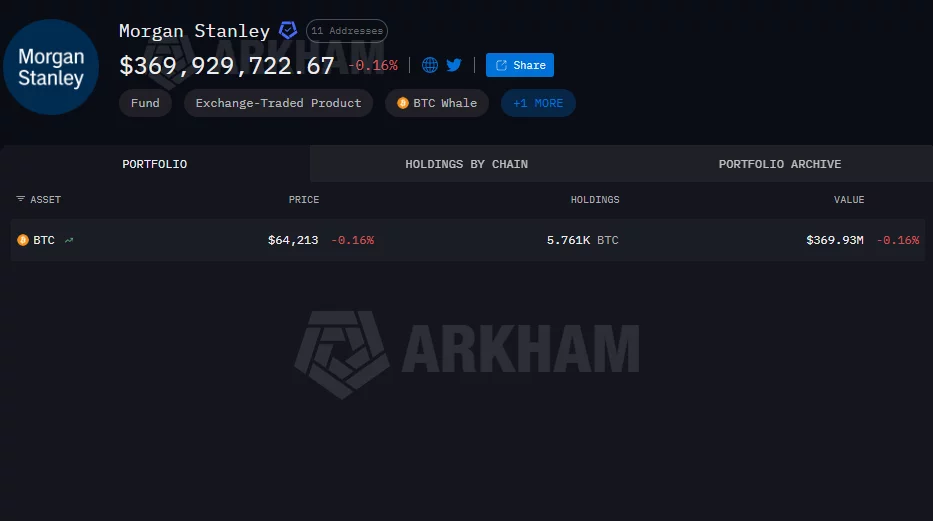
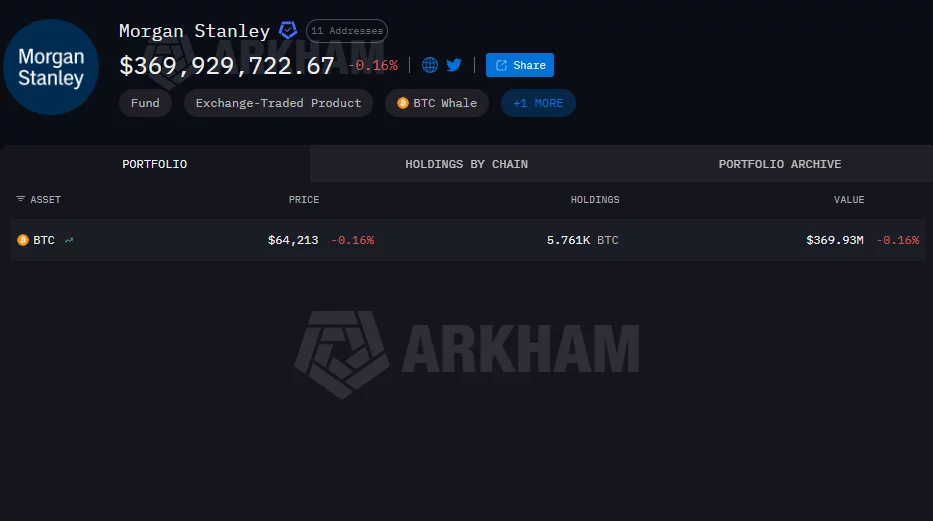
- Morgan Stanley added nearly 1,000 BTC over the past two weeks, pushing its tracked holdings to 5,761 BTC.
- Arkham data shows the accumulation came through multiple large transfers from Coinbase Prime rather than a single purchase.
- The latest buying follows Morgan Stanley’s June crypto expansion with Galaxy Digital, allowing eligible clients to convert crypto into spot investment products.
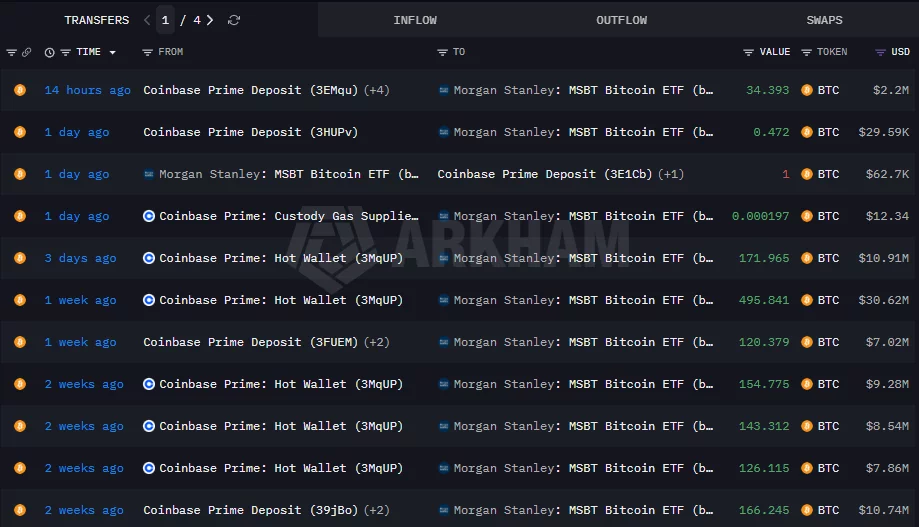
According to blockchain intelligence platform Arkham, the investment bank continued adding Bitcoin through its spot Bitcoin investment product during the recent market pullback. Arkham’s latest portfolio data shows Morgan Stanley now holds 5,761 BTC worth roughly $369.9 million, making it one of the larger institutional Bitcoin holders tracked on the platform.
The latest increase follows a series of transfers recorded over the past two weeks instead of a single purchase. Arkham’s transaction history shows several large inflows from Coinbase Prime wallets, including transfers of 495.8 BTC, 171.9 BTC, 166.2 BTC, 154.8 BTC, 143.3 BTC, 126.1 BTC, 120.4 BTC, and another 34.4 BTC within the last 14 hours. The activity also includes minor operational transfers and a 1 BTC movement back to Coinbase Prime, leaving the firm’s net increase at roughly 1,000 BTC.
Latest purchases have come through multiple large transfers
Recent Arkham data indicates Morgan Stanley accumulated Bitcoin in stages rather than executing a single large transaction. Most of the recorded inflows originated from Coinbase Prime custody and deposit addresses, suggesting institutional settlement activity linked to its Bitcoin investment product.
At current market prices shown on Arkham, the firm’s Bitcoin holdings are valued at nearly $370 million. Arkham also classifies the entity as a fund, an exchange-traded product, and a Bitcoin whale, while linking the portfolio to 11 tracked wallet addresses.
The latest buying extends a pattern of adding exposure during price weakness. Although Arkham describes the activity as another instance of Morgan Stanley “buying the dip,” the platform does not disclose whether the transactions represent direct purchases, client subscriptions, or other operational inflows into the investment vehicle.
Crypto investment services have expanded for wealthy clients
The recent accumulation follows Morgan Stanley Wealth Management’s June announcement that it had expanded its digital asset offering through a referral arrangement with Galaxy Digital.
Under the program, eligible high-net-worth clients can lend cryptocurrencies including Bitcoin, Ether, and Solana to Galaxy Digital and receive shares in spot crypto investment products, including the Morgan Stanley Bitcoin Trust. According to the companies, the structure allows investors to move crypto exposure into regulated investment vehicles without first selling their digital assets.
Morgan Stanley and Galaxy Digital also said the arrangement can reduce in-kind crypto-to-exchange-traded product onboarding times by as much as 75%, making transfers into regulated investment products faster than conventional processes.
The expanded client offering and the latest on-chain accumulation come as institutional participation in spot Bitcoin investment products continues to grow. While Arkham’s wallet data tracks assets associated with Morgan Stanley’s Bitcoin product, the platform does not identify the underlying investors or distinguish between firm-owned holdings and assets managed on behalf of clients.

Haeran Ryu wins second straight LPGA major at Evian Championship

This gamer had to sue Microsoft to get his hijacked Xbox account back

Who is King ? #Bitcoin vs #Etherium #trading #crypto #cryptocurrency


-

 Fashion6 days ago
Open Thread: What Great Books Have You Read Recently?
-

 News Videos6 days ago
Whats Hidden Inside This Cash Register? #treasure #reselling #money
-

 Fashion2 days ago
Weekend Open Thread: Nutriplenish Leave-In Conditioner
-

 Fashion3 days ago
Loro Piana Fall 2026 Enters Houston’s Art Scene
-
 Tech5 days ago
Anthropic’s new “J-lens” reveals a silent workspace inside Claude that mirrors a leading theory of consciousness
-

 Crypto World6 days ago
$1,000 Credit Alert! BlockDAG X Exchange Pre-Registration Now Officially Open, Polkadot Dips & Zcash Rebounds
-

 Business6 days ago
AXT Shares Jump Nearly 14% as Semiconductor Materials Maker Rebounds on AI-Linked Indium Phosphide Demand
-

 Sports5 days ago
Joshua Pacio ‘more complete’ ahead of ONE rematch vs Malachiev
-
 Sports3 days ago
2026 Genesis Scottish Open Thursday TV coverage: Round 1
-

 News Videos6 days ago
Best Time to Enter Small Caps Right Now? Another Bull Run? | Financially Free
-
 Crypto World6 days ago
SK hynix (000660.KS) Stock Dips as $28B Nasdaq ADR Offering Drives AI Memory Expansion
-

 Tech5 days ago
Anthropic brings Claude Cowork to mobile and web as usage data shows most users aren’t coding
-

 News Videos6 days ago
Avoid entering in FOMO #bitcoin #cryptocurrency #trading #scalping
-

 Sports2 days ago
Super Eagles star Moses Simon opens up on Liverpool transfer regret
-
Sports5 days ago
We have punished the disrespect
-

 Crypto World6 days ago
Binance lists Strategy’s STRC stock as company expands Bitcoin funding
-

 Tech3 days ago
Character.AI enters the microdrama arena with its own productions, but there’s a twist
-

 Tech6 days ago
9 Best Keyboards (2025), Tested and Reviewed
-

 Business6 days ago
Enbridge: AI Tailwind Priced In (Rating Downgrade)
-

 News Videos5 days ago
“What’s going on?!” Carl Froch discusses Floyd Mayweather Jr financial issues
You must be logged in to post a comment Login