

Crypto World
Crypto Platform 1win Welcomes Ilia Topuria as the 1win VIP Community Member


[PRESS RELEASE – Mexico City, Mexico, June 3rd, 2026]
The international crypto entertainment platform 1win has announced the addition of Ilia Topuria to its VIP community. The signing of the contract with the fighter became publicly known on June 2, 2026.
Topuria becomes a new member of the global 1win VIP Community, the brand’s exclusive project that brings together prominent figures from sports, music, and entertainment industries. One of the most dominant fighters of his generation, Topuria remains undefeated with a professional MMA record of 17 wins and 0 losses. His excellence in sport will become a unique asset and source of inspiration for other 1win members.
The collaboration between a globally recognized brand and one of MMA’s most unstoppable fighters promises exclusive moments for fans, a closer look into the lifestyle of a true 1win VIP member, and a wave of premium entertaining content for international audiences. The expansion of the project highlights the international scale of the initiative and further strengthens 1win’s position as a brand operating at the intersection of sports, digital culture, and entertainment. Previously, famous rapper Tyga had also joined the VIP community.
On June 14, Topuria takes part in one of the year’s most highly anticipated fights – UFC Freedom 250 – a bout against Justin Gaethje that will take place during the UFC tournament at the White House. The upcoming fight has already generated significant attention from the MMA community and sports media worldwide.
1win is also widely known for its collaborations with MMA representatives and professionals in the sports industry. The brand’s ambassadors include legendary UFC fighter Jon Jones, Olympic champion and UFC fighter Gable Steveson, and Latin American athlete Ignacio Bahamondes.
About 1win
Founded in 2016, 1win is a crypto-focused platform in the global gaming industry. Operating across Asia, Latin America, and Africa, 1win offers a wide range of entertainment products adapted to regional audiences. The brand has active collaborations with international public figures, including actor Johnny Sins, martial artist Jon Jones, and Olympic champion and UFC fighter Gable Steveson. In 2026, 1win welcomed American rapper Tyga as a new member of the 1win VIP community.
The post Crypto Platform 1win Welcomes Ilia Topuria as the 1win VIP Community Member appeared first on CryptoPotato.

Key points:
- Bitcoin risks falling below $65,000, but lower levels are likely to attract solid buying by the bulls.
- HYPE, ZEC and XLM look strong on the charts while other major altcoins risk resuming their downtrend.
Bitcoin (BTC) is attempting a bounce off the $65,426 level, but the bulls are struggling to hold onto higher levels. The launch of fresh strikes by the US and Iran has hurt sentiment, but Bitrue Research Institute research lead Andri Fauzan Adziima told Cointelegraph that the fall was more about “leveraged liquidations, heavy ETF outflows, and technical breakdowns than pure Iran news, but it amplifies the fear.”
All eyes have shifted to BTC’s yearly lows of $60,000. Veteran trader Peter Brandt said in a post on X that BTC has formed an expanding triangle, a common and reliable pattern. He projects a decline to about $56,000, but added that a move above $75,000 would invalidate this bearish view.
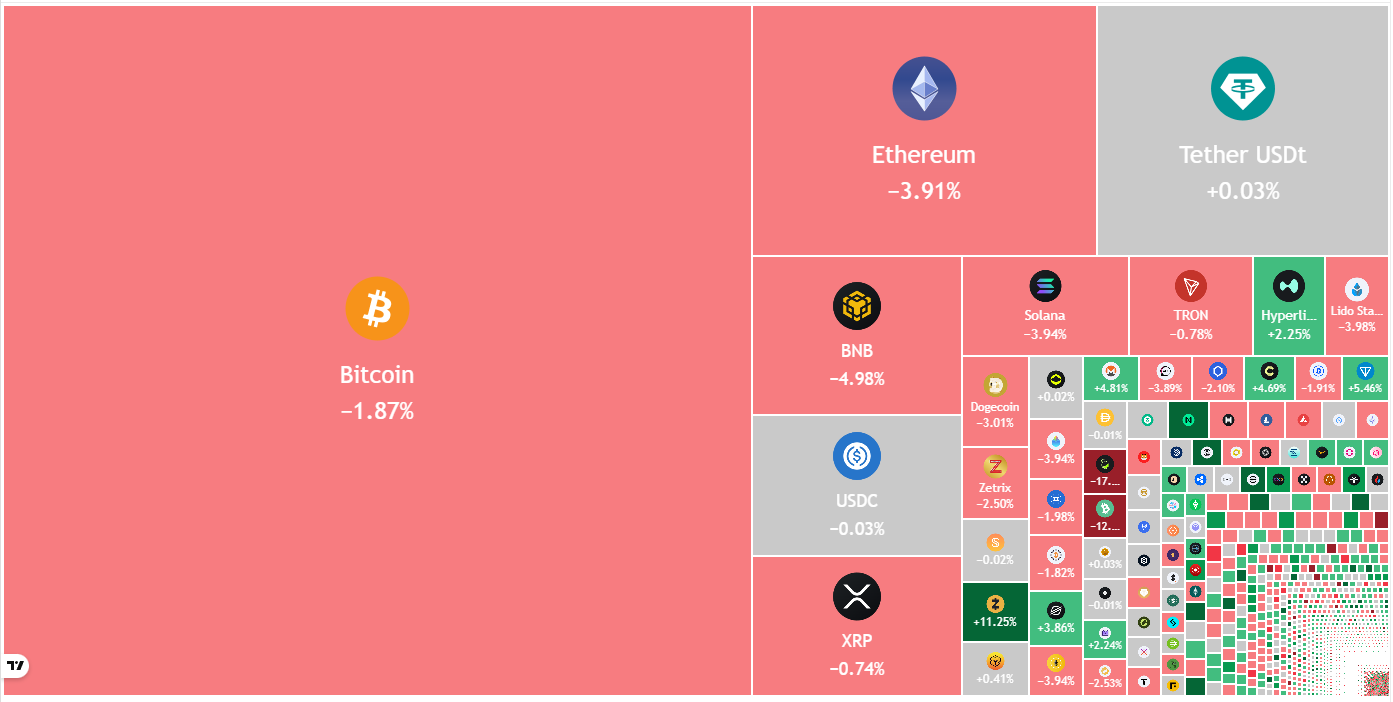
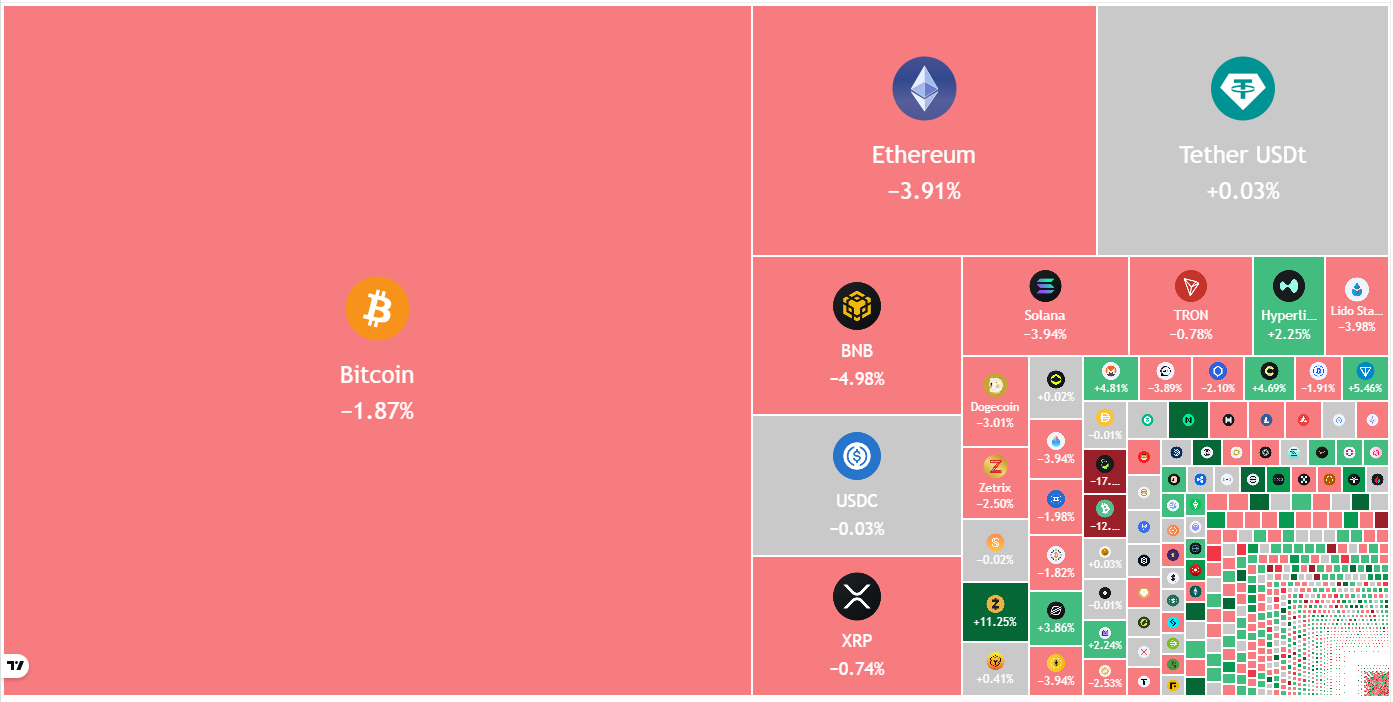
Crypto market data daily view. Source: TradingView
The short-term trend has turned negative, but the bulls are unlikely to give up without a fight. Buyers are expected to enter the $65,000 to $60,000 zone, but relief rallies are likely to be sold into. Volatility is likely to increase over the next few days as the bulls and bears battle for supremacy. Buyers will have to propel the price above $77,000 to signal that BTC has bottomed out in the short term.
What are the crucial support levels to watch out for in BTC and the major altcoins? Let’s analyze the charts of the top 10 cryptocurrencies to find out.
Bitcoin price prediction
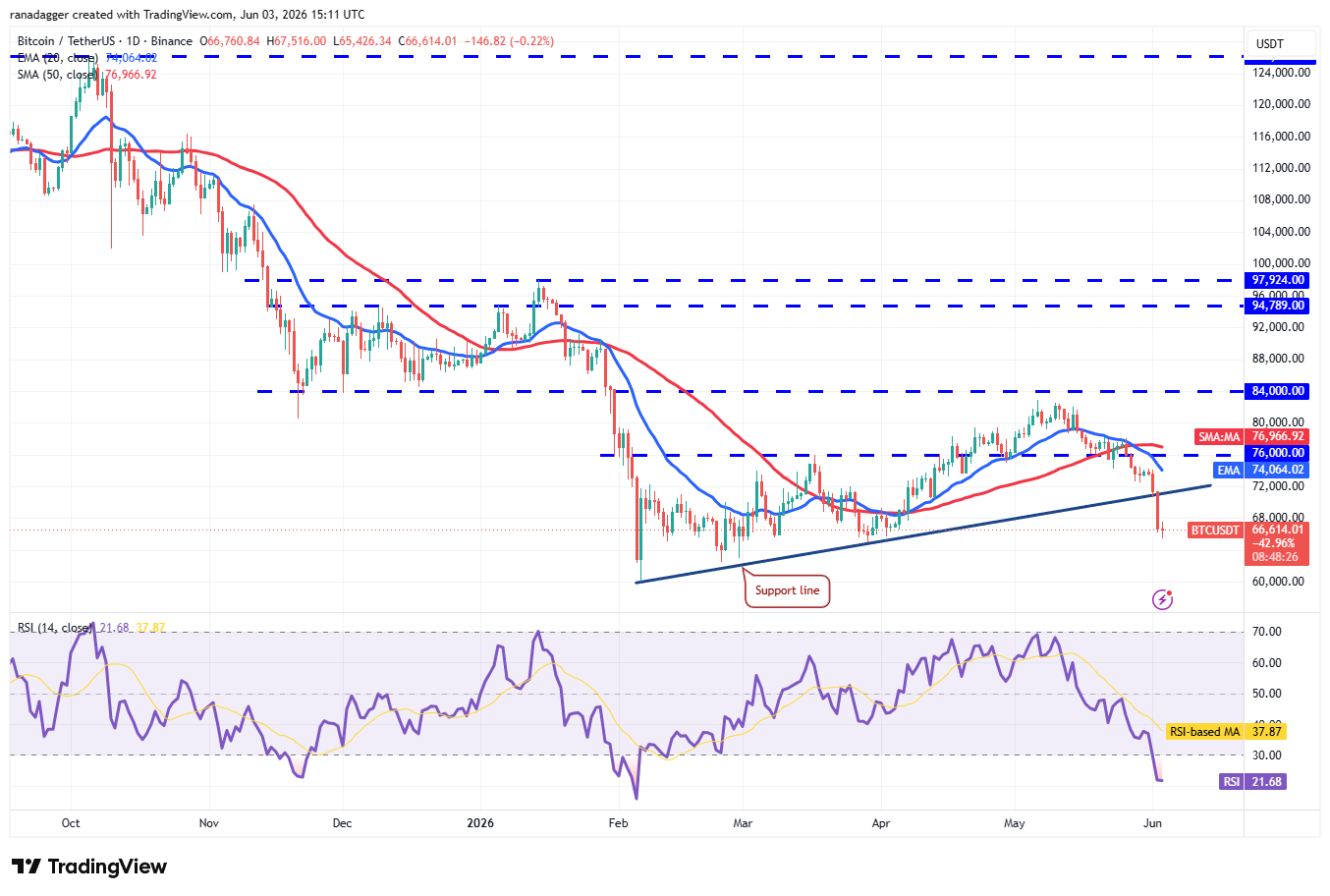
BTC collapsed after breaking below the support line on Tuesday, indicating aggressive liquidation of long positions.
BTC/USDT daily chart. Source: Cointelegraph/TradingView
There is support at $65,000, but that may not hold. That clears the path for a drop to the $62,500 to $60,000 support zone. Buyers are expected to defend the zone with all their might, as a close below it would signal a resumption of the downtrend. The BTC/USDT pair then risks falling to $50,000.
The bears will attempt to maintain their advantage by selling the relief rallies to the 20-day exponential moving average ($74,064). Buyers will have to secure a close above the 50-day simple moving average ($76,966) to signal a comeback.
Ether price prediction
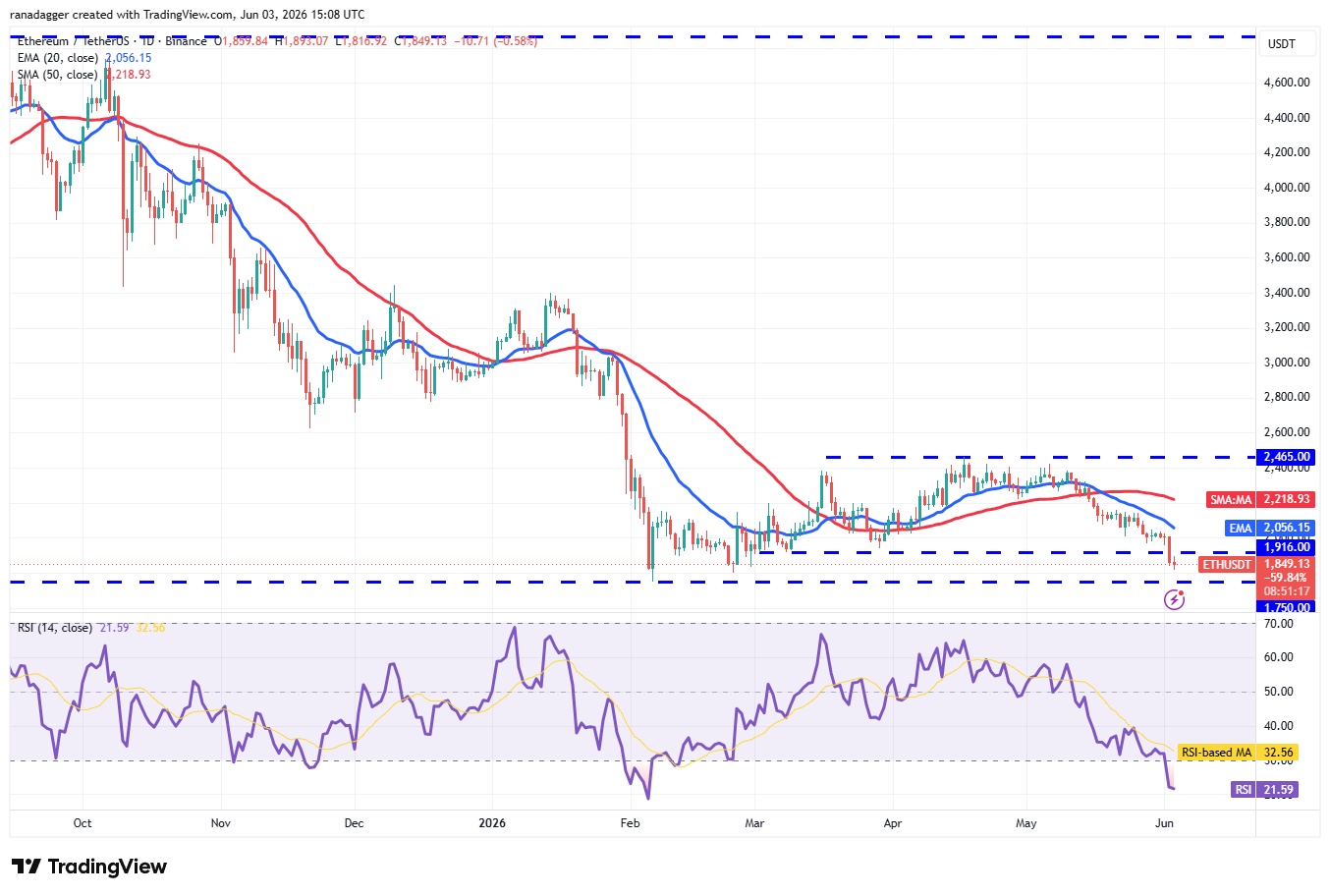
Ether’s (ETH) $1,916 to $2,465 range resolved to the downside on Tuesday, indicating that the bears are in control.
ETH/USDT daily chart. Source: Cointelegraph/TradingView
The ETH/USDT pair may dip to the solid support at $1,750. The oversold level on the relative strength index (RSI) suggests a bounce is possible from $1,750, but rallies are likely to be sold into. A shallow rebound increases the possibility of a break below the $1,750 level. If that happens, the ETH price may plummet to $1,550.
Buyers have an uphill task ahead of them. They will have to swiftly push and sustain the price above the 20-day EMA ($2,056) to suggest that selling pressure is easing. The pair may then rise to the 50-day SMA ($2,218).
BNB price prediction
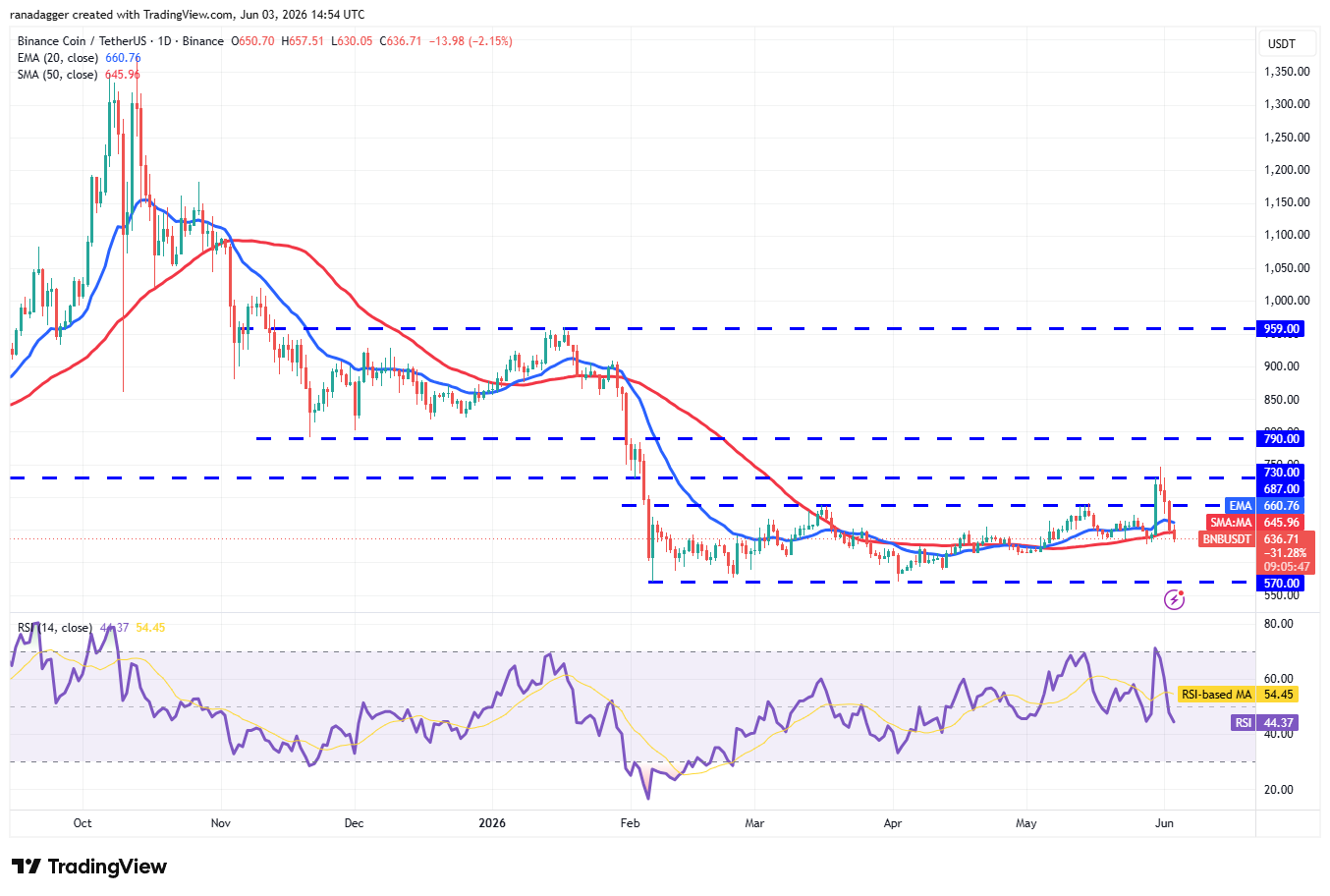
BNB (BNB) fell below the breakout level of $687 on Monday and extended its decline to the 50-day SMA ($645) on Tuesday.
BNB/USDT daily chart. Source: Cointelegraph/TradingView
The drop back below $687 may have trapped the aggressive bulls. The $628 level may act as a temporary support, but it is likely to be broken. If that happens, the BNB/USDT pair may plummet to solid support at $570.
This negative view will be invalidated in the near term if the BNB price turns up sharply from the current level and breaks above $745. That signals solid demand at lower levels. The pair may then march to $790 and later to $900.
XRP price prediction
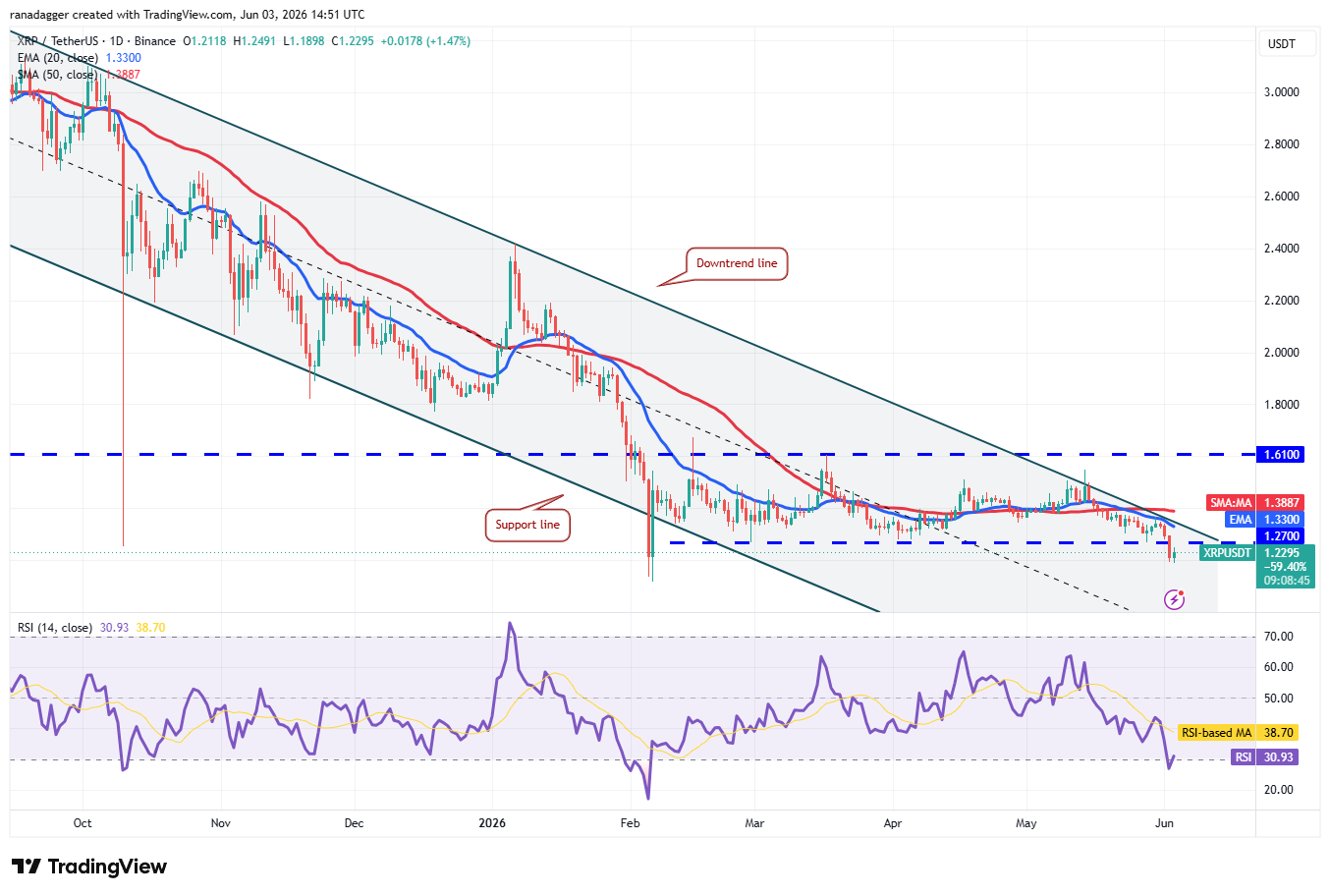
XRP (XRP) broke below the strong support of $1.27 on Tuesday, indicating that the bears are in charge.
XRP/USDT daily chart. Source: Cointelegraph/TradingView
The next support on the downside is the Feb. 6 intraday low of $1.11. Buyers are expected to fiercely defend the $1.11 level, as a close below it signals the start of the next leg of the downtrend to $1.
On the way up, the downtrend line is the first hurdle for the bulls to overcome. If they clear that, the XRP/USDT pair may climb to $1.61. Sellers are expected to pose a substantial challenge at the $1.61 level, but if the bulls prevail, a new up move may begin.
Solana price prediction
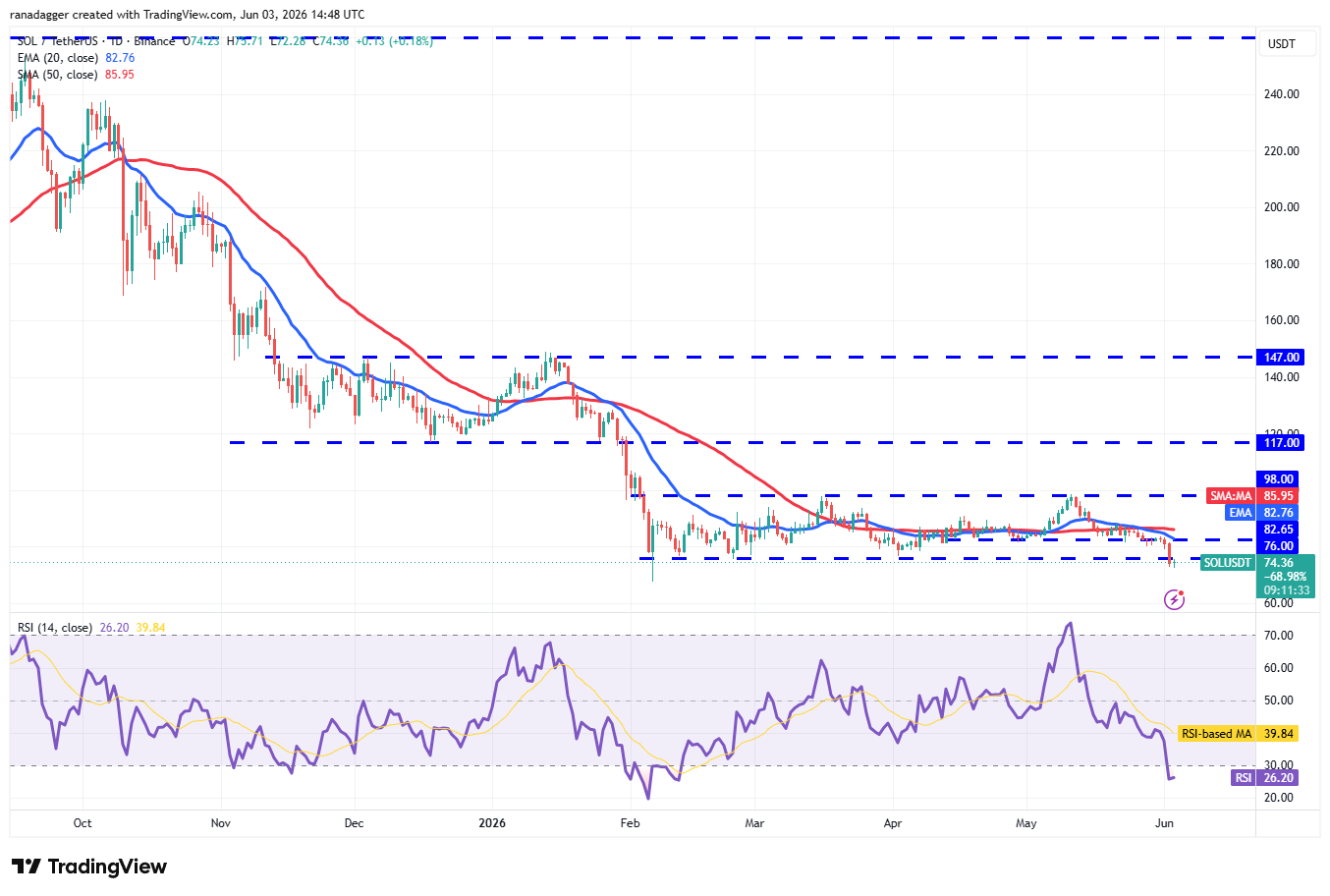
Solana (SOL) closed below the $76 support on Tuesday, indicating that the bears have overpowered the bulls.
SOL/USDT daily chart. Source: Cointelegraph/TradingView
The bulls will attempt to push the SOL price back above $76, but are expected to face significant resistance from the bears. If the price declines from $76, the next stop is likely the Feb. 6 low of $67. Buyers will strive to hold the $67 level, as a close below it may sink the SOL/USDT pair to $60.
Buyers will have to drive and maintain the price above the moving averages to suggest that the break below $76 may have been a bear trap.
Hyperliquid price prediction
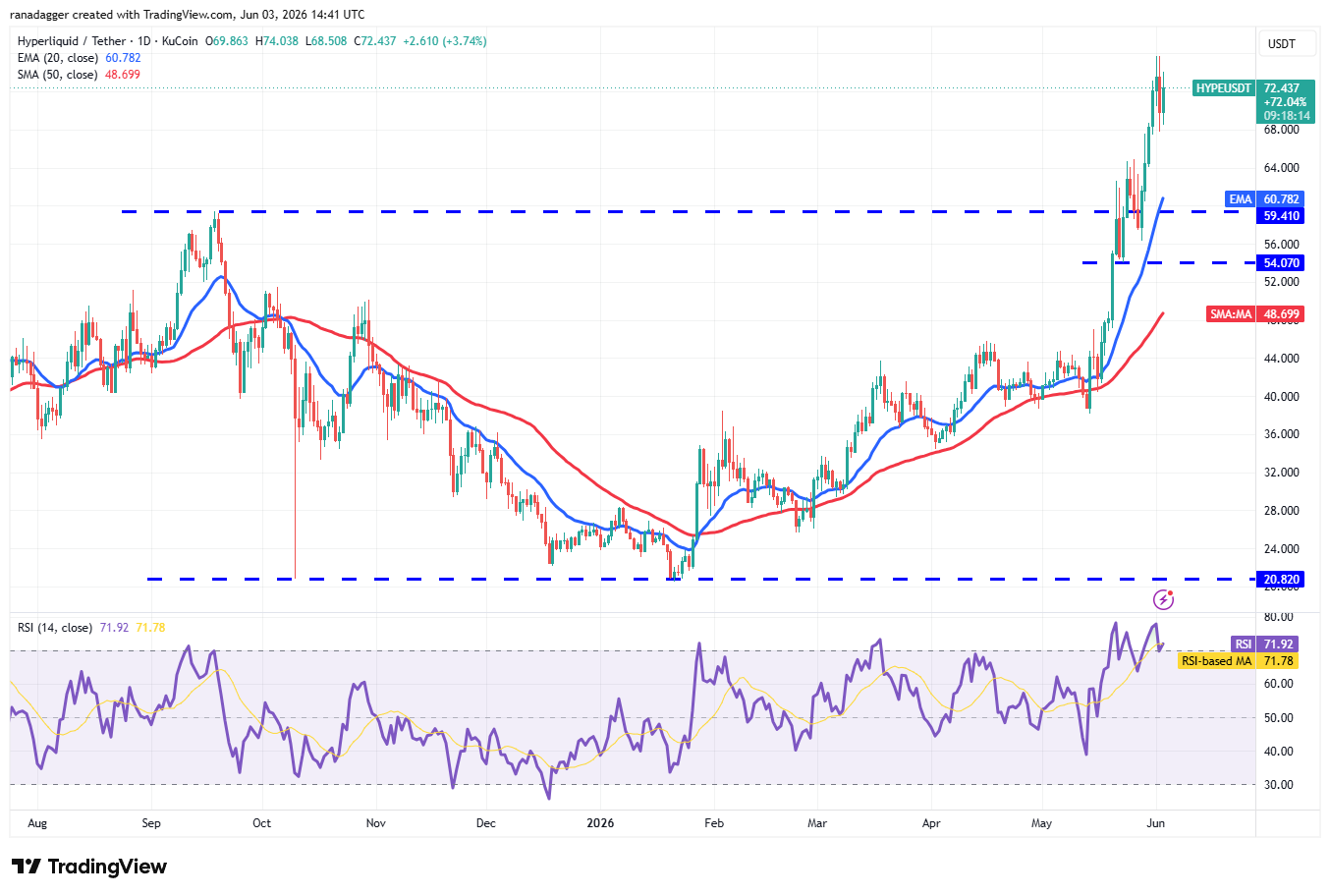
Hyperliquid (HYPE) has held strong among all the mayhem, signaling that the bulls expect the uptrend to continue.
HYPE/USDT daily chart. Source: Cointelegraph/TradingView
Profit-booking was seen near $75, but the shallow pullback suggests the bulls view the dips as buying opportunities. If buyers push the HYPE price above $75, the rally could reach the $85-$89 zone.
The first support on the downside is $64, and then the breakout level of $59.41. If the HYPE/USDT pair rebounds off $59.41, it suggests that the bulls have flipped the level into support. The buyers will then again attempt to resume the uptrend.
Dogecoin price prediction
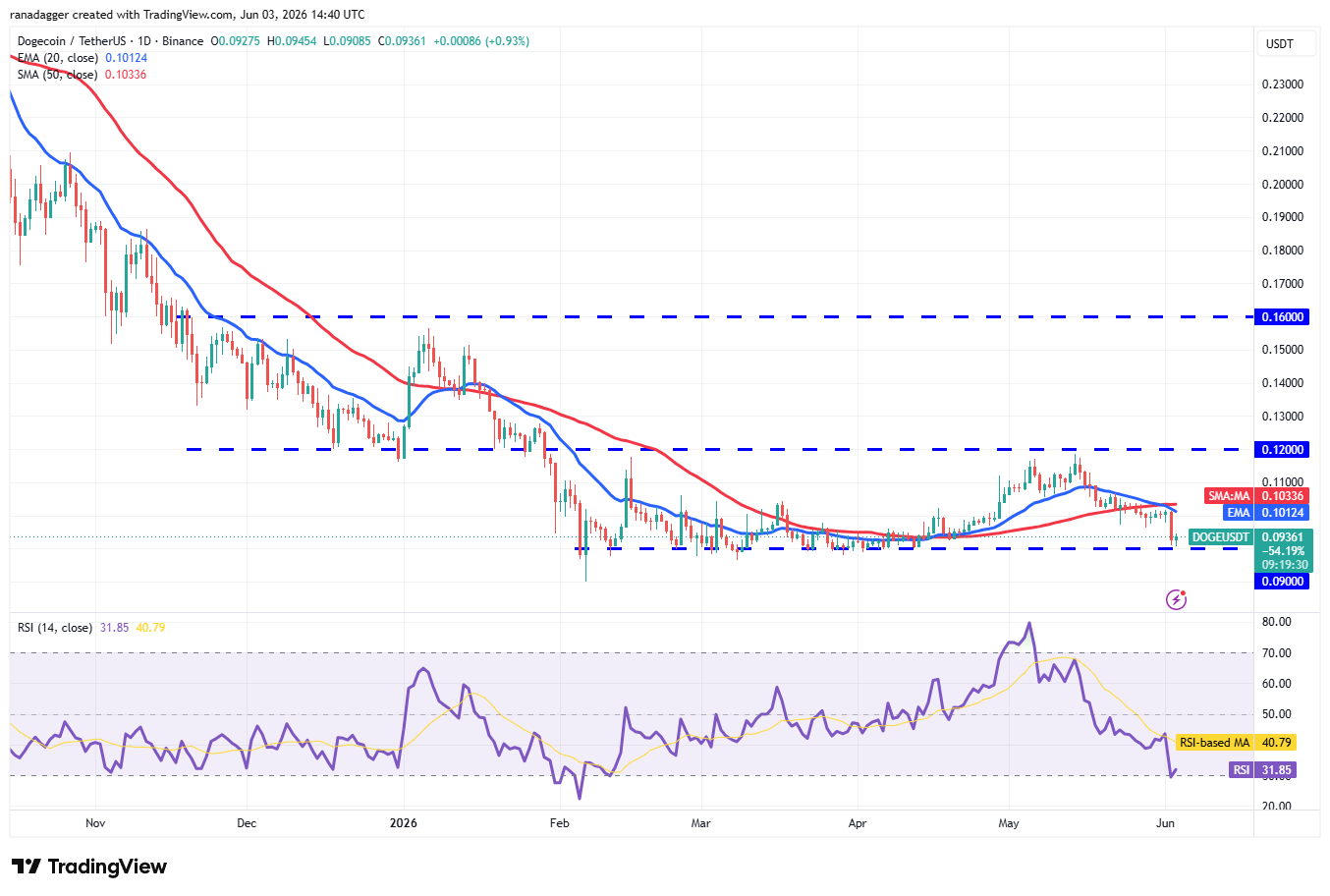
Dogecoin (DOGE) has dipped to the support of the $0.09 to $0.12 range, where buyers are expected to step in.
DOGE/USDT daily chart. Source: Cointelegraph/TradingView
If the DOGE price turns up from the current level, the bears will attempt to halt the recovery at the 20-day EMA ($0.10). If the price turns down sharply from the 20-day EMA, the risk of a break below $0.09 increases. The DOGE/USDT pair may then slump to $0.08.
This negative view will be invalidated in the near term if the price rises above the moving averages. That suggests the pair may extend its stay inside the range for a few more days.
Related: Bitcoin copying 2022 ‘almost perfectly’ as trader sees key support failing
Zcash price prediction
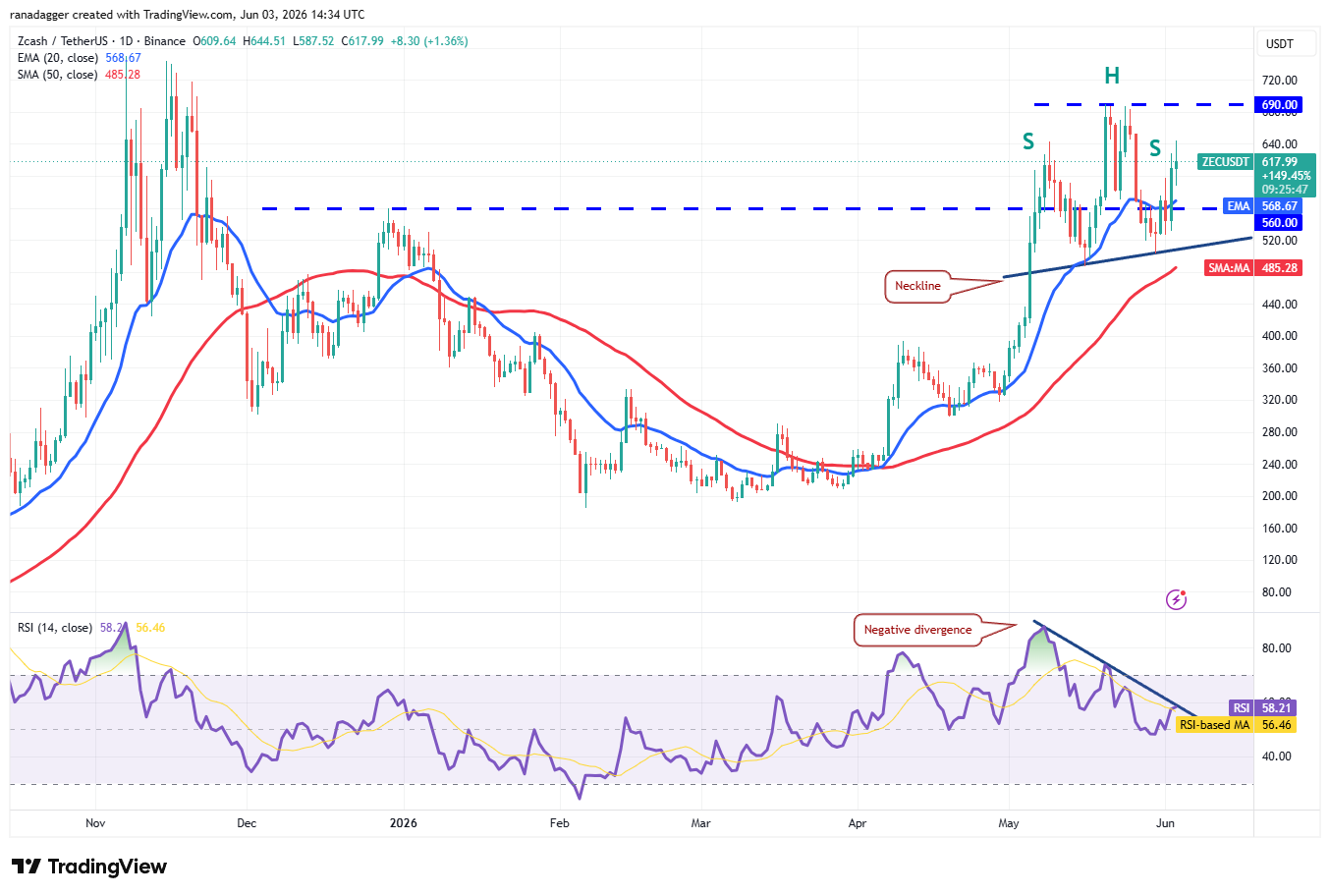
Zcash (ZEC) turned up and closed above the 20-day EMA ($568) on Tuesday, indicating buying at lower levels.
ZEC/USDT daily chart. Source: Cointelegraph/TradingView
The bulls will have to drive and maintain the ZEC price above $690 to signal the resumption of the uptrend. If they manage to do that, the ZEC/USDT pair may rally to $750, where the bears are expected to mount a strong defense. However, if buyers overcome the barrier, the pair may soar to $856.
Sellers are likely to have other plans. They will attempt to pull the price below the neckline of the developing head-and-shoulders pattern. A close below the neckline signals that the pair may have topped out in the short term.
Cardano price prediction
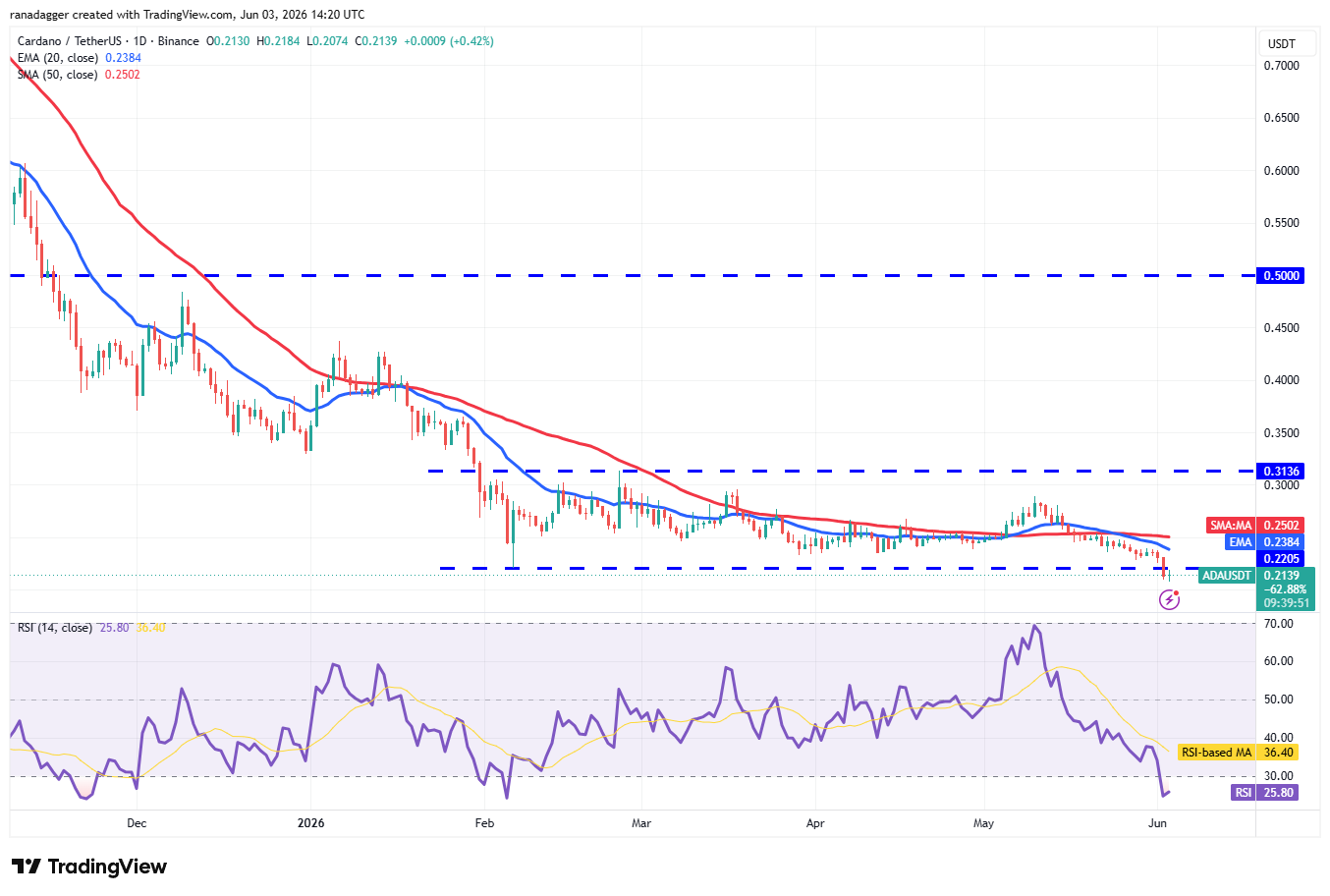
Cardano (ADA) continued lower, plunging below the $0.22 support on Tuesday, signaling the resumption of the downtrend.
ADA/USDT daily chart. Source: Cointelegraph/TradingView
The RSI has slipped into oversold territory, increasing the likelihood of consolidation or a relief rally in the near term. Any recovery attempt is expected to face selling at $0.22 and then at the 20-day EMA ($0.24). If the ADA price breaks down from the overhead resistance, the bears will attempt to pull the ADA/USDT pair down to $0.20.
Buyers will be back in the driver’s seat on a close above the 50-day SMA ($0.25). That suggests the market rejected the break below $0.22.
Stellar price prediction
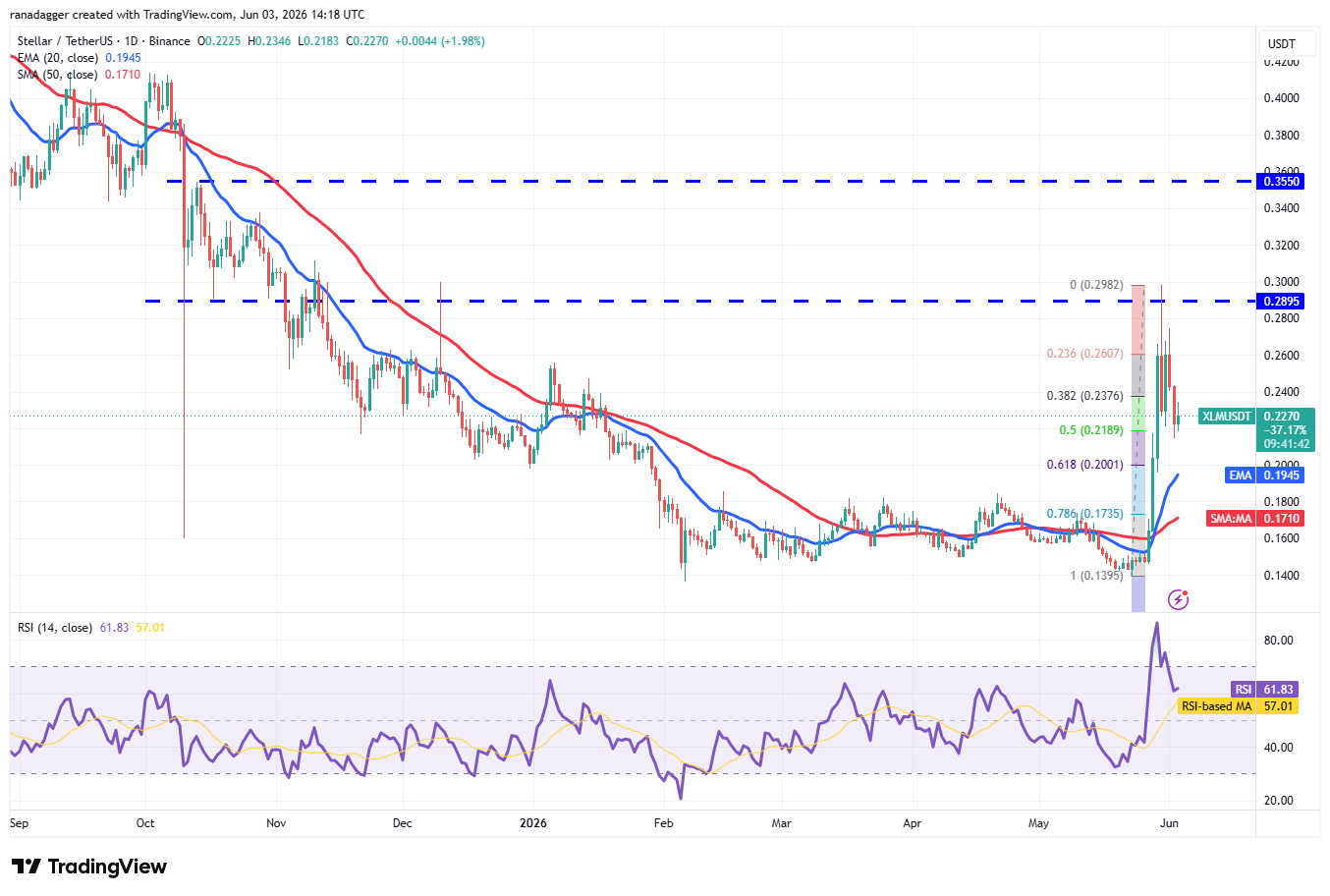
Stellar (XLM) has been in a bull phase of its own, rising from $0.14 on May 23 to $0.30 on May 30.
XLM/USDT daily chart. Source: Cointelegraph/TradingView
The sharp rally prompted profit-booking by short-term traders, pulling the XLM price down to the 50% Fibonacci retracement level at $0.22. If the price rises from the current level, the bulls will attempt to push the XLM/USDT pair above $0.27 and then $0.30. If they succeed, the pair may surge to $0.35.
Contrary to this assumption, if the price declines and breaks below the 61.8% retracement level at $0.20, it suggests the pair may have topped out in the near term.
Crypto World
Bitcoin selloff continues as prices slide below $63,000 for the first time since February
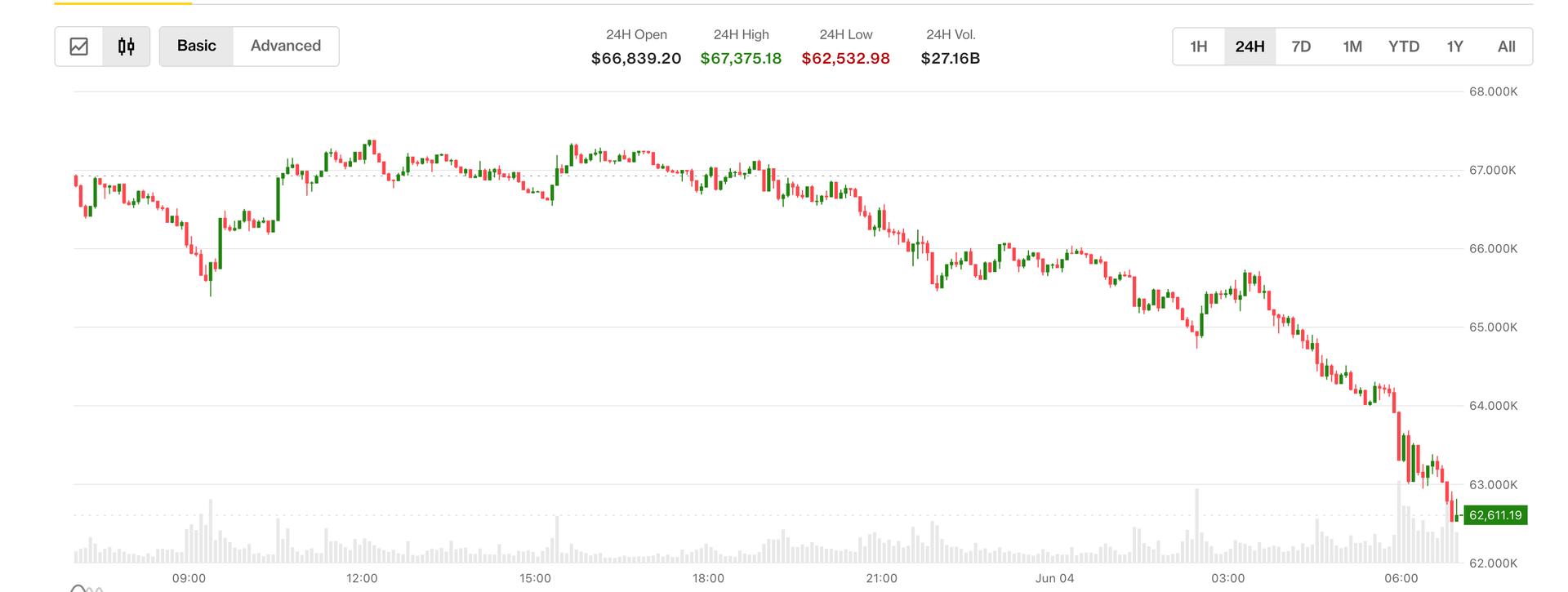
Bitcoin extended losses early Thursday, falling to $63,000 for the first time since February 24. The cryptocurrency has lost over 14% this week alone and 21% over the past four weeks, according to CoinDesk data.
The selloff has triggered demand for protective options plays, pushing the fear gauge, the 30-day implied volatility index BVIV, to 53.17, its highest level since April 2.
Investors yanked another $50 million from U.S.-listed spot ETFs Wednesday, marking the 13th consecutive trading day of outflows from these vehicles, which are viewed as a proxy for institutional demand.
“A broad sell-off in crypto, which started with Strategy’s transfer triggering ETF outflows and is now fueled by speculative news about Mt. Gox liquidations, signals a potential continued sell-off. BTC at $50k is a level some are starting to talk about as a bottom this year,” Paul Howard, senior director at liquidity provider Wincent, said in an email.
“Whilst there is a long way to go, the absence of catalysts and the movement of liquidity into other tech sectors such as AI indicate we have further volatility ahead,” he added.
Some traders are closely watching levels around $60,000 as potential support. The February crash saw prices nearly test that level on some exchanges before the sell-off ran out of steam
“The first major zone I’m watching is the low $60k region, because that is where a lot of important pieces start coming together. We have the local low around $59.9k. We have the 200-week moving average now sitting in that same general area,” analysts at data tracking platform Material Indicators said in an email.
“That does not guarantee support. It simply tells us this is where the market should have to make a decision,” they added.


A coalition of 160 former U.S. national-security, intelligence and law-enforcement officials urged the Senate on Tuesday to pass the Digital Asset Market Clarity Act, casting the bill as a national-security upgrade rather than an industry favor. The letter, organized by the Blockchain Association,… Read the full story at The Defiant


The uptake on Israel’s crypto voluntary disclosure program remains modest relative to policymakers’ expectations, underscoring the challenges of using immunity from criminal prosecution to coax tax compliance in a rapidly evolving asset class. The policy, introduced to encourage disclosure and correct reporting of crypto holdings, became effective with an August 2025 framework that offers certain protections for filers who come clean and settle their liabilities.
Globes reported that the Israel Tax Authority has so far received disclosures totaling roughly $50 million in crypto capital, a fraction of the tens or even hundreds of billions that could be underreported, depending on holdings. The program’s design grants immunity from criminal charges for filers whose crypto asset value does not exceed the equivalent of $522,000 as of December 2024, provided reports are corrected and all taxes are paid in full before August 31, 2026. To date, only 58 filers have attempted to use the mechanism, according to the same coverage.
“In the cryptocurrency field, the difficulty of the absence of an anonymous track is even more acute,” commented Iftach Simhony, a CPA and head of the tax department at the Prof. Bein Law Office, as cited by Globes. “When the risk assessment of some taxpayers is not high, and the procedure itself does not offer certainty or anonymity in the first stage, the incentive to undergo voluntary disclosure is weakened.”
The disclosure framework announced by the tax authority describes a pathway to immunity from criminal charges for crypto holders who disclose holdings within the threshold, file accurate reports, and settle tax obligations by the deadline. The policy relies on transparency and timely reporting, with the threshold tied to December 2024 values and a rigidity around the full payment deadline, signaling a measured approach to bringing crypto gains into the tax net without immediate criminal exposure for disclosures within the cap.
Separately, data from the Bank of Israel situates the private crypto landscape within a broader national financial frame. The bank’s financial stability report covering January to June 2024 estimates that Israelis held about $1 billion worth of crypto assets, highlighting the scale of the market and the potential tax base that policy makers are trying to align with enforcement and compliance strategies.
Key takeaways
- Israel’s voluntary disclosure program has yielded about $50 million in crypto disclosures so far, far below the projected potential as of the August 2025 policy rollout.
- The program offers immunity from criminal charges if holdings stay under the equivalent of $522,000 (as of December 2024) and all taxes are paid and reported by August 31, 2026; uptake remains limited, with 58 filers reported.
- Analysts point to concerns about anonymity and risk assessment, suggesting that the lack of a clear anonymity pathway dampens participation in the early stage of the program.
- Bank of Israel data indicates Israelis hold roughly $1 billion in crypto assets, underscoring the significant scale of the market and the implications for future tax policy and enforcement.
- In the United States, lawmakers are pursuing a de minimis exemption for small crypto transactions through the PARITY Act, signaling a shift toward simpler reporting for routine, low-value activity.
Israel’s disclosure program: incentives, constraints, and what changes could matter
The August 2025 framework aims to strike a balance between enforcement and voluntary compliance by offering a shield from criminal charges for those who disclose and settle. Yet the limited early engagement—just 58 filers—suggests that farmers of crypto reporting may be deterred by a combination of perceived risk, the timing of the deadline, and the perception that the disclosure process lacks sufficient privacy guarantees. The threshold, pegged to the December 2024 value reference, creates a clear boundary: the smaller holders could leverage the immunity route, while larger holders remain under the ordinary tax regime with heavier scrutiny.
Observers stress that successful tax collection in this space requires not just a carrot (amnesty) but also a clear, efficient path to reporting that reassures taxpayers about privacy and minimizes the friction of compliance. The Globes interview with Iftach Simhony captures a core tension: when the incentives to disclose are not compelling—especially for those who worry about privacy and potential audits—the policy’s effectiveness can falter before it starts to reshape behavior.
Global context: how U.S. policy discussions could influence Israel and broader crypto taxation
The international backdrop adds another layer of complexity for policymakers. In the United States, a bipartisan effort known as the PARITY Act seeks to relieve the burden of crypto tax reporting for small-value activity. The bill would direct the Internal Revenue Service to study establishing a de minimis exemption for digital assets, potentially allowing taxpayers to bypass reporting for minor or routine transactions. If such a threshold were adopted, it could reduce administrative costs for individuals and exchanges alike and shift how tax authorities allocate enforcement resources.
From a policy design perspective, the American approach contrasts with Israel’s emphasis on disclosure as a pathway to immunity. The divergent approaches highlight the ongoing debate over how to balance tax compliance with user privacy, enforcement risk, and the practical realities of a fast-growing asset class. For investors and users in both markets, the cross-border regulatory dialogue matters because it affects how crypto gains are reported, how accurately holdings are captured, and how compliant behavior is incentivized over time.
For Israeli readers, the question remains: will the current uptake be sufficient to close the gap between expected tax receipts and actual revenue? For U.S. stakeholders, will any de minimis exemption gain legislative traction, and how might that shape reporting standards for international crypto activity? Both questions are central to understanding how governments adapt tax regimes to the digital-asset era while striving to maintain a competitive, innovation-friendly environment.
As crypto markets continue to evolve, regulators will likely reassess thresholds, reporting formats, and enforcement priorities. Market participants should monitor updates to the Israeli policy framework, potential changes to the Bank of Israel’s regulatory stance, and any new developments in U.S. tax policy that could ripple across borders and influence how crypto profits are disclosed and taxed in the months ahead.
Readers should stay attuned to further disclosures from the Israel Tax Authority and Bank of Israel, as well as Congressional updates on the PARITY Act, to gauge how these regulatory movements might affect tax planning, compliance costs, and strategic decisions for investors and businesses operating in or collaborating with Israel and the United States.
This article was originally published as Israel Tax Authority Dissatisfied With Voluntary Crypto Disclosures on Crypto Breaking News – your trusted source for crypto news, Bitcoin news, and blockchain updates.
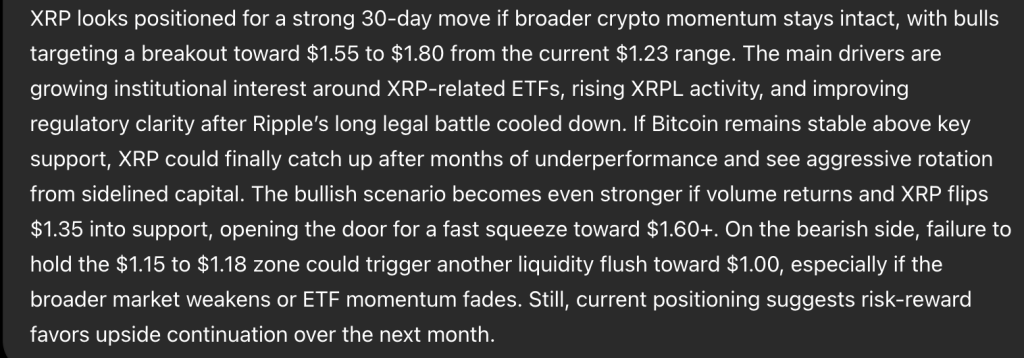
ChatGPT AI predicts XRP price positioned for a strong 30-day move, targeting $1.55 to $1.80 prediction from a current price of $1.238, with the squeeze scenario toward $1.60 and beyond activating the moment XRP flips $1.35 into support.
The bull case Sam Altman’s AI is building is not complicated but the timing element makes it more interesting than most XRP predictions this week.
Months of underperformance have left a large pool of sidelined capital sitting on the sidelines waiting for a signal, and ChatGPT is arguing that signal is close.
Institutional ETF interest is still growing, XRPL activity is rising, and the regulatory cloud that suppressed participation for years has cleared. Those 3 things working together create the conditions for aggressive rotation when Bitcoin stabilizes and gives altcoins room to breathe.
The $1.35 level is the specific technical trigger ChatGPT identifies. Right now, it is resistance. Flipping it into support on a closing basis with volume behind it is the event that changes the character of the trade from a range grind to a momentum move toward $1.60 and above.
That is a precise and useful read because it gives a clear line in the sand rather than a vague directional opinion.
The bear case is equally specific. The $1.15 to $1.18 zone is the floor that matters most on the downside. Losing it with conviction would trigger a liquidity flush toward $1.00, which is a level XRP has not traded at since before the November 2024 breakout.
Broad market weakness or fading ETF momentum are the 2 catalysts that could push the price there, and both are live risks given where Bitcoin is sitting right now.
XRP Price Prediction: XRP Just Had a 6.98% Weekly Loss and Is Now Testing the Pre-Breakout Zone That Started Everything
XRP price is closing the current week at $1.238, down nearly 7% on the week, and this weekly chart, going back to early 2024, is showing something that has not happened since the original November 2024 breakout: price is approaching the launch zone where the entire institutional repricing began.
The vertical move from $0.55 to $3.40 in late 2024 left little structural support on the way up, as it happened too quickly for buyers to build meaningful positions at any particular level.
That speed is now working against the recovery, because there are no strong historical support zones between $1.00 and $1.60 built through accumulation rather than just passed through during a parabolic move.
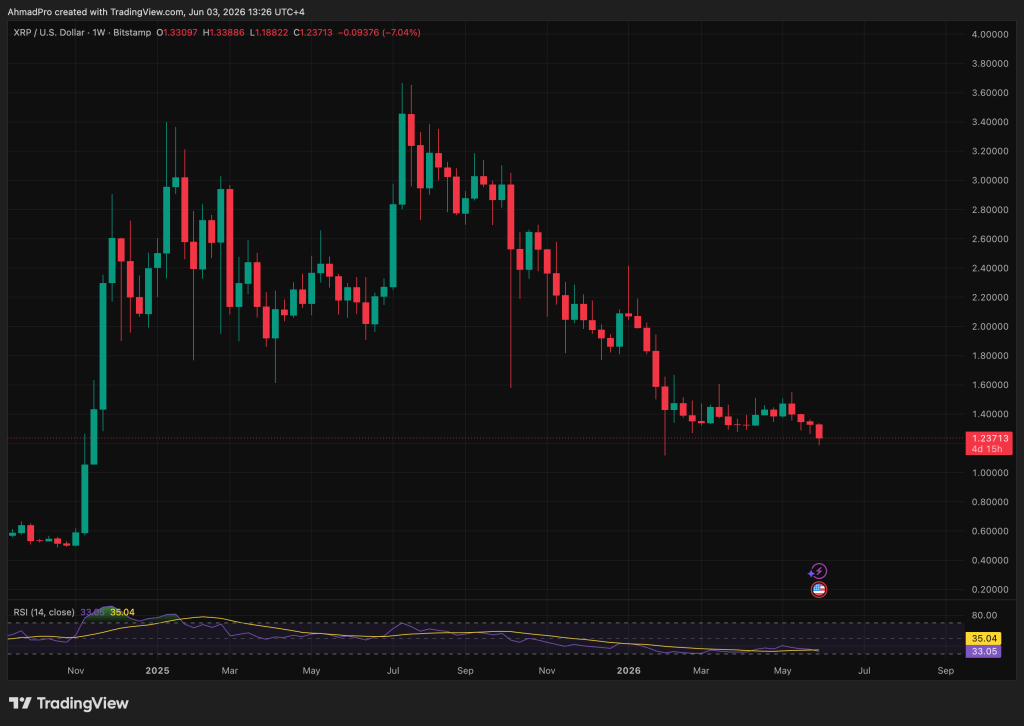
The $1.20 level is the closest thing to a genuine floor on this chart, and it has been tested and held on multiple weekly closes since February.
This week’s candle low of $1.188 tested below $1.20 intraweek before recovering to close at $1.238, which mirrors the wick behavior seen at the February low.
That kind of below-support wick followed by a recovery close is often the last liquidity grab before a meaningful bounce, and it is exactly the pattern ChatGPT’s $1.15 to $1.18 bear case floor is referencing.
If $1.20 holds on a weekly close basis, the base between $1.20 and $1.60 remains intact, and the $1.55 to $1.80 target stays in play. If it breaks, the next level with historical significance is $1.00, where the pre-election institutional positioning began in late 2024.
LiquidChain Is Catching the Attention of XRP holders: ChatGPT AI Predicts It’s the Next 100x
The rotation has already started. Most people just have not noticed where it is going.
Large-cap crypto is not broken. It is just capped. Bitcoin, Ethereum, and XRP are all pressing against the same resistance bands they have been testing for weeks.
The macro relief that would unlock the next leg keeps getting delayed. The institutional inflows that were supposed to arrive keep getting pushed back. Sitting in assets where the upside depends entirely on catalysts outside your control is a strategy with a known ceiling.
The money that understands cycles does not wait at that ceiling. It moves before the next thing becomes obvious.
Early-stage infrastructure plays operate on fundamentally different math. The market cap is small enough that a relatively modest capital rotation produces dramatic price movement.
The upside has not been priced in yet because the market has not fully discovered the project yet. That gap between what something is worth and what the market currently thinks it is worth is where the asymmetric returns come from.
Multi-chain fragmentation is one of the most persistent and costly problems in DeFi. Bitcoin, Ethereum, and Solana each run their own isolated liquidity infrastructure with no native way to connect them.
Every user who moves value between ecosystems pays for that disconnection in fees, slippage, and failed transactions. LiquidChain eliminates that cost entirely by collapsing all 3 networks into a single execution layer. One deployment. Full ecosystem access. No cross-chain tax on every interaction.
The presale is at $0.01454 with just over $700,000 raised. Ground floor is not a marketing phrase here. It is a description of where this actually sits in its lifecycle.
Execution is unproven. Adoption is unknown. Those risks are real and worth naming directly. Established assets offer a smoother ride toward a ceiling that is already visible. This offers an earlier seat at a table that has not been set yet.
Explore the LiquidChain Presale
The post Sam Altman ChatGPT AI Predicts XRP Price For The Next 30 Days appeared first on Cryptonews.

The crypto market is moving through uneven momentum as different narratives compete for attention. Toncoin remains tied to its messaging-based ecosystem and steady network usage. Shiba Inu continues to rely on strong community participation and periodic meme-driven cycles across retail sentiment shifts. Bonk Coin tracks closely with Solana activity, often reacting quickly to broader ecosystem moves.
BlockDAG is drawing increased focus due to its now live Legacy Sale offering BDAG at a $0.00000044 price and a buyback program allowing holders to sell coins at $0.001 per coin. This is where the next big crypto discussion intensifies, as direction splits across utility, community, and sentiment-led assets. BlockDAG currently sits within a more active participation cycle compared to its peers.
1. BlockDAG: Live Legacy Sale Drives Buyback Program Access
The Legacy Sale is now live, allowing participants to access the Buyback Program through their dashboard after purchase by selecting “Sell Coins.”
There are two participation routes. Legacy Sale buyers can register their BDAG in the dashboard for the Buyback Program with no swap required. Existing holders may also participate by acquiring BDAG via BDAG SWAP at a discounted rate and sending tokens to the designated buyback wallet, subject to a daily submission cap per wallet.
Eligible BDAG submitted under the Buyback Program will be repurchased, with payments made in USDT to the registered wallet by November 1, 2026. Proof-of-funds wallets have also been added to the “Sell Your BDAG” page for added transparency.
The next big crypto discussion often centers on assets where timing and access shape participation more than passive holding. In this case, attention is focused on the narrowing buyback window and how quickly conditions are expected to change within a short timeframe.
Overall, BlockDAG is experiencing a moment where urgency is driven by a clearly defined buyback adjustment, making timing a critical variable for those engaging with the current participation opportunity.
2. Toncoin: Price Holds Near $2 Range Stability
Toncoin is a blockchain asset within The Open Network ecosystem, primarily used for payments, staking, and network-based transactions. It has maintained steady visibility due to ongoing ecosystem activity and integration with messaging-based applications.
Price movements have reflected broader market conditions, with periods of volatility followed by consolidation rather than sustained directional trends. Toncoin is currently trading in the approximate range of $2.00–$2.10, based on recent market data, with intraday fluctuations across exchanges.

In broader discussions around the next big crypto, Toncoin is often referenced due to its established position among large-cap assets and consistent network usage. Its price behavior continues to be shaped by market sentiment and overall crypto cycle movements rather than isolated momentum shifts.
3. Shiba Inu: Market Driven by Social Sentiment
Shiba Inu remains a widely recognized meme-based cryptocurrency, driven primarily by community participation, social sentiment, and periodic retail-driven interest. Within the next big crypto discussion, it is often referenced as an example of a sentiment-led asset that tends to move in short cycles rather than sustained trends.
Its ecosystem includes additional utility components, but price action continues to be influenced mainly by broader market mood and liquidity shifts across exchanges. Shiba Inu is currently trading around $0.0000055 USD, with minor fluctuations reflecting overall crypto market volatility. Despite cyclical movement patterns, it maintains consistent visibility due to its large holder base and active trading presence across major platforms.
4. Bonk Coin: Volatility Driven by Solana Sentiment
Bonk Coin operates within the Solana ecosystem as a meme-driven token influenced heavily by community activity and broader network sentiment. Price action tends to respond quickly to shifts in liquidity and trading interest across the ecosystem.
Bonk Coin is currently trading around $0.0000055 USD, with short-term movement driven largely by speculative flows and overall market conditions. Within the next big crypto discussion, it is often referenced as part of Solana’s meme segment that experiences sharp but sentiment-led price cycles rather than steady directional trends.

Its behavior remains closely tied to retail engagement patterns, where momentum builds and fades in line with broader crypto market risk appetite.
The Bottomline
Toncoin continues to trade near the $2 level as it tracks broader market cycles, while Shiba Inu remains around $0.0000055 with movement shaped by shifting sentiment. Bonk Coin also holds near $0.0000055, reflecting fast reactions to Solana-driven liquidity changes. These assets remain active, but their direction largely follows the overall market rhythm rather than setting it.
BlockDAG, however, is currently defined by timing sensitivity around its $0.001 buyback window, creating a clear focus on execution over waiting. At the same time, BDAG remains available at $0.00000044 with direct buyback program access and 30% off live swap access, adding another layer of participation interest.

This mix of structured timing and accessible entry points keeps BlockDAG in the next big crypto narrative as attention shifts toward assets where timing directly shapes opportunity. Momentum continues building as engagement tightens around its current window.
Disclaimer: This is a Press Release provided by a third party who is responsible for the content. Please conduct your own research before taking any action based on the content.

Crypto World
Outpoll Launches Global Prediction Market Platform Built Around Professional Trading Tools
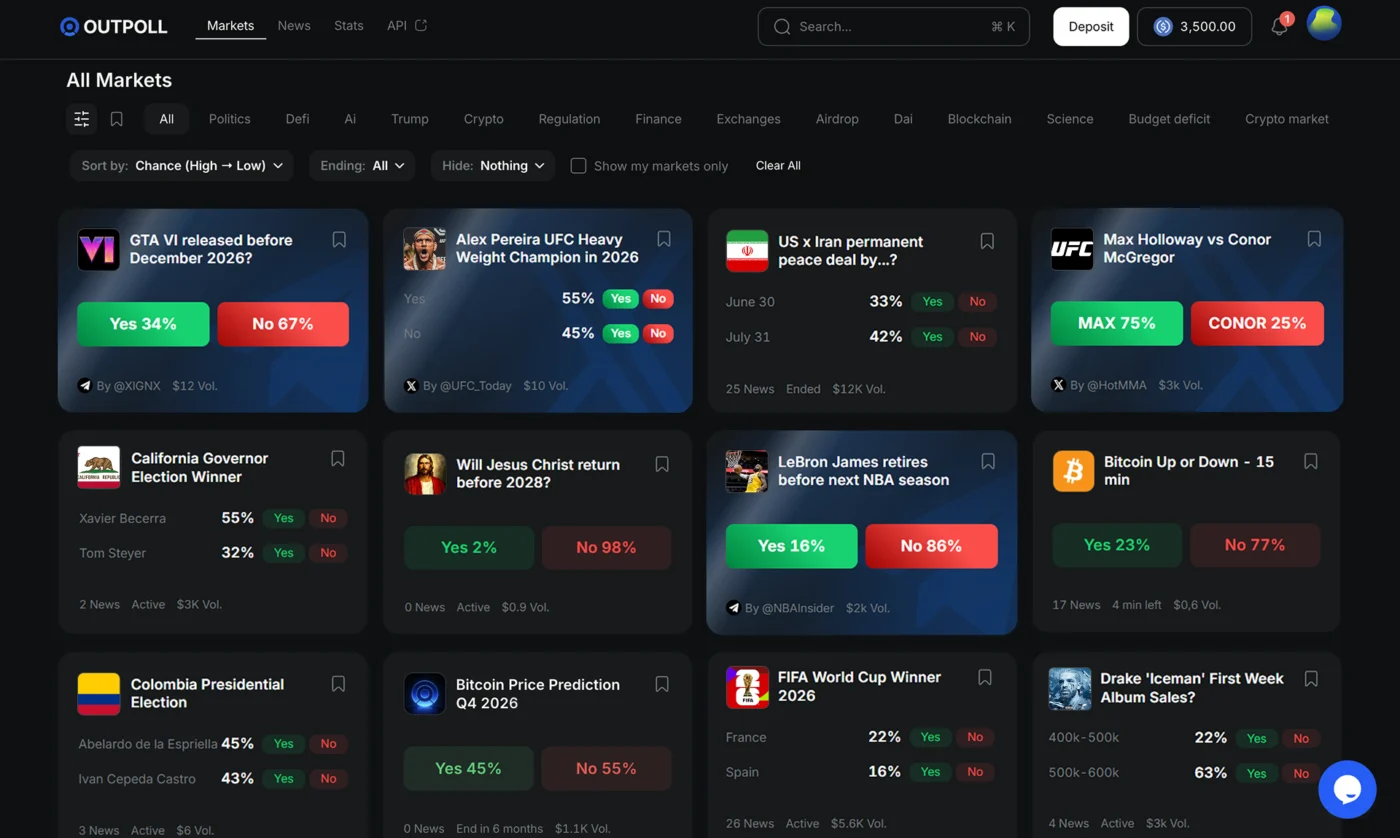
Outpoll announced the global launch of its prediction market platform, a venue where users can trade on the outcomes of real-world events across politics, sports, crypto, and culture. The platform goes live as prediction markets have moved firmly into mainstream coverage, with the category reaching a multi-billion-dollar valuation tier and prices from these markets increasingly cited alongside polls and expert forecasts.
The Outpoll prediction market platform is built around a specific conviction: prediction markets have become a full trading category and deserve the same toolkit traders bring over from FX, crypto, and futures. Where the category historically optimized for casual participation, Outpoll’s prediction market platform treats the user as a trader from the first interaction.
The launch product covers six pillars. Take-profit and stop-loss orders are available on open positions, alongside both limit and market order types – standard equipment on most trading venues, and overdue in the prediction market category. A full public REST and WebSocket API ships with the platform, with documented Python examples covering automation of protective orders, real-time price monitoring, and integration with external infrastructure. Creator-led markets allow approved community leaders and subject-matter experts to launch and curate their own markets with platform-level oversight on quality and resolution. An integrated news section sits directly inside the trading interface, removing the gap between consuming a relevant headline and acting on it. The platform launches with a native Android application available on Google Play, with an iOS version on the roadmap. Multi-currency deposits with in-app conversion to USDC remove first-time friction for users funding their accounts.
Markets on the Outpoll prediction market platform are fully collateralized at the contract level, with positions settled in USDC. Resolution rules and authoritative sources are published before each market opens, with platform-level oversight ensuring markets resolve as defined. Trading fees are approximately 0.1% per trade, in line with industry norms, with no additional charges in the order flow. Onboarding uses a risk-based, trigger-driven KYC approach managed by a dedicated compliance team. The platform also operates a cashback program in which active traders receive Outpoll Token rewards credited to their accounts.
Prediction markets earn their seat at the table by producing prices worth paying attention to. The Outpoll prediction market platform is built around the conviction that the more efficiently traders can express views, the more those prices are worth – and that the platforms which invest in serious tooling earliest will compound a structural advantage as the category matures.
About Outpoll
Outpoll is a global prediction market platform built for traders, forecasters, and audience-led communities. The platform is available globally with restrictions per Terms of Use. More information is available at outpoll.com, with full API reference at docs.outpoll.com/api and the Android application available on Google Play.
Fintech company Revolut plans to offer stablecoins through its future US bank, Reuters reported Wednesday, citing comments from the company’s US CEO, Cetin Duransoy.
Duransoy told the news service that customers of the bank, which is expected to launch next year, will have access to FDIC-insured accounts, multi-currency deposits, stock trading and cryptocurrency services. He said that Revolut plans to initially target retail and business customers with international banking needs, including those managing multiple currencies.
Revolut applied for a US national bank charter in March, which would allow the company to offer federally insured banking products nationwide under a single federal regulatory framework.
That filing marked a change from the company’s earlier plans to acquire a US bank as part of its expansion strategy. Duransoy joined Revolut that same moont to lead its growth in the United States.
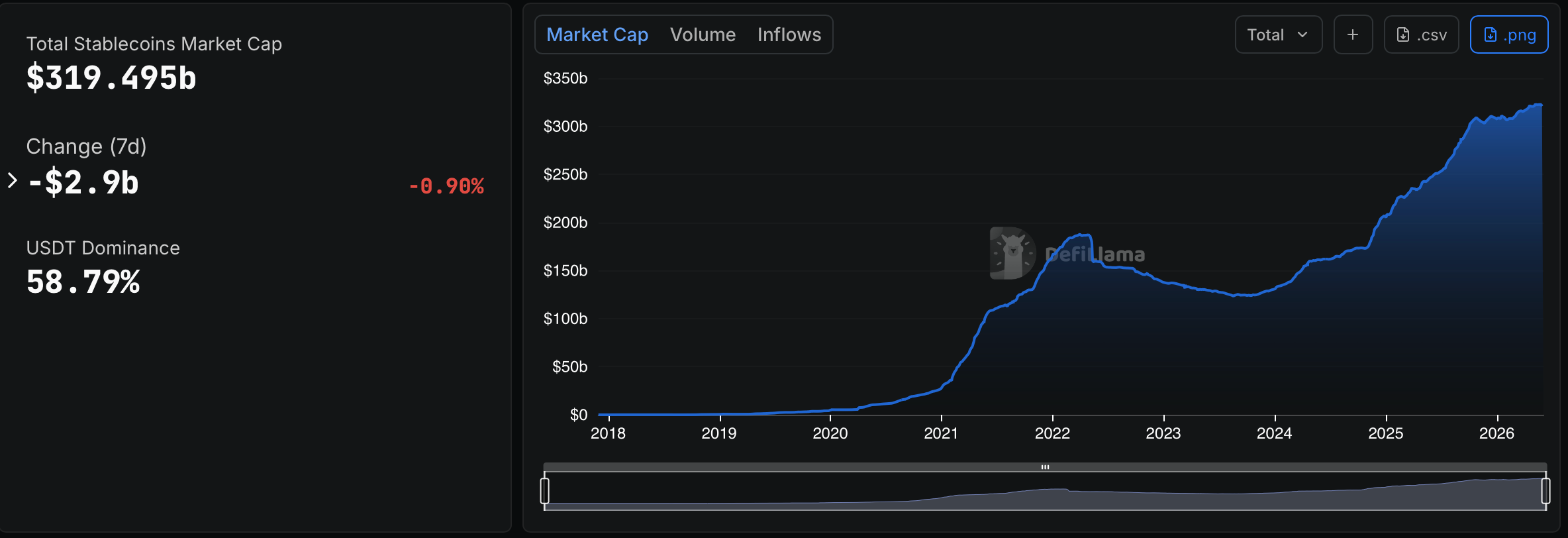
Revolut is looking to get a US foothold in a stablecoin market that has grown to around $319.5 billion, up from about $247 billion a year ago, according to DefiLlama data.
Founded in 2015, Revolut offers digital banking, payments, investing and cryptocurrency products to more than 75 million customers globally, according to its website. Outside of the US, its customers are already able to use their bank cards to make payments with USDT and USDC Stablecoins.
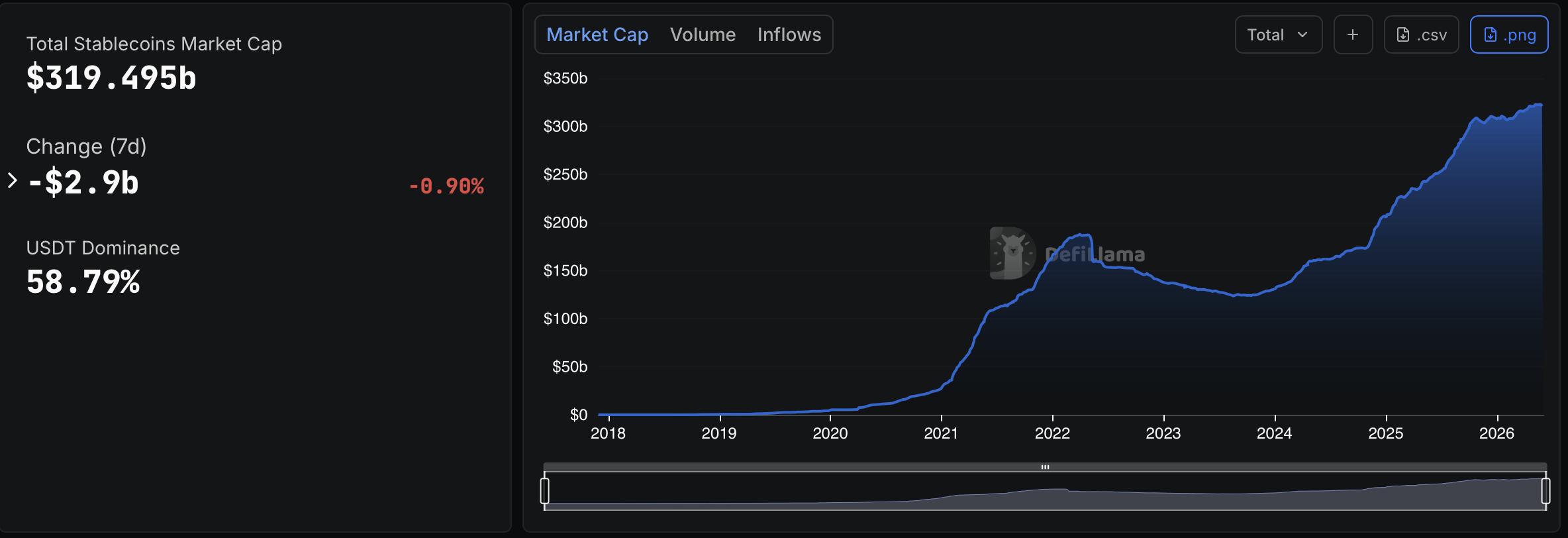
Source: DefiLlama
Related: Mastercard expands support to USDC, PYUSD, RLUSD stablecoin settlement
Stablecoins draw big interest from financial services providers
Revolut’s plans come amid a series of recent stablecoin launches by banks, fintech companies and payment providers as digital-dollar products move deeper into payments and banking services.
In December, digital bank SoFi launched SoFiUSD, a dollar-backed token that enables customers to transact on the Ethereum and Solana networks through the company’s mobile app.
Last week, Falcon Finance introduced the stablecoin fUSD through Anchorage Digital’s regulated issuance platform. The token is backed by cash, repurchase agreements and short-term US government securities and is intended for institutional trading and treasury operations.
On Tuesday, MoneyGram introduced MGUSD in partnership with Bridge, Stripe’s stablecoin platform. The Stellar-based token is integrated into the MoneyGram app and can be used to hold and transfer dollar-denominated balances.
The activity has coincided with a broader push by fintech and digital asset companies to obtain federal banking approvals in the United States. This year, Nubank and Crypto.com received conditional approval to establish national banks, while Circle, Ripple, BitGo, Fidelity Digital Assets and Paxos secured similar approvals from the Office of the Comptroller of the Currency in late 2025.
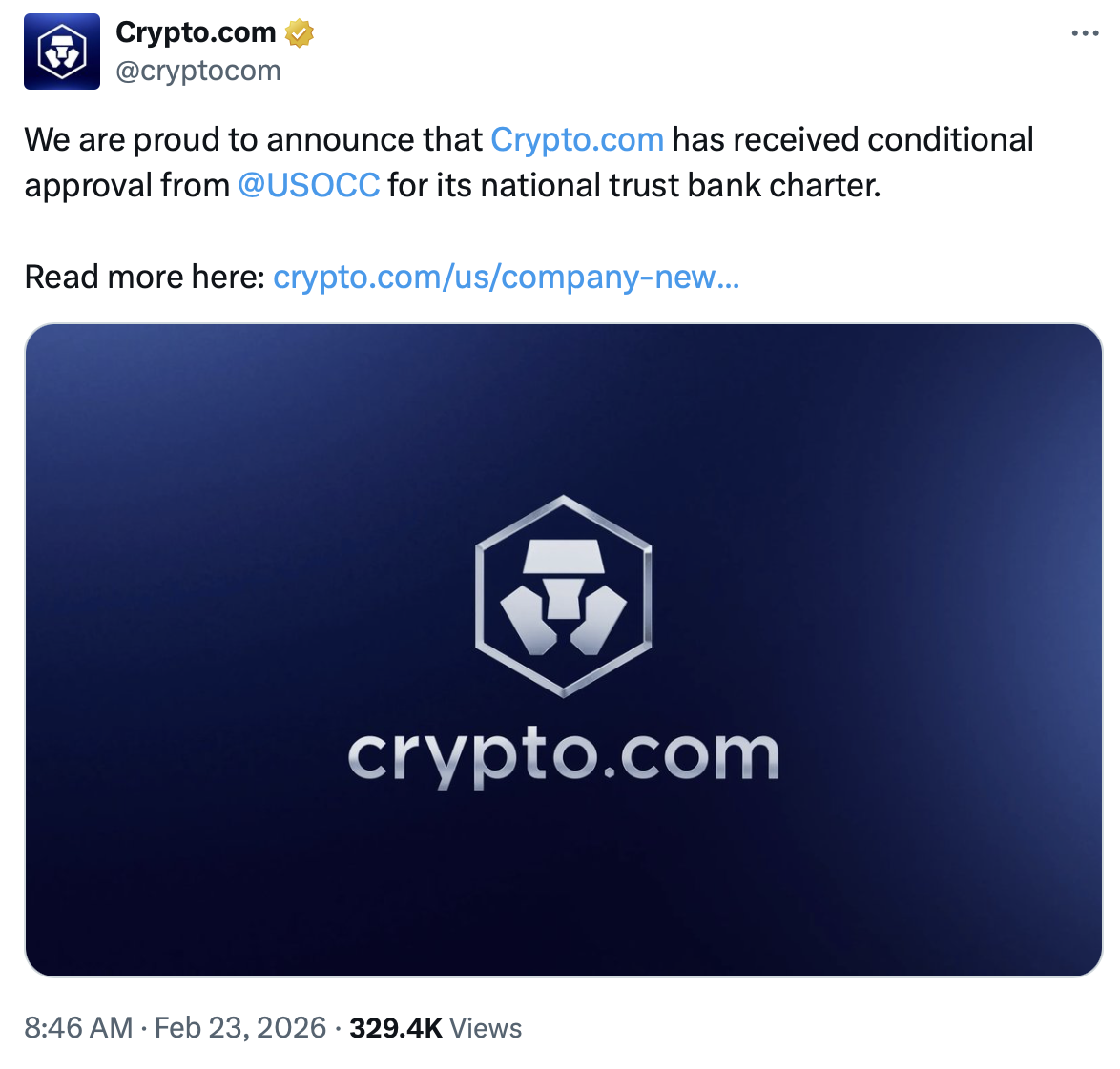
Source: Crypto.com
Magazine: Big Questions: Do we really only need 2–5 cryptocurrencies?
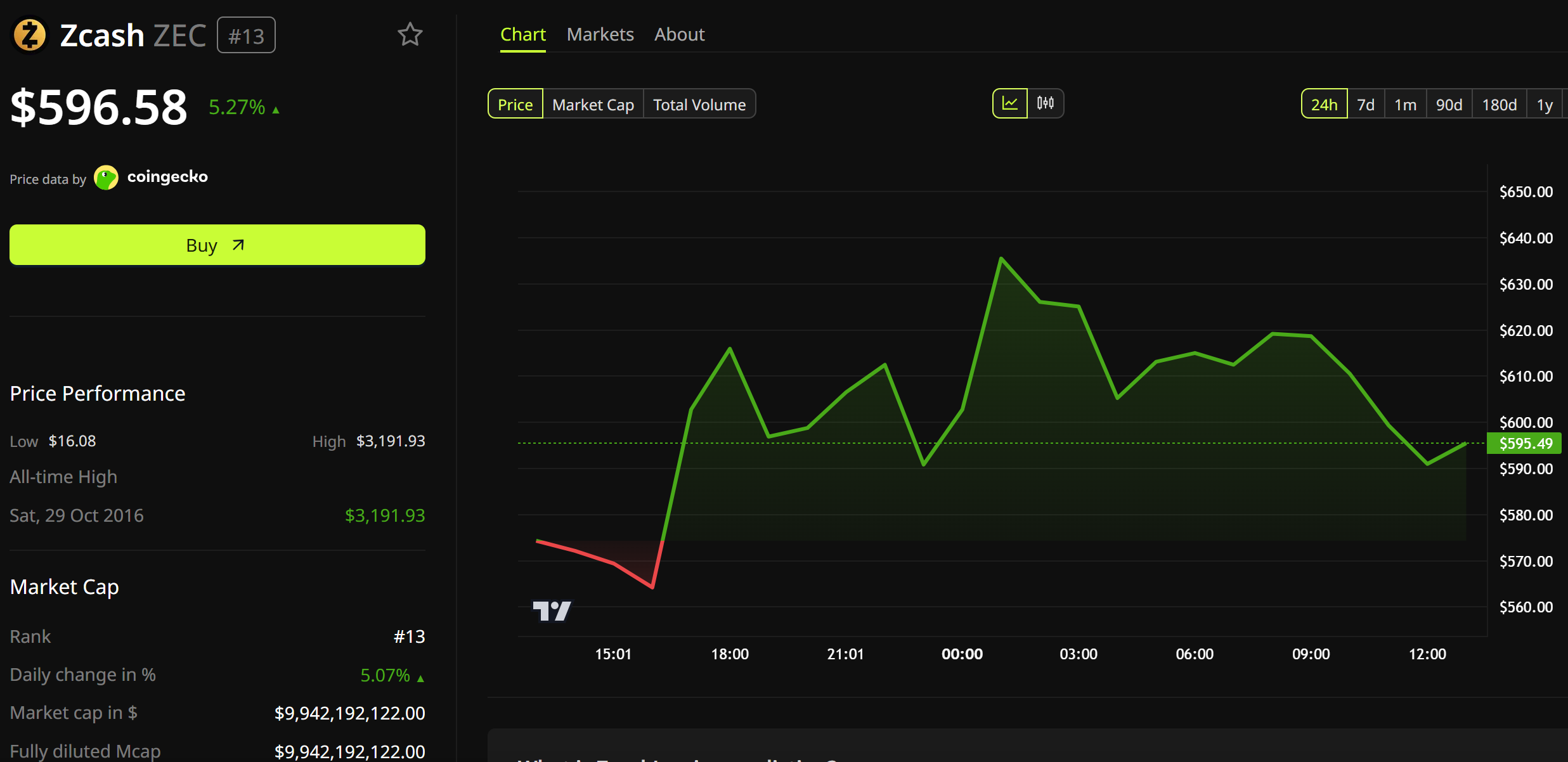
The Zcash Foundation shipped an emergency upgrade to patch a critical bug in its Orchard shielded pool, and Zcash (ZEC) climbed even as the broader crypto market sold off.
The fix arrived through two releases, Zebra 4.5.3 and 5.0.0, which paused and then restored Orchard transactions with a corrected circuit. No funds were lost, and total supply stayed intact.
Zcash Patches a Soundness Bug in Orchard
The flaw sat in the Orchard Action circuit, the zero-knowledge system behind Zcash’s newest privacy pool. If exploited, it could have let value be created without detection.
Follow us on X to get the latest news as it happens
Earlier upgrades had pushed record amounts of ZEC into shielded pools, raising the stakes for any Orchard flaw. Both releases shipped within days of the discovery.
Zebra 4.5.3 disabled Orchard actions through an emergency soft fork at block height 3,363,426. Zebra 5.0.0 then activated the NU6.2 hard fork at block 3,364,600 and switched Orchard back on.
The Foundation said it caught the flaw before any known exploitation. Transparent and Sapling transactions kept working, so user privacy was unaffected. The team urged every node operator to upgrade to 5.0.0.
Why the Network Looked Offline
Reports claimed Zcash had stopped producing blocks for hours. Several explorers showed the chain stuck near height 3,364,601 during the upgrade window, and social posts amplified the confusion.
The halt was only apparent. Mining pools kept producing blocks under the new rules while lagging explorers resynced.
By midday on June 3, most had caught up to the upgraded consensus.
ZEC Holds Up as Markets Fall
ZEC traded for $596 as of this writing, up by over 5% over 24 hours, according to market data. The token ranged between $560 and $638 on the day, while Bitcoin and other large caps slid.

Its market value sits near $9.9 billion, placing ZEC around 13th by capitalization. The strength fits a wider rotation into privacy assets that has lifted the token in recent months.
Growing institutional interest has tracked rising demand for privacy. Talk of ETF prospects for ZEC has added to the momentum, though approval is far from certain.
The incident tested Zcash’s coordination more than its order book. Some analysts have floated higher long-term targets, but those calls stay speculative until operators cleanly finish the move to 5.0.0.
The post Zcash Fixes Emergency Bug as ZEC Defies Crypto Market Crash appeared first on BeInCrypto.
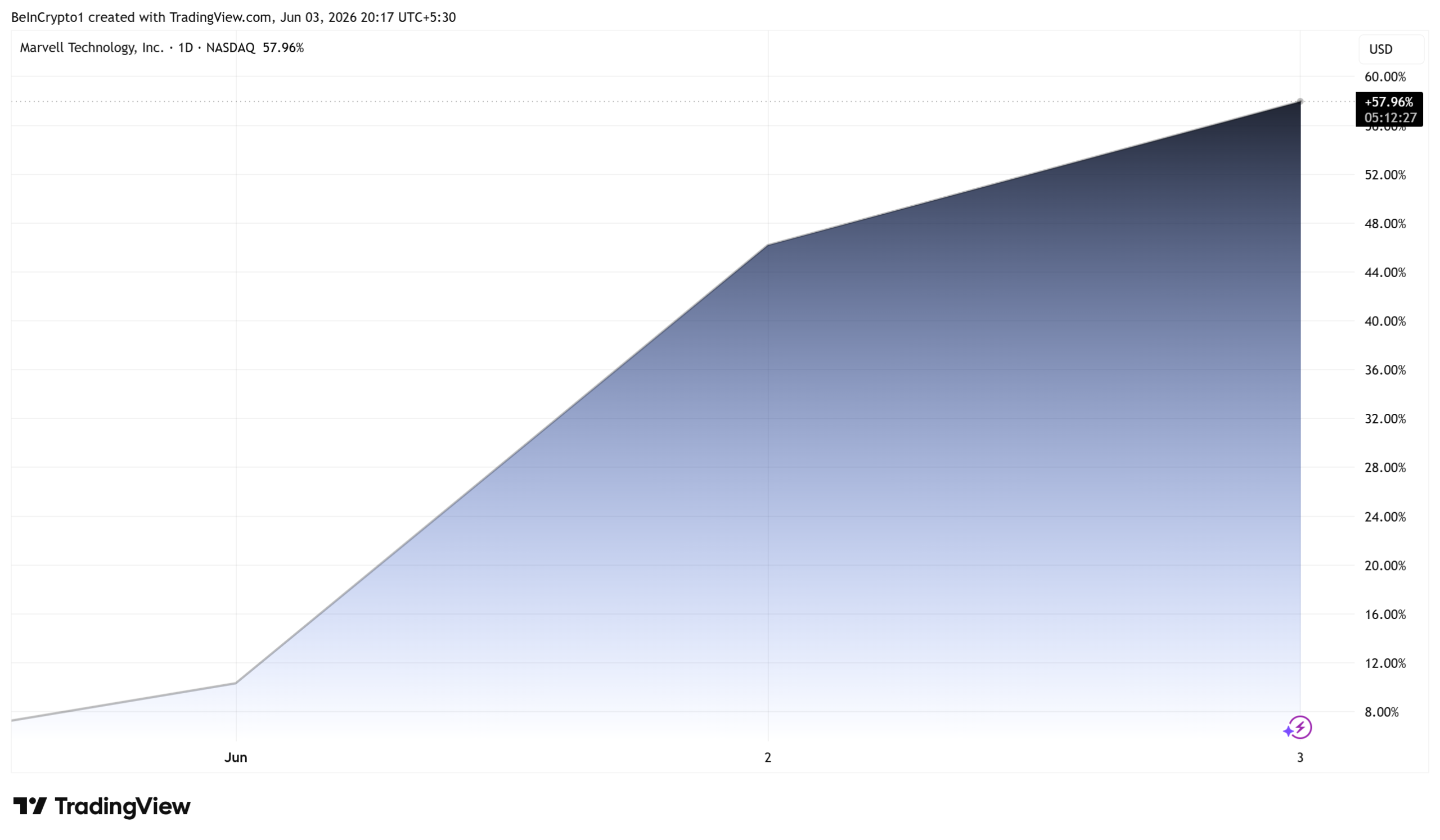
Nvidia CEO Jensen Huang called Marvell Technology the next trillion-dollar company at Computex on June 2. Marvell shares jumped about 33% in a single session, their biggest one-day gain on record. The move added roughly $56 billion in market value, pushing Marvell above $250 billion.
The endorsement landed as investor Michael Burry warned that Nvidia itself faces concentrated demand and hidden financing risk across the AI buildout.

What Jensen Huang Said About Marvell
Huang made a surprise appearance during Marvell CEO Matt Murphy’s keynote in Taipei, spending about 10 minutes on stage. He praised Marvell’s networking and connectivity chips as essential to data centers, where AI workloads run across thousands of linked processors that must share data quickly.
The remark followed Nvidia’s roughly $2 billion equity investment in Marvell, which tied the firm’s custom accelerators and optical networking to Nvidia’s AI factory architecture.
Follow us on X to get the latest news as it happens
Why the Marvell Bull Case Holds
Bulls argue connectivity is the next bottleneck in AI systems after raw compute and memory. Marvell builds the switches, optics, and custom silicon that link those clusters, and data center products now drive most of its revenue.
Skeptics counter that Marvell trades at a steep valuation. It also faces strong competition from Broadcom in networking silicon.
“…the next trillion-dollar company,” CNBC reported, citing Jensen Huang.
A single endorsement rarely changes fundamentals, yet Huang’s words carry weight with traders. Analysts have also stayed broadly bullish on Nvidia, reflecting confidence in the wider AI trade.
Michael Burry’s Warning on Nvidia
Michael Burry, known for his role in The Big Short, has taken the other side of the AI story. His firm, Scion Asset Management, bought put options (short orders) on one million Nvidia shares.
Burry flagged Nvidia’s customer concentration as a core risk. He said the top three customers now account for 64% of Nvidia’s accounts receivable, up from 56% the prior quarter and about 33% in 2020.
He also described much of today’s spending as a temporary benchmarking phase he calls a tokenmaxxing bubble. In his view, that demand looks permanent now, but could fade.
“The conditions for an aggressive fall are as strong as they have been in the history of the stock,” Burry stated.
Burry’s caution echoes other warnings he has issued about a wider market bubble. He has recently been shorting chip stocks as well.
His thesis points to leveraging hidden across the system. A Moody’s report in February found that Microsoft, Amazon, Alphabet, Meta, and Oracle have $662 billion in future data center lease commitments that are not yet reflected on their balance sheets.
That figure equals roughly 113% of the five companies’ adjusted debt, according to Moody’s. The obligations become real cash costs once the leases begin.
Other signals have added to the caution. Reports of falling H200 rental prices have raised questions about near-term GPU demand.
The post Nvidia CEO Just Crowned the “Next Trillion-Dollar” Chip Stock and It Went Up 33% appeared first on BeInCrypto.

Game 1: Spurs, Knicks set to open the NBA Finals
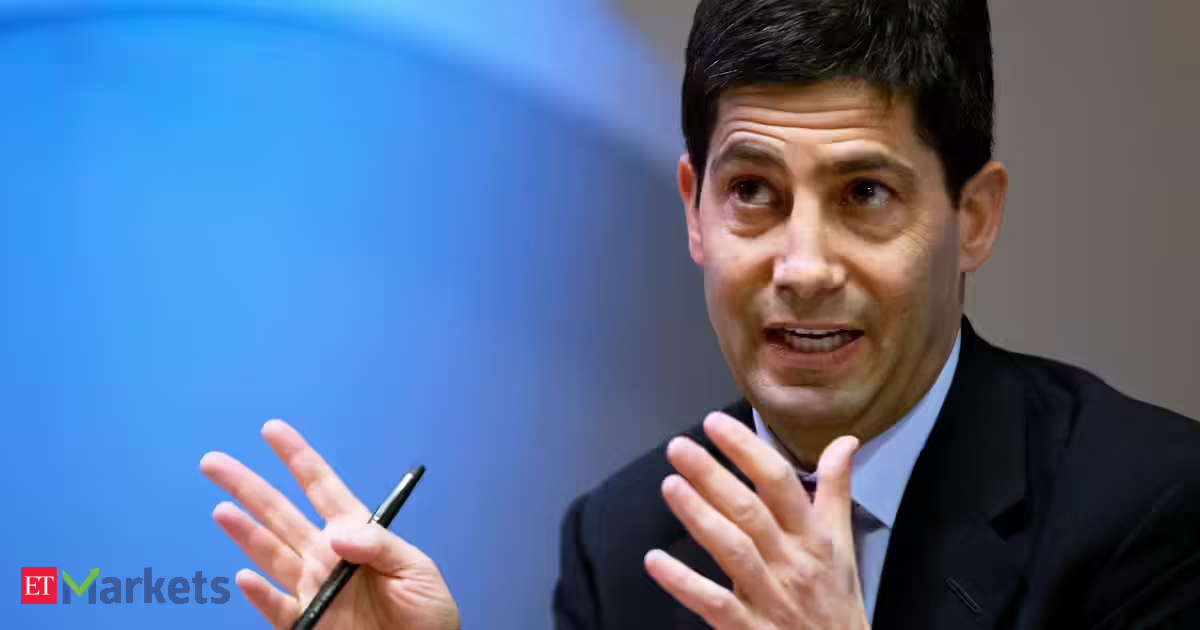
Fed’s Warsh inherits economy increasingly squeezed by inflation

The selloff In Bitcoin, Altcoins Deepened, Will Bulls Buy The Dip?



-

 Tech6 days ago
Waymo dominates autonomous vehicle registrations as Tesla trails behind
-

 News Videos6 days ago
This is BROKEN! INSANE 5x MONEY CAR WASH WEEK! The NEW GTA Online UPDATE Today! (GTA5 New Update)
-
 Tech5 days ago
SpaceX just won a second Golden Dome contract. This one is $4.16 billion.
-

 Business2 days ago
Jade Biosciences, Inc. (JBIO) Discusses Positive Interim Results From JADE101 Phase I Healthy Volunteer Study and Development Plans Transcript
-

 News Videos5 days ago
SHE IS KILLING XRP!!! WATCH URGENT AND ACT FAST
-
 NewsBeat5 days ago
FIRST NIGHT REVIEW: Take That bring the Circus back to life in spectacular sun-soaked style
-
 Crypto World5 days ago
CFTC Has Approved the First Regulated Bitcoin Perpetual Contract in the U.S.
-

 Business5 days ago
Is the Spurs Phenom Already Better Than Prime Diesel?
-
 NewsBeat5 days ago
Novak Djokovic v Joao Fonseca LIVE: French Open latest scores and results after Jannik Sinner’s shocking collapse
-
 Entertainment5 days ago
Weak ‘Supergirl’ Box Office Tracking Amid Milly Alcock Backlash
-
 Crypto World5 days ago
Snowflake (SNOW) Stock Rallies on Strong Q1 Results and AI Product Growth
-

 Business5 days ago
Demand Conditions Improve In Chemicals Sector In April 2026
-

 Politics5 days ago
The House | Inside Andy Burnham’s Makerfield Campaign: “Nobody Thinks This Is In The Bag”
-
 Crypto World5 days ago
MicroStrategy Moves $30 Million in BTC to Coinbase Prime: Is the Bitcoin Sell-Off Already Here?
-

 Tech5 days ago
This Week In Security: Ubiquiti Fixes, And FreeBSD Joins The Club You Don’t Want To Join
-

 Entertainment6 days ago
Maddox Jolie-Pitt Legally Requests to Drop Brad’s Surname
-
 Entertainment5 days ago
One of the Greatest Sitcoms of All Time Shoots Up Apple TV’s Charts 11 Years Later
-
 Crypto World1 day ago
Seagate (STX) Stock Surges to Record High on AI Boom and Legal Settlement
-
 NewsBeat5 days ago
Everything you need to know as Cambridge’s Strawberry Fair returns after cancelled year
-
 Entertainment5 days ago
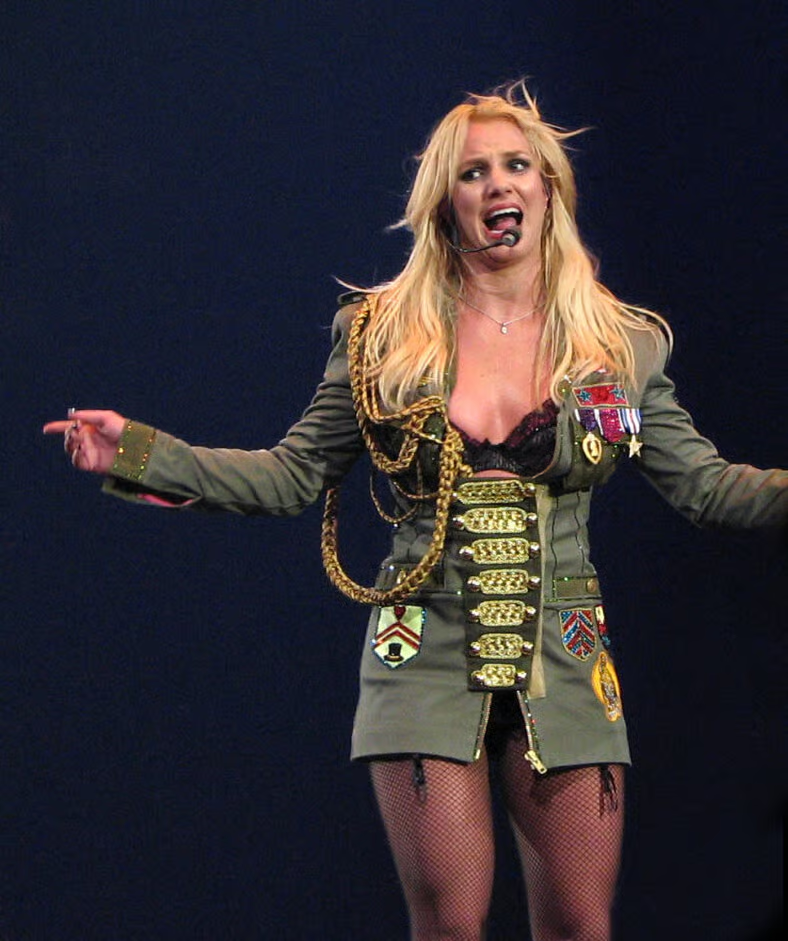
Britney Spears Shares Troubling Update After Hard Year
You must be logged in to post a comment Login