

Crypto World
CZ Claims Rival Crypto Exchanges Opposed His Pardon Bid


Binance founder Changpeng “CZ” Zhao has framed his trajectory in the U.S. crypto saga as a political and legal chess game, noting that a presidential pardon—even after a four-month prison term—hung on contested lobbying dynamics inside Washington. Zhao, who completed his sentence in September 2024 amid a sprawling set of U.S. probes and a $4.3 billion settlement tied to Bank Secrecy Act and IEEPA violations, said in a recent interview that he was not “very confident” a pardon would come, citing resistance from some competitors within the U.S. market. The remarks come as Binance navigates a patchwork of U.S. regulatory expectations while its U.S. arm has slowly re-emerged.
Speaking with Ran Neuner on the Crypto Banter podcast, Zhao suggested that rival exchanges in the United States lobbied against any favorable disposition toward him, even as Binance looks to re-enter a market it exited in late 2023. The exchange’s U.S. operations were halted after a broad settlement with U.S. authorities and tied to the company’s failure to register adequately as a money transmitter and broader AML controls. The four-month sentence and the subsequent settlement have loomed large over Binance’s U.S. strategy, even as the company seeks to rebuild trust with users and regulators.
Key takeaways
- Pardon timeline and competing narratives: Donald Trump pardoned Zhao in October 2025, more than a year after Zhao completed his four-month sentence in September 2024. Zhao indicated that strong lobbying opposition from U.S. rivals may have shaped perceptions around the pardon process.
- Binance.US partially returns to the U.S. market: Binance.US resumed operations for eligible U.S. users in February 2025, months before Zhao’s pardon.
- Ongoing legal scrutiny and a narrow victory in court: A federal court in Alabama granted a March 2024 motion to dismiss a complaint accusing Binance, Binance.US, and Zhao of facilitating transfers to terrorist groups, signaling internal pressure points in the broader legal battle.
- Public framing of the future: Zhao has repeatedly framed crypto’s long arc as moving toward “invisible infrastructure” by 2031, suggesting a future where digital assets are seamlessly embedded in daily life rather than discussed as crypto in isolation.
Regulatory tides, court decisions, and the road to normalization
The U.S. regulatory environment for crypto has remained fragmented, with high-profile enforcement actions shaping market expectations and corporate strategy. Binance’s 2023 exit from the U.S. market followed a settlement that charged the company with Bank Secrecy Act and IEEPA violations and failing to register as a money transmitter. The resolution, valued at about $4.3 billion, framed Binance’s U.S. operations as a cautionary tale for exchanges navigating a complex federal framework that blends criminal-justice oversight with financial regulation.
In the U.S. legal sphere, a March decision in Alabama added a separate dimension to the broader narrative. The federal court granted a motion to dismiss a 2024 complaint filed against Binance, Binance.US, and Zhao, which alleged that the entities facilitated transfers to terrorist groups. While not a ruling on the merits of the underlying claims, the dismissal underscores the legal system’s ongoing efforts to adjudicate complex cross-border crypto activity while addressing national-security concerns. The outcome does not erase regulatory risk, but it does illustrate how individual cases are resolved within the broader enforcement climate.
Against this backdrop, industry insiders and policymakers have kept a close eye on proposed legislation and regulatory benchmarks. The CLARITY Act has appeared in conversations as a potential framework to clarify the treatment of crypto firms and digital assets, with markup discussions noted as moving toward mid-May in various reports. While not providing a definitive policy verdict, these developments signal an ongoing effort to articulate clearer standards for exchange registration, AML controls, and consumer protections that could influence how fast and how broadly U.S. entrants like Binance may re-scale.
Looking ahead: Zhao’s long arc and the industry’s trajectory
Beyond the immediate legal and political back-and-forth, Zhao’s public remarks have consistently pushed a longer-term narrative: crypto should become an integrated part of everyday infrastructure—much like the internet itself—so that future users do not need to discuss “crypto” as a separate category. In a separate interview in April, Zhao reiterated that the goal is for crypto and blockchain technologies to blend into daily life to the point where the terminology fades from common parlance, akin to how TCP/IP or HTML does not dominate discussions about the internet today.
That reframing matters for investors and builders alike. If regulatory clarity progresses and enforcement actions are perceived as more predictable, the market could re-price risk and unlock new use cases in payments, cross-border settlement, and decentralized finance. For traders, the ongoing legal cases and potential future approvals will shape liquidity and market access for U.S.-based participants. For developers, clearer rules could accelerate enterprise adoption and the construction of compliant, interoperable infrastructure.
As Zhao’s narrative intersects with political timing, market dynamics, and judicial rulings, observers will watch several key questions unfold. Will the pardon translate into practical steps toward restoring Binance’s U.S. footprint in a legally compliant framework? How will Binance.US and other entities navigate ongoing scrutiny and new regulatory requirements? And will the vision of crypto as “invisible infrastructure” gain traction as policymakers finalize clearer, enforceable standards?
What readers should watch next
The coming months will reveal how much the pardoned status affects Binance’s strategic posture in the United States and how regulators respond to a more clearly defined framework for digital assets. Investors and users should monitor developments around U.S. regulatory actions, any new compliance milestones for Binance.US, and further court rulings or settlements that could alter the risk profile of participating in the Binance ecosystem.
In the meantime, Zhao’s public outlook remains a reminder that the crypto industry’s political and legal dimensions continue to interact with technology and market dynamics in fundamental ways. As enforcement, policy, and industry responses evolve, the path toward broader adoption—and toward crypto becoming an ordinary facet of financial life—will hinge on how credible, predictable, and scalable the regulatory environment proves to be in practice.


Aside from a few impressive but relatively brief upticks during the late 2024/early 2025 rally, Cardano’s native token has mostly underperformed in the last cycle.
While many other large-cap altcoins, alongside the market leader, managed to break their previous all-time highs last year, ADA remained far from such a feat. Its subsequent decline was also quite painful, as it now trades over 90% below its record price seen in 2021. It’s also out of the top 10 alts by market cap, slipping to the 15th spot on CoinGecko.
However, popular analyst Ali Martinez noted that it has maintained a key level that has historically led to impressive price rallies, including one of triple digits.
ADA to Bouce by 240%?
The support level in question is at $0.25, according to the analyst. In early 2023, ADA managed to rebound swiftly from it after the major correction at the time, and jumped by 85% in a relatively short period of time. Although that’s an impressive feat, the September 2023 rally of 243% was even more profound after a successful bounce from that line.
Martinez noted that the asset stands firm above that level now, currently trading $0.27 after it was rejected at $0.30 earlier this week. His short-term target is set at $0.36, while the secondary, more macro target, is all the way up to $0.53. It’s worth noting that ADA hasn’t seen such high levels in over half a year.
$0.25 is a critical support level for Cardano!
In my analysis of the monthly chart, this floor has acted as a launchpad for significant rebounds on two major occasions:
• January 2023: $ADA bounced off $0.25, resulting in a 88.27% rally over the following weeks.
• September… pic.twitter.com/COknFMkG3H— Ali Charts (@alicharts) May 9, 2026
No Downside Pressure?
Fellow analyst CW weighed in on how investors are positioning on ADA’s futures market. They noted that there has been a notable uptick in long position net buying, which led to a minor price increase for the asset.
Moreover, CW believes ADA’s momentum continues, and there’s no evident downside pressure yet.
$ADA rose following net buying of long positions.
And the upward momentum is being maintained. There is no downside pressure yet. https://t.co/5iURKjSxNH pic.twitter.com/rpk8QEH4AZ
— CW (@CW8900) May 9, 2026
The post ADA Bullish Prediction: Can Cardano Repeat Its Historic 240% Rally? appeared first on CryptoPotato.

TeraWulf reported a widening first-quarter loss for 2026, posting a net deficit of $427 million as revenue remained modest despite a notable swing into high-performance computing (HPC) capacity. The company’s top line for the quarter was $34 million, with HPC lease revenue accounting for $21 million—roughly 60% of total revenue and up 117% from the prior quarter. Bitcoin mining revenue came in at about $13 million, representing a 50% year-over-year decline.
The HPC segment was driven by 60 megawatts of active IT capacity at Lake Mariner, one of North America’s largest HPC campuses, leased to Core42. TeraWulf is coordinating capacity expansion with infrastructure partners Fluidstack and Google, with additional upgrades slated for delivery during 2026. The company closed the quarter with roughly $3.1 billion in cash, a liquidity position management stressed as essential for a growth path tied to long-term contracts.
Chief Financial Officer Patrick Fleury framed the results as a balance between disciplined growth and financial flexibility, noting the capital structure is designed to align long-term financing with contracted cash flows.
Key takeaways
- The quarter underscores a shift in TeraWulf’s business mix toward HPC and AI compute, with HPC revenue representing the majority of quarterly earnings and growing rapidly versus BTC mining.
- A strategic, Google-backed data-center expansion through Fluidstack anchors the AI transition, highlighted by a 25-year lease that began as part of a broader collaboration worth about $9.5 billion in contracted revenues, expanding a prior 10-year agreement.
- Beyond Lake Mariner, TeraWulf is developing a national pipeline of “power-advantaged” sites, including a 480 MW site in Hawesville, Kentucky; a 300 MW site in Lansing, New York; and a 210 MW site in Morgantown, Maryland, with potential to scale to roughly 1 gigawatt. Abernathy, a 168 MW HPC project under a 25-year lease, remains on track for delivery in late 2026.
- Market sentiment shows noise around the stock despite strong year-to-date momentum: shares of WULF were down about 2.6% on the day, even as the stock surged more than 100% since the start of the year.
TeraWulf accelerates AI transition
In October of the previous year, TeraWulf announced a landmark 25-year lease with Fluidstack, backed by Google, worth around $9.5 billion in contracted revenues. This expanded the company’s earlier 10-year commitment and signaled a deliberate pivot toward AI compute assets rather than conventional crypto mining alone. The developer intends to lay out a national network of power-advantaged sites to support scalable HPC and AI workloads, a move aimed at mitigating the volatility of BTC mining revenue.
Alongside the Lake Mariner operations, the company has been building out a broader infrastructure program, with plans for multiple sites designed to deliver reliable, power-rich capacity. The Abernathy joint venture remains a focal point, delivering 168 MW of HPC capacity under a 25-year lease and targeting delivery in Q4 2026. CEO Paul Prager framed the expansion as a differentiator in a market increasingly constrained by access to affordable energy, where long-term contracted power can stabilize returns for compute-heavy AI workloads.
TeraWulf’s approach mirrors a growing trend among crypto miners, where the economics of Bitcoin mining are increasingly complemented or even superseded by data-center operations and AI compute infrastructure. The company’s cash position—about $3.1 billion—offers a buffer as it deploys capital into capacity expansion while managing the uncertainties of crypto pricing and energy costs.
Industry pivot: data centers, not just miners
Riot Platforms, an adjacent name in the crypto infrastructure space, disclosed $167.2 million in revenue for the first quarter of 2026, with its newly launched data-center business contributing $33.2 million. Bitcoin mining revenue for Riot declined to $111.9 million from $142.9 million a year earlier, underscoring the sector-wide move toward diversified, more predictable revenue streams tied to AI compute and data-center services.
The broader market narrative aligns with a wave of miners reassessing strategy amid narrowing margins. Core Scientific, MARA Holdings, Hive, Hut 8 and Iren have all signaled moves to convert mining facilities into data centers or to acquire AI compute assets, aiming to harvest steadier demand from enterprise workloads and AI model training. In this evolving landscape, the ability to secure long-duration power contracts and stable revenue from non-mining compute could determine which players emerge as durable infrastructure providers in crypto and AI applications.
For readers watching the sector, the near-term watchpoints include progress on Abernathy’s delivery timetable and the pace at which Fluidstack/Google-backed capacity comes online, as well as how the AI compute demand environment evolves in relation to BTC price volatility and regulatory developments. The balance between crypto mining cycles and AI-oriented capacity will likely continue to shape margins and strategic choices across the ecosystem.
Ripple’s XRP has continued trading within a broader bearish market structure despite the recent stabilization around the $1.3 key support zone. While short-term volatility has declined in recent weeks, the asset is now approaching a decisive technical region where the next major directional move could soon emerge.
Ripple Price Analysis: The Daily Chart
On the daily timeframe, XRP is currently facing a strong confluence of resistance levels around the $1.4-$1.45 region. This area includes the 100-day moving average, positioned near $1.4 and aligned with the upper boundary of the long-term descending channel. Such a technical confluence significantly strengthens the importance of this resistance zone and increases the probability of a bearish rejection due to growing seller presence.
The recent recovery attempts have so far lacked sufficient bullish momentum, and failure to reclaim this region could trigger another pullback toward lower support levels around the $1.3 and $1.2 areas. From a broader perspective, only a valid bullish breakout above the descending blue channel on higher timeframes would invalidate the ongoing bearish structure and potentially initiate a sustained bullish rally toward higher resistance zones.

XRP/USDT 4-Hour Chart
On the 4-hour chart, XRP has entered a prolonged consolidation phase, forming a symmetrical triangle pattern. This structure reflects a temporary equilibrium between buyers and sellers, with neither side currently holding a decisive advantage. Typically, such formations lead to strong directional moves once a breakout eventually occurs.
The price has now reached the narrowest section of the triangle around the $1.4-$1.45 range, suggesting that a breakout scenario could unfold in the near term. A bullish breakout above the upper trendline may open the path toward higher resistance regions, while a bearish breakdown below the lower boundary would likely accelerate downside pressure and continue the broader bearish trend.

The post Ripple Price Analysis: XRP Reaches Decision Point After Weeks of Consolidation appeared first on CryptoPotato.
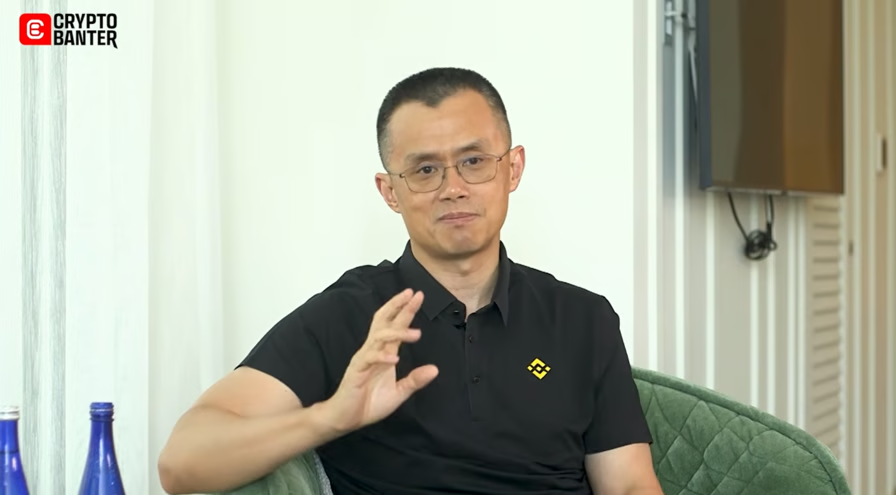
Binance co-founder Changpeng “CZ” Zhao said he was not very confident he would be pardoned by US President Donald Trump after serving a four-month prison sentence in 2024 for violating US anti-money-laundering laws.
“You never know because we actually had very strong anti-lobbying from some of our perceived competitors in the US,” Zhao told Ran Neuner on the Crypto Banter podcast published to YouTube on Saturday.
“The other crypto exchanges in the US don’t want me to get a pardon,” Zhao said, arguing they were concerned about Binance re-entering the US market after its exit in November 2023. The departure followed a $4.3 billion settlement with Binance and the US government over violations of the Bank Secrecy Act (BSA) and the International Emergency Economic Powers Act (IEEPA), as well as failure to register as a money transmitting business.
Binance.US resumed operations roughly four months after pardon
“I’m pretty confident it happened to some extent. I don’t have concrete evidence of any of it, but I’m pretty confident there was push back,” Zhao said, referring to crypto exchange competitors in the US.

Zhao spoke to Ran Neuner on the Crypto Banter podcast. Source: Crypto Banter
US President Donald Trump pardoned Zhao in October 2025, just over a year after Zhao completed his four-month prison term in September 2024.
During an interview with 60 Minutes in November 2025, Trump said he had “no idea who he is” but was told that he was a victim of a “witch hunt” by the administration of former US President Joe Biden.
Binance.US resumed operations for eligible US users in February 2025, months before Zhao’s pardon was granted.
Zhao cleared of recent allegations
Zhao’s comments came just months after a federal court in Alabama granted a motion in March to dismiss a 2024 complaint filed against Binance, its separate US entity Binance.US, and Zhao over allegations that the crypto exchange facilitated transferring funds to terrorist groups.
Related: US CLARITY Act sees ‘big step forward’ as markup set for May 14
Looking ahead, Zhao said in April that he hopes cryptocurrencies and blockchain will simply become an invisible part of daily infrastructure by 2031, much like the internet today.
“I’m hoping that we don’t talk about crypto as crypto in five years, just like we don’t talk about the internet anymore, we don’t talk about TCP/IP, we don’t talk about HTML, JavaScript, etc,” Zhao told Scott Melker on the Wolf of All Streets podcast.
Magazine: XRP ‘probably going to $12,’ Bitcoin ETFs add $1B: Market Moves
Crypto World
Could Pepeto Be the Next Crypto to Explode While Solana Grinds at $88.33 and Cardano Struggles Below $0.30
Tom Lee just declared at Consensus 2026 that the crypto winter is over and Bitcoin closing May above $76,000 confirms a new bull market. Every cycle produces a handful of tokens that turn small entries into life changing wealth, and the search for the next crypto to explode is heating up.
Pepeto, which raised $9.84 million during the fear under the direction of the original Pepe coin creator with a Binance listing ahead, is where the sharpest capital sits right now.
Next Crypto to Explode Gains Traction as Tom Lee Confirms the Bull Cycle Has Begun
Fundstrat cofounder Tom Lee told the Consensus 2026 audience in Miami that Bitcoin needs one more monthly green candle to confirm the bear market ended during the February dip below $63,000, according to CoinDesk.
BTC trades near $80,900 and Lee called tokenization and AI driven finance the two forces shaping the next cycle. Spot Bitcoin ETF spulled in more than $500 million this week. When Bitcoin enters a confirmed bull cycle, the next crypto to explode is the presale still at ground level ahead of the wave.
Where Pepeto, Solana, and Cardano Sit as the Bull Cycle Returns
Pepeto
Bitcoin is confirming the bull cycle, but the tokens that print the largest gains are always found before the crowd shows up, and Pepeto is the next crypto to explode for holders looking at the math with $9.84 million already raised during months when the rest of the market was pulling out.
Return targets land between 100x and 300x at the current $0.0000001868 presale price the moment the Binance listing goes live, which is why SOL and ADA holders at their current caps cannot compete with this entry.
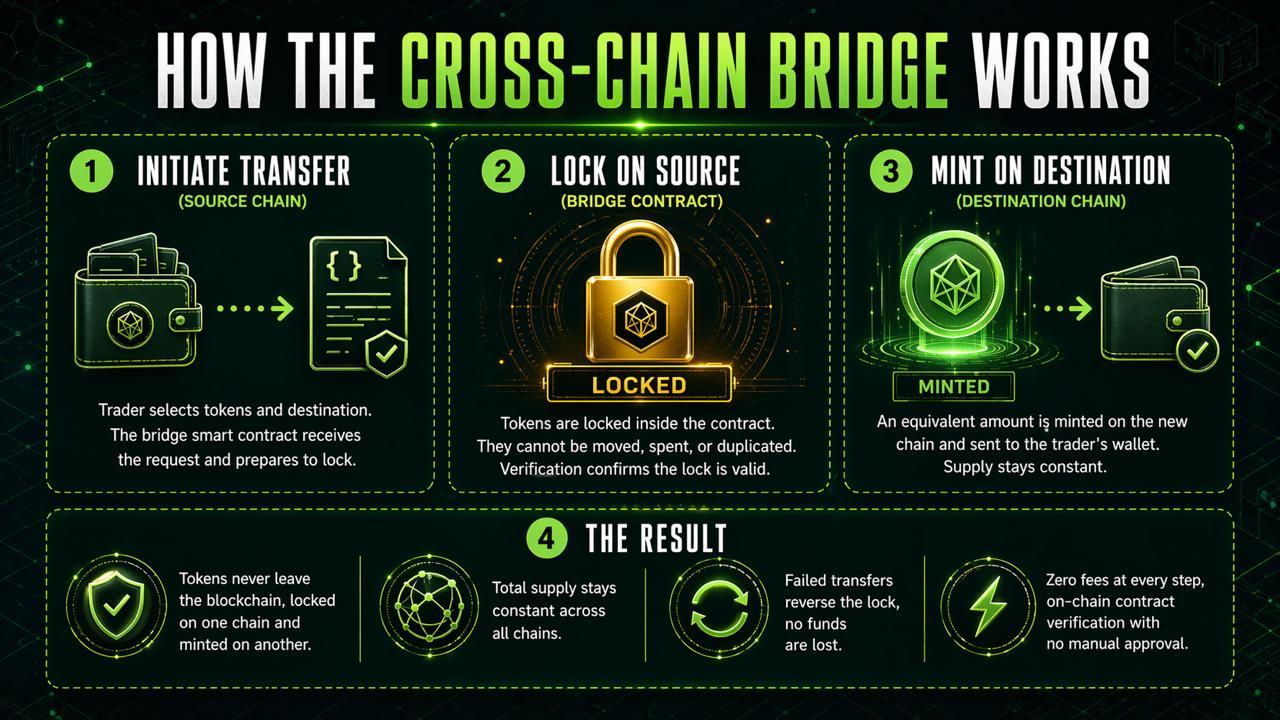
Put together by a team that includes an insider who worked at Binance and the founder who sent Pepe past $11 billion on pure community demand, PepetoSwap lets holders trade across chains at zero cost while the risk scorer scans contracts before capital goes in so buyers avoid traps that drain wallets overnight.
Pepeto is not waiting to build, because every product already runs, the SolidProof audit checked every contract, and staking at 175% APY grows positions while the presale stays open, so as the bull cycle returns an exchange with zero fees and built in protection is approaching the listing that turns presale holders into the winners SOL and ADA buyers would spend years trying to become.
Solana (SOL) Price at $88.33 as the Network Builds Toward Recovery
Solana trades at $88.33 as of May 8 according to CoinMarketCap, up 35% from its February low but still 70% below its $293 all time high set in January 2025. The network attracts developers building DeFi and meme coin projects, with Western Union recently launching a stablecoin on Solana and the Firedancer upgrade boosting performance.
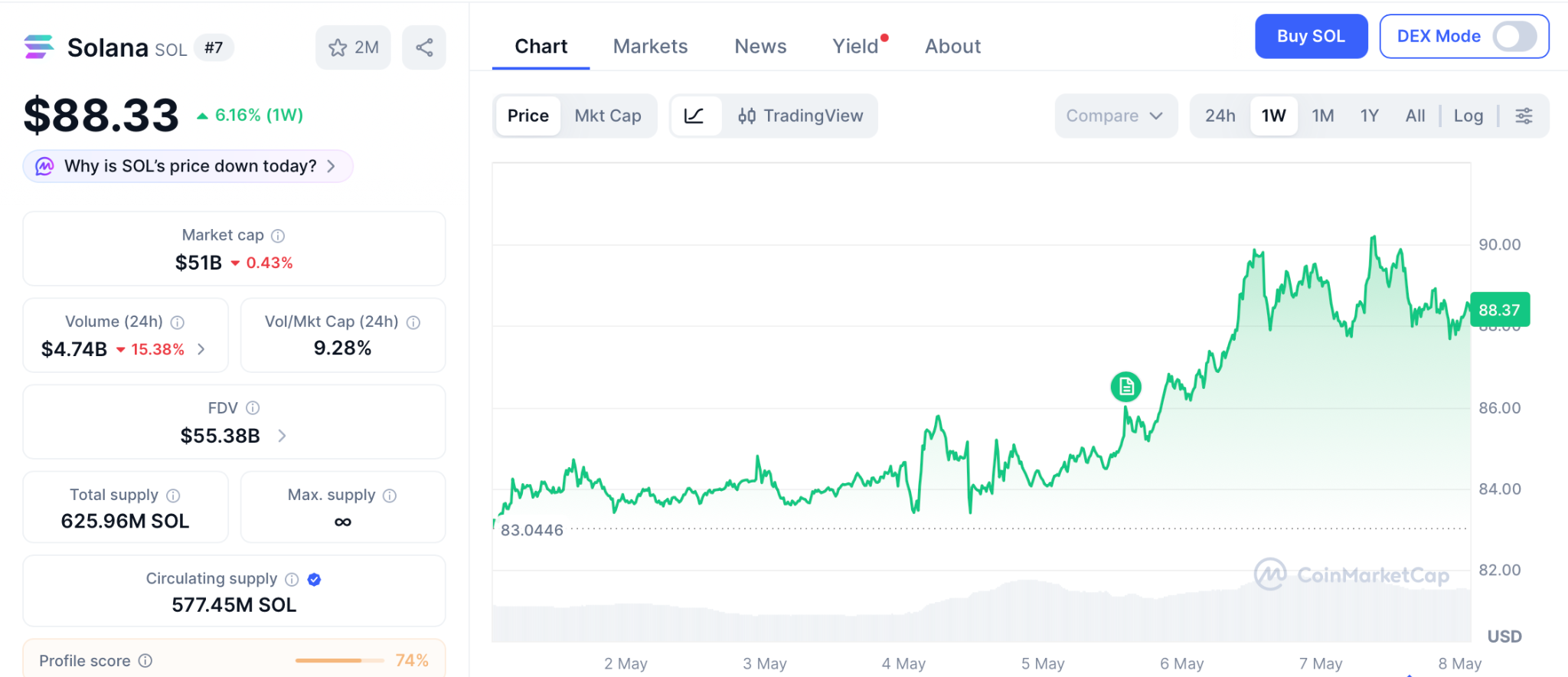
But SOL carries a $51 billion market cap, and even reaching $135 is a 52% gain spread across months, not the compressed return a presale to listing event provides.
Cardano (ADA) Price at $0.26 as the Token Fights to Reclaim Lost Ground
Cardano sits at $0.26 as of May 8, still 91% below its $3.10 all time high from 2021. ADA recently saw a short squeeze after funding rates on Binance hit their most bearish level since June 2023, but that rally is borrowed from leverage, not demand.
The token needs massive inflows to move from its $9.5 billion market cap, and the next crypto to explode is not the project that needs billions just to revisit old highs.
Conclusion
The next crypto to explode is decided by who moved while the entry was still open and who waited until the price no longer made sense, and that separation is exactly what the Pepeto presale creates right now. The exchange runs, the scanner protects every trade, and the SolidProof audit gave the code a clean bill.
The Binance listing moves closer with every presale stage that fills and the $0.0000001868 entry shuts the moment it arrives, because listing day is when the presale price stops existing and the market sets a new floor.
Pepe went from zero to $11 billion with no working product, and the people who acted early made the biggest returns of their lives. The $9.84 million already inside the Pepeto presale shows the same pattern forming before the crowd sees it, and missing this presale could become the most expensive decision of 2026, because the gap between acting now and waiting is the gap between holding a 100x to 300x position and watching someone else celebrate what should have been the easiest call of the cycle.
Click To Visit Pepeto Website To Enter The Presale

FAQs:
What makes a token the next crypto to explode in 2026?
The next crypto to explode needs a working product and a presale entry before listing. Pepeto has all three with $9.84 million raised.
How does Pepeto compare to buying Solana or Cardano right now?
SOL at $88.33 and ADA at $0.26 need billions for major moves. Pepeto targets 100x to 300x from presale price at listing.
Disclaimer: This is a Press Release provided by a third party who is responsible for the content. Please conduct your own research before taking any action based on the content.


“Bitcoin mining is competitive and fragmented by design. It is a race for efficiency where a millisecond can determine whether a miner wins a block or loses to a competitor.”
Foundry and AntPool are the two largest Bitcoin mining pools by hashrate, the total computing power deployed to secure the network. Hashrate Index data show Foundry controlling nearly 30% of the global mining pool hashrate, with AntPool accounting for about 17.7%.
Developing an open standard for mining pools that is not controlled by any single operator represents a deliberate move toward decentralization in an industry that has grown increasingly centralized in practice. By enabling more flexible block template selection and reducing reliance on any one pool’s internal systems, the Stratum V2 initiative seeks to lower barriers to entry for smaller operators and solo miners alike.
In a related note, Cointelegraph coverage has highlighted ongoing efforts to unify Bitcoin infrastructure through open-source tooling. For example, Tether recently launched an open-source mining framework intended to complement open standards in the space. These kinds of collaborations underscore a broader industry push toward interoperability that could reshape how mining capacity is aggregated and allocated across the network.
Key takeaways
- Seven major pools—AntPool, Block Inc, F2Pool, Foundry, MARA Foundation, SpiderPool, and DMND—joined the Stratum V2 working group to push an open, industry-wide pool-to-miner protocol.
- The open standard aims to reduce latency in block discovery and enhance miner choice by avoiding single-point control over mining templates and communications.
- Hashrate Index data place Foundry at roughly 30% and AntPool at about 17.7% of global pool hashrate, highlighting continued concentration even as open standards emerge.
- Bitcoin mining is facing a tougher profitability environment, with the next difficulty adjustment expected to tighten the race for efficiency and rising energy costs adding to the pressure on operators.
Open standards and the push for a more decentralized mining landscape
The Stratum V2 effort arrives at a time when the mining sector is re-evaluating how information about block templates, work distribution, and payout mechanics should flow between pools and miners. The Stratum V2 blog post frames the standard as a neutral, shared baseline that prevents any single operator from holding undue sway over the mining workflow. By enabling more miners to participate in block assembly and by standardizing communication layers, the protocol could improve resilience and resilience against outages or targeted disruptions in any single pool’s infrastructure.
This is not just a technical nicety. The degree to which mining remains decentralized is a live concern among observers. When a handful of pools control a sizable portion of the network’s hashrate, the incentives around protocol design, block templates, and timing can become concentrated. An industry-wide standard that is collectively owned could help tilt the balance back toward broader participation while preserving pool-level incentives for efficiency and reliability.
Beyond the Stratum V2 development, the broader crypto media ecosystem has been tracking parallel efforts to standardize and modernize Bitcoin infrastructure. The open-source mining framework advocated by Tether, as noted by Cointelegraph, aligns with a growing thesis that interoperability will be a key driver of adoption and resilience in the Bitcoin mining space.
Mining pressures: difficulty, costs, and the profitability outlook
Looking at the macro side of the mining equation, the network’s difficulty—the measure of how hard it is to mine a new block—is expected to rise at the next adjustment. CoinWarz projects the adjustment to occur around May 15, 2026, with the difficulty increasing from about 132.47 trillion to 135.64 trillion. While the exact timing can shift, the direction matters: a higher difficulty amplifies the cost per mined block unless efficiency improves.
At the same time, miners face mounting energy costs as the economics of securing the network tighten. The combination of higher difficulty and rising energy expenses compounds the pressure on a sector that, according to CoinShares, already has around 20% of operators unprofitable in the current market environment. Profitability is tightly tied to the price of electricity, which continues to be a critical input for miners globally.
Another signal of the tightrope miners walk is hashprice—the revenue per unit of mining power before expenses. CoinShares reports hashprice levels in a narrow band, roughly between $36 and $38 per petahash per day, which for some operators is near or at the breakeven point given their costs and efficiency profiles.
These dynamics frame the Stratum V2 adoption as a potentially important tailwind for miners seeking to regain material efficiency. By enabling faster, more reliable block templates and reducing coordination overheads between pools and miners, the open standard could help some operators squeeze out small but meaningful gains in throughput and stability even in a market where margins remain under pressure.
As readers watch these developments, investors and builders may consider how broader adoption of Stratum V2 could affect pool competition, miner profitability, and the resilience of the network during periods of stress. And while the path forward is still unfolding, the convergence around open standards is likely to influence both the competitive landscape and the regulatory conversations shaping how mining operations scale in the years ahead.
For readers interested in related industry threads, Cointelegraph’s coverage of mining sector dynamics, including Squeeze scenarios and the push for more open tooling, remains a useful companion resource. And as the sector contends with post-quantum considerations, industry voices continue to explore timelines for upgrading Bitcoin’s security layers—an arc that could shape debates on long-term protocol robustness as the mining ecosystem evolves.
Watch closely how many more pools embrace Stratum V2 and whether new open-standard implementations gain traction. The outcome could influence not only operational efficiency but also the degree to which the mining landscape remains distributed in practice, even as capital and technology concentrate around efficiency leaders.
Related: Tether launches open-source mining framework to unify Bitcoin infrastructure — Cointelegraph Tether launches open-source mining framework to unify Bitcoin infrastructure
Published context: CoinWarz data on difficulty, CoinShares mining insights, and Hashrate Index pool shares CoinWarz · CoinShares · Hashrate Index
Post-quantum reference: Bitcoin may take 7 years to upgrade to post-quantum — BIP-360 co-author Cointelegraph Magazine

TLDR:
- Bitfinex ETH shorts surged sharply in 72 hours, signaling aggressive whale bearish positioning.
- Ethereum remained above key support despite rising short exposure from large market participants.
- Historical Bitfinex short spikes have often preceded strong volatility and short squeeze events.
- ETH gained 0.84% daily and 0.28% weekly, showing resilience amid growing bearish sentiment.
Bitfinex ETH shorts remain a major talking point after whale traders doubled bearish exposure within 72 hours, raising expectations of a volatility-driven move.
Meanwhile, Ethereum traded higher with a 0.84% daily gain and a 0.28% weekly increase, showing resilience despite growing short pressure and keeping both breakdown and short squeeze scenarios firmly in play.
Whale Positioning Sparks Fresh Ethereum Uncertainty
Bitfinex ETH shorts surged aggressively over the last 72 hours, capturing the attention of traders tracking institutional flows.
The move reflects a rapid increase in bearish exposure, with whale-sized traders appearing to position ahead of a potential volatility event.
Bitfinex has historically attracted sophisticated market participants, including large funds, arbitrage desks, and high-net-worth traders.
Because of this, unusual changes in Bitfinex ETH shorts are rarely ignored. Market watchers often treat such positioning as an early signal of directional conviction or strategic hedging.
Recent data showed shorts rising almost vertically, creating a sharp contrast with Ethereum’s relatively stable price action. ETH continues consolidating between $2,280 and $2,400, showing no decisive breakdown despite the growing short interest.
That contradiction has fueled market debate. If whale traders truly expect a sharp correction, many would anticipate heavier spot selling and broader downside expansion. Instead, Ethereum has remained resilient, with buyers repeatedly defending lower levels.
The sudden rise in Bitfinex ETH shorts could indicate traders preparing for macro-driven volatility. However, the visible short exposure alone does not confirm outright bearish conviction.
Institutional traders often use exchange shorts to hedge spot holdings, manage options risk, or capture basis opportunities. As a result, the reported positions may represent part of a broader market-neutral strategy.
Short Squeeze Risk Keeps Bulls Engaged
While the increase in Bitfinex ETH shorts appears bearish, historical market behavior offers a different perspective. Similar spikes in whale short positioning have previously created the conditions for powerful short squeezes.
Large short positions function as future buy orders under pressure. If Ethereum pushes above resistance near $2,420, forced liquidations could trigger rapid upside momentum.
That process typically unfolds quickly. Short sellers rush to close positions, momentum traders enter breakout setups, and algorithmic systems amplify directional movement.
Ethereum’s current technical structure supports this possibility. Price remains compressed within a narrow range, while repeated dips toward $2,300 continue attracting buyers.
Momentum indicators also suggest the bearish trend may be losing strength. MACD is beginning to recover, and RSI has climbed toward neutral territory after cooling from recent weakness.
This leaves Ethereum in a pressure zone where either side could gain control rapidly. A breakdown below support may validate the whale positioning and accelerate selling.
However, a clean breakout above resistance could turn Bitfinex ETH shorts into liquidity for a sharp upside move.
For now, Bitfinex ETH shorts remain the market’s primary volatility signal. Ethereum is holding steady, but positioning suggests that price compression may not last much longer.
TLDR:
- Tom Lee forecasts a 25x move for Ethereum, driven by tokenization and agentic AI infrastructure demand
- ETH outperformed the S&P 500 by nearly 20 points and beat gold and energy stocks since the Middle East conflict
- Lee’s $62,500 target places Ethereum at one-quarter of Bitcoin’s projected $250,000 fair value using ratio models
- JPMorgan CEO Jamie Dimon’s shift on crypto supports Lee’s view that blockchain rails are reshaping global finance
Fundstrat’s Tom Lee has laid out a bold price target for Ethereum, citing macro conditions, tokenization trends, and the rise of agentic AI. His analysis points to a potential 25x move for ETH from current levels.
The forecast draws on historical consolidation patterns, Bitcoin ratio comparisons, and structural shifts in global finance. Lee believes Ethereum is better positioned today than at any prior cycle peak.
Tom Lee’s Case for a Massive Ethereum Move
Ethereum has shown notable resilience against traditional assets in recent market cycles. According to Lee, since the Middle East conflict began, ETH outperformed energy stocks and beat the S&P 500 by nearly 20 percentage points.
It also outperformed gold and silver over the same period. These figures form part of the foundation for his bullish long-term outlook.
Lee also references Ethereum’s decade-long chart to support his thesis. He identifies three major consolidation phases in ETH’s history. The first, in 2016, preceded a 227x price increase. The second, spanning 2018 to 2019, led to a 54x rally.
He stated, “I think there is a massive move coming in Ethereum, driven by a couple of things: tokenization and agentic AI.” Lee argues Ethereum is now deep in its third consolidation, setting up for a similarly large move ahead.
Two main catalysts drive Lee’s forecast: tokenization and agentic AI. On tokenization, he draws a comparison to the U.S. leaving the gold standard in 1971.
That transition unleashed a wave of financial innovation, from money market funds to currency futures to indexed products.
Lee explained, “Tokenization is making almost every asset synthetic, and it follows a roadmap that happened when the US went off the gold standard in 1971.” He sees a similar wave unfolding today as financial assets become digital.
He points to a notable shift in sentiment from JPMorgan CEO Jamie Dimon, once one of crypto’s loudest critics. Dimon has since stated that “crypto is better than the current financial system.”
For Lee, this reflects a broader institutional acknowledgment that blockchain infrastructure is becoming central to modern finance.
Ethereum’s Price Ratio to Bitcoin Drives the $62,500 Target
Lee builds his price target using Ethereum’s historical ratio against Bitcoin. The 8-year average ETH/BTC ratio sits at 0.0479, while the 2021 peak reached 0.087.
Using a Bitcoin fair value estimate of $250,000, a return to the average ratio puts ETH at $12,000. A return to the 2021 high would bring it to $22,000.
However, Lee argues Ethereum’s positioning today exceeds its 2021 setup. He introduces what he calls the “payment rails” thesis, placing ETH at roughly one-quarter of Bitcoin’s total value.
He noted, “That gets you to $62,500, and that’s kind of following the previous historical price cycles.” That ratio produces the price target he now puts forward publicly.
Agentic AI also plays a role in this outlook. Lee notes that AI agents will need identity and payment infrastructure. He argued, “Agents almost certainly won’t want to use PayPal or Visa or MasterCard to do micropayments.” Crypto rails, particularly Ethereum, are better suited for that function going forward.
Lee sees a bull market potentially running through 2028, provided macro conditions stabilize. He noted, “If we clear this Middle East problem and the US economy holds up through higher oil, I think we’re looking at a bull market that could run through 2028.”
If equity markets move higher and oil pressures ease, Ethereum could be among the biggest beneficiaries of the next major cycle.
TLDR:
-
- Bitcoin dominance neared 60% in early 2026, driven by ETF inflows and institutional accumulation across the market.
- CryptoOnchain’s Altcoin Volume Trend signal shows 30-day averages crossing above 365-day averages on CEX data.
- SOL and SUI posted double-digit gains recently, suggesting early capital rotation beyond Bitcoin is already underway.
- MVRV and Profit/Loss Margin remain below cycle peaks, indicating the current bull market may have room to grow.
- Bitcoin dominance neared 60% in early 2026, driven by ETF inflows and institutional accumulation across the market.
Bitcoin dominance has begun losing momentum following a prolonged uptrend, drawing fresh attention from analysts and traders.
A bearish MACD crossover on the BTC dominance chart has triggered wide speculation. Many market observers now believe capital is starting to rotate into altcoins.
Throughout the first half of 2026, Bitcoin led the crypto market almost entirely on its own. Whether this shift marks a temporary pullback or the start of a broader altseason remains the central question.
On-Chain Data Points to Early Rotation Signals
For most of early 2026, Bitcoin absorbed the majority of crypto market inflows. Spot BTC ETF demand, institutional buying, and macro uncertainty pushed BTC dominance close to 60%. During this period, most altcoins struggled to keep pace with Bitcoin’s performance.
However, conditions appear to be changing beneath the surface. Crypto Quant analyst CryptoOnchain recently pointed to a key metric called the “Altcoin Volume Increasing Trend.”
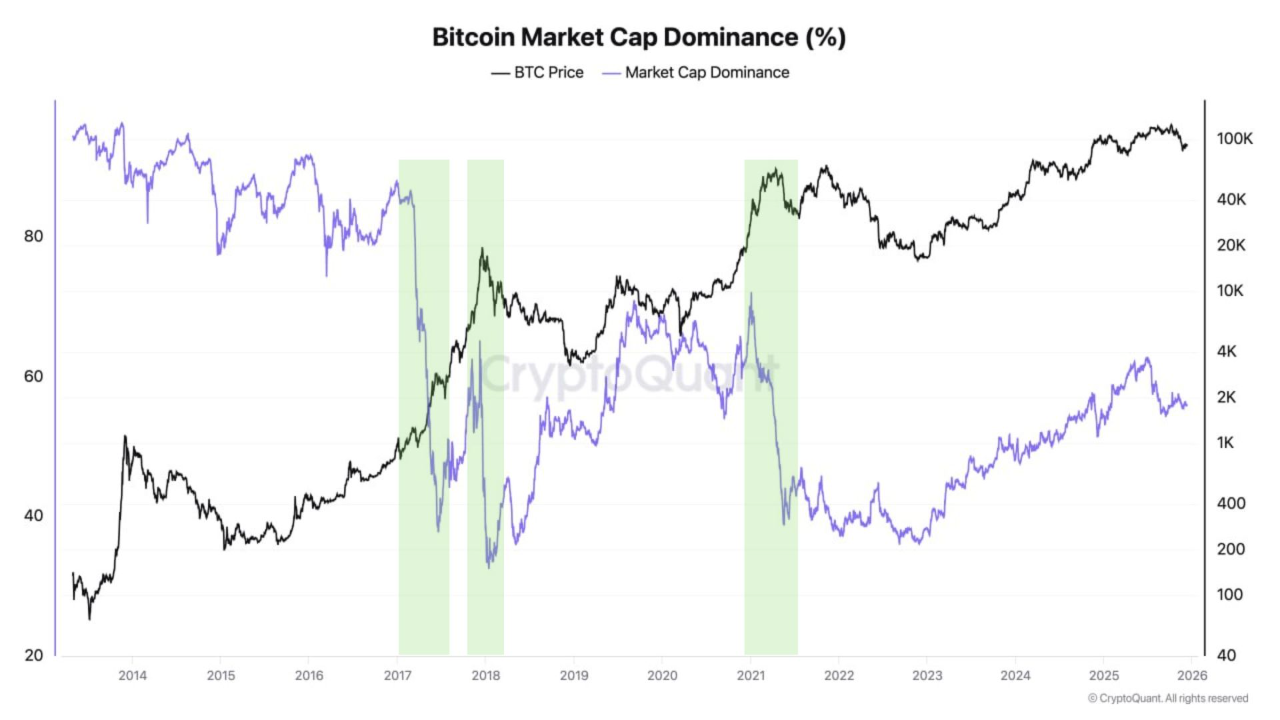
Source: Cryptoquant
This signal appears when the 30-day average altcoin trading volume crosses above the 365-day average. It measures the CEX Volume Ratio between Others and the Top 5 assets.
Historically, this pattern has appeared before major altcoin rallies. During the 2021 cycle, similar signals preceded strong runs in ETH and smaller-cap tokens. That context has given analysts reason to take the current reading seriously.
Price action is beginning to reflect early rotation as well. While ETH has held relatively steady, SOL and SUI have posted notable double-digit gains recently. These moves suggest capital may already be moving beyond Bitcoin into the broader market.
Cycle Metrics Suggest Bull Run Has Room to Grow
Beyond volume data, on-chain metrics are painting a broader picture. Indicators such as Profit/Loss Margin and MVRV remain well below previous cycle peaks. This suggests the current bull market has not yet reached the levels of excess seen in prior tops.
Long-term holders are also showing limited selling behavior at this stage. Historically, sustained distribution from long-term holders has preceded major market tops. The current restraint from this group points to continued confidence in further upside.
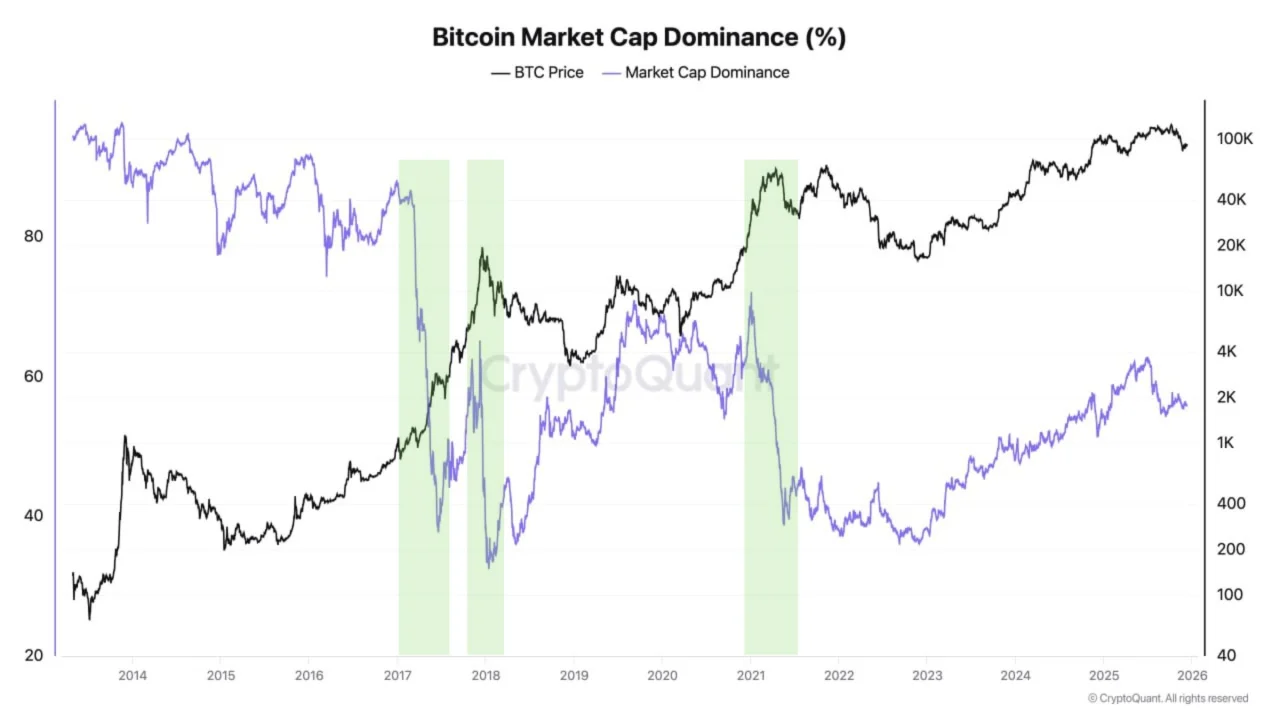
Looking back at the long-term BTC Market Cap Dominance chart adds further context. Both the 2017 and 2021 cycles saw dominance decline sharply before altcoins rallied hard. Capital rotated from BTC into ETH first, then spread into smaller assets, triggering broader market gains.
The pattern forming today shares structural similarities with those prior cycles. That said, past performance does not guarantee future outcomes.
Traders are now watching closely to see whether BTC dominance recovers or continues its decline into a confirmed altseason.
Seven major Bitcoin mining pools have joined the Stratum V2 working group to develop an industry-wide open standard protocol used by mining pool operators to communicate with individual miners in their pools.
AntPool, Block Inc, F2Pool, Foundry, MARA Foundation, SpiderPool, and DMND all joined the working group to collaborate on the mining pool communication standard, which could reduce the time it takes pools to successfully mine blocks, according to an announcement from Stratum V2.
“Bitcoin mining is competitive and fragmented by design. It is a race for efficiency where a millisecond can determine whether a miner wins a block or loses to a competitor,” the announcement said.
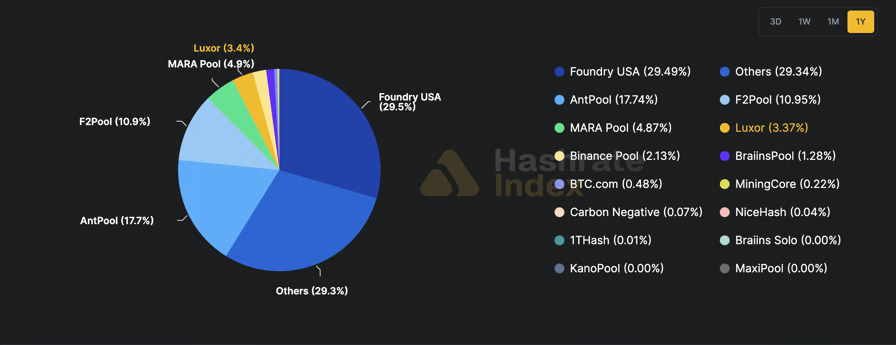
Foundry and AntPool are the two largest Bitcoin mining pools by hashrate, the total amount of computing power deployed by miners to secure the Bitcoin network.
Foundry controls nearly 30% of the global mining pool hashrate, and AntPool controls about 17.7%, according to data from Hashrate Index.

Mining pools broken down by the share of global Bitcoin mining hashrate they control. Source: Hashrate Index
Developing an open standard for Bitcoin mining pools that is not controlled by any one mining pool operator helps decentralize the mining industry, which has become increasingly centralized, while also giving miners greater flexibility in choosing block templates.
Related: Tether launches open-source mining framework to unify Bitcoin infrastructure
Bitcoin mining difficulty is set to rise in the next difficulty adjustment, while energy costs soar
The Bitcoin mining difficulty, the relative challenge of adding new blocks to the ledger, is projected to rise again in the next difficulty adjustment in May.
“The next Bitcoin difficulty adjustment is estimated to take place on May 15, 2026, 5:58 PM UTC, increasing the Bitcoin mining difficulty from 132.47 T to 135.64 T,” according to CoinWarz.

Bitcoin mining difficulty continues to increase over the long term. Source: CoinWarz
Rising network difficulty and increasing energy costs are placing additional pressure on the already competitive Bitcoin mining industry.
Up to 20% of Bitcoin miners are unprofitable under current crypto market and economic conditions, according to asset manager CoinShares.
Hashprice, a critical metric for miner profitability, fell to levels between hit $36 and $38/Petahash-seconds per day, which is at near or at breakeven profit levels for some miners, CoinShares said.
Magazine: Bitcoin may take 7 years to upgrade to post-quantum: BIP-360 co-author

17 TV Shows That Almost Had Very Different A-List Actors In Their Casts
Daniel Dubois’ most likely next opponent revealed after surviving knockdown to stop Wardley

Beatbot’s Anniversary Campaign Turns Pool Cleaning Into a Smarter Buying Decision

Manchester United reach agreement with Casemiro over contract clause amid transfer speculation

US brings back mandatory military draft registration

Steven Gerrard disagrees with Gary Neville over ‘shock’ Chelsea and Arsenal claim | Football


-
 Crypto World2 days ago
HarrisX Poll Found 52% of Registered Voters Support the CLARITY Act
-

 NewsBeat6 days ago
Channel 5 – All Creatures Great and Small series 7 new post
-

 Crypto World3 days ago
Upbit adds B3 Korean won pair as Base token gains Korea access
-

 Tech5 days ago
Image AI models now drive app growth, beating chatbot upgrades
-

 Fashion1 day ago
Weekend Open Thread: Marianne Dress
-

 News Videos7 days ago
AP Dhillon – Old Money (Official Audio)
-
 NewsBeat3 days ago
NCP car park operator enters administration putting 340 UK sites at risk of closure
-
 Business17 hours ago
Ignore market noise, India’s long-term story intact, say D-Street bulls Ramesh Damani and Sunil Singhania
-

 Business7 days ago
Luka Doncic Injury Update: Doncic’s Hamstring Recovery Slows Lakers’ Hopes Against Thunder: Can He Run Yet?
-

 Business7 days ago
Winning Numbers Drawn as Jackpot Resets to $20 Million
-

 Politics23 hours ago
Politics Home Article | Starmer Enters The Danger Zone
-

 Sports7 days ago
Is Man United v Liverpool on TV? Channel, streaming and how to watch Premier League fixture
-

 Crypto World6 days ago
BlackRock Buys $284M In Bitcoin On May 1 As The Best Crypto To Invest In For 2026 Sits Below A Pending Binance Listing
-

 Entertainment6 days ago
Olivia Wilde Reacts To Viral ‘Corpse’ Comparison
-

 Sports6 days ago
Inter Milan Win Serie A Title After Victory Over Parma
-

 Crypto World5 days ago
UAE Free Zone Deploys Blockchain IDs to Verify Registered Firms
-
 Sports7 days ago
IPL 2026: Gujarat Titans opt to bowl vs Punjab Kings; Nishant Sindhu handed debut | Cricket News
-

 Sports7 days ago
Kofi Kingston and Xavier Woods reportedly released by WWE along with others
-
Entertainment6 days ago
Jennifer Lawrence’s Mary Jane Sneakers Are Spring’s It-Girl Shoe
-

 Sports6 days ago
Joel Embiid urges Sixers fans not to sell playoff tickets to Knicks fans
You must be logged in to post a comment Login