

Crypto World
Dartmouth Endowment Invests in Solana ETF, Holds $14M in Crypto Exposure

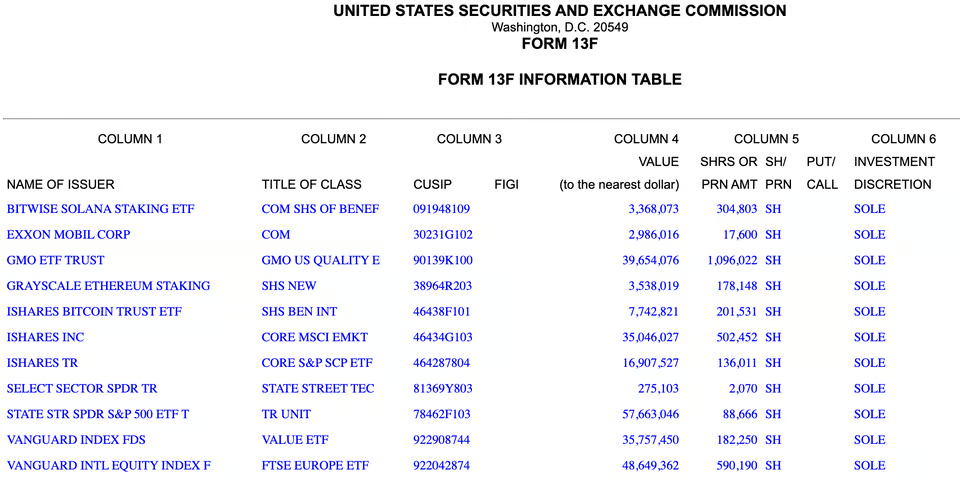
The $9 billion endowment of Ivy League university Dartmouth College reported new investments with exposure to cryptocurrencies, increasing the digital assets in its portfolio since January.
In a Thursday filing with the US Securities and Exchange Commission (SEC), the trustees of Dartmouth College reported that the university endowment held about $3.3 million worth of the Bitwise Solana staking exchange-traded fund (ETF).
The trustees also disclosed about $3.5 million worth of the Grayscale Ethereum staking ETF and about $7.7 million of BlackRock’s iShares Bitcoin ETF.
The investments changed the endowment’s crypto exposure compared to that reported in January, when the same number of shares of BlackRock’s Bitcoin ETF were worth more than $10 million and it held about $5 million in the Grayscale Ethereum Mini Trust ETF.

Source: SEC
Dartmouth’s initial crypto exposure, which it reported purchasing in 2025, marked another US university endowment moving closer to digital assets. Harvard, with a reported endowment of about $57 billion in 2025, reported holdings in BlackRock’s iShares Bitcoin Trust and Ethereum Trust in January.
Related: JPMorgan lifts Bitcoin ETF exposure in Q1, led by BlackRock’s IBIT
The SEC first approved listings of spot ETFs tied to Bitcoin in January 2024, including BlackRock’s iShares Bitcoin Trust and the Bitwise Bitcoin ETF. The regulator has since given the green light to ETFs tied to Ether, Solana, Dogecoin, XRP, and has other applications under consideration.
Bitcoin ETFs record largest daily outflow since January
The SEC filing came shortly after ETFs tied to Bitcoin recorded $635.2 million in daily outflows, marking the largest increase since January. On Jan. 29, the funds lost more than $800 million, led by losses in BlackRock’s iShares Bitcoin Trust.
The price of Bitcoin was $81,237 at the time of publication, having risen about 2% in the previous 24 hours, tapping the 200-day exponential moving average (EMA), a dynamic support level.
However, despite the rally, the price of BTC remains well below the 365-day EMA and the all-time high of about $126,000 reached in October 2025.
Magazine: eToro founder timed Bitcoin top perfectly due to belief in 4 year cycles

Crypto World
Shiba Inu (SHIB) Collapses 60% in a Year: 3 AIs Reveal What Might Trigger a Big Revival

It was late 2021 when the self-proclaimed Dogecoin killer shocked the crypto world with a massive price surge, pushing its market capitalization above $40 billion.
However, that peak was short-lived, and Shiba Inu headed south before staging an evident resurgence in 2024 (though it did not reach its historical peak). The past year has been nothing but disappointing for the token, whose price is down by 60%. And while disbelief may be currently running high within the community, we asked three of the most popular AI-powered chatbots what may could potentially spark a major revival.
The Catalysts
According to ChatGPT, SHIB is no longer viewed purely as a meme coin, meaning its future increasingly depends on whether its ecosystem is actually used. One main factor that could fuel a revival is massive Shibarium adoption.
The layer-2 scaling solution was specifically designed to advance the Shiba Inu ecosystem by lowering transaction fees, improving speed, and enhancing scalability. It was officially launched in the summer of 2023, and in its early days, it sparked huge interest and facilitated multi-million-dollar transactions on a daily basis. Last year, though, the protocol was exploited, after which the numbers were drastically reduced.
Next on ChatGPT’s list is Shiba Inu’s mechanism, adding that the meme coin’s “gigantic supply” has always been its biggest problem.
“If daily activity becomes enormous – gaming, payments, DeFi, AI apps, etc. – burn rates could accelerate dramatically. A true revival probably requires the market believing the supply can shrink meaningfully over time,” it added.
Last but not least, the chatbot assumed that the introduction of a spot SHIB ETF could positively impact the token’s price because it would attract more investors to the ecosystem. Recall that the US regulators have already approved the launch of such products with ETH, XRP, SOL, DOGE, and other altcoins as underlying assets.
Perplexity agreed with ChatGPT’s remarks regarding the burn rate and Shibarium’s role, adding that a renewed meme coin season may also largely benefit SHIB:
“When Dogecoin, Pepe, and similar coins start breaking out together, SHIB often benefits from sector-wide speculative flows rather than needing its own news first.”
The ‘Bitcoin Effect’ and More
The third chatbot we consulted was Google’s Gemini. It suggested that SHIB’s next breakout will largely hinge on Bitcoin’s price movement, noting that the meme coin has matured to a point where it’s unlikely to moon in isolation.
“If Bitcoin (BTC) breaks out its all-time highs and market liquidity increases, ‘hot money’ typically rotates from Bitcoin to Ethereum, and then into high-risk/high-reward meme coins like SHIB,” it stated.
In addition, Gemini touched upon the importance of whale activity. It claimed that Shiba Inu has a limited chance of posting an evident resurgence without the involvement of big investors.
The post Shiba Inu (SHIB) Collapses 60% in a Year: 3 AIs Reveal What Might Trigger a Big Revival appeared first on CryptoPotato.
US lawmakers on the Senate Banking Committee advanced the Digital Asset Market Clarity Act (CLARITY) in a markup session, marking a significant step in Congress’ bid to establish regulatory clarity for digital asset companies and markets. The vote underscored a consequential, though tightly contested, path toward settling how the United States governs crypto markets, exchanges, and associated services.
In the Thursday session, all 13 Republican members and two Democrats voted to move CLARITY forward, while nine Democrats opposed the bill. Senators Ruben Gallego and Angela Alsobrooks joined the Republican bloc in voting yes. The markup followed a flurry of proposed amendments aimed at reshaping various facets of crypto regulation, including stablecoin yields and ethics restrictions. According to Cointelegraph, lawmakers proposed more than 100 amendments to the crypto bill ahead of the markup.
During opening remarks, committee chair Tim Scott framed the measure as a balance between consumer protection, US innovation, and national security in the digital asset space. In contrast, ranking member Elizabeth Warren argued the bill would be “written by the crypto industry for the crypto industry,” suggesting it would facilitate a political-friendly path for the administration’s crypto agenda. “Nothing made it into this bill that wasn’t approved by the crypto industry,” Warren contended.
“This is a pro-law-enforcement, pro-consumer framework,” said Senator Cynthia Lummis, a leading Republican advocate for CLARITY, countering several Democratic criticisms.
Senator Jack Reed, a Democrat, characterized the process as lacking bipartisan parity, noting that Scott had repeatedly curtailed consideration of Democratic amendments. The exchange highlighted deep partisan fault lines surrounding the bill’s scope and its approach to enforcement, consumer protections, and industry oversight.
As CLARITY moved through the process, discussions touched on several high-profile amendments, including proposals to establish AI sandboxes, address tokenization loopholes, and strengthen anti-money-laundering provisions. Notably, lawmakers debated regulatory approaches to crypto mixers and the tracing of illicit flows, with supporters arguing that the bill would clarify enforcement authority, while critics warned of gaps that could hamper consumer protection and market integrity.
In a separate debate, Democrats floated provisions to expand law-enforcement capabilities in crypto cases, while Republicans defended the bill’s balance between oversight and innovation. Several amendments related to stablecoins, digital dollars, and the role of banking regulators were introduced and voted on along partisan lines, with many failing to advance.
Additionally, the committee weighed concerns about ethics and potential conflicts of interest within the executive and legislative branches. Democratic Senator Chris Van Hollen pressed for an amendment addressing potential conflicts tied to the Trump administration and related crypto ventures, but the measure did not pass. Republican supporters argued that the governance framework should not be distorted by extraneous political entanglements.
Key takeaways
- CLARITY advanced from the Senate Banking Committee with a partisan vote: all Republicans and two Democrats in favor, nine Democrats opposed.
- Senators Ruben Gallego and Angela Alsobrooks joined Republicans in voting yes; chair Tim Scott framed the bill as a consumer-protective measure that preserves US innovation and national security.
- Dozens of amendments were proposed, reflecting a broad debate over stablecoins, AML/CFT controls, AI use in markets, and ethics considerations; several amendments were debated and either adopted or rejected along party lines.
- Progress now hinges on a Senate floor vote (requiring 60 votes) and subsequent House approval of the amended language before any presidential signature.
- The regulatory architecture remains a focal point, with ongoing implications for the SEC, CFTC, and broader licensing, AML/KYC, and banking-backbone requirements for crypto firms and related financial institutions.
Regulatory context and implications for markets
The CLARITY debate sits at the intersection of multiple regulatory streams seeking to harmonize oversight for a rapidly evolving sector. Supporters frame the bill as a needed framework to reduce uncertainty for digital asset issuers, exchanges, and custodians while strengthening protections for investors and consumers. Critics, however, warn that the bill could entrench industry-friendly provisions and delay comprehensive, codified standards from the SEC and CFTC, potentially creating regulatory arbitrage across jurisdictions.
The measure contemplates cross-agency alignment, with consideration of SEC and CFTC roles, and signals ongoing congressional interest in clarifying which activities trigger securities, commodities, or other regulatory regimes. Observers note that the outcome could influence licensing pathways, anti-money-laundering controls, customer due diligence, and the integration of crypto services with traditional banking rails, including stablecoin settlements and on/off-ramp facilities.
Industry participants have stressed the practical significance of a clear statutory framework. Kristin Smith, president of the Solana Policy Institute, told Cointelegraph prior to the markup that floor passage would depend on sufficient Senate support and eventual alignment with the House’s stance on identical language. The comments underscore the central question: will CLARITY provide a lasting, enforceable baseline that reduces legal ambiguity for market participants, or will it remain a negotiating platform for a broader regulatory settlement?
Ethics, oversight, and the path forward
Ethics and governance remained a recurring theme for Democratic lawmakers, who raised concerns about potential conflicts of interest and the influence of political actors on crypto policy. While some amendments targeted enforcement powers or supervisory discretion, others probed whether the administration’s broader crypto strategy would withstand legislative scrutiny. Republicans countered that robust oversight and clear standards would strengthen governance without stifling innovation.
Experts emphasize that the bill’s ultimate impact will depend on the text that emerges from the committee and the compatibility of House and Senate versions. If a floor vote in the Senate yields passage, the amended legislation would advance to the House for approval, where political dynamics and alignment with the White House would shape the likelihood of enactment. Until then, the regulatory timetable remains fluid, with ongoing debates likely to influence subsequent drafting and enforcement priorities.
As the process unfolds, industry and policy observers will monitor how CLARITY interacts with broader regulatory efforts, including MiCA in the European Union and evolving US AML/KYC standards, as well as the cross-border implications for stablecoins, banking integration, and enforcement actions by the DOJ and other agencies.
Closing perspective
With the markup marking a milestone in congressional consideration, CLARITY’s trajectory will depend on continued bipartisan buy-in and the ability to reconcile divergent views on enforcement, ethics, and consumer protections. The next steps—floor debates in the Senate, House harmonization, and potential presidential engagement—will determine whether the United States achieves a durable regulatory framework for the digital asset economy or enters another round of regulatory negotiation.
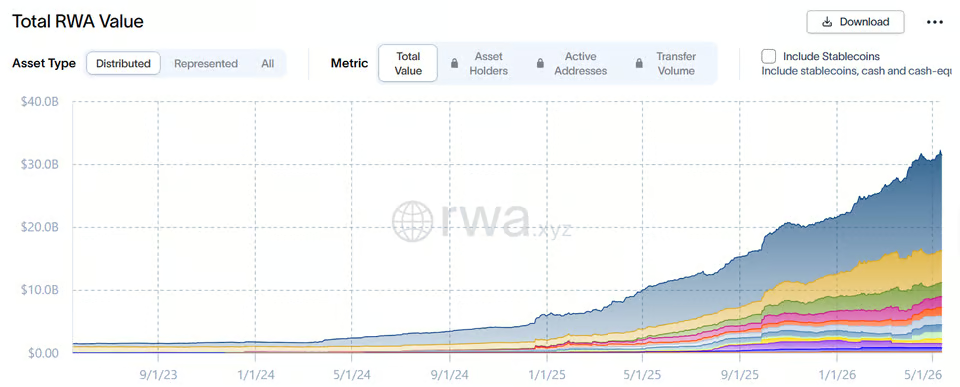
Real-world assets (RWA) crossed $32 billion in market value for the first time on Tuesday, as Wall Street’s love affair with tokenization continues to accelerate.
JPMorgan was the latest to double down on its interest through a filing with the Securities and Exchange Commission for a new tokenized money-market fund for stablecoin issuers on Ethereum.
Not everyone is impressed by the big names and numbers.
“[Most] of the projects out there, and even the traditional finance players coming into crypto, they’re only looking at the issuance layer,” Chris Kim, founder and CEO of liquidity provider Axis, told Cointelegraph. “Nobody is actually focusing on the liquidity side of things.”
Issuing a tokenized asset and being able to trade it are two very different things, Kim argued. The industry’s obsession with market cap figures doesn’t measure how much of $32 billion can actually change hands.

Onchain RWA assets market value grew by about $10 billion in 2026 so far. Source: rwa.xyz
Putting assets onchain is the easy part
Tokenized finance is expected to continue growing. McKinsey & Company projects the tokenized market cap could reach $2 trillion by 2030. Standard Chartered sees $30.1 trillion by 2034.
But Kim claimed that the industry is obsessed with the wrong metrics, as the race to issue is outpacing the ability to trade these assets.
“The tradability around it is going to be an important factor to determine the value of these tokenisation markets going forward. But right now, there isn’t that much trading happening around tokenized RWAs,” he said.
The headline figure doesn’t tell the story of how unevenly liquidity is distributed across asset classes. Tokenized Treasuries, which account for roughly half of the RWA market, benefit from the underlying liquidity of US government debt, as rwa.xyz data shows.
But for other categories, Chainalysis reported that the tokenized assets market cap is drawn from a platform — rwa.xyz — that tracks highly illiquid assets like real estate alongside liquid ones.
“Because these illiquid assets lack continuous secondary market trading, their exact present market value is inherently difficult to measure, meaning certain aggregate valuations should be treated as best-available estimates,” Chainalysis wrote in its April report.
Chainalysis tracked $40.5 billion in tokenized gold trading volume and found that for most of its history, it had almost no correlation to traditional gold markets, frequently decoupling entirely. It is only since mid-2025 that the two markets have begun moving in tandem.

Tokenized gold is beginning to track physical gold prices more closely, but the two markets have not yet fully converged. Source: Chainalysis
Related: Crypto and AI could be dirty words on 2026 midterm campaign trail
In other words, even for one of the most mature tokenized asset classes, onchain trading has only recently started to behave like the real thing.
Fragmentation is taxing the RWA economy
For RWA assets in today’s Web3 economy, the same asset is issued across multiple blockchains.
“The fragmentation is accelerating,” Kim said. “We are seeing the same asset being issued on multiple blockchains in 30 different formats, and they can’t interact with each other.”
Kim has a stake in the narrative. Axis, his arbitrage yield platform, is built on capturing price discrepancies across fragmented markets.
When tokenized assets are spread across blockchains without seamless interoperability, pricing diverges and capital efficiency takes the hit. Issuers can face duplicated legal work and siloed liquidity pools, while investors must navigate different custody models and risk profiles.
The cost of this fragmentation is already measurable, according to a report by RWA.io. Moving capital between networks compounds the problem by costing investors between 2% to 5% per transaction in fees and slippage.

The same tokenized fixed-income asset trades at different prices across blockchains. Source: RWA.io
RWA.io estimated these inefficiencies drain between $600 million and $1.3 billion from the market every year. If the fragmentation persists as the market scales, those annual losses could reach $75 billion by 2030.
The technology to fix this exists, but the infrastructure connecting it all is the missing piece of the puzzle, according to RWA.io. Onchain operational failures drove a 143% increase in financial losses in the first half of 2025 compared to all of 2024.
The long road to a functioning RWA market
Kim is not bearish on tokenisation and views it as an inevitable destination for global capital markets. But inevitable does not mean imminent.
“I view tokenisation as a default standard in the far future,” he said. “But until we get there, we are still going to have a differentiation between TradFi liquidity profiles and on chain liquidity profiles.”
JPMorgan and BlackRock are racing to put assets on chains. But until the liquidity infrastructure catches up, the market cap figure doesn’t fully measure a functioning market.
“We are just maybe in the early innings,” Kim said. “Until more sophisticated liquidity providers are able to synchronise TradFi and onchain tokenised markets, then I think we can only call it a successful alternative to TradFi.”
The IMF has also flagged a longer term concern in a January 2025 note on tokenization and financial market inefficiencies. It warned that while tokenization could reduce some trading costs, it may amplify shocks if institutions become more interconnected and hold lower liquidity buffers as a result.
In other words, the race to put assets on blockchains may be creating new systemic risks even as the old infrastructure problems remain unsolved.
Magazine: eToro founder timed Bitcoin top perfectly due to belief in 4 year cycles
Bitcoin (BTC) is struggling to enter a stronger breakout phase above $80,000, as capital inflows into the BTC market remain below levels seen in past bull runs. BTC futures traders are also staying cautious, while a growing number of investors who have held for the past six months may look to sell into key resistance levels, according to new analysis.
Bitcoin capital inflows remain muted: Glassnode
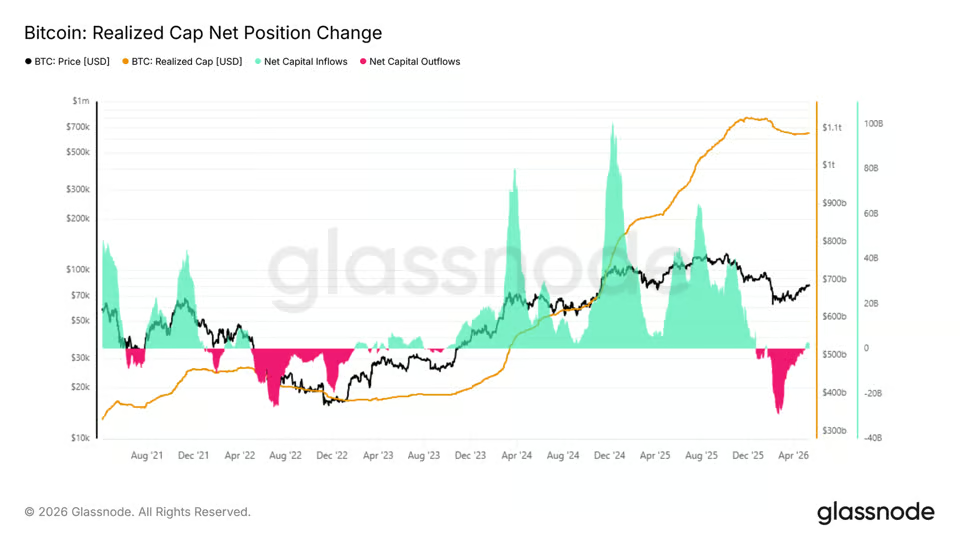
The Week On-chain report from Glassnode stated that Bitcoin’s 30-day realized cap net position change recently climbed to $2.8 billion per month. The metric tracks the amount of new capital entering the BTC market over 30 days.

Bitcoin realized cap net position change. Source: Glassnode
The positive flows helped support the BTC recovery from April’s lows near $65,000. But previous breakout phases during the 2023–2025 rally were accompanied by much bigger capital rotations. The slower pace of capital entering the market this year has raised doubts about whether Bitcoin can rally above the $80,000–$82,000 range.
Related: Bitcoin risks slump after hitting ‘major bear market resistance’: CryptoQuant
Glassnode also flagged a growing cluster of holders near the $86,900 level. These investors accumulated BTC during the November-to-February period and are now approaching breakeven. These holders could sell near their entry price after extended drawdowns, creating a large overhead supply zone that may stall Bitcoin’s rally.

BTC realized price by age. Source: Glassnode
Short-term buyers continue to support the market around $76,900, which marks the average cost basis for coins acquired over the past 30 days. This indicates fresh demand is still entering the market at lower levels, even as overhead supply is concentrated closer to $87,000.
Related: JPMorgan lifts Bitcoin ETF exposure in Q1, led by BlackRock’s IBIT
BTC futures traders stay cautious
Bitcoin researcher Axel Adler Jr. said that the buying activity across spot and futures markets has started to cool after Bitcoin’s recent push above $80,000. The 30-day net taker volume indicator rose to +2.0 on May 6 before dropping to +1.25 on Wednesday. The metric shows whether buyers or sellers are in control.
BTC buyer pressure has dropped roughly 35% from last week, showing traders are becoming less aggressive as Bitcoin trades near $80,000. Adler noted that past corrections in the +0.3 range often coincide with slower price action or sideways periods.

Bitcoin net taker volume oscillator. Source: Axel Adler Jr.
At the same time, the 30-day Bitcoin funding rate has remained negative since March. Negative funding means the short traders are paying long traders to keep their positions open, showing that bears still dominate futures activity.
Even with Bitcoin reclaiming the $80,000 range, BTC futures traders have not added long positions needed to support a decisive breakout. Adler said a move back above zero in funding rates would offer the first stronger sign of renewed bullish positioning.
Meanwhile, Alphractal CEO Joao Wedson said Bitcoin still needs stronger money flows before a larger bull market can begin. Wedson pointed to the Realized Cap Impulse metric, which tracks whether fresh capital is entering or leaving the Bitcoin market.

Bitcoin realized cap impulse. Source: Joao Wedson/X
The indicator remains slightly below zero, showing fresh capital inflows have not yet returned to the levels typically seen during stronger Bitcoin breakout phases. Wedson said a move back above zero would signal that investors are putting fresh capital back into Bitcoin.


Cerebras IPO shares nearly doubled on their first day of trading, opening at $350 after pricing at $185 per share on Wednesday evening.
Summary
- Cerebras raised $5.55 billion at $185 per share and opened Thursday at $350, the largest US tech IPO since Uber’s 2019 debut.
- The AI chipmaker carries a market capitalisation above $100 billion with OpenAI and Amazon Web Services as anchor customers.
- The debut is seen as a bellwether for a broader AI listing wave with OpenAI and SpaceX targeting later-year offerings in 2026.
Cerebras IPO shares opened at $350 on Thursday on the Nasdaq under the ticker CBRS, nearly doubling from the $185 per-share price set the evening before. The AI chipmaker raised $5.55 billion from 30 million shares, making it the largest IPO by a US technology company since Uber’s 2019 debut.
At the open, Cerebras carried a market capitalisation above $100 billion. Shares were halted briefly for volatility before trading around $324 in the afternoon. If underwriters exercise their option to buy an additional 4.5 million shares, total proceeds could reach $6.38 billion.
The offering priced well above its initial range of $115 to $125 per share, which was revised upward twice before landing at $185. The company had previously withdrawn its IPO filing before refiling on renewed investor interest. Cerebras reported $510 million in revenue and $237.8 million in net income for 2025, a sharp reversal from a near-$500 million net loss the year before.
The Nvidia challenger
Cerebras builds chips based on its Wafer-Scale Engine architecture, designed to handle large language model workloads more efficiently than clusters of traditional GPUs. OpenAI has committed to $20 billion in chip purchases from Cerebras, and Amazon Web Services has deployed the company’s CS-3 system on Amazon Bedrock.
CEO Andrew Feldman told reporters that demand for Cerebras chips, used for AI inference specifically, is not speculative. “We’re not in a situation like Field of Dreams, where ‘if you build it, they will come,’” Feldman said. “If you ask Anthropic, if you ask OpenAI, they have vastly more demand for their offering than they have compute to make it.”
The Cerebras debut is being read on Wall Street as a bellwether for a coming pipeline of AI listings. OpenAI is targeting a regulatory filing in the second half of 2026 after crossing $25 billion in annualised revenue. SpaceX, which merged with xAI in February, is separately eyeing a June Nasdaq listing at a reported valuation of up to $1.75 trillion.
The VanEck Semiconductor ETF has gained 58% in 2026 as capital floods into AI hardware. Cerebras is the first significant pureplay AI chip IPO on US markets and the first notable tech offering in months, giving investors their clearest read yet on public market appetite for AI infrastructure at scale.

London’s political-finance landscape is sharpening its focus on crypto-enabled gifts as scrutiny tightens around donations and personal gifts to public figures. Nigel Farage, the leader of the Reform Party, received a £5 million personal gift from crypto entrepreneur Christopher Harborne, which was used to acquire a property valued at £1.4 million. The deal closed in May 2024, several weeks before Farage announced his candidacy for the general election. Critics and opposition figures have raised questions about whether the gift should have been disclosed and registered under political-finance rules after he assumed office. Farage and his party deny any wrongdoing, arguing the gift predated his formal entry into Parliament and thus was not subject to the same reporting requirements.
According to Sky News, the property transaction was completed in May 2024, and the gift was part of the broader discussion surrounding Farage’s parliamentary bid. The case has since become a focal point in debates over crypto-enabled political donations and the evolving regulatory framework governing political financing in the United Kingdom. Cointelegraph reported that Farage is facing a UK parliamentary probe over the £5 million gift, signaling the potential for formal inquiries that could affect the party’s fundraising practices and compliance posture.
The broader context includes a growing push among UK lawmakers to curb crypto political donations amid concerns about ethics, transparency, and foreign influence. The Reform Party’s stance, which includes resistance to bans on crypto political contributions, is juxtaposed with regulatory-driven efforts to impose stricter controls on such donations. The dynamic underscores a key regulatory tension: balancing the use of digital assets in political philanthropy with robust governance and enforcement mechanisms.
Nigel Farage said the Reform Party will fight back against bans or temporary moratoriums on crypto political donations. Source: Sky News
The developing narrative extends beyond Farage’s case. In February 2025, Matt Western, chair of the United Kingdom’s Joint Committee on the National Security Strategy, urged lawmakers to temporarily ban crypto donations to political parties and figures. Western argued that tightening controls is warranted given concerns about foreign governments seeking to influence UK elections through political finance channels that include cryptocurrency donations. “As the security environment worsens and the UK’s military role in Europe grows, the value of influencing the UK’s political positions, for example, on Ukraine, or US-EU relations, is likely to increase,” he said in a parliamentary document.
The government has moved, in parallel, to advance a legislative proposal to temporarily ban political crypto donations, following Western’s recommendations and an independent inquiry into the threats posed by foreign political donations. Although the proposal reflects heightened regulatory intent, it still requires passage through both houses of Parliament and royal assent before becoming law. Prime Minister Keir Starmer emphasized a decisive approach to protecting democratic processes, stating that the government will act to curb crypto political donations if legislation progresses to enactment.
Against this backdrop, regulatory and policy implications are becoming more pronounced for a range of actors—political parties, donors, financial institutions, and crypto firms. The Farage matter has amplified discussions about disclosure obligations, pre-office gifts, and how such transfers should be treated under existing rules governing political financing. It has also elevated the importance of robust AML/KYC controls, due-diligence standards for political donors, and the potential need for licensing or heightened oversight for entities that facilitate large crypto gifts to political actors.
Key takeaways
- A £5 million personal gift from crypto entrepreneur Christopher Harborne to Nigel Farage is the subject of a UK parliamentary probe, spotlighting the governance of crypto-backed political donations.
- The associated property purchase, valued at £1.4 million, closed in May 2024, weeks before Farage publicly announced his election bid. Farage contends the gift predated his official office entry and thus falls outside post-office reporting requirements.
- There is growing legislative and regulatory attention on crypto contributions to political campaigns in the UK, including calls for a temporary ban on such donations.
- In February 2025, Matt Western urged a temporary ban on crypto political donations, arguing foreign influence risks and national security considerations. The proposed policy is progressing through the legislative process but has not yet become law.
- The government’s March proposal to curb crypto political donations represents a broader effort to align political finance rules with emerging crypto-regulatory standards, raising implications for compliance programs, financial institutions, and political actors.
Gift receipts and disclosure: legal and regulatory implications
The Farage case foregrounds a critical question for UK political finance law: how gifts and donations that involve digital assets or crypto-linked funds should be disclosed and recorded, especially when transfers occur before an individual assumes public office. The existing framework in the UK requires certain gifts and donations to be declared to ensure transparency and prevent undue influence. If the gift predates official office, as Farage contends, regulators and oversight bodies may view the reporting thresholds and timelines differently. The ongoing parliamentary inquiry will likely examine whether any disclosure requirements were met or could have been triggered under applicable rules at the time of receipt and subsequent use.
Regulatory filings and parliamentary records show a deliberate push to scrutinize crypto-donation pathways used by political actors. The case has catalyzed discussions about whether amendments to the Political Parties, Elections and Referendums Act, or related guidance, are warranted to close potential gaps in reporting, especially for non-traditional funding mechanisms. While the gift itself is not a direct financial transaction from a political party to a candidate, the transparency framework surrounding personal gifts to politicians in the context of campaign activities remains an active area of regulatory assessment.
Regulatory push: crypto donations in UK politics
The UK’s policy environment for crypto donations is evolving on multiple fronts. The Joint Committee on the National Security Strategy’s inquiry into foreign influence, combined with broader ethics and democratic-resilience concerns, has spurred regulatory interest in strict limits or temporary prohibitions on crypto donations. The February 2025 letter from Matt Western exemplifies a growing chorus among lawmakers advocating precautionary measures as a safeguard for national security and political integrity.
In March, the government introduced a legislative proposal aimed at temporarily banning political crypto donations. The aim is to address recommendations from Western and an independent inquiry into foreign donations, while acknowledging that the proposal must navigate parliamentary approval and constitutional processes, including assent by the sovereign. The steps underscore how quickly policy can evolve in response to perceived regulatory risks associated with crypto contributions to public life.
From a compliance perspective, the evolving regulatory stance has material implications for entities involved in processing or facilitating crypto gifts to political actors. Crypto firms, exchanges, and payment service providers may face enhanced due diligence, anti-money-laundering checks, and reporting obligations if crypto contributions become subject to stricter licensing, oversight, or even restricted access to political channels. Banks and traditional financial institutions, increasingly engaged in crypto-related banking relationships, will be attentive to any shifts that could affect cross-border fund flows, reporting requirements, and customer onboarding protocols tied to political donors.
At the margin, the regulatory discourse resonates with broader developments in international crypto policy, including how MiCA (Market in Crypto-Assets) and related frameworks interact with national approaches to political financing and banking integration. While the UK has not adopted MiCA wholesale, the policy direction—emphasizing transparency, supervision, and risk mitigation for crypto-enabled activities—frames the context in which UK regulators are refining how political gifts are treated in practice.
Policy implications for institutions and market structure
Beyond the immediate political-finance questions, the Farage matter spotlights practical implications for institutions interfacing with crypto donations and political funding. For political parties, tighter rules could necessitate enhanced donor screening, more rigorous record-keeping, and clearer guidance on the timing and manner of disclosures. For financial institutions and crypto service providers, the case reinforces the imperative to align client onboarding, sanctions screening, and transaction monitoring with evolving regulatory expectations. In a new normal where crypto gifts intersect with public financing, firms must anticipate potential licensing or registration requirements and heightened regulatory scrutiny.
From a policy design perspective, the UK’s approach may influence cross-border regulatory dynamics and the future stance toward crypto fundraising and political engagement. The conversation around foreign influence, transparency, and the security implications of crypto-based donations remains unsettled in the short term, with the risk of policy changes that could reorder how donors participate in political campaigns.
Analysts and compliance teams will be watching how the government balances democratic safeguards with the practicalities of fundraising and political expression in a digital age. The pace and direction of legislative progress, as well as the outcomes of parliamentary scrutiny, will shape the regulatory baseline for political crypto donations in the UK for years to come.
In sum, the Farage gift case serves as a bellwether for how crypto philanthropy and political finance will be governed moving forward. It highlights the need for clear disclosure standards, robust enforcement, and an adaptable regulatory framework that can address both national-security concerns and the realities of digital asset markets.
Closing perspective: As Parliament weighs temporary restrictions and potential reforms, observers should monitor the legislative timeline, the outcomes of the ongoing probe, and the broader regulatory alignment with international standards on crypto assets and political finance. The coming months will reveal how aggressively the UK intends to constrain crypto contributions—and what that means for political actors, financial institutions, and the evolving crypto market ecosystem.
Source lines and attribution: The property transaction and timing were reported by Sky News. The political-probe context and related developments have been covered in Cointelegraph, including reports on regulatory discussions around crypto donations and related parliamentary activity. The parliamentary and government actions cited reflect ongoing UK oversight and policy reform discussions surrounding crypto-enabled political contributions.
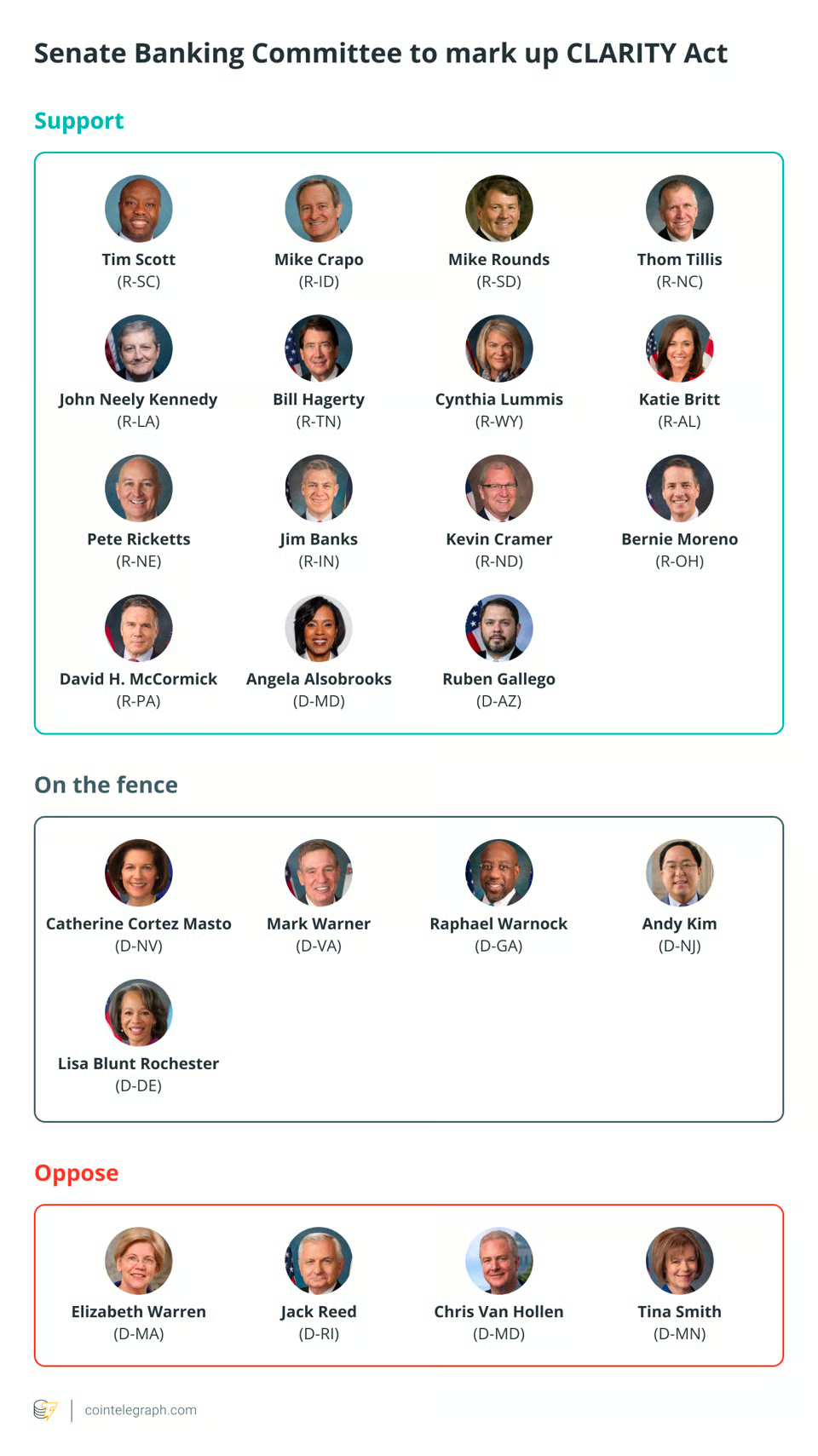
The CLARITY Act, the crypto lobby’s long-awaited regulatory framework, is finally headed to a markup session in the United States Senate Banking Committee.
It’s been a long road. The bill passed the House of Representatives on July 17, 2025, and has since been in deliberation in the Senate. Most recently, the crypto and banking lobbies were at loggerheads over whether stablecoins could offer interest, further delaying progress.
The two industry interest groups appear to have reached an agreement. However, this does not mean that the bill is finished. Indeed, far from it, as members could introduce contentious amendments, vote against reporting the bill to the Senate floor, or not produce a quorum.
With the vote set for May 14, here’s a quick look at who supports the bill on the Senate Banking Committee.

Supporters
Tim Scott (R-SC)

Source: US Senate
As Chairman of the Senate Banking Committee, Senator Scott has led the group’s work on CLARITY, stating his desire to make the US “the crypto capital of the world.”
He was also a cosponsor of the GENIUS Act regulating stablecoins, and voted for SAB 121, a resolution that made pro-crypto amendments to US banking standards.
Scott received an A grade from Coinbase’s crypto policy tracking site Stand With Crypto.
Mike Crapo (R-ID)

Source: US Senate
Senator Crapo supported the GENIUS Act, as well as SAB 121 and SJ Resolution 3. The latter was a Senate Resolution that disapproved of the Internal Revenue Service (IRS) requiring DeFi services to collect user data.
While supporting the crypto industry with his votes, in his statements, Crapo has noted the need to create regulations with some investor protections. In a February 2018 statement, he said, “Technology is forward-looking, and we look to our regulators to continue carrying out their mandates, including investor protection, as the markets evolve.”
Crapo received an A from Stand With Crypto.
Mike Rounds (R-SD)

Source: US Senate
In addition to many of his Republican colleagues, Senator Rounds voted for GENIUS, SAB 121, and SJ Resolution 3.
Amid the pro-crypto furor that followed US President Donald Trump entering office, Rounds harshly criticized former President Joe Biden’s administration on its approach to crypto.
As the banking and crypto lobbies debated CLARITY, Rounds called for open negotiations, saying the public must have a chance to see what’s going on. Rounds himself has violated federal transparency laws by failing to disclose stock trades.
Rounds received an A from Stand With Crypto.
Thom Tillis (R-NC)

Source: US Senate
Tillis voted yes on GENIUS, SAB 121 and SJ Resolution 3. He also supported the Equal Opportunity for all Investors Act which, if it had passed, would have expanded who could have been considered a qualified investor under US securities law.
He supported the Trump administration’s decision to allow 401(k) retirement plans to invest in cryptocurrencies
Tillis said that the current form of CLARITY, which prohibits stablecoin rewards from resembling interest on bank deposits, but allows other forms of rewards, “helps put us on a bipartisan path to pass the CLARITY Act.”
Tillis received an A from Stand With Crypto.
John Neely Kennedy (R-LA)

Source: US Senate
Kennedy has supported pro-crypto regulations in the Senate like GENIUS, SAB 121 and SJ Resolution 3.
In an October 2025 statement on the floor of the US Senate, Kennedy said that the market structure bill would be “one of the most important pieces of legislation that this body will consider.”
Kennedy received an A from Stand With Crypto.
Bill Hagerty (R-TN)

Source: Bill Hagerty
Senator Hagerty is very pro-crypto, introducing the GENIUS Act to the Senate as a co-sponser. He also co-sponsored SJ Resolution 3, voted for SAB 121, and co-sponsored the Capital Gains Inflation Relief Act of 2023. The latter proposed indexing tax of certain assets, like Bitcoin, to inflation to reduce capital gains taxes on long-term investments. It didn’t pass.
Hagerty has said on many occasions that CLARITY is needed to make American markets more competitive. “In the race to lead in digital assets, America’s markets are our competitive edge,” he said in April.
Hagerty received an A from Stand With Crypto.
Cynthia Lummis (R-WY)

Source: Cynthia Lummis
Senator Lummis has long been an advocate for the crypto industry in the United States. She co-sponsored GENIUS and sponsored the Blockchain Regulatory Certainty Act of 2026.
The latter would acknowledge that blockchain developers and infrastructure providers don’t have control over users’ digital assets, and therefore cannot be classified as money transmitters under federal law. It has been referred to the banking committee.
She has also sponsored a bill to create a “Mined in America” certification for Bitcoin miners. This would ostensibly encourage miners to locate in the US rather than set up compute infrastructure overseas.
Ahead of the markup sessions, she said, “After nearly a year of bipartisan work, this markup brings us one step closer to cementing America’s place as the global leader in financial innovation.”
Lummis received an A from Stand With Crypto.
Katie Britt (R-AL)

Source: US Senate
Senator Britt has supported several pro-crypto bills, voting for SAB 121, GENIUS and SJ Resolution 3.
Like many of her colleagues, Britt has made crypto regulation an issue of national competition. She wrote on X in 2021, “Supporting #Bitcoin means supporting personal freedom, American competitiveness and national security.”
Britt received an A from Stand With Crypto.
Pete Ricketts (R-NE)

Source: US Senate
Senator Ricketts has supported the GENIUS Act, SJ Resolution 3 as well as SAB 121. In regulating the cryptocurrency market, he said the goal was “making sure the digital asset market is both innovative and predictable.”
Ricketts received an A from Stand With Crypto.
Jim Banks (R-IN)

Source: US Senate
Senator Banks is a reliable pro-crypto vote on the Senate Banking Committee. He supported the GENIUS Act and cosponsored SJ Resolution 3.
He previously co-sponsored and voted for the CBDC Anti-Surveillance State Act and FIT21 in the House before moving to the Senate. The latter clarified jurisdiction over crypto, shifting it primarily from the SEC to the Commodity Futures Trading Commission (CFTC).
In a June 2024 X post, Banks said that Trump “is the best choice for Bitcoin,” signaling a broader alignment between his crypto views and the MAGA political coalition.
Banks received an A from Stand With Crypto.
Kevin Cramer (R-ND)

Source: US Senate
Senator Cramer voted for GENIUS, SJ Resolution 3 and the earlier SAB 121 resolution, building a consistently pro-crypto voting record.
He has vocally supported the CLARITY Act, and keeping America as a leader in the industry. He argued in a March 2026 Fox Business appearance that the US “cannot allow digital assets and digital industry to go overseas.”
Cramer received an A from Stand With Crypto.
Bernie Moreno (R-OH)

Source: US Senate
Senator Moreno is an outspoken crypto advocate, himself shifting into blockchain collectibles from a career in the automotive industry. He co-sponsored SJ Resolution 3 and voted for GENIUS.
On the campaign trail, he repeatedly attacked his predecessor, Democrat Sherrod Brown, as an “extremist” on crypto regulation, and once declared that “our Founding Fathers would have been bitcoiners.”
Since joining the Senate, Moreno has served on the Digital Assets Subcommittee and has been named by industry analysts as a likely early supporter of the CLARITY Act.
Moreno received an A from Stand With Crypto.
David H. McCormick (R-PA)

Source: David McCormick
Senator McCormick, the former CEO of Bridgewater Associates, has voted for GENIUS and SJ Resolution 3, and has personally invested over $1 million in a spot Bitcoin ETF since taking office.
In a 2024 op-ed, McCormick wrote that blockchain and crypto “offer America the chance to lead another generation of critical innovation” and warned that without regulatory clarity, the industry would develop and thrive elsewhere. He now sits on the Senate Banking Committee’s Digital Assets Subcommittee.
McCormick received an A from Stand With Crypto.
Angela Alsobrooks (D-MD)

Source: US Senate
Senator Alsobrooks voted for GENIUS at every stage and has supported SJ Resolution 3.
On CLARITY, she co-negotiated a compromise with Tillis on the question of stablecoin rewards, agreeing to the language that bars passive interest-like payments on stablecoins while preserving other forms of rewards.
Her spokesperson has also signaled that bipartisan ethics provisions are a prerequisite for her final support. Industry analysts classify her as “constructive/pro-framework.”
Alsobrooks received an A from Stand With Crypto.
Ruben Gallego (D-AZ)

Source: Ruben Gallego
Senator Gallego is the Ranking Member of the Senate Banking Committee’s Digital Assets Subcommittee. He voted for GENIUS at both cloture stages and on final passage, and voted for SJ Resolution 3 and the earlier FIT21 and SAB 121 measures in the House.
Galaxy Digital classifies him as “constructive/pro-framework” on CLARITY. However, Gallego has also joined colleagues in pressing the DOJ and Treasury to investigate Binance over alleged Iran-linked fund flows.
Gallego received an A from Stand With Crypto.
Opponents
Elizabeth Warren (D-MA)

Source: US Senate
Senator Warren is the Senate’s most prominent and prolific crypto skeptic, and has used her role as Ranking Member of the Banking Committee to lead Democratic opposition to major crypto legislation.
She voted against both cloture attempts on GENIUS and against its final passage, and sponsored the Digital Asset Anti-Money Laundering Act of 2023, which Stand With Crypto classified as “very anti-crypto.”
At a July 2025 committee hearing, Warren laid out priorities for any crypto market structure legislation, including closing anti-money laundering loopholes and barring public officials from profiting off crypto tokens.
On the CLARITY Act, she has called the legislation a “corruption superhighway” and urged colleagues not to pass any crypto bill without addressing presidential conflicts of interest.
Warren received an F from Stand With Crypto.
Jack Reed (D-RI)

Source: US Senate
Senator Reed has been a consistent skeptic of pro-crypto legislation, voting against both cloture votes and the final GENIUS Act passage in June 2025.
In a Senate floor statement, Reed called the bill “fundamentally flawed,” arguing it exposed taxpayers to crypto company bailouts and created venues for “criminals, terrorists, and rogue governments.”
He has also led bipartisan anti-money laundering efforts targeting DeFi, cosponsoring the CANSEE Act with Republican senators including Mike Rounds.
Reed received an F from Stand With Crypto.
Chris Van Hollen (D-MD)

Source: US Senate
Senator Van Hollen voted against GENIUS and is expected to oppose the CLARITY Act as well. He also voted against SAB 121, SJ Resolution 3. He co-sponsored a bill, the Digital Asset Anti-Money Laundering Act of 2023, that would make some crypto companies subject to the Bank Secrecy Act compliance regime.
He has co-signed multiple anti-crypto letters with Warren, including a 2023 letter to the DOJ requesting an investigation into Binance.
Van Hollen also co-sponsored the End Crypto Corruption Act, which would ban elected officials and their families from issuing or endorsing crypto assets.
Van Hollen received an F from Stand With Crypto.
Tina Smith (D-MN)

Source: US Senate
Senator Smith voted against GENIUS and is expected to oppose CLARITY. She has been a vocal critic of the legislation’s potential to enable presidential corruption, and in June 2025 posted that Republicans were “jamming through the GENIUS Act which will turbocharge Donald Trump’s crypto corruption.”
Smith has also raised concerns about allowing crypto and private equity into 401(k) retirement accounts, joining Warren in opposing a Trump executive order to that effect.
Smith received an F from Stand With Crypto.
On the fence
Catherine Cortez Masto (D-NV)

Source: US Senate
Senator Cortez Masto has carved out a complicated position on crypto, supporting consumer protection and anti-money laundering measures while ultimately voting for the GENIUS Act.
As a former Nevada attorney general, she has focused on closing loopholes exploited by drug cartels and terrorist organizations. She cosponsored Warren’s Digital Asset Anti-Money Laundering Act and pushed to ensure the GENIUS Act included stronger foreign issuer oversight.
After its passage, Cortez Masto said the law was “an important first step toward clarity and security” but added that “there is still more work to do to protect consumers and our national security.” Industry analysts at Galaxy Digital classify her as a “conditional dealmaker” on the CLARITY Act.
Cortez Masto has received an A from Stand With Crypto.
Mark Warner (D-VA)

Source: US Senate
Senator Warner has a more nuanced and at times industry-friendly approach than some of his Democratic colleagues. He voted for GENIUS at both cloture stages and on final passage, and voted for SJ Resolution 3, though he voted against the earlier SAB 121 resolution.
Warner has pushed for tax compliance and sanctions enforcement in the crypto space, co-introducing the Digital Asset Sanctions Compliance Enhancement Act in 2022 in the wake of Russia’s invasion of Ukraine. He also pushed back against overly broad regulations that would snare legitimate participants.
He serves on the Digital Assets Subcommittee and is seen by analysts as a “conditional dealmaker” on the CLARITY Act.
Warner has received an A from Stand With Crypto.
Raphael Warnock (D-GA)

Source: US Senate
Senator Warnock has a more neutral voting record on crypto legislation, initially voting against cloture on GENIUS, then eventually voting to support it.
“We’re already using these products. And so from a public policy point of view, one of the questions for me, is, what will leave the consumers in a better place? So we clearly need some kind of regulatory structure,” Warnock told NBC News.
He also has been a strong proponent for ethics and conflicts of interest clauses in crypto regulations, co-sponsoring the End Crypto Corruption Act targeting.
Industry analysts classify him as a “conditional dealmaker” on CLARITY.
Warnock has received a C from Stand With Crypto.
Andy Kim (D-NJ)

Source: US Senate
Like Warnock, Kim initially voted against cloture for GENIUS before eventually voting to pass it. He supported SJ Resolution 3 and also voted for FIT21.
Senator Kim, who is the newest Democrat on the Banking Committee, is categorized by Galaxy Digital as a conditional dealmaker on CLARITY, as he is willing to support a framework but attentive to anti-money laundering and consumer protection controls.
He cosponsored the End Crypto Corruption Act and joined colleagues in pressing the DOJ and Treasury to investigate Binance over alleged Iran-linked funds.
Kim has received a C from Stand With Crypto.
Lisa Blunt Rochester (D-DE)

Source: US Senate
As a House member, Blunt Rochester voted for SAB 121 and supported several pro-crypto measures. But she voted against final passage of the GENIUS Act as a senator, making her the outlier among the Democrats who had supported its earlier procedural stages.
Industry analysts at Galaxy Digital labeled her “mixed,” and she is seen as a potential swing vote on CLARITY depending on the strength of ethics and illicit finance provisions added to the bill. She cosponsored the End Crypto Corruption Act.
Blunt Rochester has received a D from Stand With Crypto.
US lawmakers in the Senate Banking Committee held a markup for a long-awaited crypto market structure bill, marking a pivotal step toward Congress’ effort to establish regulatory clarity for digital asset companies and markets.
In a Thursday session of the US Senate Banking Committee, all 13 Republican members and two Democrats voted to advance the Digital Asset Market Clarity Act (CLARITY), with nine Democrats also voting no on the bill.
Senators Ruben Gallego and Angela Alsobrooks sided with Republicans to vote yay. The vote came after lawmakers proposed more than 100 amendments to the crypto bill, ranging from provisions on stablecoin yield to ethics restrictions.
In opening statements before the vote, committee chair Tim Scott said that the bill was focused on protecting consumers, keeping innovation in the US, and safeguarding national security in regards to digital assets.
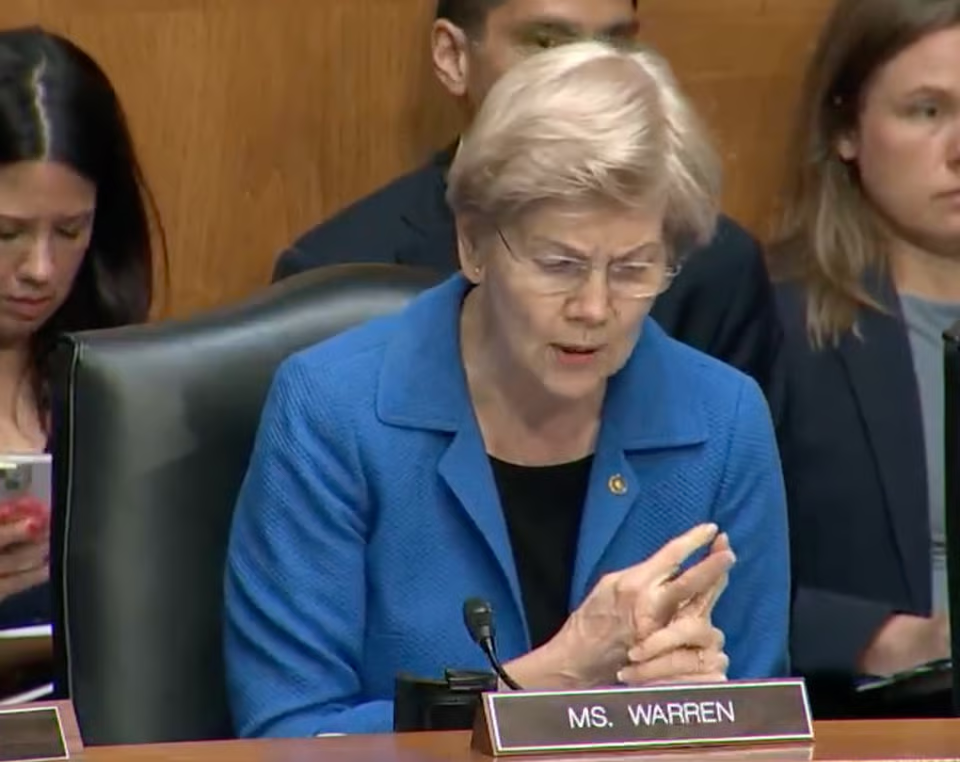
Ranking member Elizabeth Warren said that the bill was “written by the crypto industry for the crypto industry,” adding that it would allow Republican lawmakers to “grease the skids” for US President Donald Trump’s “crypto grift.” “Nothing made it into this bill that wasn’t approved by the crypto industry,” said Warren.

Senator Elizabeth Warren addressing lawmakers at the Thursday markup. Source: US Senate Banking Committee
Senator Cynthia Lummis, one of the legislation’s chief Republican advocates, pushed back against many of Warren’s concerns, saying CLARITY was a “pro law enforcement” and “pro consumer” bill.
Senator Jack Reed, a Democrat, said that the bill was not an example of bipartisan work, given that Scott had “arbitrarily” dismissed consideration of amendments Democrats had proposed.
Related: Ethics remain sticking point as crypto market structure bill goes to markup
With the advancement of CLARITY in the banking and agriculture committees to address laws and regulations in the Securities and Exchange Commission (SEC) and Commodity Futures Trading Commission (CFTC), respectively, the bill is expected to head for a floor vote in the Senate soon.
The bill will need 60 votes to pass. the Senate. The US House of Representatives will then need to approve the amended legislation.
“I think it’s so difficult to get Senate floor time, and if they get something through the Senate that has the votes, I think the House will probably pass that identical language, and then it will be able to go on to the president’s desk for a signature,” Solana Policy Institute President Kristin Smith told Cointelegraph before the markup.
Several amendments were debated and dismissed at markup
Many of the amendments proposed at markup were either adopted or failed along partisan lines, addressing different aspects of regulating the crypto industry.
Among those considered at markup included provisions on sandboxes for AI by Scott and ones on “tokenization loopholes” and money laundering by Warren, who cited reports that Iran was collecting tolls in crypto for ships using the Strait of Hormuz and otherwise evading sanctions.
Lummis said that CLARITY would address the regulation of crypto mixers in response to Warren’s proposed amendment. Scott’s amendment was included, while Warren’s failed.

Senator Cynthia Lummis addresses the Senate Banking Committee. Source: US Senate Banking Committee
Another amendment by Warren included a demand for US banking regulators to report on information related to deceased sex offender Jeffrey Epstein, whom she described as an “early backer of crypto.”
Lummis said the provision was not related to digital assets and should not be included. Lawmakers voted along party lines, and the amendment failed to pass. Republicans also voted against amendments proposed by Reed on stablecoins and digital dollars.
Senator Catherine Cortez Masto, a Democrat who expressed general support for the CLARITY Act at the markup, introduced an amendment that would give law enforcement more authority over crypto-related cases. The amendment failed along party lines.
Democratic Senator Tina Smith proposed an amendment to prohibit federal agencies from bailing out crypto companies if another market crash were to occur. Calling it a “preventative measure” in response to volatility in the crypto markets, Smith and all Democrats voted in favor of the amendment, which failed along party lines.
Ethics still a concern for Democrats
The committee also considered an amendment from Democratic Senator Chris Van Hollen over Trump’s potential conflicts of interest with the crypto industry through his family’s World Liberty Financial business and memecoins.
Republican Senator Bernie Moreno and Scott defended the president, accusing Van Hollen of “ad hominem” attacks. All 13 Republicans voted against the provision.
“The people involved directly in making these policies, from the president to the Congress, should not be able to be issuers of these particular assets and coins,” said Van Hollen.
Senator Raphael Warnock withdrew an amendment in response to what he called “pure corruption” by the Trump administration, adding that he would not support any bill without these carveouts.
Warren echoed these concerns in a separate amendment, which would continue to fund the Consumer Financial Protection Bureau in response to the administration’s attempt to shutter the agency since 2025.
Magazine: eToro founder timed Bitcoin top perfectly due to belief in 4 year cycles

In a developing thread at the intersection of politics and crypto money, United Kingdom politician Nigel Farage and his Reform Party are under scrutiny after Farage received a 5 million pound gift from crypto financier Christopher Harborne. Less than two months later, Farage closed on a 1.4 million pound property—purchased in May 2024, before public campaigning for the general election intensified, Sky News reported. The arrangement has since triggered a parliamentary probe into whether the gift should have been declared and registered after Farage took office.
The Reform Party contends that the gift, received prior to Farage entering parliament, falls outside the reporting requirements now being debated in political circles. Farage himself has said the transfer was completed before he assumed office, and therefore not subject to the stricter post-office disclosure rules that govern political donations in the UK. The party has signaled it will contest attempts to curb crypto-driven political donations, framing the debate as an erosion of political freedoms in the name of regulation.
Key takeaways
- Nigel Farage’s team disclosed a 1.4 million pound property purchase completed in May 2024, following a 5 million pound gift from crypto billionaire Christopher Harborne.
- The gift is at the center of a UK parliamentary probe, with critics arguing it should have been disclosed after Farage entered office; the Reform Party claims the gift predates official duties and falls outside reporting rules.
- Britain’s political establishment has been intensifying its stance on crypto donations, with lawmakers calling for bans or moratoria as concerns about ethics and foreign influence grow.
- In early 2025, Matt Western, chair of the Joint Committee on the National Security Strategy, urged a temporary ban on crypto donations to political parties and figures, citing national security considerations.
- The government has advanced a legislative proposal to temporarily ban political crypto donations, but the measure still requires passage through Parliament and assent from the Crown before becoming law.
Regulatory momentum tightens around crypto funding
The episode surrounding Farage arrives amid mounting scrutiny of crypto-related political giving in the UK. Critics argue that crypto gifts introduce opacity into political fundraising and raise the risk of foreign influence or other ethical concerns influencing elections. In February 2025, Matt Western, who chairs the Joint Committee on the National Security Strategy, urged lawmakers to consider a temporary ban on crypto donations to parties and political figures. He framed the move as a precautionary step as the security landscape evolves and the UK’s role on the world stage grows more complex, noting that the value of political influence could increase in areas such as Ukraine policy or transatlantic relations.
The government responded with a legislative proposal in March aimed at temporarily banning crypto donations to political actors. While this reflects a clear policy stance, the proposal still requires approval from both Houses of Parliament and the king’s assent to become law. Prime Minister Keir Starmer has pledged decisive action to safeguard democratic processes, emphasizing the need to close any gaps that crypto financing might exploit.
The conversation around crypto donations is not limited to Farage’s case. Related reporting and commentary have highlighted broader tensions between political fundraising integrity and the growing availability of crypto funding. The debate encompasses questions about disclosure thresholds, the timing of gifts, and the appropriate oversight mechanisms to prevent misuse without chilling legitimate political participation.
Implications for voters, donors, and the industry
For investors and builders in the crypto ecosystem, the evolving UK stance on political donations signals a broader shift toward tighter accountability and transparency. If lawmakers move forward with temporary bans or stricter reporting requirements, crypto donors could face a more predictable regulatory environment, but with new compliance costs and potential reputational risks for participants and platforms involved in political giving. The Farage case illustrates how even high-profile figures can become flashpoints in a wider policy shift that could reshape how crypto-derived money flows into politics.
From a market and ecosystem perspective, the trajectory of UK policy could influence other jurisdictions observing the UK’s approach to crypto fundraising, political integrity, and national security implications. The balance between safeguarding democratic processes and maintaining an open political system that allows diverse funding sources remains delicate, particularly as political actors weigh the strategic value of crypto partnerships and endorsements.
Context, uncertainties, and what to watch next
At present, the core questions revolve around timing, disclosure, and enforcement. If the parliamentary probe concludes that the 5 million pound gift required registration, Farage and his party may face renewed calls for stricter compliance measures, while proponents of crypto donations could push back against regulatory overreach. The legislative process will determine whether a temporary ban on crypto political donations becomes formal policy, and whether any exceptions or grandfathering apply to gifts already in motion before the ruling.
Observers should watch for developments in two areas: the outcome of the parliamentary probe into the Harborne gift and Farage’s property transaction, and the progress of the government’s temporary ban proposal as it navigates debates in both chambers and the constitutional steps required for enactment. These threads will shape how crypto-funded political activity is perceived and regulated going forward.
The broader lesson for readers is clear: as crypto money intersects more directly with political power, transparency, timing, and accountability will define the boundaries of permissible fundraising and the political viability of crypto-centric donors and campaigns.
What happens next in the UK’s regulatory debate over crypto donations will shape both political strategy and investor sentiment. Keep an eye on parliamentary updates and any new disclosures related to high-profile gifts in the months ahead.

TLDR:
- Sonic’s VI model generated $13,000 in revenue, converting to 295,454.55 S in deflationary equivalent since March 1.
- Total fee-related burns reached only 59,786.728 S, putting VI impact at roughly 4.94 times the burn amount.
- Early VI revenue came solely from USSD and Metropolis vault activity, with the broader model yet to scale.
- Sonic Labs confirmed the full VI model has barely started, with more product revenue lines still ahead.
Sonic Labs has reported that its Vertical Integration model is generating measurable deflationary results just weeks after launch.
Since March 1, 2026, early VI revenue has produced roughly 400% more deflationary impact than fee-related burns over the same period.
The data comes from a narrow set of products, with the broader model yet to scale. These early numbers offer a concrete look at how the network plans to capture value beyond gas fees.
Early VI Numbers Show a Clear Lead Over Fee Burns
Sonic’s VI model generated $13,000 in revenue between March 1 and May 11, 2026. Using a TWAP price of $0.044, that converts to 295,454.55 S in deflationary equivalent.
Over the same window, total fee-related burns reached only 59,786.728 S. That figure includes 10,358.726 S from direct transaction fee burns and 49,428.002 S from FeeM-related returns that were burned.
Sonic Labs captured the early result on X, saying, “Sonic’s Vertical Integration is outperforming expectations right out of the gate. In the first 10 weeks, early VI revenue produced ~400% more deflationary impact than fee-related burns over the same window.”
The team also noted the scope of the current implementation, adding, “This is only from $USSD and @MetropolisDEX vault activity. The full VI model has barely started.”
No other revenue lines were contributing during this window, making the ratio more telling given how limited the setup remains.
Total transaction fees for the period were 207,174.525 S. The network splits fees as 90% to the FeeM Treasury, 5% to validators, and 5% to burn.
FeeM also returned 98,856.004 S, split evenly between rewards and burns during the same block range. The ratio puts VI impact at roughly 4.94 times the total fee-related burn amount.
The Case for Product Revenue Over Gas-Based Value Capture
High-throughput chains are built to keep execution costs low. As gas fees fall, fee-burn models produce less deflationary pressure on the native asset.
Sonic’s VI thesis addresses this by sourcing revenue from native financial products instead of relying on transaction pricing alone.
The network still burns a portion of transaction fees. However, the early data shows that product-level revenue can outpace that burn by a wide margin, even in a minimal setup. Users continue to benefit from cheap execution while aligned products contribute back to the network economy.
Sonic Labs described this as a proof of concept rather than a mature revenue base. The $13,000 figure is not presented as a major milestone but as early confirmation that the mechanism works as intended.
As the team stated, “If this is possible with a narrow implementation, the model becomes more interesting as more product surfaces begin contributing revenue.”
More product surfaces are expected to contribute revenue as the full VI model rolls out. The current result reflects only what a narrow, early version of the system can produce.
Additional revenue lines remain ahead, and the team views this first data point as a signal of the model’s direction.


20-Store Surplus Food Trial to Save 11.9m Meals
Shiba Inu (SHIB) Collapses 60% in a Year: 3 AIs Reveal What Might Trigger a Big Revival

Why Are Off Campus Fans Crying Over Beau? Book Arc Explained

Manchester United reach agreement with Casemiro over contract clause amid transfer speculation

US brings back mandatory military draft registration

Steven Gerrard disagrees with Gary Neville over ‘shock’ Chelsea and Arsenal claim | Football

#yoga #yogalife #yogamusic #cryptocurrency #bollywood #funny #funny #stitch #dance #duet #love

Crypto Wallet Hunter App comment ‘apk’#software#foryou#crypto#btc#cryptocurrency#foryoupage #foryou

Socios.com Is This the Future of Fan Engagement #cryptocurrency #crypto
-
 Crypto World7 days ago
HarrisX Poll Found 52% of Registered Voters Support the CLARITY Act
-

 Fashion6 days ago
Weekend Open Thread: Marianne Dress
-

 Fashion3 days ago
Coffee Break: Travel Steam Iron
-

 Fashion4 days ago
What to Know Before Buying a Curling Wand or Curling Iron
-

 Tech5 days ago
Auto Enthusiast Carves Functional Two-Stroke Engine from Solid Metal
-

 Politics3 days ago
What to expect when you’re expecting a budget
-
 Business6 days ago
Ignore market noise, India’s long-term story intact, say D-Street bulls Ramesh Damani and Sunil Singhania
-

 Politics6 days ago
Politics Home Article | Starmer Enters The Danger Zone
-

 Tech4 days ago
GM Agrees To Pay $12.75 Million To Settle California Lawsuit Over Misuse Of Customers’ Driving Data
-

 Crypto World6 days ago
PROS explodes 48% as Upbit and Bithumb listings ignite demand
-

 Crypto World5 days ago
CZ says US crypto rivals tried to block Trump pardon
-

 Tech3 days ago
GM agrees to $12.75M California settlement over sale of drivers’ data
-

 Sports7 days ago
Bayern Munich vs PSG UEFA Champions League SF2 live match time, streaming | Football News
-

 Entertainment6 days ago
YNW Melly Denied Bond Again Ahead Of Double Murder Retrial
-
Tech7 days ago
The Most Exciting Apple Products In The Pipeline For 2026 And Beyond
-
Crypto World6 days ago
The Hantavirus Danger: Can a Potential Outbreak Spark a New Meme Coin Frenzy?
-

 Crypto World6 days ago
Kraken Parent Seeks OCC Charter, Signaling Regulated Banking Access
-

 Politics7 days ago
David Attenborough ‘Overwhelmed’ By Love Shown Ahead Of 100th Birthday
-

 Sports6 days ago
After Waka Waka, Shakira now drops first teaser for FIFA WC 2026 song | FIFA World Cup 2022
-

 Crypto World7 days ago
Here’s Why Cristiano Ronaldo and Taylor Swift Lost Millions of Followers on Instagram
You must be logged in to post a comment Login