
Crypto World
Designing and Making the Future List


Of the inaugural list, TIME editors write: “Our inaugural TIME Trailblazers list recognizes those leaders who, across the world, are designing and making the future…This is a world full of potential, promise, and problems to solve. This is a world that is still being built. These 14 Trailblazers are standout examples of the many committed to building it.” Read more here.
TIME’S 2026 ‘TRAILBLAZERS: DESIGNING AND MAKING THE FUTURE’ LIST INCLUDES:
Alex Athenson, Co-founder of the Foothill Catalog Foundation
Alex Honnold, Founder of the Honnold Foundation
Bjarke Ingels, Founder and creative director, Bjarke Ingels Group
Cynthia Sigler, Co-founder of the Foothill Catalog Foundation
Eloy van Hal, Founder of The Hogewyk
Erika Woolsey, Chief scientist and CEO of The Hydrous
Jason Ballard, CEO at ICON
Kaushik Kappagantulu, CEO of Kheyti
Mike Schultz, Founder and CEO of Biodapt
Saket Soni, Founder and Executive Director of Resilience Force

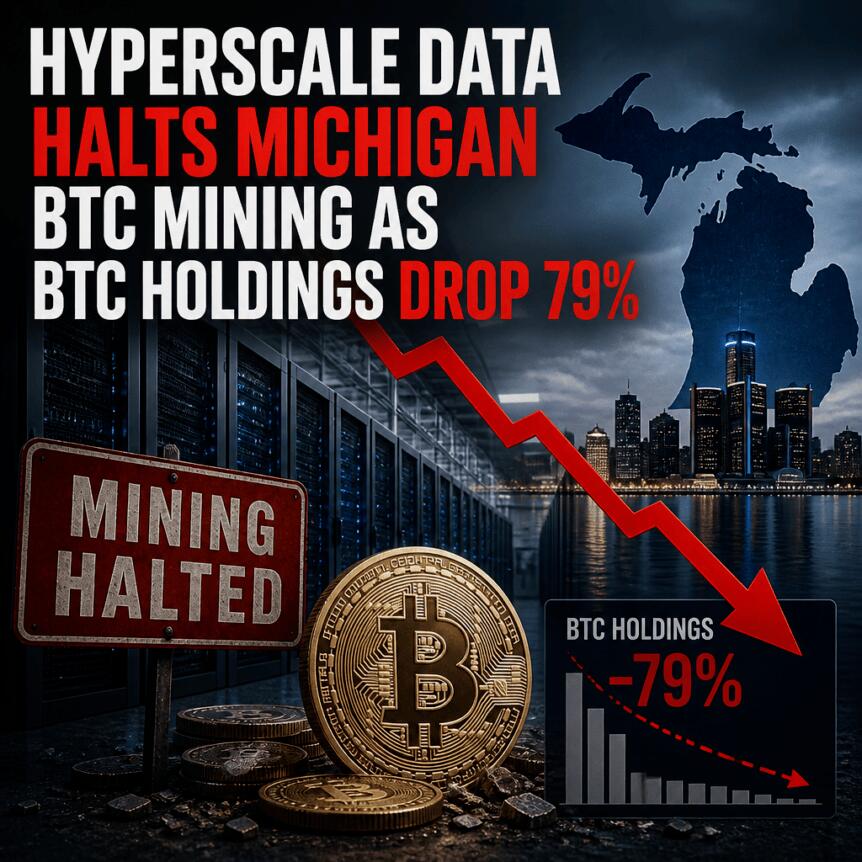
Hyperscale Data has shut down all Bitcoin mining at its Michigan facility as it moves forward with plans to repurpose the site for an artificial intelligence (AI) data center customer. The company said the change follows an inspection tied to the customer’s requirements, and it plans to sell the mining hardware once the transition is complete.
In the same period, Hyperscale has also been drawing down its Bitcoin holdings to fund the buildout. Shares, meanwhile, slid to a record-low level on Wednesday after a recent reverse stock split.
Key takeaways
- Hyperscale Data ended Bitcoin mining at its Michigan site to fulfill requirements for an AI data center agreement.
- The company said miners were switched off after an inspection by an unnamed California-based neocloud provider.
- Hyperscale expects the AI master services agreement to generate more than $1.2 billion over up to 20 years, with upside if additional capacity is taken.
- The firm cautioned that expansion economics depend on financing, approvals, and the customer exercising extension and capacity options.
- Hyperscale shares fell sharply to a split-adjusted record low following a one-for-five reverse split that became effective Aug. 25.
From mining to AI compute at the Michigan campus
Hyperscale Data said Wednesday that it has ceased Bitcoin mining operations at its Michigan facility and switched off all miners. The company tied the step to an inspection conducted for its AI data center master services agreement requirements, with the inspection carried out by an unnamed California-based neocloud provider, as described in its statement carried by PR Newswire.
According to Hyperscale, the firm intends to sell the mining equipment associated with the facility’s halted operations. The shutdown is part of a broader shift in which Hyperscale is converting the Michigan site from a mining-focused setup into AI infrastructure. It also indicated that the AI effort is being funded through proceeds from Bitcoin activity under its “Bitcoin treasury.”
The AI master services agreement: capacity, term, and revenue range
Hyperscale said the AI customer has contracted for 20 megawatts (MW) of computing capacity under a 10-year master services agreement. The deal includes two optional five-year extensions, giving the arrangement a possible 20-year maximum term.
In its estimate, Hyperscale projected that the agreement could generate more than $1.2 billion over the maximum 20-year period. The company also said an additional 32 MW option could push the potential revenue above $3 billion. On the infrastructure side, Hyperscale stated the facility is expected to support up to 340 MW, leaving room for scaling beyond the initial contracted capacity.
Importantly, Hyperscale emphasized that its expansion plans remain preliminary. The company said realized revenue figures depend on multiple conditions—specifically financing, approvals, and other risks that could affect how the project progresses. In addition, it noted that the $1.2 billion estimate assumes the customer exercises both extension options, while the higher $3 billion scenario requires the customer to take the additional capacity option.
Stock slump follows reverse split as Bitcoin holdings shrink
Alongside the operational shift, Hyperscale’s equity performance reflected investor skepticism about the pace and certainty of the AI transition. According to Yahoo Finance data, the company’s shares closed at $0.1984 on Wednesday, down about 17%, after trading as low as $0.1932 intraday. The close marked a split-adjusted record low for the NYSE American-listed stock.
Hyperscale’s decline came shortly after it completed a one-for-five reverse stock split. The SEC filing referenced in the report indicates the split-adjusted shares began trading on Aug. 25.
Hyperscale has also reduced its Bitcoin holdings while funding the Michigan buildout. Earlier coverage noted that as of July 30, the company held about 1,006 Bitcoin and had sold 100 BTC, while arranging a BTC-backed credit facility for the Michigan campus (as described in prior reporting on Cointelegraph).
More recently, Hyperscale said in a PR Newswire update that it sold about 65 BTC for roughly $5.1 million during the week ending Aug. 30, with proceeds intended to provide additional capital for the Michigan development. BitcoinTreasuries.NET now lists Hyperscale as holding 215 BTC, worth about $16.7 million—down roughly 79% from the amount cited in July, according to the listing.
Why the mining shutdown matters for investors
The immediate takeaway for shareholders is the tradeoff Hyperscale is making between steady-state mining revenue and long-duration AI infrastructure economics. By switching off mining and directing resources toward compute services, the company is effectively betting that contracted AI capacity will provide a more valuable path forward than ongoing Bitcoin production.
However, the company’s own revenue range highlights the uncertainty embedded in that bet. Hyperscale’s estimates are conditional on customer decisions (exercising extensions and taking additional MW capacity) and on execution factors such as financing and approvals. That means the timeline and realized profitability of the AI transition may diverge from the optimistic projections depending on how those conditions play out.
Meanwhile, the stock’s reaction following the reverse split underscores that investors are watching not only the operational shift but also whether the company can translate Bitcoin-treasury wind-downs into credible, funded, and approved construction milestones.
Going forward, market participants will likely focus on whether Hyperscale can convert its contracted 20 MW into the full extension and additional-capacity scenarios it cited—and whether financing and permitting stay on track, especially as Bitcoin holdings continue to fall in support of the AI buildout.


Backpack US appointed Multicoin Capital cofounder Kyle Samani to its board of directors on Sept. 2 as the company expands its regulated financial services in the United States.
Summary
- Backpack US appointed Multicoin Capital cofounder Kyle Samani to its board of directors on Wednesday.
- Samani stepped back from Multicoin in February while retaining an advisory relationship with the firm.
- He remains chairman of Forward Industries, a publicly traded company pursuing a Solana treasury strategy.
- Backpack says the appointment will support its expansion across regulated U.S. and onchain financial markets.
- Backpack reports serving users across 150 countries and processing more than $450 billion in volume.
Samani is an early Solana investor and a longtime supporter of blockchain based capital markets. He stepped back from managing Multicoin Capital in February 2026 but retained an advisory relationship with the venture firm.
The appointment gives Samani a governance role at Backpack US rather than an executive position. Backpack did not disclose his term, compensation, committee assignments or specific responsibilities.
Backpack CEO Armani Ferrante said Samani’s experience with decentralized networks and crypto regulation made him a suitable adviser. Ferrante said Samani understands the company’s plan to connect traditional financial markets with blockchain infrastructure.
Samani brings Solana and venture capital experience
Samani cofounded Multicoin Capital in 2017 and helped establish the firm as an early institutional investor in Solana. Multicoin has also backed projects focused on decentralized finance, blockchain infrastructure and crypto trading.
Samani announced his departure from Multicoin’s daily management in February. He said he planned to explore other areas of technology while continuing to advise the firm.
He also remains chairman of Forward Industries, a publicly traded company pursuing a Solana treasury strategy. Forward adopted the strategy after completing a $1.65 billion private placement led by Multicoin, Galaxy Digital and Jump Crypto in 2025.
The strategy is designed to increase the company’s exposure to SOL and expand its SOL holdings per share. Those objectives are corporate targets rather than guaranteed results.
Samani’s Forward Industries position gives him experience overseeing a public company with a digital asset treasury. It also connects him closely to the Solana ecosystem, which remains central to several Backpack products.
Backpack did not explain how it would address potential conflicts involving Samani’s roles at Forward and Multicoin. The company also did not disclose whether he would be excluded from decisions involving Multicoin portfolio companies.
Backpack US focuses on regulated financial products
Backpack describes itself as a financial services group connecting crypto markets with traditional finance. Its products include a crypto exchange, a self custody wallet and Backpack Securities.
The company says Backpack Securities combines a regulated brokerage with a tokenization platform. Its stated objective is to provide access to conventional securities and blockchain based asset distribution within one product environment.
Backpack did not identify the U.S. licenses held by each group entity in its appointment announcement. It also did not provide registration numbers or explain which entity would handle brokerage, custody, tokenization and trade execution.
Companies providing securities brokerage services in the United States generally must register with the Securities and Exchange Commission and become members of the Financial Industry Regulatory Authority unless an exemption applies. Specific registrations should therefore be confirmed against official regulatory records as Backpack expands its services.
The company has already followed a regulated expansion strategy in Europe. Backpack acquired FTX EU and assumed responsibility for returning funds to eligible former customers. The company later addressed questions surrounding its purchase of FTX EU.
Backpack subsequently launched its European exchange through a Cyprus based entity operating under the Markets in Financial Instruments Directive framework. That expansion gave the company a regulated route for offering crypto derivatives to eligible European customers.
Equity trading supports Backpack’s broader strategy
Backpack said Samani’s appointment followed the launch of continuous trading for several equity products. It named SpaceX, Micron, SanDisk and SK Hynix among the assets available through its services.
The company described its offering as trading in “real” equities alongside a growing range of tokenized stocks. However, the announcement did not provide a complete explanation of the execution venues, custody structure, settlement system or shareholder rights attached to each product.
Those distinctions matter because traditional shares, tokenized shares and price tracking instruments do not always provide identical rights. Depending on the structure, investors may not receive direct voting rights, dividend claims or ownership of the underlying security.
Other crypto platforms are developing similar services. Kraken recently introduced more than 7,000 traditional U.S. stocks for eligible European customers alongside its tokenized xStocks products.
Kraken has also allowed eligible traders to use certain tokenized stocks as collateral for futures and margin positions. The development reflects growing competition among crypto companies seeking to combine securities exposure with blockchain based trading systems.
Samani said the future of capital markets involves combining “institutional risk controls with onchain efficiency and transparency.” His comment represents his assessment of the market’s direction, not a confirmed outcome for Backpack’s products.
Board appointments support Backpack’s U.S. expansion
Samani joins a board that also includes former acting SEC chairman Michael Piwowar, whom Backpack appointed earlier in 2026. The appointments add venture capital, public company and securities regulation experience to Backpack’s governance structure.
Backpack said its leadership additions would support the creation of regulated infrastructure connecting traditional and digital assets. It has not announced new product approvals or regulatory licenses resulting from Samani’s appointment.
The company reports serving customers in more than 150 countries and regions and processing over $450 billion in trading volume. These figures come from Backpack and were not accompanied by an independently audited breakdown in the board announcement.
Backpack has not provided a fixed schedule for expanding its U.S. equity or tokenized asset services. It also has not disclosed whether Samani’s appointment is connected to a specific product launch, acquisition or licensing application.
The next relevant updates will involve Backpack’s U.S. registrations, customer eligibility rules and product structure. Further disclosures may clarify which entities handle securities execution, custody and token issuance.
Until then, the appointment represents a governance step supporting Backpack’s stated U.S. strategy. It does not by itself confirm regulatory clearance for additional securities or tokenized asset products.


Hyperscale Data stopped all Bitcoin mining operations at its Michigan facility on Sept. 1 as it began preparing the site for an artificial intelligence computing customer.
Summary
- Hyperscale Data stopped all Bitcoin mining at its Michigan facility effective September 1, 2026, completely.
- Company plans to sell mining equipment while preparing the site for AI computing operations now.
- Bitcoin holdings fell about 79% from 1,006 BTC in July to approximately 215 BTC recently.
- Customer contracted 20 MW for ten years with two optional five year extensions available later.
- GPUS shares closed Wednesday at $0.1984, falling 17% after reaching a record intraday low earlier.
The company switched off the facility’s mining equipment after an inspection by an unnamed California based neocloud provider, according to a Sept. 2 announcement. Hyperscale intends to sell the servers previously used to mine Bitcoin.
The shutdown completes the first operational step in converting the Michigan property from a Bitcoin mine into an AI data center. Hyperscale has also sold most of its Bitcoin treasury to provide capital for the project.
Its holdings have fallen approximately 79% from about 1,006 BTC on July 30 to 215 BTC at the end of August. The remaining Bitcoin was worth approximately $16.7 million when the company published its latest treasury update.
Hyperscale Data redirects Michigan power toward AI
Hyperscale said its customer contracted for 20 megawatts of critical AI computing capacity under a master services agreement. The initial term runs for 10 years and includes two optional five year extensions controlled by the customer.
The company estimates that the contract could produce more than $1.2 billion in revenue over 20 years. However, that figure assumes the customer exercises both extension options. It is not guaranteed revenue under the initial contract term.
The customer also has an option to take another 32 MW of computing capacity. Hyperscale estimates that total revenue could exceed $3 billion if the customer exercises that option within two years and retains the capacity through both extensions.
The larger projection therefore depends on several future decisions by the customer. Hyperscale has not disclosed the contracted revenue expected from the initial 10 year term alone.
Hyperscale said the Michigan facility could eventually support approximately 340 MW of power. A full 52 MW deployment under the current agreement would consume about 20% of that expected capacity, leaving the remainder available for other customers.
The 340 MW target remains a development plan. The company cautioned that the additional capacity depends on financing, engineering work, power availability, approvals and commercial demand.
Bitcoin treasury sales help finance construction
Hyperscale has reduced its Bitcoin treasury as it redirects money toward engineering, equipment procurement and other costs at the Michigan facility.
The company reported selling approximately 65 BTC for $5.1 million during the week ending Aug. 30. It said the proceeds would provide additional capital for the data center project.
The sales left Hyperscale holding approximately 215 BTC. BitcoinTreasuries.NET ranks the company 84th among the public businesses tracked by its database.
Hyperscale held approximately 1,006 BTC in late July, meaning it disposed of about 791 BTC within roughly one month. The company has not published one consolidated breakdown showing the price and proceeds for every sale during that period.
Its decision reflects a broader shift among Bitcoin miners seeking to use existing power connections and data center infrastructure for AI computing. Recent coverage noted that miners are redirecting infrastructure toward AI as demand for high performance computing capacity grows.
Bitcoin mining and AI workloads both require access to power, cooling equipment and data center buildings. However, converting a mining site does not automatically make it suitable for AI customers, which can require different networking, backup systems and computing infrastructure.
Mining equipment will be sold after the shutdown
Hyperscale said it expects to record additional gains from selling the Bitcoin mining servers removed from the Michigan operation. It has not disclosed the number of machines, their models, book value or expected sale proceeds.
The value of mining equipment can depend on Bitcoin prices, network difficulty, energy efficiency and demand from other operators. The company’s expectation of gains remains forward looking until the equipment is sold and the final proceeds are recorded.
The shutdown applies specifically to Hyperscale’s Michigan facility. The announcement did not say that the company had ended every Bitcoin related activity across the wider corporate group.
Hyperscale also continues to hold Bitcoin through its treasury. Its longer term corporate plan calls for separating Ault Capital Group through a divestiture expected in 2027, after which Hyperscale would focus on data center operations and digital asset holdings.
The divestiture remains subject to the exchange process involving the company’s Series F preferred stock. Only investors who surrender those shares under the planned offer would receive shares in Ault Capital Group.
Hyperscale Data stock falls after reverse split
Hyperscale Data shares closed at $0.1984 on Sept. 2, falling about 17% during the session. The stock traded as low as $0.1932 and reached an intraday high of $0.3012, according to market data.
The closing price represented a split adjusted record low. Trading volume exceeded 117 million shares, considerably increasing activity around the announcement.
GPUS began trading on a split adjusted basis on Aug. 25 after Hyperscale completed a one for five reverse stock split. The company confirmed the effective date through an SEC filing.
A reverse split reduces the number of shares outstanding while proportionally increasing the price assigned to each share. It does not by itself increase the company’s total market value.
CEO William Horne said he believed shareholders would benefit as the Michigan conversion advances and Hyperscale’s market valuation moves closer to those of other data center companies. This is management’s expectation and is not assured.
The next measurable milestones will include preparing the initial 20 MW for the customer, selling the mining equipment and disclosing revenue under the initial contract term. Investors will also need updates on construction costs, financing and the timing of capacity deployment.


Hyperscale Data has ended all Bitcoin mining operations at its Michigan facility as it prepares the site for an artificial intelligence data center customer.
On Wednesday, the company said that all Bitcoin miners at the facility were switched off following an inspection by the unnamed California-based neocloud provider. Hyperscale said it intends to sell the associated mining equipment.
Hyperscale said the customer has contracted for 20 megawatts (MW) of AI computing capacity under a 10-year master services agreement with two optional five-year extensions. The company estimated that the agreement would generate more than $1.2 billion over the maximum 20-year term. An additional 32 MW option could lift potential revenue above $3 billion, while the site is expected to support 340 MW.
The shutdown marks a further step in Hyperscale’s conversion of its Michigan facility from Bitcoin mining to AI infrastructure, a project it is also funding through sales from its Bitcoin treasury.
Hyperscale also cautioned that its expansion plans remain preliminary and subject to financing, approvals and other risks. The $1.2 billion estimate requires the customer to exercise both extension options, while the $3 billion projection also depends on it taking the additional capacity.
Hyperscale Data stock slides to record low
According to Yahoo Finance data, Hyperscale Data shares closed at $0.1984 on Wednesday, down about 17%, after touching an intraday low of $0.1932. The closing price marked a split-adjusted record low for the NYSE American-listed stock.
The decline came shortly after Hyperscale completed a one-for-five reverse stock split. Its shares began trading on a split-adjusted basis on Aug. 25, according to a filing with the US Securities and Exchange Commission.
Related: Bitcoin ETFs notch best month of 2026 as BTC gains 25% in August
Hyperscale has also reduced its Bitcoin holdings sharply while funding the AI buildout. On July 30, the company held about 1,006 Bitcoin and had sold 100 BTC while arranging a BTC-backed credit facility for the Michigan campus.
On Tuesday, the company said that it sold about 65 BTC for $5.1 million during the week ending Aug. 30. Hyperscale said the proceeds would provide additional capital for the Michigan development.
BitcoinTreasuries.NET now lists Hyperscale as holding 215 BTC, worth about $16.7 million. This represents a decline of about 79% from the amount cited in July and leaves it ranked 84th among public companies tracked by the platform.
Magazine: BTC will hit $1M by 2030… but Arthur Hayes is buying ETH instead


Full Sail, a decentralized exchange, is winding down on Sui (SUI) after an attacker drained roughly $91,000 from three of its vaults on August 29.
The closure makes the DeFi protocol the latest 2026 casualty of a security failure rather than weak demand.
Follow us on X to get the latest news as it happens
Full Sail Winds Down After $91,000 Exploit
Full Sail said the attacker exploited Switchboard production code that governs who can sign oracle price updates. The attacker then added a key they controlled to a live oracle.
Once the network accepted that key, false prices appeared valid. The attacker pushed prices to roughly 100 times below market and deposited into the affected vaults. Restoring the prices then allowed a withdrawal worth more than the deposit.
“This was not a Full Sail admin key compromise,” the team added.
Direct liquidity pool positions escaped the attack. Full Sail paused the deposits and withdrawals after confirming the incident on August 29.
Virtue separately reported about $455,000 in losses tied to the same Switchboard incident. Switchboard, meanwhile, said contributors halted its network on Aptos, Sui, Iota, and Movement.
Full Sail added that Switchboard had not supplied the technical details it requested as of September 1, nor committed funds toward compensation. Mysten Labs also reportedly declined a request for financial support.
“All remaining protocol owned liquidity is going to users, and the team will absorb the shortfall so community depositors are compensated first,” Full Sail noted. “We will follow with a detailed incident report and a separate reflection on what led to the decision to wind down.”
Hacks Keep Closing Crypto Projects in 2026
Full Sail joins a lengthening 2026 list of teams that closed after a breach rather than a funding squeeze. Decentralized Finance (DeFi) platform Summer.fi wound down after a $6 million exploit hit its Lazy Summer Protocol.
Radiant Capital ended DAO operations in June, 18 months after losing more than $50 million. Step Finance and SolanaFloor closed in February following a treasury hack.
The pattern is now visible in the totals. RootData counts 204 crypto projects that shut down, went dark, or entered bankruptcy in 2026.
Subscribe to our YouTube channel to watch leaders and journalists provide expert insights
The post Full Sail Becomes 2026's Latest Protocol to Close After a Hack appeared first on BeInCrypto.
Crypto World
Dogecoin becomes only losing bet for Japan-listed firm as it sells altcoins for bitcoin
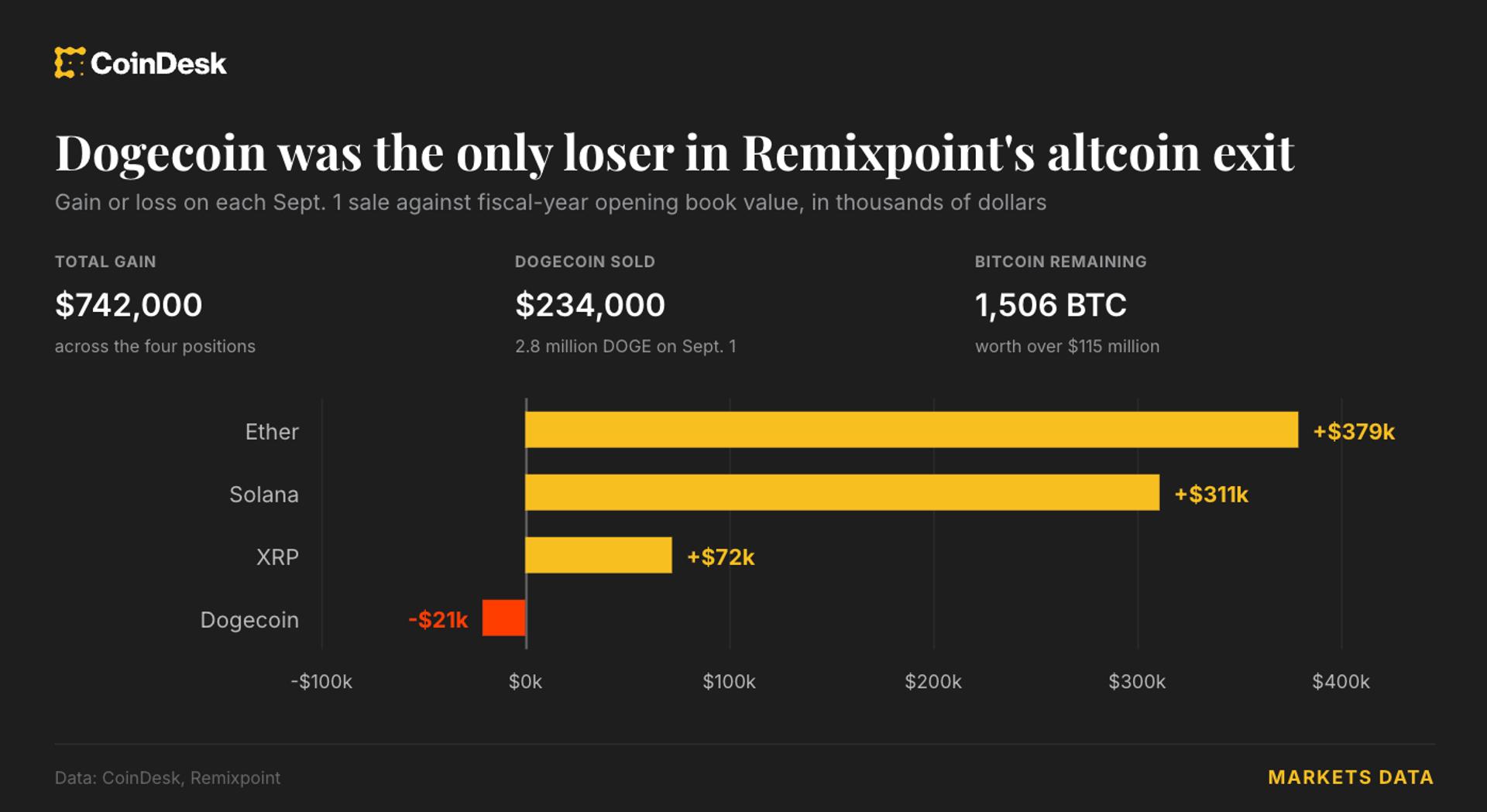
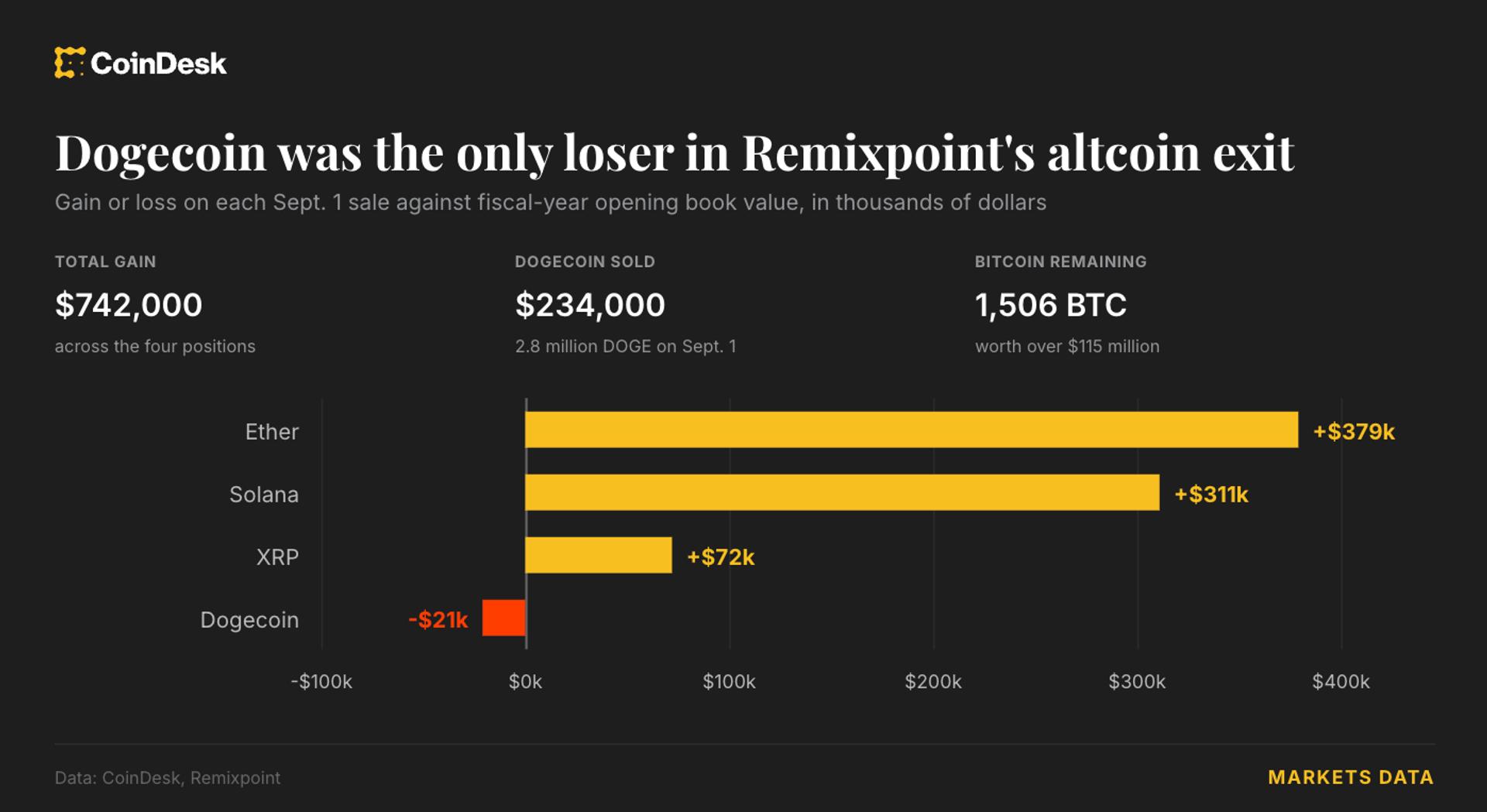
Remixpoint booked gains on ether, solana and XRP, but sold DOGE below its fiscal-year opening value as it concentrated its crypto holdings in bitcoin.

Japan’s Remixpoint has substantially reshaped its corporate crypto portfolio by exiting all of its major altcoin positions and concentrating its holdings on Bitcoin. In a disclosure filed this week, the company said it sold its Ether (ETH), Solana (SOL), XRP (XRP) and Dogecoin (DOGE), leaving it with approximately 1,506 BTC as its only cryptocurrency holding.
According to the company’s Wednesday disclosure, Remixpoint raised a combined 878.8 million yen (about $5.5 million) from the sales and expects to recognize the resulting gains in the second quarter of its fiscal year ending March 2027. The net effect of the transactions was a 117.8 million yen gain (about $736,000), after accounting for losses on its DOGE position.
Key takeaways
- Remixpoint sold all holdings of ETH, SOL, XRP and DOGE for a combined 878.8 million yen, according to the company filing.
- The company expects to book the net gain of 117.8 million yen in the second quarter of the fiscal year ending March 2027.
- After the trades, Bitcoin becomes the company’s sole remaining cryptocurrency exposure, with about 1,506 BTC on hand.
- The disclosure indicates Remixpoint booked gains on ETH, SOL and XRP, while selling DOGE at a 3.26 million yen loss.
- Remixpoint also cited capital-efficiency and strategy clarity as reasons for narrowing its crypto focus to Bitcoin.
From multi-asset crypto to a Bitcoin-only stance
Remixpoint described the move as a deliberate shift in investment strategy. The company, which is listed among Japan’s largest corporate Bitcoin holders, sold its altcoin positions after assessing market conditions, the risk-return characteristics of those assets, and how the portfolio fits into its broader financial approach.
The company said concentrating on Bitcoin is intended to “clarify investment strategy” and “improve capital efficiency.” In practical terms, that means reducing exposure to multiple token classes—each with different liquidity profiles, volatility drivers and market narratives—and consolidating that risk around a single asset.
Prior to the sale, Remixpoint held about 901 ETH, 13,920 SOL, 1.19 million XRP and 2.8 million DOGE. Based on CoinGecko prices at the time of publication, those amounts were valued at roughly $2.14 million, $1.36 million, $1.57 million and $226,000, respectively.
Breakdown of the sales and the timing
Remixpoint completed the altcoin divestment on Tuesday. The company reported that it generated the majority of proceeds from ETH, SOL, XRP and DOGE combined—878.8 million yen (about $5.5 million)—and that the overall portfolio outcome translated into a net gain of 117.8 million yen (about $736,000).
The filing specifies that Remixpoint recorded gains on ETH, SOL and XRP, while its DOGE sale resulted in a loss of 3.26 million yen (about $20,000). The company said it expects those results to be reflected in its second-quarter reporting for the fiscal year ending March 2027.
What remains: roughly 1,506 BTC and ongoing Bitcoin activity
After the divestments, Remixpoint reported that it retains about 1,506 BTC, worth about $115 million based on the disclosure’s figures. The company’s posture therefore changes from holding a diversified set of large-cap crypto assets to effectively running a single-asset treasury approach.
The company also pointed to returns generated through its Bitcoin holdings. In the same disclosure, Remixpoint said it earned 14.92 BTC from lending between Feb. 24 and Aug. 31, valued at 164.2 million yen (about $1 million). While the altcoin positions were exited, this lending activity suggests Remixpoint is still actively managing its remaining Bitcoin exposure rather than simply holding it passively.
Why the pivot matters for corporate treasury investors
Corporate crypto strategies often balance two competing priorities: maintaining exposure to the growth potential of the broader crypto market, and preserving capital efficiency with clearer risk management. By liquidating ETH, SOL, XRP and DOGE, Remixpoint is effectively choosing simplification—reducing token-level decision complexity and leaving its market exposure concentrated in Bitcoin.
That concentration can influence how the company’s financial performance may respond to future crypto market swings. With altcoin exposures removed, the value and results of Remixpoint’s crypto assets are more likely to track Bitcoin’s direction more closely, while idiosyncratic altcoin volatility becomes less relevant to its reported holdings. Still, the exact impact will depend on future price movements and any additional portfolio actions the company may take after this sale period.
Investors and market watchers may also look for whether Remixpoint’s shift changes its risk controls around lending and treasury management. Since the company already reported gains from Bitcoin lending over a defined period, the next question is whether it will broaden that activity further, adjust lending practices as conditions change, or continue prioritizing capital efficiency through a Bitcoin-only framework.
Remixpoint’s filing shows a concrete example of corporate players trimming multi-token crypto exposure in favor of a clearer Bitcoin-focused strategy. The key developments to watch next are whether the company continues to execute Bitcoin lending and whether any future disclosures indicate a return to altcoin exposure—or a firm continuation of the Bitcoin-only approach.


Crypto argument against traditional finance has remained ideological, with banks acting as gatekeepers, centralized institutions restricting access, and money seen as something that should flow freely through open networks.
Summary
- Ault Blockchain was developed after founder Todd Ault experienced banking restrictions while operating regulated businesses.
- The EVM compatible Layer 1 is designed for trading, settlement and tokenizing real world assets.
- The network uses Cosmos SDK, Cosmos EVM and CometBFT consensus while targeting 200ms block times.
- Ault Blockchain plans no traditional public token sale, with $AULT distributed through a ten year declining emissions schedule.
That argument hits differently when you hear it from executives operating inside the regulated financial system.
The OCC reported last year that nine of the largest U.S. banks had actively restricted services for certain perfectly legal businesses, with digital asset companies singled out. That creates a paradox where regulators urge crypto companies to act like traditional financial institutions with strict compliance, audit trails, and governance. Yet jumping through those hoops gave no guarantee from being cut off from basic banking services.
Ault Blockchain was born out of that frustration. Developed by a subsidiary of NYSE-listed Hyperscale Data, the EVM-compatible Layer 1 is the brainchild of founder Todd Ault. After years of navigating regulated and publicly traded structures, Ault experienced the systemic friction firsthand. During the height of COVID-19, one of his operating companies had its cash frozen and was handed a 30-day notice to find a new home.
For an operator spanning Bitcoin mining, digital infrastructure, and public markets, there was only one takeaway. If a private intermediary can unilaterally cut your access, being compliant and being permissionless are two completely different things. That now guides Ault Blockchain’s strategy.
Most new L1s pitch faster block times and higher throughput. Ault Blockchain is taking a finance-first approach built specifically for trading, settlement, and tokenizing real-world assets. It’s built on the Cosmos SDK and Cosmos EVM with CometBFT consensus, targeting sub-second 200ms block times.
Instead of focusing purely on raw speed, the network features an integrated stack where its core settlement layer is tied directly to dedicated trading via the Ault DEX, streamlined distribution through Ault Affiliates, and community governance managed by a Wyoming DAO LLC. To maintain and strengthen institutional trust, the platform takes its parent company Hyperscale
Data’s public-market audit and disclosure standards, baking compliance straight into the tech. The project is also skipping a traditional public token sale because $AULT relies on a deterministic ten-year declining emissions schedule that rewards Licensed Mining Nodes as they execute verifiable offchain work like oracle services, indexing, and AI-related computing.
The project is proving that permissionless finance doesn’t have to mean anonymous, wild-west operations. You can comply with legal standards while using infrastructure that can’t be arbitrarily shut off by a bank’s shifting risk appetite. It won’t be easy, but Ault isn’t running away from traditional finance. It’s taking its best controls, stripping away the fragile middleman dependencies, and building stronger rails underneath.

Disclosure: This content is provided by a third party. Neither crypto.news nor the author of this article endorses any product mentioned on this page. Users should conduct their own research before taking any action related to the company.
Summary
- XRP entered September near $1.35 after gaining 28.5% in August.
- Ripple unlocked 1 billion XRP on Sept. 1 under its monthly escrow program.
- The XRPL 3.3.0 upgrade could activate on Sept. 11, pending validator approval.
- A reported Sept. 15 CLARITY Act vote could influence XRP’s regulatory outlook.
- ASDeFi promotes Bitcoin cloud-mining contracts funded with XRP and other cryptocurrencies.
September opens with XRP under pressure
XRP is trading at approximately $1.35 as September 2026 begins, down 8.20% from its August peak near $1.70, after delivering its best August performance since 2021 with a 28.5% monthly gain.
The month opened with two immediate headlines: Ripple unlocked 1 billion XRP through three escrow transactions on September 1 — worth approximately $1.38 billion at current prices — and XRP broke below the $1.35 support level that analyst Ali Charts had identified as one of the most significant demand zones on the chart.
For XRP investors, September 2026 is not a month to watch passively. Three specific events — each with a defined date — will determine whether August’s gains were the start of a sustained recovery or simply a relief rally that September will partially unwind.
Event 1: Ripple unlocks 1 billion XRP—What does this really mean?
On September 1, Ripple unlocked 1 billion XRP in accordance with its established monthly escrow mechanism, through three separate transactions of 500 million, 400 million, and 100 million XRP, respectively. It is important to note that unlocking does not equate to selling: In the past, Ripple has typically re-locked the majority of unused XRP back into escrow, so the actual amount entering the market is far less than 1 billion; following this unlock, there are still approximately 31.28 billion XRP in Ripple’s escrow accounts.
Consequently, what the market should really focus on is not “how much was unlocked,” but rather where these XRP will flow next and whether the actual increase in circulating supply will put pressure on the price.
Event 2: XRPL 3.3.0 upgrade — September 11
The upcoming XRPL 3.3.0 release introduces a “confidential transaction” feature that uses technologies such as zero-knowledge proofs to hide transaction amounts and balances while maintaining address visibility. This feature is primarily aimed at multi-purpose tokens (MPTs) and institutional users.
The proposal has received 82.86% support from validators and has entered a two-week activation window, with activation on the mainnet expected as early as September 11, 2026. The new version also addresses vulnerabilities in single-asset vaults, lending protocols, AMMs, and pseudo-accounts, further enhancing the security and stability of XRPL DeFi.
Event 3: Senate vote on the CLARITY Act—September 15
The U.S. Senate’s vote on the CLARITY Act on September 15, 2026, will be one of the most critical events of the month—and indeed of the entire year. If passed, the bill could further clarify XRP’s classification as a commodity and provide longer-term legal certainty regarding its regulatory status;
September seasonal challenges
Historical data adds uncertainty to XRP’s September performance. XRP rose 28.5% in August, marking its strongest August performance since 2021, but most of the gains were concentrated in the final two weeks, suggesting that the capital driving the rally may not be held for the long term. At the same time, three major catalysts—the unlocking of custodial funds, the XRPL 3.3.0 upgrade, and the vote on the CLARITY Act—may help alleviate the traditional September seasonal pressure, but it remains uncertain whether they can fully offset potential selling pressure.
XRP vs. Bitcoin: A comparison of two risk profiles
Bitcoin is generally regarded as the more mature asset in the crypto market, thanks to its spot ETFs, institutional capital, and relatively mature regulatory framework; XRP, on the other hand, is more sensitive to market liquidity and regulatory developments, and while it may see greater gains during favorable market conditions, it may also experience more pronounced declines during market corrections.

For investors seeking exposure to crypto assets while minimizing their reliance on regulatory developments involving XRP, ASDeFi’s cloud mining model takes a different approach by continuously accumulating Bitcoin, rather than relying directly on XRP regulatory policies, the unlocking of escrowed funds, or XRPL governance events.
How does the ASDeFi cloud mining platform work?
ASDeFi is a Bitcoin cloud mining platform founded in 2020, with over 5 million users in more than 170 countries and regions worldwide. It operates nine physical data centers globally and is powered by Bitmain, the world’s largest ASIC manufacturer. ASDeFi accounts for over 1% of global Bitcoin hash rate, with a total hash rate of 16.7 million TH, reaching an all-time high.
How do I join ASDeFi cloud mining?
1. Go to https://asdefi.com to register for a Cloud Mining account.
Enter your email address and password to create an account. You’ll receive a $15 bonus upon registration, and a $0.60 bonus for logging in every day.
2. Deposit cryptocurrency
The platform supports deposits and withdrawals of more than a dozen cryptocurrencies, including XRP, BTC, SOL, ETH, DOGE, BNB, and USDT.
3. Purchase hashrate contracts
Purchase a $15 contract. The platform also offers a variety of hashrate contracts; choose different tiers based on your investment budget.
Examples of Common Contracts:
Check-in Contract: $15 — 1-day cycle — Total profit of approximately $15.60
Introductory Contract: $100 — 2-day cycle — Total profit of approximately $108
Basic Contract: $1,500 — 10-day cycle — Total profit of approximately $1,717.50
Stable Contract: $6,000 — 20-day cycle — Total profit approximately $8,040
Stable Contract: $30,000 — 30-day cycle — Total profit approximately $47,100
(For more contract details, please visit the official website.)
4. Withdraw earnings
After purchasing a contract, the platform automatically allocates computing power, and the system runs automatically. You can monitor the process in real time on your phone and choose to withdraw your earnings or purchase new contracts.
Portfolio Logic: XRP Position + Bitcoin Cloud Mining
For investors who are bullish on XRP’s long-term regulatory outlook and payment infrastructure, ASDeFi’s sustained accumulation model can serve as a complementary allocation. XRP is more akin to a directional bet on specific regulatory developments and market catalysts; its performance in September is highly dependent on key events such as the CLARITY Act, resulting in relatively concentrated risk. In contrast, ASDeFi continuously accumulates Bitcoin through cloud mining without relying directly on any single regulatory vote, the unlocking of custodial funds, or market events.
The two are not mutually exclusive: XRP carries higher event-driven risks and potential returns, while ASDeFi offers a relatively steady path to accumulating Bitcoin. Together, they can form a complementary portfolio with different sources of risk. For more details, visit: https://asdefi.com
App Download:https://asdefi.com/xml/index.html#/app
Customer Service Email: [email protected]
Disclosure: This content is provided by a third party. Neither crypto.news nor the author of this article endorses any product mentioned on this page. Users should conduct their own research before taking any action related to the company.


Kalshi plans to seek U.S. regulatory approval as early as next week for a perpetual futures contract linked to West Texas Intermediate crude oil, Bloomberg reported on Sept. 2.
Summary
- Kalshi reportedly plans to seek CFTC approval for a WTI perpetual futures contract next week.
- The proposed product would trade continuously from Monday through Friday instead of operating every day.
- Approval would make it the first oil perpetual contract available on a regulated U.S. exchange.
- Kalshi already lists a CFTC approved Bitcoin perpetual contract that began trading in June 2026.
- As of Sept. 3, no WTI filing appeared in the CFTC public product database yet.
The proposed contract would have no fixed expiration date. It would trade 24 hours a day from Monday through Friday, rather than operating continuously throughout the week, according to the report.
If the Commodity Futures Trading Commission approves the product, it would become the first WTI perpetual futures contract offered through a regulated U.S. exchange. The information came from an unidentified person familiar with Kalshi’s plans because the filing was not yet public.
No application for the proposed WTI contract appeared in the CFTC’s public product filing database as of Sept. 3. Its specifications, margin requirements, position limits, funding mechanism and expected launch date therefore remain unconfirmed.
Kalshi would remove the traditional expiration date
A conventional WTI futures contract expires during a specified month. Traders who want to retain exposure must close or settle the expiring position and open another contract with a later maturity.
Kalshi’s proposed product would remove that recurring expiration process. Traders could theoretically hold positions for an indefinite period, provided they maintained sufficient collateral and met the contract’s other requirements.
Perpetual futures normally use recurring payments or another price adjustment mechanism to keep their value close to the underlying reference market. Offshore crypto exchanges commonly use funding payments exchanged between long and short traders.
Kalshi has not publicly disclosed how its WTI product would remain aligned with the underlying oil benchmark. The method should become clearer if the exchange submits its proposed contract terms to the CFTC.
Existing WTI futures also have a direct connection to the physical oil market. CME Group’s benchmark contract represents 1,000 barrels and uses physical delivery at Cushing, Oklahoma. More than one million WTI futures and options contracts trade daily, according to CME’s product page.
Kalshi’s reported contract may use cash settlement or another structure to avoid physical delivery. No settlement method has been confirmed because the regulatory filing has not been published.
Kalshi already offers a Bitcoin perpetual
The planned oil product would expand Kalshi’s use of perpetual futures beyond cryptocurrency. The CFTC approved the exchange’s Bitcoin perpetual contract on May 29 under Commission Regulation 40.3.
Kalshi began offering the contract in June. As previously reported, the regulated Bitcoin perpetual gave U.S. traders continuous exposure without a fixed expiration date.
The earlier approval established that the CFTC can treat a contract without an expiration date as a futures product under the Commodity Exchange Act. It did not automatically authorize Kalshi to list perpetual contracts tied to other assets.
Each new product remains subject to applicable CFTC requirements. The regulator can examine whether its design prevents manipulation, provides reliable price discovery and complies with limits intended to protect market participants.
CFTC Chair Michael Selig later defended the regulator’s treatment of perpetual futures. He said existing U.S. law does not require every futures contract to have a predetermined expiration date.
Selig also rejected claims that regulated U.S. perpetuals would automatically offer the extreme leverage seen on some offshore platforms. In related coverage, the CFTC chair said regulated perpetual contracts remain subject to domestic leverage and risk controls.
Oil perpetual enters the 24-hour trading debate
Kalshi reportedly plans to make the WTI contract available continuously on weekdays. Trading would run 24 hours per day for five days, leaving the market closed during part of the weekend.
The schedule represents a compromise between existing commodity trading hours and fully continuous markets. Oil prices can react sharply to geopolitical events, production disruptions and policy announcements that occur while regulated exchanges are closed.
Supporters of longer trading hours argue that continuous access allows market participants to respond immediately. Critics warn that overnight or weekend periods may have lower liquidity, wider spreads and fewer market makers.
These concerns can become more serious in energy markets because commercial participants use futures to hedge physical production and consumption. A perpetual product could also behave differently from dated futures when the oil market moves into contango or backwardation.
Contango occurs when later-dated contracts trade above near-term prices. Backwardation describes the opposite structure. These price relationships reflect storage costs, supply conditions and demand for immediate delivery.
Kalshi’s filing will need to explain how the perpetual contract reflects those market structures without relying on a single delivery month. The funding or price adjustment formula will be central to understanding that relationship.
CME dispute creates a legal complication
Kalshi’s expansion comes while CME Group disputes the CFTC’s decision to classify perpetual contracts as futures rather than swaps. CME CEO Terry Duffy has argued that products without expiration dates should fall under the swaps framework created by the Dodd-Frank Act.
CME has threatened legal action over the regulator’s approval of crypto perpetual contracts. As crypto.news reported, the dispute concerns whether perpetual products can legally qualify as ordinary futures.
The disagreement becomes more direct when the underlying asset is WTI crude. CME operates the dominant regulated U.S. market for WTI futures and holds licensing arrangements connected to energy benchmarks.
A Kalshi WTI perpetual could therefore compete with an established commodity franchise rather than only with offshore cryptocurrency exchanges. However, the proposed product’s size, customer base and settlement design remain unknown.
CME is also preparing smaller WTI futures with continuous trading throughout the week, pending regulatory review. Its website advertises planned 10-barrel contracts that would offer access to global oil markets at all times.
The CFTC will need to assess Kalshi’s contract independently of the broader commercial dispute. Approval is not guaranteed, and Bloomberg’s report did not provide a regulatory timetable beyond the planned filing.
Public filing will reveal the contract mechanics
The next confirmed milestone will be Kalshi’s submission to the CFTC. A public filing should include the contract specifications, reference price, settlement process, position limits and safeguards against manipulation.
It should also explain the trading schedule and procedures for periods when the underlying physical and futures markets are less active. Margin and liquidation rules will determine how the exchange manages sharp oil price movements.
The filing route will matter as well. Kalshi previously sought formal CFTC approval for its Bitcoin perpetual under Regulation 40.3 instead of relying on immediate self-certification.
If Kalshi uses the same process for WTI, the regulator may approve the product, reject it or extend its review while requesting more information. The product cannot be treated as confirmed until the filing is submitted and the CFTC completes the applicable process.

Hyperscale Data Halts Michigan BTC Mining as BTC Holdings Drop 79%

“Rohit Sharma Was Angry But Agreed”: Report Makes Huge ‘Retirement’ Claim

Global Heating Will Hit At Least 1.8C, UN Warns, and There Are 'No Good Outcomes'





-

 Fashion5 days ago
Weekend Open Thread: Maeve – Corporette.com
-

 Crypto World6 days ago
Bitcoin’s 22% rally now needs real demand to outlast Treasury liquidity boost
-

 Business6 days ago
Apple Confirms September 9 Keynote and Reveals Its Full Pre-Order Schedule
-

 Business6 days ago
Salesforce Stock Soars 19% as Blowout Earnings and Agentforce AI Growth Silence Software Skeptics
-

 Business5 days ago
Onto Innovation Stock: AI’s Next Bottleneck Is Yield (NYSE:ONTO)
-

 Crypto World5 days ago
Bitcoin price tests $82K resistance as Brandt stays long
-
 Tech4 days ago
Hugging Face built a $4.5 billion empire on free AI models. Now Nvidia is buying it for $12.9 billion
-

 Business6 days ago
iPhone 18 Pro Pre-Orders Could Shift to Saturday as Apple Reportedly Avoids September 11 Anniversary
-

 Crypto World6 days ago
Truflation calls for Fed rate cut after PCE forecast
-

 News Videos4 days ago
Charlie Munger on Robinhood: No one should believe that Robinhood’s trades are free
-

 Tech5 days ago
PaperCut releases second emergency patch for exploited flaws
-
 Business7 days ago
AI Assistant Startup Instinct Rockets to $2.5 Billion Valuation in Weeks Amid Investor Feeding Frenzy
-

 Tech6 days ago
The fix for the AI agent that hijacked a company’s DNS: it can propose the change, but it can’t approve it
-

 Tech4 days ago
Tamagotchi Ring Takes the 30-Year Digital Pet and Places it on Your Finger
-
 Entertainment6 days ago
‘Adults’ Creators Break Down Season 2’s Most Shocking Moments and Tease a Potential Season 3
-

 Tech4 days ago
As the influencer economy drives retail sales, Seattle startup raises $22M to play matchmaker
-
 NewsBeat4 days ago
Trump posts AI video of ‘Lake America’ being protected by an army of bequiffed ‘Donald Ducks’
-
 Entertainment3 days ago
Taylor Swift Reportedly ‘Frustrated’ With Travis Kelce After ‘Short’ Honeymoon
-
 Business1 day ago
Oil Price Today (September 2): Crude oil nears $97 as war tensions escalate. Will it hit $100 again?
-

 Crypto World6 hours ago
CLARITY Act could advance within weeks, Atkins says
You must be logged in to post a comment Login