

Crypto World
Dogecoin grew up. Almost nobody noticed.



Six months ago, the first spot Dogecoin ETF started trading on a major US exchange. The flows have been tiny, the price has gone almost nowhere, and the whole experiment has played out in near-silence. That silence is the story. For an asset built on noise, behaving like a normal investment product is the most surprising thing Dogecoin has ever done.
Summary
- Spot Dogecoin ETFs have remained active six months after launch, with combined assets under management reaching nearly $14.7 million despite muted inflows and limited price movement.
- Products from REX Osprey, 21Shares, and Grayscale have started giving institutional investors multiple regulated ways to gain Dogecoin exposure through traditional markets.
- Recent ETF flow patterns have pointed to gradual accumulation by professional allocators rather than speculative retail trading that once defined Dogecoin’s market cycles.
A meme coin walked onto Wall Street, and nothing exploded
In November 2025, an asset created in 2013 as a literal joke about a Shiba Inu became eligible for an exchange-traded fund. By January 2026, a second one was trading on the Nasdaq, physically backed one-for-one by Dogecoin (DOGE) held in cold storage. As of mid-May 2026, both products are still live, both are still attracting money, and combined assets under management sit at roughly $14.7 million across the suite.
That is not a typo. Fourteen million dollars. For context, spot Bitcoin ETFs hit their first billion in a matter of weeks. Spot XRP ETFs are sitting on well over a billion. Dogecoin’s ETF complex, after six months, is smaller than a mid-sized private equity fund.
The instinct, looking at those numbers, is to write the whole thing off as a failure. That is the wrong read, and missing why it is wrong means missing what may be the most interesting quiet shift in crypto this year. The spot Dogecoin ETFs were never going to launch with a billion in inflows, because Dogecoin was never an asset that traditional finance was waiting to buy. What is actually happening is stranger and more telling. A meme coin is being slowly, boringly, and professionally accumulated by a small group of allocators who have decided it belongs in a portfolio. The trickle is the point. And it tells you something about what Dogecoin is becoming.
The two products, and why their differences matter
Before going further, it is worth understanding what exists, because the two live Dogecoin ETFs are not the same thing in different wrappers. There are two distinct bets about what Dogecoin is.
The first to launch was REX-Osprey DOJE, which listed on Cboe BZX on September 18, 2025. It is structured under the 1940 Act using a Cayman subsidiary that holds derivatives rather than DOGE itself. Day-one inflows came in around $17 million, a meaningful number that suggested real opening-day appetite. Eight months on, the fund’s AUM sits at roughly $17.8 million, essentially flat, and its net asset value was down more than 55 percent from inception to the end of 2025. The fee is 1.50 percent, expensive by ETF standards.
The second, 21Shares TDOG, launched on Nasdaq on January 22, 2026. It is the cleaner of the two products. Physically backed, one-for-one with Dogecoin held in cold storage, and charging a fee of 0.50 percent, in line with how the major Bitcoin and Ether ETFs are priced. As of early May 2026, TDOG’s AUM is around $4.1 million.
The two products tell two different stories. DOJE is the early-mover trade, a structured, derivatives-based vehicle that arrived first, sold itself to opportunistic buyers, and has been mostly digesting since. TDOG is the institutional-grade product, more expensive to build, cheaper to own, and aimed at a buyer who wants their Dogecoin exposure to look and behave like a normal ETF position. Add Grayscale’s GDOG, which now sits alongside TDOG as a magnet for the bulk of recent inflows, and you have a small but real product shelf. The maturity here is not in the dollar size. It is a fact that allocators now have a choice of how to hold Dogecoin in a regulated form. That choice did not exist eighteen months ago. It exists now.
What the inflow pattern actually shows
The story being told on crypto Twitter is that DOGE ETFs are “quietly cooking,” racking up inflow days, gathering momentum. The actual flow data is messier and, on close reading, more interesting.
What the spot Dogecoin ETFs have shown since launch is not a steady drumbeat of buying. It is long stretches of basically zero net flow, broken by sporadic days of small inflows. In one recent eight-day stretch, the funds saw net inflows on four of them, with monthly inflows in May running at roughly $1.3 million through mid-month and climbing toward $2.15 million as the month wore on. On May 19, with Bitcoin and Ether ETFs collectively bleeding more than $700 million, Dogecoin ETF activity jumped 215 percent and pulled in around $860,000 in net inflows in a single day.
None of those numbers is large. All of them are real.
The pattern behind those numbers is what makes the story worth telling. It is not retail mania. Retail mania looks like January 2021. It does not look like four inflow days out of eight at less than a million dollars each. The pattern looks much more like the early days of an asset that a small group of professional allocators has decided is worth a token allocation in a diversified book. They buy when there is rotation out of the majors. They sit on their hands when the broader market is dull. They are not trying to time DOGE’s next leg up. They are treating it as one of many uncorrelated bets that earn a single-digit-percent slot in a portfolio.
That is, by some distance, the most boring thing Dogecoin has ever been the protagonist of. And boring, here, is the most interesting word in the sentence.
What it means for an asset to “grow up”
For most of its life, Dogecoin was a behavior. Its price moved on tweets, on memes, on collective enthusiasm, on a sense among holders that the joke itself was the asset. The peaks were vertical, and the crashes were vertical. The thesis, to the extent there was one, was vibes.
A maturing asset behaves differently. It still has cycles, but the buyer base diversifies. A wider range of investors hold it for a wider range of reasons. Some are still there for the meme. Some are there for the payments use case, which Dogecoin is now genuinely being explored for in House of Doge’s enterprise pilots. Some are there because they read a research note recommending a small allocation as part of a multi-asset crypto basket, and the regulated ETF gave them the wrapper to act on it.
The behavioral signs of that diversification have started to show up. Whale wallets, addresses holding tens of millions of DOGE or more, have climbed through 2026 to multi-year highs. Steady ETF inflows, even tiny ones, reduce free-floating supply on the margin. DOGE recently broke above its full EMA stack for the first time since October 2025, a piece of technical evidence that the buyer mix has shifted. None of that is a moonshot signal. It is, again, the picture of an asset behaving more like an asset than like a vibe.
Two notes of caution worth keeping in mind. First, this transition is partial. Dogecoin is still highly volatile, still moves on sentiment, and still trades around $0.11 after a brutal first quarter that broke many holders. Calling it “mature” in the sense that Bitcoin is mature would be silly. The shift is from “pure meme” to “meme with an investable layer on top,” not to anything resembling a blue-chip asset. Second, the inflows are small enough that they could reverse in a single bad month and undo the trend. Six months of consistent net positive flow is a beginning. It is not yet a pattern that can survive a serious test.
The bigger thing the ETF approvals signaled
Step back from Dogecoin specifically, and the existence of these products says something more important than any flow number.
The SEC approved a spot ETF for an asset with no foundation managing its development in the traditional sense, no formal roadmap, no consensus use case beyond payments and culture, and a mascot that is a meme of a dog. That approval, under the new generic listing standards the SEC adopted in 2025, was the moment American securities regulation effectively decoupled “is this asset investable through a regulated wrapper?” from “does this asset have a serious institutional pitch?” If Dogecoin can have an ETF, the list of crypto assets that cannot is suddenly very short.
That has knock-on effects worth watching. It clears the path for ETFs covering other large meme or culture-driven tokens. It tells issuers there is real money in the long tail of regulated crypto products, even if no single fund will rival Bitcoin’s. And it forces a quiet rethink of what “investable” has ever really meant. For a long time, the unstated answer was: an asset serious people can defend in a meeting.
Dogecoin in an ETF wrapper is the asset that broke that definition. Once it breaks, it does not put itself back together.
What to actually watch from here
For a Dogecoin holder, or anyone trying to read whether this slow maturation is real or a head fake, the things worth tracking are unglamorous.
Watch whether net inflows stay positive over multiple months, not whether any single month spikes. Six straight months of net positive flow, including a brutal Q1, is more meaningful than any single big day. Watch whether TDOG and GDOG, the cheaper and more institutionally structured products, continue to attract the bulk of new money relative to DOJE. That is the cleanest signal of whether the buyer base is sliding toward more professional allocators. Watch whether House of Doge’s payments and enterprise work produce any visible adoption traction that gives DOGE a use case beyond culture. And watch whether ETF inflows hold up during the next genuine risk-off stretch in crypto, rather than evaporating the moment Bitcoin sells off.
If those things keep happening, slowly, in the same quiet way they have been, then six months from now the story will be hard to deny. A meme coin will have professionalized. It will not have stopped being a meme coin, but it will have grown an investor base that does not depend on the meme. That is not the moonshot most DOGE holders have spent years waiting for. It may be something more durable and more useful than the moonshot ever would have been.
For an asset that started as a joke about a dog, becoming a slightly boring portfolio holding is one of the strangest possible victories. It is, against the odds, that Dogecoin is actually winning.
This article is for informational purposes and does not constitute financial or investment advice. Cryptocurrency markets are volatile, and ETF flows, AUM, and prices change quickly; the figures described reflect reporting available as of mid-May 2026. Always do your own research.


Key Takeaways
- SMCI shares climbed over 8% Wednesday following a Q3 FY2026 non-GAAP EPS of $0.84, surpassing the $0.62 estimate by 35%
- Quarterly revenue hit $10.24 billion, marking a 123% year-over-year increase, despite falling short of analyst expectations
- Company executives elevated full-year FY2026 revenue projections to $38.9B–$40.4B
- Super Micro disclosed concerns including significant cash outflows, increasing debt obligations, inventory accumulation, and an export compliance probe
- Despite Wednesday’s gains, SMCI remains down 24% over the trailing twelve months, while Dell surged 112% and HPE climbed 89%
Shares of Super Micro Computer (SMCI) experienced a notable surge exceeding 8% during Wednesday’s trading session on May 20, positioning it as the top performer among AI server manufacturers that day.
Super Micro Computer, Inc., SMCI
The upward movement followed the company’s disclosure of Q3 FY2026 financial results that demonstrated substantial outperformance on the earnings front. The firm posted non-GAAP EPS of $0.84, handily beating analyst projections of $0.62.
Quarterly revenue totaled $10.24 billion, representing a robust 123% year-over-year expansion. The top line figure, however, failed to meet Street expectations.
Investors looked past the revenue shortfall and instead concentrated on the company’s improved outlook. Leadership increased its full-year FY2026 revenue guidance to a band of $38.9 billion through $40.4 billion.
Chief Executive Charles Liang emphasized that the organization’s “transformation into a total datacenter infrastructure provider is accelerating,” highlighting margin improvements and expansion in the DCBBS segment as indicators of underlying strength.
The organization has also broadened its manufacturing capabilities internationally, a move executives characterized as essential to meeting surging demand for AI infrastructure solutions.
Headwinds Persist Despite Rally
The earnings report wasn’t without blemishes. Super Micro cautioned about substantial cash outflows, mounting debt obligations, and inventory accumulation as it works to satisfy customer demand.
Company leadership also acknowledged persistent supply chain limitations. Additionally, the firm revealed it’s subject to an export-related regulatory inquiry, introducing further uncertainty for market participants tracking the equity.
These complications have contributed to SMCI’s challenging twelve-month performance. Shares remain down 24% over that timeframe, stemming from filing delays and auditor transitions that rattled shareholder confidence.
Market sentiment had been gradually improving before Wednesday’s advance. Social media sentiment data from Reddit during the May 9–10 weekend indicated bullish indicators for SMCI recovering to the 68–72 range following bearish readings earlier that month.
SMCI Performance Versus Dell and HPE
Wednesday’s price action gave SMCI the daily lead among its industry competitors. Dell Technologies (DELL) advanced approximately 3.9% while Hewlett Packard Enterprise (HPE) gained roughly 2.7%.
However, the longer-term comparison tells a different story. Across the past year, Dell has surged 112% and HPE has climbed 89%, whereas SMCI continues trading in negative territory.
Dell disclosed AI-optimized server revenue of $8.95 billion in its most recent quarter, representing a 342% year-over-year jump, with a $43 billion AI order backlog entering FY27. The company is scheduled to announce fiscal Q1 2027 results on May 28.
HPE delivered non-GAAP EPS of $0.65 last quarter, exceeding internal forecasts, with networking revenue soaring 152% year-over-year to $2.71 billion. Its upcoming earnings announcement is set for June 1.
Extending the timeline to five years, SMCI maintains sector leadership with a 751% advance compared to Dell’s 417% and HPE’s 134%.
Dell Technologies’ May 28 earnings report will provide the next significant benchmark for evaluating the AI server industry’s trajectory.

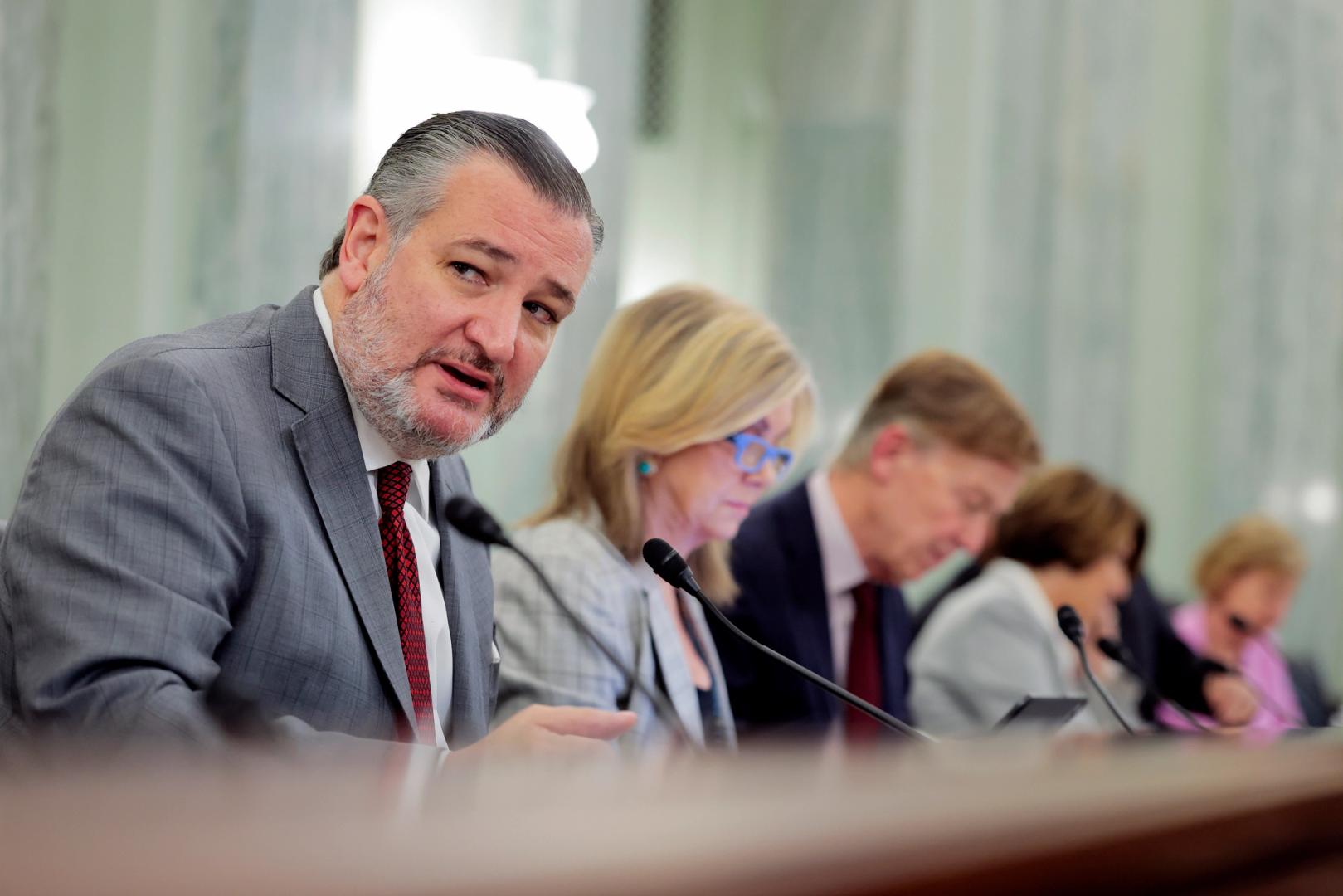
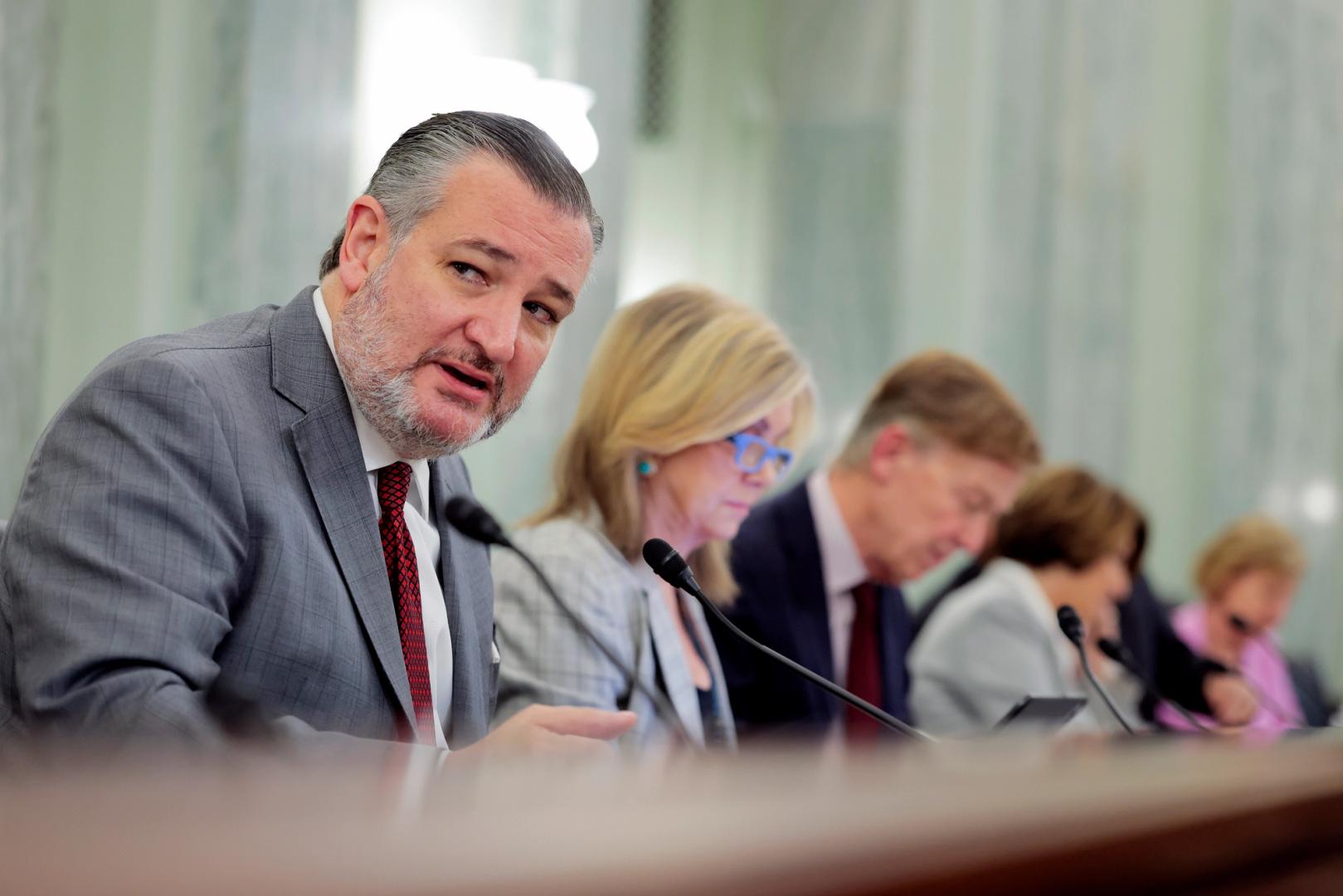
Prediction markets platforms such as those run by Kalshi and Crypto.com drew two hours of critical questioning in a U.S. Senate Commerce Committee hearing, including scrutiny on the platforms’ advertising practices, regulatory disputes and the cheating they may encourage.
“We want athletes competing on merit, but the opportunity to make money can tempt gamblers — and sometimes even athletes themselves — to guarantee a sure bet,” Senator Ted Cruz, a Texas Republican who chairs the committee, said during the Wednesday hearing. He said high-profile incidents of player cheating “sow doubt in the minds of fans.”
Cruz flagged some recent cases, saying: “NBA players and coaches are accused of manipulating performance and providing insider information to win bets. Two major league baseball pitchers allegedly rigged their own pitches in exchange for money. [Major League Soccer] banned two players for intentionally getting yellow cards to win bets, and the UFC has canceled matches and terminated contracts because of suspected match fixing.”
“It is not uncommon for fans scrolling Twitter on a Sunday afternoon in the fall to see posts speculating that a controversial call by an official was related to gambling,” Cruz said.
Other lawmakers focused on marketing that fosters problem gambling or that has reached youths that are otherwise meant to be blocked from betting. Senator John Hickenlooper, a Colorado Democrat, accused the prediction markets businesses of unleashing the “hounds of hell” in social media and marketing to “prey on our young people.”
Patrick McHenry, who was a prominent member of the House of Representatives until his recent retirement, is now an adviser at the Coalition for Prediction Markets that represents Kalshi, Crypto.com, Robinhood, Coinbase and others. He said trades aren’t allowed for anybody under 18 and that the average age of users is 33.
Problem gamblers
Harry Levant, director of gambling policy at the Public Health Advocacy Institute, testified on Wednesday, telling the lawmakers he was a recovering gambling addict and lamenting the “avalanche of unregulated advertising” from prediction market firms.
“It’s a known addictive product, just like heroin,” he said.
Earlier this week, Kalshi co-founder and CEO Tarek Mansour posted on social media site X to highlight his company’s $2 million commitment with the National Council on Problem Gambling to support an initiative on “trader health and safety.””As retail participation in markets increase, we have a responsibility to balance free markets and individual responsibility with customer education and safety guardrails,” he wrote.
And still other lawmakers on Wednesday dove into the rapidly growing industry’s avoidance of state regulators and competition with regulated gaming on U.S. tribal lands, where revenue is a core support of tribal reservations’ financial health.
CFTC
Even as the senators put the event-contract space under the microscope, the Commodity Futures Trading Commission that regulates derivatives trading platforms is pursuing a lawsuit filed on Tuesday to stop a new law in Minnesota that was set to hold prediction market activity as illegal there. The regulator adds this to a growing list of lawsuits the federal agency has filed against states that have sought to limit prediction markets or declare them in violation of state gambling laws.
“This Minnesota law turns lawful operators and participants in prediction markets into felons overnight,” said CFTC Chairman Mike Selig in a statement, who added this suit alongside similar agency fights against Arizona, Connecticut, Illinois and New York.
Selig has led an agency legal campaign to defend his agency’s authority to supervise and regulate prediction markets, which are managed on registered platforms under CFTC rules. Meanwhile, his agency — at which he’s the sole member of what’s meant to be a five-member commission — is also pursuing a formal rule to establish tailored standards for the sector.
McHenry defended the CFTC role on Wednesday.
“The CFTC, as a cop on the beat, has the capacity to oversee this market, just as they’ve done with the broader commodities marketplace that’s been around and well versed for decades,” McHenry said.
Senator Hickenlooper responded, “You’re the first person who’s told me you think that they think the CFTC is up to the standards.”
One of the witnesses, Bill Miller, the president and CEO of the American Gaming Association, contended the federal regulators “are absolutely not competent to handle this, and two, they are absolutely hurting tribes and states financially.” He added that, “it was never Congress’s intent to create a federal department of gambling through the CFTC.”
McHenry argued that these event contracts are derivatives that belong to “fundamentally different business models” from bets placed with gambling businesses. He equated them to long-regulated grain futures contracts, and he added that “our member companies have enhanced surveillance greater than any casino and greater than any sportsbook in the country.”
In the end, Chairman Cruz said, “The Supreme Court may have to decide the issue.”
Bitcoin (BTC) halted its latest recovery at Wednesday’s Wall Street open as US traders sold off.
Key points:
- Bitcoin nears $78,000 before the US open spoils momentum, continuing a trend from earlier in the week.
- US stock markets await Nvidia earnings amid a tense macro atmosphere.
- Bitcoin’s Coinbase Premium sees multi-month lows in a sign of “soft” US demand.
BTC price stops short of $78,000 ahead of Nvidia numbers
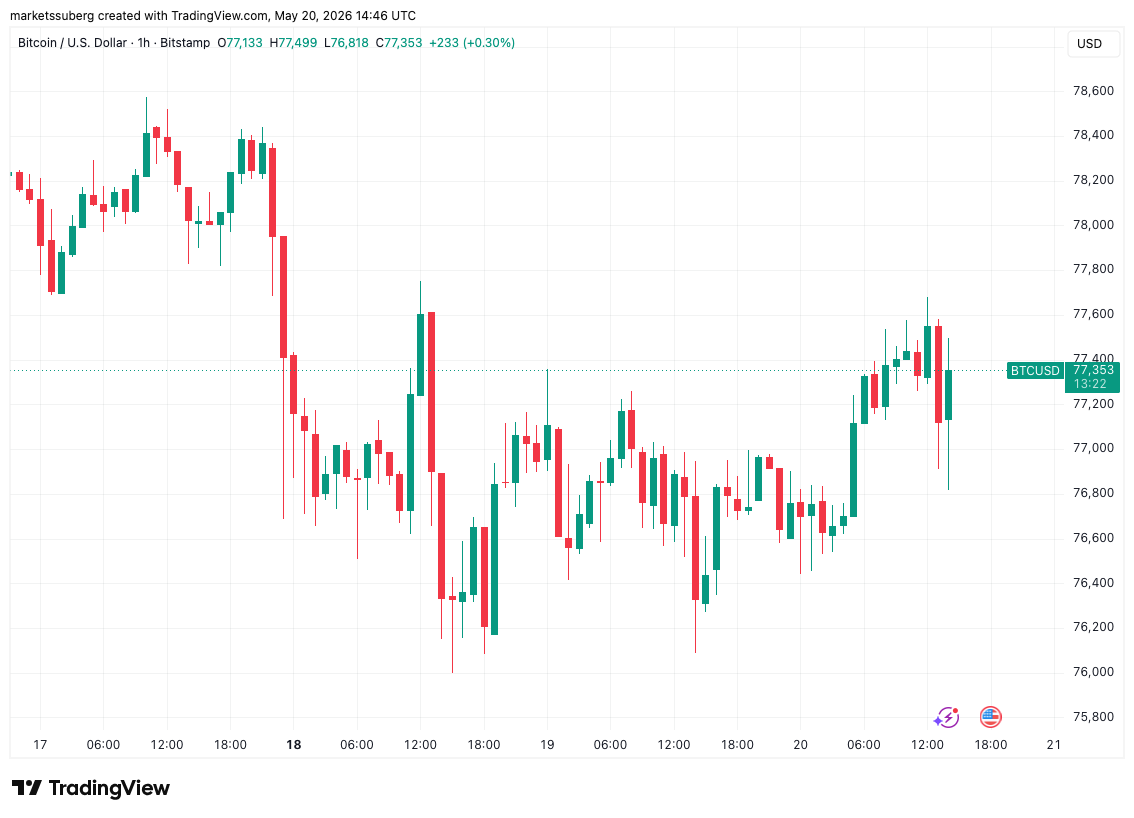
Data from TradingView showed BTC/USD reaching $77,678 on Bitstamp before the US trading session sparked fresh losses.
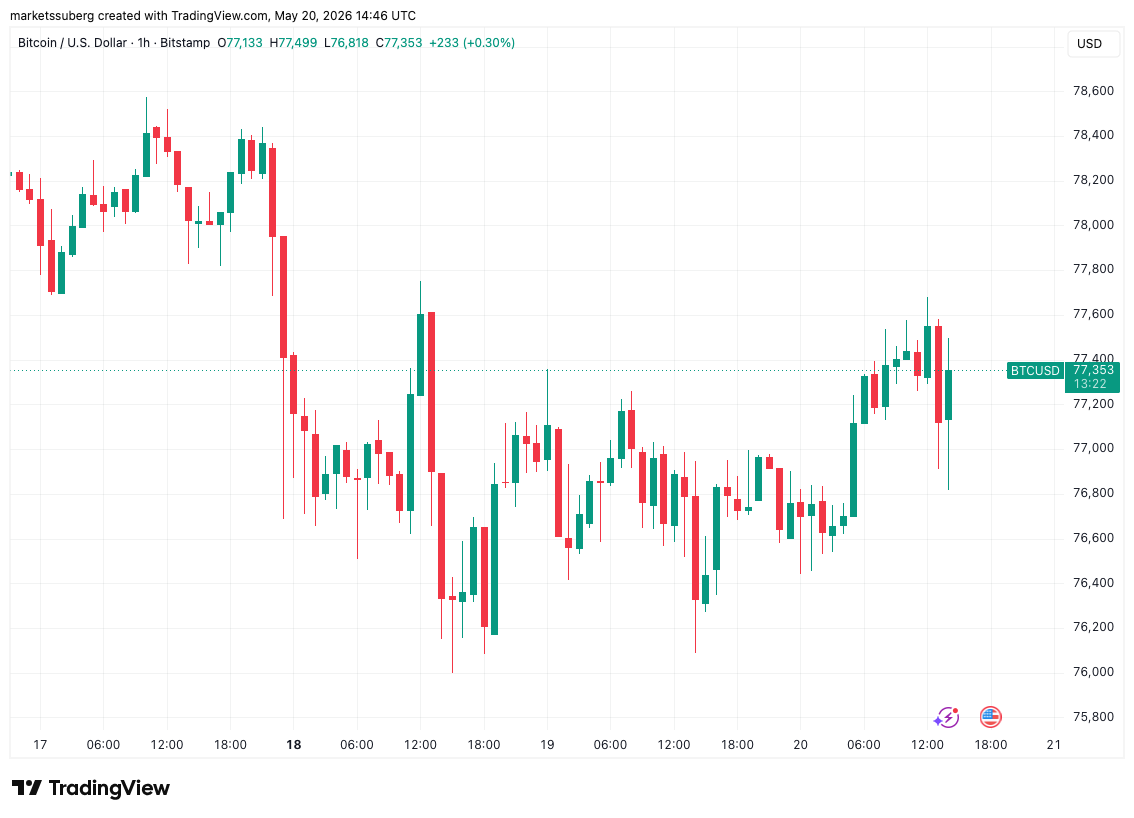
BTC/USD one-hour chart. Source: Cointelegraph/TradingView
Copying its moves from the week’s first two trading days, Bitcoin faced tailwinds as US market sentiment stayed bearish on the macroeconomic outlook.
The S&P 500 fell 1.3% before rebounding, with traders waiting for the week’s key potential volatility catalyst: Q1 earnings from tech company Nvidia.
On Monday, trading resource The Kobeissi Letter described the numbers as the “biggest earnings event of the quarter.”
Continuing, it noted the role of tech stocks in driving S&P 500 strength — even as the US-Iran war and associated inflation risk spooked other markets.
“A handful of tech stocks are driving the entire market,” it summarized in a post on X.
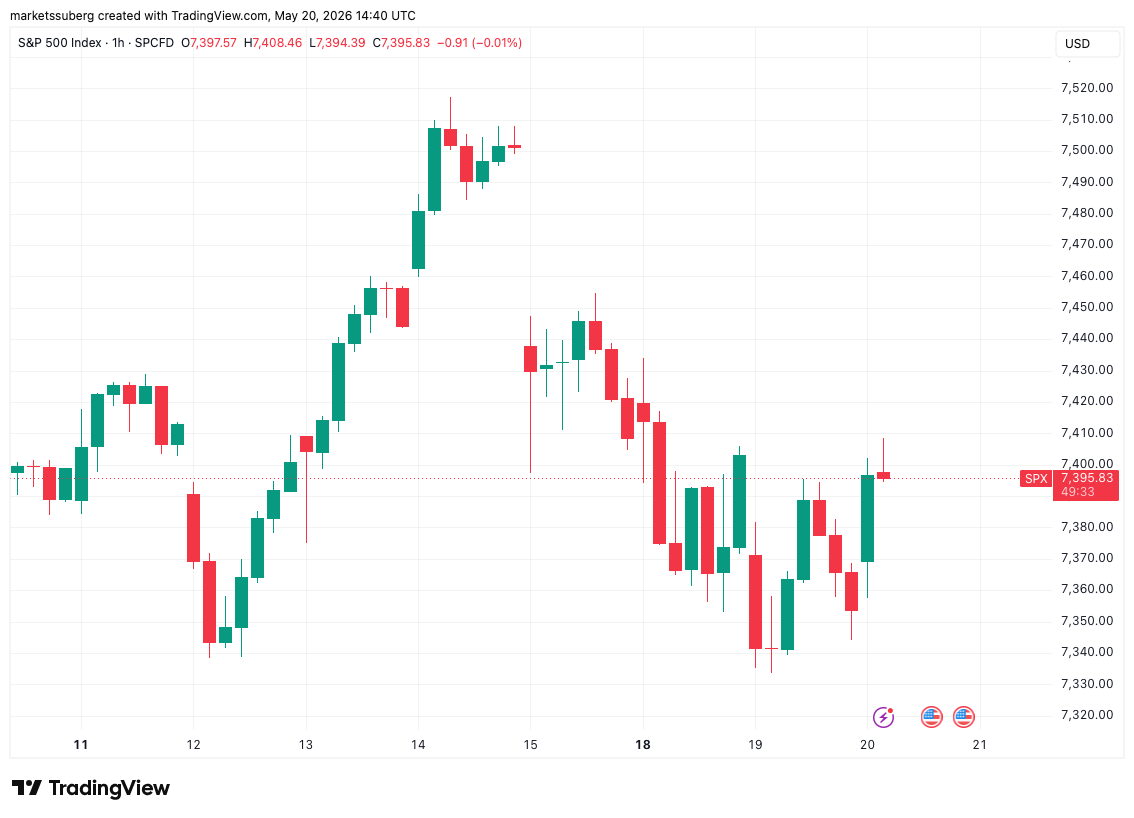
S&P 500 one-hour chart. Source: Cointelegraph/TradingView
Bitcoin Coinbase Premium reflects “soft” demand
In crypto circles, attention focused on the Coinbase Premium Index, which highlighted the ongoing lack of bullish sentiment during US trading sessions.
Related: BTC price ‘bull trap’ at $76.5K? Five things to know in Bitcoin this week
The Index, which measures the difference in price between Coinbase’s BTC/USD and Binance’s BTC/USDT pairs, fell to its lowest levels since February on the day.
Commenting in one of its QuickTake blog posts, onchain analytics platform CryptoQuant said that spot Bitcoin demand “remains soft.”
“The latest Coinbase Premium Gap reading stands near -$66.8, meaning Bitcoin is trading at a lower price on Coinbase Pro’s USD pair compared with Binance’s USDT pair. This is deeper than the late-March reading of around -$62.6, when Bitcoin was trading near $68,000,” contributor Amr Taha wrote.
“The comparison is important because Bitcoin is now trading much higher, around $77,200, yet the Coinbase discount versus Binance is wider than it was when BTC was nearly $9,000 lower.”
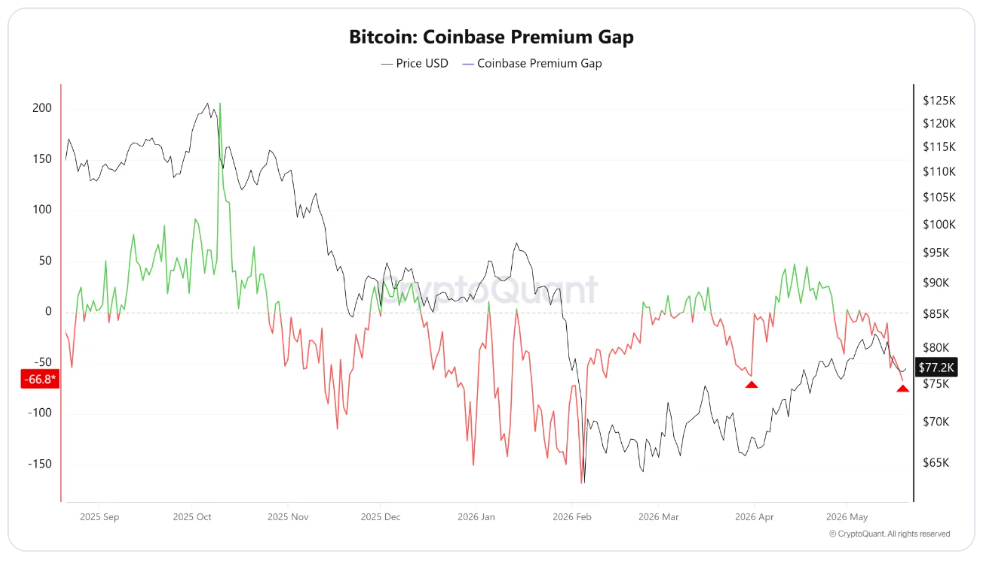
Bitcoin Coinbase Premium gap (screenshot). Source: CryptoQuant
Others monitored familiar trend lines, including the 21-week exponential moving average (EMA).
As Cointelegraph reported, BTC/USD reclaimed that level on weekly time frames in late April, only to lose it again this week.
“Bitcoin has Weekly Closed below the 21-week EMA (green) which technically positions price to potentially turn it into new resistance on any upcoming rebound,” trader and analyst Rekt Capital told X followers on Tuesday while analyzing the weekly chart.
“Turning the 21-week EMA into new resistance would fully confirm the breakdown from it.”
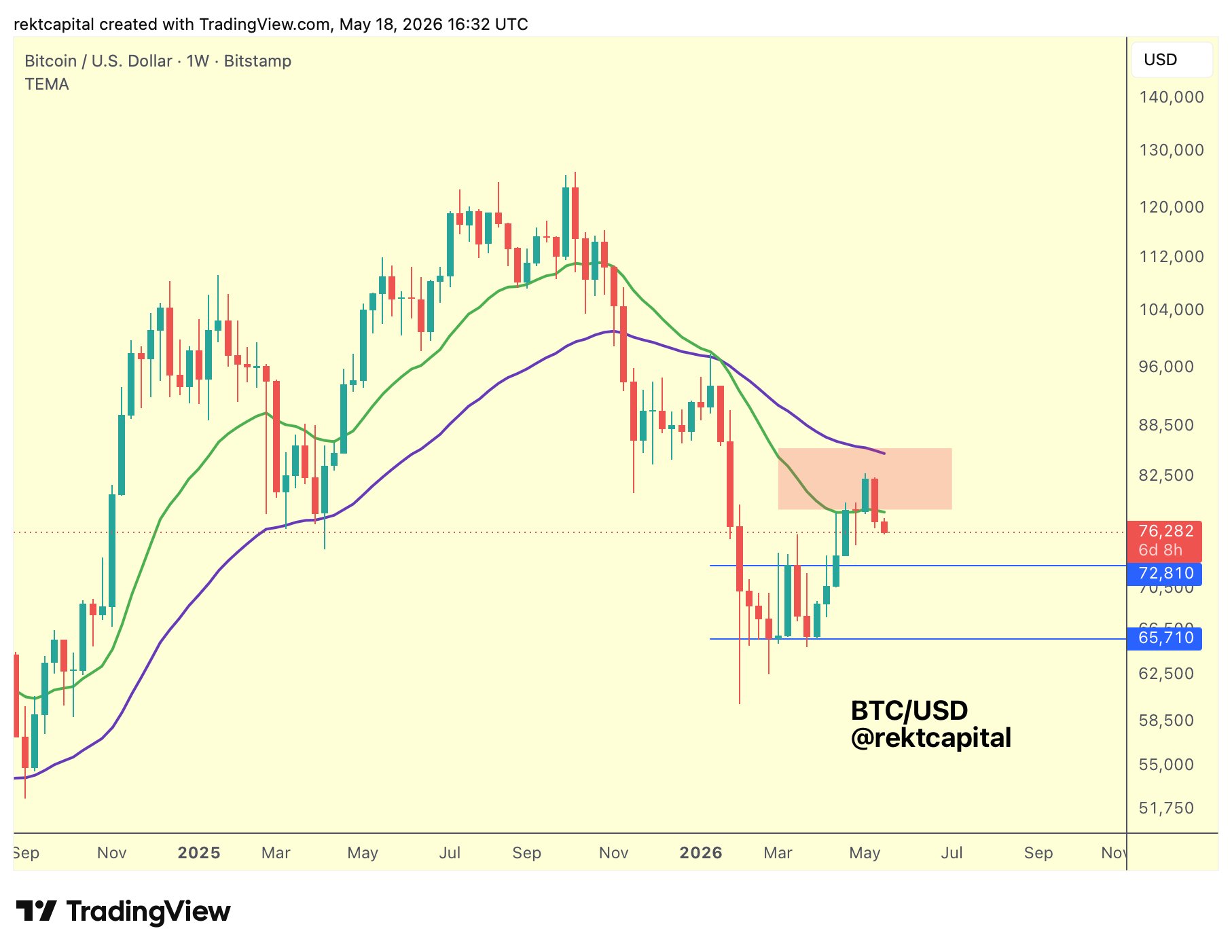
BTC/USD one-week chart. Source: Rekt Capital/X
Tether International has announced acquiring Japanese multinational investment firm SoftBank’s minority stake in the Bitcoin-focused treasury company, Twenty One Capital (XXI).
At the closing of the transaction, SoftBank’s representatives on the XXI Board of Directors stepped down in line with the shareholder agreement.
Tether Absorbs SoftBank Position
In its official blog post, Tether stated that the transaction “reflects the continued development of XXI as the company builds on its foundation and advances its long-term Bitcoin strategy.” With the transaction finalized, SoftBank’s role in governance has now concluded.
Commenting on the latest development, Tether CEO Paolo Ardoino said,
“SoftBank’s involvement gave XXI the kind of institutional depth that few early-stage companies ever have. Their experience backing some of the most consequential technology companies in the world brought credibility, perspective, and discipline to XXI during a critical period of formation. They leave behind a company with a stronger foundation, a clearer mandate, and an ambitious path ahead. Tether’s conviction in XXI has only deepened, and we look forward to building on that foundation as the company enters its next chapter.”
In April 2025, Twenty One Capital was launched as a new crypto venture with Strike founder Jack Mallers named as CEO. The company was backed at launch by Tether International and Bitfinex as majority owners, alongside SoftBank Group and Cantor Fitzgerald as initial investors. It was disclosed that the company would begin with about $3.6 billion in Bitcoin held in its treasury. SoftBank was included as a minority stakeholder at formation, while Tether held controlling ownership.
Twenty One Capital went public in December of the same year through a SPAC merger in New York.
Merger Proposal
Last month, Tether put forward a multi-step plan involving Twenty One Capital, which included merging the company first with Strike. After that initial step, the plan proposes a second stage where the combined entity would then merge with the bitcoin mining company Elektron Energy.
Meanwhile, according to the latest data, Twenty One Capital is currently the second-largest public company holder of Bitcoin, with 43,514 BTC. It trails Michael Saylor-led business intelligence firm, Strategy, which holds 843,738 BTC.
The post Tether Acquires SoftBank Stake in Bitcoin-Focused Treasury Company XXI appeared first on CryptoPotato.


Cryptocurrency custody firm Copper has been out shopping itself, seeking a buyer willing to pay about $500 million for the platform, according to two people familiar with the matter.
Wall Street investment bank Cantor Fitzgerald has been appointed to help sell Copper, the people said.
Copper and Cantor didn’t respond to requests for comment.
The jewel in Copper’s crown is the ClearLoop settlement system, which enables network participants to do delivery versus payment (DvP) from within custody without bringing assets onchain, thereby eliminating settlement risk.
Copper closed its enterprise custody business in 2023 to focus on ClearLoop, launched in 2020 and caters to dozens of institutional firms. The firm boasts more than 1,000 active counterparties and over $50 billion in monthly notional trading volume, according to its website.
Copper was said to be weighing an IPO earlier this year, potentially following in the footsteps of crypto custodian Bitgo, with whom Copper forged a partnership on the ClearLoop application. However, with bitcoin trading below $80,000, and artificial intelligence soaking up most of the capital, the crypto IPO market has been on a holding pattern this year.
Meanwhile, the deal-making in the crypto market has been active this year, as crypto-native, traditional and fintech firms are looking to expand their digital asset capabilities through acquisitions.
Earlier this year, Mastercard agreed to buy U.K.-based stablecoin infrastructure firm BVNK for as much as $1.8 billion. Kraken’s parent company, Payward, agreed to acquire the derivatives platform Bitnomial, while Bullish, owner of CoinDesk, announced a $4.2 billion deal to buy Equiniti, aimed at combining transfer agency services with tokenization infrastructure.
And just this week, London-based bank Standard Chartered said it will buy the remaining shares of Zodia Custody, its cryptocurrency custodian subsidiary, that it doesn’t already own. The deal came just weeks after the bank’s venture capital division reportedly took a stake in crypto trading firm GSR at a valuation of more than $1 billion.
SoftBank has sold its stake in Jack Mallers-led Twenty One Capital to Tether, according to the stablecoin giant.
Twenty One Capital (also known as XXI) is a bitcoin (BTC) treasury firm that was founded with Tether providing the BTC and getting the controlling share, SoftBank purchasing a stake from Tether, and the entity being publicly listed by utilizing a reverse merger with a Cantor Fitzgerald-affiliated special purpose acquisition company.
Tether’s announcement details how it has “acquired SoftBank’s stake in XXI,” which it claims “reflects the continued development of XXI.”
Read more: How Tether-backed Twenty One plans to rival MicroStrategy
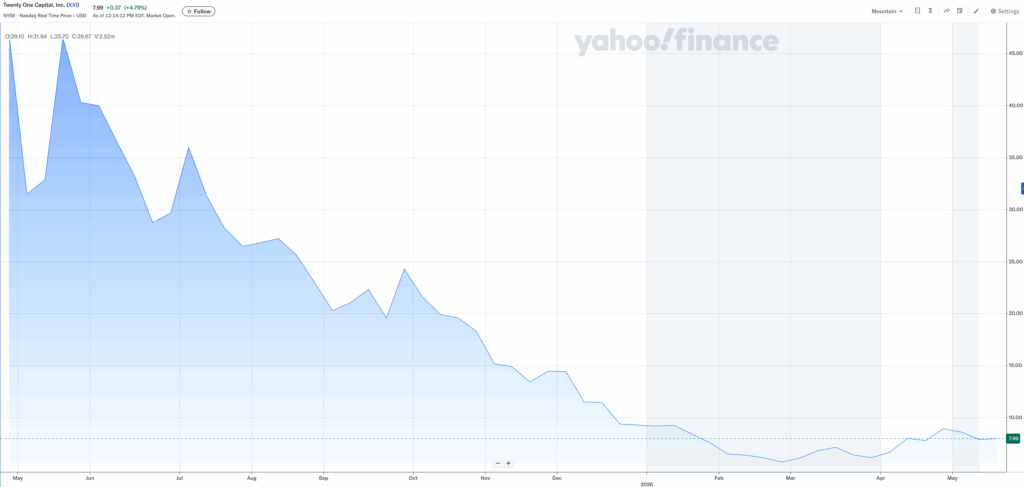
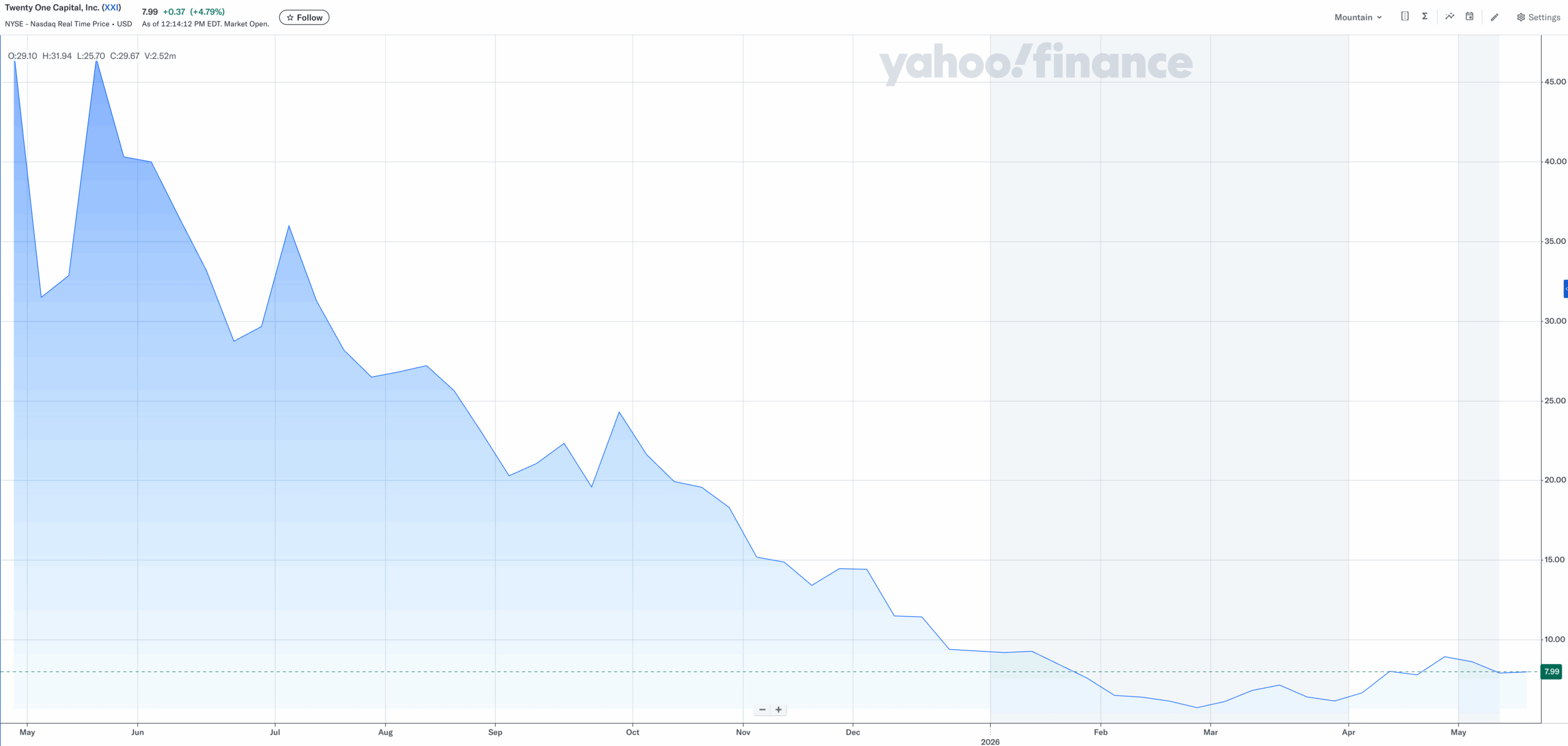
The combined firm was first listed on December 9, 2025.
Since then, the price of the stock has fallen by 23%, from approximately $10.74 to $7.85.
However, the peak for this stock came after the announcement and before the merger, when it reached a peak value of approximately $49.62 on May 21.
The price has fallen approximately 84% since this peak.
Despite these travails for the equity of this firm, Tether chief executive Paolo Ardoino said, “Tether’s conviction in XXI has only deepened and we look forward to building on that foundation.”
Got a tip? Send us an email securely via Protos Leaks. For more informed news and investigations, follow us on X, Bluesky, and Google News, or subscribe to our YouTube channel.
Crypto World
Nearly 10% of Bitcoin Supply is ‘Structurally Unsafe’ from Quantum Computing: Glassnode
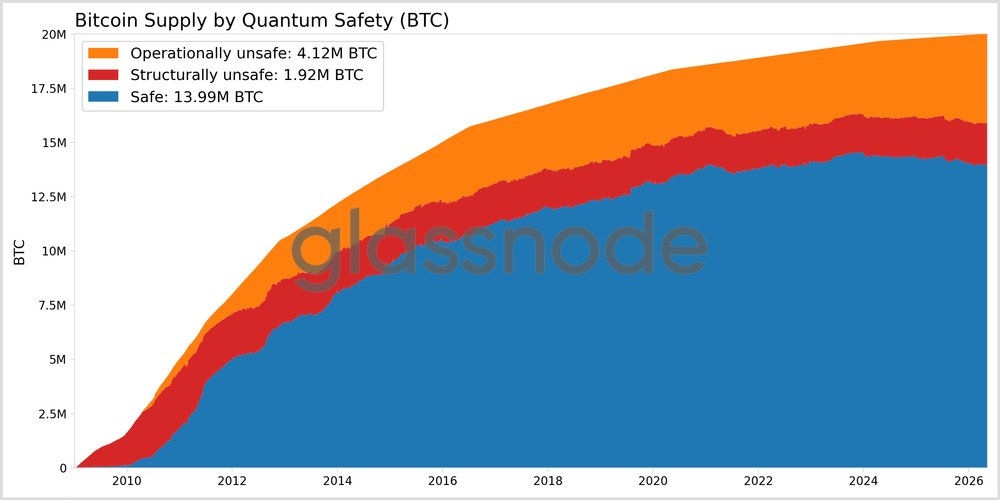
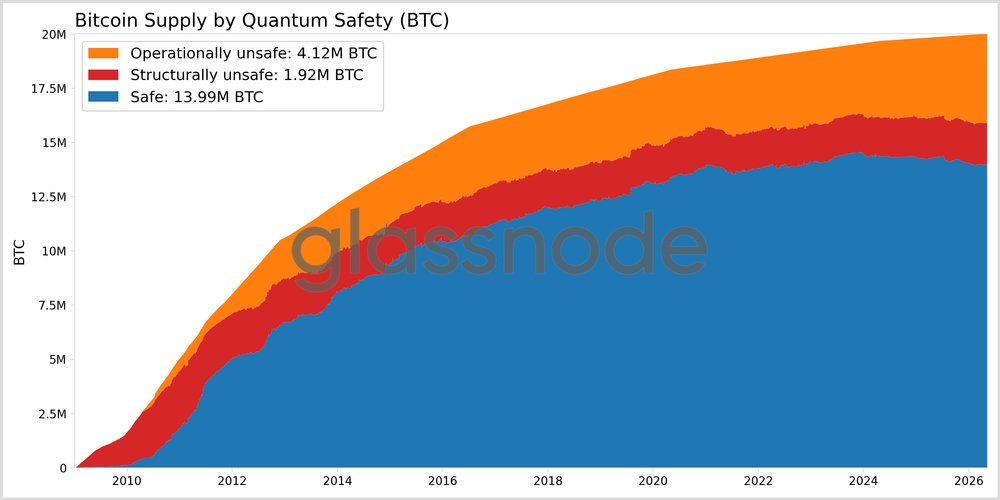
Nearly 10% of the total Bitcoin supply is considered “structurally unsafe” due to a quantum computing breakthrough, as their output type reveals the public key by design, regardless of address management practices, according to data analytics platform Glassnode.
Totaling about 1.92 million Bitcoin (BTC), the group includes BTC from early Satoshi-era Pay-to-Public-Key (P2PK) outputs, legacy multi-sig structures such as Pay-to-Multisig (P2MS) and modern Pay-to-Taproot (P2TR) outputs, which reveal the public key or public key-equivalent by design, wrote Glassnode in a Wednesday X post.
Bitcoin creator Satoshi Nakamoto’s coins represent about 1.1 million or 5.5% of the vulnerable supply, following another 620,000 Satoshi-era coins or 3.1% of the supply and about 200,000 coins or 1% of the supply in Taproot addresses.
Choosing how to implement PQC [post-quantum cryptography] and deploy it on-chain should remain decoupled from the question of what to do about coins that remain quantum vulnerable. Yet the two matters often are conflated, the controversy around the latter often clouding discussions of the former – ARK Invest
The findings underscore the need to implement a quantum-proof path for Bitcoin, such as the adoption of BIP-360’s proposed Pay-to-Merkle-Root (P2MR) output type, which seeks to remove Taproot’s quantum-vulnerable key path spend, though it does not itself add post-quantum digital signatures.
While 9.6% of the total supply remains structurally exposed, a significant part of this exposure “could be reduced if wallet infrastructure, address standards, and user behavior evolve,” added Glassnode.
However, this supply would only be vulnerable to quantum theft if quantum computers can break Bitcoin’s elliptic curve cryptography (ECC), which would require about 2,330 logical qubits and tens of millions to billions of quantum gates, according to a March white paper published by US investment manager Ark Invest.
Source: Glassnode
Nearly 70% of Bitcoin’s supply is safe from quantum computing threat
Glassnode estimates that about 13.99 million Bitcoin, representing 69.8% of the total supply, remain unexposed to a quantum computing threat, which is largely in line with Ark Invest’s figures, which show that 65% of the supply was safe, Cointelegraph reported in March.
Still, the analytics provider notes that about 4.12 million BTC, or 20.6% of the total supply, are “operationally unsafe,” meaning that these coins are exposed due to a key or address management issue.
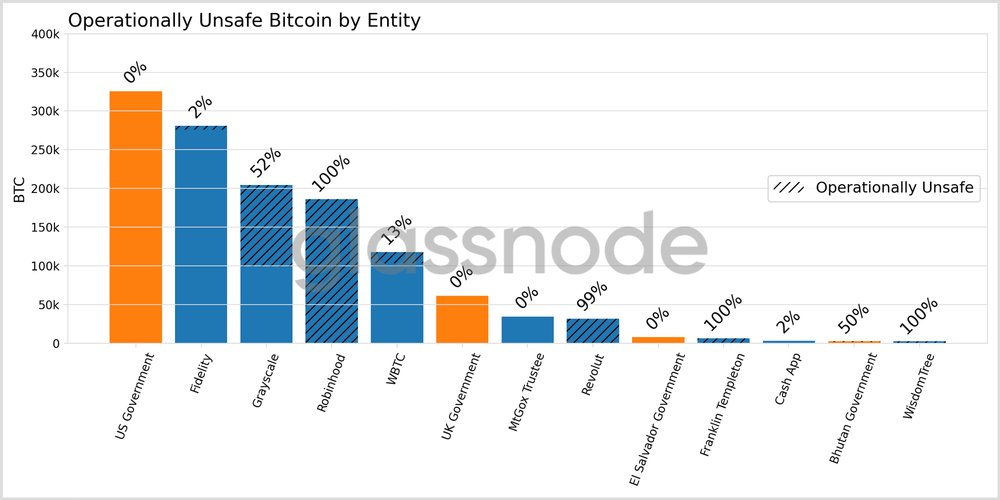
Source: Glassnode
Entity-level data shows that the holdings of some large corporate entities are exposed. This includes 100% of BTC held by Franklin Templeton, WisdomTree and Robinhood, 99% of neobank Revolut’s Bitcoin, 52% of Grayscale’s holdings and just 2% of Fidelity’s Bitcoin stash.
Related: Bernstein says Bitcoin market already priced in quantum risk
Looking at the exposed tokens of cryptocurrency exchanges, only about 5% of BTC held on Coinbase is exposed, compared to 85% of Binance’s BTC and about 100% of the holdings on Bitfinex exchange.
To reduce exposure, exchanges and custodians are advised to reduce key reuse, improve address hygiene and plan a migration into a quantum-proof format to position for a future quantum breakthrough, wrote Glassnode.
Magazine: Bitcoin vs. the quantum computer threat — Timeline and solutions (2025–2035)


OpenAI is preparing to file for an IPO very soon, potentially as early as this Friday, according to a new exclusive Wall Street Journal report.
The ChatGPT maker is working with bankers at Goldman Sachs and Morgan Stanley on a confidential draft prospectus for regulators.
The post OpenAI IPO Filing Looms: Crypto Liquidity Crunch Incoming? appeared first on BeInCrypto.

Disclosure: This article does not represent investment advice. The content and materials featured on this page are for educational purposes only.
Hyperliquid highlights shift in crypto design as user experience overtakes token-first product narratives.
Summary
- Hyperliquid shows crypto is shifting from token-driven hype to product-driven usage, dominating perpetual futures volume without incentives.
- Nika Finance builds on this shift with a mobile-first, non-custodial trading app combining spot, perps, staking, yield, and prediction markets.
- Nika reflects the new model where small teams ship fast, integrate proven infra like Hyperliquid, and compete on product rather than token narratives.

For most of the last decade, a useful generalization about crypto products was that the token mattered more than the product. The user experience could be inelegant, the workflow could be confusing, the latency could be poor, and most of it could be explained away by the technical constraints of the underlying chain. The promise was that the token would carry the product, and the product itself could catch up later.
That generalization is no longer holding. The clearest evidence is Hyperliquid.
According to multiple industry trackers, Hyperliquid now processes more monthly perpetual futures volume than its next several competitors combined. There is no airdrop campaign explaining it. There are no incentives war driving the migration. There is no narrative cycle propping up the volume. Users are using Hyperliquid because the product is materially better than the alternatives at the specific thing it does. That is, by crypto standards, an unusual thing to say about a piece of category infrastructure. It is also the correct thing to say.
What makes Hyperiquid different?
What Hyperliquid demonstrated is not a particular technical breakthrough. The matching engine performance is excellent, but the more important fact about it is that the user can feel the difference. The fees are predictable. The order book is deep. The execution is quick. The funding rates are visible. The UI behaves like a serious trading interface rather than a DEX demo. Each of those is a small thing. The accumulation of them is the story.
This is the part the industry spent the last cycle convincing itself was not necessary. The theory was that the token would carry the product. Yield farming, airdrops, retroactive distribution, points programs, all of these were the engines of growth. The product itself could be rough; the user would tolerate it for the upside. For a few years that theory worked, because the upside was real. When the upside thinned out, so did the user base, and what remained was a category full of products that had never had to earn their users in the first place.
A wave of products is forming around the opposite premise. The pattern is consistent across the teams, making the most credible runs at their categories right now: deep investment in product, very little investment in narrative, and an unusually short distance between user feedback and shipped change. None of these teams use the word “discipline” about themselves. This is not ideology. It is an adaptation. They are responding to the same observable fact, which is that the product is now the unit of competition, not the token or the narrative around either.
There are reasons this happened, and they are not personal to the founders running the products. The user base that drove the last cycle has either left or grown more discerning. The capital that used to subsidize narrative-heavy teams is not coming back at the same valuations. Most importantly, on-chain transparency made it possible to compare products against each other on metrics that are real rather than reported. A product that does not perform at the level its marketing claims gets caught within weeks. The penalty is immediate, and the recovery is slow.
Nika is building on top of what Hyperliquid started
A useful example of how this pattern looks at the consumer-facing application layer is Nika Finance, a non-custodial application combining spot trading, perpetuals, staking, yield, and prediction markets powered by Polymarket across multiple chains in a mobile-first interface. The product is live. The team operating it is three people. The traction has accumulated without a marketing engine.
The relevant point about Nika in the context of this argument is not that it competes with Hyperliquid. It does not. Nika’s perpetuals layer is powered by Hyperliquid through builder codes, which is a concrete instance of what the new pattern looks like in practice: a consumer application built on top of the perps infrastructure Hyperliquid set the new bar for. The argument is not that Nika has built a better Hyperliquid. The argument is that Hyperliquid’s product quality has made it the underlying engine for a generation of consumer applications, and Nika is one of them.
“For most of the last cycle, crypto products competed primarily on token incentives and financial engineering. Hyperliquid showed that users will move aggressively toward products that are simply better to use. We are building with that same assumption,” said Daniel Brinzan, founder of Nika Finance.
The implication for the next few years is that the easy part of crypto product strategy is over. The token mechanics that used to substitute for product work are still possible to deploy, but they will produce smaller and shorter-lived returns than they did during the cycle just past. The work that was previously deferable, the work of making the user experience genuinely good, is no longer deferable. Teams that internalize this early will compound faster than teams that arrive at the same conclusion through losing users.
Hyperliquid did not change the rules by getting bigger. It changed them by being noticeably, durably better in its category than its competitors. That distinction matters for the next wave of teams trying to build serious products in serious categories. The audience has now seen what good actually looks like. It is going to be harder, after this, to convince users to put up with less.
Disclosure: This content is provided by a third party. Neither crypto.news nor the author of this article endorses any product mentioned on this page. Users should conduct their own research before taking any action related to the company.

Key Highlights
- MDT stock declined 1.44% following the $650M SPR Therapeutics acquisition reveal.
- SPR’s temporary 60-day peripheral nerve stimulation technology enhances Medtronic’s pain therapy range.
- Strategic move targets chronic pain market affecting approximately 50 million Americans.
- Transaction reinforces Medtronic’s position in the neuromodulation sector.
- Transaction anticipated to finalize during first half of Fiscal 2027.
Shares of Medtronic (MDT) retreated 1.44% to close at $77.45, pulling back from earlier session peaks around $79. The stock’s decline came after the medical device giant revealed plans to acquire SPR Therapeutics, Inc. through an all-cash transaction valued at $650 million. This strategic purchase is designed to bolster Medtronic’s neuromodulation capabilities and pain therapy solutions.
Strategic Expansion of Pain Therapy Solutions
Medtronic plans to acquire all outstanding shares of SPR, a pioneering company in temporary peripheral nerve stimulation technology. This strategic acquisition enhances Medtronic’s capacity to deliver minimally invasive, short-duration pain management alternatives. The deal is consistent with the company’s broader initiative to reinforce its core business segments.
SPR’s FDA-approved SPRINT PNS System provides temporary pain relief for up to 60 days without requiring permanent device implantation. The technology seamlessly fits into current clinical practices and facilitates early-stage treatment intervention. This methodology expands treatment availability and minimizes reliance on permanent surgical procedures.
With chronic pain impacting approximately 50 million adults across the United States and restricting everyday activities, the acquisition enables Medtronic to serve this substantial patient demographic more comprehensively. Furthermore, the transaction reflects increasing market preference for non-opioid, minimally invasive therapeutic options.
Industry Position and Business Rationale
Medtronic brings more than five decades of expertise in neuromodulation technology and offers the most comprehensive pain therapy portfolio in the industry. The peripheral nerve stimulation market segment is experiencing robust expansion, supported by substantial clinical data and widening insurance coverage. Clinical results from more than 6,100 patients who received the SPRINT PNS System showed that over 71% achieved significant pain reduction or enhanced quality of life.
The acquisition adds depth to Medtronic’s neuromodulation product range across various treatment phases. It works in conjunction with the company’s existing permanent implantable devices and temporary intervention options. The combined offerings are projected to improve patient results and accelerate clinical implementation.
The deal remains contingent upon standard regulatory clearances and closing requirements. Both Medtronic and SPR will continue autonomous operations pending transaction completion. The anticipated closing timeframe falls within the opening half of Medtronic’s Fiscal Year 2027.
Investment and Growth Considerations
The $650 million transaction represents a significant commitment to Medtronic’s expansion plans. It demonstrates the company’s dedication to advancing patient-focused innovation within pain management. SPR’s specialized platform strengthens Medtronic’s competitive stance in the dynamic neuromodulation marketplace.
Market observers may view the acquisition as an extension of Medtronic’s ongoing efforts to enhance its therapeutic product lineup. The transaction emphasizes the company’s concentration on minimally invasive, clinically validated treatments. This move could impact future revenue performance and competitive positioning.
Medtronic’s move to purchase SPR mirrors larger healthcare technology market dynamics. Industry leaders are increasingly pursuing therapies that shorten recovery periods and enhance patient well-being. The acquisition corresponds with prevailing sector movements toward early-stage, temporary, and non-opioid pain management solutions.

United Fire Group, Inc. (UFCS) Shareholder/Analyst Call Prepared Remarks Transcript
Super Micro Computer (SMCI) Stock Rallies 8% Following Strong Q3 Earnings Beat

McLaughlin: What Does Settlement Mean for Pac-12, MW?


![These 4 Things Terrify Me About Bitcoin Right Now [URGENT!!]](https://wordupnews.com/wp-content/uploads/2026/05/1779296261_maxresdefault-80x80.jpg)

-

 Crypto World5 days ago
BloFin War of Whales 2026 Grand Prix opens registration for $5M trading championship
-

 Fashion5 days ago
Weekend Open Thread: Theory – Corporette.com
-

 Crypto World5 days ago
E-Estate Announces 1 Year Live: Washington DC Summit as Real Estate Tokenization Enters Its Next Phase
-

 Tech5 days ago
Tech Moves: Microsoft AI leader jumps to OpenAI; former AI2 exec joins Meta; and more
-

 Tech5 days ago
Google reimburses Register sources who were victims of API fraud
-

 Crypto World6 days ago
Google’s Gemini AI Predicts Incredible Solana Price by the End of 2026
-
 Business5 days ago
H&R Real Estate Investment Trust (HR.UN:CA) Q1 2026 Earnings Call Transcript
-
 Entertainment6 days ago
Zara Larsson Has Blunt Response To Chris Brown Diss
-

 Sports5 days ago
Napoleonic enters 2026 Doomben 10,000 field via Abounding withdrawal
-
 Crypto World7 days ago
Two AI Tokens Lead May Rally, But Risks Are Rising
-

 Crypto World5 days ago
BeInCrypto 100 Institutional Awards Nomination: KAST for Best Digital Assets Neobank and Best Digital Assets Fintech
-

 Fashion4 days ago
On the Scene at Gucci’s Cruise Show in New York City: Mariah Carey, Kim Kardashian, Lindsay Lohan, Iman, and More!
-
 Crypto World5 days ago
Bitcoin Battles US Bond Nerves With BTC Price Dip Toward New May Lows
-
 Crypto World5 days ago
Wall Street’s Boldest Gold Prediction Has Russians Rushing to Buy
-

 Fashion4 days ago
Trending Western Style Vests Perfect for Summer
-

 Crypto World5 days ago
ICE and CME urge US regulators to curb Hyperliquid energy trading
-

 Politics6 days ago
DWP PIP Timms review continues to be an absolute farce
-

 Entertainment5 days ago
David Letterman Returns to Late Show, Blasts Cancellation
-

 Fashion4 days ago
Amazon Sundays: Memorial Day Hosting
-

 Crypto World5 days ago
IREN closes $3 billion convertible notes deal amid AI infrastructure expansion
You must be logged in to post a comment Login