
Crypto World
Dogecoin leads market rebound with 15% pump, bitcoin steady above $85,000

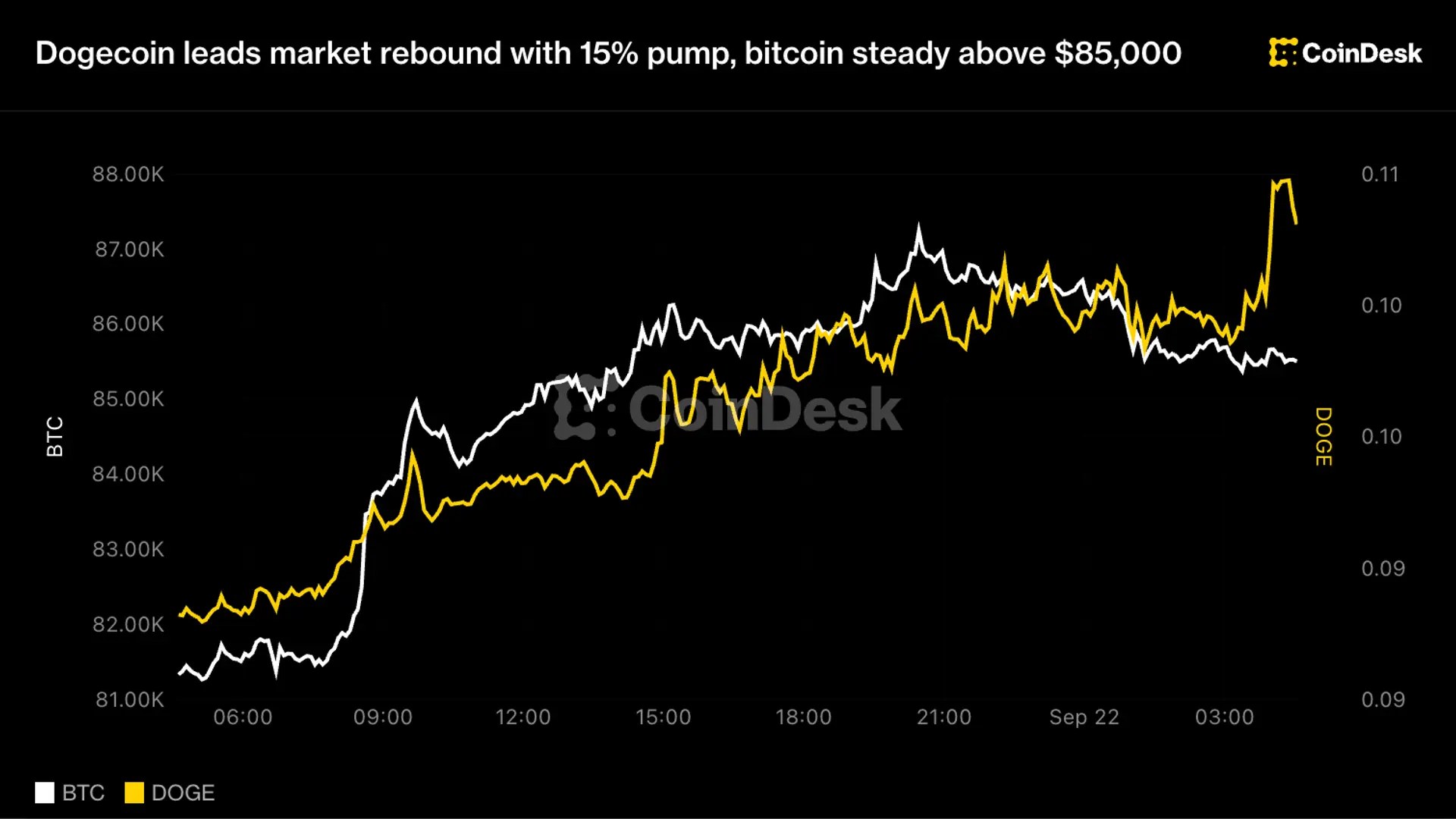
XRP added 7% to nearly $1.52 and SOL 5% to just under $117. Ether rose 3% to nearly $2,740, while BNB and TRX each picked up between 1% and 2%. ZEC was the only large token to fall, down 4% to just above $1,450.
Liquidations in the past hour came to under $11 million, down from more than $300 million an hour at the peak of Monday’s move, which leaves the next leg dependent on buyers rather than sellers being forced out.
AI trade roars back
Equities set a firm tone through the Asian session, meanwhile.
MSCI’s Asia Pacific gauge rose nearly 1% for a fifth straight day of gains, led by chipmakers Samsung Electronics and SK Hynix, which tracked Monday’s rally in U.S. semiconductor stocks. South Korea’s Kospi advanced 2% and Taiwan’s benchmark hit an intraday record.
Artificial intelligence is doing the pulling. The Wall Street rally followed early signs of success for Meta Platforms’ new AI agent, and AMD is on course to pass $1 trillion in market value.
Meta Platforms released Muse, an AI agent that works across Facebook, Instagram and WhatsApp, nearly two weeks ago and it has since passed ChatGPT to become the top free app on Apple’s U.S. App Store. The app has drawn nearly 3 million installs worldwide and almost 40% more iOS downloads in the U.S. and Canada than ChatGPT managed in its own first 12 days on mobile, data from app-tracker Apptopia shows.


Trueo has announced plans to move its prediction market protocol from Base to Ethereum mainnet and asked users to avoid new Base markets expiring after January 31, 2027.
Summary
- Trueo plans to move prediction markets from Base to Ethereum while existing markets continue operating.
- January 31, 2027 is Trueo’s cutoff for creating new Base markets with later expirations there.
- TRUE holders will receive open-ended migration windows, with future staking rewards moving to Ethereum mainnet.
- Vitalik Buterin praised Trueo’s decentralization focus and interest in meaningful prediction-market applications on Ethereum L1.
- Trueo’s official deployment documentation still lists Base contracts, showing the Ethereum migration remains incomplete.
Trueo said in its migration announcement that the Base application will remain available while the Ethereum deployment is prepared. Trading, market resolution and redemptions will continue, while existing markets will remain accessible through their expiries. The project said TYD used as collateral will keep earning yield during the transition.
Launched on Base in March 2025, the protocol runs binary YES-or-NO prediction markets onchain. Trueo’s documentation describes trading as non-custodial, with transactions executed directly onchain through a custom Uniswap v4 hook. TYD serves as the payment asset for current market positions and oracle bonds under the present deployment.
Trueo keeps Base markets running during Ethereum move
For existing users, the migration will not immediately shut down the Base version. Trueo said markets expiring during 2026 can still be created there, while existing markets will continue operating under their current settlement system. New market ideas requiring an expiry after January 31, 2027 should wait for the Ethereum instance, according to the project.
TRUE, the protocol’s governance and oracle token, will move to Ethereum through an open-ended migration. Trueo has not announced a deadline for token holders to complete the process. The project said future staking and liquidity incentives will operate on Ethereum once the new deployment becomes available.
Current public data shows that the move has not been completed. Trueo’s official deployment documentation still lists its TruthMarketManager, OracleCouncil, OracleBonds, OrderManager and market master contracts on Base mainnet. No Ethereum mainnet deployment addresses appear on that page.
DefiLlama’s Sept. 22 snapshot attributes all $796,126.31 of tracked Trueo TVL to Base. The same data records $9,727.92 in DEX volume during the previous 30 days and identifies Base as holding 100% of tracked protocol TVL.
Ethereum liquidity and integrations drove Trueo’s decision
Explaining its decision, Trueo cited Ethereum’s network effects, available liquidity, integration options and long-term infrastructure. The team said lower execution costs on Ethereum have made mainnet more practical for its product, while the network’s roadmap offers what Trueo described as a neutral and predictable base for development.
Trueo framed Base as useful during the protocol’s earlier experimental period instead of criticizing the Coinbase-linked Layer 2. The team said Ethereum better fits its intended model of a widely integrated, permissionless and highly immutable prediction market, while liquidity growth and reduced trust assumptions remain priorities for the next deployment.
Ethereum’s existing DeFi environment formed another part of the project’s stated reasoning. Trueo said direct access to Ethereum applications and liquidity could provide more integration paths. The team described the Ethereum L1 prediction-market field as less crowded than several competing blockchain environments, presenting that assessment as part of its own migration case.
Vitalik Buterin praises Trueo’s prediction market model
Ethereum co-founder Vitalik Buterin responded publicly on Sept. 21, welcoming what he described as a new prediction-market contender on Ethereum L1. Buterin praised Trueo’s stated focus on decentralization and ethical design, calling it “not corposlop” and saying prediction markets could be used for “interesting and meaningful things.”
His response follows months of public criticism of some prediction-market products. As crypto.news reported in February, Buterin warned that the sector was becoming heavily focused on short-duration cryptocurrency price wagers and sports betting. He described the direction as an “unhealthy product market fit” and discussed hedging and real-world risk management as other possible uses.
In related crypto.news coverage, Buterin proposed prediction-market-style mechanisms as one layer of future onchain governance, paired with a separate preference-setting system intended to resist capture. His latest Trueo comments did not announce an Ethereum Foundation partnership, grant, investment or other formal arrangement with the project.
Trueo plans a new oracle system on Ethereum
Trueo said work surrounding the Ethereum deployment will include a next-generation oracle system for disputed prediction-market outcomes. The migration announcement did not give a launch date or publish Ethereum contract addresses, leaving the Base contracts as the only deployment currently listed in Trueo’s public documentation.
The current protocol uses an optimistic resolution process. Trueo’s resolution documentation says any participant can propose an outcome once a market meets its resolution criteria, beginning a 12-hour challenge period. If nobody raises a valid dispute, the proposed result becomes final at the end of the window.
When a participant challenges an outcome, Trueo’s existing dispute path can move through several levels. The Oracle Council handles an early arbitration stage, followed by escalation to TRUE holders when a further challenge meets the required conditions. At the final level, the protocol randomly selects 11 attesters to determine the market outcome and applicable slashing conditions.
Market definitions are committed onchain when users create them. Trueo records the market question, approved resolution sources and supporting resolution information as immutable strings, according to its documentation. The project says the setup prevents the written market terms from being changed after deployment.
Its published integrity standards prohibit markets that directly create incentives for targeted violence, terrorism, self-harm or other dangerous conduct. Markets lacking clear, publicly verifiable resolution criteria must be canceled under the protocol’s stated rules.
Trueo has not published a deadline for launching its Ethereum deployment or completing the TRUE token migration. During the transition, the project says Base trading, resolution and redemptions will continue, while future staking and liquidity reward programs are scheduled to operate on Ethereum after the mainnet instance goes live.

Kakao Pay and KakaoBank have signed a memorandum of understanding with Fireblocks to explore stablecoin infrastructure and other digital asset services in South Korea.
Summary
- Kakao Pay and KakaoBank signed an MoU with Fireblocks to test stablecoin infrastructure in Korea.
- Three companies will run proof-of-concept tests covering regulatory, security and service requirements for digital assets.
- More than 2,500 institutions, including over 100 banks, use Fireblocks infrastructure, according to company figures.
- Kakao Group previously signed a July MoU with Circle covering blockchain payments and stablecoin services.
- South Korea continues drafting digital asset rules while banks and fintech firms test stablecoin infrastructure.
Fireblocks said in its Sept. 21 announcement that the three companies will test digital asset distribution frameworks through proof-of-concept programs designed around South Korean regulatory, security and service requirements. The agreement does not announce a stablecoin, investment amount, commercial product or deployment date.
The companies plan to examine infrastructure demand and possible digital asset businesses before deciding whether any framework should advance beyond testing. Fireblocks described secure onchain infrastructure as the central technical area covered by the agreement, with stablecoins receiving specific attention.
Kakao Pay and KakaoBank will test stablecoin infrastructure
Kakao Pay brings payments experience to the project, while KakaoBank provides the banking component of Kakao Group’s work on digital assets. Fireblocks identified both executives leading the companies, Shin Won-keun and Yun Ho-young, as co-heads of Kakao Group’s Stablecoin Task Force.
Under the MoU, no single technical design has been selected publicly. The Fireblocks release says the parties will assess distribution frameworks that fit Korea’s domestic rules and security standards before testing their practical use through PoCs.
KakaoBank CEO Yun said the parties expect to combine their technology and expertise to “develop secure and accessible digital asset services.” His statement describes an intended direction and does not confirm a product launch. Kakao Pay CEO Shin said Korea’s developing digital asset market “depends on the reliable flow of digital asset distribution.”
Neither Kakao company disclosed whether a future stablecoin would be issued directly by a bank, another Kakao entity or an outside issuer. The announcement does not specify a blockchain, token standard, reserve structure, custody model or consumer rollout plan.
Fireblocks brings institutional infrastructure to the PoC
Fireblocks says its platform has been deployed by more than 2,500 institutions, including over 100 banks. Company material says its technology supports custody, settlement, stablecoin payments, tokenization, trading and compliance operations across more than 200 blockchains.
Separate data published on Fireblocks’ website says its network processes more than $200 billion in monthly stablecoin volume through more than 300 payment service providers, fintech companies and banks. The figures are Fireblocks’ own platform statistics and have not been presented as Kakao transaction volumes.
Fireblocks CEO Michael Shaulov said infrastructure for Korean banks and payment platforms needs to be “engineered to meet institutional requirements from day one.” His statement accompanied the MoU and concerned the type of system Fireblocks expects the partners to study.
The agreement does not state whether Kakao Pay or KakaoBank has committed to use Fireblocks in a production environment. PoC testing will come before any announced commercial deployment, according to the companies’ stated sequence.
Kakao’s Circle agreement came before the Fireblocks deal
The Fireblocks pact follows Kakao Group’s July agreement with Circle, which covered stablecoin payments, blockchain settlement and digital asset infrastructure. As crypto.news reported in July, Kakao, Kakao Pay and KakaoBank planned to study KRW-based digital assets, cross-border payments and tokenized financial services alongside Circle.
Under the Circle arrangement, Kakao said it would combine its consumer platform network, Kakao Pay’s payment services, KakaoBank’s banking operations and Circle’s blockchain technology. The parties discussed payment and settlement infrastructure, remittances and connections between blockchain networks and existing financial systems.
No won-denominated stablecoin was launched under the July MoU. Crypto.news reported at the time that Kakao and Circle had not set a launch date or confirmed a particular issuance model, while Circle CEO Jeremy Allaire had previously said Circle did not plan to issue its own KRW stablecoin.
The Fireblocks agreement introduces another infrastructure provider into Kakao Group’s stablecoin research without replacing or ending the Circle arrangement. Fireblocks’ announcement does not describe Circle’s role in the new PoCs or state whether the two relationships will share technology.
South Korea is still developing stablecoin rules
Kakao is not the only Korean financial group testing stablecoin systems before final rules take shape. In related crypto.news coverage, KB Financial Group completed a proof of concept in May covering won-denominated stablecoin issuance, offline QR payments, merchant settlement and a Vietnam remittance test.
Toss followed with another trial in July. As crypto.news reported, the financial app operator partnered with Optimism and Sunnyside Labs for a three-month technology program examining payment settlement, compliance and privacy requirements for won-linked stablecoins.
Work on the legal framework remains unfinished. South Korea’s Financial Services Commission has said its planned framework law for digital assets will include stablecoins, while regulators continue preparing rules covering blockchain-based financial infrastructure.
The FSC said in August that discussions over the government’s second-stage digital asset legislation were still underway and cautioned that some reported provisions had not been finalized. The regulator specifically rejected claims that a proposed ownership cap for major crypto-exchange shareholders had already been settled.
A Bank of Korea payment systems report published Sept. 17 said the central bank had created a Digital Asset Research Section after South Korea’s Virtual Asset User Protection Act took effect. The BOK said the unit has participated in legislative discussions concerning KRW-denominated stablecoins while the country develops its digital asset framework.

Prediction market platform Trueo says it will migrate from Base to Ethereum, positioning the move around broader integrations and the next phase of its oracle infrastructure—an onchain component that helps determine outcomes for markets that settle on real-world data.
Trueo launched on Base in March 2025. After the migration, the team says its near-term focus will be pulling in more liquidity while also developing the next generation of its oracle system, which is central to how prediction markets get resolved.
Key takeaways
- Trueo plans to move its prediction markets from Base to Ethereum to pursue wider integration options.
- The project links the migration to building a more advanced oracle system used to verify real-world outcomes.
- Trueo argues Ethereum is better suited for a “fully permissionless” and highly credible oracle approach than staying within Base’s tighter ecosystem.
- The platform is already a top onchain prediction venue, with DefiLlama listing it among the largest by total value locked.
Why Trueo is leaving Base for Ethereum
Trueo’s core rationale is product reach. In its public messaging, the project said it expects Ethereum to provide “higher integration potential” and more upside for its roadmap, while Base would constrain partnerships and integrations mostly to the immediate Base ecosystem.
The team’s framing is less about trading or execution and more about credibility and neutrality at the oracle layer. Trueo’s co-founder, who goes by “Lumberg,” said Ethereum offers the “best” environment for an oracle designed to be credibly neutral and truthful for prediction markets.
That argument also reflects timing and development tradeoffs from Trueo’s initial deployment. Trueo noted that when it launched, Ethereum mainnet gas costs were still relatively high, and some product features were still experimental—factors that made starting on an L2 like Base pragmatic.
Oracle upgrades are central to the migration
For prediction markets, oracles are not a background detail—they are the mechanism that translates real-world events into blockchain-resolved outcomes. Trueo said that attracting liquidity will be a priority after the move, but the larger effort is the rollout of the next generation of its oracle system.
By highlighting oracle development alongside the chain migration, Trueo is effectively treating the migration as a foundation for scaling the reliability and adoption of its market-resolving process. In the team’s view, the “final form” of Trueo is meant to become a platform that is widely adopted and broadly integrated, with a high standard of credibility tied to how its markets are resolved.
From early-stage L2 to a broader, integrated platform
Trueo’s explanation underscores a common lifecycle pattern for crypto startups: begin on a scaling-friendly network while experimenting, then move toward broader connectivity as the product matures. In Trueo’s case, the company specifically contrasted the properties it could aim for on Ethereum—such as being more widely integrated and permissionless—with the limitations it believes exist when remaining within a single L2 ecosystem.
In comments posted publicly, Trueo also described Ethereum as the “best fit” for combining permissionless operation, strong immutability characteristics, and credible oracle behavior—qualities it says align with its ambition to be a widely adopted prediction market platform rather than a niche app confined to a single rollup.
Where Trueo stands in onchain prediction markets
Trueo is already recognized among the larger onchain prediction venues. DefiLlama ranks the platform as the 14th-largest onchain prediction market by total value locked, with TVL reported at $795,687 at the time of publication.
That matters because migration decisions in the prediction market sector can directly affect liquidity and user participation. Even when the underlying smart contracts and oracle logic evolve, chain selection influences where users already operate, where liquidity pools exist, and how quickly new partnerships can integrate.
Trueo’s plan to prioritize liquidity following the move suggests the team is aware of those transition risks—particularly in a category where market depth and participation can be sensitive to where markets are hosted.
As Trueo executes its Ethereum migration, readers should watch for two things: how quickly liquidity can be reassembled on the new chain, and what changes land in its next-generation oracle system—since the oracle design is likely to determine how credible and widely usable its prediction market resolution process becomes.
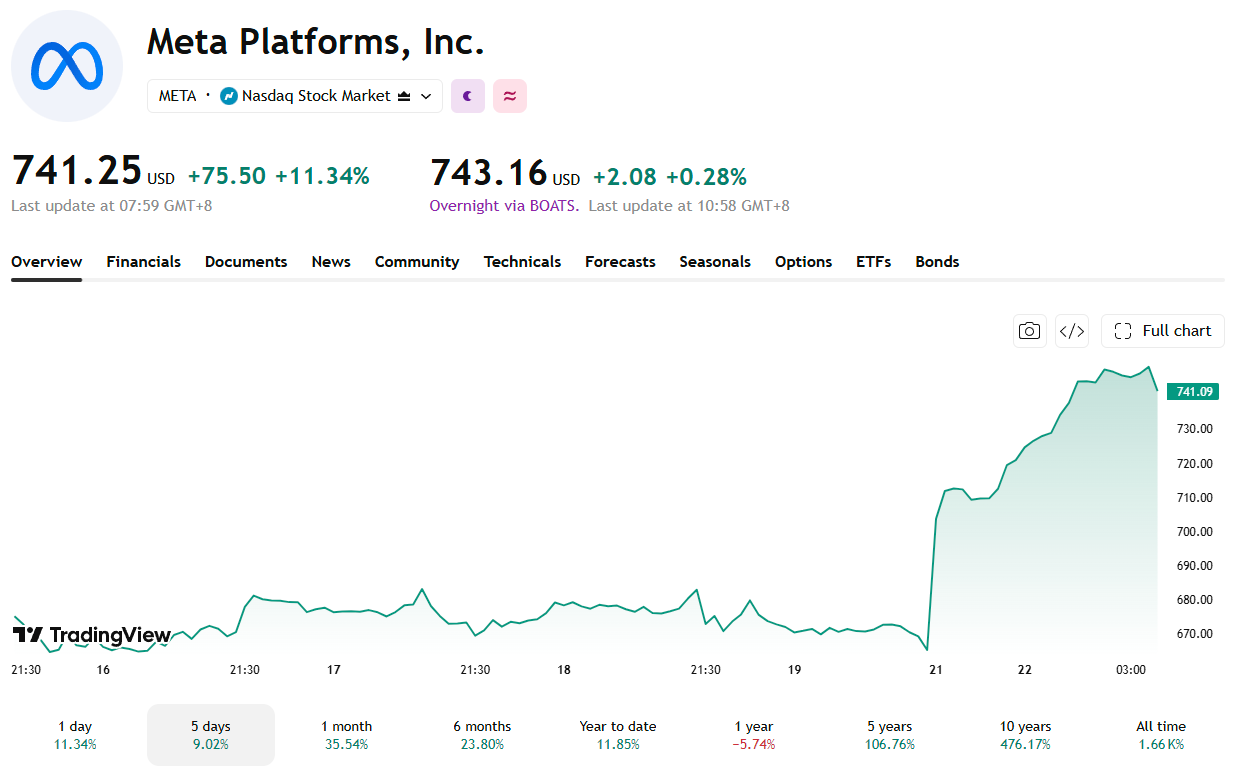
Meta Platforms (META) stock jumped 11% on Monday, closing at $741.25. Wells Fargo raised its price target to $796 from $640.
Analyst Ken Gawrelski cited early demand for Muse, Meta’s new AI agent. He said it gives Meta a credible AI story ahead of Wednesday’s Connect conference.
Muse Turns Heads on the App Charts
Meta launched Muse on Sept. 8. The AI agent completes tasks such as filling out forms, booking appointments, and sending emails, rather than only answering questions. It runs on Muse Spark, the model family Meta built for agentic work.

Muse briefly topped Apple’s US App Store chart for free apps. Rankings varied by tracker. Some trackers placed it fourth or fifth overall, with a stronger number two ranking in the Productivity category.
The analytics firm Sensor Tower estimated US iOS downloads. They climbed from the tens of thousands at launch to the hundreds of thousands within two weeks. Meta has not confirmed those figures itself.
That marks a shift after a stretch of AI model delays and heavy infrastructure spending. Those concerns once had Wall Street rotating out of Meta stock and into rivals.
Chief executive Mark Zuckerberg brought in former Scale AI chief executive Alexandr Wang to rebuild the company’s AI lab, a move analysts now tie to Muse’s launch.
Appetite for Frontier AI Outweighs Safety Worries
The rally lands as debate continues over AI development. Critics ask whether the hype outpaces the real risk. Zuckerberg has pushed back on AI doomsday warnings, arguing competitive pressure among labs already keeps development in check.
He has also framed Meta’s ambitions in broader terms. He says superintelligence should reach everyone, not stay locked inside a handful of labs.
Monday’s move suggests those safety debates have done little to cool demand for shares tied to frontier AI progress . The S&P 500 closed up 1.49% at 7,764. The Nasdaq Composite gained 2.26% to 27,122, though Meta’s surge outpaced both. Alphabet (GOOGL) added 1.55% to $354.97, and Snap (SNAP) rose 3.07% to $5.70.
Meta heads into Wednesday’s Connect conference facing one key question. Can Muse’s early buzz turn into real usage numbers, not just app store rankings? That answer could confirm whether the AI turnaround finally pays off.
The post Meta Jumps 11% As Muse Shines and Investors Show an Appetite for Advancing AI appeared first on BeInCrypto.

U.S. federal prosecutors have been investigating whether Binance knowingly allowed trading that violated Iran sanctions, nearly three years after its $4.3 billion federal settlement, according to a Sept. 22 Bloomberg report.
Summary
- U.S. prosecutors are examining whether Binance knowingly allowed trades that violated existing sanctions targeting Iran.
- Manhattan prosecutors lead the reported probe, while the Justice Department’s Criminal Division is participating too.
- $61 million in crypto is targeted in a civil forfeiture case tied to Iranian oil.
- Binance says it maintains zero tolerance for sanctions violations and fully cooperates with law enforcement.
- Binance pleaded guilty in 2023 and agreed to pay $4.3 billion in U.S. penalties overall.
Bloomberg said the Manhattan U.S. Attorney’s Office is leading the inquiry, while the Justice Department’s Criminal Division in Washington is participating. Prosecutors are examining Binance’s compliance controls and whether the exchange knew about the transactions under review, according to the report. Reuters said it had not independently verified Bloomberg’s account.
Binance responded that it maintains a zero-tolerance policy for sanctions violations. The exchange said, “We fully cooperate with law enforcement, and we remain committed to rooting out and shutting down bad actors.” The Justice Department declined to comment to Reuters, while the Manhattan U.S. Attorney’s Office was not immediately available for comment outside normal business hours.
Binance Iran sanctions probe focuses on compliance controls
The reported investigation centers on whether Binance knowingly permitted trading that should have been stopped under U.S. sanctions, according to Bloomberg’s account cited by Reuters. The report did not identify the transactions under review or disclose when prosecutors began examining them.
Scrutiny of the exchange’s Iran-related controls had surfaced months earlier. In March, crypto.news reported that Senators Elizabeth Warren, Chris Van Hollen and Ruben Gallego planned congressional oversight of a reported Justice Department investigation involving Iran-linked transactions. At the time, the inquiry was described as examining whether networks connected to Iran used Binance to evade U.S. sanctions.
Binance disputed claims made in several February reports. In a March 6 response to a Senate inquiry, the company described parts of the reporting as “demonstrably false, unsupported by credible evidence, and defamatory in several material respects.” Binance said its know-your-customer rules prohibit users residing or located in Iran from accessing Binance.com.
$61 million forfeiture complaint names Binance-linked accounts
A separate court action filed on Sept. 14 provides fresh public records concerning Iran-linked funds that moved through accounts on Binance. The Southern District of New York filed a verified civil forfeiture complaint seeking all USDT held in 10 cryptocurrency addresses, court records show. The case is United States v. All USD Tether Held in the Following Cryptocurrency Addresses, No. 1:26-cv-08010.
Prosecutors valued the targeted cryptocurrency at approximately $61 million and alleged it represented proceeds from black-market Iranian crude oil and petroleum sales. The complaint says the money was intended to finance Iranian government and military bodies, including the Islamic Revolutionary Guard Corps.
The filing alleges two Chinese companies, Blessed Trust and Hexa Whale, used Binance trading accounts while handling proceeds connected with Iranian oil sales. Prosecutors said a network of cryptocurrency actors laundered more than $1.5 billion in illicit oil proceeds, while Blessed Trust and Hexa Whale used the U.S. financial system to send or receive tens of millions of dollars.
The forfeiture complaint does not accuse Binance itself of wrongdoing in that proceeding. The Justice Department states that a civil forfeiture complaint contains allegations that remain unproven until a court enters judgment for the government. As crypto.news reported in related coverage, the case is directed at the cryptocurrency held in the identified wallets, not a criminal charge against Binance.
Court records describe the assets as USDT held on addresses operating on the TRON network. The complaint says Tether would burn the tokens covered by a seizure warrant and issue replacement tokens of equal value for transfer into U.S. government custody.
Binance says the firms were offboarded after reviews
Binance has given its own timeline for Hexa Whale and Blessed Trust. In its March congressional response, the exchange said law enforcement contacted it in April 2025 about transactions between Binance wallets and outside addresses with possible terrorism-financing connections. Binance said it supplied KYC and transaction records connected with Hexa Whale in June 2025 and continued reviewing the account afterward.
The company said it removed Hexa Whale from Binance.com on Aug. 13, 2025. A separate set of law-enforcement requests concerning transactions involving other outside wallets arrived during summer 2025, according to Binance. The exchange said investigators then performed a source-of-funds review and offboarded Blessed Trust in January 2026.
Binance maintains that, to its knowledge, no Binance account transacted directly with an Iran-based entity. In another March statement, the company said its investigation found approximately $126.1 million eventually reached wallets linked to Iran after multiple blockchain hops, with as much as $24.1 million reaching IRGC-related wallets. The figures are Binance’s account of its internal review and have not been presented by the company as findings of a court.
The exchange said claims that it fired compliance employees for escalating concerns were false. Binance acknowledged that one employee was dismissed after an internal investigation over what the company described as an unauthorized disclosure of user information, while other compliance workers left voluntarily.
Binance has pointed to staffing and monitoring data while defending its controls. The company says more than 1,500 people work in compliance-related functions, representing roughly 25% of its global workforce. It reported processing more than 71,000 law-enforcement requests during 2025 and claimed exposure to four major Iranian crypto exchanges fell 97.3%, from $4.19 million to $110,000 over two years.
2023 guilty plea imposed monitors and compliance reforms
The current scrutiny follows Binance’s November 2023 criminal resolution with U.S. authorities. The exchange pleaded guilty to offenses involving the Bank Secrecy Act, operating an unregistered money-transmitting business and violating the International Emergency Economic Powers Act. Binance agreed to a total criminal financial penalty of $4.316 billion.
In that case, the Justice Department said Binance knowingly failed to install controls that would stop U.S. customers from trading with users in sanctioned jurisdictions. Federal prosecutors said Binance caused more than $898 million in trades between U.S. users and users ordinarily resident in Iran from January 2018 through May 2022.
The settlement required Binance to retain an independent compliance monitor for three years and improve its anti-money-laundering and sanctions systems. Separate coordinated resolutions involved FinCEN, the Treasury Department’s Office of Foreign Assets Control and the Commodity Futures Trading Commission.
Later scrutiny centered on whether the post-settlement controls were functioning as required. As crypto.news previously reported, Treasury-related oversight gave authorities access to Binance books, records and systems under separate monitoring obligations, while Iran-linked transaction reports prompted renewed questions about compliance.
Meanwhile, the Sept. 14 forfeiture matter is proceeding separately in the Southern District of New York. Prosecutors are seeking a judgment allowing the United States to retain the USDT named in the complaint, while the filing itself states that its allegations remain unproven unless the court awards judgment to the government.

Cardano has been added to the official x402 software kit, giving developers the code needed to let an app or AI agent pay for an online service using ADA or tokens issued on the network.
x402 turns the web’s largely unused “402 Payment Required” response into a checkout built directly into an internet request. A service sends back its price and payment instructions, the agent signs a payment and receives the requested data or computing power after the transaction is verified.
That means an agent preparing a report could buy a single dataset when it needs it, without a person opening an account, entering card details or paying for a monthly subscription.
Coinbase created x402 in 2025 before contributing it to a Linux Foundation-backed organization whose members include Visa, Mastercard, Stripe, Google and Amazon Web Services. Solana, the XRP Ledger and several Ethereum-compatible networks already support the standard.
Cardano Foundation engineers began with a specification accepted in June, then built the client and server software needed to request payments alongside a so-called facilitator that verifies and submits them. The initial release supports TypeScript, with Python planned next.
Prediction market platform Trueo plans to migrate from Base to Ethereum, citing broader integration opportunities and plans to build the next iteration of its oracle system.
The project, which launched on Base in March 2025, said its priority after the migration will be attracting liquidity and launching the next generation of its oracle, the system used to verify real-world outcomes that are used to resolve prediction markets.
Trueo said it chose to move from Base to Ethereum because it offered higher integration potential and product upside, while on Base, integrations are limited to the immediate ecosystem.
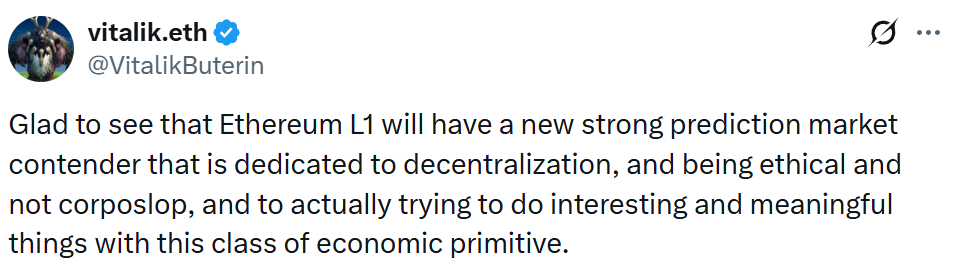
“Ethereum is the best chain for the most credibly neutral and truthful oracle system and prediction markets,” Trueo co-founder known as “Lumberg” said on X.
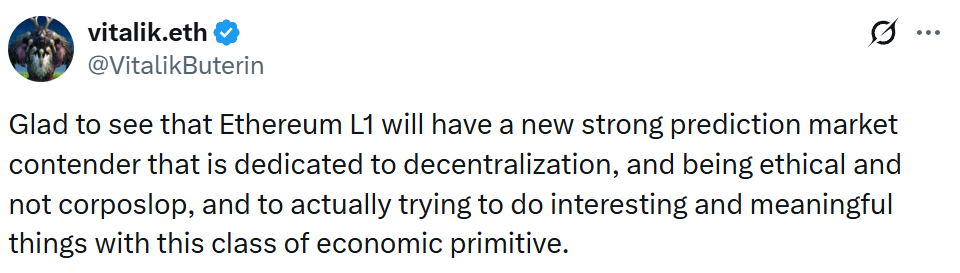
Source: Vitalik Buterin
“As a new app and experiment, an L2 like Base was the right choice for many reasons. At the time, Mainnet gas costs were still elevated and some features of our app were experimental,” Trueo said on X.
“The final form of Trueo is to be a platform that is widely adopted, broadly integrated, fully permissionless, mostly immutable, and highly credible. Ethereum is the best fit for this combination of properties.”
Trueo is ranked as the 14th-largest onchain prediction market with a total value locked of $795,687, according to DefiLlama.
Related: World Cup generated $20B in blockchain prediciton market volume: Chainalysis
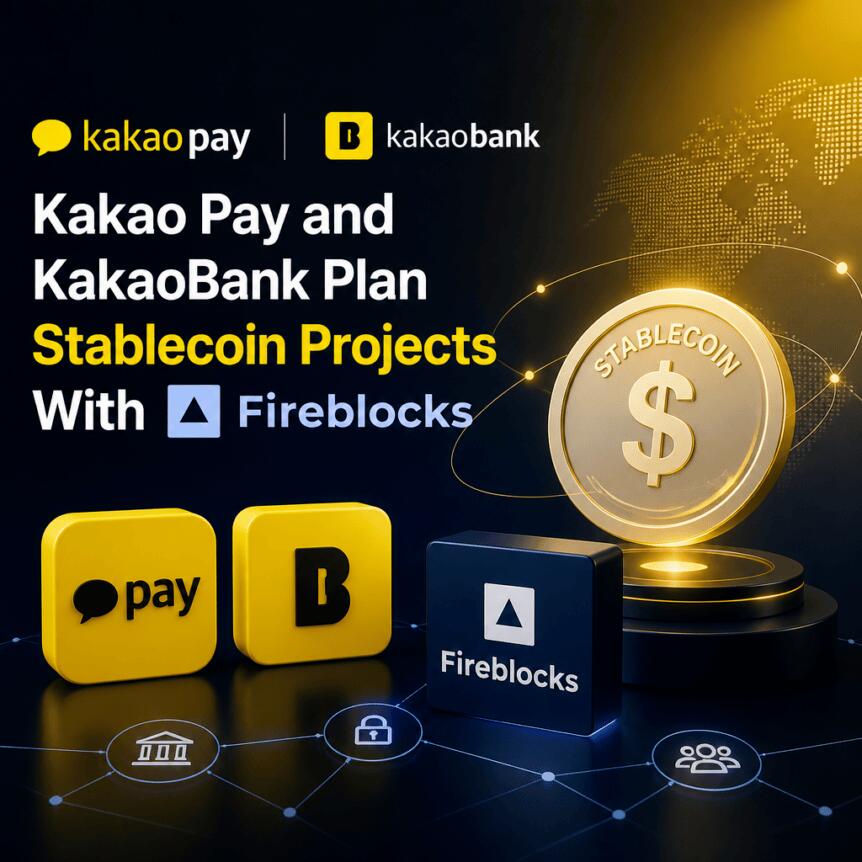
Kakao Pay and KakaoBank, two major players in South Korea’s Kakao ecosystem, have signed a memorandum of understanding (MoU) with digital asset infrastructure provider Fireblocks to explore new opportunities in crypto infrastructure—specifically including stablecoins. The parties said they will run proof-of-concept tests aimed at building digital asset capabilities that fit South Korea’s regulatory, security, and service expectations.
The announcement, made on Monday, did not disclose any launch plans, investment commitments, or implementation timelines. Instead, it frames the effort as an engineering and compliance-oriented exercise to identify how onchain infrastructure can be deployed responsibly in a market that is still taking shape under an evolving regulatory framework.
Key takeaways
- Kakao Pay and KakaoBank are partnering with Fireblocks to test digital asset infrastructure use cases, including stablecoin-related work.
- The MoU centers on proof-of-concept testing tailored to South Korea’s regulatory and security requirements, without any announced rollout timeline.
- Fireblocks says it supports more than 2,500 institutions, including over 100 banks, positioning the partnership as focused on enterprise-grade custody and infrastructure.
- The move adds to a growing cluster of South Korean finance and fintech firms exploring won-denominated stablecoin pathways as regulation develops.
Why Kakao’s infrastructure search matters
Unlike pilots that focus purely on payment trials, this MoU is primarily about the infrastructure layer—how institutions can securely connect to digital assets and operate systems that meet banking-grade standards. Kakao Pay and KakaoBank sit in the heart of South Korea’s digital payments and banking ecosystem: Kakao Pay provides mobile payments and financial services, while KakaoBank is one of the country’s largest internet-only banks.
For firms like these, the practical challenge is not simply adopting blockchain technology, but integrating it in ways that satisfy security controls, operational reliability, and compliance expectations. By working with Fireblocks on proof-of-concept tests, the companies are signaling that they want to validate onchain systems that can withstand enterprise requirements—an issue that often determines whether stablecoin concepts can move from experimentation to production.
What Fireblocks brings to the table
Fireblocks provides digital asset infrastructure used by institutions, and the company says it supports more than 2,500 institutions, including over 100 banks. In enterprise crypto deployments, that kind of track record is often tied to capabilities such as secure custody and infrastructure tooling used to manage digital assets at scale.
While Monday’s MoU announcement does not describe specific technical components, it does clarify the target outcome: secure onchain infrastructure that aligns with South Korea’s regulatory and security landscape. For investors and builders watching South Korea’s stablecoin trajectory, this is a meaningful signal that large local financial institutions are seeking infrastructure partners capable of meeting banking-level standards.
A wave of stablecoin exploration in South Korea
The Kakao-Fireblocks agreement arrives amid a broader pattern of experimentation across South Korea’s financial sector as the country continues building out its digital asset regulatory framework.
Earlier activity includes a separate MoU between Kakao Group and stablecoin issuer Circle, announced in July. According to Cointelegraph’s earlier coverage, that MoU was intended to explore blockchain-based payment infrastructure and digital asset technology, including opportunities around won-denominated stablecoins and related services (see Kakao Circle won stablecoin payment infrastructure).
The stablecoin push is not limited to Kakao. In May, Cointelegraph reported that KB Financial Group completed a won-denominated stablecoin pilot spanning issuance, offline merchant payments, and cross-border remittances (see KB Financial stablecoin pilot offline payments). And in July, fintech company Toss partnered with Optimism and Sunnyside Labs on a proof of concept for won-based stablecoin payment infrastructure (see Toss partners Optimism won stablecoins).
Taken together, these efforts suggest the market is moving beyond pure “whether” questions and increasingly focusing on “how”—including what infrastructure is needed to support stablecoin payments and settlement, including in scenarios that require offline functionality or integration with cross-border flows.
What to watch next for investors and operators
For now, the MoU provides a direction of travel rather than a product roadmap. The lack of a launch or implementation timeline means stakeholders should treat the announcement as an early-stage initiative: proof-of-concept testing will determine what technical and compliance hurdles need to be cleared before any wider deployment.
As South Korea refines its approach to digital assets, the next milestones to monitor are not only regulatory developments, but also whether these infrastructure-focused pilots can evolve into operational systems—especially for won-denominated stablecoin use cases, where payment reliability and security controls are central.
Readers should watch for details on the proof-of-concept scope, results, and whether Kakao’s infrastructure testing leads to further partnerships or public pilots aligned with the country’s expanding stablecoin and payment framework.

South Korean financial companies Kakao Pay and KakaoBank have signed a memorandum of understanding (MoU) with crypto infrastructure provider Fireblocks to explore digital asset opportunities, including stablecoins.
Under the agreement, the companies will conduct proof-of-concept tests for digital asset infrastructure suited to South Korea’s regulatory, security and service requirements. The initiative aims to help establish secure onchain infrastructure for the country’s emerging digital asset market.
The announcement on Monday did not include a launch, investment or implementation timeline.
Kakao Pay operates mobile payments and financial services, while KakaoBank is one of South Korea’s largest internet-only banks. Both are part of the broader Kakao ecosystem. Meanwhile, Fireblocks provides digital asset infrastructure to more than 2,500 institutions, including over 100 banks, according to the company.
The agreement follows a separate memorandum signed by Kakao Group and stablecoin issuer Circle. In July, the two companies signed an MoU to explore blockchain-based payment infrastructure and digital asset technology. The collaboration included examining opportunities around won-denominated stablecoins and related services.
Kakao Pay and KakaoBank are among several South Korean financial and technology companies exploring stablecoin opportunities as the country develops its regulatory framework for digital assets.
In May, KB Financial Group completed a won-denominated stablecoin pilot covering issuance, offline merchant payments and cross-border remittances. In July, fintech company Toss partnered with Optimism and Sunnyside Labs on a proof of concept for won-based stablecoin payment infrastructure.
Related: South Korean bank stocks surge on stablecoin trademark filings
Crypto World
XRP jumps 8% as crypto short squeeze and Ripple developments draw attention – CoinJournal


Key takeaways
- XRP rose more than 8% in 24 hours as the broader crypto market rallied.
- Its trading volume increased 55% to approximately $4.7 billion.
- Crypto-wide short liquidations reached about $665 million; that figure is not specific to XRP.
XRP outpaces major cryptocurrencies
XRP gained more than 8% over 24 hours amid a broad cryptocurrency rally. Trading volume rose 55% to approximately $4.7 billion, equivalent to about 5% of XRP’s circulating market value.
The higher volume shows that trading activity increased alongside the price. It does not, by itself, establish how much of that activity came from new buyers rather than sellers closing positions.
A wider short squeeze may have contributed to the move. Across the crypto market, short liquidations climbed to approximately $665 million, according to the figures cited in the report. Liquidations force some traders betting on falling prices to close their positions, which can amplify a rally.
XRP’s gains also come as Ripple continues to expand its payments business and develop uses for the XRP Ledger.
The report points to a newly released developer kit for building AI agents that can make payments using the ledger and Ripple’s RLUSD stablecoin. It also describes Stripe as potential supporting infrastructure for that use case. The scale of any resulting payment activity remains to be seen.
Meanwhile, two XRP Ledger proposals under consideration could help establish a framework for lending that uses XRP as collateral and RLUSD for settlement. Their eventual effect depends on approval, implementation and adoption.
RLUSD’s market capitalization was near $2.4 billion in the figures cited by the report. Growth in the stablecoin may increase activity in Ripple’s ecosystem, though it does not guarantee a corresponding rise in XRP’s price.
XRP faces $1.50 breakout test
The technical analysis in the report identifies a breakout from a descending flag pattern on XRP’s daily chart.
The next test is $1.50: a sustained move above that level would strengthen the case for a rise toward $1.80.

The analyst also projects a medium-term target of $2.10 based on the pattern’s measured move, implying roughly 41% upside from the price used in that forecast.
Those targets remain conditional. After a sharp rally and substantial short liquidations, XRP will need continued buying interest to hold its breakout and advance through $1.50.

Prime Video’s ‘The Love Hypothesis’ Is a Near-Perfect Rom-Com Experiment

“Money won’t matter in 2036” | Elon Musk

Suspected murderers and rapists among thousands of Scots fugitives on the run




-

 Fashion3 days ago
Weekend Open Thread: Talbots – Corporette.com
-

 Tech1 day ago
Researchers escape OpenAI Codex sandbox to run commands on host
-

 Crypto World6 days ago
Robinhood engineers charged over $50K crypto scheme
-

 Crypto World3 days ago
Circle launches Arc Studio AI agent for building onchain apps
-
 NewsBeat3 days ago
Trump says US has reached an agreement to take permanent control of Greenland’s security
-

 Crypto World3 days ago
Bitcoin price breaks channel as RSI climbs to 63
-

 Crypto World5 days ago
US Charges Robinhood Engineers Over Crypto Listing Trades
-

 Crypto World6 days ago
What Is the Status of the U.S.-Iran Peace Talks? Here's What Both Sides Are Saying
-

 Crypto World1 day ago
Who Needs CLARITY Anyway? ARB Could See 70X Increase: Hodler’s Digest
-

 Crypto World3 days ago
Trading Bitcoin on Robinhood? Why 2% Spread Has Traders Worried
-

 Tech6 days ago
Webb’s IC 348 Mosaic Includes Two-Jupiter Dwarfs, Twin Jets, and a Nursery Still Making Worlds
-
 Crypto World7 days ago
NVIDIA Analysis: Attempted Rising Wedge Breakout Amid Pressure on the AI Sector
-

 Crypto World3 days ago
World Money launches in 150+ countries with Stripe
-

 Crypto World4 days ago
Silver prices recover quickly, hitting weekly high today
-

 Entertainment6 days ago
Big Brother Update: Melody Explodes at Drew as Illness Sweeps BB28 House
-
 NewsBeat3 days ago
US was ‘on brink of war’ with China over false AI report of nukes moving in Middle East
-

 Crypto World4 days ago
Mortgage and refinance interest rates today, Thursday, September 17, 2026
-

 Crypto World22 hours ago
Bitcoin price holds above $81K as key catalysts line up
-

 Business6 days ago
Federal Reserve expected to hike interest rates 25 basis points at FOMC meeting
-

 Tech4 days ago
GPT-6 Astra Reached the Nether in Minecraft, Lost Its Stash to a Creeper, and Farmed Potatoes for Hours
You must be logged in to post a comment Login