

Crypto World
Don’t call us just a WLFI treasury company, says AI Financial



AI Financial, formerly known as Alt5 Sigma, wants the market to know that it’s more than just its token holdings, and calling it a WLFI treasury company isn’t the right way to describe it.
“AiFi continues to operate an active fintech and digital payments business while executing on a broader long-term strategy across digital assets, settlement infrastructure, tokenization, and next-generation financial technologies,” a company spokesperson told CoinDesk in an email. “Characterizing the company solely as a ‘treasury company’ does not accurately reflect the breadth of AiFi’s operating business.”
AI Financial operates ALT5 Pay, its crypto payments platform, and ALT5 Prime, its over-the-counter digital asset trading business. Since quarter-end, it has also announced the acquisition of tokenization and ICO infrastructure firm Block Street, signed a commercial agreement with SuperQ Quantum, and outlined broader expansion into digital financial infrastructure.
The response from the spokesperson comes after AI Financial’s latest SEC filing painted a starkly different picture of its current financial profile.
The Nasdaq-listed company disclosed in this filing that it held 7.28 billion WLFI tokens, worth $706.4 million at the end of March, down from an acquisition cost of roughly $1.46 billion. By comparison, its operating fintech business generated just $4.7 million in quarterly revenue.
AI Financial also warned in this filing that recurring losses and a $5.5 million working capital deficit raise “substantial doubt” about the company’s ability to continue as a going concern within one year after the financial statements were issued.
Complicating the picture further, the company’s WLFI holdings remain contractually locked, limiting its ability to convert its largest asset into cash. AI Financial ended the quarter with just $10.5 million in cash.
AI Financial’s relationship with WLFI goes far beyond ownership. World Liberty CEO Zach Witkoff serves as the company’s chairman. Co-founder Zachary Folkman sits on its board; WLFI has lent it $15 million, secured by WLFI tokens, and WLFI holds rights equivalent to roughly 46% of its fully diluted equity.
But the question is, can investors see past WLFI when looking at AI Financial as a whole?
AI Financial may be building a broader fintech and digital infrastructure platform, but its SEC filing suggests WLFI remains the asset defining its financial story.
Unlike a typical digital asset treasury company holding bitcoin or another liquid asset, AI Financial’s relationship with WLFI is more complex: the issuer of its core treasury asset also has deep governance, lending and equity ties to the company itself.

Crypto World
Nvidia (NVDA) Stock Slides in After-Hours Trading Despite Crushing Q1 Earnings Expectations

Key Highlights
- Nvidia exceeded Q1 earnings projections with adjusted EPS of $1.87 versus the Street’s $1.77 expectation, while revenue reached $81.6B against a forecast of $79.19B.
- The company’s Q2 revenue outlook of $91B significantly surpassed analyst predictions of $87.36B.
- Management authorized an $80B stock buyback initiative and dramatically increased its quarterly dividend from 1 cent to 25 cents per share.
- Jensen Huang, Nvidia’s CEO, introduced the “Vera” CPU platform, positioning it as an entry point into a $200B addressable market with projected sales of $20B by fiscal year-end.
- Shares declined approximately 1.6% during after-hours sessions as market participants assessed intensifying competition from proprietary chip development.
Nvidia’s shares settled at $223.47 during Wednesday’s regular trading session ahead of its post-market earnings announcement. The stock retreated roughly 1.6% in after-hours activity despite delivering impressive financial results.
The chip giant recorded fiscal first-quarter revenue of $81.62B, surpassing the analyst consensus of $78.86B. Adjusted earnings per share reached $1.87, exceeding the Street’s $1.77 projection by ten cents.
The company’s data center segment generated $75.2B during the quarter, outpacing the $72.8B estimate. This division continues to serve as Nvidia’s primary growth driver.
For the current quarter, management issued guidance of $91B with a 2% variance in either direction, comfortably beating Wall Street’s $87.36B projection. The upper boundary suggests potential revenue approaching $92.8B.
The company unveiled an $80B share repurchase authorization while simultaneously raising its quarterly dividend payment from 1 cent to 25 cents—representing an extraordinary 2,400% increase.
Vera CPU Launch Targets Massive New Opportunity
During the earnings conference call, Jensen Huang highlighted Nvidia’s newly announced “Vera” central processing unit, describing it as an entry into a $200B total addressable market. The executive stated that Nvidia anticipates generating $20B in Vera-related revenue by the conclusion of the current fiscal year.
Importantly, this $20B projection was excluded from Nvidia’s previous $1 trillion revenue estimate that encompassed Blackwell and Rubin AI accelerators through 2027. Huang indicated that Vera is expected to emerge as the company’s second-largest revenue generator outside that trillion-dollar framework.
“All of our customers are quite excited about Vera,” Huang stated during the analyst call.
However, he acknowledged a significant challenge. “My sense is that we’ll be supply-constrained through the entire life of Vera Rubin,” he noted, referencing the integrated platform scheduled for release later this year.
To address potential supply chain bottlenecks, Nvidia’s supply commitments expanded to $119B in Q1, marking an increase from the previous quarter’s $95.2B.
Rising Competitive Pressures
The after-hours price decline appears linked to mounting concerns among investors regarding custom chip development by Nvidia’s largest customers.
Alphabet, Amazon, and Microsoft are projected to allocate more than $700B toward AI infrastructure investments in 2025, representing a substantial increase from approximately $400B in 2024. A meaningful portion of these expenditures is directed toward proprietary semiconductor solutions aimed at decreasing dependence on Nvidia’s products.
Intel and AMD are simultaneously expanding their presence in the inference chip space, which is gaining prominence as artificial intelligence workloads transition from model training to deployment and execution.
Nvidia has responded proactively. Earlier in March, the company introduced a new central processing unit and AI system incorporating technology from Groq, a startup specializing in inference-optimized chips.
Huang highlighted an emerging subsector within the data center business—AI-focused cloud service providers—where revenue levels matched those from major hyperscale operators while demonstrating superior sequential growth. “We should be growing faster than hyperscale capex,” Huang remarked.
According to InvestingPro data, Nvidia has received 34 upward EPS revisions against just one downward revision over the past 90 days, with the platform assigning its financial health an “excellent performance” rating.
The stock has appreciated 17.73% during the previous three-month period and has gained 69.55% year-over-year.


Disclosure: This article does not represent investment advice. The content and materials featured on this page are for educational purposes only.
AJC Mining gains attention as cloud mining platforms evolve beyond traditional crypto mining models.
Summary
- AJC Mining offers beginner-friendly cloud mining with automated contracts, daily settlements, and no hardware setup required.
- Cloud mining in 2026 now includes apps, marketplaces, and hosted systems, with AJC Mining targeting easy beginner access.
- AJC Mining simplifies Bitcoin and Dogecoin mining through cloud contracts, reducing technical and equipment barriers.

As more users search for easier ways to understand Bitcoin mining and Dogecoin cloud participation, mobile-first platforms and browser-based dashboards continue gaining visibility as alternatives to hardware-heavy mining setups.
As users continue searching for questions like what Bitcoin mining is, how cloud mining works, and whether mobile-friendly mining options still exist in 2026, platform-based mining access remains an area of interest.
Compared with buying hardware, managing electricity costs, or operating mining rigs directly, cloud mining platforms are often seen as a more accessible starting point for beginners.
In real use, “free” rarely means unlimited mining at no cost forever. More often, it refers to free registration, app access, welcome rewards, trial contracts, beginner dashboards, or activation features that help users understand how a platform works before choosing larger participation plans.
That is why comparison roundups still matter for users trying to understand how cloud mining platforms operate and which services may be easier to approach.
What “free” usually means in 2026
Free cloud mining usually refers to:
- Free account registration
- App or browser-based platform access
- Welcome rewards or onboarding bonuses
- Trial or entry-level contracts
- Dashboard access before selecting paid plans
- Automated mining participation under separate platform terms
Top free cloud mining platforms in 2026
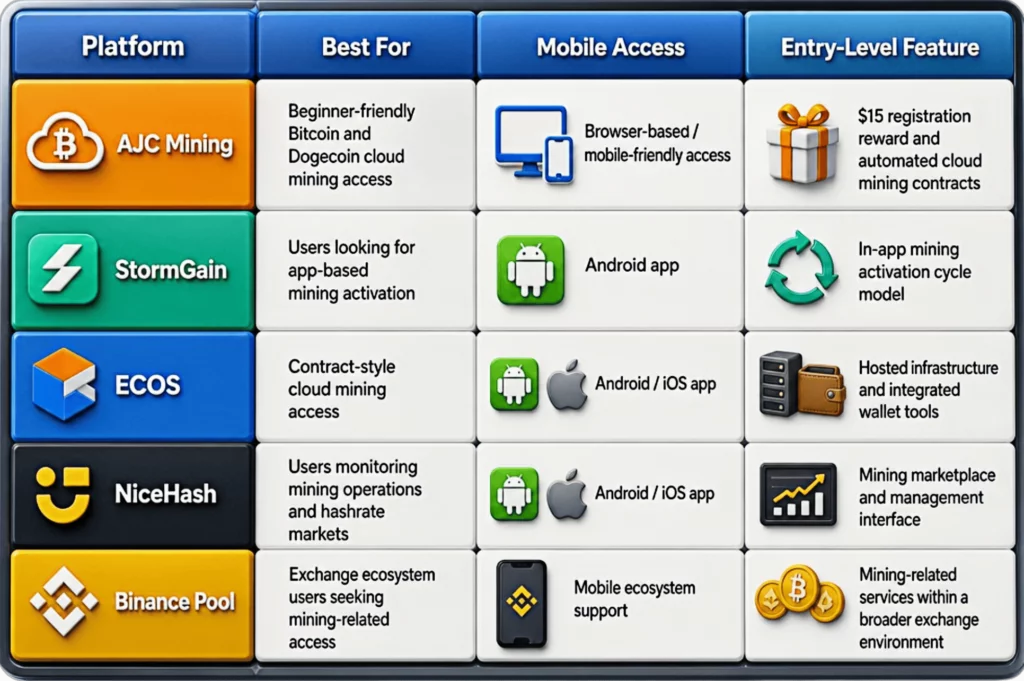
The comparison above reflects the different ways users approach mining in 2026. Some prefer simple onboarding, some want structured cloud mining contracts, while others prefer marketplace tools or exchange-integrated mining ecosystems.
1. AJC Mining — Best for beginners seeking automated cloud mining access
AJC Mining can be understood as a beginner-friendly cloud mining platform designed for users who want to explore Bitcoin and Dogecoin mining participation without buying or maintaining physical mining machines.
For users with no prior mining experience, AJC Mining offers a relatively simple onboarding process. The platform focuses on cloud computing power deployment, fixed-term contract options, and automated daily settlement according to contract terms.
This makes AJC Mining suitable for users who want a lower-barrier entry point into cloud mining while avoiding hardware setup, technical configuration, heat management, and manual operation.
How do users join AJC Mining?
The process for joining AJC Mining is designed to be simple for new users.
Step 1: Register an account
Users can register through the official AJC Mining website. After successful registration, new users receive a $15 reward.
(Click here to register now and claim a reward.)
Step 2: Select a cloud mining contract
AJC Mining offers both short-term and longer-term cloud mining contracts. Users can choose based on:
- Budget
- Contract duration
- Profit goals
- Preferred mining strategy
Step 3: Activate the contract
Once a contract is selected, the system automatically deploys cloud computing power. Earnings are settled daily according to the contract terms, and no manual mining operation is required from the user.
AJC Mining cloud mining contract reference
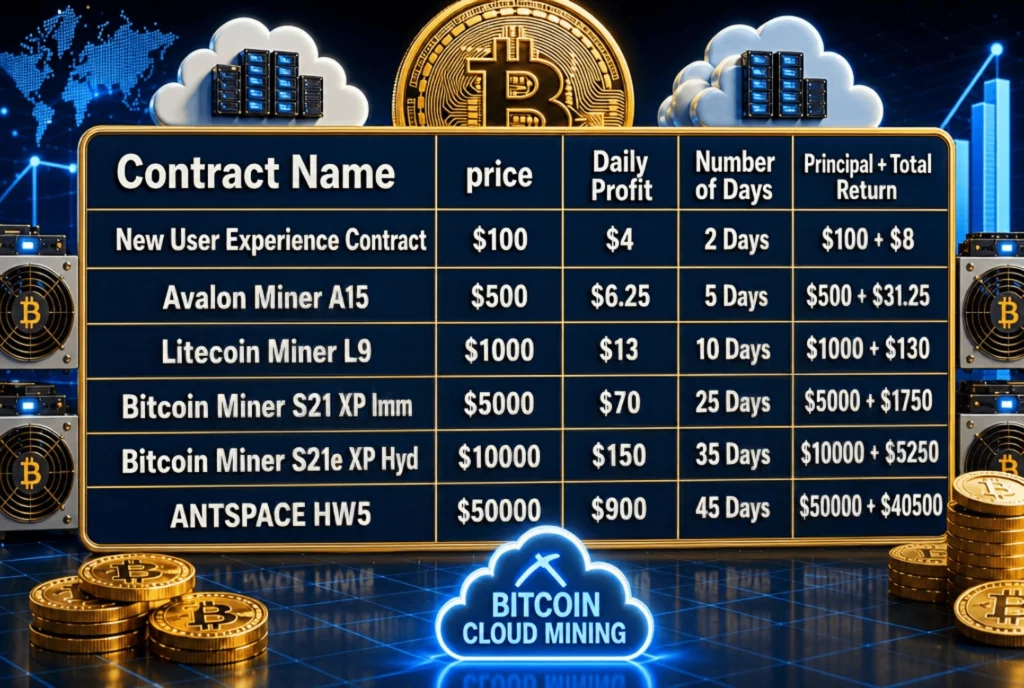
These contracts represent different levels of computing power and participation strategies. AJC Mining emphasizes:
- Fixed-term cloud mining contracts
- Daily profit settlement
- Fully automated mining operations
- Beginner-friendly access
- No hardware purchase or maintenance required
(Click to view more cloud mining contracts.)
2. StormGain — Best for users who want an app-oriented mining experience
StormGain is often discussed by users looking for a mobile-first cloud mining experience. Its app-based interface makes it easier for users to activate mining-related features without navigating a complex technical dashboard.
This convenience helps explain why StormGain continues to appear in beginner-focused mining discussions. It may appeal to users who want a lighter app experience rather than a traditional contract-style cloud mining setup.
3. ECOS — Best for structured contract-style cloud mining access
ECOS is often included in cloud mining roundups because it presents hosted mining through a more structured contract-style model. This type of setup may suit users who prefer clearly defined participation terms, contract durations, and platform-managed infrastructure.
For users who want something more organized than simple app activation, ECOS remains a commonly referenced option.
4. NiceHash — Best for users interested in mining marketplace tools
NiceHash is less of a typical “free mining app” and more of a mining marketplace and management environment. It gives users visibility into hashrate markets, mining power activity, and operational tools.
This makes NiceHash more suitable for users who want to understand mining power markets or manage mining-related activity with more control.
5. Binance Pool — Best for exchange-integrated mining access
Binance Pool stands out because it connects mining-related services with the broader Binance exchange ecosystem. For users already operating within Binance’s platform environment, this integrated structure may feel easier than using a separate standalone mining service.
Its appeal comes from ecosystem convenience, especially for users who prefer having exchange, wallet, and mining-related services in one place.
Why Bitcoin and Dogecoin cloud mining continue to attract attention
Bitcoin remains the best-known digital asset by market value, while Dogecoin continues to attract everyday interest from retail crypto participants. Together, they represent two highly visible but very different parts of the digital asset market.
Many users searching for how to mine cryptocurrency or how cloud mining works are not necessarily trying to build large mining operations. More often, they are looking for easier ways to understand the process and decide whether a mobile-friendly or browser-based platform makes more sense than running mining hardware directly.
Cloud mining platforms continue to attract attention because they reduce several traditional barriers, including:
- Hardware purchase costs
- Machine maintenance
- Electricity and heat management
- Technical configuration
- Direct mining operation
How to choose the right cloud mining platform
Every platform works differently, and “free” does not mean the same thing everywhere. Before choosing a platform, users usually compare:
- What the free registration or reward actually includes
- Whether the service is app-based, browser-based, or contract-based
- How clearly the platform explains its mining model
- Whether fees, returns, contract terms, and withdrawal rules are disclosed
- Whether the platform is built for beginners or advanced users
- Whether daily settlement and contract details are transparent
A practical starting approach is often to begin with a lower-barrier platform, review the dashboard and platform rules carefully, and only then decide whether to commit more time or capital.
Frequently asked questions
What is Bitcoin mining?
Bitcoin mining is the process of using computing power to validate transactions and help secure the Bitcoin blockchain. Cloud mining generally allows users to access mining participation through remote infrastructure instead of owning and operating mining machines themselves.
What is Dogecoin cloud mining?
Dogecoin cloud mining refers to participating in Dogecoin-related mining through hosted computing power or platform-based infrastructure. Instead of running hardware directly, users access mining services through a cloud mining provider.
What does “free cloud mining” usually mean?
Usually, it refers to free registration, platform access, welcome rewards, trial contracts, app features, or limited activation periods. It does not usually mean unlimited mining forever at zero cost.
How can beginners start exploring cloud mining?
Beginners often start with platforms that offer simple registration, beginner dashboards, automated contracts, and clear explanations of how mining participation works. AJC Mining, for example, provides a registration reward and automated cloud mining contract options for new users.
Can users mine crypto on a phone or laptop?
Serious direct mining on a phone or laptop is generally not practical anymore. In most cloud mining models, mobile devices and laptops are mainly used for account access, contract management, and dashboard monitoring while the actual mining infrastructure runs remotely.
How should beginners choose a platform?
Beginners should look for platforms that clearly explain their mining model, provide transparent contract details, disclose fees and withdrawal rules, and offer a user-friendly dashboard.
Conclusion
The cloud mining landscape in 2026 is no longer defined by a single type of product. Users can now choose between automated cloud mining contracts, mobile-first mining apps, hosted infrastructure platforms, mining marketplaces, and exchange-linked mining ecosystems.
For users exploring Bitcoin and Dogecoin mining participation, a practical starting point is usually a platform that clearly explains its access model and reduces the hardware, setup, and technical barriers involved in traditional mining.
AJC Mining stands out in this comparison because it offers a beginner-friendly registration process, a $15 new user reward, automated contract activation, and daily profit settlement based on selected contract terms. For users who want a simpler way to understand cloud mining without managing physical equipment, AJC Mining may be a suitable platform to explore.
As always, users should compare platform terms carefully, understand what “free” really means, and review contract rules, risks, fees, and withdrawal conditions before participating.
For more information, visit the official website.
Disclosure: This content is provided by a third party. Neither crypto.news nor the author of this article endorses any product mentioned on this page. Users should conduct their own research before taking any action related to the company.

EUR/USD and GBP/USD have moved into recovery mode following a sharp test of key support levels, although the market remains cautious ahead of the release of important macroeconomic data from the US, the eurozone and the UK. Earlier this week, the European currencies came under pressure: GBP/USD fell towards the 1.3300 area, while EUR/USD tested support at 1.1600. However, the successful defence of these levels triggered active profit-taking on the US dollar and a subsequent corrective rebound in the European currencies.
In the coming trading sessions, investors’ attention will focus on the publication of PMI business activity indices in the eurozone, the UK and the US, as well as US housing market data and jobless claims statistics. The market is assessing signs of a further slowdown in the US economy following recent indications of weakening business activity, which is partly limiting the potential for further dollar appreciation.
EUR/USD
The EUR/USD pair recovered after testing support at 1.1600. Technical analysis of EUR/USD points to the possibility of growth towards 1.1670–1.1700, as a bullish piercing candlestick pattern has formed on the daily timeframe. Should yesterday’s low be broken, the pair may decline towards the 1.1540–1.1500 area.
Key events for EUR/USD:
- today at 10:15 (GMT+3): France Manufacturing PMI;
- today at 10:30 (GMT+3): Germany Composite PMI;
- today at 15:30 (GMT+3): Philadelphia Fed Manufacturing Index (US).

GBP/USD
The GBP/USD pair fell sharply at the start of the week towards the important support level at 1.3300. The rebound from this support, followed by a recovery towards 1.3440, allowed a bullish engulfing reversal pattern to form. Technical analysis of GBP/USD suggests the potential for further growth towards 1.3520–1.3550 if the pair manages to consolidate above 1.3460. A move below yesterday’s low could trigger another test of 1.3300.
Key events for GBP/USD:
- today at 11:30 (GMT+3): UK Composite PMI;
- today at 16:45 (GMT+3): US Manufacturing PMI;
- today at 18:00 (GMT+3): speech by Bank of England Governor Bailey.

Overall, EUR/USD and GBP/USD are attempting to extend their recovery after sharply testing key support levels. However, the market has yet to receive sufficient fundamental confirmation for the formation of a полноценный upward trend. Upcoming macroeconomic data from the US, the eurozone and the UK will be the key driver of further price action: weak US figures could increase pressure on the dollar and support further gains in the European currencies, while stronger data may return the market to a bearish scenario and keep trading confined within established ranges.
Trade over 50 forex markets 24 hours a day with FXOpen. Take advantage of low commissions, deep liquidity, and spreads from 0.0 pips (additional fees may apply). Open your FXOpen account now or learn more about trading forex with FXOpen.
This article represents the opinion of the Companies operating under the FXOpen brand only. It is not to be construed as an offer, solicitation, or recommendation with respect to products and services provided by the Companies operating under the FXOpen brand, nor is it to be considered financial advice.


Missouri has sued GPD Holdings LLC, the company behind CoinFlip, alleging the crypto ATM operator enabled scam transactions and used poorly disclosed fees.
Summary
- Missouri sued CoinFlip, alleging crypto ATMs enabled scams against seniors and veterans.
- State seeks Missouri ban, restitution, and civil penalties of up to $1.826 million.
- Bitcoin Depot’s bankruptcy shows crypto ATM operators face mounting legal and regulatory pressure.
Missouri Attorney General Catherine Hanaway filed the case against GPD Holdings LLC, doing business as CoinFlip, on May 21. Her office said the company allegedly “knowingly facilitating fraudulent transactions and profiting from them” through cryptocurrency kiosks across the state.
The complaint asks the court to declare that CoinFlip’s conduct violated the Missouri Merchandising Practices Act. The state also wants to stop CoinFlip from operating in Missouri, recover restitution for consumers, and impose $1,000 per violation, capped at $1.826 million for the past five years.
State cites seniors, veterans and hidden fees
Hanaway’s office said the case centers on scam activity that used crypto ATMs to move victims’ money quickly and with limited recovery options. The office said these transactions can carry poorly disclosed fees and are often hard to trace once completed.
The AG also pointed to fraud risks for seniors and veterans. In the lawsuit notice, Hanaway said “Bitcoin and crypto ATMs are the new getaway cars for fraud,” adding that her office would focus on protecting Missourians, especially older residents and veterans.
Investigation began after statewide scam reports
The lawsuit follows a December 2025 investigation into cryptocurrency kiosk operators in Missouri. At the time, the attorney general said the office was reviewing claims tied to “hidden fees and deceptive charges” and scam activity involving Bitcoin ATMs.
The state said common warning signs include urgent calls, claims of legal trouble, demands for secrecy, and instructions to withdraw cash before sending it through a crypto ATM. It urged affected consumers to contact law enforcement, the FBI’s IC3 portal, and the attorney general’s office.
According to the AG’s office, the Missouri State Highway Patrol’s Missouri Information Analysis Center and the St. Louis Fusion Center linked 350 crypto cases over the past two years to cryptocurrency ATMs. The office also cited FTC data showing crypto ATM fraud losses rose nearly tenfold from 2020 to 2023.
Crypto ATM pressure widens across states
CoinFlip’s own locator page lists 136 CoinFlip ATM locations in Missouri, including machines in St. Louis, Columbia, Kansas City, Springfield, and other cities. The Missouri AG release said CoinFlip operates more than 140 kiosks in the state.
Related coverage shows that the crypto ATM sector is under pressure beyond Missouri. Bitcoin Depot filed for Chapter 11 bankruptcy in Texas after regulatory actions, legal cases, and falling revenue weighed on its business. A May 18 report said Bitcoin Depot had also taken its global ATM network offline.
CoinFlip has published scam-prevention material warning that crypto transactions are final and irreversible. Its terms page also warns users that fraudulent transactions may result in loss of money or cryptocurrency. The Missouri lawsuit now tests whether those warnings and controls were enough under state consumer protection law.

The U.S. Securities and Exchange Commission is pausing the rollout of a new wave of “novel ETFs,” including those designed to let investors bet on the outcomes of real-world events, so regulators can weigh their implications before approving them. In a Wednesday statement, SEC Chair Paul Atkins said that “novel products raise novel questions” and directed the agency’s staff to solicit public feedback on how to respond to these applications.
The pause comes as Bitwise filed in February for a series of prediction-market ETFs under the PredictionShares brand to track U.S. election results, with Roundhill Investments and GraniteShares also pursuing prediction-market ETF filings in the same month. Prediction markets have surged in crypto discourse over the past year and a half, evolving into a notable use case within the space. Analysts note the regulatory attention surrounding these instruments as they move toward traditional market structures.
Prediction markets—where participants trade contracts tied to the outcome of events—have become one of crypto’s hottest themes in recent times. Industry observers estimate that these markets now clear more than $15 billion in monthly trading volume, spanning sports, elections, financial results, and other events. The prospect of a prediction-market ETF is to give mainstream investors a way to gain exposure to these binary event contracts through a familiar brokerage account, echoing the broader trend of bringing crypto and related innovations into traditional financial rails.
Bloomberg ETF analyst Eric Balchunas described the SEC’s stance as one of deliberate caution, noting that the regulator is “clearly wrestling” with how to handle this new asset class—much as it grappled with spot crypto ETFs before approving them in early 2024. Balchunas suggested the agency wants to feel comfortable with prediction-market ETFs before it “opens the barn door.”
Source: Eric Balchunas
Looking ahead, the delay coincides with broader regulatory dynamics around prediction markets and related platforms. Kalshi and other prediction-market operators have faced ongoing legal challenges in several U.S. state courts, underscoring the regulatory complexity as the sector seeks broader legitimacy. Kalshi’s litigation and expectations around state-level outcomes feed into the SEC’s careful approach to approving any product that could unlock significant exposure to probabilistic event outcomes.
Key takeaways
- The SEC is delaying novel ETF applications, including prediction-market ETFs, to solicit public input and assess regulatory implications.
- Bitwise, with its PredictionShares line, and rivals Roundhill and GraniteShares are among the firms that filed for prediction-market ETFs in February, aiming to translate binary-event contracts into tradable securities.
- Prediction markets already generate substantial activity—roughly $15 billion per month—highlighting why a regulated ETF path is attractive to institutional and retail investors alike.
- The regulatory mood around novelty in ETFs has warmed in recent years, but the SEC’s cautious stance on these products signals ongoing risk assessment before broader rollout.
- Legal challenges facing prediction-market platforms, including Kalshi, add to the uncertainty about how courts and regulators will shape the space’s future.
Regulatory caution and the evolving path for innovation
The SEC’s emphasis on “novel questions” reflects a broader tension in the market between innovation and investor protection. Atkins’ call for public feedback signals a methodical approach: regulators want to hear how these products would function in real markets, which risks they pose, and how they would be integrated into existing disclosure, settlement, and liquidity frameworks. This stance aligns with a historical pattern in which the agency tests the waters before greenlighting more complex or controversial products, even after adopting more flexible listing standards in recent years.
Beyond prediction-market ETFs, the agency has been reported to be considering an “innovation exemption” that could allow tokenized stock trading to run on crypto rails. Such a policy, if adopted, would translate shares of widely followed corporations—like Apple, Nvidia, and Tesla—into tokenized, on-chain equivalents that could be traded within crypto ecosystems. While this remains speculative, the possibility underscores the SEC’s willingness to rethink traditional boundaries between conventional securities markets and digital-asset infrastructure. For now, the focus remains on carefully vetting how novel ETFs would operate in the regulated environment.
The current environment also reflects a broader push to formalize crypto-adjacent products within mainstream financial channels. The launch of spot crypto ETFs earlier this year marked a notable milestone in investor access, and the regulatory apparatus is now testing similar pathways for other innovative vehicles, including those tied to event outcomes. The outcome of these deliberations will influence not only product design and disclosure requirements but also the speed at which new market infrastructures—bridging traditional finance and crypto-native models—will gain legitimacy among institutional participants.
Prediction markets: from niche use case to mainstream instrument?
Prediction markets exist at the intersection of finance, information markets, and behavioral science. By aggregating diverse viewpoints on the probability of a future event, these markets purportedly reflect a collective intelligence that can be applied to forecasting and hedging. The sector’s momentum has drawn attention from a broad range of participants, including traditional asset managers curious about non-correlated exposure and crypto-native firms seeking broader institutional acceptance. A dedicated ETF would, in theory, provide custody, tax reporting, and liquidity channels familiar to traditional investors, potentially expanding participation beyond crypto-native traders.
Yet regulatory and legal questions remain central. Kalshi and related platforms have already pressed for broader access in the face of state-level challenges, illustrating a regulatory patchwork that could shape the feasibility and design of any ETF. The SEC’s current pause suggests that, even as interest grows, a cautious, evidence-based approach will govern the path forward. Observers will be watching closely to see how the agency reconciles investor protection with innovation, and whether a future approval would come with strict prerequisites on product design, disclosure, and governance.
What comes next for tokenized stock ideas and other innovations
While the focus of the current wave is clearly on prediction-market ETFs, regulators’ discussions about tokenized stock trading add another layer to the broader reform agenda. If an innovation exemption progresses, tokenized equities could gain a formal foothold in regulated markets, potentially altering liquidity dynamics and cross-asset competition. Market participants would need to digest the implications for price discovery, settlement timelines, and cross-border operations, as tokenized equities blend the advantages of crypto rails with the protections of traditional securities regimes.
For investors and builders, the immediate takeaway is that the regulatory blueprints for novel ETFs and tokenized securities are still taking shape. The SEC’s public-consultation approach means market participants should prepare for a longer, more consultative process than a straightforward binary approval. In the near term, expect continued regulatory signaling, more formal comment periods, and potentially more test cases as firms align product design with the agency’s evolving framework.
As this space evolves, the next milestones to watch include the SEC’s release of feedback from its public solicitation, any refined criteria for prediction-market ETFs, and whether tokenized-stock initiatives advance toward a formal exemption or dedicated rulebook. The convergence of traditional fund architecture with event-driven and tokenized strategies could redefine how investors access non-traditional exposures, but the path will likely remain incremental and tightly regulated.
Readers should stay attentive to the regulator’s responses and to ongoing court developments affecting prediction-market platforms. The evolving balance between innovation and protection will continue to shape which products make it to market and how they’re designed to protect everyday investors.
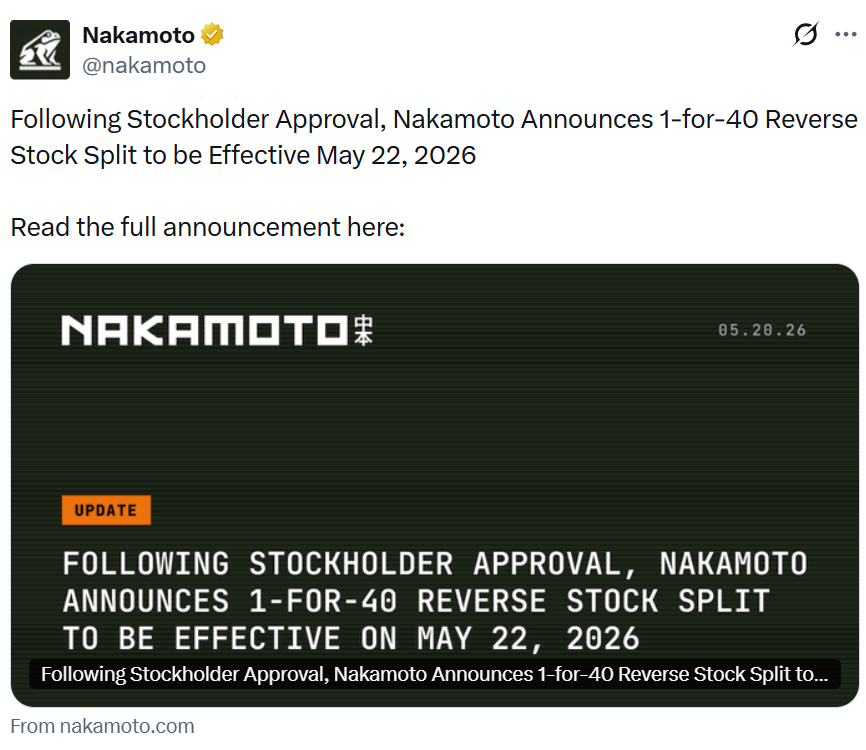
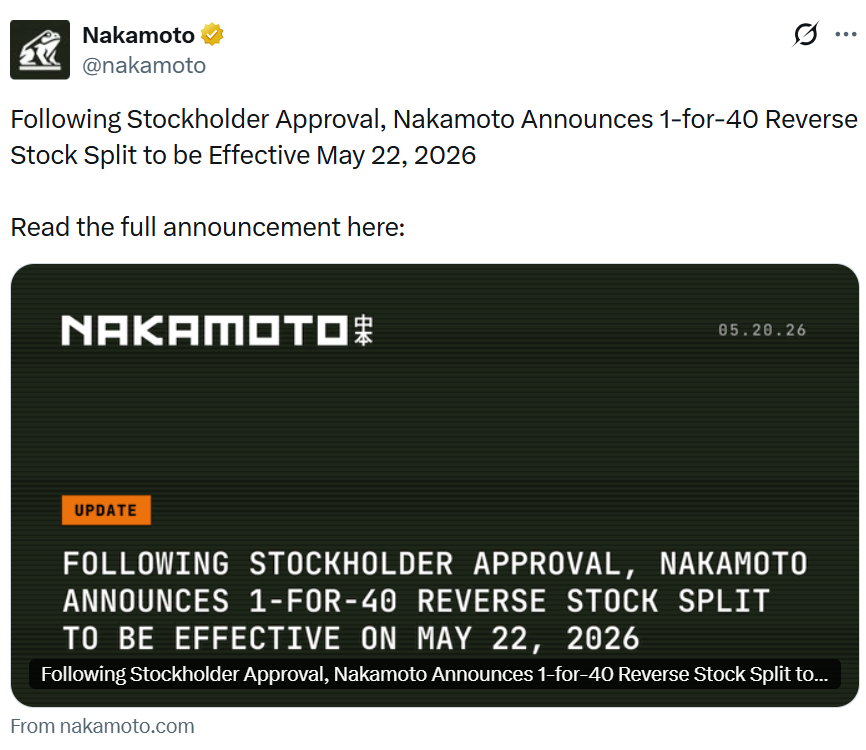
Bitcoin treasury company Nakamoto is moving ahead with a shareholder-approved 1-for-40 reverse stock split on Friday in an effort to avoid delisting from the Nasdaq Stock Exchange.
The company received a notice from the Nasdaq on Dec. 10, warning that its stock price had fallen below the $1 minimum for 30 consecutive business days, according to an SEC filing. Nakamoto has until June 8 to address the issue and keep its stock above $1 for at least 10 days.
A reverse stock split reduces the number of shares outstanding. In a 1-for-40 split, every 40 shares are combined into one. After completion, Nakamoto’s total common shares will drop from 696.1 million to 17.4 million, the company said Wednesday.
“The reverse stock split is intended to increase the per-share trading price of the company’s common stock to regain compliance with the $1 minimum bid price requirement for continued listing on the Nasdaq Global Market,” it added.
Crypto treasury companies have been in a downturn since 2025, with many companies’ stock prices falling below the value of the crypto on their balance sheets, Standard Chartered reported last September.
Wojciech Kaszycki, chief strategy officer of crypto infrastructure and treasury company BTCS, told Cointelegraph in March that treasury companies will likely start merging and consolidating this year to stay afloat.
Nakamoto’s share price, NAKA, closed 16 cents on Wednesday, down 7.5%, according to Google Finance. It is down more than 99% from May last year, when it traded above $25 shortly after the company unveiled its Bitcoin treasury strategy and merger with health care provider KindlyMD.
Source: Nakamoto
Nakamoto posts $238.8 million net loss in Q1
Nakamoto shareholders approved a reverse split ratio range of 1-for-20 to 1-for-50 at a special meeting on May 8. The shares are expected to undergo the change on Friday, according to Nakamoto.
The company announced its first-quarter financial results on May 14, recording a 500% quarter-over-quarter increase in revenue but a $238.8 million net loss, with more than $102 million attributed to a mark-to-market loss on its 5,058 Bitcoin (BTC) treasury after the cryptocurrency fell 23% during the quarter.
Related: Tether buys SoftBank’s stake in Bitcoin company Twenty One Capital
Most Bitcoin treasury companies, aside from Strategy and Metaplanet, have slowed Bitcoin buying over the past 12 months, while others have started tapping their Bitcoin treasuries to pay off debt. The Genius Group liquidated its entire treasury holdings of 84 Bitcoin in February to help pay debts.
Nakamoto didn’t buy any Bitcoin during the quarter but sold 284 Bitcoin on March 31 to cover operational expenses.
Nakamoto’s current holdings make it the 20th largest Bitcoin treasury company according to BitcoinTreasuries.Net, just behind ProCap Financial, which holds 5,457 Bitcoin. The leading treasury is Michael Saylor’s firm Strategy, with more than 843,000 Bitcoin on its balance sheet.
Magazine: eToro founder timed Bitcoin top perfectly due to belief in 4-year cycles


Bitcoin’s rejection near its 200-day moving average has renewed pressure, but K33 says the market still differs from past bear-market rallies.
Summary
- Bitcoin’s February low near $60K remains K33’s base case for this cycle’s deepest drawdown now.
- K33 says weaker leverage and bearish derivatives positioning make this recovery unlike past bear-market rallies.
- Recent ETF outflows show defensive positioning as Bitcoin trades near average spot ETF cost basis.
Bitcoin has struggled since revisiting its 200-day moving average near $82,000 earlier in May. The move revived concern that the latest recovery could fail like the rebounds seen in 2014, 2018 and 2022, when rallies into the same indicator came before new cycle lows.
K33 Head of Research Vetle Lunde said the current setup does not match those periods. Bitcoin took 189 days between its November break below the 200-day moving average and the May retest, far longer than the 96, 132 and 85 days seen in earlier cycles. Lunde wrote,
“Past rallies recovered quickly, rebuilding risk appetite and leverage and setting up the unwind that fueled the next leg lower. The current slow grind has not.”
ETF outflows show defensive positioning
K33 said the market still lacks the heavy leverage build-up that often appears before a deeper sell-off. The firm also pointed to 13F filings, which showed institutional investors cut Bitcoin exposure by 26,733 BTC in the first quarter, while retail investors added 19,395 BTC.
Separate market updates show the same defensive tone. U.S. spot Bitcoin ETFs recorded more than $1 billion in cumulative weekly outflows as Bitcoin fell below $77,000, while liquidations across crypto topped $661 million. A day later, the products posted $648.6 million in net outflows, the largest single-day withdrawal since Jan. 29, with BlackRock’s IBIT accounting for $448.3 million.
Bitcoin traders remain cautious near cost basis
K33 also said heavy ETF withdrawals have become more common when Bitcoin trades close to the average cost basis for ETF buyers. Lunde said investors often try to avoid losses or limit losses after deep drawdowns when price returns to that area.
The firm kept its central view unchanged despite the recent weakness. Lunde said, “We maintain our view that the less aggressive bull market of 2025 sets the stage for a more moderate bear market in 2026,” adding that February’s $60,000 low remains K33’s base case for the cycle’s maximum drawdown.
Meanwhile, Bitcoin traded near $77,400 on May 20, according to crypto.news, down about 4.2% over seven days.
The asset also remains far below its October 2025 record high of about $126,080, showing that the recovery has not fully repaired market confidence.
Disclosure: This article does not represent investment advice. The content and materials featured on this page are for educational purposes only.
Crypto World
Japan’s megabanks post record profits, but analysts warn growth may slow as risks mount
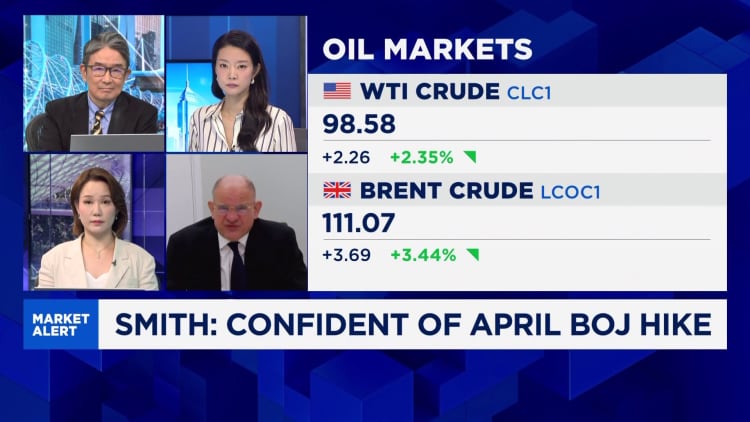
The yen gained on Wednesday following a rally in Japan’s equities and bets on more fiscally responsible policies after Prime Minister Takaichi’s election win.
Yevgen Romanenko | Moment | Getty Images
Japan’s largest banks posted record annual profits in their latest financial results, but earnings growth could slow as credit costs rise and geopolitical risks cloud the outlook, analysts say.
Mitsubishi UFJ Financial Group, the country’s largest lender, said net profit rose 30% from a year ago to 2.4 trillion yen for the fiscal year ended March 2026, a record high for the third consecutive year.
Similarly, Sumitomo Mitsui Financial Group and Mizuho Financial Group also reported record annual profits in their latest earnings, rising 34% and 41% from a year ago, respectively.
“Higher yen rates are improving lending margins and supporting net interest income, while healthy corporate funding demand and stronger fee income are adding to revenue,” said Kaori Nishizawa, Director of Banks at Fitch Ratings.
Nomura reiterated its bullish stance on Japan’s major banks and named Sumitomo Mitsui and Mizuho as its top picks. The three megabanks — Mitsubishi UFJ, Sumitomo Mitsui and Mizuho — still “look undervalued relative to the strength of their earnings,” Nomura said.
However, analysts said the lenders could struggle to keep profits at record levels.
“Earnings growth is likely to moderate,” said Nishizawa, noting that recent upside has come from one-off items, including market-related gains and contributions from acquisitions.

Banks also face higher credit costs, competition for deposits and pressure from broader macroeconomic and geopolitical risks, according to Nishizawa.
“As such, sustainability of profit growth at current levels is likely to be challenged,” she added.
The earnings improvements appear more structural than in previous cycles, driven by higher domestic interest rates, inflation and stronger corporate funding demand, said Koichi Niwa, an analyst at UBS.
Stronger wholesale and corporate finance activity has benefited large Japanese banks and helped lift recent earnings amid renewed investor interest in the sector, Niwa said.
But financing mergers and acquisitions, large corporate lending, overseas loans and structured transactions often require more capital than domestic lending.
“As a result, even if profits are growing, banks also need to allocate more capital to support balance-sheet expansion,” he added.
Lorraine Tan, director of equity research in Asia for Morningstar, expects Mitsubishi UFJ’s earnings growth to slow to 5% from fiscal 2027, as global interest rates outside Japan are expected to ease.
“This, coupled with slowing contributions from associate Morgan Stanley, should eat into domestic growth,” Tan added.
Tan also expects Sumitomo Mitsui’s earnings growth to slow to 9% through fiscal 2028, citing its exposure to a loan book with around 35% outside Japan, while Mizuho’s net interest margin gains could ease from fiscal 2027 as interest rates outside Japan resume an easing cycle.
Meanwhile, the Japanese lenders are also keeping a close eye on developments in the Middle East, which could weigh on their earnings outlook.
Junichi Hanzawa, MUFG’s chief executive, said at a recent earnings briefing that the bank’s bottom line could be negatively impacted if Middle East tensions continue to build. A further rise in oil prices before year-end could also weigh on global economic growth.
“Middle East-related risks, including potential spillover effects, are partly provisioned for and remain closely monitored,” Sumitomo Mitsui said in an earnings filing.
Mizuho also said that it “will continuously monitor the external environment & its potential impacts, and flexibly revise [its] financial outlook if necessary going forward.”


Coinbase and Flipcash have launched USDF, a Solana-based custom stablecoin fully backed by USDC, as Coinbase expands its branded stablecoin infrastructure business.
Summary
- Coinbase powers USDF on Solana, giving Flipcash a USDC-backed settlement asset for app currencies now.
- Flipcash chose Coinbase for reserves, onchain settlement, fiat access, and scalable USDC-linked rewards for users.
- Custom Stablecoins puts Coinbase deeper into branded dollar rails as stablecoin payment competition grows fast.
Coinbase said on May 20 that USDF was created through its Custom Stablecoin platform. The token is issued on Solana and fully backed by USDC. Coinbase described the launch as part of its effort to make stablecoin issuance easier for businesses.
Flipcash will use USDF inside its app, where users can create fixed-supply digital currencies. Each currency on the platform will be priced and settled in USDF, giving the app a single dollar asset for buying, selling, and using those currencies.
Coinbase targets branded stablecoin demand
Coinbase’s Custom Stablecoins product lets companies launch branded digital dollars without building the full blockchain, reserve, and settlement system themselves. The company says the product allows partners to issue stablecoins backed 1:1 by USDC and other dollar stablecoins.
The product page says Coinbase manages issuance, reserves, smart contracts, and onchain operations. It also says custom stablecoins are redeemable 1:1 with USDC, while partners can use the tokens for payments, treasury, rewards, and DeFi use cases.
“We launched USDF with Coinbase because they delivered everything we needed,” Flipcash founder and CEO Ted Livingston said in a quote published on Coinbase’s Custom Stablecoins page. He said Coinbase helped support the consumer experience Flipcash wanted to build.
Coinbase expands USDC use across payments and settlement
Related crypto.news coverage in December reported that Coinbase’s Custom Stablecoins service allows businesses to issue branded, USDC-backed tokens through Coinbase Business. That report said the service covers issuance, custody, and compliance support for participating companies.
Coinbase has also been growing USDC use in payments and settlement. Separate crypto.news coverage said Nium integrated Coinbase infrastructure to support USDC-based cross-border payments across more than 190 countries. That setup allows businesses to fund payouts in USDC and settle in stablecoins or local currencies.
Stablecoin infrastructure competition grows
USDF comes as more companies build stablecoin payment and settlement products. Coinbase is not only offering a stablecoin asset. It is offering the infrastructure that lets other companies place their own brand on a dollar-backed token.
The model places Coinbase in a growing market for white-label stablecoin tools. Businesses can use these systems to issue branded digital dollars while relying on larger providers for custody, reserves, access to fiat rails, and onchain operations.
For Flipcash, USDF gives the app a dollar unit for its user-created currencies. For Coinbase, the launch adds another live example of its stablecoin infrastructure strategy as companies test branded digital dollars for consumer apps, payments, and settlement.
MAPO, the native token of the Map Protocol, fell 96% on Wednesday after an exploit of the Butter Network cross-chain bridge, which allowed an attacker to mint a quadrillion MAPO tokens.
The malicious mint was tens of thousands of times larger than the legitimate supply of tokens, sending the value of MAPO from around $0.003 to $0.0001 in a matter of hours, according to CoinGecko.
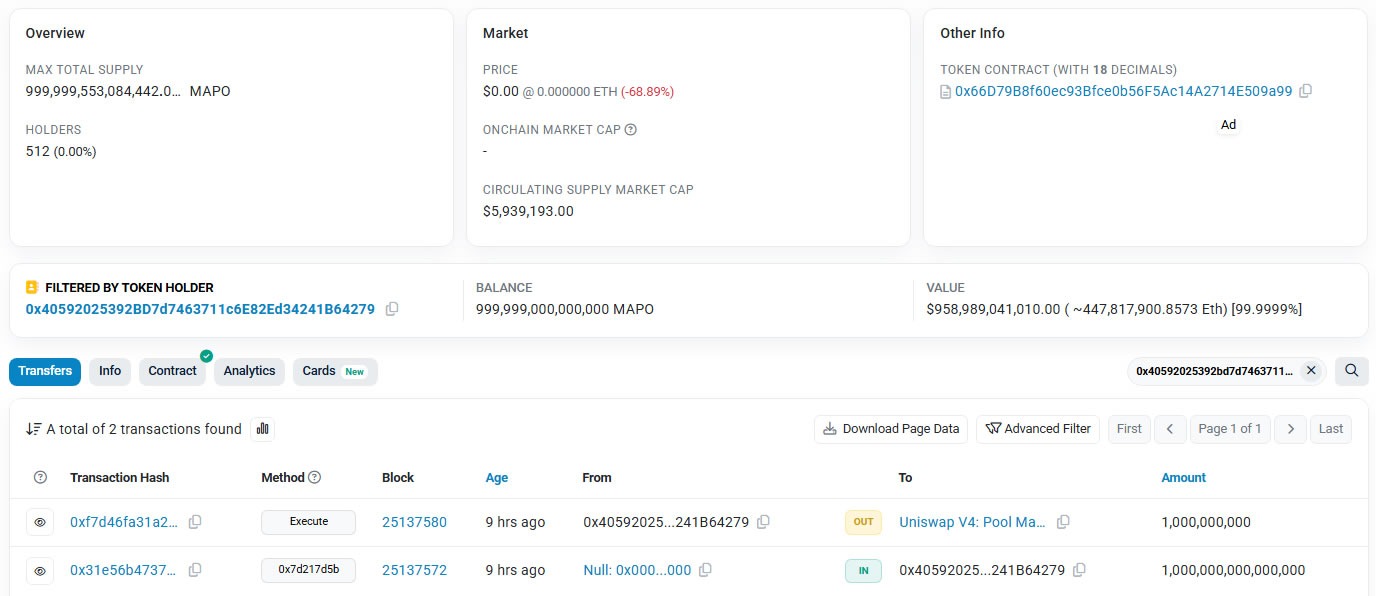
The attacker used a new externally-owned account (EOA) to dump around a billion MAPO tokens, draining about 52 ETH, worth about $180,000, from Uniswap liquidity pools while retaining nearly a trillion tokens that continue to threaten other pools and potential exchange listings, reported Blockaid on Wednesday.
This latest exploit comes during a month in which at least 18 DeFi and blockchain protocols have been compromised, including THORChain, Verus Protocol’s Ethereum bridge, Transit Finance, TrustedVolumes, Ekubo, Echo Protocol and RetoSwap.
Map Protocol said the bug was in the Solidity contract layer, and it has paused the mainnet and has begun migration while the investigation continues. The Butter Network said it has paused ButterSwap, adding that user funds were not at risk.
In its latest post, the Map Protocol project said it would announce a new contract address and select an appropriate time to conduct an asset snapshot. “Any remaining tokens held by attacker-controlled addresses will be fully invalidated and will not be included in any future snapshot or conversion process,” it said.
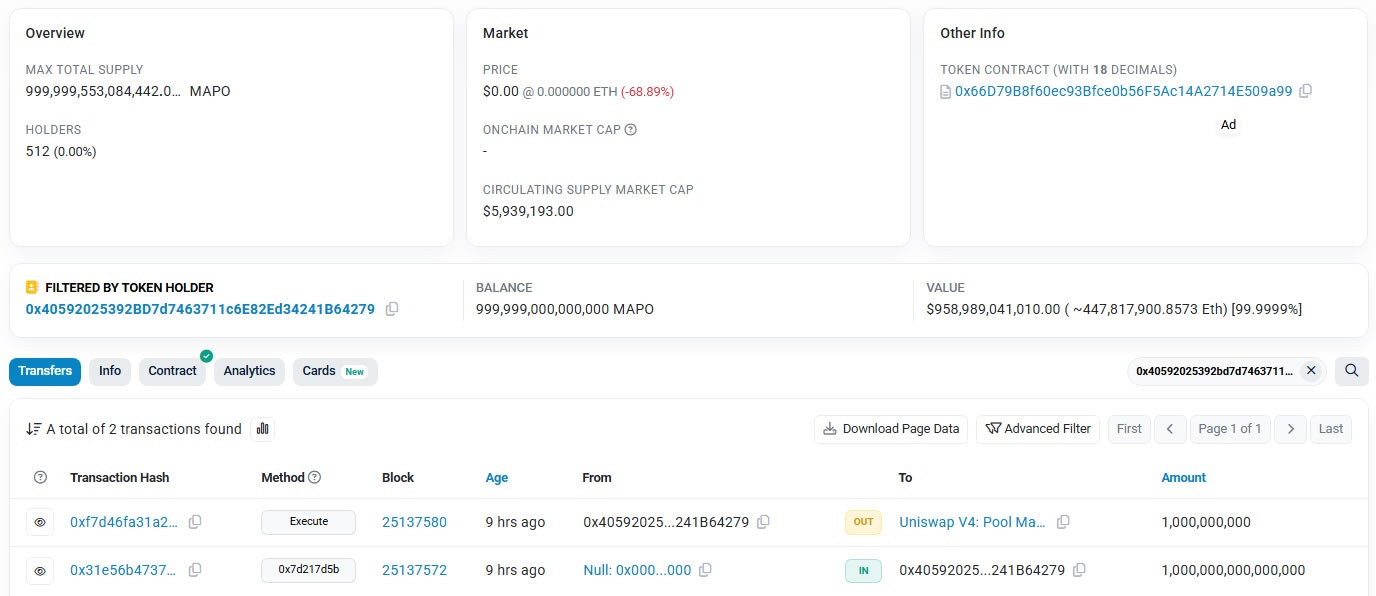
A billion MAPO tokens were sent to Uniswap after a quadrillion tokens were minted. Source: Etherscan
The MAPO attacker first sent a legitimate oracle multisig-signed message before deploying a malicious contract at a specific address. The attacker then resent a modified “retry” message that appeared identical in hash but was actually fake. The cross-chain bridge verified it as valid and executed the massive token mint.
No private keys were stolen, and no light clients were broken; it was a classic Solidity vulnerability involving multiple dynamic fields, Blockaid explained.
Related: GitHub investigates unauthorized access to internal repositories
Map Protocol is an omnichain network for swapping Bitcoin, stablecoins and tokenized assets across blockchains, connecting the Bitcoin mainnet with ecosystems such as Ethereum, BNB Chain, Tron and Solana.
TON-TAC issues a post-mortem for $2.7 million exploit
Meanwhile, the TON-TAC asset bridge, a cross-chain bridge designed as a network extension for The Open Network, issued a post-mortem on Thursday detailing its $2.68 million exploit that occurred on May 11.
It adds to a wave of cross-chain bridge exploits over the past few weeks, including the Verus-Ethereum Bridge, Echo Bridge, and Butter Network’s cross-chain bridge.
The “security incident” stemmed from missing validation in the sequencer software, which accepted a counterfeit wallet on TON that lacked proper code-hash and minter checks, leading to another unauthorized token mint.
Recovery efforts secured about 80% of the affected assets, but the bridge remains paused for an independent audit of the patched sequencer and liquidity restoration, it added.
Magazine: DeFi’s billion-dollar secret: The insiders responsible for hacks

SteelSeries Arctis Nova 7X Gen 2 review: The headset to beat

Apollo Micro Systems shares rally 22% in 3 days after strong Q4 results. Should you buy?
Nvidia (NVDA) Stock Slides in After-Hours Trading Despite Crushing Q1 Earnings Expectations


-

 Crypto World5 days ago
BloFin War of Whales 2026 Grand Prix opens registration for $5M trading championship
-

 Fashion6 days ago
Weekend Open Thread: Theory – Corporette.com
-

 Crypto World6 days ago
E-Estate Announces 1 Year Live: Washington DC Summit as Real Estate Tokenization Enters Its Next Phase
-

 Tech6 days ago
Tech Moves: Microsoft AI leader jumps to OpenAI; former AI2 exec joins Meta; and more
-

 Tech5 days ago
Google reimburses Register sources who were victims of API fraud
-
 Crypto World7 days ago
Google’s Gemini AI Predicts Incredible Solana Price by the End of 2026
-

 Business6 days ago
H&R Real Estate Investment Trust (HR.UN:CA) Q1 2026 Earnings Call Transcript
-
 Entertainment7 days ago
Zara Larsson Has Blunt Response To Chris Brown Diss
-

 Sports5 days ago
Napoleonic enters 2026 Doomben 10,000 field via Abounding withdrawal
-

 Crypto World5 days ago
BeInCrypto 100 Institutional Awards Nomination: KAST for Best Digital Assets Neobank and Best Digital Assets Fintech
-
 Crypto World5 days ago
Bitcoin Battles US Bond Nerves With BTC Price Dip Toward New May Lows
-

 Fashion4 days ago
On the Scene at Gucci’s Cruise Show in New York City: Mariah Carey, Kim Kardashian, Lindsay Lohan, Iman, and More!
-
 Crypto World5 days ago
Wall Street’s Boldest Gold Prediction Has Russians Rushing to Buy
-

 Crypto World5 days ago
ICE and CME urge US regulators to curb Hyperliquid energy trading
-

 Fashion5 days ago
Trending Western Style Vests Perfect for Summer
-

 Politics6 days ago
DWP PIP Timms review continues to be an absolute farce
-

 Entertainment6 days ago
David Letterman Returns to Late Show, Blasts Cancellation
-

 Crypto World5 days ago
IREN closes $3 billion convertible notes deal amid AI infrastructure expansion
-
 Crypto World6 days ago
Lido Finance Selects Chainlink CCIP as the Official Cross-Chain Infrastructure for wstETH Security
-

 Fashion4 days ago
Amazon Sundays: Memorial Day Hosting
You must be logged in to post a comment Login