
Crypto World
DoorDash Pays Drivers in Stablecoins via Tempo



DoorDash has begun building stablecoin payment infrastructure on Tempo, the Layer-1 blockchain incubated by Stripe and Paradigm, to pay delivery workers and merchants across more than 40 countries at near-instant settlement speeds and fixed US dollar fees, in one of the largest real-world stablecoin payment deployments by a publicly traded US company to date.
Summary
- DoorDash is using Tempo’s stablecoin blockchain to pay drivers and merchants across more than 40 countries, targeting payout speed, cross-border cost reduction, and transaction flexibility as the primary benefits.
- Tempo, which raised $500 million at a $5 billion valuation and launched its public mainnet in March 2026, also announced that Stripe, Coastal Community Bank, Fifth Third Bank, and Latin American fintech ARQ are now running payment operations on its stablecoin rails.
- DoorDash processed nearly $75 billion in merchant sales last year and manages a three-sided marketplace across more than 40 countries, each with different payment rails, FX dynamics, and regulatory requirements.
DoorDash announced on April 21 that it is building stablecoin payment infrastructure with Tempo to pay its delivery workers and merchants across more than 40 countries, choosing on-chain settlement to solve the fragmentation of running global payouts across dozens of different payment rails, currencies, and regulatory environments simultaneously. “If we can get merchants and Dashers their money faster, and do that in a way that’s affordable for them, that’s a no-brainer for the entire ecosystem,” said DoorDash’s head of payments.
DoorDash Stablecoin Payments Tempo Partnership Targets the Global Payout Problem
DoorDash’s operational complexity is substantial. Its three-sided marketplace connects consumers, merchants, and delivery workers across more than 40 countries, each with different settlement timelines, FX spreads, and compliance requirements. A payout flow that works in Atlanta may require an entirely different infrastructure stack in Helsinki, Mexico City, or São Paulo. Stablecoin settlement compresses that variability. As crypto.news reported, Tempo is positioned as a payments-first blockchain with sub-second deterministic finality, fees paid in dollar-denominated stablecoins rather than a volatile native gas token, reserved blockspace for payment workloads, and ISO 20022 compliance for enterprise reconciliation. DoorDash chose Tempo over other stablecoin options because of what it described as Tempo’s “payments focus and enterprise readiness,” noting the platform’s experience combining crypto technology with the regulatory and operational requirements of large-scale enterprise deployments.
Tempo’s Growing Institutional Ecosystem
The DoorDash announcement was one of several that landed the same day, with Tempo simultaneously confirming that Stripe, Coastal Community Bank, Fifth Third Bank, and ARQ, a Latin American fintech operating in Mexico, Colombia, Argentina, and Brazil, are all now running or preparing to run payment operations on its stablecoin rails. As crypto.news documented, Stripe, which processed $1.9 trillion in payment volume in 2025, is using Tempo as a core blockchain for its money-management products, allowing businesses to hold, send, and receive stablecoins alongside traditional currencies. Klarna has announced plans to launch a stablecoin on Tempo’s mainnet, while Visa, Nubank, and Shopify had been cited as early ecosystem participants during the testnet phase. Tempo itself raised $500 million at a $5 billion valuation ahead of its March 2026 mainnet launch, with Stripe and Paradigm as founding investors and Paradigm co-founder Matt Huang serving as CEO.
What the DoorDash Move Signals for Enterprise Stablecoin Adoption
The DoorDash deployment is meaningful precisely because DoorDash is not a crypto company. It is a publicly traded consumer platform that generated nearly $75 billion in merchant sales last year and whose primary relationship with payments is operational rather than speculative. As crypto.news tracked, Tempo was explicitly designed to solve the practical obstacles that have prevented enterprises from adopting blockchain rails at scale, including network congestion, volatile gas fees, and settlement delays. For DoorDash, the stablecoin integration is invisible to end users: merchants and Dashers receive funds faster and at lower cost without interacting with blockchain tooling directly. Stablecoin settlement on Tempo compresses international payout windows from the standard one to three business days on ACH-equivalent rails toward near-instantaneous finality, the same performance benchmark that makes card networks indispensable for real-time commerce.
DoorDash said it will start with the payout flows where faster and cheaper settlement creates the most immediate value, prioritizing the cross-border corridors where traditional rail delays and FX costs are most punishing for merchants and delivery workers.

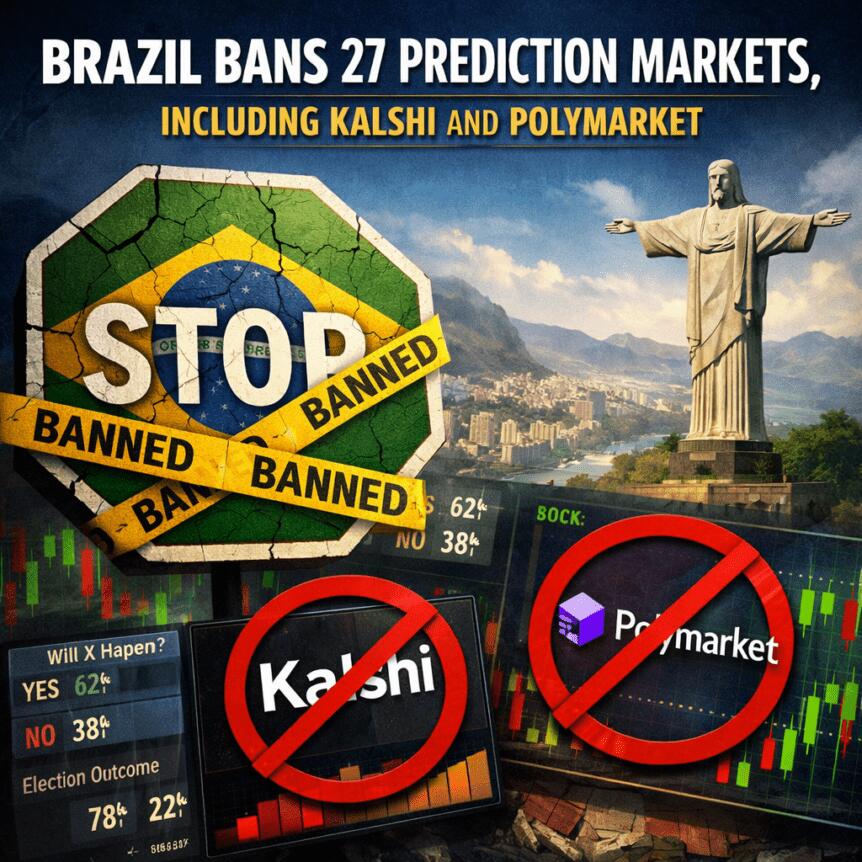
Brazilian authorities have moved to shut down 27 prediction market platforms, including Kalshi and Polymarket. The action, announced Friday, follows a directive from the Finance Ministry and enforcement by Anatel, Brazil’s telecom regulator, which contends that these services operate outside the country’s current legal framework.
Finance Ministry executive secretary Dario Durigan described the moment as a turning point for the sector, telling reporters at the Palácio do Planalto that Brazil previously experienced “a period of anarchy because there were no rules, no oversight, from 2018 to 2022.”
The crackdown aligns with a new rule framework issued by the National Monetary Council (CMN). Resolution 5.298, issued on Friday, takes effect in early May and narrows the scope of permissible prediction-market contracts. Under the CMN’s plan, contracts tied to sports, politics, entertainment, or social events are banned, as authorities deem them closer to gambling than to financial investments. Only contracts linked to economic indicators—such as inflation, interest rates, exchange rates, or commodity prices—will remain allowed and fall under financial-market oversight.
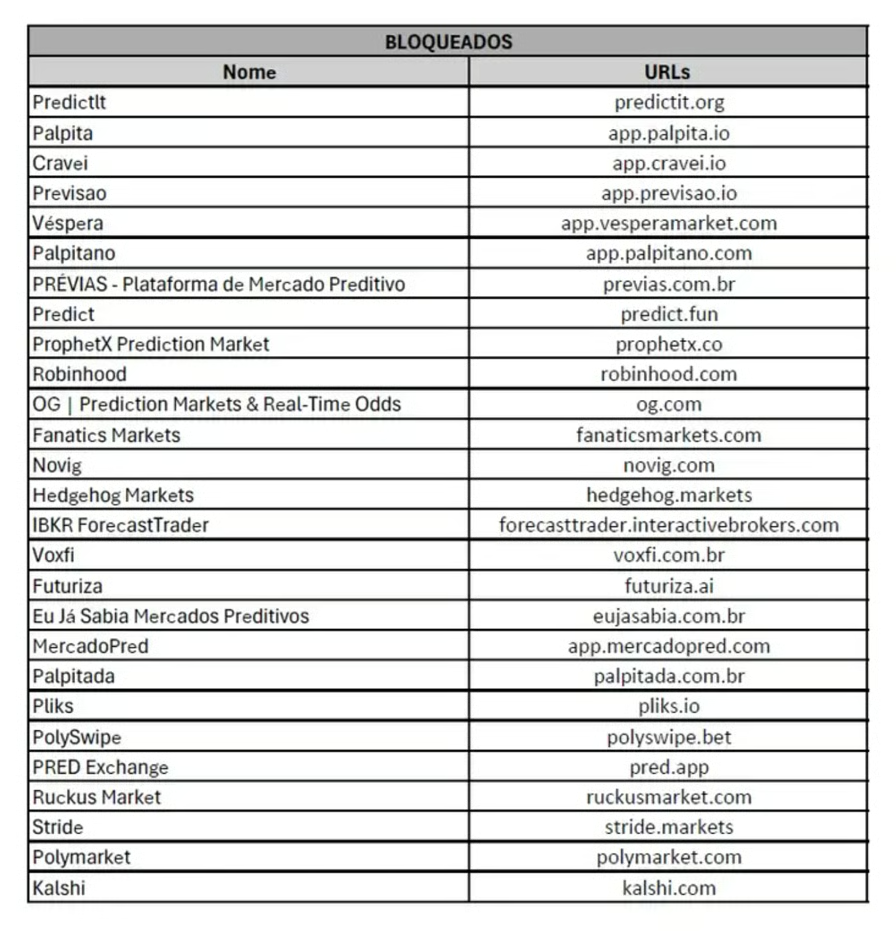
The block list spans both international operators and Brazil-focused platforms. Among the best-known affected names are Kalshi, Polymarket, PredictIt, and Robinhood’s forecasting feature, along with Fanatics Markets. The crackdown also targets ProphetX, Hedgehog Markets, Novig, Polyswipe, PRED Exchange and Stride, as well as several Brazil-centric services such as Palpita, Cravei, Previsao and MercadoPred.
Related: Kalshi bans 3 US politicians for betting on their own election races
Brazil flags prediction platforms as debt risk
Durigan argued that prediction markets could deepen household debt and expose users to financial harm. “At a time when we are working to reduce debt levels among families, small businesses, and students, we must also prevent new forms of harmful indebtedness,” he said.
The government’s stance frames these markets as potential vectors of financial risk at a moment when Brazil seeks to curb indebtedness across households and enterprises. The Ministry and Anatel emphasized that only markets tied to tangible economic indicators will remain within the legitimate financial-market framework.
Global trend and what to watch next
The Brazilian move fits a broader, ongoing pattern as several jurisdictions move to restrict or ban prediction markets, often by folding them into gambling or broader financial-regulatory regimes. In Europe, countries such as France, Belgium and the Netherlands have restricted or penalized operators operating without authorization. The United States presents a more fragmented picture, with ongoing friction between federal authorities and individual states over how to regulate or limit prediction-market activity.
Earlier coverage noted that Kalshi has also taken steps to limit betting on political events in other markets, underscoring the regulatory sensitivity surrounding this sector.
As the CMN rule takes effect and enforcement continues in Brazil, investors and users should watch whether other markets in the region follow suit and how platforms adapt—whether by narrowing offerings, seeking licenses, or exiting certain jurisdictions altogether.
The shift signals a clarifying moment for the intersection of prediction markets and financial regulation. While the technology and its potential for price discovery persist, the path to legitimate, supervised use remains tightly tethered to national frameworks and consumer-protection considerations. Watch how Brazil’s enforcement actions influence platform strategies, local participation, and the broader adoption of regulated forecasting markets in Latin America.


Rep. Anna Paulina Luna accused former House Speaker Nancy Pelosi of insider trading on Thursday, arguing that her reported 17,000% portfolio return since entering Congress is statistically impossible without access to nonpublic government information.
The Florida Republican posted the allegation on X, contrasting Pelosi’s stock market gains with the federal prosecution of a Special Forces soldier facing decades behind bars over prediction market bets tied to a classified mission.
Pelosi’s $280 Million Portfolio and the 17,000% Claim
The Pelosi household portfolio sits near $280 million, with returns since 1987 estimated around 17,000%. That cumulative gain dwarfs the Dow Jones Industrial Average’s roughly 2,300% over the same period and outpaces every benchmark Warren Buffett’s Berkshire Hathaway has set during the same stretch.
Paul Pelosi has repeatedly drawn scrutiny for trading technology options before related legislation moved through Capitol Hill. The household reset its portfolio in January 2026, exiting Nvidia, Apple, Amazon, and Alphabet positions before re-entering through long-dated options on the same names.
STOCK Act Penalties Versus a 50-Year Sentence
Civil penalties under the 2012 STOCK Act remain at $200 per disclosure violation, and watchdog reviews show most late filings draw no fine at all.
Treasury Secretary Scott Bessent has publicly called for an outright ban on congressional stock trading, a stance now shared by senators in both parties. Critics argue that without meaningful criminal exposure, the disclosure regime will continue to produce the kind of returns Luna highlighted.
Master Sergeant Gannon Van Dyke, the soldier Luna referenced, was indicted last week over roughly $409,000 in Polymarket profits tied to the Maduro capture operation.
He faces up to 50 years in prison on charges of commodities fraud, wire fraud, and unlawful monetary transactions.
Renewed Pressure for a Congressional Trading Ban
Luna’s post lands amid bipartisan momentum building behind legislation that would require lawmakers and their immediate family members to divest individual stock holdings within 180 days.
Whether the Van Dyke prosecution accelerates that effort or hardens partisan lines could shape how Congress confronts conflict-of-interest concerns in the coming months.
With midterm campaigns ramping up, both chambers face mounting pressure to enforce penalties beyond the STOCK Act’s $200 penalty.
The post Rep. Luna Accuses Nancy Pelosi of Insider Trading After 17,000% Gains appeared first on BeInCrypto.
BridgeTower Capital has officially deployed Chainlink’s full infrastructure stack to tokenize securities tied to the DOM X Arizona Copper-Gold Project, an $11 billion US natural resource initiative, in what the companies describe as live production infrastructure rather than a pilot.
Summary
- BridgeTower Capital is using Chainlink’s complete stack, including CCIP, Proof of Reserve, NAVLink, and CRE, to tokenize $11 billion in securities from the DOM X Arizona Copper-Gold Project.
- The deployment is live production infrastructure, not a pilot, making it one of the largest single-asset tokenization builds ever brought to institutional scale.
- BridgeTower plans to expand the same platform to tokenize over $25 billion in additional US natural resources, energy, and metals assets.
BridgeTower Capital announced on April 23 the adoption of Chainlink’s full infrastructure stack to tokenize securities from the DOM X Arizona Copper-Gold Project, a US natural resource initiative valued at $11 billion. The deployment covers the complete tokenization lifecycle: Chainlink’s CCIP for cross-chain connectivity to regulated DeFi venues and licensed secondary markets, Proof of Reserve for on-chain asset verification, NAVLink for real-time valuation data, and the Chainlink Runtime Environment to coordinate compliance, reserve checks, and settlement automation in a single operational environment.
Chainlink Tokenization BridgeTower DOM X Marks a First for Physical Commodity Infrastructure
The distinction between live production and pilot matters materially. As crypto.news reported, institutional buyers evaluating tokenization vendors require production evidence, not proof-of-concept demonstrations, before approving vendor relationships or allocating capital. The DOM X deployment provides that evidence in the physical commodities sector, where Chainlink’s institutional reach has until now been concentrated in financial assets like equities, treasuries, and funds. Johann Eid, Chief Business Officer at Chainlink Labs, said the deployment shows “what it looks like when tokenized assets become core institutional infrastructure,” adding that the world’s largest financial institutions are watching tokenization right now and looking for exactly this kind of production-scale evidence. KYC, KYB, and AML controls are embedded at the protocol level throughout the platform, while investor subscriptions are funded through fiat and stablecoin rails powered by Iron, a MoonPay company. Privacy-preserving workflows for institutional primary issuance are also being developed, keeping ownership positions confidential while preserving compliance and on-chain verifiability.
Why Physical Commodities Are the Next Tokenization Frontier
The BridgeTower deployment arrives as the tokenized commodities market is accelerating. As crypto.news documented, tokenized commodities had surpassed $7 billion in value by April 2026, rising nearly 600% since early 2025, with gold-backed tokens dominating but oil, natural gas, and agricultural products gaining share rapidly. Physical commodities present a different tokenization challenge than financial assets: they require verified reserve attestation of underlying physical material, real-time commodity pricing data that can vary by location and grade, and cross-chain connectivity to the multiple settlement venues where institutional commodity trades clear. Chainlink’s Proof of Reserve, NAVLink, and CCIP address each of those requirements directly. As crypto.news tracked, CCIP was averaging approximately $90 million in weekly token transfers by March 2026 and the network had enabled over $28 trillion in cumulative transaction value, providing the operational track record that institutional compliance teams require before deployment.
A $25 Billion Pipeline Behind the Initial Deployment
BridgeTower has structured the DOM X deployment as the first phase of a much larger program. The company plans to tokenize a pipeline exceeding $25 billion in natural resources, energy, and metals assets through the same Chainlink-powered platform, with the DOM X copper-gold project serving as the production reference point for that expanded rollout. As crypto.news noted, Chainlink launched 24/5 US equity data streams across more than 40 blockchains in the same week as the BridgeTower announcement, with the tokenized RWA sector at $27 billion and Chainlink positioned as the primary oracle infrastructure across the growing institutional pipeline. LINK was trading at approximately $9.31 on April 23 as the announcement landed, consolidating below the $9.50 resistance level that analysts have identified as the near-term trigger for a potential directional move.
BridgeTower CEO Cory Pugh described the platform as an end-to-end system in which CRE acts as the orchestration layer linking data agents, regulatory agents, compliance logic, and payments inside one coordinated environment, with institutional issuance and distribution readiness built in from day one.

Quick Summary
- Intel shares skyrocketed approximately 24% on Friday following a massive Q1 earnings surprise
- Adjusted earnings per share reached $0.29 versus Wall Street’s modest $0.01 projection; total revenue hit $13.6B compared to $12.36B consensus
- The Data Center and AI division generated $5.1B in revenue, surpassing analyst expectations of $4.41B
- Forward guidance for Q2 revenue of $13.8B–$14.8B significantly exceeded the $13.03B Street estimate
- Citigroup elevated Intel to Strong-Buy status; numerous Wall Street firms increased their price targets post-earnings
Intel delivered results that caught Wall Street completely off guard. The semiconductor giant reported adjusted earnings of $0.29 per share, demolishing the meager $0.01 consensus projection — representing a stunning $0.28 beat. Total revenue reached $13.6 billion, substantially exceeding analyst forecasts of $12.36 billion.
This marks the sixth straight quarter where Intel has exceeded its own revenue projections, a streak CEO Lip-Bu Tan attributed to a “deliberate reset” in the company’s operational approach.
Shares finished Friday’s session at $82.54, representing a remarkable 23.6% single-day gain. The closing price positions the stock close to its 52-week peak of $85.22, a dramatic recovery from its yearly low of $18.97.
Intel’s Data Center and AI division emerged as the clear winner. This segment generated $5.1 billion in revenue, significantly outpacing the $4.41 billion Wall Street projection. Company leadership characterized CPU demand for AI applications as “unprecedented.”
The AI Agent CPU Thesis
Intel’s positioning is clear and focused. While graphics processors dominate AI model training and execution, the actual tasks performed by AI agents — web navigation, data retrieval, workflow execution — depend heavily on CPUs. This represents Intel’s core strength.
“The next wave of AI will bring intelligence closer to the end user,” Tan explained, “moving from foundational models to inference to agentic.”
The Client Computing division, encompassing PC processors, also exceeded expectations. Revenue reached $7.7 billion versus the $7.1 billion forecast — despite IDC projecting an 11.3% contraction in the global PC market for 2026.
Outlook for Q2 landed between $13.8 billion and $14.8 billion. Analysts had previously estimated $13.03 billion. Intel also projected Q2 earnings per share at $0.20, surpassing the current full-year analyst consensus of $0.08.
Major Partnership Announcements
Intel secured multiple significant contracts during Q1. The company will collaborate with Elon Musk on the upcoming Terafab project, manufacturing chips for SpaceX, xAI, and Tesla. Tesla’s selection of Intel’s 14A manufacturing process represents a significant validation of its foundry operations.
Additionally, Intel announced an extended partnership with Google, with Xeon processors designated to support AI and inference applications across Google Cloud infrastructure.
In a strategic transaction, Intel announced plans to reacquire a 49% ownership stake in a manufacturing plant previously sold to Apollo in 2024 for $11.2 billion — now repurchasing it for $14.2 billion.
Regarding analyst coverage, Citigroup elevated Intel from Hold to Strong-Buy after reviewing the results. Royal Bank of Canada increased its price target from $48 to $80. BNP Paribas shifted from Underperform to Buy. The overall consensus rating remains Hold, with an average target of $72.12 — which now sits below the current trading price.
Major institutional investors had been accumulating shares prior to the report. Norges Bank initiated a position valued at approximately $2.2 billion during Q4. Vanguard increased its stake by 3.5%. Institutional ownership currently stands at roughly 64.5% of outstanding shares.
Despite supply constraints in its Data Center business — where demand continues to exceed production capacity — the company confirmed it will progressively increase output each quarter.


Key Highlights
- The company set its IPO price at $23 per share, surpassing the initial $16–$19 target range and securing $1.02 billion
- Shares began trading at $30.11 and climbed to $31.33, representing a 36% first-day increase
- Demand exceeded available shares by more than 15 times, with institutional buyers competing heavily
- Major backers include Amazon as both client and shareholder; Ark Investment Management signaled potential purchases up to $105 million
- The company recorded approximately $390 million in net losses against $94 million revenue in the previous year
X-Energy Inc. kicked off its public trading journey Friday with an impressive performance, seeing shares climb 36% during its initial session following a heavily oversubscribed offering that brought in over $1 billion.
X-Energy, Inc. Class A Common Stock, XE
The Maryland-headquartered developer of small modular nuclear reactors (SMRs) sold 44.25 million shares at $23 apiece — exceeding its projected $16 to $19 pricing bracket. The company also expanded the offering size beyond its original plan of 42.86 million shares.
Trading under ticker symbol XE on the Nasdaq, shares debuted at $30.11 and reached an intraday peak of $31.33.
Investor appetite proved overwhelming, with subscription levels topping 15 times the available allocation. Approximately one-third of institutional participants walked away empty-handed. Company leadership played an active role in determining final share distributions.
The offering generated roughly $1.02 billion in total capital, significantly outpacing initial projections of approximately $700 million.
Calculated on outstanding equity, the first-day valuation pushed X-Energy’s market capitalization near $12 billion, though alternative calculations suggested figures closer to $9 billion.
Regulatory documents revealed that Ark Investment Management indicated potential purchases reaching $105 million of IPO shares.
JPMorgan Chase, Morgan Stanley, Jefferies Financial Group, and Moelis & Co. served as lead underwriters for the transaction.
Core Technology and Strategic Partnerships
X-Energy specializes in SMR development and produces next-generation nuclear fuel. The company’s reactor systems utilize Triso fuel — tristructural isotropic uranium particles approximately the size of poppy seeds — engineered to operate at higher temperatures and extended durations compared to traditional nuclear fuel.
CEO Clay Sell articulated the company’s vision of standardizing nuclear power generation. “We want to make nuclear boring,” he stated. “We can build this over and over and over again. That’s the way you get costs down.”
The firm has secured commercial contracts with Amazon, Dow Inc., and Centrica. Amazon has also taken an equity position in the enterprise.
Regulatory approval for X-Energy’s inaugural reactor is anticipated this year, with construction slated for a Texas facility serving Dow. The plant is expected to become operational in the early 2030s.
Further developments are in the pipeline for Washington state locations supporting Amazon’s energy requirements.
Financial Position and Shareholder Structure
X-Energy remains in the pre-revenue phase from a commercial operations standpoint. The company reported net losses of roughly $390 million against $94 million in revenue last year, not including government grants. The year prior showed net losses of $126 million on $84 million in revenue.
Loss figures are expanding as the organization accelerates development initiatives in preparation for its first reactor launch.
Company founder and chairman Kamal Ghaffarian maintains control of 61% of Class B voting shares. Entities affiliated with Ares Management Corp. possess another 26%.
The stock concluded its inaugural trading session substantially above the offering price, with XE finishing approximately 27% higher by market close.
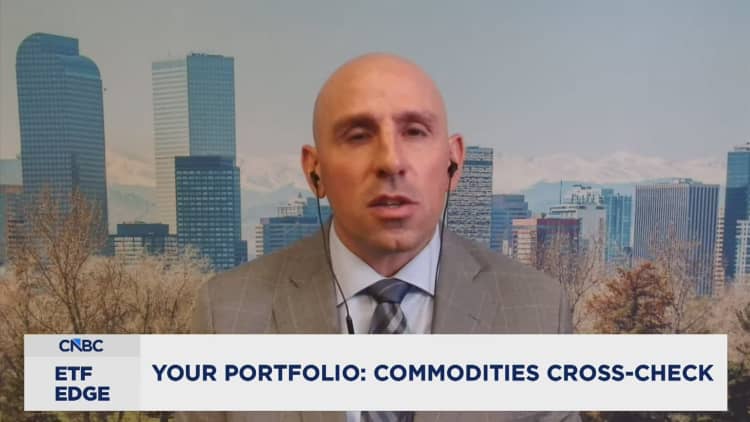

As geopolitical tensions ripple through global energy markets and a deal to end the U.S.-Iran war remains elusive, oil prices have soared, but there’s an even better trade on energy volatility that investors have flocked to: the cost of moving crude.
The Breakwave Tanker Shipping ETF (BWET), a little-known exchange-traded fund tied to crude oil tanker freight rates, has surged more than 600% year-to-date as war and disruption in key maritime corridors drive shipping rates sharply higher.
“I started getting a lot of questions about this ETF, like, what is up with it? What kind of performance is this?” Cinthia Murphy, VettaFi director of research, said on this week’s CNBC’s “ETF Edge.”
BWET is a $30 million portfolio that launched in May 2023, in an ETF market that has over $13 trillion in assets.
Murphy explained the scale of the move has forced the market to rethink where the real leverage in energy resides. Rather than focusing only on oil prices, which have been extremely volatile this year, investors may be looking toward infrastructure that the world relies on to move energy commodities.
“It really is a story about shipping costs,” Murphy said. “Anytime you have some big disruption to shipping … freight futures skyrocket and there’s one ETF that captures pretty much that performance better than anybody else.”

BWET 1Y
Murphy said the ongoing tensions in the Strait of Hormuz have proven to hold the ability to send freight futures higher quickly while markets reprice the risk of moving commodities through the region, and not only oil. For example, the Baltic Exchange Dry Index is up over 6% for the past week and 41% since the beginning of the year.
But, “it’s really moving that oil around that has been a big story,” said Paul Baiocchi, head of fund sales & strategy at SS&C Technologies.
Oil prices have risen sharply this year, with the U.S. Oil Fund (USO) up close to 90% as of Friday, and the SPDR State Street Energy Select Sector SPDR ETF (XLE) up over 23% as energy stocks have posted strong gains. But those moves seem modest compared with the spike in freight futures, and the surge in BWET began even before the outbreak of war in the Middle East, with BWET up over 1,000% in the past year.
“Of course, oil prices have been dramatically higher and the energy sector in general, energy equities, every part of the energy story this year has been a big blockbuster year,” Murphy said. But she added, “BWET is really standing [out].”
Wall Street equity research teams are also placing more attention on surging tanker stocks.
At the same time, Baiocchi said the rally ties into a broader theme that is being played out throughout global markets: underinvestment in energy infrastructure and the growing need to secure more resilient supply chains.
“[We talked] about this idea that even before the Iran conflict, a lot of these global commodities markets were fraught, and if nothing else, this conflict has exacerbated a lot of the challenges,” Baiocchi said.
That includes not just oil transport, but the broader buildout of energy systems. “Countries and companies around the world will be scrambling to find more stable sources of energy,” he said.
Even as BWET draws outsized attention, ETF experts caution that freight rates are inherently volatile and driven by short-term shocks. But as geopolitical conflict continues to reshape global trade, more investors are looking beyond commodity prices and to the system that determines how commodities move to market for investing profits.
Sign up for our weekly newsletter that goes beyond the livestream, offering a closer look at the trends and figures shaping the ETF market.


Coinbase has filed with the CFTC to activate Trade at Settlement for XRP futures on May 1, placing XRP alongside Bitcoin, Ethereum, gold, and crude oil as an asset institutional traders can execute at the official settlement price.
Summary
- Coinbase will launch Trade at Settlement for XRP futures on May 1, covering both nano XRP and full-sized contracts.
- TAS lets institutions execute large block orders at the official closing price, eliminating intraday price exposure that makes high-volume execution costly and unpredictable.
- The launch completes XRP’s institutional execution pathway on Coinbase, following the SEC and CFTC’s joint March 2026 classification of XRP as a digital commodity.
Coinbase filed with the CFTC on April 21 to roll out Trade at Settlement for XRP futures starting May 1. The filing covers both nano XRP and standard full-sized XRP futures contracts on Coinbase Derivatives. TAS lets large institutions execute block orders at the official 4:00 p.m. settlement price, removing the intraday execution risk that distorts costs when trading at volume.
Coinbase XRP Institutional Trading TAS Closes the Final Execution Gap
As crypto.news reported, the CFTC filing outlines how TAS will support block trades under the Commodity Exchange Act, with Coinbase’s Market Regulation team overseeing all TAS activity to ensure market fairness and prevent manipulation. TAS has been standard in traditional commodity futures markets because institutional participants managing large positions cannot afford to execute against live, fluctuating intraday prices without moving the market against themselves. By locking in the settlement price, TAS makes cost management transparent and position sizing precise. The 247 Wall St. analysis noted that in March, Ripple Prime added Coinbase’s XRP futures to its $3 trillion clearing platform, meaning institutional clients can already route XRP trades through Ripple to Coinbase Derivatives. Adding TAS on May 1 closes the last execution gap in that institutional pipeline.
XRP’s Institutional Infrastructure Is Expanding Simultaneously
The TAS launch is arriving as XRP’s broader institutional footprint grows on multiple fronts. As crypto.news documented, Goldman Sachs has disclosed a $153.8 million position across four XRP ETFs, becoming the largest known institutional holder among the top 30 disclosures, which collectively control approximately $211 million in XRP ETF exposure. Total XRP ETF assets under management have now reached $1.53 billion with 773 million XRP in custody, and as crypto.news tracked, the funds have not recorded a single outflow day since April 9, the longest positive streak in their history. A Coinbase and EY-Parthenon survey of 351 institutional investors found that 25% plan to add XRP to their portfolios in 2026, with 65% citing regulatory clarity as the single condition holding them back.
The Regulatory Foundation Behind the TAS Move
The TAS expansion into XRP carries direct regulatory context. The SEC and CFTC jointly classified XRP as a digital commodity in March 2026, giving the asset the same legal standing as Bitcoin and Ethereum under the commodity framework that governs Coinbase’s TAS-eligible products. As crypto.news noted, the commodity classification removed a key legal barrier that had previously complicated institutional deployment in XRP futures, and the TAS mechanism is designed precisely for the institutional buyer profile that commodity frameworks attract. If sustained block trade flows through TAS materialize after May 1, they would represent the clearest on-chain signal yet that institutional demand for XRP is converting from stated intent into actual capital deployment.
Coinbase’s Market Regulation team will oversee all TAS activity for XRP futures, and the feature will go live on May 1 barring any CFTC objection to the filed documentation.


XChat, the standalone messaging app from Elon Musk’s X, climbed to the top spot on the US App Store, edging out OpenAI’s ChatGPT and Anthropic’s Claude within hours of its iPhone debut.
The leap to No. 1 hands Musk an early win in his bid to fold messaging, AI, and crypto-ready payments into a single app under the X brand.
XChat tops the free app chart
The App Store screenshot, shared by X head of product Nikita Bier on Saturday morning, showed XChat first, ChatGPT second, and Claude third. Bier reposted the chart with a brief caption.
Bier joined X last year to lead consumer growth and previously took social apps TBH and Gas to the top of the chart.
The chart performance puts a private messenger ahead of two of the highest-profile US AI assistants. ChatGPT had held the top free spot through much of the past year, with Claude tracking it closely.
XChat is built in Rust with what X calls Bitcoin-style encryption. The app offers end-to-end encrypted chats, voice and video calls, and file transfer without requiring a phone number.
Group chats hold up to 481 members, with X targeting a 1,000-seat cap in the coming weeks. The integrated Grok assistant lets users summarize files and draft messages inside conversations.
X Money and Crypto Rails are Next?
The download surge matters because XChat is one piece of Musk’s broader stack. X has said its X Money wallet, built with Visa, will roll out shortly after the messaging launch.
The roadmap covers peer-to-peer fiat transfers first, with crypto support flagged for a later release. That would put XChat users a tap away from on-platform payments. X has secured money transmitter licenses in more than 40 US states, clearing one regulatory hurdle for the rollout.
The launch positions XChat against WhatsApp, Telegram, and Signal on messaging, with PayPal and Venmo entering the picture once payments go live. For traders, the pairing matters most when Cashtags and X Money sit alongside group chats.
Whether XChat holds the No. 1 spot past the launch news cycle will depend on retention, not headline downloads. The next test arrives once X Money rolls live and the promised crypto rails switch on inside Musk’s broader vision. Holding the chart will be the harder challenge once the launch news fades.
The post Elon Musk’s XChat Tops App Store, Beats ChatGPT and Claude at Launch appeared first on BeInCrypto.
Brazilian authorities have moved to shut down 27 prediction market platforms, including Kalshi and Polymarket.
The decision, announced Friday, follows a directive from the Ministry of Finance and enforcement by the National Telecommunications Agency (Anatel), according to state-owned news outlet Agência Brasil. Authorities claimed that such services fall outside Brazil’s current legal framework and therefore operate illegally.
“We have been monitoring the evolution of this sector in Brazil, which suffered a period of anarchy because there were no rules, no oversight, from 2018 to 2022,” Finance Ministry executive secretary Dario Durigan reportedly said during a press conference at the Palácio do Planalto.
The crackdown follows Resolution 5.298 issued by Brazil’s National Monetary Council (CMN) on Friday, which takes effect in early May and sharply limits what prediction market platforms can offer. Under the new rules, contracts tied to sports, politics, entertainment, or social events are banned, as authorities consider them closer to gambling than financial investments.
Only contracts linked to economic indicators, such as inflation, interest rates, exchange rates, or commodity prices, will remain allowed and fall under financial market oversight.
Related: Kalshi bans 3 US politicians for betting on their own election races
Brazil flags prediction platforms as debt risk
Durigan claimed that prediction markets could deepen household debt and expose users to financial harm. “At a time when we are working to reduce debt levels among families, small businesses, and students, we must also prevent new forms of harmful indebtedness,” he said.
The blocked platforms include a mix of international and Brazil-focused services, with major names including Kalshi, Polymarket, PredictIt, Robinhood (via its forecasting feature) and Fanatics Markets.
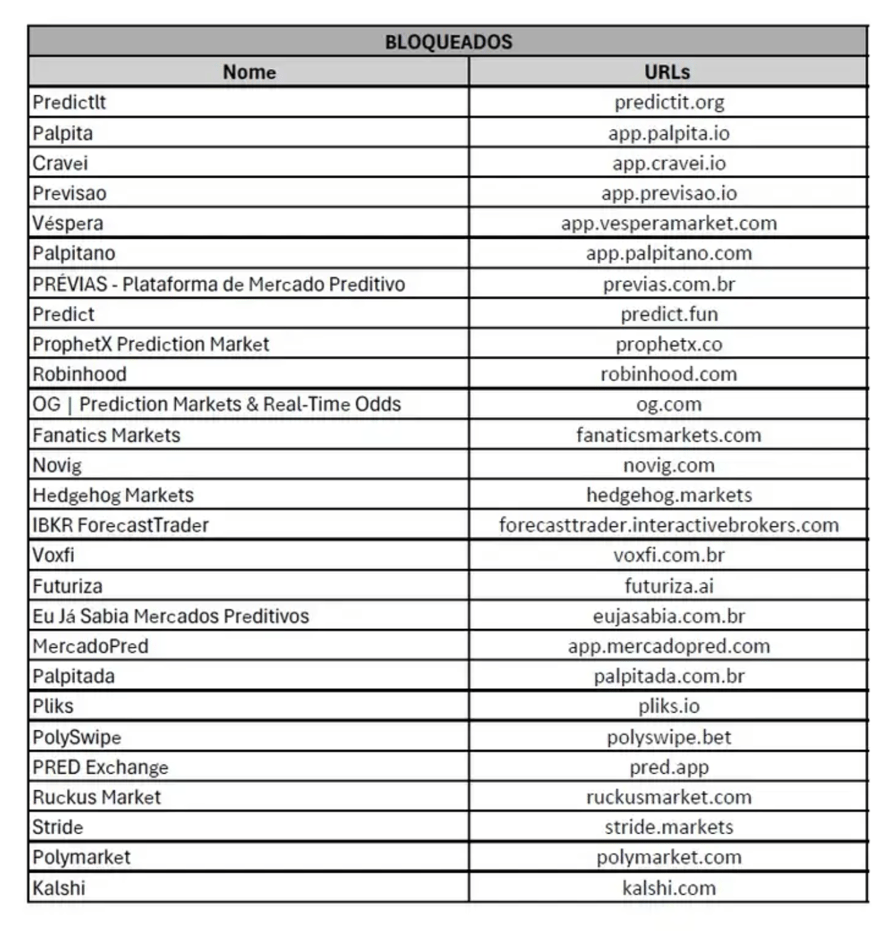
Banned prediction markets in Brazil. Source: Agência Brasil
Other affected platforms include ProphetX, Hedgehog Markets, Novig, Polyswipe, PRED Exchange and Stride, alongside several Brazil-focused services such as Palpita, Cravei, Previsao, and MercadoPred.
Related: Prediction market battle gets closer to Supreme Court
More countries ban prediction markets
A growing number of jurisdictions have moved to ban prediction markets, often folding them into gambling or financial regulations. Several European nations, including France, Belgium and the Netherlands, have blocked or penalized platforms operating without authorization.
In the United States, the situation is more fragmented, with an ongoing tug-of-war between federal regulators and individual states over prediction markets.
Magazine: How to fix suspected insider trading on Polymarket and Kalshi

Brazilian authorities have intensified a crackdown on prediction-market platforms, ordering the blocking of 27 services, including Kalshi and Polymarket. The move was announced in a joint escalation by the Finance Ministry and enforcement agencies, with state media Agência Brasil confirming the action. Officials argued that these platforms operate outside Brazil’s current legal framework and are therefore illegal.
According to Agência Brasil, the enforcement follows a directive from the National Monetary Council (CMN) and marks a shift toward tighter oversight. Finance Ministry executive secretary Dario Durigan described the regulatory stance as a response to a period of regulatory “anarchy” in the sector from 2018 to 2022, signaling a transition to structured rules intended to prevent unregulated financial activity.
The crackdown is anchored in CMN Resolution 5.298, issued on Friday and set to take effect in early May. The regulation sharply curtails the scope of prediction-market offerings: contracts tied to sports, politics, entertainment, or other social events are banned, with authorities classifying them as closer to gambling than traditional financial investments. Only contracts linked to economic indicators—such as inflation, interest rates, exchange rates, or commodity prices—will remain permissible and will fall under financial-market oversight.
Related platform activity has drawn attention from industry observers, including prior coverage of market-betting platforms and their governance. For example, Kalshi’s governance actions have recently been scrutinized in other jurisdictions as part of a broader debate about insider-trading concerns and regulatory compliance.
Brazil flags prediction platforms as debt risk
Durigan argued that prediction markets can amplify household indebtedness and expose participants to financial harm at a time when policy aims include reducing debt burdens for families, small businesses, and students. He suggested that curbing exposure to non-productive debt forms is a key objective of the new framework.
The list of platforms affected by the ban comprises a mix of international and Brazil-focused services. Notable names among those blocked include Kalshi, Polymarket, PredictIt, Robinhood’s forecast feature, and Fanatics Markets. Several smaller and domestic platforms were also targeted, reflecting a broad sweep across the sector.
- Kalshi
- Polymarket
- PredictIt
- Robinhood (Forecasting)
- Fanatics Markets
- ProphetX
- Hedgehog Markets
- Novig
- Polyswipe
- PRED Exchange
- Stride
- Palpita
- Cravei
- Previsao
- MercadoPred
- And other Brazil-focused services
Ahead of the May effective date, the CMN’s resolution delineates the boundary between permissible financial-market instruments and prohibited speculative bets presented as market forecasts. The policy is designed to channel market activity into instruments that regulators deem financial in nature, rather than gambling, and to provide clearer supervisory oversight for platforms and participants.
What changes for market participants and platform operators
From the perspective of compliance teams, the new rules impose several practical shifts. Prediction-market operators must implement licensing or registration under the established financial-market framework, align product offerings with economic-indicator-based contracts, and strengthen KYC/AML procedures to satisfy the oversight regime. For financial institutions and banks, the threshold effect is a narrowing of permissible partnerships or facilitation services for unfettered speculative markets, potentially influencing cross-border flows and data-sharing arrangements.
For Brazil-based users, the immediate effect is a reduction in the availability of prediction-market products and a narrowing of hedging or speculative tools that rely on non-traditional event outcomes. While the prohibition targets non-financial event contracts, market participants seeking exposure to macroeconomic or commodity-price developments can still access allowed instruments within the new framework, subject to the appropriate regulatory oversight.
Regional and global regulatory context
The Brazilian action sits within a broader, evolving regulatory pattern. A growing cohort of jurisdictions has moved to ban or tightly regulate prediction markets, often recasting them under gambling or financial-regulatory regimes. In Europe, several member states have restricted or penalized platforms operating without authorization, while the broader trend emphasizes consumer protection, anti-fraud safeguards, and prudential risk management.
In the United States, policy and enforcement around prediction markets remain fragmented, with ongoing tensions between federal authorities and state-level regulators over permissible operations. The Brazilian case adds to a global mosaic in which regulators are increasingly scrutinizing cross-border platforms and the reliability of dispute resolution, KYC/AML standards, and traceable ownership structures.
From a policy perspective, the Brazil action reinforces several themes: the alignment of prediction-market activity with formal financial instruments, the emphasis on debt-risk mitigation for households, and the push for clear licensing and oversight for platforms that reach Brazilian users. For multinational operators and custodians, the actions underscore the importance of jurisdiction-specific licensing, risk frameworks, and data-transfer arrangements necessary to operate legally in diverse markets.
Compliance, licensing, and enforcement implications
Operators—particularly those with cross-border reach—will need to reassess product catalogs, geographic availability, and compliance controls. The enforcement approach in Brazil signals a willingness to actively police non-compliant services and to enforce interagency coordination between the Ministry of Finance, Anatel, and other regulatory bodies. For exchanges and banks that support related activities, the ruling may affect how they structure custody arrangements, settlement processes, and Know-Your-Customer/Anti-Money Laundering programs to remain within permitted use cases.
The case also raises questions about licensing timetables, potential transitional periods, and the degree of alignment with international standards. As CMN Resolution 5.298 takes effect, firms will need to monitor developments in domestic enforcement, anticipate future rule refinements, and adjust risk assessments accordingly. Analysts and compliance teams should track any further guidance from Brazil’s monetary authorities regarding acceptable contract types, reporting obligations, and supervisory expectations for ongoing operations in the country.
Overall, the Brazilian action highlights a tightening of regulatory oversight over prediction markets and a preference for instrument classes with clearer financial-market characteristics. Institutions with exposure to global platforms or Brazilian users should prepare for tighter controls, clearer licensing paths, and enhanced due diligence requirements as regulatory authorities continue to refine the framework for these market-forecasting tools.
Closing perspective: The ongoing regulatory consolidation around prediction markets suggests that institutions will need to prioritize clear governance, robust compliance programs, and vigilant monitoring of cross-border activity. As jurisdictions converge on stricter oversight, market participants should anticipate further policy developments and the potential for additional platform-level restrictions in other regions.

Why $100,000 in $100 Bills Costs Less Than $100,000 in $20 Bills #money #cash #banking #bills #prop

Man in 30s found dead behind Heron Foods shop in Stockton

Republicans retool midterm strategy: Trump’s policies, but less Trump

Manchester United reach agreement with Casemiro over contract clause amid transfer speculation

US brings back mandatory military draft registration

Steven Gerrard disagrees with Gary Neville over ‘shock’ Chelsea and Arsenal claim | Football
Why $100,000 in $100 Bills Costs Less Than $100,000 in $20 Bills #money #cash #banking #bills #prop

Crypto Gold Live Trading 24 APRIL – stock_learners

No.1 Money Saving Experts: Do Not Buy A House! Putting Money In A Bank Makes You Poorer!
-

 Business6 days ago
Powerball Result April 18, 2026: No Jackpot Winner in Powerball Draw: $75 Million Rolls Over
-

 Politics6 days ago
Zack Polanski demands ‘council homes not luxury flats for foreign investors’
-

 Fashion19 hours ago
Weekend Open Thread – Corporette.com
-
Entertainment6 days ago
NBA Analyst Charles Barkley Chimes in on Ice Spice McDonald’s Fiasco
-

 Tech6 days ago
Auto Enthusiast Scores Running Tesla Model 3 for Two Grand and Turns It Into Bare-Bones Go-Kart
-

 Politics5 days ago
Gary Stevenson delivers timely reminder to register to vote as deadline TODAY
-

 Politics3 days ago
Making troops accountable for war crimes threatens US alliance, ex-SAS colonel warns
-

 Business3 days ago
Rolls-Royce Voted UK’s Most Iconic Trade Mark as IPO Register Hits 150
-

 Politics3 days ago
Disabled people challenge government SEND proposals over segregation concerns
-
 Crypto World5 days ago
Bank of Hawai’i (BOH) Q1 2026: Net Income Drops to $57.4M as Net Interest Margin Expands
-

 Politics3 days ago
Zack Polanski responds to home secretary’s taser threat
-
Politics3 days ago
Wings Over Scotland | How To Get Away With Crimes
-

 Politics3 days ago
Starmer handler McSweeney to be dragged from shadows by Foreign Affairs Committee
-
Crypto World6 days ago
Kelp DAO rsETH Bridge Hack Drains $292M as DeFi Losses Top $600M in Two Weeks
-

 Politics3 days ago
‘Iran is still a nuclear threat’
-
 Crypto World4 days ago
Five Value Stocks with Recovery Potential in 2026: PayPal (PYPL), Nike (NKE), and More
-

 Crypto World4 days ago
New York sues Coinbase, Gemini over prediction market offerings
-

 Business3 days ago
The Job Benefits Most Men Don’t Know to Negotiate
-

 Crypto World1 day ago
Michael Saylor says BTC winter is over. Market analyst disagrees, says bitcoin was in a pullback
-

 Politics6 days ago
Reform investigating candidate who ‘hates’ the NHS
You must be logged in to post a comment Login