

Crypto World
Dubai Strengthens Crypto Lead as Asia Splits Between Regulation


TL;DR
- Dubai has become Asia’s largest regulated crypto hub with 50 licensed virtual asset firms.
- India’s central bank continues pushing to keep banks insulated from cryptocurrency risks.
- Metaplanet expanded its Bitcoin holdings while Russia confirmed its digital ruble launch timeline.
- Taiwan, South Korea, and Kazakhstan advanced crypto regulation, tokenization, and blockchain adoption.
Asia’s digital asset landscape continues to evolve at different speeds, with some jurisdictions like Dubai accelerating crypto adoption while others tighten oversight. Over the past week, regulators and institutions across the region announced major developments spanning licensing, central bank digital currencies (CBDCs), tokenization, and corporate Bitcoin strategies.
Dubai expanded its lead as one of Asia’s most regulated crypto hubs, while India’s central bank reiterated its cautious stance on digital assets. Meanwhile, Japan, Russia, South Korea, Taiwan, and Kazakhstan each unveiled initiatives that underscore the region’s increasingly diverse approach to blockchain technology.
Dubai Expands Lead While India Maintains Conservative Approach
Dubai reached a significant milestone after its Virtual Assets Regulatory Authority (VARA) issued its 50th Virtual Asset Service Provider (VASP) license, further strengthening the emirate’s position as one of the region’s most established crypto jurisdictions. The latest license was awarded to Tribe Tokenisation FZE, reflecting Dubai’s continued focus on regulated digital asset businesses and real-world asset tokenization. Although not every licensed company has begun commercial operations, the growing number of approvals highlights the city’s long-term commitment to building a compliant crypto ecosystem.
India, however, appears to be moving in the opposite direction. Reports indicate the Reserve Bank of India (RBI) urged lawmakers to shield the country’s banking sector from cryptocurrency exposure while keeping the door open for regulated tokenization initiatives. According to the central bank, allowing banks to engage directly with cryptocurrencies could introduce financial stability risks, whereas tokenized versions of traditional financial assets remain a separate area worthy of development.
Elsewhere in the region, Taiwan passed its first comprehensive crypto legislation, introducing licensing requirements for virtual asset service providers and reserve rules for stablecoin issuers. The move aligns Taiwan more closely with established regulatory frameworks already adopted in markets such as Japan and Singapore.
Institutions Push Ahead With Bitcoin, CBDCs, and Tokenization
Institutional adoption also remained a dominant theme across Asia.
Japanese investment firm Metaplanet expanded its Bitcoin treasury once again, increasing its holdings to more than 43,000 BTC after purchasing an additional 2,823 Bitcoin during the second quarter. The company also reported revenue generated through its Bitcoin yield strategy, reinforcing its commitment to a long-term digital asset accumulation model.
Meanwhile, another Japanese player, SBI Crypto, announced it will shut down its Bitcoin mining pool at the end of July after five years of operation. While no official reason was provided, the decision marks the end of one of Japan’s notable mining services.
Russia is also preparing for the next phase of its digital currency plans. Bank of Russia Governor Elvira Nabiullina confirmed the country’s digital ruble remains on track for a September 1 rollout, with banks and financial institutions expected to begin supporting the CBDC as scheduled.
In South Korea, Bank of Korea Governor Hyun Song Shin emphasized that tokenized government bonds could significantly improve settlement efficiency and collateral management. The central bank is also exploring a unified ledger that would combine tokenized government securities, wholesale CBDCs, and commercial bank deposits into a single blockchain-based infrastructure.
Central Asia is also becoming more active in blockchain development. Kazakhstan continues advancing its digital economy ambitions after Solana Company agreed to help develop blockchain infrastructure for Alatau City, a planned technology-focused megacity backed by more than $6 billion in potential investment.
Meanwhile, compliance efforts remain a major focus beyond Asia. The U.S. Treasury sanctioned 134 cryptocurrency wallets linked to ISIS-K, prompting Tether to freeze USDT held across 131 sanctioned TRON addresses. The action highlights the growing role of blockchain analytics and stablecoin issuers in supporting international financial enforcement efforts.


TLDR:
- Bitcoin price reclaimed the $63,500 area after volatile trade, keeping the short-term structure constructive while $65,700 stays the next upside test.
- Spot Bitcoin ETFs pulled in fresh demand after a long outflow streak, giving buyers a stronger institutional signal after June’s weakness.
- Weak U.S. labor data cooled rate-hike fears, helping BTCUSD as Treasury yields eased and traders moved back into selected risk assets.
- A break below $63,500 could shift attention toward $61,000, while sustained support may force more short-covering near resistance.
Bitcoin price traded near $63,173 on Monday after a volatile session around the reclaimed $63,500 area. BTCUSD moved between $62,468 and $63,874, showing fast movement around a key support zone.
The move followed weaker U.S. labor data, renewed spot Bitcoin ETF inflows, and short liquidations near $62,000. Traders are now watching whether Bitcoin can hold $63,500 and retest $65,700, where the last major rejection developed.
Bitcoin Price Holds Key Support After ETF Inflows Return
Bitcoin price action improved after U.S.-listed spot Bitcoin ETFs posted $221.7 million in net inflows. The daily intake ended a 10-day outflow streak and marked the strongest inflow in about two months. That shift mattered as June had damaged sentiment across institutional crypto products.
The inflow also arrived as Bitcoin reclaimed the $63,500 zone. Analyst That Martini Guy says the first rejection at that level looked normal. He added that prior resistance rarely breaks on the first attempt.
The technical setup now depends on whether buyers defend the area. Holding $63,500 keeps the short-term structure constructive. A clean push above it could put $65,700 back in focus.
A loss of $63,500 would weaken the rebound. The next downside area sits near $61,000, based on the analyst’s chart view. That level would show whether recent buying was durable or only a relief move.
Spot demand and derivatives flows also shaped the rally. Short sellers were exposed after Bitcoin moved above $62,000. Forced buybacks then added speed to the recovery and lifted BTC through crowded intraday levels.
The setup is still fragile. Bitcoin price has recovered support, but it has not cleared the last rejection zone. Buyers need steady volume and follow-through before the move looks more durable.
Fed Minutes And Labor Data Put BTCUSD Traders On Alert
Bitcoin price also gained support from softer U.S. labor data. June nonfarm payrolls rose by only 57,000, below expectations for 110,000. May job gains were revised lower, while the unemployment rate fell to 4.2% as labor force participation dropped.
That report lowered fears of a near-term Federal Reserve rate hike. Treasury yields eased, the dollar softened, and risk appetite improved. Lower yields often help non-yielding assets, including Bitcoin and gold.
This week brings more macro risk for BTCUSD traders. The Federal Reserve will release minutes from its June meeting on Wednesday. The minutes could show how officials judged inflation risks under new Chair Kevin Warsh.
Investors will also monitor services PMI, ADP employment data, and jobless claims. These numbers may shape rate expectations before earnings season starts. A stronger inflation or labor signal could pressure the Bitcoin price again.
For now, traders are weighing two opposing forces. ETF inflows and reclaimed support favor another test higher. Yet June’s heavy outflows, weak liquidity, and regulatory pressure in Europe still limit conviction.
Bitcoin price needs sustained spot demand to extend the recovery. A hold above $63,500 keeps $65,700 in play. Failure there could reopen the $61,000 area as traders reassess leverage and macro risk.

Crypto markets have had a positive weekend, holding on to and marginally improving gains made late last week.
The next seven days will see the release of the Federal Reserve’s minutes from its last meeting, which could shed more light on the direction of monetary policy as inflation continues to climb.
Meanwhile, the US stock market capitalization topped $80 trillion, setting a new record, and now accounts for around 48% of global market cap.
“We expect another volatile week ahead as markets brace for earnings season,” said the Kobeissi Letter.
Economic Events July 6 to 10
June S&P Global Services purchasing managers’ index (PMI) data is due on Monday, painting a broader picture of economic activity. This report is followed on Tuesday by ADP Employment Change data.
Wednesday will see the FOMC minutes, the first for new Chairman Kevin Warsh. The central bank held rates steady, but inflationary pressures from higher energy prices could prompt it to raise them.
“I think it’s going to be interesting to see how the discussion went around the table, how incrementally hawkish are they leaning,” said Matthew Miskin, co-chief investment strategist at Manulife John Hancock Investments.
“That’s what investors and markets are going to be wondering: What is this new Fed chairman and updated (Fed policymaking body) looking for to decide the path of rates from here?”
Initial Jobless Claims data is due on Thursday, while full-time employment dropped by 514,000 in June to its lowest since December 2024. “The weakness in the US labor market is accelerating,” said Kobeissi.
Key Events This Week:
1. June S&P Global Services PMI data – Monday
2. ADP Employment Change data – Tuesday
3. Fed Meeting Minutes – Wednesday
4. Initial Jobless Claims data – Thursday
5. June Existing Home Sales data – Thursday
6. IEA Monthly Report – Friday
We are one…
— The Kobeissi Letter (@KobeissiLetter) July 5, 2026
Also this week, SpaceX (SPCX) is set to join the Nasdaq 100 index, and another quarterly earnings season will begin this month.
Crypto Market Outlook
Crypto markets are holding gains this Monday morning in Asia, with total capitalization up 1.1% on the day to $2.26 trillion.
Bitcoin is leading the pack with a 2.7% gain over the weekend to reach $63,700 on Monday morning, its highest level for two weeks after its worst month for four years.
Ether prices did even better, with a 14% gain over the past week, closing in on $1,800 in early trading on Monday.
Altcoins were predominantly green at the time of writing, with Hyperliquid and Canton outperforming.
The post 3 Things That Could Impact Crypto Markets This Week appeared first on CryptoPotato.
TLDR:
- Polymarket political bets from U.S.-linked wallets reached $571 million in 12 months, topping every other tracked country despite the ban.
- Allium said country-level wallet tags cover only about 6% of political-market wallets, making the data directional rather than exact.
- U.S.-linked wallets favored geopolitical prediction markets, with foreign conflict bets taking a larger share than election contracts.
- American wallets won resolved bets at nearly the same rate as other users, showing bolder positioning rather than a clear trading edge.
Polymarket political bets from U.S.-linked wallets reached about $571 million over the past year, even though the platform cannot legally serve American users. The figure, reported by on-chain analysis firm Allium, placed the United States ahead of every other tracked country. Hong Kong followed with $422 million in political market volume.
The data highlights a sharp gap between official restrictions and actual user behavior. Polymarket blocks U.S. users through IP checks. Yet crypto wallets, stablecoins, and VPN access appear to keep the offshore market open to American traders.
Polymarket Political Bets Expose Weak U.S. Access Controls
Polymarket political bets show how hard geographic blocks are to enforce on crypto rails. A traditional financial platform can reject an account, block a bank payment, or stop a broker connection. Polymarket works differently, as users interact through wallets and stablecoins.

That structure leaves fewer points of control. A VPN can mask a location, while a crypto wallet can settle trades without a bank in the middle. Allium’s tracking looked at wallet behavior instead of IP addresses, so the same VPN that bypasses access controls does not erase on-chain patterns.
The firm added an important limit. It can link only about 6% of political-market wallets to a specific country. That means the $571 million figure should not be treated as a precise total. Still, the scale points to strong U.S. demand for offshore prediction markets.
The finding also raises a harder regulatory question. Polymarket’s ban may satisfy a legal access rule, yet it does not fully stop U.S.-linked wallets from trading. Instead, activity moves to a venue outside direct U.S. oversight.
Geopolitical Markets Pull More U.S.-Linked Wallet Activity
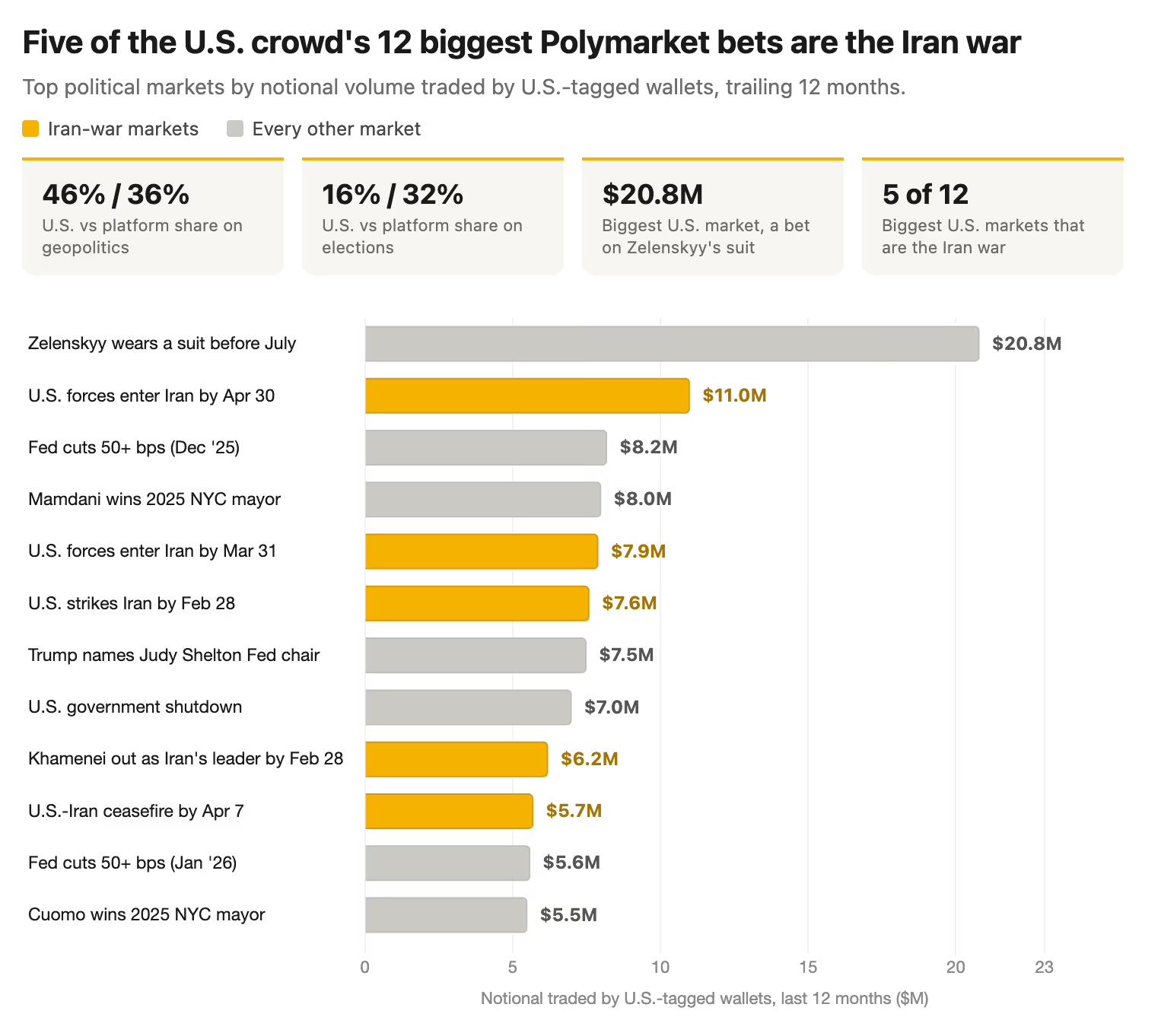
The bigger surprise is what American wallets traded. U.S.-linked wallets put 46% of their political volume into geopolitics, compared with 36% across Polymarket overall. Elections accounted for only 16% of U.S. volume, while the full platform average stood near 32%.
That split suggests American traders used Polymarket political bets less for election speculation and more for foreign conflict markets. Iran-related contracts were especially active. Five of the twelve largest U.S. wallet markets involved bets linked to an Iran conflict.
At one stage, American wallets placed 53% of their volume on a U.S. invasion of Iran. The rest of the platform stood at 26% on the same theme. That gap shows higher conviction among U.S.-linked wallets, though not better accuracy.
The largest single U.S.-linked market was more unusual. A contract on whether Ukrainian President Volodymyr Zelenskyy would wear a suit drew $20.8 million in trading volume. That market shows how offshore prediction markets list contracts that regulated U.S. venues often avoid.
Kalshi and compliant U.S. prediction venues focus more on elections, economic data, and rate decisions. Offshore polymarket markets include ceasefires, regime change, and war-related outcomes. That difference appears to pull U.S.-linked wallets toward the markets domestic rules restrict.
Resolved market data did not show a major U.S. betting edge. American wallets backed winners 81.9% of the time, close to 80.3% for other users. The main distinction was not accuracy. It was stronger interest in politically sensitive markets beyond U.S. regulatory reach.
TL;DR
- Bitcoin whale inflows to Binance have dropped 34% since June 12, outpacing the decline in retail deposits.
- Retail inflows fell 18%, highlighting a slower pullback among smaller investors.
- The widening gap between whale and retail inflows suggests reduced exchange activity from large BTC holders.
- Lower whale deposits could ease potential selling pressure if the trend continues.
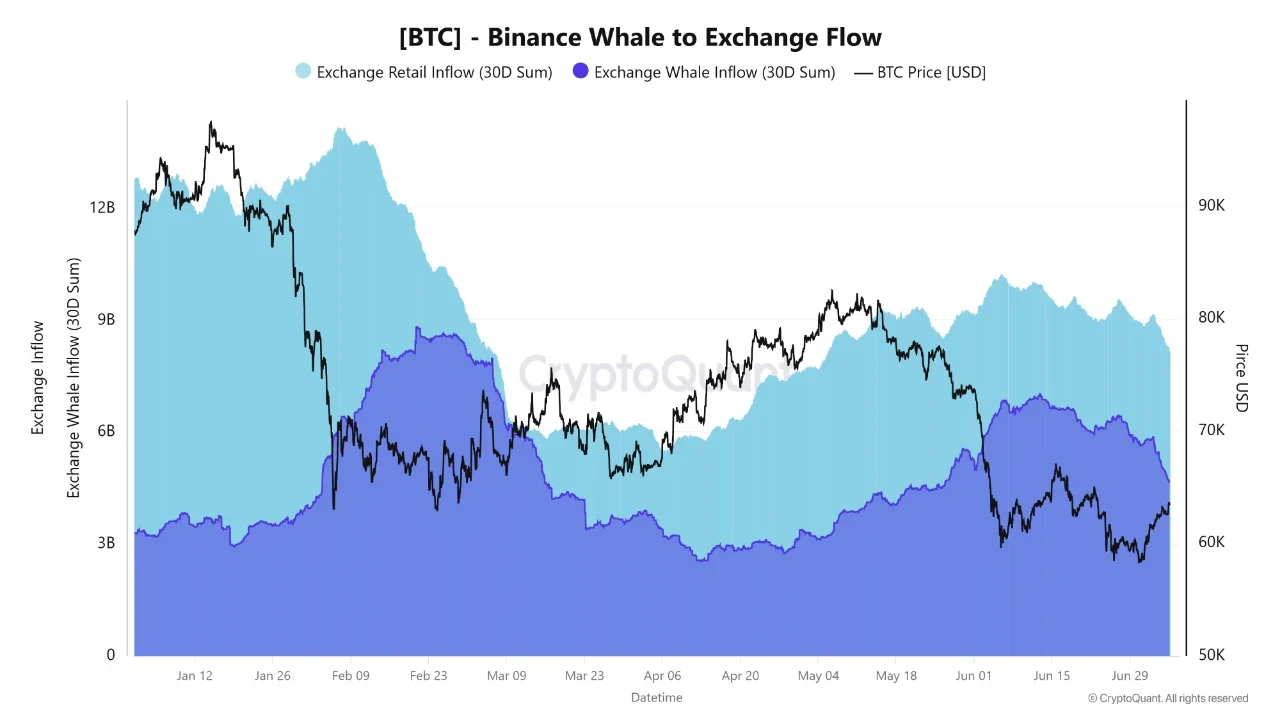
Bitcoin whale activity on Binance has slowed considerably over the past few weeks, with new on-chain data showing that large holders are moving significantly less BTC to the exchange than they were in mid-June. The decline has outpaced the slowdown in retail deposits, suggesting a shift in how different investor groups are positioning themselves.
Data from CryptoQuant shows the 30-day rolling value of Bitcoin whale inflows to Binance fell from approximately $7.04 billion on June 12 to $4.65 billion by July 6, representing a decline of about $2.39 billion, or 34%.
Whale Exchange flow Data | Source: CryptoQuant
Retail investors also reduced their exchange deposits during the same period, although at a much slower pace. Retail inflows declined from roughly $10.02 billion to $8.20 billion, a drop of $1.82 billion, or around 18%.
The sharper contraction among whales means large holders have pulled back from sending Bitcoin to Binance at nearly twice the rate of smaller investors.
Bitcoin Whale Activity Slows Faster Than Retail
The difference between whale and retail behavior has become increasingly noticeable over the past month.
While retail investors continue to account for the larger share of exchange inflows, the gap between the two groups has widened. The difference grew from approximately $2.98 billion in mid-June to around $3.55 billion by early July, highlighting the faster retreat in whale transfers.
Exchange inflows are closely monitored because they often indicate that investors are preparing to trade or liquidate assets. Although transferring Bitcoin to an exchange does not automatically mean a sale is imminent, reduced inflows from whales generally imply that fewer large holders are positioning coins for potential selling.
That could translate into lower exchange-side selling pressure, especially if whales continue keeping their holdings in self-custody or other long-term storage solutions rather than moving them onto trading platforms.
The latest figures also align with a broader trend seen throughout this market cycle, where institutional and long-term investors have increasingly favored holding strategies instead of actively rotating large amounts of Bitcoin through exchanges.
Market Watches Whether the Trend Continues
The next key question is whether whale inflows have simply paused or whether the decline marks the beginning of a more sustained trend.
If whale deposits remain around the current $4.65 billion level or fall even further, it would reinforce the view that large Bitcoin holders are becoming less active on Binance relative to retail participants. Such a development could reduce one potential source of short-term market supply.
On the other hand, a renewed increase in whale inflows would likely signal that major investors are once again moving funds closer to trading venues, something traders often watch for signs of changing market sentiment.
For now, the data suggests that while retail investors continue using Binance at relatively steady levels, Bitcoin whales have become noticeably more cautious in transferring assets to the exchange. Whether that reflects growing confidence in holding BTC over the longer term or simply a temporary pause remains one of the key on-chain trends to watch in the weeks ahead.
TL;DR
- Coinbase is investigating an AI-generated alert that falsely reported a World Cup result before the match began.
- CEO Brian Armstrong confirmed the company is reviewing the incident after users raised concerns.
- The error has sparked fresh debate over the reliability of AI-generated prediction market content.
- The incident highlights the need for stronger AI safeguards as Coinbase expands its AI-powered financial products.
Coinbase is investigating an AI notification that falsely reported the outcome of a FIFA World Cup match before the game had even begun, prompting criticism over the reliability of artificial intelligence in prediction markets.
The erroneous alert claimed that Norway had defeated Brazil 3-2, with striker Erling Haaland scoring twice. However, Coinbase’s own prediction market page showed the fixture was under a weather delay at the time, meaning no official result existed when the notification was sent.
The incident quickly drew attention across social media, raising fresh questions about the safeguards surrounding AI content on financial platforms.
Brian Armstrong Confirms Internal Review
Coinbase CEO Brian Armstrong acknowledged the issue after users flagged the false notification online, confirming that the company had begun investigating what went wrong.
“Taking a look with the team – thanks for reporting it,” Armstrong said in response to user complaints.
The exchange has not disclosed what caused the incorrect alert or whether it originated from an AI model, an automated data feed, or another internal system. Coinbase also has not indicated whether similar notifications will be paused while the investigation is underway.
The mistake is particularly notable because Coinbase has increasingly incorporated artificial intelligence into its products and operations. The company has also expanded its presence in prediction markets through its partnership with Kalshi, offering users access to event-based markets alongside traditional crypto services.
The false notification has also reignited debate over Coinbase’s positioning of prediction markets as tools that can help surface reliable information. Critics argued that sending an incorrect result before an event had taken place undermines confidence in AI-powered alerts, particularly when they are integrated into financial products.
AI Accuracy Faces Growing Scrutiny
The latest incident adds to the broader conversation surrounding the use of artificial intelligence in customer-facing financial services, where inaccurate information can quickly spread to large numbers of users.
Although Coinbase’s prediction market page correctly displayed that the match had been delayed due to weather conditions, the conflicting push notification created confusion by presenting a fabricated final score as though it were an official outcome.
The company has previously dealt with notification-related issues. Earlier this year, Armstrong addressed a separate bug involving push notifications, noting that Coinbase generally prefers to resolve technical problems without unnecessarily restricting customer access to its services.
So far, Coinbase has not reported any material impact on its business or share price following the incident. Instead, attention has shifted toward how the exchange verifies AI content before it reaches users.
As financial technology firms continue integrating artificial intelligence into trading platforms, prediction markets, and customer communications, maintaining accuracy is becoming increasingly important. The Coinbase incident highlights the challenges of balancing automation with reliability, particularly when AI-generated information has the potential to influence user decisions or public perception.
While the investigation continues, the episode serves as a reminder that AI-powered tools are dangerous and require robust oversight, especially as crypto exchanges expand their use of artificial intelligence across core products and market services.
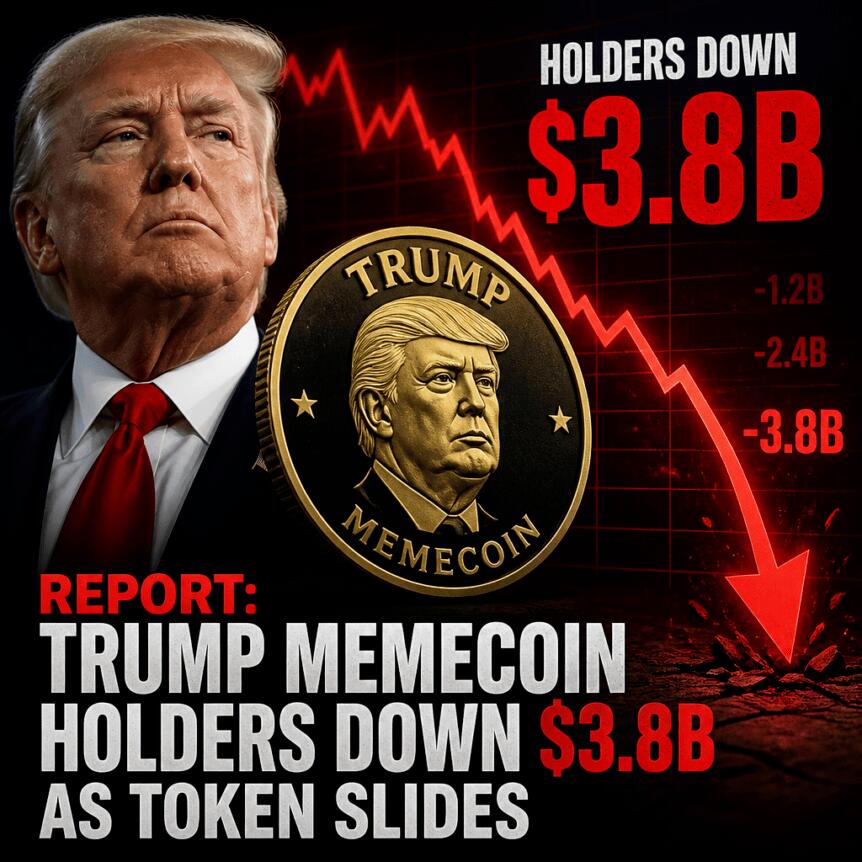
Nearly one million investors in Donald Trump’s memecoin, Official Trump (TRUMP), are sitting on paper losses totaling about $3.8 billion, according to an analysis published by The New York Times that relies on on-chain analytics from Nansen. The findings underscore a familiar pattern in retail-heavy memecoins: a small group of early wallets capture outsized gains while the broader base carries most of the downside.
The same Nansen analysis also points to losses among buyers of World Liberty Financial’s token (WLFI), a crypto asset tied to a trading platform co-founded by Trump and his three sons. Together, the data arrives amid renewed scrutiny sparked by Trump’s financial disclosures describing substantial crypto-related income.
Key takeaways
- According to Nansen data cited by The New York Times, 988,905 TRUMP wallets (about two-thirds of buyers) were losing money as of the end of June.
- Total TRUMP losses for those wallets were reported at $3.81 billion, while a smaller group of wallets recorded gains totaling about $4 billion.
- Separate Nansen analysis of WLFI found that 85% of the company-tracked wallets held losses, totaling $83 million, with the rest profiting $23 million.
- Trump’s recent financial disclosure described substantial income from his crypto ventures, adding fuel to concerns about conflicts of interest while in office.
TRUMP holders face broad losses, early buyers capture gains
The New York Times reported that as of the end of June, 988,905 TRUMP buyers—roughly two out of every three—were underwater. Across those wallets, losses were estimated at $3.81 billion, with Nansen’s analysis including both holders who were still holding at a loss and those whose positions were already marked negative by the time of measurement.
By contrast, just under half a million wallets recorded profits. In total, the reporting stated that profitable wallets accounted for about $4 billion in gains. Nansen characterized the distribution as skewed, describing it as “a small number of early buyers capturing enormous gains while the broad retail majority absorbed the losses.”
The contrast matters for how investors interpret memecoin risk. These tokens often start with hype and easy participation, but the on-chain outcome can be highly uneven—especially when early buyers benefit from momentum and late entrants become liquidity providers to the exit of better-positioned traders.
In terms of performance since launch, the token’s peak is reported at more than $73 shortly after it debuted. Since then, it has fallen by over 97%, and CoinGecko data in the report placed TRUMP at about $1.70 at the time of publication.
Financial disclosure raises new questions around crypto involvement
The TRUMP loss analysis arrives days after Trump’s annual financial disclosure, released earlier in the week, drew attention for crypto-related earnings. The filing reportedly showed that Trump earned more than $1.4 billion in income from crypto ventures last year, renewing debate around how personal financial interests intersect with public duties.
The disclosure, described as nearly 1,000 pages, also reportedly indicated Trump made over $630 million on the TRUMP memecoin. Meanwhile, the filing suggested that all token buyers combined made a net profit of around $200 million—an aggregate that contrasts sharply with the large number of losing wallets highlighted by Nansen.
This mismatch points to a crucial detail investors may overlook: even if the broader market settles slightly positive in aggregate, individual outcomes can still be heavily negative for most participants. Large early wins can dominate totals even when most holders end up losing money.
Trump launched the memecoin in January 2025, shortly before returning to office. The New York Times coverage and the Nansen-based approach place particular emphasis on buyer-level outcomes as of the end of June, offering a more granular view than price-only narratives.
WLFI token analysis suggests similar imbalance for retail buyers
Nansen’s work also extended to World Liberty Financial (WLFI), a token connected to the crypto trading platform of the same name. The platform’s co-founders include Trump and his three sons, according to the reporting in the article.
The token was reportedly sold directly to investors in two early rounds: first at 1.5 cents, and later at 5 cents. The analysis cited by The New York Times suggested that buyers who entered at 5 cents likely made a small profit overall. But among the nearly 27,000 wallets Nansen tracked, 85% recorded losses totaling $83 million, while the remaining wallets profited $23 million.
The article also cautioned that losses may be understated. Nansen reportedly noted that additional buyers likely purchased WLFI on exchanges where the relevant data is not public, meaning some losing positions may not be captured in the wallet set the firm analyzed. It was also noted that WLFI later became available to the public via secondary exchanges in September.
From a business-flow perspective, the reporting stated that Trump’s financial disclosure indicated he earned just under $800 million from the World Liberty Financial platform last year. The same section of the article said the Trump-linked business received 75% of WLFI sales regardless of the token’s price—an arrangement that could matter when assessing who captures value as token pricing fluctuates.
Scrutiny continues as Trump addresses conflict-of-interest concerns
In an interview with CNBC reported by Cointelegraph, Trump was described as dodging questions about perceived conflicts of interest related to his crypto activity and said there was “nothing illegal” and “nothing wrong” with the disclosed profits, adding that others were responsible for the investments.
For market participants, the emerging theme across these different threads—wallet-level loss concentration for both TRUMP and WLFI, and the scale of crypto-related income described in financial disclosures—is that retail participation may be riskier than price charts alone suggest. The on-chain outcomes reported by Nansen point to an uneven value transfer, where early access and execution timing can outweigh later entry enthusiasm.
Investors should watch whether additional on-chain breakdowns expand beyond the tracked wallet sets (especially for WLFI), and whether future disclosures provide clearer detail on how token-linked revenues and allocations are structured. As long as memecoins and tokenized platform interests remain central to attention, the key question is how consistently late participants are protected—or whether, as the Nansen analysis implies, they continue to pay most of the cost of early wins.


European regulators and central bankers have warned that rulemaking cannot keep pace with rapid advances in agentic artificial intelligence and have called for guardrails to protect the financial system.
Bank of England deputy governor Sarah Breeden is one of several central bankers who have said that agentic AI could amplify volatility during bouts of market stress.
Breeden questioned if guardrails are needed, “analogous to circuit breakers or kill switches that would limit or stop trading market-wide if faulty AI models cause market meltdown,” she said at the European Central Bank’s annual meeting in Sintra, Portugal, on Tuesday.
US companies are leading in AI investment and frontier model development, and Europe’s financial system gives it fewer capital channels into AI compared to the US equity markets. Regulating too cautiously could widen that gap further, as AI companies may seek out jurisdictions with lower compliance requirements.
Cybersecurity and financial risk warnings
European Central Bank President Christine Lagarde, in an interview with French outlet Les Echos on Thursday, warned that AI technology poses a “major risk.”
“For about a decade now, we have been talking about cybersecurity risks, hacking, data theft, and so on,” Lagarde said. “But with the acceleration and deepening of AI models, we are confronted with a much more serious risk, because it is happening very, very quickly, and because the means of defense — and the funding required for them — have yet to be found.”
Related: Anthropic to bring back Fable 5 as US lifts export controls
Meanwhile, Nikhil Rathi, CEO of the UK’s Financial Conduct Authority, told CNBC’s Squawk Box on Thursday that traditional regulation cycles don’t work in an era of fast-moving AI development.
“Technology moves incredibly fast, and we need to think differently about some of the innovations that we are seeing on AI,” Rathi said.
“The reality is some of these technologies now move in weeks or months, and the traditional cycle of rulemaking simply doesn’t work in that way, so we need to think about new tools and a different way of working with the market in a more collaborative way.”
Central bankers, especially in Europe, have raised the same red flags about crypto, claiming that it could disrupt the traditional financial system.
Bankers warn of AI boom-bust risk
The Bank for International Settlements warned on June 28 that AI “exuberance” could have major financial consequences.
If central banks tighten policy to contain inflation, this could precipitate a “sharp pullback in [AI] asset prices after a prolonged period of exuberant risk-taking,” which could trigger “disruptive macro-financial feedback loops,” the BIS said.
Breeden said that debt financing was rising rapidly. “We therefore judged that the financial stability consequences of any fall in AI-related asset prices could well increase,” she said.
Meanwhile, Tobias Adrian, Director of the IMF’s Monetary and Capital Markets Department, said in an interview with Bloomberg on June 30 that there is a “potential maturity mismatch in between the duration of the physical assets and the duration of the debt.”
Magazine: AI is banking the unbanked in Africa… faster than crypto

Nearly 1 million buyers of Official Trump (TRUMP), US President Donald Trump’s memecoin, have lost a collective $3.8 billion on the token as of the end of June, newly reported analysis shows.
As of the end of last month, 988,905 TRUMP buyers, or around two out of every three buyers, have lost money on the memecoin, The New York Times reported on Saturday, citing a report by analytics firm Nansen.
Those buyers lost a total of $3.81 billion, which includes those who have held on to the token at a loss.
The report comes days after Trump’s annual financial disclosure, released on Tuesday, revealed he earned more than $1.4 billion in income from his crypto-related ventures last year, raising fresh concerns about the president’s crypto dealings while in office.
Just under half a million wallets had reportedly recorded a profit on the token, totaling $4 billion, which Nansen said reflected “a small number of early buyers capturing enormous gains while the broad retail majority absorbed the losses.”

Donald Trump posted to X on Jan. 18 about his new self-branded memecoin. Source: Donald Trump
The nearly 1,000-page disclosure showed Trump had made over $630 million on his TRUMP memecoin, while all buyers of the token taken together made a net profit of around $200 million in comparison.
Trump launched the memecoin just days before he re-entered office in January 2025, where the token quickly peaked at over $73. It has since fallen by over 97% and currently trades at $1.70, according to CoinGecko.
World Liberty Financial token buyers also likely lost out
Nansen also analyzed World Liberty Financial (WLFI), the token tied to the crypto trading platform of the same name that lists Trump and his three sons as co-founders.
WLFI was first sold directly to investors at 1.5 cents, then at 5 cents. Nansen said those who bought WLFI at 5 cents have likely made a small profit, but of the nearly 27,000 wallets the company tracked, 85% had recorded a loss, which amounted to $83 million in total, while the remaining wallets profited a total of $23 million.
Nansen said there are likely more investors who have lost on the token, as other buyers purchased WLFI on exchanges where the data is not public. The token was made available to the public via secondary exchanges in September.
Related: Senate Dems urge probe into $500M crypto deal between Trumps, UAE
Meanwhile, Trump’s financial disclosure showed that he earned just under $800 million from the World Liberty Financial platform last year, as a business tied to Trump collects 75% of the sales of WLFI regardless of its price.
In an interview with CNBC on Thursday, Trump dodged questions about perceived conflicts of interest and said there was “nothing illegal” and “nothing wrong” with his disclosed crypto profits and claimed that other people were responsible for his investments.
Magazine: Trump’s crypto ventures raise conflict of interest, insider trading questions
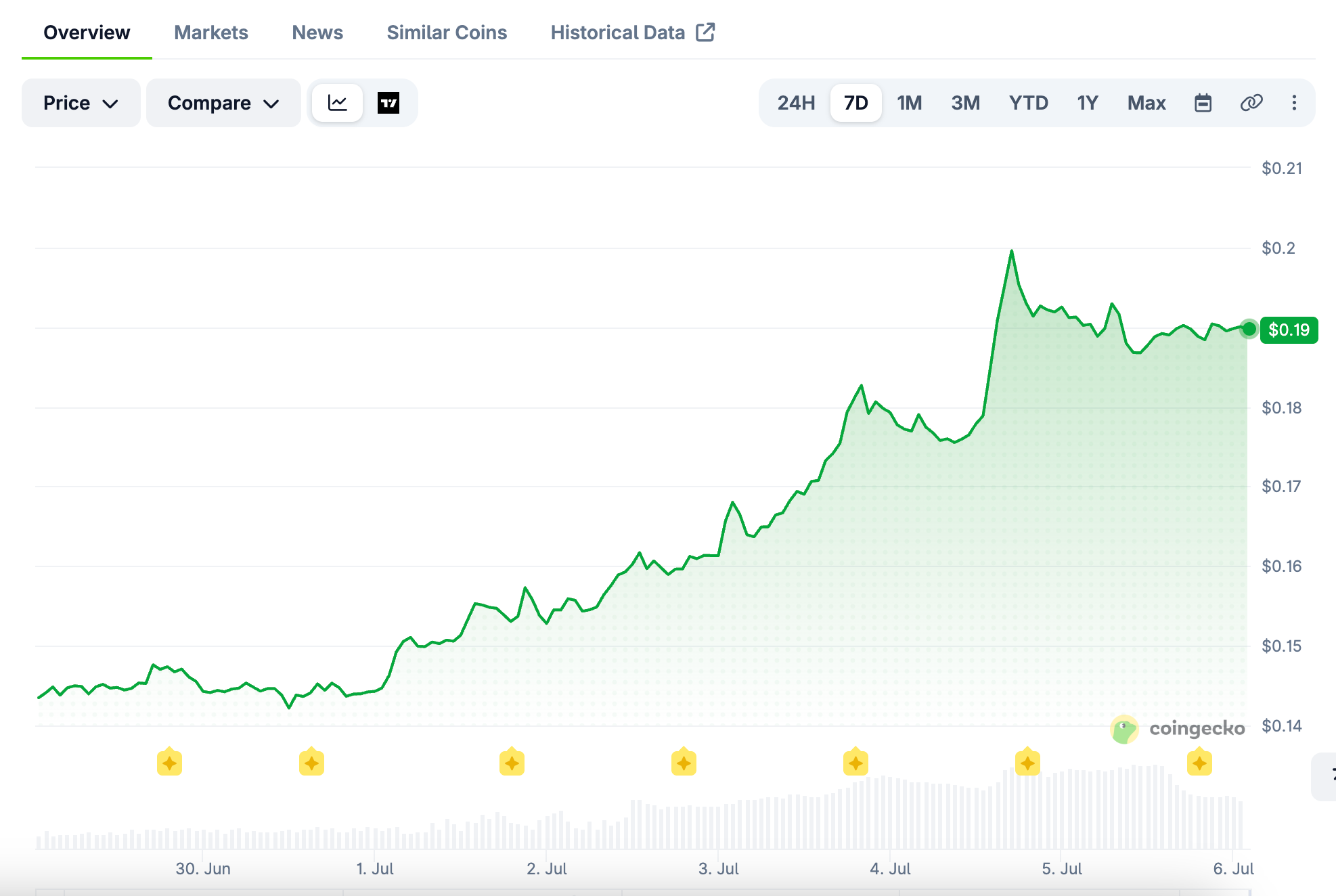
Cardano added 14,783 new non-empty ADA wallets after its June 23 bottom, according to Santiment, and ADA has rallied hard since.
ADA touched a multiyear low near $0.14 in late June. It has since gained 32.5% over the past seven days, touching $0.199 on July 5 before settling near $0.19.
ADA Retail Wallets Return After a Rough June
The wallet growth follows weeks of heavy selling. Failed treasury funding votes and warnings from founder Charles Hoskinson about strain on the project pushed ADA to levels last seen in 2020 in early June.
Santiment linked the shift to a broader mood change in the Cardano community.
The wallet uptick suggests some retail buyers returned once prices stabilized. Cardano’s whale accumulation data already showed large holders adding ADA even as network activity slowed. That pattern suggests some investors positioned ahead of expected upgrades.

Governance Friction Still Weighs on the Rebound
The rebound has not erased Cardano’s underlying tensions. Hoskinson recently opened a governance overhaul review that audits thousands of decentralized organizations tied to the treasury system.
That review follows a cancelled 2026 summit and ongoing funding disputes. Together, they keep sentiment fragile even as the current Cardano price sits far above its June bottom.
Cardano’s technical roadmap continues regardless. The Leios scalability milestone aims to lift network throughput ahead of a planned mainnet push later this year.
The new wallets face a real test at the next governance vote. If holders stay put instead of exiting at the first sign of trouble, June’s fear will look more like capitulation than lasting damage.
The post Cardano Adds 14,783 Wallets as ADA Rallies Near 33% in a Week appeared first on BeInCrypto.
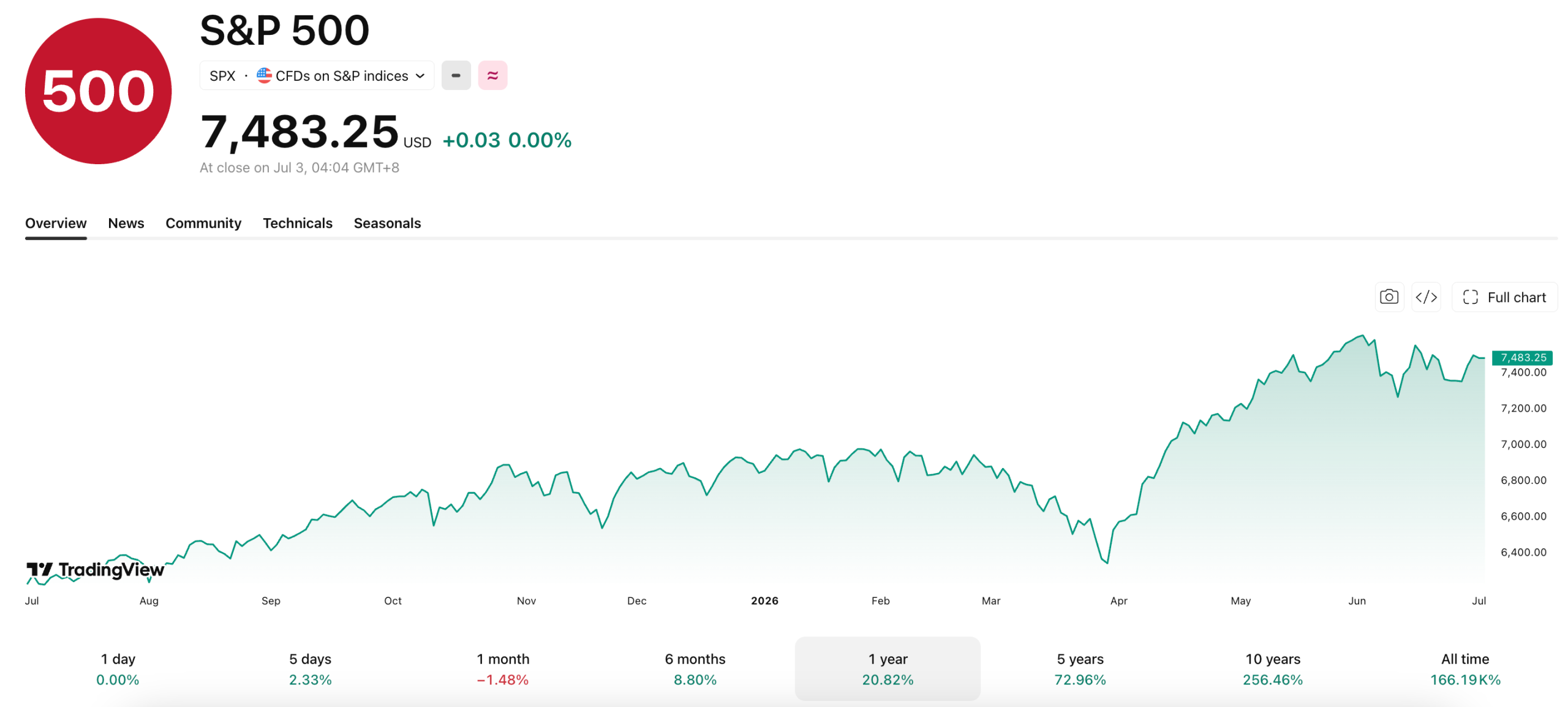
Wall Street analysts are raising S&P 500 profit forecasts at the fastest pace since the pandemic rebound. Several strategists now warn the estimates propping up the market’s record rally may not hold up.
Analysts expect S&P 500 company earnings to grow 25% over the coming year, according to data cited by the Financial Times. Consensus profit estimates have jumped nearly 20% in six months, the sharpest six-month rise since 2021.
The Numbers May Not Be Real
Ben Inker, co-head of asset allocation at GMO, said forecasts for the next two years are “rising at an exceedingly high rate, nothing we have seen outside of a crisis recovery.” He expects markets to eventually realize the numbers will not come true.

Chipmakers and hyperscalers riding AI-driven stock rallies are driving most of the upgrades. Michel Lerner, who leads UBS’s HOLT analytics platform, warned of an “earnings bubble” forming in the market. He said shares tied to AI are priced to maintain supernormal profits, and that sustaining current levels of profitability and growth is highly unlikely.
The S&P 500 has climbed 20% over the past year. The Nasdaq Composite has gained more than 25%, including its best quarter in six years. Rising forecasts have kept valuations in check even as indices hit fresh highs. Stocks now trade near 20 times forward earnings, well below the levels hit during the dot-com boom and last year’s rally.
Earnings and AI Bubbles Are Building
Kasper Elmgreen, chief investment officer for fixed income and equities at Nordea Asset Management, pointed to a thin cushion for error. He said earnings carry a slim margin of safety heading into the second-quarter reporting season. He questioned how long positive surprises can continue.
Investors flagged a separate risk. Traders now price in at least one quarter-point rate hike by year-end. That marks a reversal from earlier bets on multiple cuts, adding fresh pressure to profit assumptions that already look overstretched.
The post Strategists Warn of ‘Earnings Bubble’ as Wall Street’s Profit Forecasts Surge appeared first on BeInCrypto.

England’s greatest World Cup victory since 1966: OLIVER HOLT on how 15 Three Lions heroes stood tall at the fearsome Azteca on a night of red card, two penalties, Jude Bellingham’s double and Harry Kane’s winner
JCB and MUFG Bank form strategic alliance in ASEAN region
Bitcoin Price Tests $63.5K as ETF Flows Shift Back Into Market


-

 Fashion2 days ago
Weekend Open Thread: High Hopes
-

 Politics3 days ago
The House | “Reframing the debate from a binary discussion of winners and losers”: Yuan Yang reviews ‘We Are Not Machines’
-

 Crypto World6 days ago
Strategy authorizes up to $1.25B in Bitcoin sales under new capital plan
-

 News Videos6 days ago
How to Build INSANE Live Financial Dashboards With Claude
-

 Tech6 days ago
Anonymous researcher drops 0-day ‘exploitarium’ repo
-

 Business6 days ago
Australia treasurer says alleged access of prime minister’s bank data ’incredibly concerning’
-
 NewsBeat1 day ago
Taylor Swift and Travis Kelce wedding staffer hilariously struggles to keep her cool while checking in megastars
-
 Business6 days ago
The AI boom won’t burst all at once. It will pop in ‘rolling bubbles’: Macquarie
-

 Sports5 days ago
Broncos roster: OL Ben Powers (No. 74) entering final year of contract
-
Crypto World5 days ago
Airdrop Registration Becomes Key Focus For Remittix As RTX Launch Updates Approach
-

 NewsBeat5 days ago
Presenter Caroline Flack’s brother Paul Flack dies aged 55
-

 Crypto World4 days ago
Binance stock trading tops $1B in first month after launch
-

 Crypto World4 days ago
Alibaba-affiliate Ant Group enters the humanoid robot market with 12 deals
-
 NewsBeat4 days ago
New exhibition reflects five decades of movement between island of Ireland and GB
-

 Crypto World14 hours ago
South Africa proposes crypto tax guidance under existing rules
-

 Tech17 hours ago
Lenovo laptops are now shipping with YMTC SSDs, a sign of Chinese NAND entering the mainstream
-

 Business3 days ago
What a 10 Percent Drop Means for Buyers, Sellers and Renters
-

 Crypto World3 days ago
Standard Chartered Secures MiCA License as ESMA Adds 37 New Crypto Firms
-

 Business4 days ago
Meta Platforms Stock Jumps 7% Today as Bloomberg Reports Company Plans to Enter the Cloud Business
-

 Crypto World3 days ago
Binance Re-Enters Philippines As EU MiCA Rules Restrict Access
You must be logged in to post a comment Login