
Crypto World
ECB to set digital euro standards by summer, Cipollone says


The European Central Bank is laying out a concrete path toward a potential digital euro, signaling that standards for a future euro-wide digital currency could be announced as soon as this summer. ECB Executive Board member Piero Cipollone told EU lawmakers that once those standards are in place, the bank will collaborate with market participants to integrate them into payment terminals and other infrastructure ahead of any issuance decision. The move aims to give European providers a head start by embedding the necessary rails into devices and apps, so European companies can adapt quickly if parliament approves a digital euro in the years ahead.
According to Cipollone, finalizing the rulebook would also enable new payment terminals and apps to ship with the required rails already embedded, positioning Europe to move faster once EU legislation is enacted. The ECB anticipates that legislation could be in place in 2026, aligning with the broader timeline for a potential launch in the subsequent years.
Key takeaways
- Standards for a potential digital euro are expected to be announced by the ECB by summer, with industry participants invited to build the rails into their devices and services.
- A 12-month digital euro pilot is planned to run from the second half of 2027, testing person-to-person and point-of-sale payments in a controlled environment ahead of any possible issuance.
- The ECB envisions the digital euro as public infrastructure used by banks and payment providers to offer wallets and services, not as a consumer-facing product from the central bank.
- Banking-sector costs for implementing the digital euro could reach 4–6 billion euros over four years, roughly 3% of banks’ annual IT maintenance budgets, according to Reuters’ analysis cited by the ECB.
- Even as it aims to broaden pan-European payment rails, the ECB stresses that the digital euro would complement cash and bank deposits, not replace them, with accessibility features designed from the outset.
Standards, timing, and industry readiness
In addressing lawmakers, Cipollone emphasized that releasing clear technical standards would allow market participants to embed the necessary rails into payment terminals and apps well before any formal issuance decision. By finalizing the rulebook, the ECB aims to give European merchants and providers a smoother transition, reducing the risk of fragmentation as the euro area moves toward a unified digital payments backbone. The authorities expect the EU legislative process around the digital euro to play out in 2026, creating a window in which private players can align their products with the coming framework.
Beyond the technical standards, the ECB has been exploring a broader architecture for central bank digital money that could underpin a tokenized and interoperable European financial ecosystem. The agency’s broader agenda includes efforts to ensure that digital euro rails can be used across national schemes and by co-badged cards and bank wallets, enabling seamless switching between domestic schemes and the digital euro within the euro area.
Pilot, cost, and strategic rationale
The 12-month pilot, set to begin in the second half of 2027, will test both person-to-person and point-of-sale payments within a controlled environment. The aim is to assess technical readiness and interoperability across platforms, laying the groundwork for a possible 2029 issuance if lawmakers approve the legal framework. This timeline underscores the ECB’s cautious but forward-leaning approach: build the rails first, test them extensively, then scale to a full launch if political backing coalesces.
On the economic side, the cost of a digital euro to EU banks has been a major talking point. Reuters reported that the ECB’s analysis estimated a four- to six-billion-euro price tag over four years for banks to implement and operate the necessary systems. The bank framed these costs as roughly 3% of the sector’s annual information technology maintenance budget, arguing that the long-term benefits—such as reduced merchant fees and more scalable European payment schemes—could offset the upfront spend.
The ECB stresses that the digital euro is designed as public infrastructure—the rails that private intermediaries will use to offer wallets and services—rather than a product marketed directly to consumers. This distinction is central to the ECB’s design philosophy: a trusted, state-backed settlement layer that can underpin a variety of private offerings while ensuring broad accessibility and resilience.
Public rails, private wallets, and the road ahead
One of the core ambitions of the digital euro program is to reduce Europe’s dependence on international card schemes by establishing pan-European rails for payments. Co-badged cards and bank wallets could potentially switch between domestic schemes and the digital euro, creating a more cohesive payments landscape across the euro area. This approach aligns with the ECB’s broader strategy of anchoring future wholesale markets in central-bank money, a principle that persists across initiatives such as the Pontes project for tokenized securities and the Appia roadmap for a tokenized European financial ecosystem.
In parallel, Cipollone highlighted ongoing work on tokenized central bank money that could serve as the settlement asset for stablecoins and tokenized deposits. While still exploratory, these concepts reflect the ECB’s broader vision of a multi-layered, interoperable financial system where central-bank digital money sits at the core of settlement and reconciliation, while private innovations build on top of this trusted infrastructure.
Accessibility remains a clear priority. The ECB intends to embed inclusivity features—such as voice commands and large-font displays—into the digital euro’s reference app from the outset, ensuring that a wide range of users can access and utilize digital payments as part of the currency’s broader public utility.
For now, the key questions center on the legislative path to a digital euro and the practicalities of cross-border interop. The ECB’s current trajectory suggests a deliberate, staged approach: publish the standards this summer, run a rigorous pilot starting in 2027, and evaluate legislative alignment toward a potential 2029 issuance. Whether policymakers and financial institutions will synchronize their efforts in time remains a live question that readers should monitor closely as EU lawmaking advances and pilots unfold.
Readers should watch for updates on the public standards release and the evolution of the pilot program, as these signals will indicate how quickly Europe might transition toward a digital euro and how the model could influence global central-bank digital currency debates.


Key Takeaways
- Amazon has finalized its purchase of Fauna Robotics, a humanoid robot company based in New York and established in 2024 by former engineers from Meta and Google.
- The startup’s flagship product, Sprout, is a bipedal humanoid robot measuring 3’6″ tall with a $50,000 price tag, operating on NVIDIA’s Jetson Orin technology.
- The transaction was completed last week, with no public disclosure of the acquisition price.
- Approximately 50 Fauna employees will transition to Amazon’s Personal Robotics Group in New York, functioning under the brand “Fauna, an Amazon company.”
- This acquisition follows closely on the heels of Amazon’s purchase of Rivr, a Swiss robotics company, indicating an aggressive expansion into consumer and delivery automation.
On Tuesday, Amazon publicly confirmed the completion of its acquisition of Fauna Robotics, a startup focused on humanoid robots that was launched in 2024 by engineering veterans from Meta and Google. The transaction reached its conclusion last week, although the purchase price remains undisclosed.
$AMZN has acquired Fauna Robotics marking its entry into the consumer humanoid market after the deal closed last week.
Fauna is developing a compact 42-inch humanoid called Sprout that can walk, grip objects, interact with people and even dance. pic.twitter.com/ibRfxcIOuT
— Shay Boloor (@StockSavvyShay) March 24, 2026
With this strategic purchase, Amazon enters the increasingly competitive arena of humanoid robotics, a sector that has witnessed substantial growth and innovation in recent years.
The flagship offering from Fauna is Sprout — a two-legged robot that stands at 3 feet 6 inches and tips the scales at 50 pounds. The design philosophy emphasizes accessibility and consumer appeal rather than industrial warehouse applications.
Priced at $50,000, Sprout is packaged with integrated software, gripper attachments, and a replaceable battery providing approximately 3 hours of operational time. The robot leverages NVIDIA’s Jetson Orin robotics computing platform and features memory capabilities that develop over time.
Sprout’s capabilities include walking, dancing, door manipulation, name recognition, and engaging in two-way conversations. Notable early adopters include Disney and Hyundai’s Boston Dynamics division.
The entire Fauna team of approximately 50 personnel will relocate to an Amazon facility in New York, maintaining operations under the designation “Fauna, an Amazon company.” Both co-founders, Rob Cochran and Josh Merel, will remain with the organization.
The integration places Fauna within Amazon’s Personal Robotics Group — a distinct division separate from the company’s warehouse automation operations.
Amazon’s Robotics Evolution
Amazon’s involvement in robotics extends over ten years. The company’s $775 million purchase of Kiva Systems in 2012 established the foundation for Amazon Robotics, which currently powers the company’s warehouse automation infrastructure.
Amazon previously ventured into the home robotics market with Astro, a $1,600 mobile household robot introduced in 2021 that continues to operate on an invitation-only basis. Sprout represents a more targeted consumer-focused initiative.
The Fauna acquisition arrives mere days after Amazon revealed its purchase of Rivr, a Swiss enterprise developing robotic solutions for last-mile delivery.
Intensifying Competition in Humanoid Robotics
Amazon enters an increasingly saturated marketplace. Tesla is advancing its Optimus humanoid robot at its Fremont manufacturing facility, with CEO Elon Musk projecting annual production of 1 million units.
Additional competitors in this domain include 1X, Figure AI, Apptronik, Agility Robotics, and China-based Unitree.
Amazon has indicated intentions to leverage its robotics knowledge, retail infrastructure, and devices division expertise to investigate potential applications for personal robots in consumer settings.
According to an Amazon spokesperson, the company is “excited about Fauna’s vision to build capable, safe, and fun robots for everyone.”
AMZN shares concluded Tuesday’s trading session with a 2.28% increase, gaining $4.73.

Solana price rises back above $90 with multi-billion-dollar volume as traders bet on congestion fixes, the Alpenglow upgrade, and SOL’s role as a leading high-throughput layer-1.
Summary
- Solana price is trading around $92–$93 today, with a market cap near $52.9 billion and 24-hour volume of roughly $4.2–$4.4 billion.
- The layer-1 token has gained about 3.3% over the past 24 hours and roughly 2.8% in the last seven days, outpacing the broader market’s 1.3% daily rise.
- Ongoing work to address network congestion and upcoming protocol upgrades are helping shape Solana’s position as a high-throughput Ethereum rival despite its history of outages.
Solana (SOL) price is changing hands around $92.39 today, up 0.62% in the last hour, 3.27% over the past 24 hours and 2.78% in the past week, giving it a market capitalization of about $52.88 billion and 24-hour trading volume near $4.18 billion. External dashboards place SOL’s current price in the $92.02–$92.64 band, with a circulating supply of roughly 572.25 million tokens, a market cap of around $52.65–$52.89 billion and 24-hour volume between about $4.34 billion and $4.39 billion. Over the past several sessions in March, daily closes have clustered roughly in an $86–$94 range, confirming a consolidation phase after a volatile start to the month.
That performance is unfolding in a firm market: the total crypto market cap stands near $2.45 trillion, up about 1.31% over the last day, putting Solana among the stronger large-cap performers over the same period. In earlier March snapshots, SOL traded around $84.56 with a market cap of $48.18 billion and 24-hour volume of $5.40 billion, then climbed toward the mid-$90 area with a market capitalization near $54 billion and daily volume described as “moderate,” highlighting a steady recovery rather than a single spike. Together, these figures point to a liquid, actively traded market where price is being driven by both spot demand and derivatives positioning.
Solana is a high-throughput layer-1 blockchain that combines a proof-of-stake consensus mechanism with a timing technique called proof of history, which allows validators to order transactions more efficiently and target tens of thousands of transactions per second. The network has become a core venue for decentralized finance, NFTs, and consumer apps, with SOL serving as the native asset for transaction fees, staking and collateral, firmly placing it in the layer-1 smart contract platform category rather than a DeFi protocol or AI token. Historically, this speed-focused design has come with a trade-off: Solana has experienced multiple outages and congestion episodes, including several multi-hour network halts in 2023 and earlier, which pushed developers and validators to prioritize stability improvements.
More recently, the project has been preparing a major core protocol overhaul known as Alpenglow, described as the most significant reconsideration of Solana’s architecture to date and expected in the first half of 2026. Community governance records show that about 98% of participating token holders backed the upgrade in a 2025 vote, indicating broad internal support for changes aimed at improving decentralization, throughput and fee dynamics. In parallel, client teams have rolled out updates such as version 1.17.31 and follow-on releases to mitigate persistent network congestion and transaction failures that surfaced during recent periods of high meme-coin and NFT activity.
Although detailed whale transaction feeds for Solana are spread across multiple analytics sites, available market metrics demonstrate heavy participation by larger traders and leveraged players. Historical data shows that on March 25, 2026, SOL traded in a $90.82–$93.21 band with daily volume around 4.43 billion units, corresponding to multi-billion-dollar turnover at current prices. Another dataset cites a volume-to-market-cap ratio near 8.2–8.3%, based on roughly $4.34–$4.39 billion in volume against a market cap just above $52.6 billion, a level of activity consistent with ongoing directional trading and derivatives hedging rather than solely passive holding.
Sector-wide, Solana is part of a cluster of alternative layer-1 networks that includes Ethereum, Avalanche and Sui, all of which compete on smart contract capacity but with different trade-offs in fees, security models and decentralization. Today, Ethereum trades around $2,180 with a market cap of about $263.11 billion and 24-hour volume near $19.19 billion, while Avalanche changes hands around $9.74 with a market cap of $4.21 billion and $262.28 million in daily volume, and Sui trades near $0.969 with a market cap of $3.78 billion and $382.72 million in 24-hour volume. This positions Solana as one of the most valuable and actively traded non-Ethereum smart contract platforms, a status that has persisted despite its checkered stability history and now rests heavily on the successful delivery of congestion fixes and the Alpenglow upgrade.
Within that broader landscape, Solana’s latest push back above $90 looks like a textbook consolidation rally in a flagship layer-1: price grinding higher in a defined range, supported by billions in daily volume and a clear catalyst path in the form of protocol upgrades and congestion relief.


Led by Prime Minister Keir Starmer, the U.K. government has announced an immediate moratorium on cryptocurrency donations to political parties, citing concerns that digital assets could be used to hide the origins of foreign money in British politics, according to the Press Association.
The move puts crypto at the centre of a wider crackdown on foreign interference, signaling that regulators are increasingly treating anonymous digital payments as a democratic risk rather than just a financial one.
The ban, triggered by the government-commissioned Rycroft review, covers donations of any size and takes effect today. Parties have 30 days from now to return any crypto received once legislation is passed, after which criminal penalties apply. Overseas donations from British expats will also be capped at £100,000 a year.
The review’s author, former senior civil servant Philip Rycroft, stopped short of calling for a permanent ban — framing the moratorium as a pause for regulation to catch up with reality. But with the rules written into the Representation of the People Bill currently going through Parliament, the bar to lift them is high.
“I wasn’t here to look out for the interests of any political party,” Rycroft said. “I was here to look out for the interest of our democratic processes.”
Members of Reform U.K., which currently leads polling data, walked out of Parliament during the announcement. Prime Minister Keir Starmer took a pointed swipe at Reform leader Nigel Farage, suggesting he would “say anything, no matter how divisive, if he is paid to do so.”

Quick Overview
- Nvidia shares advanced 1.6% in premarket hours Wednesday, trading at $177.97
- Arm Holdings unveiled the Arm AGI CPU for data centers, projecting $15B yearly revenue by 2031
- The Arm chip doesn’t directly challenge Nvidia’s GPU dominance but may overlap with Nvidia’s Vera CPU lineup
- Amazon Web Services committed to acquiring 1 million Nvidia GPUs for AI inference workloads, valued above $50 billion
- Nvidia restarts H200 chip manufacturing and develops China-compliant Groq 3 variants, potentially adding $32B in annual sales
Nvidia shares moved higher during early Wednesday sessions, brushing aside concerns about Arm Holdings’ entry into the AI chip arena. The development coincided with two significant revenue opportunities that had escaped widespread attention.
Arm revealed its inaugural data center CPU on Tuesday evening—the Arm AGI CPU—identifying Meta Platforms and OpenAI among its initial clients. During an after-hours investor presentation, Arm outlined aggressive financial targets, forecasting approximately $15 billion in yearly CPU revenue by 2031 as part of a comprehensive $25 billion revenue objective.
Arm shares surged 12% in premarket activity following the disclosure.
However, industry observers were swift to clarify that this new processor doesn’t directly challenge Nvidia’s flagship GPU offerings.
Benchmark Research’s Cody Acree noted that Arm’s strategy is “less about catching up to the accelerator wave and more about inserting itself deeper into the architecture that governs how AI infrastructure actually runs.”
Jensen Huang, Nvidia’s CEO, appeared in Arm’s promotional content, characterizing their nearly twenty-year collaboration as the backbone for “one seamless platform, from cloud to edge to AI factories.”
The competitive dynamic becomes more nuanced regarding Nvidia’s recently launched Vera CPUs, introduced during last week’s developer conference. J.P. Morgan’s Harlan Sur highlighted potential overlap between Arm’s chip and that product category. He additionally noted Meta’s existing agreement with Nvidia for Arm-architecture CPUs—complicating the competitive landscape.
Amazon Web Services Makes Massive Nvidia Commitment
Separately, Amazon Web Services revealed plans to procure 1 million Nvidia GPUs dedicated to AI inference capabilities. The announcement caught many off guard—AWS had previously promoted itself as housing “the largest cluster of non-Nvidia chips in the world” following its October 2025 Indiana data center deployment.
The agreement encompasses a “broad mix” of six supplementary Nvidia chip variants, including the recently announced Groq 3 inference processors, alongside Nvidia networking equipment. Industry estimates place the complete package well beyond $50 billion, with completion targeted by late 2027.
This singular agreement accounts for approximately 25% of Nvidia’s total 2025 annual revenue.
Chinese Market Revenue Resumes
CEO Jensen Huang confirmed last week that Nvidia is resuming manufacturing of its H200 processor—engineered to meet U.S. export control requirements—specifically for Chinese customers. Industry sources suggest a China-compliant Groq 3 variant is also under development.
Nvidia had incorporated zero Chinese data center sales into its Q1 projections. Throughout 2025, those revenues approximated $8 billion quarterly—roughly $32 billion on an annualized basis, representing about 15% of total 2025 revenue.
Together, the AWS contract and China market reentry represent over $82 billion in revenue streams absent from Nvidia’s current financial forecasts.
Nvidia shares traded 1.6% higher at $177.97 during premarket hours Wednesday, rebounding from a 0.3% decline in the previous session.
Key Insights
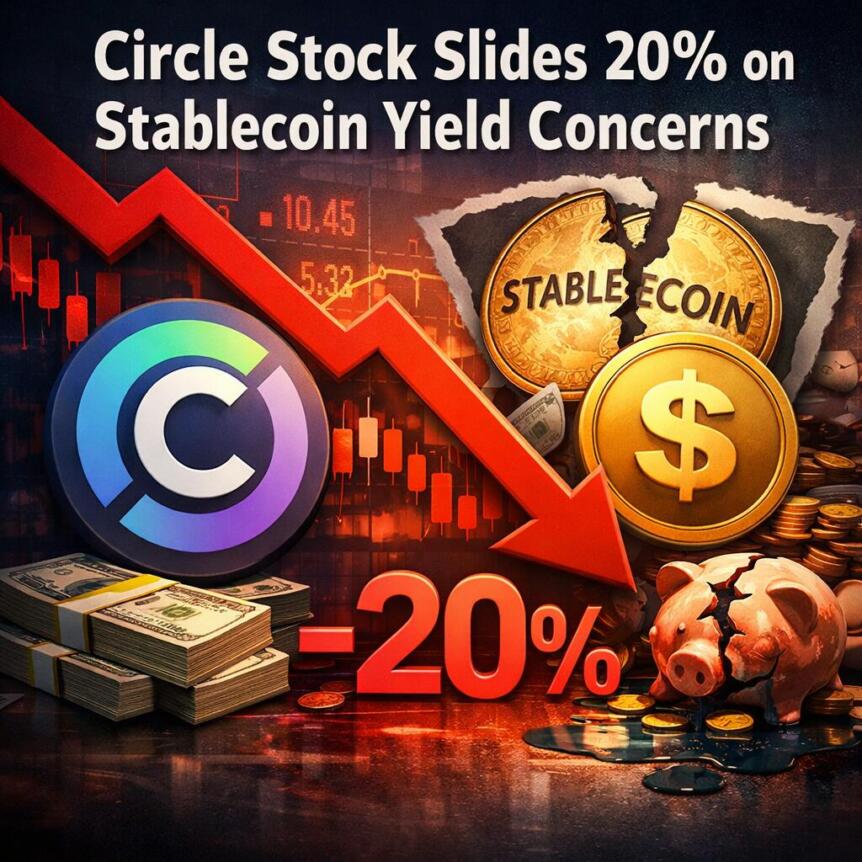
- Circle shares fell nearly 20% as draft rules threaten stablecoin reward models and user incentives
- Proposed limits on yield could reduce USDC adoption and weaken exchange-driven demand
- Tether audit plans and wallet freezes added pressure to Circle’s market position
Shares of Circle Internet Group fell sharply on March 24, dropping nearly 20% in one session. The stock declined from about $127 to near $102. This marked one of its steepest recent losses. The decline came after a good surge in March where shares soared below $60 to over $130.
Source: TradingView
The trading volume rose through the downturn, signaling intense selling pressure. The action implied a swift change in investor mood. Market participants reacted to emerging concerns around stablecoin regulation.
The decline also affected related firms. Shares of Coinbase fell nearly 10% during the same session. Analysts linked the broader sell-off to uncertainty in the stablecoin sector.
Draft Proposal Targets Reward Structures
Reports indicated that draft legislative language could restrict how platforms offer stablecoin rewards. The proposal would prohibit yield for simply holding stablecoins. It would also ban incentives that resemble traditional interest payments.
The rules would apply to exchanges, brokers, and related services. However, the proposal allows activity-based rewards tied to user behavior. These include loyalty or promotional programs that do not function like interest.
Analysts noted that such restrictions could reduce the appeal of holding USD Coin. Rewards are used by many platforms to attract deposits and keep users. In absence of these incentives, stablecoins can be less competitive with bank products.
Competitive Pressure and Additional Developments
At the same time, Tether announced plans for a full financial audit. The move could improve its transparency profile. This development may narrow Circle’s perceived advantage as a compliant issuer.
Separately, reports indicated that Circle froze USDC balances linked to several wallets. The action related to an ongoing U.S. civil case, though details remain limited. These developments added further uncertainty for investors.
Analysts stated that limiting rewards could weaken long-term demand for USDC. Exchange-driven incentives currently support a significant share of stablecoin activity. Any reduction in these programs may affect user behavior and revenue models.
Crypto World
Former SEC chair Jay Clayton says regulators would scrutinize trading ahead of Trump post
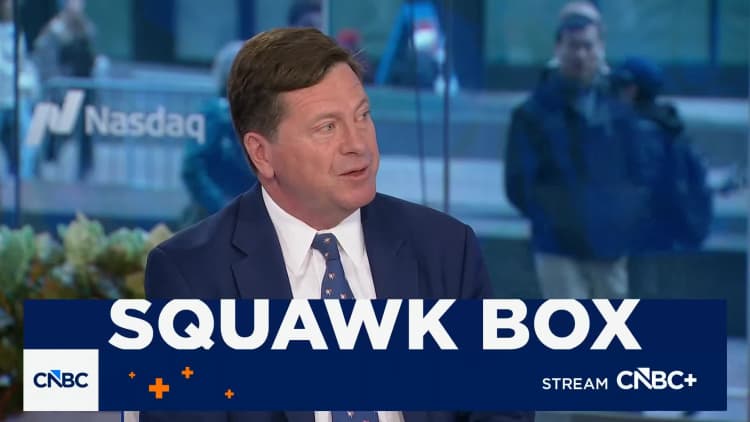

Jay Clayton said regulators would likely examine the unusual burst of trading activity early Monday that preceded a market-moving social media post from President Donald Trump.
“Any move like that in advance of any announcement, the regulators are going to look at,” Clayton, a former chair of the Securities and Exchange Commission, said Wednesday on CNBC’s “Squawk Box,” referring to the spike in futures trading minutes before Trump disclosed that the U.S. and Iran had held talks and that planned strikes on Iranian infrastructure would be halted.
Clayton, now the U.S. Attorney for the Southern District of New York, said authorities would work to reconstruct the activity and identify participants across markets.
“They’ll go back and track every single thing, everyone,” he said.
The SEC declined to comment.
Clayton noted that regulators have the most visibility in cash equities, where trading data allows for detailed analysis of who bought and sold securities and when. Surveillance in other areas, including futures and commodities markets, can be more complex and less comprehensive.
“I always tell people our best surveillance is in the cash equities markets — like, we can track it,” Clayton said. “Commodities markets, and others, it’s a little more difficult.”
The comments come after a sharp spike in trading volume in S&P 500 and oil futures around 6:50 a.m. New York time, roughly 15 minutes before Trump’s post helped lift equity markets and push oil prices lower.
“There’s a point here which Congress should act on — let’s make it clear across the board,” he said. “The law is not as clear as it should be…There are a lot of people who say this is okay. I don’t feel like it’s okay.”
Crypto World
Why iGaming Brands Are Turning to Kooc Media for Guaranteed Press Coverage and PR Distribution
Kooc Media, a specialist PR distribution agency headquartered in the United Kingdom, has opened its doors to the iGaming industry with a dedicated press release service for online casinos, sportsbooks, betting platforms and gambling affiliates. The service delivers confirmed article placements on the agency’s own news websites, expert content creation by an in-house editorial team, and optional newswire distribution that can place gambling brand announcements on some of the biggest media platforms in the world.
Online gambling has quietly become one of the most profitable digital industries on the planet. Millions of players across dozens of regulated markets spend billions each year on sports betting, online slots, live dealer games, poker and other casino products. The industry employs tens of thousands of people and attracts serious investment from both private equity and public markets.
Despite all of this, the iGaming sector remains badly underserved when it comes to professional public relations. Most gambling companies that have tried to secure press coverage through conventional PR agencies have come away disappointed. The standard experience involves paying a retainer, waiting weeks for outreach results and ending up with little or nothing to show for it. Journalists at mainstream outlets frequently ignore pitches from betting and casino brands, and many generalist PR firms lack the knowledge to craft effective messaging for the gambling audience.
Kooc Media spotted this problem years ago while working with clients in similarly challenging industries. The agency was founded in 2017 and built its reputation providing PR services for crypto projects, fintech startups and technology companies — sectors that face comparable media resistance. The decision to formally extend its services to iGaming was driven by increasing demand from gambling brands looking for a PR partner that could actually deliver measurable results.
“We kept hearing from iGaming companies who had been let down by other agencies,” said Michelle De Gouveia, spokesperson for Kooc Media. “They had spent money on PR and received nothing in return. Our model is the opposite of that. We guarantee placements, we publish fast, and we prove everything with live links. That is what the gambling industry has been waiting for.”
How the Service Works in Practice
The process Kooc Media has developed for its iGaming PR clients is deliberately straightforward. A gambling brand comes to the agency with an announcement — it could be a new casino launch, a sportsbook entering a regulated market, a software integration, a licensing achievement, a rebrand, a partnership deal or any other piece of genuine business news.
From there, Kooc Media’s editorial team takes over. They write a professional press release based on the client’s brief, handling the structure, messaging and tone. The client reviews the draft and requests any changes. Once approved, the article goes live.
Publication happens across the agency’s owned network of news sites, which includes titles such as Blockonomi, CoinCentral, MoneyCheck, Parameter, Beanstalk and Computing. These are established publications covering finance, technology, business and digital trends. All of them are indexed by Google News, which gives every published article the chance to appear in Google News feeds and rank in organic search results.
Most articles are live within 24 hours of client approval. For brands working to tight deadlines around product launches, sporting events or regulatory milestones, this speed is a major advantage.
Clients who want their announcement to reach a wider audience can choose packages that include distribution through partner newswire networks. At the highest tier, this can result in placements appearing on outlets such as Business Insider, Bloomberg, Benzinga, MarketWatch, USA Today and feeds linked to Dow Jones. For an online casino or sportsbook, landing coverage on platforms of that calibre creates instant credibility.
After every campaign, clients receive a full report containing live links to each published article. There is no ambiguity about what was delivered.
The Strategic Case for iGaming PR
Gambling companies invest heavily in marketing. Paid search, affiliate partnerships, social media campaigns, sponsorship deals and television advertising have all been core channels for the industry. But each of these channels is becoming more difficult or more expensive to use effectively.
Google restricts gambling advertising in many markets. Social media platforms continue to tighten their rules around betting content. Television advertising bans for gambling are being implemented or expanded across parts of Europe. Even sports sponsorship, once the go-to branding tool for sportsbooks, is under increasing regulatory pressure in several countries.
Public relations cuts through many of these restrictions. A press release published on a respected news website reaches audiences through organic search and news aggregation rather than through paid advertising channels. It is not subject to the same platform restrictions that limit other forms of gambling marketing. And it carries inherent credibility because the content appears on a third-party publication rather than on the brand’s own website or social media accounts.
The search engine benefits are equally important. Every article placed on a high-authority, Google News indexed website creates a backlink that strengthens the client’s domain authority. Over time, this improves rankings for high-value search terms like “new online casino,” “best sportsbook,” “sports betting platform” and dozens of other phrases that drive player acquisition. For iGaming brands competing in organic search, regular press coverage is not just a branding exercise — it is a core part of the SEO strategy.
Player trust is another factor that makes PR particularly valuable for gambling companies. Online gambling requires customers to hand over personal and financial information to a platform they may have never used before. Players naturally look for signals that a brand is legitimate and trustworthy. Seeing a casino or sportsbook mentioned on a well-known news site provides exactly that kind of reassurance.
Packages Designed Around iGaming Needs
Kooc Media has built its iGaming packages to be flexible enough to serve the full range of businesses operating in the online gambling space. Small operators and startups can access entry-level packages that provide publication across a selection of the agency’s owned websites. These packages are affordable enough for companies working with limited marketing budgets but still deliver real, verifiable media coverage.
Mid-tier options add broader distribution through partner networks and additional placements, suitable for growing brands that want more visibility without committing to a large-scale campaign. Premium packages provide the full newswire experience with distribution across major financial and business media, ideal for established operators making significant announcements.

Custom campaigns are available for companies with specific needs. Whether a client wants to target particular geographic markets, focus on certain types of publications, or run a sustained monthly PR programme, Kooc Media can build a campaign to match.
All packages include managed content creation. Clients never need to provide a finished press release or hire external writers. The agency handles everything internally, keeping the process simple and fast.
An Agency Built for Industries That Move Fast
Speed, reliability and transparency sit at the centre of everything Kooc Media does. The agency was built to serve industries where timing matters, where results need to be tangible and where traditional PR methods consistently fall short.
“iGaming is a perfect fit for our model,” said De Gouveia. “These are fast-moving companies that need coverage today, not in three weeks. They need to know exactly what they are getting before they spend a penny. And they need an agency that understands their industry well enough to get the messaging right first time. That is what we deliver.”
About Kooc Media
Kooc Media is a specialist PR distribution agency founded in 2017 in the United Kingdom. The company owns and operates multiple news websites and provides guaranteed media placements, professional press release writing, newswire distribution and managed PR campaigns for clients across the crypto, fintech, technology and iGaming industries.
Kooc Media’s gambling PR packages are available now through the company’s website at https://kooc.co.uk.
Disclaimer: This is a Press Release provided by a third party who is responsible for the content. Please conduct your own research before taking any action based on the content.
Crypto World
Gold hits worst losing streak in 100 years as bitcoin outperforms as middle east conflict continues


Gold is currently on its longest losing streak in over a century, its worst run since February 1920, lasting 10 consecutive days, according to Katie Greifeld, Bloomberg analyst.
The yellow metal has fallen as much as 27% from its January all time high, dropping to a low of $4,090, where it found support at its 200 day moving average, a widely watched technical level that often signals longer term trend strength.
However, it has rebounded by around 2% over the past 24 hours, likely signaling the end of the streak. Since the escalation of the Middle East conflict at the end of February, gold remains down roughly 12%.
Meanwhile, bitcoin, often referred to as digital gold, is holding above $70,000, keeping the bitcoin to gold ratio just below 16 ounces. The ratio bottomed at around 12 ounces just before the Middle East conflict, meaning the ratio has risen roughly 30% from those lows, with bitcoin outperforming.
Charlie Morris, chief investment officer at ByteTree, noted: “I remember the excitement when 1 BTC first surpassed one ounce of gold in March 2017. Since then, it has consistently built higher lows, reaching 2.7 oz in 2019, 3.4 oz during the 2020 pandemic crash, 9.1 oz after the FTX collapse, and 12.4 oz in February this year. Now, one BTC is worth 16 ounces of gold. With gold appearing exhausted, we could reasonably expect a new all time high above 40 ounces in the coming months or years.”
Historically, bitcoin has tended to lag gold in market cycles. Gold typically leads with an initial rally, then consolidates, allowing bitcoin to catch up and outperform.
While, Bloomberg ETF analyst Eric Balchunas argues that bitcoin and gold are not inversely correlated, but rather largely uncorrelated.
He highlights that gold exchange traded funds (ETFs) such as SPDR Gold Trust (GLD) and iShares Gold Trust (IAU) have seen billions of dollars in outflows over the past week.
In contrast, bitcoin ETFs have recorded around $2.5 billion in inflows this month, with only about $140 million in net outflows year to date, despite bitcoin being down roughly 20% over that period.
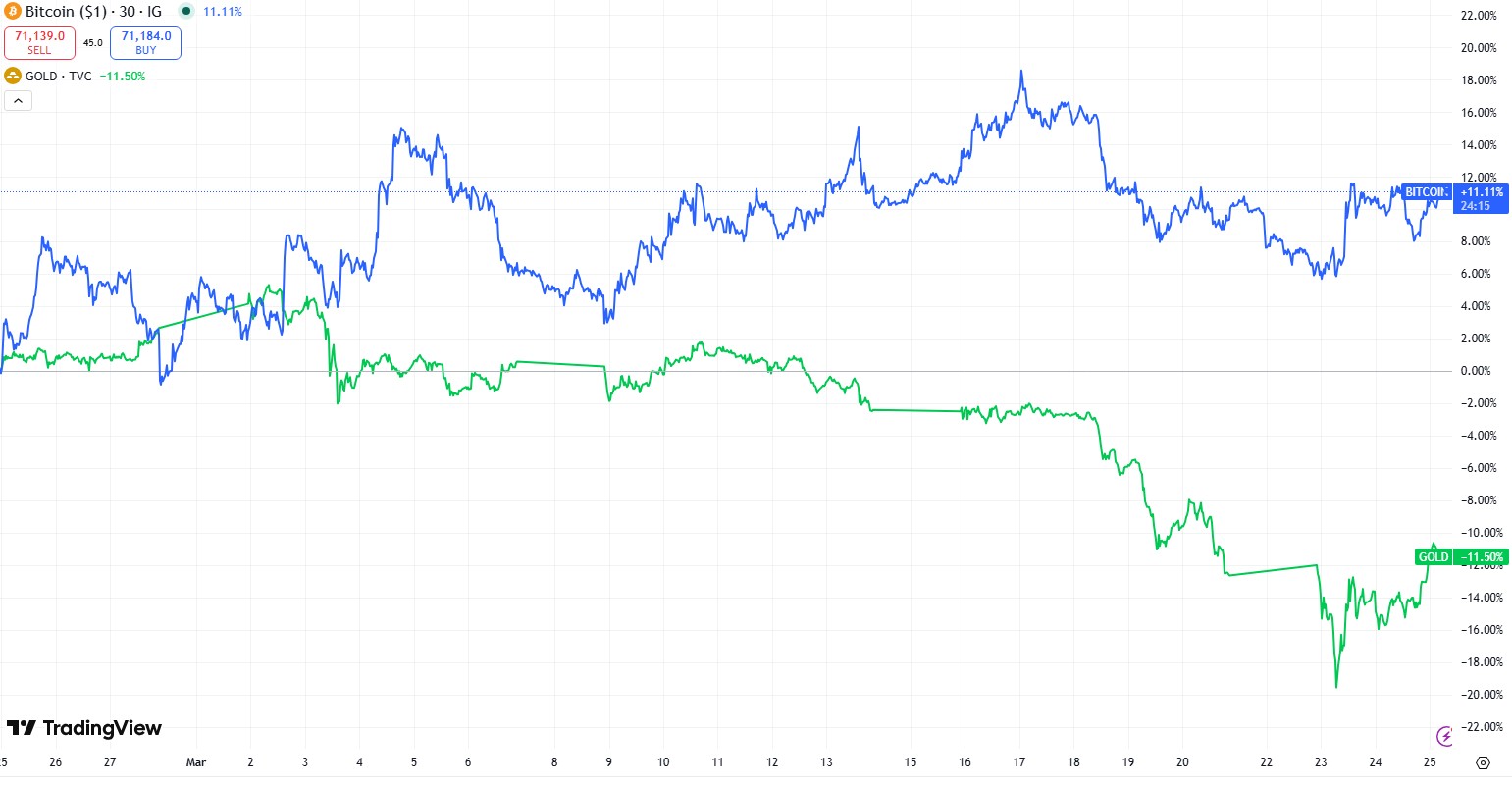
Before the Iran war broke out, Bitcoin spent months trading sideways while gold rallied to record levels.
At the time, gold was seen as the go-to safe haven; inflation concerns remained persistent and geopolitical tensions continued to build, while Bitcoin (BTC) failed to live up to that role.
Nearly a month after the US and Israel launched the first strikes on Iran on Feb. 28, that view is being challenged. Bitcoin initially fell to $63,176 on the news of the attacks but has since risen about 12% to $71,012, as of Wednesday.
Meanwhile, rising oil prices and inflation fears have weighed on gold, which fell 11% last week, marking its largest weekly loss since 1983.

However, Jonatan Randin, a senior market analyst at PrimeXBT, said Bitcoin continues to trade like a risk asset rather than a safe haven. It sells off alongside equities during geopolitical shocks.
“It’s range-bound and showing weakness within a broader downtrend. That’s not safe haven behavior,” he said.
Liquidity is the “dominant” Bitcoin price driver
In recent years, Bitcoin has reacted to global news events, including geopolitical shocks and social media posts from influential figures such as US President Donald Trump. Those moves tend to be short-lived.
Matthew Pinnock, co-founder of decentralized finance project Altura, told Cointelegraph that global liquidity remains the dominant driver of Bitcoin’s price, with macro conditions outweighing headline-driven volatility.
“BTC is trading as a high-beta liquidity asset, which means tighter financial conditions, such as higher real yields, a strong dollar and weaker [exchange-traded fund] inflows, reduce marginal capital and pressure price,” he said.
A September 2024 analysis compiled and written by Sam Callahan of treasury company OranjeBTC found that Bitcoin’s price had a 0.94 correlation with global liquidity between May 2013 and July 2024.
Callahan’s analysis also showed Bitcoin moved in the same direction as global M2 in 83% of 12-month periods, higher than gold, which logged 68.1%. The closest directional alignment after Bitcoin was the S&P 500 index, which represents US large-cap equities and is an often-cited benchmark for risk assets.

Randin said more recent data reflected a similar pattern, pointing to global liquidity rising in the third quarter of 2025, around the time when Bitcoin reached a new all-time high.
The divergence highlights a broader issue with Bitcoin’s safe haven narrative. While it has outperformed gold over certain periods since the war began, its sensitivity to liquidity conditions means it reacts more to financial tightening than to geopolitical stress itself. That complicates the idea of Bitcoin as “digital gold,” particularly in environments where inflation and rates move in tandem.
Related: Bitcoin is a real-time sentiment gauge for weekend warmongering
Oil shock complicates Bitcoin’s inflation narrative
Near-term inflation concerns have been shaping market expectations since the conflict began, driven by rising oil prices and supply disruptions following the closure of the Strait of Hormuz, one of the most important shipping routes in the world.
Randin said rising inflation concerns tied to geopolitical shocks tend to work against Bitcoin in the short term, as higher oil prices feed into inflation expectations, reduce the likelihood of rate cuts and keep real yields elevated. That chain of events tightens financial conditions and suppresses risk appetite, limiting demand for assets like Bitcoin.
In that sense, Bitcoin is not reacting to inflation itself, but to the policy response that follows, said Randin.
The Iran conflict pushed oil prices above $110 while the Federal Reserve raised its 2026 personal consumption expenditures inflation forecast to 2.7% and signaled a more cautious easing path.

“Bitcoin could be better understood as a long-term monetary debasement hedge rather than a short-term inflation hedge, and that’s a critical distinction,” Randin said.
“It responds to the expansion of money supply over multi-year cycles, not to CPI prints. On the timescale of a war-driven oil shock, it still behaves like the risk asset it is.”
Related: ‘Bitcoin Standard’ author explores reality where decentralized gold stopped WWI
Bitcoin rebounds during Iran conflict but risk profile remains
Bitcoin’s behavior during the Iran conflict still aligns with a risk asset. Each escalation has triggered selloffs, liquidation cascades and tighter correlation with equities, even as Bitcoin has held up better than traditional assets over certain periods.
“But it’s important to remember the context. Bitcoin entered this conflict already in a technical bear market, down over 40% from its October highs and well ahead of equities in pricing in deteriorating conditions,” Randin said.
“So while it has held up relatively well since the strikes began, outperforming the S&P 500, gold and silver over certain windows, it hasn’t given us any meaningful directional move.”
A structural shift would require a clear break from that pattern, and those signals have yet to appear.
Onchain data points to a different undercurrent. Continued accumulation, declining exchange reserves and growing holdings among large wallets suggest positioning is building, even if price action has not reflected it.
However, that positioning is still constrained by macro conditions.
“Right now, inflation driven by a hike in oil prices due to geopolitical factors is pushing yields higher and keeping central banks hawkish, which tightens liquidity. That creates a ‘bad inflation’ regime where BTC falls alongside other risk assets,” Pinnock said.
“The inflation hedge thesis breaks because Bitcoin responds more to monetary expansion than to inflation itself, and currently, conditions are restrictive, not stimulative,” he added.
Until liquidity conditions ease and Bitcoin decouples from equities during stress events, its role as a safe haven remains unproven.
Magazine: Banks want to run Vietnam’s crypto exchanges, Boyaa’s $70M BTC plan: Asia Express
Crypto World
Bitcoin tests $72,000 again as rising leverage hints at volatility ahead: Crypto Markets Today
Bitcoin rose 1.2% after midnight UTC, mirroring gains in U.S. equities, with Nasdaq 100 futures up by 1% over the same period.
The advances follow oil’s retreat below $100 per barrel on Tuesday after U.S. President Donald Trump proposed a “15 point plan” to end the war in Iran, although Iranian officials dismissed Trump’s statement as fake news.
The crypto market remains resilient to the conflict with consistent outperformance of traditional haven assets gold and silver since early February.
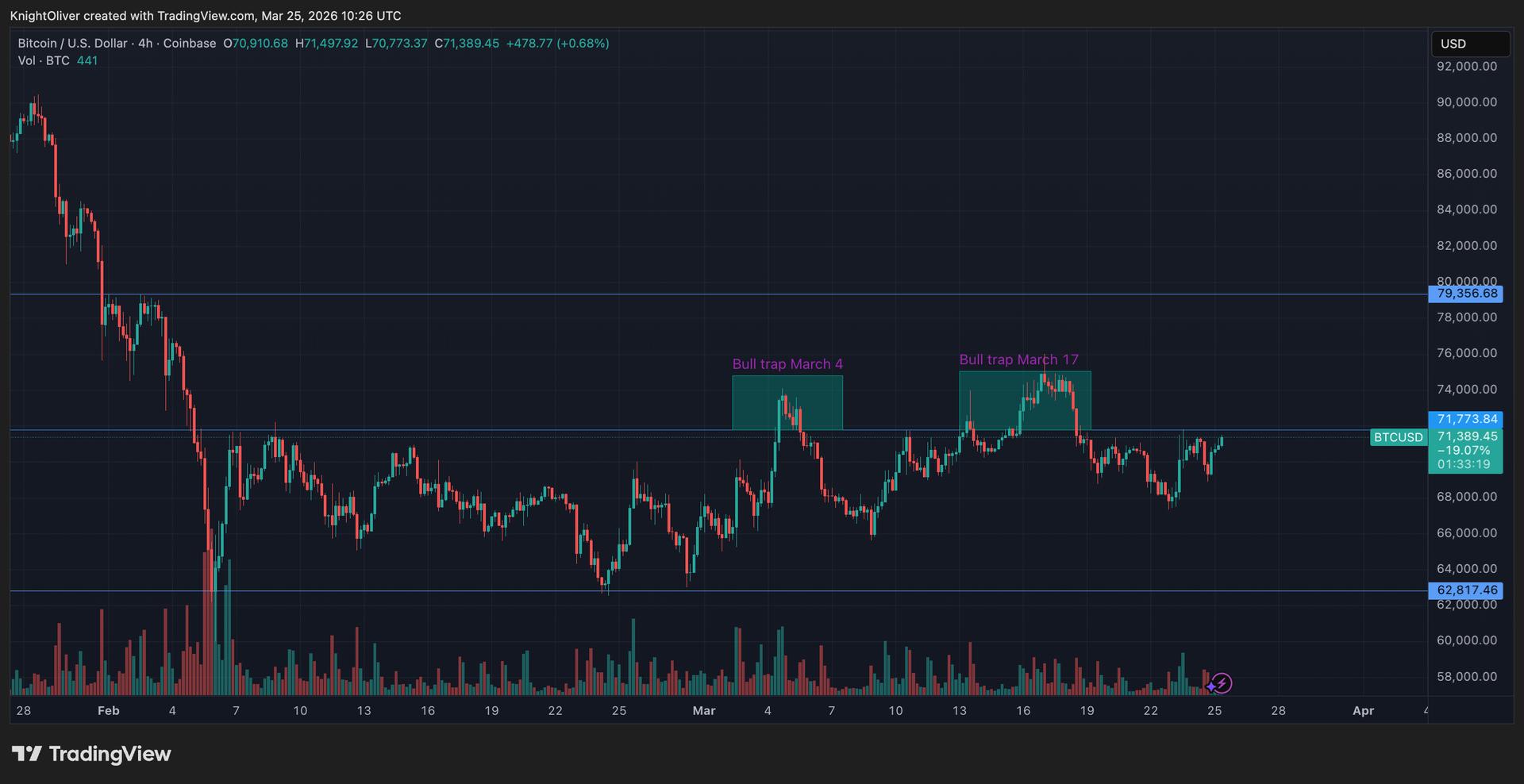
Bitcoin has forayed above $72,000 twice this month, each time followed by a selloff that sent prices to between $67,000 and $65,000.
Traders are opening short positions in this region, resulting in a disproportionate increase in open interest.
Portions of the altcoin market are outperforming bitcoin, with decentralized finance (DeFi) tokens LDO and ETHFI rising by between 2.5% and 3.5% since midnight.
Derivatives positioning
- Industry-wide crypto futures open interest (OI) rose to a one-week high of $112 billion.
- The top 10 tokens, including BTC and ETH, all registered increases of 4% or more in futures open interest in the past 24 hours.
- Ether OI jumped to 14.55 million ETH, the most since Aug. 24. This, coupled with positive funding rates and cumulative volume delta, point to growing demand for bullish bets or longs.
- DOGE and ZEC are other standout tokens with OI increases of over 10% in 24 hours.
- Bitcoin’s 30-day implied volatility index, BVIV, dropped for a third straight day, nearing the weekly low of 53% to indicate a fading geopolitical risk premium. Ether’s volatility is declining, too.
- On Deribit, BTC and ETH put skews continue to weaken, although overall pricing still shows downside concerns across all tenors.
- Friday’s multibillion dollar expiry points to $75,000 as the potential magnet. The max pain theory suggests a potential bounce toward that level.
Token talk
- The CoinDesk Computing Select Index (CPUS) is the best-performing benchmark on Wednesday, rising by 1.9%. The bitcoin-heavy CoinDesk 20 (CD20) gained 0.9% over the same period.
- The CPUS Index is made up of AI tokens TAO and FET as well as chainlink , which makes up 62% of the index weighting.
- LINK is up by 1.5% while TAO and FET have increased by 4.9% and 2.9%, respectively.
- CoinMarketCap’s “Altcoin Season” indicator remains at 48/100, in bullish territory after spending much of February languishing at around 22/100.
- On the flip side, privacy coins XMR and ZEC fell, losing around 1% each as traders rotated between altcoin sectors to position themselves ahead of a potential breakout.
How Amanda Peet’s Kids Reacted to Breast Cancer Diagnosis

Peaky Blinders Creator Explains Paul Anderson’s Absence From Film

Golf news: Tiger Woods makes Masters admission as Scottie Scheffler pulls out of event


-
 Crypto World5 days ago
NIO (NIO) Stock Plunges 6.5% as Shelf Registration Sparks Dilution Worries
-

 Fashion5 days ago
Weekend Open Thread: Adidas – Corporette.com
-

 Politics5 days ago
Jenni Murray, Long-Serving Woman’s Hour Presenter, Dies Aged 75
-

 Crypto World4 days ago
Best Crypto to Buy Now: Strategy Just Spent $1.57 Billion on Bitcoin During Fear While Early Investors Quietly Enter Pepeto for 150x Potential
-

 News Videos7 days ago
RBA board divided on rate cut, unusually buoyant share market | Finance Report | ABC NEWS
-
 NewsBeat5 hours ago
Manchester United reach agreement with Casemiro over contract clause amid transfer speculation
-

 Crypto World4 days ago
Bitcoin Price News: Bhutan Sells $72 Million in BTC Under Fiscal Pressure, but the Smart Money Entering Pepeto Sees What the Market Does Not
-

 Tech5 days ago
inKONBINI Lets You Spend Summer Days Behind the Register
-

 Crypto World7 days ago
Canada’s FINTRAC revokes registrations of 23 crypto MSBs in AML crackdown
-

 Sports2 days ago
Remo Stars and Kano Pillars Strengthen Survival Hopes in NPFL
-
 NewsBeat7 days ago
Residents in North Lanarkshire reminded to register to vote in Scottish Parliament Election
-

 Politics6 days ago
Gender equality discussions at UN face pushbacks and US resistance
-

 Business3 days ago
No Winner in March 21 Drawing as Prize Rolls to $133 Million for Next
-

 Business7 days ago
Who Was Alex Pretti? 5 Key Facts About the ICU Nurse Killed by Federal Agents in Minneapolis
-

 Sports2 days ago
Gary Kirsten Accuses Pakistan Cricket Board Of ‘Interference’, Mohsin Naqvi Responds
-

 Tech3 days ago
Give Your Phone a Huge (and Free) Upgrade by Switching to Another Keyboard
-

 Tech7 days ago
Inventec’s bizarre VeilBook laptop hides its touchpad under a sliding keyboard just to give cooling fans a little breathing room
-

 Sports5 days ago
2026 Kentucky Derby horses, odds, futures, preview, date: Expert who nailed 12 Derby-Oaks Doubles enters picks
-
Sports6 days ago
Vikings Free Agency Enters Phase 2 with Key Questions
-

 Tech3 days ago
AI enters the chat: New Seattle dating app relies on tech to facilitate meaningful human connections
You must be logged in to post a comment Login