
Crypto World
Elon Musk Backs the Physics Behind a Claim Quantum Computers Can't Break Bitcoin

Elon Musk has backed a fringe physics theory that says quantum computers can only grow so big. Crypto traders turned his five word reply into proof that Bitcoin (BTC) is already safe from them.
But it is not proof. The theory comes from Oxford physicist Tim Palmer, predicting that quantum machines stall somewhere between 200 and 400 qubits.
What Musk Actually Said
Musk was not talking about Bitcoin. On August 29, he replied to an Institute of Art and Ideas post about Palmer’s work.
Follow us on X to get the latest news as it happens
He agreed the universe comes in fixed chunks. He said nothing about private keys or Bitcoin’s quantum problem. Investor Fred Krueger cited him a day later anyway, under the headline that Bitcoin is already quantum-safe.
“Bitcoin may already be quantum-safe…The latest estimates require at least 835 logical qubits to break Bitcoin’s signatures with Shor’s algorithm…Elon Musk and Steve Jurvetson have commented positively on this research,” he said.
The Physicist Behind the Theory
Palmer’s credentials are real, though they sit outside this field. He is a Royal Society fellow, elected in 2003, and spent his career building weather forecasting models at Oxford.
His paper ran in the Proceedings of the National Academy of Sciences (PNAS) in March. It argues nature contains no smooth continuum, so entanglement eventually hits a wall.
Palmer puts that wall at 200 to 400 qubits on current hardware, and says it will never pass 1,000. Ordinary quantum theory sets no such limit, which leaves him in a minority until a machine proves him right.
The Gap Nobody Can Close Yet
Cracking Bitcoin’s signatures takes an estimated 835 logical qubits. A July study by Han Luo and colleagues cut that from earlier figures of 1,098 and 1,175. Those shrinking qubit estimates are the part worth watching.
The hardware is nowhere near either number. IBM plans a machine with 200 logical qubits by 2029. That would test Palmer’s floor. It would not touch Bitcoin.
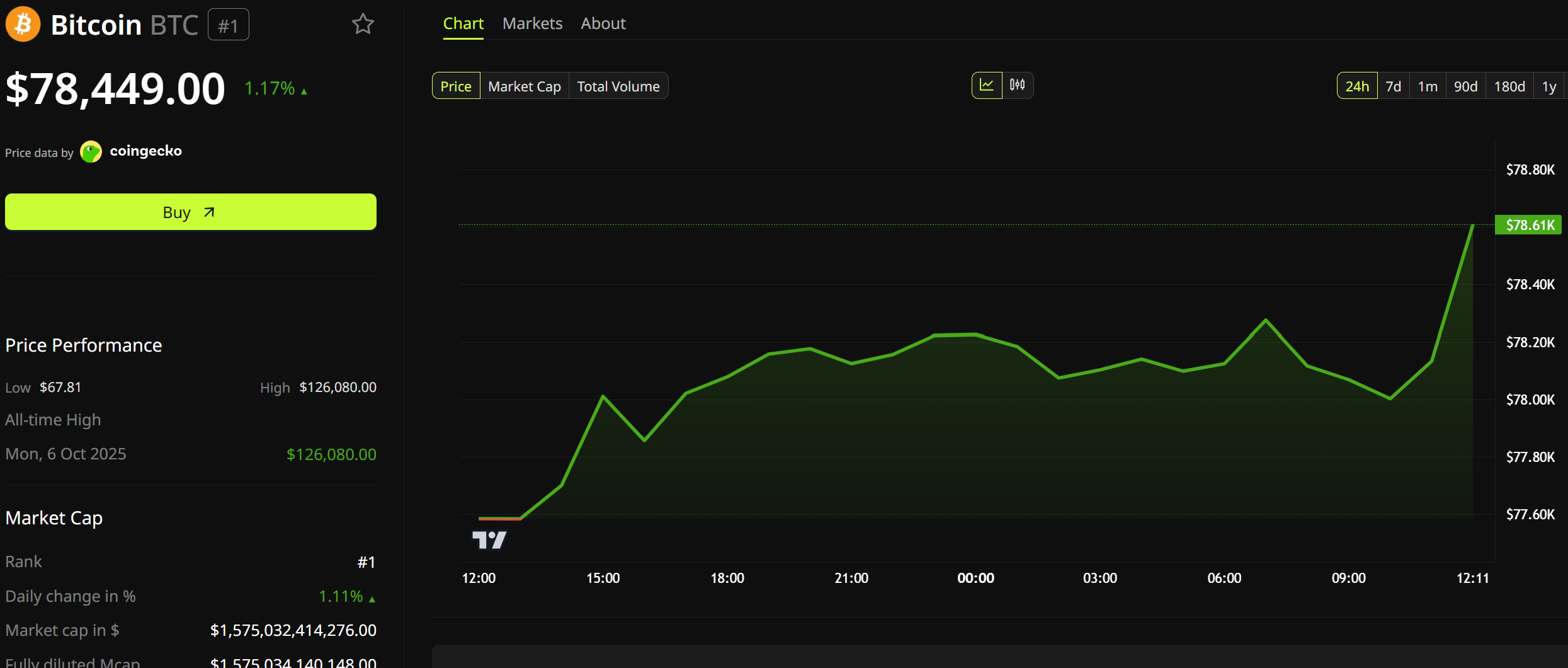
Bitcoin’s price action has ignored the argument, with BTC near $78,449 after a 1.17% daily gain.

Developers are not waiting for physics either, and a post-quantum migration proposal is already circulating. The real test arrives around 2029.
The post Elon Musk Backs the Physics Behind a Claim Quantum Computers Can't Break Bitcoin appeared first on BeInCrypto.


Strategy’s chief executive Michael Saylor has posted what market watchers are reading as a near-term signal for renewed corporate Bitcoin buying. In a recent social media message, Saylor wrote “We’re Back,” pointing to a potential return to accumulating BTC after a pause in Strategy’s routine purchases earlier this year.
The timing matters because Saylor has a history of sharing ambiguous weekend-style hints ahead of Monday morning announcements related to Strategy’s treasury activity. If that pattern holds, the post could be interpreted as a psychological nudge—suggesting the company is prepared to deploy capital again rather than continue its more conservative balance-sheet focus.
Key takeaways
- Saylor’s “We’re Back” message on X is being treated by observers as a signal that Strategy may resume BTC accumulation.
- Earlier in the year, Strategy paused its regular weekly buying cadence and shifted attention toward financing and balance-sheet strengthening.
- Strategy’s large BTC treasury has recently benefited from Bitcoin reclaiming levels above $80,000, moving the company’s overall position back into paper profit.
- If Strategy resumes purchasing, the change would mark a return to the company’s core playbook after a summer hiatus.
Why “We’re Back” is getting attention
Saylor’s post—shared on X—has drawn attention not only for its message, but for how Strategy typically communicates around treasury moves. Earlier coverage noted that Saylor has sometimes used cryptic weekend teasers that precede official updates when Strategy’s Monday announcements detail new corporate Bitcoin purchases.
Strategy’s investor base often watches these cues closely because they provide a sense of whether capital is likely to be deployed or retained. Even when the post does not specify the timing or size of future purchases, it can shape expectations heading into the next scheduled corporate updates.
The post can also be read as a repositioning signal. After a period of reduced Bitcoin buying activity, “We’re Back” suggests a return to the strategy’s defining mission: increasing exposure to Bitcoin through its treasury operations.
A pause in buying, followed by balance-sheet consolidation
Over roughly the past two months, Strategy deviated from its standard pattern of regular Bitcoin acquisition. Instead of expanding its BTC holdings, the company pivoted toward strengthening its balance sheet.
According to the reporting cited in the original coverage, Strategy’s management concentrated on stabilizing its preferred stock offerings, building a $5.1 billion US dollar reserve, and creating a $1.59 billion cash pool sourced from common stock offerings. In practical terms, this shift indicates that—at least during the hiatus—Strategy prioritized liquidity and capital market mechanics over direct BTC accumulation.
That change has significance for how investors assess Strategy’s near-term path. Corporate Bitcoin accumulation is not only a market decision; it also depends on the company’s ability to raise capital and manage funding costs. When buying slows, traders often interpret it as a temporary reallocation of resources—either due to market conditions, financing structure, or internal readiness to scale purchases again.
Bitcoin’s rebound improves the optics for Strategy’s treasury
The renewed focus on Bitcoin buying comes as the broader market has improved. The original article ties Strategy’s position to Bitcoin trading dynamics, stating that its industry-leading BTC treasury has been “deep in the red on paper” during a challenging stretch. More recently, it notes that macro momentum has helped push Bitcoin above the $80,000 threshold.
With Strategy reportedly holding more than 840,447 BTC at an average cost basis hovering around $75,385, Bitcoin’s move above $80,000 would translate into a return to positive territory for the company’s overall position—at least on an unrealized basis. That matters because it changes the psychological and strategic framing around accumulation. When the treasury sits under its cost basis, additional buying can feel more defensive; when it moves back above, management’s messaging often becomes more offensive and conviction-driven.
It also raises a practical question investors typically track: whether renewed purchasing signals a shift from capital preservation and financing stabilization back toward asset deployment at scale.
What to watch next
Saylor’s “We’re Back” statement may function as a multi-layer signal—both operationally (suggesting readiness to resume BTC accumulation) and psychologically (reinforcing a return to profitability narratives). Still, until Strategy publishes an official Monday update detailing treasury actions, investors should treat the post as a directional cue rather than confirmation of specific purchase terms.
The key next step for the market will be whether Strategy’s upcoming disclosures confirm resumed Bitcoin buying and whether the company’s capital allocation priorities shift from reserve-building and financing to further treasury expansion.
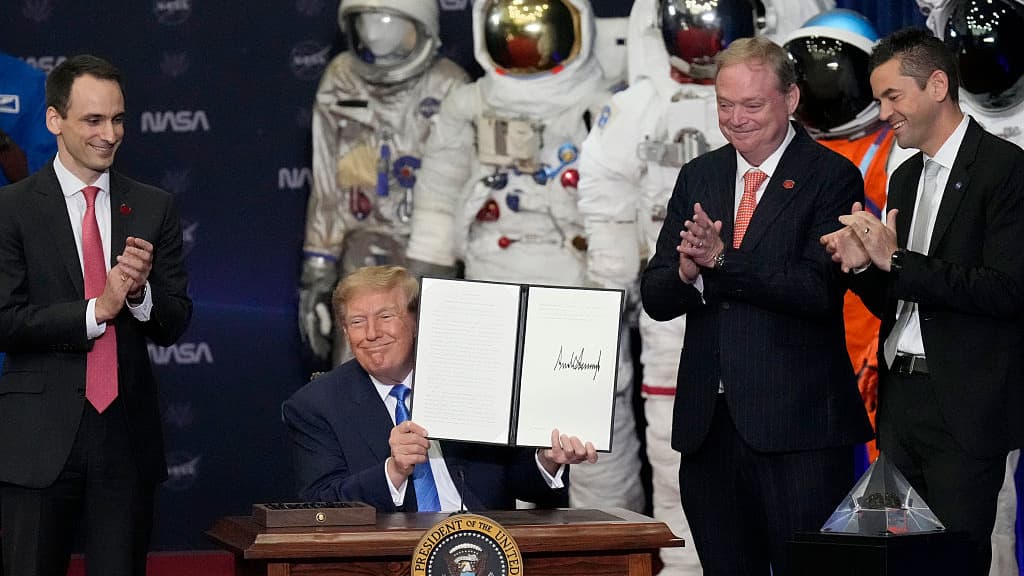
At the ceremony, Trump also acknowledged the Nancy Grace Roman Space Telescope, named for one of the forebears of modern space science, which was launched Sunday aboard a SpaceX Falcon Heavy. With surveying capabilities over 1,000 times faster than its predecessor, the Hubble Space Telescope, Roman seeks to explore dark matter, uncharted corners of the cosmos, and questions about the expansion of the universe.
What do we know so far about the Space Academy?
The first step in establishing the new academy is forming a Presidential Commission to develop recommendations for it. NASA Administrator Jared Isaacman will chair the new commission, according to the executive order, and it will also include War Secretary Pete Hegseth and Air Force Secretary Troy E. Meink, or their designees, among other federal representatives.
The commission has 120 days from Aug. 28 to submit its report to the President. It must include a governance framework, an academic and leadership curriculum, prerequisites for students, a service obligation for graduates, and a plan of implementation, legislative and otherwise, for all of the included components to take effect.

Crypto company BitGo has officially acquired NYDIG’s Bitcoin-focused institutional trading business. The deal was signed and completed on Thursday and reported on Friday, paying $7 million in cash and about $35.5 million in stock at closing, with up to $15 million more in cash tied to two revenue milestones.
The purchase brings NYDIG’s derivatives, structured products, financing, and capital markets operations to the custody company, along with roughly 30 employees.
NYDIG Turns to Power and Compute
Around 250 institutional client relationships were moved across, though they appear in the 8-K filed the same day, which also grants seller NYDIG IHC LLC earn-out shares on the second milestone and sets aside staff retention awards targeting $5 million each in stock and cash.
“Institutions increasingly want to work with a trusted partner that can support the full lifecycle of digital assets,” said Mike Belshe, CEO and Co-founder of BitGo. The firm went public on the NYSE at the start of the year and had a market value below $1 billion as of Thursday, per CNBC.
NYDIG, an affiliate of Stone Ridge Holdings Group, said the sale lets it concentrate on power generation, Bitcoin mining and high-performance computing data centers, a development pipeline it puts above 3 gigawatts, with more than 1 gigawatt deliverable in 2027 and 2028.
“Our team built NYDIG’s institutional trading business into something exceptional: proven execution expertise with derivatives and financing capabilities,” said Tejas Shah, CEO of NYDIG, adding that the data center business is “where we see one of the most significant opportunities ahead.”
Belshe Pushes Senators on CLARITY
Belshe went on CNBC’s Squawk Box on Friday, days after Bitcoin briefly topped $80,000. Asked about a crypto winter, he said the markets “have had high highs and low lows” while “the thesis behind Bitcoin continues to grow,” pointing to tokenized equity plans from Morgan Stanley, Charles Schwab and DTCC.
.@BitGo CEO @mikebelshe breaks down its acquisition of $BTC miner NYDIG: https://t.co/coIINsM3RZ pic.twitter.com/ZqyUsNCkOu
— Squawk Box (@SquawkCNBC) August 28, 2026
On the CLARITY Act, which faces a Senate cloture vote on September 15, Belshe said everyone should want the market structure bill to pass. “This is what gives a legislative path forward to help rein that in, prevent any FTX from ever happening again,” he said, estimating 12 to 18 months of rulemaking after passage and noting he was at the White House with President Trump last week.
Belshe confirmed BitGo runs infrastructure for USD1, the stablecoin behind the Trump family’s World Liberty Financial, and said BitGo just received a license in South Korea. “People don’t realize this, but America actually is behind,” he added.
The post BitGo Buys NYDIG’s Institutional Trading Arm for $7M Cash and $35.5M in Stock appeared first on CryptoPotato.

Strategy’s co-founder Michael Saylor has signaled—via a fresh post on X—that the firm may be preparing to resume buying Bitcoin. In his latest message, Saylor wrote “We’re Back,” prompting speculation that the company could return to its prior pattern of corporate accumulation announcements on Mondays.
For long-time watchers of Strategy’s moves, the timing matters. Earlier weekend-style signals from Saylor have often been followed by official updates tied to treasury activity at the start of the week, turning small social posts into something of a market barometer for what investors should expect next.
Key takeaways
- Michael Saylor’s “We’re Back” post on X has reignited expectations that Strategy will restart Bitcoin buying.
- Strategy paused its regular weekly Bitcoin purchases over the summer, shifting attention toward balance-sheet and capital-market actions.
- Recent strength in Bitcoin has reportedly moved Strategy’s BTC treasury back into positive territory on paper after months of losses.
- Investors will likely watch for whether Monday announcements confirm that the signal translates into renewed accumulation.
A weekend signal with a track record
In the post, Saylor described a return rather than a new thesis, reinforcing the idea that Strategy may be moving back toward Bitcoin accumulation after a period of restraint. The community interpretation is grounded in how Strategy has historically communicated: cryptic weekend hints have frequently preceded official Monday morning treasury purchase announcements.
The practical relevance for market participants is straightforward. Strategy’s Bitcoin buying has been closely watched because its scale and regularity can influence sentiment around corporate participation. Even when the underlying purchase mechanics are formalized only later, the lead time created by Saylor’s messaging can shift expectations well before any transaction details are released.
What Strategy changed during its summer pause
Over the past two months, Strategy reportedly stopped its routine weekly Bitcoin purchases, replacing the accumulation cadence with a broader focus on strengthening its financial foundation. Instead of expanding crypto holdings, management emphasized balance-sheet stability and funding structure adjustments.
According to the article, Strategy’s priorities during this period included stabilizing preferred stock offerings, building a US dollar reserve of $5.1 billion, and setting up a dedicated cash pool of $1.59 billion generated through large common stock offerings. Together, these steps suggest the firm treated the pause not as an abandonment of its approach, but as a financing reset—keeping liquidity available so that future buying could proceed on its preferred schedule.
That shift also aligned with a difficult stretch for Strategy’s on-paper position. With Bitcoin under pressure during parts of the summer, the firm’s large BTC treasury was said to be “deep in the red,” at least on mark-to-market measures.
Bitcoin’s move back above $80,000 and Strategy’s position
The renewed “We’re Back” narrative is now landing against a different backdrop for Bitcoin’s price. The article notes that recent macro momentum has pushed Bitcoin above the $80,000 threshold, a move that changes the immediate math for holders.
Strategy holds more than 840,447 Bitcoin, with an average cost basis hovering around $75,385, as described in the source text. With Bitcoin recovering, that reported cost-versus-market relationship has pushed the company’s overall BTC position back into positive territory for the first time in months.
This matters for two reasons. First, it removes some of the accounting pressure that tends to weigh on corporate crypto holders during drawdowns. Second, it can make a return to accumulation more strategically attractive: when the treasury is back above average cost, renewed buying can be framed less defensively and more as an offensive strategy—something investors typically prefer to see when evaluating risk-adjusted prospects.
Why “We’re Back” could mean more than a headline
While Saylor’s post is not a formal announcement of a specific purchase amount or exact timing, the statement carries multiple layers for Strategy stakeholders. Operationally, it can be read as a readiness check—suggesting the company is prepared to deploy its “dry powder” back into Bitcoin. Psychologically, it signals a re-energized approach after a period when market conditions and Strategy’s reported balance-sheet focus may have temporarily shifted attention away from routine accumulation.
Still, there’s an important distinction investors should keep in mind: a social media signal is an expectation, not execution. The real confirmation will come from official treasury disclosures that specify whether and when Strategy restarts buying activity, and how the company positions its financing tools alongside any resumed purchases.
That uncertainty is precisely why the post is notable. Strategy’s previous pattern—weekend teasers followed by Monday morning corporate actions—has created a framework in which traders and long-term observers can interpret early hints. If the pattern holds again, Saylor’s message may function as an early warning that accumulation could return as a central pillar of Strategy’s next phase.
For now, market participants are likely to watch Bitcoin closely as well as Strategy’s upcoming filings and announcements for confirmation. If the firm does resume its cadence, the move could reinforce the narrative that corporate treasury buying remains a key driver of crypto sentiment even after pauses designed to manage liquidity and capital-market conditions.
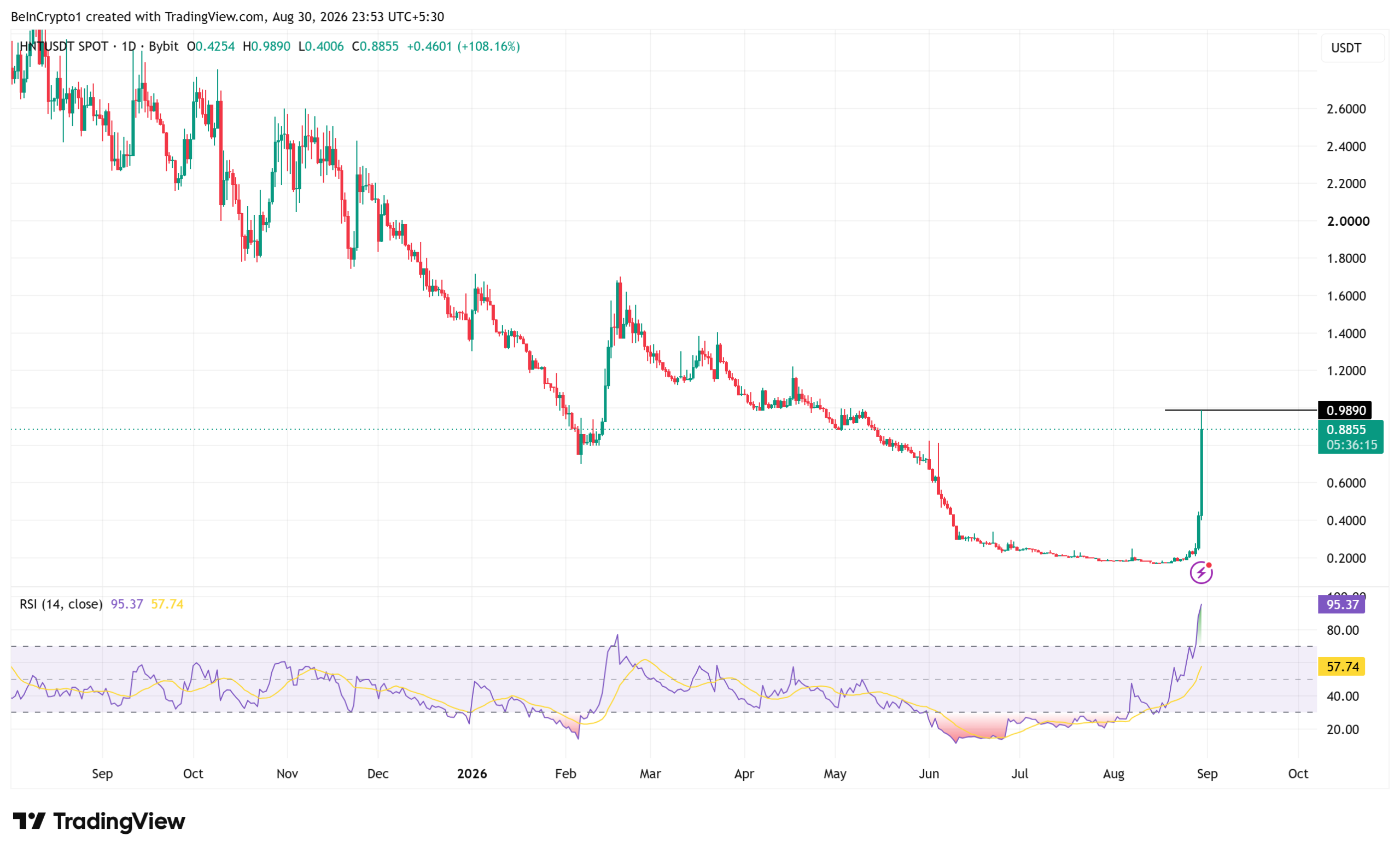
Helium (HNT) jumped as much as 167% over the weekend, establishing an intra-day high of $0.989 as of this writing. Traders who arrived late are asking whether it is too late to buy HNT.
The rally was not built on buyers, but on sellers being forced out.

Why a Forgotten Token Moved So Fast
Helium runs a wireless network. Ordinary people host the hardware in their homes and shops. The industry calls this decentralized physical infrastructure, or DePIN.
The trigger was a Texas Wi-Fi deployment BeInCrypto reported on Saturday. The reaction dwarfed the news itself. HNT price, which had traded under $0.30 for most of the summer, surged by almost 170% in one weekend. Helium’s pitch has always been real customers.
In April 2025, developer Nova Labs paid $200,000 to settle SEC charges. Regulators said it wrongly claimed Lime, Nestle and Salesforce used the network. The case covered statements to stock investors, not the token.
What the Charts Actually Show
The HNT price did not climb in a straight line. It moved in two bursts, grounding from $0.33 up to $0.45 overnight. It then jumped to $0.70 by 09:00 and stalled for four hours. A second push from 15:00 carried it to $0.9782.
- HNT Volume Outlook
During the pauses, forced buying ran out. Now volume. The daily bar is the tallest on Helium’s two-year chart. Earlier spikes topped out near $45 million. This one cleared $110 million, thresholds last tested in 2023.

In total, $248.26 million changed hands, while the whole token is worth only $154.8 million. So the token changed hands more than once in a single day. Most people holding HNT now bought it this weekend, near the top.
- HNT Liquidations
Some traders had bet against HNT, borrow the token, sell it, and plan to buy it back cheaper. The price rose instead, and their losses grew with every tick. Exchanges liquidated them, closing those bets for them and bought the token back at market price.

Coinglass shows nearly $1.5 million worth of short positions were liquidated on Sunday alone and over $1.6 million across the weekend. There is almost nothing before it. Traders betting on a rise lost just $196,650.
Every forced closure is a purchase. That is how the price climbed without new buyers arriving. Traders call this a short squeeze.
- HNT Funding Rates
Next comes the funding rate, the clearest chart of the five. On these markets, one side pays the other a small fee every few hours.
For eight months that fee sat flat at zero. This weekend it fell past minus 1.2% on a single payment. Traders betting against HNT now pay the ones betting on it.

“The funding rate on Bybit HNT-PERP was close to -1000% this last print. A $60m market cap token with real users, with a chart that has no resistance for another 150%, down 99% from ATH. Shorts are trapped paying crazy funding with no spot supply,” one trader observed.
Finally, open interest. This is the total money riding on these bets. It shows the number of all open long and short positions for HNT price.
It jumped 197.6% to $13.64 million, the highest in about a year. When those bets get closed out, this number falls. Here it nearly tripled instead.

They are not surrendering, with new money and fresh capital entering the futures market as new contracts are created for HNT. They are being replaced faster than they are cleared out.
As HNT price rises alongside rising open interest, it signals strong bullish momentum. It shows high-conviction, aggressive bullish breakout driven by explosive leveraged demand.
Is It Too Late to Buy HNT?
That squeeze is already cooling, as HNT peaked at $0.989 and now trades near $0.88. Forced buying has nearly stopped. Only $22,920 of bearish bets closed in the most recent hour (as of this writing), against $1.61 million across the day.
Traders watching this setup tend to treat a vertical spike in open interest as a warning rather than an entry. Positioning is stretched, and a sharp drop can trigger a chain of forced closures in the other direction.
The signal they wait for is open interest flattening, or easing slightly, while the price holds. That combination suggests the market has accepted the higher level rather than simply leveraged into it.
Funding is the second gauge, and HNT reads in reverse of the usual case. A crowded long market shows sharply positive funding. Here it is deeply negative, so the crowd is still short and paying to stay there.
A move back toward zero would mean those bets have been closed or abandoned. The buying that came from forced closures stops at that point, and the price has to hold on ordinary demand.
One supply point favors holders, but with a caveat. Every HNT minted so far is already trading, so no locked block is waiting to vest. Issuance continues toward a 223 million cap though, with about 37 million still to come.
Once funding returns to zero, ordinary demand must hold Helium price data alone. Anyone buying now is betting on a second squeeze, not the first.
The post Helium Price Soars 170% in One Weekend: Is It Too Late to Buy HNT Now? appeared first on BeInCrypto.


Sberbank plans to accept Bitcoin (BTC), Ether (ETH) and Tether (USDT) as loan collateral, deputy chairman Anatoly Popov told TASS on Friday.
Russia’s largest lender wants the coins as security, not as money. Paying with crypto in Russia remains banned when the country’s digital currency law takes effect on September 1.
Collateral is Legal, but Spending is Not
A Russian company can pledge Bitcoin to a bank, but it still cannot buy a coffee with it. Popov said Sberbank prepared for the rule change early and already handles digital assets. However, he made the expansion conditional.
“We plan to accept not only Bitcoin but also Ethereum and the stablecoin Tether as collateral… after the Central Bank, of course, allows them for public circulation,” local media reported.
President Vladimir Putin signed the law on August 4. The Bank of Russia published its first approved list a week later. Only three coins cleared the screen.
Regulators wanted size, high daily turnover, and at least 5 years of price history on foreign exchanges. Bitcoin, ether and USDT passed. Nothing else did, and the regulator is clear about the rest.
Crypto cannot be used in payments within Russia. Only exporters and importers get a carve-out for crypto payments in foreign trade.
No Rate, No Date, No Term Sheet
With the key rate standing at 14% as of August 28, money is expensive in Russia, and that number explains the demand. A miner can sell coins and lose the upside, or pledge them and pay interest.
Meanwhile, ordinary Russians will not get the option. Russia’s new crypto law caps non-qualified investors at 300,000 rubles (roughly $3,632) of crypto per year per intermediary. Corporate borrowers face no such ceiling.
Popov disclosed no loan-to-value ratio, interest rate, or launch date. He tied everything to permissions the central bank has not yet issued.
What exists today is smaller. Sber closed a crypto-backed lending pilot in December 2025 and targets a digital depository by December 1.
Notably, however, USDT is the quiet outlier, sitting at $0.9999, while Bitcoin moves every day. One coin needs a thin haircut, the other a deep one.
If a borrower defaults, Sberbank must sell those coins inside a country where spending them is illegal.
The post Russia’s Largest Bank Wants Bitcoin and Ethereum as Collateral appeared first on BeInCrypto.
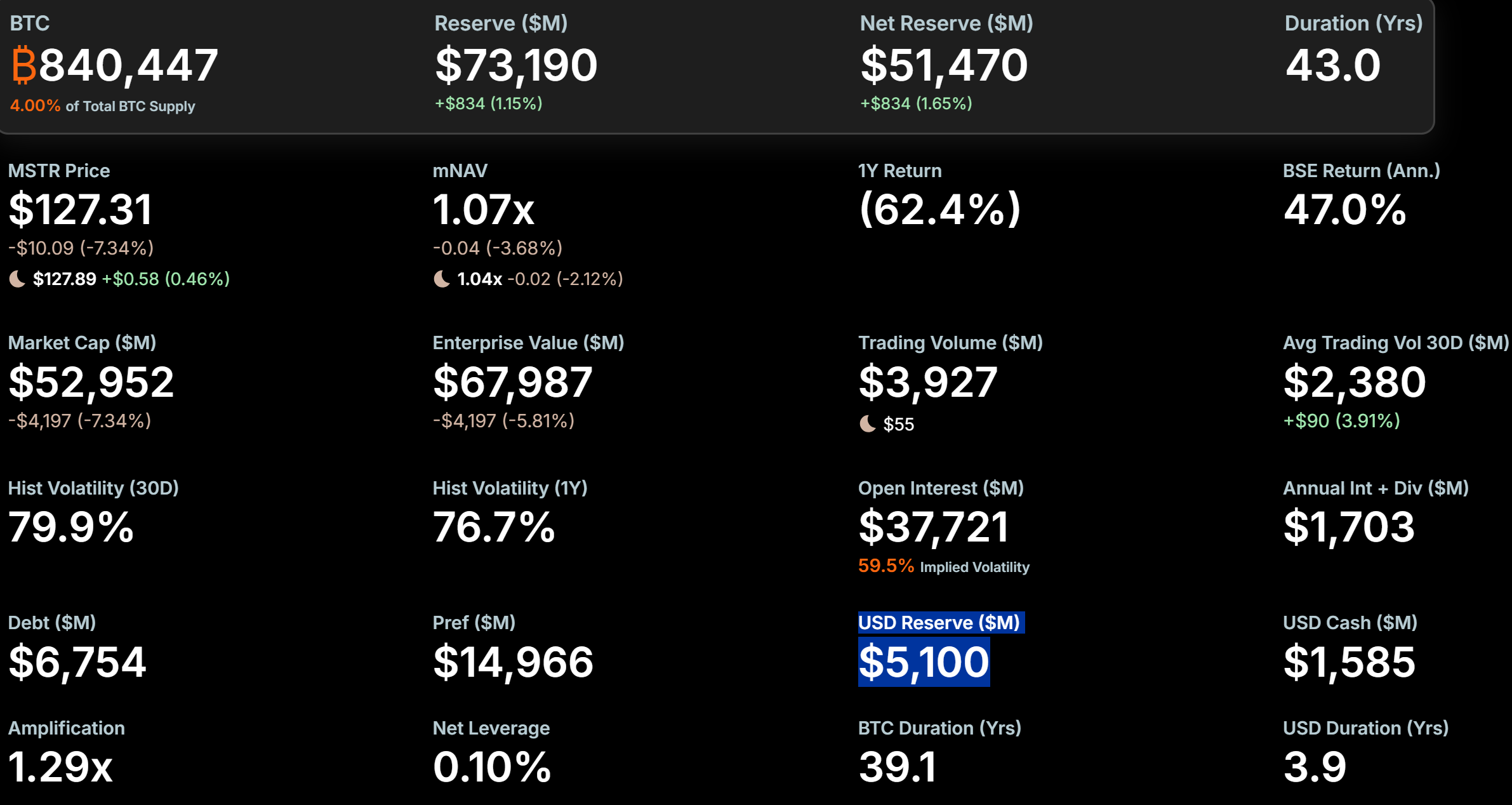
Michael Saylor says MicroStrategy is back. The two-word post landed after 10 weeks in which the company, now named Strategy, bought no Bitcoin (BTC) at all.
Three things in its finances have quietly shifted. Together they explain why traders read the post as a signal, not a slogan.
Strategy’s Debt No Longer Blocks Bitcoin Buys
Strategy holds roughly $6.69 billion in dollars. It owes about $6.71 billion on convertible notes. The company says that leaves net leverage at 0.1%.
The gap ran the other way all summer, making traders price it in forced selling. It vanished last week, and MSTR stock rallied 12% as the two numbers met.
The freeze was real, considering MicroStrategy last bought BTC on June 22, adding 520 BTC at $67,068. It has sold four times since. August brought $3.28 billion in fresh capital, and all of it went into dollars, not Bitcoin.
The build was deliberate as most of the cash sits in a reserve for dividend payments. That reserve held $3.75 billion in July. It holds $5.10 billion now.

STRC Is Almost Back at Par
STRC is a preferred share that MicroStrategy sells to raise cash. It pays a 12% dividend and is built to trade at $100.
It closed at $97.33 on August 28, up from a 12-month low of $71.25. Below $100, it costs the company money.

“Our objective is for STRC to trade over time at $99 to $100. If STRC trades below $100, we intend to repurchase STRC shares in a regular and disciplined manner,” CEO Phong Le said so in the second-quarter results.
Every dollar spent buying STRC back is a dollar not spent on Bitcoin. Strategy sold coins in August to fund that defense. Near $97, the drain almost stops.
The stakes have grown. STRC raised $2.47 billion in July 2025 at $90 a share, paying 9%. Today roughly $10 billion of it trades, at 12%.
Those dividends are not small. Strategy paid $400.7 million on its preferred shares in the second quarter alone.
Saylor Is Signaling, Not Filing
Saylor paired his post with a chart of 840,447 coins worth $65.72 billion. Hours earlier he wrote “Business as usual.”

Neither post is a filing, but purchases show up in weekly reports and the next one is expected on Monday, August 31.
MicroStrategy may have bought Bitcoin last week, but it is also possible that they did not. After all, he also declared Bitcoin had won in July, and the buying stayed frozen for another five weeks.
With Bitcoin traded near $79,183 as of this writing, up 1.3% in a day, MicroStrategy’s treasury is barely above water, given they paid an average of $75,388 a coin.
The post Michael Saylor Says ‘We're Back': 3 Reasons MicroStrategy May Resume Buying Bitcoin appeared first on BeInCrypto.

Real Trump Coins has denied involvement in the launch of a token called “Trump Digital GOLD,” after the project briefly promoted the Solana-based asset across its online channels before the promotion disappeared.
The company said the activity was carried out by “third-party bad actors” and stated it is working with authorities to investigate. The episode comes amid scrutiny of how crypto promotions can move fast—and sometimes leave little trace—before platforms delete posts.
Key takeaways
- Real Trump Coins says it did not authorize or promote any digital token, following short-lived advertising for “Trump Digital GOLD.”
- Promotion originated from the Real Trump Coins X account and RealTrumpCoins.com, though the posts were deleted after going live.
- Blockchain data cited by Lookonchain indicates extreme concentration of supply among a small number of newly created wallets.
- Real Trump Coins’ denial has prompted confusion among observers about how both the account and its website appeared to be advertising the token.
Token promotion appears, then vanishes
According to Cointelegraph, the Real Trump Coins X account promoted “Trump Digital GOLD” on Saturday and directed users to RealTrumpCoins.com, where the token was also advertised. The promotional posts were subsequently deleted.
As the incident unfolded, the X account began linking to a different domain, TrumpCoins.com, while RealTrumpCoins.com had still displayed the GOLD promotion for at least a period afterward. Cointelegraph also reported that at the time of publication, RealTrumpCoins.com continued to show the token advertisement.
In the meantime, Real Trump Coins’ X account bio had been updated to point to TrumpCoins.com, even as some audience members saw earlier posts—including at least one referenced by the reporting—that still pushed users toward RealTrumpCoins.com as late as Aug. 25.
Project denies authorization and cites “bad actors”
In an X post on Saturday, Real Trump Coins said it had not authorized any token launch or promotion, adding that it would not do so. The project’s statement also said it is working with authorities to investigate the matter.
That denial raises the central question for observers: whether the token promotion was the result of compromise on the project’s side, or whether there was another mechanism used to make the promotion appear affiliated with Real Trump Coins.
Concentration concerns highlighted by Lookonchain
Separate reporting and on-chain analysis framed the token as potentially suspicious based on distribution and sell activity. Lookonchain reported that the developer and newly created wallets controlled 82.45% of the token supply.
Lookonchain also said that 15 wallets tied to the team sold holdings worth about $330,000, resulting in an estimated $312,000 profit. Such concentration—paired with rapid selling by wallets linked to the launch—can be a red flag for traders because it often suggests the possibility of coordinated exits rather than broad, organic distribution.
While tokenomics alone do not prove wrongdoing, the combination of tight control by a small set of wallets and swift monetization typically heightens investor risk, especially when promotions appear to be connected to recognizable brand accounts.
Why the account-and-domain confusion matters
The incident has drawn attention not just for the token itself, but for how branding and audience access were leveraged. Cointelegraph noted that observers were confused by the relationship between the X account and the two different domains—RealTrumpCoins.com and TrumpCoins.com—particularly after posts were deleted.
Crypto users questioned how both the social account and the website appeared to be participating in the promotion, especially given that the X account reportedly linked to TrumpCoins.com while, in later checks, RealTrumpCoins.com still displayed the GOLD advertising.
This kind of mismatch can be a warning sign for anyone dealing with brand-adjacent token launches. If a reputable or officially connected account appears compromised—or if a token promotion is run through lookalike infrastructure—the practical effect is similar: consumers may assume endorsement where none exists.
Real Trump Coins’ continued activity and following behavior also drew notice from observers in the Cointelegraph report, including that Trump followed the Real Trump Coins X account and that the account was among a set of accounts the person followed. The significance of that detail is limited to what it implies socially, but in incidents like this it can still affect how quickly users decide whether to trust promotional content.
What to watch next
For investors and builders, the key unanswered items are whether Real Trump Coins will provide additional technical details on how the promotion occurred and what changes it will make to prevent repeat misuse. Until then, the episode underscores how quickly a token can surface alongside brand signals—and how crucial it is to verify authenticity through more than just a token’s earliest promotional footprints.


Strategy’s Michael Saylor said “We’re Back” in his latest signal on X (formerly Twitter) of the company’s likely return to Bitcoin buying.
For market watchers, the post could be a strong psychological signal as Saylor has a track record of dropping cryptic weekend teasers that precede official Monday morning treasury purchase announcements.
Should that record, and community interpretation, hold true, his post points to the resumption of corporate Bitcoin accumulation following a notable summer hiatus.
To put the message in context, over the past two months, Strategy paused its regular weekly Bitcoin buying spree. Instead of expanding its crypto holdings, management pivoted toward bolstering its balance sheet. The firm focused on stabilizing its preferred stock offerings, building a $5.1 billion US dollar reserve, and introducing a dedicated $1.59 billion cash pool generated through massive common stock offerings.
Related: Strategy’s $66B Bitcoin machine hinges on capital markets, not BTC price: Report
This strategic breather coincided with a challenging market stretch that left Strategy’s industry-biggest BTC treasury sitting deep in the red on paper. However, recent macro momentum has propelled Bitcoin past the $80,000 threshold.
Because Strategy holds more than 840,447 Bitcoin at an average cost basis hovering around $75,385, the recent price recovery has pushed the firm’s overall position back into positive territory for the first time in months.
Saylor’s “We’re Back” declaration functions on multiple levels. Operationally, it likely signals that the company is ready to deploy its considerable dry powder back into the asset class it champions. Psychologically, it marks a triumphant return to profitability and a renewed offensive for the world’s largest corporate Bitcoin treasury.
Magazine: 200,000 fake AI ‘victims’ deployed to scam bait online fraudsters
Crypto World
Crypto Lost $3.63B to Exploits Since 2025: 60% of Hit Platforms Had Been Audited (CoinGecko)

Crypto platforms have lost more than $3.63 billion to security incidents between January 2025 and July 2026. CoinGecko documented 245 attacks during the period.
The 10 largest incidents accounted for more than 72.5% of the total amount stolen, demonstrating that a relatively small number of major breaches drove most of the losses. Infrastructure and supply-chain vulnerabilities were the biggest sources of damage across both centralized exchanges and decentralized exchanges. Combined losses exceeded $1.8 billion.
Most Attacked Platforms Had Been Audited
Security failures involving Bybit and KelpDAO were notable examples. CoinGecko also found that the main weaknesses differ depending on how platforms are built.
For centralized exchanges, compromised private keys remained the most common point of failure, while decentralized applications lost $546 million through sophisticated smart contract exploits. Both centralized and decentralized platforms, however, remain exposed to oracle and market manipulation, with errors in internal mechanisms causing major losses for platforms including Bitget, Binance and Hyperliquid.
Upon examining the role of security checks, the report found that having an independent audit did not prevent many of the incidents. Of the 245 attacks recorded since early 2025, 147 involved protocols that had undergone audits before they were compromised. In fact, these audited platforms accounted for over 88% of the total capital drained during the 19-month period.
Conventional audits often do not cover the areas exploited in major attacks. Many incidents involved external infrastructure, unaudited code changes, or systemic features that were manipulated through governance attacks. Only about 11% of the incidents involving audited platforms were linked to smart contract vulnerabilities that fell within the audit scope, although those flaws still caused $396 million in losses.
CEXes generally do not use the same audit model as decentralized protocols and instead rely on compliance measures and financial attestations such as Proof-of-Reserve. However, CoinGecko said that such safeguards provide limited protection against social engineering and severe private-key security failures.
Crypto Insurance Is Shrinking
Even as exploits increased, active coverage across leading crypto insurance protocols has declined 20.2%, falling from $163.2 million to $130.2 million. Cumulative payouts have remained largely unchanged at $33 million. The report said high risks in the sector may have discouraged users from supplying capital or buying coverage at higher premium prices.
Crypto insurance can also have a narrow scope, as claims are often limited to verified smart contract exploits or infrastructure failures. Losses linked to human error, compromised private keys, or market volatility may not qualify.
As of August 2026, five of nine on-chain insurance protocols had become inactive or moved to other segments.
The post Crypto Lost $3.63B to Exploits Since 2025: 60% of Hit Platforms Had Been Audited (CoinGecko) appeared first on CryptoPotato.

Chinese star Ruoning Yin wins FM Championship at TPC Boston

Anthropic warns infostealer malware is hijacking Claude sessions to drain usage

Joe Root: England captain calm on form, saying ‘I’ve got 14,000 runs for a reason’





-

 Crypto World5 days ago
SpaceX stock could rise 75% to $240, JPMorgan says
-

 Fashion2 days ago
Weekend Open Thread: Maeve – Corporette.com
-

 Crypto World3 days ago
Bitcoin’s 22% rally now needs real demand to outlast Treasury liquidity boost
-

 Crypto World4 days ago
Warsh Jackson Hole keynote puts financial innovation first
-

 Crypto World6 days ago
A $30 Billion AI Fund Implodes, Now the SEC Is Investigating Wall Street’s Role
-

 Business3 days ago
Salesforce Stock Soars 19% as Blowout Earnings and Agentforce AI Growth Silence Software Skeptics
-

 Crypto World5 days ago
Did Trump Just Move SpaceX Stock With One Truth Social Post?
-

 Crypto World4 days ago
Elon Musk Grok Bot Promise: We Will Make You Whole if AI Loses Your Money
-

 Business4 days ago
Walmart takes aim at younger shoppers with new fashion brand
-
 NewsBeat4 days ago
Lindsay Clancy jury braces for closing arguments as judge tells court: ‘You’ve heard all the evidence’ – Live updates
-

 Business3 days ago
Apple Confirms September 9 Keynote and Reveals Its Full Pre-Order Schedule
-

 Crypto World2 days ago
Bitcoin price tests $82K resistance as Brandt stays long
-

 Crypto World4 days ago
NVIDIA revenue hits $96.2B as AI demand doubles
-

 Business6 days ago
Moderna CEO warns China is pouring state money into mRNA technology
-

 Business5 days ago
Thailand’s Eastern Economic Corridor Capital City (EECiti): Key Developments and Investment Opportunities
-

 Business2 days ago
iPhone 18 Pro Pre-Orders Could Shift to Saturday as Apple Reportedly Avoids September 11 Anniversary
-

 Business6 days ago
NVIDIA Stock Drops Nearly 2 Percent to $210 on Seventh Losing Day Ahead of Critical AI Earnings
-
 Crypto World7 days ago
$92 Billion Nvidia Earnings Could Make or Break the AI Trade
-

 Business2 days ago
Onto Innovation Stock: AI’s Next Bottleneck Is Yield (NYSE:ONTO)
-

 NewsBeat5 days ago
Trump’s trade truce with China faces test with Iran effort
You must be logged in to post a comment Login