

Crypto World
Elon Musk Grok AI Predicts Incredible XRP Price Target by End of 2026

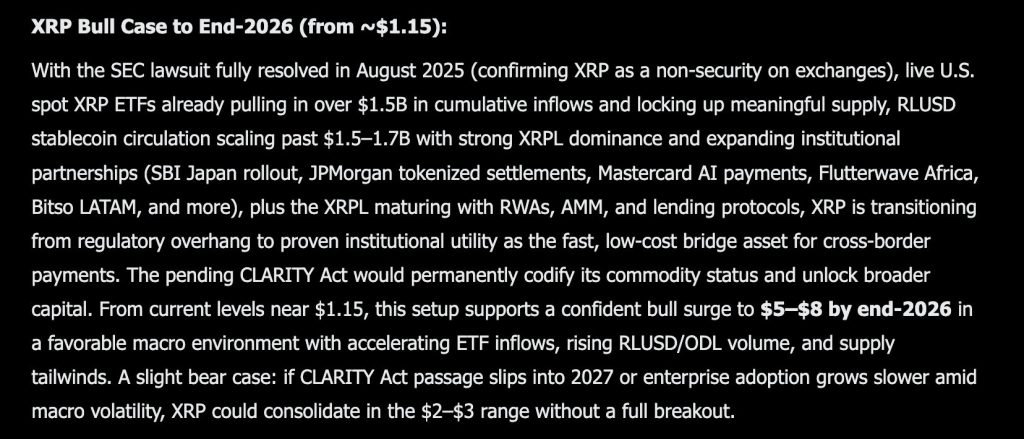
Elon Musk Grok AI just published what might be the most partnership-heavy XRP price prediction in this entire series. The model predicts $5 to $8 by the end of 2026, a 4 to 7 times return from where XRP sits today.
The bull case reads like a who’s who of global finance quietly building on the XRP Ledger while the price stays depressed. XRP trades near $1.15 today, and the thesis rests on the SEC lawsuit being fully resolved in August 2025, formally confirming XRP as a non-security on exchanges and removing the single biggest legal cloud that has held back serious institutional money for years.
Live US spot XRP ETFs have already pulled in over $1.5 billion in cumulative inflows and are actively locking up meaningful supply.
RLUSD stablecoin circulation has scaled past $1.5 to $1.7 billion with strong XRPL dominance. The partnership list is genuinely impressive by any measure.

SBI Japan is rolling out RLUSD, JPMorgan is using the XRPL for tokenized settlements, Mastercard named Ripple a partner in its AI payments network, Flutterwave is covering Africa, and Bitso is handling Latin America.
The XRPL itself keeps maturing with real world assets, automated market makers, and lending protocols all going live. Together the model frames XRP as completing a transition from regulatory overhang to proven institutional utility as the fast, low cost bridge asset for cross border payments.
The pending CLARITY Act would permanently codify its commodity status and unlock even broader institutional capital on top of everything already in motion. In a favorable macro environment with accelerating ETF inflows, rising RLUSD and on demand liquidity volume, and supply tailwinds from ETF accumulation, the model calls that $5 to $8 range a confident bull surge target.
The bear case is relatively contained. If CLARITY Act passage slips into 2027 or enterprise adoption grows slower than expected amid macro volatility, XRP could consolidate between $2 and $3 without achieving a full breakout. That would still represent a meaningful return from current levels, which tells you how skewed the model views the risk reward at $1.15.

XRP Price Prediction: XRP Finally Lifts Off The $1.00 Floor After Months Of Testing It
The daily chart shows XRP at $1.15532 after a long decline from highs above $3.65 set back in early August of last year. That entire move lower has been one extended downtrend, interrupted by a brief bounce toward $2.40 in November before sellers resumed complete control.
The most recent leg of this decline pushed XRP below $1.00 multiple times in June before buyers finally stepped in with enough conviction to push price back above that level and hold it.
That recovery off the $1.00 floor is the most meaningful chart development in months, given how many times that level was tested and how significant it is psychologically for an asset that spent years trying to sustain above $1.00 during the pre ETF era.
Resistance sits first near $1.20, the level price approached on today’s candle high of $1.16 and has not yet cleanly cleared, then a heavier ceiling near $1.60 where multiple rejections accumulated earlier this year.
Support now holds at $1.00, the exact floor that just got defended after several tests. The broader structure still shows a series of lower highs stretching back to August, so no confirmed reversal has appeared on this chart yet despite the encouraging bounce.
Momentum on the daily candles looks more constructive than at any point in the past several months, with larger green candles showing up more frequently and the $1.00 level holding on multiple tests rather than giving way.
If XRP can close convincingly above $1.20 and sustain that level through the coming sessions, the institutional accumulation story Grok is describing finally starts to show up in the price action rather than just the fundamentals.
Don’t Miss Out on Our $1,000 USDT Airdrop on ByBit
Discover: The best crypto to diversify your portfolio with
Here is What Grok AI Predicts For LiquidChain Near Future, Very Bullish
Sitting at resistance waiting for a breakout is not positioning. It is standing in line.
Bitcoin, Ethereum, and XRP have been pressing against the same ceilings for weeks. The catalyst that unlocks the next leg is perpetually one data print away.
The institutional inflows are perpetually next quarter. Every large-cap trader waiting for a breakout is waiting on a decision that belongs to someone else’s balance sheet.
Early-stage infrastructure plays by completely different rules, Copilot AI predicts. Capital that would vanish as statistical noise at Bitcoin’s scale moves a small undiscovered project by multiples.
The asymmetric return lives in one place only: the gap between what something is genuinely worth and what the market currently thinks it is worth. That gap exists because the project has not been found yet. The moment it gets found, the gap is gone.
Cross-chain fragmentation has been extracting value from DeFi participants since the first bridge went live and nobody has eliminated it. Bitcoin, Ethereum, and Solana were engineered as independent systems with no shared architecture and no intent to interoperate.
Every transaction that crosses those boundaries pays the price of that design in fees, slippage, and execution failures. Bridges were supposed to be the solution. They became the mechanism through which the problem collects its fee.
LiquidChain eliminates the fee entirely. Three networks inside a single execution layer. One deployment reaches all of them. No cross-chain tax on any interaction anywhere.
Grok AI flagged it as worth watching. The presale is at $0.01454 with just over $860,000 raised.
Execution is unproven. Adoption is unknown. Established assets offer a predictable ride toward a ceiling that is already fully visible. LiquidChain is an entry point that disappears once the market finds it.
The post Elon Musk Grok AI Predicts Incredible XRP Price Target by End of 2026 appeared first on Cryptonews.

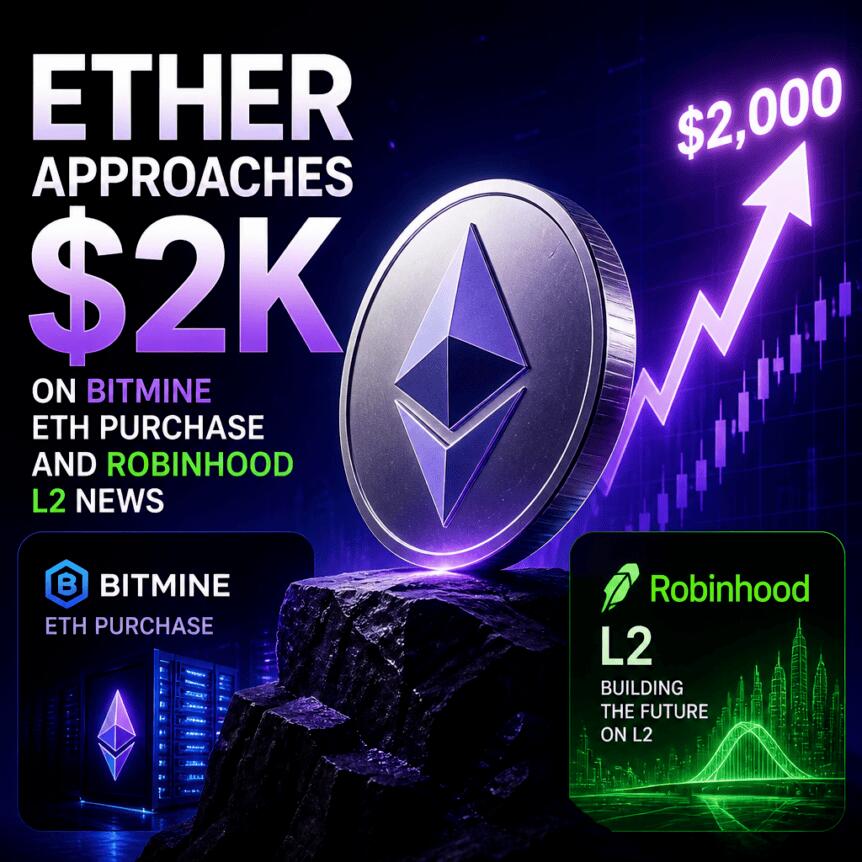
Ether has bounced back sharply, rising roughly 15% over the past five days and pulling away from the $1,500 area that marked a June 26 low. The recovery reflects a mix of renewed confidence around Ethereum’s roadmap and ongoing accumulation of ETH by BitMine Immersion Technologies.
Beyond price, Ethereum’s narrative is also shifting toward practical use cases: the Glamsterdam upgrade is still progressing through testing toward later in 2026, while the July 2 launch of Robinhood Chain has put additional attention on regulated, tokenized finance built on top of the Ethereum ecosystem.
Key takeaways
- Ether’s rebound followed the June 26 low, helped by optimism tied to final testing for Ethereum’s Glamsterdam upgrade.
- BitMine Immersion Technologies’ continued ETH buying is cited as a key factor supporting the $1,500 level, despite large unrealized losses.
- Ethereum options markets have cooled from fear conditions, with Deribit skew moving away from last week’s extremes.
- Robinhood Chain’s rollout and tokenized stock expansion reinforce a TradFi-focused growth angle for Ethereum-based infrastructure.
Ether strength, with support under $1,500
In the latest stretch of strength, Ether’s performance has outpaced the broader crypto complex. The article notes that ETH has gained about 7% relative to total crypto market capitalization over the last 30 days, suggesting demand for Ether specifically rather than a purely market-wide risk-on move.
Part of the backdrop is political and regulatory momentum. The piece points to optimism surrounding the proposed Digital Assets CLARITY Act, which has faced delays in Congress due to banking-sector pushback, particularly around stablecoin regulation and potential rewards for token holders. Even without immediate clarity, investor expectations can still influence short-term positioning in major assets like ETH.
Derivatives: fear metrics ease, but bullishness is not yet dominant
Ether’s rally toward $1,800 also coincided with improvement in ETH options positioning. According to the article, Deribit’s 25% delta skew (put-call) — a common measure used to infer the balance between protective puts and upside calls — moved out of the fear zone that persisted until Friday.
The current skew is described as showing a 9% premium for put options over equivalent call options. That is still not “bullish” in the strictest sense, but it is meaningfully less extreme than the 15% level recorded the prior week. The article adds that readings above 12% often align with heightened fear, implying sentiment improved even if traders remained cautious.
Deribit options skew data referenced in the article via Laevitas: Laevitas.
Ethereum’s upgrade path and what Glamsterdam is meant to fix
One persistent critique of Ethereum has been scalability at the base-layer level, especially as layer-2 rollups rely on data “blobs” to keep fees low. While blobs reduced transaction costs, the article highlights that the policy and resulting economics created wider debates around long-term data censorship and centralization, and also influenced base-layer fee dynamics.
With base-layer network revenue under pressure, ETH burning has been reduced, shifting the supply picture toward inflationary dynamics rather than consistent deflation. That makes every improvement to base-layer throughput more important to the broader thesis: if Ethereum can process more data and transactions efficiently without relying on tradeoffs that worsen long-term incentives, the market narrative improves.
In that context, the article focuses on the Glamsterdam upgrade. It states that Glamsterdam is in testing and is designed to improve Ethereum’s processing speed by allowing more transactions to run in parallel, expanding capacity to handle additional data at higher throughput, and reducing “database bloat.” The stated aim, per the article, is to provide institutional-grade infrastructure for financial use cases.
Ethereum upgrade reference in the article: Glamsterdam upgrade.
BitMine’s accumulation and the meaning of large unrealized losses
The article also credits continued spot accumulation by BitMine Immersion Technologies with helping reinforce the $1,500 support level. It notes that BitMine increased its ETH holdings by 325,000 ETH over the past month, bringing total reserves to 5.74 million ETH.
Crucially, the article acknowledges the risk embedded in this strategy: even with roughly $8 billion in unrealized losses on its ETH holdings, BitMine continues buying. It frames the company’s approach as aligned with a longer-term plan toward acquiring 5% of the existing supply.
For market participants, the practical takeaway is not just that a large holder is accumulating — it’s that the firm appears willing to sustain accumulation through drawdowns. Large, persistent demand can change how investors interpret support levels, particularly around psychological price ranges like $1,500.
BitMine holdings reference in the article: bmnr.rocks.
Robinhood Chain and tokenized stocks: TradFi grows inside Ethereum’s orbit
While onchain and derivatives metrics may still look cautious — particularly given low network fee conditions mentioned in the article — the upside case for ETH is being reinforced by traditional finance integration.
The piece highlights the launch of Robinhood Chain on July 2. It describes Robinhood Chain as an EVM-compatible Ethereum layer-2 built using Arbitrum technology, positioning the network for interoperability with Ethereum’s broader ecosystem.
More importantly for adoption, the article says Robinhood rolled out tokenized stock trading in more than 120 countries, alongside DeFi integrations including Uniswap, 1inch, and Morpho. This matters because it ties Ethereum-aligned infrastructure to real consumer-facing financial products rather than relying solely on speculative activity.
In effect, the article reframes the ETH rally as not merely a macro bet or a sentiment swing: it points to a structural narrative where Ethereum’s scaling roadmap and base-layer expansion could support an expanding layer-2 and application economy — and where TradFi participants are increasingly comfortable building tokenized instruments on Ethereum rails.
What to watch next for the $2,000 question
The article concludes that the path toward $2,000 looks plausible in the near term, given the combination of improving sentiment in options markets, ongoing ETH accumulation, and visible growth in tokenized finance use cases. Still, investors should watch how Ethereum’s base-layer economics evolve alongside Glamsterdam’s testing progress, and whether derivatives positioning continues to reflect a steady improvement rather than a temporary bounce.


EU lawmakers have approved a policy position calling for a review of whether decentralized finance, staking, crypto lending, borrowing and NFTs should be brought more clearly under the European Union’s crypto rulebook after MiCA’s rollout.
Summary
- EU lawmakers want the European Commission to review DeFi, staking, NFTs and crypto lending under MiCA.
- Parliament’s report does not change the law but outlines priorities for future crypto regulation.
- Decta data shows MiCA-compliant euro stablecoins grew 128% in market cap over the past year.
According to the European Parliament, members on Tuesday adopted the report titled Digital assets – challenges for the competitiveness and integrity of the European Union’s financial system, setting out Parliament’s official position on the next stage of crypto regulation.
The paper does not amend the Markets in Crypto-Assets regulation or impose new legal obligations on crypto companies, but it asks the European Commission to examine areas that remain outside the existing framework.
The vote comes days after MiCA’s transition period ended on July 1, when crypto-asset service providers that fall under the regulation became required to obtain either EU-wide or national authorization to continue serving customers across the bloc.
Lawmakers have turned attention to activities outside MiCA
With MiCA now in force, Parliament has asked the European Commission to assess whether decentralized finance, staking, crypto lending and borrowing, non-fungible tokens, and tokenized financial assets require additional regulatory treatment. The report also calls for consistent enforcement across member states, warning that different national approaches could weaken the EU’s single market for digital assets.
Earlier this year, the European Commission had already begun reviewing possible changes to the framework. In May, the Commission opened a public consultation seeking feedback on whether MiCA should cover additional crypto activities and whether restrictions on interest-bearing stablecoins should be reconsidered.
Alongside those proposals, Parliament’s report presents a favorable view of tokenization and euro-denominated stablecoins, stating that regulated digital assets could strengthen the competitiveness of European financial markets if the rules are applied consistently throughout the bloc.
Recent market data has pointed to growing activity in regulated euro-backed tokens. As previously reported by crypto.news, payments company Decta found that the combined market capitalization of eight MiCA-compliant euro stablecoins increased 128% over the 52 weeks ending June 28, 2026, rising from $295.6 million to $673.9 million.
Decta also reported a 43.1% increase in combined trading volume, while the number of compliant euro stablecoins with active market data grew from five to eight. According to Decta, EURC, EURCV and EURI accounted for most of the expansion.
Companies and users continue adapting to the new rules
The end of MiCA’s transition period has also prompted changes across the industry as firms and users adjust to the licensing regime.
As previously reported by crypto.news, BNB Chain recently published guidance explaining how users can move assets from centralized exchanges into self-custody wallets and connect directly with decentralized applications. The guide was released as European users evaluate whether their exchanges remain authorized under MiCA’s Crypto-Asset Service Provider licensing requirements.
While Parliament’s latest position does not immediately change the law, it gives the European Commission political backing to continue examining parts of the crypto market that remain outside MiCA. Any expansion of the framework would still require separate legislative proposals before new rules could take effect.

New Hampshire is moving closer to issuing what would be one of the first U.S. state-run municipal bond products backed by Bitcoin. The state’s Business Finance Authority (BFA) has scheduled a public hearing for Wednesday to discuss a proposed $100 million offering, following prior approvals that cleared the way for the plan to advance to the Governor and executive council.
According to the New Hampshire Secretary of State’s office agenda update, the BFA previously approved the BTC-backed bond arrangement in November 2025, with issuance tied to authorization from Governor Kelly Ayotte and the state’s five-member executive council. If granted, the structure would represent an attempt to integrate a highly volatile asset class into traditional public finance channels without placing state funds or taxpayers directly at risk—at least according to how the plan was framed by its proponents.
Key takeaways
- New Hampshire has scheduled a public hearing for Wednesday on a proposed $100 million Bitcoin-backed bond.
- The BFA approved the bond concept in November 2025, pending sign-off from Governor Kelly Ayotte and the executive council.
- A November 2025 framing by officials suggests the collateral is funded by a private party, aiming to avoid recourse to state funds.
- Moody’s assigned a provisional Ba2 rating (speculative grade), underscoring the credit risk tied to Bitcoin-linked structures.
- Similar Bitcoin-backed bond ambitions in El Salvador failed to progress after the crypto market downturn.
From approval to a public hearing
The latest development comes via an update to the New Hampshire governor and executive council agenda. The Business Finance Authority has scheduled a meeting for Wednesday focused on the proposed issuance of $100 million in bonds backed by Bitcoin.
The groundwork for the proposal was laid earlier. The BFA approved the bond in November 2025, indicating it planned to proceed only after receiving required authorizations from Governor Kelly Ayotte and New Hampshire’s five-member executive council. That sequence matters for investors and market participants because it shows the state is not treating the offering as an automatic follow-through—it remains subject to final governance checkpoints.
In connection with the approvals at the time, Ayotte described the effort as an “innovative way” to expand investment opportunities while positioning New Hampshire as a leader in digital finance, while emphasizing that it would not risk state funds or taxpayer dollars.
A new use case for digital finance—and an unresolved governance path
New Hampshire’s push toward Bitcoin-backed instruments fits a broader shift in state policy toward regulated experimentation. The state was the first to approve a law establishing a strategic Bitcoin reserve in May 2025, allowing public investments equal to 5% of funds, subject to a market capitalization threshold (over $500 billion). That legal direction provides the policy backdrop for why state institutions are exploring Bitcoin-adjacent financial products.
Still, the hearing scheduled for Wednesday highlights the practical reality: even if legislative policy is supportive, bond issuance typically depends on risk allocation, collateral mechanics, and credit considerations that rating agencies evaluate independently. Those concerns surfaced when industry scrutiny addressed whether a Bitcoin-backed municipal bond can function like conventional public finance debt.
Credit risk and the case for “proof of concept”
A key question for readers is how “municipal bond” applies when the underlying collateral is tied to a highly volatile cryptocurrency. In an analysis authored in April, David Krause, an emeritus associate professor of finance at Marquette University, argued that while the proposal could act as a proof of concept for integrating digital assets into structured finance, it is not suited to serve as a general-purpose public finance tool.
Krause’s assessment emphasized that although a private borrower, CleanSpark, would supply the funds for collateral, the structure provided “no recourse to state funds or taxpayers.” In other words, the risk profile is meant to be contained, but the broader challenge remains: adapting traditional financial frameworks to assets with large and rapid price swings.
Rating activity reflected those concerns. In March, Moody’s assigned the proposed Bitcoin bond a provisional Ba2 rating. In Moody’s scale, that places the offering in the speculative grade category, signaling substantial credit risk tied to the bond’s structure and asset exposure.
For investors and traders, this combination—contained recourse to the state but speculative-grade credit implications—suggests the market impact will likely hinge on collateral management rules, redemption protections, and how volatility is handled across the life of the bond. Those are the types of details that often determine whether such instruments behave more like structured credit products than traditional municipal debt.
El Salvador’s “Volcano Bonds” as a cautionary parallel
New Hampshire’s attempt follows earlier momentum that briefly looked promising elsewhere. Under President Nayib Bukele, El Salvador announced $1 billion in Bitcoin-backed “Volcano Bonds” intended to fund the proposed Bitcoin City project. The idea was revealed in 2022, alongside efforts that later culminated in Bitcoin being recognized as legal tender.
However, the Volcano Bonds plan did not move forward as intended. The source notes that the project fizzled out following a crypto market downturn—an outcome that matters for how market participants interpret New Hampshire’s current effort. If the global risk environment deteriorates or liquidity thins, Bitcoin-linked structured products can face additional operational and valuation pressures even when the legal framework is designed to isolate state exposure.
Comparing the two situations underscores a broader point: regulatory willingness and political support do not eliminate market-driven constraints. In both cases, price cycles and institutional risk appetite can determine whether Bitcoin-backed financing becomes scalable or remains experimental.
Going forward, the decisive question for New Hampshire will be whether the Governor and executive council clear the remaining authorization steps after the public hearing—alongside how bond terms address volatility, collateral requirements, and credit-risk mechanics under rating scrutiny. As the proposal advances, investors should watch for the final structure details that explain how speculative-grade risk is managed, and whether that framework can hold under changing Bitcoin market conditions.


Tether has invested $20 million in Mercado Bitcoin to support the Brazilian company’s expansion across tokenized assets, blockchain payments, lending, and on-chain capital markets.
Summary
- Tether has invested $20 million in Mercado Bitcoin to expand tokenized assets, blockchain payments, lending, and capital markets.
- Mercado Bitcoin plans to use the funding to grow its payments infrastructure, tokenization business, and international presence.
- The investment comes as Tether continues expanding beyond USDT, including its upcoming Bitcoin-native USDT launch via RGB.
According to a July 7 announcement from Tether on Tuesday, the investment forms part of a strategic growth financing round for Mercado Bitcoin, one of Latin America’s largest digital asset platforms.
The stablecoin issuer said it is backing companies that combine regulatory approvals with large-scale blockchain infrastructure, as demand for tokenized financial services continues to grow across the region.
Founded in São Paulo in 2013, Mercado Bitcoin has evolved beyond cryptocurrency trading into an on-chain financial services provider. The company said it now serves 4.5 million users and has issued more than 2 billion Brazilian reais worth of tokenized assets.
It also holds more than 10 regulatory licenses across Brazil and Europe, including a payment institution license from the Central Bank of Brazil, while operating brokerage, securitization and asset management businesses.
The funding will expand blockchain-based financial services
Mercado Bitcoin said the fresh capital will be used to strengthen its payments infrastructure, increase the availability of tokenized investment products for retail and institutional clients, expand lending and credit operations, develop on-chain capital markets, and support international growth.
Commenting on the investment, Tether Chief Executive Paolo Ardoino said:
“Mercado Bitcoin has built exactly that, a regulated, full-stack on-chain financial platform serving millions of users across one of the world’s most dynamic financial markets.”
Ardoino added that the company’s combination of licensing, tokenization infrastructure and integrated financial services stands out across the region.
Roberto Dagnoni, chairman and chief executive of Mercado Bitcoin, said financial services are increasingly moving onto blockchain networks, with tokenization, stablecoins, payments and capital markets becoming the next stage of industry development.
According to Dagnoni, Tether’s investment will help accelerate the company’s expansion of on-chain financial services in Brazil and overseas markets.
Tether continues investing beyond its stablecoin business
As banks and consumers increasingly adopt blockchain-based payment systems, Tether pointed to Brazil’s financial ecosystem as an important market because of its digital adoption, regulatory progress and the success of Pix, the country’s instant payment network developed by the central bank. The company said these conditions have supported faster adoption of blockchain-based financial products.
The investment adds to a series of recent deals completed by Tether. In June, the company announced it would lead a funding round of up to $1.4 billion for German robotics company NEURA Robotics.
During the same month, Tether signed a memorandum of understanding with the Dubai Multi Commodities Centre to collaborate on tokenization initiatives and blockchain education. It also announced plans to discontinue Alloy by Tether and its aUSDT token after reviewing market demand and platform usage.
Separately, as previously reported by crypto.news, Tether has confirmed that USDT will return to Bitcoin as a native asset through the RGB protocol. According to an exclusive interview published by Bitcoin Magazine, the rollout is being developed with software company UTEXO, which will commercially issue and distribute Bitcoin-native USDT in partnership with Tether.
The launch is expected within weeks using RGB protocol version v0.11.1, bringing USDT back to the Bitcoin network where it originally debuted through the Omni Layer in 2014.
Neither Tether nor Mercado Bitcoin disclosed the valuation of the financing round or its total size. Tether described its participation as a long-term strategic investment supporting Mercado Bitcoin’s next phase of development as the company expands blockchain-based financial services across Latin America and international markets.
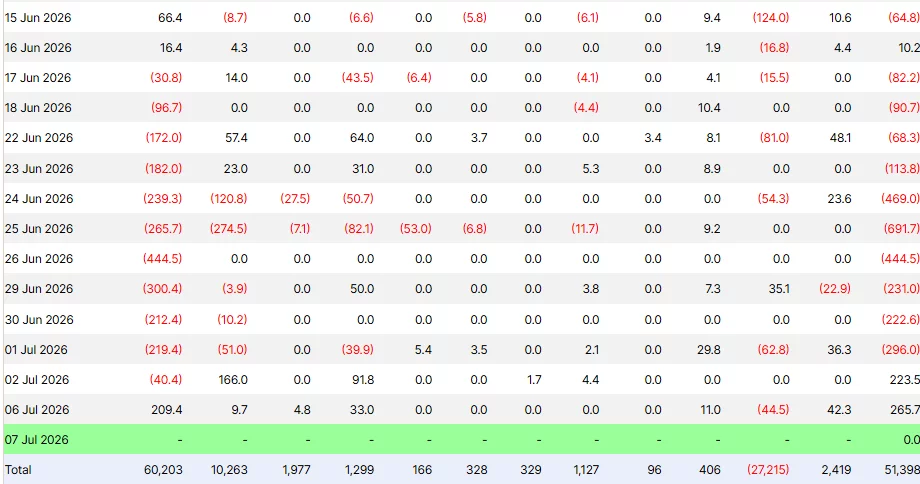
BlackRock’s iShares Bitcoin Trust has recorded its strongest inflow in weeks, helping lift total U.S. spot Bitcoin ETF demand to $265.7 million and adding fresh support to Bitcoin’s latest recovery.
Summary
- BlackRock’s IBIT attracted $209.4 million, lifting total U.S. spot Bitcoin ETF inflows to $265.7 million.
- Two straight days of ETF inflows have improved market sentiment as Bitcoin trading activity picked up sharply.
- BIT says favorable July seasonality and the upcoming CLARITY Act deadline could support Bitcoin’s next move.
According to data from Farside Investors, BlackRock’s iShares Bitcoin Trust (IBIT) attracted $209.4 million in net inflows on July 7, ending a prolonged period of muted activity and intermittent outflows.
The renewed demand helped total net inflows across U.S. spot Bitcoin exchange-traded funds reach $265.7 million, extending the market’s positive streak to a second consecutive trading day.
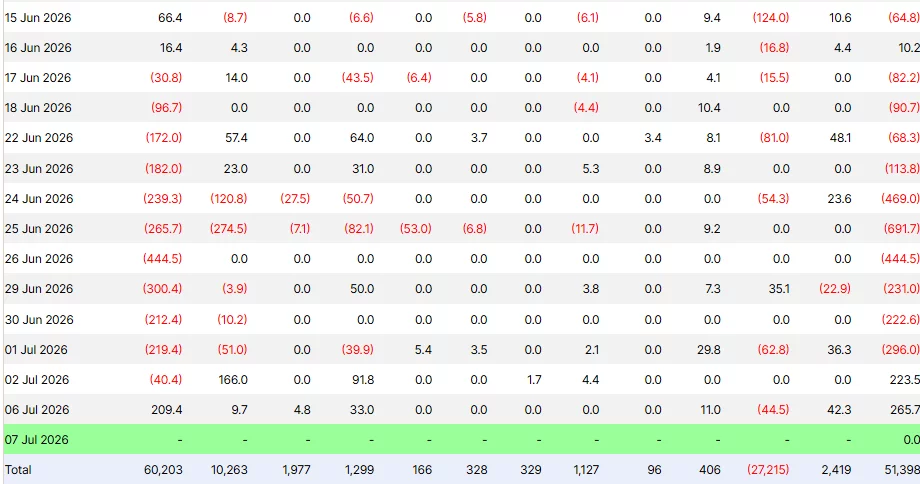
The broader ETF market also posted gains. Fidelity’s FBTC added $9.7 million, Bitwise’s BITB brought in $4.8 million, ARK 21Shares’ ARKB recorded $33 million, and Grayscale’s Bitcoin Mini Trust received $42.3 million. Grayscale’s GBTC, however, continued to lose assets with $44.5 million in net outflows, according to Farside Investors.
The latest figures follow a difficult stretch in late June and early July when spot Bitcoin ETFs experienced mixed or negative daily flows. Even after the first positive session last week, IBIT still posted a $40.4 million daily outflow, making Monday’s rebound the fund’s first notable inflow after several weeks of weak momentum.
Institutional demand has returned to Bitcoin ETFs
Growing ETF demand arrived as Bitcoin traded between $61,275 and $64,597 during the day. Trading volume climbed more than 90% over the previous 24 hours, suggesting stronger participation from market participants as prices recovered.
Historically, inflows into BlackRock’s ETF have coincided with periods of price support during market weakness. The latest buying also came despite software intelligence firm Strategy selling approximately $216 million worth of Bitcoin, indicating that institutional demand through ETFs has continued to offset some selling pressure.
BlackRock has remained the largest player in the U.S. spot Bitcoin ETF market, with cumulative inflows exceeding $60 billion. Beyond Bitcoin products, the asset manager has also expanded its presence in tokenized finance. Last week, Ondo Finance completed the first live on-chain deployment of tokenized U.S. securities backed by BlackRock’s iShares Core S&P 500 ETF (IVV).
According to Ondo Finance, the underlying ETF shares remain with regulated U.S. custodians while Oasis Pro issues Ethereum-based tokens backed one-to-one by those securities under a structure designed to align with the U.S. Securities and Exchange Commission staff guidance issued in January 2025.
Several catalysts continue supporting market sentiment
Market research firm BIT, formerly known as Matrixport, said Bitcoin has entered July with historically favorable seasonal conditions. The firm also pointed to supportive comments from U.S. President Donald Trump about the country’s position in the crypto industry as another factor lifting investor sentiment.
Alongside those developments, BIT said market attention has increasingly turned to the CLARITY Act, which faces an Aug. 7 deadline before the U.S. Senate begins its summer recess. According to the firm, progress on the legislation could remain an important catalyst for digital asset markets in the coming weeks.
BIT also projected that Bitcoin’s first major resistance level sits at $65,955. With spot Bitcoin ETFs now posting back-to-back inflow days after weeks of weak demand, investors will be watching whether sustained institutional buying is enough to push the cryptocurrency above that level.
Grayscale Research has argued that Strategy’s recent $216 million Bitcoin sale has improved the company’s financial position while helping create conditions for a more stable Bitcoin price.
Summary
- Grayscale says Strategy’s $216 million Bitcoin sale has reduced financing risk and strengthened its balance sheet.
- The research firm argues higher cash reserves could support a more durable Bitcoin price bottom over time.
- Bitcoin rebounded above $63,000 as BlackRock’s ETF recorded fresh inflows and trading volume surged.
According to a July 6 report from Grayscale Research, the market reaction to Strategy’s decision to sell part of its Bitcoin holdings has overlooked what the firm sees as a strengthening of the company’s balance sheet rather than a sign of financial stress.
The report comes after Michael Saylor’s company faced criticism when Bitcoin briefly fell to the $61,000 area following the announcement before recovering above $63,000.
Grayscale Head of Research Zach Pandl wrote that Strategy’s financing structure remains well supported despite concerns raised by some market participants.
Strategy, the largest corporate Bitcoin holder, owns 843,775 BTC valued at nearly $53 billion while carrying almost $7 billion in debt. According to Grayscale, the company’s annual preferred equity dividend obligations remain below $2 billion, leaving it with sufficient financial capacity to meet both debt and dividend commitments.
Higher cash reserves strengthen Strategy’s financial position
Grayscale said the $216 million Bitcoin sale increased Strategy’s U.S. dollar reserves to roughly $2.55 billion, enough to cover nearly 17 months of dividend payments under current obligations. According to the research note, maintaining a larger cash buffer lowers financing risk and could improve investor confidence in the company’s capital structure.
Alongside the sale, Strategy introduced a treasury framework stating it may issue shares or sell Bitcoin whenever necessary to maintain adequate U.S. dollar reserves for dividend payments. Grayscale argued that this policy gives the company greater flexibility during periods of market volatility without forcing emergency financing measures.
Pandl also said in the report that reducing financing pressure may benefit Bitcoin itself. Rather than viewing the sale as bearish, Grayscale argued the transaction could help Bitcoin establish a more durable price bottom by easing concerns surrounding Strategy’s balance sheet and funding needs.
Investors have continued backing the company
Trading activity has suggested investors remain comfortable with Strategy’s latest decision. STRC shares finished Monday 0.81% higher at $88.58 before adding another 0.51% to around $89 in premarket trading on Tuesday.
At the same time, Binance launched trading for STRC tokenized stock, allowing users to gain exposure to the company’s shares without using traditional brokerage accounts.
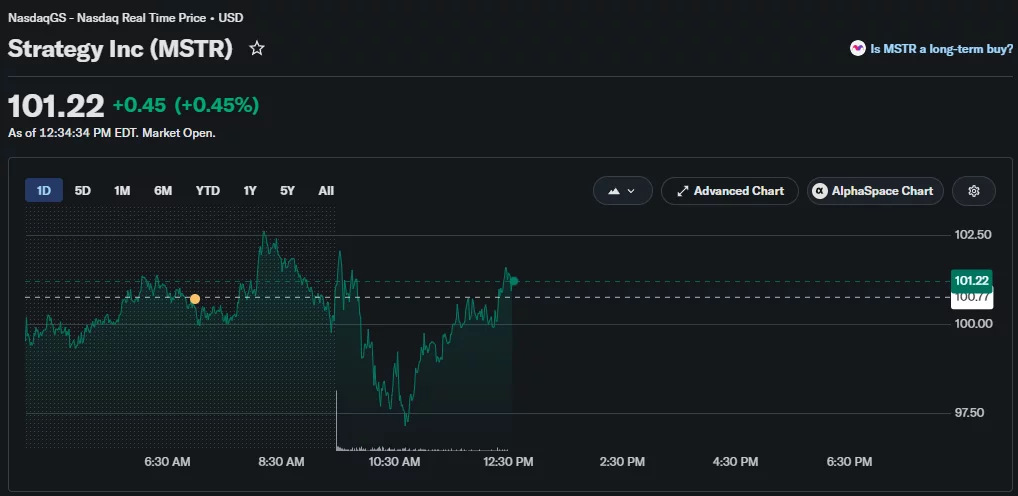
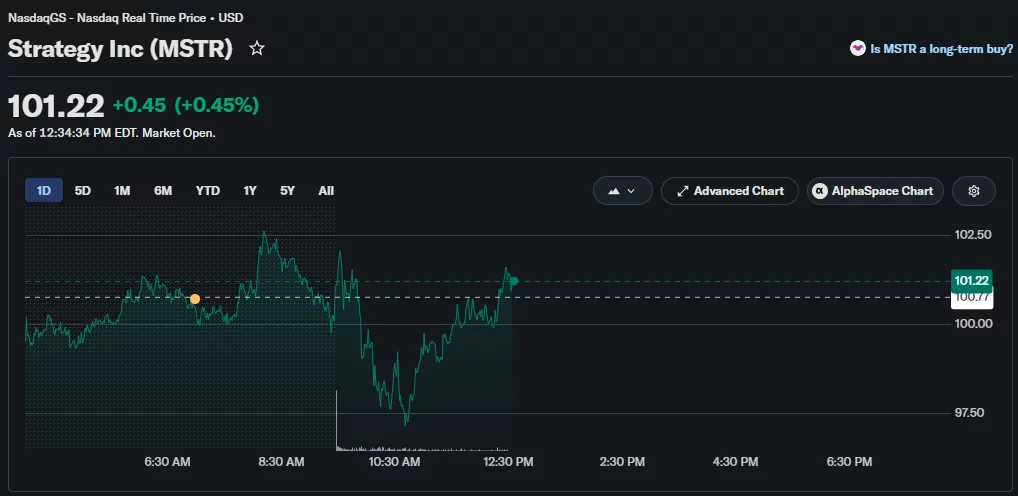
Meanwhile, MSTR also rose 0.45% to $101.22 during Tuesday’s trading session after recovering from an early intraday dip. The stock remains nearly 18% higher over the past week. Separately, Cantor Fitzgerald reiterated its buy rating on MSTR and maintained a 12-month price target of $212, indicating the firm remains optimistic despite recent market volatility.
Bitcoin has also recovered from the initial selloff that followed the announcement. The cryptocurrency traded near $64,000 after touching a 24-hour low of $61,275 and reaching a high of $64,597. The rebound coincided with a 77% increase in trading volume over the past day.
Recent market sentiment has also improved following the return of net inflows into BlackRock’s spot Bitcoin ETF after several weeks of outflows. Combined with seasonal market strength, those inflows have helped support Bitcoin’s recovery even as investors continue assessing the impact of Strategy’s updated treasury policy.
Elon Musk’s SpaceX has secured fresh buy ratings from several major Wall Street banks, with Morgan Stanley assigning a base-case price target of $300 as the stock prepares to join the Nasdaq-100 Index.
Summary
- Morgan Stanley leads fresh Wall Street buy calls with a $300 base-case and $600 bull-case target for SpaceX.
- JPMorgan estimates Nasdaq-100 inclusion could trigger about $4.3 billion in passive fund buying.
- SpaceX shares eased before the index debut despite bullish analyst ratings and strong institutional interest.
According to research notes released by Morgan Stanley, Goldman Sachs, Citigroup, and other investment banks, analysts expect further gains for SpaceX despite the stock pulling back after its recent rally.
The latest recommendations come just before the company enters the Nasdaq-100, an event that JPMorgan estimates could trigger about $4.3 billion in automatic purchases by passive investment funds.
Morgan Stanley sees Starship and Starlink driving long-term value
Morgan Stanley initiated coverage of SpaceX with an Overweight rating. Analyst Adam Jonas set a $300 base-case price target and a $600 bull-case target, implying substantial upside from the stock’s latest trading price.
According to Jonas, SpaceX’s investment case is supported by the economics of the Starship launch program, the expansion of Starlink’s satellite network, and the company’s role in building infrastructure for space-based artificial intelligence.
Goldman Sachs also started coverage with a Buy rating and a $205 price target. Analyst Eric Sheridan wrote that SpaceX is well positioned across the space, connectivity, and artificial intelligence industries, adding that each of those markets has the potential to become “multiple trillion-dollar opportunities over a 5+ year time horizon.”
Bullish coverage extended beyond those firms. Citigroup assigned a Buy rating with a 12-month price target of $200, while UBS and Wells Fargo also initiated coverage with positive recommendations, adding to growing institutional support for the newly listed company.
Nasdaq-100 entry could drive billions in passive fund buying
Attention has also turned to SpaceX’s scheduled inclusion in the Nasdaq-100 Index on July 7.
According to a Nasdaq announcement, the company qualified under updated index rules that allow certain large newly listed companies to enter the benchmark after just 15 trading days following their public debut.
JPMorgan estimates that exchange-traded funds and index funds tracking the Nasdaq-100 will need to purchase about $4.3 billion worth of SpaceX shares once the rebalancing takes effect.
The bank said the buying is expected to occur around the July 6 market close and July 7 opening, as passive funds such as the Invesco QQQ Trust are required to match the revised index regardless of their view on the company’s valuation. SpaceX is expected to enter the benchmark with an index weighting below 1%.
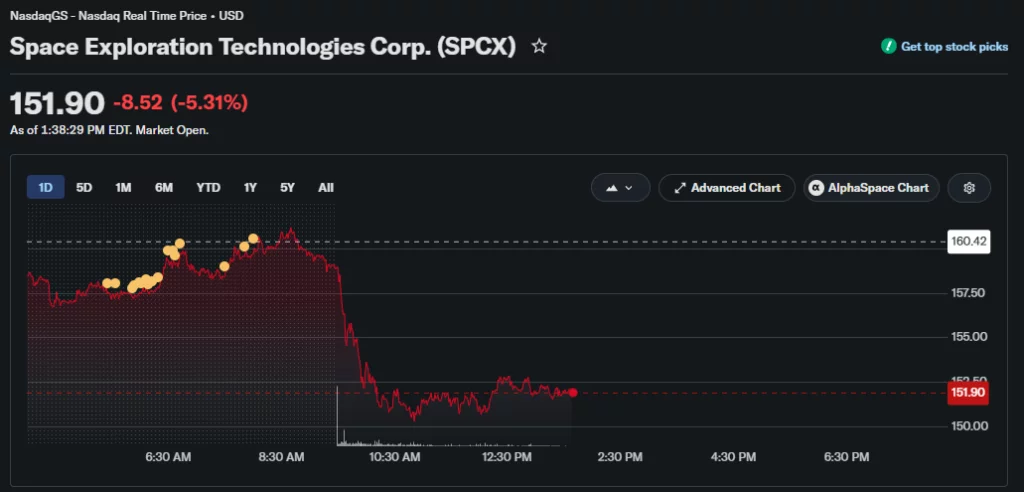
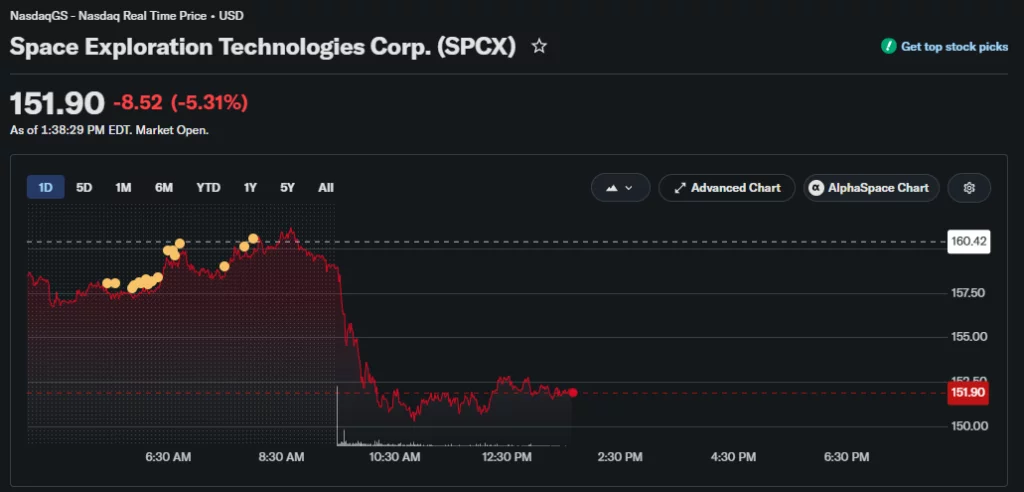
Despite the wave of bullish analyst ratings, SpaceX shares came under selling pressure. The stock closed Monday down 0.98% at $160.42, trimming its weekly gain to just over 2% after profit-taking. By early Tuesday afternoon, however, the stock had fallen 5.31% to $151.90 after the market opened, extending losses even as investors digested its Nasdaq-100 inclusion.
Derivatives trading also pointed to cautious sentiment. SPCX USDC perpetual contracts on Hyperliquid traded about 3.15% lower at $159.17, with trading volume reaching roughly $284 million at press time.
Meanwhile, the crypto market remained firm alongside developments surrounding SpaceX.
Bitcoin held above its 200-week moving average at $62,865 and traded near $63,300 after reaching a 24-hour high of $64,597. Trading volume stayed more than 70% higher as Grayscale argued that Strategy’s recent Bitcoin sales could help establish a market bottom.
Key takeaways:
- BitMine’s aggressive ETH accumulation has reinforced the $1,500 support despite $8B unrealized losses.
- Glamsterdam upgrade and Robinhood Chain launch signal stronger TradFi focus for Ethereum’s base layer.
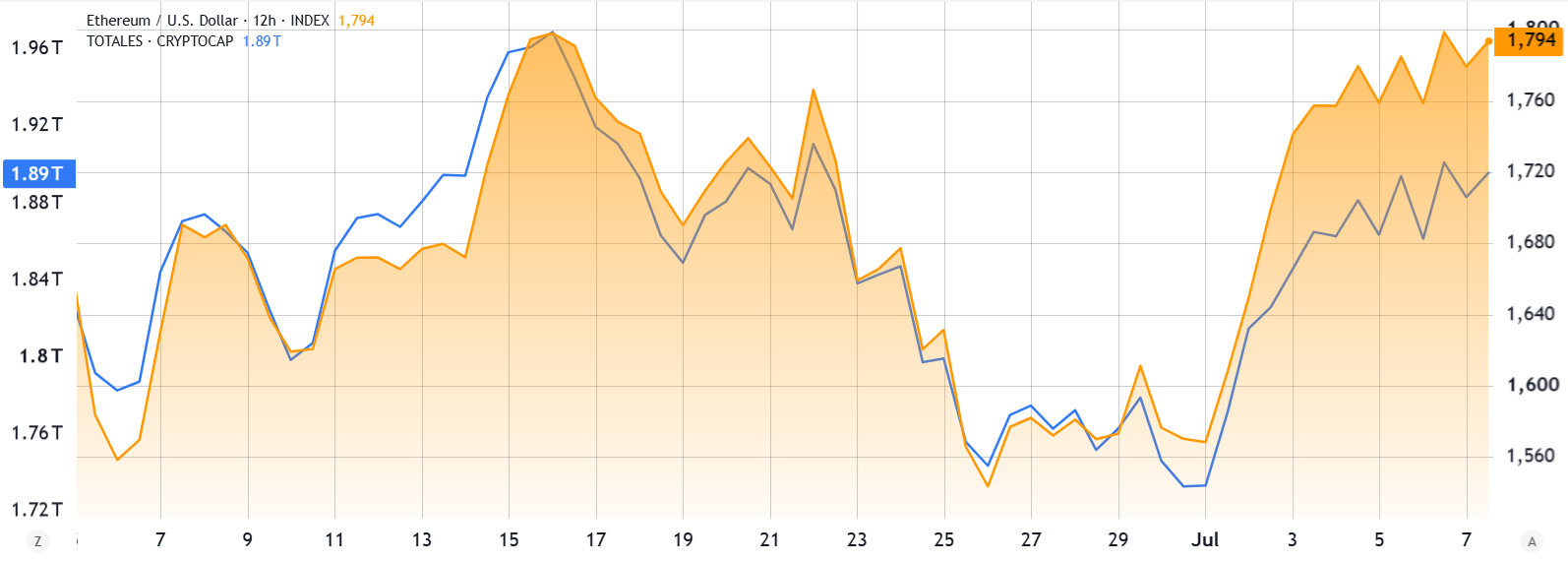
Ether (ETH) price rallied 15% in five days, distancing itself from the $1,500 low hit on June 26. Part of the improvement in investor sentiment can be pinned to the final tests on Ethereum’s Glamsterdam upgrade, targeted for later in 2026. Moreover, BitMine Immersion Technologies’ continued Ether accumulation helped strengthen the support level. Will $2,000 come next?
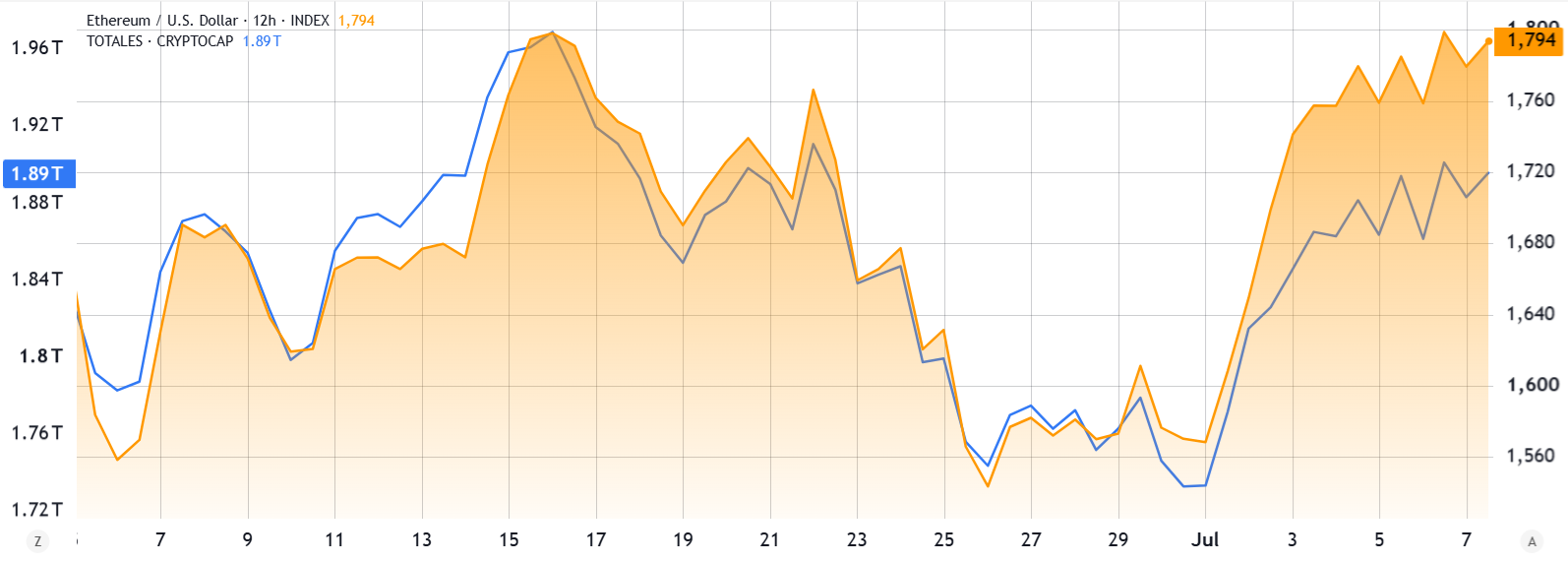
Total crypto capitalization/USD (left) vs. ETH/USD (right). Source: TradingView
Ether outperformed the total crypto market capitalization by 7% over the past 30 days. Some excitement came from optimism about the passage of the Digital Assets CLARITY Act, a bill that has faced several hurdles advancing in Congress after pushback from the banking sector on stablecoin regulation and potential rewards to its holders.
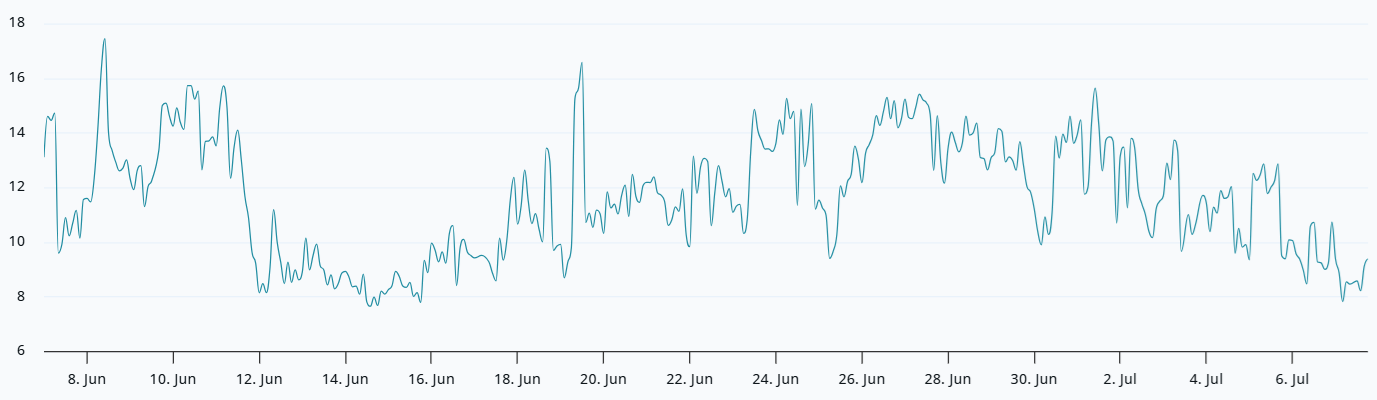
ETH options 25% delta skew (put-call) at Deribit. Source: Laevitas
Ether’s recent rally toward $1,800 was enough to instill some confidence in ETH options markets as the skew (put-call) metric exited the fear levels that prevailed until Friday. The current 9% premium in put (sell) options relative to equivalent call (buy) instruments is far from bullish, but it distances itself from the 15% mark from the prior week. Levels above 12% typically indicate extreme fear.
Ethereum network upgrade, Robinhood Chain behind ETH price rally
One of Ethereum’s main criticisms lies in its scalability using layer-2 rollups facilitated by data packages (blobs) that drastically reduced transaction fees but triggered fierce debates over long-term data censorship and centralization. Base layer network fees took a hit, which in turn reduced ETH burning and ultimately led to inflationary supply dynamics.
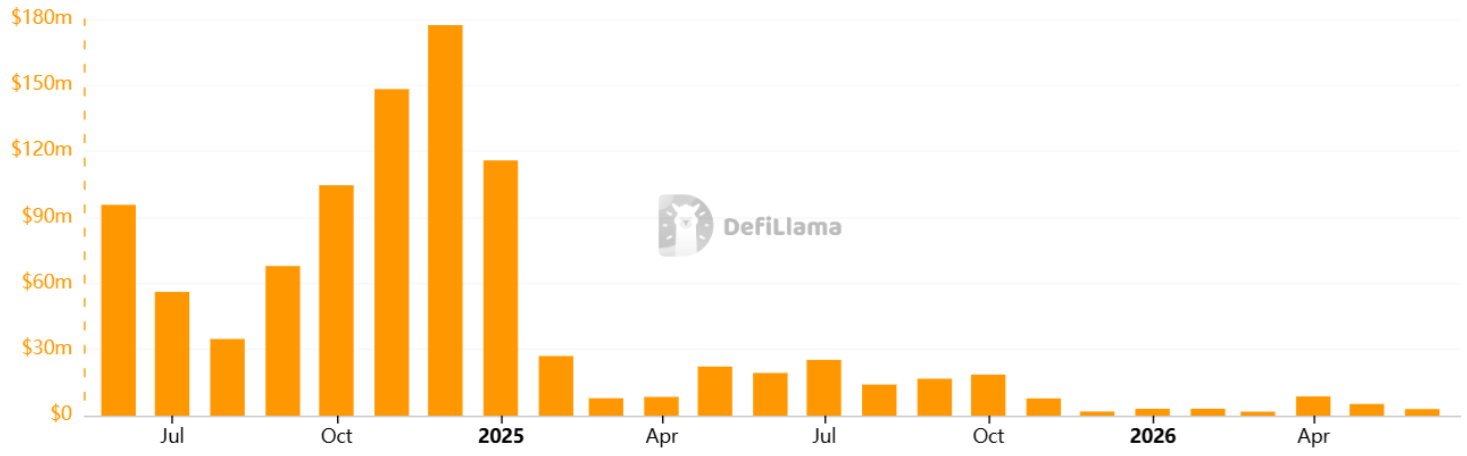
Ethereum base layer monthly network revenue, USD. Source: DefiLlama
The Ethereum Glamsterdam upgrade, currently in the testing phase, should improve network processing speeds by allowing more transactions to be processed in parallel. The proposal will also expand capacity for Ethereum to handle more data at higher throughput and reduce database bloat. One goal is providing institutional-grade infrastructure for financial use cases.
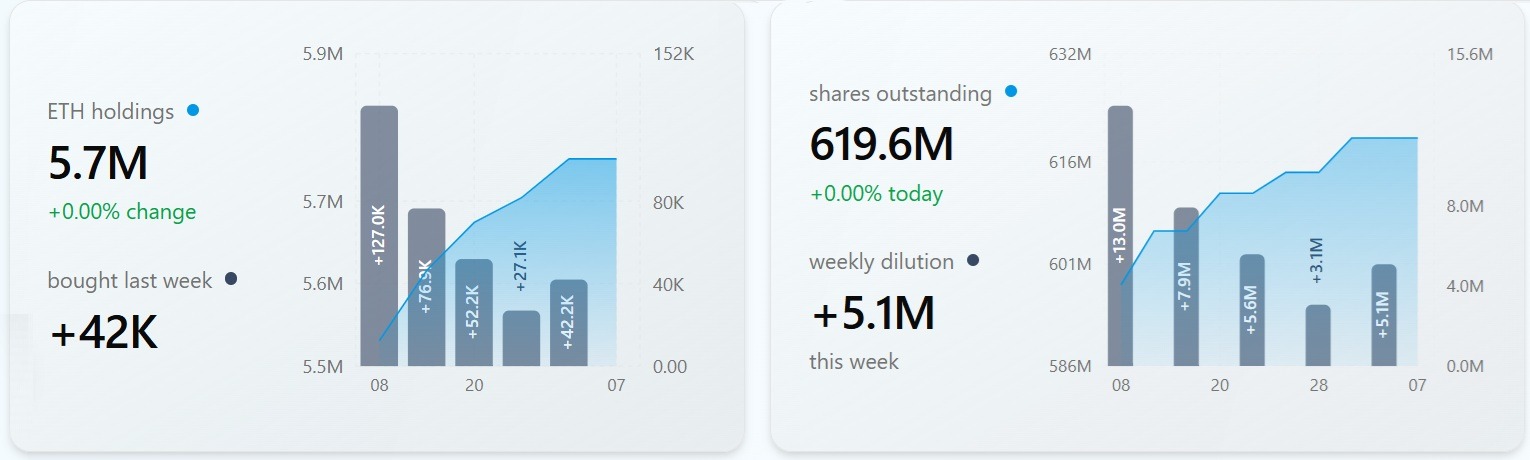
BitMine (BMNR US) ETH holdings and shares outstanding. Source: bmnr.rocks
The continued accumulation by the US-listed company BitMine Immersion has likely helped strengthen the $1,500 support. The company increased its holdings by 325,000 ETH over the past month, boosting its reserves to 5.74 million ETH. Regardless of the current $8 billion in unrealized losses on its ETH holdings, BitMine continues its path toward acquiring 5% of the existing supply.
Related: Vitalik Buterin shares priorities for new ‘Lean Ethereum’ strawmap
The launch of Robinhood Chain on July 2, an EVM-compatible Ethereum layer-2 built using Arbitrum technology, helped consolidate the ecosystem with the traditional finance industry. More importantly, Robinhood rolled out tokenized stock trading in more than 120 countries along with major decentralized finance (DeFi) integrations, including Uniswap, 1inch and Morpho.
While Ethereum onchain and derivatives metrics paint a somewhat bearish picture with low network fees and low conviction in options markets, Ether’s upside comes from real-world traditional finance use case growth and network upgrades capable of significantly expanding base layer capacity. Overall, the path to ETH at $2,000 appears entirely viable in the near term.

$PULT Early Public Round drew $2.3 million on its first day, at a token price of $0.06, representing roughly 80% of the round’s target. It follows an invite-only whitelist round that sold out within a minute of opening.
Catapult Trade is a trading platform that combines the model of a token launchpad with iGaming mechanics. Its core product, Turbo, drops the order book entirely: prices are generated by a mathematical model designed to simulate real market conditions while remaining statistically neutral. Each chart’s full price path is committed to a public cryptographic hash before trading and disclosed afterward, so anyone can confirm it was not altered. Because the path is fixed in advance, neither the team nor anyone else can move a chart once it is live: fully provably fair, with the engine audited by Halborn and Hashlock.
The project has attracted a broad group of backers over the past year. KuCoin Ventures led the investment, alongside Oddiyana Ventures and IBC Group, with angels from trading and infrastructure backgrounds. Claire “Cookie” Dang, previously in growth roles at Binance, KuCoin, and Crypto.com, joined as co-founder and VP of growth. In June, the project integrated with Binance Wallet, putting the app in front of that wallet’s users. It also ran joint reward campaigns with exchanges including Gate.
According to the company, part of protocol revenue is used to buy $PULT on the open market and permanently remove it from circulation, tying supply reduction to platform activity rather than scheduled emissions.
The token generation event is planned for the third quarter of 2026. The team says it has agreements to list $PULT on eight centralized exchanges on day one, backed by established market makers, and that the token will launch as a multichain asset, including Ethereum and Solana. Before that, a smaller public sale will run on outside launchpad platforms at a higher price, for buyers who missed the early round.
A second product, Catapult Hyper, which extends the platform into real markets, is also due for a wider release in the quarter. Its fees are expected to begin contributing to the buy-and-burn model shortly after launch.
Alongside the public sale, the project continues running a points program. According to the team, participants will receive token allocations at TGE and through a later reverse airdrop. Allocation and vesting details have not yet been disclosed.



Ten days after its token generation event, Cap's CAP token has become the second-most-traded lending and borrowing protocol token tracked by CoinGecko, behind only Aave. CAP generated more than $355 million in trading volume in its first seven days on the market, Cap said in a statement, a level… Read the full story at The Defiant

GameStop Shares Dip Modestly as Retailer Navigates Post-Meme Era Challenges

Ether Approaches $2K on Bitmine ETH Purchase and Robinhood L2 News

Taylor Swift And Travis Kelce Keeping Wedding Footage ‘Private’

No Jackpot Winner as $257 Million Prize Rolls Over to $269 Million Monday Draw

Renter of Home in Anne Heche Crash Denies Settlement With Son

Weekend Open Thread: Staud – Corporette.com

XRP MEGA NEWS: EUROPE JUST GAVE US THE GREEN LIGHT! XRP HOLDERS YOU BETTER SEE THIS!

Why Minimum Payments Cost You $2,000 Extra #creditcard #debtpayoff #moneytips #interest #finance

Bhagya & Vishmi | Five Million Money Drop S4 | Episode 46 | Sirasa TV
-

 Fashion4 days ago
Weekend Open Thread: High Hopes
-
 NewsBeat3 days ago
Taylor Swift and Travis Kelce wedding staffer hilariously struggles to keep her cool while checking in megastars
-

 Fashion1 day ago
Open Thread: What Great Books Have You Read Recently?
-

 Politics5 days ago
The House | “Reframing the debate from a binary discussion of winners and losers”: Yuan Yang reviews ‘We Are Not Machines’
-
Crypto World7 days ago
Airdrop Registration Becomes Key Focus For Remittix As RTX Launch Updates Approach
-

 Crypto World4 days ago
Standard Chartered Secures MiCA License as ESMA Adds 37 New Crypto Firms
-

 Business1 day ago
AXT Shares Jump Nearly 14% as Semiconductor Materials Maker Rebounds on AI-Linked Indium Phosphide Demand
-

 Sports7 days ago
Broncos roster: OL Ben Powers (No. 74) entering final year of contract
-

 Crypto World6 days ago
Binance stock trading tops $1B in first month after launch
-

 Crypto World6 days ago
Alibaba-affiliate Ant Group enters the humanoid robot market with 12 deals
-
Crypto World1 day ago
SK hynix (000660.KS) Stock Dips as $28B Nasdaq ADR Offering Drives AI Memory Expansion
-

 Crypto World2 days ago
South Africa proposes crypto tax guidance under existing rules
-

 News Videos1 day ago
Best Time to Enter Small Caps Right Now? Another Bull Run? | Financially Free
-

 Tech3 days ago
Lenovo laptops are now shipping with YMTC SSDs, a sign of Chinese NAND entering the mainstream
-

 News Videos21 hours ago
Whats Hidden Inside This Cash Register? #treasure #reselling #money
-

 Business6 days ago
Meta Platforms Stock Jumps 7% Today as Bloomberg Reports Company Plans to Enter the Cloud Business
-
 NewsBeat6 days ago
New exhibition reflects five decades of movement between island of Ireland and GB
-

 Business5 days ago
What a 10 Percent Drop Means for Buyers, Sellers and Renters
-

 Crypto World5 days ago
Binance Re-Enters Philippines As EU MiCA Rules Restrict Access
-

 News Videos2 days ago
Avoid entering in FOMO #bitcoin #cryptocurrency #trading #scalping
You must be logged in to post a comment Login