
Crypto World
Elon Musk Said Bitcoin Has No Throat to Choke: Why Does That Matter?

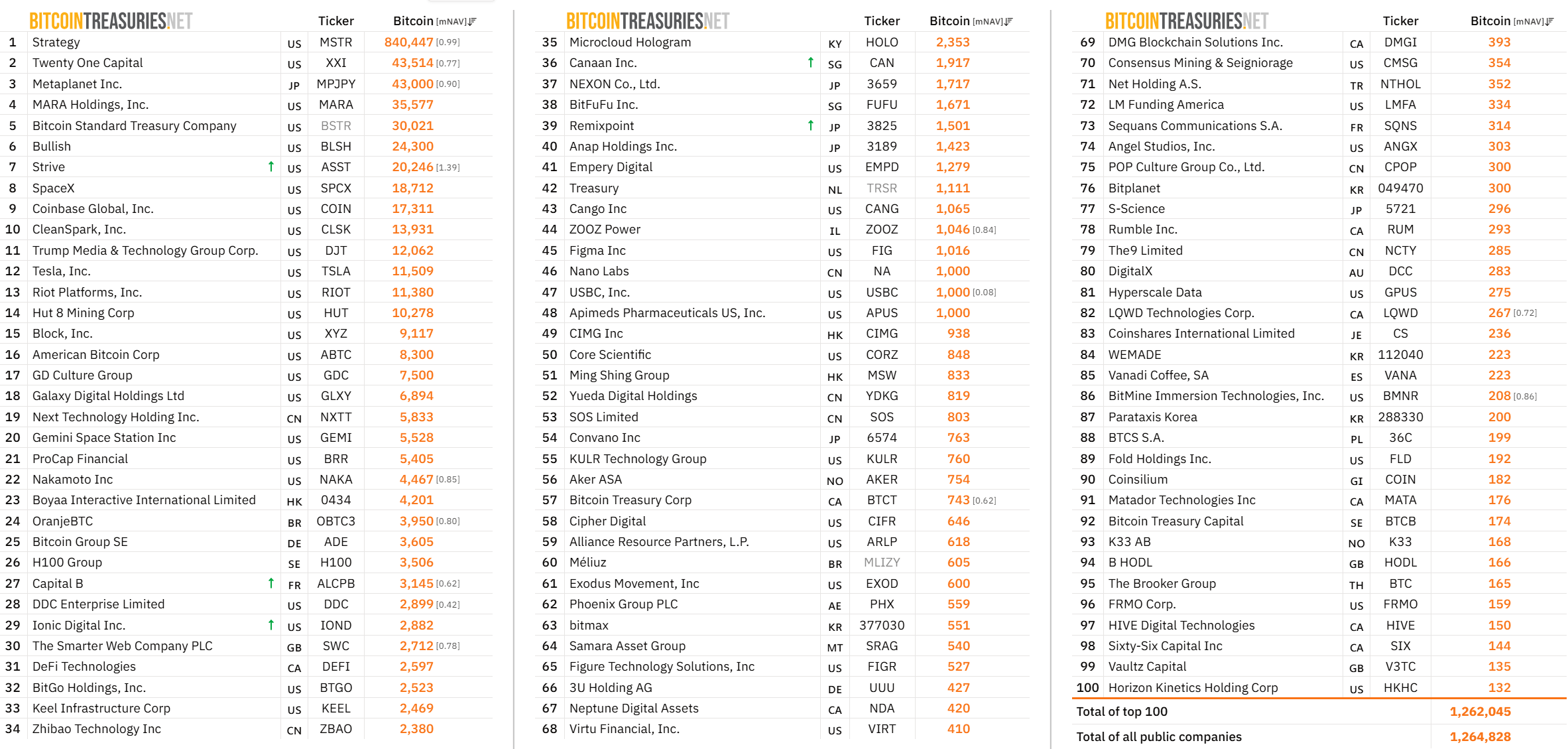
A 2021 clip of Elon Musk making his case for Bitcoin (BTC) is circulating again. His main argument was not scarcity. It was that Bitcoin has no throat to choke.
He meant there is nobody to threaten. No single party can be forced to empty the system. Five years on, filings show what his own companies did with that idea.
Why Elon Musk Framed Bitcoin as an Information System
Musk spoke in July 2021 at The B Word, a one-day conference he joined alongside Jack Dorsey and Cathie Wood.
He opened by redefining money itself. He called it an information system for allocating labor.
Then he went after the plumbing. Bank settlement still takes one to five business days. He called the ACH network ancient and insecure. Paying by card, he said, is like handing a stranger your password.
Bitcoin’s edge, in his telling, was not speed. It was that nobody can be leaned on.
“Bitcoin per se is mostly solving for … having no throat to choke, decentralized, so there’s no one who can be coerced in any way to empty their bitcoin account,” Elon Musk, at The B Word conference, July 2021.
Follow us on X to get the latest news as it happens
In plain terms, there is no head office to raid. There is no chief executive to lean on.
Subscribe to our YouTube channel to watch leaders and journalists provide expert insights
What Tesla and SpaceX Actually Did
Musk named the flaws in the same breath.
“Transaction volume is low, transaction cost is high and usability for the average person is not yet very good, but it has a lot of potential.”
He had already wavered once. Two months before the panel, he stopped Tesla accepting bitcoin for cars, blaming mining emissions.
The harder test came 11 months later. Tesla had bought $1.50 billion of bitcoin in early 2021. By mid-2022 it had converted roughly 75% of that into cash, a filing shows. The sales raised $936 million.
SpaceX did the opposite. Its Bitcoin has not moved in any period it has ever disclosed.
Every SpaceX filing since 2024 lists the same 18,712 BTC at the same $661 million cost. Only the value changes. It was $1.75 billion at the end of 2024 and $1.10 billion in June.
That grip held through pressure. In July, an $88 test transfer triggered sale rumors. Weeks later its debut earnings report booked a $539 million paper loss for the half and kept every coin.
Tesla’s leftover 11,509 BTC cost $386 million and has sat still since 2022. Its second quarter results logged a further $334 million decline over the half. Together the two hold 30,221 BTC for about $1.05 billion.

At a current price near $78,570, that is worth roughly $2.37 billion.
So the answer is plain. Nobody can force either company to sell. Tesla did anyway, once, by choice. That is the part no ledger protects against.
The post Elon Musk Said Bitcoin Has No Throat to Choke: Why Does That Matter? appeared first on BeInCrypto.



Bitcoin has climbed about 24% over the past week to around $76,844, prompting Standard Chartered to say its $100,000 year-end forecast may now be too low as the cryptocurrency moves closer to its $126,000 all-time high.
Summary
- Bitcoin has risen about 24% over the past week to around $76,844.
- Standard Chartered says its $100,000 year-end Bitcoin forecast may now be too low.
- Geoff Kendrick sees a potential move toward the $126,000 record after Oct. 6.
- Short liquidations and recovering spot Bitcoin ETF inflows have supported the rally.
According to Geoff Kendrick, Standard Chartered’s global head of digital asset research, the latest Bitcoin rally has been driven mainly by short liquidations, while recovering inflows into U.S. spot Bitcoin exchange-traded funds could provide another source of demand if the advance continues.
Kendrick said in a Friday note shared with crypto media that low open interest across the market also leaves room for investors to rebuild positions as Bitcoin rises. A combination of forced buying from short sellers and returning ETF demand has helped BTC recover rapidly after spending much of the past two months around the $60,000 to $65,000 range.
“For the first time this year there is now a risk my end year forecast (of USD100k) is too low,” Kendrick wrote.
Bitcoin was trading at $76,844 at the time of the report, up roughly 24% over seven days, according to CoinGecko data. At that level, BTC remained about 39% below Standard Chartered’s $100,000 forecast and roughly 64% below the $126,000 record high.
Bitcoin could challenge $126,000 after Oct. 6
Kendrick said Bitcoin could move toward its previous record before the end of the year, with the recovery potentially accelerating after Oct. 6.
The date corresponds closely with Bitcoin’s 2025 market peak, after which the cryptocurrency entered an extended decline that continued into 2026. Kendrick’s latest view places particular focus on whether BTC can maintain its recovery once the market moves beyond the anniversary of that high.
Standard Chartered has not formally replaced its $100,000 year-end forecast with a $126,000 target. Kendrick instead described the all-time high as a level Bitcoin may revisit if the current recovery gathers momentum, while acknowledging that the bank’s existing forecast could prove conservative.
The position is stronger than the bank’s assessment during the June selloff. On June 4, crypto.news reported that Standard Chartered had retained its $100,000 Bitcoin target even after BTC fell more than 15% in a week and briefly moved toward $61,000.
At the time, Kendrick said some of the forces behind the decline were beginning to ease. He also expected Strategy to resume Bitcoin purchases and noted that liquidations during the selloff had remained below levels recorded during some previous market crashes.
Only nine days later, the bank kept the same forecast after Bitcoin fell toward $59,000 and recovered to roughly $63,500. Kendrick described the move toward $59,000 as the “likely low” of the cycle and tied the decline to forced selling, weak ETF flows and liquidity stress.
Bitcoin has since risen more than $17,000 above that June low.
Spot Bitcoin ETF flows have started to recover
ETF demand has become one of the components Kendrick is watching as Bitcoin moves higher.
The analyst said inflows into spot Bitcoin ETFs have started recovering after weak institutional demand contributed to pressure earlier in the year. Stronger ETF flows would provide buying demand that does not depend solely on traders being forced out of short positions.
ETF activity had already started improving during Bitcoin’s July recovery. On July 3, spot Bitcoin ETF inflows ended a 10-day negative streak after U.S.-listed funds recorded $221.7 million in net inflows on July 2, according to SoSoValue data cited by crypto.news at the time.
Bitcoin was trading near $61,700 during that recovery and had only recently moved back above the sub-$60,000 area.
By July 21, BTC had returned above $65,000 as spot ETF inflows extended to five consecutive sessions. Bitcoin was trading around $65,245 at the time, up about 5% over seven days, while $70,000 remained an important resistance level.
The latest rally has since carried Bitcoin well beyond both $65,000 and $70,000.
Open interest remains another part of Kendrick’s assessment. Lower open interest means fewer leveraged positions are currently active compared with periods when speculative exposure is heavily concentrated, leaving capacity for traders to rebuild positions if confidence returns.
Kendrick said the current combination of low positioning and higher prices could therefore pull investors back into the market rather than immediately creating the type of crowded leverage that can make a rally more vulnerable to liquidation cascades.
Standard Chartered cut its Bitcoin target in February
The bank’s current $100,000 forecast followed a major downgrade earlier this year.
In a Feb. 12 report, Kendrick cut Standard Chartered’s year-end Bitcoin target from $150,000 to $100,000 and lowered its Ether forecast from $7,500 to $4,000.
At the time, he expected Bitcoin could decline toward $50,000 before recovering during the remainder of the year, while Ether could fall as low as $1,400.
A February report on the downgrade said Standard Chartered cited ETF outflows, weaker macroeconomic conditions, reduced expectations for Federal Reserve rate cuts and changes in investor positioning among the factors behind its lower forecasts.
Bitcoin did not ultimately reach Kendrick’s $50,000 downside estimate. Its sharpest decline instead took the cryptocurrency toward the upper-$50,000 range before buyers returned.
Even as volatility continued during July, Standard Chartered declined to reduce the forecast again. On July 10, the bank reaffirmed its $100,000 call while Bitcoin traded above $64,000.
Kendrick said investor concerns surrounding Strategy’s changing Bitcoin treasury approach had been responsible for part of the market pressure, while Standard Chartered did not view those developments as enough to alter its longer-term price expectation.
Bitcoin has cleared July’s main resistance zones
Bitcoin had repeatedly struggled around $65,000 during the early stages of the recovery.
On July 16, BTC failed to hold above $65,000 after briefly reaching about $65,470 following softer U.S. inflation data. Whale selling and profit-taking from longer-term holders capped the move, while liquidations accelerated after the cryptocurrency slipped below the $64,400 area.
Bitcoin subsequently returned toward the same resistance zone several times before eventually breaking above it.
A July 21 rally carried BTC as high as $66,965 before sellers stepped in near $67,000. ETF inflows, progress around U.S. crypto legislation and short liquidations contributed to the advance, while higher oil prices linked to the U.S.-Iran conflict limited the move.
Those July price levels now sit more than $10,000 below Bitcoin’s latest market price.
Other industry observers have also started looking for evidence that the 2026 bear market has run its course. Swan Bitcoin CEO Cory Klippsten said Bitcoin could form a bottom in October, according to the report, while 10x Research founder Markus Thielen said an August close above $63,000 could confirm a bear-market bottom.
Bitcoin has already moved well above that threshold before the end of August, though Thielen’s condition specifically depends on where the cryptocurrency finishes the month.
During the July downturn, BTC repeatedly traded around the same $62,000 to $65,000 region. On July 17, Bitcoin fell below $63,000 as renewed U.S.-Iran military action weighed on risk assets, while U.S. spot Bitcoin ETFs still recorded $79.15 million in net inflows during the previous session.
Kendrick’s latest assessment now places the bank’s focus above those former resistance levels, with Standard Chartered retaining its official $100,000 year-end forecast while its digital asset research head sees a possibility that Bitcoin could return to $126,000 before 2026 ends.


Disclosure: This content is provided by a third party. Neither crypto.news nor the author of this article endorses any product mentioned on this page. Users should conduct their own research before taking any action related to the company.
Besu discloses five CertiK-found flaws after patching them in version 26.7.1, released July 27.
Summary
- Besu fixed five CertiK-reported vulnerabilities in version 26.7.1 before publishing full technical advisories publicly afterward.
- CertiK found resource-exhaustion risks across networking, RPC, WebSocket, and consensus interfaces during independent security research.
- Coordinated disclosure gave Besu operators time to upgrade before detailed vulnerability information became publicly available.
Besu published detailed advisories on August 14 covering five Besu security vulnerabilities found by CertiK and fixed in version 26.7.1, released on July 27.
The issues affected the Java-based Ethereum client across peer-to-peer, RPC, WebSocket, and consensus-facing interfaces. Under affected configurations, they could exhaust memory or thread capacity and disrupt node availability or consensus processing. CertiK found the flaws through self-directed testing on a private, multi-node Besu network and reported them privately to the project team.
Besu 26.7.1 released before technical details
Besu first released version 26.7.1 on July 27 as a security update and urged users to upgrade. The release addressed all five CertiK findings along with separate security issues. Besu’s GitHub release page identifies 26.7.1 as a security-focused update and credits CertiK and EF Security for responsible disclosure. The release notes also introduced limits affecting JSON-RPC filters and WebSocket subscriptions.
Technical details became public on August 14, when Besu published four advisories covering the five CertiK findings. Each advisory identified version 26.7.1 as the patched release. The timing meant operators had access to the fix before detailed information about the weaknesses became public. This coordinated sequence gave users time to upgrade while reducing unnecessary exposure to details before remediation was available.
Coordinated disclosure and independent testing
CertiK reported all five findings directly to the Besu team. Researchers also supplied reproducible proof-of-concept test harnesses that Besu could use to examine the behavior. The two teams coordinated confidentially while Besu evaluated and remediated the issues. They made technical information public only after the patched release was available, following a responsible disclosure process described in the source material.
CertiK identified the Besu security vulnerabilities during self-directed research using its Chain Scan adversarial-testing methodology. The work used a private, multi-node Besu test network. Researchers introduced controlled faults across peer-to-peer, HTTP RPC, WebSocket RPC, and consensus-facing interfaces. They used those tests to examine availability and resource-exhaustion risks under controlled conditions rather than through a client engagement.
Besu security vulnerabilities raised resource risks
The research had no commercial scope. CertiK rated the five findings from Minor to Major in severity. The affected areas included block-announcement processing, buffering of future-height consensus proposals, WebSocket subscription limits, and JSON-RPC filter creation without effective caps. These areas touch how a node handles network messages, subscriptions, remote requests, and consensus-related data.
In affected configurations, the weaknesses could consume node memory or available threads. That resource pressure could interfere with node availability or consensus processing. Two remediations visible in the 26.7.1 release added limits for active JSON-RPC filters and WebSocket subscriptions, closing paths for unbounded resource growth. Besu urged operators to move to the patched version when it released the update.
Advisories add public record of remediation
Besu’s publication of the advisories created a public record of the five findings and their remediation. The project’s release notes also acknowledged CertiK and EF Security for their respective responsible disclosures. Besu is an open-source Ethereum client written in Java and licensed under Apache 2.0, according to Linux Foundation Decentralized Trust. The project supports public and private network use cases.
Besu serves as an execution client on Ethereum Mainnet and testnets, while also supporting enterprise private networks. It provides a command-line interface, JSON-RPC API, and Plugin API for node operations and extensions. CertiK, founded in 2017 by professors from Yale University and Columbia University, says it has detected more than 119,000 vulnerabilities and protected over $600 billion in digital assets across 150+ countries and regions.
Disclosure: This content is provided by a third party. Neither crypto.news nor the author of this article endorses any product mentioned on this page. Users should conduct their own research before taking any action related to the company.
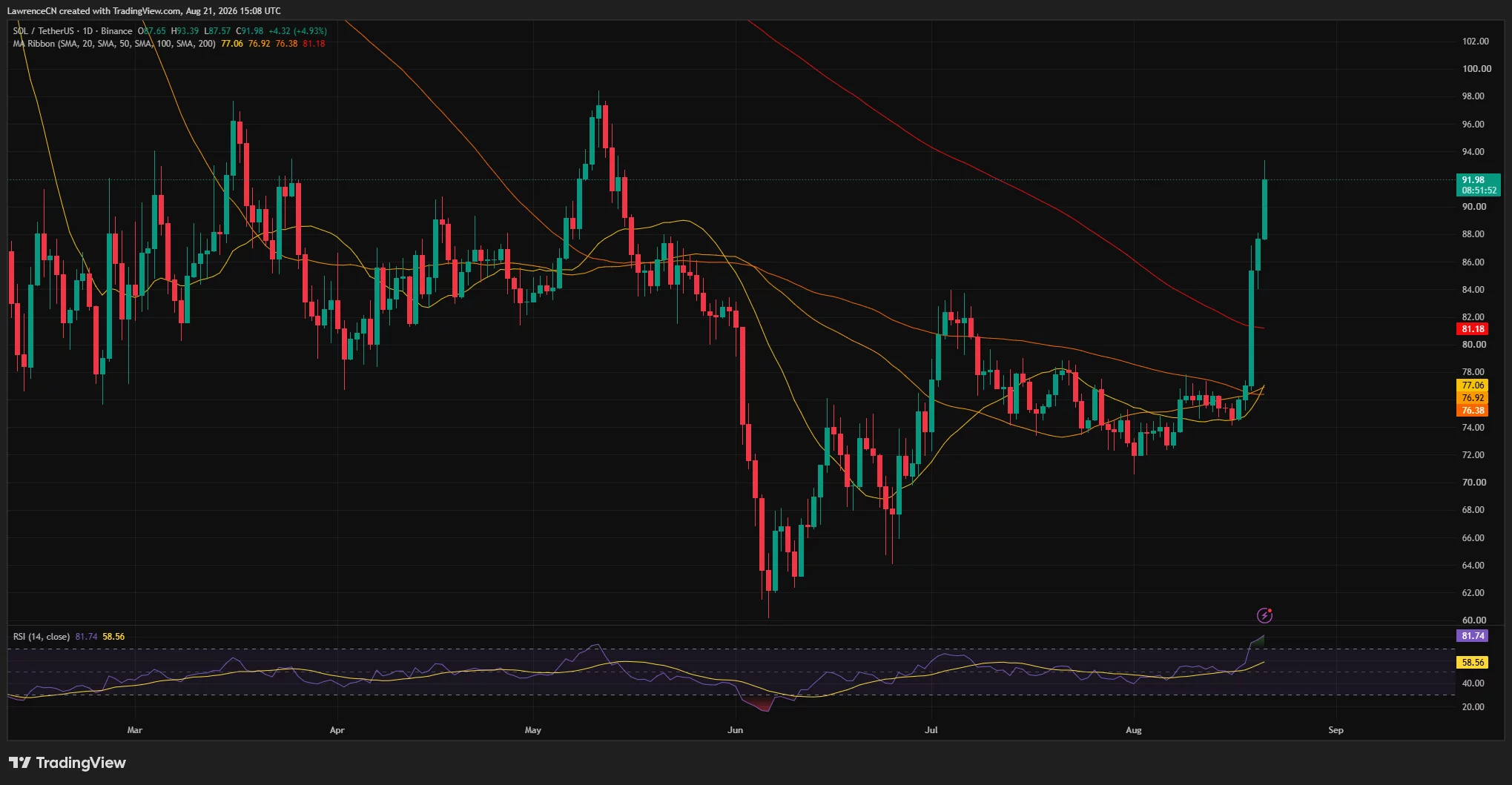
Solana price surged 25% over the past week and briefly reached $93.39 on Aug. 21 as a market-wide short squeeze pushed SOL above its major moving averages. The breakout has opened a path toward $98 and $100, although an overbought daily reading raises the risk of a short-term pullback.
Summary
- Solana price climbed 25% in one week and traded near $92 after reaching $93.39.
- SOL broke above its 20-day, 50-day, 100-day, and 200-day moving averages.
- The daily relative strength index reached 81.74, placing SOL deep in overbought territory.
- Liquidation data shows nearby liquidity around $93–$95, followed by support near $90 and $88.
Solana price breaks out of a two-month range
According to data from crypto.news, Solana (SOL) price was trading near $92 at the time of writing, up almost 5% on the day after moving between $87.57 and $93.39. The advance extended its weekly gain to approximately 25% and carried the token out of the range that had controlled its price since June.
The daily chart shows SOL breaking above the $76–$78 resistance zone, where several recovery attempts had failed during July and early August. The move also cleared the previous swing high near $82, changing the short-term market structure from a series of lower highs to a higher high.
Trading activity expanded during the breakout, supporting the move beyond the former range. SOL has now returned to price levels last seen in May, when sellers repeatedly defended the area between $94 and $98.
The rally followed a broader cryptocurrency short squeeze that erased more than $4 billion in bearish positions over 48 hours. Solana’s faster rise relative to several large-cap assets reflected its tendency to record wider moves during changes in crypto market sentiment.
Short squeeze meets institutional and network catalysts
The derivatives-driven rally received additional support from Shinhan Asset Management’s announced partnership with the Solana Foundation. The South Korean asset manager plans to test a Korean won-denominated tokenized bond fund modeled on BlackRock’s BUIDL product.
The pilot adds to Solana’s effort to attract tokenized real-world assets and institutional financial products. However, its effect on SOL demand will depend on the fund’s eventual size, launch terms, and on-chain activity, none of which were established by the price charts.
Network activity also supported the bullish narrative after Solana reportedly processed 1.2 billion non-vote transactions in one week. A recent increase in the compute limit per block gave applications more capacity, while the planned Alpenglow upgrade aims to reduce finality times and change how validator votes are handled.
Broader US market conditions helped risk assets as well. The supplied market context linked the recovery to increased US Treasury buybacks, falling long-term yields, and a weaker dollar. Washington’s renewed push for the Digital Asset Market Clarity Act and the SEC’s proposed Regulation Crypto Assets framework also contributed to improving regulatory sentiment, though both initiatives still require further action before becoming final policy.
SOL’s overbought RSI warns against chasing
The daily chart confirms the strength of the breakout but also shows that momentum has become stretched. SOL’s 14-day relative strength index reached 81.74, well above the 70 level commonly associated with overbought conditions.
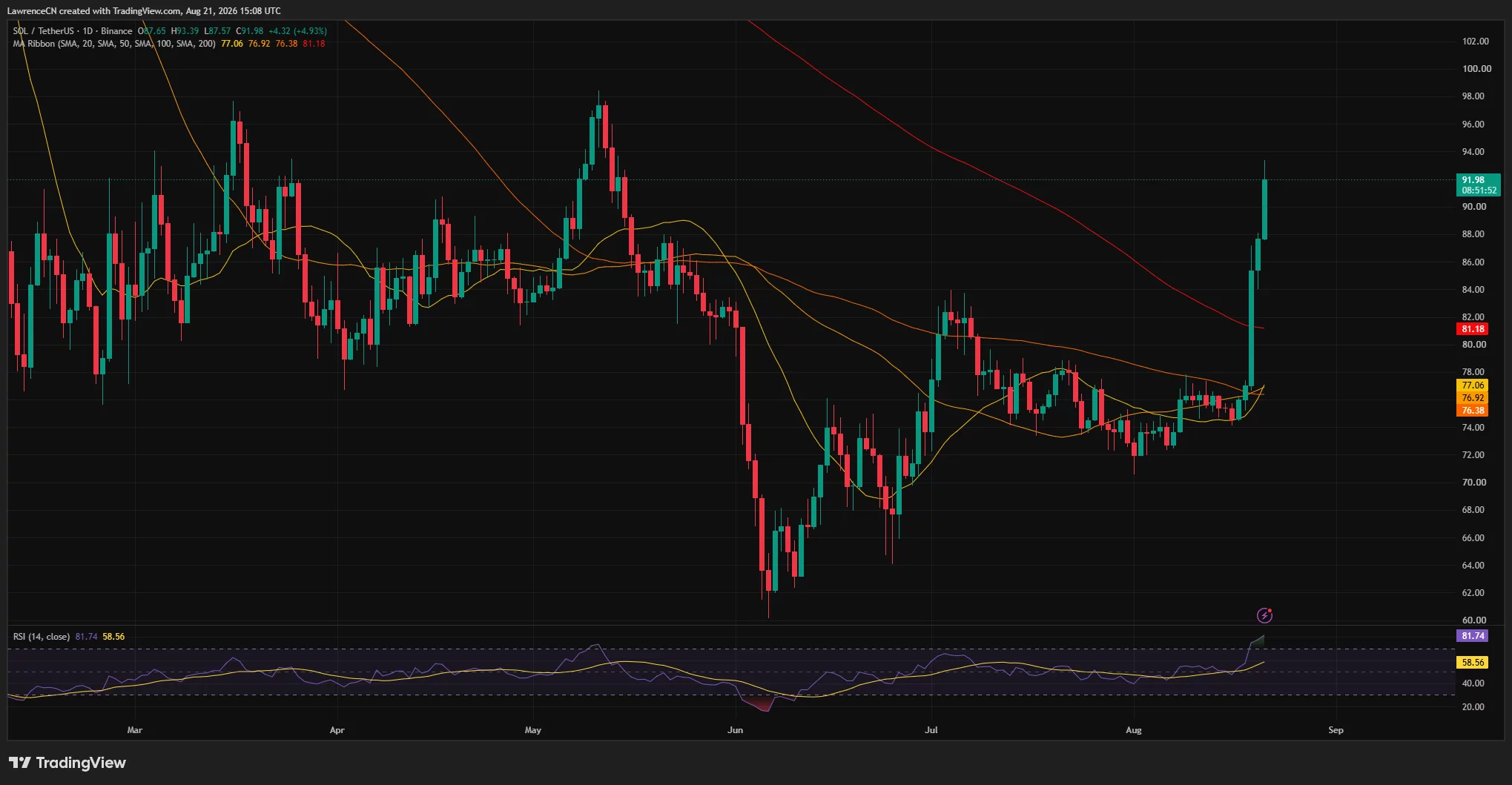
An overbought RSI does not require an immediate reversal. It does, however, show that price has risen much faster than its recent average and may need to consolidate before another sustainable advance.
SOL now trades above its 20-day simple moving average at $77.06, its 50-day average at $76.92 and its 100-day average at $76.38. The token also cleared the 200-day average near $81.18, which had acted as the most important long-term barrier on the chart.
The tight grouping of the shorter averages around $76–$77 identifies the base of the breakout. A later decline into that region would represent a full retest, although nearer support sits at $87–$90.
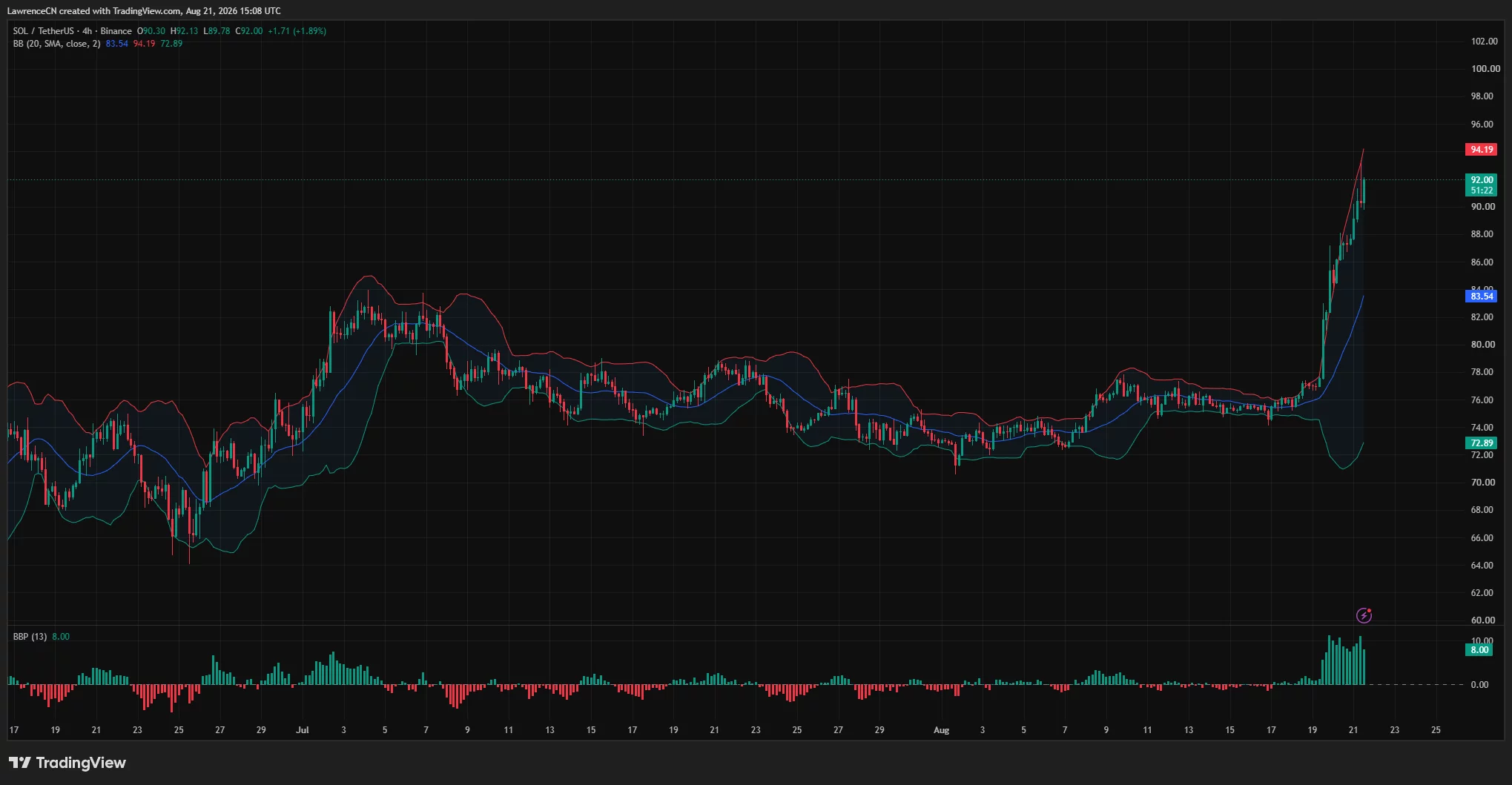
The 4-hour chart shows similarly stretched conditions. SOL traded near $92 while the upper Bollinger Band stood at $94.19. The middle band was much lower at $83.54, showing how quickly the price separated from its recent mean.
Solana liquidation map puts $95 and $98 in focus
The three-day CoinGlass liquidation heatmap shows SOL climbing through several layers of short liquidity between $80 and $92. Forced purchases from liquidated short positions likely helped accelerate the near-vertical move.
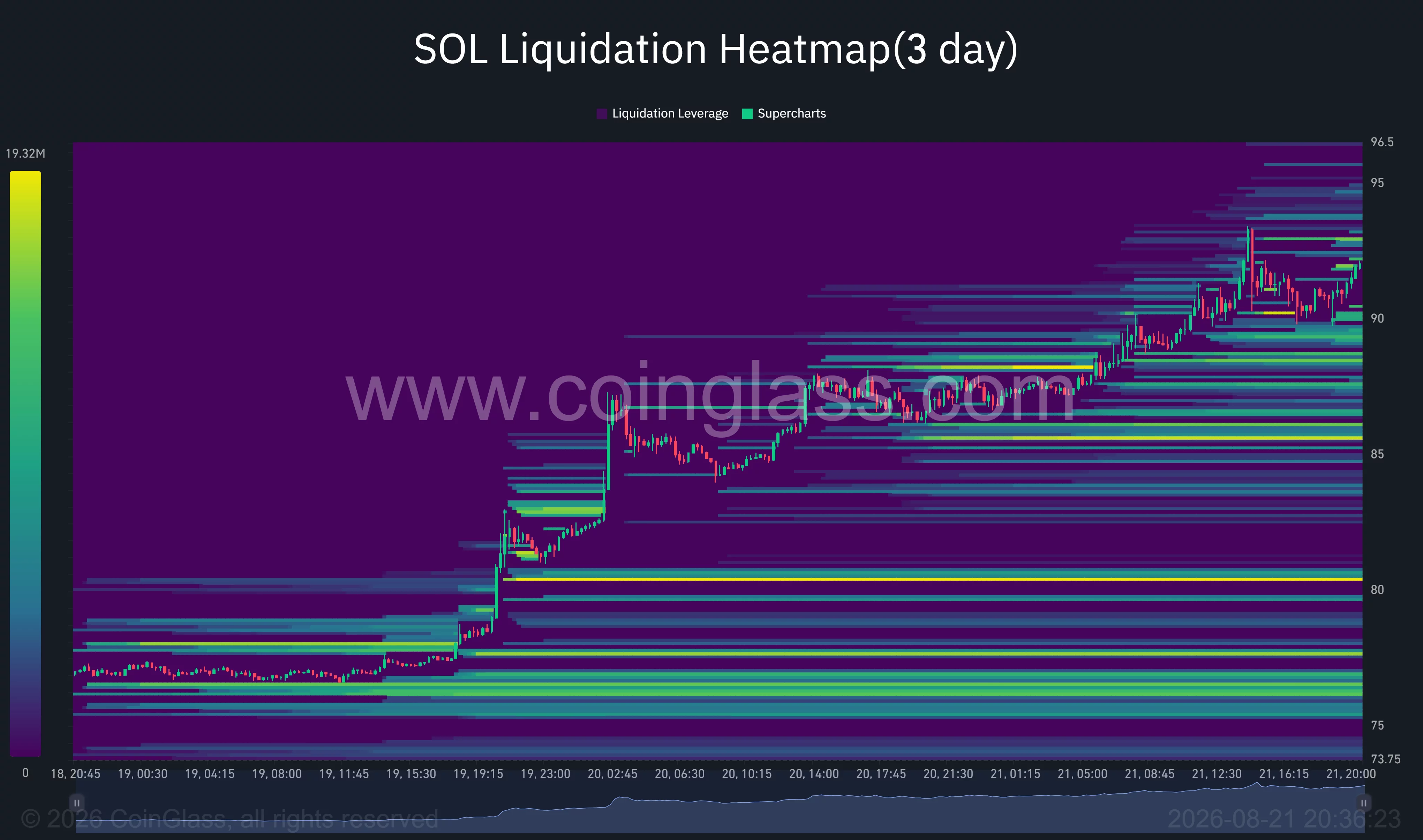
Remaining liquidity appears concentrated immediately above the market between roughly $93 and $95. A break through that area could produce another burst of forced buying, but the chart shows less dense liquidity once SOL moves beyond $95.
Crypto trader Daan Crypto Trades identified approximately $98 as the next range high and said another squeeze could develop if SOL reaches the equal highs around that level. His chart places the larger range between about $67.60 and $97.60.
Altcoin Sherpa offered a similar bullish view, naming $95 as the first target and $120 as a possible later objective if Bitcoin remains strong. Both projections are conditional forecasts rather than confirmed outcomes, and SOL must first hold its breakout.
The heatmap also shows downside liquidity near $90, $88, and $86. The $86 area contains one of the brighter nearby clusters and could attract price if buyers fail to defend $90. A larger concentration remains around $80–$81, close to the daily 200-day moving average.
A $100 breakout depends on holding $87–$90
SOL’s immediate bullish scenario requires a sustained close above the $93–$95 region. Clearing that zone would expose the May range high near $98, followed by the psychological $100 level.
A confirmed move above $100 could strengthen the case that the longer decline from SOL’s 2025 peak has ended. The next target cited by Altcoin Sherpa is $120, but the current charts do not yet confirm that extension.
The bearish scenario starts with rejection below $95 and a loss of $90. Such a move could return SOL to $87–$88, while a deeper correction would bring the 4-hour Bollinger midpoint near $83.54 and the 200-day average near $81.18 into focus.
For US investors, Treasury yields, dollar strength, and progress on federal crypto legislation remain relevant outside catalysts. SOL’s immediate direction, however, will likely depend on whether spot buying can replace the forced purchases that powered the initial squeeze.
Disclosure: This article does not represent investment advice. The content and materials featured on this page are for educational purposes only.


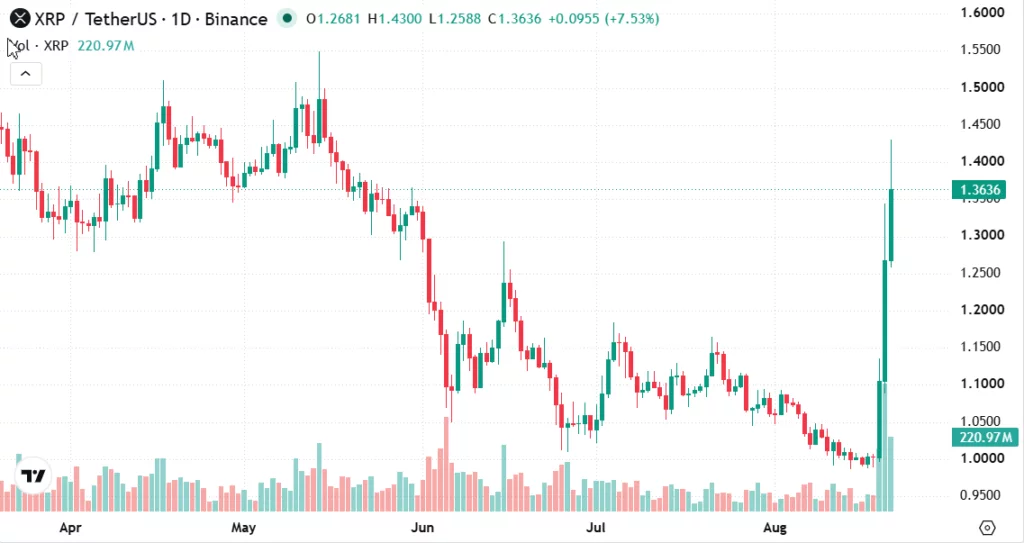
XRP has climbed 17% to an intraday high of $1.43 as Ripple’s vote for the PermissionDelegationV1_1 amendment has moved a key part of the XRP Ledger’s version 3.3.0 upgrade deeper into the validator approval process.
Summary
- XRP rose 17% in 24 hours and traded between $1.22 and $1.43.
- Ripple voted to support PermissionDelegationV1_1, which would allow limited account authority.
- Seven of 35 trusted validators supported the amendment at the latest count.
- U.S. spot XRP ETFs attracted $13.24 million in daily net inflows.
XRP Ledger amendment has entered its validator vote
XRPL validator voting data showed that seven of the 35 validators on the default Unique Node List supported PermissionDelegationV1_1 at the latest count. Ripple’s affirmative vote adds support from one of the network’s most closely watched participants, but it does not approve or activate the feature.
Under the XRP Ledger’s amendment process, a proposal must retain support from more than 80% of trusted validators for two continuous weeks. Based on the current 35-validator configuration, PermissionDelegationV1_1 would need at least 29 votes to exceed 80%, though some community trackers describe the practical threshold as 28 of 35.
If support falls to 80% or lower during the two-week window, the waiting period restarts. Validators can also change their votes before an amendment becomes active, leaving the activation date dependent on the network rather than Ripple alone.
PermissionDelegationV1_1 would let an XRP Ledger account authorize a second account to carry out selected transaction types. The account owner could grant narrowly defined permissions without transferring full signing authority or control of every account function.
Such an arrangement resembles role-based access systems used by financial companies, where employees and service providers receive access only to the operations required for their work. A business could, for example, let one account handle an approved transaction category while keeping control over unrelated payments and account settings.
RippleX head of product Jazzi Cooper linked the feature to controls needed by regulated financial institutions that issue and manage assets on public blockchains.
“Tokens are the pre-requisite for on-chain utility; you can’t move value without it existing on-chain first,” Cooper said.
In the rest of her statement, Cooper said regulated institutions need suitable controls before they can bring tokenized value onto a public ledger. Permission Delegation is designed to provide part of that account-level structure.
PermissionDelegationV1_1 replaces an earlier version
The XRP Ledger’s official amendment registry says PermissionDelegationV1_1 replaces the original PermissionDelegation proposal, which was disabled in version 2.6.1 after developers identified a critical bug.
The revised amendment, based on the XLS-75 specification, keeps the limited-authority model while correcting the flaw found in the earlier implementation. Security work has carried added weight because the feature would determine which transactions another account can submit on behalf of an owner.
Released in August, XRP Ledger version 3.3.0 introduced PermissionDelegationV1_1 alongside BatchV1_1, ConfidentialTransfer, DynamicMPT, Sponsor, and the fixCleanup3_3_0 package. An earlier XRPL upgrade report detailed how the proposals cover atomic transaction batches, private token transfers, adjustable token properties, and sponsored network costs.
ConfidentialTransfer would allow users to conceal Multi-Purpose Token balances and transfer amounts while leaving the sending and receiving accounts visible. DynamicMPT would let issuers change selected token properties after issuance, while Sponsor would allow a third party to cover reserve requirements and transaction fees for another account.
BatchV1_1 would group several transactions so they succeed or fail under defined conditions. Such processing can support settlement workflows in which several related actions must be completed together rather than separately.
Node operators need software containing the code for an approved amendment before it activates. According to XRPL documentation, servers using older software become amendment-blocked when they encounter protocol rules they cannot understand, preventing them from processing ledger data under outdated assumptions.
The fixCleanup3_3_0 amendment packages corrections involving Single Asset Vaults, the Lending Protocol, automated market makers, permissioned exchange functions, Checks, and pseudo-accounts. Ripple also backed the fixes during their validator vote.
XRP Ledger lending proposals remain below activation level
Permission Delegation is advancing through the same governance system as the proposed Single Asset Vault and Lending Protocol amendments, both of which have already received Ripple’s support.
Single Asset Vaults, described in XLS-65, would allow several depositors to pool one type of asset, including XRP, RLUSD, or another token issued on the ledger. Depositors would receive vault shares representing their proportional interest in the pooled assets.
XLS-66 would add fixed-term lending functions at the ledger level, including loan issuance, servicing, and repayment. The design uses pooled vault liquidity and off-chain credit assessment rather than requiring every loan to be secured by excess crypto collateral.
Recent validator voting coverage reported support of about 40% for Single Asset Vaults and more than 37% for the Lending Protocol after Ripple voted in favor. Both totals remained well short of the required supermajority.
A June re-audit by blockchain security firm Halborn found no critical or high-severity issues in the lending code it reviewed. Formal verification work involving RippleX and protocol research firm Common Prefix has also tested whether the system could enter unintended states that ordinary scenario-based reviews might miss.
For U.S. users, the protocol votes do not change the legal status of XRP, RLUSD, tokenized securities, or lending products. Any American company using the functions would remain responsible for the federal and state rules that apply to its product, while validator approval would only determine whether the underlying XRPL features become available.
XRP gains as ETF and futures activity increases
Against the upgrade vote, XRP rose more than 17% over 24 hours to reach $1.43, its highest price of the day. The token advanced about 40% over seven days after trading as low as $1.22 during the latest session, while spot trading volume increased 156%.
The token’s rise also formed part of a strong crypto market rebound that produced heavy short liquidations. As traders who had bet on lower prices bought assets to close leveraged positions, XRP moved through several resistance levels during the session.
U.S. spot XRP exchange-traded funds recorded $13.24 million in net inflows on Thursday, according to SoSoValue data. Bitwise’s fund accounted for $9.9 million, while Franklin Templeton’s product received another $3.34 million.
ETF shares give U.S. investors regulated brokerage exposure to XRP without requiring them to hold the token directly. Flows into the products do not measure demand across the entire spot market, but daily creations and redemptions provide a separate view of activity in U.S.-listed investment vehicles.
Derivatives positioning rose alongside the spot price. CoinGlass data cited in the report put total XRP futures open interest at $3.44 billion, up more than 17% over 24 hours.
CME-listed XRP futures open interest increased by more than 35% during the same period, while Binance recorded a 15% rise and Hyperliquid posted a 29% increase. Open interest measures the value of outstanding contracts and can rise when traders add either long or short exposure; by itself, the figure does not establish which side controls the market.
Disclosure: This article does not represent investment advice. The content and materials featured on this page are for educational purposes only.


Solana Company has backed Solana’s proposed constitution while opposing two economic plans that could cut token issuance by 18.9 million SOL and raise daily token burns as voting opens on Aug. 22.
Summary
- Solana Company will support SGP-0001 and vote against SGP-0002 and SGP-0003.
- SGP-0002 could reduce projected SOL emissions by 18.9 million tokens over six years.
- The Nasdaq-listed company said changing staking and fee rules could discourage institutions.
- Successful governance votes would guide policy but would not automatically activate either proposal.
The company said in an Aug. 21 press release that it will vote for SGP-0001, known as the Solana Constitution, while opposing SGP-0002, the Double Disinflation Rate proposal, and SGP-0003, the Resource and Inclusion Fee proposal.
On-chain voting for the first three Solana Governance Proposals is expected to begin on Aug. 22. Solana Company, which trades on Nasdaq under the HSDT ticker, operates institutional validator infrastructure across the Asia-Pacific region and earns staking revenue from its SOL treasury.
Its support for SGP-0001 rests on the proposed constitution’s voting structure. Under the system, staking participants receive transparent votes weighted by their stake, while token holders retain the power to override votes cast by the operators managing their delegated SOL.
According to the company, the structure gives financial institutions a direct way to participate in decisions affecting the network without surrendering control of their voting rights to validators. Management said adopting the constitution would establish the governance system needed to bring more institutional participants into Solana.
Solana Company opposes changing two economic rules
While supporting the governance framework, Solana Company said the first voting cycle should not be used to change Solana’s issuance schedule and transaction fee model at the same time.
Management described the goals behind SGP-0002 and SGP-0003 as reasonable. However, the company said institutions considering validator operations or staking need economic rules they can model across several years.
In conversations with financial institutions, Solana Company said issuance itself has rarely been raised as a barrier. Questions have instead focused on whether Solana’s economic rules will remain reliable long enough for institutions to forecast revenue, costs and cash flow.
Changing two of the network’s most stable economic parameters during the first live governance cycle could delay decisions by firms already assessing Solana, according to the release. The company therefore framed both opposing votes as objections to timing rather than to the proposals’ underlying goals.
“We strongly believe that institutional adoption is a critical driver of Solana’s growth, and institutions make decisions based on consistent, predictable structures,” Solana Company Chairman and CEO Joseph Chee said.
Chee added that the disclosed positions were intended to support institutional participation and said the company plans to work with other industry participants as Solana’s governance system develops.
SGP-0002 would accelerate SOL disinflation
SGP-0002 asks Solana voters whether the network should proceed with a faster reduction in token issuance. The related technical plan, SIMD-0550, would double the annual disinflation rate from 15% to 30% while retaining Solana’s terminal inflation rate of 1.5%.
Proposal estimates indicate that the faster schedule would reach the 1.5% floor in about 2.8 years instead of 5.7 years. Projected emissions would fall by approximately 18.9 million SOL over six years, although the estimate does not represent a guaranteed supply reduction.
As crypto.news reported in an Aug. 9 proposal analysis, SIMD-0550 entered Solana’s improvement-document repository with “Review” status on July 23. Inclusion in the repository did not approve or activate the proposed change.
Solana Company said it does not oppose lower issuance as a possible end result. Its objection concerns reopening a fixed schedule that already takes inflation toward the 1.5% terminal rate.
For institutional holders, staking yield can appear as an audited and disclosed financial line item, according to the company. Some holders also treat staking rewards as operating cash flow, making changes in issuance relevant to their revenue forecasts.
The company said it may support another discussion about accelerating disinflation after SOL records sustained net capital inflows.
Solana Company’s reliance on staking revenue makes the issue material to its own accounts. An Aug. 15 earnings report showed that staking generated $2.512 million of the company’s $2.526 million in second-quarter revenue.
During the quarter, it earned 31,200 SOL in staking rewards and automatically restaked the tokens. Revenue from staking helped produce a gross margin of about 97%, but operating costs and losses from digital-asset sales contributed to a $30.3 million quarterly net loss.
SGP-0003 would replace a predictable flat fee
Solana Company also plans to vote against SGP-0003, which supports a resource-based transaction charge and an inclusion fee through SIMD-0553.
Under the design, transaction costs would depend partly on the network resources consumed by each transaction. The resource portion would be burned in full, linking fees more closely to network use than Solana’s existing flat charge.
Galaxy Research previously cited estimates that the proposal could lift daily SOL burns from roughly 650 tokens to between 7,500 and 9,000 under recent network conditions. SIMD-0553’s author later said earlier estimates were “misleading” and published a range of possible outcomes based on the previous month’s activity.
Solana Company agreed that a flat charge does not accurately match fees with the amount of network capacity a transaction consumes. Yet management said the current fee remains a known expense that financial institutions can place in budgets before they use the network.
Introducing variable transaction costs before users and operators have adjusted their systems would transfer estimation risk to them, the company said. Management would consider a revised proposal that maintains a fee floor that institutions can calculate in advance.
U.S. investors have exposure to Solana staking rules
Because Solana Company is listed on the Nasdaq Capital Market, American investors can gain indirect exposure to SOL, staking revenue, and validator operations through HSDT shares without holding the token themselves.
The company’s financial results remain sensitive to SOL prices, staking returns and capital raised through stock sales. During the second quarter, it raised $7.9 million in net proceeds by selling about 3.08 million shares at $2.60 each, while spending approximately $2.3 million to repurchase 1.3 million shares.
Changes to Solana’s issuance schedule could also affect U.S.-listed funds that stake their SOL holdings. An Aug. 11 fund report found that Bitwise’s Solana Staking ETF held 8.18 million SOL worth $622.02 million as of Aug. 9, with 99% of the tokens staked.
Bitwise reported a 6.21% gross annualized staking reward rate over the previous 90 days and a 5.84% net rate after staking-related costs. The fund warns investors that rewards can change with network conditions and do not represent the ETF’s investment performance.
A successful SGP vote would not immediately alter Solana’s issuance or fee rules. Each proposal must secure support from at least 66.67% of the decisive stake, which includes votes for and against but excludes abstentions.
Even after approval, an SGP serves as a policy instruction rather than executable code. Developers would still need to complete the associated Solana Improvement Document, prepare the software, and deploy the change through a feature gate.
Solana Company said it disclosed its positions before voting so delegators would know how their validator operator intended to vote. Under the proposed constitution, the underlying SOL holder can override an operator’s choice by submitting a separate vote.
Crypto World
Bitcoin just had its best week since 2024; sentiment flipped from fear to greed in a day


Disclosure: This article does not represent investment advice. The content and materials featured on this page are for educational purposes only.
Bitcoin surges above $75,000 as Treasury buybacks trigger short liquidations and rapidly shift crypto market sentiment.
Summary
- Bitcoin surged 20% in a week after a surprise Treasury buyback announcement, triggering a sharp shift from Fear to Greed.
- Bitcoin’s rally sent funding rates to a 20-month high as ETF flows and whale buying offer mixed signals on its sustainability.
- Treasury policy, rising crypto sentiment, and stronger liquidity are driving Bitcoin’s rebound while traders watch for volatility risks.
A surprise Treasury announcement, not an ETF headline, set off bitcoin’s best week since 2024, even though the policy itself doesn’t take effect for three more weeks. It also flipped traders’ mood from Fear to Greed in about a day, which is either confirmation or a warning sign in itself.
Those who didn’t move before Wednesday have probably spent the past two days doing the math on what they missed. Bitcoin is up roughly 20% in seven days, its best week since March 2024, trading above $75,000 in Asian hours on Friday after spending most of the past two weeks below $65,000. Ethereum climbed right along with it, and total crypto market capitalization is back above $2.5 trillion.
The trigger
On Wednesday, Treasury Secretary Scott Bessent doubled the size of the department’s long-duration bond buybacks, from $2 billion to at least $4 billion per operation. One detail got lost in a lot of the crypto coverage: the change doesn’t take effect until September 9 and runs through November 4. No Treasury cash has moved yet.
The announcement said it all. Long-bond yields, which had climbed to a near two-decade high after months of weak demand for 30-year debt, dropped sharply within minutes as traders saw the surprise timing as a sign that the Treasury would step in to support a shaky market. That relief faded fast: yields drifted back up again by Thursday morning, and economists were split on whether a modestly bigger buyback program changes much of anything structurally.
Crypto’s reaction didn’t fade with it. Traders who had shorted bitcoin, positioned for tighter conditions rather than a friendlier-sounding Treasury, got caught wrong-footed by the shift in tone. About $3 billion in short positions were liquidated over the following day, and each forced liquidation led to more buying, which kept pushing the price up on its own, regardless of what bonds were doing by then. Bessent added fuel on Thursday, telling CNBC that the eventual buyback total could exceed $4 billion.
Call it a signaling story rather than a plumbing one: a policy surprise most crypto traders had never heard of on Tuesday moved the market’s price and its mood before a single dollar of the actual buyback had been spent. The Fear & Greed Index jumped from 46 to 62 in a single day, one of the sharper sentiment swings of the year, then kept climbing to 72 by Friday.
The case for it, and the case against it
There’s no consensus on whether the move means anything beyond this week, but the raw inputs are public enough to weigh for yourself.
| Supporting the move | Reasons for doubt |
| Large holders have added billions of dollars in bitcoin over the past two months, through the drawdown as well as the bounce | Sentiment swung from Fear to Greed in about 24 hours, one of the sharpest reversals this year, and moves that fast have a history of unwinding just as fast |
| Spot and futures demand both turned positive on a 30-day basis for the first time in months, per on-chain analytics firm CryptoQuant | Funding rates, what leveraged traders pay to stay long, hit a 20-month high this week |
| Spot bitcoin ETF flows turned positive again in July and early August after a weak first half of the year | Analyst Benjamin Cowen has argued the cycle bottom could still be more than two months out |
Both sides are reading real data, just on different clocks. Flows and positioning shift over weeks. Sentiment and leverage can turn in a single bad session.
“Forty-six to seventy-two in two days sounds like leverage and momentum, not real conviction,” said Rick Cramer, Head of Analytics at SimpleSwap. “True conviction builds over weeks. This move happened before the slower data could even catch up, and moves that fast often unwind just as quickly.”
Four numbers, not the price
Funding rates, what leveraged traders pay to hold a long position on perpetual futures, hit a 20-month high this week. Elevated funding has appeared right before most of Bitcoin’s sharper pullbacks over the past two years, because it signals that the rally is increasingly running on borrowed money rather than fresh buyers. If that number cools off even while the price holds steady, it tends to be a healthier sign than it looks.
Spot ETF flows tell a cleaner story, and the funds publish their inflows and outflows daily. After a rough first half of the year, flows turned positive again in July and stayed positive into August. One good week doesn’t mean much on its own. A few in a row have historically been a better read on institutional conviction than any single day’s candle.
Then there’s what the largest wallets are doing, which on-chain trackers make public in something close to real time. Big holders kept adding through the drawdown and haven’t stopped through the bounce, a different kind of buying than retail chasing a green candle after the fact.
The Fear & Greed Index told its own version of this story: 46 on Wednesday, 62 by Thursday, 72 by Friday, Fear to solid Greed in 48 hours. Sentiment did not lag the price for long. Worth checking again next week regardless: a reading in the 70s this early in a move has historically been more of a caution flag than a confirmation, since it leaves less room for the rally to keep surprising anyone.
None of these four numbers will tell you what to do. They’re a reasonable approximation of what people trading actual size are watching, which tends to be a more honest signal than whatever is trending on social media by Sunday.
The regulatory backdrop
The rally also lands in a busier regulatory calendar than crypto has had in years. The White House hosted a digital-asset summit this month. The SEC has proposed a dedicated “Regulation Crypto Assets” framework with tailored exemptions for token issuers, and stablecoin rules under the GENIUS Act are due by November. Whatever happens to the price from here, that backdrop isn’t going away.
Where execution comes in
For anyone moving assets this week rather than watching the chart from the sidelines, volatility changes the mechanics of execution as much as the price. Spreads widen. Slippage on manually routed trades gets worse, and the price on screen stops matching the price you get.
SimpleSwap, a self-custodial swap aggregator, doesn’t hold customer funds between transactions. Every trade moves wallet-to-wallet, with pricing pulled in real time from more than 20 liquidity providers across centralized and decentralized sources. The platform supports more than 2,800 assets and over 3.2 million trading pairs through a single interface. Most weeks, that routing layer is invisible. This week, it’s under load.
“Nobody really thinks about routing infrastructure when the market is calm. That is exactly when you do not need to,” said Stefan Lauer, Head of Infrastructure at SimpleSwap. “A week like this is what puts it to the test. Liquidity thins in some places, and prices can move by the minute rather than the hour. The system either finds the best price across dozens of sources in real time, or it does not. That is not a market call. It is an engineering one.”
Whether this is the start of a new leg or just another sharp bounce will not be clear for more than a week. What happened this week was real either way, and it moved fast enough that anyone waiting for certainty probably missed most of it.
Disclosure: This content is provided by a third party. Neither crypto.news nor the author of this article endorses any product mentioned on this page. Users should conduct their own research before taking any action related to the company.
Disclosure: This article does not represent investment advice. The content and materials featured on this page are for educational purposes only.
UE Crypto offers XRP investors diversified digital asset allocation through cloud mining and yield aggregation mechanisms.
Summary
- XRP traded at $1.42 on Aug. 21, rising 22.8% in 24 hours as XRP-related ETF inflows topped $1,323.71.
- Despite softer trading and cautious retail sentiment, institutional demand continues supporting steady XRP capital inflows.
- UE Crypto draws XRP investors with cloud mining and yield aggregation options, plus layered security and asset protections.
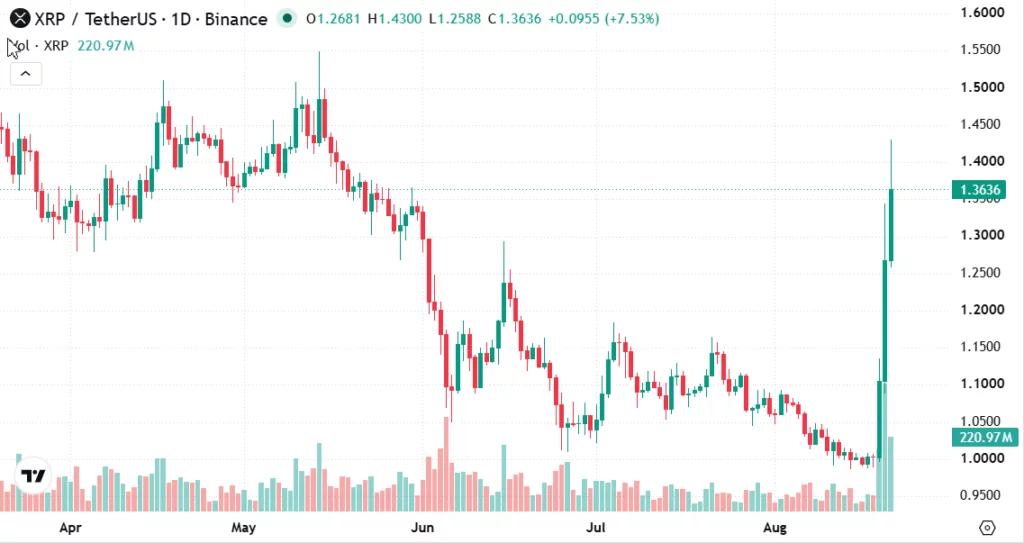
On August 21, XRP ETF prices continued their strong recovery momentum, breaking above the $1.42 mark for the first time since late August. The breakthrough was supported by institutional capital inflows and improving liquidity conditions in the United States.
Continued inflows into XRP ETFs further demonstrate the growing demand from institutional investors for XRP exposure. Although retail investors remain relatively cautious due to market volatility and price uncertainty, institutional capital continues to increase XRP allocations through regulated financial products, making XRP one of the most closely watched mainstream digital assets in the current market.
As the regulatory environment gradually becomes clearer and financing conditions continue to improve, more investors are beginning to reconsider a key question: beyond relying on price appreciation for returns, are there more diversified, efficient, and sustainable ways to participate in the long-term value growth of XRP and the broader digital asset ecosystem?
Total daily net inflows into XRP ETFs reached the $13.2371 million milestone, marking a significant development.
XRP price today
As of August 21, 2026, the current price of XRP (XRP) is $1.42. Over the past 24 hours, the price has moved 22.8%, with a 1.9% increase over the past hour. Over the longer term, the price has moved 41.2% over the past seven days and 25.1% over the past month. The XRP spot ETF market has reached an important milestone. According to data published by the analytics platform uToday, driven by continued net capital inflows, cumulative inflows into XRP-related exchange-traded funds (ETFs) have exceeded $1,323.71.
Meanwhile, overall market liquidity continues to improve. Although secondary-market trading activity has declined somewhat and retail investors remain relatively cautious amid market volatility, institutional allocation demand remains steady, driving continued net capital inflows on most trading days.
A new choice for XRP investors: UE Crypto helps explore diversified digital asset yield mechanisms
In light of this trend, an increasing number of XRP investors are turning their attention to UE Crypto, seeking to expand their digital asset allocation channels through cloud mining and yield aggregation mechanisms and explore more diversified, stable, and sustainable yield models.
Compared with highly volatile futures trading or investment approaches that rely solely on ETF price performance, UE Crypto provides a more convenient and intuitive way to participate in digital assets, allowing users to remain focused on the long-term development of the XRP ecosystem while further expanding their approaches to digital asset allocation and utilization. For users with a certain level of capital, this model also provides another option for exploring potential daily income opportunities.
About UE Crypto
UE Crypto is headquartered in the United Kingdom and operates within European regulatory frameworks such as MiCA and MiFID II, continuously improving its transparency, operational standards, and user protection mechanisms.
The platform adopts a multi-layer security architecture, including:
- Annual financial and security compliance audits by PwC;
- Digital asset custody insurance provided by Lloyd’s of London;
- Enterprise-level network protection from Cloudflare and McAfee® security systems;
- Bank-grade data encryption and professional security infrastructure to provide multiple layers of protection for user assets and accounts.
Currently, UE Crypto supports a range of mainstream digital assets, including XRP, BTC, ETH, USDT, USDC, DOGE, LTC, and SOL, providing users with a more flexible and convenient digital asset service experience.
Start earning daily returns in just three steps
1. Register an account
2. Choose a mining package
Choose a suitable cloud mining contract based on personal budget and needs, and start mining with one click.
3. Start earning
Once the contract is activated, the system will automatically allocate computing power, and returns will be settled every 24 hours. Users can withdraw their earnings at any time or continue participating as needed to achieve long-term compound growth of their assets.
Popular UE Crypto contracts
BTC (Beginner Experience Contract)Investment Amount: $100, Contract Term: 2 days
Daily Return: $4, Total Return at Contract Maturity: $100 + $8
Dogecoin (DOGE, Digital Intelligent System Contract) Investment Amount: $500,
Contract Term: 5 days, Daily Return: $6.25, Total Return at Contract Maturity: $500 + $31.25
BTC (Super Computing System Contract)Investment Amount: $1,000, Contract Term: 10 days, Daily Return: $13.10, Total Return at Contract Maturity: $1,000 + $131
LTC (Algorithm-Driven System Contract)Investment Amount: $5,000, Contract Term: 25 days, Daily Return: $72, Total Return at Contract Maturity: $5,000 + $1,800
BTC (Quantitative Intelligent System Contract)Investment Amount: $10,000, Contract Term: 35 days, Daily Return: $158, Total Return at Contract Maturity: $10,000 + $5,530
For more details about the contract plans, please visit the UE Crypto official website.
Overview
Continued inflows into XRP ETFs, together with the improving regulatory environment, further indicate that XRP is gradually becoming integrated into the mainstream financial system. At the same time, UE Crypto provides XRP investors with more diversified ways to participate in digital assets, encouraging a shift from relying solely on price fluctuations toward a diversified strategy that considers both asset price performance and potential sources of returns.
As a new market cycle gradually unfolds, investors are shifting their focus from simply tracking price movements toward more stable, long-term, and sustainable asset allocation and management strategies. This trend reflects the continued evolution of market participants’ investment approaches and also demonstrates that the digital asset market is moving toward greater maturity and diversification.
Join the UE Crypto cloud mining digital asset platform today, seize the golden opportunity, and embark on a new journey toward wealth growth.
Disclosure: This content is provided by a third party. Neither crypto.news nor the author of this article endorses any product mentioned on this page. Users should conduct their own research before taking any action related to the company.

Bitcoin and the wider crypto market rallied this week after a US Treasury move that effectively expanded long-dated bond buybacks without being labeled as quantitative easing. The shift reignited debate about whether ongoing liquidity measures—however framed—can support high-volatility assets such as Bitcoin and Ether.
Bitcoin rose more than 23% toward $79,000 and Ether pushed above $2,400, according to the market moves described in the original reporting. The same theme has been spilling into corporate strategy across crypto, from treasury reallocations to mining expansions and even new avenues for regulated derivative trading.
Key takeaways
- Standard Chartered’s Geoff Kendrick linked Bitcoin’s strength to expanded US long-end bond buybacks, flagging $65,500 as a key technical level.
- Metaplanet is extending its Bitcoin treasury play into the US by taking a controlling stake in Nasdaq-listed Super League, to be renamed Superplanet.
- Cypherpunk Technologies is launching Zcash mining after a $33.33 million equity deal, claiming roughly 18% of Zcash network hashrate.
- The CFTC is seeking public comment on futures tied to AI compute capacity, while CME Group plans a related launch on Oct. 5 pending approval.
Liquidity optics and Bitcoin’s “not-QE” bounce
According to Standard Chartered’s Geoff Kendrick, the US Treasury’s plan to at least double certain long-dated bond buybacks is “exactly the type of thing Bitcoin loves,” framing the move as a liquidity tailwind even if it stops short of QE terminology. Kendrick highlighted the potential for a technical confirmation, pointing to $65,500 as a key level for Bitcoin.
The original report states that the Treasury buyback program expands operations for 10- to 20-year and 20- to 30-year coupons, with the run scheduled from Sept. 9 through Nov. 4. In the immediate aftermath, long-dated yields fell and Bitcoin climbed more than 6% to nearly $69,000, with the price reference attributed to CoinMarketCap in the source.
Importantly, Kendrick’s bullish thesis is conditional. The analysis notes that Bitcoin must hold above $65,500 for the “cycle low” interpretation to remain intact. Investors watching this narrative will likely focus less on the label attached to government support and more on whether the liquidity impulse persists alongside credit and yield dynamics.
Metaplanet brings its Bitcoin treasury strategy to the US
Corporate moves mirrored the macro discussion. Metaplanet announced plans to take a controlling stake in Nasdaq-listed Super League Enterprise as part of expanding its Bitcoin treasury approach into US markets.
As described in the original coverage, Metaplanet will contribute 2,100 BTC and $2.5 million in cash to Super League, which is expected to be renamed Superplanet. The BTC contribution is said to come from existing treasury holdings rather than fresh purchases, and it represents under 5% of Metaplanet’s approximately 43,000 BTC holdings.
Metaplanet’s leadership described the structure as creating two capital-raising pathways: Superplanet in the US and Metaplanet in Japan. The report also notes that shares of Super League surged by more than 50% on the news. For market participants, the key takeaway is the strategic shift from simply holding Bitcoin as a balance-sheet asset toward building vehicles that may access liquidity and investor demand more directly in different jurisdictions.
The deal is expected to close in the fourth quarter, subject to shareholder approval and standard conditions, according to the source.
Cypherpunk expands into Zcash mining with large hashrate claim
While traditional Bitcoin narratives leaned on macro liquidity, another thread focused on infrastructure and token-specific catalysts. Cypherpunk Technologies announced it is expanding into Zcash (ZEC) mining after acquiring a mining fleet from Winklevoss Capital through a $33.33 million equity deal.
The original report states that Cypherpunk’s setup is already online at US facilities, producing about 4.2 GSol/s and giving the company roughly 18% of Zcash’s current network hashrate. In addition to mining exposure, Cypherpunk holds 323,394 ZEC, about 1.9% of circulating supply, and targets 5% ownership.
The company’s argument for Zcash mining economics versus Bitcoin mining or AI-related data center workloads—also reflected in the source—will matter primarily because mining profitability is sensitive to multiple variables: ZEC price, network hashrate, mining difficulty, and operating costs. The report also notes the broader context: ZEC had surged more than 1,300% over the prior 12 months before correcting.
Another part of the backdrop is Zcash’s technical roadmap. The source points to the network’s Ironwood upgrade, implemented on July 28 to replace the Orchard pool after a flaw that could have allowed counterfeit ZEC creation. It also states that no exploitation was ever detected. For readers, the practical implication is that protocol changes can influence both security assumptions and mining operations, even when the immediate impact is not immediately visible in day-to-day price action.
CFTC seeks input on AI compute futures as CME prepares launch
Regulatory attention isn’t limited to crypto-native assets. The US Commodity Futures Trading Commission (CFTC) is seeking public comment on futures contracts tied to AI computing capacity—an effort that could help shape how markets price and hedge the cost of compute-intensive infrastructure.
As reported, Bloomberg said the CFTC sent a request for comment to the White House Office of Management and Budget. Separately, CME Group announced last week it plans to launch two compute futures contracts on Oct. 5, pending regulatory approval, with Silicon Data providing the benchmarks. The source also attributes estimates to TD Lombard, Goldman Sachs, and Bridgewater Associates that place AI infrastructure spending at roughly 2% to 2.5% of US GDP this year.
The significance for market structure is straightforward: if compute becomes tradable via regulated futures, it may offer hedging tools for industries exposed to fluctuating power, hardware availability, and demand cycles. It could also introduce a new pricing reference point that indirectly affects investment decisions across AI infrastructure vendors and data center operators.
However, timelines appear complicated by review steps. The source notes that once the White House review is complete, the CFTC is expected to open a comment period, typically lasting 30 or 60 days, according to Bloomberg. That process could further influence the schedule for other compute-related products under regulatory consideration, including those described as planned by Intercontinental Exchange in the original report.
What to watch next
Crypto traders and long-term allocators may want to track whether Bitcoin’s momentum holds above the $65,500 technical level flagged by Standard Chartered—and whether additional “liquidity without QE” measures materialize. On the business side, watch how Metaplanet’s US vehicle develops post-close, and whether Zcash mining economics stabilize as hashrate and difficulty move, while regulators continue to define how compute capacity futures should be structured.


ZK proving has begun competing with trillion-dollar AI data centers for the same GPUs, raising proof costs even as Cysic reports a 9% performance gain from improving hardware use.
Summary
- Cysic says inefficient GPU use, rather than inadequate raw computing power, now drives proving costs.
- ZK workloads compete with AI for Nvidia GPUs despite relying on different mathematical operations.
- Real-time Ethereum proving and ZK-rollups could face higher costs before consumer applications do.
- Cysic expects the squeeze to speed up adoption of FPGAs, ZK-specific ASICs and open prover markets.
Cysic founder and CEO Leo Fan told crypto.news that GPU use has become a binding constraint for zero-knowledge proving because proof systems now compete with heavily funded AI data centers for the same silicon.
“AI models are converging. Compute isn’t. Everyone assumed proving costs would fall because chips get cheaper. Instead, we’re bidding against trillion-dollar data centre budgets for the same silicon. That’s why the hardware layer had to be opened up rather than left to a handful of proprietary provers.”
The pressure does not come from a lack of computing capacity alone, according to Fan. He said the main problem is an architectural mismatch between zkVM software and the accelerators used to generate proofs, which leaves part of the available GPU capacity unused and raises the cost of each proof.
Cysic’s Venus proving engine exposed that mismatch by reducing the time spent coordinating work between CPUs and GPUs. As reported in April, the company recorded an end-to-end proof-time improvement of more than 9% against ZisK 0.16.1 without replacing the underlying hardware.
ZK proving costs now matter more than raw speed
Built as a hardware-focused extension of Polygon Hermez’s ZisK zkVM, Venus represents proof generation as one connected computation graph. Cysic says the design lets the system schedule work across the full proving process instead of handling each hardware function as a separate call.
Through CUDA Graph integration, kernel tuning, and shared-memory changes, Venus reduces repeated data transfers and synchronization between the processor and GPU. Fan said the result shows that existing accelerators were not being fully used, making utilization the practical bottleneck behind proof costs.
Raw proving speed has improved quickly across the industry. Cysic has said ZisK can generate an Ethereum block proof in 7.4 seconds with 24 GPUs and can submit real-time proofs through a single RTX 4090 setup. The claims come from the company and have not been independently tested under a common benchmark covering energy use, proof size, security level, and total hardware cost.
Other developers have also crossed Ethereum’s real-time threshold. In November 2025, Succinct reported that SP1 Hypercube proved 99.7% of a 954-block Ethereum sample in less than 12 seconds using 16 Nvidia RTX 5090 GPUs. About 95.4% of the sample was proven within 10 seconds.
The Ethereum Foundation defines real-time proving as completing proofs for at least 99% of mainnet blocks within 10 seconds. Its framework also calls for fully open-source code, proof sizes below 300 KiB, at least 128-bit security, hardware costing no more than $100,000, and power use capped at 10 kilowatts.
Energy use may be a more serious limit than equipment cost for home provers, the Foundation said. A proof can arrive before Ethereum’s deadline while still requiring too much power, cooling or capital for an independent operator.
AI demand is tightening access to the same GPUs
Although AI and ZK proving use GPUs differently, both workloads depend on Nvidia accelerators ranging from consumer RTX cards to data-center H100 systems.
AI training and inference mainly use matrix calculations. ZK proof generation relies heavily on multi-scalar multiplications and number-theoretic transforms, operations that GPUs can process but were not specifically designed to run.
Fan said the mismatch supports the case for ZK-specific hardware because proof systems are entering the same supply queue as AI developers without using the chips in the same way. Since GPU-hours account for much of the proving bill, higher hardware and rental costs pass into the cost of each proof, he added.
Nvidia’s financial results show the scale of demand coming from AI infrastructure. The U.S.-listed chipmaker reported $75.2 billion in data-center revenue for the quarter ending April 26, up 92% from a year earlier. Data-center compute revenue reached $60.4 billion, an annual increase of 77%.
Amazon Web Services has separately agreed to buy one million Nvidia GPUs, with deliveries scheduled to continue through 2027, Reuters reported in March. Nvidia CEO Jensen Huang has estimated a $1 trillion sales opportunity for the Blackwell and Rubin product families through that year.
In June, Nvidia’s planned bond sale sought at least $20 billion to fund AI investments and refinance debt. Bitcoin mining companies had announced more than $70 billion in AI and high-performance computing contracts at the time, illustrating how crypto-linked infrastructure owners are also redirecting power and facilities toward AI workloads.
A Bernstein report covered in May placed announced AI infrastructure partnerships at nearly $90 billion. The analysts estimated that Bitcoin miners controlled more than 27 gigawatts of planned power capacity, compared with about 3.7 gigawatts tied to announced AI agreements, while some U.S. grid connections could take up to 50 months.
ZK-rollups and real-time provers face the pressure first
Real-time layer-1 proving sits at the front of the cost squeeze because it requires GPUs to produce a fresh proof for every block, Fan said. Any delay can cause a prover to miss the network’s time limit, so operators need spare capacity as well as enough hardware for normal demand.
ZK-rollups and proof marketplaces follow because GPU-hours feed directly into operating expenses and, in some cases, user fees. An earlier proving cost analysis estimated that proof generation accounted for 60% to 70% of fees on ZK layer-2 networks, citing L2Beat data.
According to the same analysis, generating a proof for a batch of 4,000 transactions could take two to five minutes on an Nvidia A100 and cost between $0.04 and $0.17 in cloud computing charges. The figures depend on the proof system, transaction batch, hardware configuration, and cloud rate.
Fan placed zkML among the most exposed applications because it combines an AI workload with the added expense of proving that the model ran correctly. For private payments, on-chain games, and other consumer products, he said the economics often require proof costs measured in pennies.
“Can cost limit adoption? Yes at the margin,” Fan said, adding that private payments and gaming would likely be deferred first when their economics no longer work.
Cost pressure could also affect how many entities can operate provers. Fan said more than 90% of ZK layer-2 networks rely on a small group of prover services, although the estimate requires a named dataset and should be treated as Cysic’s assessment.
FPGAs and ZK ASICs offer an alternative hardware path
Cysic has responded by developing multiple backends rather than relying only on GPUs. The public Venus repository includes GPU optimizations, a complete FPGA acceleration backend, and an early ASIC-oriented implementation.
Its FPGA backend contains kernels for Goldilocks field arithmetic, NTTs, Poseidon2, Merkle trees, FRI and expression evaluation. The code targets AMD UltraScale+ and Versal devices with high-bandwidth memory and is available under Apache 2.0 and MIT licences.
Unlike an ASIC, an FPGA can be reprogrammed after production, allowing developers to update circuits and experiment with new proving systems. Custom ASICs offer less flexibility but can deliver better performance and energy efficiency when designed for a stable set of ZK operations.
Fan said moving to FPGAs and ZK ASICs would remove proof operators from the main AI hardware queue. Specialized devices would also avoid paying for GPU functions that ZK workloads do not need, although development costs and limited manufacturing volumes remain obstacles.
Opening the software is one part of Cysic’s approach. The company also proposes a global prover marketplace in which devices ranging from mobile hardware to professional clusters can accept jobs, with GPU and FPGA backends reducing dependence on one chip class.
Cryptographic verification means a verifier rejects an invalid proof regardless of which operator generated it, Fan said. Opening participation, therefore, does not change the proof system’s soundness, but it increases exposure to implementation errors in unaudited or unfinished code.
Cysic states in the Venus repository that the project remains under active development. Fan said audits and redundant multi-prover configurations would be needed to limit implementation risk.
Draft EIP-8025 would let Ethereum validators opt into generating or verifying execution proofs while conventional block re-execution remains in place. The proposal introduces a proof gossip channel and external proof nodes, but its current version does not provide incentives for operators that generate and broadcast the proofs.


Bitcoin has climbed about 23% over the past week to $77,535 as Bitfinex analysts say spot buying, ETF inflows and limited leverage could give the rally more staying power than a typical short squeeze.
Summary
- Bitcoin rose 10%–11% during the breakout while open interest increased only about 4%.
- Bitfinex identified $68,000–$69,000 as the main support zone for the recovery.
- U.S. spot Bitcoin ETFs attracted more than $1.1 billion across Aug. 19 and Aug. 20.
- Rising Treasury yields and profitable coins moving to exchanges could threaten the advance.
Why Bitfinex sees more runway for Bitcoin
Bitfinex analysts told crypto.news that forced liquidations helped Bitcoin break out of its previous range, but spot purchases and returning institutional demand have continued supporting the price after much of the short pressure cleared.
Bitcoin (BTC) traded at about $77,535 at the latest check after reaching an intraday high near $79,200. The cryptocurrency was up almost 7% over 24 hours and about 23% over seven days, extending a rally that began below $65,000 on Aug. 19.
Although squeeze-led advances often weaken once traders finish closing bearish positions, Bitfinex said the combination of ETF demand, improving macro conditions and limited selling could give the latest move a “longer runway,” with smaller retracements still possible.
Derivatives activity provides part of the evidence behind that assessment. Bitcoin gained between 10% and 11% during the initial breakout, while aggregate open interest rose by only about 4%, according to figures cited by the analysts.
“The shape of the move is the tell,” the Bitfinex team said. “Rallies built on fresh leverage show open interest jumping in step with price.”
Because open interest increased at a much slower pace than Bitcoin’s price, the analysts said spot buying and short covering performed most of the work. New leveraged positions played a smaller role, reducing the immediate risk of another large liquidation event caused by an overcrowded long market.
A weaker version of the setup would show open interest building quickly while Bitcoin stops rising. Bitfinex said the latest data had not displayed that pattern, although derivatives positioning will remain important if traders add leverage after the price increase.
Spot demand has outpaced fresh leverage
Bitcoin’s move began with a large short squeeze after the price cleared resistance around $65,000 and then crossed liquidation clusters near $67,000. Traders who had borrowed funds to bet on a decline were forced to buy Bitcoin as exchanges closed positions that no longer held enough collateral.
More than $1 billion in crypto short positions were liquidated within about one hour. Total short liquidations later approached $1.79 billion, while a longer market-wide count placed bearish liquidations near $2.7 billion over 24 hours.
The forced purchases helped Bitcoin jump from below $65,000 to approximately $69,500 on Aug. 19. As earlier liquidation data showed, the move carried BTC through several liquidity bands between $65,000 and $67,500 before it tested the upper cluster around $69,000.
Short covering explains the speed of the advance but does not fully account for Bitcoin holding above $70,000 after many bearish positions had closed. Bitfinex pointed to spot purchases and ETF inflows as evidence that other buyers entered during the breakout.
The distinction matters because liquidation demand is temporary. Each forced purchase closes an existing position, while continued spot accumulation can remove coins from the available market without creating the same exposure to futures liquidations.
Open interest will therefore remain one of the main indicators for judging the rally. A sharp increase in leveraged positions without matching price gains would weaken Bitfinex’s current reading, while steady prices accompanied by restrained open interest would remain consistent with a spot-led move.
The $68K–$69K zone could determine whether Bitcoin holds
Bitfinex identified the $68,000 to $69,000 area as the most important support zone because Bitcoin’s short-term holder cost basis currently sits within that range.
The metric represents the average acquisition price of coins held by investors who entered the market during the previous several months. Bitcoin trading above the level means that recent buyers are collectively holding unrealized profits, according to the analysts.
A sustained price above the range could limit pressure from holders seeking to exit at break-even. Falling below it would place part of the recent buyer group back into loss and could increase selling if confidence weakens.
The same area contains Bitcoin’s 200-day moving averages. BTC crossed its 200-day simple and exponential moving averages near $69,000 during the rally, reclaiming the long-term indicators for the first time in about nine months.
Barchart noted that Bitcoin had remained below its 200-day average since November 2025, about one month after it reached a record above $126,000. A sustained hold above the indicator would support the view that the decline from the October peak is losing strength, though the technical signal cannot guarantee further gains.
For a clearer measure of U.S. participation, Bitfinex said traders should monitor the Coinbase Premium. The indicator compares Bitcoin’s price on Coinbase with prices on other major exchanges, with a positive reading suggesting relatively strong demand through the U.S.-focused platform.
According to the analysts, a Coinbase Premium that catches up with the rally would provide a cleaner signal that American buyers are returning. Weakness in the indicator would suggest that demand remains concentrated outside the United States or in offshore derivatives markets.
ETF inflows and Treasury yields remain key tests
U.S. spot Bitcoin ETFs received approximately $517 million in net inflows on Aug. 19, their strongest daily result since May, according to SoSoValue data cited by market analysts. The funds added about $606 million on Aug. 20, bringing their two-session intake above $1.1 billion.
Across Monday through Thursday, the products attracted approximately $1.6 billion, putting them on course for their strongest week of 2026. Bitfinex said a complete week of inflows at a similar pace would strengthen support and provide firmer evidence of a lasting change in demand.
American investors access Bitcoin through the funds on regulated securities exchanges, making ETF flows a direct measure of demand from U.S. brokerage and institutional accounts. Continued inflows would also separate the rally from an advance driven mainly by traders closing short positions.
As reported earlier Friday, Standard Chartered global head of digital asset research Geoff Kendrick said recovering ETF flows and low open interest could allow more investors to return as Bitcoin rises.
“For the first time this year there is now a risk my end year forecast (of USD100k) is too low,” Kendrick wrote in a client note.
Kendrick said Bitcoin could move toward its $126,000 record before year-end, potentially gaining speed after Oct. 6. Standard Chartered has not formally replaced its $100,000 forecast with a $126,000 target; Kendrick described the record as a possible overshoot if the recovery continues.
Macro conditions have also supported the rally. On Aug. 19, the U.S. Treasury Department announced that it would at least double the maximum size of liquidity-support buybacks for government securities in the 10-to-20-year and 20-to-30-year maturity sectors.
The maximum will increase from $2 billion to at least $4 billion per operation beginning Sept. 9 and remain in place through Nov. 4. Long-term Treasury yields initially declined after the announcement, improving conditions for risk assets as Bitcoin moved through $70,000.
Bitfinex identified renewed increases in Treasury yields and the exhaustion of short covering as possible obstacles. The analysts also warned that a large volume of profitable Bitcoin has moved onto exchanges during the rally, creating the risk of the year’s largest profit-taking wave if holders begin selling those coins.
Disclosure: This article does not represent investment advice. The content and materials featured on this page are for educational purposes only.

Bigger Scoops and Full Control is Why the Ninja Creami XL (NC601) Still Earns Its Place as Summer Lingers

3 Crypto Experts Just Made MASSIVE Ethereum Price Predictions

Naomi Watts’ nepo baby Kai Schreiber, 17, mingles with Christie Brinkley, Katie Holmes and fashion elite at glitzy Hamptons event

Weekend Open Thread – Corporette.com

Weekend Open Thread: Brooks Brothers

London Mayor Sadiq Khan handed a peerage by Keir Starmer alongside 15 other Labour figures… just days before the PM leaves No10
3 Crypto Experts Just Made MASSIVE Ethereum Price Predictions

#trading #tdctrades #millionaire #motivation #money #mindset #privatejet #reichtum #geld

Day 54 of 90 Days of Financial Wisdom #finance #gospel #wealth #christian #finance
-

 Fashion8 hours ago
Weekend Open Thread: Madewell – Corporette.com
-

 Sports7 days ago
Birmingham 2026: Day 6 Timetable for Irish Athletes
-
 NewsBeat7 days ago
Myanmar says over 300,000 Rohingya refugees verified for repatriation as exodus enters ninth year
-

 Business4 days ago
SMA Solar Technology AG (SMTGY) Q2 2026 Earnings Call Transcript
-

 Politics7 days ago
SEQ Code: The Three Letter Boarding Pass Code That Could Give You The Worst Seat
-

 Crypto World7 days ago
Pi Network Protocol 27 endgame: last upgrade before what?
-

 Tech4 days ago
Qwen3.8-27B runs frontier-class coding agents and reasoning locally, no cloud API required
-

 Crypto World4 days ago
OCC Greenlights Trump Family Crypto Firm for Trust Charter
-
 Entertainment7 days ago
Marvel Studios Reveals New X-Men Cast Including Adam Driver and Sadie Sink
-
 Tech7 days ago
Every fusion startup that has raised over $100M
-
 Business7 days ago
Monarch Mutual Fund set to enter MF space with maiden overnight fund; files draft with Sebi
-

 News Videos2 days ago
Don’t Leave Your Financial Future To Chance | August 19, 2026
-

 Business7 days ago
Cristiano Ronaldo’s Secret Wedding Deepens As Presenter Claims Family Learned ’30 Seconds’ Before
-

 Business7 days ago
Facebook Down Now? Users Report Login And Loading Problems As Outage Trackers Monitor Ongoing Issues
-

 Crypto World5 days ago
Data of 54K Wallet Users Leaked, Clarity Odds Just 10%: Hodler’s Digest, Aug. 16
-

 Crypto World4 days ago
NAVI Prime launches institutional lending framework on Sui
-

 Politics5 days ago
Britain is facing a housing disaster
-

 Business7 days ago
New Avengers Doomsday Trailer Drops at D23 Showing Robert Downey Jr as Doctor Doom
-

 Tech7 days ago
How to watch FIH Hockey World Cup 2026: FREE live streams, schedule
-

 Business6 days ago
Rebel Creamery files Chapter 11 with $23.8M Van Leeuwen judgment on appeal
You must be logged in to post a comment Login