

Crypto World
ETH Profit-Taking Hits 3-Week High Despite 5.5% Price Drop

Ethereum’s network recorded its highest realized profits in three weeks on Thursday, with $74.58M booked in a single spike even as the asset’s price fell roughly 5.5% over the past three days.
The data, published by on-chain analytics firm Santiment, points to a specific group of sellers: traders who bought ETH when it was trading below $2,000 during February and March and are now cashing out while they still can.
Who’s Selling and Why It Makes Sense
Santiment’s analysis is worth sitting with for a moment, because the headline number looks strange at first. Prices are down, yet profit-taking is at a three-week high, but the explanation is straightforward once you know what to look for.
ETH spent much of February and March below the $2,000 mark, a period Santiment described as one of “war fears and notably uncertain times in crypto.” Traders who accumulated during that window are still sitting on gains even after this week’s decline, and many have decided to act on them.
Furthermore, separate analysis by CryptoQuant contributor Rei Researcher shows that deposit addresses on Binance spiked to roughly 9,000 ETH, the highest in over a year, with inflow bars confirming selling pressure concentrated around the $2,260 price zone.
The Santiment data also shows that four-hour candles have been compressing near $2,241, a sign of elevated distribution activity. More transactions across a network mean more realized profit-and-loss events, and when volume is elevated, those modest individual gains pile up quickly into large network-level totals.
Santiment’s guidance for traders is to “lean cautious” but stop short of turning outright bearish. The firm is watching for a spike in realized losses as a potential bottoming signal, and advises against aggressive positioning until the distribution phase shows clear signs of ending.
A Technically Fragile Picture
The selling activity is hitting Ethereum at a structurally vulnerable moment, as noted by analyst Keith Alan, who said that the cryptocurrency briefly broke above its macro trend line before being rejected at the 21-week simple moving average and has since slipped below a cluster of technical levels near $2,280.
Should ETH not be able to recapture the 21-week moving average, Alan found a series of support zones to monitor: $2,196, followed by $2,060, with a breach beneath this area possibly clearing the way for $1,892 and beyond.
As per CoinGecko figures, ETH remained trading considerably above the $2,200 mark as of writing but had lost close to 2% from the previous day and 3% over a week. The cryptocurrency is currently roughly 54% off its all-time high of slightly above $4,950 recorded in August 2025.
The post ETH Profit-Taking Hits 3-Week High Despite 5.5% Price Drop appeared first on CryptoPotato.


Around 25,000 Bitcoin options contracts will expire on Friday, May 15, with a notional value of roughly $2 billion. This event is small, so it is unlikely to have any impact on spot markets.
Crypto prices took a mid-week dip following the US inflation report, but have started to recover a little on Friday, with around $25 billion in total capitalization exiting since Monday.
Bitcoin Options Expiry
This week’s batch of Bitcoin options contracts has a put/call ratio of 0.55, meaning that there are almost twice as many sellers of longs as shorts. Max pain is around $80,000, according to Coinglass, which is a little lower than current spot prices, so some could be out of the money on expiry.
Open interest (OI), or the value or number of Bitcoin options contracts yet to expire, remains highest at the $80,000 strike price on Deribit, with $1.68 billion, but bears still have $1.2 billion in OI at $60,000. Total BTC options OI across all exchanges has been steadily climbing this month and is at $38 billion, according to Coinglass.
“Compared to last week, expiry size has grown materially while put/call ratios moved even lower, showing traders continue rotating toward upside exposure,” said Deribit.
Options Expiry Alert.
At 08:00 UTC tomorrow, over $2.63B in crypto options are set to expire on Deribit.bitcoin:native : $2.01B notional | Put/Call: 0.55 | Max Pain: $80,000
ethereum:native : $625M notional | Put/Call: 0.39 | Max Pain: $2,300Compared to last week, expiry… pic.twitter.com/r0cJwp1eRy
— Deribit (@DeribitOfficial) May 14, 2026
In addition to today’s batch of Bitcoin options, around 274,500 Ethereum contracts are also expiring, with a notional value of $625 million, max pain at $2,300, and a put/call ratio of 0.39. Total ETH options OI across all exchanges is around $7.3 billion.
Spot Market Outlook
Total capitalization is up 1.7% on the day at $2.77 trillion, and today could see some volatility as the US CLARITY Act advanced out of the Senate Banking Committee in a 15-9 bipartisan vote on Thursday. The past six weeks have seen steady gains with markets increasing by 16%.
Bitcoin recovered from its Thursday dip below $80,000 but failed to break resistance at $82,000, falling back below $81,000 again during the Friday morning Asian trading session.
There has been little recovery for Ether, which failed to break above $2,300 and has fallen back again to $2,265 at the time of writing. The altcoins are faring a little better with positive moves for XRP, Hyperliquid, Zcash, and Canton.
The post How Will Markets React When $2B Bitcoin Options Expire Today? appeared first on CryptoPotato.


Art Dubai 2026 uses its 20th anniversary to make digital art a structural pillar, not an NFT-era novelty, with immersive, multisensory work driving both discourse and market.
Summary
- Curated by Ulrich Schrauth and Nadine Khalil, Art Dubai Digital 2026 reframes immersive and computational art as the fair’s conceptual engine rather than a speculative NFT-era add-on.
- Under “Myth of the Digital,” artists turn code, data, sound and scent into sculptural, spatial, multisensory environments tied to crisis, memory and ancient knowledge.
- A smaller “special edition” fair still centers this fifth-year digital section, signalling that digital practice now underwrites Art Dubai’s market and institutional ambitions.
Art Dubai’s 20th‑anniversary edition in 2026 is, bluntly, a stress test for whether “digital art” in the Gulf has matured beyond NFT spectacle into a structurally embedded part of the fair. Early evidence suggests it has: the Art Dubai Digital section is no longer framed as a novelty add‑on, but as a curated engine for the fair’s conceptual and market agenda.
Curated by Ulrich Schrauth and Nadine Khalil under the title “Myth of the Digital,” Art Dubai Digital 2026 explicitly positions immersive and computational practices as a present tense, not a futurist sideshow. The section is described as “a one‑of‑a‑kind” platform that “champions new models for market development in digital art,” foregrounding installation‑led and multisensory practices rather than just screen‑based work, with galleries, independent studios, and collectives using code, data, sound, and scent as core materials.
‘Myth of the Digital’ and the post‑NFT market
The curatorial text for Art Dubai Digital 2026 is unusually direct about wanting to kill the idea of the digital as a marginal, speculative add‑on. The section’s overview stresses that works “draw on both speculative futures and ancient knowledge systems,” and that artists are “transmuting sound, scent, data, and code into image,” effectively reframing digital practice as a kind of media archaeology rather than just generative eye candy. Installations, kinetic works, AI‑informed painting, immersive environments, and “computational sculpture” are singled out as core formats, signalling a deliberate shift away from pure NFT display walls toward spatialized, embodied encounters.
This is reinforced by how the fair has built programming around the digital strand over the last two years. The 2025 edition already hosted a Digital Summit under Gonzalo Herrero Delicado’s theme “After the Technological Sublime,” exploring how artists use AI, VR/AR, and other systems to address environmental, social, and political questions rather than just tech fetishism. That framework flows into 2026’s “Myth of the Digital,” where the focus, according to the fair’s materials and affiliated commentary, is on “how artists transform code, data and technology into sculptural, tactile and multisensory experiences” and on digital culture as a lens on planetary crisis and memory.
AI, myth and memory: Ila Colombo, Isaac Sullivan, Morehshin Allahyari
A different slice of the Art Dubai Digital 2026 program comes through a set of artist mini‑interviews published under the heading “artists on ‘Myth of the digital’,” which focus less on individual titles and more on project logics. Ila Colombo, for example, is presented with the work “The Form of Resonance Looking Outwards” (2024), described as approaching AI “as a site of biological and computational becoming.” The language around her practice is about using machine‑learning systems to model resonances between bodies and environments, folding algorithmic pattern‑finding back into sensory experience. In the Digital section, that kind of work slots neatly into the curators’ insistence on “multisensory encounters” and “embodied seeing,” where code and data are transmuted into images and spatial experiences that the viewer has to feel their way through.
Isaac Sullivan’s contribution, “First Words” (2022), is framed through a screenshot titled “Chyron’s first words,” with the artist described as “materializing algorithmic memory, treating machine perception as archaeological residue.” The implication is a work that turns the outputs of machine vision or language systems into artefacts—chyrons, captions, image residues—that you read the way an archaeologist reads a shard, as evidence of a vanished or opaque process. That sits directly inside the section’s interest in “how we increasingly encounter ourselves through mirrored digital interfaces” and how perception becomes a recursive loop between human eyes and machine filters.
Art Dubai turns inward as regional conflict forces the fair to confront it’s own geography
All of this sits inside a tightened fair: after the original April fair was postponed due to the ongoing conflict in the region, the “special edition” at Madinat Jumeirah from May 15–17 is smaller—around 50 galleries versus more than 120 the previous year—but proportionally heavier on regional and digital programming. In that compressed context, the fact that Art Dubai is still foregrounding a thematically coherent digital section, with its own summit‑style discourse and multi‑sensory installations, is the tell: in 2026, digital art at Art Dubai is no longer the speculative ornament riding the NFT wave, it’s one of the core pillars propping up the fair’s claim to be a serious node in the global conversation about art, technology, and power.
The market structure mirrors this conceptual repositioning. Art Dubai Digital is now in its fifth year and described as “supporting practices that often exist outside traditional frameworks, offering a space to rethink how digital practices intersect with the art market and broader cultural production.” That means galleries and project spaces are not simply hanging token‑linked JPEGs; they’re building room‑scale environments, AR‑layered sculptural work, and time‑based installations where blockchain may exist as infrastructure rather than subject, aligning more with how major museums are now absorbing digital practices.


Dartmouth College’s endowment has disclosed about $14 million in crypto-linked ETF exposure, with new positions tied to Solana and Ethereum staking products added alongside its existing Bitcoin ETF holding.
Summary
- Dartmouth added Solana ETF exposure as endowments keep testing regulated crypto access through public funds.
- The filing shows Bitcoin remains the largest crypto ETF position in Dartmouth’s reported public portfolio.
- Bitcoin ETF outflows added market caution, even as universities continue building selective digital asset exposure.
The filing shows about $3.3 million in the Bitwise Solana Staking ETF, about $3.5 million in the Grayscale Ethereum Staking ETF and about $7.7 million in BlackRock’s iShares Bitcoin ETF.
The move gives the Ivy League school exposure to three major digital assets through regulated public products, rather than direct token custody. Dartmouth’s reported endowment stands near $9 billion, which means the crypto ETF position remains small in size but notable in allocation type. The latest disclosure also shows a change from January, when its Bitcoin ETF stake carried a higher value.
University endowments keep testing crypto access
Dartmouth is not the only university name appearing in crypto ETF filings. Earlier reports said Harvard built a large BlackRock iShares Bitcoin Trust position in 2025 and later raised its exposure, making IBIT one of its larger listed holdings. Brown, Emory and other U.S. universities have also reported Bitcoin ETF or trust positions.
That pattern shows how some endowments are using ETFs to enter crypto markets through familiar structures. These products give institutions exposure to Bitcoin, Ethereum or Solana while keeping the investment inside standard brokerage and reporting systems. For schools, ETF wrappers can reduce custody work and make holdings easier to track.
Solana ETF demand adds a new layer
Moreover, the Solana position is the key change in Dartmouth’s latest disclosure. The Bitwise Solana Staking ETF launched in October 2025 as a U.S.-listed spot Solana product with direct exposure and on-chain staking. Market updates said the fund had already drawn strong demand, while wider Solana ETF flows remained positive after launch.
Separate market data also showed about 30 institutions holding roughly $540 million in Solana ETF exposure. That gives Dartmouth’s position a wider context, as institutional demand for Solana products has moved beyond retail trading and into public portfolio filings. The staking element also makes Solana funds different from plain spot products because rewards can be reinvested into the fund.

The Wild Within pushes ruin‑romantic digital art into a fully immersive Dubai environment, reanimating global architectural remains with lush, time‑based ecosystems inside Kanvas.
Summary
- On May 18 in Dubai, Ryan Koopmans and Alice Wexell are part of an immersive evening at Kanvas that extends their ongoing project The Wild Within into a multi‑artist environment about memory, architecture, and time.
- Their contribution blends large‑scale projections, time‑based digital works, and physical prints, transforming documented ruins from Beirut, Istanbul, Abu Dhabi and beyond into lush, animated ecosystems where vegetation, light, and atmosphere are digitally re‑composed.
- The project sits squarely in the lineage of digital art and art history, echoing Romantic ruin painting, post‑industrial photography and video installation, while using 3D, animation and immersive display tech to restage the classic “nature versus architecture” motif for an AI‑ and climate‑fractured present.
The May 18 event at Kanvas is billed as an “immersive exhibition opening” under the umbrella “IN TIME — Where Memory and Place Continue to Change,” bringing together multiple projects, including “Chafic Mekawi: Beirut Balconies” and “Ryan Koopmans & Alice Wexell: The Wild Within.” The gallery’s announcement makes clear this is not just a static hang but a blended environment “combining physical and digital artworks, and an immersive program” with curated sound, large‑scale projections and spatial staging designed for viewers to move through layered screens and architectures.

Koopmans and Wexell stage immersive May 18 environment in Dubai
Within that frame, Koopmans and Wexell are effectively exporting and re‑staging The Wild Within—originally on view at Leila Heller Gallery in Alserkal from November 10, 2025, to mid‑January 2026—as a time‑based, site‑responsive chapter in a new venue. At Leila Heller, the project was presented through “large‑scale prints and immersive screen works” in which historic and abandoned buildings were documented on site and then digitally reanimated with vegetation, changing light and subtle motion, turning derelict interiors into overgrown, semi‑surreal biomes. In Kanvas’s more explicitly immersive context, those time‑based pieces are foregrounded: high‑resolution motion works such as “Heartbeats” (2025), described as “time‑based media, adaptable to any dimensions,” can be scaled across walls or multi‑screen arrays, so that the slow breathing of light and foliage across a ruin’s façade becomes an environmental condition rather than a single framed image.

Digital art as art‑historical ruin, updated
Conceptually, The Wild Within is a digital art project built on a very old art‑historical problem: how to picture ruins and the return of nature. Koopmans shoots real sites—abandoned Soviet sanatoria in Georgia in earlier iterations, and, in this Dubai chapter, structures across Beirut, Istanbul and Abu Dhabi—with a documentary photographer’s attention to geometry, ornament and spatial rhythm. Wexell then “digitally introduces meticulously crafted vegetation, light, and motion,” compositing 3D plants, animated dust, mist, and shifting atmospheres into the architectural shell so that the resulting images hover between documentation and fiction. The duo have described the process, in related statements, as “bringing new life to abandoned architectural spaces,” where “each work begins as an image of a physical site in transition” before being re‑composed as a speculative ecosystem.
Seen from digital art history’s perspective, the May 18 event is a convergence point between several strands: Romantic ruin painting (Piranesi, Hubert Robert), the Bechers’ typological industrial photography, post‑Soviet ruin tourism, and contemporary CGI‑driven environmental art. Koopmans’ lens‑based origin keeps the work anchored in indexical reality—these are actual buildings—while Wexell’s animation, coding and 3D skills push the images into the territory of time‑based media and immersive installation, closer to the language of Pipilotti Rist or teamLab than to straight photography.
In Dubai specifically, the work acquires another historical charge: set against a city that has spent three decades demolishing and rebuilding itself as speculative architecture, The Wild Within uses digital tools to imagine a future in which those speculative shells are reclaimed by plants, humidity, and dust.
In that sense, the May 18 Kanvas event is not just a promotional spin‑off from the Leila Heller show but an extension of the project’s core thesis—using immersive digital art to stage the very old fantasy of nature’s return inside the newest kinds of architectural and technological space, during a time in which Dubai, and the region at large, is going through profound transformation.


Charles Gerstein wants a federal judge to order Tether to transfer OFAC-frozen USDT tied to Iran’s Revolutionary Guard to victims holding unpaid terrorism judgments
Crypto World
The two- and ten-year Treasury yields hit a 12-month high. Bitcoin is still stuck below its 200-day average.


Rising yields may act as a headwind for assets like bitcoin and gold while potentially benefiting tokenized Treasury markets.


CrowdStrike’s 2026 Financial Services Threat Landscape Report says North Korea-linked hackers stole $2.02 billion in crypto in 2025, a 51% jump from 2024.
The findings frame Democratic People’s Republic of Korea (DPRK) operations as a key threat to crypto and fintech firms, with stolen funds reportedly routed to the regime’s military programs.
North Korean Threat Actors Intensify AI-Driven Attacks
The report stated that North Korea-linked cyber groups increasingly leveraged artificial intelligence to expand operations targeting the financial sector. FAMOUS CHOLLIMA reportedly doubled its activity by using AI-generated identities to infiltrate crypto exchanges, fintech firms, and retail banks.
Meanwhile, STARDUST CHOLLIMA employed AI-created recruiter profiles and fabricated video meeting environments to target fintech companies across North America, Europe, and Asia.
“Financial services organizations face threats from every direction and AI is making each of them harder to stop. The cost to create convincing identities, automate reconnaissance, and accelerate credential theft is near zero,” Adam Meyers, head of counter adversary operations at CrowdStrike, said.
Follow us on X to get the latest news as it happens
Ransomware and Espionage Compound the Pressure
CrowdStrike further counted 423 financial services victims on dedicated leak sites during the reporting period, a 27% annual increase. Hands-on-keyboard intrusions rose 43% globally, with North America posting a 48% spike.
Pressure has continued into 2026. The region accounted for over half of the sector intrusions in the first quarter of 2026.
Moreover, CrowdStrike said that by Q1 2026, the financial services industry had become the fourth-most-frequently targeted sector, accounting for 12% of all recorded activity.
TRM Labs also linked DPRK groups to roughly $577 million in stolen funds from Drift Protocol and KelpDAO through April. However, North Korea has rejected the cyber threat claims through its state news agency KCNA.
Subscribe to our YouTube channel to watch leaders and journalists provide expert insights
The post North Korea’s Crypto Theft Surged 51% in 2025, CrowdStrike Finds appeared first on BeInCrypto.

Strive Inc., the Bitcoin-focused company founded by Vivek Ramaswamy, has unveiled a bold shift toward a “Daily Dividend Company” model while reporting a debt-free quarter. In a GlobeNewswire release outlining its first-quarter 2026 results, Strive said its Variable Rate Series A Perpetual Preferred Stock, ticker SATA, will begin paying dividends every business day starting June 16, at an annualized rate of 13%. The payouts will be funded by income generated from the company’s Bitcoin treasury strategy, marking a notable departure from traditional buy-and-hold stances.
CEO Matt Cole framed the move as a milestone in a focused push to reward shareholders while leveraging Bitcoin holdings. He described a balance sheet that is no longer burdened by debt or margin requirements, positioned to weather the volatility inherent in a Bitcoin-centric strategy. The decision to deploy daily dividends follows a path similar to approaches popularized by Strategy, Michael Saylor’s venture that has used perpetual preferred stock to finance Bitcoin purchases while delivering investor payouts on a biweekly cadence. Bitcoin For Corporations contributor Adam Livingston highlighted the pace of innovation in digital credit that this approach represents, calling the daily payout model a striking development for crypto treasury management.
The company also reported an unrealized net loss of $265.9 million for Q1, attributed to a 23% decline in Bitcoin’s market value over the quarter. Strive noted that the unrealized loss largely reflects the mark-to-market hit on its Bitcoin holdings, not a realized cash outflow. The quarter’s performance underscores the ongoing challenge of aligning a volatile crypto treasury with financing and dividend objectives.
In another balance-sheet update, Strive announced it had ended the quarter with no outstanding debt after repurchasing the remaining long-term notes. The company also emphasized zero margin requirements and zero encumbered Bitcoin, portraying a debt-free, liquidation-ready posture designed to endure price swings in its flagship asset.
Strive’s stock responded to the news, rising 5.8% to $17.70 on the session and edging higher in after-hours trading. The shares are up about 2.4% for the year but remain down more than 80% over the last 12 months, reflecting the broader bear market pressures facing many crypto-focused firms. As the quarter closed, Strive reported a Bitcoin position of 15,009 coins, up from 13,628 at the end of Q1 after adding 1,381 through ongoing treasury activities. Based on current prices, those holdings were valued at roughly $1.22 billion. The company had previously disclosed it held 13,628 Bitcoin, including 5,048 acquired via its Semler Scientific deal earlier in the quarter.
Market participants will be watching how the daily dividend initiative interacts with the company’s Bitcoin yield strategies and the evolving regulatory and macro environment. The arrangement ties investor income directly to the performance and income of the Bitcoin treasury, rather than to discretionary cash flows alone. The strategy’s proponents argue it creates a more predictable income stream, even as the underlying Bitcoin price remains volatile.
In the broader crypto earnings landscape, other notable players moved in tandem with the market’s mixed tone. Nakamoto reported a substantial QoQ revenue gain in Q1—up 500% to $2.7 million, with $1.1 million coming from using its Bitcoin holdings as collateral to earn yield. Circle rose about 15% after posting a quarter with revenue up 20% QoQ to $694 million, exceeding expectations, while Coinbase posted a sizable first-quarter revenue decline, and Robinhood’s revenue also missed estimates, contributing to a mixed sector backdrop as investors digest crypto-adjacent earnings.
For context, Strive’s path sits among several crypto treasury players experimenting with increasingly sophisticated capital structures to fund Bitcoin accumulation while delivering investor value. The daily-dividend approach, if sustained, could raise the bar for how crypto-native firms think about capital markets access and liquidity during bear markets. It also invites questions about tax treatment, payout sustainability, and how such a model scales as Bitcoin pricing and volatility evolve.
Key takeaways
- Strive announces SATA daily dividends starting June 16, at a 13% annual rate, funded by its Bitcoin treasury income.
- The company exits Q1 2026 debt-free after buying back remaining long-term notes, with zero margin requirements and no encumbered Bitcoin.
- Q1 2026 posted an unrealized net loss of $265.9 million due to a 23% quarterly drop in Bitcoin’s market value.
- Strive holds 15,009 Bitcoin, valued at roughly $1.22 billion at current prices, up from 13,628 at quarter’s end.
- Stock reaction was positive, with a 5.8% intraday gain to $17.70 and a further uptick in after-hours trading; year-to-date gain around 2.4% but down about 81% year over year.
A debt-free, dividend-focused path amid Bitcoin volatility
The new daily dividend framework marks a strategic expansion for Strive beyond a simple buy-and-hold stance. By aiming to distribute daily income to SATA holders, the company attempts to offer ongoing value to investors regardless of short-term price swings in Bitcoin. The approach mirrors the broader industry tendency to blend traditional equity mechanics with crypto treasury strategies, creating hybrid instruments designed to attract income-focused investors while maintaining exposure to Bitcoin’s upside potential.
Strive’s debt elimination reshapes its balance sheet and risk profile. With no margin loans or encumbrances on its Bitcoin, the company emphasizes resilience against liquidity squeezes and market downturns. As the market digests the implications of daily payouts, investors will assess whether the yield cadence can be maintained even as Bitcoin’s price oscillates—particularly in the wake of a quarter defined by material price declines.
What the numbers suggest for the quarter ahead
Looking forward, the Q1 results illustrate a contrast between income ambitions and asset volatility. While the daily dividend program may attract income-seeking investors, the realized reality of the quarter’s mark-to-market losses underscores the sensitivity of these strategies to Bitcoin price movements. The combination of debt-free leverage, a sizable Bitcoin treasury, and daily payout commitments makes Strive a case study in crypto-native financing that could influence how peers structure capital rounds, yield-bearing instruments, and shareholder communications during a prolonged phase of price volatility.
Market observers will also be watching how Strive’s approach compares to contemporaries pursuing similar models. For example, Nakamoto’s Q1 performance showed meaningful revenue growth from yield-based strategies, while Circle and Coinbase provided a broader market backdrop—highlighting divergent outcomes among crypto-influenced firms in the same period. As the sector weighs these developments, Strive’s daily dividend initiative stands out as a notable experiment at the intersection of crypto governance, investor income, and treasury management.
Next up, investors should monitor how the daily payout schedule intersects with quarterly performance, how the Bitcoin position evolves through subsequent treasury activity, and whether the model sustains itself as macro conditions shift. The coming quarters will reveal whether this dividend strategy can deliver durable value in a volatile market while keeping Strive debt-free and nimble.
Source disclosures and quotes accompany this coverage, including the GlobeNewswire release detailing Strive’s Q1 2026 results and the company’s statements on debt elimination and daily dividends. Further context comes from related crypto treasury developments and contemporaneous earnings reports from peer companies in the sector.
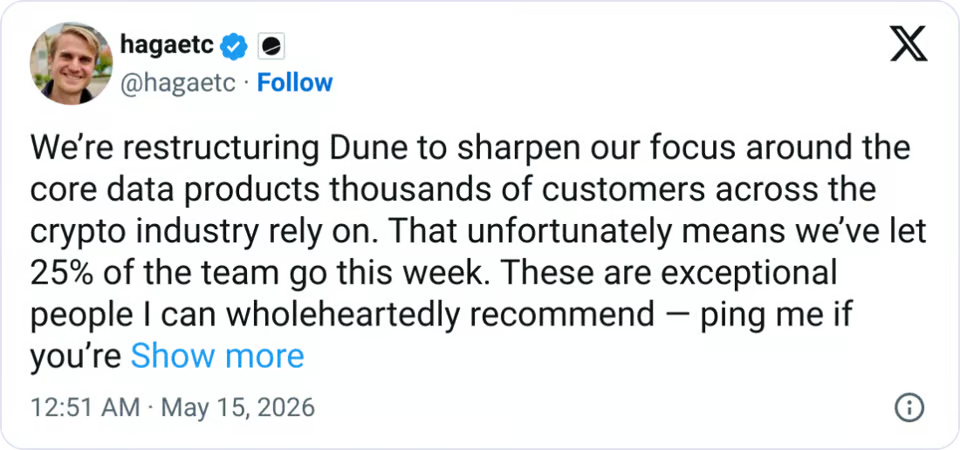
Crypto data company Dune said it is laying off 25% of its workforce, citing a need to restructure its business to focus on its core products.
“We’re restructuring Dune to sharpen our focus around the core data products thousands of customers across the crypto industry rely on,” Dune co-founder and CEO Fredrik Haga posted to X on Thursday. “That unfortunately means we’ve let 25% of the team go this week.”
Haga did not share the number of staff who were laid off. The company’s LinkedIn shows about 150 employees. Haga said the company remained “well capitalized” and that Dune was “all-in” on artificial intelligence and growing institutional interest in crypto.
Layoffs and closures are rising across the crypto and tech sectors this year, with many companies citing AI as both a help and a hindrance.
Just this month, Coinbase cut 700 employees, or about 14% of its workforce, on May 5, citing an increase in AI use, while the crypto news outlet DL News shuttered on Friday, citing part of the reason was decreased reach in internet search results due to AI aggregation.
Haga said that Dune’s Model Context Protocol, or MCP, which allows AI to interact with the platform, means “teams and agents can now build dashboards and workflows without needing to know anything” about data infrastructure or SQL, a programming language for databases.

Source: Fredrik Haga
He added the company would also be “investing heavily” in its data products and services for institutions, as the company sees “currencies, stocks, bonds, commodities and more” are moving onchain.
Related: How AI became crypto’s favorite reason to cut staff
Dune’s cutbacks add to the more than 5,000 jobs eliminated at major crypto companies this year.
Block Inc. undertook the biggest round of layoffs of a crypto company so far in 2026, halving its workforce and cutting 4,000 staff in February.
The crypto exchanges Gemini and Crypto.com also laid off 200 and around 180 employees, respectively, earlier this year, with each citing the rising use of AI for efficiency gains.
Layoffs are also widespread in the US tech sector, with 137 companies cutting nearly 109,000 jobs so far in 2026, according to data from Layoffs.fyi.
Magazine: Guide to the top and emerging global crypto hubs: Mid-2026
Bitcoin (BTC) treasury firm Strive Inc. will make its SATA preferred stock the first US-listed security paying cash dividends every business day. The daily payouts begin June 16.
The Dallas-based Bitcoin treasury firm disclosed the structural shift alongside first-quarter results.
Strive’s SATA to Pay Investors Cash Every Single Business Day
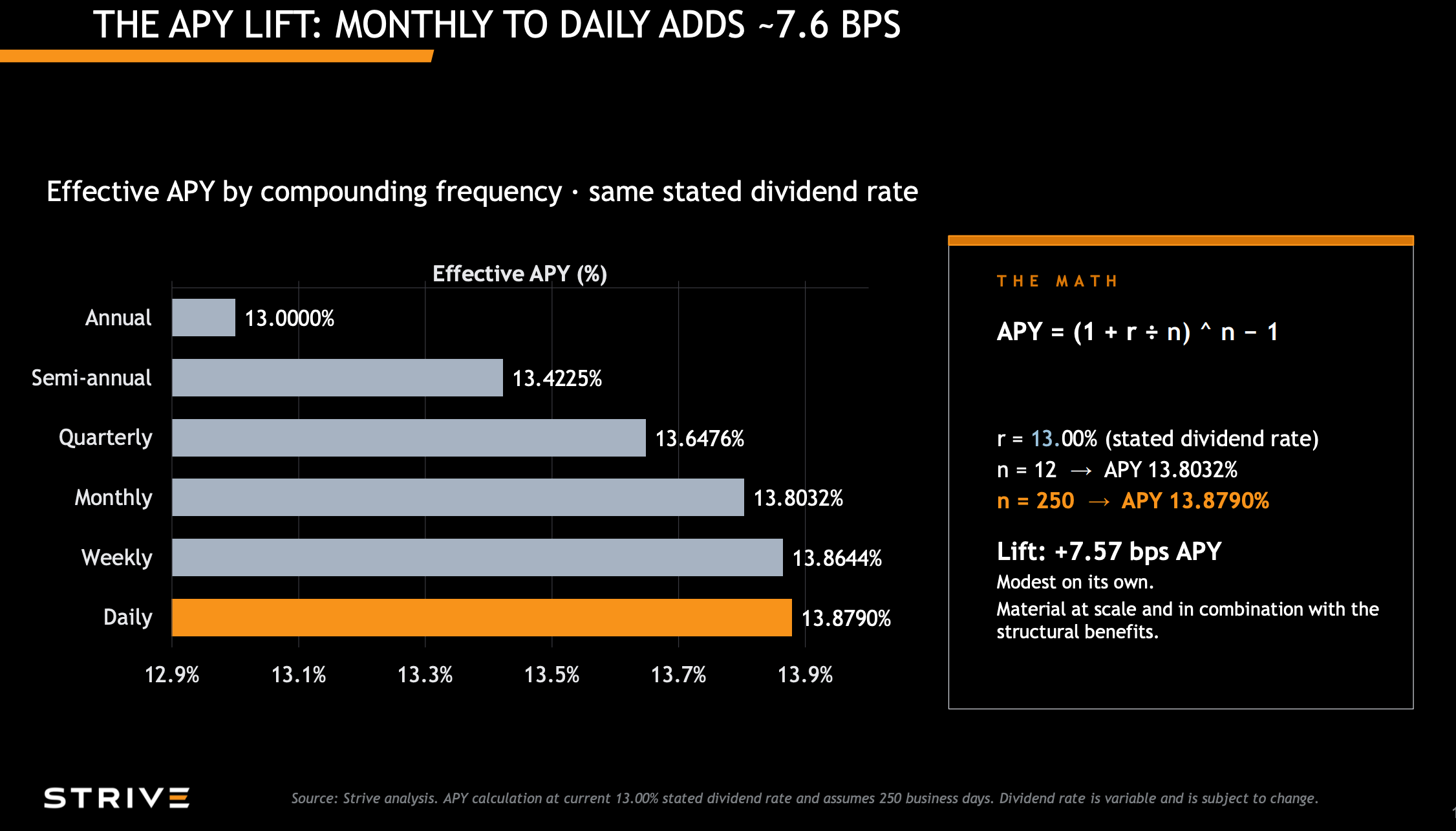
Strive’s Variable Rate Series A Perpetual Preferred Stock (SATA) currently pays a 13% annualized dividend monthly. While the headline rate remains unchanged, daily compounding over roughly 250 business days lifts the effective annual yield to 13.88%.
Follow us on X to get the latest news as it happens

CEO Matthew Cole framed the shift as a “zero-to-one innovation.” He also called the firm “The Daily Dividend Company.”
“SATA will be the first listed security in the history of U.S. capital markets to pay cash dividends every single Business Day, beginning June 16, 2026, at a current annualized rate of 13.00%,” he said.
Bitcoin Treasury Expands Past 15,000 BTC
Meanwhile, the firm also announced its first-quarter financial results. First-quarter GAAP net loss totaled $265.9 million, with $295.8 million tied to the fair value decline in Bitcoin holdings. That figure accounts for 96.6% of the reported loss.
The company added 6,001 BTC during the first quarter, including 5,048 BTC absorbed through the all-stock acquisition of Semler Scientific. Another 1,381 BTC came in April and early May.
Strive’s Bitcoin holdings reached 15,009 BTC as of May 12. That ranks the firm ninth among public corporate holders, according to Bitcoin Treasuries data.
Strive also confirmed it carries no short or long-term debt. The balance sheet held $87.6 million in cash and a $50.5 million position in Strategy’s STRC preferred stock.
Subscribe to our YouTube channel to watch leaders and journalists provide expert insights
The post Strive Makes SATA First US Security to Pay Cash Dividends Every Business Day appeared first on BeInCrypto.

Design Within Reach Promo Codes: 30% Off | 2026

How Big Celebrity Buys GOLD Safety Tips #finance #shorts

Elon Musk Calls Out Farage Over Donation Allegation

Manchester United reach agreement with Casemiro over contract clause amid transfer speculation

US brings back mandatory military draft registration

Steven Gerrard disagrees with Gary Neville over ‘shock’ Chelsea and Arsenal claim | Football
![[CONFIRMED] Bitcoin Holders...This is BIG!](https://wordupnews.com/wp-content/uploads/2026/05/1778822840_maxresdefault-80x80.jpg)

-
 Crypto World7 days ago
HarrisX Poll Found 52% of Registered Voters Support the CLARITY Act
-

 Fashion6 days ago
Weekend Open Thread: Marianne Dress
-

 Fashion3 days ago
Coffee Break: Travel Steam Iron
-

 Fashion4 days ago
What to Know Before Buying a Curling Wand or Curling Iron
-

 Tech5 days ago
Auto Enthusiast Carves Functional Two-Stroke Engine from Solid Metal
-

 Politics3 days ago
What to expect when you’re expecting a budget
-
 Business6 days ago
Ignore market noise, India’s long-term story intact, say D-Street bulls Ramesh Damani and Sunil Singhania
-

 Politics6 days ago
Politics Home Article | Starmer Enters The Danger Zone
-

 Tech4 days ago
GM Agrees To Pay $12.75 Million To Settle California Lawsuit Over Misuse Of Customers’ Driving Data
-

 Crypto World6 days ago
PROS explodes 48% as Upbit and Bithumb listings ignite demand
-

 Crypto World5 days ago
CZ says US crypto rivals tried to block Trump pardon
-

 Tech3 days ago
GM agrees to $12.75M California settlement over sale of drivers’ data
-

 Entertainment6 days ago
YNW Melly Denied Bond Again Ahead Of Double Murder Retrial
-

 Sports7 days ago
Bayern Munich vs PSG UEFA Champions League SF2 live match time, streaming | Football News
-
Tech7 days ago
The Most Exciting Apple Products In The Pipeline For 2026 And Beyond
-
Crypto World7 days ago
The Hantavirus Danger: Can a Potential Outbreak Spark a New Meme Coin Frenzy?
-

 Crypto World6 days ago
Kraken Parent Seeks OCC Charter, Signaling Regulated Banking Access
-

 Politics7 days ago
David Attenborough ‘Overwhelmed’ By Love Shown Ahead Of 100th Birthday
-

 Sports6 days ago
After Waka Waka, Shakira now drops first teaser for FIFA WC 2026 song | FIFA World Cup 2022
-
 Crypto World6 days ago
Solana UFO Meme Coins Surge After Pentagon Reveals Alien Files
You must be logged in to post a comment Login