

Crypto World
ETH Smart Money Flow Index Shows Net Inflow Amid Bearish ETF Outflow Trend


TLDR:
- The ETH Smart Money Flow Index recorded an 18% net inflow rise over seven days despite bearish ETF data.
- Large non-exchange ETH wallet cohorts net-added ETH across nine of the last twelve trading sessions.
- The same cohort bridged ETH to Hyperliquid and Base during the May 14 dip, signaling repositioning not selling.
- This accumulation pattern mirrors October 2023 wallet behavior, which preceded ETH’s move from $1,500 to $4,100.
The ETH Smart Money Flow Index has recorded an 18% net inflow rise over seven days, even as ETF outflows mount. This divergence is drawing attention from on-chain analysts tracking large wallet behavior.
While exchange data and ETF metrics point toward capitulation, a separate layer of on-chain activity tells a different story.
The contrast between these two data streams is reshaping how some analysts interpret current ETH market conditions.
Large Wallet Cohorts Net-Buy ETH During Price Decline
ETH lost its $2,200 support level recently, triggering widespread bearish sentiment across the market. ETF outflows totaled $431.86 million across eight sessions between May 11 and May 20. Public dashboards broadly reflected capitulation signals during that same stretch.
However, Alphractal posted on X that the Smart Money Flow Index told a different story. The metric tracks the largest non-exchange ETH wallet cohorts and monitors where they route liquidity on-chain. According to the post, these wallets net-added ETH in nine of the last twelve sessions.
This metric does not read ETF wrappers or aggregate exchange balances. Instead, it focuses on wallet-level activity from cohorts historically tied to large ETH price moves. That distinction separates it from most publicly available tracking tools.
The same cohort also began bridging ETH to Hyperliquid and Base during the May 14 dip. This movement suggests repositioning rather than outright selling, which differs from what exchange flow data currently shows.
On-Chain Repositioning Mirrors a Pattern Seen in October 2023
Alphractal noted that this behavior mirrors a pattern the same cohort displayed in October 2023. At that time, these wallets accumulated ETH before the asset moved from $1,500 to $4,100. The current setup is drawing comparisons to that earlier accumulation phase.
The post stated that stacking ETF outflow data alongside Smart Money Flow data produces a clearer picture. Retail investors and ETF allocators appear to be selling below $2,200. Meanwhile, the cohort tied to previous cycle bottoms continues to absorb that supply.
No single metric is sufficient for reading ETH market structure accurately. ETF outflows appear bearish in isolation, while Smart Money Flow reads bullish on its own. Combining both layers reveals the divergence between surface-level sentiment and deeper on-chain activity.
Alphractal stopped short of predicting an immediate price rally. The post clarified that the takeaway is about net buying behavior, not a short-term price call. The divergence between front-page narratives and wallet cohort activity remains the central point of the analysis.



Key Highlights
- Shares of NVTS climbed nearly 20% following investor conference announcements and sustained earnings-driven momentum
- First-quarter revenue reached $8.6M, exceeding forecasts; second-quarter outlook of approximately $10M surpassed Street projections by more than 11%
- Baird increased its price target from $9 to $20; Needham upgraded from $13 to $21
- Elevated short interest at 21% intensified the rally as bearish traders scrambled to exit positions
- Company secured a GaN technology licensing agreement with Cyient Semiconductors to produce India’s inaugural domestically branded GaN IC portfolio
Shares of Navitas Semiconductor (NVTS) reached a 52-week peak of $28.85 during Thursday’s trading session, climbing nearly 20% as several positive developments converged simultaneously.
Navitas Semiconductor Corporation, NVTS
The upward momentum accelerated following the company’s announcement that CEO Chris Allexandre and CFO Tonya Stevens will participate in the Craig-Hallum Institutional Investor Conference scheduled for May 28 in Minneapolis, along with the Evercore Global TMT Conference set for June 3 in San Francisco.
This conference participation news built upon recent earnings results that exceeded Wall Street projections. First-quarter revenue totaled $8.6M, surpassing analyst forecasts, while earnings per share registered at -$0.04 compared to the consensus estimate of -$0.05.
Management’s second-quarter fiscal 2026 revenue projection of roughly $10M exceeded the Street’s $8.93M estimate, suggesting sequential revenue expansion exceeding 16% alongside enhanced gross margin performance.
Wall Street analysts moved swiftly to adjust their outlooks. Baird elevated its price objective from $9 to $20, highlighting three secular expansion drivers connected to 800V AI data-center power infrastructure.
Needham subsequently increased its target from $13 to $21, emphasizing the quarterly earnings outperformance and above-consensus forward guidance as key justifications.
The semiconductor company had already established itself as one of the sector’s more notable recovery narratives. Through the current year, NVTS has advanced more than 241%.
Short Covering Intensifies Upward Movement
With short interest representing 21% of available shares as of mid-April, Thursday’s positive catalysts didn’t merely draw in fresh buyers — they compelled short sellers to unwind positions.
When heavily-shorted securities experience rapid price appreciation, forced covering can drive valuations significantly beyond what fundamental factors alone might justify, a pattern that clearly manifested in this situation.
Strategic GaN Partnership Expands Market Reach
Navitas simultaneously unveiled a licensing arrangement with Cyient Semiconductors to create India’s first domestically branded 650–700V gallium nitride integrated circuit product line.
These semiconductor components target AI data center applications, telecommunications infrastructure, rapid charging solutions, industrial power systems, and electric mobility sectors. Cyient will additionally serve as an alternative manufacturing source for selected Navitas GaN products.
This partnership introduces an expanded geographical element to NVTS’s expansion narrative and reflects increasing global appetite for its gallium nitride semiconductor technology.
From a financial position standpoint, NVTS maintains negligible debt obligations while holding cash reserves exceeding $220M, providing sufficient capital to support its gallium nitride and silicon carbide transformation without requiring external financing in the near term.
Broader equity markets contributed supportive conditions as well, with the S&P 500 advancing 0.6%, the Dow Jones climbing 0.8%, and the Nasdaq gaining 0.6% during the session.
Industry competitors including Wolfspeed and Marvell Technology continue operating within the AI power semiconductor landscape, sustaining investor focus on the broader GaN and SiC technology ecosystem.
NVTS’s current market capitalization stands at approximately $5.37B, with typical daily trading volume approaching 29 million shares. The stock concluded trading on May 22 at its 52-week peak of $28.85.


GameStop (GME) CEO Ryan Cohen publicly questioned eBay’s spending efficiency after the e-commerce platform posted a Senior Manager of Marketing Effectiveness role, citing the company’s $2.4 billion marketing budget.
The remarks extend a running public dispute between the two companies. It began with GameStop’s rejected $56 billion acquisition offer and escalated after eBay suspended Cohen’s seller account.
Cohen Questions Where the Money Goes
In response to a seller’s thread about eBay’s support failures and account access problems, Cohen posted on X that a company with $2.4 billion in marketing spend should be able to handle basic platform functions.
When a separate post flagged eBay’s new Toronto-based marketing effectiveness role, Cohen quote-tweeted it with a pointed observation that the position’s responsibilities include finding out where the money is going.
The role, listed under job code R0074539, sits within eBay’s Marketing & Communications division and reports to the Head of Marketing Efficiency. eBay’s fiscal 2025 sales and marketing spend totaled $2.4 billion.
GameStop – eBay Takeover Feud Behind the Jabs
Cohen’s efficiency critique ties to the ongoing GameStop acquisition bid. GameStop offered $56 billion in cash and stock, or $125 per share. TD Securities provided a highly confident letter backing up to $20 billion in financing.
eBay’s board reviewed the proposal and rejected the bid as neither credible nor attractive after consulting independent advisors.
Shortly after the feud became public, eBay permanently suspended Cohen’s seller account. The company said the activity posed a risk to its community.
Cohen had listed GameStop-branded items on the platform, including store signs and a square of branded carpet. The Cohen account suspension drew substantial public attention and was widely viewed as a deliberate publicity move.
With the acquisition rejected and his account banned, Cohen has turned to publicly scrutinizing eBay’s operations. The marketing effectiveness hire gives him a ready-made target.
The post GameStop CEO Questions eBay’s $2.4 Billion Marketing Spend appeared first on BeInCrypto.


Bitcoin ETF outflows reached $1.26 billion over six sessions, but Santiment says the streak signals a buying opportunity.
Summary
- US spot Bitcoin (BTC) ETFs recorded net outflows in each of the six trading sessions from May 15 through May 22, totalling $1.26 billion across 11 funds.
- Santiment says ETF flows reflect retail investor sentiment rather than institutional positioning, calling the outflow streak a contrarian accumulation signal.
- Bitcoin was trading at $75,410 when Santiment published its report, down from a May high of $79,052 reached on May 16.
The 11 US-listed spot Bitcoin ETFs have recorded net outflows in each of six sessions from May 15 through May 22, totalling $1.26 billion according to Farside data.
“Sustained ETF outflows have historically correlated with conditions favorable for patient accumulation rather than panic,” Santiment said in a published report. The analytics firm argued that ETFs disproportionately reflect retail conviction rather than smart money positioning, making large outflows a counter-signal.
Why Santiment reads outflows as a buying signal not a warning
Santiment’s analysis rests on a historical pattern: Bitcoin’s strongest rallies have followed periods of heavy ETF withdrawals. The firm said retail investors grew less patient after Bitcoin failed to hold $80,000, with the current streak resembling a healthy market reset.
ETF analyst James Seyffart noted that Bitcoin ETFs have clawed back most of the $9 billion in outflows seen between October 2025 and February 2026. Crypto.news has reported on the first May outflow event, which reversed the early-month inflow trend.
What the Farside data shows across the 11 funds
Fidelity’s Wise Origin Bitcoin Fund led individual redemptions within the streak. BlackRock’s IBIT saw outflows on multiple sessions, and Morgan Stanley’s MSBT attracted positive flows on some days during the period.
Crypto.news has tracked Bitcoin ETFs ending Q1 2026 with net outflows of approximately $500 million, showing the current six-session streak continues a broader 2026 pattern of intermittent redemptions.
Santiment’s contrarian framing does not eliminate further downside risk. If Bitcoin breaks below $74,000, the outflow streak would need reassessment as a buy signal.

Key Takeaways
- BB shares reached a 52-week peak at $6.64, surging approximately 19% in one trading session
- Fourth quarter fiscal 2026 earnings exceeded projections: EPS of $0.06 versus consensus of $0.05, revenue of $156M compared to $142.55M forecast
- QNX business unit posted 20% annual growth, achieving record revenue of $78.7M
- Company executives announced at CIBC Technology and Innovation Conference that BlackBerry is transitioning into a phase of profitable expansion
- InvestingPro data suggests potential overvaluation; Baird maintains $5.00 target, Canaccord sets $4.40 price objective
Shares of BlackBerry soared approximately 19% to reach a 52-week peak of $6.64, extending a rally that has propelled the stock more than 75% higher year-to-date.
The dramatic upswing followed executive presentations at the CIBC Technology and Innovation Conference 2026, where company leadership informed investors that BlackBerry has entered a phase of profitable growth driven by its QNX software platform and physical AI initiatives.
The announcement resonated strongly with market participants who have been increasingly receptive to the company’s transformation toward software-centric operations.
Additional momentum came from the renewal of a critical U.S. FedRAMP cybersecurity authorization for the AtHoc platform. The Class D (High) recertification maintains BlackBerry‘s qualification for federal government contracts, providing important support for its Secure Communications division.
A reinstated share repurchase authorization, encompassing up to 26.8 million shares, further bolstered investor sentiment by demonstrating management’s conviction in the strategic direction.
Fourth Quarter Results Surpass Forecasts
BlackBerry’s fiscal 2026 fourth quarter performance exceeded analyst expectations across key metrics. The company delivered adjusted earnings per share of $0.06, topping the $0.05 consensus estimate, while revenue reached $156 million—significantly above the projected $142.55 million.
The revenue figure marked a 10% year-over-year expansion, reflecting the type of sustained top-line momentum the organization has been pursuing through its strategic transformation.
The QNX division, which develops embedded software solutions for automotive and industrial applications, delivered particularly strong results. Revenue in this segment increased 20% to an all-time high of $78.7 million. Meanwhile, the Secure Communications unit expanded 8% to $72.5 million.
Wall Street Price Targets Lag Stock Performance
Notwithstanding the market’s enthusiasm, Wall Street analyst price objectives haven’t kept pace with the stock’s ascent.
Baird maintained its Neutral stance with a $5.00 valuation target. Canaccord revised its objective downward to $4.40 while retaining a Hold recommendation.
Both price targets remain substantially beneath current trading levels, suggesting potential concerns about whether market valuations have outpaced underlying business fundamentals.
InvestingPro’s analytical framework identifies the stock as potentially trading above its Fair Value estimation, including BB among its most overvalued securities.
During the preceding six-month period, shares have appreciated nearly 49%. For the current year, gains exceed 75%. The company’s market capitalization currently stands at roughly $3.62 billion.
Daily trading volume averages approximately 15.9 million shares, while technical momentum indicators presently generate buy signals.
The primary recent catalyst continues to be the CIBC conference presentations coupled with robust QNX performance, the FedRAMP recertification achievement, and the buyback program announcement.
TLDR:
- Bloom Energy posted $751M in Q1 2026 revenue, a 130% year-over-year jump driven by AI data center demand.
- Bloom deploys fuel cell systems in 90 days versus the two-to-five years a standard grid connection typically requires.
- Oracle has committed to procure up to 2.8 gigawatts of Bloom’s systems, with 1.2 gigawatts already under contract.
- Bloom projects 30% of all data center sites will rely on onsite power as a primary energy source by 2030.
Bloom Energy is gaining ground as one of the most closely watched names in AI infrastructure. The company posted $751 million in revenue in Q1 2026, a 130% increase year over year.
Product revenue alone grew 208% in that single quarter. With full-year 2026 guidance now set at $3.4 billion to $3.8 billion, Bloom Energy is moving well beyond the margins of the AI buildout conversation.
Rapid Deployment Solves the AI Power Problem
Bloom Energy addresses a bottleneck that is slowing down data center construction across the sector. A traditional utility grid connection for a large data center typically takes two to five years to complete.
Bloom can deploy its fuel cell systems in as little as 90 days, scaling from 20 megawatts up to 500 megawatts per site.
That speed is one of the key reasons major cloud and infrastructure operators are turning to Bloom. Oracle has committed to procure up to 2.8 gigawatts of Bloom’s fuel cell systems, with 1.2 gigawatts already under contract.
Equinix, CoreWeave, and AEP — which supplies power to Amazon Web Services — are also confirmed customers.
The reliability figures are also notable. Bloom’s systems operate at up to 99.999% availability. That number exceeds what most utility grid connections can guarantee, making it a compelling option for workloads that cannot tolerate downtime.
Milk Road AI, an industry analyst account, described the investment case in a recent post: Bloom solves the single biggest problem in data center development right now — getting power fast.
Analysts at Milk Road Pro flagged Bloom Energy early. Their central thesis was that the AI energy bottleneck would become just as large an investment opportunity as the chip bottleneck. That view has since been validated by the company’s financial results and contract pipeline.
Institutional Deals and Production Expansion Signal Long-Term Growth
The scale of Bloom’s commercial agreements suggests this is not a temporary cycle. Bloom has signed a $5 billion strategic AI infrastructure partnership with Brookfield Asset Management.
Under that agreement, Bloom becomes the preferred onsite power provider across Brookfield’s $1 trillion infrastructure portfolio.
This week, a supplier to Bloom received what it described as the largest single contract in its company’s history. The contract covers switchgear manufacturing in support of a large-scale AI data center project.
On the production side, Bloom is on track to double its annual manufacturing capacity to 2 gigawatts by the end of 2026. Further scaling is planned beyond that point.
The company’s own research projects that approximately 30% of all data center sites will rely on onsite power as a primary energy source by 2030.
That market barely existed three years ago. The shift toward continuous computing — where AI models run around the clock rather than on demand — is what is driving the structural change.
Jensen Huang, CEO of Nvidia, has noted that AI computing requires up to 1,000 times more energy than traditional on-demand computing, and has acknowledged that estimate could move in either direction by another order of magnitude.
Bloom Energy’s stock has risen 1,231% over the past twelve months and is up more than 130% year to date. Those figures reflect a broader market recognition that the energy layer of AI infrastructure carries just as much value as the hardware layer above it.


Michael Saylor says a Strategy Bitcoin sale before year-end is ‘not unlikely’ in a Coin Stories podcast interview.
Summary
- Saylor told Natalie Brunell it was “not unlikely” Strategy would sell some Bitcoin before year-end, softening his long-held never-sell position.
- He said any model relying solely on equity, credit, or Bitcoin sales underperforms, and that Strategy uses a mixed capital management approach.
- Strategy holds 818,334 BTC worth approximately $65 billion and aims to maximise Bitcoin per share over a seven-year horizon to 2033.
Strategy executive chairman Michael Saylor told the Coin Stories podcast it was “not unlikely” the company would sell some Bitcoin before year-end. The comment softens his long-standing public position that Strategy would never sell.
“I think it’s not unlikely that we’ll sell some Bitcoin between now and the end of the year,” Saylor said. “Any model that we put together that’s limited only to equity or only to credit or only to Bitcoin always underperforms.”
Why Saylor says Strategy might sell Bitcoin in 2026
The comments follow Strategy’s Q1 earnings call, where Saylor said the company raised the possibility of selling Bitcoin to fund dividends, saying it would “inoculate the market.” Crypto.news has reported on that call and the $12.54 billion Q1 net loss that preceded it.
Saylor described Strategy’s capital management as programmatic and data-driven, with liabilities evaluated against a mix of cash, equity, credit and Bitcoin. Strategy holds 818,334 BTC acquired for approximately $61.6 billion at an average price of $75,527.
Saylor also confirmed Strategy does not plan to retire its STRF, STRD, and STRK preferred products, calling them useful parts of the capital structure while convertible bonds remain senior liabilities to be retired over time.
What a Strategy Bitcoin sale would mean for markets
Saylor said any sale would be small relative to Bitcoin’s daily market liquidity, estimated at $20 to $50 billion. He argued Strategy could buy roughly 20 Bitcoin for every one sold if dividends were fully funded through BTC sales.
Crypto.news has noted Saylor’s framing of Strategy’s three-layer capital structure, with Bitcoin as digital capital, STRC as digital credit, and MSTR as leveraged equity. The firm’s seven-year goal is to maximise Bitcoin per share by 2033.
Saylor said this long-term lens makes 2026 Bitcoin sales a capital allocation decision, not a reversal of conviction.
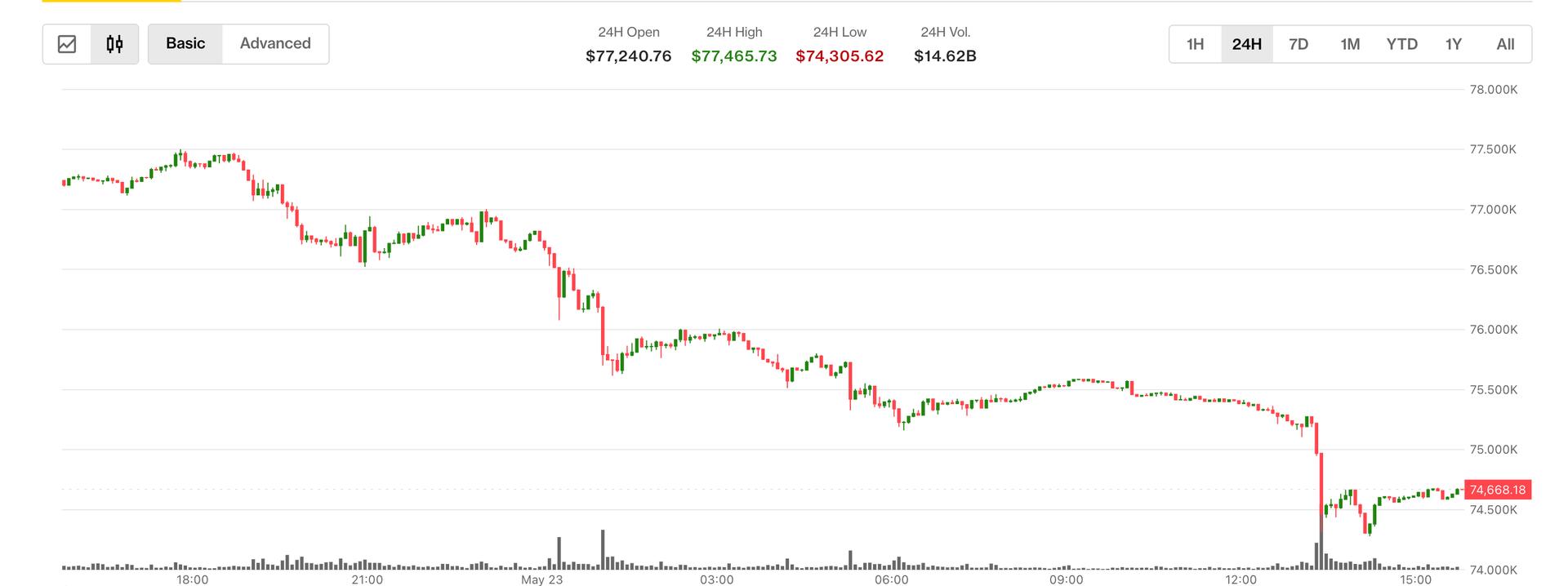
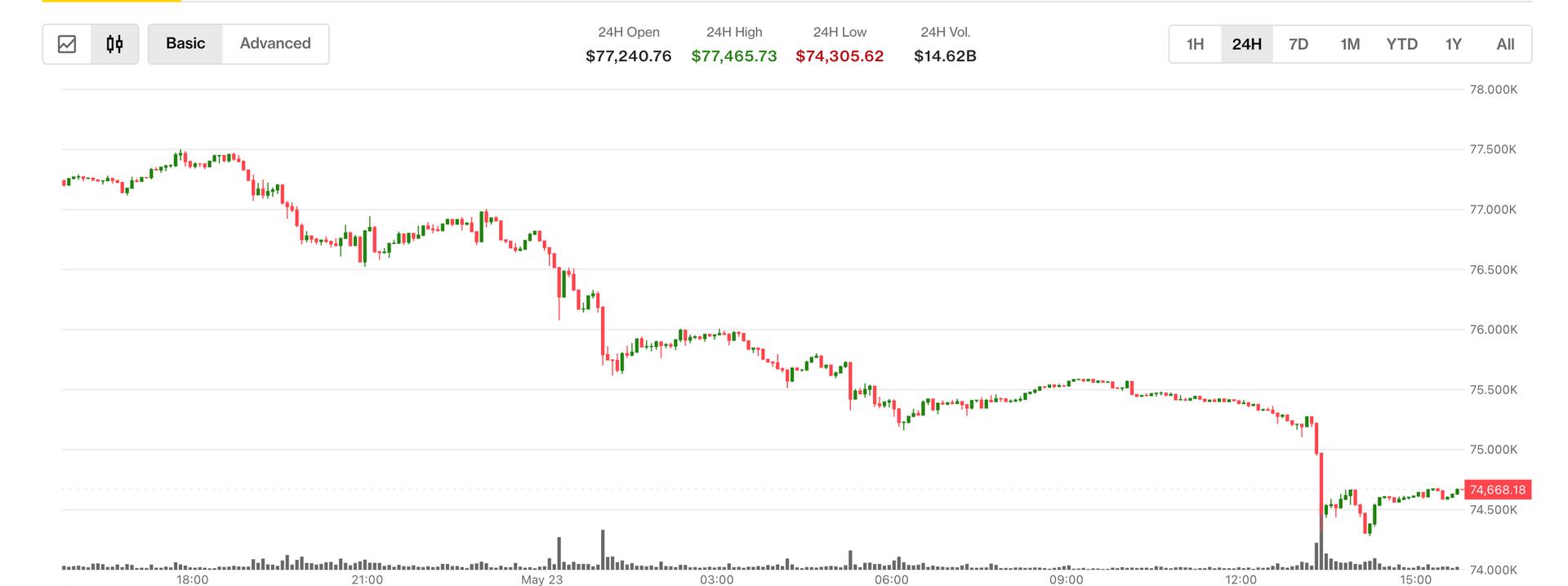
Bitcoin is rapidly losing ground as investors pull out billions of dollars from U.S.-listed spot ETFs.
The world’s largest cryptocurrency fell to $74,305 early Saturday, its lowest level since April 20, according to CoinDesk data. As of writing, BTC was down more than 3% over the past 24 hours and approximately 10% below its recent high of over $82,500 reached on May 6.
The sell-off accompanies a notable upswing in U.S. Treasury yields and parallel increases in government bond yields across developed markets, which are reducing appetite for high-risk, zero-yielding assets like bitcoin.
Investors withdrew $1.26 billion from U.S. spot Bitcoin ETFs this week, the largest single-week outflow since January, following roughly $1 billion in outflows the previous week. In total, the funds have seen more than $2.26 billion in redemptions over the past two weeks.
Meanwhile, commodities such as oil, copper, and sulfur are seeing strong flows of speculative money as markets continue to price in potential supply disruptions through the Strait of Hormuz due to the Iran conflict.
One theory also points to capital being redirected toward SpaceX’s anticipated IPO, with several blockchain-based pre-market derivatives tied to the event already seeing millions in trading volume on blockchain-based platforms.
TLDR:
- The tokenized ETF market tripled since late 2025, reaching $1.4B TVL with $400M+ in daily onchain settlement volume.
- Ondo Finance controls roughly 70% of the market with over 200 live assets and more than $1B in total value locked.
- xStocksFi surpassed $25B in cumulative transactions, powering DeFi collateral and lending for tokenized stocks on Solana.
- Analysts project $10B+ TVL by end of 2026, with a potential 50–100x rise if assets capture 0.5% of global equity AUM.
The tokenized ETF market has crossed $1.4 billion in total value locked, marking a sharp rise from late 2025. Daily onchain settlement volume across top platforms now exceeds $400 million.
Monthly transaction volume has grown 12 times over the past six months. The sector now accounts for over 18% of all relevant real-world asset flows.
Industry analysts project tens of billions in TVL by year-end as tokenized assets target even a fraction of the $120 trillion global equity market.
Ondo Finance and Key Players Drive Tokenized Equity Growth
Ondo Finance currently holds roughly 70% of the tokenized ETF market. The platform has crossed $1 billion in TVL with over 200 assets live. That dominance places it well ahead of other competing protocols in the space.
Researcher Nick posted on X that the market cap of the sector rose from just $0.62 million on July 1, 2025, to approximately $300 million by the end of Q1 2026.
That figure reflects a broad shift in how institutions and retail users are accessing equity exposure. The growth has been steady rather than driven by a single asset class.
Dinari Global operates as the first broker-dealer licensed for dShares, targeting domestic retail and platform flows.
WisdomTree Prime offers 24/7 trading and instant settlement for its tokenized Treasury and ETF products. Both firms bring regulated infrastructure to a market that has historically operated in a gray area.
Robinhood has also entered the space, offering stock tokens covering over 2,000 U.S. stocks and ETFs for European users.
All tokens are backed by Robinhood custody, which adds a layer of security and compliance. That move brings a mainstream brokerage into direct contact with onchain settlement rails.
xStocksFi Powers the DeFi Layer for Tokenized Assets on Solana
xStocksFi has recorded over $25 billion in cumulative transaction volume on its platform. The protocol issues more than 100 one-to-one backed tokens with full DeFi collateral and lending options on Solana. That positions it as a core liquidity layer for tokenized stocks in decentralized finance.
The platform’s role goes beyond simple token issuance. By supporting lending and collateral use cases, xStocksFi allows tokenized equities to function as productive assets within DeFi ecosystems. That functionality has drawn both retail and institutional participants to the Solana network.
Current projections place the sector at $10 billion or more in TVL by the end of 2026. That would represent a sevenfold increase in roughly seven months from the current $1.4 billion figure.
Over a three-to-four year horizon, capturing just 0.5% of global equity and ETF assets under management could push the market 50 to 100 times higher.
The payments, real-world asset, and institutional settlement use cases are all expanding alongside tokenized equities.
The convergence of regulated issuers, DeFi liquidity, and mainstream custodians appears to be accelerating the adoption curve faster than prior cycles in crypto.


Robinhood crypto COO Tanya Denisova is leaving the platform after more than five years.
Summary
- Tanya Denisova, COO of Robinhood Crypto, is leaving the firm after more than five years as the platform navigates a 47% decline in Q1 crypto revenue.
- Robinhood’s Q1 2026 crypto revenue fell to $134 million from $252 million a year earlier, contributing to an earnings miss reported on April 28.
- No successor has been named and neither Denisova nor Robinhood have publicly commented on the departure.
Tanya Denisova, chief operating officer of Robinhood Crypto, is leaving the company after more than five years, according to two people with knowledge of the matter. Neither she nor Robinhood has publicly commented and no successor has been named.
Robinhood’s Q1 2026 crypto revenue fell 47% year over year to $134 million, down from $252 million a year earlier. The drop contributed to an earnings miss on April 28, with Morningstar describing crypto trading as a “particular pressure point” for the quarter.
What Denisova built and why her exit matters now
Under Denisova’s operational watch, Robinhood launched commission-free crypto trading, digital wallets, and staking options. The platform also completed its acquisition of Bitstamp in 2025, significantly expanding its institutional and international reach.
Crypto.news has tracked the Q1 2026 earnings miss, with Morningstar describing crypto as a “particular pressure point.” Crypto.news has also reported on the Q4 2025 crypto revenue decline of 38%, a trend that now extends into 2026 with a steeper fall.
Crypto trading revenue is tied directly to market volatility and retail participation. In Q1 2026, Bitcoin spent most of the quarter below $80,000 and retail trading volumes contracted sharply following macro pressures at the start of the year.
Why crypto revenue fell 47% and what it means for Robinhood’s business
Robinhood’s total net revenue rose 15% to $1.07 billion in Q1 2026, meaning the overall business is growing even as crypto drags. Crypto.news has reported on the platform’s $25 billion monthly crypto trading volume in early 2026, a figure that shows volume remained large while revenue capture per trade weakened.
The leadership gap comes as Robinhood evaluates how aggressively to pursue crypto amid sustained market pressure. A 47% year-over-year revenue decline signals the platform is capturing less value from each dollar of crypto trading volume than it did in 2025, a structural challenge that any incoming COO will need to address.

Key Takeaways
- Dell Technologies shares jumped more than 16% Friday, closing near $294 and marking a fresh all-time high before the company’s Q1 earnings release on May 28.
- Year-to-date gains have reached between 130% and 140%, positioning Dell among the best-performing stocks in the S&P 500 for 2026.
- Multiple Wall Street firms upgraded their outlook, including Mizuho’s $300 price target driven by Dell’s massive $43 billion AI server order backlog.
- Competitor Lenovo reported impressive first-quarter performance with an 84% surge in AI revenue, boosting confidence in Dell’s upcoming results.
- Options traders are displaying bullish sentiment with a 0.5 put-to-call ratio and implied post-earnings targets approaching $323.
Shares of Dell Technologies (DELL) rocketed over 16% Friday, approaching $294 and establishing a fresh all-time closing high. The explosive rally extends the stock’s year-to-date advance to approximately 130–140%, marking it as one of 2026’s most impressive performers within the S&P 500.
The dramatic single-session move followed a coordinated series of bullish analyst calls, all published just days before Dell reports first-quarter financial results after market close on May 28.
Citi analysts boosted their DELL price objective to $290, highlighting the company’s strategic role in “neocloud” infrastructure buildouts and growing appetite for “sovereign AI” systems. JPMorgan chimed in with reassurance that rising memory component costs remain “manageable” while enterprise AI server demand continues accelerating.
Mizuho took the most aggressive stance, pushing its target to $300. The firm emphasized that institutional buyers are fixating on Dell’s staggering $43 billion AI server backlog rather than worrying about short-term margin headwinds.
Bank of America, maintaining its “buy” recommendation, noted observing “substantial” momentum in both AI hardware purchases and conventional PC sales during the first half of 2026, with AI server strength expected to persist through year-end.
Among the seven analysts currently covering Dell according to Visible Alpha data, six maintain buy ratings while just one holds a neutral view. Notably, the stock has already sailed past the consensus price target of $223.
Lenovo Results Provide Encouraging Preview
Competitor Lenovo delivered first-quarter numbers that further energized Dell bulls. The Chinese technology giant posted 27% year-over-year revenue growth reaching $21.6 billion, while net income doubled to $559 million. Particularly striking was the 84% explosion in AI-related revenue.
Market participants are interpreting Lenovo‘s performance as a positive indicator for Dell’s upcoming disclosure. The prevailing view suggests that if Lenovo captured such robust demand, Dell should deliver comparable or superior results given its market positioning.
Street consensus anticipates Dell reporting approximately 52% year-over-year revenue expansion for Q1, with earnings per share projected around $2.94.
Nvidia’s stronger-than-anticipated quarterly performance earlier this week provided additional momentum. Citi specifically cited those results as a constructive signal for Dell, considering the deep integration between both companies across AI infrastructure supply chains.
Derivatives Trading Signals Bullish Positioning
Options market activity reveals traders preparing for continued upside following the earnings announcement. The put-to-call ratio for contracts expiring May 29 stands at 0.5, reflecting decidedly bullish positioning. Implied volatility pricing suggests an upper target near $323, indicating expectations for a potential 10% post-earnings jump.
Technically, DELL is trading comfortably above all significant moving averages, with the Relative Strength Index hovering in the mid-70s—indicating persistent buying momentum.
Dell also maintains a dividend yielding 0.85%, offering a supplementary income element for buy-and-hold investors.
The company’s first-quarter earnings announcement is confirmed for after the closing bell on May 28.

TOP 5 MOST EXPENSIVE CARS ON FINANCIAL AUDIT

Pope Leo visits area near Naples polluted by toxic waste

YouTuber Finds 750-Year-Old Bone While Searching for Nancy Guthrie Near Tucson


-

 Crypto World2 days ago
Blockchain.com files with SEC for U.S. IPO
-

 Fashion17 hours ago
Holiday Weekend Open Thread – Corporette.com
-

 Crypto World6 days ago
Intesa Sanpaolo’s crypto holdings jump to $235M as XRP enters
-

 Business20 hours ago
Dell Technologies DELL Stock Surges 15% on AI Server Momentum and Analyst Upgrades in 2026
-

 Crypto World20 hours ago
Space X IPO Is ‘Bad News’ for Tech Stocks: But What About Bitcoin?
-

 Fashion6 days ago
On the Scene at Gucci’s Cruise Show in New York City: Mariah Carey, Kim Kardashian, Lindsay Lohan, Iman, and More!
-

 Fashion7 days ago
Trending Western Style Vests Perfect for Summer
-

 Politics16 hours ago
Makerfield: a tale of two social-media histories
-

 Crypto World1 hour ago
Robinhood crypto COO Tanya Denisova exits
-

 Fashion6 days ago
Amazon Sundays: Memorial Day Hosting
-
 Tech22 hours ago
A 0.12% parameter add-on gives AI agents the working memory RAG can’t
-

 Entertainment6 days ago
Off Campus Easter Eggs Explained: Characters, Stories, More
-

 Crypto World21 hours ago
AI infrastructure race heats up as IREN pitches full-stack strategy, WhiteFiber lands $160M deal
-
Crypto World5 days ago
Revolut Launches Dogecoin Debit Card Across UK and EU
-

 Crypto World1 day ago
Bitcoin Accumulation Weakens as BTC Realized Losses Hit $600M
-
 NewsBeat2 days ago
Charity run by Reform leader Malcolm Offord accused of ‘law breaking’ over Scottish registration
-

 Tech1 day ago
WhatsApp ads could make Irish debut after discussions with DPC
-

 Sports1 day ago
2026 CJ Cup Byron Nelson leaderboard: Brooks Koepka finds putting stroke in Round 1
-
Business6 days ago
Australia defends property tax changes designed to fix ‘broken’ housing
-

 Crypto World1 day ago
Trump Media’s Bitcoin Stash Shrinks Again as 2,650 BTC Lands on Crypto.com
You must be logged in to post a comment Login