
Crypto World
Ethereum Adopts Zero-Knowledge Proof Validation in 2026 L1-zkEVM Roadmap Shift


TLDR:
- Ethereum EIP-8025 allows validators to verify blocks using ZK proofs instead of re-executing transactions
- zkAttesters can sync in minutes without holding execution layer state or running full EL clients
- The 3-of-5 proof threshold preserves client diversity while enabling proof-based block validation
- ePBS extends proving window to 6-9 seconds, making real-time proof generation feasible for L1-zkEVM
Ethereum is implementing a major architectural change in block validation, transitioning from transaction re-execution to zero-knowledge proof verification.
The L1-zkEVM 2026 roadmap introduces EIP-8025, which enables validators to confirm blocks through cryptographic proofs rather than running full execution clients.
This optional framework allows zkAttesters to verify blocks without maintaining execution layer state. The first L1-zkEVM workshop is set for February 11, 2026, at 15:00 UTC, marking the formal start of this development phase.
Technical Framework for Proof-Based Validation
The new validation pipeline operates through several coordinated steps. Execution layer clients generate an ExecutionWitness containing all necessary data for block validation without full state storage.
A standardized guest program then processes this witness to validate state transitions. Subsequently, a zkVM executes the program while a prover creates proof of correct execution. Consensus layer clients verify these proofs instead of calling execution clients to repeat computations.
Ethereum Foundation member ladislaus.eth described the transformation in a post explaining how proof verification changes the validation paradigm. “Instead of repeating the computation, you verify a cryptographic proof that someone else did it correctly. One proof. Compact. Constant verification time regardless of what happened inside the block,” the post stated.
This approach contrasts sharply with current methods where every node re-executes every transaction independently.
EIP-8025 establishes the consensus layer mechanics enabling this transition. Proofs from different execution client implementations circulate through a dedicated peer-to-peer gossip network.
The specification modifies block processing to allow attesters to verify proofs rather than execute transactions directly.
A preliminary 3-of-5 threshold requires attesters to verify three out of five independent proofs before accepting a block’s execution as valid.
Benefits Across the Validator Ecosystem
Solo stakers and home validators receive the most direct operational improvements. The ladislaus.eth post noted that zkAttesters eliminate the need for full execution layer operation and state storage.
“A zkAttester does not need to hold EL state. It does not need to sync the full execution layer chain,” the explanation clarified. Syncing reduces to downloading proofs for recent blocks since the last finalization checkpoint.
The resource savings extend beyond basic operation. Current validators must run both consensus and execution clients, with the latter consuming significant storage, processing power, and bandwidth.
These requirements scale linearly with gas limit increases. Proof verification replaces this scaling burden with constant-time verification regardless of block activity levels.
Multiple stakeholders gain from this infrastructure shift. Execution client teams can develop implementations as proving targets within a standardized framework.
zkVM vendors including RISC Zero, openVM, and ZisK can build against clear interfaces while working on what could become the largest zero-knowledge application globally.
Layer-2 teams benefit from infrastructure convergence, as validator proof verification enables shared proving infrastructure for native rollups through an EXECUTE precompile.
Development Status and Dependencies
EIP-8025 has been integrated into the consensus-specs features branch for eventual inclusion consideration. The 2026 L1-zkEVM roadmap divides work across six sub-themes: execution witness and guest program standardization, zkVM-guest API standardization, consensus layer integration, prover infrastructure, benchmarking and metrics, and security with formal verification.
The system depends on ePBS (Enshrined Proposer-Builder Separation) targeted for the Glamsterdam hardfork. Without ePBS, the proving window spans only 1-2 seconds, creating unrealistic constraints for real-time proof generation.
ePBS extends this window to 6-9 seconds through block pipelining, making single-slot proving feasible for production use.
Proving infrastructure remains under active discussion. The design assumes a 1-of-N liveness model where one honest prover maintains chain operation.
The ladislaus.eth post emphasized that “proving should remain viable outside of data centre infrastructure,” addressing concerns about centralization. Several zkVM vendors already prove Ethereum blocks, demonstrating technical feasibility ahead of protocol integration.
The February 11 workshop will address the full scope of development themes as teams move toward implementation.



TLDR
- Gnosis, Zisk, and the Ethereum Foundation launched the Ethereum Economic Zone at EthCC 2026 in Cannes.
- The framework aims to connect more than 20 Ethereum layer two networks under a unified structure.
- The Ethereum Economic Zone enables synchronous smart contract calls across rollups and the mainnet.
- The system uses ETH as the default gas token and removes separate bridge requirements.
- Early partners include Aave, Centrifuge, and a Swiss-based EEZ Alliance.
The Ethereum Economic Zone launched on March 29 at EthCC in Cannes to address layer-2 fragmentation. Gnosis, Zisk, and the Ethereum Foundation introduced the rollup framework at the Palais des Festivals. The initiative aims to unify liquidity and restore synchronous composability across the Ethereum mainnet and participating rollups.
Ethereum Economic Zone framework targets L2 fragmentation
Gnosis, Zisk, and the Ethereum Foundation presented the Ethereum Economic Zone during EthCC 2026 in Cannes. They introduced a rollup framework that connects multiple layer-2 networks under a shared structure. The project seeks to reduce fragmentation across more than 20 operational Ethereum L2s.
Those networks currently secure about $40 billion in assets but operate as isolated systems. Each L2 maintains separate liquidity pools, deployments, and bridge infrastructure. As a result, users and developers navigate disconnected environments.
Gnosis co-founder Friederike Ernst addressed this issue during the conference. She said, “Ethereum doesn’t have a scaling problem. It has a fragmentation problem.” She added that each new L2 creates another isolated liquidity pool and bridge.
The Ethereum Economic Zone enables smart contracts to perform synchronous calls across rollups and the mainnet. It allows atomic transactions that execute across networks within a single process. The framework also uses ETH as the default gas token.
Developers can remove separate bridge protocols under this structure. The system keeps security anchored to Ethereum’s base chain. Project backers said the design restores composability between rollups.
Zisk developer Jordi Baylina joined Ernst during the presentation. They described the framework as aligned with Ethereum’s scaling roadmap. The collaboration receives co-funding from the Ethereum Foundation.
Zisk CEO Maria Roberts spoke during the event. She said, “The zone will facilitate a new era of blockchain innovation.” She added that developers can integrate existing applications into the framework “pretty easily.”
Conference highlights institutional focus and market data
Early partners include Aave, Centrifuge, and a Swiss-based EEZ Alliance. Organizers confirmed these groups joined at launch. Coverage from The Block and CoinDesk reported their participation.
Ethereum’s shift toward cheaper L2 networks has reduced mainnet fee revenue. ETH trades near $2,000 according to recent market data. The network secures about $53 billion in DeFi total value locked.
Stablecoins on Ethereum account for about $163 billion in value. Market data cited by Phemex outlined these figures. Organizers positioned EEZ as a structural upgrade for capital flow efficiency.
EthCC organizers described 2026 as “the year of professionalisation of Ethereum and the wider crypto ecosystem.”
The conference relocated to Cannes for this edition. The event featured institution-focused forums.
Kaiko launched its Agora forum during the conference. Organizers said the forum targets professional market participants. They highlighted infrastructure and market structure discussions.
Separate reporting referenced Kaiko’s findings on market structure gaps. One report stated that an Alameda trading gap still exists. The conference sessions addressed transparency and liquidity topics.
The Ethereum Economic Zone framework officially went live during EthCC. Project representatives confirmed that onboarding discussions continue with other L2 teams. The launch took place on March 29 at the Palais des Festivals in Cannes.

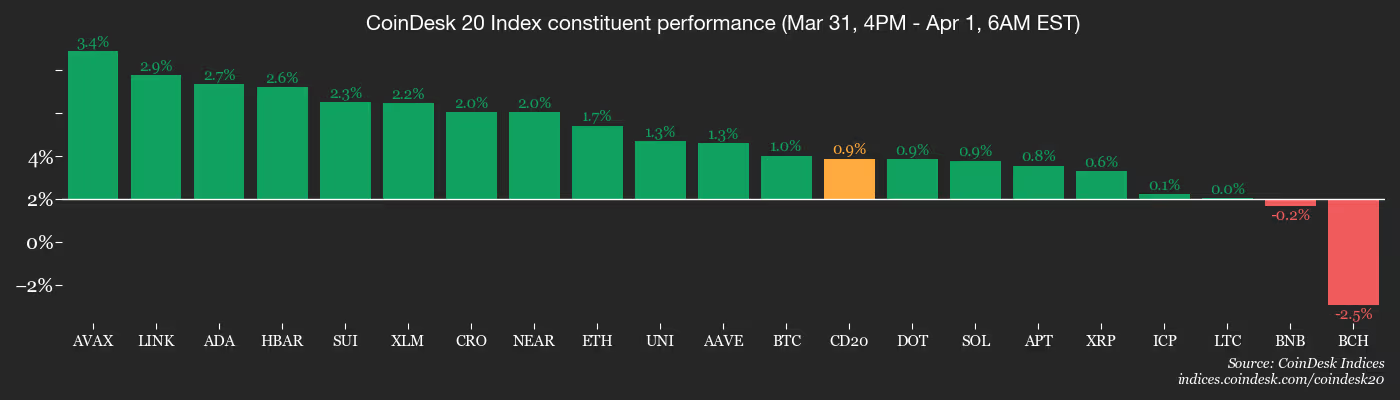
By Omkar Godbole (All times ET unless indicated otherwise)
As the new quarter gets underway, the crypto market is sending a subtle but important signal: traders seem a bit more cautious about bitcoin than ether (ETH).
You can see this in the options market, where more experienced traders and institutions go to hedge risk or generate extra returns. Think of options as a kind of insurance. Traders can buy protection against price drops (puts) or bet on price increases (calls), depending on their outlook.
Right now, one key metric, called a risk reversal, is negative for both bitcoin and ether across different time frames. In simple terms, that means puts, or downside protection, is more expensive than bullish bets. When traders are willing to pay more for put options, it usually signals lingering fears of a price drop. That’s perfectly normal, considering the brutal downtrend in bitcoin and ether since October.
But here’s where it gets interesting: that caution is stronger for bitcoin. Put options on bitcoin are more expensive than those on ether across all time frames, suggesting traders are more worried about BTC’s downside risk.
The difference becomes even clearer when zooming further out. Longer-dated ether options, such as those expiring next March, are only slightly bearish, while bitcoin’s equivalent options carry a much steeper premium for downside protection.
In short, the market is betting that ether will be relatively resilient. That would signal a bullish trend change in the ether-to-bitcoin ratio, which has been in a downtrend since August (see the technical analysis section).
Ether has risen 5% over the past 24 hours, outpacing bitcoin , XRP (XRP), solana (SOL), and the CoinDesk 20 Index. Several smaller tokens associated with quantum-computing-resistant technology have rallied by 20% or more.
Analysts said a firm breakout in BTC above its 50-day moving average of $68,680 will likely strengthen the bullish momentum.
In traditional markets, the 10-year U.S. Treasury yield fell for the fourth straight day while futures tied to the Nasdaq and S&P 500 rose nearly 0.5%. Together, these things point to risk-on sentiment ahead. Stay alert
Read more: For analysis of today’s activity in altcoins and derivatives, see Crypto Markets Today
What to Watch
For a more comprehensive list of events this week, see CoinDesk’s “Crypto Week Ahead“.
- Crypto
- Macro
- April 1, 8:15 a.m.: U.S. ADP Employment Change for March (Prev. 63K)
- April 1, 10:00 a.m.: U.S. ISM Manufacturing PMI for March (Prev. 52.4)
- Earnings (Estimates based on FactSet data)
Token Events
For a more comprehensive list of events this week, see CoinDesk’s “Crypto Week Ahead“.
- Governance votes & calls
- Unlocks
- Token Launches
- April 1: Orexn (OXN) enters a phased exchange listing period after the token generation event.
Conferences
For a more comprehensive list of events this week, see CoinDesk’s “Crypto Week Ahead“.
Market Movements
- BTC is up 0.61% from 4 p.m. ET Wednesday at $68,622.64 (24hrs: +3.34%)
- ETH is up 1.47% at $2,136.90(24hrs: +5.27%)
- CoinDesk 20 is up 0.62% at 1,968.28 (24hrs: +3.62%)
- Ether CESR Composite Staking Rate is unchanged at 2.76%
- BTC funding rate is at 0.0033% (3.5193% annualized) on Binance

- DXY is down 0.37% at 99.59
- Gold futures are up 1.5% at $4,748.80
- Silver futures are down 0.69% at $74.40
- Nikkei 225 closed up 5.24% at 53,739.68
- Hang Seng closed up 2.04% at 25,294.03
- FTSE is up 1.63% at 10,342.45
- Euro Stoxx 50 is up 1.75% at 5,667.09
- DJIA closed on Tuesday up 2.49% at 46,341.51
- S&P 500 closed up 2.91% at 6,528.52
- Nasdaq Composite closed up 3.83% at 21,590.63
- S&P/TSX Composite closed up 2.61% at 32,768.04
- S&P 40 Latin America closed up 4.26% at 3,623.86
- U.S. 10-Year Treasury rate is down 3.2 bps at 4.279%
- E-mini S&P 500 futures are up 0.33% at 6,592.25
- E-mini Nasdaq-100 futures are up 0.48% at 24,030.25
- E-mini Dow Jones Industrial Average Index futures are up 0.36% at 46,750.00
Bitcoin Stats
- BTC Dominance: 58.72% (-0.04%)
- Ether-bitcoin ratio: 0.03111 (0.89%)
- Hashrate (seven-day moving average): 1,004 EH/s
- Hashprice (spot): $32.37
- Total fees: 2.47 BTC / $166,441
- CME Futures Open Interest: 104,900 BTC
- BTC priced in gold: 14.5 oz.
- BTC vs gold market cap: 4.58%
Technical Analysis

- The chart shows daily swings in the ether-bitcoin ratio in the candlestick format.
- The ratio has been trending lower since August, showcasing ether underperformance relative to bitcoin. This downtrend is represented by the yellow line that connects the steady decline over seven months.
- The outlook would flip bullish if the ratio rises past this trendline. Such a move would confirm renewed investor preference for ether, as suggested by the options market.
Crypto Equities
- Coinbase Global (COIN): closed on Tuesday at $174.61 (+8.60%), +1.80% at $177.75 in pre-market
- Circle Internet (CRCL): closed at $95.41 (+6.12%), +2.69% at $97.98
- Galaxy Digital (GLXY): closed at $18.45 (+7.58%), +1.94% at $18.81
- Bullish (BLSH): closed at $35.73 (+7.39%), +0.95% at $36.07
- MARA Holdings (MARA): closed at $8.16 (+4.62%), +1.35% at $8.27
- Riot Platforms (RIOT): closed at $12.36 (+4.48%), +2.35% at $12.65
- Core Scientific (CORZ): closed at $14.96 (+7.55%), -0.40% at $14.90
- CleanSpark (CLSK): closed at $8.51 (+4.03%), +2.12% at $8.69
- CoinShares Valkyrie Bitcoin Miners ETF (WGMI): closed at $34.82 (+7.70%), +1.81% at $35.45
- Exodus Movement (EXOD): closed at $6.50 (+4.84%), -0.92% at $6.44
Crypto Treasury Companies
- Strategy (MSTR): closed at $124.80 (+2.77%), +1.48% at $126.65
- Strive (ASST): closed at $10.02 (+6.94%), +1.90% at $10.21
- SharpLink Gaming (SBET): closed at $6.45 (+7.32%), +2.02% at $6.58
- Upexi (UPXI): closed at $0.99 (+3.90%), +6.49% at $1.05
- Lite Strategy (LITS): closed at $1.16 (+11.54%)
ETF Flows
Spot BTC ETFs
- Daily net flow: $117.5 million
- Cumulative net flows: $56.09 billion
- Total BTC holdings ~ 1.29 million
Spot ETH ETFs
- Daily net flow: $31.2 million
- Cumulative net flows: $11.59 billion
- Total ETH holdings ~ 5.70 million
Source: Farside Investors
While You Were Sleeping
Trump says Iran war could end in ‘two weeks’, with or without deal (euronews): Trump, who will address the nation Wednesday night, said the war in Iran could end in two to three weeks. However, Israeli Prime Minister Benjamin Netanyahu said its war on Tehran will continue.
Iran fires missiles across Middle East as Trump signals exit (Bloomberg): Iran fired missiles across the Middle East while Israel and the U.S. kept up their bombardment of the Islamic Republic, even as Trump fueled market optimism by signaling he’s preparing to end the war.
UAE wants to force Hormuz open and is willing to join the fight (The Wall Street Journal): The UAE is preparing to help the U.S. and other allies open the Strait of Hormuz by force, Arab officials said, a move that would make it the first Persian Gulf country to join the war.
Crypto asset manager CoinShares to list on Nasdaq after $1.2 billion SPAC deal (CoinDesk): CoinShares, a leading European digital asset manager with over $6 billion under management, is set to begin trading on the Nasdaq Stock Market under the ticker symbol CSHR.


Summary
- EthCC 2026 in Cannes has introduced a dedicated institutional forum, The Agora by Kaiko, drawing more than 60 speakers and around 600 participants from traditional finance and Web3.
- For the first time, firms like Bloomberg, S&P Global, BNP Paribas, Euroclear, Amundi, SG Forge and Tradeweb are on the official EthCC agenda to debate Ethereum’s market structure under Europe’s MiCA regime.
- With MiCA and new EU tax rules nearing full implementation, panellists argued that Ethereum’s future liquidity and depth will increasingly depend on institutional rails rather than purely on retail-driven DeFi.
EthCC 2026 has shifted decisively from a builders’ retreat to an institutional showcase, as this year’s edition in Cannes hosts the inaugural “Agora” forum curated by market data provider Kaiko for more than 60 expert speakers and roughly 600 TradFi and crypto-market professionals.
Held on March 31 at the JW Marriott and branded as a neutral stage “where the foundations of digital market structure will be examined,” the event is explicitly designed for executives from banks, asset managers, trading venues and blockchain projects to interrogate how far crypto and digital assets can underpin the next generation of financial infrastructure.
If previous EthCC editions were best known for governance wars and protocol roadmaps, Cannes has brought bankers directly into the developers’ line of sight. Reporting from French outlet CrypCool notes that “Jean‑Marc Stenger, PDG de SG Forge,” alongside Aave founder Stani Kulechov and representatives from Euroclear, Bloomberg, BNP Paribas, S&P Global, Amundi, Google and Tradeweb, are now part of the official program, with Euroclear’s Isabelle Delorme cited as evidence that “l’institution est désormais dans la salle.” A separate analysis from TechFlow captures the mood shift more bluntly: “What was new was the formal participation of traditional financial institutions… on EthCC’s official agenda for the first time,” the publication writes, arguing that developers and market-structure professionals are finally sharing the same stage rather than operating in parallel tracks.
The core of the Agora’s agenda is not token launches but plumbing. According to Kaiko’s event materials, discussion tracks span tokenization of financial instruments, perpetual futures and ETPs, collateral mobility, and the convergence between centralized and decentralized venues. As one invitation post from Kaiko’s Hadrien Comte on LinkedIn put it, the goal is “a day of conversation focusing on tokenization, market infrastructure transformation, capital efficiency in institutional crypto, and next-generation digital asset investment strategies” rather than marketing pitches.
Underpinning those debates is Europe’s maturing regulatory environment. Commentaries from TechFlow, ODaily and Moomoo all highlight a “regulatory puzzle” coalescing around the EU’s Markets in Crypto‑Assets Regulation (MiCA), which is expected to be fully implemented by mid‑2026 and will cover trading platforms, stablecoin issuers and institutional participants. Combined with new EU‑wide and national tax-reporting frameworks for digital assets, that clarity offers the legal scaffolding banks and asset managers say they need before committing more balance sheet to Ethereum-based products.
For Ethereum (ETH) itself, the message from Cannes is that future liquidity may rely as much on regulated rails as on organic DeFi flows. CrypCool argues that the involvement of SG Forge, Euroclear and Tradeweb in Ethereum debates “valide une thèse: la convergence TradFi/DeFi est un chantier opérationnel,” adding that for ETH holders “la profondeur institutionnelle du marché se construit en partie ici.” That view is echoed in a Phemex dispatch, which describes EthCC 2026 as marking “un changement significatif dans l’écosystème Ethereum, avec la participation… d’institutions financières traditionnelles” and the launch of The Agora as a forum dedicated to aligning digital assets with traditional capital markets.
In short, EthCC’s centre of gravity has moved. The same conference that once incubated “governance meme” experiments now features Bloomberg terminals, Euroclear settlement specialists and bank capital-markets teams arguing over how Ethereum’s blockspace, rollups and collateral models fit into their risk frameworks. Whether that ultimately leads to deeper, more stable liquidity for ETH or dilutes the ecosystem’s grassroots ethos is a debate that will likely continue long after the lights go down in Cannes.

Key takeaways
-
Meta plans to introduce dollar-linked stablecoin payments across its platforms in late 2026. Unlike its earlier Libra attempt, the company will not issue its own cryptocurrency but instead integrate existing stablecoins.
-
Regulatory opposition to the Libra/Diem project made it clear that governments were uncomfortable with Big Tech issuing private global currencies. Meta’s new strategy reflects those lessons by avoiding direct control over the currency itself.
-
Instead of managing stablecoin reserves or issuance, Meta intends to work with external partners that handle infrastructure, compliance and settlement, while Meta itself focuses on user experience and payment distribution.
-
With billions of users across Facebook, Instagram and WhatsApp, Meta can embed stablecoin payments into everyday social and commercial interactions, potentially creating one of the largest digital payment ecosystems.
Meta is re-entering the stablecoin market with a revised strategy. Following the regulatory challenges that ended its previous Libra project, the company plans to introduce dollar-linked digital payments across its social media platforms in late 2026.
Rather than developing its own cryptocurrency, Meta is now opting to facilitate third-party stablecoins on its apps. This approach indicates a shift in focus. Instead of managing the currency itself, the company aims to leverage its massive user base to control how and where these transactions occur.
This article explores why Meta’s 2026 stablecoin strategy relies on partnerships rather than issuing its own currency. It examines how regulatory lessons from Libra, new stablecoin rules and Meta’s vast platform distribution are shaping a model focused on payment integration rather than monetary control.
The enduring lesson of Libra
To understand why Meta is being cautious with digital payments today, you need to look at its earlier attempt.
In June 2019, Meta, then Facebook, announced Libra, an ambitious plan to create a global digital currency linked to a basket of traditional currencies. The idea was to enable fast, low-cost payments across Facebook, WhatsApp and Instagram and to build a new cross-border payment system used by billions of people.
However, regulators quickly pushed back.
Governments in the US, Europe and other regions raised several concerns. They worried that a prominent private company launching a currency could weaken national monetary control and create risks to financial stability. There were also concerns about inadequate safeguards against money laundering and illicit finance. Meta’s past controversies over data privacy, including the Cambridge Analytica scandal, further deepened distrust.

The idea that a social media company with billions of users could launch something resembling a private global currency alarmed policymakers. Under strong political pressure, several partners left the project. Libra was later renamed Diem, but the project eventually shut down in 2022.
The episode made it clear that regulators would not accept Big Tech issuing its own currency. Meta’s current strategy reflects that lesson. Instead of creating a new coin, it now plans to integrate existing regulated stablecoins from partners and act mainly as a payments platform.
An alternative stablecoin approach for 2026
Meta is renewing its efforts in stablecoins, this time by integrating stablecoin payments directly into its platforms without issuing its own coin.
The company has issued requests for proposals (RFPs) to external partners capable of handling the back-end stablecoin infrastructure. Meta’s role would center on crafting a seamless user payment experience within its apps rather than managing the currency itself.
This could involve introducing a built-in digital wallet feature, allowing users to send and receive stablecoin payments throughout Meta’s ecosystem, which includes Facebook, Instagram and WhatsApp.
The planned rollout targets the second half of 2026.
This strategy marks a significant shift from the earlier Libra/Diem model. Instead of attempting to launch a new global monetary system, Meta is now positioning itself as a major distribution and user interface layer for established, regulated stablecoins like USDC (USDC) or USDt (USDT), potentially through partners such as Stripe.
Did you know? The term “stablecoin” was first widely used around 2014 and 2015, as crypto developers experimented with tokens designed to maintain stable value against fiat currencies, long before large tech platforms began exploring their payment potential.
Why partners may matter more than owning the power
At first glance, Meta’s decision to outsource stablecoin infrastructure could seem like a step back from control. It may actually amplify the company’s strengths.
Meta holds a wide distribution reach. With billions of active users across Facebook, Instagram and WhatsApp, it operates one of the planet’s largest communication and social networks. Seamlessly embedding stablecoin payments into these everyday apps could rapidly establish one of the world’s biggest digital payment ecosystems. It enables Meta to reach its objective without the need to issue a coin itself.
In this setup, real value shifts away from minting the currency and toward directing how and where it moves. Stablecoin issuers handle reserves, backing and regulatory compliance, while infrastructure providers manage settlement and back-end rails. What Meta brings to the table is the intuitive user interface, the social context and the daily transaction flow.
The Stripe angle
Stripe has become a front-runner for partnership in Meta’s revived stablecoin push. It has aggressively built its stablecoin capabilities, taking steps such as its acquisition of Bridge, a specialized crypto infrastructure firm that powers custody, transfers and blockchain-based payments at scale.
The ties between Meta and Stripe run deep. Stripe co-founder and CEO Patrick Collison joined Meta’s board of directors in April 2025, fueling speculation about closer strategic alignment between the two companies.

If Stripe, through Bridge, becomes the primary back-end partner, Meta gains instant access to a mature, regulated payments stack. This would help Meta bypass the heavy lift of building compliant infrastructure from the ground up. Stripe would own the complex financial pipeline, including settlement, compliance and reserves. Meta, on the other hand, would focus on delivering a frictionless, engaging user experience across its massive social ecosystem.
Regulatory changes have reshaped the industry
The evolution of the regulatory environment is a key reason Meta is choosing partners over power in its 2026 stablecoin push.
In 2025, the US passed the GENIUS Act (Guiding and Establishing National Innovation for U.S. Stablecoins Act). This law created a clear federal framework for payment stablecoins. It established strict requirements for 1:1 reserves with high-quality liquid assets. Other compliance requirements include issuer licensing and oversight, risk management, transparency through monthly reserve disclosures and consumer protections.
While the GENIUS Act brings much-needed clarity and promotes innovation in regulated stablecoins, it also imposes certain restrictions. Only permitted issuers, typically regulated banks, their subsidiaries or qualified nonbank entities, can legally issue payment stablecoins in the US.
This environment favors established, heavily regulated financial institutions and infrastructure providers over large consumer tech companies. By choosing to partner with compliant stablecoin issuers and infrastructure providers instead of issuing its own coin, Meta sidesteps regulatory burdens, compliance costs and intense scrutiny.
Did you know? The original Facebook payments system launched in 2009, allowing users to purchase virtual goods in games. It was one of Meta’s earliest experiments in building a payments ecosystem inside social platforms.
Stablecoins as the foundation for AI-driven commerce
Meta’s renewed focus on stablecoins also ties into a larger shift in technology. The company is making major investments in artificial intelligence (AI), with projections for 2026 indicating a capital expenditure (CapEx) range of $115 billion to $135 billion. A significant portion of this spending supports the development of autonomous digital agents. These are AI systems that can independently handle tasks such as shopping, booking services and executing payments on behalf of users.
In this scenario, stablecoins could serve as an ideal global settlement layer. These digital dollars offer instant, programmable, borderless transactions that machines can execute reliably and efficiently.
For Meta, embedding stablecoin payments could unlock several practical use cases, including:
-
Fast, low-cost cross-border payouts to creators worldwide
-
Seamless transactions in international marketplaces
-
Automated purchases and payments initiated by AI agents
-
Easier financial access and payments in emerging markets where traditional banking remains limited
In this context, stablecoins move beyond speculative crypto tools. They become essential infrastructure for machine-to-machine and AI-powered commerce.
Did you know? Stablecoins are widely used for international remittances and cross-border payments, particularly in regions where traditional bank transfers are slow or expensive.
The wider competition among platforms
Meta is not the only company exploring stablecoin payments.
Across the technology industry, major platforms are actively looking for ways to bring digital currencies into their ecosystems. The main goal is no longer to create and issue new coins. Instead, the focus is on controlling the payment systems built on top of existing stablecoins.
Shopify, for instance, facilitates payments in USDC on Base at checkout through partnerships with Coinbase and Stripe. PayPal’s PYUSD is designed for payments on PayPal and for transfers between PayPal, Venmo and external wallets or exchanges.
The reasoning is straightforward. When a platform enables and processes transactions, it gains valuable insight into users’ economic behavior. This information allows the company to develop new products and services tied to payments.
Stablecoins provide a practical solution. They enable programmable, instant and borderless payments without depending completely on traditional banks. For companies with hundreds of millions or billions of users worldwide, this represents a very large opportunity.
Risks remain significant
Even with a partnership-based approach, Meta’s stablecoin plan still faces certain risks.
-
Regulatory constraints: Regulatory attention on large technology companies continues to be strong, particularly when they enter financial services. Governments could introduce new rules or limits on how platforms offer or integrate digital payments.
-
Operational challenges: These include the risk of fraud, the need for strong wallet security, the high costs of regulatory compliance and the complexity of handling customer disputes at a very large scale.
-
User reluctance: Finally, the entire effort depends on whether users actually choose to use it. If the sign-up process feels too difficult, or if rules add too much extra friction, many people may simply stick with familiar payment methods such as cards or bank transfers.
Meta’s task will be to meet all regulatory requirements while keeping the experience simple and easy for users.
Cointelegraph maintains full editorial independence. Guides are produced without influence from advertisers, partners or commercial relationships. Content published in Guides does not constitute financial, legal or investment advice. Readers should conduct their own research and consult qualified professionals where appropriate.
Crypto World
Jack Dorsey says AI should replace the middle manager after Block (XYZ) cuts 4,000 jobs


In Jack Dorsey’s view of the world, the job most at risk from the AI revolution is the middle manager.
Dorsey argues in a new essay, “From Hierarchy to Intelligence,” published with Roelof Botha, Sequoia Capital’s managing partner, an investor in Block, that his company’s decision to cut approximately 4,000 of its more than 10,000 employees was not a cost reduction but a permanent restructuring to replace middle managers with AI.
Corporate hierarchy, the essay argues, has always existed to solve one problem: routing information through organizations too large for any single person to oversee.
Managers aggregate context from below, act as messengers from above, and maintain alignment across teams. AI can now perform those functions continuously and at scale, the authors argue, making the messenger redundant.
In place of management layers, Dorsey and Botha proposes two AI-driven “world models.”
One aggregates internal data from code, decisions, workflows, and performance metrics to create a continuously updated picture of company operations, replacing the context that managers traditionally carried.
The other maps customer and merchant behavior using transaction data from Cash App and Square.
Those models feed what Block calls an “intelligence layer” that composes financial products dynamically to fit market demand.
If done properly, the models absorb the coordination work that previously justified the existence of middle management.
Rather than building from fixed roadmaps, the essay proposes breaking Block’s business into modular capabilities, including payments, lending, card issuance and payroll.
When the system identifies a need, the essay’s example is a merchant facing a seasonal cash flow gap, it assembles a solution from existing capabilities. When it cannot, the missing capability defines what gets built next, replacing the product roadmap with a system-generated backlog.
The organizational structure is reduced accordingly. Block plans to operate with three roles: individual contributors who build the system, directly responsible individuals who own specific outcomes on 90-day cycles, and player-coaches who remain hands-on while developing people.
Dorsey told Wired in early Marchthe restructuring was triggered by a capability shift he observed in December in tools including Anthropic’s Opus 4.6 and OpenAI’s Codex 5.3, which he said was now capable of operating effectively in large codebases.
But current and former Block employees told the Guardian that roughly 95% of AI-generated code changes still require human modification, and that AI tools cannot yet lead in regulated areas like banking and money transfers.
Welcome to our institutional newsletter, Crypto Long & Short. This week:
- Nilmini Rubin on the challenge facing crypto and traditional markets to create a hybrid, shared governance structure.
- Meredith Fitzpatrick covers how financial institutions must fundamentally rethink AML risk as crypto and TradFi converge.
- Top headlines institutions should pay attention to by Francisco Rodrigues.
- Maple loans surge past $1 billion in Chart of the Week.
Expert Insights
Governance is the real Layer 1
By Nilmini Rubin, chief policy officer, Hedera
When Silicon Valley Bank collapsed in 2023, USDC briefly lost its dollar peg after billions in reserves were trapped in the bank. The impact spread quickly, stalling markets, repricing assets mid-transaction and triggering a broader confidence shock. While regulators stress-test traditional markets, this event exposed a new risk where failures in traditional finance can directly impact digital assets.
This episode raised fundamental questions about what happens if risk moves in the other direction, from crypto to the traditional market: who intervenes, who absorbs losses and how is confidence in markets restored?
As blockchains begin underpinning financial markets, the next phase of digital assets will be defined not only by innovation but by coordinated accountability. That accountability is shaped by how networks are designed.
The false binary
For years, blockchain debates revolved around a familiar divide: public vs. private networks.
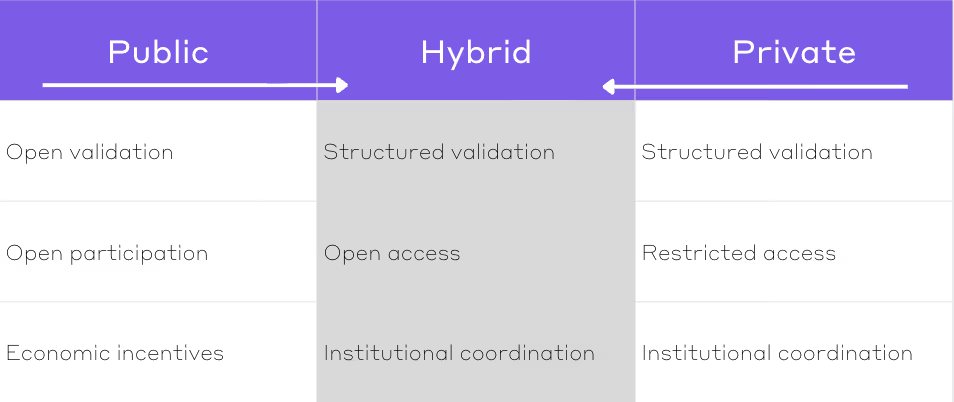
Permissionless networks maximize openness and censorship resistance, but can struggle with coordinated upgrades, regulatory integration or emergency intervention. Private systems emphasize control and compliance over neutrality and interoperability.
As institutional adoption accelerates, hybrid models are emerging as the preferred solution.
Hybrid architectures combine public verifiability with open participation and predictable governance. This renders them more suitable for regulated use cases and compliance frameworks that require greater transparency and clear roles. Coordinated accountability, rather than simply public or private choices, is blockchain’s next major challenge.

Blockchain architecture is increasingly converging toward hybrid governance models.
When governance meets crisis
In complex systems, responsibilities are usually defined before problems emerge. Participants know who has authority, who absorbs losses and how emergencies are handled.
Blockchain networks should begin with that level of clarity. When stress arrives through sanctions enforcement, protocol failures or market crashes, effective governance proves a difficult test.
The industry has already seen early signals. During the March 2020 market crash, MakerDAO required emergency intervention after auction failures erased millions in value. The protocol recovered, but we cannot allow these incidents to occur frequently and at scale. In other cases, networks have used coordinated forks to address hacks or illicit activity, but only after the fact.
As tokenization expands, increasing resilience will require governance systems that anticipate crises and define decision-making before an event occurs to effectively mitigate.
Putting governance to the test
Mature financial systems routinely stress-test their governance structures to ensure resilience well before moments of disruption.
Hybrid networks must bring that discipline on-chain. Governance stress testing clarifies roles, aligns incentives and strengthens coordination under pressure, helping the industry prepare for scenarios such as stablecoin volatility, regulatory shifts and AI-driven governance dynamics.
Governance is the real Layer 1
Digital assets are reimagining ownership and participation. The next challenge is applying that same creativity to governance.
The networks that endure will not be the ones with the most tokens or the fastest throughput. They will be the ones that know how to govern effectively when the system comes under pressure.
Headlines of the Week
– By Francisco Rodrigues
The crypto industry has continued navigating the regulatory system over the week, making its way into the mortgage market while also seemingly being stopped from offering yields on stablecoin balances. Other major developments further build trust in the industry, even as prices drop.
Expert Perspectives
The new financial order: updating TradFi risk for crypto
– By Meredith Fitzpatrick, partner and head of cryptocurrency, Forensic Risk Alliance
The convergence of traditional finance and cryptocurrency is no longer theoretical sci-fi — it’s here. Regulatory clarity across major jurisdictions is accelerating institutional entry into digital assets, from Europe’s Markets in Crypto-Assets (MiCA) framework to expanding U.S. legislative momentum with the Guiding and Establishing National Innovation for U.S. Stablecoins (GENIUS) Act. For financial institutions, the question is no longer whether to engage with crypto, but how to do so safely.
The critical misstep many institutions make is treating crypto as an extension of existing products. It is not. Crypto fundamentally changes how anti-money laundering (AML) risk must be assessed, monitored and controlled.
At its core, blockchain introduces three defining characteristics: immutability, pseudonymity and borderless value transfer. These reshape both financial crime risk and the tools required to manage it.
Control shifts from accounts to keys
In traditional finance, assets are secured through centralized systems and reversible transactions. In crypto, control rests with private keys. When institutions offer custody, AML risk becomes inseparable from cybersecurity risk. A compromised key is not just a breach — it is an irreversible transfer of value, often beyond recovery. This requires controls such as multi-signature authorization, cold storage, strict access governance and wallet segregation — all of which sit outside traditional AML frameworks but are critical to risk mitigation.
Non-custodial wallets mean dynamic risk assessments
Traditional AML relies heavily on customer identity and static risk profiling. In crypto, this model breaks down. Customers can transact through non-custodial wallets that exist outside institutional onboarding frameworks, and illicit activity often hides in transaction behavior rather than identity.
As a result, risk assessment must evolve from “who the customer is” to “what the wallet does.” This requires continuous monitoring of on-chain activity, including exposure to high-risk counterparties, mixers and decentralized protocols. Risk becomes dynamic, not periodic.
Crypto financial crime is structurally more complex
Cryptocurrency money laundering can involve newer technologies, such as chain-hopping and the use of privacy-enhancing technologies like mixers, that have no direct parallel in traditional finance. Transactions can traverse multiple jurisdictions in minutes, rendering legacy screening systems insufficient. Effective AML now depends on blockchain intelligence: the ability to trace funds, identify direct and indirect exposure to risky parties and interpret transaction patterns across networks.
These shifts require a corresponding evolution in governance and risk management. Boards and risk committees must redefine risk appetite to reflect crypto-specific exposures. Institutions should introduce specialized teams (e.g., digital asset approval committees and high-risk customer panels) to manage rapidly changing risks.
Most importantly, the Enterprise-Wide Risk Assessment (EWRA) must become dynamic. Static, point-in-time assessments are inadequate in an environment where risk profiles can change with a single transaction.
The table below illustrates how customer risk assessment must evolve:
Area of focus |
TradFi |
Crypto |
|---|---|---|
| Customer identity | Typically, through identification and verification using government-issued IDs, physical addresses and relevant databases (e.g., credit history). | Most centralized virtual asset service providers (VASPs) have KYC/CDD/EDD procedures like TradFi institutions. However, “non-custodial wallets” (wallets where the user retains private key control) exist outside of a centralized body that collects KYC. In this case, on-chain activity may be used when assessing the risk of the customer. |
| Risk indicators | Based on factors like employment, income, geography and transaction history with the institution. | Based on wallet behaviour, age, transaction counterparties, interactions with high-risk services (e.g., mixers), and exposure to certain smart contracts, non-custodial wallets, or DeFi platforms. |
| Transaction transparency | Transaction data is private and accessed through internal banking records. | On-chain transactions are publicly available, enabling advanced analytics, but only for those with the tools and expertise to interpret them. |
| Dynamic risk monitoring | Risk profiles are usually static or periodically updated. | Risk can change dynamically with wallet activity, based on real-time blockchain analysis and ongoing monitoring. |
Finally, institutions must invest in new capabilities. Fluency in blockchain analytics for transaction monitoring and forensic investigation are no longer niche skills — they are core AML functions. Most organizations will require a hybrid model combining internal expertise with external specialists.
Professionals in this space must recognize that cryptocurrency compliance is not merely adapting existing frameworks but requires fundamentally different approaches to transaction monitoring, due diligence and incident investigation. Success requires compliance teams to understand traditional regulatory requirements and crypto-specific investigation challenges. Institutions approaching crypto adoption with appropriate forensic rigour — treating it as a fundamental compliance transformation rather than simple product addition — will be best positioned for sustainable success.
Chart of the Week
Maple loans surge past $1B on record $350M single-day issuance
Maple’s loans outstanding jumped back above $1 billion last week as the protocol issued $350 million in loans on a single day. With total AuM now exceeding $4.6 billion, there is a divergence between the protocol’s strong fundamentals and the associated SYRUP token price action. This growth, in spite of broader market conditions, continues to highlight the resilient demand for institutional-grade lending among crypto-native firms.

Listen. Read. Watch. Engage.
Looking for more? Receive the latest crypto news from coindesk.com and market updates from coindesk.com/institutions.
Note: The views expressed in this column are those of the author and do not necessarily reflect those of CoinDesk, Inc., CoinDesk Indices or its owners and affiliates.


- StakeStone price jumped from $0.11 to above $0.26, going vertical amid a spike in daily volume.
- The sharp gain follows a whale accumulating over 25.5 million STO tokens.
- STO price could see a steep pullback amid profit-taking deals.
StakeStone (STO) price exploded during early trading on April 1, pumping more than 130% to hit a new all‑time high.
The vertical action, which occurred amid a broader consolidation across the crypto market, saw STO’s intraday trading activity surge.
The token is in price discovery, but can the lofty levels hold?
Why StakeStone jumped 136% today
STO token posted a sharp intraday surge on Wednesday, significantly outperforming the broader altcoin market.
While most cryptocurrencies traded near key support levels, STO jumped from around $0.11 to a new all-time high above $0.26.
The move marked a gain of roughly 136% and made it the top performer among the 500 largest cryptocurrencies by market capitalisation.
The rally appears to have been driven by a large transaction linked to a newly created wallet.
Data from Lookonchain shows the wallet withdrew more than 25.5 million STO tokens, valued at over $4.85 million, from Binance.
The holdings represent approximately 11.32% of StakeStone’s circulating supply, suggesting concentrated accumulation that may have contributed to the sharp price movement.
The price of $STO surged from $0.11 to $0.26 today, a 136% increase.
A newly created wallet(0x5e2E) withdrew 25.5M $STO($4.85M) from #Binance in the past 20 hours, 11.32% of the circulating supply.https://t.co/UhTfZhT8CS pic.twitter.com/GAI5Y2L8LE
— Lookonchain (@lookonchain) April 1, 2026
The transfer acted as an immediate and powerful demand shock, with the size of the order absorbing available sell liquidity near the market price.
It forced quotes higher as market makers and sellers adjusted to the sudden imbalance between bids and offers.
With limited resting supply at higher levels, the price moved rapidly upward as each successive fill occurred at incrementally higher prices.
Data from CoinMarketCap shows a 560% increase in intraday volume, with over $190 million traded in the past 24 hours.
StakeStone’s market cap was also sharply up, as STO printed a new all-time high.
Prices hovered around $0.25 at the time of writing, up more than 390% since the all-time low of $0.049 on February 6, 2026.
STO price outlook — is a sharp decline next?
From a technical perspective, STO’s chart now reflects a near‑vertical candle following the 136% single‑day move.
Price currently hovers well above recent consolidation zones and historical trading ranges.
Such abrupt expansions in price and volume often leave the token looking temporarily extended.
In the market, this type of structure frequently precedes volatile retracements as the market digests the move and short‑term participants reassess risk and reward.

Given the magnitude and speed of the rally, a period of profit‑taking and a potential steep pullback cannot be ruled out.
A rapid unwind of intraday positions could see STO test lower levels, with $0.19 key.
If selling intensifies, the next major support zone could be $0.15-$0.11.
However, the reduced circulating supply could help support prices and allow for an extended, though volatile, ride to new highs.
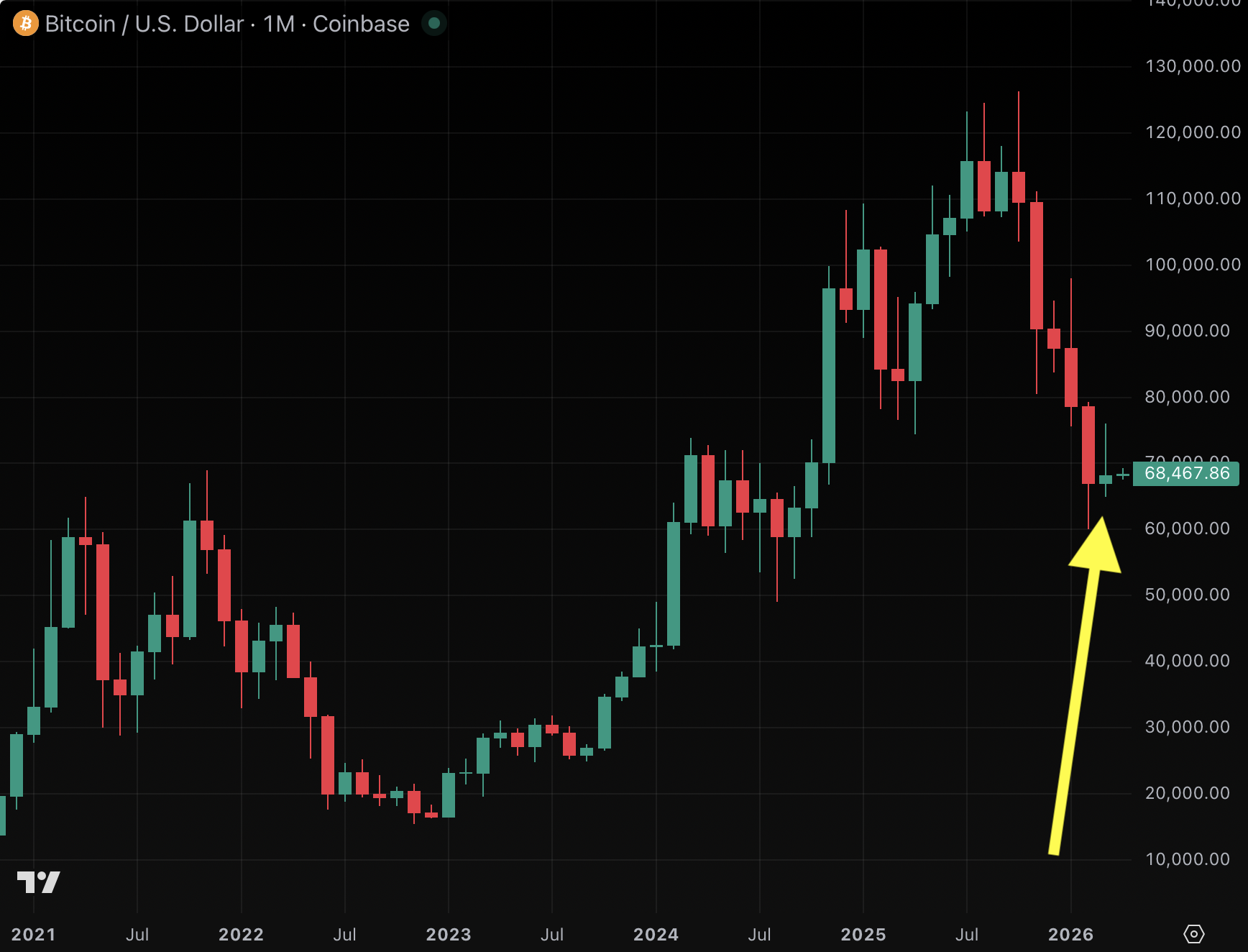
Bitcoin (BTC) finally closed a month with positive price performance for the first time since September, but it only snapped its five-month losing streak by the slimmest of margins.
BTC opened the month at $67,000 and closed at $68,221. In other words, the entire “gain” amounted to about $1,200 per coin, or 1.8%.
For context, BTC often fluctuates by that amount within a few minutes on an average day.
Energized by even the most pitiful shred of evidence that the crypto bear market might be ending, the BTC community celebrated the momentum shift.
The Fear and Greed Index hit an all-time low of five out of 100 on February 6, 2026. It’s now much higher, if you squint a bit less, at 31.
One less bad month for BTC
The streak that preceded March’s flicker of positivity was genuinely ugly.
BTC was worth more than $126,000 on October 6, 2025. By February 6, it had collapsed to $60,000.
Recent monthly losses have been relentless. Total crypto market capitalization fell by $200 billion in October, $610 billion in November, $110 billion in December, $300 billion in January, and $350 billion in February.
March paused that decimation with a $40 billion gain, the slimmest of margins.
Still, at least it’s not as bad as its absolute worst moment this year.
BTC is 14% higher than its $59,930 low set on February 6. It’s even rallied a bit since the onset of a typically bearish war and macro environment.
Read more: Bitcoin outperforms gold as Iran war shakes ‘safe-haven’ trade
The reaction on social media revealed just how desperate BTC traders had become for any glimmer of hope.
Bitcoin Magazine announced the green close with a breathless all-caps alert, as if BTC hadn’t just spent half a year losing nearly half its value.
One popular account called it a “massive dose of hopium” before adding, perhaps wisely, “Let’s hope this is not an April Fools’ joke.”
Read more: What is @inversebrah?
The longest continuous monthly bear streak prior to this stretch was a six-month long red streak from August 2018 through January 2019.
BTC is today priced at $68,300, 46% below its October high and 23% lower year to date.
Got a tip? Send us an email securely via Protos Leaks. For more informed news, follow us on X, Bluesky, and Google News, or subscribe to our YouTube channel.

Something is shifting in the crypto casino market. Search volumes for terms like “Stake alternative,” “sites like Stake,” and “Stake.com replacement” have been climbing steadily throughout 2026. Stake.com remains one of the most visited crypto gambling platforms in the world, so the rising interest in alternatives is not about Stake failing — it is about players wanting more. More games, more bonuses, more ways to earn while they play. ZunaBet is one of the names that keeps appearing in those searches. Launched in 2026, it has quickly positioned itself as the kind of platform that players leaving or supplementing Stake are looking for. This article examines what is driving the trend and how the two platforms compare.
Stake.com: Where Things Stand
Stake.com has been a force in crypto gambling since 2017. Licensed in Curaçao, it grew rapidly by being one of the first platforms to build a serious gambling product entirely around cryptocurrency. Bitcoin, Ethereum, Litecoin, Dogecoin, and other major coins are all supported for deposits and withdrawals.
The platform made its name with a lineup of provably fair original games. Crash, Plinko, Dice, Mines, and similar titles became synonymous with the Stake brand and built a community of dedicated players. Third-party games from providers like Pragmatic Play, Evolution, and Hacksaw Gaming fill out the rest of the casino with slots and live dealer tables.
Stake also operates a full sportsbook covering football, basketball, tennis, MMA, esports, and other markets. The odds are competitive and the interface is clean, which keeps experienced bettors engaged.
For years, Stake has held a dominant position in the crypto gambling space. But dominance invites scrutiny, and players who have spent time on the platform are increasingly vocal about the areas where Stake falls short of their expectations.
Why Players Are Looking Elsewhere
The search interest in Stake alternatives does not come from nowhere. Several recurring themes show up in community discussions, forums, and social media conversations about why players are exploring other options.
The most frequently mentioned issue is the lack of a welcome bonus. Stake does not offer any deposit match, free spins, or sign-up promotion for new players. You deposit and you play with exactly what you put in. All rewards are funneled through an invite-only VIP program that activates based on sustained high-volume wagering. For players who do not wager at that level, Stake offers no additional value beyond the games themselves.

The VIP program itself generates mixed opinions. Players who have earned an invitation generally speak well of the rakeback and bonuses they receive. But the closed nature of the system frustrates everyone else. There are no published tiers, no public requirements, and no way to track your progress toward an invitation. For many players, it feels like a program that exists for someone else.
Game library size is another factor. Stake carries a solid selection, but newer platforms have launched with significantly larger catalogs, making Stake’s offering feel less comprehensive by comparison.
These gaps have created an opening in the market, and platforms like ZunaBet have stepped directly into it.
ZunaBet: What the Alternative Looks Like
ZunaBet launched in 2026 under Strathvale Group Ltd with an Anjouan gaming license. The team behind it has more than 20 years of combined online gambling experience. The platform was built from scratch as a crypto-native operation — cryptocurrency is not a payment add-on but the foundation of the entire system.
The game library immediately addresses one of the most common complaints about Stake. ZunaBet offers over 11,000 games from 63 providers, including Pragmatic Play, Hacksaw Gaming, Yggdrasil, BGaming, and Evolution. That covers slots, RNG table games, and live dealer experiences. With 60+ studios contributing content, the range of game styles, themes, and mechanics is among the widest in the crypto casino space. Players moving from Stake to ZunaBet are unlikely to feel like they are downsizing.
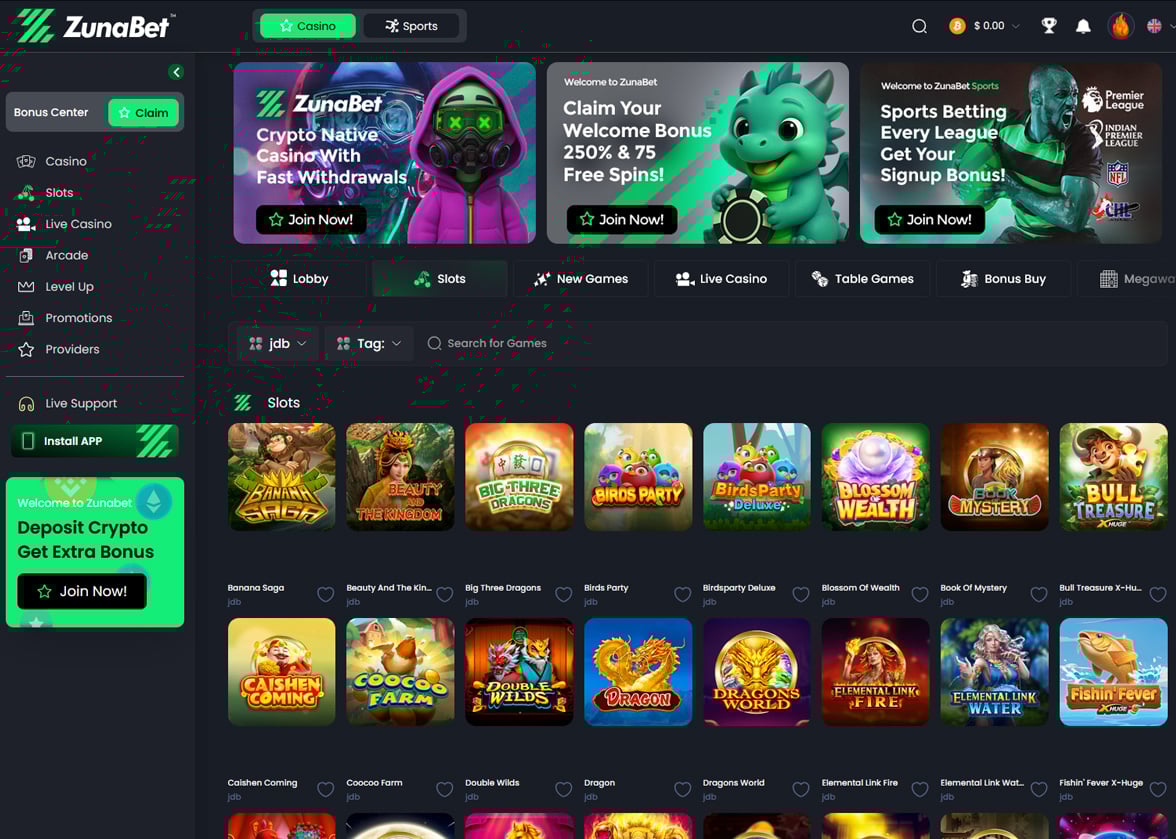
The sportsbook is fully integrated. Coverage includes football, basketball, tennis, NHL, combat sports, virtual sports, and esports markets for CS2, Dota 2, League of Legends, and Valorant. One account and one balance handle everything, so switching between casino and sports is seamless.
ZunaBet supports more than 20 cryptocurrencies: BTC, ETH, USDT across multiple blockchains, SOL, DOGE, ADA, XRP, and others. No platform processing fees are applied. Withdrawals are built for speed. Apps are available for iOS, Android, Windows, and MacOS, with live chat running 24/7.
The Bonus Gap
This is the single biggest reason players search for Stake alternatives, and it is where ZunaBet makes its strongest first impression.
Stake offers nothing when you sign up. No matched deposit. No free spins. No promotional credit. Your first session is funded entirely by your own money with zero cushion.
ZunaBet opens with a welcome package worth up to $5,000 plus 75 free spins across three deposits. First deposit: 100% match up to $2,000 with 25 free spins. Second deposit: 50% match up to $1,500 with 25 spins. Third deposit: 100% match up to $1,500 with 25 spins. The three-deposit structure keeps bonus value flowing across a player’s first several sessions rather than concentrating it all on day one.
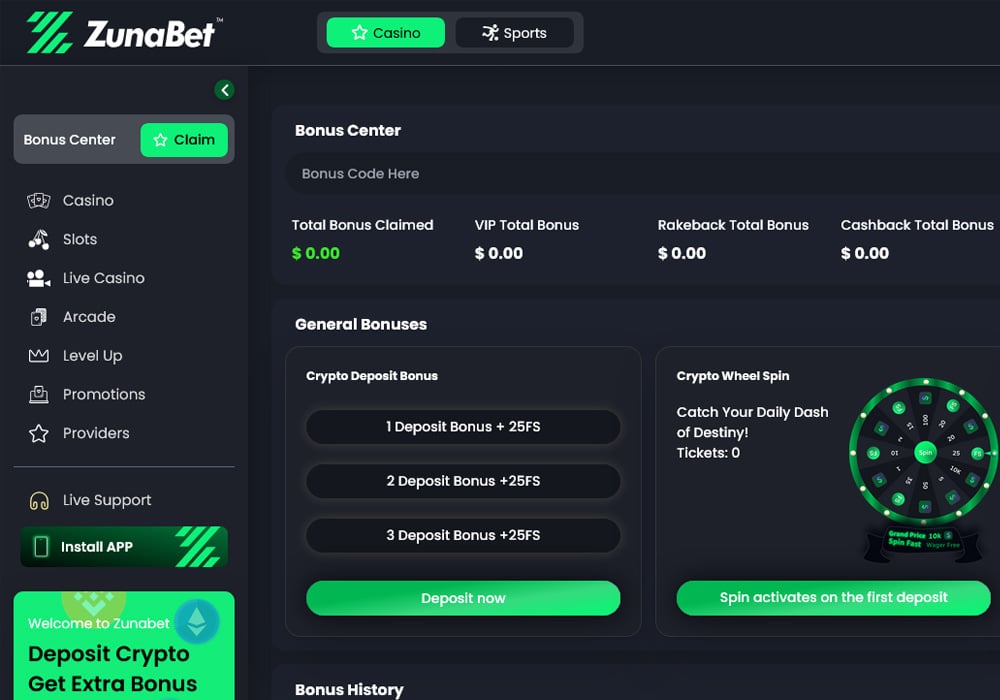
For a player evaluating whether to try a new platform, this alone answers the question. ZunaBet gives you significantly more to work with from the start, which means more games explored, more bets placed, and more time on the platform before your own funds carry the full weight.
Loyalty: Closed System vs Open Progression
The loyalty comparison is the second major driver of the search trend.
Stake’s VIP program operates behind closed doors. Invitation is based on wagering volume, but the thresholds are not published. Players have no visibility into where they stand or how close they are to qualifying. Those who make it in report strong benefits — rakeback, recurring bonuses, and personal account management. Those who do not make it in see nothing. For a large portion of Stake’s user base, the VIP program might as well not exist.
ZunaBet takes the opposite approach with a dragon evolution loyalty system featuring six published tiers. Squire starts at 1% rakeback. Warden gives 2%. Champion gives 4%. Divine gives 5%. Knight gives 10%. Ultimate reaches 20%. Each tier also unlocks free spins scaling up to 1,000, VIP club membership, and double wheel spins. A dragon mascot named Zuno gives the program personality and makes the progression feel gamified rather than transactional.
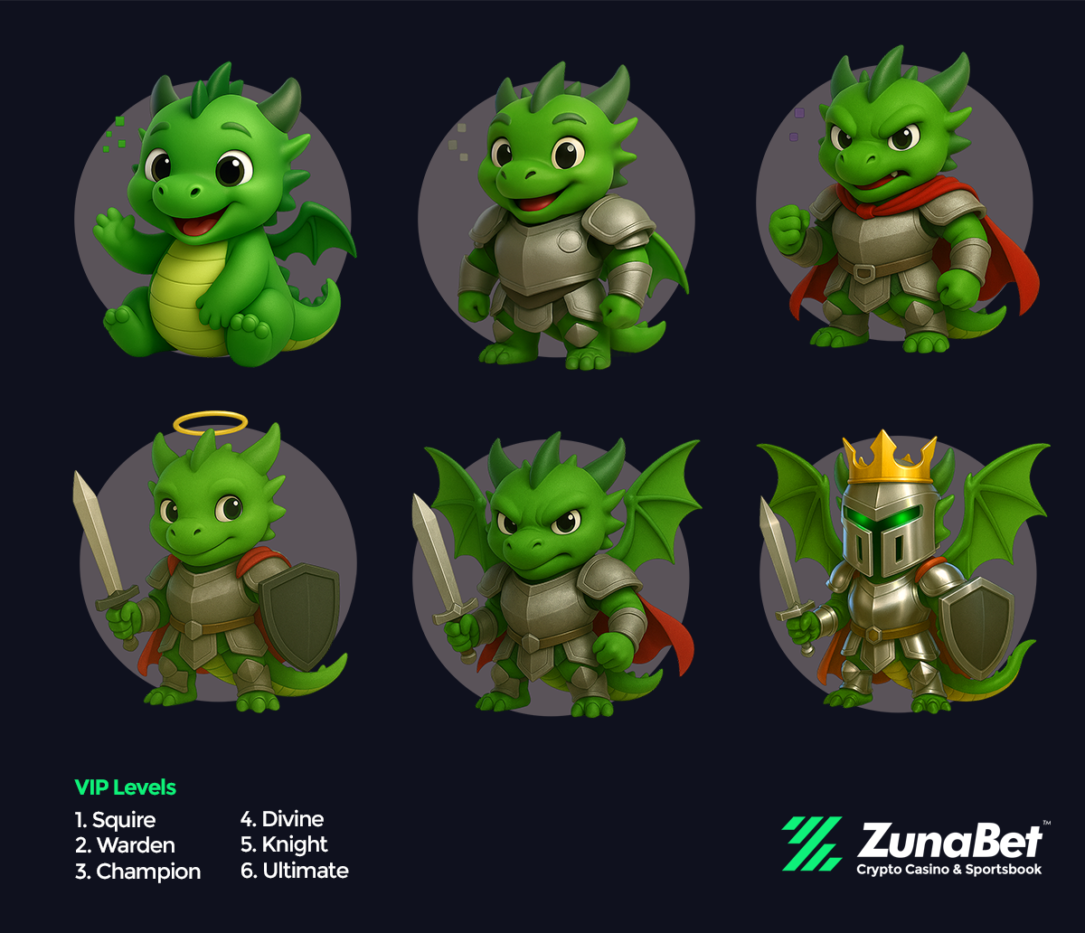
Every element of ZunaBet’s loyalty program is visible from day one. Players see every tier, every reward, and every requirement the moment they create an account. There is no ambiguity and no closed doors. For players frustrated by Stake’s opaque VIP system, this transparency is exactly what they are looking for. The 20% rakeback ceiling at the Ultimate tier offers a return rate that matches or exceeds what many Stake VIP members report receiving, but without requiring an invitation to access.
The Broader Crypto Casino Shift
The surge in alternative searches is not just about Stake specifically. It reflects a broader maturation of the crypto gambling market. When Stake launched in 2017, the options were limited and any decent crypto casino attracted players almost by default. In 2026, the landscape is crowded with platforms competing aggressively on bonuses, game variety, coin support, and loyalty rewards.
Players have become more sophisticated in how they evaluate platforms. They compare wagering requirements, check rakeback percentages, count supported cryptocurrencies, and read the fine print on loyalty programs. The era of sticking with one platform out of habit or lack of alternatives is fading.
ZunaBet benefits directly from this shift. Supporting over 20 cryptocurrencies with no processing fees, offering a game library that dwarfs most competitors, and running a loyalty program with published tiers and up to 20% rakeback positions it as the kind of platform that informed players actively seek out. It was built for a market where players shop around, and it was designed to win that comparison.
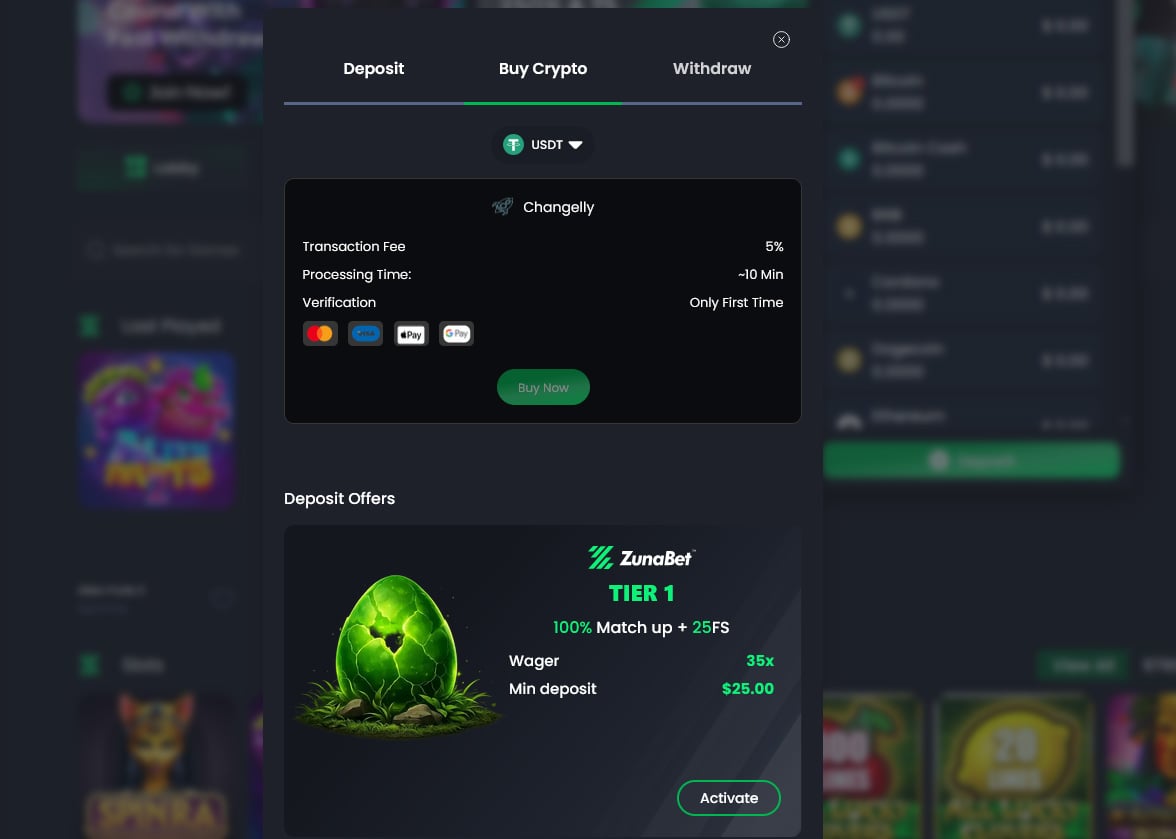
Both Stake and ZunaBet sit firmly in the crypto camp, which already separates them from traditional fiat operators like DraftKings, BetMGM, FanDuel, and Caesars. Those platforms process payments through banks and cards with slower withdrawals and higher fees. For players whose finances already run on crypto, neither traditional platform is a natural fit. The real choice for crypto gamblers in 2026 is between established crypto platforms like Stake and newer ones like ZunaBet that are pushing the category forward.
What the Search Trend Signals
Rising search interest in Stake alternatives is not a sign that Stake is declining. It is a sign that the market has evolved past what any single platform established years ago can satisfy without adapting. Players want welcome bonuses. They want transparent loyalty programs. They want massive game libraries and broad crypto support. They want platforms that earn their loyalty rather than assume it.
ZunaBet checks every one of those boxes. A $5,000 welcome bonus with free spins. Over 11,000 games from 63 providers. More than 20 supported cryptocurrencies with zero fees. A six-tier loyalty program reaching 20% rakeback with full visibility. A complete sportsbook with esports. It is a platform built specifically for the player who typed “Stake alternative” into a search engine and wanted to find something better.
Stake wrote the early playbook for crypto casinos. ZunaBet is writing the updated version — with more generosity, more transparency, and more reasons to choose it over what came before. The search trends suggest that a growing number of players are ready for that next chapter, and ZunaBet is the platform best positioned to deliver it.
Disclaimer: This is a Press Release provided by a third party who is responsible for the content. Please conduct your own research before taking any action based on the content.
The digital asset space has shifted a lot in 2026. The era of speculative retail frenzies is being replaced by a sophisticated, capital-heavy infrastructure driven by global institutions.
We are witnessing a historic migration. Crypto innovation is moving from hype-cycle headlines into the mission-critical backends of the world’s largest asset managers, banks, and payment networks.
As the border between TradFi and crypto effectively vanishes, the market requires something more effective than a “popularity contest” to identify its true leaders. It requires a data-backed standard of excellence.
Enter the BeInCrypto Institutional 100 Awards.
Unlike traditional industry awards that often rely on subjective “vibes” or paid placements, BeInCrypto has unveiled a data-backed framework designed to measure excellence across the entire institutional value chain.
Whether the category is high-speed trading infrastructure, the tokenization of real-world assets, or large-scale enterprise rollouts, the 2026 evaluation process is anchored by one “gold standard” rule: Show us the receipts.
In crypto, we know that marketing often outpaces reality. So, how do you solve this? Every point a nominee earns must be backed by an auditable data source. If you can’t trace it to a specific metric, a regulatory filing, or a verified on-chain event, it doesn’t count.
BeInCrypto has built a “firewall” around its rankings. No entity can purchase, negotiate, or lobby for a spot on this list. Unlike traditional awards, where a small committee might pick winners based on personal connections or brand recognition, our process is entirely transparent and traceable.
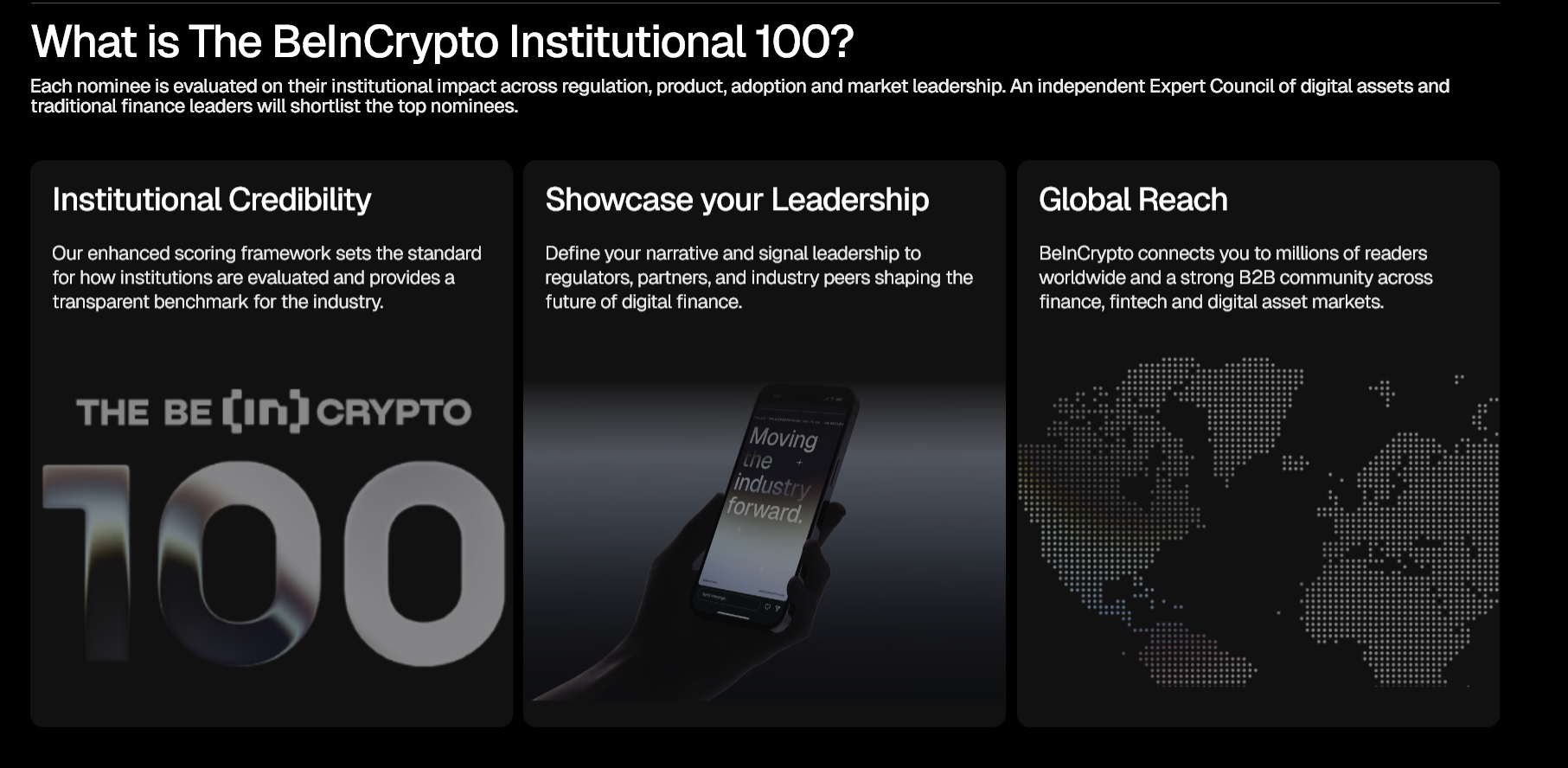
To ensure total fairness, we use a two-stage evaluation designed to eliminate “anchoring bias,” that common human tendency to automatically favour “big names” over better-performing newcomers. Here is how the process works:
- Stage 1: The Data Filter
We start by looking at the numbers. This stage is purely mathematical, using hard metrics to filter dozens of candidates down to the top contenders. If the data doesn’t back up the hype, the nominee doesn’t move forward.
- Stage 2: The Expert Council
The top candidates are then reviewed by a panel of industry veterans. Their job isn’t to pick favorites, but to interpret the data profiles through the lens of real-world experience, strategic execution, and leadership.
- The Result
This creates a ranking where a disruptive, high-growth “underdog” can actually unseat a legacy giant, provided the data proves they are doing a better job.

A Methodology Built for Reality
Institutional finance is built on privacy and proprietary strategy. Many firms treat their specific user numbers and revenue splits as confidential, which often leaves researchers with a “data gap.”
BeInCrypto uses a specialized toolkit of Derived Estimation Methods to ensure these firms are still measured accurately.
Reverse-Engineering Impact
If a firm doesn’t disclose specific user counts, our analysts work backward. Using Revenue-Ratio Inference, we take reported segment earnings and apply industry benchmarks to find a realistic activity level.
The “Reciprocity” Test
We verify partnership claims by checking the other side of the deal. Through Partnership Reciprocity Testing, we search the communications of a nominee’s partners. A partnership that is actively acknowledged by both parties carries significantly more weight than a one-sided claim.
Regional Modeling
By combining a company’s total footprint with local crypto adoption data from sources like Chainalysis, we build an accurate map of their actual influence in specific global markets.
The Three-Track Architecture
You wouldn’t use a ruler to measure the temperature, and you shouldn’t use the same criteria to measure a Bitcoin ETF as you would a New York Law Firm. To keep things fair, the 2026 methodology splits all 25 award categories into three specialized “tracks” based on what kind of data is available.
Track A: The Data-First Track
- Best for: High-transparency products like ETFs, On-Chain Protocols, and Asset Managers.
- How it works: In this track, the numbers do 50% of the talking. Because we can see exactly how much money is moving on the blockchain or in a fund, the data carries equal weight with our experts.
- Example: When evaluating “Best Digital Asset Product,” we look at $AUM$ (Assets Under Management) and daily inflows. If a new Bitcoin ETF is growing at 300% month-over-month, the data automatically pushes it to the top of the pile.
Track B: The Hybrid Track
- Best for: Consumer-facing companies like Neobanks, Crypto Brokers, and Onramps.
- How it works: These companies often have “hidden” data, like how many monthly active users they actually have. This track rewards transparency. We give a 20% “bonus” weight to firms that voluntarily share their internal metrics with our researchers.
- Example: If two Digital Banks have similar public reputations, but Bank A provides verified data on their institutional client growth while Bank B stays silent, Bank A earns a higher “Transparency Score,” giving them the competitive edge.
Track C: The Expert-Led Track
- Best for: Complex areas like Governance, Regulatory Compliance, and Policy Leadership.
- How it works: You can’t measure “good leadership” with a spreadsheet alone. In this track, our Expert Council, veterans from traditional finance and legal sectors, provides 80% of the score. However, we still include a 20% “sanity check” based on measurable signals.
- Example: For “Best Compliance Program,” the Council looks at the quality of a firm’s legal framework. But we anchor that opinion with data, such as: How many licenses do they actually hold? or What is the ratio of compliance staff to total employees? This ensures even “expert opinions” are rooted in reality.
Negative Signals
Innovation shouldn’t come at the cost of integrity. Every nominee faces a mandatory Negative Signal Scan.
This isn’t just a Google search. Our team scours SEC and VARA enforcement databases, Immunefi bug bounty records, and the DefiLlama Hacks database.
An unresolved security breach or a major regulatory fine isn’t just a “red flag,” it’s often a disqualifier. By baking risk assessment into the core score, BeInCrypto ensures that the “Institutional 100” represents the most stable and reliable actors in the space.
Looking Ahead to June 2026
The BeInCrypto Institutional 100 is about setting a real-world benchmark for an industry that has finally found its footing.
By opening up our playbook and publishing this methodology in full, we’re doing more than just handing out awards; we’re inviting the entire market to hold us and the winners to a much higher standard.
When the winners are revealed this June, you’ll know exactly how they got there. In a market still crowded with noise, we’re placing our bets on the data.
The post The BeInCrypto Institutional 100: A Benchmark for the New Financial Stack appeared first on BeInCrypto.
Ethereum Economic Zone Targets Layer-2 Fragmentation

The Best Period Pants And Swimwear, Tried And Tested

NBA MVP race: Shai Gilgeous-Alexander, Luka Dončić decline to campaign for award

Smart energy pays enters the US market, targeting scalable financial infrastructure

Why Israel is blocking foreign journalists from entering

Bitcoin: We’re Entering The Most Dangerous Phase

Janine fell into a financial crisis because of the breakup#shortvideo #shorts #foryou #comedy

Top 3 Best Cars under $10,000 #shorts #credit #money #finance #credit #carbuyingtips #carbuying

Why You’ll Never Sell Your Bitcoin Again. WOW!
-

 News Videos7 days ago
Parliament publishes latest register of MPs’ financial interests
-

 Business6 days ago
Instagram, YouTube Found Responsible for Teen’s Mental Health Struggle in Historic Ruling
-
 Tech6 days ago
Intercom’s new post-trained Fin Apex 1.0 beats GPT-5.4 and Claude Sonnet 4.6 at customer service resolutions
-

 NewsBeat5 days ago
The Story hosts event on Durham’s historic registers
-

 Sports5 days ago
Sweet Sixteen Game Thread: Tide vs Michigan
-
Entertainment2 days ago
Fans slam 'heartbreaking' Barbie Dream Fest convention debacle with 'cardboard cutout' experience
-
 Entertainment4 days ago
Lana Del Rey Celebrates Her Husband’s 51st Birthday In New Post
-
Crypto World1 day ago
Dems press CFTC, ethics board on prediction-market insider trades
-

 Sports1 day ago
Tallest college basketball player ever, standing at 7-foot-9, entering transfer portal
-

 Tech3 days ago
The Pixel 10a doesn’t have a camera bump, and it’s great
-

 Entertainment7 days ago
HBO’s Harry Potter Series Will Definitely Fail For One Big Reason, And It’s Not J.K. Rowling Or Snape
-

 Crypto World2 days ago
U.S. rule change may open trillions in 401(k) funds to crypto
-

 Fashion6 days ago
En Vogue in Brown Leather and Tailored Neutrals by Atelier Savoir, Styled by J Bolin
-

 Politics2 days ago
Should Trump Be Scared Strait?
-

 Tech1 day ago
EE TV is using AI to help you find something to watch
-

 Tech1 day ago
How to back up your iPhone & iPad to your Mac before something goes wrong
-

 Fashion6 days ago
What Are Your Favorite T-Shirts for the Weekend?
-

 Fashion5 days ago
Weekly News Update, 3.27.26 – Corporette.com
-

 Fashion4 days ago
Amazon Sundays: Soft Spring Layers
-

 Tech3 days ago
Elon Musk’s last co-founder reportedly leaves xAI
You must be logged in to post a comment Login