
Crypto World
Ethereum ETFs log $1.42B in 9 days as BlackRock buys all



Nine consecutive sessions of net inflows have narrowed the gap with Bitcoin ETFs to almost nothing. But spot volume tells a different story, and one that matters more.
Summary
- U.S. spot Ethereum ETFs recorded $225.8 million in net inflows on August 28, their strongest single day in 10 months, extending a buying streak to nine consecutive sessions worth $1.42 billion.
- BlackRock’s ETHA fund absorbed $1.02 billion of that total, or 72% of all category flows, without missing a single day of net buying across the entire run.
- The gap between Ethereum and Bitcoin ETF daily inflows narrowed to just $16.5 million on August 28, down from a factor of 10 on the first day of both streaks.
- Spot trading volume has softened to its 16th percentile year on year since the rally began on August 19, raising questions about whether flows alone can sustain price momentum.
- Ethereum is hovering around its 200 week moving average for the first time since breaking support in late January, with roughly 1.1 million ETH accumulated near that level acting as potential resistance.
The nine day streak that began on August 17 has been the most concentrated burst of institutional Ethereum buying since the spot ETFs launched. It has also been the most lopsided. One issuer, BlackRock, has accounted for nearly three quarters of every dollar that entered the category. Everyone else has been a rounding error.
How the streak took shape
The buying run started quietly. On August 17, Ethereum ETFs drew a fraction of what their Bitcoin counterparts pulled in. Bitcoin funds took roughly ten times as much that day. The ratio narrowed steadily over the following sessions, and by August 28 the two categories were separated by just $16.5 million, with Ethereum ETFs logging $225.8 million against Bitcoin’s $242.3 million.
The last day of net outflows for the Ethereum funds was August 11. Farside Investors data shows August 14 as the only session since then to register no net flow in either direction. From August 17 onward, every session has been positive.
Fidelity’s FETH posted its best day of the run on August 28 at $56.2 million. BlackRock’s staked Ethereum product, ETHB, added $20.7 million that same day. But neither fund has matched ETHA’s consistency. BlackRock has bought on all nine days without exception.
The streak’s trajectory accelerated in the second half. Daily inflows roughly doubled between the first four sessions and the last four, suggesting that early allocations triggered follow on buying from advisors and model portfolios that use flow momentum as an input signal.
BlackRock’s dominance in numbers
Blockchain analytics firm Arkham flagged the streak on August 27, counting $889.8 million across the first eight days for ETHA alone. The ninth session pushed the total past $1 billion. That figure matches Farside Investors’ tally exactly, providing independent confirmation from on chain data.
That 72% share is not normal. During the initial wave of spot Ethereum ETF inflows in mid 2025, BlackRock held roughly 40% to 50% of category flows. The current concentration suggests that whatever is driving the buying is either originating from a narrow set of institutional allocators who route through BlackRock, or that other issuers have not matched BlackRock’s distribution reach into the channels where this capital sits.
The distribution advantage is structural, not accidental. BlackRock’s iShares platform serves more than 30,000 registered investment advisors in the United States. Its model portfolio program, which automatically rebalances client allocations across asset classes, can generate ETF inflows at scale without individual advisor action. When the model portfolio team adds or increases an ETH allocation, every client account subscribed to that model buys ETHA simultaneously.
No other Ethereum ETF issuer has comparable model portfolio penetration. Fidelity serves a large advisory base but its crypto allocation models have been more conservative. Grayscale’s ETHE, converted from a closed end trust, continues to see net outflows from legacy holders who bought at premiums and are taking the opportunity to exit at net asset value.
Goldman Sachs agreed in August to acquire Neos Investments for up to $2.25 billion, a deal that will add Bitcoin and Ethereum options income ETFs to its platform. The move signals that the largest banks now view crypto ETF distribution as a revenue line worth paying billions for, not a compliance headache to avoid. But Goldman’s entry will take quarters to affect flows. For now, BlackRock operates in a distribution class of its own.
What is pulling the money in
The buying is coming from outside crypto, according to Max Shannon, senior research associate at Bitwise Europe. Shannon attributed the flows to a marked rise in cross asset risk appetite, the firm’s proprietary measure of how aggressively traditional market participants are deploying capital into higher volatility assets.
The catalyst was macroeconomic. The U.S. Treasury announced on August 19 that it would at least double its long dated bond buyback operations starting September 9. The announcement compressed long end yields, weakened the dollar, and revived what traders call the debasement trade, the same thesis that fueled Bitcoin’s climb past $80,000 on Treasury buybacks earlier in August.
Ethereum caught the spillover. But it caught less of it than almost everything else. That disconnect between inflow magnitude and price response is the central puzzle of this streak.
The timing also matters. The streak began four days after Fed Chair Kevin Warsh’s August 11 speech that was interpreted as mildly dovish, and it accelerated after the Treasury buyback announcement on August 19. Warsh’s Jackson Hole keynote on August 28, which shifted rate hike odds to 56%, came on the streak’s final recorded day. Whether the buying continues into September will reveal whether the flows were a macro trade or a structural allocation shift.
The underperformance paradox
Here is the arithmetic that makes this streak unusual. Ethereum ETFs have absorbed $1.42 billion in nine days. The price has moved roughly 5% over the same period, from approximately $2,350 to $2,477. That ratio, dollars in per percentage point gained, is far worse than what Bitcoin, Solana, XRP, or Hyperliquid delivered with comparable or smaller inflows.
Bitcoin gained 15% on $2.8 billion in ETF inflows over the same stretch. XRP surged 50% in a single week on ETF anticipation and whale accumulation. Hyperliquid hit a new all time high above $86. Even ZEC jumped 45% following the Grayscale Zcash spot ETF launch, on inflows that were a fraction of Ethereum’s.
Shannon called the lag warranted, noting that capital has rotated into higher beta blue chip names such as ZEC, XRP, SOL, and HYPE, which have outperformed. Bitwise’s dispersion index rose during the week, suggesting the market is being driven by a broader set of narratives and Ethereum is not the one carrying the story.
The implication is uncomfortable for ETH holders. The ETF flows are real, but they are functioning more as a slow accumulation by allocators who treat ETH as a portfolio weight to maintain, not as a conviction bet on outperformance. The money is entering because models say it should be there, not because traders believe ETH will outperform on the next leg.
The volume problem
This is the section a competitor could not have written, because it requires reconciling two data sets that point in opposite directions.
Flows are reflexive and momentum based. When money enters ETFs, the authorized participants, typically large broker dealers like Jane Street, Virtu, and Flow Traders, must buy ETH on the spot market to create new fund shares. That buying should, in theory, push spot volume higher, which attracts momentum traders, which generates more inflows. The feedback loop works until it does not.
Right now, it is not working. Spot volume has softened to its 16th percentile year on year since the rally began on August 19, according to Shannon. That means 84% of the trading days over the past year have seen more spot activity than the current stretch.
The authorized participant mechanism explains part of the gap. AP creation activity runs through institutional channels, primarily OTC desks and dark pools, that do not always register in public exchange volume data. Some portion of the $1.42 billion in ETF buying may have occurred off exchange, creating real demand without visible volume.
But even accounting for OTC activity, the volume picture is weak. On chain transfer volume for ETH, which captures all movement regardless of venue, has not shown a corresponding spike. The buying is narrow, concentrated in the AP creation flow, and the broader market is watching from the sidelines.
This creates a fragile setup. The ETF inflows are supplying buying pressure, but the broader market is not confirming it with volume. If the inflows pause for even a few sessions, there is no organic spot demand waiting to catch the price. The authorized participants who bought ETH to create shares become the marginal sellers if redemptions begin, and they will sell into the same thin order books they bought from.
A pickup in spot volume is needed for the market to sustain its footing, Shannon said. Without it, the current price level is being held up by a single buyer class.
The 200 week moving average test
Ethereum is hovering around its 200 week moving average for the first time since it broke support in late January. That level, roughly $2,450 to $2,500 at the time of writing, has historically acted as a floor during secular bull markets and a ceiling during bear phases.
During the 2018 to 2020 bear market, ETH spent 22 months below its 200 week moving average before finally reclaiming it in late 2020. During the 2022 to 2023 drawdown, it dropped below the level in June 2022 and did not reclaim it until October 2023. Each reclaim preceded a major rally. Each failure preceded further drawdown.
Shannon noted that investors accumulated roughly 1.1 million ETH around the current level, worth approximately $2.7 billion at current prices. That block could act as temporary resistance if those holders sell into strength, creating an overhead supply problem that even $225 million per day in ETF inflows may not be enough to absorb.
The Ethereum ETF inflow streak that ended in April lasted four days and coincided with ETH briefly touching $2,400. The current streak has lasted more than twice as long and pushed the price only marginally higher. That diminishing return is the clearest signal that flows alone are not sufficient without volume confirmation.
The Grayscale drag
Any analysis of Ethereum ETF flows is incomplete without accounting for Grayscale’s ETHE, which has been a persistent source of selling pressure since its conversion from a closed end trust in July 2024.
ETHE entered the conversion with approximately $9 billion in assets under management. Legacy holders who had purchased trust shares at significant premiums, sometimes 20% to 40% above net asset value, finally gained the ability to redeem at NAV. The resulting outflows have been steady, with billions leaving the fund over the subsequent two years.
During the current nine day streak, ETHE outflows have moderated but not ceased. The net category figure of $1.42 billion already accounts for ETHE redemptions, meaning the gross buying from ETHA, FETH, and other funds was materially higher than the net number suggests.
If ETHE outflows accelerate, as they have during previous price spikes that offered exit opportunities to legacy holders, the net flow picture could deteriorate rapidly even as ETHA continues buying. This is the hidden risk in the headline streak number.
How this compares to Bitcoin’s ETF dynamics
Bitcoin spot ETFs pulled in $2.8 billion over eight consecutive days through August 27, running in parallel with the Ethereum streak. But the two patterns diverge on a critical dimension.
Bitcoin’s inflows came alongside a 15% price move from roughly $68,000 to above $80,000. Ethereum’s $1.42 billion came alongside a 5% move. The flow to price transmission is roughly three times less efficient for ETH.
Part of the explanation is structural. Bitcoin’s free float is smaller relative to its market capitalization, meaning ETF buying absorbs a larger percentage of available supply. Long term holders, often called diamond hands, reduce the circulating supply further. Ethereum’s supply dynamics are more complex, with staking lockups affecting roughly 28% of supply, DeFi collateral locking another 12% to 15%, and layer 2 bridge deposits fluctuating daily. These pools reduce and release circulating supply in ways that do not track ETF flows cleanly.
The fee structure also matters. Bitcoin ETFs charge between 0.12% and 0.25% in expense ratios. Ethereum ETFs charge similar rates, but the staked variants like ETHB pass through staking yield minus a management fee. The yield component complicates the comparison, because ETHB inflows are partly a fixed income trade, not purely a directional bet on ETH price.
What would prove this thesis wrong
Two developments would invalidate the bearish read on Ethereum’s flow efficiency.
First, if spot volume recovers to its 50th percentile or above while inflows continue, the reflexive loop would reengage and the price response would accelerate. That would mean the current lag is a timing issue, not a structural one. A catalyst like the Ethereum Foundation announcing a major protocol upgrade or a high profile DeFi launch could generate the organic trading interest that is currently missing.
Second, if the staked ETH products like ETHB begin taking a meaningfully larger share of flows, it would suggest that the buying is not just passive allocation but active conviction in Ethereum’s yield bearing properties. ETHB took $20.7 million on August 28, a solid day but still a fraction of ETHA’s total. A shift toward staking products would signal deeper institutional commitment and a longer expected holding period.
Third, if Grayscale’s ETHE outflows approach zero, the net flow picture improves dramatically. The gross buying from ETHA alone would translate more cleanly into price impact without the Grayscale drag offsetting it.
What to watch
Daily spot volume relative to ETF creation activity. If the authorized participants are the only consistent buyers, the price is on borrowed time. Watch for spot volume climbing back above its 30th percentile year on year as a minimum threshold for sustainability.
The gap between ETHA and the rest of the field. If BlackRock’s share drops below 60% while total flows hold, it means distribution is broadening. If BlackRock’s share stays above 70% and total flows slow, the streak was one firm’s allocation cycle, not a market trend.
Ethereum’s 200 week moving average. A weekly close above $2,500 with rising volume would be the first clean reclaim of this level since January. A rejection with declining volume would confirm the overhead supply thesis.
Redemption signals from Grayscale’s ETHE. Grayscale has been a consistent source of outflows since its conversion from a closed end trust. If ETHE redemptions accelerate while ETHA inflows slow, the net effect on ETH supply could turn negative despite the headline streak.
The September Fed decision. Rate hike odds jumped to 56% after Warsh’s Jackson Hole keynote. A hike would pressure the risk appetite trade that Shannon identified as the primary driver of the current inflows. A hold or dovish surprise would extend it.
What are Ethereum ETFs?
Ethereum ETFs are exchange traded funds that hold ether directly and trade on U.S. stock exchanges. They allow investors to gain exposure to ETH through a brokerage account without managing private keys or interacting with cryptocurrency exchanges.
How much have Ethereum ETFs taken in during August 2026?
U.S. spot Ethereum ETFs recorded $1.42 billion in net inflows over nine consecutive trading sessions from August 17 through August 28, 2026. The single largest day was August 28 at $225.8 million, the strongest session in 10 months.
Why is BlackRock dominant in Ethereum ETF flows?
BlackRock’s ETHA fund took $1.02 billion of the $1.42 billion total, or 72% of all category flows. BlackRock’s iShares platform serves more than 30,000 registered investment advisors, and its model portfolio program can generate ETF inflows at scale without individual advisor action. No other issuer has comparable distribution reach.
Is the Ethereum ETF inflow streak bullish for ETH price?
The flows are net positive for price, but the transmission has been weak. ETH rose roughly 5% during a period that saw $1.42 billion in inflows, while Bitcoin gained 15% on $2.8 billion. Spot volume at its 16th percentile year on year suggests the broader market is not confirming the ETF driven demand.
How do Ethereum ETF flows compare to Bitcoin ETF flows?
On August 28, Ethereum ETFs took $225.8 million versus Bitcoin’s $242.3 million, a gap of just $16.5 million. At the start of the parallel streaks on August 17, Bitcoin’s daily inflows were roughly ten times larger. The gap narrowing suggests Ethereum is catching up in institutional allocation, though the price response remains weaker.
What is the 200 week moving average and why does it matter?
The 200 week moving average is a long term trend indicator that smooths price data over nearly four years. Ethereum is hovering around this level for the first time since January 2026. Historically, sustained trading above this average has signaled bull market conditions, while a failure to hold it has preceded extended drawdowns lasting a year or more.
What are staked Ethereum ETFs?
Staked Ethereum ETFs like BlackRock’s ETHB hold ether that is locked in Ethereum’s proof of stake consensus mechanism, earning yield for the fund. These products offer investors exposure to both ETH price movement and staking rewards, currently around 3% to 4% annually. They charge a management fee that reduces the net yield passed through to shareholders.
Should I invest in Ethereum ETFs based on this streak?
This is educational analysis, not investment advice. The inflow streak reflects institutional buying patterns but does not guarantee future price appreciation. Spot volume, macroeconomic conditions, Grayscale redemption dynamics, and the sustainability of BlackRock’s concentration in category flows all present risks that prospective investors should evaluate independently.
Disclaimer: This article is for informational purposes only and does not constitute financial advice. Cryptocurrency investments carry significant risk. Always conduct your own research before making investment decisions. Published August 29, 2026.

Trump Digital Gold has crashed 99% from its peak after wallets controlling 82.45% of the Solana token’s supply sold their holdings for about $1.01 million.
Summary
- Connected wallets sold 824.54 million GOLD tokens for 9,784.6 SOL, according to EmberCN.
- GOLD briefly reached a $66 million market cap after a Trump-affiliated merchandise account promoted it.
- The token’s market cap fell from $55 million to $1 million in about 30 seconds.
- U.S. regulators warn that social media promotions are frequently used in crypto pump-and-dump schemes.
GOLD wallets sold 82.45% of the token supply
On-chain analyst EmberCN reported on Aug. 29 that wallets linked to the Trump Digital Gold token had sold their entire holdings two hours before the post, receiving 9,784.6 Solana tokens worth approximately $1.01 million.
The wallets collectively controlled 824.54 million GOLD tokens, equal to 82.454% of the asset’s total supply, through a combination of pre-allocation and purchases made shortly after trading began. Such concentrated ownership allowed the connected addresses to sell most of the circulating supply once other traders entered the market.
EmberCN called the wallets the token’s “scammers,” although no law enforcement agency or U.S. regulator had publicly identified the people controlling the addresses at the time of writing. The on-chain analyst’s post also did not name GOLD’s developers or provide evidence linking its creators directly to President Donald Trump, his family, or the Trump Organization.
GOLD was created on Solana at 7:38 a.m., according to the timeline shared by EmberCN. Less than two hours later, an X account using the handle @realtrumpcoins1 posted the token’s contract address, giving traders a direct route to buy the new asset.
The account is associated with a Trump merchandise collaboration, but its connection to branded products does not by itself establish that GOLD was an official Trump project. TrumpStore.com identifies itself as the Trump Organization’s official retail website, while the organization’s website directs customers to TrumpStore.com for its official merchandise. Neither page identified GOLD as an authorized digital asset.
Trump-linked promotion sent GOLD to a $66M peak
At around 9 a.m., the contract-address post from @realtrumpcoins1 prompted a rapid increase in trading, EmberCN said. GOLD’s market capitalization briefly reached $66 million as buyers entered the newly created market.
The token remained volatile over the next several hours before the promotional post disappeared at 11:48 a.m. According to the analyst, the connected wallet cluster began selling at the same time the account deleted the message.
Heavy selling drove GOLD’s market cap from approximately $55 million to $1 million in about 30 seconds. The addresses continued exchanging their tokens for SOL until they had disposed of the full 824.54 million-token position by around 2 p.m.
By the time EmberCN published the findings, GOLD’s market cap had fallen to approximately $700,000, representing a decline of nearly 99% from its $66 million peak. The analyst estimated that the sellers had converted their position into $1.01 million of SOL based on the cryptocurrency’s value at the time.
A separate report citing Lookonchain described 15 wallets as linked to the team and said some of the addresses had bought GOLD before the promotional post appeared. Neither on-chain account identified the owners of the wallets, and the available blockchain records alone do not establish whether the same people controlled the token or the X account.
No public statement cited by EmberCN showed that Donald Trump promoted GOLD himself. The token is also separate from Official Trump (TRUMP), the Solana memecoin launched in January 2025 and publicly promoted through Trump’s verified social media accounts.
GOLD crash follows a familiar Solana token pattern
The concentration of GOLD’s supply left buyers exposed to sales from a small wallet group. Once the holders of more than four-fifths of the supply exited, the token had few buyers capable of absorbing the volume entering the market.
As crypto.news previously explained, Solana launch platforms can make token creation and early trading almost immediate. The same process lets automated buyers, bundled wallets, and insiders acquire large positions before most retail traders find the asset.
Traditional rug pulls involve developers removing liquidity from a decentralized exchange pool. A token can also collapse when connected wallets control most of its supply and sell into demand created by social media promotion, even when liquidity has not been directly withdrawn.
GOLD’s sequence closely resembles an earlier incident involving BARRON, an unofficial token named after Trump’s son. In January 2025, an insider wallet bought 136.35 million BARRON tokens for about $1,048 before exchanging the position for 4,405 SOL worth roughly $1.05 million after the token rallied, according to a report on the dump.
Another politically branded token drew scrutiny in May 2026 after Bubblemaps connected more than 200 newly funded wallets to nearly all of its initial supply. Wallets associated with the Ghanaian former president-themed CWU token sold about $600,000 while related addresses still controlled around 85%, according to the platform’s wallet-cluster findings.
Official Trump has faced separate questions in the United States. In August, U.S. senators called for the Securities and Exchange Commission to examine whether the official token had operated as a “soft rug pull” after falling about 98% from its peak. Nansen data cited by the lawmakers showed that 988,905 of the 1.48 million wallets that bought TRUMP held combined losses of approximately $3.81 billion, as detailed in the SEC probe request.
The lawmakers’ request did not establish that fraud occurred. Any enforcement decision would require regulators to examine the token’s structure, promotion, distribution, and the economic facts surrounding its sale.
U.S. rules leave meme coin buyers with limited protection
For U.S. traders, the SEC’s Division of Corporation Finance said in February 2025 that the offer and sale of meme coins fitting its description generally do not involve securities under federal law. The staff viewed such assets as collectibles purchased mainly for entertainment, social interaction, and cultural purposes rather than investments tied to a business operation.
The SEC staff statement also said holders of meme coins covered by its analysis do not receive the protections of federal securities laws. The assessment is not binding law, and the agency said it would examine the economic reality of any product that uses a meme coin label to avoid securities requirements.
Fraudulent conduct can still lead to action under other federal or state laws even when a token is not considered a security, according to the SEC. Its Office of Investor Education and Advocacy has separately warned that fraudsters may create culture-themed tokens, promote them on social media to raise the price, and then sell their holdings before the attention disappears.
Under the agency’s description of a crypto pump-and-dump, promoters profit from the inflated price while later buyers can suffer steep losses. The investor alert advises traders not to rely solely on social media posts or celebrity associations when deciding whether to buy a crypto asset.

Dow Jones futures will open Sunday evening, along with S&P 500 futures and Nasdaq futures. The stock market’s major indexes rose modestly for the week, despite Friday’s losses as Treasury yields jumped on Fed chief Kevin Warsh’s Jackson Hole speech. But the small-cap Russell 2000 fell below key support while many sectors retreated for the week often with downside reversals.…
Copyright ©2026 Investor’s Business Daily, LLC. All rights reserved. 87990cbe856818d5eddac44c7b1cdeb8


Hyperliquid has received its first reported builder-deployed HIP-4 outcome exchange after OUT completed deployment through the network’s permissionless market framework.
Summary
- OUT has become the first reported outcome DEX deployed through Hyperliquid’s HIP-4 framework.
- Deployers can create YES/NO markets using templates approved by Hyperliquid validators.
- HIP-4 contracts are fully collateralized and operate without leverage, funding payments or liquidations.
- Hyperliquid’s current developer documentation lists permissionless deployer actions as available on the testnet.
Hyperliquid’s block explorer shows that a successful on-chain transaction registered the Outcome DEX under the name OUT through the HIP-4 deployment framework.
The transaction confirms OUT’s deployment but does not show whether its markets have opened for live trading. No separate announcement or verifiable website detailing its markets, liquidity, or trading activity was available at the time of writing.
Hyperliquid’s HIP-4 framework lets builders create markets
According to Hyperliquid’s developer documentation, HIP-4 lets approved deployers create outcome markets without seeking validator approval for every individual contract. Each market must still follow a template that the validator set has previously approved.
Templates define the basic form of a contract, its available results, and how it settles. Once validators approve one, a deployer can use the same structure to create separate markets that meet its conditions.
A YES/NO template allows traders to choose between two possible results. Multi-result templates can cover questions with several possible answers, although Hyperliquid’s main HIP-4 documentation says multi-outcome support was not included in the initial mainnet release and would arrive in stages.
Hyperliquid’s deployer page, updated on Aug. 13, lists functions for activating a DEX, selecting templates, setting a deployer fee scale, and creating markets. The documentation currently labels its HIP-4 deployer actions as testnet-only, meaning OUT’s deployment should not yet be described as a confirmed permissionless mainnet launch without additional evidence.
As crypto.news previously reported in July, Hyperliquid’s permissionless deployment plan was scheduled to begin on testnet before reaching mainnet. The proposal required market operators to stake 500,000 HYPE and allowed validators to slash deployers for incorrect or delayed settlement, according to the July report.
Separate stakes are required for HIP-3 and HIP-4 operations because one HYPE allocation cannot support both deployments at the same time, according to Hyperliquid’s framework. At current prices, the requirement can create a high entry cost for independent teams seeking to operate both perpetual and outcome exchanges.
HIP-4 outcome contracts remove leverage and liquidations
Hyperliquid introduced HIP-4 on testnet in February before activating its first outcome contracts on mainnet on May 2. A July HIP-4 framework explainer described the products as fully collateralized contracts that settle within a fixed range at expiration.
Unlike perpetual futures, an outcome position does not rely on borrowed funds or recurring payments between long and short traders. HIP-4 has no funding rate, while fully funded positions remove the liquidation process used to close leveraged trades when collateral falls below maintenance requirements.
For a binary market, a YES token settles at 1 if the stated event occurs and at 0 if it does not. The NO side receives the opposite result. A trader buying YES at 0.60 can earn 0.40 per contract if the event happens, while the purchase price represents the maximum possible loss.
Hyperliquid’s documentation describes HIP-4 as a general-purpose tool rather than a system limited to conventional prediction questions. Its fixed-range structure can also support bounded options-style products whose maximum payout and loss are known when the position opens.
Trading takes place through HyperCore, the network’s on-chain order-book engine. HyperCore also runs Hyperliquid’s spot, perpetual, and HIP-3 builder-deployed markets, allowing HIP-4 products to use the same matching infrastructure and order types.
Fees are not charged when an outcome position opens, according to the protocol documentation. Charges can apply when a trader closes, burns, or settles a position, although Hyperliquid waived outcome-market fees during its initial testing period.
Bitcoin and CPI contracts tested HIP-4 settlement
Hyperliquid’s first mainnet HIP-4 product was a recurring Bitcoin binary contract. The market settled each day at 06:00 UTC against the BTC mark price published through HyperCore, providing an objective data point for deciding whether YES or NO tokens received the payout.
The network later expanded the product beyond crypto prices. In May, a U.S. CPI contract allowed traders to take positions on the annual inflation rate reported by the Bureau of Labor Statistics.
The CPI market offered three possible results: below 4.3%, exactly 4.3%, or above 4.3%. It used USDC as collateral and was scheduled to settle from the official BLS release, while early activity stood at about $3,000 in volume and $5,000 in open interest.
Validator-settled markets subsequently covered Federal Reserve decisions and sporting events, according to Galaxy Research. The research firm said validators could publish approved off-chain results through regular network operations, reducing reliance on a separate oracle provider.
Galaxy reported that HIP-4 recorded $2.38 million in 24-hour Bitcoin outcome volume by its 25th day. The total represented about 20% of the combined BTC prediction-market volume measured between Hyperliquid and Polymarket during that period, according to the firm’s June report.
Activity later declined after an early increase tied to World Cup markets. Blockworks data cited in a July market report placed HIP-4 open interest at about $182,000 and cumulative notional activity at approximately $881,000 at the time, though the figures covered a later snapshot and used a different measurement period.
U.S. access depends on event-contract regulation
For American traders, OUT does not carry the same regulatory status as Kalshi, which operates event contracts through a Commodity Futures Trading Commission-registered designated contract market. Hyperliquid has not announced that OUT is registered with the CFTC or available to U.S. users.
Hyperliquid Policy Center and Multicoin Capital addressed the regulatory divide in a July prediction-market rules filing. The groups asked the CFTC to publish clear federal standards for reviewing event contracts and explain publicly why specific contracts are approved or rejected.
Their submission said settlement terms should determine whether a contract falls into restricted categories involving gaming, war, assassination, or unlawful activity. The filing represented an industry policy request and did not give HIP-4 exchanges permission to serve U.S. traders.
State and federal regulators have also disputed whether some sports event contracts qualify as federally regulated derivatives or state-regulated wagers. Kalshi, Crypto.com and Robinhood have faced state challenges over sports-related products even when the contracts were offered through federally regulated market structures.
Hyperliquid users in the United States remain unable to access the protocol, according to an August filing cited by Hyperliquid Strategies. The company said it was unaware of a pending CFTC approval process for the network and warned that a route into the regulated U.S. market could not be assured.
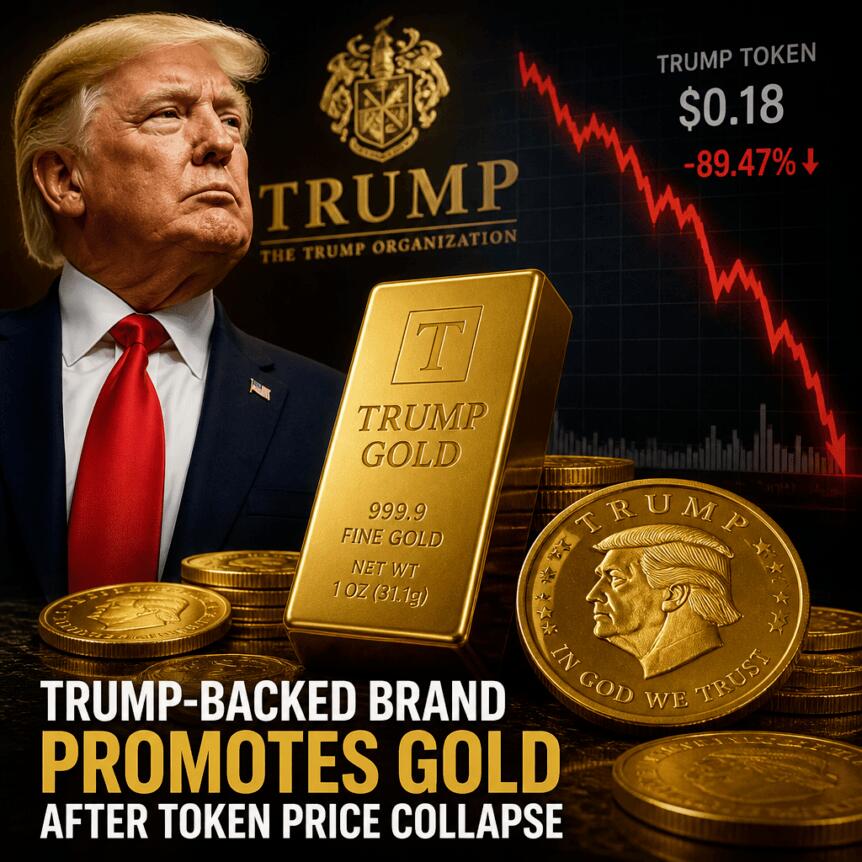
A Solana token promoted under the Real Trump Coins brand collapsed within hours of its launch, according to blockchain analytics and on-chain activity. The episode has quickly sparked scrutiny over the token’s legitimacy and raised questions about whether the brand’s social accounts or website were compromised.
Real Trump Coins—an outlet that US President Donald Trump publicly promoted in 2024—advertised a “Trump Digital GOLD” token on X before deleting related posts on Saturday. Blockchain analytics firm Lookonchain later flagged the launch, alleging that the team behind the token controlled a large portion of the supply and used newly created wallets to dump holdings shortly after launch, causing the token’s value to plunge.
Key takeaways
- Lookonchain says GOLD’s developer and associated wallets controlled about 82.45% of the token supply at the time of the analysis.
- After being acquired by 15 newly created wallets, 224.5 million GOLD was reportedly sold for 3,178 SOL (about $330,000 at the time), contributing to a rapid price collapse.
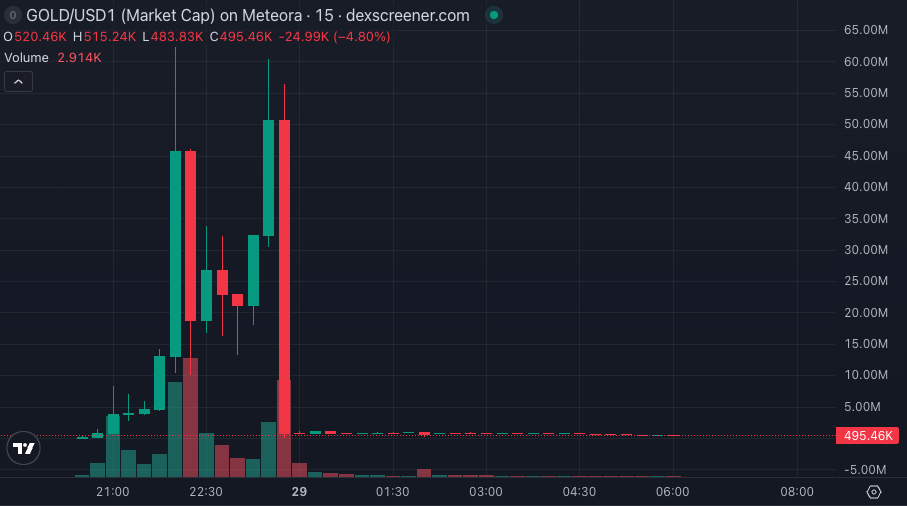
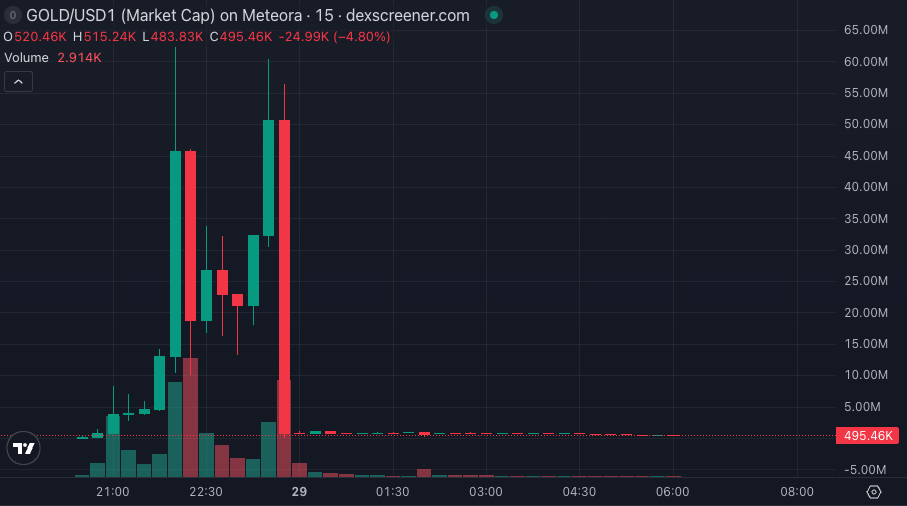
- DE X Screener data cited in the reports shows GOLD’s market capitalization dropped from roughly $50 million to about $500,000 within hours.
- Real Trump Coins’ website continued promoting the GOLD token after the X posts were deleted, leaving observers to question who initiated the launch and promotion.
- The incident adds to broader concerns around Trump-linked crypto brands as US policymakers debate a regulatory framework for digital assets.
GOLD launch on Solana ends in rapid sell-off
The token surfaced early Saturday after the Real Trump Coins X account—an account that Trump’s official profile follows—posted about the GOLD launch and directed users to RealTrumpCoins.com. Shortly after, Lookonchain flagged the activity, drawing attention to wallet distribution and the token’s early trading behavior.
In a thread referencing the on-chain setup, Lookonchain said the developer held 600 million GOLD while 15 newly created wallets spent $18,657 to buy an additional 224.5 million tokens. Lookonchain also warned that the team “currently controls 82.45% of the total supply,” advising traders to exercise caution.
Lookonchain later reported that those 15 wallets sold all 224.5 million GOLD for 3,178 SOL, describing it as an apparent rug-style extraction of value soon after acquisition. The same analysis estimated the wallets’ profit at roughly $312,000—about 17 times the initial amount invested.
As selling spread, the token’s valuation deteriorated quickly. According to DEX Screener data referenced in the reporting, GOLD’s market capitalization fell from about $50 million to around $500,000 at the time of publication.
For traders, the takeaway is not just that the token declined, but how quickly supply concentration and early transfers translated into market impact. Such a pattern—large holdings clustered near the deployer paired with rapid post-launch selling—often leaves retail buyers with limited exit liquidity.
Real Trump Coins keeps marketing GOLD after X deletion
Real Trump Coins’ connection to the episode matters because Trump has previously promoted the brand. The company’s site continued advertising GOLD at the time of publication, including a claim that it would charge a 4% trading fee and that it would use 99% of those fees to buy back the token in an attempt to push it toward a top-10 ranking by market capitalization.
However, observers noted a mismatch between marketing on the website and the behavior of the brand’s X account. Lookonchain reported that Real Trump Coins promoted GOLD on X and then deleted the related posts on Saturday.
That combination—public promotion followed by deletion, while the website remains active—has fueled speculation that either the token launch was mishandled, or that the brand’s online presence may have been compromised. Some crypto commentators went further, describing the setup as an apparent scam or rug pull, though the reports in circulation included claims that were not independently substantiated within the available facts.
The immediate practical concern for users is how to verify whether token promotions stem from legitimate operators or from unauthorized actors. In incidents like this, “official-looking” social posts may not be enough, and the contract’s distribution, liquidity conditions, and wallet behavior can become the more reliable indicators.
Why the Real Trump Coins tie is under scrutiny
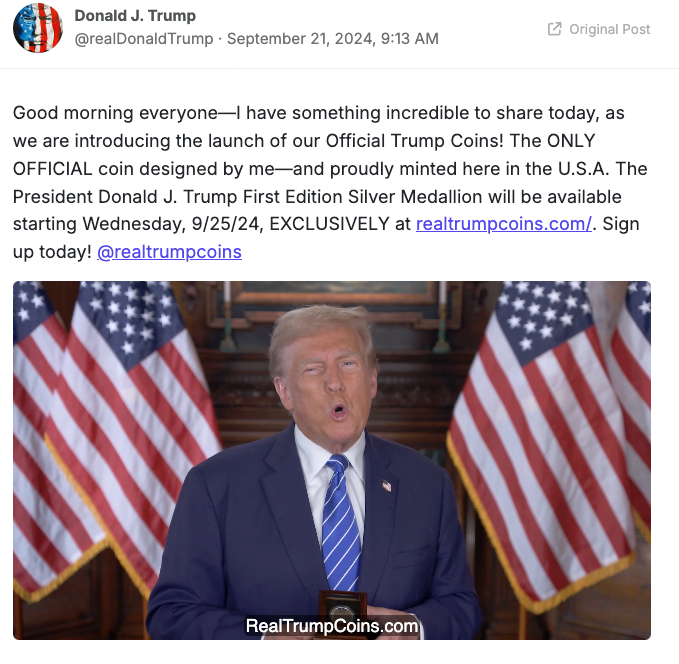
Real Trump Coins was publicly promoted by Donald Trump in September 2024, when he highlighted RealTrumpCoins.com during announcements related to his silver medallions. The website’s terms state that its products are not manufactured, distributed, or sold by the Trump Organization.
Even with that disclaimer, the GOLD incident revived attention on the ecosystem of Trump-linked crypto activity and the potential governance and conflict-of-interest concerns that come with high-profile endorsements. The episode lands as Trump continues to press Congress on crypto oversight, including legislation aimed at establishing a regulatory framework and clarifying whether tokens should be treated as securities or commodities.
In the weeks and months preceding the broader regulatory debate, Trump and his family have backed or launched multiple crypto ventures, including the Official Trump memecoin and World Liberty Financial. The White House has denied impropriety in connection with these efforts, but incidents like the GOLD collapse inevitably intensify public scrutiny of how legitimacy is communicated to retail investors.
Earlier reporting on these policy efforts has emphasized that lawmakers’ decisions could shape how token issuers and promoters are regulated—especially when promotional reach overlaps with political visibility. In that context, the GOLD episode is less about one token’s fate and more about the recurring problem of investor harm when marketing appears to outpace verification.
What to watch next
For now, traders and observers will likely focus on whether the GOLD token’s contract and wallet flows show any further coordinated activity, and whether Real Trump Coins addresses the on-chain behavior that Lookonchain highlighted. More broadly, the incident underscores how quickly reputational risk can spread when high-profile branding intersects with on-chain launches—especially in the absence of clear, verifiable operator confirmation.


INTERPOL has reported 58 arrests, 263 identified suspects and $2.67 million seized after a 22-country operation targeted crypto investment scams, romance fraud and money laundering networks.
Summary
- Operation Jackal IV involved 22 countries across six continents between November 2025 and June 2026.
- Police arrested 58 people and identified 263 suspects linked to West African organized crime networks.
- South African authorities seized $2.67 million and blocked 257 bank accounts after raids in Johannesburg.
- Romanian police arrested 11 suspects in an investment scheme linked to an estimated €143 million.
According to an official INTERPOL release published on Aug. 25, Operation Jackal IV ran for eight months from November 2025 through June 2026 and focused on the financial systems used by West African organized crime groups.
Authorities from 22 countries across six continents took part in the operation, including the United States, the United Kingdom, Canada, the United Arab Emirates, South Africa, Argentina, Nigeria, Romania, and several European countries.
Investigators focused on groups such as Black Axe and similar criminal organizations accused of running romance scams, fake cryptocurrency investments, business email fraud, and other financial crimes. Police also tracked the shell companies, bank accounts, digital wallets, and outside service providers used to receive or conceal stolen money.
During the operation, INTERPOL helped participating agencies exchange intelligence across borders, analyze financial activity, and coordinate enforcement work. The organization also provided specialist training to investigators handling money laundering cases.
“By following illicit financial flows across borders, we are attacking the very lifeblood of organized crime and making it increasingly difficult for criminal networks to profit from their activities,” said Tomonobu Kaya, director of the INTERPOL Financial Crime and Anti-Corruption Centre.
Interpol crypto scam operation leads to 58 arrests
Operation Jackal IV resulted in 58 arrests and the identification of another 263 people suspected of links to the targeted criminal networks, according to INTERPOL.
In Argentina, federal police uncovered a Crime-as-a-Service network suspected of supplying website domains and money laundering support to West African crime groups. Investigators identified 196 people connected to the operation and arrested 17 suspects.
An INTERPOL Operational Support Team assisted Argentine authorities with the examination of seized information. The team analyzed the material for links among suspects, criminal groups, and overseas partners while helping local investigators develop additional leads.
South African authorities conducted the largest enforcement action reported in the operation, arresting 39 people during raids at seven locations in Johannesburg. Police linked the sites to a group accused of running romance and investment scams against retirees in English-speaking countries.
According to INTERPOL, members of the network handled different stages of the fraud, with some working as “conversion” agents and others serving as “retention” agents. Such roles involved turning initial contacts into paying victims and persuading existing victims to continue sending money.
Police seized $2.67 million, blocked 257 bank accounts, and collected evidence during the Johannesburg raids. An INTERPOL support team also worked in South Africa to help local investigators examine the network’s financial and international links.
The agency’s release lists 17 arrests in Argentina and 39 in South Africa, accounting for 56 of its stated 58 arrests. However, the same release separately reports 11 arrests in Romania, bringing the country-level figures mentioned in the statement to 67. INTERPOL did not explain whether the Romanian arrests were included in its headline total or treated as the result of a connected investigation.
Romanian investment scam allegedly moved €143 million
Romanian police dismantled a call center accused of offering investors large returns from stocks and cryptocurrencies. INTERPOL said the suspects redirected victims’ deposits to electronic wallets under their control rather than placing the money in genuine investments.
Investigators estimated that the group stole and laundered about €143 million worldwide. Police arrested 11 people and seized approximately €330,000 in cash and cryptocurrency, six properties and several luxury watches.
In Italy, investigators identified one person suspected of involvement in a money laundering network operating across Europe. According to INTERPOL, the network used shell companies, remittance services, and cash withdrawals to hide the source of funds.
A single bank account processed €845,000 across 560 transactions involving 20 financial instruments, the agency said. Investigators did not report an arrest in the Italian case, and the inquiry remained tied to the identification of one suspect.
Operation Jackal IV also found that some West African crime groups were buying Crime-as-a-Service tools from outside providers, often through dark web markets. INTERPOL said such arrangements allowed fraud groups to outsource website infrastructure, money laundering, and other technical work instead of managing every part of their operations internally.
In July, crypto.news reported another INTERPOL operation that produced 5,811 arrests and intercepted $293 million in illicit assets across 97 countries and territories. Operation First Light also identified more than 142,000 victims and blocked over 31,000 bank accounts while targeting romance scams, investment fraud and related money laundering.
Thai police uncovered a crypto laundering network during that earlier operation, with INTERPOL saying one wallet processed more than $122.5 million over 10 months. Investigators alleged that the network moved romance scam proceeds through several digital assets and used cross-chain swaps to make the money harder to trace.
U.S. authorities pursue overseas crypto scam proceeds
The United States was among the 22 countries participating in Operation Jackal IV, although INTERPOL’s release did not describe a specific U.S. arrest or asset seizure from the operation.
American authorities have separately pursued overseas networks accused of targeting U.S. residents with similar romance and crypto investment schemes. In July, the Department of Justice sought the forfeiture of $25 million in cryptocurrency recovered through five investigations involving suspected victims in the United States and Canada.
According to the U.S. Attorney’s Office for the District of Columbia, the five cases involved fake cryptocurrency platforms and laundering networks with links to China, Malaysia and Cambodia. Prosecutors said the DOJ’s Scam Center Strike Force had seized more than $800 million since its creation in November 2025.
One of the investigations involved more than 270 suspected victim transfers and approximately $10.4 million in cryptocurrency, while another covered over 200 romance scam victims and $12.1 million in assets. Under the civil forfeiture process, eligible victims may seek compensation if courts approve the government’s claims to the recovered funds.
During a separate June enforcement action, Coinbase froze over $3 million in cryptocurrency tied to alleged Southeast Asian scam networks. The exchange worked with the DOJ, Meta, Microsoft, Starlink and overseas law enforcement agencies to identify financial transfers and online infrastructure linked to romance and investment fraud.
Meta disabled more than 1.4 million accounts, pages and groups connected to suspected scams, while Microsoft suspended about 20,000 accounts. Starlink terminated service for thousands of internet kits associated with suspected unlawful activity, and the Royal Thai Police arrested 63 people linked to scam operations.
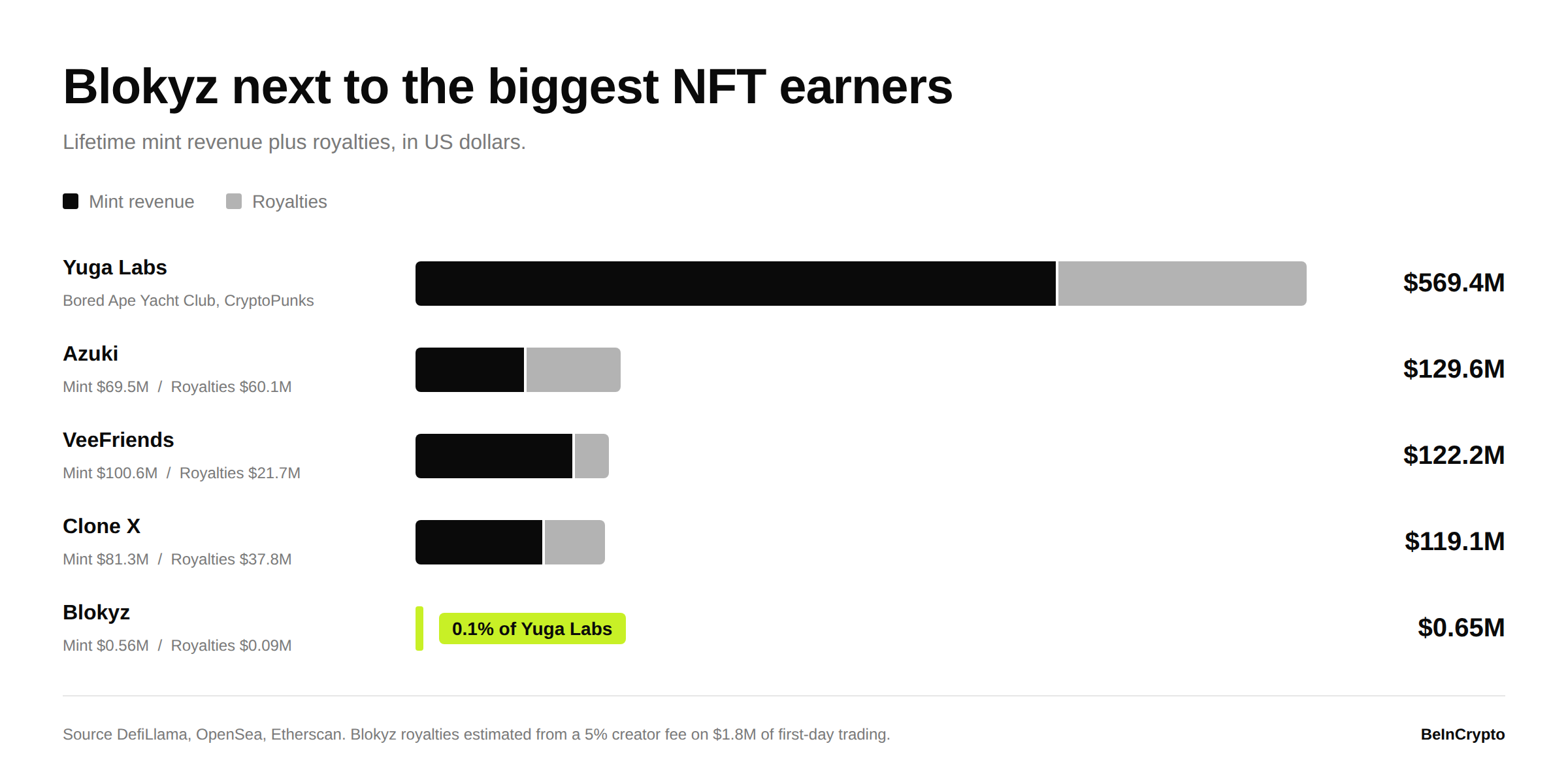
More than $64 million poured into the Blokyz NFT sale in 24 hours. But the company had to refund most of this money, keeping less than $600,000.
Blokyz is a Web3 collectibles company that has made physical resin figures for brands including CoinGecko, Arbitrum, and KuCoin. Its latest project was much larger: a collection of 10,000 Original Blokyz NFTs on Ethereum.
How $64 Million Chased 7,500 NFTs
Blokyz reserved 7,500 NFTs for a public raffle at 0.03 ETH each, roughly $75 at the time. Anyone could enter; there was no limit on entries per wallet, and every unsuccessful entry would receive its 0.03 ETH back.
The raffle stayed open for 24-hours throughout that period, even though there were already enough entries to fill every available spot. Buying more tickets meant locking up more ETH temporarily, rather than losing the full entry price each time the raffle failed.
By the close, 22,443 wallets had submitted 853,964 entries, committing 25,618.92 ETH worth $64.4 million. That worked out to roughly 114 entries chasing each available NFT.
But only 7,500 winning entries could actually settle. At 0.03 ETH each, Blokyz could keep just 225 ETH, or about $566,000.
So, initially it looked like Blokyz made a new NFT sale record with $64 million. Surprising for a time when NFTs are supposed to be dead. But it turns out, most of this money was temporarily queued for refund.
Was It a Record? Nobody Can Say
By money earned, it is not close. Yuga Labs, the studio behind Bored Ape Yacht Club, made roughly $410 million from its mints. Blokyz did not earn enough to appear on that list at all.

By money queued, it might be a genuine record. Nobody tracks that, though. Public rankings measure what a project keeps, not what passed through its hands.
The most striking thing about this sale is the one thing nobody can check. Something real did happen, as the figures now trade at about five times what they cost, so most winners chose to keep them.

Meanwhile, scale still argues for caution because the wider NFT market is worth around $2 billion, while Bitcoin (BTC) alone is worth $1.6 trillion. A hot weekend for collectibles is not a sign of a returning bull market.
The real test starts now that 22,000 people just got their money back. Will they really spend it on the same thing again?
The post Ethereum Holders Staked $64 Million to Buy a $75 Blokyz NFT appeared first on BeInCrypto.

Solana’s native token became one of the recent top performers in the crypto market, surging to a new seven-month high at over $105 before it was finally halted and retraced slightly.
This substantial rally from under $75 came amid several major developments within the broader Solana ecosystem. Perhaps the most important came from the network itself.
Issuance Changed
The network finally succeeded in reducing future SOL issuance. Although the decision could hardly have been any closer, validators approved SGP-0002, which endorses doubling Solana’s annual disinflation rate from 15% to 30%. The proposal finished with approximately 67%, barely clearing the two-thirds supermajority required for approval.
Helius CEO Mert Mumtaz, one of the most prominent and vocal supporters, summed up the dramatic finish by saying his team made hundreds of calls in the final hours and ultimately passed the measure by a “literal hair.”
It’s worth noting that the proposal does not eliminate inflation. It doubles the speed at which SOL’s existing inflation rate declines each year – from 15% to 30%, while leaving the network’s terminal inflation rate unchanged at 1.5%. Under the current schedule, Solana was expected to reach that floor in the first half of 2032. The new schedule reduces that time by half, bringing it to H1 of 2029.
The trade-off is that normal staking yields are projected to fall faster as fewer new tokens are distributed, which is where most of the arguments against it come from.
SOL ETF Breaks $1 Billion Milestone
The Bitwise Solana Staking ETF (BSOL) became the first exchange-traded fund tracking the altcoin to surpass the coveted $1 billion target in assets under management on Friday. It saw the light of day last October, meaning that it took around 10 months to do so.
What’s particularly interesting here is that this achievement occurred despite SOL’s broader price performance. As Bitwise President Teddy Fusaro pointed out, BSOL shares remain about 40% below their listing prices, while SOL itself is still 60% away from its ATH.
BSOL held more than 9.3 million SOL when it crossed the $1 billion mark. It targets staking 100% of its holdings, while the net staking reward rate currently stands at around 5.8%.
Whales Go Big
Lookonchain data from earlier today showed that two major Solana whales have continued to withdraw major holdings from exchanges after completing significant accumulations. A wallet ending with 3WzfuP withdrew almost $3.9 million in SOL from Kraken, while another one, ending with 5p6zPz, transferred nearly $30 million worth of the asset from Binance.
SOL’s price has been on the move lately, surging to a six-month peak at over $105 on Friday before the broader market’s correction drove it south. Nevertheless, it remains well above $100 after a 42% monthly surge. Some analysts believe more gains are around the corner, with predictions ranging from $150 to $300.
The post 3 Major Solana (SOL) Developments You Should Know About appeared first on CryptoPotato.


President Donald Trump has announced an oil agreement that would give the United States a 55% effective output share in a new venture controlling 65 billion barrels of Venezuelan reserves.
Summary
- The planned venture covers 17 Venezuelan oil fields with an estimated 65 billion barrels.
- A U.S. official said the United States would receive equity and rights to buy crude at cost.
- Venezuela expects the projects to attract $100 billion in investment and generate $209 billion in taxes.
- Damaged infrastructure, political uncertainty, and unresolved legal questions could delay any production increase.
According to Trump’s Truth Social announcement, Secretary of State Marco Rubio and Defense Secretary Pete Hegseth negotiated the agreement with Venezuela’s interim President Delcy Rodríguez and private businesses.
Trump called the arrangement “the biggest oil deal in world history” and said it would give the United States majority control over more than 65 billion barrels of proven reserves at no cost to American taxpayers.
Rodríguez’s government said the planned venture would develop 17 strategic fields. A field list reviewed by Reuters placed the assets in the Orinoco Belt and the Lake Maracaibo region, two central parts of Venezuela’s oil industry.
Neither government has released the complete agreement, named the private operator, or explained how the United States would exercise control over reserves that remain subject to Venezuelan law.
Venezuela oil deal includes equity and at-cost crude
The Associated Press, citing an unnamed U.S. official familiar with the terms, reported that the United States and a private operator would form a new company in Venezuela. Rodríguez has granted the company development rights lasting 100 years, according to the official.
Under the proposed structure, the United States would receive 55% of the venture’s effective output. The arrangement includes an equity interest as well as the right to purchase crude at cost, but the official did not disclose the government’s exact ownership percentage.
Axios separately described the structure as a public-private partnership rather than a cash acquisition by Washington.
“It’s not a purchase. They’re giving us equity,” a U.S. government source told Axios.
The Pentagon’s Office of Strategic Capital would oversee the arrangement, according to the report. The office finances projects tied to U.S. national security, although the administration has not published documents explaining its authority or financial role in the Venezuelan venture.
Questions also emerged inside the administration immediately after Trump’s announcement. Axios reported that officials initially disagreed over whether the agreement had been completed before Rodríguez issued a statement supporting it.
“It’s going to happen. It’s just a question of when,” another U.S. source told the publication.
Venezuelan officials are preparing to sign exploration and production agreements with several companies next week, Reuters reported. U.S. firms are expected to receive priority, while a lease and auction model has also been discussed.
If formed on the stated terms, the company would control the second-largest proven oil reserve base held by a corporate entity, behind Saudi Aramco, the U.S. official told the Associated Press.
The agreement targets investment and US oil costs
Rubio said the projects could bring almost $100 billion in private investment to Venezuela, create thousands of jobs, and support the rebuilding of its oil industry.
“This deal is a huge win for both the American and Venezuelan people,” Rubio wrote on X.
Rodríguez projected that the venture would produce $209 billion in tax revenue for Venezuela. In a government statement, she said the investment would support the recovery of the country’s energy infrastructure and raise production from the 17 fields.
For the United States, crude purchased through the venture would be used to replenish the Strategic Petroleum Reserve and meet military needs, the U.S. official told the Associated Press.
Reserve stocks fell below 300 million barrels in early August, more than 100 million barrels below their level at the start of 2026, according to AP. Average U.S. gasoline prices stood near $4.09 per gallon on Friday, compared with $3.21 a year earlier, based on AAA data cited by the news agency.
Trump has faced pressure to lower fuel costs ahead of the November midterm elections. Rubio said stable supplies of lower-cost Venezuelan crude could reduce gasoline prices, although neither government has provided an output schedule.
Venezuela holds about 303 billion barrels of proven crude reserves, equal to roughly 17% of the world’s total, according to the U.S. Energy Information Administration. Despite its underground resources, the country currently produces about 1.25 million barrels per day after years of sanctions, underinvestment, and poor maintenance.
Much of Venezuela’s oil is heavy crude that requires specialized equipment and refining capacity. Pipelines, electrical systems, export terminals and upgraders would require billions of dollars in repairs before the 17 fields could add substantial supply, according to energy specialists cited by Reuters and AP.
ExxonMobil CEO Darren Woods called Venezuela “un-investable” during a White House meeting with oil executives after Nicolás Maduro’s removal in January. AP reported that executives showed interest in the country’s reserves but remained concerned about damaged assets and the history of government expropriation.
Lower oil prices could affect Bitcoin through inflation
An increase in Venezuelan output could affect crypto markets if it produces a sustained decline in oil and fuel costs, though no source has established that the agreement will deliver such an effect soon.
Energy costs feed into U.S. inflation through gasoline, transport, and production expenses. Lower inflation can give the Federal Reserve more room to reduce interest rates, while persistent price pressure can keep borrowing costs high and restrict liquidity available for Bitcoin and other risk assets.
As previously covered by crypto.news, a lasting fall in crude prices can lower direct fuel costs and reduce expenses across supply chains. The report noted that a one-day oil decline has little effect on inflation unless lower prices remain in place long enough to enter official data.
July’s latest PCE reading showed that the headline index rose 0.2% for the month and 3.7% from a year earlier, according to the U.S. Bureau of Economic Analysis. Core PCE also increased 0.2% monthly and remained at 3.3% annually, above the Federal Reserve’s 2% target.
Bitcoin has already shown sensitivity to energy prices and U.S. rate expectations during the Iran conflict. A July report found that rising oil pressure accompanied Bitcoin’s fall below $64,000 as disruptions around the Strait of Hormuz added to inflation concerns.
Venezuelan production, however, cannot replace impaired Gulf supply immediately. The Associated Press reported that oil flows through the Strait of Hormuz remain well below levels recorded before the six-month U.S.-Iran conflict, while the waterway previously carried about 20% of global petroleum supply.
Legal and political risks remain unresolved
David Goldwyn, president of Goldwyn Global Strategies, told Reuters that the agreement’s legal basis remains unclear under Venezuela’s constitution and hydrocarbons law.
Goldwyn said there was “no precedent for having the U.S. government enter into a lease to operate oil fields.” He also questioned whether the structure could overcome an unreliable power grid, weak export capacity and government discretion over energy projects.
Venezuela nationalized its oil industry in the 1970s and later forced foreign producers into ventures led by the state oil company PDVSA. Under former President Hugo Chávez, the government expropriated projects operated by U.S. companies, including ExxonMobil and ConocoPhillips.
Rodríguez opened parts of the industry to private ownership after becoming interim president, reversing rules that had kept the state at the center of oil production. Venezuelan opposition figures have challenged her authority and argued that a long concession involving national reserves would violate the constitution.
Her government took power after U.S. forces captured Maduro in January and transferred him to the United States to face federal narcoterrorism and drug-trafficking charges. Maduro remains in U.S. custody and has pleaded not guilty.

XRP price trades around the $1.40 to $1.45 range, down from the recent $1.70 peak as the token digests one of its sharpest weekly swings of the year, despite its prediction still leaning bullish. The rally has faded, leaving traders with a much simpler question: Does $1.40 hold, or does this unwind further?
The move traces back to a broken falling wedge pattern and a wave of legislative optimism. President Trump pushed Congress on the CLARITY Act during a White House crypto meeting featuring Ripple’s Brad Garlinghouse. The Senate then moved toward a scheduled cloture vote.
— RippleXity (@RippleXity) August 19, 2026
 JUST IN: #Ripple CEO Brad Garlinghouse is now LIVE from the White House alongside President Trump.
Leveraged shorts were caught wrong-footed, triggering a squeeze that turned the rally into a danger zone once buyers failed to defend the $1.50 to $1.55 area.
Crypto markets remain caught between regulatory optimism and traders carrying increasingly heavy leverage. That tug of war makes the next XRP move particularly important. If buyers can reclaim $1.50, the recent rally could have another act. If $1.40 breaks instead, sellers could start asking how far this correction can really go.
Discover: The Best Crypto to Diversify Your Portfolio
XRP Price Prediction: Can Ripple Token Hold $1.40 and Retest $1.63?
XRP is trading around the $1.40 range, with the pullback from the recent peak shaving 15% off the local top. The seven-day gain remains positive despite the recent red candles. This means that XRP is still a rally cooling rather than a trend that has completely broken. Volume has also thinned since the squeeze, a familiar sign of mean reversion after an overheated move.
The bull case starts with XRP holding the $1.40 to $1.45 area and reclaiming $1.50 to $1.55. A move through $1.63 could then provide the acceleration needed for another run toward $1.85 and potentially $2.

The base case is less exciting, with XRP consolidating between roughly $1.23 and $1.50 while excess leverage gets flushed from the market.
The bear case becomes more serious if XRP loses $1.23. That would expose the $1.12 support zone, while a deeper breakdown could eventually send the token back toward the $1.00 area.
For now, the key battle remains around $1.40. Hold it, and the bulls still have something to work with. Lose it, and this cooling rally could turn into something much colder.
Trade XRP on Bybit and Get a Chance to Win Our $1,000 USDT Airdrop
LiquidChain Targets Early Mover Upside as XRP Tests Key Levels
XRP holders who bought the wedge breakout are sitting on decent gains, but let’s be honest, a move from $1.42 to $2 is a 41% return on an asset with a market cap already in the tens of billions.
The upside is real, but it’s not the asymmetric setup early-stage buyers look for. This is where capital increasingly rotates toward presale-stage infrastructure plays with room to actually multiply.
LiquidChain is making “which chain?
” a thing of the past.
⟁https://t.co/vqvBcdSQYC pic.twitter.com/ip83gw1P0u
— LiquidChain (@getliquidchain) August 23, 2026
LiquidChain ($LIQUID) is a Layer 3 infrastructure project fusing Bitcoin, Ethereum, and Solana liquidity into a single execution environment. It is solving the fragmentation problem that forces developers to rebuild for every chain.
LIQUID is currently priced at $0.01494, with $950K raised so far. The deploy-once architecture and verifiable settlement layer are its standout features, letting builders access three major ecosystems without duplicating work.
Those tracking the ETF inflow trend covered in this whale activity breakdown may find the diversification argument familiar.
Research LiquidChain before the presale window ends.
Discover: The Best Token Presales
The post XRP Price Prediction: Momentum and $1.40 Floor to Hold appeared first on Cryptonews.
A Solana-based token promoted by a Trump-linked coin brand collapsed within hours of its launch, raising questions over who was behind it and its unusual trading activity.
Real Trump Coins, a brand US President Donald Trump publicly promoted in 2024, touted the “Trump Digital GOLD” token on X before deleting related posts on Saturday, according to blockchain analytics platform Lookonchain.
The Real Trump Coins website continued promoting GOLD as of publication, advertising a 4% trading fee and pledging to use 99% of trading fees to buy back the token in an effort to make it a top-10 crypto asset by market capitalization.
The launch has left crypto observers questioning GOLD’s legitimacy, with some suggesting the Real Trump Coins website and its Trump-followed X account may have been compromised.
GOLD token wallets sell amid 82% supply concentration
The token surfaced early Saturday when the Real Trump Coins X account, which Trump’s official account follows, announced the GOLD launch and directed users to RealTrumpCoins.com to buy the token.
Lookonchain flagged the launch shortly afterward, noting that the developer held 600 million GOLD while 15 newly created wallets spent $18,657 to acquire another 224.5 million tokens. “The team currently controls 82.45% of the total supply,” Lookonchain said, advising users to be cautious.
Lookonchain later reported that the 15 wallets, which it linked to the team, sold all 224.5 million GOLD for 3,178 Solana (SOL), worth about $330,000. GOLD subsequently lost nearly all of its value, with its market capitalization falling from about $50 million to $500,000 at the time of publication, according to DEX Screener.
Source: DEX Screener
“GOLD just rugged!” Lookonchain said, estimating that the wallets made a $312,000 profit, or roughly 17 times their initial investment.
What is Real Trump Coins?
Trump publicly promoted RealTrumpCoins.com in September 2024 when announcing his silver medallions, describing the website as the exclusive place to buy them. The site says the products are not manufactured, distributed or sold by the Trump Organization.
The sudden GOLD promotion and subsequent deletion of related X posts fueled speculation that the brand’s X accounts and website had been compromised. Several crypto outlets have since described GOLD as an apparent scam or rug pull, while unverified reports have linked the suspected compromise to Iranian hackers.
US President Donald Trump promoted the Real Trump Coins brand in September 2024. Source: Truth Social
The GOLD episode adds to scrutiny of Trump-linked crypto ventures as the president pushes Congress to advance legislation that would reshape US oversight of the industry.
Related: Trump cost investors $4.7B through crypto ‘schemes’: Public Citizen
Trump urged lawmakers on Aug. 19 to pass a “fair version” of the CLARITY Act, proposed legislation that would establish a regulatory framework for crypto assets and clarify whether tokens fall under securities or commodities rules.
Trump and his family have backed or launched several crypto ventures, including the Official Trump (TRUMP) memecoin and World Liberty Financial. The ventures have drawn conflict-of-interest concerns as his administration shapes crypto policy, while the White House has denied any impropriety.
Magazine: Who is legally liable when an AI agent goes rogue?

The 10 Greatest Techno-Thriller Books of All Time, Ranked

Liverpool vs Nottingham Forest – Premier League LIVE: Andoni Iraola suffers nightmare start at Anfield as visitors take deserved lead before VAR rules out Florian Wirtz equaliser
Mutinous soldiers attack airport, presidency in Niger capital, sources say





-

 Crypto World4 days ago
SpaceX stock could rise 75% to $240, JPMorgan says
-

 Crypto World2 days ago
Bitcoin’s 22% rally now needs real demand to outlast Treasury liquidity boost
-

 Business7 days ago
Musk’s Tesla, SpaceX Confirm $16.8 Billion ‘Terafab’ Chip Plant as World’s Largest Building in Texas
-

 Fashion18 hours ago
Weekend Open Thread: Maeve – Corporette.com
-

 Crypto World4 days ago
A $30 Billion AI Fund Implodes, Now the SEC Is Investigating Wall Street’s Role
-

 Crypto World3 days ago
Warsh Jackson Hole keynote puts financial innovation first
-

 Business1 day ago
Salesforce Stock Soars 19% as Blowout Earnings and Agentforce AI Growth Silence Software Skeptics
-

 Crypto World3 days ago
Did Trump Just Move SpaceX Stock With One Truth Social Post?
-

 Business6 days ago
Mystery AI Model ‘Ox Alpha’ Draws Developers With Free Access as Chinese Lab Origins Remain Debated
-

 Business3 days ago
Walmart takes aim at younger shoppers with new fashion brand
-
 NewsBeat3 days ago
Lindsay Clancy jury braces for closing arguments as judge tells court: ‘You’ve heard all the evidence’ – Live updates
-

 Business5 days ago
Moderna CEO warns China is pouring state money into mRNA technology
-

 Crypto World3 days ago
Elon Musk Grok Bot Promise: We Will Make You Whole if AI Loses Your Money
-

 Business5 days ago
NVIDIA Stock Drops Nearly 2 Percent to $210 on Seventh Losing Day Ahead of Critical AI Earnings
-

 Crypto World2 days ago
NVIDIA revenue hits $96.2B as AI demand doubles
-

 Business20 hours ago
iPhone 18 Pro Pre-Orders Could Shift to Saturday as Apple Reportedly Avoids September 11 Anniversary
-
 Crypto World5 days ago
$92 Billion Nvidia Earnings Could Make or Break the AI Trade
-

 Business4 days ago
Thailand’s Eastern Economic Corridor Capital City (EECiti): Key Developments and Investment Opportunities
-

 Business6 days ago
Where Will Kevin Durant Play in 2027? Rockets Hold Player Option Key to His Future With Houston via Deal
-

 Sports6 days ago
Deshaun Watson fires back at Browns fans after being booed: ‘It’s a disrespectful thing’
You must be logged in to post a comment Login