

Crypto World
Ethereum News: Tom Lee Sets $22,000 Ethereum Target


Ethereum just fall below $2,300, and Fundstrat’s Tom Lee called it cheap, making news publicly, on stage, with a $22,000 price target attached. Speaking at the Consensus conference in Miami, Lee laid out a data-driven case for a 7x rally driven by tokenization, agentic AI, and institutional supply absorption that is already tightening the float.
— BMNR Bullz (@BMNRBullz) May 7, 2026
 TOM LEE: “ETHEREUM’S CHEAP.”
At $2,300,
ETH is trading well below where the math says it should be. If $BTC hits $250K fair value, the ETH/BTC ratio puts ETH at $22,000. Long-term avg ratio: 0.048 2021 high ratio: 0.087 Implied ETH: $22K Crypto spring = ETH lags… pic.twitter.com/ucvnJy2MWG
Lee anchored it to Ethereum’s historical ETH/BTC ratio of 0.048, which spiked to 0.087 during the 2021 bull cycle, applied against his $250,000 Bitcoin fair value projection. The math lands at $22,000, and that’s his base case. Lee had already declared crypto spring earlier this month, and his Consensus appearance doubles down on that conviction with hard numbers.
Discover: The best pre-launch token sales
Forget the News, $22,000 Ethereum is Not A Pipe Dream
Ethereum has spent nearly five years consolidating after its last major rally, a historically long compression window. On-chain data shows ETH held on exchanges has dropped to multi-year lows, with a significant portion locked in staking contracts or deployed as DeFi collateral. When demand spikes against a supply this thin, price moves fast.
Current resistance sits just above $2,400. A clean break and weekly close above that level opens a path toward $3,200, the next meaningful structural zone. But a close below $2,100 reopens the $1,900 support shelf and delays the thesis materially.
Lee’s on-chain data read is frankly striking. BitMine, which Lee chairs, now controls more than 4% of Ethereum’s circulating supply and stakes roughly 85% of those holdings, generating over $300 million in annualized staking revenue.
“Ethereum is a scarce settlement layer,” Lee said. “It has never had downtime.”
The tokenization narrative underpins the longer-range targets. Tokenized real-world assets on Ethereum have already crossed $8 billion in U.S. Treasuries alone, and Lee cited industry projections that put the total addressable market for tokenized assets in the hundreds of trillions of dollars.
Stablecoin transaction volumes have already surpassed Visa payment volumes, a milestone Lee flagged as proof that blockchain finance is no longer a thesis, it’s infrastructure.

Beyond $22,000, Lee outlined two higher-conviction scenarios: $62,000 if the ETH/BTC ratio reaches 0.25, and $250,000 in a full tokenization-dominance scenario where Ethereum captures the majority of global settlement volume.
Those above numbers are long-duration bets, but the $22,000 base case has a defined trigger. Bitcoin closing above $90,000 and sustaining that level would, in Lee’s framing, confirm the cycle is on.
Discover: The best crypto to diversify your portfolio with
The post Ethereum News: Tom Lee Sets $22,000 Ethereum Target appeared first on Cryptonews.



Avalanche founder Emin Gün Sirer has warned that Bitcoin may face a long-term security issue as miner rewards continue to fall after each halving.
Summary
- Emin Gün Sirer says Bitcoin’s future risk may come from falling miner rewards.
- Up to 20% of Bitcoin miners may be unprofitable.
- The debate centers on whether fees can replace shrinking Bitcoin block rewards.
Sirer argued that Bitcoin’s reward model could become a larger concern than quantum computing or rival tokens. His view centers on whether miners will still earn enough to secure the network when block rewards keep shrinking.
Bitcoin’s security budget faces fresh debate
Bitcoin miners secure the network by using computing power to validate blocks. They earn block rewards and transaction fees for that work.
The problem is that block rewards fall by half during each Bitcoin halving. Over time, transaction fees may need to carry more of the cost of keeping miners online.
Crypto.news recently reported that CoinShares estimated 15% to 20% of the global Bitcoin mining fleet may be unprofitable under current conditions. Older machines and miners with high power costs face the most pressure.
The same report said Q4 2025 was the hardest quarter for Bitcoin miners since the April 2024 halving. CoinShares also said hashprice fell near five-year lows, while listed miners’ average cash cost to produce one Bitcoin reached about $79,995.
Sirer points to a possible technical path
Sirer suggested Bitcoin could use a pre-consensus layer to reduce the load on the base network. He argued that such a design could help Bitcoin process activity more efficiently.
That idea may face resistance from Bitcoin users who prefer limited changes to the base protocol. Bitcoin’s community has often moved slowly on large technical changes, especially those seen as changing its security model.
Sirer’s warning that shrinking rewards pose a bigger risk than quantum computing remains a debated claim. It depends on future Bitcoin fees, miner costs, hardware gains, and market price.
CZ’s recent comment was also taken out of context by some accounts. He said Bitcoin could only be replaced in theory by better technology, while still calling BTC “global money.”
Crypto World
PUMP Token Burns 36% of Supply as Platform Revenue Crosses $1B and Multi-Chain Expansion Grows

TLDR:
- PUMP has permanently burned $370M worth of tokens, removing 36% of circulating supply via an irreversible smart contract.
- Fifty percent of all platform revenue auto-executes buybacks and burns through a locked, coded smart contract mechanism.
- PumpSwap recorded a single-day volume of $1.28B in January 2026, marking a record high for the Solana-based exchange.
- PUMP holds roughly 70% of Solana token launch market share while expanding actively to Ethereum and Monad blockchains.
PUMP token has removed 36% of its circulating supply through a permanent burn mechanism, positioning itself as one of the more structurally deflationary assets on Solana.
The token currently trades at under $0.01, sitting 82% below its all-time high of $0.01214. With over $1 billion in lifetime platform revenue and expanding blockchain presence, PUMP is drawing renewed attention from the crypto community heading into mid-2026.
Burn Mechanism and Tokenomics Drive Deflationary Structure
Approximately $370 million worth of PUMP tokens have been permanently removed from circulation. The burn is coded directly into a smart contract, making it irreversible by design. This removes any reliance on team promises or future governance votes.
The protocol directs 50% of all platform revenue into a locked smart contract that automatically executes buybacks and burns.
With a fixed maximum supply of one trillion tokens and zero inflation, each burn cycle reduces available supply permanently. This structure creates consistent downward pressure on circulating tokens over time.
Crypto analyst Crypto Patel noted on X that the burn mechanism is “coded, not promised,” pointing to the contract-level execution as a key differentiator.
The absence of inflationary supply expansion adds further weight to the deflationary thesis for long-term holders watching on-chain activity.
Platform Revenue and Expansion Signal Operational Maturity
PUMP became the first Solana-based platform to cross $1 billion in lifetime revenue, a milestone that reflects real product usage rather than speculative activity.
PumpSwap, its native decentralized exchange, recorded a single-day volume of $1.28 billion in January 2026. That figure represents organic trading demand at scale.
The platform currently holds approximately 70% market share of all new token launches on Solana. That dominance translates directly into fee revenue, which feeds the buyback-and-burn contract on a continuous basis. The revenue loop is self-sustaining as long as launch activity remains active.
Beyond Solana, PUMP has expanded to Ethereum and Monad, broadening its addressable user base across chains. Additionally, a $3 million “Build in Public” hackathon is actively funding new developers building on the protocol.
These moves suggest a platform focused on long-term ecosystem growth rather than short-term price performance.
The token is currently trading around 42% above its earlier accumulation zone of $0.0014–$0.0016, according to Crypto Patel’s post.
Despite that recovery, it remains well below previous highs, leaving a wide gap between current price and prior peak levels.



Consensys attorney Bill Hughes said the CLARITY Act could help bring more crypto activity back to the United States by giving companies clearer rules.
Summary
- Bill Hughes says clear crypto rules could shift trading activity back to US-based platforms.
- Banks are pushing back over stablecoin yield language in the bill.
- HarrisX found 52% voter support as Senate lawmakers prepare for a key markup vote.
Hughes said the U.S. dollar remains the world’s largest fiat on-ramp for crypto, with more than $2.4 trillion in volume between July 2024 and June 2025. Still, he said much of the trading tied to that demand happens outside U.S.-based exchanges.
Hughes pointed to exchange market share data to show how far crypto trading has moved offshore. He said Binance handled more than 38% of centralized exchange trading volume in December 2025, while Coinbase was the only U.S.-based platform in CoinGecko’s top 10 exchange list.
That gap has become a key argument for supporters of the CLARITY Act. They say clear rules could make it easier for firms to build, list assets, and serve users inside the United States.
Senate faces tight timeline
The Senate Banking Committee is expected to review the bill on May 14, according to Reuters. The measure aims to define when digital assets fall under securities or commodities rules.
Hughes warned that lawmakers have only a narrow window before the August recess and the 2026 midterm campaign season. He said the next broad chance for market structure legislation may not come until 2030 if Congress misses this window.
Banking pushback
Crypto.news reported that banking groups are trying to slow the bill over Section 404, which deals with rewards tied to stablecoin holdings. The groups argue that some rewards may look like deposit interest under another name.
Senator Cynthia Lummis pushed back, saying the revised text reflects a compromise on yield. Senator Thom Tillis also warned that some traditional finance groups may oppose any version of the bill.
Hughes said the CLARITY Act would help “reshore” the crypto industry. That claim depends on whether the final bill passes, how regulators apply it, and whether major firms choose to move more activity back to the U.S.
A HarrisX poll found that 52% of registered U.S. voters support the bill, while 11% oppose it. Crypto.news also reported that prediction markets place passage odds above 60%, while Galaxy’s Alex Thorn estimated the odds near 50-50.
Trump Media & Technology Group posted a $405.9 million net loss in the first quarter of 2026, up from $31.7 million a year earlier, amid growing unrealized losses on its crypto holdings.
The parent company of Truth Social booked $244 million in unrealized losses on its Bitcoin position and a further $108.2 million in investment losses tied mostly to equity securities, with nearly $370 million of the quarter’s total losses stemming from digital asset and equity markdowns, according to a recent filing with the Securities and Exchange Commission (SEC).
The losses mostly trace back to Bitcoin purchases made at last summer’s market peak. Trump Media bought roughly 9,500 Bitcoin at an average cost of around $108,519 per coin. By March 31, the company held 9,542 Bitcoin with a cost basis of $1.13 billion but a fair value of just $647 million, a gap of nearly $500 million. The position has since recovered somewhat, now worth around $770 million with Bitcoin trading above $80,000.
The company also holds 756 million Cronos (CRO) tokens, purchased for $113.9 million as part of a Crypto.com deal last year, which were worth just $53 million at quarter-end. Of the firm’s Bitcoin holdings, 4,260 BTC is pledged as collateral for convertible notes and another 2,000 BTC is held against covered call options to hedge against price swings.
Related: UAE firm bought 49% of Trump-linked crypto startup for $500M
Cash flow stays positive despite mounting crypto losses
Despite the losses, Trump Media still generated $17.9 million in operating cash flow during the quarter, helped by selling options tied to its pledged Bitcoin. Total financial assets reached $2.1 billion, three times the level from a year ago.
Revenue came in at $871,200, up just 6% from $821,200 in Q1 2025, with media revenue of $810,100 and $61,100 in management fees from Truth.Fi ETF offerings.
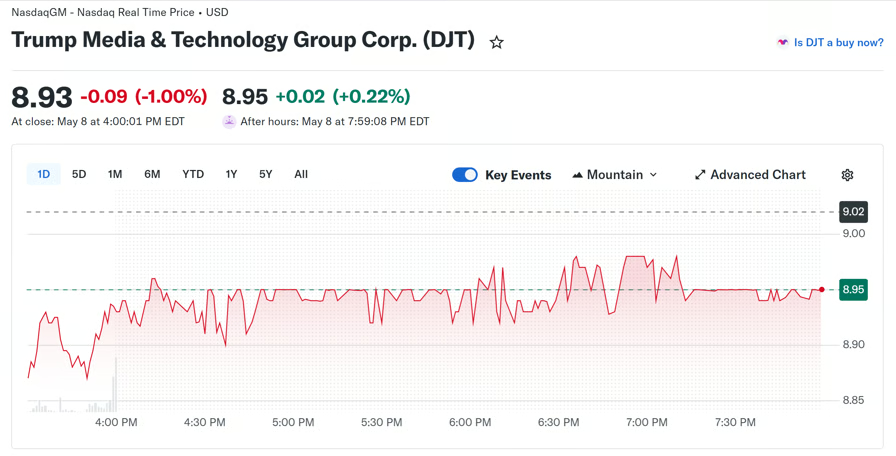
The results arrive after a turbulent stretch for the company. CEO Devin Nunes stepped down on April 22, and the stock has lost more than 90% of its value since peaking at $97.54 in early 2022, last changing hands around $8.93.

Trump Media shares. Source: Yahoo! Finance
Related: Trump-linked American Bitcoin energizes 11,298 new ASICs
American Bitcoin posts $82 million quarterly loss
As Cointelegraph reported, American Bitcoin, the crypto mining company co-founded by Eric Trump and backed by Donald Trump Jr., posted an $81.7 million net loss in the first quarter of 2026, narrowing from a $100.6 million loss a year earlier.
Revenue came in at $62.1 million, a 400% jump from $12.3 million in Q1 2025 but a step down from $78.3 million in the prior quarter, missing analyst estimates by 17%. The company also reported a loss of 8 cents per share, well above Wall Street’s estimate of 1 cent.
Despite the miss, American Bitcoin mined a record 817 Bitcoin during the quarter, up from 783 in Q4 2025.
Magazine: Trump’s crypto ventures raise conflict of interest, insider trading questions


Seven major Bitcoin mining pools have joined the Stratum V2 working group as the industry seeks a common open standard for communication between pools and miners.
Summary
- Seven mining pools joined Stratum V2 to improve pool communication and miner choice.
- Foundry and AntPool control a large share of global Bitcoin mining hashrate.
- Crypto.news reported that up to 20% of Bitcoin miners may be unprofitable.
The new members include AntPool, Block Inc., F2Pool, Foundry, MARA Foundation, SpiderPool, and DMND. The group will work on wider adoption of Stratum V2, a protocol built to improve how mining pools share work with individual miners.
Stratum V2 aims to improve mining efficiency
Stratum V2 is designed to make Bitcoin mining pool communication faster and more secure. It can also give miners more control over block template selection instead of relying only on pool operators.
The timing matters because mining remains highly competitive. The Stratum V2 announcement said, “Bitcoin mining is competitive and fragmented by design.” That claim fits the current market, but the real benefit will depend on how widely pools and miners adopt the protocol.
Foundry and AntPool are among the largest Bitcoin mining pools by hashrate. Their role gives the working group more market weight than earlier protocol efforts.
Foundry controls nearly 30% of global pool hashrate, while AntPool controls about 17.7%, according to Hashrate Index data cited in recent reports. Their participation could help Stratum V2 move from technical work toward broader use.
Miners remain under pressure
Crypto.news reported that CoinShares estimated 15% to 20% of the global Bitcoin mining fleet may be unprofitable under current conditions. The pressure is strongest among miners using older machines or paying higher electricity costs.
CoinShares also said Q4 2025 was the hardest quarter for miners since the April 2024 halving. Hashprice fell near five-year lows, while the average cash cost to produce one Bitcoin among listed miners reached about $79,995.
Moreover, Bitcoin mining difficulty is also expected to rise again in May. Higher difficulty means miners need more computing power to earn the same block rewards.
That leaves miners searching for small efficiency gains. Stratum V2 may help reduce delays and improve coordination, but it will not remove the broader cost pressure from energy prices, hardware costs, and Bitcoin price swings.


Binance co-founder Changpeng “CZ” Zhao said rival crypto exchanges in the United States opposed his pardon request before President Donald Trump granted clemency in October 2025.
Summary
- CZ said rival exchanges opposed his pardon, but admitted he had no concrete evidence.
- Binance’s US exit followed a $4.3 billion settlement with American authorities in 2023.
- Recent court dismissals gave Binance fresh legal wins after earlier terrorism-finance allegations in lawsuits.
Speaking on the Crypto Banter podcast, Zhao said some competitors did not want him pardoned because they feared Binance could return to the U.S. market.
He said, “The other crypto exchanges in the US don’t want me to get a pardon.”
Claim lacks public proof
Zhao also said he believed there had been pushback from competitors, but he did not present proof. “I don’t have concrete evidence of any of it,” he said.
That makes the claim hard to verify. The statement still adds a new layer to the debate around his pardon, which drew criticism from lawmakers and renewed talk about Binance’s U.S. future.
Moreover, Zhao pleaded guilty in 2023 to failing to maintain an effective anti-money-laundering program. Binance also reached a $4.3 billion settlement with U.S. authorities over violations linked to sanctions and money-transmission rules.
Crypto.news reported that Trump pardoned Zhao on Oct. 23, 2025. The outlet also noted that the decision sparked criticism and questions over Binance-linked business ties involving Trump-related crypto ventures.
Binance wins recent court relief
Zhao’s comments also came after Binance and Zhao won dismissal of a civil lawsuit brought by victims and relatives of victims of terrorist attacks. Reuters reported that a judge found the plaintiffs did not plausibly show culpable involvement or intent by Binance or Zhao.
A separate Alabama court also dismissed key claims against Binance, Binance.US, and Zhao in another case tied to alleged transfers to terrorist groups, though plaintiffs were given room to amend parts of the complaint.
Crypto.news previously reported that Trump said he did not personally know Zhao before granting the pardon. Trump said others told him Zhao had been treated unfairly during the Biden administration’s crypto crackdown.

Crypto market chatter on social platforms has surged, but analysts caution that a rally driven by bullish sentiment may be vulnerable to a quick reversal. A recent briefing from Santiment highlights a classic dynamic: crowds that buy with confidence often see those gains fade, while markets built on skepticism can extend their run.
According to Santiment, the ratio of bullish to bearish crypto-related comments among active accounts tracked across major platforms sits around 1.5 to 1. Bitcoin has climbed about 11.5% over the past 30 days and was trading near $80,628 at the time of writing, according to CoinMarketCap.
Key takeaways
- Sentiment-driven rallies may be prone to sharper pullbacks, as crowded optimism tends to fade faster than moves supported by caution and skepticism.
- Bitcoin’s recent price trajectory remains positive, up roughly 11.5% over the last month and hovering around the $80k level.
- The Crypto Fear & Greed Index has swung into cautious territory, with a neutral reading of 47 on Sunday after dipping into Fear earlier in the week, and further softening to 38 on Friday.
- On-chain data show a rise in Bitcoin supply on exchanges, which Santiment interprets as potential early profit-taking as holders look to realize gains at current levels.
- Analysts present divergent scenarios: some anticipate a retest toward $70k–$75k before resuming a larger uptrend, while others see a path to $87k–$95k by June.
Sentiment cycles and the risk of a short-lived rally
Market observers watch overall sentiment as a proxy for potential near-term direction. Santiment notes that a rally fueled by a confident crowd frequently fades as positions become crowded and momentum slows. In contrast, periods of skepticism that gradually resolve into constructive doubt have historically tended to extend the advance. This framing matters for traders evaluating when to deploy new capital or trim risk in a late-cycle move.
Bitcoin’s price action provides context to the mood metrics: a broad thrust higher over the past month sits alongside a sentiment backdrop that remains mixed, with even a relatively elevated price level not guaranteeing a sustained breakout if crowd psychology shifts toward caution. For investors, the implication is that price moves could stall or revert if social chatter becomes overwhelmingly bullish or if profit-taking accelerates.
On-chain signals: exchange supply and profit-taking dynamics
Another vector Santiment highlights is the behavior of supply on centralized exchanges. After a prolonged period of declines, the amount of Bitcoin held on exchanges ticked up over the past several days, a reversal that some interpret as holders preparing to take profits or reallocate. While on-chain activity remains broadly quiet, the uptick in supply on venues where selling pressure can materialize may help explain any short-term hesitation around fresh breakouts.
In the broader discourse, market participants remain divided on the implications. Some observers view the uptick in exchange balances as a sign that current price levels are attractive for taking gains, potentially offsetting further upside momentum in the near term.
Dueling forecasts: near-term retest versus continued upside
Within the crypto commentary space, a spectrum of outlooks has emerged. Michael van de Poppe, founder of MN Trading Capital, indicated he would not be surprised to see Bitcoin retest the $70,000–$75,000 zone before continuing higher, suggesting a short-term retracement that could flush late longs and reset sentiment for the next leg up.
Other analysts have skewed more bullish in the near term. Crypto strategist Matthew Hyland suggested Bitcoin could reach roughly $87,000 to $95,000 before June, arguing for continued upside amid existing momentum and macro liquidity conditions. These varying viewpoints reflect the ongoing tug-of-war between price momentum and the risk of a pullback that could reframe market positioning.
Beyond these views, some observers point to broader market dynamics, such as the performance of large-cap risk assets and evolving infrastructure around Bitcoin exposure, as potential accelerants or dampeners for the next leg of the cycle. The tension between on-chain signals, exchange activity, and social sentiment underscores the complexity of predicting immediate outcomes in a market that has demonstrated rapid shifts in sentiment and liquidity conditions.
As the market watches for direction, participants should keep a close eye on Bitcoin’s price interactions with key levels near the $75,000 mark and the higher target zone around the mid-to-high $80,000s and beyond. The balance between on-chain behavior, sentiment parity, and macro liquidity will likely shape whether the coming weeks produce a sustained move or a temporary pullback.
Readers should stay tuned for how sentiment shifts align with price action and on-chain activity, particularly as exchange balances evolve and traders weigh the potential for a structural pause versus a renewed ascent.

While bitcoin (BTC) has continued to rise in what analysts have called a bear market rally, traders and investors have increased their profit-taking. Daily realized profits have risen to levels not seen since early December 2025, while unrealized profits hover near levels historically associated with intensified distribution.
According to a CryptoQuant report, BTC has surged 37% since the beginning of April. The rally has been driven by a combination of easing macro pressures, prior undervaluation, and a sharp increase in perpetual futures demand. Amid the rally, the leading digital asset has reached a peak not seen in the last three months.
Bitcoin Profit-Taking Surges
On May 4, Bitcoin holders realized daily profits of 14,600 BTC, a level not seen since December 10. This marks the highest profit realization since December 2025, when BTC traded above $90,000. With traders back in profitable territory, the short-term holder (STH) spent output profit ratio (SOPR) has risen above 1.016, holding above 1.00. The metric has been in profitable territory since mid-April.
CryptoQuant analysts insist that historical data show that increased realized profits at key resistance levels precede local tops or sustained consolidation phases. This suggests that the Bitcoin market could witness either of the two outcomes after the ongoing rally.
On a 30-day rolling basis, Bitcoin holders are realizing net profits of at least 20,000 BTC for the first time since December 22, 2025. This trend follows a period of heavy net losses in February and March, during which investor realization fell as low as -398,000 BTC.
“The shift from net loss realization to net profit realization is a structural inflection point in bear market dynamics. The crossing back into positive net territory reflects the degree to which the April–May price rally has restored profitability across the holder base,” analysts stated.
Spot Demand Still in Contraction
Despite traders being on a 30-day net profit of 20,000 BTC, the figure remains far below the 130,000–200,000 BTC threshold associated with bull markets. At the same time, they are sitting on their highest unrealized profit margin since June 2025. Unfortunately, this level historically indicates elevated correction risk, as there is a greater incentive to lock in profits.
Meanwhile, perpetual futures demand has continued to expand, sustaining the same speculative environment that triggered April’s rally. Spot demand remains in contraction, but at a milder level than early 2026. Combined with muted exchange inflows, the current market environment carries significant correction but has not reached a distributional peak.
The post Bitcoin Investors Took More Profit as BTC Rallied to 3-Month High: CQ appeared first on CryptoPotato.


Trump Media & Technology Group reported a $405.9 million net loss for the first quarter of 2026, as its Bitcoin and Cronos holdings lost value on paper.
Summary
- Trump Media’s Q1 loss widened as Bitcoin and Cronos holdings fell below purchase prices.
- The company still reported positive operating cash flow despite large non-cash crypto markdowns.
- Crypto.news earlier covered Trump Media’s deeper Crypto.com and Cronos treasury strategy.
The company said most of the loss came from non-cash charges, including $368.7 million tied to unrealized losses on digital assets, pledged digital assets, and equity securities. It also reported $11.5 million in accreted interest and $11.8 million in stock-based compensation.
Bitcoin and Cronos weigh on results
The loss was mainly linked to Trump Media’s crypto treasury strategy. The company held 9,542 Bitcoin at the end of March, with a reported cost basis of about $1.13 billion and fair value of about $647 million.
Trump Media also held around 756 million Cronos tokens. These were linked to its Crypto.com partnership, which crypto.news previously reported as part of a wider Cronos treasury push involving Trump Media, Crypto.com, and Yorkville.
Revenue reached $871,200 in Q1, up 6% from the same period last year. The figure included media revenue and fees from Truth.Fi ETF products.
Despite the loss, Trump Media reported $17.9 million in positive operating cash flow and $2.1 billion in financial assets. The company said it is still building its platform and financial products.
Crypto.news context shows earlier warning signs
Crypto.news reported in November 2025 that Trump Media had already posted a $54.8 million quarterly loss while expanding into crypto. That report noted its CRO strategy, Truth Social reward plans, and deeper Crypto.com links.
The latest numbers show how exposed the company became to crypto price swings. Bitcoin purchases made near market highs later produced large unrealized losses when prices fell during the quarter.
Trump Media’s interim CEO Kevin McGurn said the company is using its “strong balance sheet and positive operating cashflow” to keep growing. That claim may need careful reading because the company still posted a large quarterly net loss.
The company also described Truth Social as a “bastion of free speech,” but it did not give detailed user growth figures in the latest results. That makes it harder to judge platform growth from the filing alone.
TLDR:
- Bitcoin open interest dropped over 55% from its March 1, 2026 peak, reflecting massive forced liquidations across the market.
- STH-SOPR hit 0.9215 in January 2026, confirming short-term holders sold at heavy losses during peak capitulation period.
- By May 7, 2026, aSOPR reached 1.0008 and STH-SOPR hit 1.0037, showing the market has returned to a neutral equilibrium.
- Funding rates have normalized to near-zero or slightly negative levels, removing speculative leverage pressure from the market.
Bitcoin has moved through one of its most turbulent correction cycles in recent memory. After the speculative excess of 2025, the market entered 2026 facing forced liquidations and widespread capitulation among short-term holders.
Today, on-chain indicators are settling near equilibrium. Analysts now point to a shift from panic-driven selling to a more stable, spot-driven market structure — one that may mark the early stages of a genuine recovery base.
Q1 2026 Brought Heavy Losses for Short-Term Holders
The first quarter of 2026 was unforgiving for recently entered investors. Open interest across derivatives markets dropped by more than 55% from its March 1 peak. That kind of decline reflected aggressive forced exits across leveraged positions market-wide.
Short-term holder behavior during this period told a clear story. The STH-SOPR — a metric measuring whether recent buyers are selling at a profit or loss — fell to 0.9215 in January 2026. Any reading below 1.0 means holders are realizing losses, not gains.
This level of STH-SOPR is historically associated with capitulation events. It showed that a large portion of investors who bought near the top were exiting their positions at steep losses. That kind of selling typically marks the more painful but necessary phase of a market reset.
Such periods are often uncomfortable, yet they tend to clear the path for healthier price action later. The excess leverage built up through 2025 needed an exit, and Q1 2026 provided that exit — forcefully.
May 2026 Data Shows the Market Has Found Its Footing
By early May 2026, the picture looked notably different. As of May 7, the aSOPR reading stood at 1.0008, while STH-SOPR recovered to 1.0037. Both figures sit just above the 1.0 equilibrium mark.
When SOPR values hover near 1.0, it means sellers are moving coins at roughly breakeven. There is no panic, and there is no excessive greed either. The market is, in effect, digesting recent history without distress.
Funding rates — once elevated to extreme levels during the 2025 bull run — have since normalized. They are now consistently near zero or slightly negative. That shift removes a major source of upward price distortion driven by leveraged long positions.
Together, these readings suggest the speculative energy that drove the 2025 cycle has been largely flushed out. The current setup favors spot-based exposure over derivatives trading.
Investors looking to build positions may find the present environment more transparent and less prone to sudden, leverage-driven crashes than at any point in the past 18 months.

CISA gives feds four days to patch Ivanti flaw exploited as zero-day

Michael Jackson – Money (Audio)

Andoni Iraola makes next job admission amid Man United links

Manchester United reach agreement with Casemiro over contract clause amid transfer speculation

US brings back mandatory military draft registration

Steven Gerrard disagrees with Gary Neville over ‘shock’ Chelsea and Arsenal claim | Football


-
 Crypto World2 days ago
HarrisX Poll Found 52% of Registered Voters Support the CLARITY Act
-

 NewsBeat7 days ago
Channel 5 – All Creatures Great and Small series 7 new post
-

 Crypto World3 days ago
Upbit adds B3 Korean won pair as Base token gains Korea access
-

 Fashion2 days ago
Weekend Open Thread: Marianne Dress
-

 Tech6 days ago
Image AI models now drive app growth, beating chatbot upgrades
-
 NewsBeat3 days ago
NCP car park operator enters administration putting 340 UK sites at risk of closure
-
 Business21 hours ago
Ignore market noise, India’s long-term story intact, say D-Street bulls Ramesh Damani and Sunil Singhania
-

 Business7 days ago
Winning Numbers Drawn as Jackpot Resets to $20 Million
-

 Politics1 day ago
Politics Home Article | Starmer Enters The Danger Zone
-

 Entertainment6 days ago
Olivia Wilde Reacts To Viral ‘Corpse’ Comparison
-

 Crypto World7 days ago
BlackRock Buys $284M In Bitcoin On May 1 As The Best Crypto To Invest In For 2026 Sits Below A Pending Binance Listing
-
 Sports7 days ago
IPL 2026: Gujarat Titans opt to bowl vs Punjab Kings; Nishant Sindhu handed debut | Cricket News
-

 Sports6 days ago
Inter Milan Win Serie A Title After Victory Over Parma
-

 Sports7 days ago
Kofi Kingston and Xavier Woods reportedly released by WWE along with others
-

 Crypto World5 days ago
UAE Free Zone Deploys Blockchain IDs to Verify Registered Firms
-
 Sports6 days ago
Every word of Arne Slot’s heated rant after Manchester United win vs Liverpool
-

 Business7 days ago
Can LeBron James Lead LA Past OKC Without Injured Luka Doncic?
-
Entertainment6 days ago
Jennifer Lawrence’s Mary Jane Sneakers Are Spring’s It-Girl Shoe
-

 Politics7 days ago
The Devil Wears Prada 2 Cast: How Do Their Premiere Looks Compare To The Original?
-

 Entertainment7 days ago
Other Bennet Sister Love Triangle Cast: Ella Bruccoleri, Donal Finn
You must be logged in to post a comment Login