
Crypto World
Ethereum price breakout hinges on a close above $2,535

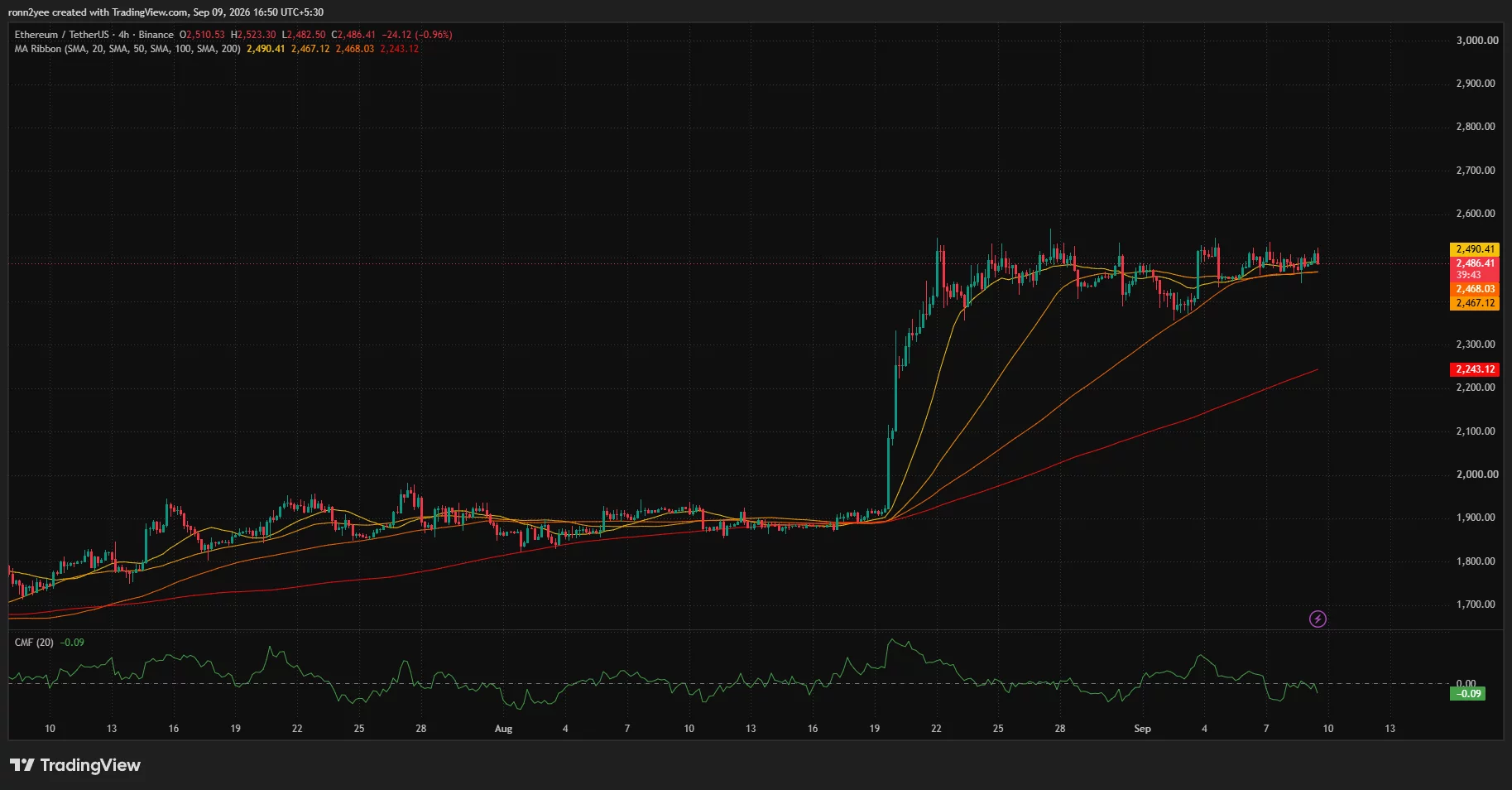
Ethereum price hovered around $2,500 on Sep. 9 as buyers defended short-term support, but weakening momentum and negative capital flows kept a breakout above $2,535 out of reach.
Summary
- Ethereum price traded within a narrow intraday range between $2,482.50 and $2,523.30.
- The 4-hour price slipped below the 20-period moving average at $2,490, while CMF fell to -0.09.
- A daily close above $2,525–$2,535 could open a move toward $2,550 and $2,600.
- The liquidation heatmap shows major liquidity concentrations near $2,430, $2,550, and $2,600.
- Losing the $2,478 pivot would raise the risk of a retreat toward $2,435–$2,445.
Ethereum (ETH) price traded near $2,486 at the time of writing on Sep. 9 after briefly rising above $2,520 earlier in the session. Price remained almost unchanged on the daily chart as buyers and sellers competed around the psychological $2,500 level.
The narrow move followed several days of consolidation after ETH recovered from its early-September low near $2,430. Buyers have repeatedly stepped in around $2,478–$2,485, but each attempt to extend the recovery has met selling pressure between $2,525 and $2,535.
Spot Ethereum exchange-traded fund outflows have reduced one source of institutional demand during the consolidation. Broader risk appetite has also remained weak ahead of the Federal Reserve’s Sep. 15–16 policy meeting, while higher energy prices linked to the U.S.-Iran conflict have added to inflation concerns.
Regulatory uncertainty ahead of the expected U.S. Senate procedural vote on the Clarity Act on Sep. 15 has given institutional investors another reason to limit exposure. Ethereum has consequently struggled to separate from the wider risk-off tone across the crypto market.
Ethereum price momentum weakens below $2,500
The 4-hour chart shows ETH trading at $2,486 after a rejection from an intraday high of $2,523. Price moved below the 20-period simple moving average at $2,490, placing buyers under immediate pressure.
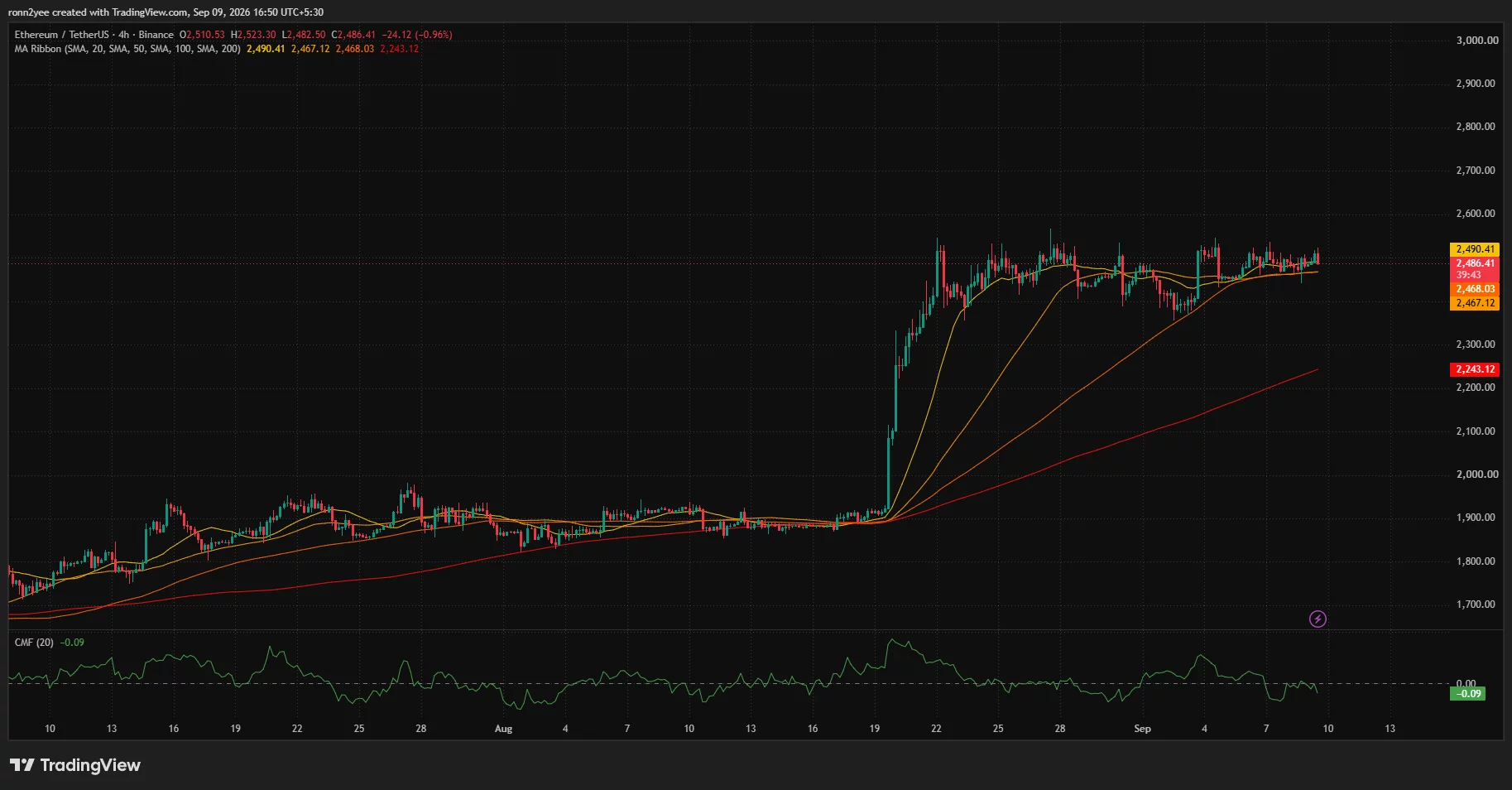
Ethereum remained above the 50-period and 100-period moving averages, located at $2,467 and $2,468, respectively. The close grouping of those averages creates an initial support zone between $2,465 and $2,470.
A break below the cluster would expose the recent range floor around $2,435–$2,445. Deeper selling could place the broader $2,350–$2,360 support zone back in focus, where the weekly liquidation heatmap shows the largest pool of downside liquidity.
The 200-period moving average remains much lower at $2,243, showing that ETH’s medium-term structure has not broken despite its inability to clear nearby resistance.
Still, the Chaikin Money Flow reading of -0.09 points to net capital leaving the asset on the 4-hour timeframe. Continued negative CMF would make it harder for buyers to sustain a breakout, even if ETH briefly returns above $2,500.
Daily momentum also warrants caution. The Awesome Oscillator remains positive at 239.44, but its contracting bars show that bullish momentum has cooled since the sharp August advance. ETH is therefore consolidating below resistance rather than accelerating into a new upward leg.
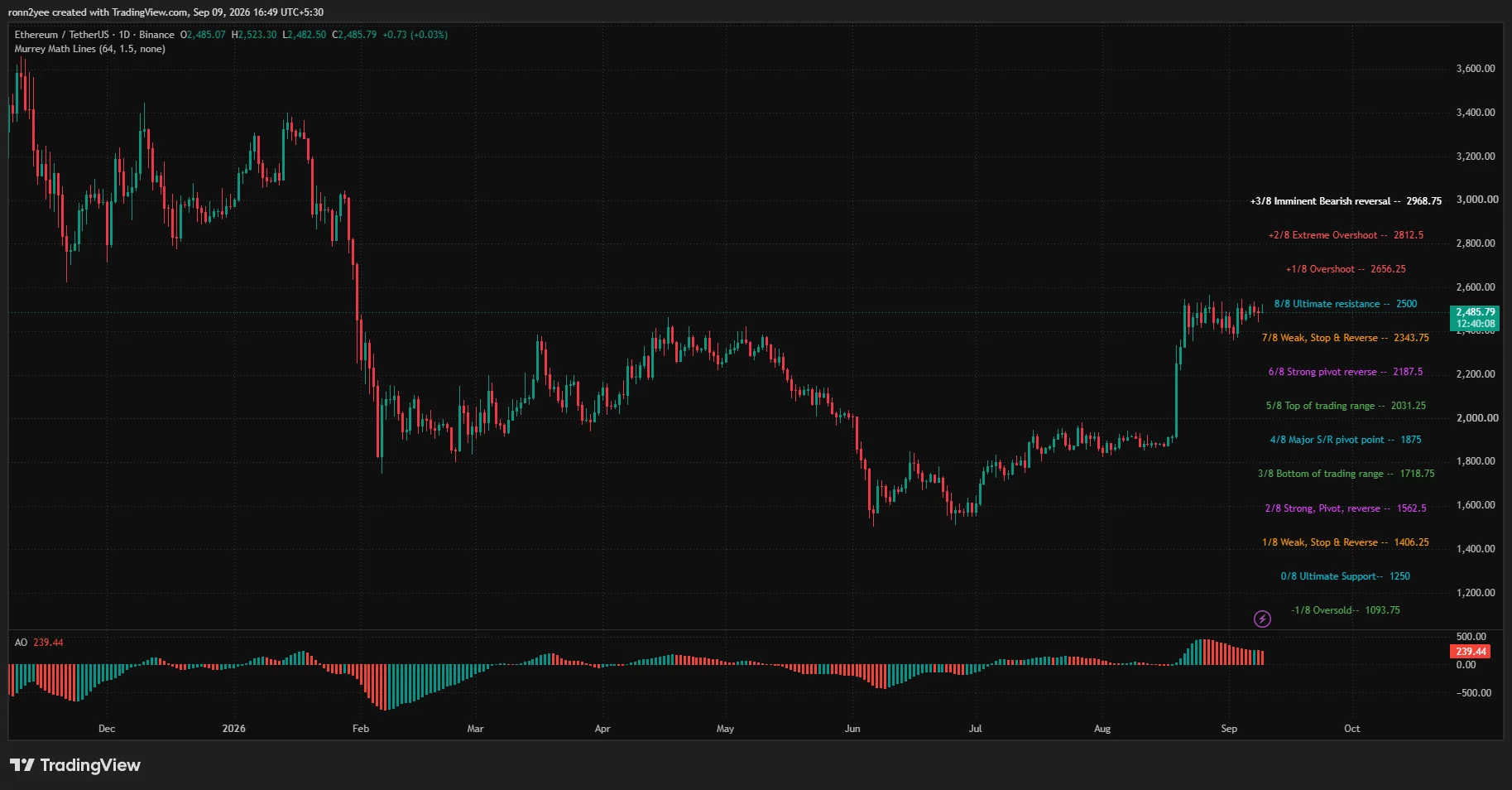
The daily chart places $2,500 at the Murrey Math 8/8 resistance level. A confirmed close above it would improve the immediate outlook, although buyers would still need to overcome repeated supply around $2,525–$2,535.
Market analyst Jules identified $2,478–$2,485 as the key short-term pivot and said repeated rebounds from the area showed active demand. However, the analyst warned that ETH remained in compression until it closed above the resistance band.
“Both sides have clean levels. The longer this squeeze lasts, the more the eventual break will matter.”
According to Jules, a strong close through $2,525–$2,535 could clear the way toward $2,580–$2,600. Losing the pivot would instead weaken the setup and bring $2,435–$2,445 back into play.
Analyst Ted Pillows also identified $2,550 as a major resistance level. Pillows said a strong weekly close above the barrier could support an advance toward $3,000, although the current charts do not yet confirm such a breakout.
Liquidation clusters could shape the next ETH move
CoinGlass’s one-week liquidation heatmap shows leverage building on both sides of Ethereum’s current price.
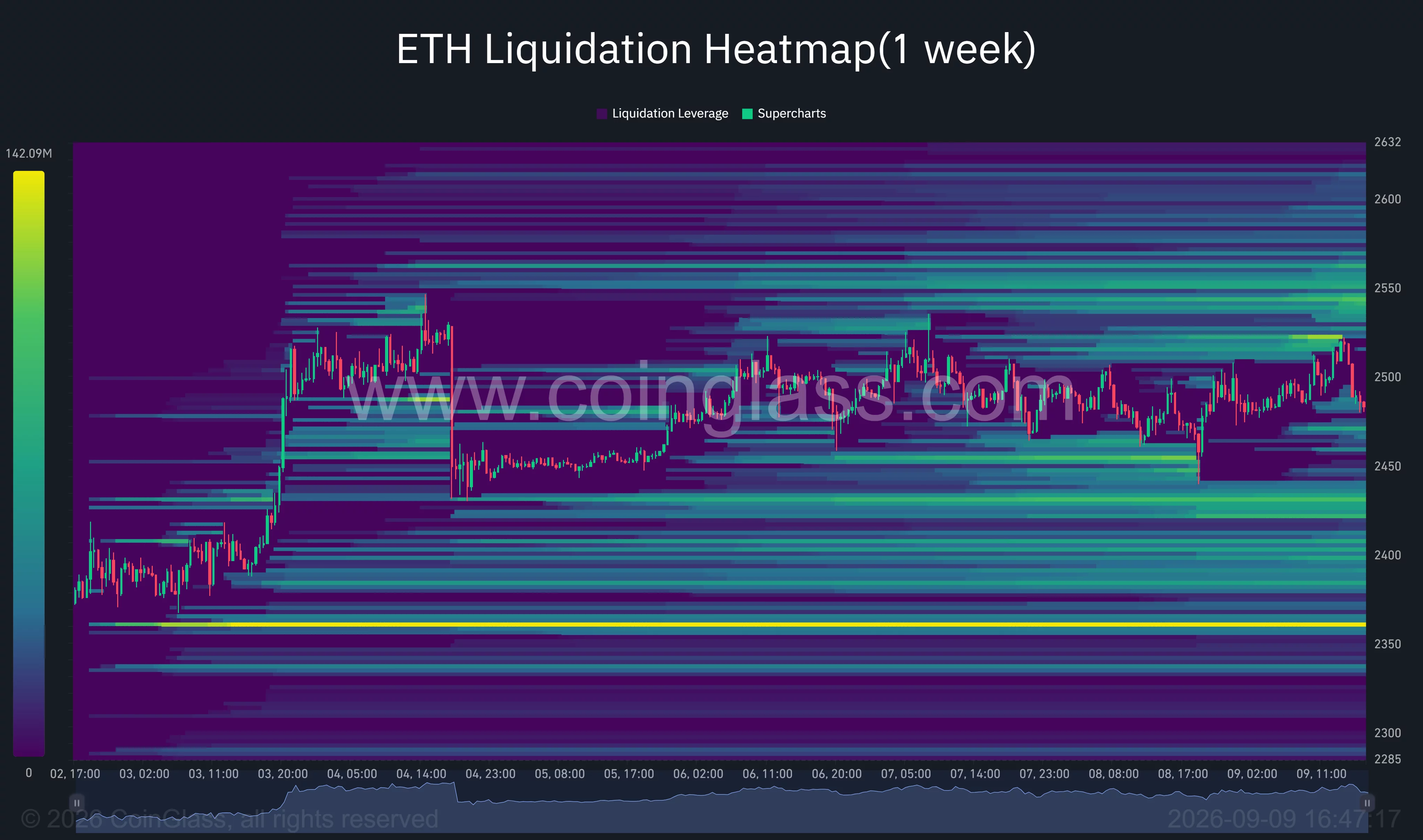
The closest large overhead clusters appear between $2,520 and $2,550. A move into the region could force short positions to close and provide additional momentum, but the same zone has repeatedly attracted spot selling.
More liquidation liquidity is visible between $2,580 and $2,610. Buyers would first need a sustained break above $2,535 and $2,550 before the upper cluster becomes a realistic target.
Downside liquidity is concentrated around $2,430, followed by a much larger band near $2,355–$2,365. A loss of $2,478 could pull price toward the first cluster, while a break below $2,430 would increase the probability of a deeper liquidity sweep.
Ethereum’s next directional move therefore depends on whether buyers can reclaim $2,500 and convert $2,525–$2,535 into support. Failure to do so would leave ETH exposed to another test of $2,478, followed by $2,445 and $2,430. A daily close above $2,535 would strengthen the bullish case and place $2,550, $2,600, and eventually $3,000 on the upside map.
Disclosure: This article does not represent investment advice. The content and materials featured on this page are for educational purposes only.

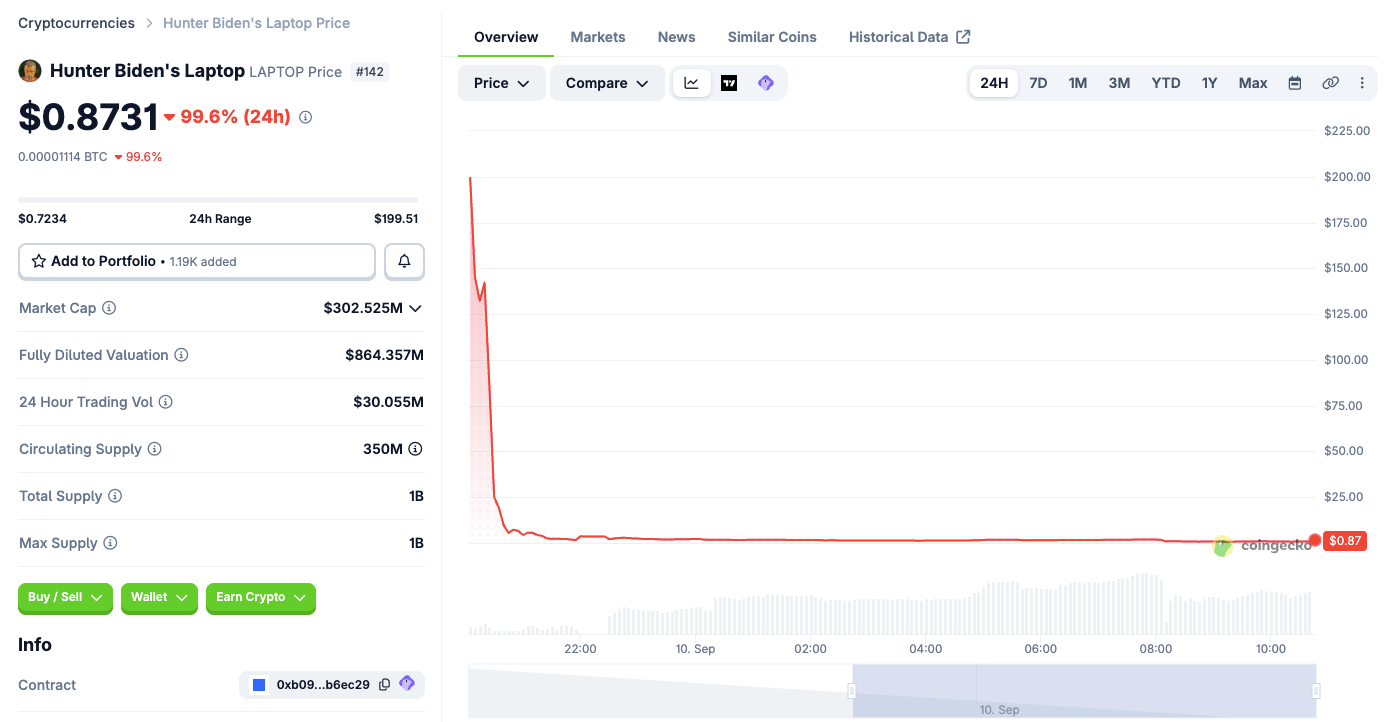
A crypto trader tried to catch Hunter Biden’s LAPTOP, a meme coin built on Base, on the way down. It fell anyway, and he has already lost most of the $170,000 he spent buying the dip.
The trader bought 28,448.72 LAPTOP at $5.97 apiece, according to on-chain tracker Lookonchain. That stake is now worth about $21,000, an 87% loss from the purchase price, as it sits at $0.87 per token, according to a wallet tracked by DeBank.
A Coin Built to Crash
LAPTOP launched Wednesday and lost roughly 98% of its value within an hour, according to Quartz. It slid from a peak of $190.81 to as low as $3.70. The token settled near $4.77 an hour after opening. That valued it near $1.6 billion against a liquidity pool of just $2.5 million.
The mismatch was even starker earlier on. Blockchain intelligence firm Arkham found the pool backing LAPTOP trades held roughly $48,000 shortly after launch. The token’s fully diluted value briefly reached $144 billion.
Hunter Biden, the 56-year-old son of former President Joe Biden, built the token around his laptop. He left the device at a Delaware repair shop in 2019, and its contents fueled years of political controversy.

They turned laptop into a weapon. I turned it into a token.
— Hunter Biden, via Bloomberg
Taking Aim at Trumps’s Memecoin
Founders, including Biden, hold 30% of the coin’s one billion tokens, locked for six months and vesting over two years.
The Wall Street Journal reported the terms first. Another 20% goes to wallets burned by Trump’s coin, plus Biden’s Substack subscribers. A third slice goes to a mailing list tied to video journalist Andrew Callaghan. He says he has no role in the project.
The launch doubled as a jab at Trump. His TRUMP token still trades roughly 97% below its January 2025 peak, more than a year after debut.
I also want to make some money.
— Hunter Biden, via Bloomberg
The trader who bought at $5.97 was not the only one chasing LAPTOP’s opening spike. Another wallet spent $200,000 near the all-time high, and that stake shrank to a few thousand dollars within hours.
For the dip buyer, the second crash offers a reminder. The coin’s volatility did not end with its opening hour. A thin order book can punish latecomers just as easily as it punished the traders who bought the top.
The post Trader Buys $LAPTOP Dip at $5.97, Loses 87% More as Token Craters appeared first on BeInCrypto.
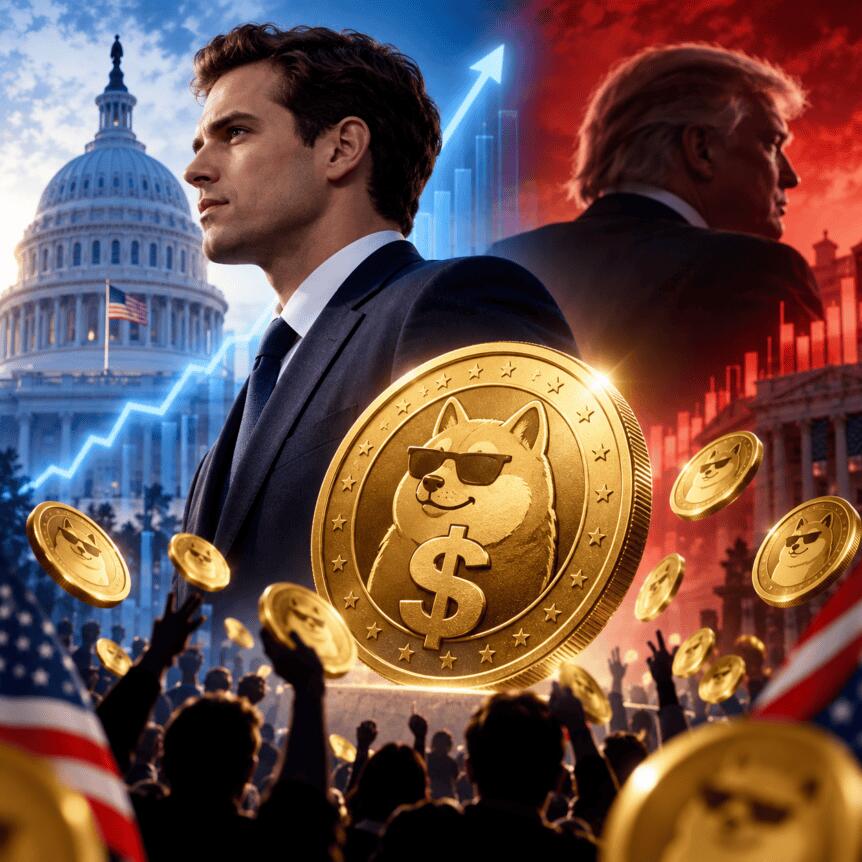
Hunter Biden says he is preparing to launch a new memecoin called LAPTOP, using as its namesake the laptop that has been a long-running subject of political and legal controversy.
In a post on X on Monday, Hunter Biden shared the token ticker and indicated a Wednesday launch for the memecoin. The move comes as U.S. crypto legislation and high-profile political crypto projects continue to draw public attention.
Key takeaways
- LAPTOP is scheduled to launch on Wednesday, after Hunter Biden posted its ticker on X.
- Reporting from The Wall Street Journal says 20% of the one-billion token supply would be directed to substack subscribers, mailing-list members, and investors in Donald Trump’s memecoin Official Trump (TRUMP).
- The memecoin is tied to the “infamous laptop” story—an issue that has been widely revisited in U.S. politics and has been subject to legal action involving privacy claims.
- According to the same reporting, founders would hold 30% of the supply and could burn up to 30% depending on future conditions.
- Any launch would land amid renewed congressional momentum toward the CLARITY Act, with a Senate cloture vote set for Sept. 15.
How Hunter Biden frames the memecoin launch
Hunter Biden’s announcement points to a deliberate blend of crypto marketing and political narrative. The token’s ticker—$LAPTOP—signals that the memecoin’s central theme is the computer associated with allegations surrounding his family during the 2020 election cycle.
That laptop story has remained prominent in parts of the media ecosystem, and its existence and contents have been discussed repeatedly in connection with privacy-related disputes. Biden, according to the article’s background, has pursued two lawsuits tied to privacy laws connected to the laptop narrative.
While the memecoin announcement itself does not resolve the underlying political controversy, it does show how persistent those narratives remain—and how they can be repackaged into tokenized communities.
Token distribution, supply plan, and conditions for potential burns
Coverage from The Wall Street Journal reports additional details about how the token supply may be allocated. The outlet said Biden plans to allocate 20% of the total one-billion token supply to:
- substack subscribers
- members of a mailing list
- investors in President Donald Trump’s memecoin, Official Trump (TRUMP)
TRUMP’s market performance has been under scrutiny as well; the same report states its value is down roughly 97% from its all-time high reached in January 2025.
The article also notes that the LAPTOP founders hold 30% of the token supply and that they could burn up to 30% of the memecoin supply depending on outcomes that include political and market milestones—such as a Democrat winning the presidency in 2028, Bitcoin reaching a new all-time high, and LAPTOP’s fully diluted value exceeding TRUMP.
For investors and traders, these kinds of conditional supply mechanics matter because they can influence perceived scarcity narratives—even when they depend on future events rather than immediate tokenomics. What remains unclear is how these conditions would be measured in practice, and how transparently they would be implemented once the token is live.
Why this timing could resonate with lawmakers
The announcement also arrives during a period when lawmakers are actively working on broader digital asset rules. The article points to U.S. Senate consideration of a comprehensive market structure bill, the Digital Asset Market Clarity Act, known as the CLARITY Act.
According to the provided information, the Senate is scheduled to hold a cloture vote on Sept. 15. A cloture vote is a procedural step that can be used to limit debate and move legislation toward a final vote.
Memecoins that are tied to major political figures and prominent political narratives can quickly become a stress test for regulators: they often combine marketing-driven community incentives with token distribution structures that resemble traditional fundraising dynamics, but without the same level of clarity investors may expect from regulated products.
Earlier coverage in the same ecosystem has also highlighted how politicians’ crypto projects continue to draw scrutiny and controversy, suggesting that legislators may face pressure to define how these tokens should be treated—especially when they appear to be aligned with political stakeholders.
Hunter Biden’s crypto posture and the contrast with World Liberty
Beyond the memecoin itself, the launch fits into a broader pattern described in the article: since Joe Biden left office in January 2025, Hunter Biden has increased his public rhetoric on crypto and blockchain.
The piece highlights criticism from Biden aimed at the Trump family’s involvement with the industry through World Liberty Financial. It cites Biden calling World Liberty “corruption at a scale we’ve never seen,” drawing comparisons to the defunct exchange FTX, and pointing to alleged ties to foreign governments such as the UAE.
It also references comments from June where Biden said “decentralized digital currency and the blockchain are the inevitable future.” In the context of a memecoin launch, those statements underscore an apparent tension: Biden can be both an outspoken critic of certain crypto-linked political enterprises and a promoter of the idea that blockchain networks will continue to expand.
What remains to be seen is how LAPTOP will be positioned once it launches—whether it remains primarily an attention-driven cultural token or evolves into something with more operational transparency that would better satisfy the standards lawmakers may be considering during the CLARITY Act process.
As Wednesday’s release approaches, readers should watch closely for whether the announced distribution and any proposed supply burns are documented clearly on-chain, and how the project’s mechanics are communicated—especially as U.S. regulators move toward potential market-structure rules in the coming weeks.


Cardano founder Charles Hoskinson said on Sept. 9 that artificial intelligence had advanced further in formal mathematics than he expected.
Summary
- Cardano founder Charles Hoskinson said artificial intelligence’s mathematical progress considerably exceeded his earlier expectations publicly.
- OpenAI says roughly 10,000 agents produced a Navier–Stokes solution within 88 hours of work total.
- Clay still classifies Navier–Stokes as unsolved pending publication, review and broad mathematical acceptance worldwide today.
- Hoskinson raised confidentiality concerns for researchers entering unpublished work into centralized cloud AI systems online.
- OpenAI denied accessing private work but could not exclude de-identified usage data influencing model improvements.
His comments followed OpenAI’s claim that an internal system produced a solution to the Navier–Stokes Millennium Prize Problem.
During a broadcast, Hoskinson called the reported capabilities “pretty remarkable.” However, he also addressed unresolved questions about the work’s provenance and the privacy of research submitted to cloud-based AI services.
Cardano founder says AI moved beyond collaboration tools
Hoskinson said he originally expected formal systems to help larger teams of mathematicians collaborate and verify human-written proofs. He did not expect large language models to generate complete proofs themselves so soon.
“We never anticipated the extent to which AI would come in,” Hoskinson said. He added that the idea of AI fully writing a proof had previously appeared “pretty far out.”
Hoskinson has a direct connection to formal mathematics research. In 2021, he donated $20 million to Carnegie Mellon University to establish the Hoskinson Center for Formal Mathematics, according to the university’s announcement.
His latest comments also fit Cardano’s broader experimentation with artificial intelligence. As crypto.news previously reported, Hoskinson has defended Cardano AI agent experiments involving communications, community activity and the privacy-focused Midnight ecosystem.
OpenAI claims its system resolved Navier–Stokes
OpenAI published its research on Sept. 8. The company said an internal model coordinated roughly 10,000 agents and produced a proposed solution after 88 hours. GPT-6 Astra then spent another 17 hours formalizing and checking the argument in Lean.
The proof attempts to establish that an initially smooth, stationary fluid can develop a singularity in finite time when subjected to a smooth external force. OpenAI said this satisfies statements C and D in the official Millennium Prize formulation.
The company also released an analytical paper and Lean code. A Lean formalization provides machine-checkable verification that the encoded steps follow from the stated assumptions. It does not independently establish that every definition and assumption accurately represents the intended mathematical problem.
OpenAI said it does not plan to seek the associated $1 million prize. The company nevertheless described its work as a resolution of the problem.
Clay has not recognized the claimed solution
The Clay Mathematics Institute still labels the Navier–Stokes problem “unsolved.” Its website had not recognized OpenAI’s proposed proof as an accepted solution at the time of reporting.
Clay does not accept proposed solutions through direct submissions. Under its rules, a solution must appear in a qualifying publication. At least two years must then pass, and the work must gain general acceptance from the global mathematics community.
That process means OpenAI’s announcement and formal proof do not constitute immediate institutional recognition. Mathematicians must examine whether the construction satisfies the precise problem statement and whether its use of external forcing answers the question as commonly understood.
A provenance dispute raises research privacy questions
The announcement also drew scrutiny involving New York University mathematician Tristan Buckmaster and Anthropic researcher Levent Alpöge. The researchers had been working on a related Euler-equation result using a forcing approach.
Buckmaster questioned whether private work entered into OpenAI’s Codex system could have contributed to the company’s result. He stopped short of alleging proven misconduct, saying: “I do not know whether our data was used.”
OpenAI denied accessing their specific work. However, the company said it could not completely rule out the possibility that de-identified data from their product use had helped improve its models. OpenAI maintained that its proof was developed independently and differed from the researchers’ work.
Hoskinson argued that the dispute should concern researchers handling unpublished ideas. He said scholars using centralized AI services should consider whether prompts, notes and research logs remain confidential.
The next phase will involve public examination of OpenAI’s paper and Lean formalization. Until specialists review the assumptions and Clay’s formal conditions are met, the work remains a claimed solution rather than a recognized resolution.
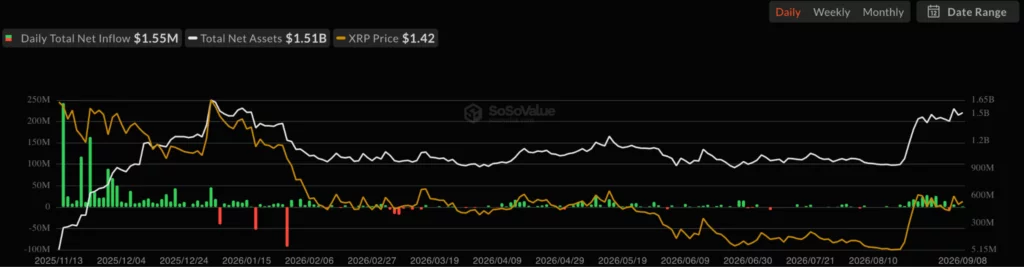
XRP exchange-traded funds appeared in institutional collateral arrangements and attracted fresh investor money on Sept. 8, offering two distinct signs of their expanding role in U.S. markets.
Summary
- SEC filing shows eight XRP ETF collateral line items valued near $11.39 million combined overall.
- XRP ETFs attracted nearly $2 million Tuesday while larger U.S. crypto ETF categories posted outflows.
- Five XRP products now hold $1.69 billion in cumulative inflows, according to SoSoValue data published.
- Schwab’s filing reports collateral received through repos, rather than direct XRP ETF investments by Schwab.
- JPMorgan Securities and BofA Securities supplied collateral pools containing shares from four XRP ETF issuers.
A Charles Schwab Family of Funds regulatory filing contained eight XRP ETF collateral line items valued at approximately $11.39 million. Separately, the five XRP products tracked by SoSoValue received nearly $2 million of net inflows during Tuesday’s trading session.
The collateral disclosure does not show Charles Schwab buying XRP ETFs or holding the underlying cryptocurrency. Instead, the shares secured repurchase agreements between Schwab Prime Advantage Money Fund and two Wall Street counterparties.
XRP ETF collateral totaled $11.39 million
The Schwab Prime Advantage Money Fund reported the collateral in a Form N-MFP3 filed with the U.S. Securities and Exchange Commission on Sept. 8. The report covers the fund’s portfolio as of Aug. 31.
A review of the filing’s underlying XML identifies eight XRP ETF entries from Bitwise, Canary Capital, Franklin Templeton and Grayscale. Their reported collateral values total approximately $11.39 million.
Counterparty
XRP ETF
Shares
Collateral value
JPMorgan Securities
Grayscale XRP Trust ETF
37,810
$1,011,417.50
JPMorgan Securities
Canary XRP ETF
209,440
$3,066,201.60
JPMorgan Securities
Canary XRP ETF
209,440
$3,066,201.60
JPMorgan Securities
Grayscale XRP Trust ETF
2,014
$53,874.50
BofA Securities
Grayscale XRP Trust ETF
20,591
$550,809.25
BofA Securities
Canary XRP ETF
42,214
$618,012.96
BofA Securities
Franklin XRP ETF
46,830
$701,981.70
BofA Securities
Bitwise XRP ETF
150,450
$2,316,930.00
The $11.39 million calculation reflects the aggregate value of all eight line items in the SEC filing. Two Canary entries carry identical share counts and values but belong to separate JPMorgan repurchase agreements. They are therefore reported line items, although the document alone does not establish whether they represent economically distinct blocks of shares.
An earlier estimate of approximately $4.8 million counted only three entries: $1.01 million in Grayscale shares, $3.07 million in Canary shares and $702,000 in Franklin shares. It excluded five XRP ETF collateral entries contained elsewhere in the same filing.
Schwab did not report buying XRP ETFs
The securities appeared as collateral for repurchase agreements, commonly known as repos. In a repo transaction, a money market fund provides short-term cash to a counterparty. The counterparty transfers securities as collateral and agrees to repurchase them under specified terms.
Form N-MFP3 requires money market funds to describe securities securing their repo investments. The SEC’s filing instructions expressly define the listed underlying securities as collateral.
JPMorgan Securities was the counterparty for XRP ETF entries valued at approximately $7.20 million. BofA Securities accounted for the remaining $4.19 million. The collateral pools also contained conventional equities, bonds, mortgage-backed instruments and numerous unrelated ETFs.
The disclosure therefore does not establish that Schwab selected XRP ETFs for investment exposure. It also does not show that Schwab pledged the shares or borrowed against them. The Schwab fund was the cash provider receiving collateral from the two securities dealers.
That distinction separates this filing from Form 13F disclosures, which report qualifying long positions held by institutional investment managers. As crypto.news previously explained, institutional crypto holdings reported on Form 13F represent ownership through listed securities rather than collateral received in repo transactions.
XRP ETFs drew nearly $2 million as rivals lost money
The collateral disclosure arrived as XRP ETFs posted the only meaningful positive flow among the main U.S. spot crypto ETF categories on Tuesday. The five products attracted nearly $2 million, according to SoSoValue.
Their cumulative net inflows reached approximately $1.69 billion. The products also collected about $173 million over the preceding 30 days, showing that Tuesday’s result formed part of a longer positive run rather than an isolated session.
The rest of the larger U.S. crypto ETF market moved in the opposite direction. Spot Bitcoin ETFs recorded approximately $46.65 million in combined net outflows on Sept. 8.
Grayscale’s GBTC led the withdrawals with roughly $65.51 million in redemptions. Positive flows into BlackRock’s IBIT, Bitwise’s BITB, Ark and 21Shares’ ARKB and Morgan Stanley’s MSBT partly offset that amount. Together, those four products added approximately $41 million.
The Bitcoin fund group still finished negative because GBTC’s redemptions exceeded the combined inflows and activity across the remaining products. The result ended a four-session run of positive Bitcoin ETF flows.
Collateral use and inflows show different developments
The two data points should not be combined into a single measure of institutional demand. ETF inflows track net creations and redemptions. Collateral disclosures identify securities pledged to support financial transactions.
The Schwab filing shows that XRP ETF shares were eligible to enter repo collateral pools assembled by major securities dealers. Tuesday’s inflow data separately shows investors added modest net capital to XRP products while Bitcoin and other major categories experienced withdrawals.
XRP ETF demand had already strengthened before the filing emerged. In related coverage, the products reached record trading volume as cumulative inflows crossed $1.57 billion in August. The latest SoSoValue total extends that figure to approximately $1.69 billion.
Other filings also show direct ownership by financial firms. Goldman Sachs disclosed $86.5 million across five XRP ETFs for the second quarter of 2026 after reporting no such exposure at the end of the previous quarter.
Future monthly N-MFP3 reports will show whether XRP ETFs remain in Schwab’s repo collateral pools after the disclosed agreements mature or roll over. Daily fund-flow reports will separately indicate whether investor demand continues after the recent $173 million monthly intake.
Disclosure: This article does not represent investment advice. The content and materials featured on this page are for educational purposes only.

Hunter Biden officially launched the politically themed “LAPTOP” memecoin on Wednesday, marking a high-profile entry into the crypto space for a figure long tied to US political drama. Early trading was volatile: the token was reported by CoinGecko at $2.0977 at 3:45 p.m. UTC after opening at $199.50, representing a sharp first-hour slide of 95.7%. CoinGecko also shows more than $13.4 million in volume during that initial period.
On-chain data analyst Bubblemaps said most of the largest holders appear to be wallets funded within the past 10 days, pointing to a rapidly assembled distribution rather than long-term accumulation. The project’s launch quickly drew both backlash and engagement across social media.
Key takeaways
- According to CoinGecko, LAPTOP’s opening price of $199.50 fell to $2.0977 within about the first hour, down 95.7% at 3:45 p.m. UTC.
- Bubblemaps data indicates a concentration of top holders in recently funded wallets, suggesting short-term positioning around the launch.
- Project disclosures describe LAPTOP as a tokenized digital collectible with no utility and no rights to profits, governance, or yield.
- Founders received 30% of the 1 billion-token supply, locked for six months and then vested monthly over 24 months.
- Airdrop allocations include up to 2% reserved for wallets that lost money on Trump-linked crypto, with eligibility tied to specific conditions outlined in the disclosures.
Launch volatility and early holder concentration
LAPTOP debuted on Ethereum’s Base layer-2 network and saw a rapid, dramatic drawdown from its first trade range. CoinGecko data, cited in the report, shows the token trading at $2.0977 at 3:45 p.m. UTC after an opening at $199.50. Trading activity accelerated quickly, with volume reported above $13.4 million in the early window.
Beyond price action, distribution patterns also stood out. Bubblemaps said that most of the top holders are wallets funded in the past 10 days, implying the token’s early ownership skewed toward accounts that positioned themselves close to the launch rather than participants with longer holding histories.
Such “fresh wallet” clustering is common in memecoin launches, but it can amplify downside risk for new buyers—particularly when supply dynamics include locked founder allocations and marketing-driven initial hype. Traders typically watch for whether holder counts stabilize after the first day and whether liquidity deepens, but those longer-term signals were not part of the early snapshot.
Biden’s response amid backlash over memecoins
Hunter Biden addressed the backlash publicly on X during Wednesday’s market reaction. In a post, he responded to criticism by framing the token’s ticker as “resilience, redemption and recovery.” He also said he understood the cynicism around memecoins and described President Donald Trump’s token as a “grift,” while warning buyers not to expect him—or others—to make LAPTOP more valuable.
The launch campaign is positioned around the “laptop narrative,” referring to a MacBook that Biden reportedly left at a Delaware repair shop in 2019. In the lead-up to the 2020 election, Trump allies promoted material they said came from that device, according to reporting referenced in the article.
Before the official launch, Biden teased the memecoin on Monday by posting the ticker alongside a montage of media coverage related to the laptop. The announcement drew criticism from prominent crypto commentators, including digital investigator Stephen Findeisen (known as Coffeezilla), who urged followers not to buy LAPTOP and called it a “shitcoin.” Other accounts told Biden there was “still time to walk this back,” underscoring that the project entered a market already primed for debate.
Base founder Jesse Pollak also weighed in, saying the project had contacted his team, but that Base made a “conscious decision” not to help with the token’s design or promotion. In other words, while the token launched on Base, the platform’s founder indicated the broader development and promotion workflow was not supported by the network’s team.
What the disclosures say: collectible framing, fixed supply, founder vesting
The project’s own disclosures, published as a PDF, describe LAPTOP as a digital collectible with no utility and no rights to governance, voting, yield, or profit-sharing. The disclosures set a fixed supply of 1 billion tokens, with 350 million tokens circulating at launch.
Founder allocation is central to understanding how the token’s supply may behave after the initial trading frenzy. The disclosures state that founders—including Biden—receive 300 million tokens (30% of the total supply). Those tokens are locked for six months and then vested monthly over the following 24 months. That schedule can matter for investors because it defines when additional tokens may enter the market under the project’s control, potentially affecting liquidity and price pressure during vesting windows.
Another 30% of supply is allocated to a mechanism tied to “political, cultural and crypto predictions,” with tokens burned when specified outcomes occur and released to charity if outcomes do not occur as described. The disclosures also outline airdrop structure, including an initial round representing 10% of total supply.
Within that initial airdrop framework, 2% of the total supply is reserved for wallets that lost money on TRUMP, while 8% is allocated for eligible subscribers to Biden’s “Where’s Hunter” Substack newsletter. The disclosures also describe a separate 10% future airdrop distributed at a foundation’s discretion, which means overall airdrops account for 20% of supply—but the specific TRUMP-loss allocation remains capped at 2%.
For readers assessing risk, the combination of a fixed supply, locked and vested founder tokens, and conditional burning/release mechanisms suggests LAPTOP’s long-term behavior may depend less on external demand shocks and more on whether vesting schedules and outcome-based rules play out as outlined.
Why the TRUMP-loss allocation became part of the narrative
Even before the launch day price action, the memecoin drew attention for tying its distribution to a “reimbursement”-style concept aimed at wallets that lost money on a Trump-linked token. That approach immediately raises questions—especially in memecoins—about eligibility, enforcement, and what qualifies as a “loss.” The disclosures cap the relevant allocation at 2% of total supply, but they do not change the underlying reality that only a limited slice of supply is earmarked for that purpose.
Hunter Biden’s earlier criticism of Trump-adjacent crypto ventures also helped shape the hypocrisy debate surrounding the launch. Earlier posts, as referenced in the article, accused a Trump-linked finance project of leveraging political influence and centralized control to benefit founders. The launch of LAPTOP then positioned Biden as both critic and participant—an asymmetry that appears to have fueled the intensity of social media reactions.
For traders, the key watchpoint is whether the token’s early speculative demand fades into sustained activity, and whether any follow-through occurs around claimed “laptop narrative” momentum beyond day-one attention. For builders and compliance-minded participants, the explicit disclosures are noteworthy: the project is framed plainly as a collectible without utility or profit rights, which can help clarify expectations during ongoing debate about memecoin value propositions.
Going forward, market participants are likely to focus on three things: how much liquidity remains after the initial volatility, whether holder concentration shifts away from newly funded wallets, and how the project’s vesting and airdrop rules—particularly the TRUMP-loss portion capped at 2%—are handled in practice as eligibility and execution become clearer.


BitMart appointed Alvarez & Marsal as its financial adviser on Sept. 9 as the crypto exchange reviews its financial position, withdrawal restrictions and possible paths following the suspension of trading.
Summary
- BitMart appointed A&M to assess finances, stakeholder claims and withdrawal arrangements with its legal advisers.
- Five business days is BitMart’s deadline to publish a dedicated user feedback portal online publicly.
- BitMart expects to announce its action plan and consultation details within three weeks of Wednesday.
- BitMart halted trading on August 26 after announcing an orderly platform wind-down in July 2026.
- No audited asset balance, creditor recovery rate or withdrawal timetable accompanied the advisory appointment announcement.
The exchange said A&M would work alongside its legal advisers to assess its finances, stakeholder matters and arrangements for an “orderly withdrawal” process. BitMart also said it would examine a potential phased business restart and proposals from unidentified third parties.
The appointment does not reverse BitMart’s trading halt or provide users with a confirmed repayment schedule. The exchange has not published independently verified asset and liability figures, customer shortfall estimates or expected recovery rates.
BitMart gives itself three weeks to produce an action plan
BitMart said it would progressively announce its proposed action plan, user consultation process and feedback mechanisms during the next three weeks. That timetable points to further information by approximately the end of September, although the company did not provide a specific date.
The exchange plans to establish a dedicated website through which users can submit opinions about withdrawals and BitMart’s future direction. It promised to publish the link within five business days of the Sept. 9 announcement.
A&M will review BitMart’s current operations and asset position before the exchange releases related financial information. BitMart said independent review was needed to ensure that future disclosures were accurate.
However, the announcement did not specify what records A&M would examine, whether its findings would be published in full or whether users would receive an independently audited balance sheet. A search of A&M’s public website did not identify a separate statement confirming the engagement at the time of reporting.
Withdrawal arrangements remain unresolved
BitMart acknowledged that users had faced withdrawal restrictions and resulting uncertainty. It said withdrawal arrangements, asset status and future procedures were among the matters now being reviewed.
The exchange did not say how many users remain unable to withdraw, which assets are affected or how much customer property is awaiting release. It also did not provide a date for clearing pending withdrawal requests.
BitMart said it would appoint another independent third party to oversee operations and asset custody during the review. The company did not identify that party or explain its authority over wallets, private keys and transaction approvals.
This leaves several central questions unanswered. Users still lack verified figures showing BitMart’s available assets against customer liabilities. No court-supervised restructuring, bankruptcy petition or regulator-led creditor process has been announced publicly.
Claims on social media that assets are missing or that every withdrawal has failed remain unverified. BitMart’s own acknowledgement of withdrawal restrictions confirms an operational problem, but it does not establish the size or cause of any potential shortfall.
BitMart had already halted trading during its wind-down
BitMart announced an orderly wind-down on July 26, citing its operating conditions, market environment and future strategy. The original notice scheduled the end of spot, futures and other trading services for Aug. 26.
The exchange initially planned to complete the wider platform closure by Jan. 31, 2027. It encouraged users to close positions, complete identity checks and submit withdrawals as early as possible.
BitMart later began considering a restructuring that could combine creditor distributions with a phased restart. It appointed White & Case as restructuring counsel and promised an update by Sept. 9.
As crypto.news previously reported, the exchange was evaluating creditor distributions and a phased operational restart without disclosing reserve figures, creditor eligibility rules or payout percentages. The A&M appointment satisfies the promised update but does not answer those financial questions.
The company’s support pages and main website remain online. Some promotional product pages also remain visible, but their presence does not establish that centralized trading services have resumed.
A business restart remains only one possible outcome
BitMart said it would explore “various feasible follow-up actions.” Those options include a possible orderly restart and third-party proposals, but the exchange did not identify potential investors, buyers or financing providers.
The company also did not commit to reopening. Any restart would depend on the financial review, available assets, legal advice and negotiations with affected stakeholders.
User feedback may influence the assessment, according to BitMart. However, the feedback portal is a consultation channel rather than a formal creditor vote or legally binding claims process.
The next confirmed deadline is the publication of that portal within five business days. Users should then expect additional action-plan details within three weeks. The most consequential disclosures will be independently verified asset and liability figures, the status of pending withdrawals and the identity of the proposed custody supervisor.
Until those disclosures appear, BitMart’s financial condition and users’ expected recoveries remain unknown.


Zurich, Switzerland, Sept. 9, 2026 – CV Summit 2026, Switzerland’s institutional Digital Assets and AI conference, brings global and Swiss leaders to Zurich on Sept. 29-30 to examine where institutional utility of frontier technologies goes next. Franklin Templeton, Ripple, Binance, BlackRock, Standard Chartered and Deutsche Bank are among the international entities attending.
Switzerland was the first jurisdiction to create clear legal ground for digital assets, and 54 of the country’s 225 banks are now active in the space. That leadership extends to AI: Zurich hosts 7 of the world’s 10 leading technology and AI companies, and 70% of the 185+ AI entities based there are Swiss-made.
Frontier Reputation
Switzerland’s commitment to technology solidifies its frontier reputation. Crypto Valley, the hub that anchors the region’s blockchain industry, counts close to 1,800 firms and captures 47% of Europe’s blockchain funding, according to the CV VC Top 50 & Ecosystem Report. Switzerland also directs 63% of all venture capital to deep tech, the highest share of any country in the world, outpacing both China (56%) and the United States (54%) on a per-capita basis, according to the Swiss Deep Tech Report 2026.
AI Diplomacy
That position extends to AI. Switzerland ranks number one globally in AI talent density, according to the Stanford AI Index Report 2026. With advanced supercomputing infrastructure, neutrality and international diplomacy, Switzerland has become a global hub for AI, and will host the official Geneva AI Summit in 2027. CV Summit 2026 is an official event of the Road to Geneva programme, ahead of Geneva AI Summit 2027.
“Institutions across the world are rapidly embracing frontier technologies to deliver efficiencies essential for global economic progress and human good. CV Summit unites the players and pioneers shaping what is possibly the biggest moment in time: the AI age.” said Benedek Orban, Head of Ecosystem at CV VC & CV Labs, hosts and organisers of CV Summit.
Three Stages, Four Tracks
CV Summit 2026 unfolds across three stages, Anchor, Catalyst and Deep Dive, alongside a dedicated networking area. Content is around four core tracks: Financial Infrastructure; Tokenization of Capital Markets; AI and the Intelligent Economy; Wealth and Asset Management.
Global and Swiss Leaders
International company speakers include Christopher Perkins, Head of Franklin Crypto; Cassie Craddock, Managing Director UK & Europe at Ripple; Catherine Chen, Lead of VIP & Institution at Binance; Dirk Klee, Country Head Switzerland at BlackRock; Marianne Webber, Head of Market & Regulatory Strategy, Digital Assets, at Standard Chartered; Manuel Klein, Head of Market Management Payments & Digital Currencies at Deutsche Bank; and Vincent Gusdorf, Head of Digital Finance Research & AI Analytics at Moody’s.
They will be joined by Swiss leaders including PostFinance, Maerki Baumann, Luzerner Kantonalbank, UBS, Zürcher Kantonalbank, Sygnum, GenTwo, the SIX group and ISP, among others.
CV Summit 2026 is supported by partners from Switzerland, USA, Europe and UAE. The presenting partner, Franklin Templeton, is joined by 60+ others including DMCC, Ephelia Group, Luzerner Kantonalbank, PostFinance, Ripple, SCRYPT and Unblock. Swiss industry driving bodies participate as well, including: Crypto Valley Association, Swiss Blockchain Federation, Swiss Fintech Association, Greater Zurich Area and Swiss Fintech Innovation. Multiple universities and Zug Institute of Blockchain Research (ZIBR) will be present.
CV Summit 2026 | September 29–30, 2026 | Kongresshaus Zurich, Switzerland
For more information, visit cvsummit.ch
About CV Summit 2026
CV Summit is Switzerland’s C-level institutional Digital Assets and AI conference, held annually in Zurich. It convenes global and Swiss leaders in Zurich to examine where institutional utility goes next, drawing 3000+ senior executives to explore the deepening convergence and impact of frontier technologies on economic progress, for human good..
200+ speakers across four tracks anchor the agenda: financial infrastructure, tokenization of capital markets, AI and the intelligent economy, wealth and asset management.
Now in its 12th edition, CV Summit 2026 is an official event of the Road to Geneva programme, ahead of Geneva AI Summit 2027.
The post CV Summit 2026: Global Leaders Convene in Zurich for the Digital Assets, AI conference appeared first on BeInCrypto.
Disclosure: This content is provided by a third party. Neither crypto.news nor the author of this article endorses any product mentioned on this page. Users should conduct their own research before taking any action related to the company.
Accepting cryptocurrency is only one part of handling a digital asset payment. What happens to the funds after they arrive can determine how much value a business ultimately keeps.
A payment may arrive in Bitcoin at the correct amount and confirm successfully on-chain, but its value can continue moving while the business waits to convert it. For companies processing payments regularly, repeated exposure between receipt and conversion can add up.
Trybit has built automatic conversion directly into its crypto payment infrastructure to shorten that window. Businesses can set preferred conversion rules for each currency, allowing incoming payments to be exchanged into a chosen stablecoin when the transaction confirms.
The platform combines that function with bulk payouts through API, scheduled auto-withdrawals, static wallets, White Label deployments and custom terms for businesses processing crypto and stablecoin transactions.
Trybit at a glance
• Supports Bitcoin, Ethereum, USDT and other cryptocurrencies and stablecoins
• Automatically converts eligible incoming payments into a selected stablecoin
• Uses the exchange rate available when the transaction confirms on-chain
• Provides bulk payouts through API
• Supports scheduled auto-withdrawals and static wallets
• Offers White Label deployments and scalable custom terms
• Has operated for more than five years
• Recorded 99.9% payment gateway uptime over the past 12 months
Trybit targets the time between receiving and converting crypto
A successful crypto transaction does not lock in the value of the asset after it reaches the merchant.
Take a $1,000 Bitcoin payment as an example.
The customer sends $1,000 worth of BTC, the transaction confirms and the invoice is marked as paid. If the business leaves that Bitcoin untouched for several days and BTC falls 15% during that period, the balance would be worth $850 when it is eventually converted.
The payment itself worked correctly. The difference came from the price changing after the funds arrived.
Trybit’s market insights indicate that daily volatility of 2% to 5% remains a standard occurrence for major digital assets such as Bitcoin and Ethereum. Lower-liquidity tokens can experience considerably larger price swings.
For businesses processing a high volume of lower-value transactions, the effect may be spread across many individual payments instead of appearing as one large loss.
A 2% or 3% difference on one transaction may look relatively small. Repeated across thousands of monthly payments, the same type of movement can reduce the value eventually converted by the business.
The payment gap in numbers
Customer sends: $1,000 in BTC
↓
Payment confirms: $1,000
↓
BTC falls 15% before conversion
↓
Value at conversion: $850
Trybit describes delayed conversion as an operational issue because the resulting difference may not appear as a separate line item on a company’s income statement. Instead, the loss can simply be attributed to market conditions.
Automatic conversion is designed to address the period in which that exposure occurs.
Automatic conversion begins after the payment confirms
Trybit lets businesses decide in advance how incoming cryptocurrencies should be handled.
A merchant can set preferred conversion rules for each currency. Once a qualifying payment is confirmed on-chain, it is swapped into the selected stablecoin using the exchange rate available at that point.
The process removes the need to leave incoming crypto in a conversion queue until someone manually handles the balance.
How Trybit automatic conversion works
1. A customer sends a crypto payment
The business can accept Bitcoin, Ethereum, USDT and other supported cryptocurrencies and stablecoins.
2. The transaction confirms on-chain
Trybit processes the incoming payment through its payment gateway.
3. The configured conversion takes place
Where the business has established a conversion rule, the incoming payment is exchanged into its chosen stablecoin.
4. The converted value remains in the selected asset
The business does not have to wait until a later manual conversion to move the payment out of the original cryptocurrency.
Trybit says the exchange takes place at the rate in effect when the transaction confirms, cutting the period of volatility exposure down to network confirmation time.
The resulting balance can therefore remain closer to the value the customer paid instead of continuing to move with the original cryptocurrency while waiting for a later conversion.
Businesses can accept crypto without keeping the original asset
Payment choice and the asset ultimately held by a business do not have to be the same.
A company can accept Bitcoin from a customer while configuring Trybit to convert that payment into its selected stablecoin following confirmation.
The same automated process means a business does not need to repeatedly make conversion decisions as payments arrive.
Without automatic conversion
Crypto payment arrives → Asset remains exposed to market movements → Business converts later
With Trybit automatic conversion
Crypto payment arrives → Transaction confirms → Configured conversion takes place
The distinction becomes particularly relevant when businesses process payments continuously. Trybit positions its infrastructure for high-volume enterprise payments instead of casual crypto acceptance.
Interest in stablecoins for business payments has been increasing at the same time.
A June 2025 EY-Parthenon survey of 350 corporate and financial-institution executives found that 13% of companies were already using stablecoins for payments and settlements.
Among respondents that were not yet using stablecoins, 54% planned to adopt them within the following six to 12 months.
For businesses accepting volatile cryptocurrencies, Trybit’s setup provides a way to use a stablecoin after the payment arrives without requiring the customer to make that conversion before paying.
Trybit covers more than the conversion stage
Automatic conversion is one part of Trybit’s payment infrastructure.
Businesses handling outgoing transactions can use bulk payouts through an API, allowing multiple payments to be processed through the platform.
Scheduled auto-withdrawals provide another automation option for managing funds, while static wallets are available within the payment system.
For companies that want to deploy the payment infrastructure within their own offering, Trybit provides White Label deployments.
The company lists scalable custom terms alongside those services for businesses with different payment requirements.
Trybit payment tools
Crypto and stablecoin processing: Accept supported assets including Bitcoin, Ethereum and USDT
Automatic conversion: Convert incoming payments into a selected stablecoin based on predefined rules
Bulk payouts: Process outgoing payments through API
Scheduled auto-withdrawals: Automate withdrawals through the platform
Static wallets: Use static wallet functionality within the payment infrastructure
White Label: Deploy Trybit’s payment infrastructure as a White Label service
Custom terms: Access scalable terms based on business requirements
Each function addresses a different part of processing and managing digital asset payments, while automatic conversion remains the feature designed specifically to reduce the time incoming volatile assets remain exposed to price changes.
Trybit has operated for more than five years
Trybit says it has been operating for more than five years and recorded 99.9% payment gateway uptime over the past 12 months.
Its gateway supports payments in popular cryptocurrencies and stablecoins, including Bitcoin, Ethereum and USDT.
The company positions the service around businesses operating globally, with its payment infrastructure designed to support crypto acceptance alongside conversion, withdrawals and payouts.
Trybit’s CEO said the value lost between payment and conversion represents money a business ultimately does not receive on its balance.
“Volatility exposure is not about theory. It’s real money a business won’t see on its balance if conversion isn’t handled at the moment of payment.”
The CEO said Trybit removes the conversion decision from the business after a payment arrives, allowing the received value to become a stable amount at the point of receipt instead of waiting until the company later decides to convert it.
Businesses interested in the service can create a Trybit account, learn more through the Trybit crypto processing page or join the company’s Telegram channel.
Trybit Team
Contact: trybit.com/support
Disclosure: This content is provided by a third party. Neither crypto.news nor the author of this article endorses any product mentioned on this page. Users should conduct their own research before taking any action related to the company.
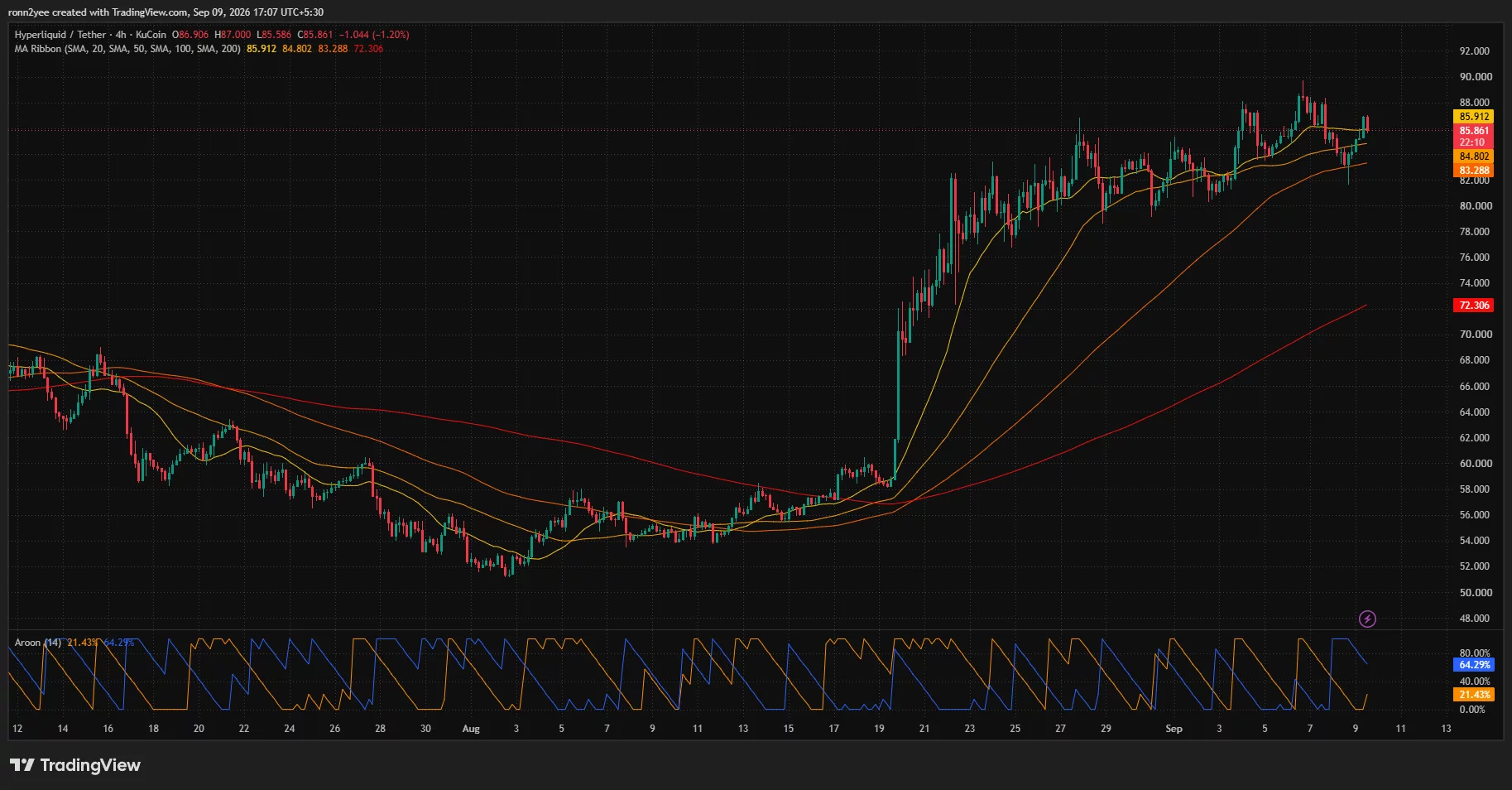
Hyperliquid price remained close to its record high on Sep. 9 as buyers absorbed an estimated $820 million token unlock, although weakening daily momentum and heavy liquidity near $87–$90 could slow the next advance.
Summary
- Hyperliquid price gained about 4.9% from its Sep. 3 opening price to trade near $85.84.
- The token reached an all-time high of $89.57 on Sep. 6 before entering consolidation.
- 4-hour moving averages place immediate support between $83.29 and $85.91.
- Liquidation clusters near $87 and $83.50 could shape HYPE’s next short-term move.
Hyperliquid price consolidates below $90
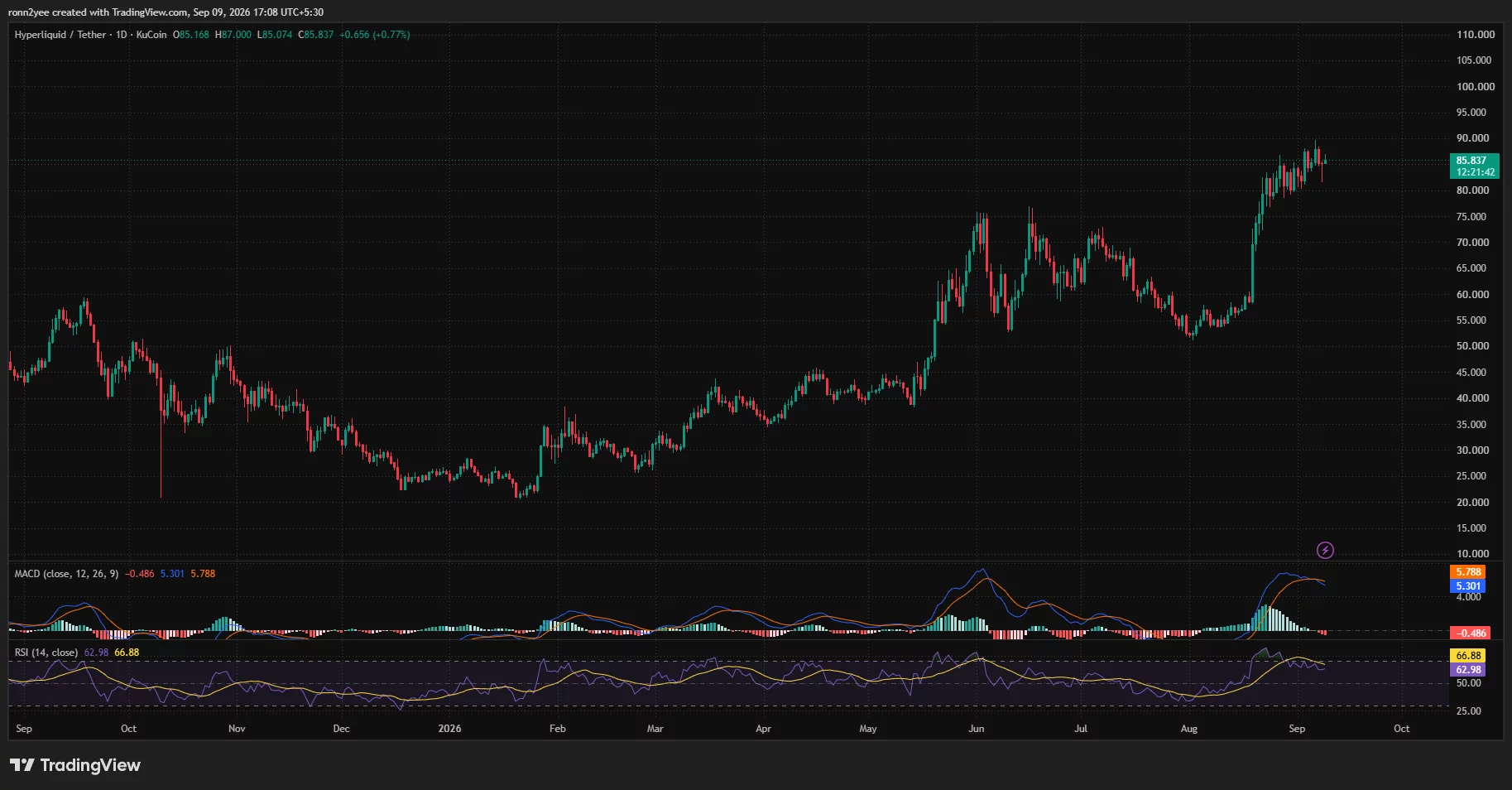
Hyperliquid (HYPE) price traded at $85.84 at the time of writing on Sep. 9, holding most of its gains after a volatile six-day period. HYPE opened near $81.82 on Sep. 3, placing its net gain at approximately 4.9%.
The token initially climbed to $87.99 before market-wide selling interrupted the advance. HYPE then recovered and reached an all-time high of $89.57 on Sep. 6, showing greater relative strength than several large-cap cryptocurrencies during the broader correction.
Price action has since narrowed between roughly $84 and $88 as traders test demand below the record high. The daily chart shows that buyers have repeatedly stepped in around $84.70–$85, while attempts to hold above $87 have attracted selling.
HYPE’s daily Relative Strength Index stood at 62.98, down from its RSI moving average of 66.88. The indicator remains above the neutral 50 level but shows that bullish momentum has cooled since the record-setting move.
The daily moving average convergence divergence indicator has also weakened. Its MACD line fell to 5.301, below the 5.788 signal line, while the histogram slipped to -0.486. The bearish crossover points to slower short-term momentum rather than a confirmed reversal, as the token remains near its high.
Token unlock meets sustained protocol demand
HYPE’s resilience followed the Sep. 6 unlock of about 9.92 million tokens allocated to core contributors. The tokens were worth approximately $820 million at the prices recorded around the event.
Large unlocks can raise selling pressure by expanding the amount of supply available to holders. However, only a small portion of the newly unlocked HYPE was reportedly claimed or moved toward venues associated with selling, limiting the immediate impact on the market.
Demand from Hyperliquid’s fee-funded assistance fund also helped offset supply concerns. The mechanism uses most of the protocol revenue assigned to the fund to purchase HYPE from the market, linking token demand to activity on the trading platform.
Hyperliquid open interest reached $14.3 billion during the period, indicating that traders maintained substantial derivatives exposure despite the broader market decline. High open interest can support trading-fee generation, though it also raises the risk of sharper moves if leveraged positions unwind together.
Broader markets faced pressure as tensions between the United States and Iran pushed oil toward $100 per barrel. Strong U.S. employment data and a rise in the 10-year Treasury yield to 4.784% also reduced demand for risk assets.
The resulting crypto sell-off liquidated about $188 million in long positions on Sep. 4. HYPE briefly fell toward $83.68 during the event but recovered faster than much of the market.
HYPE price faces resistance from $87 to $90
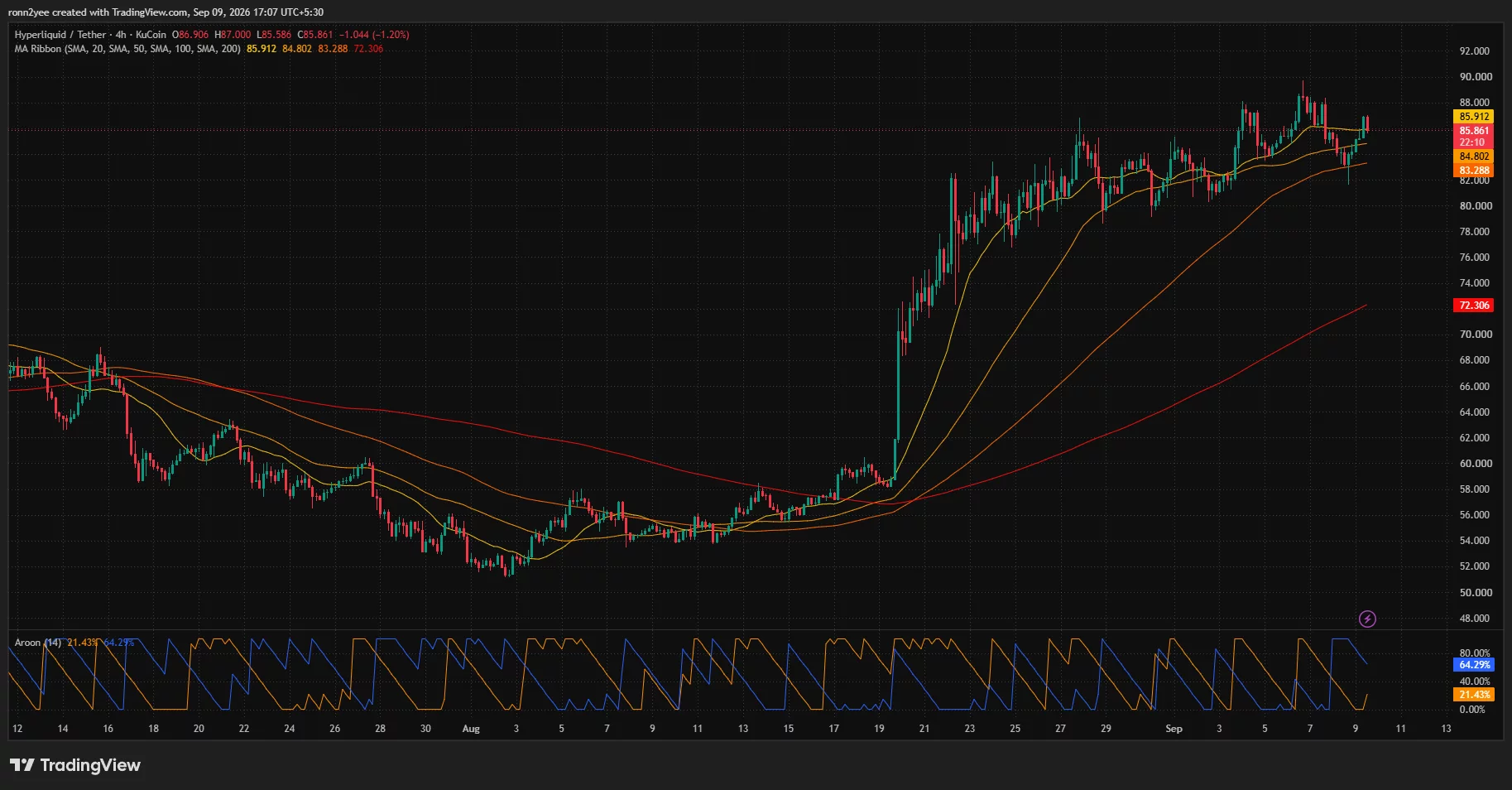
The four-hour chart places HYPE close to its 20-period simple moving average at $85.91. A sustained move above that level could give buyers another opportunity to challenge $87 and the record-high region.
Lower support comes from the 50-period SMA at $84.80 and the 100-period SMA at $83.29. The alignment of the 20-, 50-, 100-, and 200-period averages remains bullish, with each shorter average positioned above the longer one.
The four-hour Aroon Up reading of 64.29% also exceeded Aroon Down at 21.43%. The gap suggests that recent highs still carry more weight than recent lows, although neither reading shows complete control.
CoinGlass’ 24-hour liquidation heatmap shows a nearby concentration of leveraged positions around $86.80–$87.20. A move through that area could force short liquidations and help HYPE retest $88–$90.
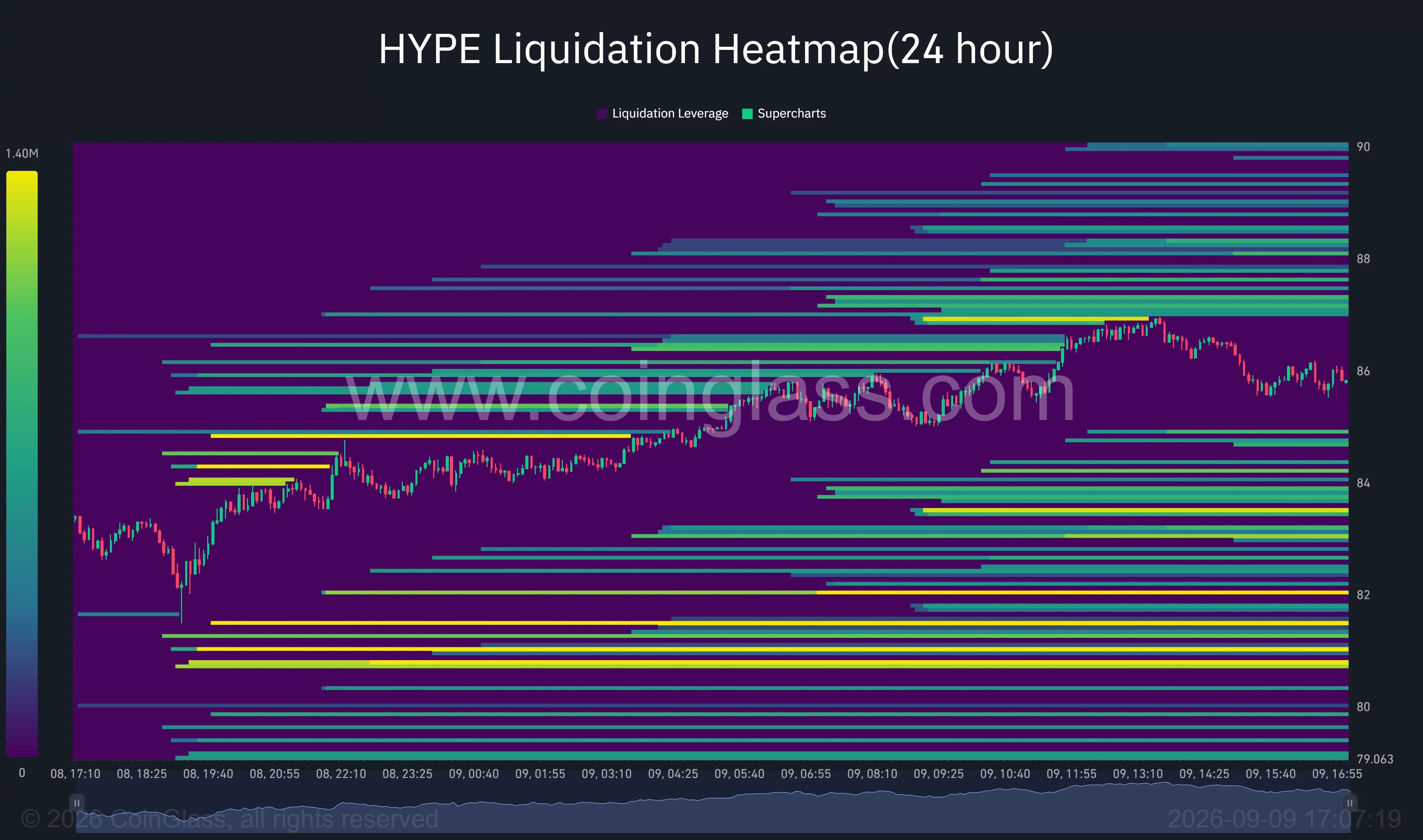
Liquidity below the market is concentrated near $84, $83.50, and $82. Larger bands appear around $80.70–$81.50, making that region a potential downside target if the nearer moving-average support fails.
A daily close above $89.57 would place HYPE in price discovery and bring the psychological $100 level into view. Failure to defend $83.29 would weaken the short-term structure and expose $82, followed by the four-hour 200-period SMA near $72.31.
Analysts remain cautious near the supply zone
Crypto analyst CryptoPatel said in a Sep. 8 post that HYPE was trading inside a daily supply and resistance zone between $84 and $90. The analyst viewed $90 as the invalidation level for a corrective setup and identified $76, $68, and $60 as possible downside levels if sellers take control.
Team LAMBO Charts separately placed the main resistance area between $90 and $95. The analyst said sellers had previously entered around that region and wanted to see stronger volume before treating another test as a confirmed breakout.
Both views identify $90 as the level that separates continued consolidation from a possible bullish expansion. Their longer-term support projections sit well below the immediate levels shown by the four-hour moving averages, reflecting the difference between a short-term pullback and a wider structural correction.
For U.S. traders, Treasury yields, oil prices, and expectations for Federal Reserve policy remain external risks. HYPE has resisted the latest market decline, but another increase in yields or inflation concerns could trigger renewed deleveraging across speculative crypto positions.
The immediate setup, therefore, depends on whether buyers can reclaim $87 and close above $89.57. Until then, HYPE remains in a bullish broader trend but faces fading momentum and concentrated resistance below $90.
Disclosure: This article does not represent investment advice. The content and materials featured on this page are for educational purposes only.

For many crypto believers, retirement planning isn’t about giving up Bitcoin—it’s about deciding whether staking a meaningful portion of future spending power on a volatile asset is actually prudent. A growing debate is emerging at the intersection of personal finance and crypto’s place in mainstream portfolios, with retirement researchers and market participants increasingly focused on the same question: how much (if any) should belong in a long-term retirement allocation?
While some retirement industry professionals argue there is a “sweet spot” near minimal exposure—or even none at all—others say Bitcoin can be integrated more thoughtfully, including as a potential replacement for part of equity risk. The practical challenge is not only whether crypto can deliver returns, but whether investors can survive large drawdowns at the exact moment they need stability most.
Key takeaways
- Public sentiment remains cautious: a National Institute on Retirement Security survey found 77% of Americans view cryptocurrency in workplace retirement plans as risky.
- Industry views diverge sharply, ranging from MIT finance professor Jonathan Parker’s “yes, zero” stance to portfolio designers who suggest small Bitcoin allocations for risk-tolerant investors.
- Financial planners often frame crypto as a small, controllable risk sleeve—commonly capped around 5%—rather than a core retirement holding.
- Retirement timelines change the math: volatility that can be absorbed during earning years may become difficult for those near retirement.
- Institutions appear to be gaining exposure through regulated vehicles and crypto-adjacent public equities, even when direct participation is limited.
Americans see retirement crypto as risky—so why is exposure growing?
Despite crypto’s increasing visibility in finance, trust is not universal. According to a survey by the National Institute on Retirement Security, 77% of Americans consider cryptocurrency in workplace retirement plans risky. That skepticism exists even as regulators, asset managers, and major institutions have gradually expanded access to crypto-related products over recent years.
BlackRock has argued that a modest Bitcoin allocation—on the order of 1% to 2%—can be reasonable in a diversified portfolio for investors who can tolerate volatility, while Fidelity has suggested higher ranges (2% to 5%) may improve outcomes. The underlying premise in both cases is similar: the position is not meant to dominate retirement planning, but to introduce upside potential while constraining downside.
For investors, the key issue is that these proposals depend on behavior as much as math. A small allocation may be manageable in theory, but retirement is when emotions and cash-flow needs often become least forgiving.
“Yes, zero” versus a capped allocation approach
MIT finance professor Jonathan Parker, whose work spans portfolio choice and retirement finance, is notably blunt about where crypto fits. In the reporting, Parker argues the answer is “Yes, zero,” emphasizing that crypto is not an instrument that naturally serves the role many retirement portfolios are designed to fulfill.
The position contrasts with guidance from some financial planners who treat Bitcoin as an adjustable component within an otherwise conventional asset mix. Ryan Firth, founder of Mercer Street Personal Financial Services and a planner specializing in digital assets, describes Bitcoin not as a stand-alone retirement bet, but as something that could potentially replace a portion of stock exposure rather than simply adding another layer of risk.
Firth tells the magazine that Bitcoin may offer “higher return potential than stocks but with more volatility.” His rule of thumb is that crypto should not exceed 5% of an investor’s investable assets, with a conservative framing: invest only what you could realistically afford to lose.
That advice highlights the difference between “conviction” and “concentration.” Even if someone believes Bitcoin is important to the future of money, retirement planning still requires controlling how much of their lifestyle depends on a single, hard-to-predict market outcome.
Institutions look beyond Bitcoin as a core retirement asset
One reason this debate is moving from academic to practical is that institutional investors are increasingly finding ways to gain exposure. Public filings show pension funds and other large investors holding regulated spot Bitcoin exchange-traded funds (ETFs). Others seek exposure through publicly traded companies tied closely to the crypto ecosystem.
CalPERS, described as the largest public pension fund in the United States, has disclosed an investment in Strategy—identified in the reporting as a major corporate Bitcoin treasury holder—within an index-oriented public equity portfolio. CalSTRS, the largest educator-only pension fund, tells the magazine it has not made direct cryptocurrency investments, but it has invested in firms “some might consider crypto companies,” including Coinbase, a publicly traded company that operates a cryptocurrency exchange platform.
As presented in the article, the nuance is significant: institutional interest may not always be about making Bitcoin a central retirement asset. Instead, some investors may be positioning their portfolios to participate in crypto industry growth or to capture returns through regulated structures and publicly traded equities.
Why timing and withdrawals matter more than long-run belief
Bitcoin’s risk profile is not only about whether prices rise over time, but about whether investors can remain invested through severe drawdowns. The reporting draws a clear line between long investment horizons and the vulnerability created when retirement withdrawals begin.
Bill Bengen—credited for research behind the widely cited 4% retirement withdrawal rule—argues that capital preservation should be the primary priority for retirement portfolios. In the piece, Bengen recommends limiting volatile assets like Bitcoin to no more than 5% in order to “help prevent a disaster.”
Firth also emphasizes that the real question is not simply if Bitcoin recovers, but whether investors have the capacity to tolerate waiting. His concern, as quoted, centers on whether people will stay disciplined when prices inevitably fall, and what happens if the asset’s long-term outcome diverges from expectations.
That “behavioral resilience” point is often overlooked in purely theoretical allocation debates. Retirement planning introduces a new constraint: spending needs can force investors to sell at the worst possible moment, turning a temporary drawdown into permanent damage to future purchasing power.
What if the investment thesis is wrong?
Even among committed holders, a common stress test is unavoidable: what happens if the core thesis fails. The reporting highlights the concern that retirement savings could become too dependent on one idea being correct—whether that means Bitcoin declining under future risks or another technology displacing it.
Parker’s broader critique aligns with that stress test. He suggests investors in retirement should not treat crypto as cash-like peer-to-peer currency, and should not treat it like a substitute for holding cash either. In the article, Parker argues that currencies are for transacting rather than investing, and that investors should prefer assets tied to economic activity that pay interest, coupons, or dividends.
Importantly, Parker’s alternative is not a demand that investors avoid crypto-related exposure altogether. He proposes that those who want exposure to crypto industry success or failure should consider owning equity or debt of companies generating revenue from the sector, rather than holding Bitcoin directly.
Belief and bet don’t have to be the same thing
The underlying message across the different perspectives is that belief in crypto’s long-term role does not automatically translate into a justified retirement allocation. As Firth frames it, crypto does not have to be “all-or-nothing.” Investors may still support the broader thesis for technology or market structure without letting one volatile asset determine whether they can fund decades of spending.
What to watch next is how retirement-focused guidance continues to evolve as more regulated crypto vehicles become familiar to institutions and as lawmakers and regulators weigh in on how (and where) digital asset exposure can fit within retirement accounts—especially during the moments when withdrawals turn portfolio volatility into real-life risk.

AI will cure cancer in our lifetime, claims boss of UK chip giant

Trader Buys $LAPTOP Dip at $5.97, Loses 87% More as Token Craters

Pakistan Team Mistaken For Asylum Seekers In UK By Anti-Immigrant Protestors


-

 Crypto World1 day ago
Bitcoin price risks $76K drop as $78K support weakens
-
 Tech2 days ago
Memory prices are slowing because buyers ran out of money
-

 Crypto World1 day ago
Ethereum price stalls below $2,500 as ADX drops to 11
-

 Crypto World1 day ago
Robinhood Stock: How To Take Advantage With Reduced Risk
-

 NewsBeat1 day ago
What went right this week: an ‘historic’ fall in violent crime, plus more
-
 Sports2 days ago
Phones confiscated, players sent home: Pakistan’s England tour turmoil revives memories of Mohammad Amir, Salman Butt and Mohammad Asif’s 2010 Lord’s spot-fixing scandal | Cricket News
-

 NewsBeat2 days ago
England up in reading, maths and science rankings as Scotland and Wales dip
-

 Business1 day ago
Meta debuts long-awaited personal AI agent, Muse
-
 Crypto World19 hours ago
Bitcoin price holds near $79K as cycle drawdowns narrow
-
 Crypto World2 days ago
Brent Crude Oil Moves Above $100 for the First Time in 3 Months
-

 Crypto World2 days ago
Visa expands stablecoin card network to 160 programs
-

 Business2 days ago
Egyptian TV Presenter Sarah Khalifa, 11 Others Sentenced To Death In Major Drug Trafficking Case In Cairo
-
 Tech2 days ago
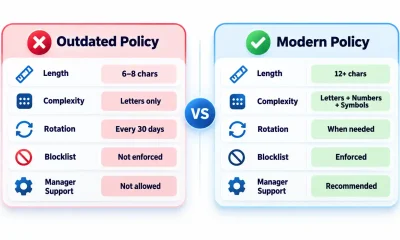
Strong Password Policy and Password Manager Guide
-

 Crypto World1 day ago
Intel Stock Jumps 9% on Chip Price Hike Report, US Stake Gains $36 Billion
-

 Entertainment1 day ago
Big Brother Spoilers: Dee SPINS & HUSTLES Votes – Yash Questions the Pact
-

 Sports1 day ago
Ballon d’Or 2026 Nominees: Lionel Messi In, Cristiano Ronaldo Out; Erling Haaland Included In Top 30
-

 Tech1 day ago
Meta debuts its Muse AI agent. Will consumers trust it?
-

 Business1 day ago
ServiceTitan, Inc. (TTAN) Q2 2027 Earnings Call Transcript
-

 Tech1 day ago
Google’s revived nuclear power plant gets $1.9B loan from US government
-

 Crypto World2 days ago
Pump Fun and Kraken delete Hunter Biden $LAPTOP promotion
You must be logged in to post a comment Login