
Crypto World
Ethereum Price Prediction: Lubin, Bitmine, and Sharplink Launch Independent Non-Profit Institution to Bring Institutional Wealth Onchain


Ethereum price is trading near $1,650, remaining below its major moving averages and preserving a bearish prediction. However, the biggest story this week is not the chart. Instead, Bitmine and SharpLink are betting that institutional Ethereum adoption could accelerate well before the price reflects it.
Ethereum Institutional has launched as an independent non-profit focused on institutional engagement. Backed by Bitmine, SharpLink, and Ethereum co-founder Joe Lubin, it formalizes outreach previously handled within the Ethereum Foundation. The organization will focus on institutional education, market intelligence, ETH marketing, standards, and global events.
Its leadership includes Thomas Lee as chairman, Joseph Chalom, and Executive Director David Walsh, and the operations have already spanned to New York, London, Hong Kong, Singapore, Zurich, Frankfurt, Tokyo, and Abu Dhabi, giving the organization an international presence from launch.
The timing reflects Ethereum’s growing role in institutional finance. The network secures roughly 60% of the stablecoin supply and about two-thirds of tokenized real-world assets. Ethereum Institutional aims to strengthen relationships with financial firms before competing blockchain networks gain market share.
Discover: The Best Crypto to Diversify Your Portfolio
Ethereum Price Prediction: $1,750 or $2,000
ETH is recovering at $1,650, trading below its 20-, 50-, and 100-day EMAs. That setup keeps the near-term trend bearish. Meanwhile, the RSI sits around 43, while the Stochastic oscillator remains neutral, suggesting selling pressure has eased without confirming a reversal.
At the same time, spot Ether ETFs have recorded persistent outflows since mid-June, limiting buying momentum. As a result, recent rallies have faded near resistance. Institutional interest remains intact, but it has yet to translate into sustained price strength.

Don’t Miss Out on Our $1,000 USDT Airdrop on ByBit
The first resistance sits near the 20-day EMA around $1,670, followed by the $1,750 level that traders continue to monitor. Above that, the 50-day EMA near $1,870 becomes the next key hurdle. On the downside, support rests around $1,520, followed by $1,400 and $1,150 if selling pressure intensifies.
A bullish scenario requires ETH to reclaim the 20-day EMA and break above $1,750 with strong volume. Otherwise, the base case remains range-bound trading between $1,520 and $1,670. If support near $1,500 fails, ETH could revisit lower levels before establishing a stronger recovery.
Discover: The Best Token Presales
LiquidChain Targets Early-Mover Upside as Ethereum Tests Key Levels
ETH at $1,650 with stacked resistance overhead and ETF outflows still unresolved means the upside for spot holders is capped in the near term, even with the institutional narrative firmly in place. Traders looking for asymmetric exposure to the same Ethereum-adjacent infrastructure thesis are eyeing early-stage infrastructure plays where the entry math still works.
LiquidChain ($LIQUID) is a Layer 3 infrastructure project positioning itself as the cross-chain liquidity layer, fusing Bitcoin, Ethereum, and Solana liquidity into a single execution environment.
That moment when you see the LiquidChain utility for the first time.
⟁https://t.co/vqvBcdSQYC pic.twitter.com/KboySb8c4X
— LiquidChain (@getliquidchain) July 2, 2026
The architecture centers on a Unified Liquidity Layer, Single-Step Execution, Verifiable Settlement, and a Deploy-Once structure that lets developers build once and access all three ecosystems simultaneously. The project has already drawn attention as a direct infrastructure beneficiary of the multi-chain institutional expansion that entities like Ethereum Institutional are accelerating.
As of now, its presale is currently priced at $0.01475, with $880K raised to date.
Don’t Miss Out on Our $1,000 USDT Airdrop on ByBit
The post Ethereum Price Prediction: Lubin, Bitmine, and Sharplink Launch Independent Non-Profit Institution to Bring Institutional Wealth Onchain appeared first on Cryptonews.


Galaxy Research head Alex Thorn warned early Monday that a fourth coordinated attack wave is likely targeting Coldcard users.
The random number generator (RNG) exploit has been linked to 1,367.05 Bitcoin (BTC) from 4,585 addresses across three confirmed waves. A verified fourth wave would push totals higher.
Coldcard Exploit Deepens as Suspected Fourth Wave Sweeps Over 380 Bitcoin
Thorn identified 218 transactions between blocks 960,778 and 960,792, moving over 380 BTC from 462 suspected victim addresses to 210 fresh destinations. Sweeps ran at 13.8 per block, roughly 45 times the pre-incident rate of 0.3.
The transactions matched the pattern of vulnerable Coldcard addresses, with some funds already swept to second-hop wallets.
“These are LIKELY Coldcard victims — they match the shape of coldcard vulnerable utxos and the elevated transaction pattern gives me high confidence they are another wave of attacks,” Thorn said.
The executive added that similar transactions remain pending in the mempool with replace-by-fee (RBF) enabled. RBF lets the sender replace an unconfirmed Bitcoin transaction with a higher-fee version. In some cases, this allows a victim to outbid an attacker’s competing transaction before either is confirmed.
Per Onchain Lens, confirmed losses stand at $88.6 million. Earlier waves drained individual holders in minutes, including one Canadian victim who lost $1.6 million.
Follow us on X to get the latest news as it happens
Coldcard Destroys Remaining Vulnerable Inventory
Meanwhile, Coldcard said Sunday it halted shipments and destroyed all remaining devices carrying the flawed firmware. Satscard, Opendime, and Tapsigner are unaffected.
The patched firmware protects only newly generated seeds. Users must create a fresh seed and migrate funds. The company also told victims to keep affected devices as its legal team coordinates with law enforcement.
“We’ve also been in direct contact with the wider hardware wallet and self-custody community, including other builders, researchers, and people who’ve thought hard about this kind of failure. All have graciously offered whatever resources they could spare. We are still engaged in this outreach and are committing to work with the broader industry going forward,” the team said.
The incident has already drawn warnings from CZ about hardware wallet risk. Whether wave 4 gains confirmation, and whether pending fee races rescue funds, may decide the final toll.
Subscribe to our YouTube channel to watch leaders and journalists provide expert insights
The post Coldcard Bitcoin Exploit Enters Fourth Wave With 462 New Suspected Victims appeared first on BeInCrypto.


Bitcoin started the week just below $63,000, with Friday’s U.S. jobs report the biggest macro event likely to determine whether the July rebound continues, though developments in Iran may take on greater significance in the coming days.
A muted rise in U.S. hiring could be the best outcome for risk assets like crypto. Such a rise would ease fears of an economic slowdown, but wouldn’t push the Federal Reserve closer to raising interest rates.
IG market analyst Tony Sycamore said a gain of around 88,000 jobs with unemployment unchanged at 4.2% would strike that balance in a “Goldlocks-type print.”
The U.S. government’s borrowing plans are another macro focus. JPMorgan strategist Jay Barry said the Treasury is likely to keep its regular debt sales unchanged, which would avoid adding pressure to interest rates. Larger-than-expected sales could raise borrowing costs for households and companies and weigh on crypto.
Traders will also watch earnings from Circle, Galaxy, Block and six bitcoin miners. BIP-110, a proposal to temporarily limit non-financial data stored on the Bitcoin blockchain, is expected to enter its required miner-signaling period.
Binance opened its August Monthly Leaderboard for Dual Investment users on Aug. 3, offering a top reward of 5,888 USDC.
Summary
- Binance will rank users by average Dual Investment subscriptions during August, rewarding the top 100.
- The first ranked participant receives 5,888 USDC through a Dual Investment subscription lasting 14 days.
- Participants need verified accounts, confirmed enrollment, and subscriptions lasting longer than three days to qualify.
The promotion runs from 06:00 UTC on Aug. 3 through 23:59 UTC on Aug. 31.
Eligible users will be ranked by their average subscription amount across Dual Investment and Dual Investment RFQ. Only subscriptions lasting more than three days will count. Binance requires participants to complete identity verification and confirm enrollment through the activity page.
Binance leaderboard favors larger subscriptions
The ranking formula multiplies each eligible subscription amount by its duration and divides the result by 30 days. Both the size and length of a position can therefore affect a participant’s place. A single large subscription made near the deadline may carry less weight than the same amount committed for longer.
The first ranked user will receive 5,888 USDC. Users in second and third place qualify for 2,188 USDC each. Rewards decline across later tiers to 68 USDC for places 71 through 100. Based on the published table, the maximum combined face value is 25,500 USDC if Binance distributes every listed reward. The exchange did not state that total directly.
In addition, the prizes are not scheduled to arrive as freely withdrawable USDC. Binance said each reward will be issued as a Dual Investment subscription lasting 14 days. Distribution is due within 14 days after the campaign closes, with Sept. 14 listed as the final delivery date.
Participants also cannot cancel or redeem a Dual Investment subscription early. Sub accounts do not receive separate rankings. Binance may reject users it believes acted fraudulently or broke the promotion rules. It also reserves the right to change, suspend or cancel the campaign.
Dual Investment can convert assets at settlement
Binance markets Dual Investment as a “high yield” structured product with Buy Low and Sell High choices. Users select a deposit asset, target price and settlement date. The settlement outcome determines whether they receive the original deposit currency or another asset.
For Buy Low, deposited funds can be converted into the selected cryptocurrency when the settlement price reaches the target condition. For Sell High, deposited crypto can be converted into a stablecoin or another currency. Binance’s official FAQ says the product does not protect principal and warns that customers may miss a better market price.
The campaign page lists BTC, ETH, SOL and BNB among Sell High deposit assets, alongside 17 other tokens. Buy Low accepts USDT, USDC, BTC or ETH. Binance advertises APRs of 15% or more, although rates can vary according to the target price, duration and market volatility.
The exchange warns that the stated APR refers to rewards in the deposit currency. It is not a forecast of fiat returns or the value of the alternate currency at settlement. Funds remain locked until settlement, limiting a participant’s ability to respond to sudden price movements.
As crypto.news previously reported, Binance introduced Dual Investment as a way to buy or sell crypto at a chosen future price while receiving rewards during the subscription period. The August leaderboard adds a ranking incentive rather than changing the product’s settlement rules.
Aug. 31 closes the Binance ranking window
Users must join the activity and maintain qualifying subscriptions during the campaign. The announcement does not disclose the number of participants, the total subscription value already committed or whether every regional Binance entity will offer the promotion. Binance states that its products may not be available in every region.
The next confirmed dates are Aug. 31, when the ranking period closes, and Sept. 14, when eligible rewards should be distributed. In related coverage, crypto.news reported that Binance is also running an $800,000 XRP campaign for eligible RLUSD users through Aug. 14. That promotion covers qualifying activity across Binance Earn, Margin and Futures.
The Smarter Web Company has increased its Bitcoin treasury by acquiring another 11.89 BTC, taking its total holdings to 2,712 BTC.
Summary
- The Smarter Web Company has purchased another 11.89 Bitcoin, increasing its treasury to 2,712 BTC.
- The latest acquisition has moved the UK listed firm to 28th place in the BitcoinTreasuries corporate Bitcoin rankings.
- The purchase comes weeks after the company repaid its Smarter Convert financing and reported holdings of 2,700 BTC.
- The company has continued building its Bitcoin reserves under its long term 10 Year Plan.
According to BitcoinTreasuries.NET, the London-listed company completed the latest purchase of 11.89 Bitcoin, lifting its corporate treasury to 2,712 BTC and moving it to 28th place in the Bitcoin 100 ranking of public companies holding the asset.
The latest acquisition follows the company’s decision last month to retire its Smarter Convert financing instrument ahead of schedule, a move that left it holding 2,700 BTC after selling part of its treasury to settle the obligation.
By adding fresh Bitcoin within weeks, the company has resumed the accumulation strategy it has repeatedly described as part of its long-term treasury policy.
Bitcoin purchase pushes holdings above July level
BitcoinTreasuries.NET said the additional purchase has increased The Smarter Web Company’s reserves by 11.89 BTC, taking the balance from 2,700 BTC to 2,712 BTC.
The update also places the company at No. 28 in the global Bitcoin 100 corporate treasury rankings, up from earlier positions it occupied as its holdings expanded through regular purchases over the past year.
In July, The Smarter Web Company announced it had repaid its $11.7 million Smarter Convert instrument nearly two weeks before maturity by selling 177.8909127 BTC at an average price of $65,762 per coin.
The company said the Bitcoin sold had originally been purchased using proceeds from the financing arrangement, which required virtually all of the subscribed capital to be invested in Bitcoin.
Following that repayment, the company confirmed it held exactly 2,700 BTC while removing the potential issuance of 7,718,551 ordinary shares linked to the convertible structure from its fully diluted capital calculations.
Bitcoin strategy continues after convertible repayment
Company chief executive Andrew Webley previously said the Smarter Convert structure served as an alternative source of funding while the firm was building its Bitcoin treasury, but added that management no longer viewed convertible financing as the most suitable option at its current stage.
According to the company’s July announcement, investment manager TOBAM and its affiliated entities supported the early repayment request, allowing the instrument to be settled before its scheduled maturity.
Although the financing arrangement has now been retired, the company said at the time that its long-term “10 Year Plan” to build a Bitcoin treasury remained unchanged. The latest purchase adds further support to that strategy, lifting the company’s holdings above the level reported after the repayment.
Earlier purchases expanded the company’s Bitcoin treasury
The Smarter Web Company has steadily expanded its Bitcoin reserves through repeated acquisitions since 2025.
In September 2025, the company appointed Coinbase Institutional as an additional Bitcoin custody partner alongside its existing custody arrangements through Coinbase Prime. At that point, it held 2,470 BTC after completing another 30 BTC purchase.
By October 2025, the company had increased its holdings to 2,650 BTC after purchasing an additional 100 BTC for approximately £9.08 million, or about $12.1 million. The company said the acquisition formed part of its long-term treasury strategy and described Bitcoin accumulation as a core element of its corporate treasury policy.
At the time, Bitcoin Treasuries ranked the company 30th among public firms holding Bitcoin. The company also reported a year-to-date Bitcoin yield of 57,718% and a quarter-to-date Bitcoin yield of 0.58% on its holdings, while its shares recorded a modest gain after the purchase announcement.
Corporate treasury position continues to climb
The latest update from BitcoinTreasuries.NET indicates that The Smarter Web Company has continued adding to its Bitcoin reserves despite using nearly 178 BTC to repay the Smarter Convert obligation only weeks earlier.
With total holdings now standing at 2,712 BTC, the company has added 12 BTC since completing the repayment and has climbed to 28th place among public corporate Bitcoin holders.
Previous company statements have described the business as the largest publicly traded corporate Bitcoin holder in the United Kingdom. It has also raised additional capital in support of treasury expansion, including a £17.5 million fundraising announced in 2025 for future Bitcoin purchases and related treasury infrastructure.
The latest purchase does not include any indication of changes to the company’s treasury policy. Instead, the updated holdings continue the accumulation plan management has consistently outlined under its 10 Year Plan while strengthening its position in the global corporate Bitcoin rankings.
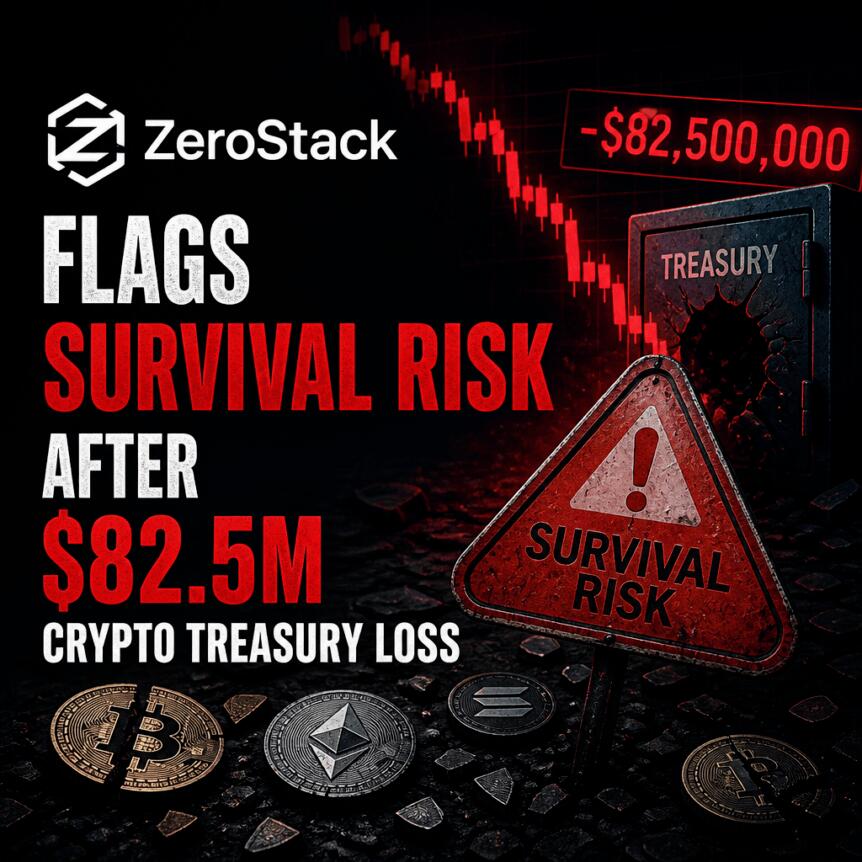
Nasdaq-listed crypto treasury firm ZeroStack has told the market that “substantial doubt” exists about whether it can keep operating over the next year, according to a recent SEC filing. The warning marks a notable shift from the company’s earlier assessment, where it said its liquidity position was expected to support operations for at least another year.
In a Form 10-Q filed with the US Securities and Exchange Commission on Friday, ZeroStack reported $2.6 million in cash as of June 30, negative working capital of about $600,000, and an accumulated deficit of $339.1 million. The company also recorded an $82.5 million fair value loss on digital assets and posted a net loss of $61.3 million for the first half of 2026. (Source: SEC Form 10-Q)
Key takeaways
- ZeroStack’s filing introduces “substantial doubt” over its ability to continue operating, reversing an earlier liquidity outlook.
- As of June 30, the firm reported $2.6 million cash and negative working capital of roughly $600,000.
- 0G token holdings were valued at about $15.2 million versus an aggregate cost of $163.3 million—an indicated ~91% decline relative to recorded cost.
- The business model depends on staking rewards and token sales, leaving funding levels tied to 0G price and market liquidity.
- In the first half of 2026, ZeroStack generated $3.8 million from staking revenue and sold nearly 4.9 million tokens for $2.4 million.
What the SEC filing says about liquidity
The company’s latest Form 10-Q provides a snapshot of a treasury-led model facing tightening economics. ZeroStack disclosed $2.6 million in cash at the end of the first half of 2026 and negative working capital of approximately $600,000. It also reported an accumulated deficit of $339.1 million.
Beyond headline balance sheet metrics, the filing points to major valuation pressure on the company’s digital asset exposure. ZeroStack stated it recorded an $82.5 million fair value loss on digital assets during the period covered by the report. It also posted a net loss of $61.3 million for the first half of 2026. (Source: SEC Form 10-Q)
The company’s token treasury is central to the funding story. ZeroStack holds 75.1 million Zero Gravity (0G) tokens, with an aggregate recorded cost of $163.3 million and a fair value of $15.2 million as of June 30. That puts the holdings at roughly 91% below their recorded costs based on the fair value disclosed. (Source: SEC Form 10-Q)
Staking revenue and token sales: the funding hinge
ZeroStack said it relies on staking rewards and token sales to support operations. That structure creates a direct link between the company’s runway and two market variables: the price of 0G and the ability to sell tokens with sufficient liquidity.
In the first half of 2026, ZeroStack reported $3.8 million in staking revenue. The company also stated it earned about 6.6 million 0G tokens after validator commissions. During the same period, ZeroStack sold nearly 4.9 million tokens for $2.4 million to help cover operating expenses. (Source: SEC Form 10-Q)
Management said it expects cash on hand and staking reward sales to cover forecast operating costs. The filing also indicates the company could sell part of its treasury holdings if additional funds are needed. However, the key line for investors is that management could not conclude those plans would be enough to eliminate the “substantial doubt” about its ability to continue operating. (Source: SEC Form 10-Q)
Reversal from earlier liquidity guidance
The new warning is not the company’s first liquidity assessment this year. ZeroStack’s latest stance reverses what it told investors in its previous reports.
In its first-quarter Form 10-Q, ZeroStack said it expected its cash and staking rewards to be sufficient to meet working capital requirements and obligations for at least another year. (Source: SEC Form 10-Q (Q1))
In the latest filing, the company’s conclusion becomes more cautious. While ZeroStack points to operational funding coming from staking and potential token sales, the company’s inability to rule out a going-concern risk suggests the funding mix—when measured against current balance sheet realities and valuation losses—may be less reliable than earlier estimates.
Context: 0G treasury strategy and the cost-to-fair-value gap
ZeroStack’s current identity is tied to a broader pivot into 0G-centered treasury operations. The company was previously known as Flora Growth, a cannabis and CBD products firm. On Sept. 19, Flora announced a $401 million funding plan for a 0G treasury strategy. That plan included $35 million in cash and commitments, alongside more than $366 million in in-kind digital assets. The company later rebranded as ZeroStack while keeping its Nasdaq listing. (Source: Earlier coverage on Flora Growth’s 0G treasury announcement)
From an investor perspective, the most striking element in the latest report is the gap between the recorded cost of 0G holdings and their disclosed fair value. As of June 30, the tokens were booked at an aggregate cost of $163.3 million but marked at $15.2 million in fair value, implying the portfolio’s valuation has compressed sharply relative to its initial recorded basis. That gap matters because it directly affects how much capital the treasury can generate if token sales are needed to fund operating requirements—especially if liquidity is uneven or prices remain pressured. (Source: SEC Form 10-Q)
ZeroStack’s report therefore reads less like a one-off accounting update and more like an operational stress test of a staking-and-sales model. When the fair value of the underlying treasury declines so dramatically, even steady staking inflows may not translate into enough liquidity to cover burn and obligations without meaningful downside risk from continued token sales.
Going forward, investors should watch for whether ZeroStack can stabilize cash levels through staking reward performance and token sale capacity, and whether future filings confirm that the going-concern doubt diminishes or expands—an outcome that will likely depend on 0G liquidity and price rather than on the company’s ability to generate rewards alone. (Source: SEC Form 10-Q)
A suspected fourth wave of attacks targeting vulnerable Coldcard-generated Bitcoin wallets may already be underway, with blockchain researcher Alex Thorn warning on August 3 that almost 449 BTC had been swept from hundreds of addresses in about two and a half hours.
The latest activity, which was still unfolding as Thorn posted, follows three earlier waves that researchers have linked to the same weak-entropy vulnerability affecting certain Coldcard firmware versions.
New Sweeps Continue
Thorn said his latest analysis had identified 218 transactions affecting 462 suspected victim addresses between Bitcoin blocks 960778 and 969792. The transactions moved 388.93 BTC, valued at about $24.4 million at current rates, into 216 destination addresses, almost all of which had been just created and had no past transaction history.
“These are LIKELY Coldcard victims — they match the shape of coldcard vulnerable utxos and the elevated transaction pattern gives me high confidence they are another wave of attack,” he wrote.
The analyst stressed that he had no direct confirmation from victims yet, which is why he had deliberately used “likely” out of caution. He also quickly corrected the destination list, removing six addresses, which he said had already been receiving and spending BTC way before the Coldcard incident started on July 30. The six accounted for just over 5 BTC of the figure previously calculated.
Furthermore, Thorn stripped out 89 multisig addresses from his list, since none had appeared in the first three waves, taking the surviving core to 709 addresses and 448.73 ($28.1 million) across both confirmed and still-pending transactions.
He urged users to immediately move their funds off affected Coldcard devices and use higher transaction fees, and also warned that some of the pending transactions had Replace-by-Fee, or RBF, enabled, meaning that victims whose transactions were still sitting in the mempool might have a very brief chance to outbid the attacker and reclaim their funds before confirmation.
Earlier Waves Still Unspent
Galaxy Research has estimated that the first three confirmed waves drained 1,367 BTC, valued at around $85.7 million, from 4,585 Bitcoin addresses. According to the firm, those funds have not been spent and are still in attacker-controlled wallets, suggesting a coordinated operation rather than opportunistic theft.
However, not every stolen BTC has stayed put. One victim holding close to 30 BTC had 17 of them routed through ThorChain into the Duel online casino, which reportedly told the victim to file a police report before it could consider a freeze.
The attack stems from a vulnerability affecting seeds generated on certain Coldcard firmware versions released after March 2021. Coinkite, the maker of the Coldcard wallet, confirmed that seeds created on affected Mk3, Mk4, Mk5 and Q devices are exposed, and although newer patched firmware has stopped the problem for future seeds, it cannot secure old ones. It also said that it has destroyed all remaining vulnerable inventory, halted shipments, and is working with customers and law enforcement as they try to identify those responsible for the theft.
In addition, the firm advised users to immediately migrate to a new seed on an unaffected device, with Thorn pointing out that every single-signature Coldcard address generated under the vulnerable conditions will eventually get drained.
The post Coldcard Wallet Attacks Enter Fourth Wave, Putting 449 BTC at Risk appeared first on CryptoPotato.
Rumors that Trade.XYZ has been seeking a $200 million equity financing at a $1.5 billion valuation have sparked conflicting views across the crypto community, with supporters calling the report credible while others have dismissed the claim.
Summary
- Trade.XYZ is rumored to be raising $200 million at a $1.5 billion valuation through an equity financing round.
- Cobie dismissed the fundraising reports, while other crypto community members argued the rumors could be credible.
- Trade.XYZ has not confirmed the reported financing or announced any plans to raise new capital.
- The funding speculation surfaced days after Trade.xyz announced reimbursements for users affected by the SK Hynix liquidation incident.
- Community members have questioned why Trade.XYZ would seek outside investors instead of funding from the Hyperliquid ecosystem.
According to market chatter circulating on X and Telegram, speculation about the funding round gained traction after several community figures discussed the possibility of Trade.XYZ raising outside capital.
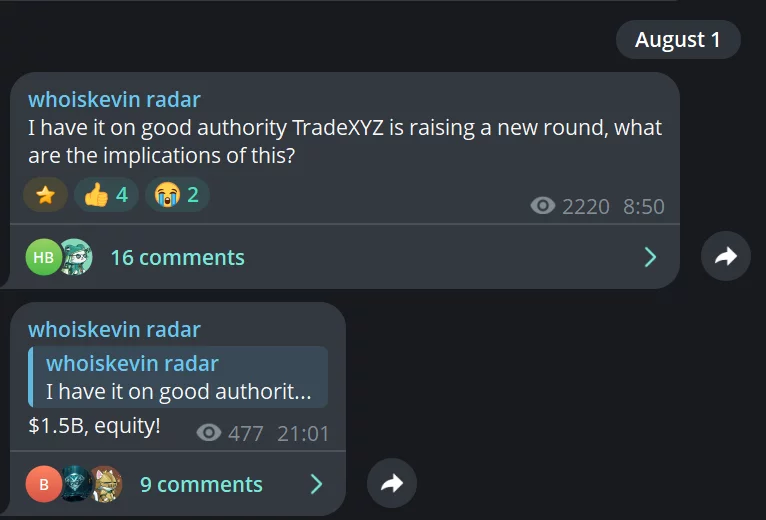
Source: ProMint on X.
The reported terms describe a $200 million equity round valuing the company at $1.5 billion, although Trade.XYZ has not publicly confirmed that such a fundraising process is underway.
Community debate has split over Trade.XYZ funding rumors
The discussion gathered pace after crypto commentator ProMint said he had heard the fundraising claim from people he knows and had seen similar reports circulating across the crypto community. In the same post, he said he believed the reports were more likely to be genuine than market noise, while arguing that venture investors can provide legal, strategic and networking support in addition to capital.
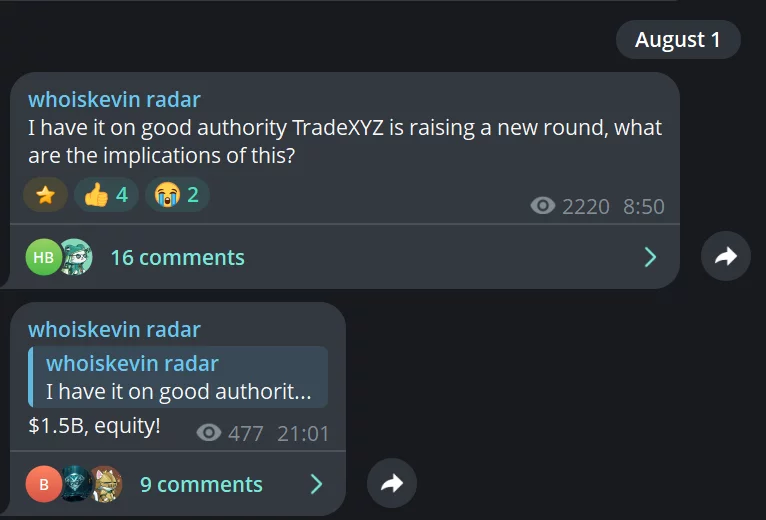
Earlier reports shared by the Telegram channel whoiskevin radar also claimed, citing what it described as “good authority,” that Trade.XYZ was raising a new equity round. A follow-up message from the same channel stated that the reported valuation was $1.5 billion and that the fundraising would be structured as an equity financing.
Not everyone accepted the claims. Cobie said the probability of Trade.XYZ completing such a financing round was zero, directly challenging the speculation spreading through social media.
The differing opinions prompted further debate within the community. One participant questioned why Trade.XYZ would seek external investors if it required additional capital, asking why the company would not instead obtain funding from the Hyperliquid team led by Jeff.
Trade.xyz has not confirmed the reported fundraising
Despite the growing discussion, Trade.XYZ has not announced an equity financing, disclosed fundraising plans or commented publicly on the reported valuation.
As a result, the reported $200 million raise remains an unverified market rumor rather than a confirmed corporate transaction.
Community members supporting the possibility of a financing have pointed to Trade.XYZ’s existing business as a reason institutional investors could still be interested, arguing that strategic investors often contribute expertise alongside capital. Those views, however, remain opinions expressed by individual commentators rather than statements from the company.
Trade.xyz recently reimbursed users after SK Hynix liquidation event
The financing speculation has surfaced only days after Trade.xyz announced a reimbursement program for users affected by an unusual SK Hynix liquidation event.
On July 29, the company said it would compensate eligible liquidation losses tied to an SK Hynix price anomaly that occurred at 23:01 UTC on July 27. Trade.xyz described the reimbursement as a one-time discretionary decision and said eligibility requirements would be released separately before distributions begin.
Earlier reporting by crypto.news showed that the SK Hynix mark price briefly dropped from $1,127.90 to $917.25, triggering forced liquidations of leveraged long positions before prices recovered.
Trade.xyz said multiple independent market data providers transmitted an executed trade from South Korea’s NextTrade pre-market and that its oracle behaved according to its published design because it tracked that external venue.
Hyperliquid separately said the affected market was independently deployed and operated by Trade.xyz under the HIP-3 framework. Under that model, external builders are responsible for defining oracle and mark-price inputs for their own markets, while Hyperliquid provides the trading, margin, and liquidation infrastructure.


Luno customers covered by the exchange’s regional-exit notice can no longer send cryptocurrency to another wallet or platform.
Summary
- June 29 marked the final date affected Luno users could transfer crypto to external wallets.
- August 31 is the final standard bank withdrawal deadline before affected accounts close September 1.
- $52 in combined monthly fees may apply from December to balances remaining after account closure.
- Luno has not publicly identified the affected regions or disclosed how many customers received notices.
They must sell their holdings before withdrawing cash to a bank by Aug. 31.
The restrictions apply to an undisclosed group of customers whose accounts will close permanently on Sept. 1. As of Aug. 3, Luno had not publicly identified the affected regions or stated how many users received the notice.
Luno crypto transfers ended on June 29
Luno began limiting the affected accounts on June 1. It disabled deposits, crypto purchases, incoming transfers, recurring purchases and pending orders. Customers could still sell assets, withdraw money to a bank and send crypto elsewhere until June 29.
The transfer window has now closed. Users who missed it cannot preserve their holdings by moving the assets through the standard account process. Luno’s guidance says their remaining ordinary option is to sell the crypto and withdraw the fiat proceeds by Aug. 31.
Meanwhile, selling and normal bank withdrawals will stop after Aug. 31, while wallet access will end when accounts close on Sept. 1. Luno advises customers who have never verified a withdrawal account to contact support because deposits, which some regions use for bank verification, are already disabled.
Customers seeking help must provide a bank statement or letter issued within the previous three months. It must show their name and account details. Luno says manual withdrawals after closure usually take three to five business days once the required information has been confirmed.
Remaining balances could face monthly fees
Luno says balances below the equivalent of $10 cannot be processed because of minimum withdrawal thresholds. Under the notice, the company will retain those balances after Sept. 1 rather than placing them into the manual-withdrawal process.
Balances above $10 remain eligible for manual withdrawal after closure, but charges begin in September. Luno says it will impose a $2 monthly inactivity fee. From December, an additional $50 dormancy charge applies, raising the stated monthly cost to $52 while funds remain stored.
Luno still has not named the affected regions
The company says it is withdrawing to “focus on our core markets across Africa and South East Asia.” Its current availability page names Kenya, Nigeria and South Africa as supported African markets, alongside Indonesia and Malaysia in Southeast Asia. The list does not establish which other regions received closure notices.
Luno also maintains a separate list of 33 unsupported countries and territories. However, the regional-exit guidance does not connect the Sept. 1 closures to that list, a regulator, a security incident or financial distress. Customers must therefore rely on direct account notices to determine whether the timetable applies to them.
The withdrawal deadline arrives during a wider company restructuring.As crypto.news reported, Luno confirmed plans on July 28 to cut about 20% of its global workforce while directing more resources toward institutional and business-to-business services. Chief Executive James Lanigan did not disclose the number of positions or regions affected.
The account closures and job cuts should not automatically be treated as the same action. Luno has not publicly linked them. Still, both move narrow parts of its earlier global retail footprint while management concentrates spending on selected markets, infrastructure and professional services.
Luno previously used a country-specific wind-down when it exited Singapore in 2023. In related coverage, crypto.news reported that Singapore customers received a named service-ending date and were told to remove both crypto and local-currency balances. The current notice differs because Luno has not publicly named the regions involved.
The next firm deadlines are Aug. 31 for ordinary sales and bank withdrawals, Sept. 1 for account closure, and December for the additional monthly dormancy fee. Affected users with bank-verification problems must contact Luno before the ordinary withdrawal route closes.


Coldcard’s five-year seed-generation flaw has renewed calls for independent testing of hardware wallet firmware after suspected attacks have drained nearly $90 million worth of Bitcoin from thousands of wallets.
Summary
- Kraken’s chief security officer has called for independent testing of hardware wallet seed generation after the Coldcard security flaw.
- Suspected attacks have drained nearly $90 million in Bitcoin, with Galaxy Research tracking more than 5,200 potential victim addresses.
- Coinkite has released fixed firmware but says affected users must create new seed phrases because updates cannot repair existing wallets.
- Security researchers traced the issue to a firmware error that used a weaker random number generator during wallet creation.
Kraken chief security officer Nick Percoco said in a post on X on Sunday that the incident should serve as a warning for the hardware wallet industry, arguing that manufacturers should not be the only parties verifying how wallet seed phrases are generated.
He said production firmware should undergo independent testing to confirm that the approved source of randomness is the one actually used when creating wallet secrets.
According to Galaxy Research’s latest blockchain analysis, suspected attackers have now swept more than 1,800 BTC from over 5,200 potential victim addresses across four observed attack waves, although the firm has stressed that those figures are on-chain estimates rather than confirmed losses. Coinkite has not verified every affected wallet, and blockchain data alone cannot determine whether a single actor carried out all of the attacks.
Coldcard flaw escaped review for more than five years
Coinkite disclosed on Thursday that the vulnerability dates back to March 2021, when the company migrated part of its firmware while integrating a new cryptographic library.
Instead of using Coldcard’s intended hardware-backed true random number generator to create wallet seeds, the updated firmware accidentally called a weaker deterministic pseudo-random generator provided by MicroPython.
According to Coinkite’s postmortem, the intended random-number generator remained active elsewhere in the firmware, allowing code reviews to verify its presence without revealing that wallet creation relied on a different source of entropy.
The company said it was unaware that the MicroPython generator existed in the relevant code path until the investigation. While the hardware random-number generator continued operating for other functions, it was no longer responsible for generating new wallet secrets.
Block’s Bitcoin engineering and security team independently reached the same conclusion during its technical review. The company said the affected firmware invoked the deterministic MicroPython fallback instead of the STM32 hardware random-number generator when creating wallet seeds. Although Block said it had not completed full empirical testing of every device, it decided to disclose its findings because reports of active theft had already emerged.
Coinkite estimates that seeds created on affected Mk2 and Mk3 devices may contain about 40 bits of effective entropy, while affected Mk4, Mk5 and Q models may contain about 72 bits instead of the intended 128 bits.
Hardware wallet testing has lacked entropy verification
Using the Coldcard incident as an example, Percoco argued that hardware wallet certification has overlooked one of the most important parts of wallet security.
He said users currently have to trust that manufacturers correctly implement seed generation because no independent process verifies that production firmware actually calls the approved entropy source. Existing certifications, including Common Criteria evaluations for secure elements, CSPN reviews and vendor-sponsored audits, do not systematically validate that relationship, according to Percoco.
To illustrate the gap, he pointed to NIST SP 800-90B, the U.S. standard governing the design and validation of true random-number generators used in cryptographic systems, along with Germany’s BSI AIS-31 framework, which sets similar testing requirements. He argued that comparable end-to-end verification does not currently exist for hardware wallets.
Percoco also compared the sector with payment security, noting that PIN entry devices cannot be shipped without independent laboratory testing, while U.S. government cryptographic modules require entropy source validation before approval.
Coldcard users still need new wallet seeds
As attack activity continued over the weekend, Coinkite said it had halted all shipments after confirming the vulnerability and destroyed every remaining device in its facilities containing the affected firmware.
The company nevertheless advised customers not to discard affected devices because they may become important if stolen funds are eventually recovered through legal proceedings. Coinkite added that its legal team would coordinate with law enforcement agencies in multiple jurisdictions where appropriate.
Firmware updates have already been released for every affected model, including version 4.2.0 for Mk2 and Mk3, version 5.6.0 for Mk4 and Mk5, version 1.5.0Q for Coldcard Q, and versions 6.6.0X and 6.6.0QX for Edge releases. According to the company, installing updated firmware only fixes future wallet creation and does not strengthen seed phrases generated before the patch.
For that reason, users covered by the advisory are being instructed to generate entirely new seed phrases after updating their devices, verify a receiving address, send a small test transaction, and migrate the remaining balance only after confirming the transfer succeeded.
Coinkite said wallets created using at least 50 fair, private dice rolls are not considered exposed by the random-number-generation flaw alone. The company added that a strong and unique BIP-39 passphrase provides another layer of protection but does not remove the weakness from an already affected seed, meaning migration remains the recommended course of action.
Ongoing attacks continue to expand the known losses
Separate blockchain analysis from Galaxy Research indicates that the attacks have continued since the vulnerability became public.
Alex Thorn, head of research at Galaxy, identified a suspected fourth coordinated attack wave on Aug. 3, bringing the firm’s observed total to about 1,815.75 BTC across 5,294 potential victim addresses if none of the address groups overlap. Thorn described the wallets as “likely Coldcard victims” and emphasized that the figures come from blockchain analysis rather than confirmed device records or law enforcement findings.
Galaxy also reported that attack activity reached 13.8 wallet sweeps per block during the latest wave, compared with a baseline of 0.3 sweeps per block before the incident. The firm observed that most victim balances were sent to newly created addresses instead of a single collection wallet, while some funds had already moved through second-hop transactions, making the stolen Bitcoin harder to trace.
According to Galaxy, users whose stolen funds remain in unconfirmed Bitcoin transactions may still have a narrow opportunity to broadcast a higher-fee replacement transaction before miners confirm the original transfer.
Citing Bitcoin Core documentation, the research firm noted that Replace-by-Fee can only be attempted while the transaction remains unconfirmed and does not guarantee recovery even when the legitimate owner still controls the affected keys.
Nasdaq-listed crypto treasury company ZeroStack warned that substantial doubt exists about its ability to continue operating over the next year, reversing its assessment from three months earlier.
In a Form 10-Q filed with the US Securities and Exchange Commission (SEC) on Friday, ZeroStack reported $2.6 million in cash, negative working capital of $600,000 and an accumulated deficit of $339.1 million as of June 30. The company also posted an $82.5 million fair value loss on digital assets and a net loss of $61.3 million for the first half of 2026.
ZeroStack said its 75.1 million Zero Gravity (0G) tokens had an aggregate cost of $163.3 million and a fair value of $15.2 million as of June 30, leaving the holdings valued about 91% below their recorded costs.
ZeroStack relies on staking rewards and token sales to fund operations, making its ability to raise cash dependent on 0G’s price and trading liquidity.
ZeroStack’s 0G strategy faces a liquidity test
ZeroStack reported $3.8 million in staking revenue during the first half of the year, earning about 6.6 million 0G tokens after validator commissions. It sold nearly 4.9 million tokens for $2.4 million to fund its operating expenses.
The company expects its cash and staking reward sales to cover forecast operating costs and said it could sell some of its treasury holdings if needed. However, management said it could not conclude that those plans would be enough to ease doubts about its ability to continue operating.
Related: BitMart withdrawals appear to slow following wind-down announcement
The latest assessment reverses the company’s position in its previous two reports. In its first-quarter filing, ZeroStack said its cash and staking rewards would be sufficient to meet its working capital requirements and obligations for at least another year.
The company was previously the cannabis and CBD products firm Flora Growth. On Sept. 19, Flora announced $401 million in funding for a 0G treasury strategy, including $35 million in cash and equivalent commitments and more than $366 million in in-kind digital assets. The company subsequently rebranded as ZeroStack and retained its Nasdaq listing.
Magazine: The real reason DeFi projects that survived 2022 crash are shutting down now
Ngarluma people send missive to ministers over Pilbara deals

Coldcard Bitcoin Exploit Enters Fourth Wave With 462 New Suspected Victims

Donald Trump Talks Nancy Guthrie Case Amid Sheriff Criticism


-

 Business4 days ago
Why Trees Belong on the Risk Register
-

 Fashion3 days ago
Weekend Open Thread: Wit & Wisdom
-

 Politics2 days ago
Meta enters AI-training agreement with far-right ‘propaganda rag’ Newsmax
-
 Entertainment6 days ago
‘Stargate’ Creator’s New Sci-Fi Series Returns for Season 3 Tomorrow
-

 Politics7 days ago
Luke Littler dismantles Gerwyn Price to retain title in Blackpool
-

 Crypto World2 days ago
MicroStrategy Post-Earnings CLARITY Act Push Could Add New Catalyst for Its Stock
-

 Politics6 days ago
The Part of the Electric Transition Nobody Wants to Discuss
-

 Business5 days ago
Major shareholder moves on Canyon
-

 Crypto World2 days ago
XRP Ledger v3.3.0 brings five institutional features
-

 News Videos4 days ago
Bitcoin Enters the 3rd Stage of the Bear Market
-

 Crypto World5 days ago
Kraken Enables Retail Access to Jersey Mike’s IPO via Tokenized Shares
-

 Tech6 days ago
New macOS Sequoia & Sonoma security updates for older Macs
-

 News Videos6 days ago
Claude: Build Financial Dashboards in Minutes (2026)
-

 Politics4 days ago
Luke Littler’s dominance sparks GOAT debate
-

 Business5 days ago
Johnson & Johnson agrees to $5.5B settlement over talc cancer claims
-

 Sports3 days ago
Seema Kaliramna Wins Discus Throw Bronze, Takes India’s CWG Medals Tally To 17
-

 Crypto World23 hours ago
Crypto PAC spending tops $2M in Michigan House race
-

 Business3 days ago
Trump Announces Hamas Disarmament Agreement as Iran Strikes Kuwait Air Base and US Attacks Pause Overnight
-

 Tech5 days ago
Gemini can now summarize the messiest comment threads in Google Docs
-

 Tech1 day ago
ESET tracks rise in malicious AI skills and adaptable malware
You must be logged in to post a comment Login