
Crypto World
Ethereum traders face $1.4b long wipeout if price breaks below $2,040



Coinglass data shows Ethereum trapped in a tight “liquidation corridor,” with $1.414b in longs at risk below $2,040 and $889m in shorts exposed above $2,253.
Summary
- Coinglass data show $1.414 billion in ETH longs at risk below $2,040 on major centralized exchanges.
- A move above $2,253 would flip the tape, exposing $889 million in short liquidations on the same venues.
- Recent heatmap studies suggest roughly $1.8 billion of ETH leverage is clustered in a tight band around current prices.
If Ethereum (ETH) slides below $2,040, around $1.414 billion worth of long positions on major centralized exchanges could be forcibly liquidated, according to derivatives analytics platform Coinglass. The same data set indicates that a break above $2,253 would reverse the pressure, putting approximately $889 million in short exposure at risk of liquidation on mainstream CEXs. That leaves spot ETH trading in a narrow but dangerous corridor where a relatively modest price move can trigger outsized forced flows across futures venues.
In a recent Ethereum liquidation heatmap update, Coinglass described these bands as “price ranges where large‑scale liquidation events may occur,” highlighting how dense leverage clusters can create mechanical selling or buying once price crosses key thresholds. Earlier this month, a crypto.news story on ETH’s “trapdoor” setup noted that nearly $1.8 billion of combined long and short leverage sat between roughly $1,952 and $2,154, meaning that a 5–7% move could turn into a cascading wipeout for over‑levered traders. Another crypto.news story on liquidation “walls” between $2,057 and $1,863 cited Coinglass and ChainCatcher data showing shorts facing up to $928 million in liquidations above $2,057, with $454 million in longs vulnerable below $1,863.
At current levels, Coinglass estimates Ethereum’s open interest at more than $27.3 billion, underscoring how tightly coiled derivatives positioning has become relative to spot liquidity. In a separate Ethereum price story, crypto.news pointed out that ETH’s market capitalization was hovering near $247 billion with 24‑hour trading volumes above $13 billion, yet leverage pockets of $700–$800 million in either direction were enough to skew short‑term price action. Coinglass has warned that “liquidations play a crucial role in the cryptocurrency market, often causing sharp price movements and significantly impacting traders’ positions,” particularly when large clusters sit just a few percentage points away from spot.
The current configuration means that if ETH breaks below $2,040, long traders could face a $1.414 billion liquidation cascade that accelerates downside far beyond the initial move. Conversely, a breakout above $2,253 risks inflicting about $889 million in pain on shorts, potentially turning forced buying into a sharp short squeeze. For traders using high leverage on Ethereum, Coinglass’ maps, highlighted in multiple crypto.news stories on liquidation traps and walls, offer a stark risk warning: once price enters these bands, risk management becomes less about discretionary exits and more about surviving the next wave of forced unwinds.


World Liberty Financial and Aster DEX have announced a partnership. According to WLFI, USD1 will serve as the settlement asset for TradFi perpetual contracts on the platform.
Gold, silver, crude oil, and additional markets are planned.
Aster DEX confirmed the collaboration on X: “Aster and WLFI are working together to support closer ecosystem alignment, with both sides exploring integration across their respective tokens.”
Both teams indicated they are exploring deeper integration across their respective token ecosystems, suggesting the partnership could expand beyond settlement.
Fun Fact: USD1 has surpassed $4.6 billion in market cap and ranks fifth among stablecoin issuers by daily active addresses, ahead of PayPal and Ethena!
What USD1 Integration Means for Traders
Aster DEX offers perpetual contracts that allow traders to gain exposure to traditional assets through a DeFi interface. Adding USD1 as a settlement option expands the stablecoin’s utility beyond simple transfers.
For USD1, the integration creates a new use case: traders holding USD1 can use it directly for trading commodities perpetuals without converting to other stablecoins first.
Similarly, for WLFI, more USD1 utility translates to more ecosystem activity. As a result, each new integration adds another reason for users to hold and use the stablecoin.
USD1’s Expanding Footprint
The Aster DEX partnership is the latest in a series of USD1 integrations. Recent developments include:
- BitGo Mint added USD1 to its institutional stablecoin management platform.
- MEXC integrated USD1 across Launchpool, Savings, and as futures collateral.
- World Liberty Markets launched as a DeFi lending platform with USD1 as the primary asset.
USD1’s circulating supply has surpassed $4.6 billion, distributed across Ethereum (40.60%), BNB Chain (40.47%), and Solana (18.48%).
The partnership between WLFI and Aster DEX reflects a broader trend of stablecoins seeking differentiated use cases. Instead of competing solely on listings, USD1 is building integrations that create specific utility.
However, details on the full scope of the integration and timeline for the TradFi perpetual markets have not yet been disclosed. Nevertheless, both teams indicated further announcements are expected as the partnership develops.
The post Trump’s WLFI Lands Exclusive Deal: USD1 on Aster DEX appeared first on BeInCrypto.

Jamie Dimon, the CEO of JPMorgan Chase, used the bank’s annual shareholder letter to underscore how rapid technological advances are reshaping competition in finance. He highlighted artificial intelligence, data analytics and other advanced tools as central to the industry’s near- and long-term trajectory, signaling a shift toward more automated and data-driven financial services.
While blockchain and digital assets were not the letter’s sole focus, Dimon acknowledged that “a whole new set of competitors is emerging based on blockchain, which includes stablecoins, smart contracts and other forms of tokenization.” The remarks come as JPMorgan doubles down on its own blockchain initiatives, even as Dimon stresses that the bank’s long-term prosperity hinges on effectively deploying AI across its operations.
JPMorgan has been building out its in-house infrastructure, now branded Kinexys, a platform designed to enable near-instant fund transfers without traditional middlemen. The effort aims to scale to as much as $10 billion in daily transaction volume and has drawn notable corporate participants into its orbit. The bank has onboarded Mitsubishi Corporation of Japan and counts Qatar National Bank, Siemens, and BlackRock among its institutional clients. Beyond payments, Kinexys is being positioned as a broader tokenization platform, with JPMorgan signaling plans to extend into asset classes such as private credit and real estate.
Dimon’s notes arrive amid a larger policy debate in Washington over how digital assets should be regulated, particularly around stablecoins. The GENIUS Act, enacted last year, established a regulatory framework that many in the crypto industry expect will accelerate adoption by clarifying the rules for stablecoins and related activities. Yet broader market-structure legislation remains stalled in Congress. A key point of contention is yield-bearing stablecoins—banking groups warn that issuers offering interest-style returns could undermine financial stability if they operate outside traditional banking guardrails.
Key takeaways
- Tech-driven competition rising: Dimon frames AI, data and blockchain-enabled firms as a new frontier, even as JPMorgan emphasizes its own tech initiatives.
- Kinexys advances its agenda: JPMorgan’s blockchain platform targets up to $10B in daily volume and has attracted marquee clients, with tokenization at the core of its expansion plans.
- Regulatory clarity vs. stalled legislation: GENIUS Act provides a clearer framework for stablecoins, but wider market-structure bills remain uncertain in Congress.
- Industry tensions surface publicly: Dimon and Coinbase CEO Brian Armstrong have publicly debated crypto regulation, while banks advocate against yield-bearing stablecoins.
- Market context matters for adoption: The stablecoin market topped roughly $315B in Q1, a data point that regulators and market participants watch closely.
Kinexys as a real-world accelerator for tokenization
JPMorgan’s Kinexys protocol is being pitched as more than just a faster rails solution for transfers. By embedding near-instant settlement capabilities into corporate and institutional processes, JPMorgan envisions Kinexys as a gateway to broader asset tokenization. The onboarding of Mitsubishi Corporation in particular signals a strategic effort to attract multinational clients with complex cross-border needs, where speed and reliability translate into tangible capital efficiency gains.
Beyond Mitsubishi, Kinexys counts Qatar National Bank and other large institutions such as Siemens and BlackRock among its users. The breadth of these clients points to a practical use case: tokenized payments and settlements can trim intermediaries, reduce settlement risk and improve liquidity management across global networks. In JPMorgan’s framing, Kinexys is a stepping stone toward a larger tokenization ecosystem—one that could eventually encompass private markets such as private equity, real estate and other asset classes that traditionally require longer settlement cycles.
As JPMorgan positions Kinexys as both a payments platform and a broader tokenization layer, investors should watch for how quickly new assets—beyond cash equivalents—can be tokenized and traded within the network. The pace at which more clients sign on and the types of asset classes brought under Kinexys’ umbrella will be a telling indicator of JPMorgan’s broader hypothesis: that tokenization can unlock liquidity and improve capital efficiency at scale.
Regulatory currents shaping the crypto horizon
The JPMorgan letter arrives at a moment when policy makers are weighing a path forward for stablecoins and crypto markets. The GENIUS Act, which laid groundwork for stablecoin regulation and custody rules, is widely viewed as a factor that could hasten institutional participation in tokenized assets, provided issuers operate under clear compliance standards. By offering a regulatory scaffold, proponents argue that GENIUS reduces legal ambiguity for banks and fintechs exploring stablecoin-related services.
However, comprehensive market-structure reform remains stuck in Congress. Lawmakers are debating a range of issues—from how stablecoins should be treated within the broader financial system to who bears responsibility for liquidity and resilience during stress events. A point of friction is whether yield-bearing stablecoins should be permitted under the same framework as traditional bank deposits or whether separate regimes are warranted to prevent regulatory arbitrage.
Industry dynamics reflect these policy tensions. Dimon and Coinbase CEO Brian Armstrong have publicly traded criticisms over the direction of crypto regulation, underscoring divergent views on how to balance innovation with safety. Banking groups, including the American Bankers Association, have prioritized a push against yield-bearing stablecoins and have pressed for clarity and adherence to robust guardrails. The policy debate will likely influence how quickly institutions feel comfortable engaging in tokenized ecosystems and whether regulated banks will collaborate with on-chain infrastructure providers like Kinexys.
From a market perspective, the size and growth of the stablecoin sector remain central to the regulatory calculus. Data from industry trackers show the stablecoin market reaching into the hundreds of billions, with quarterly measurements illustrating continued expansion. Such momentum helps explain why lawmakers view stability and transparency as prerequisites for broader mainstream adoption, even as commentators remain wary of new forms of credit-like yield in non-bank structures.
What to watch next for JPMorgan and the broader ecosystem
As JPMorgan delegates its capital toward AI and data-driven processes while steering Kinexys toward broader tokenization, the coming quarters will reveal how aggressively the bank pursues asset tokenization beyond cash settlements. The pace of client onboarding, the breadth of asset classes brought under Kinexys, and the platform’s performance at scale will be critical indicators of the strategy’s viability.
On the regulatory front, observers will be listening for any concrete progress on market-structure legislation and for further clarity on stablecoin regulation. If lawmakers advance a clear, stability-focused framework, the adoption curve for tokenized assets and related financial products could accelerate across traditional institutions and fintechs alike. Conversely, continued stalemate or restrictive provisions could incentivize firms to pursue more private, permissioned models or to rely on bespoke bilateral arrangements, potentially slowing broad-market participation.
Beyond JPMorgan, the broader market will keep a close eye on how other banks, asset managers and technology firms calibrate their tokenization ambitions. Kinexys could become a reference case for how a major financial institution balances internal AI-driven efficiency with the external opportunities of asset tokenization, a dynamic that almost certainly will influence how investors assess risk, liquidity and regulatory exposure in fiat-to-token and token-to-token workflows.
In the near term, investors and industry watchers should watch for additional client announcements from Kinexys and any concrete expansions into new asset classes. They should also pay attention to regulatory signals—whether Congress pushes forward with comprehensive market-structure bills or if separate proposals gain traction—that could either lower or raise the barriers to institutional participation in tokenized ecosystems. For now, JPMorgan’s path suggests a dual bet: keep strengthening core AI-enabled operations while pursuing a tokenization play that could redefine liquidity and settlement for institutional finance.
The ongoing dialogue between technology, finance and policy will shape the next phase of crypto adoption. As Dimon and his peers navigate this evolving terrain, the question remains: how swiftly will tokenization scale from pilot programs to widely used financial infrastructure, and what will be the precise mix of regulation and innovation that enables it?


The risk management provider exits after three years, marking the third departure of a core contributor in two months.
Chaos Labs, the risk management firm that has “priced every loan on Aave since November 2022,” announced Monday that it is proactively terminating its engagement with DeFi’s largest lending protocol, citing a fundamental disagreement over how risk should be managed.
The departure makes Chaos the third core contributor to exit Aave’s operations in recent months, following BGD Labs’ exit on April 1 and the Aave-Chan Initiative’s wind-down announcement in early March.
In a forum post, Chaos Labs CEO Omer Goldberg named all three alongside TokenLogic as the contributor group whose “people, technology, and operational experience” produced Aave’s track record, and noted that Chaos is now the last remaining technical contributor from that cohort.
Budget Gap
Goldberg pointed to three factors behind the decision: the departure of other core contributors, which increased the operational burden; the expanded scope and legal liability introduced by Aave V4’s new architecture; and the fact that the firm has operated its Aave engagement at a loss for three years.
Aave Labs offered to raise the budget to $5 million to retain Chaos, but the firm estimated that a minimum of $8 million was necessary to cover V3, V4, and its institutional go-to-market work. Goldberg framed the figure as still below the 6-10% that traditional banks allocate to compliance and risk infrastructure.
“Budgets don’t reshape the threat landscape. The cost is the cost,” Goldberg wrote.
Aave founder Stani Kulechov responded on X, thanking Chaos for its contributions but pushing back on several elements of the firm’s account.
Kulechov said that in recent weeks, Chaos had been “exploring winding down its risk consultancy services business” and had already begun winding down agreements with other protocols. He said Aave Labs was “generally supportive” of doubling Chaos’ budget to $5 million but was not willing to approve $8 million without a separate addendum tied to demonstrated workload.
More pointedly, Kulechov said the disagreement extended beyond compensation. He said Aave Labs did not support other elements of Chaos’ proposal, including making Chaos the sole risk manager, replacing Chainlink with Chaos Labs’ own price oracles on all new deployments, and adopting Chaos Labs’ vaults — which he said are not yet audited — as the default for all B2B integrations.
“While we do not see issues with these Chaos products or their future viability, we strongly believe that, given the scale of the Aave protocol, it should maintain at least a two-layer risk management model and vendor lock-in free vaults,” Kulechov wrote.
He also disputed the characterization of V4’s risk implications, saying Aave Labs held multiple risk calls with Chaos employees before V4 went live, and that the feedback received during those sessions “does not align with the concerns expressed in their post.”
Deeper Misalignment
Beyond economics, Goldberg described a fundamental disagreement over how risk should be prioritized as Aave transitions to V4 — a protocol he characterized as entirely new, with a different smart contract codebase, system architecture, and liquidation logic that shares only a name with V3.
The firm argued that its purpose-built Risk Oracle infrastructure, which streams hundreds of parameter updates monthly across Aave’s markets, cannot simply be ported to a new architecture. When the architecture is rewritten from scratch, Goldberg said, the risk infrastructure must follow, requiring significant new investment in tooling, simulations, and operational capacity.
Chaos also raised concerns about legal exposure, noting there is no regulatory framework or safe harbor for DeFi risk managers and that liability remains undefined if something goes wrong.
Knowledge Drain
In a section titled “The Ship of Theseus,” Goldberg warned that the accumulated knowledge base behind Aave’s operation is being hollowed out.
“Core contributors who built and operated V3 have departed. Most of the accumulated operating knowledge that kept Aave running through three years of live markets has left with them,” he wrote.
He noted that migrating from V3 to V4 doesn’t halve the workload but doubles it, since both systems must be operated simultaneously during a transition that could take months or years.
He also highlighted that during the tenure of its current contributors, Aave grew from $5.2B to more than $26B in TVL, processed over $2B in liquidations, and facilitated more than $2.5T in cumulative deposit volume — all with zero material bad debt.
Governance Crisis Deepens
The departure caps a tumultuous stretch for Aave governance.
The dispute between the DAO and Aave Labs has been escalating since December, when a clash over fee distribution and tokenholder rights erupted on the governance forum.
That was followed by Aave Labs’ contentious “Aave Will Win” proposal requesting $51 million in development funding, which narrowly passed but exposed deep divisions among delegates.
Chaos Labs said it would follow up with a structured offboarding proposal to support continuity during the transition.
AAVE is trading near $96, up 5% in the past 24 hours amid a broader market rally, but down roughly 73% from its August 2025 high of $356.
This article was written with the assistance of AI workflows. All our stories are curated, edited and fact-checked by a human.
Polymarket USD replaces bridged USDC as part of an exchange-wide upgrade.
Polymarket on Monday unveiled Polymarket USD, a proprietary collateral token backed 1:1 by USDC that will replace bridged USDC.e as the settlement asset across the on-chain prediction market.
The new token is the centerpiece of what Polymarket called its most significant infrastructure change to date — a full exchange upgrade spanning new smart contracts, a rebuilt central limit order book, and updated developer SDKs, all rolling out over the next two to three weeks.
For most users, the frontend will handle wrapping automatically with a one-time approval prompt, Polymarket said. Power users and API traders will need to wrap their USDC or USDC.e into the new token via a Collateral Onramp contract.
Exchange Upgrade
Alongside the collateral migration, Polymarket is deploying CTF Exchange V2, an upgraded version of its core smart contract. The new contracts optimize trade matching, add support for EIP-1271 signatures, introduce builder codes for on-chain order attribution, and streamline fee collection and distribution, according to a developer breakdown shared alongside the announcement.
All existing order books will be cleared during a short maintenance window, with the exact date and time to be announced at least one week in advance.
Scaling for Growth
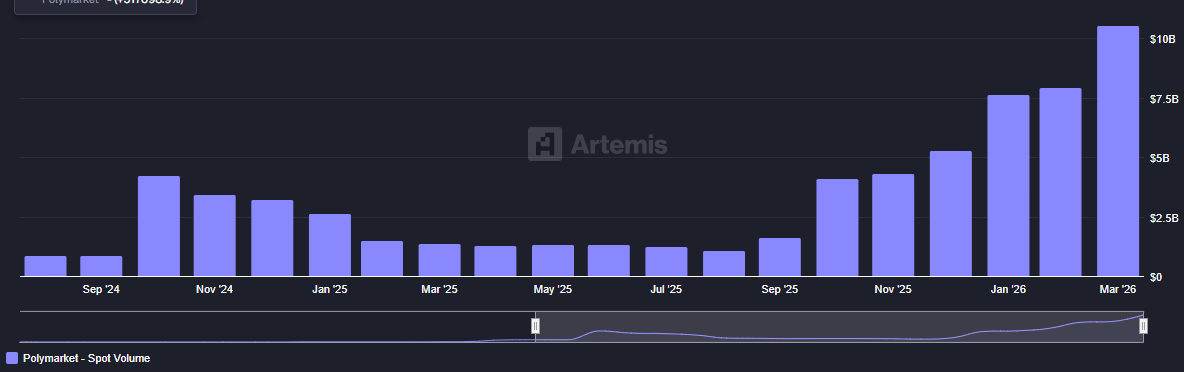
The overhaul arrives as Polymarket processes record volumes. The platform crossed $10 billion in monthly volume in March, its highest ever, according to Artemis. Weekly notional volume has consistently exceeded $1 billion through the first quarter.

The infrastructure push follows a series of milestones, including NYSE parent ICE’s $600 million follow-on investment and the launch of traditional asset markets via Pyth Network.
This article was written with the assistance of AI workflows. All our stories are curated, edited and fact-checked by a human.


On-chain researcher Andrey Sergeenkov found that only 2% of the 2.5 million wallets analyzed have ever made over $1,000.
84.1% of all Polymarket traders are in the red, according to new research published today, April 6, by independent on-chain analyst Andrey Sergeenkov.
The report looked at 2.5 million wallet addresses, analyzing data from on-chain transactions on Polygon, via Dune Analytics. Sergeenkov found that over the past year, only 2% of traders have ever made more than $1,000 in their entire history on the platform, and just 0.033% — or 840 addresses — have earned $100,000 trading on Polymarket.
Sergeenkov also took on the claim that traders can earn a living on Polymarket, analyzing the odds of consistently earning $5,000 per month — just below the average monthly salary in the U.S. — and found that those odds are less than 1% in any single month.
Sustaining profits is even rarer. “Most traders show up, trade for a short period, and leave,” the report summarizes. The odds of earning $5,000 a month drop with each consecutive month, the research found. Among the 6,600 traders who earned an average profit above $5,000 per month, just 2.6% stayed active for more than a year.
A separate study from December 2025 analyzing 124 million trades on Polymarket found that 70% were unprofitable.
The findings land as Polymarket continues its mainstream commercial momentum, earlier this month becoming MLB’s exclusive prediction market partner, as The Defiant reported.
Polymarket is currently the largest on-chain prediction market platform, and the second-largest more broadly, with $9.8 billion in notional trading volume over the past 30 days, following Kalshi with $12.5 billion, per Token Terminal.
Meanwhile, a new referral program as of this month is set to drive another wave of retail signups via influencers — a dynamic Sergeenkov warns could deepen the loss problem without better user education.
Prediction market volumes grew 130x from 2024 through 2025, and the sector has received increasing regulatory attention, especially in the United States. In recent months, the Trump administration’s CFTC has taken a clear stance in favor of federal oversight of prediction market platforms via the agency, recently launching a sweeping review of the sector.
Adding another layer to Polymarket’s ambitions, the platform has also just today unveiled Polymarket USD, a new proprietary stablecoin set to replace bridged USDC.e as the platform’s collateral token, as part of what the platform is calling a significant infrastructure upgrade.
As The Defiant has reported, Polymarket’s crowd-sourced odds are increasingly cited as among the most accurate forecasting tools available, a reputation that sits uneasily alongside these numbers for individual traders.
This article was written with the assistance of AI workflows. All our stories are curated, edited and fact-checked by a human.


Bitcoin’s muted price action is masking a buildup of downside risk in derivatives markets, where traders are increasingly positioning for a sharper move lower.
According to a recent Bitfinex report, the options market is showing a persistent gap between implied and realized volatility, with implied volatility holding in the 48% to 55% range while actual price swings remain subdued. This divergence suggests traders are paying a premium for protection, even as spot markets appear calm.
The more critical factor sits just below current levels. Analysts point to a “negative gamma environment” under $68,000, where market makers who have sold downside protection may be forced to sell bitcoin as prices fall in order to hedge their exposure.
That dynamic can turn a gradual decline into a sharper move. As prices drop, hedging activity adds further selling pressure, creating what the report describes as a “self-reinforcing feedback loop.”
The setup leaves bitcoin vulnerable to an accelerated move toward the $60,000 level if support breaks. Even recent liquidations — over $247 million in long positions — may not have been enough to fully reset positioning.
Despite the lack of large price swings, the structure of the market points to low conviction. Traders are not aggressively directional, but they are unwilling to discount tail risk, a sign that the current range may not hold, the report states.
“Stability” is a mirage
Bitcoin’s sideways trading range between roughly $64,000 and $74,000 has created the appearance of stability, but underlying demand conditions tell a different story. The report describes the market as a “fragile equilibrium,” where weakening spot demand and reduced participation leave prices supported by a thinning base of buyers.
Corporate treasury activity, once a steady source of demand, has narrowed significantly. While firms like Strategy (MSTR) continue to accumulate, others have stepped back or even reduced exposure, including a notable sale by Marathon (MARA). This shift has left the market increasingly dependent on a small number of participants rather than broad-based accumulation.
At the same time, a large concentration of supply sits above current prices, particularly around $74,000. Investors who bought at higher levels are now looking to exit on rallies, capping upside and reinforcing the range.
Together, these forces suggest bitcoin’s current calm is less a sign of strength than a temporary balance. With demand weakening and derivatives positioning turning more fragile, the market may be more exposed to a sudden break than price action alone implies.

TLDR
- Charles Hoskinson denied claims that Midnight’s bridge would permanently operate as a one-way channel.
- He said the tokenomics paper outlines phased development that includes a future two-way bridge.
- Bliss Pool stated that the document initially describes the bridge as one-way.
- Community members raised concerns about liquidity moving from Cardano into Midnight.
- Cardano DRep dori defended Midnight and described it as a partner chain focused on privacy.
Charles Hoskinson responded to renewed criticism over the Midnight bridge design and rejected claims that it harms Cardano. He addressed concerns raised by Stake Pool operator Bliss Pool on X and denied any plan to trap liquidity. Meanwhile, the debate resurfaced as Midnight secured a listing on the Australian exchange CoinSpot.
Midnight Bridge Design Sparks Debate
Hoskinson pushed back against claims that Midnight would permanently operate a one-way bridge. He said critics misread the tokenomics paper and misrepresented its phased bridge plan.
He stated that Midnight does not permanently block assets from returning to Cardano. He explained that the document outlines different stages, including a future two-way bridge.
Bliss Pool pointed to language in the tokenomics paper referencing a one-way bridge. The operator said it remains technically correct that the bridge begins as one-way.
Community members argued that a one-way structure could lock assets inside Midnight. They warned that such a setup could shift liquidity away from Cardano.
Hoskinson rejected claims that he and the IOG team chose to harm Cardano. He said critics framed a temporary design feature as a permanent policy.
He said, “There is no intention to harm Cardano.” He also said critics twist facts to support their narrative.
Cardano Community Responds to Midnight Rollout
The debate intensified after Cardano DRep dori defended Midnight over the weekend. Dori said Midnight does not compete with Cardano but supports it.
Dori described Midnight as a partner chain focused on privacy features. Dori said it fills a privacy gap in the blockchain sector.
He added that Hoskinson showed foresight by investing in privacy infrastructure early. He stated that other networks are only now moving toward similar solutions.
Community critics continued to question the bridge structure and liquidity flow. They stressed the need for transparency in project communication.
Hoskinson maintained that the tokenomics paper clearly explains the phased bridge model. He said the paper includes references to a later two-way bridge.
He criticized efforts to portray the early one-way phase as a fixed outcome. He insisted that the design evolves.
Midnight gained further traction after CoinSpot listed the token for Australian users. The exchange confirmed that traders can access Midnight and use its privacy features.
The listing expands Midnight’s availability in the Australian market. CoinSpot users can now trade the token directly on the platform.

Bitcoin briefly breached the $70,000 level on Monday, but the move lacked follow-through and quickly faded, keeping the market in a careful watch-and-weigh posture. Bulls had nudged the price above moving averages, signaling an attempted comeback, yet the recovery faces a stubborn wall of selling pressure as traders assess whether a deeper pullback is more likely than a sustained breakout.
Analysts remain wary of fresh downside pressure. Some strategists expect BTC to test lower supports, with a number projecting a retest below the $60,000 zone before a potential bottom forms. The immediate setup underscores a market trying to decide between a renewed up-leg and a renewed down-leg, rather than a clear continuation of momentum.
On-chain and sentiment signals add nuance to the picture. Glassnode’s latest observations highlight ongoing selling pressure despite several days of price action favoring bulls. The Long-Term Holder Realized Loss metric — which tracks losses locked in by investors who held coins for more than six months before selling — suggests pain may not have fully abated. The metric’s 30-day simple moving average sits around $200 million per day, with the researcher noting that a sustained drop below roughly $25 million per day would be needed for a base-building phase to take hold.
Amid the dour chatter, there are glimmers of demand at support levels. Santiment, a crypto sentiment analytics firm, reported a shift in social dynamics: five bearish BTC comments for every four bullish ones — the most bearish tilt since February 28. While this may reflect a crowded-out mood, such contrarian readings historically precede moments when markets reverse course, according to the same data framework. In practice, that means traders should watch for any early signs of stabilization or renewed upside momentum, even if the broader tone remains cautious.
Key takeaways
- Bitcoin briefly crossed $70,000 but failed to sustain the breakout, raising the possibility of a retest below $60,000.
- Glassnode’s Long-Term Holder Realized Loss metric signals lingering selling pressure; a sub-$25 million daily loss level could precede a base formation.
- Santiment’s sentiment snapshot shows a bearish tilt on BTC demand, the strongest since late February, which may precede a sentiment-driven reversal if buyers re-enter.
- Several major altcoins are rebounding from key supports, suggesting demand is reappearing at lower price levels even as BTC remains rangebound.
- Macro anchors remain in view: the S&P 500 and the U.S. dollar are tracing a pattern that could influence crypto direction in the near term.
Macro context: macro assets in a holding pattern
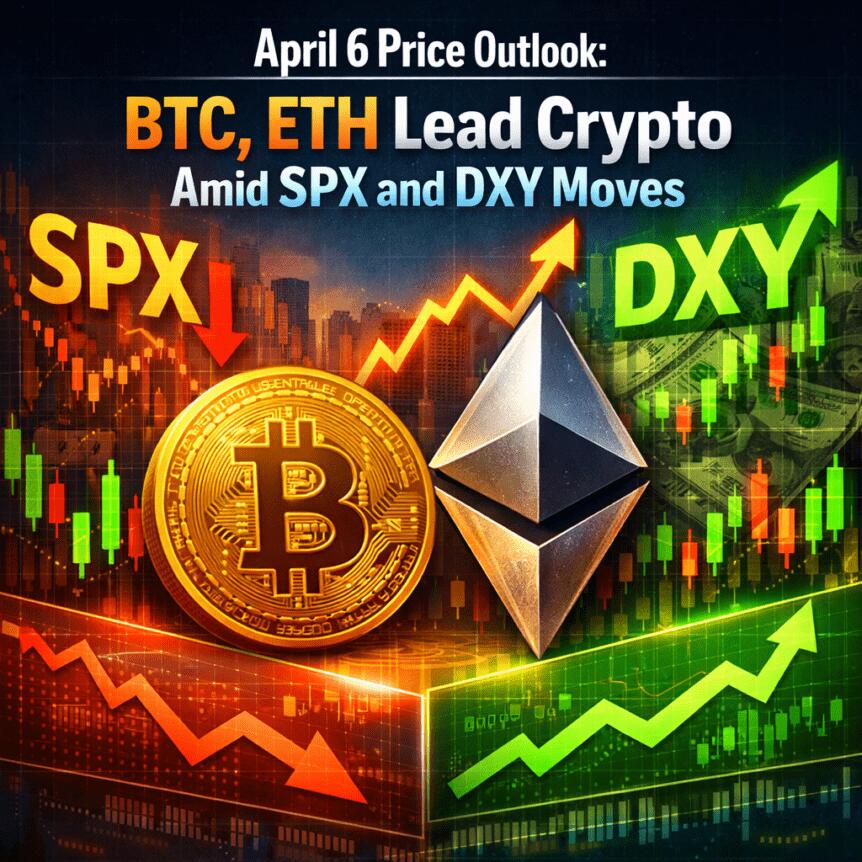
The broader market backdrop continues to shape crypto price action. The S&P 500 has retraced toward a pair of moving averages that traders monitor closely for signs of strength or weakness. At present, the index sits near the 20-day exponential moving average, with a potential move toward the 50-day simple moving average serving as a key barometer for risk-on appetite. On the downside, the index would need to break through defined supports to reassert a corrective phase, while a sustained hold above key levels could spur a broader recovery.
Against this, the U.S. dollar index (DXY) remains channeled between a recent ceiling near 100.54 and a floor around the 20-day moving average near 99.59. A decisive break above resistance could open room for mild upside moves, whereas a break below the 20-day line would amplify downside risk for the dollar and, by extension, for non-yielding assets such as Bitcoin.
In practice, the market appears to be trading within a broad range, with crypto assets often acting in sympathy with risk sentiment and macro flows. For investors, that means significant directional bets may hinge on a catalyst capable of shifting the current balance of supply and demand rather than on a single strong fundamental driver.
Bitcoin and peers: price action and near-term targets
Bitcoin’s recent price action reflects a cautious battle between bulls and bears. After closing above major moving averages on Sunday, BTC has not yet established a clear, sustained up-move. The next meaningful test for bulls would be a firm daily close above the $72,000 mark, which could open a path toward a resistance band between roughly $74,508 and $76,000. However, any sustained move higher requires overcoming a resurgent selling pressure at nearby supports; a break below the $60,000-to-$62,500 area would renew concerns about a deeper retracement.
Altcoin snapshots: signals from Ethereum, Binance Coin, XRP, Solana, DOGE, HYPE, and ADA
Ether (ETH)
ETH has cleared the short-term hurdle by closing above its moving averages, paving the way for a potential rally toward the $2,200 resistance. If buyers can push through that level, the next target sits around $2,400, with the path finally aiming for $2,800 and then $3,050 on a sustained breakout. Conversely, a retreat below the moving averages could spark a consolidation, with the chart showing a support zone near $1,916 should prices slip again.
Binance Coin (BNB)
BNB has bounced off support near $570 and met the moving averages, where sellers are expected to reassert pressure. A sharp rejection at the moving averages could open the door to a deeper drop toward $500. On the upside, a clean close above the moving averages could keep the price range-bound between roughly $570 and $687 for a few more days, with a decisive move above $687 inviting a fresh leg higher.
Ripple (XRP)
XRP staged a bounce from the critical $1.27 support, signaling strong defense by bulls. A close above the 50-day simple moving average at around $1.39 would improve the odds of a rally toward $1.61 and the downward-sloping channel’s upper boundary. If bears regain control and price turns down from the moving averages, a breakdown below $1.27 could open the way to $1.11 and eventually the $1.00 level.
Solana (SOL)
SOL has oscillated within a relatively wide range, between roughly $76 and $98, reflecting a tug-of-war between buyers and sellers. A breakout above $98 could push SOL toward $117, while a break below $76 risks sliding toward $67. The next directional move appears likely to come from a close above the resistance or below the support.
Dogecoin (DOGE)
Dogecoin remains confined to a tight corridor around $0.09, with daily dynamics anchored by a nearby moving average. A confirmed close above the moving averages could target the $0.11–$0.12 zone, while a slide below $0.09 could drive a move toward $0.08 and potentially down to $0.06 as selling accelerates.
Hyperliquid (HYPE)
The HYPE chart shows buyers attempting to maintain price above the 20-day EMA near $37.03, facing resistance from sellers. A daily close above the EMA would bolster the case for a rally to $41.59 and then toward $44. A breach below the 50-day SMA at around $34.48 could open a deeper correction toward $30 in the near term.
Cardano (ADA)
ADA closed above the $0.25 level, indicating a waning of selling pressure. The immediate hurdle sits near the 50-day SMA at about $0.26. A move beyond this resistance could bring prices to the downtrend line of the prevailing descending channel, signaling a possible near-term reversal. On the downside, the crucial support level around $0.22 remains in focus; breaking below could push ADA toward the nearby $0.16 range.
Across the landscape, the market continues to show a mix of vulnerability and resilience. The persistence of selling pressure on Bitcoin contrasts with selective rebounds in major altcoins, underscoring the varied dynamics at play as traders weigh macro cues against on-chain signals.
What to watch next: a sustained move above or below key thresholds for BTC and each altcoin, combined with shifts in on-chain metrics and sentiment, will likely dictate the near-term rhythm. Investors should monitor whether the on-chain distribution cools, if social sentiment stabilizes or improves, and how macro assets respond to evolving risk appetite in the weeks ahead.


The perpetuals exchange will use World Liberty Financial’s stablecoin as the sole settlement asset for its commodity markets, starting with gold, silver, and crude oil.
Every perpetual contract tracking real-world assets (RWA) on Aster will settle exclusively in USD1, World Liberty Financial’s dollar-pegged stablecoin, according to posts from both projects on X.
The first markets rolling out include gold, silver, crude oil, and Brent crude, with additional markets to follow, Aster said. The fee structure for USD1 commodity pairs is set at 1 basis point for takers and a negative 0.5 basis points for makers — meaning the exchange will pay a rebate to liquidity providers.
The two sides also said they are “exploring integration across their respective tokens,” though neither project elaborated.
The arrangement positions USD1 as the base asset for Aster’s RWA vertical, giving WLFI’s stablecoin exclusive infrastructure-level access to a fast-growing segment of on-chain trading.
The announcement extends a partnership that has escalated quickly. USD1, which launched in April 2025, is now the sixth-largest stablecoin with approximately $4.4 billion in circulation, according to Coingecko.
WLFI has been pushing distribution aggressively — most recently through a toolkit that lets AI agents transact autonomously using USD1, alongside a Binance campaign offering a 135 million WLFI reward pool to USD1 holders and listings on Coinbase and MEXC.
For Aster, the commodity expansion tracks with its own transformation from a crypto-only perp DEX into a multi-asset trading platform. The exchange already offers perpetuals on U.S. equities alongside its core crypto derivatives and recently launched the genesis phase of Aster Chain, a privacy-focused Layer 1 using zero-knowledge proofs.
Both projects’ native tokens are relatively muted today, with ASTER flat while WLFI is up 2%.
This article was written with the assistance of AI workflows. All our stories are curated, edited and fact-checked by a human.
A 45-day ceasefire plan and Strategy’s $330M Bitcoin purchase buoyed crypto markets.
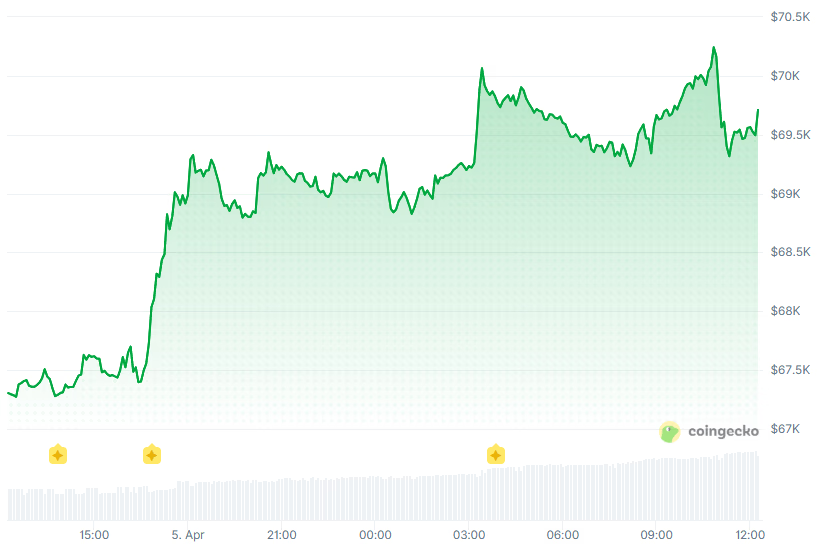
Crypto markets rallied on Monday as mediators submitted a 45-day ceasefire plan to the U.S. and Iran, while Michael Saylor’s Strategy resumed buying BTC after a weeklong pause.
Bitcoin is trading at around $69,700, up 3.7% over the past 24 hours. ETH surged 4% to $2,150, while SOL climbed 2.5% to $82. Meanwhile, XRP added 3%.

Total crypto market capitalization rose 2.6% to $2.45 trillion, according to CoinGecko.
The broad-based rally came after Reuters reported that Egyptian, Pakistani, and Turkish mediators submitted a proposal to the U.S. and Iran calling for a 45-day ceasefire and the reopening of the Strait of Hormuz, the vital shipping lane that carries about a fifth of the world’s oil and has been effectively closed since the war began on Feb. 28.
President Donald Trump called the proposal “significant” but “not good enough” at a White House Easter event on Monday. He has set a Tuesday 8 p.m. ET deadline for Iran to reopen the Strait or face strikes on its power plants and bridges.
Iran rejected the temporary ceasefire, with state news agency IRNA reporting that Tehran sent a 10-point response through Pakistan demanding a permanent end to the war, a safe-passage protocol for the Strait, and the lifting of sanctions.
Despite the uncertain diplomatic backdrop, crypto markets responded to the mere existence of a framework for de-escalation, a dynamic that has repeatedly played out since the conflict began.
The rally triggered $331 million in leveraged liquidations over 24 hours, affecting more than 83,000 traders, according to CoinGlass. Short positions accounted for roughly $268 million of the losses in the past 12 hours, adding fuel to the move higher.
Strategy Buys $330 Million of Bitcoin
Michael Saylor’s Strategy disclosed in a securities filing Monday that it purchased roughly $330 million worth of Bitcoin between April 1 and April 5. The buy lifted the firm’s total holdings to 766,970 BTC at an aggregate cost of about $58 billion and an average price of roughly $75,644.
The purchase followed a one-week pause during which Strategy made no purchases or share sales. Strategy also disclosed a $14.5 billion unrealized loss for the first quarter as Bitcoin’s decline from its October all-time high pushed its holdings below the firm’s average cost basis. MSTR shares rose roughly 5% in early Monday trading.
Meanwhile, BitMine Immersion bought another 71,252 ETH in the past week, its largest single-week purchase since December.
Looking Ahead
The immediate catalyst is Trump’s Tuesday evening deadline. A deal or even a credible extension would likely boost risk assets further, while an escalation could reverse today’s gains.
Meanwhile, the Fed is widely expected to hold rates steady at its April 29 meeting, with CME FedWatch showing a 99.5% probability of no change.

Poll finds healthcare is now Americans’ top domestic concern
Trump’s WLFI Lands Exclusive Deal: USD1 on Aster DEX

Former heavyweight champion now willing to face Moses Itauma: “I’m not dodging anyone”


-

 NewsBeat4 days ago
Steven Gerrard disagrees with Gary Neville over ‘shock’ Chelsea and Arsenal claim | Football
-

 Business4 days ago
No Jackpot Winner and $194 Million Prize Rolls Over
-

 Fashion3 days ago
Weekend Open Thread: Spanx – Corporette.com
-

 Crypto World5 days ago
Gold Price Prediction: Worst Month in 17 Years fo Save Haven Rock
-

 Business21 hours ago
Three Gulf funds agree to back Paramount’s $81 billion takeover of Warner, WSJ reports
-
Crypto World6 days ago
Dems press CFTC, ethics board on prediction-market insider trades
-

 Sports2 days ago
India men’s 4x400m and mixed 4x100m relay teams register big progress | Other Sports News
-

 Business5 days ago
Login and Checkout Issues Spark Merchant Frustration
-

 Tech6 days ago
EE TV is using AI to help you find something to watch
-

 Sports6 days ago
Tallest college basketball player ever, standing at 7-foot-9, entering transfer portal
-
Tech7 days ago
Daily Deal: StackSkills Premium Annual Pass
-

 Tech7 days ago
Flipsnack and the shift toward motion-first business content with living visuals
-

 Sports7 days ago
Women’s hockey camp eyes fitness boost, tactics ahead of WC 2026 campaign | Other Sports News
-

 Crypto World7 days ago
U.S. rule change may open trillions in 401(k) funds to crypto
-

 Tech6 days ago
How to back up your iPhone & iPad to your Mac before something goes wrong
-

 Politics7 days ago
Usha Vance: Disney Hats Over MAGA Caps?
-
Crypto World7 days ago
Valinor raises $25m to put private credit on-chain
-

 Business7 days ago
Functional benefits brewing in coffee innovation
-

 Tech7 days ago
What Are The Biggest Limitations Of Supercomputers?
-

 Crypto World6 days ago
Bitcoin enters the public bond market as Moody’s gives a first-of-its-kind crypto deal a rating
You must be logged in to post a comment Login