
Crypto World
Ethereum’s Fast Confirmation Rule targets 13-second bridge times with 98% reduction: Ethereum Foundation



Ethereum’s proposed Fast Confirmation Rule aims to slash L1-to-L2 bridge and exchange deposit times from minutes to just 13 seconds without requiring a hard fork.
Ethereum is moving forward with a Fast Confirmation Rule (FCR) designed to dramatically accelerate bridge times between Layer 1 and Layer 2 solutions, as well as exchange deposits. The mechanism targets completion times of approximately 13 seconds—a reduction of 80–98% compared to current timelines—and achieves this without requiring a hard fork to the network.
The FCR leverages attestations rather than blocks to verify transactions, representing a shift in how Ethereum handles cross-layer confirmation speed. This proposal aligns with broader Ethereum roadmap efforts to reduce finality times and slot durations, part of a longer-term vision to make the network faster and more efficient for users and institutions.
Sources: Julian (@_julianma) on X | Binance Square
This article was generated automatically by The Defiant’s AI news system from publicly available sources.

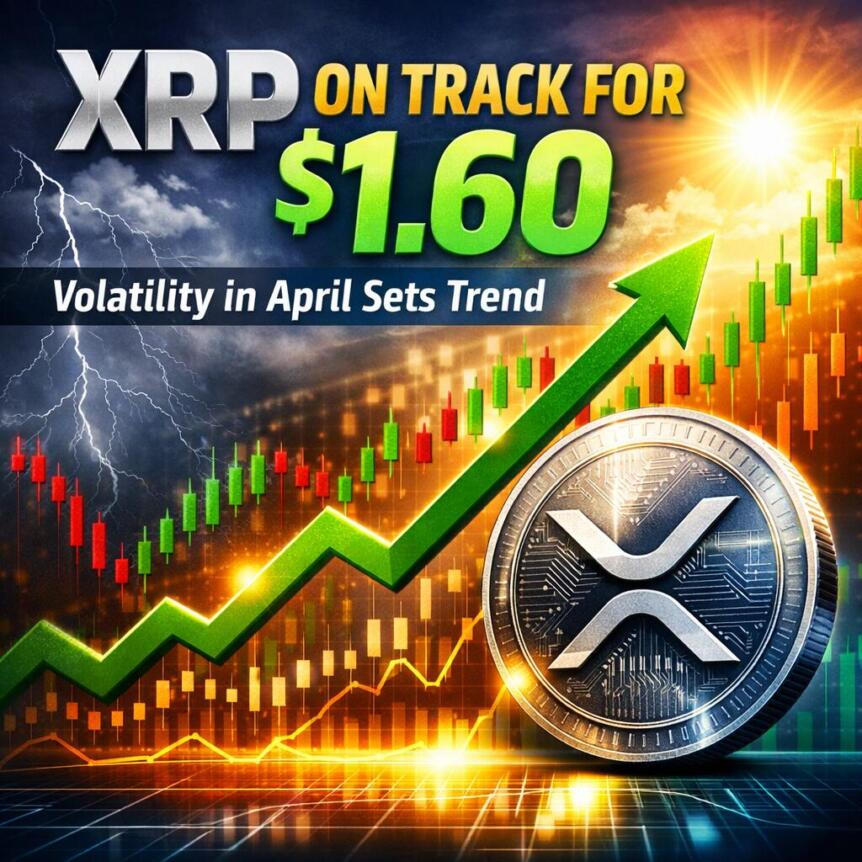
The XRP price sits around $1.30 as historical results from previous Aprils along with resistance at $1.60 influence the market outlook.
Key Insights
- Previous April has been volatile for XRP, with impressive gains in some years and losses in others.
- Consolidation at levels ranging from $1.28 to $1.36 indicates decreased volatility.
- $1.60 is an important resistance level to watch out for.
Unpredictability of the Market in April for XRP
April has proven to be inconsistent regarding its performance related to XRP, meaning that the asset is quite unpredictable when this month comes along.
Although XRP managed to show impressive gains during some periods, other years were characterized by negative movements, leaving many traders with an unsure feeling when analyzing the seasonality of this period.
For example, the coin experienced an increase by 66.11% in April 2018 and even more impressive growth — nearly 180% in April 2021. Thus, every upcoming April becomes a cause for optimism since the coin has managed to produce quite remarkable results in such periods before. However, it appears that this seasonality is gradually diminishing.
April 2022, 2023, and 2024 months witnessed negative movement, which leaves traders with concerns about the future movement. Hence, they have started taking into consideration seasonal information but at the same time using technical indicators.
Narrow Price Consolidation Suggests Upcoming Breakout
Currently, XRP trades in a tight range from $1.28 to $1.36, with this trend having been in place since late March. This type of price consolidation usually happens when there is low price volatility and is an indication that a major price movement will soon happen.
Whenever prices consolidate in a certain range, it normally implies that sellers and buyers have reached a temporary consensus, but sooner or later, one side takes control, resulting in a price explosion either upwards or downwards. For XRP, traders pay close attention to the volume of trades for validation purposes whenever a breakout happens.
Moreover, the occurrence of a falling wedge pattern implies that a bullish breakout might be expected. Falling wedge patterns are common occurrences that indicate upcoming uptrends, especially if trading volumes keep on rising.
Resistance Levels Determine Short-Term Trend
Currently, the $1.40 level has proved to be a key intermediate resistance level that is supported by the most important moving averages. A break above this level will indicate growing buying sentiment and can set the stage for a move towards the following resistance level of $1.60.
The $1.60 level still represents an important obstacle on the way to higher prices for XRP. The price had been rejected from this level back in March, confirming its importance as a strong resistance area. Breaking out above the $1.60 level will be a confirmation that upward trend momentum is intact.
If XRP fails to overcome the $1.40 level, it can be locked in the current range for some more time. Volume is another important aspect to pay attention to when analyzing the charts. High trading volumes can confirm the validity of a breakout move.
Benefits of Ripple Treasury System Introducing Digital Assets
In addition to technical analysis, Ripple continues to grow by adding new financial systems. The launch of Digital Asset Accounts and the Unified Treasury System represents a crucial move towards incorporating digital assets within traditional finance.
The Unified Treasury System will enable XRP and RLUSD balances to be monitored alongside traditional currencies in real-time. This integration between crypto assets and conventional financial practices makes it easy for organizations to incorporate digital assets.
It might be an essential step towards establishing a greater use and demand for XRP. Although this news might not affect prices, it can positively influence market sentiment.
Recovery Sentiments Begin to Emerge in Market
XRP is currently trading at around $1.31, showing signs of temporary weakness in the short term. However, the current state of the market has revealed signs of early recovery among the leading cryptos.
Trading sentiments remain cautious as investors await the breakout of prices above critical resistance levels. This shows that the market is at a decision point and the breakout could be significant in the next few weeks to come.
In any case, the performance of XRP in April will be determined by whether there is a breakout of prices above critical resistance levels or not.


Cloudflare, one of the world’s largest CDN and internet edge networks, has substantially accelerated its deadline to migrate to post-quantum cryptography amid fears that hardware breakthroughs could render current encryption obsolete within three years.
The quantum-vulnerable Bitcoin community rang alarm bells after the giant move.
Cloudflare announced its new post-quantum deadline, joining Google in an aggressive security sprint targeting 2029.
Two-thirds of human traffic to Cloudflare already uses post-quantum encryption, but the company wants that at 100% within three years.
Google set the same 2029 deadline two weeks ago, flagging concerning breakthroughs in quantum hardware, error correction, and factoring. The search engine giant has also already deployed post-quantum protections across Chrome, Android 17, and Google Cloud, and is forcing other engineering teams to follow suit.
By 2029, IBM plans to deliver its first fault-tolerant quantum machine, Starling.
The quantum breakthroughs just keep coming
The announcements continue a blistering pace of quantum breakthroughs over the last few weeks.
On March 30, Google Quantum AI released a whitepaper showing that fewer than 1,200 logical qubits could theoretically solve Bitcoin’s 256-bit Elliptic Curve Discrete Logarithm Problem.
On superconducting hardware, that meant fewer than 500,000 physical qubits by its estimate. That’s roughly a 20-fold reduction from the prior benchmark of approximately 9 million set in 2023.
The same day, Oratomic, a quantum startup founded by Caltech and Harvard faculty, theorized that Shor’s algorithm could run at cryptographically relevant scales with as few as 10,000 reconfigurable neutral-atom qubits, a step-change improvement in solving 256-bit elliptic curve discrete logarithms.
On April 5, IQM Quantum Computers and Germany’s Fraunhofer FOKUS compiled Shor’s algorithm, gate by gate, at RSA-2048 scale — a first by quantum researchers.
Prior estimates for cracking RSA-2048 relied on symbolic extrapolation and theoretical modeling, whereas this research team produced a gate-by-gate assembly with an exact qubit budget.
Read more: Google’s quantum computer could break Bitcoin in two ways
Bitcoin has a big quantum problem
There are well over $100 billion in quantum-vulnerable bitcoin (BTC), including legacy wallets such as Satoshi Nakamoto’s holdings.
Chaincode Labs, Bitcoin’s hub for technical development, estimated a comprehensive post-quantum migration could take seven years.
Taproot, Bitcoin’s prior upgrade, took four years from proposal to activation, while SegWit required two.
Approximately 1.7 million BTC have permanently exposed public keys. Chaincode puts the broader vulnerability to a cryptographically-relevant quantum computer at 20-50% of BTC, worth as much as $680 billion.
Justin Drake, a pro-Ethereum researcher who co-authored Google’s whitepaper, believes there’s at least a 10% chance a quantum computer recovers a Bitcoin private key by brute force from an exposed public key by 2032.
Bitcoin has a market capitalization of $1.36 trillion with a software upgrade process measured in years. Cryptographically-relevant quantum computers also have a deadline measured in years and could have as few as three left, according to Cloudflare, Google, and IBM.
Got a tip? Send us an email securely via Protos Leaks. For more informed news, follow us on X, Bluesky, and Google News, or subscribe to our YouTube channel.
April could be the month where the crypto market turns from panic to momentum, and the clues are piling up faster than most people notice. Bitcoin reclaimed $70,000 on April 6 after squeezing $196 million in shorts as ceasefire reports surfaced, per CoinDesk, and the Fear and Greed Index is sitting at 9, a level that has marked the bottom before every major rally in crypto history.
When BTC stabilizes and starts climbing, altcoins chase it with larger moves every time, and the question of will crypto go up in April is shifting from whether to which tokens catch the biggest wave when it happens. For anyone still asking will crypto go up in April, three projects stand out, and the first one already raised $8.82 million while everyone else is still figuring out whether to move.
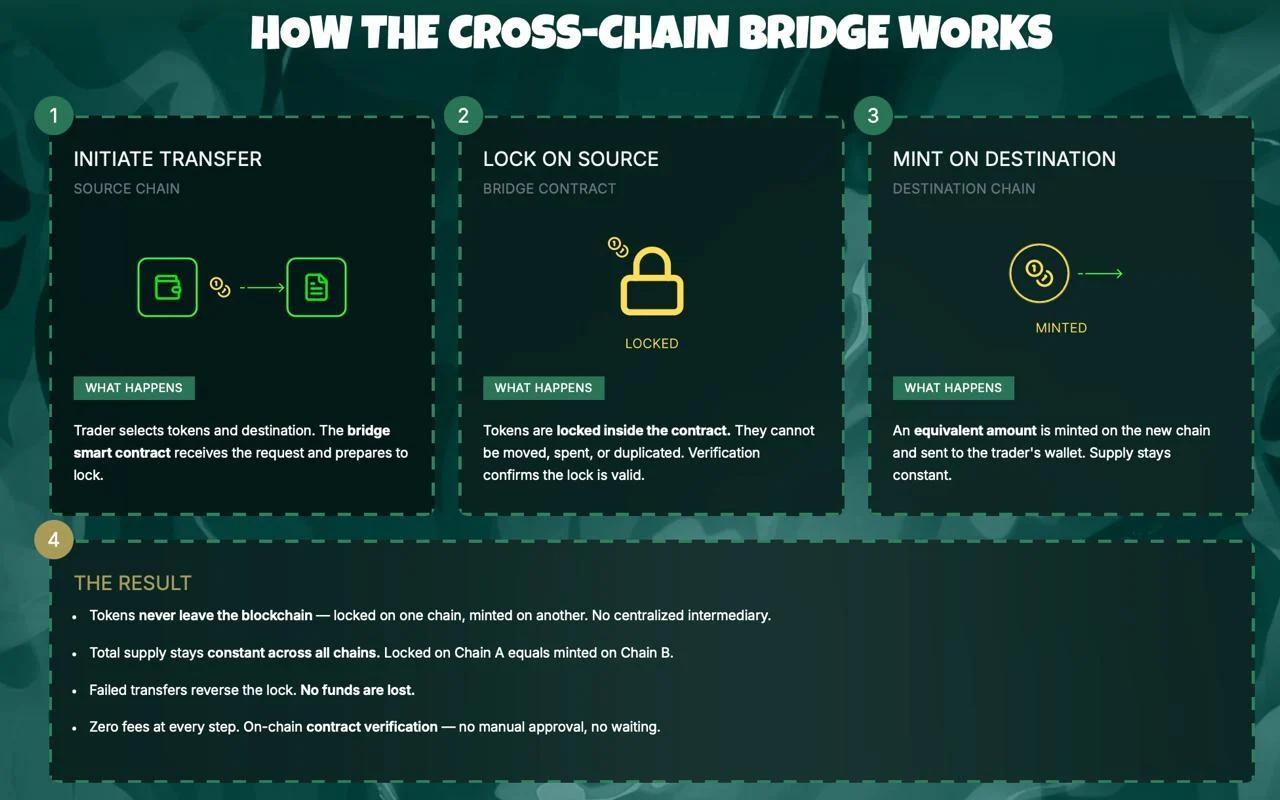
The exchange covers every cryptocurrency across Ethereum, BNB Chain, and Solana through a single verified system, getting rid of the scattered apps that overcharge and make traders pay double for every cross-chain move. Pepeto puts cross-chain swaps, token bridging, and full portfolio tools into one place.
The exchange handles every tradable coin across the full crypto market, not just memes, so every trade and every bridge fills the same pipeline and pushes organic demand into the token.
Both SolidProof and Coinsult audited every contract, the founder behind the original Pepe coin is running the project, and the staking numbers alone answer will crypto go up in April for anyone doing the math. Put $10,000 in and stake at 186% APY and that position earns you $18,600 per year, which breaks down to roughly $1,550 every single month going straight back into your bag while the exchange prepares to go live and multiply every position you locked in early.
Each presale round sells out quicker than the last and the floor price jumps the instant the current window closes, so today’s entry is the lowest price this token will ever carry.
XRP Eyes Breakout as CLARITY Act Vote Hits the Senate
Anyone asking will crypto go up in April should watch what XRP is doing right now, because the chart is about as clear as it gets. The Senate Banking Committee is targeting a late April markup of the CLARITY Act, and Senator Moreno warned that if the bill does not reach the floor by May it is dead until after midterms.
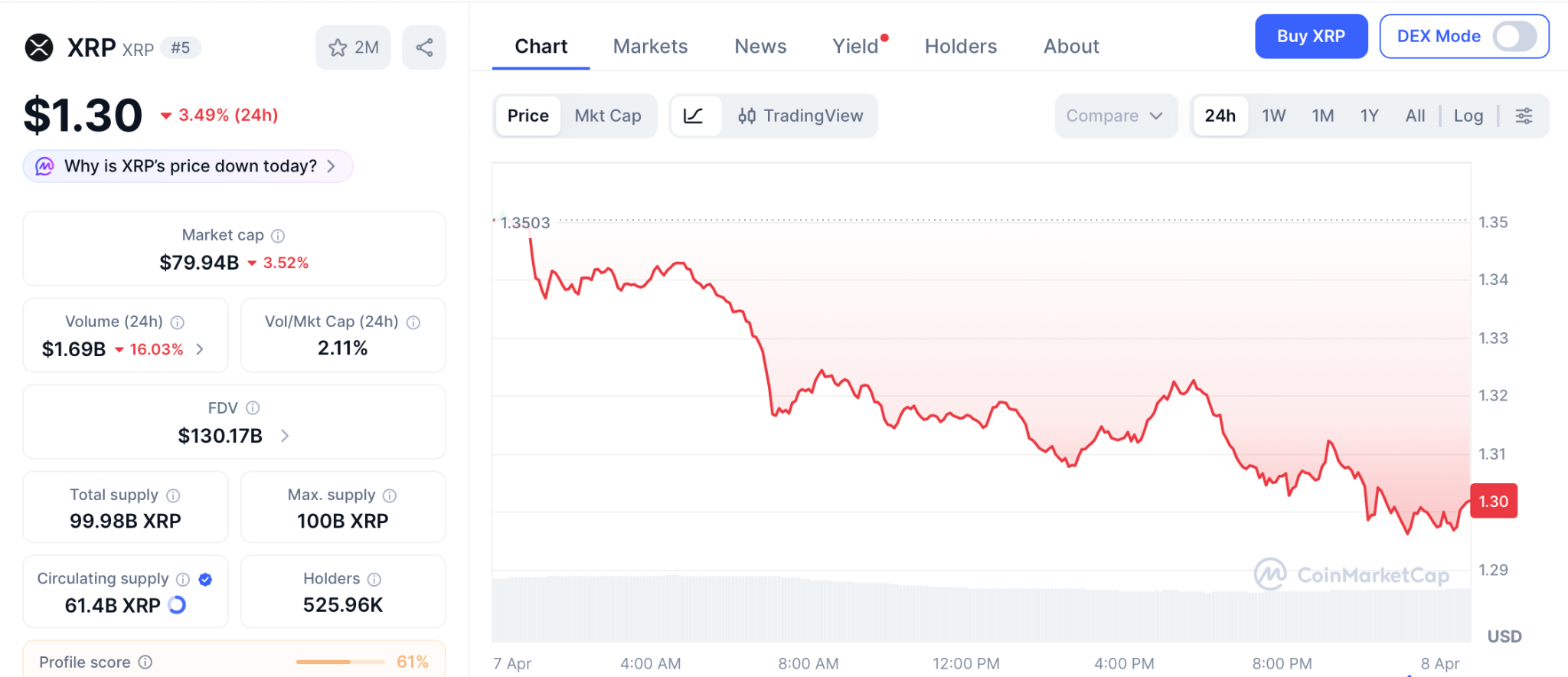
Analysts project $2.60 for XRP this cycle if CLARITY passes, giving the token a 2x from $1.30 according to CoinMarketCap. That is a decent return for XRP holders, but Pepeto at presale with $1,550 monthly staking income on $10,000 and a Binance listing ahead delivers what large caps at multi-billion valuations cannot, and Cardano completes the trio.
Cardano Builds Strength as Whales Buy 220 Million ADA in One Week
Cardano whales bought 220 million ADA worth $53 million in a single week while retail panicked, pushing large wallet holdings to 13.84 billion coins, per Santiment. Stablecoin supply on the network doubled year over year and the Midnight mainnet launched with Monument Bank already running tokenized deposits.
Analysts see $2.20 as the top end this cycle if recovery builds into Q2. For long-term holders that is a strong 8x from $0.24, and it answers will crypto go up in April with a clear yes. But the largest gains are not hiding in coins that already reflect their recovery, they are waiting in presale entries with working tools and staking that is already compounding.
The Verdict
Will crypto go up in April? Every data point says yes, and XRP and Cardano are both lined up to ride the wave with 2x to 8x gains. But $8.82 million raised, two independent audits, and 186% APY staking turning $10,000 into $1,550 per month is the kind of entry that moves with or without the broader market.
Visit the Pepeto official website and secure your entry now, because the wallets that get in at presale always become the ones everybody else regrets not following.
The names that turn into legends in crypto never come from the tokens everyone already owns, they come from the presale nobody expected, and Pepeto at $0.0000001863 is writing that story right now.
Click To Visit Pepeto Website To Enter The Presale

FAQs
Will crypto go up in April 2026?
Will crypto go up in April looks likely as BTC reclaimed $70,000 squeezing $196M in shorts and Fear and Greed hit 9. XRP, Cardano, and Pepeto are set for the biggest gains.
How does Pepeto staking work for early buyers?
Stake $10,000 at 186% APY to earn $18,600 per year or roughly $1,550 per month. Rewards grow daily while the exchange launch approaches.
Disclaimer: This is a Press Release provided by a third party who is responsible for the content. Please conduct your own research before taking any action based on the content.



The 25th amendment Trump Iran war political crisis escalated sharply on Tuesday when former Rep. Marjorie Taylor Greene, conservative commentator Candace Owens, and media personality Alex Jones all publicly called for President Trump’s removal from office after his “a whole civilization will die tonight” Truth Social post.
Summary
- MTG posted “25TH AMENDMENT!!! Not a single bomb has dropped on America. We cannot kill an entire civilization. This is evil and madness,” becoming one of Trump’s most prominent former allies to call for his removal
- Alex Jones called Trump “an unhinged super villain from a Marvel comic movie,” while Candace Owens called him “a genocidal lunatic” and wrote “our Congress and military need to intervene”
- Former White House communications director Anthony Scaramucci said Trump was “calling for a nuclear strike” and demanded “immediate removal,” while VP Vance and the Cabinet remain fully supportive and have given no indication they would act
The 25th amendment Trump Iran war confrontation broke into open MAGA civil war on Tuesday as some of the president’s most prominent former supporters called for his removal from office. Former Rep. Marjorie Taylor Greene — once described as Trump’s most loyal congressional ally before her resignation earlier this year — posted on X: “25TH AMENDMENT!!! Not a single bomb has dropped on America. We cannot kill an entire civilization. This is evil and madness.”
Greene went further in an extended post, writing: “Everyone in his administration that claims to be a Christian needs to fall on their knees and beg forgiveness from God and stop worshipping the President and intervene in Trump’s madness. I know all of you and him and he has gone insane, and all of you are complicit.”
According to Newsweek, which first reported the wave of removal calls, Alex Jones wrote on X: “The definition of genocide is destroying an entire civilization/people! Trump literally sounds like an unhinged super villain from a Marvel comic movie. This IS NOT WHAT WE VOTED FOR!!!” Candace Owens posted: “The 25th amendment needs to be invoked. He is a genocidal lunatic. Our Congress and military need to intervene. We are beyond madness.”
Anthony Scaramucci, who served briefly as White House communications director during Trump’s first term, said on X: “It was at this point that our Founders thought the best thing to do would be to remove a mad man who has the executive office.”
How the 25th Amendment Works — and Why It Almost Certainly Will Not Happen
Section 4 of the 25th Amendment allows the vice president and a majority of the Cabinet to declare the president unable to discharge his duties. If the president contests the finding, the matter goes to Congress, where a two-thirds majority in both chambers is required to uphold the removal. The provision has never been invoked in US history.
In the current environment, it has no realistic path forward. VP JD Vance stated Tuesday morning that the US has “largely accomplished its military objectives” in Iran and expects the conflict to conclude “very shortly.” No Cabinet member has expressed any dissent. The calls from Greene, Jones, and Owens reflect outrage within a fractured MAGA coalition, not the Cabinet arithmetic the mechanism requires.
What This Means for the Political Landscape
The split is notable because it mirrors the broader market dynamic around this conflict. As crypto.news reported, each escalation in the Iran war has pushed Bitcoin lower, as investors reduce exposure to risk assets during periods of acute geopolitical uncertainty. The political fracturing of Trump’s base over Iran adds a new variable: domestic political instability now runs alongside geopolitical risk as a market headwind.
As crypto.news noted in earlier Iran war coverage, escalation phases have consistently produced 3 to 5% drops in major cryptocurrencies. Tonight’s 8 PM deadline introduces the possibility of either sharp relief, if a deal materializes, or another significant leg down across risk assets if large-scale strikes on Iranian infrastructure begin.
“How do we 25th amendment his a–?” Jones asked his co-host live on air Tuesday. The question went unanswered. The Cabinet’s silence on the matter strongly suggests the answer, for now, is that they don’t.
Morgan Stanley’s spot Bitcoin ETF, trading under the ticker MSBT, is set to debut on NYSE Arca on April 8 with a 0.14% management fee, the lowest of any US spot Bitcoin fund.
The product makes Morgan Stanley the first major US bank to issue a proprietary spot Bitcoin ETF rather than distribute a third-party fund. With roughly 16,000 financial advisors overseeing $6.2 trillion in client assets, the stakes extend well beyond a single ticker.
What Smart Money Will Track on Day One
Here’s what smart money and institutional investors will be tracking from the get-go:
1. Opening volume will test whether trillions in traditional wealth are moving
The combined launch-day volume across all spot Bitcoin ETFs in January 2024 reached roughly $4.6 billion. For a single new entrant, even $500 million to $1 billion would stand out.
Strong turnover would confirm that Morgan Stanley’s distribution network is converting interest into orders.
Weak volume would raise questions about whether investors have already committed to rivals.
2. The premium-to-NAV gap will expose real demand versus hype
New ETFs sometimes open at a premium when enthusiasm runs ahead of arbitrage.
A tight spread between MSBT’s market price and its net asset value (NAV) would signal efficient market-making and serious institutional participation.
A persistent discount, on the other hand, would suggest tepid early demand.
3. The 0.14% fee is a weapon, and competitors will need to respond
MSBT’s expense ratio sits one basis point below Grayscale’s Bitcoin Mini Trust at 0.15% and 11 basis points under BlackRock’s iShares Bitcoin Trust (IBIT) at 0.25%.
Because spot Bitcoin ETFs offer nearly identical exposure, even small cost differences can redirect billions over time.
4. Early advisor allocation signals matter more than Bitcoin’s price move
Morgan Stanley’s advisors have previously recommended portfolio allocations of 2% to 4% in crypto for eligible clients. The firm recently appointed Amy Oldenburg as Head of Digital Asset Strategy.
The move formalized crypto as a core execution priority rather than a research exercise.
Even a conservative shift of existing allocations into MSBT could generate tens of billions in new demand.
MicroStrategy CEO Phong Le has estimated that a 2% allocation across the platform could translate into roughly $160 billion in buying pressure, dwarfing most existing funds.
“Morgan Stanley Wealth Management oversees about $8 trillion in AUM and recommends a 0–4% bitcoin allocation. A 2% allocation would represent $160 billion, ~3X the size of IBIT. $MSBT: Monster Bitcoin,” he wrote.
5. Day-one flows will hint at whether MSBT becomes a gateway or stalls
MSBT launches with a small seed of approximately $1 million. Net creation activity on the first day will offer an early read on whether advisors are actively placing client orders.
The figure also matters because MSBT is not a standalone product. Morgan Stanley is simultaneously rolling out direct crypto spot trading through E*Trade for Bitcoin, Ether, and Solana, and has filed for a Solana trust.
Jed Finn, head of wealth management, has called direct crypto trading “the tip of the iceberg,” signaling plans for custody, wallets, and tokenized assets.
The Bigger Picture
The broader US spot Bitcoin ETF market holds roughly $90 billion in assets. If MSBT captures even a fraction of the wealth flowing through Morgan Stanley’s advisory network, it could shift competitive dynamics across the sector and compress fees further.
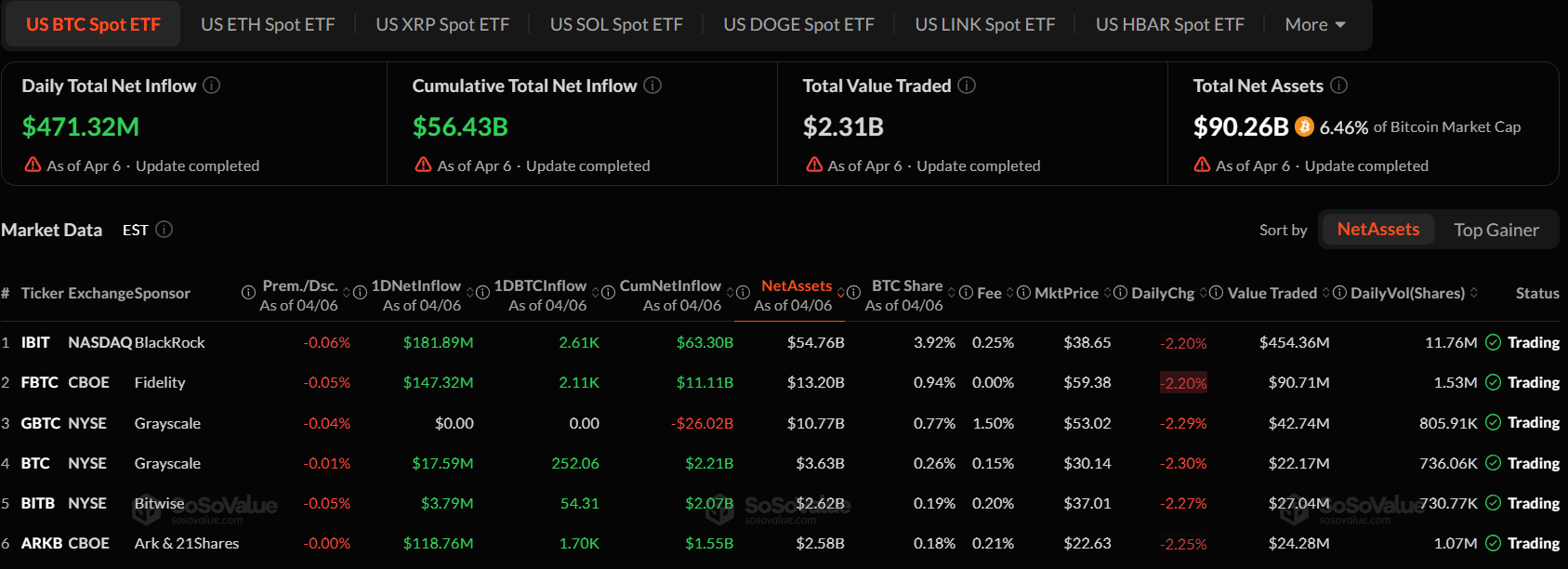
However, some analysts caution that investors have already picked their preferred funds, with IBIT alone holding over $54 billion.
While tomorrow’s open may not settle that debate, it will offer the first concrete data on whether a bank-branded, ultra-low-cost Bitcoin ETF can pull capital away from established players or whether the market has already consolidated around its early winners.
The post Morgan Stanley’s Bitcoin ETF To Go Live: 5 Things Smart Money Is Watching First appeared first on BeInCrypto.


The Iran US ceasefire deal update news today is contradictory and fast-moving: the New York Times reported that Iran halted ceasefire negotiations entirely after Trump’s “civilization will die” post, while Iran’s own Tehran Times simultaneously insisted that “diplomatic and indirect channels of talks with the US are not closed.”
Summary
- The New York Times, citing three senior Iranian officials, reported that Iran informed Pakistani mediators it was ending ceasefire negotiations after Trump’s 8 AM ET Truth Social post on April 7
- The Wall Street Journal separately reported that Iran cut off “direct communications with the US,” while Iran’s ambassador to Pakistan said mediation efforts had reached a “critical, sensitive stage”
- Iran submitted a 10-point peace proposal through Pakistani intermediaries rejecting a temporary ceasefire and calling instead for a permanent end to the war, the lifting of all sanctions, and reconstruction
The Iran US ceasefire deal update news today reflects a conflict between what different governments are saying publicly and what is happening through back channels. According to CNBC, citing the New York Times directly: “The New York Times, citing three senior Iranian officials, reported that Iran has stopped negotiation efforts with the U.S. and told Pakistan, which has acted as a mediator, that it would end ceasefire talks.” The Wall Street Journal added that Iran cut off “direct communications with the US.” But Iran’s Tehran Times posted on X that “diplomatic and indirect channels of talks with the US are not CLOSED” — and Iran’s ambassador to Pakistan said the peace efforts had reached a “critical, sensitive stage.”
The immediate trigger was Trump’s Truth Social post just after 8 AM ET on April 7, in which he wrote that “a whole civilization will die tonight.” Iranian officials cited the post as incompatible with negotiation. Foreign Ministry spokesperson Esmail Baghaei had already stated the day before that talks were “entirely incompatible with ultimatums, crimes and threats of war crimes.”
Before the breakdown, Iran submitted a formal 10-point proposal through Pakistani mediators. The proposal rejected any temporary 45-day ceasefire and instead demanded a permanent end to the conflict, a protocol governing safe passage through the Strait of Hormuz, the lifting of all US sanctions, and Iranian reconstruction funding. Trump publicly acknowledged the proposal on Monday, calling it “a significant step” but “not good enough.”
Why the 45-Day Ceasefire Was a Non-Starter for Iran
Iran’s refusal to accept a temporary ceasefire is rooted in its experience during Israel’s 12-day war in June 2025, which Iran argues showed it that ceasefire agreements do not prevent future attacks. As crypto.news reported, Iran has consistently demanded that any deal include guarantees against future attacks — not just a pause — and that the Strait of Hormuz’s full reopening would happen only under a final, comprehensive agreement, not as a confidence-building measure in a preliminary phase.
What Markets Are Doing With the Conflicting Signals
The contradiction between the official walkout and the back-channel communication is exactly what has made this conflict so difficult for markets to price. As crypto.news noted, Bitcoin pulled back below $69,000 when Trump confirmed Iran’s earlier proposal was insufficient, as traders returned to bearish positioning. The pattern throughout this conflict has been the same: ceasefire signals produce brief relief rallies, and their collapse reverses those gains within hours.
With 8 PM ET rapidly approaching, the credibility of any remaining indirect channel depends almost entirely on whether Iran uses the next few hours to signal something concrete to Pakistani mediators — or whether tonight sees the military escalation Trump has threatened.
“All elements need to be agreed today,” a source aware of the proposals told Reuters early Tuesday. “The initial understanding would be structured as a memorandum of understanding finalized electronically through Pakistan, the sole communication channel in the talks.”

In a high-stakes move that sharpens the focus on developer responsibility in crypto tooling, prosecutors in the U.S. Attorney’s Office for the Southern District of New York have asked a federal court to reject Tornado Cash co-founder Roman Storm’s bid for acquittal. The filing centers on the contention that Storm’s alleged actions go beyond a civil copyright dispute and implicate conspiracies to commit money laundering and sanctions violations.
Jay Clayton, the SDNY attorney who previously led the U.S. Securities and Exchange Commission, argued in court papers that Storm’s use of Tornado Cash was “window dressing at best and outright misdirection at worst.” The filing criticized Storm’s attempt to frame his defense around a civil copyright case, insisting there is no evidentiary basis for equating his conduct with civil liability and that such a line of defense is irrelevant to the criminal charges at hand. The motion responded to Storm’s plan to cite a 2026 Supreme Court case, Cox Communications, Inc. v. Sony Music Entertainment, as part of an argument about Storm’s intent to participate in the criminal activity prosecutors allege.
According to the SDNY, Storm’s alleged conduct bears little resemblance to the facts in the Cox case, which dealt with copyright infringement in a civil context. The government contends there is no evidence that Storm or Tornado Cash’s developers implemented any effective anti-money-laundering controls, a point Clayton stressed in the filing.
“The defendant’s conduct simply is not comparable to the conduct at issue in Cox,” Clayton said. “In any event, a civil copyright case has no relevance here in the first place.”
Last August, a jury convicted Storm of conspiracy to operate an unlicensed money transmitting business, but the panel deadlocked on two other charges — conspiracy to commit money laundering and conspiracy to violate sanctions — leaving the possibility of a retrial on those counts. The case has become a flashpoint in the broader debate over whether developers of open-source crypto tools can be held legally liable for how their code is used in illicit finance schemes.
Prosecutors and Storm’s defense team were slated to meet on the following Thursday to discuss the path ahead, including the possibility of a retrial date. In the meantime, the government has signaled continued pursuit of the remaining charges, while the defense has pressed for a dismissal or a narrow resolution based on civil-law considerations.
In a contemporaneous political thread surrounding the case, the conversation extended beyond the courtroom doors. Last week, reports circulated that U.S. lawmakers were advancing proposals intended to shield blockchain developers from broad prosecution, signaling a regulatory ambition to distinguish between personal risk and platform-level liability.
Key takeaways
- The SDNY explicitly rejects Roman Storm’s attempt to leverage Cox Communications as a defense, asserting the criminal nature of the alleged activity is not comparable to civil copyright disputes.
- Storm was convicted on conspiracy to operate an unlicensed money transmitting business, while two related charges ended in a mistrial, keeping the door open for a retrial on those counts.
- The case amplifies the ongoing debate about whether developers behind open-source crypto projects can be held criminally liable for how others use their code.
- News of a potential October retrial underscores the government’s intent to pursue the remaining charges, even as questions about evidentiary standards and defense strategy persist.
- In parallel, U.S. policymakers continue to explore protections for blockchain developers, highlighting tensions between enforcement goals and innovation incentives.
- The evolving DOJ posture, including commentary associated with acting Attorney General Todd Blanche, could influence how aggressively prosecutors pursue similar cases and how they frame regulatory boundaries around crypto platforms.
Courts, cases and a shifting DOJ posture
Clayton’s filing frames the Storm case within a larger legal question: when, if ever, does enabling code cross the line into criminal participation? The defense’s tactic of invoking a civil copyright precedent appears designed to downplay Storm’s alleged role in facilitating illicit activity, but prosecutors argue that the underlying conduct extends far beyond such civil concerns. The government’s stance rests on an assertion that there was no adequate safeguard against abuse by Tornado Cash’s tools, a factor central to charges of money laundering conspiracies and sanctions violations.
The legal strategy in play here matters beyond one defendant. It tests the boundaries of developer liability for open-source projects and raises critical questions about how prosecutors evaluate intent and control in decentralized tooling. If civil analogies or civil-law defenses fail to translate to criminal contexts, the door may remain open for tougher scrutiny of developers whose code can be used for illicit ends—even when they claim no direct involvement in wrongdoing.
Meanwhile, the timing of the potential retrial adds a layer of strategic calculus for both sides. The SDNY has requested October as a possible window for re-presenting the evidence on the two previously deadlocked counts, but no date has been officially set as of now. The outcome could influence how similar cases are positioned in the future and how aggressively prosecutors pursue open-source projects that enable or facilitate illicit activity, including cross-border sanctions evasion.
DOJ policy signals and the broader regulatory backdrop
The Storm case sits at the intersection of criminal enforcement and policy signaling within a changing regulatory landscape. Last week, headlines centered on how a reshuffled Justice Department might recalibrate its approach to crypto. Acting Attorney General Todd Blanche, who has previously commented on the need to end what he termed “regulation by prosecution,” laid out a vision that could affect enforcement priorities in the crypto space. While Blanche did not name Storm specifically, he argued that the department should avoid pursuing actions against platforms that criminals leverage to conduct illegal activity and called for alignment between enforcement actions and overarching policy goals. The implications for Tornado Cash and similar tooling are indirect but notable, as prosecutors weigh how to apply anti-money-laundering and sanctions laws to decentralized technologies.
Storm himself has publicly framed the stakes in stark terms. In March, after prosecutors indicated a path toward retrying the two deadlocked counts, he argued that the charges could carry substantial maximum penalties — up to 40 years in federal prison — for actions tied to writing open-source code for a protocol he says he didn’t control and transactions he didn’t touch. The rhetoric underscores the tension between a developer-centric view of code as a public good and a prosecutorial view that code can be weaponized for financial crime when used in unintended or illicit ways.
Beyond the courtroom, the case feeds into a broader policy dialogue about how to balance innovation with enforcement. Lawmakers have floated measures designed to protect blockchain developers from punitive prosecution while maintaining guardrails against illicit finance. The tension between protecting innovation and deterring abuse remains a central theme in crypto regulation discussions, a dynamic that could shape how the industry negotiates risk, compliance, and governance in the years ahead.
As the legal process unfolds, observers will be watching the interaction between civil-law arguments, criminal liability standards, and the practical realities of open-source development. The Storm case is not just about a single set of charges; it is a bellwether for how courts interpret developer intent, how anti-money-laundering controls are evaluated in decentralized systems, and how policymakers balance the dual aims of fostering innovation and safeguarding financial integrity.
Readers should keep an eye on timing updates from the SDNY as it relates to potential retrial dates and any new motions from either side. The outcome could influence not only this case but the broader approach to crypto tooling and developer accountability as enforcement bodies navigate a rapidly evolving technical landscape.
For policymakers and market participants alike, the central question remains: where should the line be drawn between legitimate open-source development and actions that trigger criminal liability in an environment built on privacy, pseudonymity, and permissionless participation?
As the courtroom drama continues, the crypto community will be watching closely to assess how the balance between innovation and enforcement is negotiated in this era of rapid technological change.


The U.S. Federal Deposit Insurance Corp. formally proposed its approach to stablecoin issuers as one of the federal financial regulators required to write and oversee rules under last year’s Guiding and Establishing National Innovation for U.S. Stablecoins (GENIUS) Act.
The FDIC’s proposal —meant to align closely with what its sister banking agency, the Office of the Comptroller of the Currency, proposed in February — will be open for a 60-day public comment period on the lengthy list of 144 questions posed Tuesday by the agency.
The FDIC’s job is to police U.S. depository institutions, and under the GENIUS Act, its role is to regulate such institutions issuing stablecoins from their subsidiaries. To that end, it posed capital, liquidity and custody standards for those firms, though the details won’t be set in stone until the rule is finalized — not likely to occur until the agency spends further months reviewing input and writing the final language. This is the second GENIUS Act proposal from the banking agency after its December pitch on the issuer application process.
As expected under the law, stablecoins won’t enjoy the deposit insurance that the banks maintain on traditional banking accounts, according to the proposal.
The OCC’s earlier proposal had a section that caused some initial concern among crypto policy experts wondering how the agency would allow for rewards programs managed by third-party stablecoin relationships, such as exchanges. In the same vein, the FDIC said that issuers wouldn’t be able to represent that their tokens pay interest or yield “simply for holding or using a payment stablecoin,” according to the staff presentation, including via arrangements with third parties. But crypto insiders have grown comfortable that properly tailored rewards programs shouldn’t run afoul of the rules.
The FDIC’s Tuesday proposal also suggested the capital that issuers will need to maintain to manage the risk of the business, plus “an operational backstop, separate from the capital requirement,” based on the previous year’s operating expenses.
The agency also addressed “the applicability of pass-through insurance to deposits held as reserves backing payment stablecoins,” proposing that “tokenized deposits that satisfy the statutory definition of ‘deposit’ would be treated no differently” than other deposits.
While the regulators work to implement GENIUS, some of its details are potentially already being overhauled by the work on the Senate’s Digital Asset Market Clarity Act. A clash between the banking and crypto industries over yield-bearing stablecoin holdings turned into a months-long debate that lawmakers have said they’re close to resolving, though the bill hasn’t yet advanced to a needed hearing. Congress comes back from a break later this week.
The OCC, FDIC and other agencies involved in implementing the rule, including the Treasury Department and the markets regulators, have few impediments in crafting regulations the way the Republican appointees want it. President Donald Trump’s White House has broken with past practice and declined to name any Democrat appointees to the many vacancies across the agencies, so there are no Democrats to raise objections to regulatory language.
But the GENIUS Act itself had drawn significant bipartisan support in both chambers of Congress when it was passed into law.
Read More: U.S. FDIC proposes first U.S. stablecoin rule to emerge from GENIUS Act
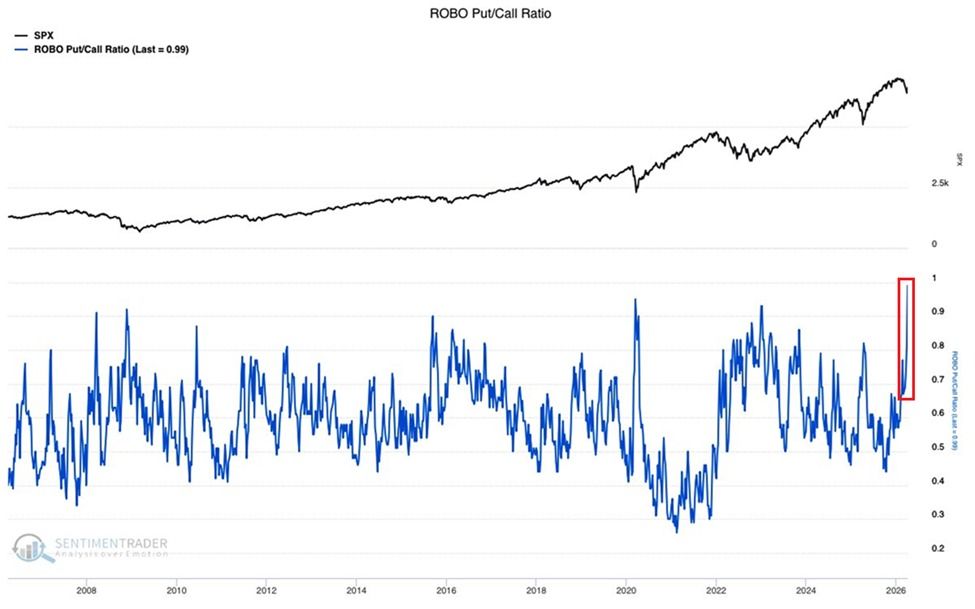
Retail fear across US equity markets has reached levels not seen in over two decades. The ROBO Put/Call Ratio has jumped to 1.0 for the first time in at least 20 years.
The reading exceeds the 0.91 peak during the 2008 Financial Crisis and the 0.95 reached during the 2020 pandemic selloff. The ratio has doubled since December, marking the sharpest rise since the 2022 bear market began.
“This ratio tracks retail opening buy orders in options, with the current reading showing retail traders buying nearly equal amounts of puts and calls…Fear is becoming overdone in this market,” The Kobeissi Letter noted.
Follow us on X to get the latest news as it happens
Market sentiment is also evidenced by the CNN Fear & Greed Index, which has fallen to 23, placing it at the threshold of extreme fear territory.
Bearish Positioning Reaches Rare Extremes
The surge comes amid a broad rise in short interest across all major US indexes. According to data from Global Markets Investor, the median short interest for the S&P 500 now stands at approximately 3.7%, its highest level in 11 years.
The Nasdaq 100 has reached roughly 2.7% short interest, a 6-year high. The Russell 2000 sits near 5.0%, its highest in 15 years.
The last time all three indexes showed such elevated short positioning simultaneously was during the 2010-2011 European debt crisis. That convergence is significant because it suggests bearish conviction extends beyond any single sector or market-cap segment.
“All three indexes have seen short interest rise sharply since mid-2024, accelerating further in 2026,” the post added.
BeInCrypto recently reported that hedge funds shorted global equities at the most aggressive pace in 13 years, with short sales outpacing long purchases by a ratio of 7.6 to 1.
The simultaneous alignment of extreme retail fear, a near-extreme Fear & Greed reading, and elevated institutional short positioning creates a notable asymmetry. Even a modest positive catalyst could trigger forced covering across multiple indexes, triggering a rapid, potentially disorderly rally.
The contrarian case is building, but a catalyst is needed. Sentiment alone doesn’t reverse markets. The critical question is whether current fear reflects genuine, fundamental deterioration or an overshoot driven by peak-fear psychology.
A resolution in the escalating US-Iran tensions could be the kind of macro shock that flips the narrative, but for now, with no signs of de-escalation, the market remains in a holding pattern between peak fear and potential inflection.
Subscribe to our YouTube channel to watch leaders and journalists provide expert insights
The post US Equity Fear Gauge Tops 2008 Crisis Levels as Short Interest Hits Multi-Year Highs appeared first on BeInCrypto.


The US Iran war latest news oil prices today tells a sharply escalating story: American forces struck more than 50 military targets on Kharg Island, the hub through which Iran exports 90% of its crude, sending oil surging more than 3% to nearly $116 per barrel within minutes of the first reports.
Summary
- The US military struck dozens of military targets on Kharg Island early Tuesday, Iran’s semi-official Mehr News Agency was first to report explosions, and Vice President JD Vance confirmed the strikes during a press conference in Budapest
- Oil jumped over 3% to nearly $116 per barrel immediately, while Brent crude crossed $110; Vance said the strikes did not include oil infrastructure and did not represent a change in strategy ahead of Trump’s 8 PM ET deadline
- The IRGC warned it would “deprive the US and its allies of the region’s oil and gas for years” if Trump follows through with threatened strikes on Iran’s civilian power and water infrastructure tonight
The US Iran war latest news oil prices today sent a fresh shock through global energy markets on Tuesday as US forces struck more than 50 military targets on Kharg Island, Iran’s largest oil export hub, hours before President Trump’s 8 PM ET deadline expired. Iran’s semi-official Mehr News Agency reported multiple explosions on the island as early as 1:30 PM local Tehran time, and oil surged immediately, with US crude jumping over 3% to nearly $116 per barrel and Brent crossing $110.
VP JD Vance confirmed the strikes during a press conference with Hungarian Prime Minister Viktor Orbán in Budapest, characterizing them as “re-strikes” on previously targeted sites. “I don’t think the news about Kharg Island changes anything,” Vance said, insisting the attacks did not touch oil infrastructure and did not alter the president’s strategy ahead of the evening deadline.
Kharg Island handles roughly 90% of Iran’s crude oil exports and carries a loading capacity of about 7 million barrels per day, making it the primary financial lifeline of Tehran’s war-era economy. Iran earns an estimated $53 billion in net oil export revenues annually, about 11% of its GDP, almost entirely flowing through the island’s pipelines and terminals.
The US has now struck the island twice since the war began February 28. The first attack in mid-March destroyed naval mine storage facilities, missile bunkers, and air defense systems while preserving oil infrastructure. Tuesday’s strikes hit some of the same sites, according to a US official, again stopping short of targeting the oil terminal itself. Whether that restraint holds after 8 PM is the question driving markets.
What an Oil Infrastructure Strike Would Mean
Analysts have warned that striking Kharg’s oil terminal would have immediate and lasting consequences. “A direct hit on Iran’s export terminal would instantly shut down most of its 1.5 million barrels per day crude exports,” JPMorgan data cited by CNBC showed. “Destruction of its oil infrastructure would take years to rebuild, leaving the country deprived of its most critical source of revenue,” Vandana Hari of Vanda Insights told CNBC.
Iran has already telegraphed its response. The IRGC warned Tuesday that it would “deprive the US and its allies of the region’s oil and gas for years” if the civilian infrastructure strikes go forward. It also signaled that restraint toward Gulf Arab states hosting US military assets is now over, saying “all such considerations have been lifted” — a direct threat to regional energy facilities in Saudi Arabia, Kuwait, and the UAE.
Bitcoin and Crypto Markets Under Fresh Pressure
As crypto.news reported, each round of escalation in this conflict has pushed oil higher and Bitcoin lower, with the Strait of Hormuz closure already keeping crude above $100 for weeks and compressing Federal Reserve flexibility on rate cuts. Crypto.news also noted that major cryptocurrencies have dropped 3 to 5% during prior escalation phases, as higher oil prices feed directly into inflation expectations and reduce appetite for risk assets.
Tonight’s 8 PM deadline, and what follows it, will determine the next major move for both energy and crypto markets.

Allegedly Gave Birth In Toilet, Let Newborn Drown

Top NFL Player-Producing Wyoming High Schools

Testing Suggests Google’s AI Overviews Tells Millions of Lies Per Hour


-

 NewsBeat5 days ago
Steven Gerrard disagrees with Gary Neville over ‘shock’ Chelsea and Arsenal claim | Football
-

 Business5 days ago
No Jackpot Winner and $194 Million Prize Rolls Over
-

 Fashion4 days ago
Weekend Open Thread: Spanx – Corporette.com
-

 Crypto World6 days ago
Gold Price Prediction: Worst Month in 17 Years fo Save Haven Rock
-

 Business2 days ago
Three Gulf funds agree to back Paramount’s $81 billion takeover of Warner, WSJ reports
-

 Business4 days ago
Expert Picks for Every Need
-

 Sports3 days ago
India men’s 4x400m and mixed 4x100m relay teams register big progress | Other Sports News
-

 Business6 days ago
Login and Checkout Issues Spark Merchant Frustration
-

 Crypto World7 days ago
Bitcoin enters the public bond market as Moody’s gives a first-of-its-kind crypto deal a rating
-
Business2 days ago
No Jackpot Winner, Prize to Climb to $231 Million
-
Crypto World7 days ago
Bitcoin stalls below key resistance as technical signals skew bearish
-

 Tech5 days ago
Commonwealth Fusion Systems leans on magnets for near-term revenue
-

 Politics7 days ago
Starmer’s centre has collapsed, and the left was right all along
-

 Fashion1 day ago
Massimo Dutti Offers Inspiration for Your Summer Mood Board
-

 Crypto World6 days ago
Ripple rolls out enterprise crypto treasury platform for corporates
-

 Crypto World6 days ago
Why It’s Partnering, Not Issuing
-
Crypto World7 days ago
AI Memory Rout Wipes 9% Off Nvidia Stock: Chart Says More Pain Ahead
-

 Business3 days ago
Akebia Therapeutics, Inc. (AKBA) Discusses Pipeline Progress and Strategic Focus on Kidney Disease Treatments at R&D Day – Slideshow
-

 Tech7 days ago
Solo Leveling: Ranking All Sung Jinwoo Shadows by Power
-

 Tech6 days ago
Drawing Tablet Controls Laser In Real-Time
You must be logged in to post a comment Login