
Crypto World
EURC’s Record Network Growth Could Signal a Major Shift in Europe’s Crypto Economy


Euro Coin (EURC) saw a sharp increase in on-chain activity as both daily active addresses and new wallet creation reached all-time highs in its four-year history, according to Santiment.
The surge likely reflects growing demand for regulated euro-denominated stablecoins as the EU’s Markets in Crypto-Assets (MiCA) framework encourages exchanges, payment providers, and crypto applications to adopt compliant digital assets.
Biggest On-Chain Spike
Circle’s EURC has emerged as one of the leading euro-backed stablecoins in this environment, particularly as usage for these tokens continues to expand beyond traditional US dollar trading pairs. Santiment said the latest on-chain data indicates euro liquidity is becoming increasingly important across blockchain networks.
The analytics firm also linked the increase in activity to recent developments within Circle’s ecosystem, broader cross-chain expansion of stablecoins, and renewed interest in compliant payment infrastructure.
Circle issues EURC through Circle SAS, with the regulated euro-backed stablecoin available on networks including Ethereum. It has also continued expanding EURC support across additional blockchain ecosystems. This includes enabling USDC and EURC on Cronos while investing in broader stablecoin infrastructure.
Santiment said that although stablecoins do not typically experience price rallies like other crypto assets, rising activity around EURC points to growing underlying demand within Europe’s blockchain-based payment ecosystem.
Europe’s Regulated Stablecoin
The market for MiCA-compliant euro stablecoins currently consists of eight fully authorized tokens, which offer regulated options for different types of users.
EURC is the largest by market capitalization and is joined by Société Générale’s EURCV, which is designed for institutional and wholesale settlement. Monerium issues EURE as a regulated e-money token, while Schuman Financial offers EUROP, a newer entrant focused on the European market. StablR’s EURR is a cash-backed euro stablecoin, and Quantoz Payments issues the MiCA-compliant EURQ.
EURI, issued through Banking Circle, is among the three largest euro stablecoins by market capitalization, while EURAU is the newest addition, launched by AllUnity. The combined market capitalization of the eight tokens grew from around $295 million to $669 million over the past year, an increase of about 126%.
The post EURC’s Record Network Growth Could Signal a Major Shift in Europe’s Crypto Economy appeared first on CryptoPotato.



South Korean cryptocurrency exchange Bithumb said Monday it plans to apply for a preliminary listing review in 2027 and complete an initial public offering in 2028.
Bithumb said it has reorganized its business structure, including spinning off Bithumb Asset, to clarify responsibilities across its business units and reduce potential conflicts of interest ahead of the listing review.
The exchange said its preparations will include upgrading internal controls and shifting from domestic accounting standards to K-IFRS, the international accounting framework used by listed companies in South Korea.
Bithumb said the timetable could change depending on market conditions and the review schedules of relevant authorities.
The exchange is one of five South Korean platforms that support fiat currency trading through real-name bank accounts, offered through its partnership with KB Kookmin Bank.
Bithumb’s listing push comes as rival South Korean exchanges deepen their ties with traditional finance and technology groups. Mirae Asset Consulting took control of rival exchange Korbit on July 23, while Upbit operator Dunamu is pursuing a share-swap deal that would make it a wholly owned subsidiary of Naver Financial, subject to regulatory and shareholder approval.
Related: Kiwoom eyes Bithumb stake as Korean brokerages push into crypto: Report
Bithumb’s 620,000 BTC crediting error
In a February promotional error, Bithumb mistakenly credited customer accounts with balances totaling 620,000 Bitcoin instead of distributing 620,000 Korean won in cash rewards. Bithumb recovered 99.7% of the erroneous credits, though customers sold about 1,788 BTC before accounts were frozen.
At a Feb. 11 National Assembly parliamentary hearing, Bithumb CEO Lee Jae-won said the exchange’s process for checking the planned distribution against its actual holdings had failed and that the promotional amount had not been earmarked in a separate account.
Its IPO preparations also come as two Bithumb-linked listed companies face continuing audit and listing problems. Vidente, a major Bithumb shareholder, and Bucket Studio, which indirectly controls Vidente, have had trading in their shares suspended since March 2023 over audit and other listing issues.
According to Yonhap news agency, Bucket Studio appointed a former police official as its standing auditor in June, while Vidente plans to appoint a former National Tax Service official to the same role. South Korea’s Government Public Service Ethics Committee cleared both hires after finding no close relationship between the officials’ previous duties and their new roles.
Magazine: The 100x obsession: Fundamentals grow in importance as crypto matures
Bitmine Immersion Technologies added 10,399 ETH to its treasury and repurchased another 4.5 million shares, but BMNR stock fell toward $17 as investors weighed its mounting unrealized losses.
Summary
- Bitmine acquired 10,399 ETH, lifting its holdings to 5,797,813 ETH.
- The company now controls about 4.8% of Ethereum’s total supply.
- Bitmine repurchased 4.5 million BMNR shares during its third consecutive week of buybacks.
- BMNR traded near $17.06, with technical indicators showing weak trend strength.
Bitmine’s Ethereum holdings approach 5.8 million ETH
Bitmine said it acquired another 10,399 ETH over the past week, continuing the accumulation strategy it adopted last year. The purchase increased its total holdings to 5,797,813 ETH, equivalent to approximately 4.8% of Ethereum’s circulating supply.
The latest purchase followed Bitmine’s acquisition of 9,946 ETH during the previous week. Together, the transactions added more than 20,000 ETH to the company’s treasury within two weeks.
Chairman Tom Lee linked the continued accumulation to Ethereum’s recent performance against US technology stocks. He said ETH outperformed the Nasdaq 100 by 25% during July, its widest margin since July 2025.
“This is the largest outperformance since July 2025, and we believe it is reflective of the strengthening fundamentals of crypto.”
Lee noted that ETH climbed from $2,375 in July 2025 to $4,057 by the end of the following month. However, past performance does not guarantee that Ethereum or BMNR will repeat that move.
Bitmine has maintained its accumulation strategy despite the broader crypto downturn and the paper losses attached to its holdings. DropsTab estimates that the company has an unrealized loss of approximately $8.8 billion on its Ethereum position.
Staked ETH could generate $247 million annually
Bitmine has also placed most of its Ethereum treasury into staking. The company reported 4,917,189 ETH staked, representing nearly 85% of its total holdings.
At the stated valuation, the staked position is worth about $9.2 billion. Bitmine projects that it could generate approximately $247 million in annualized staking revenue.
Staking provides the company with ETH-denominated income while it holds the asset on its balance sheet. However, that revenue may fluctuate with Ethereum’s staking yield, validator performance and the market value of ETH.
The strategy also means BMNR investors are exposed to several overlapping risks. These include Ethereum price volatility, the company’s cost basis, dilution from capital raises and operational risks associated with staking such a large position.
For US investors, BMNR offers equity-market exposure to Ethereum without requiring direct token custody. Unlike a spot Ethereum exchange-traded fund, however, the stock also carries corporate management, financing and capital-allocation risks.
BMNR buyback enters its third consecutive week
Bitmine repurchased 4.5 million common shares during the past week, marking the third straight week of purchases under its buyback program.
The company has now bought back more than 16 million shares. Management said it considers BMNR attractively valued relative to its assets and long-term Ethereum strategy.
Share repurchases reduce the number of outstanding shares when they are retired, potentially increasing each remaining shareholder’s proportional claim on the company. Their impact depends on the price paid, the source of the funds, and whether new stock issuance offsets the reduction.
Lee argued that periods of strong monthly ETH performance against the Invesco QQQ Trust have historically been followed by BMNR outperforming Ethereum during the next month. That relationship remains a company observation rather than a guarantee of future returns.
The buyback may provide some support for BMNR, but investors have yet to respond positively to the latest Ethereum purchase and repurchase announcement.
BMNR stock struggles with resistance near $17.15
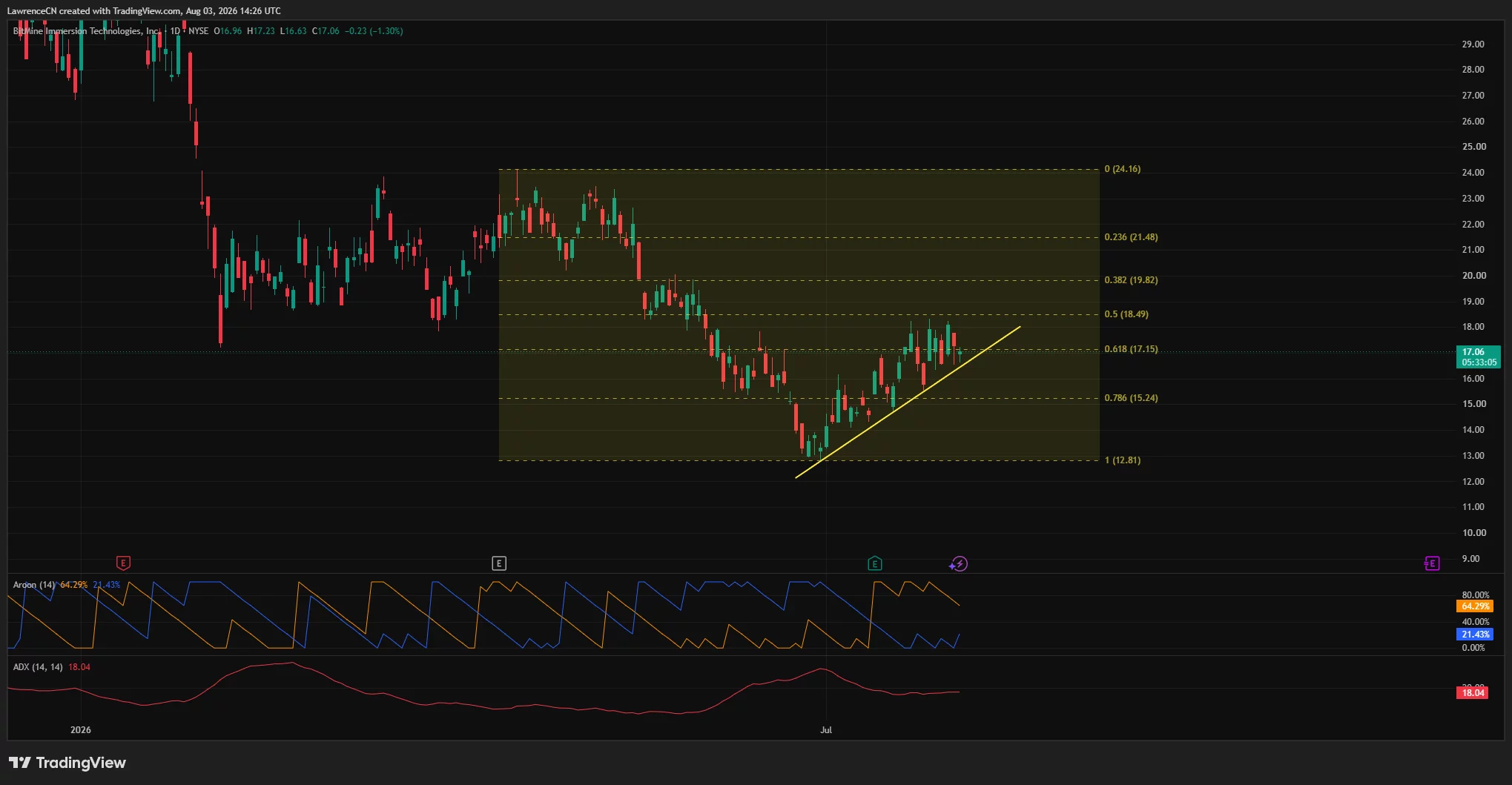
BMNR traded near $17.06 on Aug. 3, falling about 1.3% on the daily chart. The stock recorded an intraday high of $17.23 and a low of $16.63.
BMNR price is testing the 61.8% Fibonacci retracement at $17.15, which is acting as the immediate resistance level. A daily close above that mark could allow BMNR to challenge $18.49, corresponding to the 50% retracement level.
The next resistance sits at $19.82. A stronger recovery beyond that level could bring $21.48 into focus, although the stock would need greater momentum and trading volume to sustain such a move.
BMNR remains above an ascending trendline drawn from its June low near $12.81. That structure suggests the short-term recovery has not failed, but the stock has struggled to build momentum above $17.
Aroon readings of 64.29% and 21.43% favor the recent recovery attempt. However, the average directional index stands at 18.04, below the commonly watched 20 threshold, indicating that the prevailing trend remains weak.
A rejection at $17.15 could send BMNR back toward the rising trendline around $16. Stronger support sits at the 78.6% Fibonacci level of $15.24. A decisive break below that area would weaken the recovery structure and increase the risk of another test of $12.81.
Disclosure: This article does not represent investment advice. The content and materials featured on this page are for educational purposes only.
Bitcoin begins the first full week of August trading around the $63,000 area as traders look past a difficult macro calendar and focus on a fresh, ongoing catalyst from within the crypto ecosystem. Sentiment is being tested by the fallout from a Coldcard wallet hack, while broader markets await key US data and geopolitical signals that can swing risk assets.
At the same time, investors are weighing whether August will follow the bearish script that has marked prior cycles. Even with July ending higher, analysts point to technical resistance and liquidation zones that could amplify downside if momentum fades.
Key takeaways
- Bitcoin is hovering near $63,000 as traders digest the continuing Coldcard hardware wallet incident and its effects on flows.
- Crypto market participants say US nonfarm payrolls—due Thursday—may drive volatility depending on how labor strength and unemployment evolve.
- Oil prices slid after President Donald Trump signaled potential movement on an Iran-related deal, adding to macro uncertainty for risk assets.
- Long-term holder behavior appears consistent with accumulation, even as near-term traders warn that resistance could keep August pressured.
- CoinGlass and other technical observers highlight the 50-month EMA around $65,827 as a key barrier, while derivatives positioning points to liquidation risk near $64,200.
Why Treasury and FX policy still matters to crypto
The week’s macro backdrop is shaped not only by upcoming US economic releases, but also by renewed attention to how dollar liquidity and Treasury market stress can spill into global financial conditions. According to QCP Capital, the US and Japan executed a rare coordinated foreign-exchange intervention last week, designed to support the yen after it neared levels around 164 per USD, based on TradingView data.
QCP Capital emphasized that the operation’s mechanics matter: the New York Fed acted as a fiscal agent using the Federal Reserve’s Foreign and International Monetary Authorities (FIMA) repo facility, rather than reflecting a Federal Reserve monetary-policy decision. In QCP’s view, that distinction highlights how institutions outside the FOMC can still move liquidity and influence broader conditions.
Further, industry commentary cited a desire to reduce the risk of Japan selling large quantities of US Treasuries, which could otherwise disrupt the dollar environment. Louise Loo of Oxford Economics told CNBC that volatile conditions tied to potentially fiscally aggressive policies in Japan could extend into US Treasury markets, destabilizing the dollar.
In a post on X, Treasury Secretary Scott Bessent also argued the FIMA facility could be used again, describing it as an “important backstop” and encouraging that it be “upsized” in coming months. For crypto traders, the practical takeaway is that interventions affecting FX and Treasury-market liquidity can quickly shift risk appetite—often before any direct crypto-specific news lands.
US payrolls, oil, and the Iran signal: the risk-asset checklist
For digital-asset markets, the next major swing factor is Thursday’s nonfarm payrolls release. Earlier in this cycle, weaker-than-expected labor numbers put pressure on expectations for how aggressively the Federal Reserve might move on rates, a dynamic that coincided with a reaction in Bitcoin when June payroll data came in well below forecasts, as Cointelegraph previously reported.
Market positioning for Thursday remains mixed. Continuum Economics, for example, expects July nonfarm payrolls to rise by 120k overall (and 110k in the private sector), while also projecting unemployment will edge up to 4.3% from 4.2%. The firm’s forecast also notes average hourly earnings rising by 0.3% in line with its trend, according to its published preview.
Beyond labor data, traders are monitoring signals related to US-Iran de-escalation. On Sunday, President Donald Trump posted on Truth Social that he had agreed to cancel further strikes on Iranian territory “subject to being able to rapidly make a DEAL,” adding language about potential opening of the Strait of Hormuz and an end to Iran’s nuclear threat. Oil responded quickly, with both WTI and Brent down by more than 8% on Monday.
For crypto markets, the relevance of oil is straightforward: sustained moves in energy prices often feed into inflation expectations and, by extension, interest-rate expectations. When the path of rates is uncertain, risk assets—including Bitcoin—tend to trade with sharper sensitivity to macro surprises.
Coldcard hack: exchange inflows rise, but not in an outsized way
On the crypto side, one of the most immediate concerns remains the Coldcard wallet hack. Earlier coverage cited a “low-entropy bug” in Coldcard hardware wallets, with theft activity continuing for multiple days. Galaxy Research’s Alex Thorn advised Coldcard users to move funds “ASAP” and suggested using higher transaction fees to reduce the time spent interacting with the wallets.
Yet exchange flow data suggests the reaction is not turning into a broad, panic-driven transfer into trading venues. According to CryptoQuant, net exchange inflows were 34,932 BTC on Friday and 8,768 BTC on Sunday. CryptoQuant’s data framing indicates the inflow volume, while meaningful on certain days, aligns with typical levels seen during the month rather than representing a one-off liquidation wave.
What did change more noticeably was the number of inbound transactions. CryptoQuant data shows exchanges received 31,217 inbound BTC transactions on Friday, dropping to 19,537 on Sunday. CryptoQuant head of research Julio Moreno attributed the influx mainly to transactions between 1 and 10 BTC, which he said had their highest daily total since early February.
Separately, CryptoQuant reported that on a rolling 30-day basis Bitcoin long-term holders remain in a broad accumulation phase. In its analysis, the BTC LTH Accumulation & Distribution indicator showed LTH supply inflow around 220.4K BTC, implying ongoing inflow into long-term holdings outweighs distribution back to the market.
That combination—exchange activity rising in transaction count, but long-term holders still accumulating—suggests the market is processing the incident through behavior that is more nuanced than a simple rush to sell.
August caution: resistance levels and leverage-built downside
Even as Bitcoin finished July about 7.4% higher, traders are preparing for a difficult August. CoinGlass data shows monthly performance for BTC/USD came in slightly below its 2025 result, but the broader narrative remains that downside pressure can return during August, consistent with patterns some analysts associate with prior midterm-era behavior.
Rekt Capital pointed to the 50-month exponential moving average as an ongoing ceiling, stating on X that the 50-month EMA continues to act as resistance. That level is near $65,827, and the expectation is that repeated rejections could set up further downside continuation.
Derivatives positioning adds another layer of near-term risk. CoinGlass data tracking clusters of high-leverage BTC bets highlighted $64,200 as a potential area where forced liquidations could occur if price moves higher against leveraged positions.
On the other end of the spectrum, quant analyst David Eng described Bitcoin as “sitting on its long-term statistical floor” around $63,000, referencing a power law framework that expects price to grow as a power of time. While such models do not guarantee short-term price direction, they help explain why some participants remain willing to accumulate near specific long-horizon reference points.
With long-term holders accumulating quietly while near-term technicals and leverage maps warn of friction, the next macro prints and any follow-through from the Coldcard incident will likely determine whether August breaks from prior weakness—or extends it.
Traders should watch Thursday’s nonfarm payrolls for cues on rates and risk appetite, while also tracking whether Coldcard-related wallet activity continues to translate into exchange selling or stays contained to transaction-level spikes; the answer could shape how quickly Bitcoin sheds or absorbs this month’s technical pressure.
Bitcoin (BTC) starts the first full week of August circling $63,000 as traders weigh the impact of the ongoing Coldcard wallet hack.
Key points:
- US Treasury Secretary Scott Bessent leverages a Federal Reserve repo facility for a joint intervention as the Japanese briefly recovers from forty-year lows against the dollar
- Oil prices fall sharply as president Donald Trump gives hope of a deal with Iran.
- Bitcoin rounds out July 7.4% higher, but warnings of a red August stay in place.
Bessent eyes further yen interventions
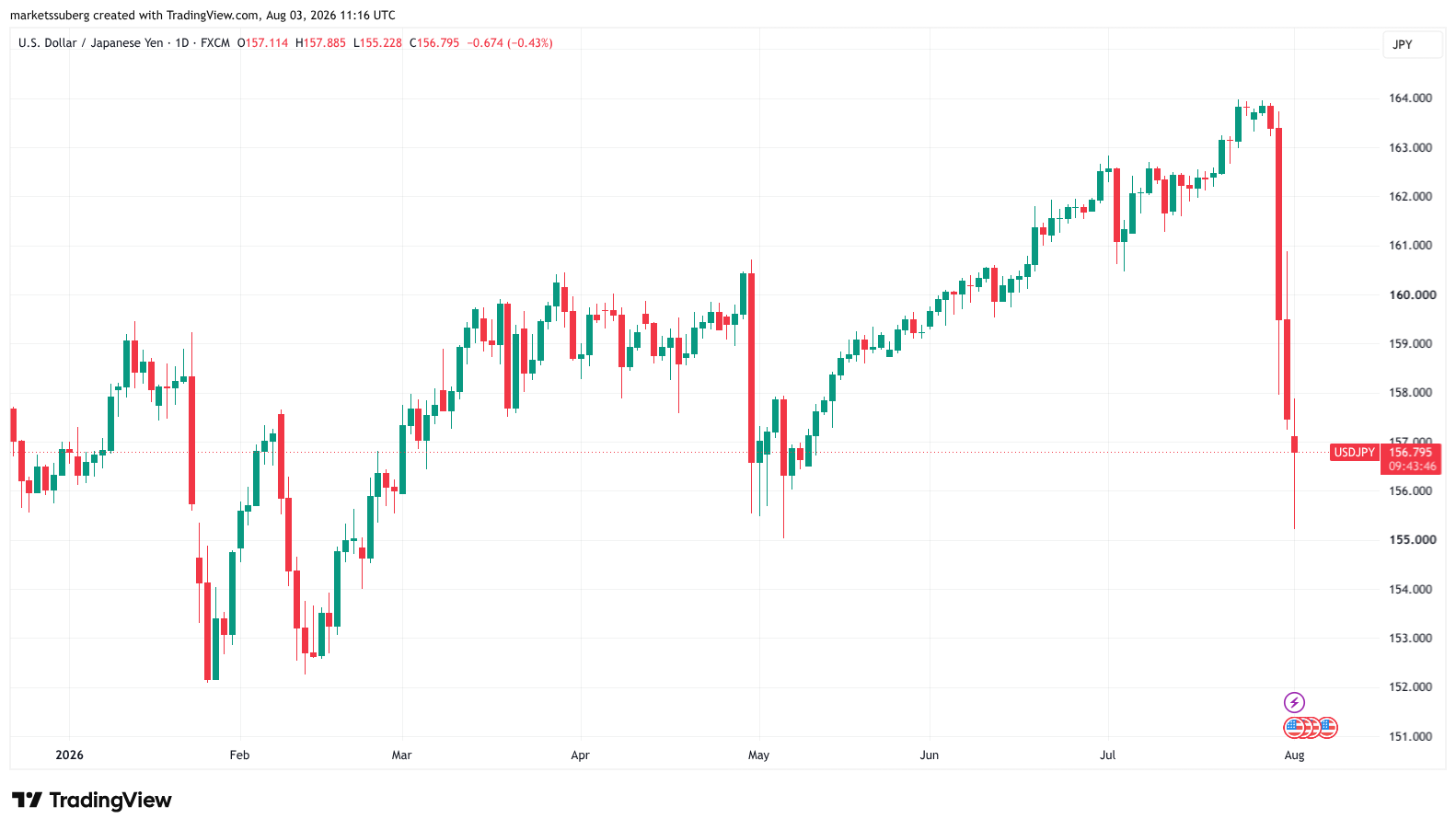
Concerns over US Treasury markets were behind the US decision to intervene in the Japanese yen last week. Washington engaged in a rare operation to support the yen after USD/ JPY had reached almost 164 last week, per data from TradingView.
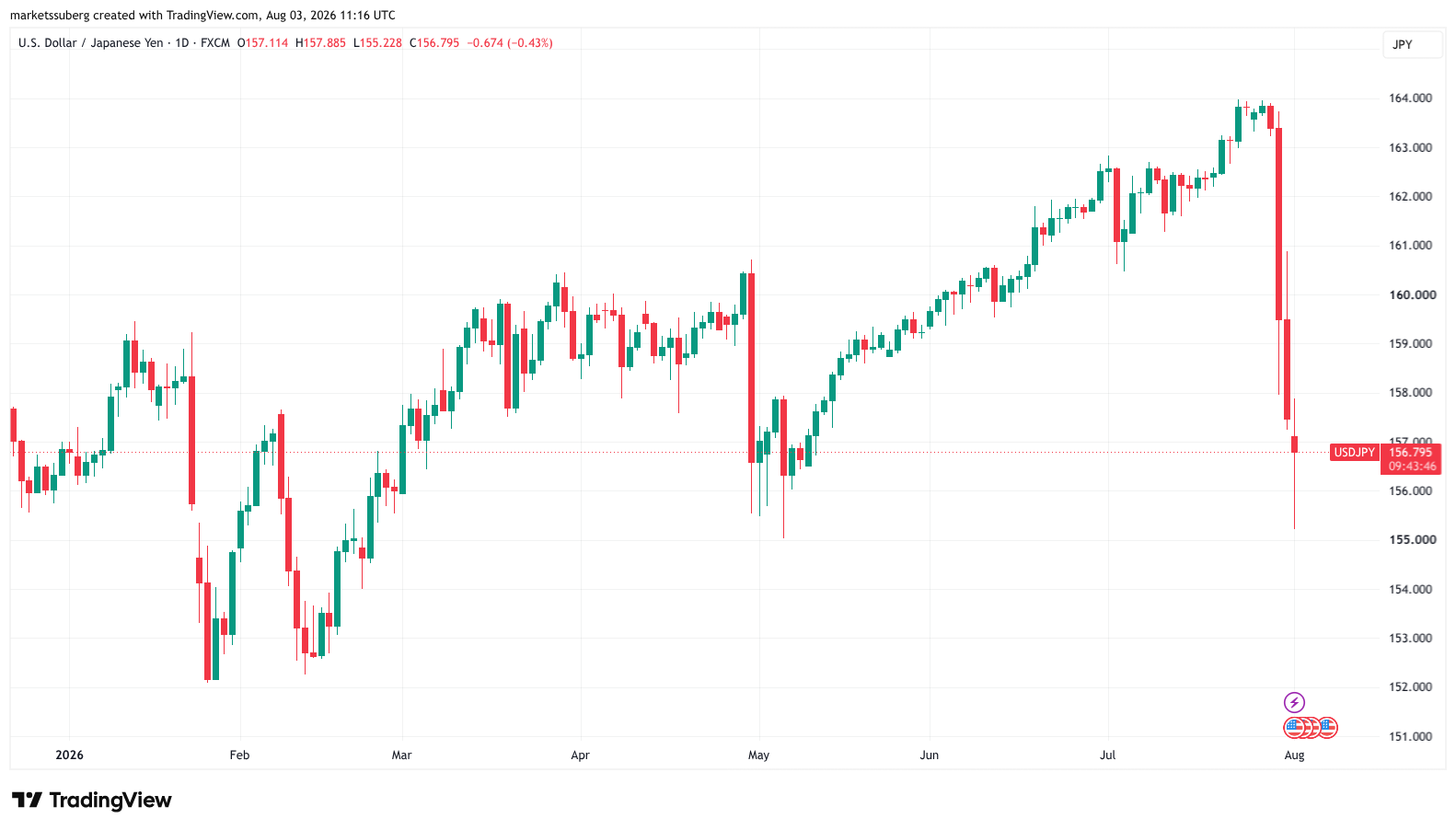
USD/JPY one-day chart. Source: Cointelegraph/TradingView
“It was the first coordinated US–Japan foreign-exchange intervention since 2011 and the first joint operation specifically supporting the yen since 1998,” crypto trading company QCP Capital noted in analysis released on Monday.
“The distinction matters. The New York Fed acted as the Treasury’s fiscal agent rather than as an independent monetary-policy decision by the Federal Reserve. The operation therefore highlights how institutions outside the FOMC can also influence currencies, liquidity and broader financial conditions.”
Speaking to mainstream media, industry insiders placed emphasis on the desire to avoid Japan selling large amounts of US Treasuries. The use of the Fed’s Foreign and International Monetary Authorities (FIMA) repo facility, which allows a handful of foreign central banks to access dollar liquidity without selling Treasuries, supports the theory.
“There is a self-preservation element here. Volatile markets driven by potentially fiscally-aggressive policies from Japan could extend to the U.S. Treasury markets, destabilizing the dollar,” Louise Loo, head of Asia economics at Oxford Economics, told CNBC.
In a post on X, Treasury Secretary Scott Bessent argued that FIMA could make further appearances going forward.
“Friday’s coordinated foreign exchange actions countered disorderly yen movements. Treasury remains attentive and in close communication with our counterparts at MOF and BOJ. We will not hesitate to participate in further joint intervention. The FIMA Repo Facility is an important backstop. We would encourage it to be upsized in the coming months,” he wrote.
Oil dives as Trump teases hope of Iran deal
US nonfarm payrolls data is the main point of interest for crypto and risk asset traders this week. Due on Thursday, the numbers will shed light on the strength of the labor market as recent US inflation prints have delivered mixed signals.
Last month, nonfarm payrolls came in far lower than expected. Only 57,000 jobs were added in June, short of the 114,000 anticipated, while the previous two months’ numbers were revised down by a combined 74,000 jobs. Bitcoin jumped on the news, because weaker labor-market conditions put pressure on the Federal Reserve to soften its stance on rate hikes.
Some market participants expect a rebound in July’s payrolls data. However, macro research firm Continuum Economics simultaneously projects an uptick in unemployment.
“We expect July’s non-farm payroll to rise by 120k overall and by 110k in the private sector, a significant improvement from June’s respective gains of 57k and 49k but largely explained by a recovery in leisure and hospitality. We expect unemployment to rise to 4.3% from 4.2%, reversing a June decline, and an in line with trend 0.3% rise in average hourly earnings,” it forecast last week.
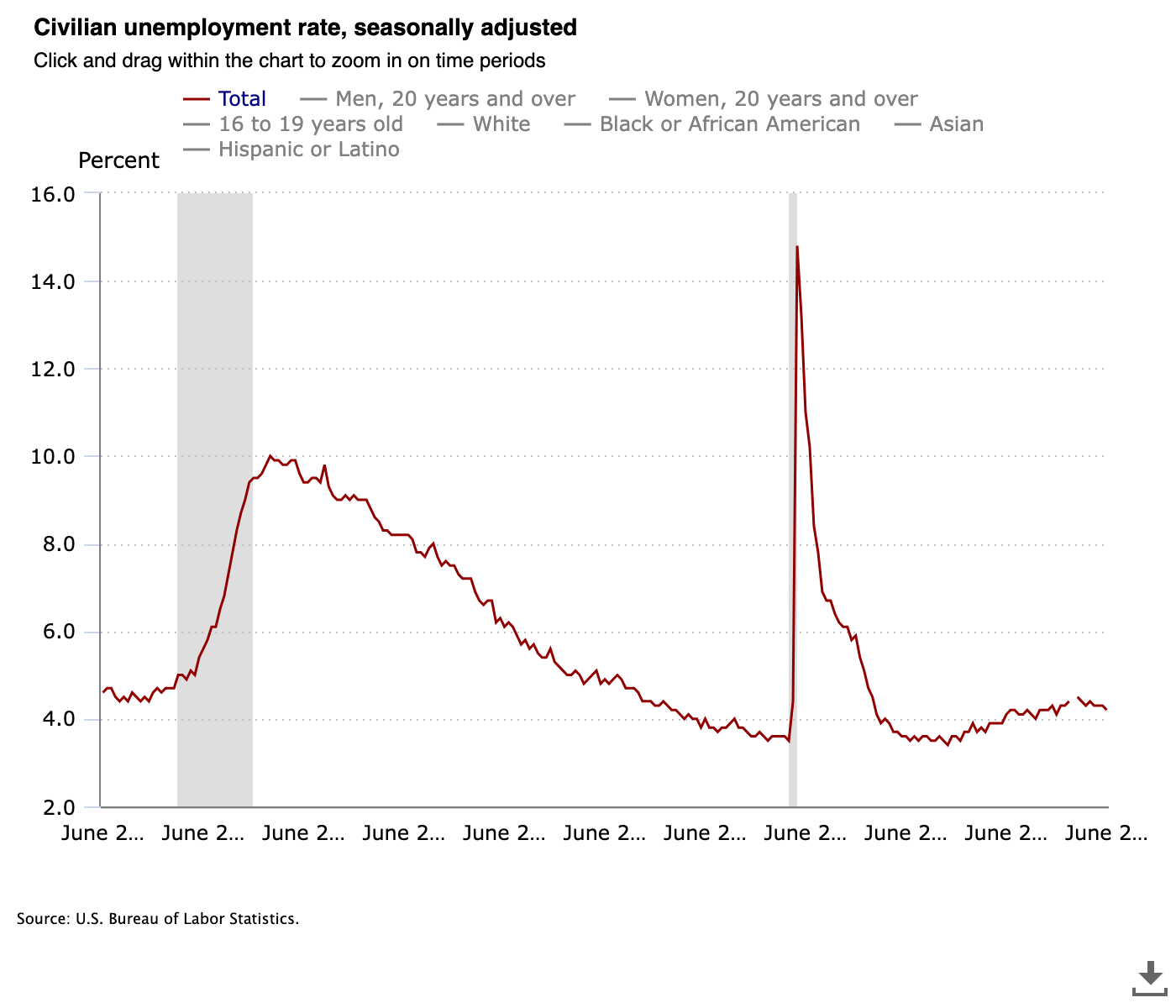
US civilian unemployment rate. Source: Bureau of Labor Statistics
Macroeconomic data prints form just one locus of potential risk-asset volatility as markets look for cues for a lasting ceasefire between the US and Iran.
In a post on Truth Social on Sunday, US president Donald Trump revealed a delay to further strikes on Iranian territory, with a potential deal on the table.
“This would include the Immediate, Complete, and Total OPENING OF THE HORMUZ STRAIT, and an end to Iran’s nuclear threat. Based on this request, I have agreed, for the future benefit of the WORLD and, likewise, the survival of a successful and prosperous Iran, to cancel the attack, subject to being able to rapidly make a DEAL,” he wrote.
Oil prices fell immediately as the week began, with WTI and Brent crude both down more than 8% on Monday.
Stocks face tough seasonality into US Midterms
US stocks face seasonal friction between now and October, in the run-up to the US Midterm elections, analysis from trading resource Mosaic Asset Company warns.
The S&P 500 finished July down 0.8%, while the tech-heavy Nasdaq Composite Index saw its worst July losses since 2006 at -3.2%.
In the latest edition of its regular newsletter, The Market Mosaic, flagged seasonal changes as a major hurdle for equities beginning this month.
“Based on multiple lookback periods, seasonality becomes a much stronger headwind over the next couple months,” it wrote, with data indicating that it could take until the start of Q4 for the situation to improve.
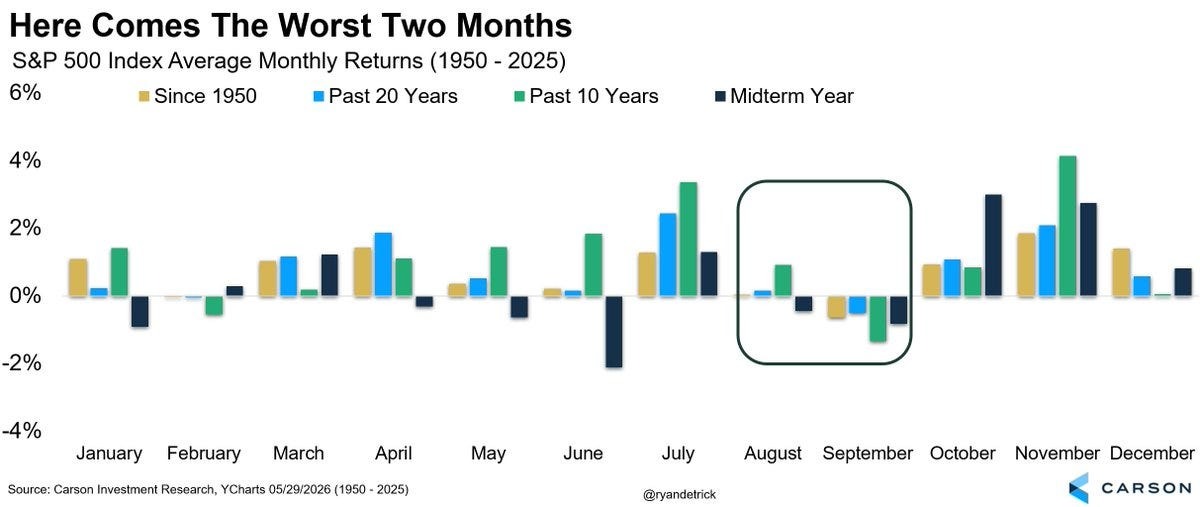
S&P 500 average monthly returns. Source: Mosaic Asset Company
US equities failed to mount a meaningful comeback into the monthly close, even as Asia markets rebounded from a major sell-off centered around semiconductor stocks. Missed earnings and concerns over debt obligations fueled a $620 billion wipeout over just two days. This comes as combined 2026 capex guidance from Alphabet, Microsoft, Amazon, and Meta is now tracking toward $730 billion.
For Bitcoin itself, the picture has a familiar precedent, analyst Benjamin Cowen, founder and CEO of quantitative analysis platform Into the Cryptoverse argued.
“Bitcoin is still generally tracking the average of prior midterm years (only slightly elevated off of that average),” he reported on X while tracking year-to-date return on investment.
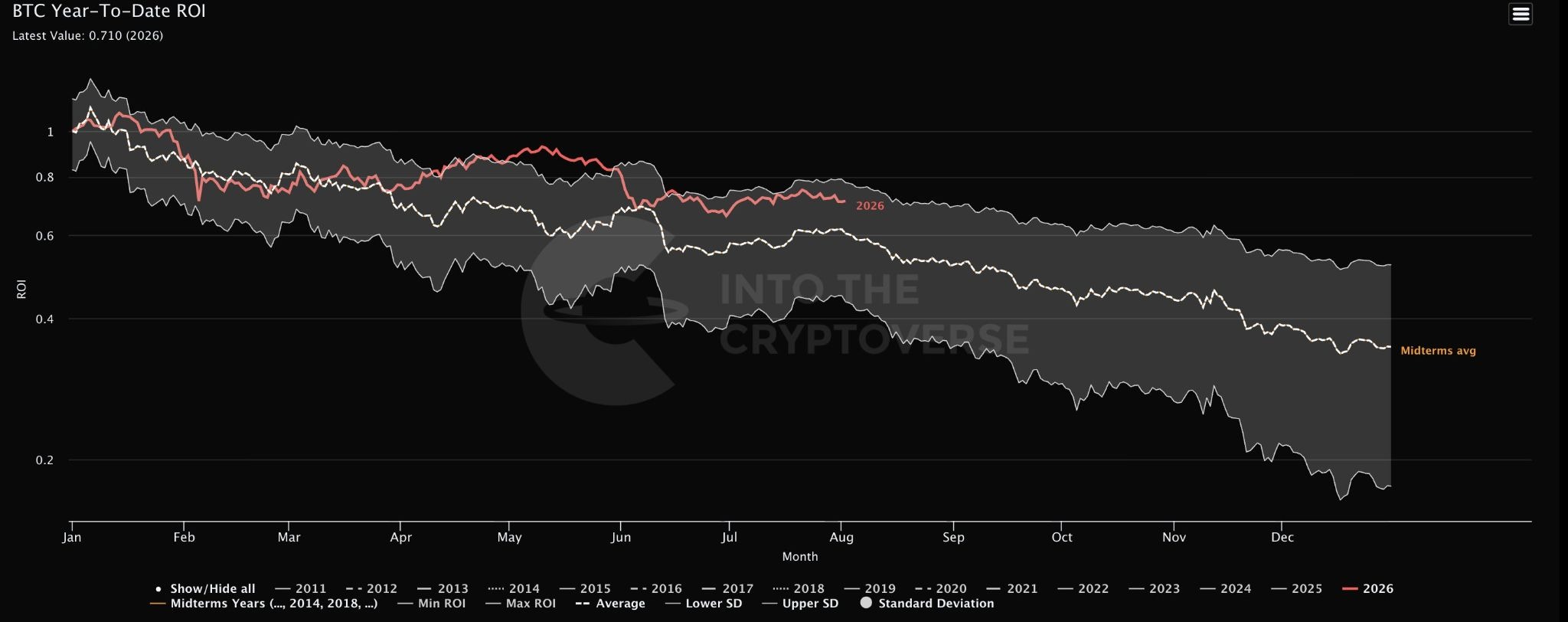
Bitcoin RoI comparison. Source: Benjamin Cowen on X.com
Exchange flows cool after Coldcard shock
Bitcoin investors continue to react to the low-entropy bug in Coldcard hardware wallets as funds are being stolen for a fourth consecutive day. The hack, which appeared to be centered on a security vulnerability originating in 2021, had drained BTC worth nearly $90 million as of Sunday.
Alex Thorn, head of firmwide research at crypto and blockchain research platform Galaxy Research, told Coldcard users to move funds “ASAP” and employ high transaction fees to reduce the remaining time spent interacting with Coldcard wallets to a minimum.
Exchange transaction data, however, does not show a mass influx of BTC from users seeking a temporary alternative to hardware wallet storage or converting their funds to ETFs. Data from CryptoQuant shows net inflows of 34,932 BTC on Friday and 8,768 BTC on Sunday. While this constitutes a significant inflow day, it is not out of the ordinary and matches the levels seen throughout the month.
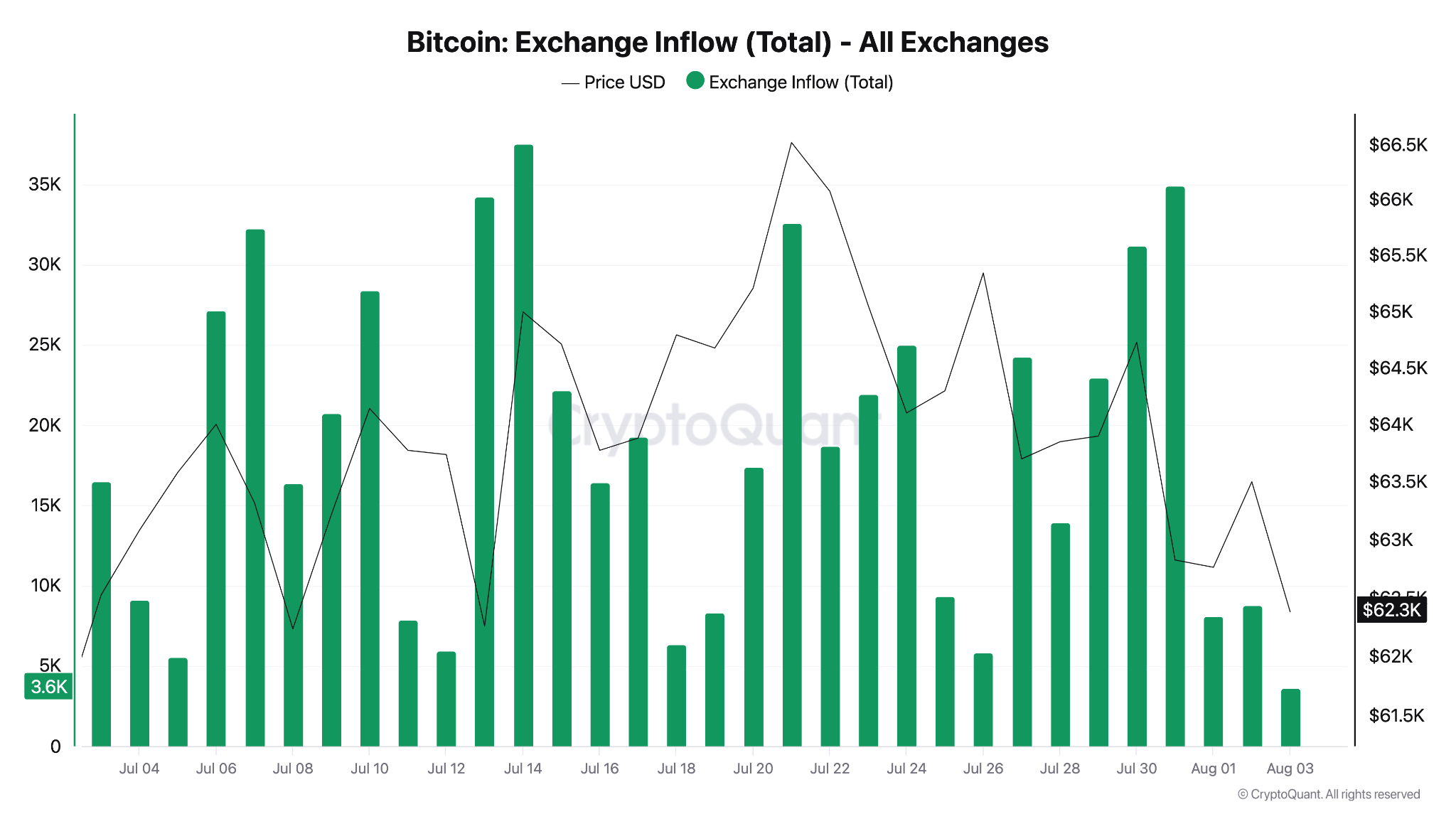
Bitcoin exchange inflows. Source: CryptoQuant
The number of depositing transactions saw a more pronounced reaction, spiking to match some of its highest daily totals since March before dropping significantly over the weekend. Exchanges recorded 31,217 inbound BTC transactions on Friday, while on Sunday, the number fell to 19,537.
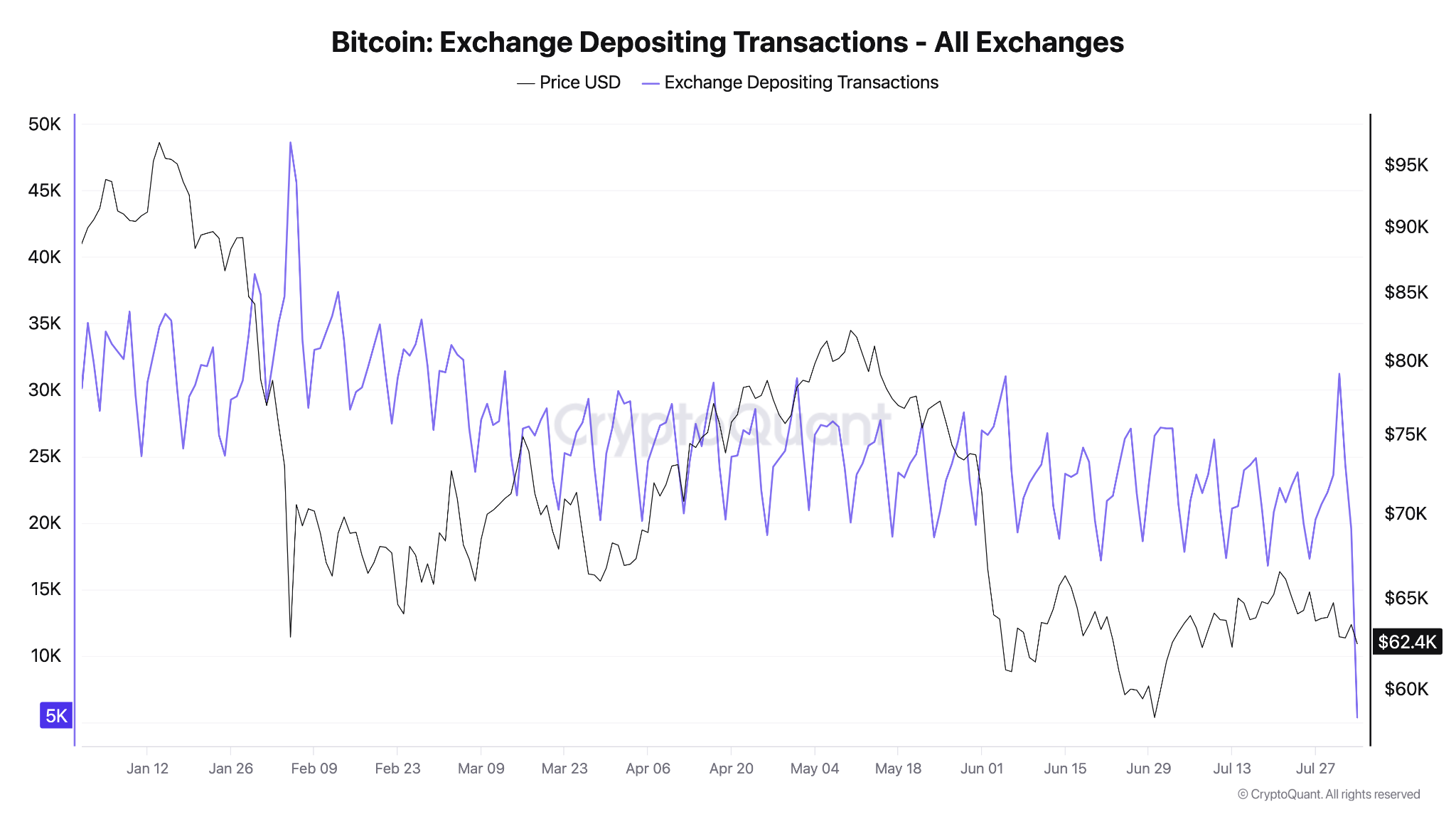
Bitcoin exchange deposit transactions. Source: CryptoQuant
Responding, CryptoQuant head of research, Julio Moreno, revealed that the influx was driven by transactions of between 1 and 10 BTC. At around 7,300, these saw their highest daily total since early February.
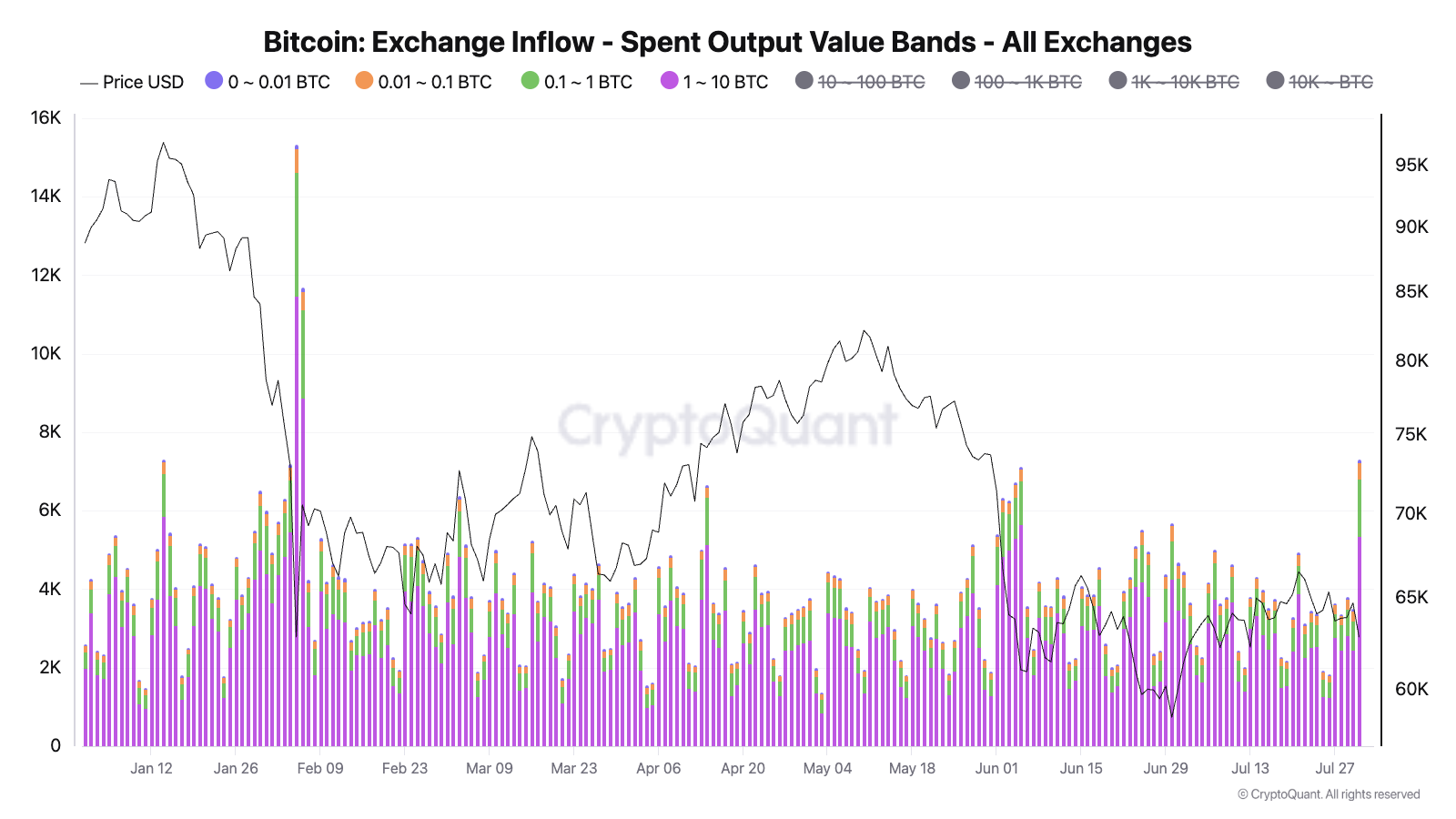
Bitcoin exchange inflows by transaction size. Source: Julio Moreno on X.com
In some of its latest analysis released on Monday, CryptoQuant observed that on a rolling 30-day basis, Bitcoin’s long-term holders (LTHs) remained in a broad accumulation phase.
“Data shows that the BTC LTH Accumulation & Distribution (30D) indicator is currently recording LTH Supply Inflow of around 220.4K BTC. This suggests that the amount of Bitcoin flowing into the Long-Term Holder cohort continues to outweigh the amount being distributed back to the market,” it wrote.
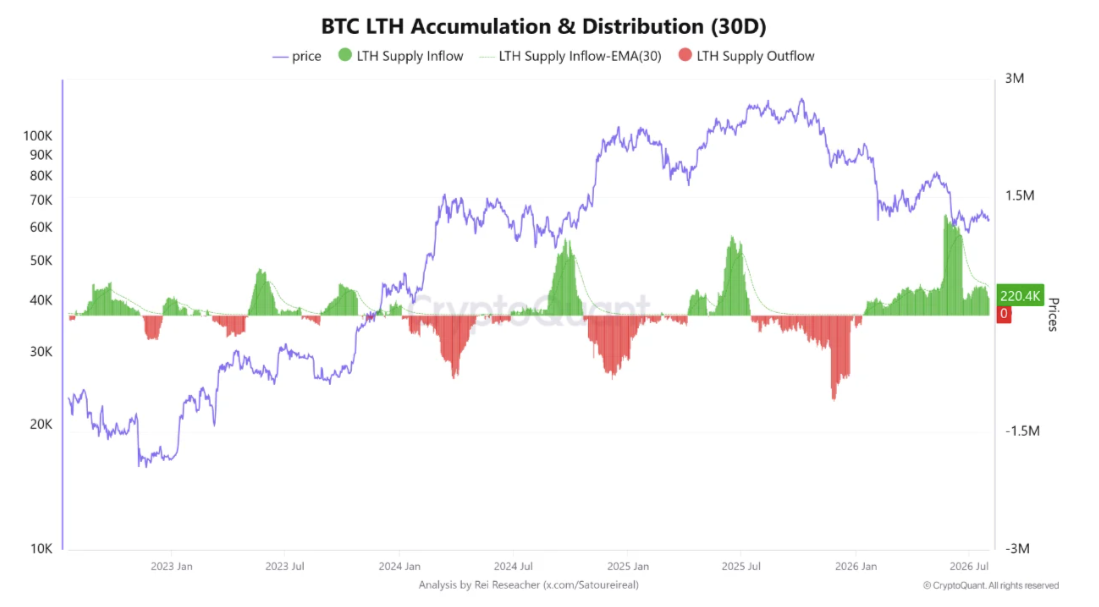
Bitcoin 30-day LTH accumulation and distribution (screenshot). Source: CryptoQuant
Trader consensus sees a “red” August for Bitcoin
Bitcoin continues to see key trend lines act as resistance into August as market participants warn over bear-market history repeating. BTC/USD finished July up 7.4%, slightly below its 2025 performance, per data from CoinGlass.
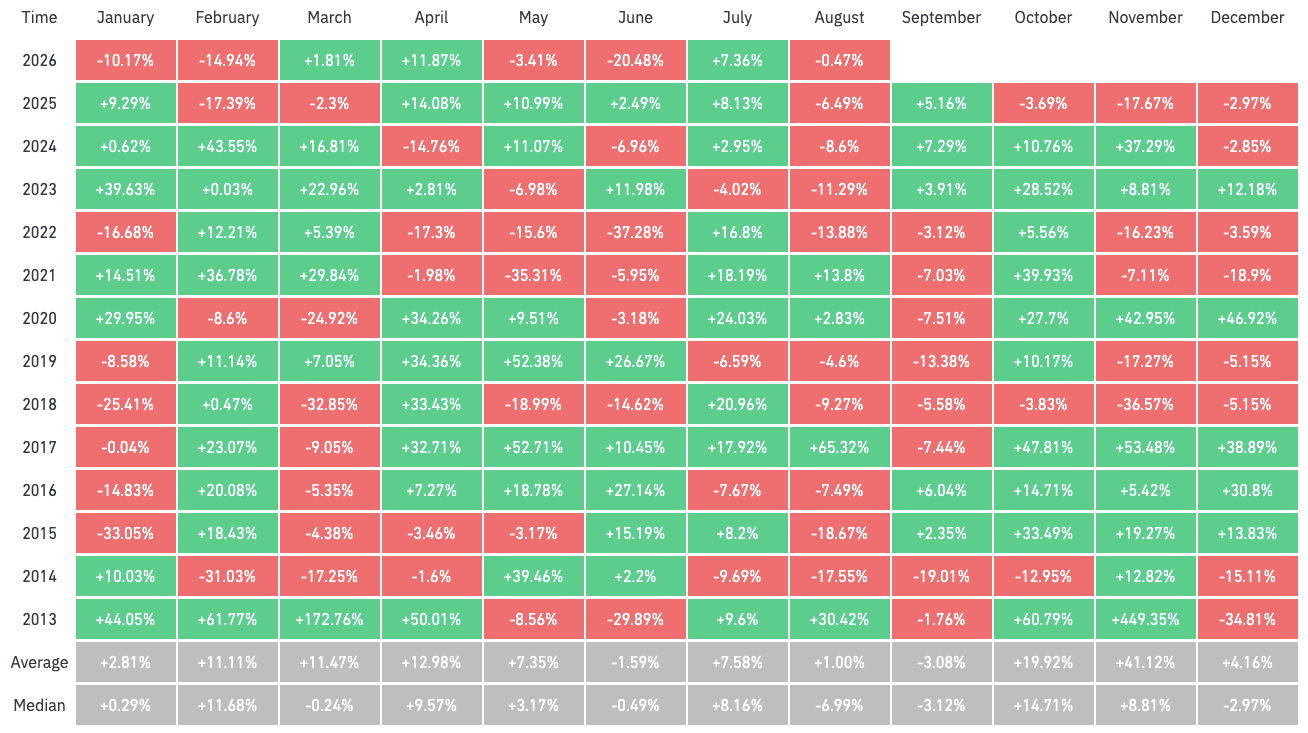
BTC/USD monthly returns (screenshot). Source: CoinGlass
Despite this, expectations remain for downside BTC price pressure to return this month, keeping the 2026 bear market in line with historical patterns. The 50-month exponential moving average (EMA) at $65,827 is an important psychological level for traders.
“It has been confirmed. The 50-Month EMA continues to act as resistance,” trader and analyst Rekt Capital wrote in an X post on Sunday.
“Continued rejection from the 50 EMA would set price up for downside continuation over time.”
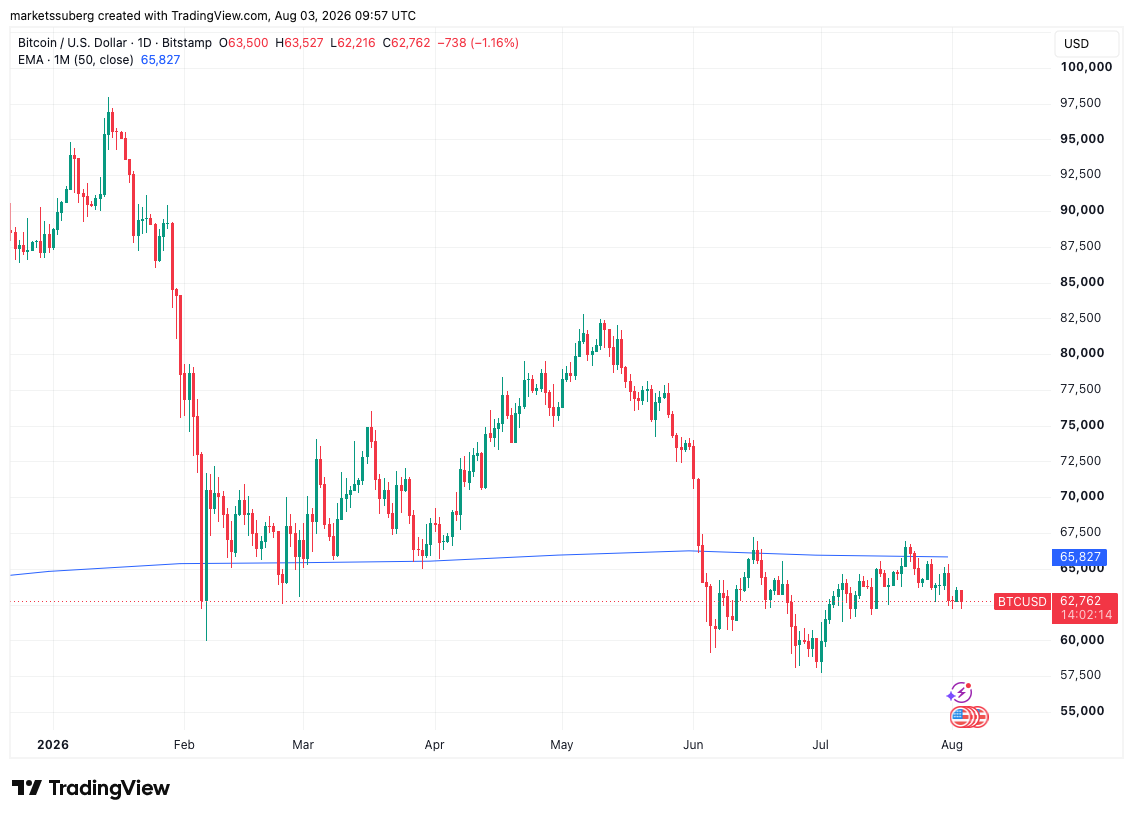
BTC/USD one-day chart with 50-month EMA. Source: Cointelegraph/TradingView
On shorter time frames, CoinGlass data that tracks clusters of high-leverage BTC bets in the derivatives market showed $64,200 as a potential area of forced liquidations should price reverse higher.
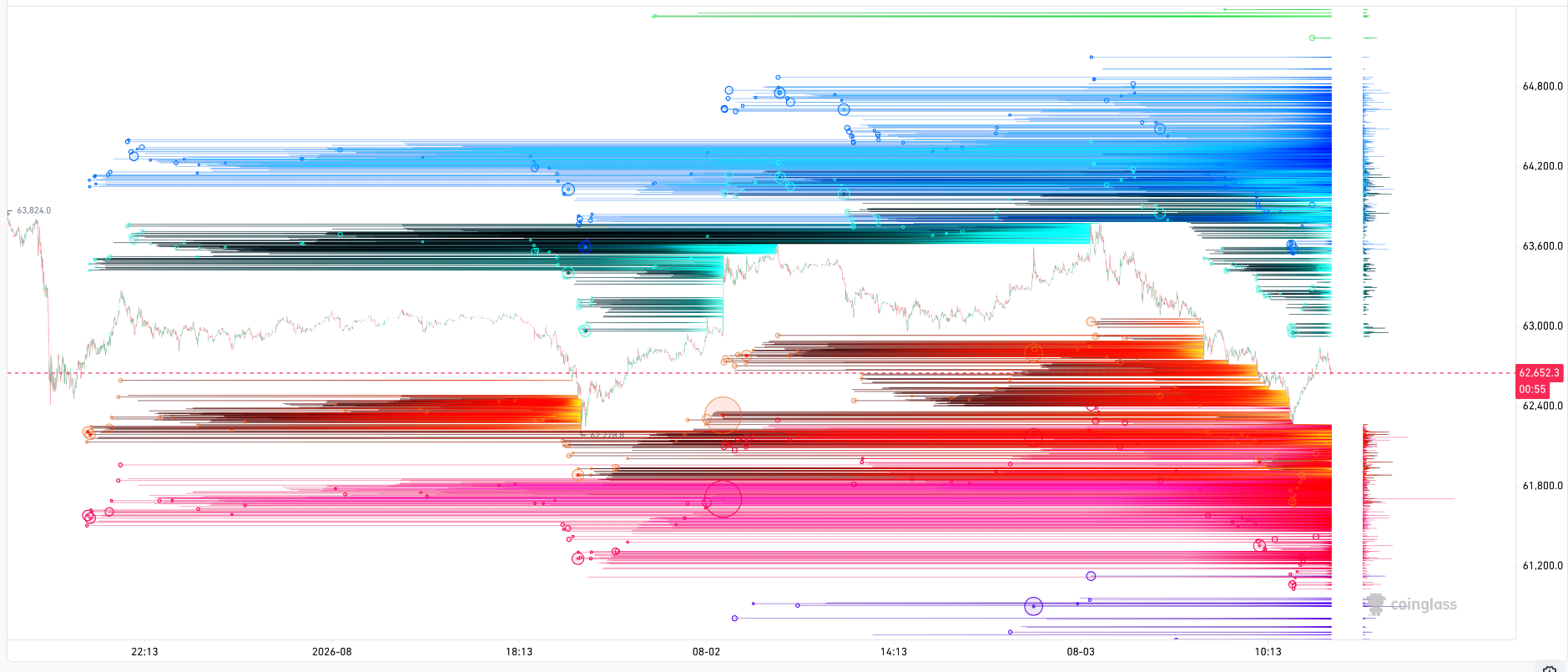
BTC liquidation heatmap. Source: CoinGlass
Quant analyst David Eng described the price as “sitting on its long-term statistical floor” near $63,000. Eng uploaded data from the power law model, which sees price growing as a power of time.
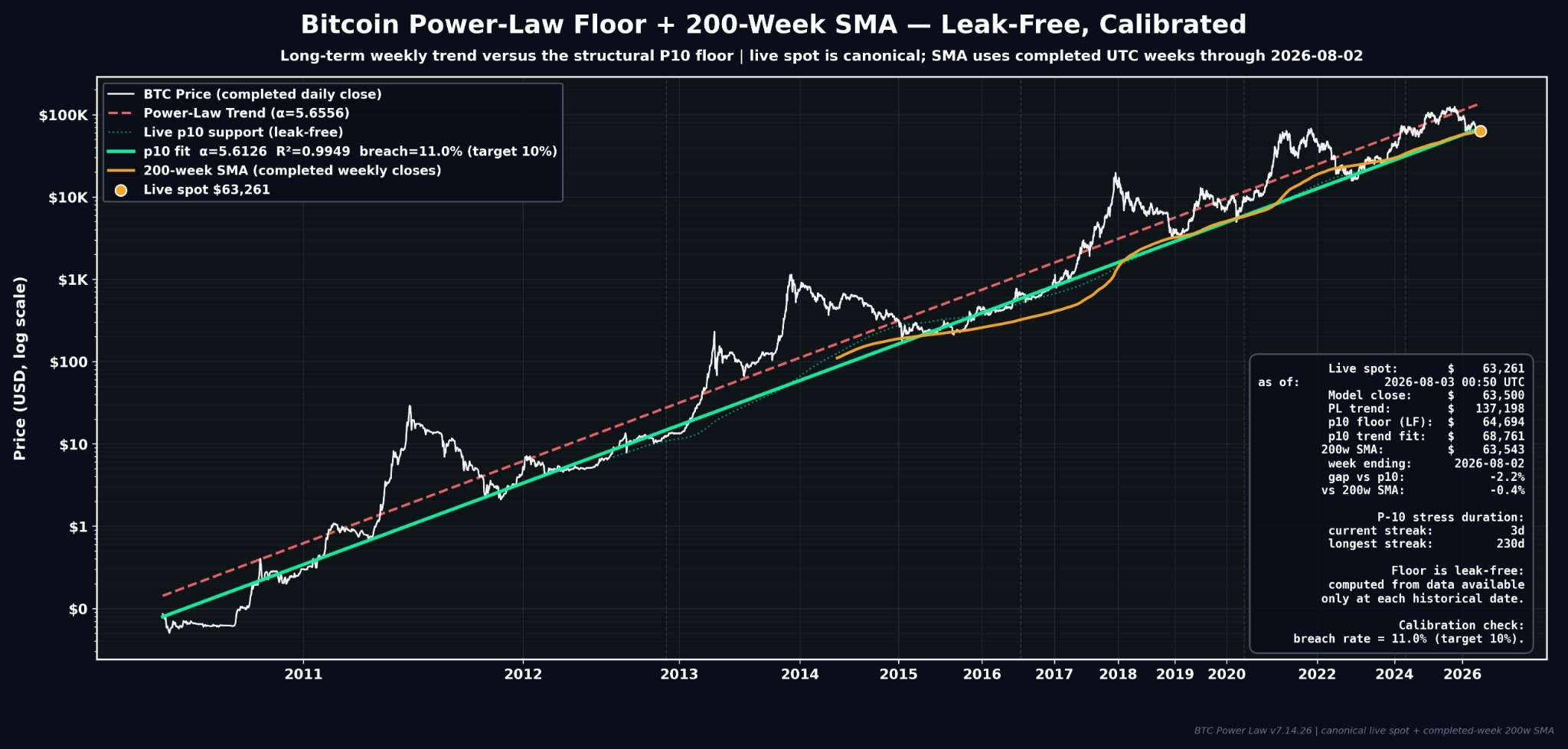
Bitcoin Power Law data. Source: David Eng on X.com
Bitcoin heads into August with long-term holders quietly accumulating even as short-term charts flash caution. Whether the month breaks its historical pattern of weakness will likely come down to how the next few macro data points land.
PIVX (PIVX), Vulcan Forged PYR (PYR), and four other lesser-known digital assets have posted substantial losses today (August 3), and the main culprit behind the decline appears to be Binance.
Over the past several weeks, the world’s largest crypto exchange announced several other platform amendments that have affected multiple altcoin traders and investors.
Goodbye to These Tokens
Binance carried out another review to ensure that all cryptocurrencies listed on its platform meet the necessary standards and industry requirements. As a result, it revealed that it will terminate all services with Across Protocol (ACX), Hashflow (HFT), PIVX (PIVX), Vulcan Forged PYR (PYR), Vanar (VANRY), and Viction (VIC).
The delisting is scheduled for August 17, but the news has already impacted the prices of the aforementioned tokens. PIVX and PYR are the biggest losers from the pack, both nosediving by 20%, while the rest have recorded more modest decreases.

Withdrawing support from Binance inevitably leads to reduced availability, thinner liquidity, and reputational damage, so the price reaction isn’t exactly surprising. Something quite similar was observed towards the end of June when the company said goodbye to Alchemix (ALCX), Ardor (ARDR), NFPrompt Token (NFP), and Marlin (POND).
NFP absorbed the heaviest hit, with its valuation plunging by a sharp 21% in a single day, while the rest also entered red territory – though their declines were not that substantial.
Some of the Previous Updates
Binance has been wrestling with regulatory pressure in Europe lately, but that hasn’t stopped it from pushing forward with its global expansion. A month ago, it solidified its presence in the Philippines: a major crypto market with millions of users.
Later on, the exchange briefly paused deposits and withdrawals on the TRX and ZEC networks to support wallet maintenance and a hard fork, respectively. All operations were restored quickly, and there were no reports of any lingering issues.
The post Binance Triggers Major Collapse for These Altcoins: Details Inside appeared first on CryptoPotato.


Bitmine Immersion (BMNR), the largest Ethereum treasury company, bought 10,399 ether (ETH) during last week as Chairman Tom Lee pointed to ether’s strongest monthly performance against the Nasdaq in a year as evidence that crypto is recovering.
The purchase, worth roughly $19.1 million at ETH’s current price of $1,840, lifted Bitmine’s holdings to almost 5.8 million ETH, or about 4.8% of Ethereum’s circulating supply, according to the company’s Monday update.
The latest acquisition was broadly in line with the previous week’s 9,946 ETH purchase, extending Bitmine’s streak of weekly ether buys since adopting its Ethereum treasury strategy in June 2025.
The company also bought back 4.5 million shares of its common stock, bringing total recent repurchases to 16 million shares.
The update comes as Strategy (MSTR), the largest corporate bitcoin holder, disclosed another sale of bitcoin. The company trimmed its treasury by 1,638 BTC, worth about $105 million, while repurchasing $81.2 million of its STRC preferred stock. Strategy also raised $290 million through sales of common shares.
Lee tied the company’s outlook to ether’s relative strength against technology stocks.
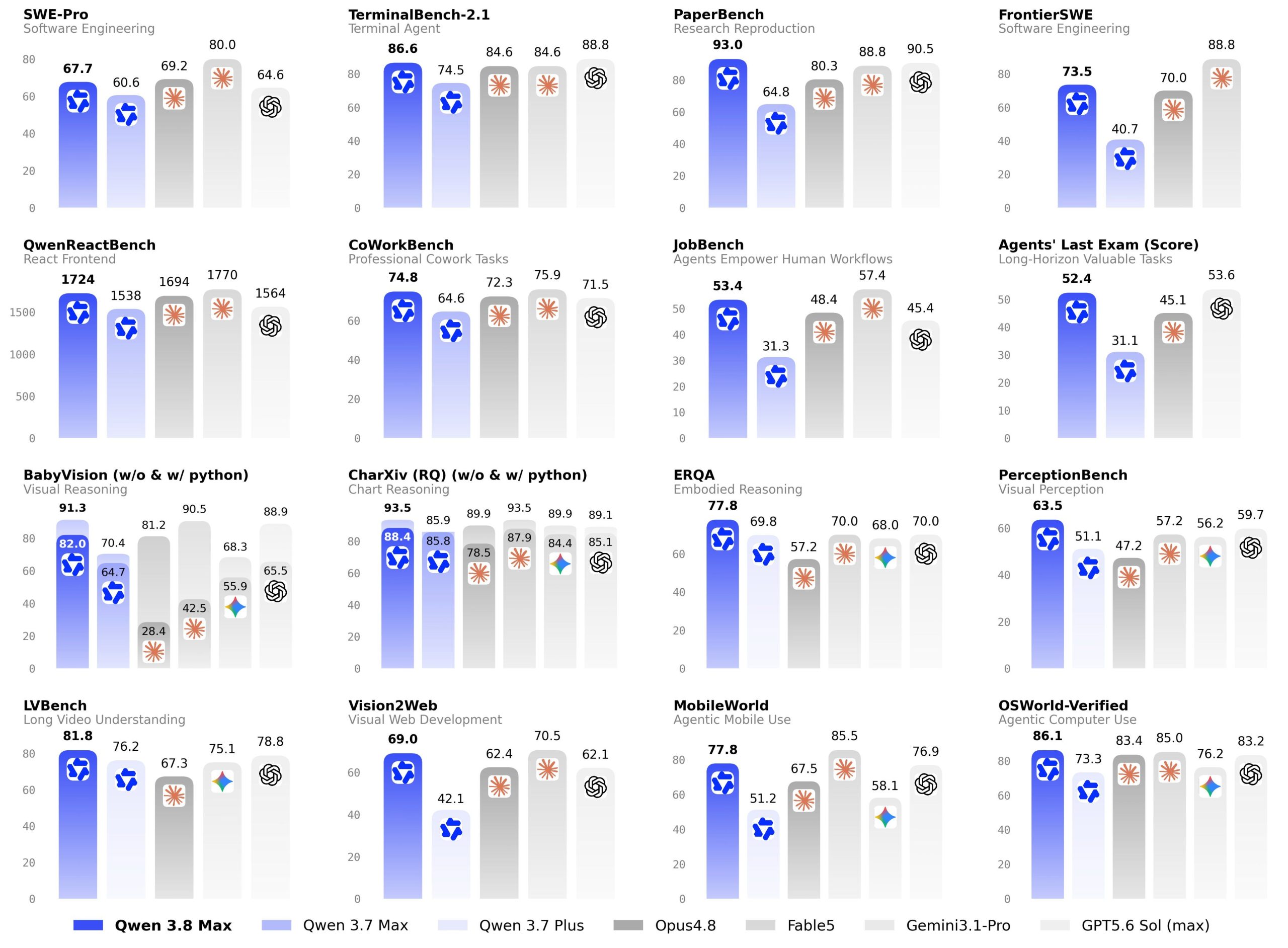
Alibaba launched Qwen3.8-Max on Monday with its first published benchmarks, and the model ranked fourth on Arena’s Frontend Code leaderboard. Only Claude Opus 5 and Moonshot’s Kimi K3 scored higher in the test.
The 2.4 trillion-parameter model exits its July preview with 95 billion active parameters, a 1 million-token context window, and public API pricing.
Qwen3.8-Max Trails Only Claude and Kimi in Coding Test
Arena’s leaderboard scored Qwen3.8-Max at 1,668 points, one point behind Claude Opus 5 (High). Claude Opus 5 (Max) leads at 1,705, while Kimi K3 (Max) holds second at 1,676. The model also placed second in Arena’s Consumer Product category.
Follow us on X to get the latest news as it happens
Data shared by Alibaba claims wins over Claude Opus 4.8, Fable 5, and GPT-5.6 on agentic and multimodal benchmarks. The data shows 86.6 on TerminalBench-2.1, 93.0 on PaperBench, and 86.1 on OSWorld-Verified.
However, Anthropic’s Fable 5 keeps a wide lead in core software engineering. It scores 80.0 on SWE-Pro against Qwen’s 67.7, and 88.8 on FrontierSWE against 73.5.

First Open Max Model Arrives as Alibaba Shares Rally
The launch also marks the first time Alibaba will open-source the weights of a Qwen-Max-class model.
“Next week, the open weights of Qwen3.8-Max will be released, and Qwen3.8-27B is also going open-weights to meet you all!” the team said.
The weights will land on Hugging Face and ModelScope. Meanwhile, API pricing debuted at $2 per million input tokens and $6 per million output tokens.
Investors responded quickly to the launch. Alibaba shares climbed 6.15% to HK$124.20 by the Hong Kong lunch break, from a previous close of HK$117.

The stock extended Friday’s 4.65% gain, which analysts tied to a reported Moonshot chip deal. Independent evaluations may sharpen the picture once the weights land next week.
Subscribe to our YouTube channel to watch leaders and journalists provide expert insights
The post How Alibaba’s New Qwen3.8-Max Stacks Up Against US AI Giants appeared first on BeInCrypto.
Just when you thought crypto was getting boring, a new phenomenon is lighting up Crypto Twitter — Fake World Assets (FWAs). Yes, really.
It’s the latest iteration of the onchain gacha craze, where users receive a random collectible, or collectibles, that are usually worth very little, but are sometimes worth quite a lot.
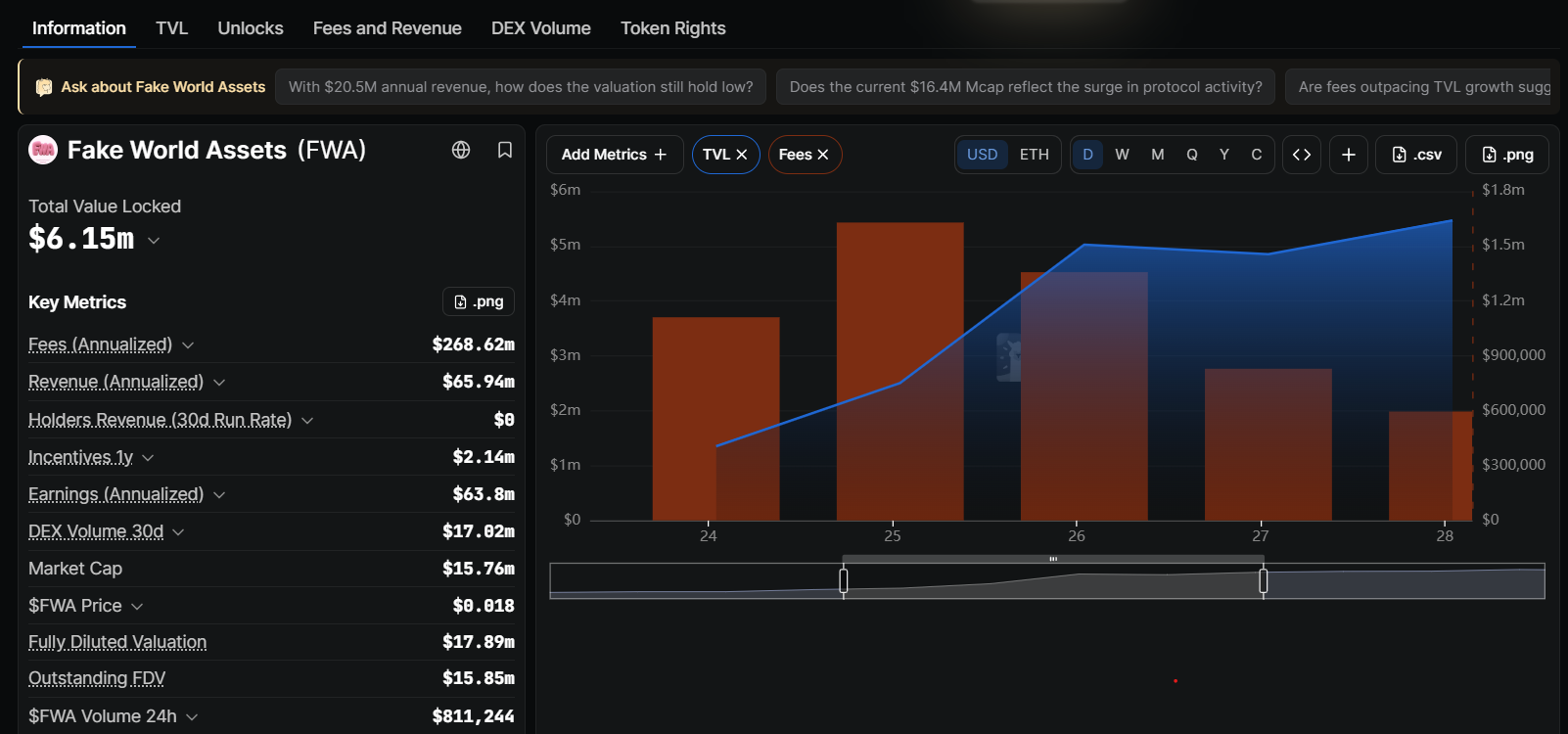
Within four days of launch, FWAs guzzled so much Ethereum gas that they briefly became the chain’s largest gas consumer by fees over a 24-hour period.
At its peak on July 25, FWAs generated approximately $1.53 million in daily fees, and even leapfrogged Tether and Circle to briefly rank among Ethereum’s biggest consumers of blockspace. Its creators, TokenWorks, proclaimed:
“4 days since launch. Fake World Assets are the next big thing.”
TokenWorks is far from an impartial observer, but TVL continues to climb, reaching over $6.15 million on July 31. Fee revenue has now eased to around $350,000 per day, which equates to an annualized run rate of roughly $268 million. By August 1, FWA had seen 10,000 ETH in volume, and 100,000 purchases. Some of the activity is driven by users trying to access early FWA token incentives, but there also appears to be genuine interest in the gamified mechanic.
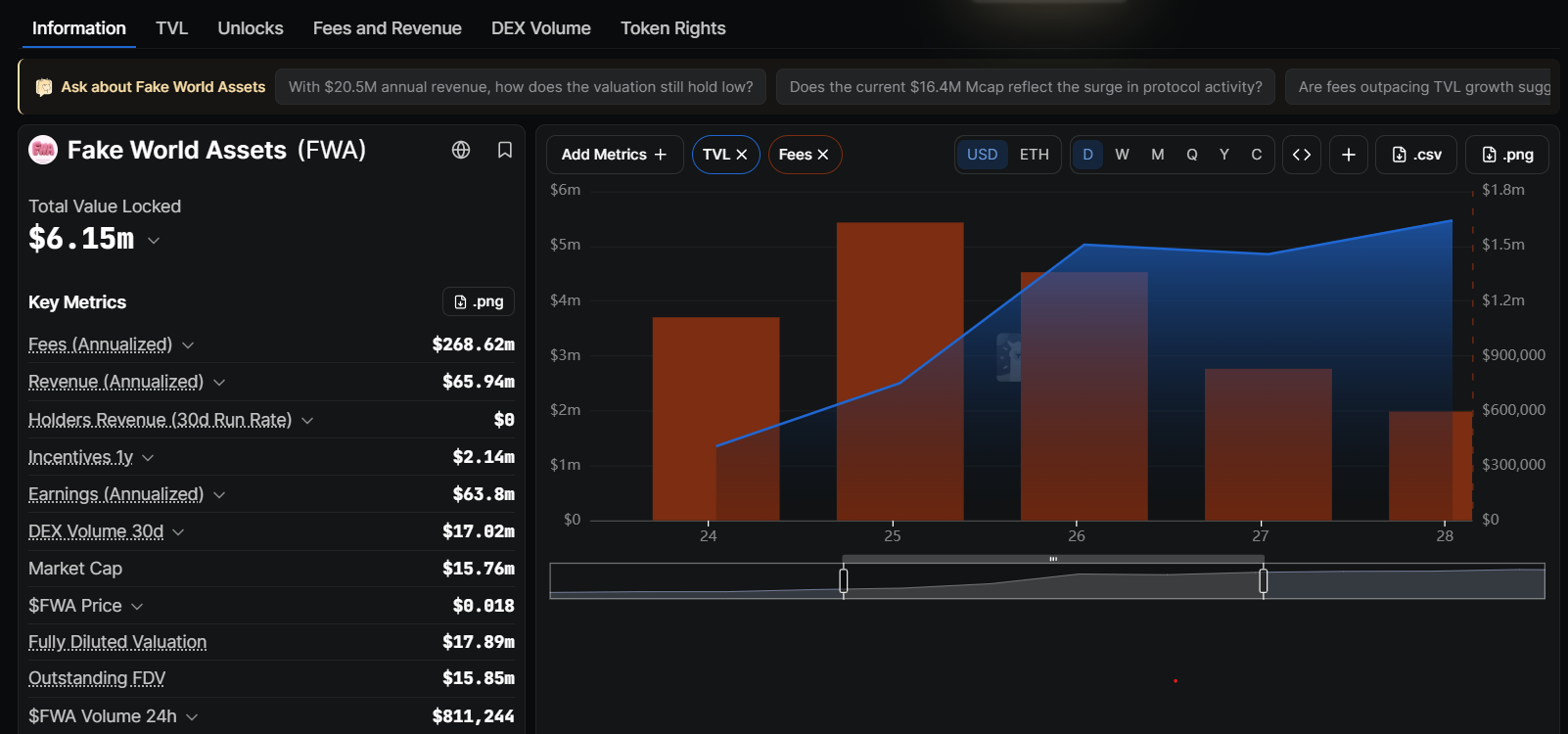
Fake World Assets TVL and fees. Source: DeFiLlama
Not everyone is convinced the excitement around FWA will last. Simon Dedic, founder of venture capital firm Moonrock Capital, and an early backer of onchain collectible platforms, tells Magazine:
“I’m very bullish on gamified commerce… my skepticism on FWA is specific.”
Dedic argues that much of the current activity is driven by generous token incentives rather than genuine demand.
“The whole thing is purely aimed at crypto degens so they can gamble and speculate,” he says.
So, is this just another short-lived obsession, or has the industry finally stumbled upon something built to last?
All very interesting, but what the heck are FWAs?
Crypto has spent years trying to put the real world onchain, from stocks and bonds to collectible cards and Brazilian cows.
Related: Gambling on random Pokémon cards: Onchain gagcha hits record high as crypto sinks
TokenWorks decided to flip the idea on its head by creating Fake World Assets, which are just NFTs. Rather than buying a specific collectible like a Bored Ape, users pay to spin an onchain “gacha” machine for the chance to win a randomly selected NFT backed by Ether.
The prizes on offer come from dozens of well-known collections, like CryptoPunks and Azuki to Lil Pudgys and Art Blocks.
Fake World Assets is just the latest Ethereum-based protocol to put a new spin on the craze.
Gacha is short for gachapon/gashapon, which are vending machines invented in Japan in the 1960s that spit out a random toy in a capsule. This mechanic migrated to mobile and browser games, with the loot boxes in Dragon Collection in 2010 often cited as the first major gacha game. Meanwhile a similar mechanic was at work with real world Pokemon trading card “booster packs” that offered a random assortment of collectible cards, of various rarity levels and values.
These cards were subsequently tokenzied onchain by projects such as Collector Crypt, Beezie and Courtyard. As Magazine reported previously, onchain gacha saw a record $324 million in volume in June. (Hundreds of these tokenized cards have now been wrapped for use on FWA.)
The concept is expanding every week, with developers experimenting with randomized “token packs” containing ERC-20 tokens, while StockRip on Robinhood chain, shows how tokenized stocks can be wrapped into NFT-based gacha packs.

Fake World Assets. Source: fwa.fun
As AzFlin, founder of DAO launchpad daos.world and a former Uniswap engineer, says:
“Just when you think everything in crypto has been invented, something new springs up.”
What is the appeal of onchain gacha?
The gacha mechanic combines crypto, collectibles and gambling . As pseudonymous crypto commentator 2Lambroz puts it, from the player’s perspective, “you’re buying a lottery ticket on the pool.”
“People enjoy playing the lottery, and it’s important to take that seriously,” says Benjamin Lockwood, a Wharton economist whose research into state-run lotteries found that people value the experience itself, not just the chance of winning.
Related: Pudgy Penguins expands retail footprint with Target trading card rollout
Meir Statman, the behavioral finance pioneer and professor at Santa Clara University and author of A Wealth of Well-Being, tells Magazine:
“There is a parallel to ‘onchain gacha’ in people bidding on the contents of abandoned storage units. Most find items worth placing in the trash, but some find items they can sell on eBay. One found a painting worth hundreds of thousands of dollars. These combine hope for riches with playfulness. This is what lotteries offer.”
Two sides to every story

Why do people play the lottery? Source: Knowledge at Wharton
There are two sides to the FWA protocol.
NFT holders become liquidity providers (LPs), depositing collectibles alongside ETH and earning a share of the fees while their position remains in the pool.
Players, meanwhile, pay for the chance to pull a randomly selected NFT, deciding afterwards whether to keep it or redeem most of its attached ETH value instead. (Blockworks Research notes that at present, around 70% of purchasers choose to convert their winnings to FWA.)
As 2Lambroz explains, LPs are effectively hoping their NFT stays in the pool long enough to earn fees before it’s selected, while players are chasing the chance of landing a prize worth far more than the cost of a spin.
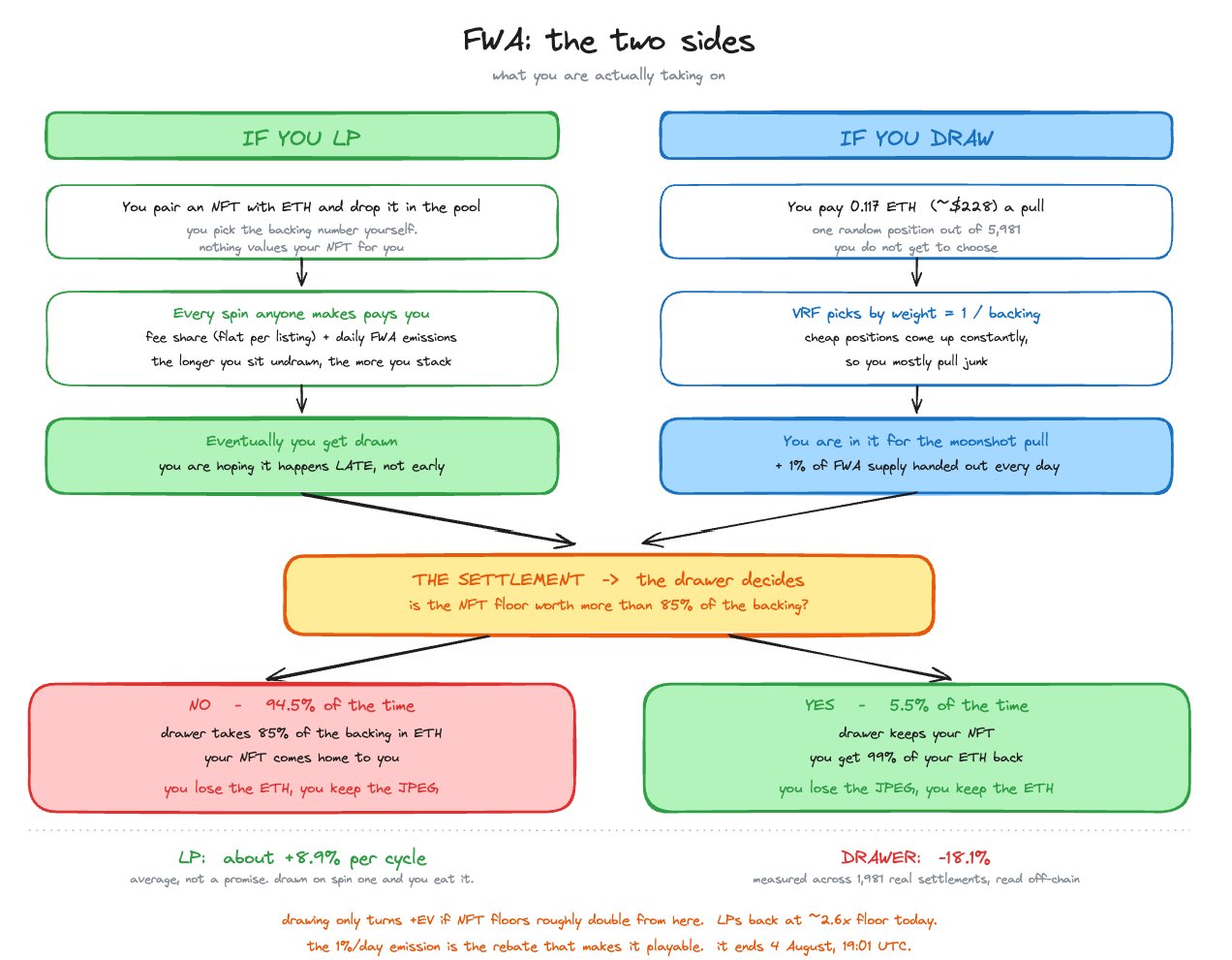
FWA: The two sides. Source: 2Lambroz
Self-proclaimed Ethereum maxi, Materkel says:
“The most fun NFT/casino primitive in over a decade of crypto, where users actually get to be both players and the house at the same time […] Money legos on Ethereum are back!”
Can the hype last?
While Dedic believes much of the activity relates to token incentives, he says he’s “very bullish on gamified commerce for a generational reason.”
“The further Gen Z moves into being the generation with the strongest buying power, the more shopping is going to be gamified and come with a dopamine kick attached.”
And rather than offering random NFTs from last cycle, Dedic believes the mechanism is better suited to assets people already want to own, such as collectibles like Pokémon cards, watches and even whiskey.
“I see enormous potential in selling much-demanded assets in a gamified way,” he says. “I see very little in building Ponzi schemes to create demand for assets nobody wanted in the first place.”
The real test will come when the novelty wears off and the incentives fade. If users keep spinning anyway, onchain gacha may have found a retail use case crypto has been searching for all along. If not, they’ll join the dumpster fire of failed crypto experiments that burned brightly before fading away.
Magazine: The 100x obsession: Fundamentals grow in importance as crypto matures
Cointelegraph publishes long-form journalism, analysis and narrative reporting produced by Cointelegraph’s in-house editorial team with subject-matter expertise. All articles are edited and reviewed by Cointelegraph editors in line with our editorial standards. Some articles contain affiliate links, from which Cointelegraph may earn a commission. These relationships do not influence which products we review or our editorial conclusions. Content published in here does not constitute financial, legal or investment advice. Readers should conduct their own research and consult qualified professionals where appropriate. Cointelegraph maintains full editorial independence.
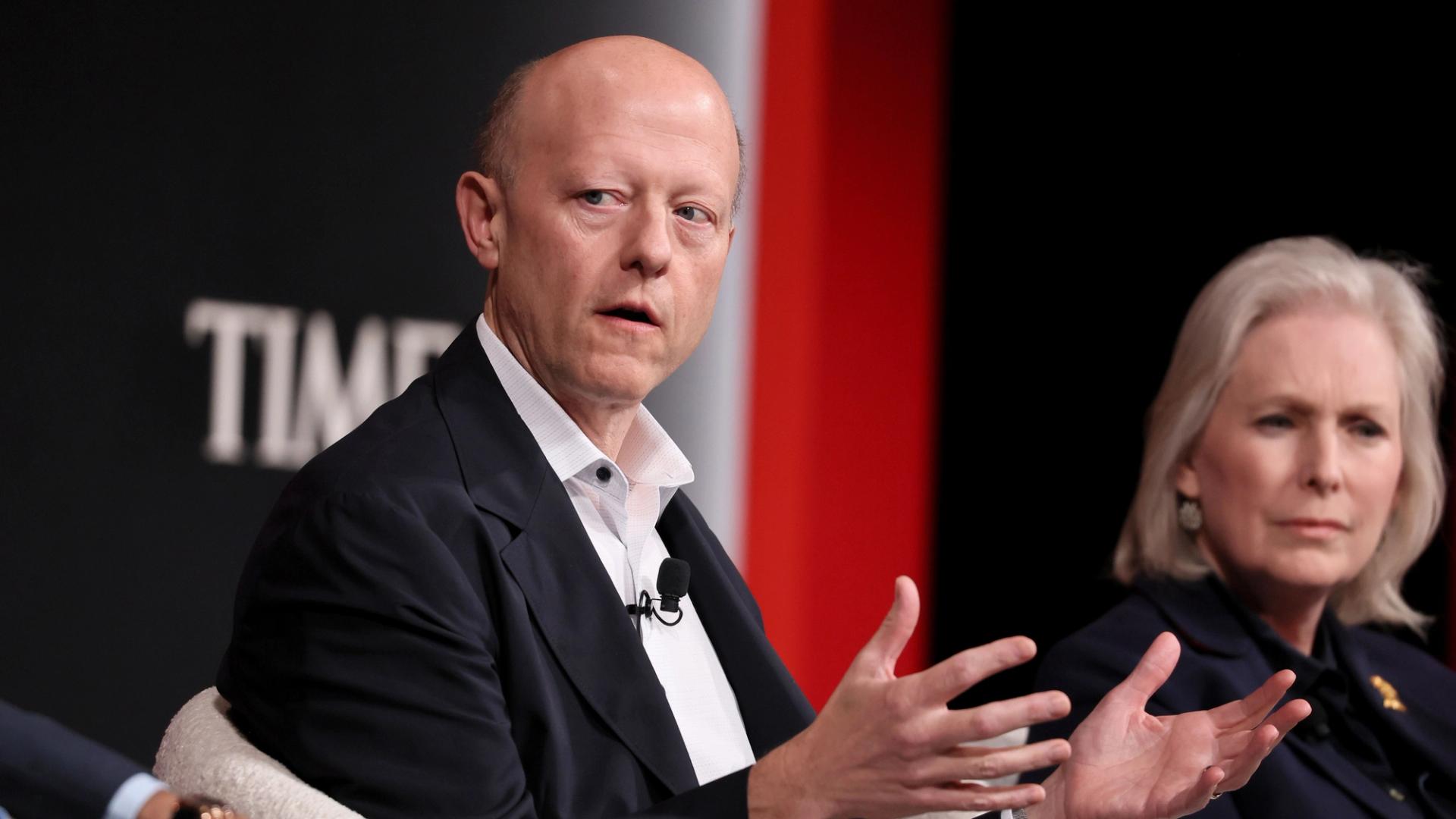
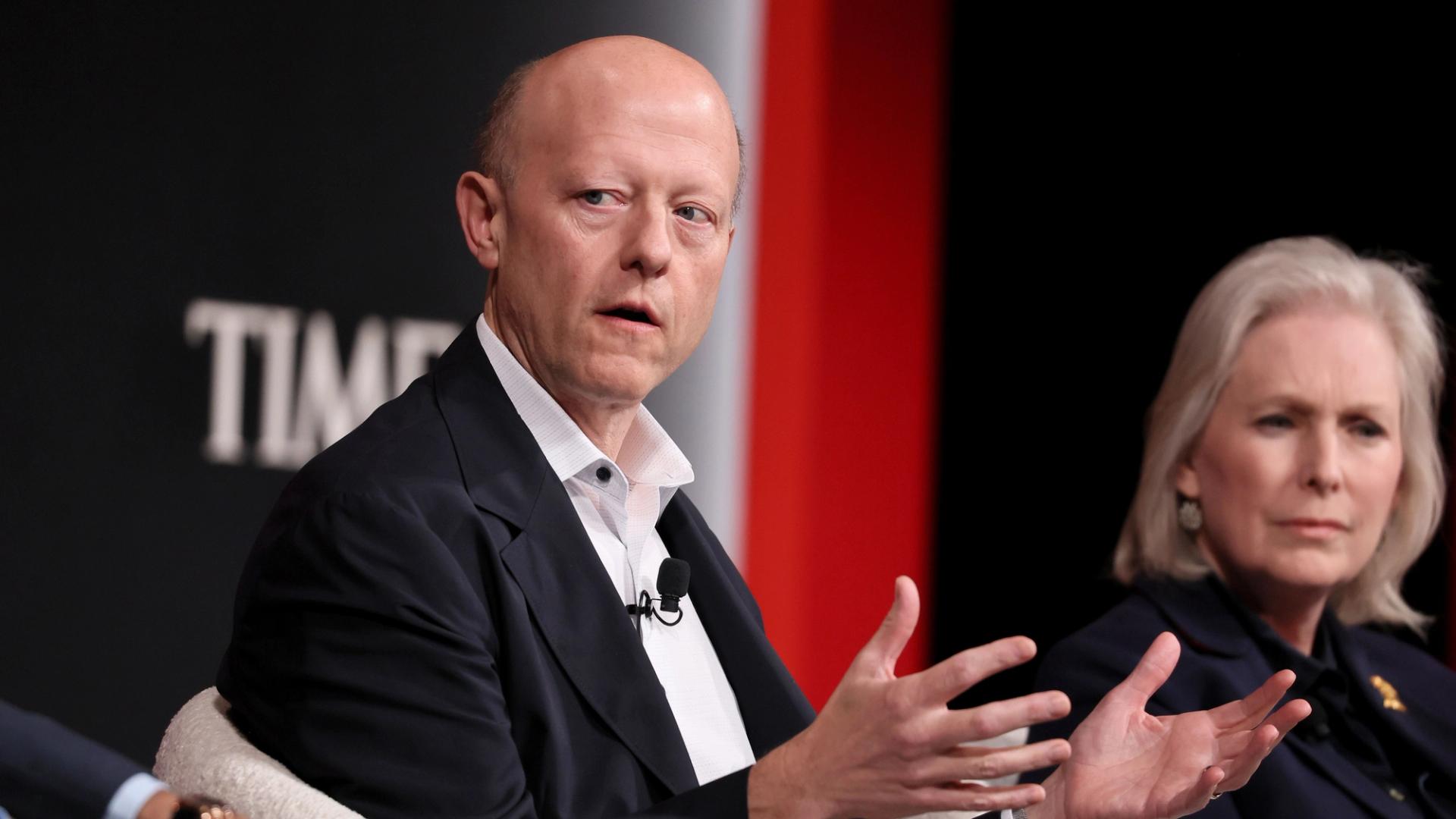
Morgan Stanley downgraded shares of Circle Internet (CRCL) to underweight from equal-weight on Monday and cut its price target to $38 from $106, citing a weaker long-term earnings outlook.
The stock, which slid 6% following the report, has fallen about 30% year-to-date, reflecting growing investor concern over the outlook for USDC, the company’s dollar-backed stablecoin and its largest source of revenue.
Analyst James Faucette said Morgan Stanley expects slower USDC growth as reserve income comes under pressure and Circle shifts toward lower-margin transaction revenue.
“We downgrade Circle, as USDC contraction exposes reserve income sensitivity and points to a lower-margin shift toward transaction revenue,” Faucette wrote in a research note.
The bank reduced its USDC supply forecasts by roughly 33% for 2027 and 44% for 2028, resulting in GAAP earnings-per-share estimates that are about 3% below Wall Street consensus in 2027 and 20% below consensus in 2028.
Morgan Stanley also pointed to rising competition from tokenized money market funds and tokenized deposits, which could reduce both USDC balances and the revenue Circle earns on reserves.

Bitmine Immersion Technologies, the largest global owner of ETH, has continued with its aggressive accumulation strategy by adding 10,399 coins over the past week.
Its treasury has consistently increased over the past year and now stands at 5,797,813 ETH – just shy of the 5.8 million milestone.
Another Big Purchase
The press release shared by the former BTC miner reads that its crypto holdings, cash, and other investments total approximately $11.3 billion. Ethereum’s stash alone is currently valued at around $10.9 billion given the asset’s retreat from over $1,900 to under $1,850. Bitmine holds 4.8% of Ethereum’s circulating supply and cemented its position as the largest corporate holder of the asset.
Moreover, it has reduced the gap with the overall leader in the cryptocurrency space, Strategy. The Saylor-co-founded company has not only halted its BTC purchases, but has just announced its third sale of the year.
According to Bitmine Chairman Tom Lee, the firm has increased its ETH position every single week since it adopted the Ethereum treasury strategy on June 30 last year. Speaking on the most recent Ethereum market performance, in which the altcoin managed to outperform BTC and many other alts, Lee noted that it’s a clear sign its fundamentals continue to improve.
Moreover, he claimed that ETH outperformed the Nasdaq 100 by 25% in July, which, as we reported during the weekend, made it the asset’s strongest month in a year.
“In July, ETH outperformed the Nasdaq 100 by 2,500bp (or 25 percentage points). This is the largest outperformance since July 2025, and we believe it is reflective of the strengthening fundamentals of crypto. Last July (2025), ETH rose from $2,375 to $4,057 by the end of August,” stated Lee.
Staking Progress
Beyond accumulating ETH, the company continues expanding its staking operations through its institutional-grade platform called MAVAN. It has already deployed 4.92 million ETH to work, representing 85% of its entire treasury. Based on current yields, Bitmine projects approximately $291 million in annual staking rewards and $247 million in annualized staking revenue.
The post Bitmine Buys Another 10,399 ETH, Treasury Nears 5.8 Million Coins appeared first on CryptoPotato.

Congress Just KILLED Crypto’s Biggest Bill

War Machine (2026) Is The Most Watched Netflix Film In 2026

Bithumb Sets 2028 IPO Target, Plans Internal-Control Overhaul


-

 Business5 days ago
Why Trees Belong on the Risk Register
-

 Fashion3 days ago
Weekend Open Thread: Wit & Wisdom
-

 Politics3 days ago
Meta enters AI-training agreement with far-right ‘propaganda rag’ Newsmax
-
 Entertainment6 days ago
‘Stargate’ Creator’s New Sci-Fi Series Returns for Season 3 Tomorrow
-

 Crypto World2 days ago
MicroStrategy Post-Earnings CLARITY Act Push Could Add New Catalyst for Its Stock
-

 Politics6 days ago
The Part of the Electric Transition Nobody Wants to Discuss
-

 Business5 days ago
Major shareholder moves on Canyon
-

 Crypto World2 days ago
XRP Ledger v3.3.0 brings five institutional features
-

 News Videos4 days ago
Bitcoin Enters the 3rd Stage of the Bear Market
-

 Crypto World6 days ago
Kraken Enables Retail Access to Jersey Mike’s IPO via Tokenized Shares
-

 Tech7 days ago
New macOS Sequoia & Sonoma security updates for older Macs
-

 Politics4 days ago
Luke Littler’s dominance sparks GOAT debate
-

 News Videos6 days ago
Claude: Build Financial Dashboards in Minutes (2026)
-

 Business6 days ago
Johnson & Johnson agrees to $5.5B settlement over talc cancer claims
-

 Sports4 days ago
Seema Kaliramna Wins Discus Throw Bronze, Takes India’s CWG Medals Tally To 17
-

 Crypto World1 day ago
Crypto PAC spending tops $2M in Michigan House race
-

 Business3 days ago
Trump Announces Hamas Disarmament Agreement as Iran Strikes Kuwait Air Base and US Attacks Pause Overnight
-

 Crypto World3 days ago
New York sues Kalshi over prediction market gambling
-

 Tech5 days ago
Gemini can now summarize the messiest comment threads in Google Docs
-

 Tech1 day ago
ESET tracks rise in malicious AI skills and adaptable malware
You must be logged in to post a comment Login