

Crypto World
Extreme fear at 16: Bitcoin’s bottom signals

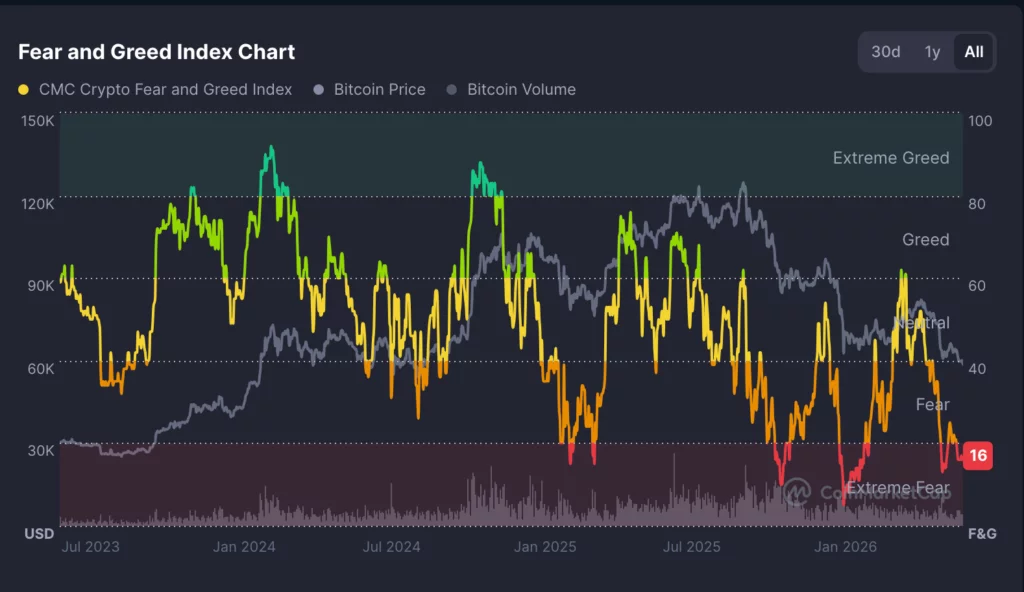
Bitcoin sits near $58,000 to $60,000 with the Fear and Greed Index buried in extreme fear. History says washed-out sentiment often precedes bottoms, but fear is a signal, not a floor. Here are the gauges traders are actually watching.
Summary
- Bitcoin trades near $58,000 to $60,000 as of July 1, 2026, down about 53% from its October 2025 record of $126,198, after back-to-back quarterly losses to open the year.
- The Fear and Greed Index sits around 12 to 16, deep in extreme fear, a zone that has historically appeared near local bottoms but is not a timing tool on its own.
- Bullish positioning signals are stacking up: open interest has collapsed from over $90 billion to about $44.5 billion, leverage is flushed, and coins are leaving exchanges in a pattern that suggests accumulation.
- The bearish counterweight is real: spot Bitcoin ETFs posted a record $4.5 billion of outflows in June, the Fed is hawkish with a likely December rate hike priced in, and one cycle model points to a bottom only around mid-October.
- The signals that would confirm a turn are concrete: reclaiming the 20-day and longer moving averages, a flip back to ETF inflows, open interest rebuilding alongside price, and the fear gauge lifting off its extremes.
Extreme fear is one of the most misread conditions in markets. When the Fear and Greed Index drops into the low teens, the crowd reads it as a reason to run, and the contrarian reads it as a reason to buy. Both are oversimplifying. Sentiment this low tells you that positioning is stretched and conviction is gone, which is often the raw material of a bottom, but “often” is not “now,” and fear can always get more extreme before it breaks.
The useful move is not to treat the fear gauge as a signal by itself, but to read it alongside the harder data on positioning, flows, and price. This piece walks through the signals traders are watching, lays out the bullish and bearish readings of each, and identifies what would actually confirm that the turn has arrived. The key point is simple: fear tells traders to pay attention, not to assume the bottom is already in.
What the Fear and Greed Index is saying
Start with the gauge everyone quotes. The Fear and Greed Index compresses several inputs, volatility, momentum, volume, and social signals, into a single 0 to 100 reading, and the latest chart still shows the market deep in extreme fear. Historically, readings this low have clustered near local bottoms, because they mark the point where sellers have largely exhausted themselves and the marginal holder is fearful rather than greedy. That is the contrarian appeal: when nobody wants the asset, much of the selling may already be done.
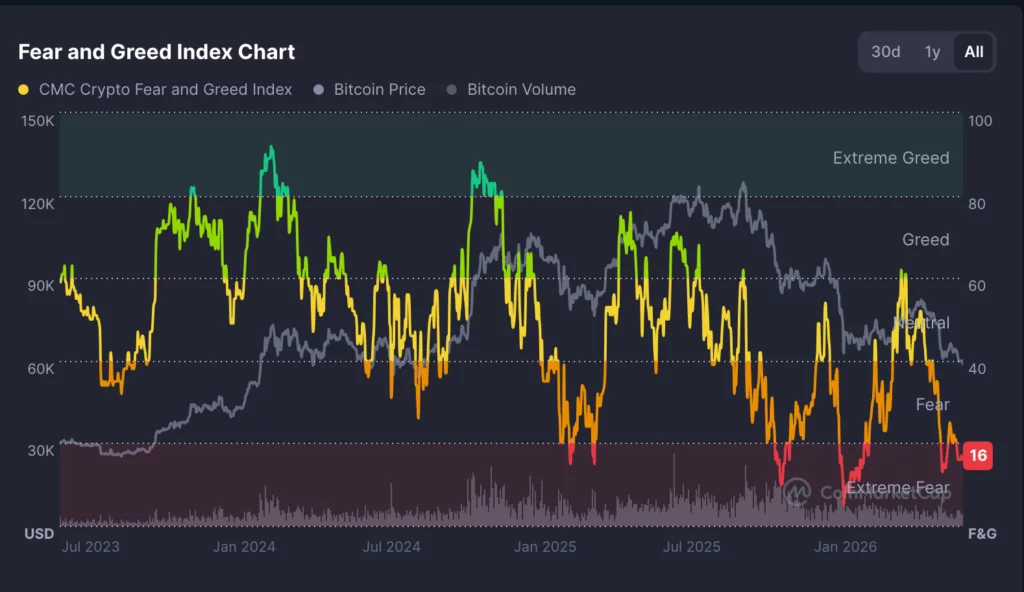
The caution is that the index is a description of the present, not a prediction of the future. Extreme fear can persist for weeks, and it can deepen. During genuine downtrends, the gauge has sat in fear for long stretches while price kept falling, so treating a low reading as an automatic buy signal has burned plenty of traders. The right way to use it is as context: it tells you the emotional backdrop is washed out, which raises the odds that other bottoming signals are meaningful, without confirming anything on its own.
That is why how the index works matters before using it as a trading signal. The number is useful because it summarizes the market mood, but it is not a floor under price. For confirmation, traders still need price levels, ETF flows, leverage data, and macro conditions to line up.
Signal one: positioning has reset
The most constructive signal under the surface is what happened to leverage. Open interest in Bitcoin derivatives has collapsed from above $90 billion to roughly $44.5 billion over recent weeks, less than half its peak. That drop reflects long liquidations, profit-taking, and traders reducing speculative exposure. In plain terms, the leverage that builds up in a rally and makes a market fragile has been flushed out.
Why this matters for a turn is mechanical. A market loaded with leveraged longs is vulnerable, because small drops trigger liquidations that cascade into larger drops. A market where that leverage has been cleared is sturdier, because the forced-selling fuel is gone. Resets like this often precede bottoms, since they remove the overhang that drags price lower and leave room for fresh positioning to push the other way.
The bearish reading is that falling open interest also signals fading demand and cautious participation, not just healthy deleveraging. Traders stepping back can mean they see no reason to buy, and a market with thin conviction can drift lower on light volume. The reset is a necessary condition for a durable bottom, but it is not sufficient by itself, because clean positioning can still sit under a price that keeps grinding down.
Signal two: exchange flows and accumulation
The second signal comes from where the coins are moving. Through the drawdown, Bitcoin has seen exchange outflows exceed inflows, meaning more coins are leaving exchanges than arriving. That pattern is typically read as accumulation: holders pulling coins into self-custody or long-term storage rather than keeping them on exchanges ready to sell. When supply leaves the venues where selling happens, it thins the pool of coins available to hit the market.
The bullish interpretation is that long-term holders are quietly buying weakness while short-term traders panic, a divergence that has marked accumulation phases before. Steady outflows during extreme fear suggest conviction underneath the fear, the kind of hands that absorb selling and set the base for a recovery. That is the constructive version of the on-chain story, and it fits with the broader idea that the market is moving from forced selling toward accumulation.
The counterpoint is that exchange flows are noisy and can reflect custody shifts, institutional plumbing, or one-off moves rather than genuine accumulation. Outflows are encouraging, but they are a soft signal, easily overstated. On their own they confirm that some holders are unbothered, not that the bottom is in. They matter most when they line up with stronger evidence from ETF flows and price.
Signal three: the ETF bid
The third signal is the one cutting against the bulls, and it is the most important on the bearish side. Spot Bitcoin ETFs recorded about $4.5 billion of net outflows in June 2026, their worst month since launching, removing the steady institutional bid that had cushioned earlier declines. The funds that were supposed to represent durable, price-insensitive demand instead became a source of selling, and their flows have tracked the drawdown closely.
This matters because the ETF bid was a structural change in how Bitcoin traded. When it was flowing in, it provided a floor of consistent demand. When it reverses, that floor becomes a headwind, and the market has to find other buyers to absorb the redemptions. For sentiment to turn convincingly, this is the signal that most needs to flip.
A return to sustained ETF inflows would tell the market that institutions are stepping back in, which would validate the bullish reading of the other signals. Continued outflows would keep the pressure on regardless of how washed out the fear gauge looks. That is why the ETF bid that reversed deserves more weight than a sentiment reading alone. In this cycle, flows are not a side detail; they are one of the main channels moving the market.
Signal four: oversold technicals
The fourth signal is on the chart. The relative strength index has dropped near 30, the oversold threshold, indicating that momentum has fallen far and fast and that the move may be stretched to the downside. Price sits near support in the $58,000 area, below the 20-day exponential moving average around $62,450, and well beneath the longer-term moving averages, the 200-day near $65,200 and the 50-month near $65,600, that mark the bull-bear boundaries.
The bullish read is that oversold conditions at support are where reversals begin, and a bounce off the high $50,000s that reclaims the moving averages would signal the downtrend is weakening. The bearish read is that oversold can stay oversold in a strong downtrend. Until price actually reclaims those moving averages, the path of least resistance points lower, with a break below support opening the door toward the mid-$50,000s. The technicals frame the levels, but they do not resolve the direction until price picks one.
That is why the level-based bottom question matters alongside sentiment. Bitcoin does not bottom because the index is low; it bottoms when buyers defend levels, reclaim resistance, and force trend-followers to change position. The fear gauge tells traders the market is stretched. The chart tells them whether the stretch is becoming a reversal.
The bull read: capitulation precedes bottoms
Put the constructive signals together and a coherent bottoming case emerges. Extreme fear, flushed leverage, steady accumulation, and oversold momentum are the classic ingredients of capitulation, the moment when the last weak hands sell and stronger hands absorb the supply. In prior cycles, this combination has marked the exhaustion of a downtrend, the point where selling pressure runs out because everyone inclined to sell already has. In this reading, the current setup looks less like the start of a new collapse and more like the late stage of a forced reset.
The bull case also treats the record ETF outflows as a lagging sign of the same capitulation instead of a fresh catastrophe. Institutions derisked into weakness, leverage was cleared, and sentiment collapsed into extreme fear. If that selling has already happened, the market may be closer to a base than the headline fear suggests. The reset positioning and the accumulation on-chain suggest a foundation is forming under the panic.
If that is right, the setup favors a recovery once a catalyst arrives to flip sentiment, and the extreme fear reading becomes, in hindsight, the marker of the low. This is the contrarian thesis, and the data gives it real support. The key caveat is timing: a market can be in a bottoming zone before the actual bottom is printed. Bulls still need confirmation before calling the turn.
The bear read: fear can deepen
The opposing case is equally grounded, and it starts with the fact that Bitcoin is down about 53% from its high with back-to-back quarterly losses, a genuine bear market instead of a shallow dip. Deep drawdowns can extend, and washed-out sentiment can get more washed out. The macro backdrop offers no relief: the Fed is hawkish under its current chair, markets are pricing a strong chance of a December rate hike as inflation drifts back toward 4%, and a key jobs report looms, all of which pressure risk assets like Bitcoin, which trades as high-beta risk far more than as a haven.
There is also a timing argument. One cycle model notes that bear-market corrections have averaged about 12 months, which, measured from the October 2025 record, points to a bottom only around mid-October 2026. By that reading, the current fear could be a stop along the way instead of the destination, with more downside and more time required before a durable low. The record ETF outflows, in this frame, are an active headwind, not a capitulation tail.
Fear is a signal, not a floor, and it can persist far longer than the impatient expect. The chart can stay oversold, ETF flows can stay negative, and macro can keep forcing risk assets lower. That does not invalidate the bottoming signals; it simply means they are conditions, not confirmations. The bear case is strongest as long as price remains below the key moving averages and the ETF bid stays absent.
What would confirm a turn
The way to cut through the debate is to watch for confirmation instead of guessing at the bottom. Four signals would mark a genuine turn. The first is price reclaiming the 20-day EMA near $62,450 and then the heavier resistance around $64,000, which would break the pattern of lower highs and put buyers back in control. The second is ETF flows flipping from outflows back to sustained inflows, the clearest sign the institutional bid has returned.
The third is open interest rebuilding alongside a rising price, which would show fresh capital coming in with conviction instead of a low-volume drift. The fourth is the Fear and Greed Index lifting off its extremes, confirming that the emotional backdrop is normalizing. Until several of those align, the constructive signals remain a setup instead of a trigger. Extreme fear, reset leverage, and accumulation describe a market that could turn, not one that has.
The discipline is to treat washed-out sentiment as a reason to watch closely, while waiting for price and flows to confirm before concluding the low is in. That is how experienced traders use a reading in extreme fear: not as a buy button, but as a cue to track the signals that actually mark the turn. The lower the fear gauge falls, the more important confirmation becomes, because the emotional temptation to act early grows stronger.
How this fear compares with past bottoms
Extreme fear is not new, and prior episodes offer a rough guide to how it tends to resolve, with a large caveat. In earlier cycles, the deepest fear readings have often clustered near major lows, appearing when a drawdown was closer to its end than its beginning, precisely because fear peaks when selling has run far. The pattern that has marked durable bottoms combines washed-out sentiment with flushed leverage and steady accumulation by long-term holders, the same three ingredients visible now. On that template, the current setup rhymes with past bottoming conditions.
The caveat is that the template has failed often enough to demand humility. Extreme fear has also appeared in the middle of downtrends, not just at their ends, and readers who bought every low reading in a bear market bought too early more than once. The difference between a fear reading that marks a bottom and one that marks a pause is usually not visible in the sentiment gauge itself. It shows up later, in whether price reclaims key levels and whether the institutional bid returns.
There is also a structural change that makes the comparison imperfect. The presence of spot ETFs has altered how Bitcoin trades, adding a large, flow-driven institutional participant that did not exist in earlier cycles. That means past bottoming patterns, built in a market without ETFs, may not map cleanly onto this one. The ETF flows can amplify moves in both directions, which is why the record June outflows matter so much and why this cycle’s bottom may look different from the ones the historical template describes.
The macro calendar that matters
Because Bitcoin is trading as a high-beta risk asset, the signals most likely to flip or deepen sentiment are macroeconomic, and the calendar is crowded. The nearest is the monthly jobs report, a read on labor-market strength that feeds directly into rate expectations: a hot number would reinforce the case for the Fed staying tight, pressuring risk assets, while a soft number could revive hopes for easier policy and lift them. Traders watching for a sentiment turn are watching that print closely. It is not a crypto-native signal, but it can decide whether crypto-native bottoming signals actually matter.
Further out sits the Fed itself. With markets pricing a meaningful chance of a December rate hike as inflation drifts back toward 4%, each inflation report and each Fed meeting becomes a potential catalyst. A hawkish surprise would deepen the risk-off mood that has weighed on Bitcoin, while any sign the tightening is ending could mark the macro turn that a sentiment-driven bottom needs. The path of rates, more than any crypto-native signal, is the backdrop against which the fear gauge will either normalize or sink further.
The practical point is that a durable turn in Bitcoin sentiment probably requires a shift in the macro wind, not just an oversold chart. The internal signals, reset leverage, accumulation, extreme fear, describe a market primed to respond, but the trigger is likely to come from outside crypto: a softer labor market, a friendlier inflation path, or a Fed that signals the end of tightening. Until the macro calendar delivers one of those, the constructive crypto signals remain a coiled setup waiting for a catalyst, which is why traders track the economic data as closely as the order book right now.
The one signal that matters most
With so many gauges flashing at once, it helps to rank them, and in this cycle one signal outranks the rest: the ETF bid. Before spot Bitcoin funds existed, a bottom was mostly a story about on-chain holders, leverage, and sentiment, the classic signals. Those still matter, but the arrival of ETFs added a large, flow-driven institutional participant whose buying and selling now sets much of the marginal price. When that participant is buying, it provides a steady floor. When it is selling, as it was through the record June outflows, it becomes a persistent drag that the other signals cannot easily overcome.
That is why the ETF flow number deserves more weight than the fear gauge or the RSI. Extreme fear can mark a bottom, reset leverage can prime one, and accumulation can build a base, but none of them forces the institutional bid to return. The flows do that directly. A market can sit at extreme fear with clean positioning and still grind lower if the funds keep redeeming, because the redemptions are real selling that has to be absorbed.
Conversely, a decisive flip back to sustained inflows would validate every other constructive signal at once, confirming that the capitulation the other gauges describe has actually ended. The practical takeaway is a hierarchy. Treat the ETF flows as the primary confirmation, the signal that most reliably separates a real turn from a false one. Treat reset leverage and on-chain accumulation as supporting evidence that the setup is favorable. Treat extreme fear and oversold technicals as context that raises the odds without confirming anything.
The macro calendar is the likely trigger that moves the flows one way or the other. Reading the signals in that order, flows first, positioning second, sentiment last, is how to avoid the classic trap of buying extreme fear too early. The gauge in extreme fear tells you the market is primed. The ETF flows will tell you when it has actually turned.
Frequently asked questions
What does a Fear and Greed reading near 16 mean?
It means the index sits deep in extreme fear, its lowest zone, reflecting washed-out sentiment across volatility, momentum, volume, and social signals. Historically, readings this low have appeared near local bottoms because much of the selling may be exhausted. But it is a description of the present, not a prediction, and extreme fear can persist or deepen during a real downtrend.
Is extreme fear a reliable buy signal?
Not on its own. Low readings raise the odds that a bottom is near, but sentiment can stay fearful for weeks while price keeps falling. It is best used as context alongside harder data on positioning, flows, and price, instead of as a standalone trigger. Treating a low reading as an automatic buy has repeatedly caught traders too early.
Why does falling open interest matter?
Open interest dropping from over $90 billion to about $44.5 billion means leverage has been flushed out through liquidations and derisking. That makes the market sturdier, because the forced-selling fuel that drives cascading drops is gone, which often precedes bottoms. The caveat is that falling open interest can also signal fading demand, so it is a necessary but not sufficient condition for a turn.
What are exchange outflows telling us?
More Bitcoin has been leaving exchanges than arriving, a pattern typically read as accumulation, with holders moving coins into storage instead of keeping them ready to sell. It suggests conviction underneath the fear. But exchange flows are noisy and can reflect custody or institutional shifts, so they are a soft signal that some holders are unbothered, not proof the bottom is in.
Why are the ETF outflows so important?
Spot Bitcoin ETFs posted a record $4.5 billion of outflows in June 2026, turning the steady institutional bid that once cushioned drops into a headwind. Because that bid was a structural support, its reversal is the signal that most needs to flip for a convincing turn. A return to sustained inflows would validate the bullish case, while continued outflows keep pressure on regardless of sentiment.
Where is Bitcoin’s key support and resistance?
Support sits near the $58,000 area, and reclaiming the 20-day EMA around $62,450 is the first upside test, followed by heavier resistance near $64,000 and the longer-term moving averages around $65,200 to $65,600. RSI near 30 shows oversold momentum. A break below support opens the door toward the mid-$50,000s, while reclaiming the moving averages would signal the downtrend is weakening.
Could Bitcoin fall further from here?
Yes. Bitcoin is down about 53% from its record with back-to-back quarterly losses, and deep drawdowns can extend. A hawkish Fed, a likely December rate hike, and looming jobs data pressure risk assets, and one cycle model points to a bottom only around mid-October 2026. Extreme fear is a signal, not a floor, and it can persist longer than expected.
What would confirm that Bitcoin has turned?
Four signals: price reclaiming the 20-day EMA near $62,450 and then resistance around $64,000, ETF flows flipping back to sustained inflows, open interest rebuilding alongside a rising price, and the Fear and Greed Index lifting off its extremes. Until several align, the constructive signals describe a market that could turn instead of one that has, so confirmation should come before conviction.
Disclaimer: This article is for information purposes only and does not constitute financial, investment, or trading advice. Cryptocurrency prices are highly volatile, and technical and sentiment analysis is speculative and may not predict actual movements. Nothing here is a recommendation to buy or sell any asset. Always do your own research and consider consulting a licensed professional before making financial decisions. Figures are accurate as of July 1, 2026, and will change.


Robinhood is pushing deeper into tokenized markets and perpetual trading, partnering with the team behind the dYdX decentralized exchange to relaunch the protocol as Arcus on Robinhood Chain. The move links a retail-focused trading brand with on-chain derivatives infrastructure, aiming to bring around-the-clock access to US equity exposure and perpetual products.
According to posts from Arcus on X, dYdX is now Arcus and the protocol will launch on Robinhood’s Arbitrum-based layer 2 network, which went live the same day. The dYdX Foundation said the dYdX blockchain itself is not affected, adding that Arcus is a separate offering built through infrastructure created by dYdX Labs in partnership with Robinhood.
Key takeaways
- dYdX is rebranded into Arcus and positioned for a launch on Robinhood Chain, Robinhood’s Arbitrum-based layer 2.
- dYdX Foundation says the original dYdX blockchain remains unchanged and continues to be community-owned.
- Arcus plans tokenized stock trading and perpetuals, including the ability for tokenized stocks to be used as collateral.
- Robinhood Chain is being marketed as a venue for expanded tokenized-asset access as regulators show interest in bringing such products to market.
- Early ecosystem integration efforts are already forming, with wallet and swap-platform partners announcing support for Robinhood Chain.
Arcus launches on Robinhood Chain with tokenized stocks and perps
Arcus describes its goal as removing access barriers for traditional market participants who—according to the protocol—have historically been “shut out” of equities, commodities, and index exposure due to geography, market hours, and institutional restrictions. In a blog post titled “Arcus x Robinhood: Trade Stocks & Perpetuals 24/7”, Arcus says the protocol was built specifically to reduce those barriers.
The protocol states that it will support perpetual products and tokenized stock trading, with the initial products scheduled to go live this month. Arcus also says tokenized stocks can be used as collateral for perpetuals—an approach that, if it scales, could connect retail stock-like exposure to continuously traded derivatives.
In addition, Arcus claims it will provide access to “pre-IPO markets.” The details of which tokenized instruments qualify for that claim are not specified in the provided materials, so users will likely need to watch the protocol’s product rollout and collateral eligibility before assuming full parity with traditional pre-IPO access channels.
dYdX Foundation: dYdX blockchain remains community-owned and “not affected”
While the product is branded as Arcus, the dYdX Foundation sought to clarify that the broader ecosystem is not being rewritten around Robinhood. In its statement, the Foundation said that Arcus is a distinct, independent product built on separate infrastructure and that the dYdX blockchain is not affected in any way. It also reiterated that the dYdX blockchain would continue operating and remain community-owned.
That distinction matters for existing users and liquidity providers who associate dYdX with a specific chain and governance structure. Instead of a direct migration of the original chain, Arcus appears positioned as a parallel protocol offering—one that Robinhood’s users can reach through Robinhood Chain.
Arcus also said Robinhood’s crypto technology arm, Robinhood Crypto, made an investment in Arcus, though it did not disclose further terms or figures in the materials provided.
Robinhood’s tokenized-assets and perp push meets competitive pressure
This development arrives as tokenized assets and on-chain derivatives move from “niche” to mainstream attention. The article framing points to renewed momentum as regulators in the US have shown interest in allowing tokenized products to come to market more easily. (For context, the provided coverage references SEC-related proposals around tokenized US stocks.)
Robinhood’s interest in perpetual trading also reflects how quickly trading formats can shift user behavior in crypto markets. The provided material notes that traders have been increasingly active on the crypto perpetual futures platform Hyperliquid, whose token reportedly climbed nearly 150% so far this year, as earlier coverage highlighted a surge in open interest and market attention. Robinhood’s bet appears to be that tokenized equities plus perpetual mechanics—traded on a familiar retail rail—could draw demand beyond traditional spot-only approaches.
More broadly, the competitive dynamic is not limited to crypto exchanges. Major retail-oriented trading platforms have expanded their offerings to remain competitive, and the provided coverage points to examples such as Coinbase expanding access to thousands of stocks. It also notes Coinbase’s earlier 2023 move into building its own Ethereum layer-2, Base, which has grown significantly, according to DeFiLlama data referenced in the provided text.
Robinhood Chain now adds another front in this trend: blending a consumer brand’s market access with on-chain infrastructure built for tokenized instruments and derivatives.
Ecosystem signals: wallets, swaps and first movers on Robinhood Chain
Alongside the Arcus announcement, additional ecosystem support was highlighted. The provided materials report that Bitget Wallet partnered with Robinhood Crypto to integrate Robinhood Chain, enabling users to trade tokenized stocks. Separately, decentralized exchange aggregator 1inch said it would be among the first major swap platforms to support Robinhood Chain.
These integrations are important because they determine how quickly new assets and liquidity can become accessible to end users. Tokenized stocks and perpetuals are only as practical as the rails that let retail participants reach them—through wallets, swaps, and routing infrastructure—without unnecessary friction.
The combination of an exchange-like retail pathway (Robinhood) and DeFi-style liquidity tools (wallet integrations and aggregators) suggests Robinhood Chain is aiming to be more than a closed ecosystem. However, the true depth of support—such as which specific tokenized stocks will be available first, how collateral is handled across markets, and what the onboarding experience looks like—will only become clear after the protocol’s rollout begins.
As Arcus products go live on Robinhood Chain this month, the key details to watch are collateral rules for tokenized stocks, the breadth of available perpetual markets, and whether liquidity and execution quality improve quickly enough for retail traders accustomed to centralized-style trading speed. The dYdX Foundation’s assurance that the original dYdX chain remains unchanged should reduce concern about existing governance and infrastructure, but users will still want to confirm how Arcus will function as a separate, Robinhood-connected product.

TL;DR
- Tether froze USDT held in 131 TRON wallets after OFAC linked the addresses to ISIS-K.
- The updated U.S. sanctions list added 134 crypto wallet addresses, including 131 on TRON and three on Monero.
- Chainalysis said the sanctioned TRON wallets received more than $1.4 million since 2023 and sent over $880,000.
- The latest action expands Tether’s compliance efforts as regulators tighten oversight of illicit crypto transactions.
Tether has frozen USDT balances held in all 131 TRON wallets linked to the terrorist group ISIS-K after the U.S. Department of the Treasury’s Office of Foreign Assets Control (OFAC) expanded its sanctions list to include 134 cryptocurrency wallet addresses. The updated designation covers 131 TRON addresses and three Monero addresses believed to be associated with the group’s financial activities.
According to blockchain analytics firm Chainalysis, the sanctioned TRON wallets have received more than $1.4 million since 2023 and have transferred over $880,000 during that period. The action follows OFAC’s latest sanctions update targeting ISIS-K, the Islamic State’s affiliate operating in Afghanistan, Pakistan, and parts of Central Asia.
OFAC Expands Sanctions as Tether Blocks ISIS-K-Linked Wallets
The latest sanctions update adds 134 cryptocurrency wallet identifiers to OFAC’s existing designation of ISIS-K, a group that has previously used cryptocurrency to support fundraising efforts. Historical investigations have shown that the organization’s media arm, al-Azaim Media Foundation, solicited crypto donations through online campaigns using multiple digital assets, including TRON, Monero, and Bitcoin.
Chainalysis points out that the 131 TRON wallets at the center of the sanctions have interacted with mainstream crypto services and, in some cases, transferred funds to cryptocurrency exchangers based in Syria. In response to the designation, Tether froze the USDT balances held in all of the sanctioned TRON addresses.
The sanctions update comes as regulators continue to strengthen oversight of cryptocurrency transactions linked to terrorism financing and other illicit activities. Following the latest designation, financial institutions and virtual asset service providers are expected to update their sanctions screening and transaction monitoring systems to identify exposure to the newly listed wallet addresses.
Tether Continues to Expand Compliance Efforts
The latest wallet freeze comes just days after Tether, currently providing custodial wallets, blocked $344 million in USDT held across two TRON wallets that had been flagged by U.S. authorities over suspected illicit activity. That action ranked among the company’s largest compliance operations and reflected its ongoing coordination with law enforcement agencies.
According to Tether, the company has frozen more than $4.4 billion in digital assets since it began working with authorities, including approximately $2.1 billion linked to requests from U.S. agencies. The stablecoin issuer says it has supported more than 2,300 investigations involving 340 agencies across 65 countries.
The latest enforcement action highlights the growing role of stablecoin issuers in enforcing sanctions on public blockchain networks. While blockchain transactions remain transparent and traceable, issuers such as Tether, which is also one of the biggest Bitcoin holders, can freeze tokens when wallet addresses are linked to sanctioned entities or criminal investigations, making compliance measures an increasingly important part of the digital asset ecosystem.


French Interior Minister Laurent Nuñez says authorities have recorded 77 incidents involving kidnapping, extortion, or attempted extortion linked to crypto in the first half of 2026—an increase from 45 cases recorded across all of 2025. Speaking to the Association for the Development of Digital Assets (ADAN), Nuñez pledged a “more ambitious” government response to tackle the so-called “crypto wrench” attacks, where criminals use physical violence to force victims into handing over cryptocurrencies.
France is among the countries most frequently targeted for these attacks, in part due to the scale of retail adoption. ADAN estimates that about 11% of the French population owns cryptocurrencies—roughly 7.3 million people—making the country a major pool for criminals seeking both visibility and leverage.
Key takeaways
- France recorded 77 crypto-linked kidnapping/extortion incidents in the first half of 2026, up from 45 across all of 2025, according to figures cited by BFM Business.
- Nuñez says France’s dedicated prevention platform and rapid-alert/protection system has attracted 724 sign-ups so far.
- Emergency measures have reportedly led to 200 arrests, including an attacker detained within eight hours after a victim used an emergency identification hotline.
- Nuñez outlined a three-part plan focused on better intelligence-sharing, deeper coordination with ADAN, and improved operational alignment between security services.
- CertiK reports wrench attacks rose 41% globally in the first four months of 2026 versus the same period in 2025, with Europe accounting for most activity.
A sharp rise in crypto-linked extortion and kidnapping
Nuñez’s remarks underscore how quickly crypto crime involving physical coercion appears to be scaling in France. The 77 incidents reported so far this year, as cited by BFM Business, represent a steep year-over-year acceleration: 45 incidents were logged over the entire previous calendar year of 2025.
Nuñez told ADAN that authorities regard these cases as serious and that public concern is justified. That framing matters for both policy and investor sentiment, because it signals that the state is moving beyond general warnings and into more structured prevention and enforcement.
France expands prevention and emergency response
Earlier in 2026, French authorities reportedly launched a prevention platform alongside a rapid-alert and protection system for crypto holders and professionals. Nuñez said the initiative has already reached 724 sign-ups, suggesting that at least some in the sector are willing to use formal reporting channels and risk-reduction tooling.
According to Nuñez, the emergency approach has also translated into enforcement outcomes. He said it has resulted in 200 arrests, and highlighted a recent case where an attacker was arrested within eight hours on Friday—helped, he said, by a victim using an emergency identification hotline.
For victims and service providers, the practical value of such a hotline is that time-to-response can determine whether coercion ends with a transfer or with the attack interrupted. For the industry, higher sign-up rates may also improve the quality of reporting data, helping law enforcement target networks rather than individual incidents.
Three-part plan: intelligence, coordination, and operations
Nuñez promised a “more ambitious” three-part plan designed to strengthen security across the crypto sector. The plan includes:
- Stronger intelligence-sharing, reflecting Nuñez’s view that criminal networks often operate from abroad.
- Deepened partnership with ADAN, aiming to align the government’s approach with the sector’s infrastructure and reporting mechanisms.
- Better operational coordination between security services, intended to streamline how cases are investigated and responded to.
While the government’s prevention measures are already in place, the emphasis on intelligence-sharing and cross-agency coordination indicates officials see wrench attacks as a transnational criminal problem—not simply isolated cases. That framing can influence how exchanges, custody providers, and other compliant market participants think about operational readiness and incident reporting.
Why France is a focal point for wrench attacks
Broader reporting from blockchain security firm CertiK adds context to Nuñez’s announcement. In a report released in May, CertiK said wrench attacks globally increased 41% in the first four months of 2026 compared with the same period in 2025, with most attacks occurring in Europe.
CertiK also described France as the “epicenter” of these attacks. In its assessment, factors include the presence of prominent industry companies and their executives, what it characterizes as a culture of public “flexing” and voluntary doxxing within parts of the crypto community, and “proven exposure” from multiple sensitive data leaks.
The human and industry consequences are not theoretical. French hardware wallet maker Ledger co-founder David Balland was kidnapped and held for ransom in January 2025, alongside his partner, before police rescued them. The incident followed a damaging earlier event: CertiK-linked coverage points to Ledger’s 2020 data breach, in which its customer database was hacked and more than 270,000 personal records were leaked—an episode that the firm says contributed to subsequent phishing and wrench attacks that continue to this day.
“France ranks among the most targeted countries in the world for this type of breach,” CertiK said, connecting the country’s risk to both criminal targeting and the downstream effects of data exposure.
What to watch next for holders and the sector
Nuñez’s plan suggests France intends to scale enforcement and prevention further, but readers should watch whether sign-ups to the rapid-alert system continue to grow and whether intelligence-sharing and operational coordination lead to sustained disruption of the networks behind these attacks. With CertiK’s data indicating Europe is driving much of the year’s rise, the next measure of success will likely be fewer incidents alongside faster intervention when threats emerge.


France has recorded 77 crypto-related kidnappings, extortions, and attempts since January, Interior Minister Laurent Nuñez said, as he unveiled a security plan he called more ambitious to protect digital asset holders.
The figure marks a sharp rise from the previous year and puts the spotlight on France again as the global center of violent crypto crime.
Inside the French Security Plan To Counter Crypto Kidnappings
Nuñez addressed members of the Association pour le Développement des Actifs Numériques (ADAN) this week.
Follow us on X to get the latest news as it happens
According to BFMTV, he outlined a plan built on three pillars.
- Strengthening intelligence sharing: He called this “fundamental and extremely effective.” The focus is on gathering more intelligence on the criminal teams behind these crimes, since those ordering them are sometimes based abroad.
- Strengthening the partnership with ADAN: This includes creating a network of experts to bring together industry players and relevant state agencies.
- Strengthening operational coordination: Finally, he pointed to improving coordination between government departments to neutralize offenders, as well as deepening cooperation with foreign states where the perpetrators of these crimes are located.
Concern had been building for months. In April, officials said France had suffered at least 41 crypto-related kidnappings and home invasions. That pace equaled roughly one every 2 to 3 days.
Notable Cases Drive the Crackdown
The plan follows a run of cases in 2026. In February, intruders targeted the home of Binance France’s chief executive. He was not there, and they fled with two phones.
Other 2026 attacks turned costly. In March, fake police officers robbed a couple of 900,000 euros in Bitcoin (BTC). In April, two men extorted 700,000 euros from a family of five.
The violence had intensified through 2025. One of the notable cases in January that year was when kidnappers seized Ledger co-founder David Balland and his partner.
These cases highlight the need for stricter security measures in France. The reach of the new plan will test whether the state can protect the sector.
Subscribe to our YouTube channel to watch leaders and journalists provide expert insights
The post France Logs 77 Crypto Kidnappings and Extortions Since January, Minister Says appeared first on BeInCrypto.


Robinhood has launched its Ethereum Layer 2 mainnet alongside tokenized stock trading and perpetual futures, expanding its blockchain based financial services beyond the testnet stage.
Summary
- Robinhood has launched its Ethereum Layer 2 mainnet with tokenized stocks and decentralized finance features.
- Eligible users in more than 120 countries can trade tokenized stocks through Robinhood Wallet on supported decentralized exchanges.
- Robinhood Wallet now offers perpetual futures through Lighter, with eligible users earning LIT token rewards based on trading activity.
According to an announcement during the company’s “The World is Flat” event in London, Robinhood has unveiled the public mainnet of Robinhood Chain, an Ethereum Layer 2 network built with Arbitrum technology, while introducing tokenized stocks and decentralized perpetual futures trading as part of its latest international product rollout.
Speaking during the launch, Robinhood CEO Vlad Tenev and other executives described the announcement as the company’s most ambitious global expansion and product strategy so far, with a focus on combining traditional financial products with decentralized finance infrastructure.
Robinhood Chain moves from testnet to mainnet
Robinhood Chain has been launched as a permissionless, AI native Ethereum Layer 2 network designed for real world assets. Built using Arbitrum’s technology stack to institutional standards, the network includes integrations with Alchemy, BitGo, and Chainlink, while also supporting built in DeFi features such as lending and borrowing.
The company said Uniswap will deploy a dedicated automated market maker as the chain’s primary public liquidity protocol, while Pleiades will launch its own automated market maker to serve as the primary proprietary trading venue.
The mainnet launch follows Robinhood Chain’s public testnet debut in February. At the time, Tenev said the network processed more than four million transactions during its first week, with developers already experimenting with tokenized stock assets and decentralized financial applications. The testnet was built to let developers evaluate tools and infrastructure before the production rollout.
Tokenized stocks and perpetual futures expand offering
Alongside the blockchain launch, Robinhood introduced a new version of Stock Tokens that allows eligible users to trade tokenized equities around the clock directly on Robinhood Chain. According to the company’s disclosures, the tokens can also be used as collateral across decentralized finance applications and deployed into lending pools.
Robinhood said the new Stock Tokens are tokenized debt securities issued by Robinhood Assets (Jersey) Limited. While they provide economic exposure to the underlying shares, holders do not receive legal ownership or beneficial rights in the underlying stocks.
Eligible users in more than 120 countries can access the assets through Robinhood Wallet, with spot trading available on decentralized exchanges including Uniswap, Rialto, Lighter, 1inch and Arcus, which was developed by the team behind dYdX. The company said the product is unavailable to users in the United States and remains restricted in several other jurisdictions, including Canada, the United Kingdom, Switzerland, the United Arab Emirates and sanctioned regions.
Robinhood also renamed its earlier tokenized equity product as Classic Stock Tokens. Those assets, first introduced during the company’s Cannes event in June 2025, will continue to operate inside the Robinhood Europe app after the launch of the new on chain version.
Attention also turned to Robinhood Wallet, which now offers eligible users in selected jurisdictions access to perpetual futures through Ethereum-based decentralized exchange Lighter. According to the company’s disclosures, the product is not available in the United States, the United Kingdom, Canada, Switzerland, the United Arab Emirates, Singapore, and other restricted markets.
Robinhood said Lighter has allocated $11 million worth of its native LIT tokens to the Robinhood community. Eligible users will earn trading points on perpetual futures transactions that convert into LIT tokens, with trades executed through Robinhood Wallet receiving double the points compared with trades placed directly through Lighter’s web application.
Key Highlights
- Trading volume across Kalshi, Polymarket, and Polymarket US surged to $44.8 billion in June, marking a 75% increase from May’s figures
- Kalshi dominated growth with an impressive 87.4% month-over-month expansion, totaling $31.5 billion
- Polymarket’s international platform jumped 45% to $10.26 billion, while its U.S. version reached $3.04 billion
- FIFA World Cup 2026, launching June 11, served as the primary catalyst for unprecedented trading activity
- Kalshi’s World Cup championship market alone accumulated over $832 million in wagers, with France leading at 35% probability
The prediction market industry witnessed its most explosive month ever in June, with major platforms Kalshi and Polymarket experiencing unprecedented growth driven primarily by FIFA World Cup 2026 enthusiasm.
New figures from The Block reveal that Kalshi, Polymarket, and Polymarket US collectively generated $44.8 billion in trading activity throughout June. This represents a substantial 75% leap compared to the $25.66 billion recorded in May.
These statistics underscore the rapidly expanding mainstream acceptance of prediction markets, platforms where participants wager actual funds on outcomes spanning political contests, sporting events, and other real-world developments.
Kalshi Dominates Market Share
Kalshi emerged as the clear leader among the three platforms, demonstrating exceptional performance. Monthly volume skyrocketed from $16.81 billion in May to $31.5 billion in June, representing an 87.4% monthly surge.
This achievement positions Kalshi as the undisputed volume leader, capturing over two-thirds of the combined three-platform total.
Polymarket’s primary international platform generated $10.26 billion throughout June, representing a 45% uptick from May’s $7.08 billion figure.
After experiencing consecutive monthly declines from March through May, Polymarket successfully reversed its downward trajectory in June.
Meanwhile, Polymarket US, the platform’s CFTC-regulated American operation, secured $3.04 billion in June volume, climbing from May’s $1.77 billion.
World Cup Emerges as Primary Growth Engine
The commencement of FIFA World Cup 2026 on June 11 has unquestionably been the dominant force propelling activity across all three prediction market platforms.
Kalshi’s tournament champion prediction market has single-handedly generated more than $832 million in total bets. Approximately 35% of those wagers favor France capturing the championship.
On Polymarket, individual match contracts have consistently attracted between $500,000 and $2 million in volume per game.
With the tournament scheduled to conclude on July 19, elevated trading volumes are expected to persist for multiple additional weeks.
These impressive volume figures emerge as prediction market platforms continue navigating complex regulatory challenges across the United States.
Over a dozen state regulatory bodies have initiated legal proceedings targeting both Kalshi and Polymarket. These jurisdictions claim the platforms provide unauthorized sports wagering or gambling services to their residents.
Both companies, supported by the Commodity Futures Trading Commission’s position, maintain that federal regulatory authority permits them to facilitate sports-related prediction markets without securing individual state licenses.
This regulatory conflict remains unresolved, though it has not dampened trading momentum in the immediate term.
June’s combined performance establishes a new benchmark for monthly platform volume, with significant World Cup action still remaining before tournament completion.
Crypto World
Ethereum Institutional Launches as Independent Nonprofit to Court Banks and Asset Managers


Ethereum Institutional launched July 1 as an independent nonprofit positioning itself as "the dedicated institutional front door for the Ethereum ecosystem," according to a press release and a launch thread posted on X. The group consolidates roughly a year of institutional engagement work… Read the full story at The Defiant


“Historically, sustained transitions from net distribution to net accumulation have often emerged during periods of market weakness, as long-term investors gradually increase their holdings while shorter-term participants de-risk,” Glassnode said in its latest report.
Small wallets lead dip-buying
The signal gets more interesting when looking at the broader accumulation picture with the help of Glassnode’s Accumulation Trend Score. This indicator measures buying behavior across wallet sizes on a rolling 30-day basis on a scale from 0 to 1, and has shifted meaningfully higher over the past month, suggesting broad-based bargain hunting.
The strongest accumulation is currently showing up among the smallest holders (under 1 BTC), whose trend score appears near maximum at roughly 0.8-0.9, and mid-sized entities holding between 100 and 1,000 BTC, which are also reading close to that range. Wallets in the 1-10 BTC and 10-100 BTC cohorts show moderate accumulation at roughly 0.6-0.7, while larger wallets in the 1,000-10,000 BTC range have also turned net buyers, though at a moderate reading of around 0.5-0.6.
What stands out is the largest whale cohort, wallets holding more than 10,000 BTC, which still reads closer to neutral at roughly 0.4-0.5, suggesting the biggest players have yet to commit meaningfully to the accumulation trend.
Still, the synchronized accumulation across most wallet-size cohorts is significant and suggests that BTC at $60,000 is cheap enough to attract new demand from several corners of the market at once.
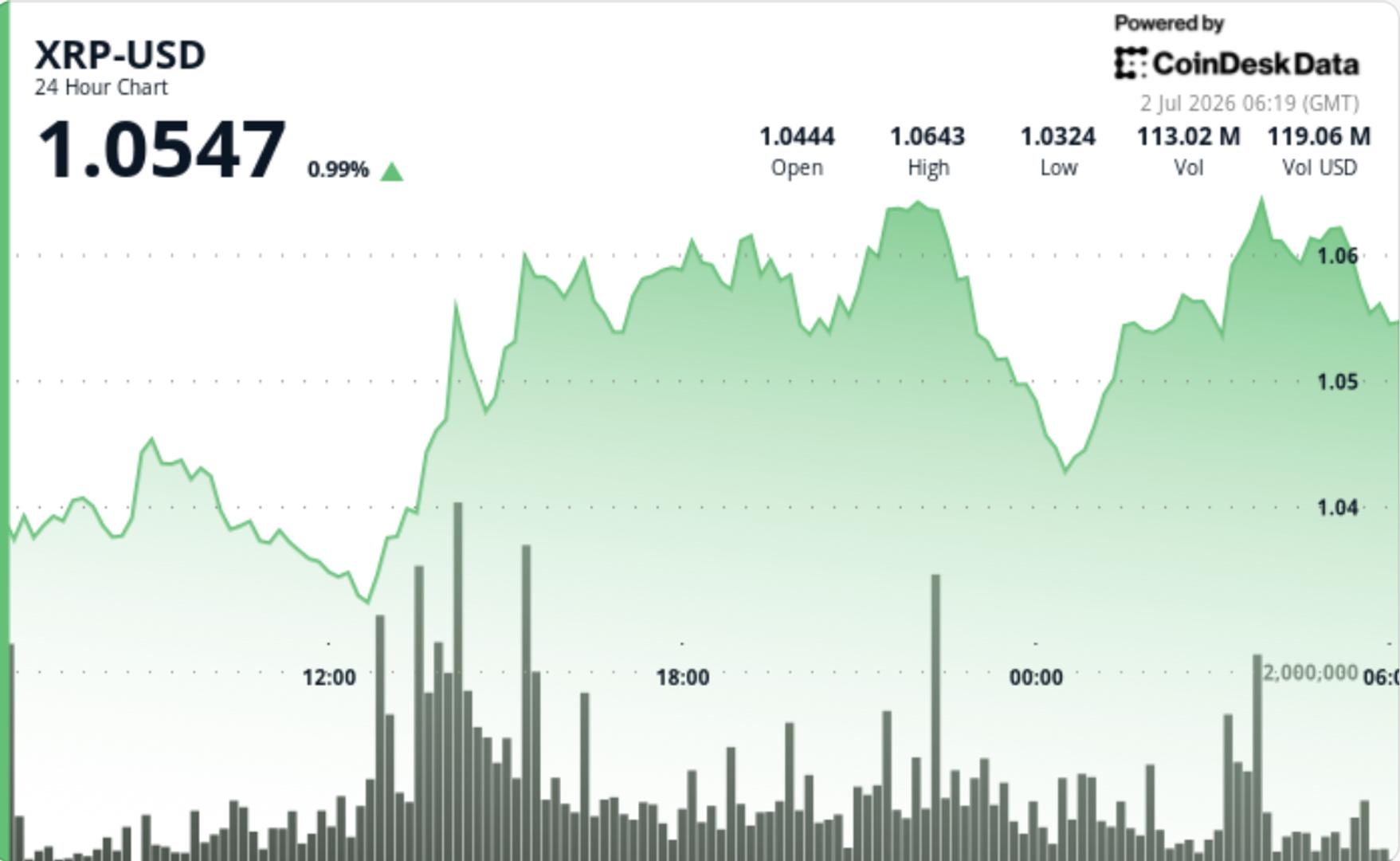
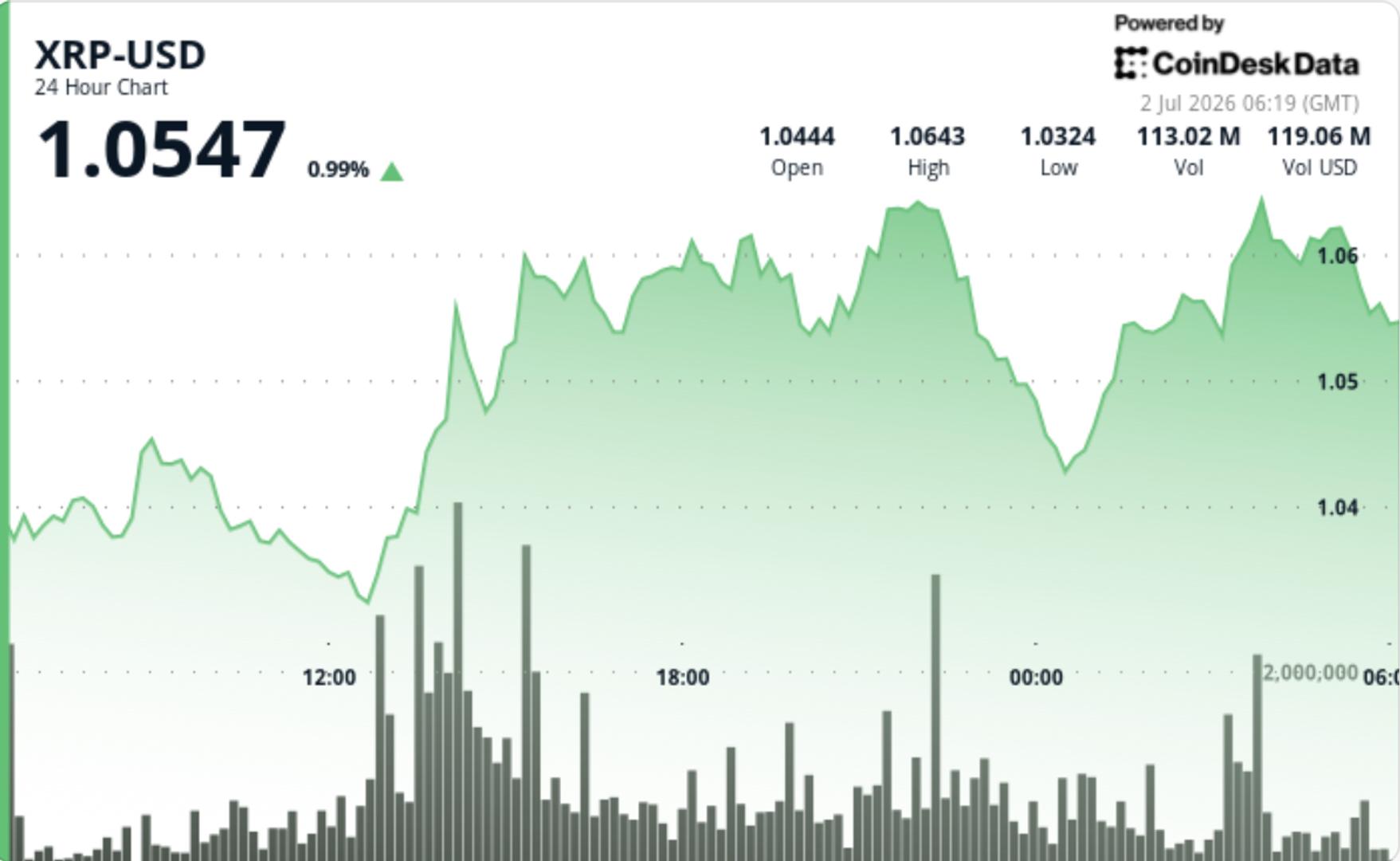
New wallet creation hit a three-month high and large-holder activity strengthened, but XRP still needs to reclaim $1.10 before the recovery looks convincing.


OpenAI has reportedly proposed giving the US government a 5% stake, a position valued at nearly $42.6 billion.
The Financial Times reported the story on Thursday. The administration’s appetite for the deal is unknown.
OpenAI Reportedly Offers Trump Administration 5% Stake
CEO Sam Altman raised the 5% figure during initial talks with President Donald Trump’s team, per the FT. According to him, allowing the public to hold a financial interest in the company is the best way to distribute the benefits created by AI.
Follow us on X to get the latest news as it happens
Based on OpenAI’s latest valuation, a 5% equity stake would be worth approximately $42.6 billion. The company secured a record funding round in March, pushing its post-money valuation to $852 billion.
OpenAI is also preparing for an initial public offering (IPO). It filed confidentially with the SEC in June but emphasized that timing remains flexible.
The proposal also calls for other US AI firms to transfer comparable equity stakes to the government. However, it remains uncertain whether the firms would adopt the plan.
The concept has a long paper trail. Altman first floated government ownership to Trump personally in early 2025, NOTUS reported. A source told CNBC in early June that the discussions had been in progress for over 12 months.
OpenAI and the White House did not immediately respond to BeInCrypto’s requests for comment sent outside regular business hours.
Subscribe to our YouTube channel to watch leaders and journalists provide expert insights
The post OpenAI Reportedly Floats Handing Washington a 5% Equity Slice appeared first on BeInCrypto.

Wales team announcement LIVE updates as Fiji match overshadowed by dispute

Asia-Pacific Healthcare Crisis: Burnout, Demand and an 18-Month Warning

Robinhood Partners With dYdX Labs to Launch Arcus DEX


-

 Fashion6 days ago
Weekend Open Thread: Staud – Corporette.com
-

 Politics6 days ago
The House | Manchesterism won’t survive the painful trade-offs unless it gets citizens on board
-

 Crypto World2 days ago
Strategy authorizes up to $1.25B in Bitcoin sales under new capital plan
-

 Politics6 days ago
Potential 2028er World Cup attendee leaderboard
-

 Business6 days ago
Asia stock markets slide as tech shares slump
-

 News Videos4 days ago
MAJOR BITCOIN & MARKET UPDATE!!!! (MUST WATCH ASAP!!!)
-

 Tech6 days ago
A Look At A Gaggle Of Transputer Boards
-
 Crypto World7 days ago
Dell (DELL) Shares Tumble Over 5% Following Analyst Downgrade to Hold
-

 Crypto World5 days ago
Coinbase, Circle Deepen Crypto Stock Losses Despite Resilient S&P 500
-

 Business2 days ago
Australia treasurer says alleged access of prime minister’s bank data ’incredibly concerning’
-

 Crypto World5 days ago
Kraken's xStocks Opens Bending Spoons IPO Registration to EEA Retail
-

 Sports5 days ago
FIH Pro League: India defeat Pakistan 7-1, register biggest win of campaign | Other Sports News
-
 Crypto World6 days ago
Bitcoin Sparks $600M Hourly Liquidations With $65,000 Set To Become Resistance
-

 Tech2 days ago
Anonymous researcher drops 0-day ‘exploitarium’ repo
-

 Tech4 days ago
Bluekit phishing kit adopts browser-in-the-middle for login theft
-

 Tech5 days ago
Russian hackers now target Signal backup recovery keys
-
Crypto World6 days ago
Hyperliquid Named on Singapore MAS Investor Alert Register
-

 Crypto World6 days ago
RTX holders must register wallets before token distribution begins
-

 Sports18 hours ago
Broncos roster: OL Ben Powers (No. 74) entering final year of contract
-
 Business3 days ago
The AI boom won’t burst all at once. It will pop in ‘rolling bubbles’: Macquarie
You must be logged in to post a comment Login