
Crypto World
Fed officials who voted to hike rates say action is needed now against inflation

Beth Hammack, president and chief executive officer of the Federal Reserve Bank of Cleveland, during a research conference at the Federal Reserve Bank of Dallas in Dallas, Texas, US, on Friday, Oct. 31, 2025.
Desiree Rios | Bloomberg | Getty Images
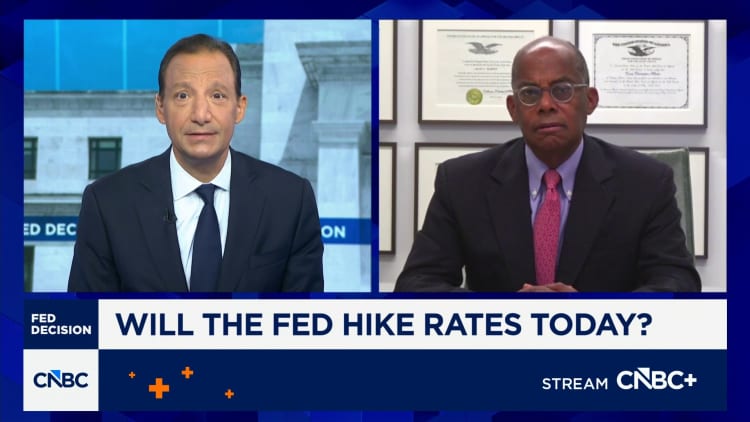
Federal Reserve officials who voted this week against the decision to hold interest rates steady said Friday they favor hiking now as a way to stave off inflation.
“In my view, now is the time for the [Federal Open Market Committee] to act to speed the return of PCE inflation to our 2 percent objective and deliver on our commitment to price stability for the American people,” Cleveland Fed President Beth Hammack said in a statement. “The longer that high inflation persists, the more challenging and costly it can be to bring it back down.”
Similarly, Minneapolis Fed President Neel Kashkari said in a separate statement that he believes small hikes now can prevent the need for larger moves later.
“In my view, a potential series of small policy moves would be better than waiting and eventually concluding that even bolder actions were necessary,” he said.
Kashkari and Hammack joined Dallas Fed President Lorie Logan in dissenting against holding the Fed’s key overnight borrowing rate in a range between 3.5%-3.75%. The other nine voting members of the FOMC voted in favor of keeping the rate steady, where it has been all year following a series of three cuts in the latter part of 2025.

Inflation has held above the Fed’s 2% target for more than five years, spiking again this war following the Iran war and the impact of President Donald Trump’s tariffs.
Logan said the Fed can’t count on an unexpected jolt to the economy to lower inflation and needs to be proactive.
“Labor, consumption and financial market conditions indicate that monetary policy is not restraining the economy,” she said, also in a prepared statement. “Without any policy restraint, inflation will likely continue to trend above target until there’s an unanticipated shock.”
Though price increases eased in June as Middle East tensions briefly eased, energy costs again have risen and generated fears that the Fed will have to tighten.
Though he voted in favor of the hold, Fed Chairman Kevin Warsh said he remains resolute in getting inflation back to target.
“We have begun a new chapter, and we understand that the five-plus years of inflation above target cannot be cured in nine weeks — or by a single month of modest price decreases,” he said.
However, Hammack said she is “not confident it will return to our objective on its own.”
“Supply-side factors, including energy prices, have boosted inflation this year, but I see inflationary pressures coming from the demand side of the economy, as well,” she added.
Hammack said her constituents in the Cleveland area have been describing “pricing pressures as broadening rather than fading, and consumers are expressing despair over persistently higher prices.”
For his part, Kashkari’s comments harken back to both the 1970s period of high inflation and the more recent episodes in which Fed officials initially dismissed the flare-up as “transitory” and brought on up issues related to the Covid pandemic.
“Economic theory argues that monetary policy is the right tool to address demand-driven inflation but faces greater trade-offs when dealing with supply shocks,” he said, adding, “I increasingly believe that monetary policy does have an important role to play in addressing a series of successive supply shocks that might lead to entrenched higher inflation.”
Logan is expected to release a statement explaining her vote later Friday morning.



Pump.fun co-founder Noah Tweedale reportedly attributed the layoffs to said the company growing too quickly.

“This year’s honorees come from more than a dozen countries, reach audiences across every major platform, and are shaping everything from science, fashion, technology, sports, and entertainment,” TIME’s CEO Jessica Sibley said in her welcome remarks, stepping behind the DJ booth to address the crowd. “Together, you command a combined social following of more than 1 billion across the world’s leading digital platforms,” she continued. “You’re driving the economy—building businesses, creating opportunities, and delivering real value for your audiences.”
Throughout the night, influencer and skin-care brand founder Alix Earle, who appears on the TIME100 Creators cover, posed for photos with guests. Maura Higgins and Serena Page, both supernovas in the Love Island cinematic universe and beyond, reunited with a big hug. Creator mental-health advocate Shira Lazar and psychiatrist turned creator Judith Joseph chatted in the bathroom line. And Kane Parsons—the 21-year-old YouTuber turned director of A24’s Backrooms, which this year became the studio’s highest-grossing feature to date—stopped by the red carpet for an interview conducted by 2025 listee Cyrus Veyssi.
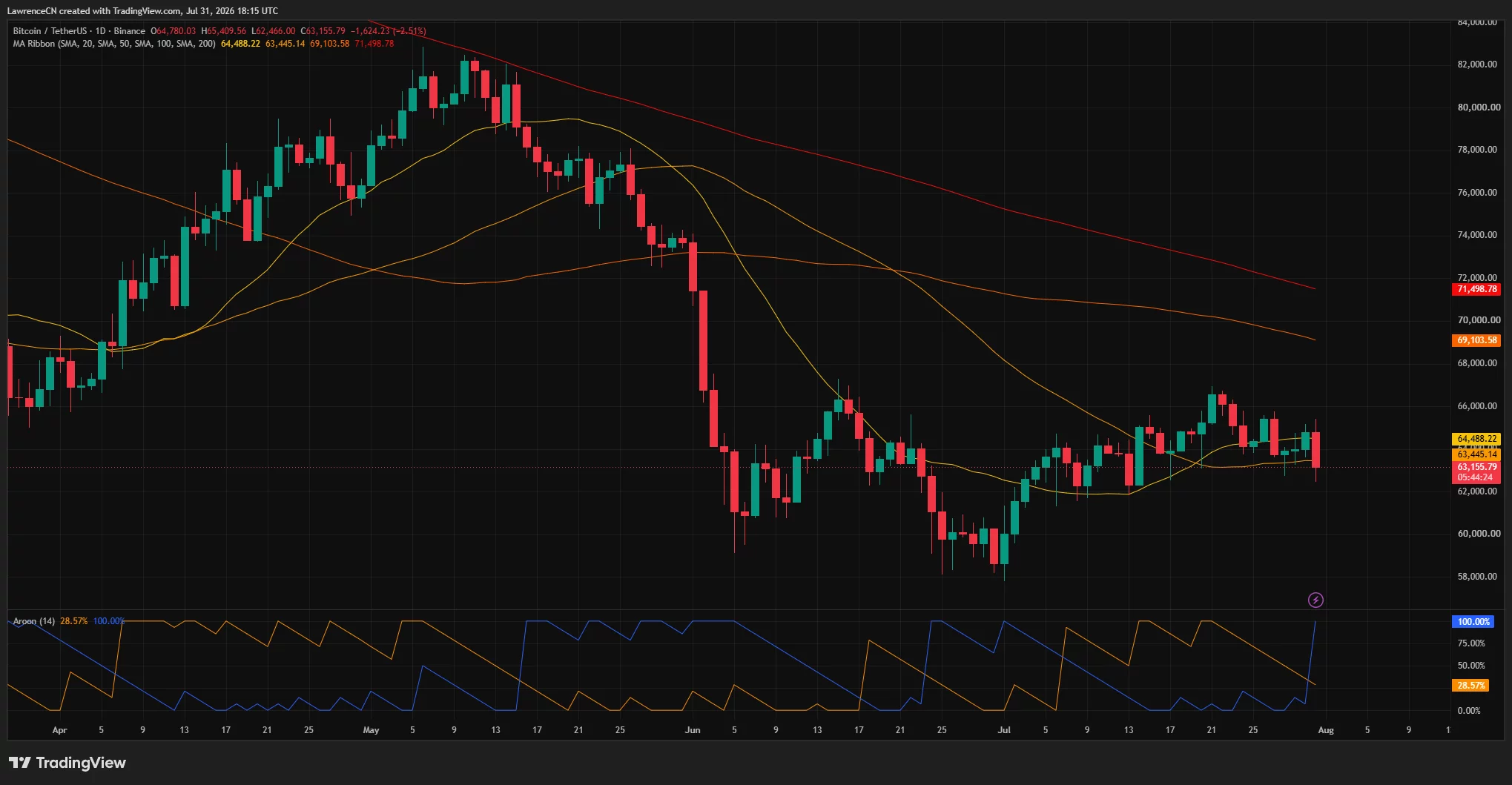
Bitcoin price fell below $64,000 on July 31 as renewed U.S.–Iran tensions lifted oil prices and strengthened the dollar, while its 4-hour chart formed a bearish rounded-top structure.
Summary
- Bitcoin price fell as low as $62,466, extending its rejection from the $65,000 area.
- A rounded-top breakdown points toward $59,000 if support near $62,000 fails.
- Iran reportedly attacked two tankers under U.S. escort in the Strait of Hormuz.
- Oversold momentum and concentrated liquidity near $62,000 could produce a short-term rebound.
Bitcoin price falls below key moving averages
According to data from crypto.news, Bitcoin (BTC) price dropped as much as 3.6% from its intraday high on Friday, sliding from $65,410 to a low of $62,466. It was trading near $63,155 at the time of the daily-chart snapshot, down 2.5% for the session.
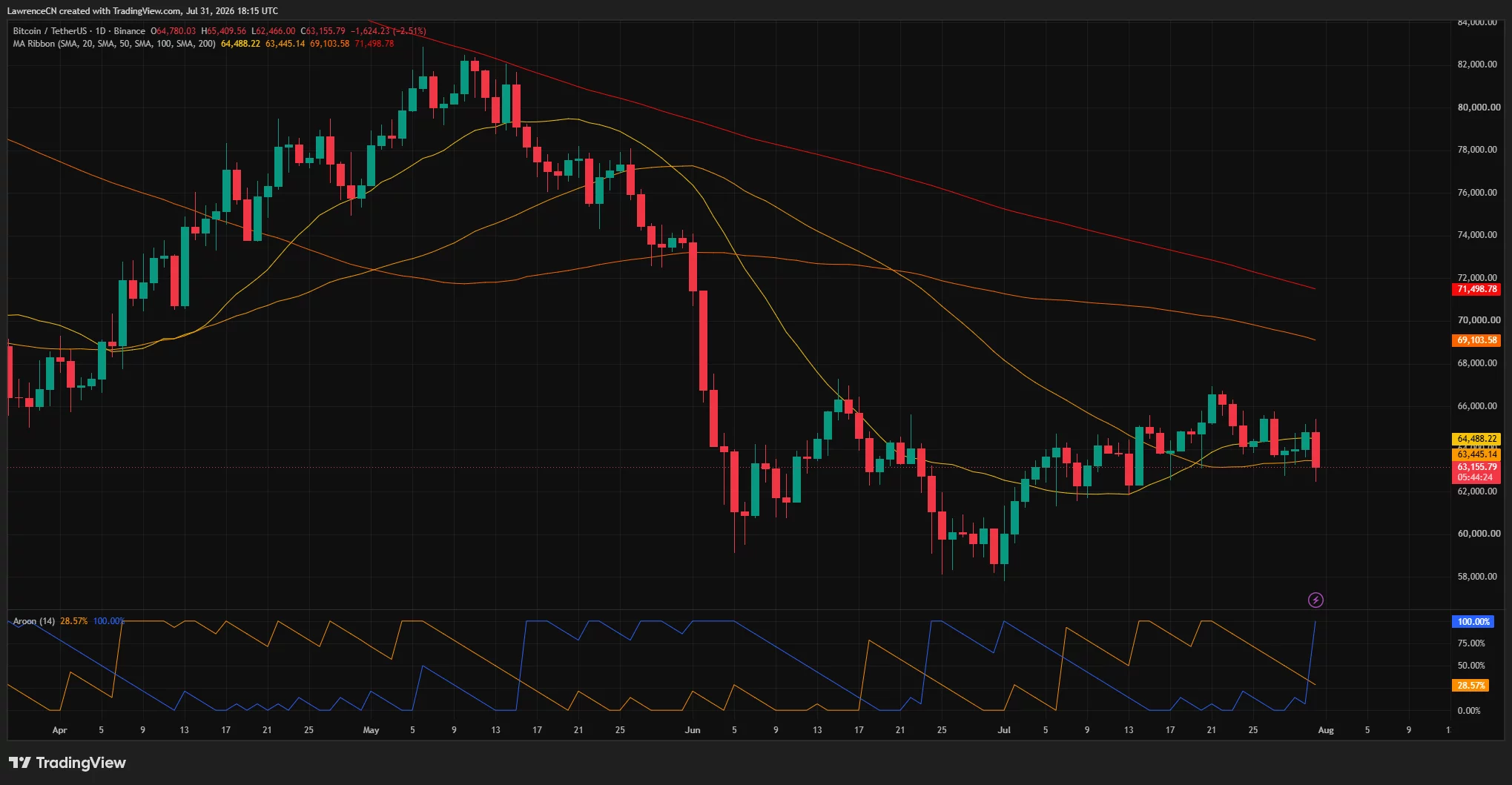
The decline pushed Bitcoin below its seven-day and 25-day simple moving averages at approximately $63,445 and $64,488. Losing both levels indicates that short-term sellers have regained control after BTC failed to sustain its July recovery.
Bitcoin also remains far below the 50-day SMA at $69,104 and the 200-day SMA near $71,499. These averages represent major overhead resistance and reinforce the wider bearish structure that has remained in place since the asset fell from above $82,000 in May.
The daily Aroon indicator supports the bearish reading. Aroon Down jumped to 100%, while Aroon Up stood at 28.57%, showing that the latest low occurred much more recently than the last meaningful high.
However, Bitcoin has not yet broken the broader range between approximately $58,000 and $67,000. Sellers would need to force a sustained move below $62,000 to expose the lower end of that structure.
Iran escalation adds to risk-off pressure
Bitcoin’s latest decline coincided with another escalation in the U.S.–Iran conflict and renewed concerns about energy supplies passing through the Strait of Hormuz.
Iran said it attacked two oil tankers attempting to cross the waterway under U.S. military escort. Tehran also claimed it turned back four other vessels, while ship-tracking data showed that traffic through the strait remained thin.
The development carries greater market risk than an isolated attack on commercial vessels because the presence of a U.S. escort raises the possibility of a direct military response.
Iran separately launched drone attacks targeting U.S.-linked military facilities in Kuwait and Bahrain. Kuwait said it intercepted the drones and reported no casualties.
President Donald Trump also convened his Cabinet at Camp David as the administration considered its next steps in the conflict. No new military operation was formally announced during the meeting.
Meanwhile, the U.S. Senate failed in a 49–50 vote to advance a measure restricting Trump’s authority to continue hostilities. The result left the administration’s short-term military options largely unchanged.
These developments lifted oil prices and renewed concerns that higher energy costs could keep U.S. inflation elevated. A stronger dollar and rising Treasury yields added pressure on Bitcoin and other non-yielding risk assets.
The reported U.S.–Israeli proposal for a land blockade of Iran remains an option under discussion rather than an announced policy. It would reportedly involve persuading neighboring countries to restrict Iranian imports and exports.
Bitcoin rounded top targets $59,000
Bitcoin’s 4-hour chart shows a rounded-top formation developing since late June. BTC climbed from approximately $59,000 to a July 22 peak near $66,700 before forming a gradual series of lower highs.
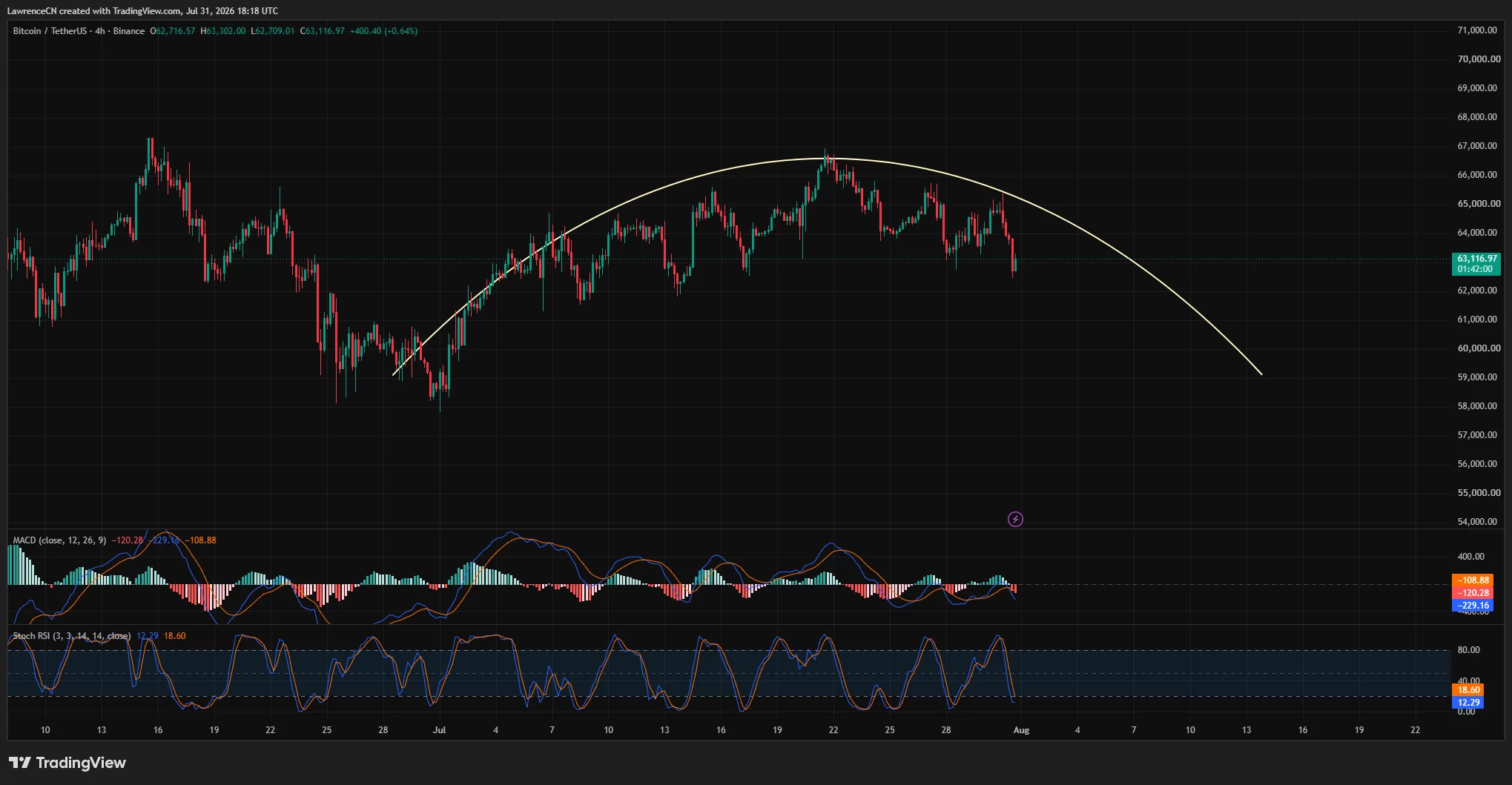
The latest rejection from around $65,000 pushed the price toward the pattern’s neckline between $62,000 and $63,000. A confirmed 4-hour close below that area could validate the breakdown and place $59,000 back in focus.
Momentum indicators currently favor sellers. The 4-hour MACD line fell to approximately minus 229, below its signal line near minus 109. The negative histogram widened to around minus 120, showing that bearish momentum accelerated during the latest decline.
Still, the Stochastic RSI has reached oversold territory. Its two lines stood at 12.29 and 18.60, both below the 20 threshold. That reading does not guarantee an immediate recovery, but it suggests that the sell-off may be becoming stretched over the short term.
Bitcoin may therefore retest the broken $63,400–$64,500 area before deciding its next direction. Reclaiming $64,500 would weaken the immediate bearish setup, while a move above $65,500 would challenge the rounded-top structure.
Liquidity near $62K could trigger a reversal
Trader Ted Pillows identified another possible downside target using Bitcoin’s liquidation map. He said the decline had already cleared much of the liquidity beneath the previous trading range, leaving a remaining concentration close to $62,000.
“There’s still one cluster around the $62,000 level, which might be next. But after that, a reversal might happen.”
The $62,000 area aligns with the rounded top’s neckline and several recent intraday lows, making it the most important near-term level.
A sweep below that support could trigger leveraged long liquidations before buyers attempt a recovery. Failure to attract demand would instead open the path toward $60,000 and the rounded-top objective near $59,000.
On the upside, Bitcoin must first reclaim $63,445 and $64,488. Stronger resistance sits between $65,000 and $66,700, where several July rallies stalled.
Geopolitical headlines remain the immediate external risk. Further attacks involving U.S. forces, tankers, or major shipping routes could lift oil and extend the risk-off move. Conversely, evidence of negotiations or safer passage through Hormuz could ease inflation concerns and help Bitcoin stabilize.
Disclosure: This article does not represent investment advice. The content and materials featured on this page are for educational purposes only.

AMLBot, a crypto compliance and forensics firm, has introduced “AI Tracer,” a new self-service blockchain analysis tool designed to help users follow funds across networks starting from a single transaction hash. The company positions the product as a way to reduce reliance on specialist tracing software and deep internal expertise when investigating how crypto moves on-chain.
In an announcement shared with Cointelegraph, AMLBot says AI Tracer automatically builds a transaction graph, follows movements of funds through intermediate wallets, and attempts to map the journey toward the endpoint addresses the funds ultimately reach. As it walks the trail, the tool matches wallet activity against known entity labels such as exchanges, related services, and flagged addresses.
Key takeaways
- AI Tracer is a self-service tracing tool that begins with a transaction hash and maps visible fund movements across supported blockchains.
- The tool is designed to follow cross-chain transfers through bridges and to handle cases where assets are split among multiple wallets.
- According to AMLBot, AI Tracer cannot view transfers between internal exchange accounts or explain the intent behind payments.
- Reports are intended as an investigation starting point and do not replace audits, legal processes, or asset recovery.
- The product includes a free check and paid plans that increase the number of automated checks.
How AI Tracer works for on-chain investigations
The core premise behind AI Tracer is graph-based transaction tracing. AMLBot states that the process is automatic: the system traverses the transaction graph from a starting transaction, follows where funds move through intermediary wallets, and continues until it reaches the money’s endpoint. This approach is aimed at giving users a structured view of the transfer path instead of requiring manual analysis across many hops.
A key added layer is entity labeling. AMLBot says it “matches known entity labels — exchanges, services, flagged addresses — against every wallet it encounters” during the traversal. For traders, compliance staff, and researchers, this can matter because addresses that look unrelated at first glance may in fact map to familiar services, custody providers, or previously identified risk clusters—information that can shape how an investigation is prioritized.
Cross-chain and split-funds tracing—plus clear limits
AMLBot highlights two real-world situations where tracing often becomes complicated: cross-chain activity and value fragmentation. The company says AI Tracer can trace through bridges that move assets between networks. It also claims it can follow cases where assets are split across multiple wallets, which is a common pattern in laundering attempts and in complex payment workflows.
At the same time, AMLBot lays out boundaries to prevent users from over-interpreting outputs. The tool, it says, cannot see transfers between internal exchange accounts. That limitation reflects a broader constraint in public blockchain data: while blockchains can show withdrawals and on-chain transfers, they do not reveal internal bookkeeping decisions inside centralized services. AI Tracer also cannot determine why a payment was made, cannot freeze assets, and does not guarantee recovery.
In the company’s description, AI Tracer’s findings are meant to help form hypotheses and provide a lead for next steps. Reports are positioned as a starting point rather than a substitute for audit procedures, legal processes, or formal enforcement action.
Networks supported and who the tool is for
AI Tracer is currently designed to work across a wide set of networks, according to AMLBot. The supported list includes Bitcoin, Bitcoin Cash, Litecoin, TRON, Ethereum, BNB Chain, Ethereum Classic, Polygon, Arbitrum, Base, Optimism, Solana, Cardano, and Ripple.
AMLBot says the tool is meant for multiple user groups, including journalists, researchers, traders, and crypto users who want to understand transaction paths. It also names law enforcement agents investigating crypto crime, along with independent investigators and compliance teams that need fast, repeatable analysis for due diligence or incident triage.
That “self-service” framing is significant: investigators often face a trade-off between speed and depth. By automating the tracing and labeling steps, AI Tracer aims to lower the initial friction for routine inquiries—especially when someone has a transaction hash but lacks the time or tooling to manually map intermediate hops across chains.
Pricing model and what to watch next
AMLBot states that AI Tracer offers a free check, with paid plans that raise limits on the number of automated checks users can run. While the announcement emphasizes usability and coverage, the practical value for compliance teams will likely depend on those limits and on the consistency of label matching over time.
For readers considering the tool, the biggest takeaway is to treat AI Tracer outputs as a structured visualization of on-chain movement—not as proof of culpability or intent. The company’s own limitations—no visibility into internal exchange transfers, inability to infer payment purpose, and no asset-freezing or recovery guarantees—signal that users should still pair the tool’s results with further verification and formal processes when stakes are high.
Going forward, attention should focus on how effectively AI Tracer handles increasingly complex cross-chain routes and entity labeling as bridge usage and address clustering tactics evolve. Users should also watch for updates that expand network support or refine what the system can reliably infer from public transaction data.


Several users of the long-defunct crypto exchange reported that distribution agents had begun releasing funds to reimburse creditors for some of their 2022 losses.
Most leading cryptocurrencies have headed south over the past 24 hours, yet Hyperliquid’s HYPE is among the few to defy the latest red wave.
While it has risen by a mere 1.5%, one analyst assumed it might be gearing up for a staggering 40% pump in the near future.
The Necessary Condition
Currently, HYPE trades at around $54.70, placing it above the lower boundary of an important channel depicted by Ali Martinez. He suggested that if the asset holds the $53 level, a move up to $75 is possible. Also speaking on the matter was Altcoin Sherpa, who claimed that HYPE’s current level is “a good spot for a bounce.”
“Expecting huge tradfi trading volumes to come over the next few days too, which helps,” the analyst added.
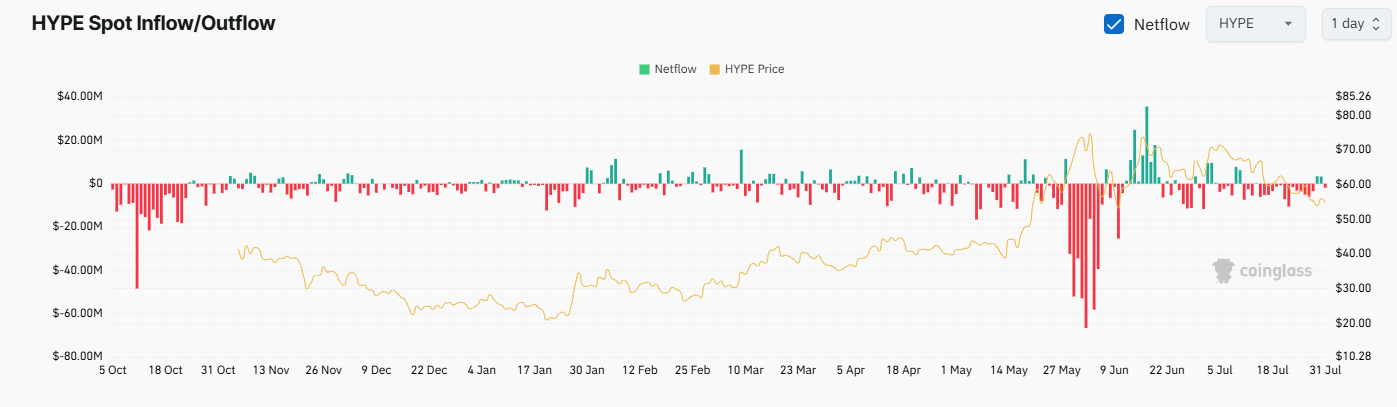
Some on-chain signals also suggest that the asset may post additional gains in the short term. CoinGlass’s data shows that exchange outflows have dominated over inflows in the last several days, meaning that investors have transferred their holdings from centralized platforms to self-custody solutions. This is considered a bullish factor since it reduces the immediate selling pressure.
The Bearish Case
The number of pessimists, though, seems even more well-represented. X user Cut recently doubted HYPE’s potential, reminding of its inability to break its all-time high and wondering if its price would make a substantial decline. Ryker joined the discussion, projecting a plunge to $32 “soon.”
Cryptorphic also gave their two cents, arguing that HYPE is showing weakness after losing its long-term trendline and its price has broken below the key ascending support. They believe that if the $57-$58 range turns into resistance, the breakdown could confirm further downside, envisioning a possible crash under $30.
Meanwhile, the whales’ activity reinforces the pessimists’ outlook. Lookonchain disclosed that large investors keep selling HYPE, revealing the case of a market participant who purchased over one million tokens at an average price of $18 17 months ago and unstaked and deposited the stash into FalconX and Coinbase, perhaps with the intention to cash out.
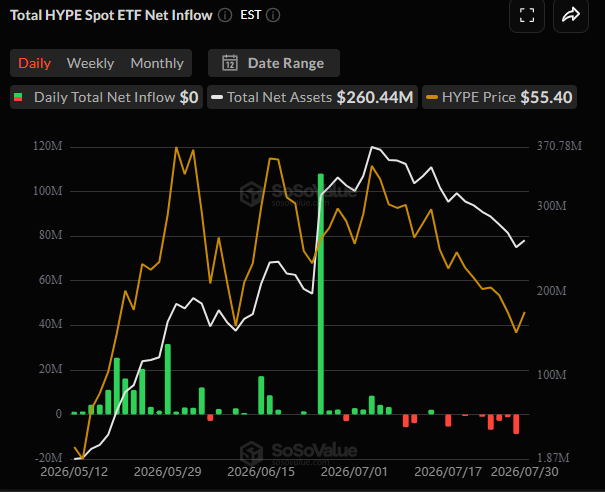
The waning institutional interest adds more weight to the bearish perspective. Spot HYPE ETFs, which attracted substantial capital in June, have not appealed to pension funds, hedge funds, and other conservative investors during most days of July, with outflows significantly dwarfing inflows.
The post Hyperliquid (HYPE) Could Soar by 40% But Under This Condition: Details appeared first on CryptoPotato.


Tether reported $1.5 billion in net operating profit for the second quarter of 2026, driven by returns from its U.S. Treasury and repurchase agreement holdings.
The issuer of USDT, the world’s largest stablecoin, reported holding $187.75 billion in assets against $183.64 billion in liabilities as of June 30, leaving it with $4.11 billion in excess reserves, according to the BDO attestation released Friday. Those excess reserves are down from just over $8.23 billion three months earlier.
The second quater report shows Tether increased its physical gold holdings by 14 tons to roughly 146.2 metric tons from 132.2 tons during the quarter. The value of those holdings, however, fell to $18.84 billion from $19.84 billion because the price of gold dropped about 15% to just over $4,000 per ounce.
The company lifted bitcoin holdings by roughly 1,796 coins to 98,933 BTC. The value of those holdings fell to $5.80 billion from $6.62 billion as the bitcoin price used in the reports declined to $58,600 from $68,200, during the period.
Tether’s USDT issuance increased by about $446 million to $184.6 billion during the quarter.
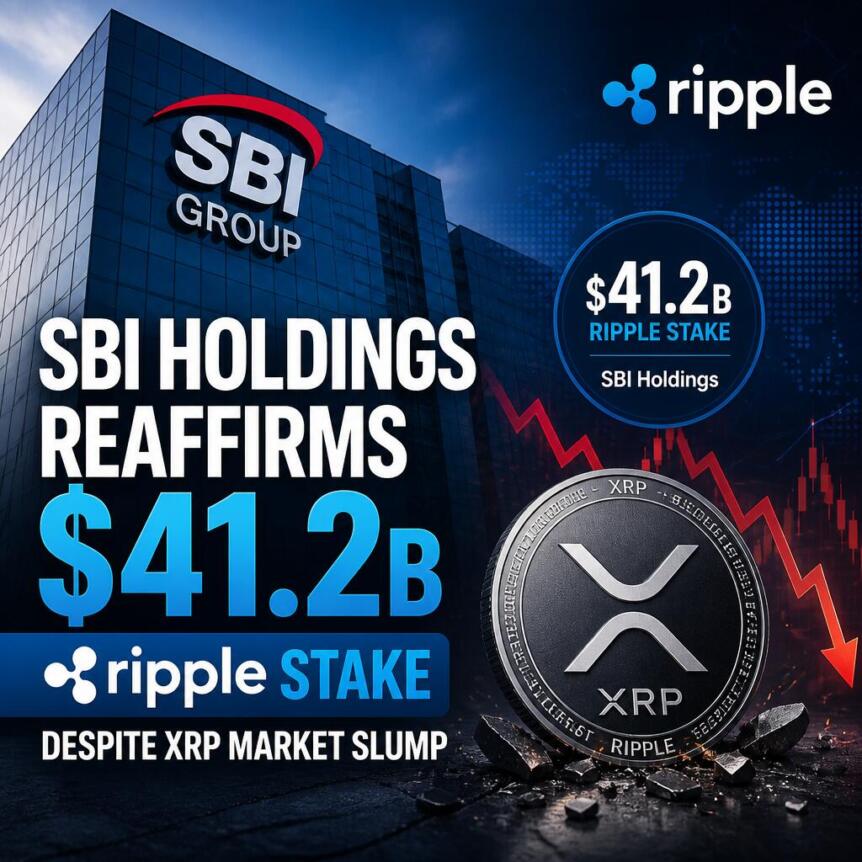
SBI Holdings has reaffirmed its commitment to Ripple despite weaker XRP prices and slower cryptocurrency activity. The Japanese financial group values its Ripple shareholding at ¥6.6 trillion, equal to about $41.2 billion. Meanwhile, SBI delivered record first-quarter earnings and continued expanding its digital asset operations.
SBI Holdings Maintains Its Ripple Investment
SBI disclosed the updated Ripple valuation during its first-quarter earnings presentation. The company stressed that its Ripple shareholding remains highly valuable despite the current weakness in the cryptocurrency market. Therefore, SBI continues to treat Ripple as a major strategic asset within its broader financial portfolio.
The group has maintained a long relationship with Ripple and has supported XRP-based payment services. SBI has also promoted blockchain settlement systems through its financial subsidiaries and regional partnerships. Consequently, its latest statement reinforces the group’s long-term focus on Ripple’s payments technology and international network.
XRP has faced selling pressure during the recent cryptocurrency market slowdown. However, SBI did not announce any reduction in its Ripple position during the earnings update. Instead, the company highlighted the stake’s valuation while explaining weaker conditions across its cryptocurrency division.
Clarity Act Uncertainty Weighs on Crypto Activity
SBI linked the sluggish cryptocurrency market to uncertainty surrounding the proposed Clarity Act. The legislation seeks to establish clearer oversight rules for digital assets within the United States. Therefore, its progress could influence market structure, regulation, and business planning across the cryptocurrency sector.
The United States Senate continues considering the bill before its scheduled August recess. Senator Cynthia Lummis recently indicated that Senate leaders had reserved potential floor time for the measure. However, several other legislative matters were also competing for attention during the remaining session.
The Clarity Act has become an important issue for cryptocurrency companies seeking clearer federal rules. Ripple has spent years operating within an uncertain American regulatory environment. As a result, regulatory progress could affect its domestic operations and the wider use of XRP-related services.
SBI Reports Record First-Quarter Earnings
SBI Holdings recorded its strongest first-quarter performance as revenue and profit increased sharply. Revenue reached ¥571.0 billion, while profit before tax climbed to ¥225.8 billion. Additionally, shareholder-attributable net profit rose 149.9% year-over-year to ¥148.1 billion.
The group reported a 29% return on equity for the previous twelve months. That result exceeded SBI’s medium-term return target of 15% by a wide margin. Strong performance across its main financial businesses offset weakness within the cryptocurrency asset division.
SBI’s crypto asset business recorded a ¥1.4 billion pre-tax loss during the quarter. However, global cryptocurrency market maker B2C2 remained profitable and supported the group’s digital asset operations. The mixed results showed continued pressure in retail crypto services but stronger performance within institutional trading activities.
SBI Expands Its Digital Asset Services
SBI continues building its digital asset business through lending, stablecoins, custody, and exchange services. SBI VC Trade recently introduced cryptocurrency lending and support services linked to the JPYSC stablecoin. These services extend the group’s reach across regulated digital payments and blockchain-based financial products.
The company also plans to acquire Bitbank and expand its cryptocurrency customer base. SBI expects the combined operations to serve about three million cryptocurrency accounts after completing the planned transaction. Furthermore, it targets approximately ¥870 billion in digital assets under custody.
These expansion plans support SBI’s strategy of combining traditional finance with regulated cryptocurrency services. The group continues investing in trading, custody, payments, stablecoins, and blockchain infrastructure. Meanwhile, its $41.2 billion Ripple stake remains the largest highlighted asset within that digital strategy.
BlackRock clients bought $273.2 million of Bitcoin over two days after selling $63.6 million earlier in the week. Those figures match BlackRock’s reported fund creations to the decimal.
The buying made BlackRock close to the entire US spot Bitcoin ETF market this week. It also arrived with the average fund dollar sitting deeply underwater.
BlackRock Was More Than the Whole Market This Week
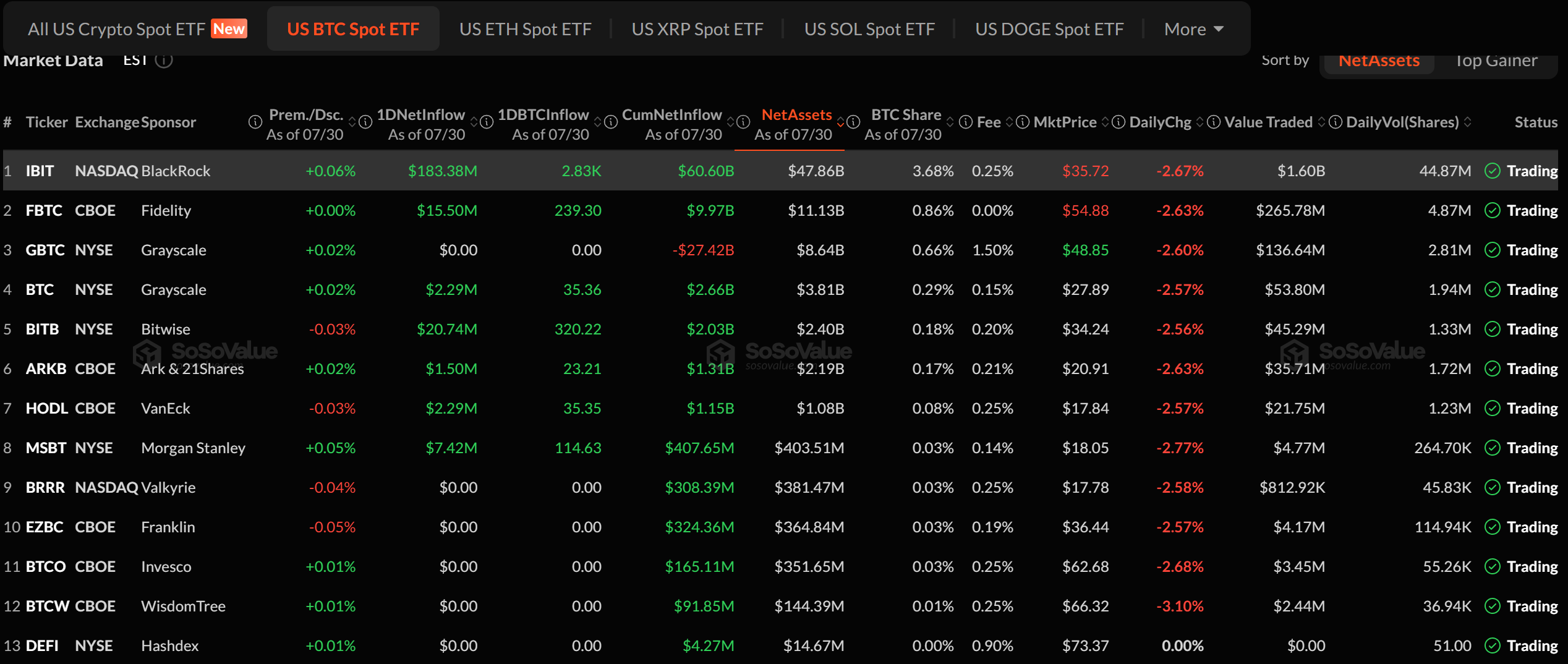
The iShares Bitcoin Trust (IBIT) took in a net $209.6 million across the four sessions from July 27 to July 30, according to Farside Investors. The full 13-fund complex took in $203.9 million. Every other fund combined therefore came out slightly negative.
The daily split shows the same concentration. IBIT supplied $183.38 million of the $233.13 million that arrived on July 30, or 79% of the total. That was the largest single-day inflow since July 6, SoSoValue records show.

Arkham’s on-chain tally reconciles exactly with those creations. IBIT redeemed $8.8 million and $54.8 million on July 27 and July 28, producing the $63.6 million of selling Arkham logged. Creations of $89.8 million and $183.4 million followed, matching its $273.2 million figure.
Follow us on X to get the latest news as it happens
The Average ETF Buyer Is Still Down 22%
Research firm Hedgeye published Bloomberg Intelligence data on July 28 showing how badly the typical fund buyer has fared since launch.

The average U.S. Bitcoin ETF buyer is now down -22%,” they wrote.
The underlying chart puts the gross cost basis of all US spot Bitcoin ETF purchases at $82,249. Measured against the $64,114 price it marks, that is a 22% shortfall.
Bitcoin (BTC) traded around $62,907 on Friday, down 2.96% over 24 hours. At that level the gap widens to roughly 24%.
The scale reads more clearly in dollars. Aggregate unrealized losses hit $16.33 billion on July 20. The same measure peaked at an $86.32 billion gain on October 6, 2025, the day Bitcoin set its $126,080 record.
Creations Track Client Demand, Not a House Bet
Flows into IBIT reflect share creations by authorized participants rather than proprietary positions taken by BlackRock. Rising demand forces the fund to buy Bitcoin. Redemptions force it to sell.
That mechanism cuts both ways, and IBIT has led in both directions. It absorbed $202.5 million and $212.2 million of outflows on July 23 and July 24, the two worst sessions of the month.
The longer arc is starker. IBIT holdings peaked near 823,000 BTC in mid-May, then fell by roughly 90,000 BTC through early July before flattening near 730,000.
BlackRock has commercial reasons to want that bleeding stopped. IBIT holds $47.86 billion, or 61% of the $78.76 billion across all US spot Bitcoin ETFs, and the firm issues formal Bitcoin allocation guidance of 1% to 2% of institutional portfolios.
Chief executive Larry Fink told CNBC on July 15 that the crypto leverage washout ended. Flow data has since moved his way, though not far. June drained $4.51 billion in the worst month on record since the funds launched in January 2024, and July has recovered $438 million of it.
Cumulative net inflows across the complex stand at $51.59 billion. IBIT alone has drawn $60.60 billion, a gap explained by Grayscale’s $27.42 billion of redemptions from GBTC. One issuer now accounts for all of the industry’s net growth, and its newest clients are buying at prices its earlier ones never saw.
The post BlackRock Bitcoin Buying Rebounds as ETF Investors Sit 22% Underwater appeared first on BeInCrypto.


South Korea will begin taxing cryptocurrency gains at a combined rate of 22% from Jan. 1, 2027, ending expectations that the long-delayed measure could be postponed for a fourth time.
Summary
- Annual crypto gains above 2.5 million won will become taxable as “other income.”
- Investors will pay 20% national tax plus 2% local income tax on gains exceeding the allowance.
- Critics warn that the absence of loss carryforwards could push trading toward offshore platforms.
- A pending opposition bill could still repeal the provisions before the rules take effect.
South Korea confirms crypto tax launch
Deputy Prime Minister and Finance Minister Koo Yun-cheol confirmed the implementation schedule during a National Assembly Finance and Economy Planning Committee meeting on July 29.
“We are pushing forward with the plan to tax cryptocurrency starting next year as scheduled,” Koo said.
Under the Income Tax Act, income earned by transferring or lending virtual assets will be classified as other income. Annual gains exceeding 2.5 million won, or about $1,740, will face a 20% national tax. A local income tax raises the combined rate to 22%.
Investors whose annual gains remain below the threshold will owe no tax under the framework. Taxpayers are expected to file their first returns in May 2028 for income earned during 2027.
The government first approved the levy in 2020 and planned to introduce it in January 2022. Lawmakers initially postponed implementation until 2025 before a December 2024 amendment moved the deadline to 2027. South Korea’s National Assembly approved that latest delay through revisions to the Income Tax Act.
Loss rules raise offshore trading concerns
People Power Party lawmaker Kim Sang-hoon questioned the tax design during the committee meeting, arguing that investors would not be allowed to offset losses against gains earned in later years.
Kim warned that the restriction could encourage traders to move activity away from domestic exchanges, including Upbit, Bithumb, Coinone and Korbit. Possible alternatives include overseas centralized exchanges, decentralized finance platforms and peer-to-peer markets.
Such a shift could reduce trading volume and tax visibility inside South Korea. Kim argued that implementation should wait until the OECD’s Crypto-Asset Reporting Framework is fully operational, allowing authorities to exchange tax information across borders.
Koo acknowledged the concern but said moving virtual assets into a capital-gains framework would require a broader review of South Korea’s tax treatment of financial markets. He left open the possibility of revising the system after authorities collect operational data.
A separate opposition bill introduced in March seeks to remove crypto income from the Income Tax Act entirely. Lawmakers referred the proposal to a subcommittee on July 29, meaning repeal or another delay remains legally possible before the end of 2026.
Crypto policy develops beyond taxation
The tax confirmation comes as South Korea considers a broader regulatory framework for digital assets and stablecoins.
Hashed Open Research and the Solana Policy Institute called for interim stablecoin licensing guidance in a policy report published July 29. The recommendations include temporary rules covering issuance, payments, permitted activities and foreign-issued tokens while lawmakers negotiate the Digital Asset Basic Act.
The proposals are advisory and do not change existing law. However, the report argues that waiting for the complete legislation could leave businesses without clear requirements for issuing or using won-backed stablecoins.
South Korea is also expanding state-backed investment in technology. As crypto.news previously reported, the government approved plans for a 20 trillion won investment account under the Korea Investment Corporation.
Unlike KIC’s existing overseas-focused portfolio, the new account can invest domestically in artificial intelligence, data centers and other industries considered strategically important.
What the tax means for US investors
The Korean framework differs from the US approach, where the Internal Revenue Service generally treats digital assets as property. US taxpayers can use capital losses to offset capital gains, subject to the applicable tax rules and reporting requirements.
South Korea’s lack of loss carryforwards could therefore leave some active traders with a less flexible tax position than US investors. The direct tax applies to income covered by Korean law, but US investors using Korean platforms should still monitor whether exchanges change access, reporting requirements or available products before 2027.
Domestic exchanges must now prepare their reporting infrastructure, while lawmakers consider the repeal bill and possible changes to loss treatment. Unless the National Assembly intervenes, the 22% levy will take effect on Jan. 1.

‘Statistically safe’ but on edge: The ongoing struggle to keep Belfast city centre secure

Nobody Approved Power BI. It’s Now Running Your Business.

Pump.fun laid off workers before they received millions in PUMP tokens: Report


-
 Sports5 days ago
Commonwealth Games boxing: Jadumani Singh seals dominant 5-0 win over Pakistan’s Sumama Rehman to enter quarter-finals | Commonwealth Games News
-

 Business2 days ago
Why Trees Belong on the Risk Register
-

 Tech5 days ago
Intel is reversing course and bringing hyper-threading back to its server chips
-

 Crypto World6 days ago
Ripple bought a bank in pieces. The $4 billion audit
-

 Politics4 days ago
Luke Littler dismantles Gerwyn Price to retain title in Blackpool
-

 Politics3 days ago
The Part of the Electric Transition Nobody Wants to Discuss
-

 News Videos5 days ago
BITCOIN JUST ENTERED THIS CRITICAL ZONE…
-
 Entertainment3 days ago
‘Stargate’ Creator’s New Sci-Fi Series Returns for Season 3 Tomorrow
-

 Business3 days ago
Major shareholder moves on Canyon
-

 Crypto World5 days ago
XRP Ledger adds $2.6B as RWA inflows rank second
-

 News Videos1 day ago
Bitcoin Enters the 3rd Stage of the Bear Market
-

 Politics5 days ago
Spain sweeps the board at 2026 World Cup with individual awards
-

 Entertainment6 days ago
Sara Gilson Killed By Husband After Viral “Pedophile” TikTok Video
-

 Fashion2 hours ago
Weekend Open Thread: Wit & Wisdom
-

 Crypto World3 days ago
Kraken Enables Retail Access to Jersey Mike’s IPO via Tokenized Shares
-

 Tech7 days ago
Anthropic launches Claude Opus 5, a cheaper AI model for coding, agents and enterprise workflows
-

 Tech4 days ago
New macOS Sequoia & Sonoma security updates for older Macs
-

 News Videos3 days ago
Claude: Build Financial Dashboards in Minutes (2026)
-

 Politics1 day ago
Luke Littler’s dominance sparks GOAT debate
-

 Sports19 hours ago
Seema Kaliramna Wins Discus Throw Bronze, Takes India’s CWG Medals Tally To 17
You must be logged in to post a comment Login