
Crypto World
Fed proposes GENIUS Act rules for stablecoin reserves and bank issuers


The Federal Reserve has released two proposed GENIUS Act rules covering the assets that must back payment stablecoins and the approval process for banks seeking to issue them through subsidiaries.
Summary
- Fed-supervised issuers would have to fully back their payment stablecoins with permitted reserve assets.
- The reserve proposal also covers capital, risk controls, and firms that hold backing assets.
- Insured state member banks would need Fed approval before a subsidiary could issue payment stablecoins.
- Public comments are due 60 days after the proposals appear in the Federal Register.
The Federal Reserve Board said in a Sep. 24 release that it is seeking public comment on two proposals for payment stablecoin issuers under its supervision. One sets operating requirements for issuers and firms holding their reserves; the other sets out how an insured state member bank would apply to issue stablecoins through a subsidiary.
The proposals would put detailed rules behind parts of the GENIUS Act that affect U.S. banks and stablecoin companies. They remain open to revision, and the 60-day comment period will begin when the notices are published in the Federal Register. The Fed has not set a calendar deadline in its release.
How the Fed would regulate stablecoin reserves
Under the first proposal, a Fed-supervised issuer would have to hold permissible assets that fully back its outstanding payment stablecoins. The Fed identified short-term U.S. Treasury bills and certain other high-quality, liquid assets as examples of eligible reserves. Full backing means the issuer must hold assets against the tokens it has issued, rather than rely on a smaller pool of reserves.
The draft would also set standardized capital requirements addressing credit and operational risks tied to payment stablecoins. Separate risk-management standards would govern how issuers run the activity. According to the Fed, the same proposal would introduce rules for firms it supervises that safeguard the assets backing stablecoins.
For a U.S. token holder, the reserve rules concern the assets behind a stablecoin issued by a firm within the Fed’s remit. The proposal does not turn a payment stablecoin into an insured bank deposit. Its requirements apply to the covered issuer and its reserve arrangements, while the Fed’s second proposal addresses a bank’s request to enter the business.
The first draft would also clarify which stablecoin and related activities Fed-supervised banks may undertake. That provision sits alongside the issuer and reserve rules, giving banks a proposed regulatory basis for activities beyond an application to create a stablecoin-issuing subsidiary.
How banks would seek stablecoin approval
The second proposal applies specifically to insured state member banks seeking Fed approval for a subsidiary to issue payment stablecoins. Under the Fed’s application draft, the bank would file the application with its appropriate Federal Reserve Bank. The bank, rather than the proposed subsidiary, would be the applicant.
Applicants would submit a business plan, financial information, and other material the Fed needs to assess the proposed operation. The filing would have to describe the plan, state what approval the bank is seeking, and explain why it should be granted under the factors in the GENIUS Act. The draft also sets procedures for hearings, appeals, and final decisions.
Timing is a material part of the bank proposal. The Fed would notify an applicant within 30 days whether its filing is substantially complete and identify additional information needed if it is not. Once an application is substantially complete, the GENIUS Act gives the Fed 120 days to decide; under the law, a complete application is deemed approved if the Fed does not decide within that period.
A material change could affect that clock. The Fed’s draft says a substantial change to a proposed issuer’s business plan, ownership, or financial condition may require more information and a new submission date. It also asks for comment on applications involving several banks in a stablecoin consortium, including whether a single filing could cover participating insured state member banks in some circumstances.
Those questions have a practical U.S. banking context. On Sep. 1, Bank of America, Citi, Goldman Sachs and 18 other financial institutions committed to establish a stablecoin company, according to a September report on the bank consortium. The group targeted a U.S. dollar token in the first half of 2027 and said it intended to meet applicable GENIUS Act requirements. Its announced plan does not establish that the venture would use the Fed application route described in this proposal.
Where the GENIUS Act rulemaking stands
The Fed’s proposals join rulemaking already underway at other U.S. agencies. In August, crypto.news covered Treasury’s proposed definitions for when payment stablecoins are issued, offered, or sold in the United States. Treasury’s questions concern which activity falls under U.S. licensing and distribution restrictions, while the Fed’s new drafts address issuers it supervises and applications from insured state member banks.
The Office of the Comptroller of the Currency has been working on a separate framework for issuers under its authority. As reported in August, Comptroller Jonathan Gould set a November target for final OCC rules after industry feedback. Its proposal covers matters including reserves, redemptions, custody, supervision and issuer applications. The OCC timetable does not set a completion date for the Fed’s newly released proposals.
Treasury has identified Jan. 18, 2027, as the expected effective date for the GENIUS Act’s main issuer restrictions. The statute also provides for an earlier start 120 days after the responsible federal regulators issue their final implementing rules. Federal agencies missed the law’s July 18, 2026, deadline for completing those rules, leaving several proposals at different stages of review.
For the two Fed notices released on Sep. 24, interested banks, issuers, and other members of the public can submit comments during the 60-day period following Federal Register publication. The application proposal identifies the Fed’s online proposal system, mail, and email as ways to file responses, with submissions identified by its docket number.

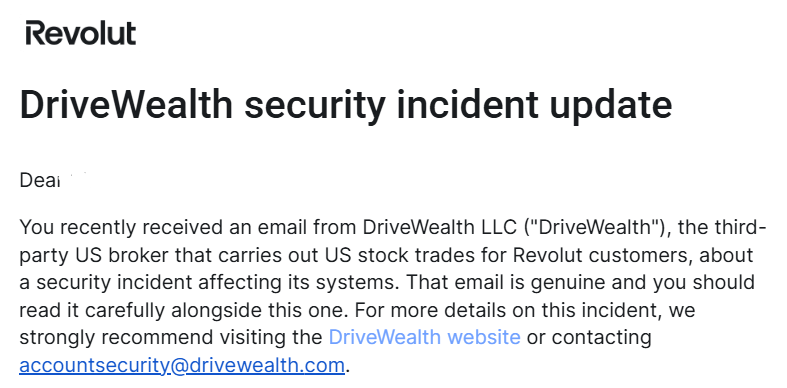
Revolut customers, including thousands in Ireland, faced their second data incident this month. This time, a third-party provider, not Revolut’s own systems, was responsible.
DriveWealth, the US broker that previously handled US stock trading for Revolut users, confirmed the breach occurred on September 4 and 5.
What Actually Happened at DriveWealth
A social engineering attack manipulates people into revealing sensitive information, rather than exploiting a technical software flaw directly. DriveWealth confirmed that’s exactly how attackers gained unauthorized network access this time.
The exposed data covers only historical customer records from before Revolut changed its trading model. In the European Economic Area, including Ireland, that cutoff fell in December 2023. Revolut stopped sharing individual customer details with DriveWealth after that switch, so recent users remain unaffected.
Exposed information may include names, email addresses, phone numbers, postal addresses, employment details, and biographical data like citizenship, age, and gender. Partial DriveWealth account numbers were also affected.
Passwords, payment card details, bank information, Revolut passcodes, and identity documents were not compromised. A Revolut spokesperson confirmed DriveWealth contacted affected customers directly, with Revolut following up through its own emails.

Why Does This Keep Happening to Revolut Customers?
This breach follows a separate incident earlier in September, when a sophisticated impersonation scam using a legitimate Italian government email domain tricked Revolut into releasing sensitive data. That case affected roughly 680 customers globally and involved identity documents.
The breach also reached beyond Revolut. Stake and Hatch, two other platforms using DriveWealth’s infrastructure, confirmed similar exposure.
Neither Revolut nor DriveWealth has disclosed exact numbers of impacted customers. Revolut serves approximately 3.4 million customers in Ireland alone.
Affected users should monitor communications, watch for phishing attempts, and contact Revolut through official channels with concerns. Two breaches in one month highlight growing risk tied to third-party fintech infrastructure.
The post Revolut Customers Hit by Second Data Breach in Just One Month appeared first on BeInCrypto.
Robert Kiyosaki thinks one of the biggest differences between rich and poor people can be heard in everyday conversation.
The Rich Dad Poor Dad author says phrases such as “I can’t afford it,” “I’ll try,” and “the rich are greedy” reveal how people think about money. In a recent post on X, he argued that repeating those ideas can reinforce a scarcity mindset.
The Phrases Kiyosaki Says Keep People Poor
Kiyosaki’s argument goes beyond positive thinking. His broader point is that wealthy people understand money differently, especially when it comes to income.
He divides income into three categories.
- Earned income comes from wages and usually faces the highest tax burden.
- Portfolio income comes from investments such as retirement accounts.
- Passive income, which Kiyosaki favors, can sometimes receive much lighter tax treatment.
That distinction helps explain one of his favorite examples: Warren Buffett.
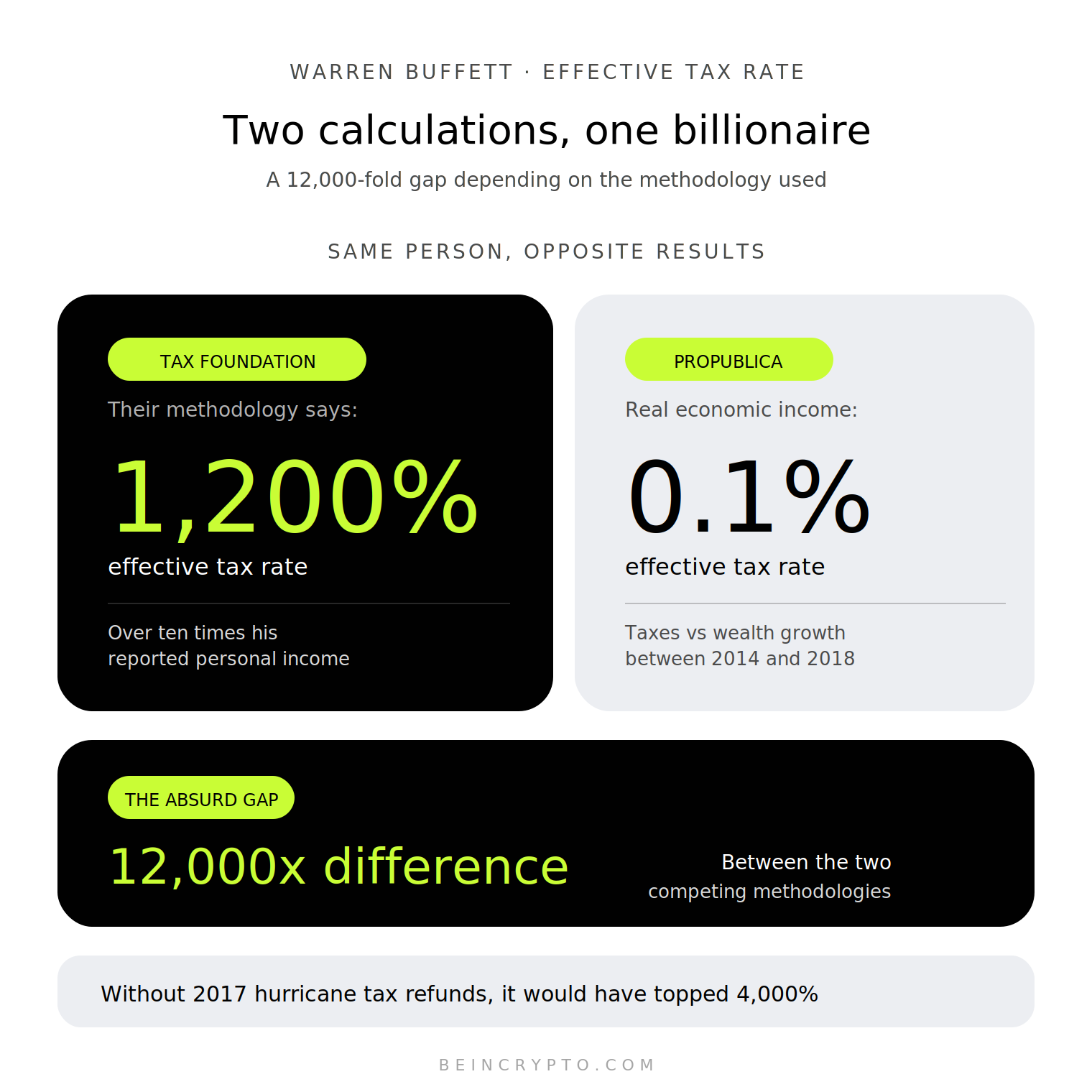
Buffett has famously paid a lower effective tax rate than his secretary in some years because most of his wealth comes from investments rather than salary.
ProPublica went further. Using leaked IRS data, one analysis estimated Buffett’s “true tax rate” at just 0.1% between 2014 and 2018 when comparing taxes paid with the rise in his overall wealth.
That figure is controversial because unrealized investment gains are generally not treated as taxable income.

Why Kiyosaki Keeps Telling People to Stop Thinking Like Employees
Kiyosaki has spent years pushing the same broader message: rely less on cash and own assets.
He says he has held gold since 1971, silver since 1965, Bitcoin since 2012, and more recently Ethereum.
His price forecasts often attract attention, and several of his 2026 targets remain well away from current levels.
Still, his central claim is simpler than any market prediction. The way people talk about money, Kiyosaki argues, often reveals how they expect money to work for them.
The post Robert Kiyosaki Says These 3 Phrases Keep People Poor appeared first on BeInCrypto.

The Federal Reserve has proposed capital, redemption and other regulatory requirements for stablecoin issuers under its supervision as it moves to implement the GENIUS Act.
The GENIUS Act already requires stablecoin issuers to maintain reserves backing their tokens on a one-to-one basis and limits the types of assets they can hold, including cash, bank deposits and short-term US Treasurys. The law left federal regulators to establish more detailed capital, reserve-diversification and risk-management requirements.
Under the Fed proposal, issuers would face an operational-risk capital charge equal to 2% of the first $20 billion in stablecoins outstanding, 1.5% of the next $30 billion and 1% of amounts above $50 billion, along with additional capital requirements tied to credit and operational risks.
Issuers would generally be required to process redemptions within two business days. If reserves fall below the required one-to-one backing, an issuer would have to notify the Fed and either restore its reserves under a remediation plan or liquidate them and redeem outstanding stablecoins.
Issuers would also have to publish monthly reports detailing their outstanding stablecoins and the value and composition of their reserves. The disclosures would have to be examined by a registered public accounting firm and certified by the issuer’s CEO and CFO.
A separate proposal would establish an application process for Fed-supervised banks seeking approval to issue payment stablecoins through subsidiaries, including requirements to submit a business plan and financial information.
The proposals are open for public comment for 60 days after publication in the Federal Register.
Related: EU banking watchdog calls for crypto lending rules under MiCA
Barr says stablecoins must remain redeemable during market stress
Fed Governor Michael Barr supported the proposal on Thursday but said further work would be required for stablecoins to become reliable payment instruments.
“Stablecoins will only be stable if they can be reliably and promptly redeemed at par in a range of conditions. This includes during market stress, when pressure can be put on the value of even otherwise liquid government debt, and during episodes of strain on the individual issuer or its related entities,” Barr said.
Barr added that he was encouraged by the proposed limits on reserve assets and standardized capital requirements, while calling for public feedback on whether the framework adequately addresses interest-rate and foreign-currency risks.
He also said universal redemption rights should be clearly established in the final rule and raised concerns about a standard that would prevent the Fed from taking supervisory or enforcement action over an anti-money laundering deficiency unless the issue is considered “significant or systemic.”
The GENIUS Act is set to take effect on Jan. 18, 2027, or 120 days after federal regulators issue final implementing rules, whichever comes first.
Magazine: Winners and losers of the SEC’s new tokenized stocks rules

The case adds to a growing fight between prediction markets and state gambling regulators over who has the authority to oversee the products.
Prediction market companies argue that their event contracts are financial products overseen at the federal level by the Commodity Futures Trading Commission (CFTC). States have taken a different view, particularly when the contracts involve sports, arguing that the products are effectively bets and must follow state gambling rules.
New York has been one of the most active states in that fight. The state sued Kalshi in July after negotiations between the company and Hochul’s office broke down, seeking as much as $36 billion in penalties and disgorgement. Many of these court cases have gone to appeals courts, and a recent case between Kalshi and New Jersey has been appealed to the U.S. Supreme Court.
“Our gambling laws exist to protect New Yorkers, prevent the potential harms of problem gambling, and ensure funding for educational and public benefit programs,” James said in a statement.
The lawsuit comes less than a year after Polymarket returned to the U.S. market.
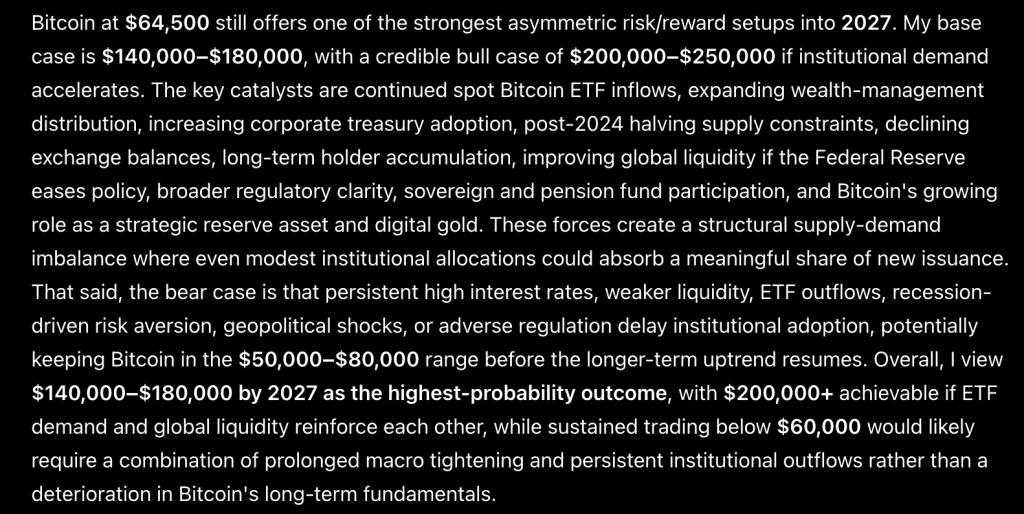
Microsoft Copilot AI predicts a wild move for BTC in Q4 2026, calling it one of the strongest asymmetric risk-reward positions available. The base case sits at $140,000 to $180,000. A credible bull case reaches $200,000 to $250,000 if institutional demand actually accelerates from here.
The catalyst list is long, but the underlying logic is simple. Continued spot ETF inflows, expanding wealth management distribution, and growing corporate treasury adoption all pull the same lever: more structural buyers competing for a shrinking pool of coins.
After the 2024 halving, supply constraints are already in effect. Layer declining exchange balances and long-term holder accumulation on top, and Microsoft Copilot AI sees a market where sellers are becoming scarce at the exact moment demand keeps widening.
Macro matters here, too. Improving global liquidity if the Fed eases, broader regulatory clarity, and early participation by sovereign or pension funds would all push in the same direction.
Microsoft Copilot AI frames Bitcoin’s evolving role as a strategic reserve asset and digital gold as the connective thread running through it all. The argument is that even modest institutional allocations could absorb a meaningful share of new issuance, given how constrained supply already is.
The bear case is not soft. Persistent high rates, weaker liquidity, ETF outflows, a recession-driven flight from risk, geopolitical shocks, or adverse regulation could all delay institutional adoption.
In that bearish scenario, Microsoft Copilot sees Bitcoin stuck in a $60,000 to $80,000 range before any longer-term uptrend resumes. Notably, the model draws a hard line at $60,000, arguing that sustained trading below it would require actual macro tightening and real institutional outflows, not just a normal pullback.

Bitcoin Price Prediction: Five Years On A Weekly Chart Says This Is Still The Same Cycle
Zoom out to the weekly, and the story changes shape entirely. Bitcoin closed yesterday above $84,000, essentially flat, with a range between $83,600 and $86,600.
From the 2022 bear market low, the climb into 2025 was one of the cleanest uptrends this asset has ever produced, breaking cleanly above the old 2021 highs and pushing toward $128,000 by late 2025.
What followed was a sharp, multi-month correction that brought the price back to a level it last visited over a year ago. It has since pushed back above $80,000 following a two-week period of bullish price action across the market.
Support on this weekly view sits at $80,000, a level defended multiple times across March and April 2025 before the breakout. Below that, $73,000 marks the last major consolidation floor from earlier in the cycle.
Resistance is layered higher up, first at $84,000, then a heavier ceiling near $92,000 to $120,000, where the 2025 top formed. Reclaiming that zone would be the first real signal that the uptrend has resumed rather than just paused.
Momentum on the weekly is neutral, neither compressed nor extended, which fits a market that has spent months digesting a major move rather than trending in either direction.
For the ‘Microsoft Copilot AI predicts’ 2027 targets to play out, this current range needs to resolve as a pause within a longer uptrend, not the top of one. The chart itself hasn’t answered that question yet.
Here is What Microsoft Copilot AI Predicts About LiquidChain
Most people will only recognize this shift in hindsight. Smart investors have already made their moves. Large-cap tokens are still finding their feet in this growing bull market structure, but they aren’t going parabolic just yet.
Bitcoin, Ethereum, and XRP are all testing key resistance levels right now. Each favorable macro trend has a new expected timeline, and the true institutional investment wave is expected to arrive next quarter.
Investing in assets where growth depends solely on someone else’s decision isn’t a solid strategy; it’s just waiting in a waiting room. Capital that has weathered numerous market cycles understands one key point: it moves before the destination becomes clear.
Early-stage infrastructure plays by completely different rules. A small market cap means that a modest rotation can produce dramatic price movement.
The returns live in the gap between what something is genuinely worth and what the market has assigned it so far. That gap exists only while the project remains undiscovered. Once found, it closes permanently.
Multi-chain fragmentation bleeds DeFi every day. Bitcoin, Ethereum, and Solana exist as completely isolated systems. No native bridge between them. Every user crossing those boundaries absorbs the cost directly in fees, slippage, and failed transactions. Every single crossing. Every single time.
Microsoft Copilot AI predicts LiquidChain fixes this entirely. All 3 networks within a single execution layer. One deployment reaches everything. Zero cross-chain tax on any interaction.
The presale is at $0.014958 with just over $972,000 raised. The market has not fully discovered this yet, and that is exactly the point.
Gain Special Access to Layer 3 Trading Here
Don’t Miss: The Hottest Meme Coin Opportunities Silently Climbing the Crypto Ranks in September
The post Microsoft Copilot AI Predicts Bitcoin Will Do Something Incredible in Q4 2026 appeared first on Cryptonews.
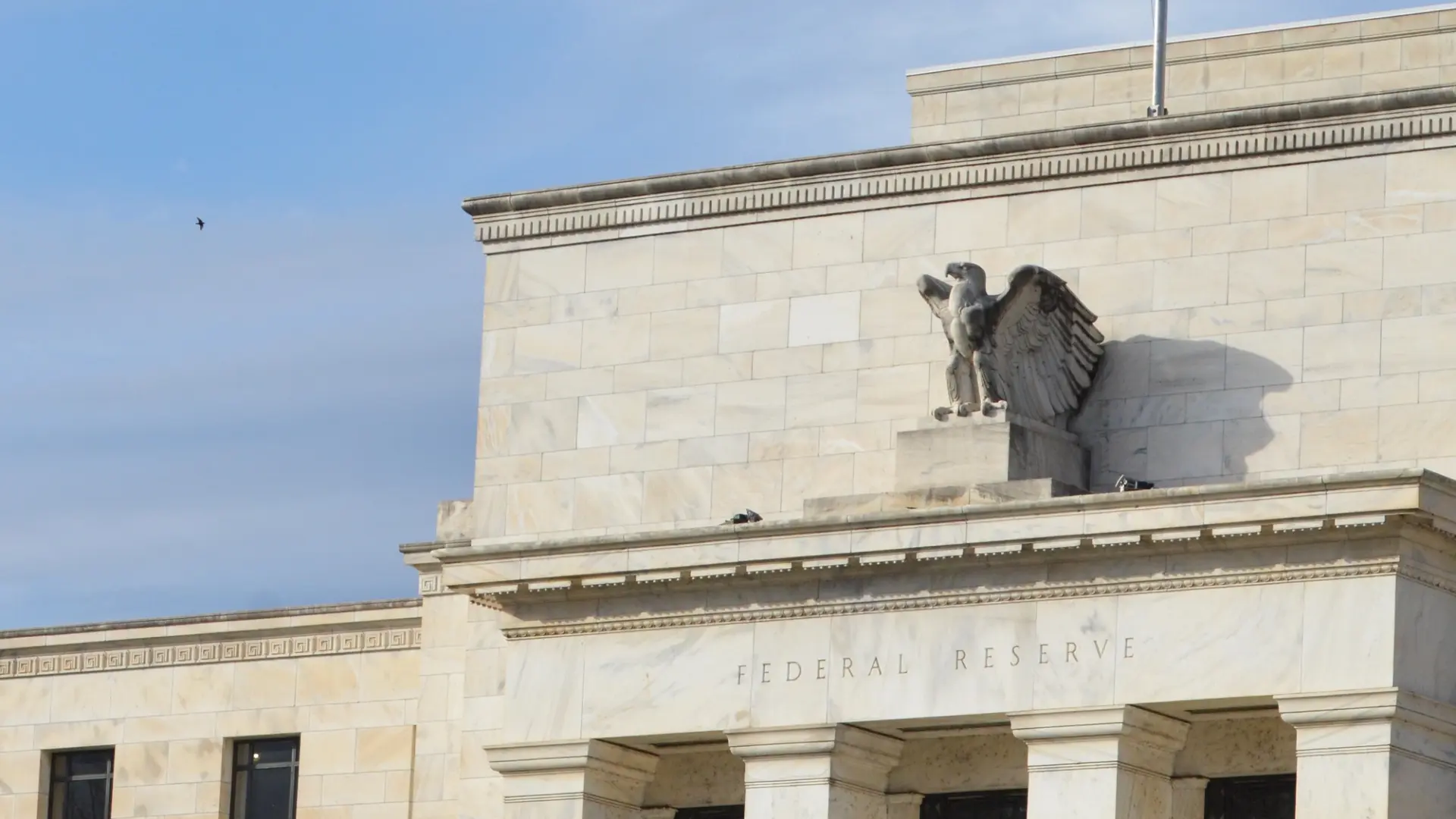
“Under the proposal, certain types of arrangements involving third parties would be presumed to be prohibited payments of interest or yield,” the Fed wrote, noting that its approach is consistent with the OCC’s. Though the regulations aren’t final, the agencies seem to be allowing a very narrow approach by crypto platforms to offer stablecoin rewards akin to credit-card incentive programs.
The question of how much companies such as Coinbase could reward stablecoin users was one of the sticking points in the debate over the recently failed Digital Asset Market Clarity Act. As it stands, the GENIUS Act is now the primary law governing stablecoin rewards, because the efforts to revise it in the Clarity Act didn’t succeed.
Proposed rules like those offered by the Fed on Thursday need to gather input from the public before the federal regulator can revise them and publish them in final form — a process that usually takes several months, sometimes much longer.
The central bank’s first proposal on Thursday governs capital and reserve requirements meant to ensure that the stablecoins are fully represented by the most liquid assets and the issuers have a solid foundation in times of stress. It also outlines accepted stablecoin activities at its supervised banks, and it’s the proposal that includes the stablecoin rewards component.
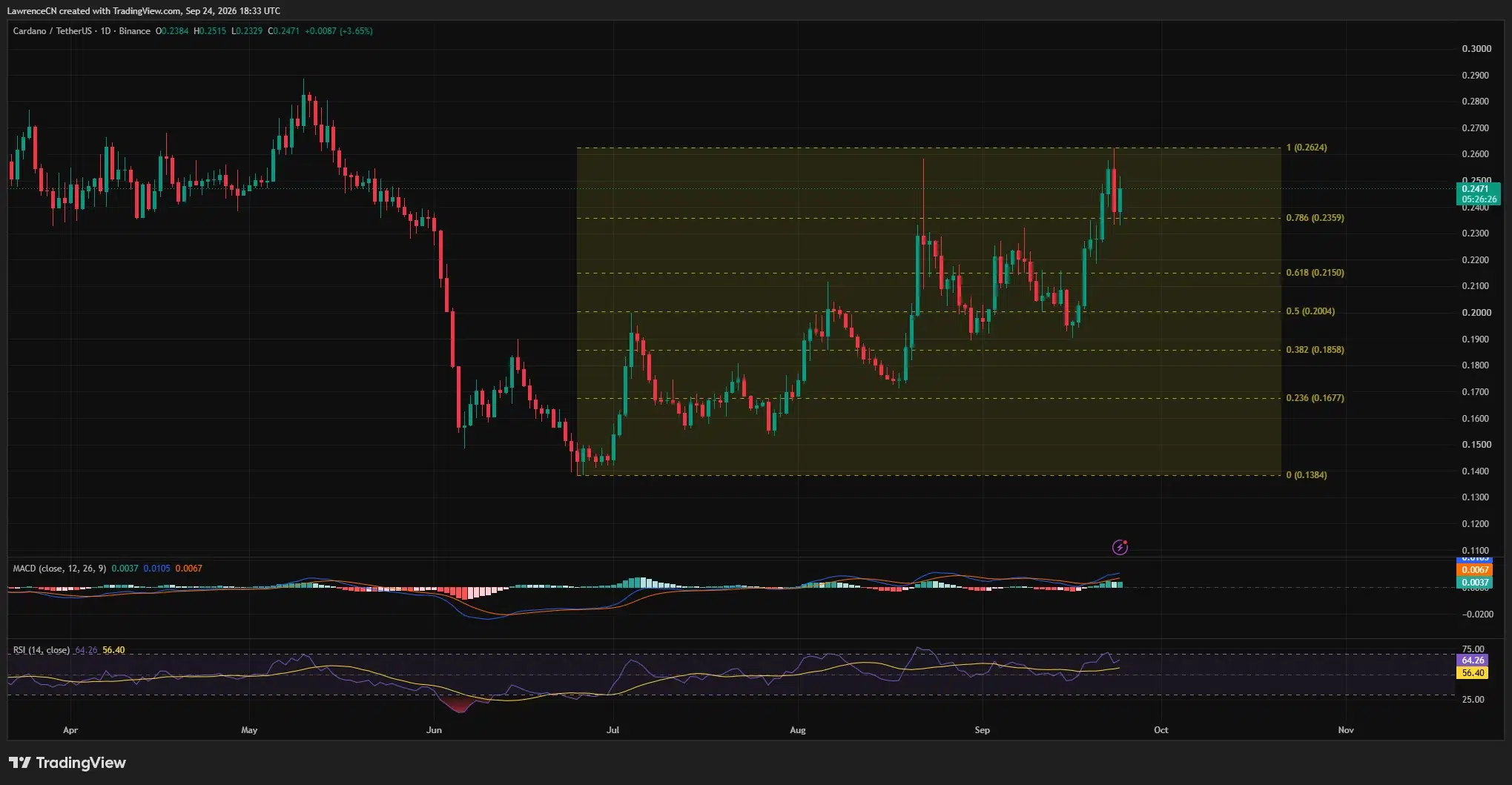
Cardano’s ADA rose toward $0.26 as the Cardano Foundation and Fireblocks announced plans to add full support for tokens issued on the network by March 2027.
Summary
- Fireblocks plans to let its institutional clients custody, send, and receive Cardano Native Tokens.
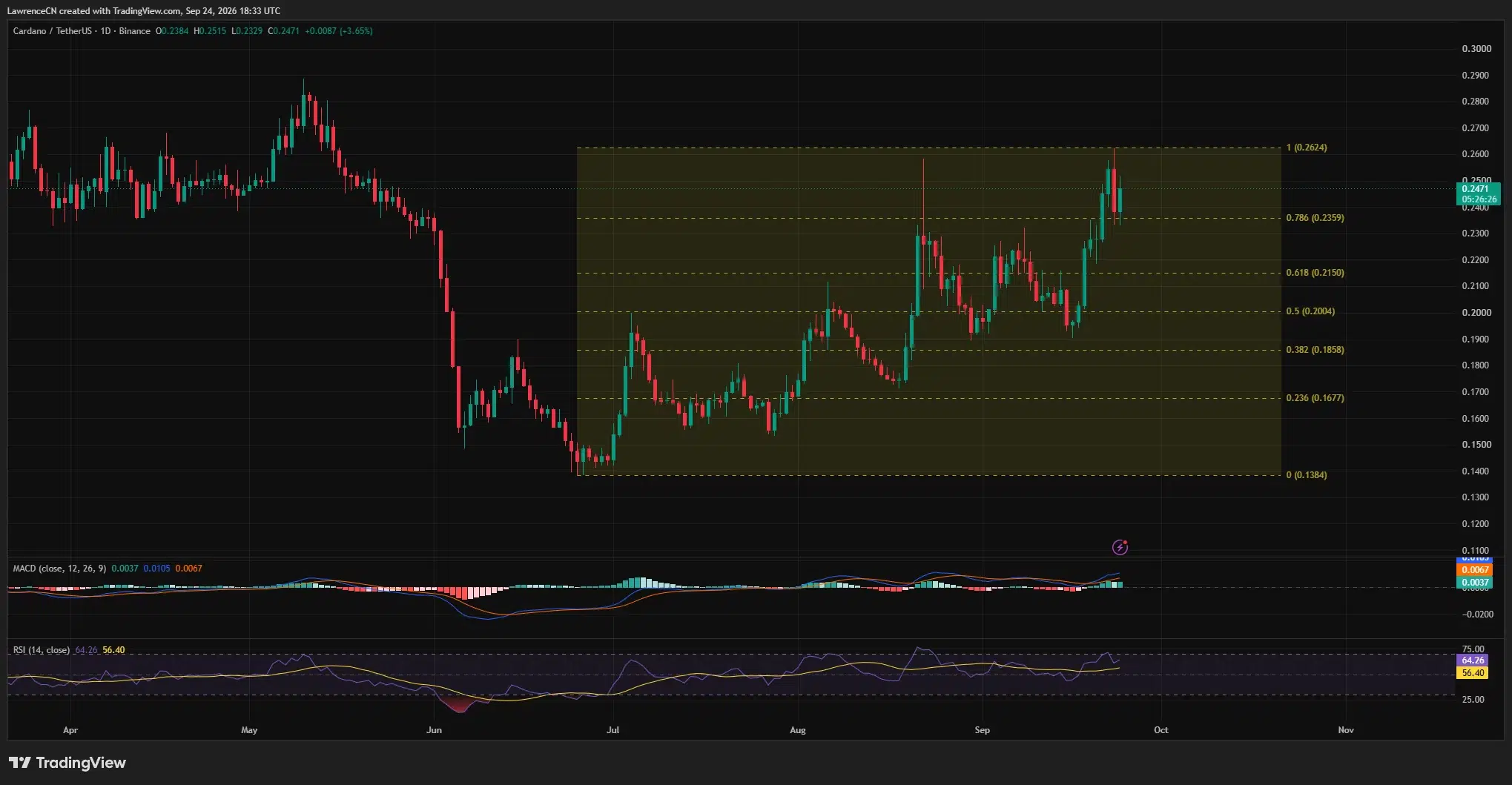
- ADA traded near $0.247 on Sep. 24 after reaching about $0.251 during the day.
- The daily chart puts $0.262 in view if ADA clears resistance near $0.26.
- Support sits near $0.236 on the daily chart and $0.235 on the 4-hour chart.
Fireblocks plans to add Cardano token support by March 2027
The Cardano Foundation and Fireblocks said on Sep. 24 that Cardano Native Tokens, or CNTs, will become standard assets on the Fireblocks platform. Banks, exchanges, payment companies and fintechs using the platform will be able to custody, send and receive the tokens under its existing security and policy controls.
Fireblocks has supported Cardano’s native coin, ADA, since 2021. The planned addition covers other assets issued on Cardano, including tokens that use the Cardano Token Registry standard, known as CIP-26, and the network’s onchain metadata standard, CIP-68. According to the announcement, handling those tokens has required extra manual steps until now.
The companies expect support to become available by March 2027. They also plan to assess further integrations with Cardano’s decentralized finance ecosystem during 2027.
Cardano Foundation CEO Frederik Gregaard said access through infrastructure institutions already used could help issuers of stablecoins and tokenized assets on Cardano reach those firms.
“Institutions rarely adopt a new asset on its own. Adoption happens through trusted infrastructure.”
The announcement concerns planned access to Cardano-based tokens. It does not report new token issuance, institutional purchases of ADA or a completed platform rollout.
ADA price faces another test near $0.26
TradingView’s ADA/USDT daily chart showed ADA near $0.247 late on Sep. 24, up about 3.65% for the day. Price had reached roughly $0.251 before pulling back, leaving the recent high around $0.26 as the next level to watch.
A Fibonacci retracement drawn from the chart’s June low near $0.138 to the recent high near $0.262 places the 78.6% level at $0.2359. ADA was trading above that level at the time of the chart. A move through the recent high would put $0.262 back in focus, while a drop below $0.236 would take price beneath the retracement level.
The daily relative strength index stood near 64, above its average of about 56. The moving average convergence divergence indicator was also positive, with its MACD line above the signal line. Both readings reflected the recent advance, though ADA had yet to clear the high used in the retracement.
On the 4-hour chart, ADA had retreated from a move above $0.26 before recovering to around $0.247. The Supertrend indicator remained below price near $0.2354. A rising trendline on the chart pointed toward the $0.25 area, making a sustained move above that level relevant to another test of the recent peak.
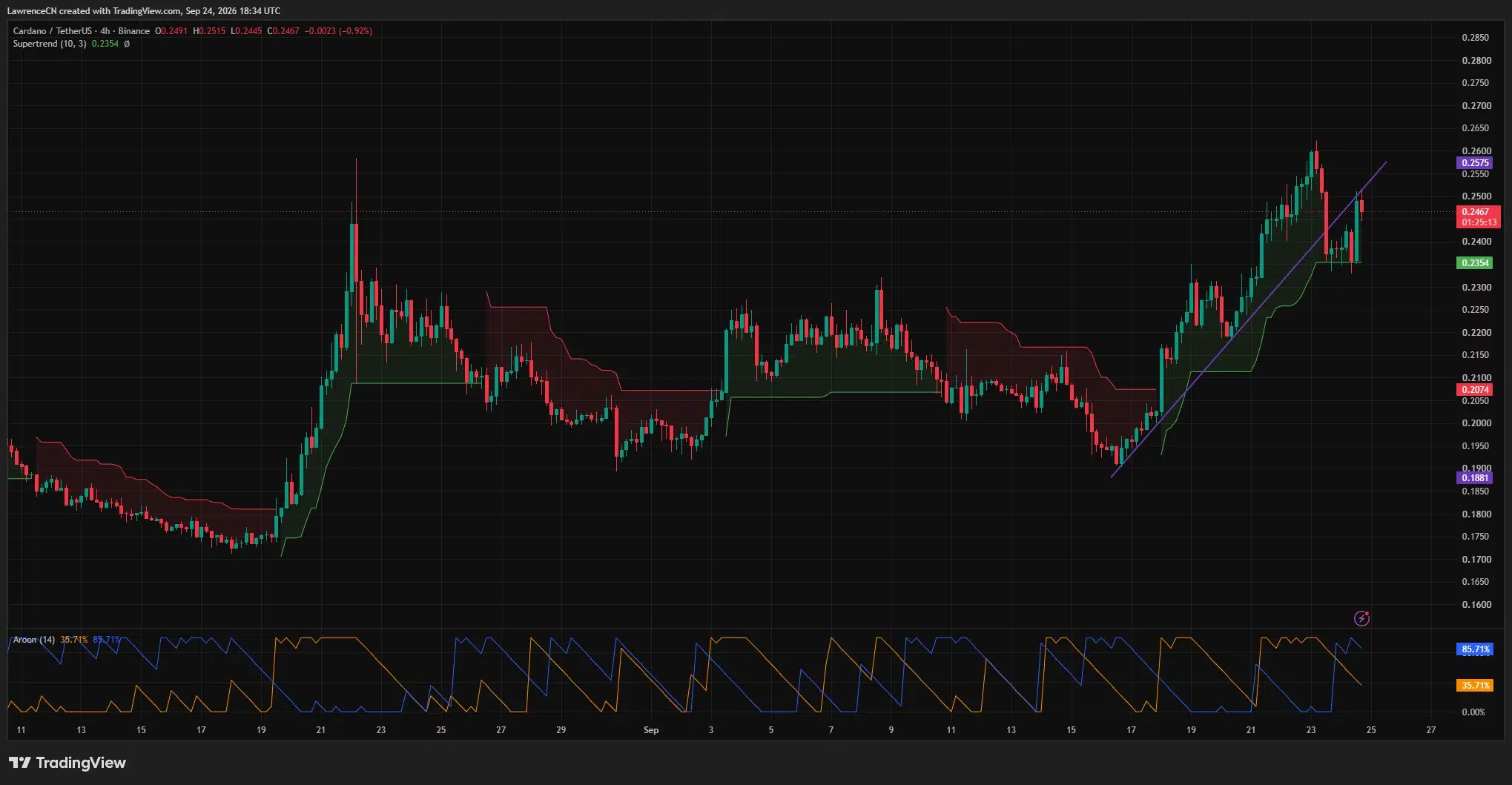
Liquidation levels cluster on both sides of ADA
CoinGlass’s 24-hour ADA liquidation heatmap showed a bright band near $0.252, just above the price at the end of the chart. Other visible bands sat around $0.242 and $0.236, with a larger group of levels lower down near $0.23.
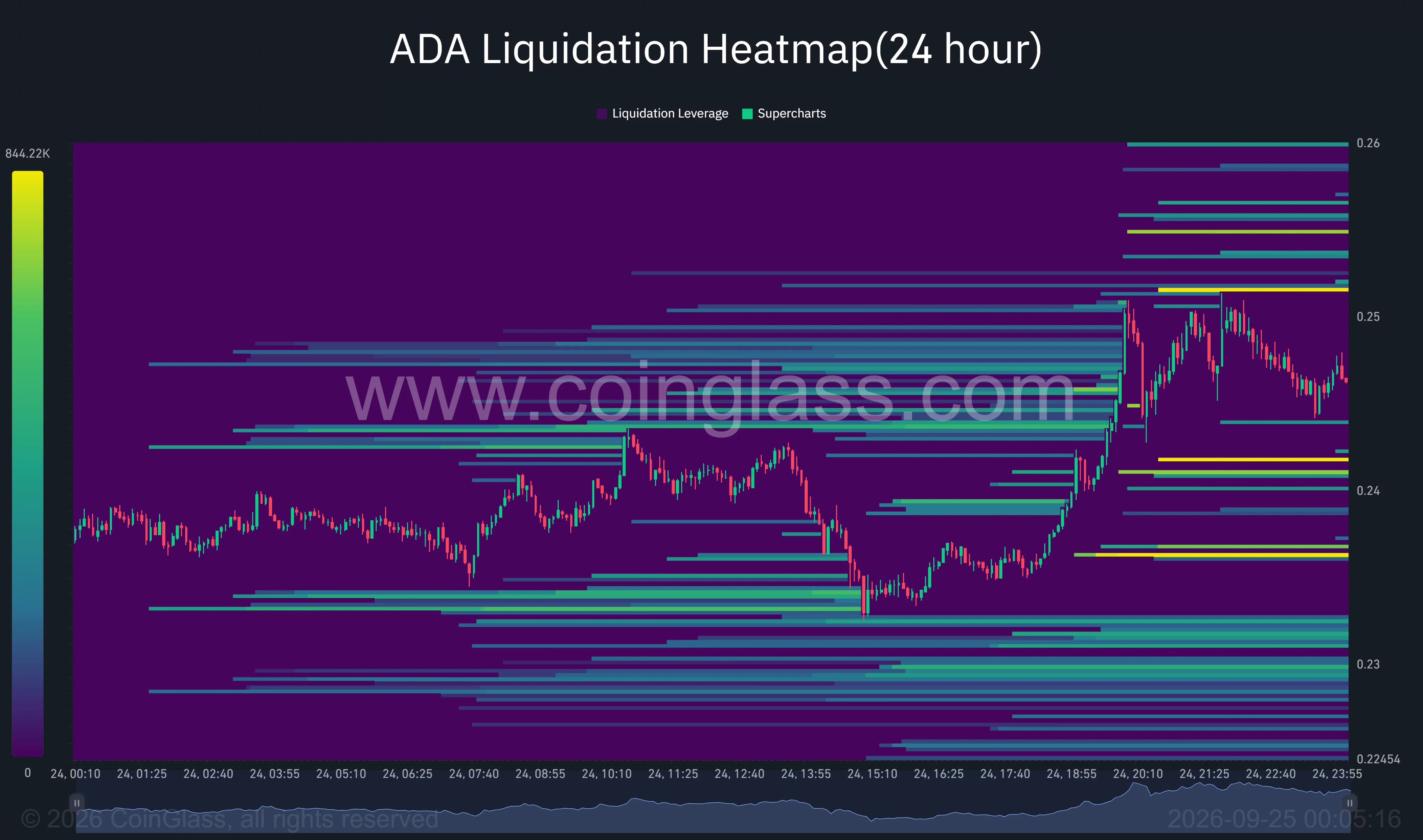
Those bands show where leveraged positions could face liquidation if price reaches them; they do not establish where ADA will trade next. The nearby $0.252 band also falls below the recent high around $0.26, so ADA would need to pass both areas to confirm a stronger breakout on the displayed charts.
The Fireblocks rollout gives Cardano token issuers a timetable for access to institutional custody and transfer tools, including firms serving the US market. For ADA holders, the nearer test remains technical: whether price can regain $0.25 and break above $0.26 while holding the $0.235–$0.236 support area on a pullback.
Disclosure: This article does not represent investment advice. The content and materials featured on this page are for educational purposes only.

The war in Gaza has been a major focus for world leaders addressing the U.N. in New York this week.
U.N. Secretary-General António Guterres, whose nearly decade-long tenure leading the international body comes to an end at the start of next year, said during his address on Tuesday that Gaza has experienced “a scale of killing and destruction unlike anything I have witnessed in all my years as Secretary-General.” He added that Israel’s “violence, displacement and settlement expansion” raised the “specter of ethnic cleansing.”
Trump said the war in Gaza was over. He took credit for ending it, “saving untold thousands of lives,” and brokering the return of the remaining hostages held in Gaza. But key elements of the peace agreement Trump helped broker in October 2025—including Hamas’ disarmament, a long-term plan for governing Gaza, and the delivery of humanitarian aid—remain largely stalled.
Other world leaders called for greater international action over the continuing suffering in Gaza. French President Emmanuel Macron asked “what is our credibility worth if we remain inactive on Gaza?” during his speech on Tuesday. British Prime Minister Andy Burnham said the same day: “We will not stand by as the horrific suffering continues to grow and the prospect of a two-state solution, the best hope for peace and stability for both nations, comes under attack.”
Crypto World
Crypto exchange Bitget says $352 million affected in a hack, claims user funds are ‘safe’

Crypto exchange Bitget had $351.6 million dollars exposed to a system breach on Thursday, CEO Gracy Chen announced in a social media post.
In a post on X, Chen said that Bitget’s cold wallets and user funds were safe, and that there were “unauthorized transfers from some of our hot wallets.” The exchange maintains a “user protection fund” that had over $464 million in it, she said.
“Cold wallets remain fully secure. Bitget operates a three-tier wallet architecture — the breach contained only a portion of the hot wallet and warm wallet layers,” she added.
Deposits and trading remain online, she said, but the exchange is “temporarily” pausing withdrawals until it can finish a security review.
Onchain data and independent blockchain researchers had earlier flagged unusual wallet movements, initially reporting that around $183 million in digital assets had moved from wallets labeled as belonging to the exchange.
Emmett Gallic, an analyst at blockchain analytics firm Arkham Intelligence, said in an X post that the transactions involved three Bitget hot wallets and one cold wallet across multiple blockchains, with the funds consolidated into a single address. The assets included ETH, BNB, AVAX and USDT0, according to his analysis.

Cointelegraph is committed to providing independent, high-quality journalism across the crypto, blockchain, AI, and fintech industries.
All news, reviews, and analyses are produced with full journalistic independence and integrity. For more details on our standards and processes, please read our Editorial Policy.

Tyson Fury vs Anthony Joshua controversial late UK ringwalk time revealed

I tried the Ray-Ban Meta Glasses (Gen 3) ahead of launch and they will be as controversial as ever

Every Money in the Bank winner of the last decade (2016-25): WWE Playlist

Weekend Open Thread – Corporette.com

Weekend Open Thread: Talbots – Corporette.com

Memory prices are slowing because buyers ran out of money
Every Money in the Bank winner of the last decade (2016-25): WWE Playlist

Why sell your xrp when you could become a millionaire if you hold longer #crypto #cryptonews #xrp

7 Business Mistakes to Avoid | Smart Awareness | Financial Discipline Motivation Video 2026
-
 Fashion6 days ago
Weekend Open Thread: Talbots – Corporette.com
-

 Tech4 days ago
Researchers escape OpenAI Codex sandbox to run commands on host
-

 Crypto World2 days ago
Goldman Sachs and Deutsche Bank Agree: The S&P 500 Rally Isn't Over
-

 Crypto World4 days ago
Who Needs CLARITY Anyway? ARB Could See 70X Increase: Hodler’s Digest
-

 Crypto World6 days ago
Circle launches Arc Studio AI agent for building onchain apps
-

 Fashion12 hours ago
8 iPhone Accessories That Add Personality
-

 Crypto World7 days ago
Mortgage and refinance interest rates today, Thursday, September 17, 2026
-
 NewsBeat6 days ago
Trump says US has reached an agreement to take permanent control of Greenland’s security
-

 Crypto World6 days ago
Trading Bitcoin on Robinhood? Why 2% Spread Has Traders Worried
-

 Crypto World6 days ago
Bitcoin price breaks channel as RSI climbs to 63
-

 Business4 days ago
Analog Devices (ADI) Bets $1.35 Billion on Chips that Let Machines Think for Themselves
-

 Tech3 days ago
Google’s $899 Googlebook is a bet that you’ll buy a new laptop for Gemini
-

 Tech5 days ago
Trump suggests rebranding AI with a new name, says he’s also creating an AI Force
-

 Crypto World4 days ago
Coinbase, Robinhood, Circle Seen as Tokenized-Stock Winners
-
 Business2 days ago
Oil Price Today (September 23): Crude oil below $100 on hopes of US-Iran talks. What did Trump say?
-

 Crypto World6 days ago
World Money launches in 150+ countries with Stripe
-

 Crypto World6 days ago
Silver prices recover quickly, hitting weekly high today
-

 Crypto World2 days ago
Trump-Xi Polymarket Odds for Handshake Hit 50%
-

 Crypto World1 day ago
Bitcoin Threatens Sub-$84,000 Breakdown as Long Liquidations Spike
-

 Entertainment2 days ago
These 17 Fall Amazon Dresses Seriously Look Like Anthropologie
You must be logged in to post a comment Login