

Crypto World
Federal Authorities Transfer Bitcoin (BTC) From Bitfinex Hack to Coinbase Prime Custody


Key Takeaways
- Federal authorities transferred approximately $606,000 worth of Bitcoin (8 BTC) connected to the 2016 Bitfinex security breach to Coinbase Prime
- The cryptocurrency is associated with Ilya Lichtenstein, responsible for stealing 119,756 BTC from Bitfinex in 2016, valued at roughly $72M during the theft
- Legal statutes mandate the confiscated Bitcoin must be returned directly to Bitfinex rather than liquidated for government revenue
- Bitfinex has outlined plans to utilize recovered assets for redeeming Recovery Right Tokens and burning LEO tokens
- Federal wallets currently contain 328,361 BTC with an estimated value approaching $24 billion
Federal authorities executed a transfer of roughly $606,000 in Bitcoin to Coinbase Prime this past Thursday. On-chain records verified the movement of 8 BTC, with the assets directly traceable to cryptocurrency stolen during the 2016 Bitfinex security incident.
Blockchain intelligence provider Arkham detected and reported the transaction, establishing a connection between the coins and Ilya Lichtenstein, the individual responsible for orchestrating one of the digital currency industry’s first significant exchange compromises.
When government-held cryptocurrency moves to trading platforms, it typically sparks speculation about possible liquidation. However, this particular situation differs significantly—legal requirements explicitly mandate the coins be restored to Bitfinex rather than converted to cash.
This transaction represents the third such movement from government wallets, following similar transfers documented on March 3 and April 10, both relating to distinct cryptocurrency enforcement actions.
On August 2, 2016, Lichtenstein leveraged a security flaw in Bitfinex’s multi-signature wallet infrastructure. Through fraudulent authorization of more than 2,000 separate transactions, he successfully diverted 119,756 Bitcoin into a wallet under his exclusive control.
The stolen Bitcoin represented approximately $72 million in value when the breach occurred. With current market prices hovering around $74,000 per unit, that identical quantity now carries a valuation of roughly $8.9 billion.
Following the security breach, Lichtenstein collaborated with his spouse, Heather Morgan, in an extensive five-year operation attempting to obscure the funds’ origins. Their methods included utilizing cryptocurrency mixing services, darknet marketplace transactions, cross-chain transfers, and physical gold acquisitions.
During February 2022, FBI investigators successfully decrypted archived files within Lichtenstein’s cloud storage infrastructure. The breakthrough revealed a detailed spreadsheet cataloging more than 2,000 private cryptographic keys, providing law enforcement complete access to virtually all stolen assets. Officials ultimately seized approximately 94,636 Bitcoin, representing $3.6 billion at that time.
Disposition of Recovered Cryptocurrency Assets
Early in 2025, federal judicial proceedings established definitively that confiscated coins require in-kind restoration to Bitfinex. Government agencies lack authorization to liquidate the cryptocurrency and redirect revenues to federal coffers.
Bitfinex has publicly outlined its strategy for handling returned assets. The platform commits to completely redeeming all outstanding Recovery Right Tokens, which represent digital instruments issued to account holders who sustained losses during the breach.
No less than 80% of any surplus net proceeds will fund the repurchase and permanent removal of its UNUS SED LEO token from circulation, adhering to previously established whitepaper obligations.
Lichtenstein received a five-year federal prison sentence in November 2024. Morgan was assigned 18 months.
Federal Cryptocurrency Portfolio Overview
Lichtenstein secured release in January 2026 through provisions of the First Step Act. He publicly expressed gratitude to President Donald Trump via X platform following his release.
Federal authorities presently maintain custody of 328,361 Bitcoin distributed across various government wallets, representing approximately $24 billion in current valuation. Additional holdings include roughly $146 million in Ethereum alongside diverse alternative cryptocurrencies.
Government officials announced previously that confiscated Bitcoin reserves would contribute toward establishing a national strategic Bitcoin reserve program.




US April inflation rose 3.8% year-over-year, outpacing 3.6% wage growth and reigniting fears that the Iran war energy shock is bleeding into food, transportation, and core consumer prices.
Bernstein, however, told clients Tuesday that tokenization platforms can sidestep the macro repricing, reiterating its $67 price target on Figure Technology Solutions (FIGR) and signaling 72% upside despite the deteriorating backdrop.
Energy Shock Bleeds Into the Real Economy
Headline US CPI rose 3.8% in April, above the 3.7% consensus, while wages climbed just 3.6%. Many US workers are losing purchasing power for the first time in roughly three years.
Energy CPI rose 3.8%, and food prices climbed 0.5%, with average US gasoline now near $4.50 a gallon, up from $3.14 a year ago. President Trump floated a temporary suspension of the federal gas tax to relieve pressure on drivers.
Plastics and manufacturing costs are rising as Iran war supply disruptions ripple through global chemical inputs, lifting the risk that price pressure spreads beyond energy and food.
The US has delayed a plan to suspend beef import tariffs that Trump pitched as a grocery price fix.
Markets Reprice for Sticky Inflation
The Bank of Japan signaled rate hikes could come as soon as June, with one policymaker citing the oil shock as justification for near-term tightening. UK 30-year yields hit their highest level since 1998.
Hot inflation is the latest argument for the Federal Reserve to delay rate cuts further into 2026, with dollar strength and elevated bond yields historically pressuring risk assets.
“While April CPI inflation rose to 3.8%, inflation is much higher in many basic necessities. This has driven cumulative inflation since 2020 to +29%, meaning goods that cost $100 in 2020 now cost $129 today. Inflation remains a major issue for Americans,” analysts at the Kobeissi Letter indicated.
The S&P 500 is still up 8.3% year-to-date despite the macro tape.
Bernstein analysts led by Gautam Chhugani argued that Figure’s blockchain-based loan origination platform is insulated from the macro repricing, with Q1 tokenization volumes rising 113% year-over-year to $2.9 billion.
Whether the repricing extends into core CPI or eases with an Iran ceasefire will determine how aggressively the Fed tightens through summer, and whether Bernstein’s macro-immune tokenization thesis holds.
The post US Inflation Just Beat Wages, But Bernstein Says One Stock May Escape the Pain appeared first on BeInCrypto.
Crypto World
Bitcoin Rallies on Aggressive Spot Demand as Market Absorbs U.S. Economic Data: Bitfinex

Following a period of speculation-driven surges, bitcoin (BTC) appears to be rallying due to spot demand. Within a short time, spot demand metrics have shifted from contraction to growth. This development comes as the crypto market digests U.S. economic data.
According to the latest Bitfinex Alpha report, the ongoing bitcoin breakout reflects a widening gap between historical information about the U.S. economy and rapidly deteriorating sentiment evident in consumer data. This macro dynamic is significantly affecting risk assets like BTC and driving their prices higher.
BTC Sees Structural Improvement
Since the beginning of April, the crypto market capitalization has risen by $200 billion, following a 12% BTC rally that led to the strongest monthly performance in a year. By early May, BTC had broken above $80,000 – a level not touched since January 31. The move cleared the $78,000–$79,000, which had a dense overhead supply zone. Although the digital asset traded around $80,900 at the time of writing, the rally pushed it close to $83,000.
Bitfinex analysts have stated that the move marked a structural improvement and shifted BTC above a major aggregate cost-basis level near $79,800. This price doubles as the True Market Mean, which BTC has now reclaimed.
The most interesting part of this rally is that it was driven by aggressive spot demand. CryptoPotato reported last week that the market was not positioned for a surge above $80,000 due to weak demand.
Spot Demand Recovers
On-chain data shows that spot Cumulative Volume Delta (CVD) rose sharply after May 8, reflecting buyers absorbing supply at premium levels. Additionally, order books moved from bid-skewed to more neutral. Spot demand has stemmed from exchange-traded funds (ETFs) and from open-market accumulation.
As of two weeks ago, Michael Saylor’s Strategy was also a major driver of spot demand. However, there is less momentum from the company’s end because the purchases have been linked to the yield-bearing product, STRC. Unfortunately, the stock has not traded at or above its $100 par value, which is a threshold required for Strategy to purchase more BTC. In fact, the business intelligence entity is even looking to sell some of its bitcoins.
Nevertheless, conviction buyers, who are entities that accumulate BTC and rarely sell regardless of price, have increased their holdings. Analysts say they currently hold roughly 4 million BTC, following their largest surge since the COVID-19 crash. Historical data show that such growth from this cohort often precedes major price recoveries.
The post Bitcoin Rallies on Aggressive Spot Demand as Market Absorbs U.S. Economic Data: Bitfinex appeared first on CryptoPotato.


JPMorgan has filed to launch the JPMorgan OnChain Liquidity-Token Money Market Fund (JLTXX), a tokenized Treasury vehicle on Ethereum powered by Kinexys Digital Assets.
According to the filing with the US Securities and Exchange Commission (SEC), under normal conditions, the fund invests only in US Treasury securities and Treasury-collateralized overnight repurchase agreements.
JPMorgan Files To Launch A Second Tokenized Treasury Fund on Ethereum
The prospectus further says the fund will invest in a manner that satisfies eligible reserve requirements under the GENIUS Act, the US stablecoin law passed in July 2025.
“The Fund invests in a manner intended to satisfy the requirements for eligible reserve assets that stablecoin issuers are required to maintain under the Guiding and Establishing National Innovation for U.S. Stablecoins Act (otherwise referred to as the GENIUS Act) and regulations adopted thereunder, to support investment in the Fund by stablecoin issuers seeking to comply with such requirements,” the filing reads.
Follow us on X to get the latest news as it happens
JPMorgan’s prospectus signals that JLTXX will start on Ethereum but may expand to other networks. The launch deepens the bank’s tokenization push, alongside similar initiatives from institutional players such as BlackRock.
JLTXX would be JPMorgan’s second tokenized money market fund on Ethereum after My OnChain Net Yield Fund (MONY). The bank launched it in December 2025 with an initial investment of $100 million.
Why Ethereum, Again
Ethereum hosts the majority of distributed tokenized real-world asset (RWA) value tracked by RWA.xyz. The network currently accounts for more than 53.99% of the distributed RWA market share and supports around 846 tokenization projects,
The chain has become the leading settlement layer for institutional issuance, including funds from BlackRock and Franklin Templeton. Insights from BeInCrypto’s Expert Council indicated that institutional preference for Ethereum is less about ideology and more about institutional risk management, comfort, and defensibility.
“I think Ethereum probably wins for the next little while on the back of TradFi getting involved. As banks and other build stuff on blockchain space, it’s almost all going to happen on Ethereum for the next couple of years, I think,” Geoff Kendrick, Global Head of Digital Asset Research at Standard Chartered, told BeInCrypto.
Kendrick expects Ethereum to win the bulk of TradFi flows over the next couple of years.
Subscribe to our YouTube channel to watch leaders and journalists provide expert insights
The post JPMorgan Picks Ethereum Again in New Money Market Fund Filing appeared first on BeInCrypto.
Crypto World
Solana price retreats from $100 after rejection, will upcoming SMA crossover trigger rebound?
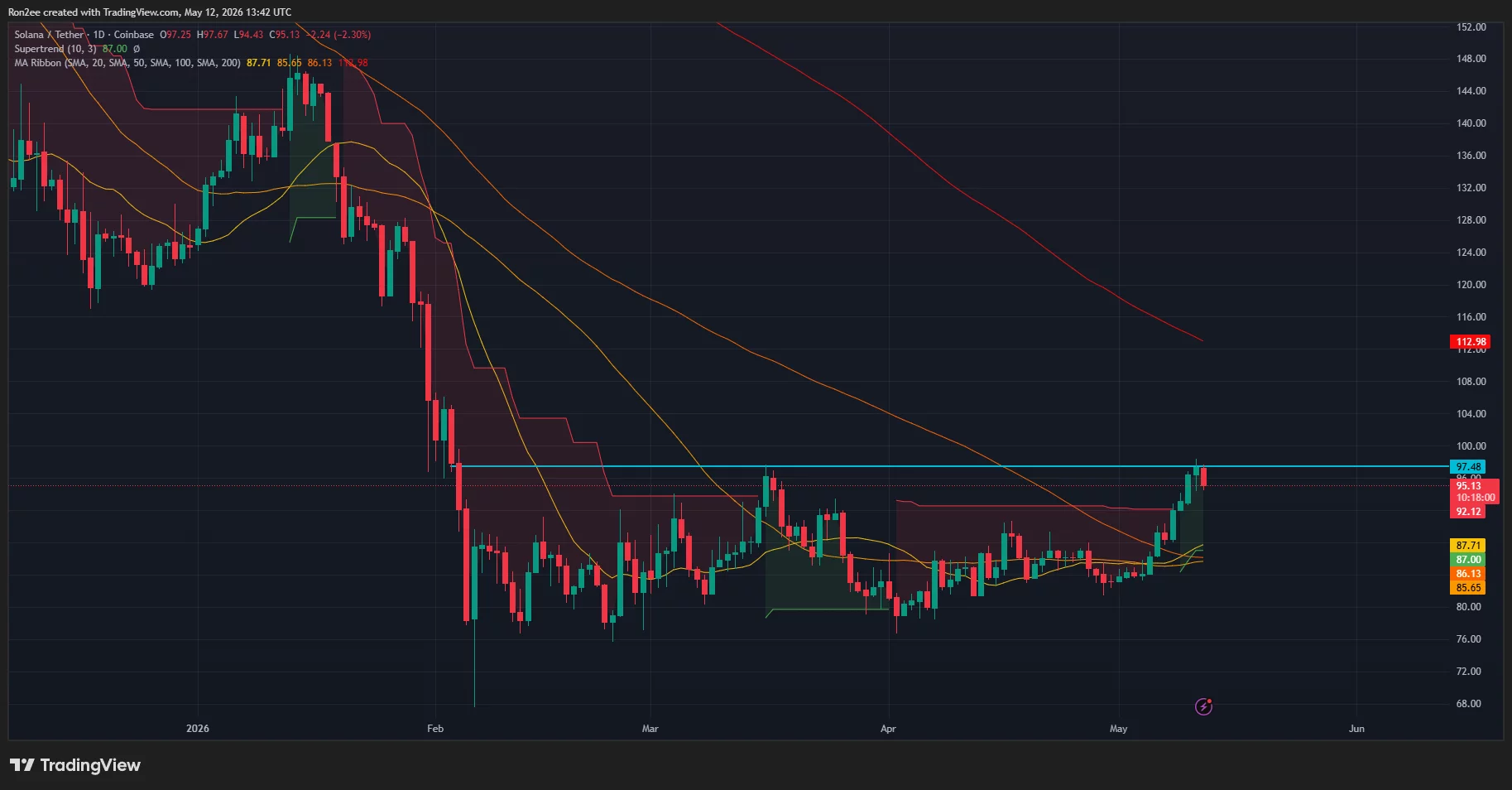
Solana price pulled back on Monday after facing rejection near the key $100 psychological level, though traders continue watching a potentially bullish moving average crossover that could support another upside attempt.
Summary
- Solana price pulled back toward $95 after facing rejection near the key $100 psychological resistance zone.
- SOL continues trading above its 20-day, 50-day, and 100-day SMAs, with a bullish crossover now approaching.
- A breakout above $100 could open the door toward the $112–$115 region, while $85 remains key support.
According to data from crypto.news, Solana (SOL) traded around $95 at press time on May 12 after briefly climbing as high as $97.6 earlier in the session. The token remains up sharply from its April lows near $80 despite the latest rejection from the upper resistance zone.
The recent cooldown comes as broader crypto market sentiment weakened following Bitcoin’s retreat below the $82,000 level amid rising geopolitical uncertainty tied to renewed U.S.-Iran tensions. Risk appetite across altcoins also softened after investors began locking in profits from last week’s rally.
Despite the pullback, Solana continues to show signs of improving technical structure after reclaiming several important moving averages over the past two weeks.
Market sentiment around the Solana ecosystem has also remained relatively stable as on-chain activity gradually recovers. While decentralized application volumes remain below peak levels seen earlier this year, network usage and validator participation have stopped deteriorating at the same pace witnessed during the first quarter correction.
At the same time, derivatives positioning has started improving modestly, with futures activity stabilizing after weeks of subdued participation. Traders now appear focused on whether Solana can establish support above the mid-$90 region before another breakout attempt toward $100.
Solana price analysis
On the daily chart, Solana recently broke above the important resistance cluster near $92 before rallying toward the $97–$100 region, where sellers quickly stepped back in.
However, the broader structure still appears constructive as SOL continues trading above its 20-day, 50-day, and 100-day simple moving averages, which are now tightly compressed between roughly $85 and $88. The close convergence between these moving averages often signals that momentum is preparing for a larger directional move.
Notably, the 20-day SMA is now approaching a bullish crossover above the 50-day SMA, which could strengthen short-term bullish momentum if confirmed over the coming sessions.
The Supertrend indicator has also flipped green for the first time since January, suggesting that buyers may gradually be regaining broader trend control after months of bearish pressure.
Still, the higher timeframe trend remains somewhat cautious as Solana continues trading below its downward-sloping 200-day SMA near the $113 region, which remains a major long-term resistance barrier overhead.
If bulls manage to reclaim momentum and push above the recent high near $97, the next major upside target could emerge at the psychological $100 level. A successful breakout above that region may then open the door toward the $112–$115 resistance area near the 200-day SMA.
On the downside, failure to hold above the moving average cluster near $85–$88 could weaken the bullish setup and potentially trigger a pullback toward the $80 support region, where buyers previously stepped in aggressively.
Disclosure: This article does not represent investment advice. The content and materials featured on this page are for educational purposes only.


BlackRock has filed a second Securitize‑powered tokenized fund with the SEC, signaling BUIDL’s $2.3B success is becoming a repeatable on‑chain RWA product line, not a pilot.
Summary
- BlackRock has submitted a new tokenized fund application to the SEC, again tapping Securitize as its on-chain infrastructure partner, marking the asset manager’s second move into the tokenized fund space.
- The filing builds on the success of BUIDL, BlackRock’s first Securitize-powered tokenized fund launched in 2024, which has grown to roughly $2.3 billion in assets under management.
- The new application signals that BlackRock is treating tokenized funds as a repeatable product line rather than a one-off experiment, accelerating the broader race among traditional asset managers to bring regulated on-chain investment products to institutional clients.
BlackRock has filed a new tokenized fund application with the U.S. Securities and Exchange Commission, once again choosing Securitize as the infrastructure provider, according to reporting by The Defiant. The filing has not yet been approved, and details on the fund’s target asset class, chain deployment and fee structure remain limited in the public record, but the move confirms that the world’s largest asset manager — overseeing more than $11.5 trillion in assets — is moving from pilot to product line in the tokenized fund space.
The new application leans on a relationship that has already produced one of the most successful tokenized fund launches in history. BlackRock and Securitize co-launched BUIDL, the BlackRock USD Institutional Digital Liquidity Fund, in March 2024 on Ethereum, initially targeting accredited investors with a $5 million minimum and a focus on short-term U.S. Treasury exposure. BUIDL has since grown to approximately $2.3 billion in assets, making it the largest tokenized Treasury fund globally and the clearest proof point that institutional demand for on-chain, yield-bearing dollar instruments is real and scalable.
Securitize, which serves as BUIDL’s transfer agent and tokenization platform, has built its business around being the regulated middleware between traditional fund structures and public blockchains. The firm is registered with the SEC as a transfer agent and operates a broker-dealer, giving it the compliance infrastructure that large asset managers need before they can list tokenized products to institutional clients. By returning to Securitize for a second filing, BlackRock is effectively endorsing that compliance stack as fit-for-purpose and signaling that it does not intend to build its own on-chain fund infrastructure from scratch.
Tokenized funds as a product line, not a pilot
The broader context matters here. BlackRock’s second filing arrives as the tokenized asset market is accelerating across multiple fronts simultaneously. A recent crypto.news story on Ondo Finance’s tokenized stock bridge detailed how the RWA tokenization market has scaled past $1.5 billion in TVL for equities alone, while a separate story on DTCC’s tokenized securities platform showed how post-trade infrastructure giants are now building the settlement rails that would make multi-billion-dollar tokenized fund flows operationally viable at scale.
For BlackRock, the strategic logic of a second tokenized fund is straightforward: BUIDL proved the model works for short-duration Treasury exposure, and a second product allows the firm to test a different asset class, duration profile or investor base on the same regulatory and technical architecture. The move also puts competitive pressure on Franklin Templeton, whose BENJI tokenized money market fund was an early BUIDL rival and whose XRPZ ETF recently led XRP spot inflows, and on Fidelity and State Street, both of which have filed or hinted at tokenized product ambitions of their own.
At a policy level, the filing lands in the same week that the CLARITY Act is heading to Senate Banking Committee markup and the White House is pushing for Trump to sign a crypto market structure bill before July 4, a convergence that turns BlackRock’s SEC submission into more than a routine product launch. As a crypto.news story on BNY’s Abu Dhabi digital asset custody expansion illustrated, the largest names in traditional finance are no longer hedging their blockchain bets — they are building production infrastructure and filing with regulators, treating tokenization as the next decade’s core product category rather than an emerging technology experiment.

JPMorgan Chase has filed with the U.S. Securities and Exchange Commission to launch a tokenized money market fund on Ethereum. The vehicle aims to hold reserves backing stablecoins in a regulated, cash-like structure while earning interest for investors.
The OnChain Liquidity-Token Money Market Fund, ticker JLTXX, would invest in US Treasury bills and overnight repurchase agreements collateralized by US Treasuries or cash, according to the SEC filing. The fund is designed to comply with the GENIUS Act, a stablecoin-focused law signed in July.
Investors would face a $1 million minimum investment, and the fund carries a 0.16% annual fee after waivers. JPMorgan’s blockchain unit, Kinexys Digital Assets, would manage the strategy. The filing indicates the regulatory filing becomes effective on Wednesday, though a formal launch date was not disclosed.
Tokenization has drawn increasing attention from Wall Street executives in recent months, who see on-chain structures as potentially improving the efficiency of trading and settlement compared with traditional systems. Data from RWA.xyz shows more than $32.2 billion of real-world assets tokenized on-chain, excluding stablecoins, across asset classes such as commodities, equities, bonds, and real estate. The platform notes that nearly every major asset class has been tokenized to some degree.
Bloomberg analyst Eric Balchunas described JPMorgan’s JLTXX as a “big deal” due to its 0.16% fee for a money market fund with a stable asset value, highlighting the potential for cost-efficient on-chain reserve management.
Key takeaways
- JPMorgan is pursuing a regulated, cash-like tokenized money market vehicle on Ethereum to back stablecoin reserves, via the JLTXX fund.
- The fund targets a 0.16% annual fee after waivers, a historically low fee for stable-value money market products, according to market commentary.
- The project aligns with the GENIUS Act, signaling ongoing regulatory engagement with tokenized financial assets and stablecoin ecosystems.
- This filing follows JPMorgan’s broader tokenization experiments, including the MONY product and related blockchain experiments, underscoring a continuing corporate push into tokenized yields.
- The momentum in asset tokenization is evidenced by industry data showing hundreds of billions in real-world assets on-chain, while regulators warn about risks around ownership clarity, settlement finality, and market fragmentation.
JPMorgan’s tokenization playbook expands
The JLTXX filing adds to JPMorgan’s growing roster of blockchain-enabled products. The bank’s earlier tokenized offering, the My OnChain Net Yield Fund (MONY), launched in December and also operates on Ethereum. MONY holds short-term debt securities intended to deliver returns that exceed typical bank deposit rates, with interest and dividends accruing daily. The SEC filing for JLTXX suggests an intent to broaden the range of on-chain, cash-like investment options available to stablecoin issuers and other on-chain actors seeking regulated yield.
In a related development, JPMorgan participated in a pilot transaction last week that demonstrated the movement of a tokenized US Treasury fund from the United States to a JPMorgan account in Singapore. The transfer leveraged XRP Ledger and interbank rails to complete in seconds, illustrating how tokenized assets can traverse traditional borders with improved settlement speed.
Industry peers have also advanced tokenized reserve strategies. In April, Morgan Stanley unveiled the Stablecoin Reserves Portfolio, a facility allowing stablecoin issuers to park reserves in a bank money market fund and earn interest. The juxtaposition of these initiatives underscores a broader trend: financial institutions experimenting with on-chain representations of real-world assets to enhance liquidity, yield, and settlement efficiency.
Regulatory and market context
While the rapid pace of tokenization activity attracts bullish sentiment around efficiency gains, major international bodies have sounded cautions. The International Monetary Fund, in a recent report, warned that tokenization can shift certain risk exposures from traditional banking systems to shared ledgers and smart-contract code, complicating interventions during stress events. The IMF stressed that without clear legal ownership records and settlement finality, tokenized markets risk becoming fragmented or peripheral.
Industry observers remain attentive to governance and legislative developments designed to address these gaps. Prominent voices, including investor Kevin O’Leary, have argued that comprehensive crypto market-structure legislation—often discussed under frameworks like the CLARITY Act—will be necessary to clarify ownership, settlement, and regulatory expectations as tokenized finance evolves.
Beyond regulatory framing, the market is watching how tokenized assets scale. The RWA.xyz data cited above indicates substantial on-chain tokenization across asset classes, suggesting meaningful adoption potential. Yet observers emphasize that standards, interoperability, and robust risk controls will determine whether these tokenized vehicles can become mainstream tools for investors, stablecoin issuers, and financial institutions alike.
Source material and context for these developments reflect filings with the SEC, industry commentary, and market data aggregators tracking tokenized real-world assets and cross-border settlement initiatives. The evolution of JPMorgan’s on-chain offerings, alongside peers’ initiatives, points to a broader shift in how traditional finance interfaces with blockchain-enabled infrastructure.
As the JLTXX filing moves through regulatory review, market watchers will be keen to see whether the fund gains a launch timeline, how its reserve strategy performs in varying market regimes, and what additional tokenized products emerge to complement on-chain yield and liquidity solutions.
What remains uncertain is how rapidly stablecoin issuers will adopt on-chain reserve vehicles at scale and how policymakers will balance innovation with resilience and investor protection. The coming months will indicate whether JPMorgan’s approach signals a durable path toward on-chain money markets or if regulatory and technical hurdles will slow the rollout.


Dogecoin sits near $0.195, 70% below its 2025 peak, as altseason signals from SUI and ETH collide with Musk‑driven sentiment and a fragile path toward the $0.50 level.
Summary
- Dogecoin is trading around $0.195, down roughly 70% from its 2025 peak, even as altseason momentum and rising open interest across the top-10 begin to suggest a broader rotation out of Bitcoin dominance.
- SUI’s 31% single-day surge to $1.40 and Ethereum’s push toward a “parabolic” breakout on some timeframes are being cited on Crypto Twitter as early altseason signals that historically precede DOGE’s most explosive moves.
- Elon Musk’s continued dominance of X — now a tradeable data point on Polymarket’s tweet-count markets — keeps Dogecoin tied to one of crypto’s most unpredictable sentiment catalysts, even as its on-chain fundamentals slowly mature.
Dogecoin (DOGE) is currently trading around $0.195, a level that places it roughly 70% below the $0.65 peak it reached during the 2025 rally and well below the $0.50 psychological threshold that permabulls have flagged as the first real target in any sustained recovery. The drawdown is steep even by crypto standards, but it is also consistent with DOGE’s historical pattern: the token tends to underperform Bitcoin and large-cap altcoins for extended periods before compressing years of gains into weeks of vertical price action when sentiment flips.
That sentiment flip may be starting to take shape elsewhere in the market. A previous crypto.news story on SUI’s 31% single-session surge to $1.40 noted how open interest across derivatives venues jumped from roughly $450 million to over $620 million in a single day as traders rotated into high-beta altcoins following a supply shock from Nasdaq-listed SUI Group Holdings. That kind of move — a top-10 token exploding on a combination of fundamental catalyst and short squeeze — is exactly the precursor pattern that has historically preceded broader DOGE runs, as capital flows down the risk curve from large-caps to mid-caps and eventually into meme coins once speculative appetite is fully engaged.
Ethereum is adding another data point. Analysis circulating on X describes ETH as forming a “parabolic” breakout structure on the weekly chart, with Ethereum’s recent upgrade roadmap — detailed in a crypto.news story on the Glamsterdam devnet going live and the Hegotá scalability roadmap advancing — giving the second-largest asset a fundamental narrative to match its technical setup. When ETH leads, DOGE has historically followed with a lag of days to weeks, as retail traders who miss the Ethereum move look for the next high-leverage, high-beta play with name recognition and exchange liquidity.
The Musk variable and the road back to $0.50
No DOGE forecast is complete without addressing Elon Musk, and in May 2026 that variable is stranger than ever. As covered in a recent crypto.news story on Polymarket’s Elon Musk tweet-count contracts, Musk’s posting behavior is now literally a tradeable market, with millions of dollars wagered on whether he will post between 100 and 139 times in a given week. That financialization of Musk’s X activity is a two-edged sword for DOGE: it keeps him in the daily conversation of crypto traders, maintaining the ambient association between Musk and Dogecoin that has driven some of the token’s most violent pumps, but it also means any single pro-DOGE tweet now lands in a market that is already pricing his behavior probabilistically rather than reacting to it as a pure surprise.
On the fundamental side, DOGE’s case for a recovery is thin but not nonexistent. Daily transaction counts on the Dogecoin network have held above 50,000 in recent months even during the price drawdown, and the token continues to be accepted as payment by a small but growing list of merchants enabled through integrations that X’s payments infrastructure could eventually formalize. None of that is a near-term price catalyst on its own, but it does mean DOGE is not quietly dying during the bear phase — it is maintaining a baseline of utility that gives it a platform to rally from when conditions improve.
The price prediction range most consistent with the current setup runs something like this: in a base case where altseason continues to build off SUI and ETH momentum but does not fully ignite, DOGE could push toward $0.25 to $0.30 in the next four to six weeks as Bitcoin consolidates above $80,000 and capital continues rotating. In a bull case where the CLARITY Act passes committee this week, the stablecoin bill clears the House on May 14, and Bitcoin makes a clean break above $90,000, DOGE has historically traded at roughly 0.25% to 0.30% of Bitcoin’s price at peak altseason euphoria — a ratio that would put it between $0.225 and $0.27 at current BTC levels, and closer to $0.45 to $0.54 if Bitcoin reaches $150,000 to $180,000 by end of year in the most optimistic scenario. The bear case — a Wyckoff retest pulling Bitcoin back toward $60,000 and open interest liquidations cascading through altcoins — could drag DOGE back toward $0.12 to $0.14, erasing most of the recovery from last year’s lows and resetting the base for a later, larger move.


Coinbase now lets users borrow up to $100K against SOL via Morpho on Base, turning Solana into its third major collateral pillar as the token eyes a retest of $200.
Summary
- Coinbase has added Solana as a supported collateral asset in its on-chain lending product, letting users borrow up to $100,000 against SOL holdings via the Morpho protocol on Base, expanding a service that has already issued over $2.3 billion in cumulative loans.
- Bitcoin dominates Coinbase’s lending book with $2.17 billion in cumulative collateralized loans, followed by ETH at $110 million and XRP at $31.6 million, with SOL now joining that roster as Coinbase pursues its “Everything Exchange” strategy.
- The SOL addition lands despite Coinbase reporting a $394.1 million net loss in Q1 and cutting roughly 14% of its workforce, with CEO Brian Armstrong maintaining that “all finance will migrate on-chain” and multiple Wall Street desks keeping buy ratings on COIN stock.
Coinbase has expanded its on-chain crypto lending product to include Solana as collateral, allowing users to borrow up to $100,000 against SOL holdings through an integration with the Morpho lending protocol on the Base network, according to reporting by The Block.
Coinbase bets on SOL as its third major collateral pillar
The product previously supported Bitcoin and Ethereum as collateral assets, and the SOL (SOL) addition marks the first time a major non-BTC, non-ETH Layer 1 has been added to Coinbase’s lending stack, reflecting the exchange’s assessment that Solana has reached the liquidity depth and institutional acceptance needed to function as reliable loan collateral.
Ben Shen, Coinbase’s Head of Financial Services and Loyalty Products, framed the move explicitly around platform strategy, saying the addition of SOL collateral is “an important step for Coinbase to become the best platform for trading and holding Solana” and that it reflects the company’s broader push to build an “Everything Exchange” — a single venue where users can trade, hold, earn, borrow and settle across any major asset without leaving the Coinbase ecosystem. Since launching its crypto lending product last year, Coinbase has issued more than $2.3 billion in cumulative loans, with Bitcoin accounting for $2.17 billion of that total, ETH at roughly $110 million and XRP at $31.6 million, followed by smaller positions in cbETH, DOGE, ADA and LTC.
SOL is currently trading around $171, having pulled back from highs above $260 earlier in the cycle, and sits in a market where the addition of a major exchange’s collateral lending service has historically acted as a mild but persistent price support: users who might otherwise sell SOL to raise dollar liquidity can instead borrow against their position, reducing spot sell pressure while keeping exposure intact. That dynamic has been well-documented in Bitcoin’s lending market, where the growth of BTC-collateralized loans is cited as one structural reason why long-term holders have been able to extract liquidity without triggering the kind of forced selling that characterized earlier cycles.
“Everything Exchange” strategy survives a $394M quarterly loss
The SOL lending launch arrives in the same news cycle as Coinbase’s Q1 earnings disclosure, which showed a net loss of $394.1 million and a workforce reduction of approximately 14%. Those numbers reflect a broader revenue compression from lower trading volumes and the cost of Coinbase’s aggressive product expansion, but CEO Brian Armstrong has been consistent in framing near-term losses as the price of building infrastructure for what he calls the inevitable migration of “all finance on-chain.” Institutional analysts appear to agree with that framing: Bernstein, Benchmark and Rosenblatt have all maintained buy ratings on COIN stock, with Bernstein specifically noting that Coinbase is “gradually validating the feasibility of its Everything Exchange strategy” through cumulative data points like $2.3 billion in loans issued and the UK market expansion completed last month.
For Solana’s price trajectory, the Coinbase lending integration is one of several institutional signals converging this week. Huma Finance’s V2 PayFi platform, detailed in a recent crypto.news story, is built on Solana and recently survived a legacy Polygon exploit that underlined the architectural superiority of its Solana-native rebuild. Meanwhile, a crypto.news story on SUI’s 31% single-session surge showed how supply shocks and new institutional products can compress months of sideways price action into days of vertical movement for high-liquidity Layer 1 tokens.
At roughly $171, SOL would need a 17% move to retest $200 — a level it held briefly in early 2026 before the broader market correction — and a 52% recovery to challenge its cycle high above $260. The Coinbase collateral addition does not by itself generate that kind of move, but it does remove one structural friction point by giving large SOL holders a dollar-liquidity option that does not require selling, and it extends Coinbase’s institutional credibility to Solana in the same way that BTC and ETH lending helped normalize those assets as balance-sheet instruments. Combined with the altseason rotation signals flagged in a separate crypto.news story on Tuesday’s top-100 movers, a clear break above $180 to $185 in the near term looks more achievable than it did before Coinbase put SOL on the same collateral shelf as Bitcoin.


Coinbase CEO Brian Armstrong said the CLARITY Act gave banks their must-haves as the Senate released its 309-page bill text.
Summary
- Senate Banking Committee Chairman Tim Scott released the 309-page CLARITY Act substitute text on May 12, scheduling a markup for May 14.
- Brian Armstrong said in an X livestream that not everyone got everything they wanted, but the core priorities were preserved in the bill.
- Five major US banking groups jointly rejected the stablecoin yield compromise on the eve of the markup, calling the deal insufficient.
The Senate Banking Committee released the 309-page substitute text of the CLARITY Act on May 12, setting a committee markup for May 14 at 10:30 am. The bill defines which digital assets fall under the SEC and which belong to the CFTC, a question the US crypto industry has been pushing Congress to answer for years.
Coinbase CEO Brian Armstrong said in an X livestream on May 12 that the compromise preserved the industry’s core asks. “Not everyone got everything they wanted, but they got the must-haves,” he said, adding that Coinbase is working with at least five of the largest global banks on crypto integration.
Why banks are still pushing back
Five major banking groups, including the American Bankers Association and the Bank Policy Institute, issued a joint statement rejecting the stablecoin yield compromise brokered by Senators Thom Tillis and Angela Alsobrooks. The groups argued that Section 404 of the bill still permits yield-like rewards that compete with bank deposits.
“Research demonstrates that yield-earning stablecoins could reduce all consumer, small-business, and farm loans by one-fifth or more,” the coalition said. The compromise bans passive yield paid solely for holding stablecoins while permitting activity-based rewards tied to payments and platform use.
Senator Cynthia Lummis responded on X that the finalized text is “the culmination of months of hard work.” Senator Tillis went sharper, warning that certain factions in traditional finance may simply oppose any version of the CLARITY Act and are using the yield debate to stall it entirely.
The stakes around the May 14 markup
The CLARITY Act cleared the House 294 to 134 in July 2025 and passed the Senate Agriculture Committee in January 2026. The Banking Committee markup is the next required step before a full Senate floor vote, which needs 60 votes to advance.
Senators Lummis and Bernie Moreno have both warned that missing the May 21 Memorial Day recess window risks pushing comprehensive crypto legislation off the calendar entirely. Prediction markets currently price the bill’s odds of becoming law in 2026 at over 60%. The White House has set a July 4 target for a presidential signature.
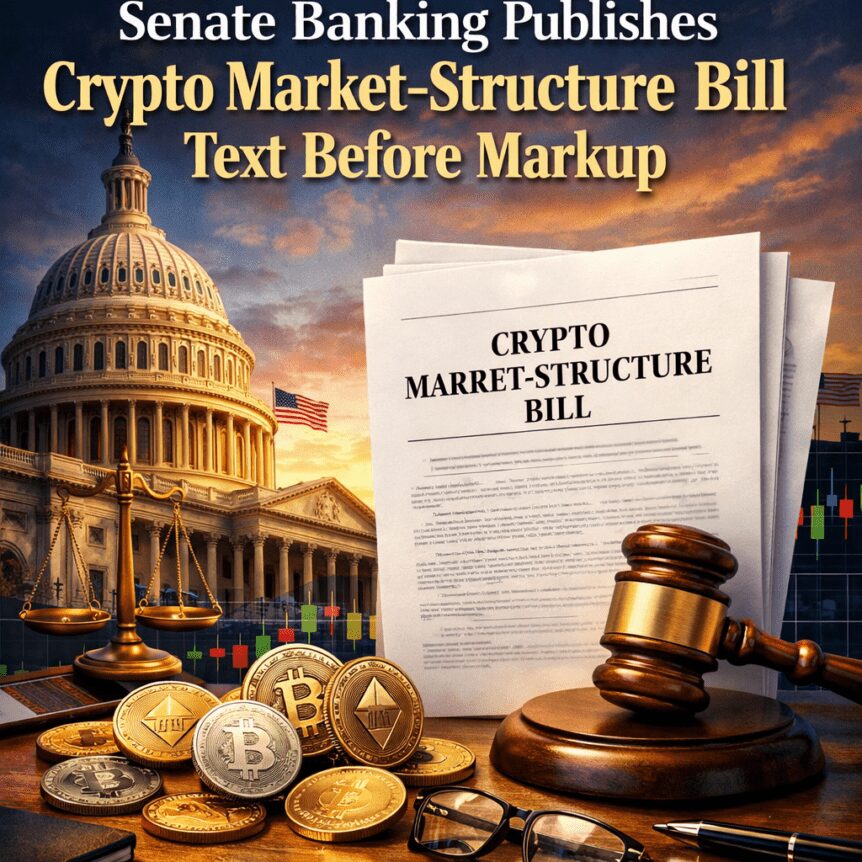
The U.S. Senate is turning its attention to the Digital Asset Market Clarity Act (CLARITY) as an anticipated Thursday markup approaches, with lawmakers weighing a text that broadens the framework for crypto market structure while surfacing questions about unrelated policy provisions. The version released by three Republican senators—marking what they say is a product of ongoing negotiations with Democratic colleagues—follows earlier drafts from mid-2025 and represents a step in recent intensive discussions over stablecoin yield and market structure governance.
According to the U.S. Senate Banking Committee release, the text will guide committee deliberations on how digital assets are supervised and regulated in the broader financial system. The bill’s release came after negotiations that extended into fall 2025, with lawmakers signaling bipartisan momentum for a markup on the measure. In parallel, some Democrats have pressed for accompanying ethics provisions to address conflicts of interest, linking the crypto policy debate to wider concerns about governance and integrity in financial legislation. As reported, the dynamics remain delicate, with discussions framed by a balance between industry structure, investor protections, and legislative oversight.
Notably, the final pages of the draft contain a housing policy element—the Build Now Act—that would create a pilot program intended to incentivize housing development within select Community Development Block Grant participating jurisdictions. This inclusion has surprised some observers, given that the core text centers on market structure for digital assets rather than housing, and has sparked questions about Senate Democrats’ appetite for attaching broader policy measures to crypto legislation. The section-by-section summary indicates the housing provisions are designed to pilot development initiatives, which could influence the overall legislative package and its political reception.
Senators Tim Scott, Cynthia Lummis, and Thom Tillis have portrayed the text as a product of ongoing bipartisan talks with their Democratic colleagues, signaling a readiness to move toward a markup on Thursday. Yet, in public comment, some Senate Democrats, including Kirsten Gillibrand, have urged that the bill not reach the floor without explicit ethics language addressing potential conflicts of interest. The tension was summarized by party-line perspectives and positioned to shape the upcoming procedural path for CLARITY.
“We have worked too hard on this bill to give up now,” said Senator Angela Alsobrooks, who sits on the banking committee and helped broker a stablecoin yield compromise with Tillis. “My hope is to get to a bipartisan markup on Thursday with a compromise on ethics.”
In the broader policy conversation, the CLARITY Act is frequently described as a vehicle to clarify and potentially expand the Commodity Futures Trading Commission’s (CFTC) oversight role in the digital-asset space, a shift often discussed in relation to where the Securities and Exchange Commission (SEC) would or would not have jurisdiction. The legislative journey has included prior committee activity—most notably, the Senate Agriculture Committee’s January markup advancing its version of the bill—but full passage remains contingent on Banking Committee action, Senate floor votes, and eventual reconciliation with the House of Representatives. The cross-chamber process mirrors the complexity of other crypto-related legislation, including past bipartisan outcomes on related measures such as stablecoin infrastructure and cross-border policy alignment.
Key takeaways
- The CLARITY Act text has been released ahead of a scheduled Senate Banking Committee markup, signaling renewed bipartisan engagement on digital-asset market structure and regulatory oversight.
- A housing-related provision—the Build Now Act—appears in the later pages of the draft, introducing a pilot program to incentivize housing development in certain Community Development Block Grant jurisdictions. The policy’s inclusion in a crypto bill raises questions about legislative scope and sequencing.
- The bill explicitly prohibits paying interest or yield on payment-stablecoins, with narrow exceptions for bona fide activities or transactions that are not economically or functionally equivalent to interest-bearing deposits. This provision directly shapes how stablecoin models may be structured or marketed in the United States.
- Provisions drawn from the Blockchain Regulatory Certainty Act aim to shield software developers from traditional money-transmitter requirements, a topic closely watched by DeFi and open-source development advocates.
- Advocacy and enforcement dynamics center on the balance between empowering the CFTC and maintaining appropriate guardrails. Ethic provisions remain a point of contention among lawmakers, with some Democrats insisting on clear ethics language before advancing.
- The overall legislative path remains complex: Agriculture Committee approval has occurred, but the Banking Committee, Senate floor, and House reconciliation are still prerequisites for any final enactment. Previous crypto measures have demonstrated that bipartisan support can be achievable but not guaranteed on procedural or policy grounds.
CLARITY Act: structure, scope, and regulatory intent
At its core, the CLARITY Act seeks to redefine regulatory posture for digital assets by clarifying which agency takes primary supervisory responsibility and by spelling out market-structure rules that would govern issuance, trading, and settlement of crypto instruments. A central element, as outlined in the text, is a prohibition on paying interest or yield on payment stablecoins. The prohibition is not absolute, however; the text allows incentives or rewards that are based on bona fide activities or bona fide transactions and that are not economically or functionally equivalent to paying interest on an interest-bearing bank deposit. The structure of this prohibition will influence how stablecoins are designed and marketed, potentially shaping issuer strategies and user expectations for on-chain payments and settlements.
In addition, the bill incorporates language from the Blockchain Regulatory Certainty Act, a provision designed to shield developers of blockchain software from being treated as money transmitters under existing statutes. This element is of particular interest to DeFi ecosystems and other open-source projects, which have long argued that broad money-transmitter designations could chill innovation. Proponents argue that such protection helps maintain near-term operational viability for developers while still enabling appropriate regulatory oversight over the broader ecosystem.
Regulatory and enforcement implications extend beyond the CFTC’s jurisdictional purview. The measure is framed in a way that could influence how responsible actors—exchanges, issuers, and liquidity providers—structure products, comply with AML/KYC requirements, and interact with banking partners. The plan to tilt certain supervisory responsibilities toward the CFTC reflects ongoing debates about investor protection versus innovation, a dynamic that has repeatedly surfaced in discussions around MiCA-equivalent regimes and U.S. market architecture.
As part of the broader policy conversation, a number of lawmakers and advocacy groups have highlighted the need for practical guardrails. The DeFi Education Fund, for example, pointed to the software-developer protections as a meaningful step toward reducing friction for compliant developers. In public commentary, the organization noted that the protections align with a pragmatic approach to innovation while maintaining a clear regulatory boundary. The latest bill text and public discussion suggest a cautious but constructive path toward balancing innovation with supervisory clarity.
Ethics, governance, and the partisan friction
The ethics dimension remains a live issue in the currency of policy negotiations. Democrats have pressed for explicit ethics provisions to address potential conflicts of interest, a concern intensified by high-profile political discussions around cryptocurrency ventures connected to public figures and their families. The absence of ethics language in the released draft has drawn criticism from some quarters. Massachusetts Senator Elizabeth Warren publicly criticized the bill, arguing that it could undermine investor protection and national financial security by not addressing ethics standards. The exchange highlighted how the crypto policy debate intersects with broader governance concerns and national policy priorities.
On the other hand, proponents emphasize a pragmatic, bipartisan approach to market structure. Senator Scott, Senator Lummis, and Senator Tillis have framed the text as a product of ongoing negotiations with Democratic colleagues, signaling a potential path to bipartisan markup. As one takeaway, the willingness to consider a stablecoin-yield compromise with Senate Democratic leadership suggests a broader readiness to reconcile technical governance with concerns about conflicts of interest. The ongoing discussion underscores the delicate balance between advancing a cohesive regulatory framework and accommodating divergent views on ethics and governance.
In the political dynamics of the process, the Agriculture Committee’s January approval and the potential for a 60-vote threshold in a full Senate passage scenario are key procedural realities. The experience of earlier crypto legislation—such as the GENIUS Act, which passed the Senate with broad bipartisan support—demonstrates that consensus is possible but not guaranteed, especially when ethics and governance topics are front and center. Observers will be watching how Thursday’s markup addresses these policy tensions and whether a bipartisan compromise can survive to final passage.
For institutions and market participants, the evolving regulatory posture around CLARITY has practical implications. Compliance teams must monitor potential shifts in supervisory expectations—particularly any transition of primary oversight responsibilities to the CFTC—and assess how these changes could affect licensing, registration, and ongoing reporting requirements. Banks and payment networks, in turn, will need to align risk management and customer due diligence with a regime that may differentiate between stablecoin models and other digital assets, while also contemplating cross-border regulatory differences that may arise in analogous regimes abroad, such as MiCA in the European Union.
As observed, the text also implies ongoing considerations about stablecoin design, product rhetoric, and the permissible nature of yield-like features. The prohibition on paying yield on stablecoins, coupled with permitted bona fide activity-based rewards, may influence issuer business models, token utility, and marketing practices. These design constraints have direct consequences for liquidity providers, custodians, and wallet providers, all of whom must maintain alignment with evolving regulatory interpretations and enforcement expectations.
Regulatory context and what comes next
The CLARITY Act sits at the intersection of U.S. regulatory modernization efforts and evolving global frameworks for digital assets. Its progression touches on issues central to MiCA-like regimes, potential SEC/CFTC jurisdiction delineations, and the broader policy objective of preventing illicit finance while enabling legitimate financial innovation. Regulators and market participants alike are watching closely for how the bill’s structure could influence cross-border activity, licensing regimes, and the calculus of risk for institutions seeking to participate in regulated digital-asset markets.
To move from proposal to law, the bill must pass through the Banking Committee, clear the full Senate, and be reconciled with a version from the House of Representatives before any presidential sign-off. The legislative timeline remains uncertain, with procedural hurdles and political considerations continuing to shape the pace and substance of crypto regulation.
For now, the latest draft represents a meaningful consolidation of several policy threads: a clearer regulatory boundary for stablecoins, enhanced protections for developers, and a continued emphasis on market structure oversight. As coverage and commentary continue, observers should monitor not only the substantive provisions but also the ethics framework that many policymakers view as essential to a credible, sustainable regulatory regime. This frame is critical for institutions seeking to align operations with evolving rules and for analysts assessing the potential long-term impact on innovation, risk management, and financial stability.
As Cointelegraph observed in coverage surrounding the markup discussions, the ethics dimension and bipartisan dynamics will likely shape Thursday’s proceedings and the ultimate trajectory of CLARITY. The ongoing debate reflects a broader inquiry into how best to harmonize investor protection, regulatory clarity, and innovation in the United States’ rapidly evolving digital-asset landscape. See the committee’s posted text and related materials for the latest details and official documentation.
Related reporting and commentary continue to illustrate the evolving stance of lawmakers toward crypto market structure, ethics governance, and the role of regulators in a shifting financial ecosystem. For context, coverage of reactions, amendments, and subsequent developments remains essential for compliance and policy teams tracking regulatory risk and strategic planning in this space. Additionally, institutional readers may find it useful to benchmark these developments against existing or proposed international standards and cross-border policy initiatives.
Source notes and further reading: the text and summary materials linked by the Senate Banking Committee; press commentary on bipartisan negotiations and ethics considerations; coverage of related legislation and committee actions; and industry commentary on software developer protections and market structure considerations. For broader context, analyses and updates from specialized outlets continue to shape the interpretation of CLARITY’s regulatory implications.

Graduates shocked after commencement speaker reveals their loans are paid off during speech

Kalyan Jewellers, Titan, other jewellery stocks crash up to 6% as Centre hikes gold customs duty to 15%

US Inflation Just Beat Wages, But Bernstein Says One Stock May Escape the Pain

Manchester United reach agreement with Casemiro over contract clause amid transfer speculation

US brings back mandatory military draft registration

Steven Gerrard disagrees with Gary Neville over ‘shock’ Chelsea and Arsenal claim | Football


-
 Crypto World5 days ago
HarrisX Poll Found 52% of Registered Voters Support the CLARITY Act
-

 Fashion4 days ago
Weekend Open Thread: Marianne Dress
-

 Crypto World6 days ago
Upbit adds B3 Korean won pair as Base token gains Korea access
-
 NewsBeat6 days ago
NCP car park operator enters administration putting 340 UK sites at risk of closure
-

 Fashion1 day ago
Coffee Break: Travel Steam Iron
-

 Fashion2 days ago
What to Know Before Buying a Curling Wand or Curling Iron
-

 Tech3 days ago
Auto Enthusiast Carves Functional Two-Stroke Engine from Solid Metal
-

 Politics1 day ago
What to expect when you’re expecting a budget
-

 Politics4 days ago
Politics Home Article | Starmer Enters The Danger Zone
-
 Business4 days ago
Ignore market noise, India’s long-term story intact, say D-Street bulls Ramesh Damani and Sunil Singhania
-

 Crypto World7 days ago
BlackRock CEO Larry Fink Discusses a New Asset Class
-

 Tech2 days ago
GM Agrees To Pay $12.75 Million To Settle California Lawsuit Over Misuse Of Customers’ Driving Data
-
 Sports7 days ago
NBA playoff winners and losers: Austin Reaves is not loving Lakers vs. Thunder matchup, but Chet Holmgren is
-

 Entertainment6 days ago
Sarah Paulson Called Out For Met Gala ‘Hypocrisy’
-

 Entertainment5 days ago
General Hospital: Ric & Ava Bombshell – Ric’s Massive Secret Exposed!
-

 Politics5 days ago
Simon Cowell Says He Was ‘Horrible’ To Susan Boyle During BGT Audition
-

 Crypto World6 days ago
Robinhood says Wall Street is building onchain
-

 Entertainment6 days ago
Bold and Beautiful Early Spoilers May 11-15: Steffy Revolted & Liam Overjoyed!
-

 Sports6 days ago
UEFA Champions League final schedule, teams, venue, live time and streaming | Football News
-

 Entertainment6 days ago
Why David Letterman Called CBS ‘Lying Weasels’
You must be logged in to post a comment Login