
Crypto World
Foundation targets institutions with new privacy framework

The Solana Foundation is making a new pitch to large institutions: privacy as a customizable feature, not a trade-off.
In a report released on Monday by the foundation, “Privacy on Solana: A Full-Spectrum Approach for the Modern Enterprise,” the organization argued that the next phase of crypto adoption will depend less on transparency alone and more on giving companies control over what they reveal — and to whom.
The framing marks a shift from crypto’s early ethos. Public blockchains have traditionally emphasized openness, where transactions are visible and traceable, even if users are represented only by wallet addresses. The report acknowledged that this “pseudonymity” model, while foundational, falls short for many real-world use cases. Financial institutions, for example, may need to prove transactions occurred without exposing counterparties, while companies processing payroll must avoid broadcasting employee salaries.
Underlying the pitch is a technical claim: that Solana’s speed makes advanced privacy techniques practical. The team argued that the network’s high throughput and low latency allow these methods to run at near-web speeds, opening the door to use cases such as encrypted order books or private credit risk calculations.
But rather than offering a single solution for privacy, the foundation presented privacy as a spectrum composed of four distinct modes: pseudonymity, confidentiality, anonymity and fully private systems.
At the base level, pseudonymity keeps identities obscured behind wallet addresses while leaving transaction data visible. Moving along the spectrum, confidentiality allows participants to be known while encrypting sensitive information like balances and transfer amounts.
Anonymity flips that dynamic, hiding the identities of participants while allowing transaction data to remain visible. At the far end are fully private systems, where both identities and transaction data are shielded through techniques like zero-knowledge proofs and multiparty computation.
The message is that no single privacy model fits all. “For enterprises, privacy is a spectrum, not a switch,” the report said.
What Solana is trying to do is bring all of these privacy options into one system. Instead of choosing just one approach, companies can mix and match tools — like hiding transaction amounts, proving something is valid without revealing details, or controlling who can access certain data — depending on what they need.
In practice, that could mean executing trades without revealing order size, sharing risk data across banks without exposing individual balance sheets, or allowing users to prove compliance without disclosing personal information.
The report leans heavily on the idea that privacy and regulation can coexist. The team pointed to mechanisms like “auditor keys,” which enable designated parties to decrypt transactions when required. Other systems would allow wallets to demonstrate compliance status without revealing identity. These features are framed as a response to growing regulatory scrutiny, particularly around anti-money laundering rules and financial surveillance.
“Privacy is a market requirement,” the report said. “Customers expect it and applications require it. On Solana, you choose your privacy level, from encrypted balances to zero-knowledge anonymity to multiparty confidential computing. Each level maps to a compliance path, and each is composable with the broader ecosystem.”
Read more: Solana Foundation’s Liu: Focus on finance, not gaming ‘misadventures’

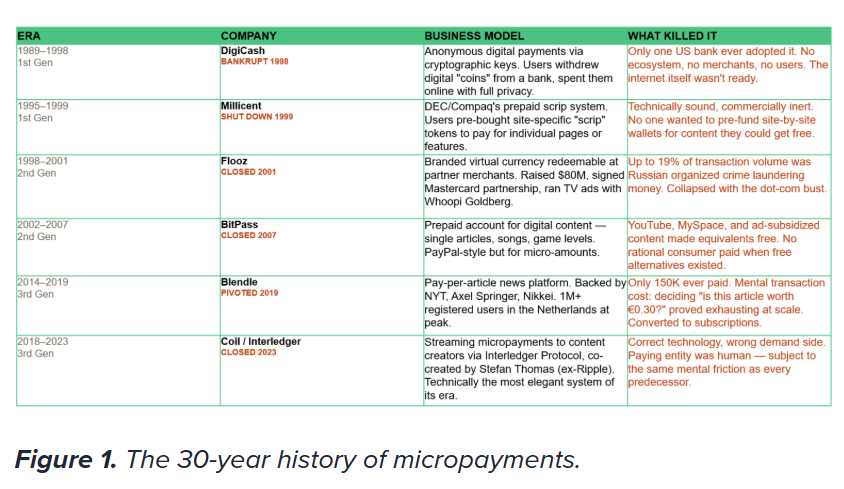
Stripe’s newly launched Machine Payments Protocol (MPP) could mark a turning point for micropayments — a long-promised but underutilized use case in crypto and beyond — as AI agents reshape how transactions are made.
That’s the key takeaway from newly published analysis by Forrester senior analyst Meng Liu, who argues that MPP may succeed where decades of earlier efforts failed.
Introduced earlier this month, MPP enables AI agents to execute transactions automatically, removing the need for human approval at each step. It is described as an open protocol for coordinating payments between AI agents and services. Liu frames this as a structural shift from human-initiated payments to machine-to-machine transactions.
Micropayments, which are typically small transactions worth a few cents or dollars, have long been seen as a way to monetize digital content, services and data, but have struggled to gain traction at scale.
A major barrier to adoption has been human behavior, including cumbersome digital checkout processes and reluctance to approve small charges, Liu said.
By contrast, AI agents executing payments as part of task completion, such as paying to access data or use online services, eliminate those constraints.
“Payment becomes a programmatic step, not a discrete decision,” Liu wrote. “There’s no checkout moment, no cart abandonment risk, and no mental transaction cost.”

Importantly, MPP is not a new settlement network. Instead, it acts as a coordination layer for automated payments, designed to work across existing infrastructure, including traditional rails, digital wallets and, where supported, crypto rails.
Related: AI agent payment volumes lower than reported, but adoption is growing: a16z
AI payments push extends beyond Stripe
Stripe is a payments company that has expanded into digital assets, including support for stablecoins, crypto on-ramps and blockchain-based payment tools. While MPP itself is not inherently blockchain-based, other companies are also developing infrastructure for AI-driven payments, particularly in areas such as micropayments and autonomous transactions.
One recent example is MoonPay, which released an open-source wallet standard designed for AI agents. The framework allows agents to hold, send and receive digital assets, enabling them to transact independently without human intervention.
Meanwhile, analysts at Bernstein believe AI agents could boost demand for stablecoins, as they are well-suited for handling frequent, low-value payments. Like Forrester’s Liu, Bernstein also pointed to Coinbase’s x402 protocol, which enables automatic internet payments between machines.

Related: Crypto Biz: Institutions aren’t waiting for the bottom
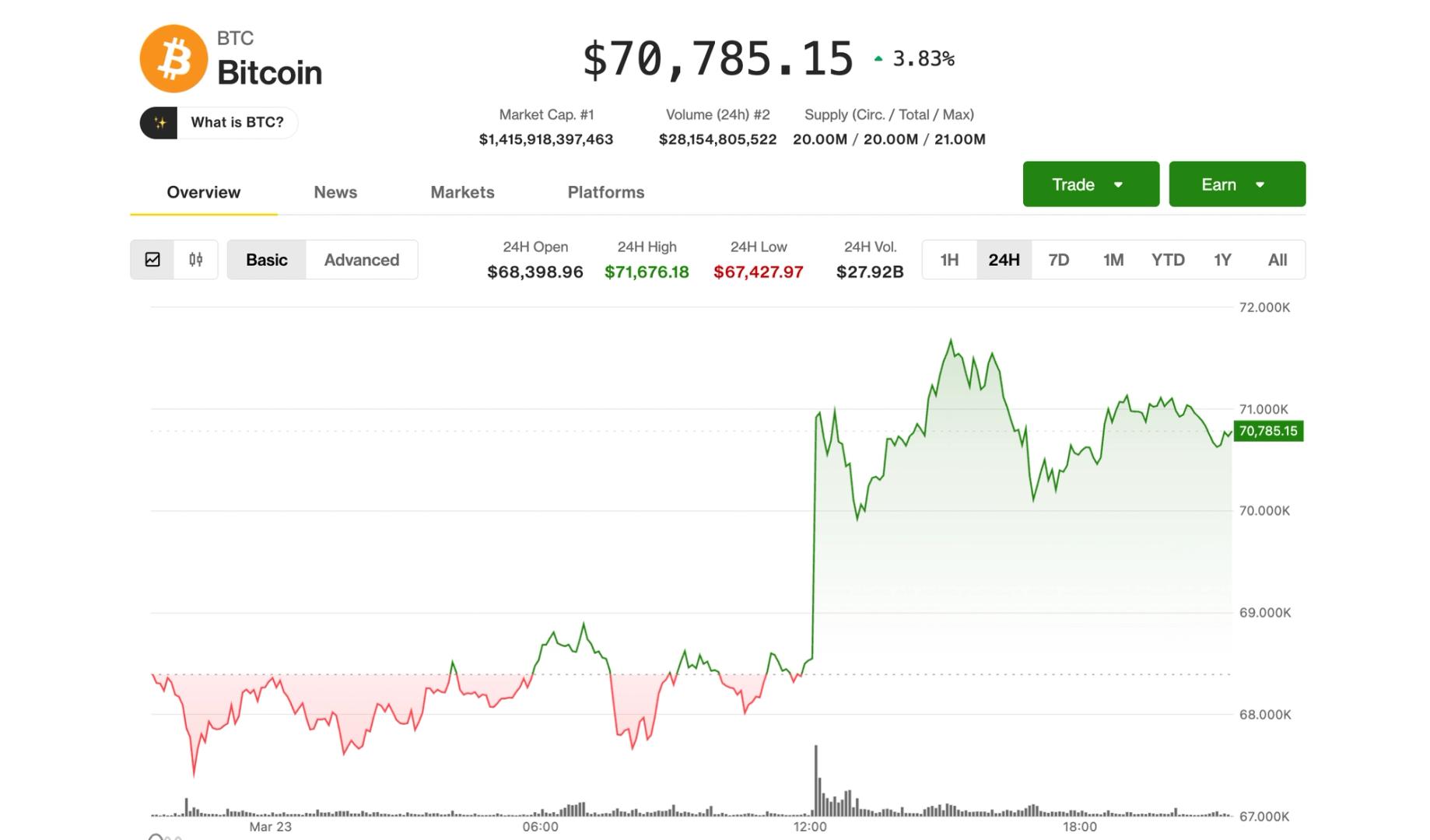
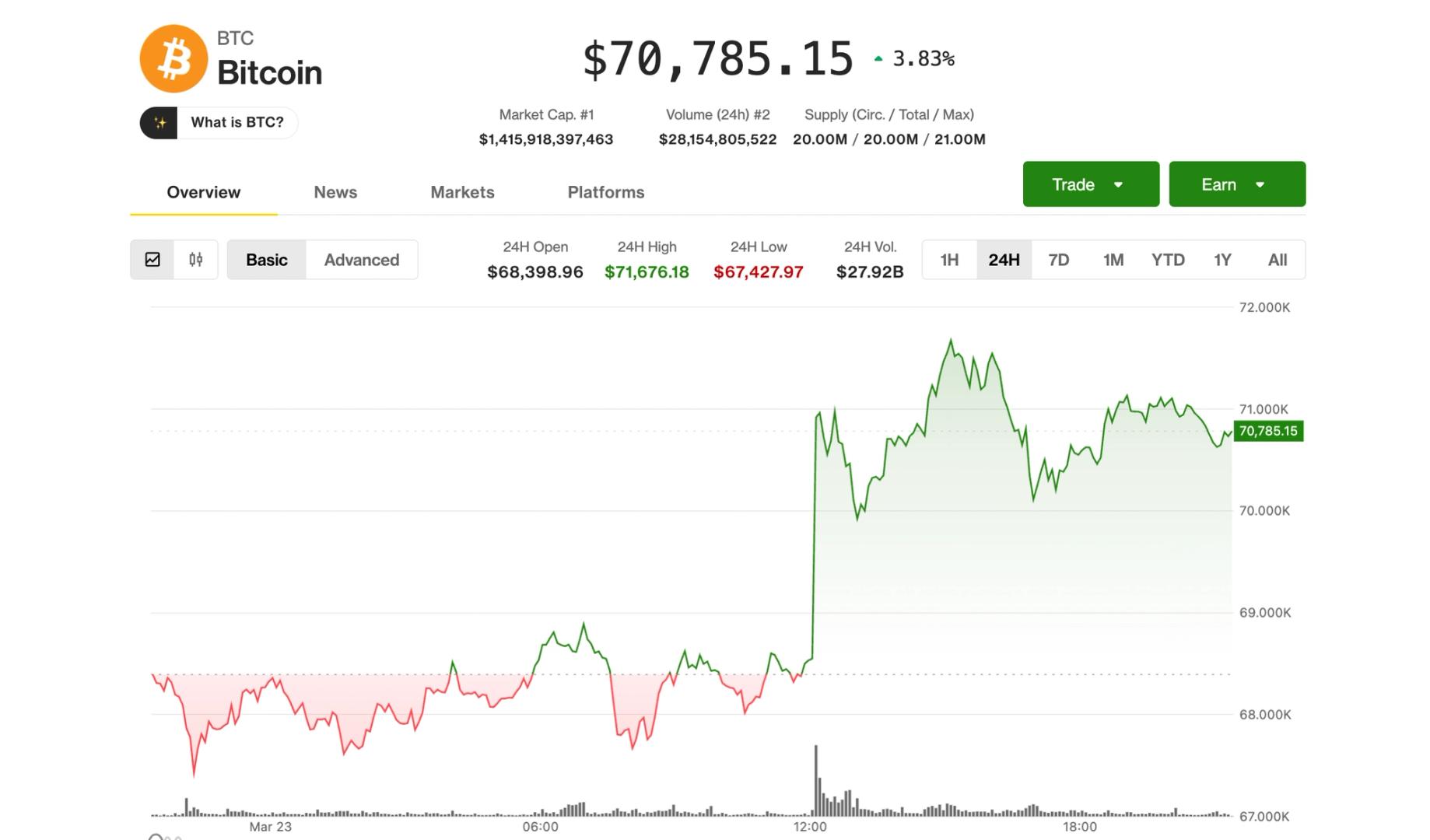
Bitcoin held onto gains Monday after an early surge above $70,000, but the rebound’s fate now hinges on what’s next between the U.S. and Iran.
The move followed U.S. President Donald Trump’s announcement of a five-day pause on strikes against Iranian energy infrastructure, citing “productive” diplomatic talks.
Iranian officials denied the existence of talks, but markets largely brushed it off, with risk assets holding firm through the session.
Bitcoin hovered just below $71,000 later in the session, up 3.8% over the past 24 hours. Altcoins outperformed, with ether (ETH), solana (SOL) and each gaining around 5%.
Crypto-linked equities also rallied, led by bitcoin miners, which have increasingly traded in line with AI infrastructure plays. Hut 8 (HUT) jumped more than 11%, while Bitfarms (BITF), Cipher Mining (CIFR), CleanSpark (CLSK), Riot Platforms (RIOT) and TeraWulf (WULF) advanced 6%-7%.
Traditional markets joined the move higher, with the S&P 500 and Nasdaq both closing about 1.2% up.
While the temporary pause has eased pressure in energy markets, traders should treat the rebound cautiously in risk assets.
“The macro ceiling has shifted,” said Jasper de Maere, OTC trader at Wintermute. “How much room opens up depends on the next five days.”
If oil stabilizes and shipping flows through the Strait of Hormuz normalize, he said, inflation concerns could ease, allowing rate-cut expectations to return and removing a key headwind for crypto.
In that scenario, bitcoin could make another run at the $74,000–$76,000 range, the level that has capped rallies in recent weeks, according to de Maere.
A breakdown in talks or renewed disruption to energy supply would have the opposite impact, he said. It would likely push oil higher again, reinforcing inflation risks and sending markets back into risk-off mode that could pull bitcoin back toward the mid-$60,000s.


The Russell 2000’s 2% rebound after a 10% correction signals a tentative risk‑on turn in U.S. stocks, giving Bitcoin and altcoins fresh “permission to breathe.
Summary
- The small-cap Russell 2000 index jumped about 2% after a bruising correction, signaling a tentative return of risk appetite in U.S. equities.
- Traders say the move is part of a broader “relief rally” that has also lifted high‑beta crypto and altcoins after weeks of macro and geopolitical stress.
- Rising stock–crypto correlation means small‑cap strength is increasingly viewed as a green light to rotate from cash into higher‑volatility tokens and perps.
The Russell 2000’s roughly 2% intraday surge comes just days after the index fell 10% from its recent peak and formally entered correction territory, capping a four‑week losing streak for U.S. stocks. U.S. small‑cap stocks staged a sharp rebound in New York on Monday as traders reassessed recession odds and war‑risk pricing, shifting from outright de‑risking toward a tentative risk‑on stance.
Analysts frame Monday’s bounce as a classic “risk‑on” rotation after weeks of selling tied to Middle East tensions and surging oil, with West Texas Intermediate futures having spiked toward $100 per barrel and Brent above $113 in recent sessions. “What you’re seeing is positioning, not euphoria,” one equity strategist said, arguing that investors who were underweight small caps are now “grudgingly adding beta back into the book” as worst‑case scenarios get priced out.
For crypto traders, the Russell’s move matters less as a stock story and more as a liquidity signal. Research highlighted by CME Group shows that in 2025 and into 2026, on days when U.S. stocks rise, “crypto assets tend to rise, but not by as much, and on days when U.S. tech stocks are selling off, crypto assets tend to fall by even more.” A recent macro explainer on crypto bitcoin rotation makes the same point more bluntly: “Most big crypto moves don’t start with a whitepaper. They start with a change in the cost of money and the price of risk.”
Correlation data backs that up. The 30‑day correlation coefficient between Bitcoin and the S&P 500 has climbed to about 0.74, its highest level this year, meaning the two now trade in close step as “an extension of broader risk sentiment.” When breadth improves in equities — first in mega‑caps, then small caps like the Russell 2000 — crypto often responds with its own breadth shift: dominance falls, majors and then mid‑caps start to participate, and liquid altcoins outperform long‑tail names.
Recent coverage has already documented how macro swings drive spillovers into digital assets, from early‑2025 fragility that pushed traders into Bitcoin (BTC) as a macro hedge alternative, to later phases where easing conditions triggered broad rallies across altcoins and crypto‑linked stocks. As one macro‑focused fund manager told crypto.news in an earlier note on rotation, “When small caps catch a bid and the dollar stops ripping, crypto finally gets permission to breathe.”
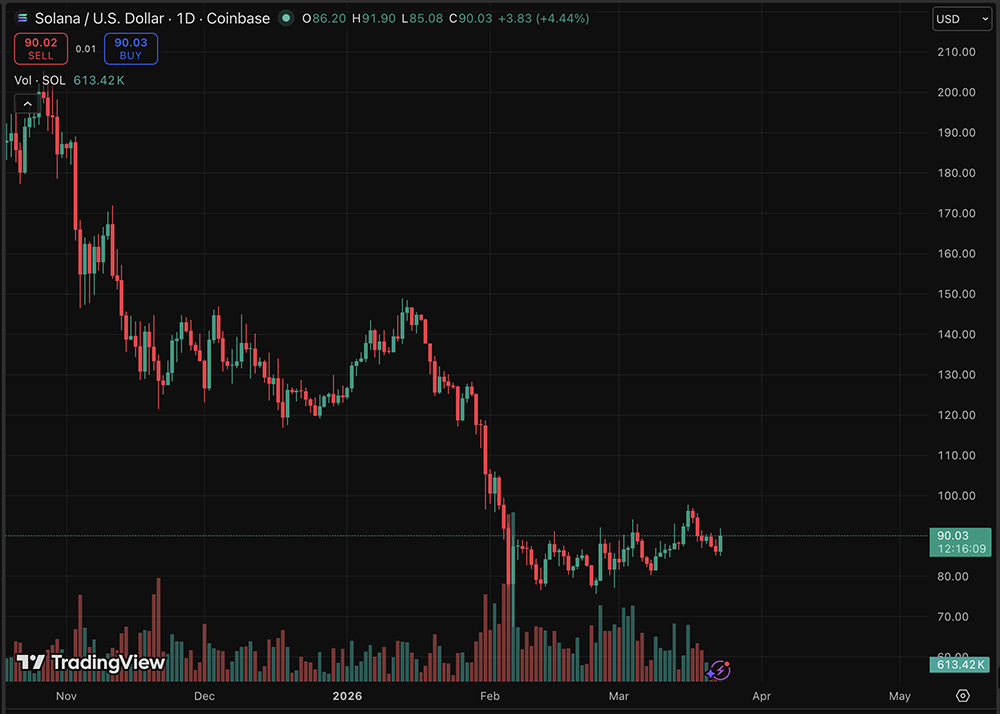
Solana (SOL) is trading in a suffocating consolidation zone, hovering just above the $90 price area, but could blast above $100 if our prediction comes true.
The technical setup is precarious; the asset is down nearly 69% from its January 2025 peak of $295.91, and DEX volumes have collapsed from $118 billion to just under $50billion in a single week, a staggering contraction of on-chain activity. While bulls point to the upcoming Alpenglow upgrade for sub-second finality, the immediate price action suggests exhaustion.
The market is holding its breath and bags around the critical $80 support level. A breakdown here completes a bearish head-and-shoulders pattern on the 3-day chart. On-chain data signals heightened risk, with capital appearing to rotate out of large caps into speculative volatility. As the Federal Reserve’s policy meeting looms, traders are forced to ask: Is this the bottom for SOL, or a rest stop on the way to $59?

Solana Price Prediction: Can it Hold or Will It Crash to $59?
The fierce defense of the $80 level defines the current market structure. Bears have tested this floor repeatedly, weakening the buy wall. Technical indicators paint a conflicted picture; the 14-day RSI sits at a neutral 55.21, while the 50-day and 200-day moving averages have formed a death cross, typically a prelude to deeper correction.
If bulls can reclaim momentum, the first major hurdle is $93, followed by stiff resistance at $96 and $105. Clearing these levels invalidates the bearish thesis. Analysis suggests a decisive break below $80 unlocks a measured move toward $59–64. Conversely, Standard Chartered maintains a long-term target of $2,000 in 5 years, viewing this sub-$100 range as an accumulation zone for institutional infrastructure plays.
— Coin Bureau (@coinbureau) February 4, 2026
 BULLISH: $800B Standard Chartered raises Solana price target to $2,000 by 2030 citing the growing dominance of SOL in micropayments and stablecoins. pic.twitter.com/T61K5Y04vK
Short-term traders should watch the $86.14 pivot. Price action above this level keeps the recovery hope alive, while sustained trading below it favors the bears. Current volumes do not support a V-shaped recovery, suggesting a “chop and drop” scenario is more likely than an immediate moonshot.
Maxi Doge Offers High-Leverage Culture as SOL Consolidates
With Solana trapped in a low-volatility tightrope walk, active capital is fiercely rotating into presale environments where multipliers, not mere percentage points, are the target. While SOL struggles to gain 10%, early-stage memes are capitalizing on the “degen” appetite for leverage and community power. This shift is evident in the traction of Maxi Doge.
Maxi Doge ($MAXI) positions itself as the antidote to boring price action. Marketing itself as a 240-lb canine juggernaut, the project embodies the “1000x leverage” mentality with viral gym-bro humor.
The presale has already raised a total of more than $4.6 million, signaling robust demand despite broader market fears. Priced at $0.000281, $MAXI also offers 66% APY of staking rewards for early buyers.
The ecosystem includes a “Maxi Fund” treasury for liquidity and holder-only trading competitions, gamifying the grind of the bull market. Liquidity in meme sectors is thinning, yet projects with strong cultural narratives like “Never skip leg-day” continue to draw volume. However, presales carry inherent risks regarding launch volatility and vesting schedules.
The post Solana Price Prediction: Are We Ready For What’s Coming? appeared first on Cryptonews.

TLDR
- DJT stock rose 6% and traded at $9.15 during Monday’s session.
- President Donald Trump said the United States held productive talks with Iran over two days.
- The Dow Jones Industrial Average gained 1,117 points, or 2.4%, after the announcement.
- The Nasdaq Composite advanced 2.4% as markets reacted to the headlines.
- The S&P 500 recorded a $3 trillion market value swing within one hour.
Trump Media & Technology Group Corp. shares climbed on Monday after President Donald Trump announced progress in talks with Iran. The rally followed a broader U.S. stock market surge that lifted major indexes. DJT stock gained 6% and traded at $9.15 during morning activity.
The advance tracked gains across Wall Street as traders responded to headlines from Washington. President Trump said the United States held productive discussions with Iran over two days. His comments triggered swift moves across equity markets and lifted risk sentiment.
DJT Stock Jumps as Markets React to Iran Developments
DJT stock rose 6% on March 23 and reached $9.15 in early trading. The Florida-based media company moved in line with major U.S. indexes. However, the stock remains down 30% year-to-date.
Trump Media & Technology Group Corp., DJT
The Dow Jones Industrial Average jumped 1,117 points, or 2.4%, during the session. At the same time, the Nasdaq Composite also advanced 2.4%. The rebound followed a week when both indexes fell about 2%.
President Trump addressed the situation on Truth Social early Monday.
He wrote that the United States and Iran held “very good and productive conversations” over two days. He added that the talks aimed at “a complete and total resolution of our hostilities in the Middle East.”
His statement lifted equity markets within minutes of publication. However, Iran later denied that officials held any contact with Washington. That denial led to rapid market swings during the same hour.
Trump Comments Trigger $3 Trillion S&P 500 Swing
The S&P 500 Index recorded a market capitalization swing of about $3 trillion within one hour. The move followed Iran’s response that rejected claims of direct talks. Markets reacted quickly to both the president’s statement and Tehran’s denial.
Art Hogan, chief market strategist at B. Riley Wealth Management, spoke with CNBC about the rally.
He said, “The market has been desperate for any good news.” He added that the update appeared to be “the best news we can expect.”
Equities had declined sharply in the prior week before Monday’s rebound. The Dow and Nasdaq both posted losses of roughly 2% during that period. Monday’s gains reversed part of those declines across major benchmarks.
Trump Media & Technology Group Corp., listed under the ticker DJT on Nasdaq, moved alongside the broader market. The company operates Truth Social, the platform where the president shared his statement. Shares traded at $9.15 at the time of reporting and reflected the 6% daily gain.


This release reports a shift in Bitcoin trading as macro momentum and evolving U.S. regulation intersect with market infrastructure updates. The price moved below $70,000 after a brief rally to about $76,000 last week, reflecting broader expectations for higher-for-longer interest rates and addressable inflation risks. At the same time, the issuing authorities outlined a framework that places major crypto assets under the Commodity Futures Trading Commission’s jurisdiction, while signaling the potential for faster spot ETF approvals. The document also notes licensing developments in DeFi and ongoing policy discussions that could shape near-term market activity and long-term confidence.
Key points
- Bitcoin traded below $70,000 after a peak of about $76,000 last week, with macro data and a hawkish Fed stance contributing to the move.
- A US regulatory framework designates major crypto assets as digital commodities under CFTC jurisdiction, alongside existing listing standards that may quicken spot ETF approvals.
- Advances on the CLARITY Act address stablecoin yield structures, signaling potential limits on passive yields while allowing returns tied to transactional activity.
- S&P Dow Jones Indices has licensed Trade[XYZ] to launch the first officially licensed S&P 500 perpetual derivative on the Hyperliquid blockchain, expanding access for non-US investors.
Why it matters
Taken together, the release frames near-term volatility as tied to macro conditions while underscoring how regulatory clarity could attract institutional participation over time. The digital-commodity designation and broader listing standards may speed spot ETF approvals, widening the pathway for mainstream exposure. Moves on the CLARITY Act and DeFi licensing signal potential shifts in how crypto markets are structured and accessed, particularly for non-US investors leveraging cross-market products. Investors and builders should watch regulatory updates, ETF timelines, and licensing milestones to gauge how policy progress may translate into market dynamics.
What to watch
- Regulatory: track progress and potential enactment of the CLARITY Act and its stablecoin yield framework.
- ETF timelines: monitor whether spot crypto ETF approvals accelerate in light of the new framework.
- Licensing milestones: observe developments around the S&P 500 perpetual derivative on Hyperliquid and related licensing deals.
Disclosure: The content below is a press release provided by the company or its PR representative. It is published for informational purposes.
Bitcoin Falls Below $70,000 Amid Macroeconomic Pressure; Regulatory Developments Signal Long-Term Growth Potential
Abu Dhabi, UAE – March 23, 2026: Bitcoin has retreated below the $70,000 mark following a recent peak of $76,000 last week, as macroeconomic headwinds weighed on investor sentiment. The decline was primarily driven by higher-than-expected US Producer Price Index (PPI) data, alongside a more hawkish tone from Federal Reserve Chair Jerome Powell, who highlighted rising oil prices as a potential inflationary risk.
Markets are now increasingly pricing in a prolonged period of elevated interest rates, with expectations that the Federal Reserve could hold rates steady through 2027. Continued geopolitical tensions in the Middle East and sustained high oil prices could further fuel inflation, potentially prompting additional rate hikes—historically a negative backdrop for cryptoasset performance due to tightening financial conditions.
Despite short-term volatility, regulatory developments in the United States are providing a more constructive long-term outlook for the crypto sector.
The US Securities and Exchange Commission (SEC) and Commodity Futures Trading Commission (CFTC) have jointly introduced a comprehensive cryptoasset classification framework. Under this framework, major cryptoassets including Bitcoin, Ethereum, Solana, and XRP have been designated as digital commodities, placing them primarily under CFTC jurisdiction rather than the SEC.
This classification, alongside previously approved generic listing standards, is expected to accelerate the approval timeline for spot crypto ETFs. Such developments could unlock significant institutional inflows and support long-term price appreciation across the sector.
In parallel, progress is being made on the proposed CLARITY Act, with reports indicating that US lawmakers and the White House have reached a tentative agreement on stablecoin yield structures. The proposed framework would restrict passive yield generation while allowing returns tied to transactional activities such as payments and trading. If enacted, the legislation could represent a major milestone in establishing regulatory clarity and fostering growth within the crypto market.
In the decentralised finance (DeFi) space, S&P Dow Jones Indices has announced a landmark licensing agreement with Trade[XYZ], enabling the launch of the first officially licensed S&P 500 perpetual derivative contract on the Hyperliquid blockchain. This innovation allows non-US investors to gain 24/7 leveraged exposure to the S&P 500 via a decentralised platform, supported by real-time index data.
Following the announcement, Hyperliquid’s native token, $HYPE, rose 6% and is now up over 55% year-to-date, significantly outperforming major cryptoassets such as Bitcoin and Ethereum, which remain down over the same period. The performance reflects growing demand for decentralised infrastructure offering continuous access to both crypto and traditional financial markets.
Meanwhile, higher-risk assets such as memecoins—including $TRUMP, $PEPE, and $PENGU—were among the hardest hit during the recent market downturn, with declines of up to 20%, highlighting their elevated sensitivity to broader market movements.

Simon Peters, Crypto Analyst at eToro, commented: “While macroeconomic pressures have driven short-term volatility in crypto markets, the evolving regulatory landscape in the US represents a significant step forward. Greater clarity around asset classification and market structure could pave the way for increased institutional participation and long-term growth in the sector.”
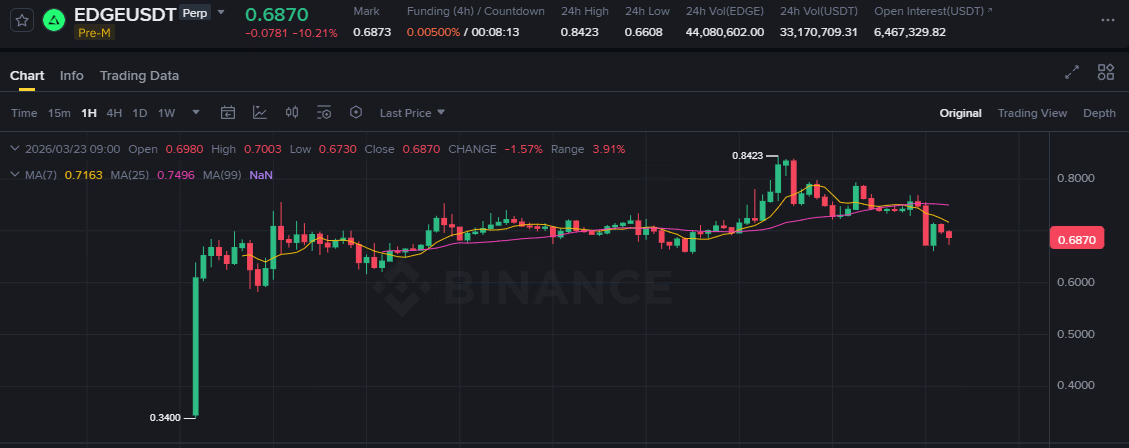
The derivatives platform has already opened airdrop claims and pre-market trading ahead of its long-anticipated token generation event.
Decentralized perpetuals exchange edgeX has confirmed that the token generation event (TGE) and listing for its native EDGE token will take place on March 31.
EDGE has a total supply of 1 billion tokens. At TGE, 25% of the supply will be airdropped, with up to an additional 5% for participants in the Pre-TGE Season points program. The remaining 70% is allocated to Ecosystem & Community, Core Contributors, and Foundation.
The token is already changing hands ahead of the official launch, with pre-market trading opening on Binance on March 19. EDGE is trading around $0.70, implying a fully diluted valuation of roughly $700 million.

The airdrop claim window also opened on March 19, according to an announcement from edgeX.
edgeX, which is incubated by Amber Group, has grown rapidly since launching in November 2024. The exchange processed roughly $4.4 billion in 24-hour trading volume across 176 trading pairs, with nearly $1.1 billion in open interest, according to CoinGecko, making it the third-largest perpetual DEX after Hyperliquid and Aster.
The TGE coincides with the platform’s transition from a single-product perp DEX to what it calls EDGE Chain, a purpose-built Ethereum Layer 2 for high-throughput financial applications.
In February, edgeX received a strategic investment from Circle Ventures alongside native USDC integration.
The Open Wallet Standard aims to fill a gap in the rapidly growing agentic payments stack by giving AI agents a universal, non-custodial way to hold funds and sign transactions across blockchains.
MoonPay on Monday released the Open Wallet Standard (OWS), an MIT-licensed, open-source specification that defines how AI agents interact with crypto wallets, including key storage, transaction signing, and cross-chain account derivation, without ever exposing a private key to the agent process or the large language model driving it.
The standard launched with contributions from over 15 organizations spanning payments, exchanges, and blockchain infrastructure, including PayPal, OKX, Ripple, Tron, TON Foundation, Solana Foundation, Ethereum Foundation, Base, Polygon, Sui, Filecoin Foundation, LayerZero, and Circle.
“The agent economy has payment rails. It didn’t have a wallet standard,” MoonPay CEO Ivan Soto-Wright said in a statement.
The release arrives as the infrastructure for agentic payments is rapidly developing, yet remains fragmented across competing protocols, each assuming agents already have a wallet without specifying how that wallet should work.
As The Defiant reported last week, two protocols are racing to become the foundation of AI payments: x402, backed by Coinbase, and the Machine Payments Protocol (MPP), launched by Stripe and Tempo. Tempo’s payments-focused Layer 1, which went live on mainnet on March 18, shipped with MPP’s “sessions” primitive, allowing agents to set a spending limit upfront and stream micropayments continuously without an on-chain transaction per interaction.
On the same day, Coinbase dropped a significant upgrade to x402, adding support for virtually any ERC-20 token via Uniswap’s Permit2 and new gas sponsorship extensions.
Meanwhile, Visa entered the arena with its own approach. Visa Crypto Labs launched Visa CLI, a command-line interface payment tool targeting AI agent payments, currently in closed beta. And Circle launched Nanopayments on testnet, built on the x402 standard and designed for sub-cent, gas-free USDC transactions for AI agents paying for pay-per-call APIs.
But as MoonPay frames it, all of these systems share a common assumption: the agent already has a wallet. None defines where the wallet lives, how keys are stored, or how one agent discovers a wallet created by another.
In practice, MoonPay says, this means a user running three different AI tools today could have their funds scattered across three separate wallets with no way to access a unified balance.
How It Works
The Open Wallet Standard is structured as seven sub-specifications covering storage, signing, policies, agent access, key isolation, wallet lifecycle, and supported chains. Each module can be adopted independently.
The core design principle is zero key exposure. Keys are encrypted, decrypted only to produce a signature, held in protected memory that cannot be swapped to disk, and wiped immediately after signing. The private key is never accessible to the agent, the LLM context, or any parent application.
A single seed phrase derives accounts across eight chain families — EVM, Solana, Bitcoin, Cosmos, Tron, TON, Spark, Filecoin, and XRP Ledger — with a unified signing interface and CAIP-2 chain identifiers.
There’s also a pre-signing policy engine that evaluates every transaction before any key material is touched. Operators can set spending limits, contract allowlists, chain restrictions, and time-bound authorizations. The standard ships with native SDK bindings for Node.js and Python, a CLI, and an MCP server interface compatible with frameworks including Claude, ChatGPT, and LangChain.
The launch positions OWS not as a competitor to x402 or MPP but as a complementary layer. When x402 returns a payment request, OWS produces the signed authorization. When MPP opens a session and streams micropayments, OWS signs each payment within the agent’s authorized limits.
Whether MoonPay’s open standard gains traction will depend on whether competing agent frameworks adopt a shared wallet layer or continue building proprietary key management.
This article was written with the assistance of AI workflows. All our stories are curated, edited and fact-checked by a human.

TLDR
- Polymarket updated its market integrity rules to address manipulation and insider trading risks.
- The company introduced stricter market design standards and clearer resolution criteria for contract outcomes.
- Polymarket enhanced surveillance systems to detect suspicious trading activity across its platforms.
- The platform banned and reported users who pressured a journalist over a $17 million prediction market.
- Reports showed that six newly created accounts earned about $1 million from bets on US strikes on Iran.
Polymarket updated its market integrity rules to address manipulation and insider trading risks. The company announced stricter standards for market design and resolution criteria on Monday. It also expanded surveillance controls as regulators increase scrutiny of event-based contracts.
Polymarket Updates Market Standards and Compliance Framework
Polymarket said it aligned its global platform rules with regulatory standards, and it strengthened oversight on its US exchange. The US platform operates under Commodity Futures Trading Commission compliance, and the company confirmed tighter monitoring systems. It stated that clearer resolution criteria and defined data sources will govern contract outcomes.
The company said it will limit markets that it considers easily manipulated or ethically sensitive, and it will restrict certain event contracts. It confirmed enhanced surveillance tools to detect suspicious trading patterns and insider activity. Polymarket said, “We are enhancing monitoring and surveillance measures to detect suspicious trading activity.”
Enforcement Actions and Regulatory Scrutiny Intensify
Polymarket said it banned and reported users who pressured an Israeli journalist over coverage of an Iranian missile strike. The disputed article related to a $17 million prediction market tied to the strike. The company confirmed it acted after users issued death threats to influence reporting tied to contract outcomes.
Bloomberg reported that six newly created accounts generated about $1 million in profits from bets on US strikes on Iran. All six accounts opened in February and placed wagers only on whether the strikes would occur. The trading activity raised questions about insider trading and market fairness.
Several US states have taken action against prediction platforms, and they allege unlicensed gambling operations. Regulators have increased oversight as prediction markets expand across political and global events. Polymarket operates its US exchange under CFTC oversight, and it said it supports integrity protections.
Growth Strategy and Partnership Agreements
Polymarket raised $200 million in July, and reports said it seeks a valuation of up to $10 billion. Prediction markets have attracted active traders who wager on political and economic outcomes. The company continues to expand its regulated presence while adjusting its compliance framework.
Major League Baseball signed a partnership agreement with Polymarket, and the league confirmed the arrangement last week. The deal includes integrity protections, and it aligns with a separate agreement involving the CFTC. The agreements outline cooperation on monitoring and compliance standards for event-based contracts.
Polymarket said the updated framework will apply to both its decentralized platform and its US exchange. The company confirmed that it will implement stricter data standards and clearer outcome definitions. Monday’s announcement detailed the new rules as the latest step in its compliance roadmap.


Former Kalshi employees are raising capital for 5c(c) Capital, a venture firm focused on prediction market infrastructure.
Two early Kalshi employees are raising up to $35 million for what may be the first venture fund dedicated to prediction market startups, according to a pitch document seen by Fortune.
The fund, called 5c(c) Capital, is led by Adhi Rajaprabhakaran, the second trader hired at Kalshi’s affiliated market maker, and Noah Zingler-Sternig, Kalshi’s former head of operations, Fortune reported. The fund’s name references Section 5c(c) of the Commodity Exchange Act, the clause that grants the CFTC oversight of event contracts offered by Designated Contract Markets.
Notably, Kalshi CEO Tarek Mansour and Polymarket CEO Shayne Coplan, whose companies are locked in a multibillion-dollar valuation war and have a well-documented public rivalry, have both invested in the fund.
Other backers include Marc Andreessen through Moneta Luna, Ribbit Capital founder Micky Malka, and former Multicoin Capital managing partner Kyle Samani. Bloomberg reported that the fund has more than 20 investors.
The fund plans to back roughly 20 companies over the next two years, targeting market makers, prediction market index providers, and other infrastructure-layer businesses, per Fortune.
The launch comes as prediction market valuations have surged. Kalshi raised $1 billion at a $22 billion valuation in a round led by Coatue Management, roughly doubling its $11 billion November mark, as The Defiant reported. Polymarket is eyeing a similar valuation of around $20 billion, according to the Wall Street Journal.
This article was written with the assistance of AI workflows. All our stories are curated, edited and fact-checked by a human.

Mason Greenwood decked as ex-Manchester United star involved in bust-up
UWM Holdings CEO Mat Ishbia sells $11 million in stock

Stripe Protocol Could Revive Micropayments With AI Agents: Forrester


-
 Crypto World3 days ago
NIO (NIO) Stock Plunges 6.5% as Shelf Registration Sparks Dilution Worries
-

 Fashion3 days ago
Weekend Open Thread: Adidas – Corporette.com
-

 Politics3 days ago
Jenni Murray, Long-Serving Woman’s Hour Presenter, Dies Aged 75
-

 Business7 days ago
How the UK and China Trade Agreement Could Shape UK Businesses in 2026
-
 Tech6 days ago
Are Split Spacebars the Next Big Gaming Keyboard Trend?
-

 Crypto World2 days ago
Best Crypto to Buy Now: Strategy Just Spent $1.57 Billion on Bitcoin During Fear While Early Investors Quietly Enter Pepeto for 150x Potential
-

 News Videos5 days ago
RBA board divided on rate cut, unusually buoyant share market | Finance Report | ABC NEWS
-

 Crypto World2 days ago
Bitcoin Price News: Bhutan Sells $72 Million in BTC Under Fiscal Pressure, but the Smart Money Entering Pepeto Sees What the Market Does Not
-

 Politics5 days ago
The House | The new register to protect children from their abusers shows Parliament at its best
-

 Tech4 days ago
inKONBINI Lets You Spend Summer Days Behind the Register
-
 Politics6 days ago
Real-time pollution monitoring calls after boy nearly dies
-

 Crypto World5 days ago
Canada’s FINTRAC revokes registrations of 23 crypto MSBs in AML crackdown
-

 Sports10 hours ago
Remo Stars and Kano Pillars Strengthen Survival Hopes in NPFL
-

 News Videos5 days ago
PARLIAMENT OF MALAWI – PAC MEETING WITH REGISTRAR OF FINANCIAL ON AMARYLLIS HOTEL – INQUIRY LIVE
-
 NewsBeat5 days ago
Residents in North Lanarkshire reminded to register to vote in Scottish Parliament Election
-

 Politics4 days ago
Gender equality discussions at UN face pushbacks and US resistance
-

 Business1 day ago
No Winner in March 21 Drawing as Prize Rolls to $133 Million for Next
-

 Business5 days ago
Who Was Alex Pretti? 5 Key Facts About the ICU Nurse Killed by Federal Agents in Minneapolis
-

 Tech1 day ago
Give Your Phone a Huge (and Free) Upgrade by Switching to Another Keyboard
-

 Sports9 hours ago
Gary Kirsten Accuses Pakistan Cricket Board Of ‘Interference’, Mohsin Naqvi Responds
You must be logged in to post a comment Login