

Crypto World
Buying the dip? Strategy prefers the top of the range



Strategy (formerly MicroStrategy) founder Michael Saylor purchased 1,031 bitcoin (BTC) last week at an average price of $74,326.
Saylor’s buy was in the 80th percentile of the available range and BTC traded between $67,354 and $76,013 during that period.
It wasn’t a fluke.
Year-to-date across his 12-weekly SEC Form 8-K disclosures totaling 89,599 BTC purchases for $7.25 billion this year, Strategy has consistently bought in the top half of each week’s trading range.
This is according to our analysis of the company’s own SEC filings and corresponding BTC market data.
Strategy’s 2026 purchases of BTC landed above the midpoint of each purchase period’s trading range 80% of the time.
Saylor buys BTC near the top
The pattern holds even when weighting for size. Indeed, Strategy’s two largest purchases of the year, 22,337 BTC in the week ending March 15 and 22,305 BTC in the week ending January 19, both cleared above the midpoint of each week’s range.
The January purchase, disclosed on January 20, cost $95,284 per coin while BTC traded between $90,016 and $97,939 that week.
That placed Strategy at the 66th percentile of the range on its $2.1 billion purchase.
In early February, the firm bought 1,142 BTC at $78,815 during a week when BTC ranged from $59,930 to $79,301. Embarrassingly, that’s the 97th percentile or nearly the worst prices Strategy could have paid.
BTC spent most of that week at much lower prices, but Saylor paid near the ceiling.
Only three of the 12 weekly purchases landed below the midpoint of the range. Worse, those three combined for just 16,705 BTC, or 18.6% of total volume purchased year to date.
‘I’m going to be buying the top forever’
Saylor has acknowledged his approach openly. “I’m going to be buying the top forever,” he posted on X.
Of course, that statement is supposed to reference the slow and long-term price appreciation of BTC, not the literal reality that Saylor is buying near the top of BTC trading ranges.
The numbers confirm it. Strategy’s volume-weighted average purchase price for 2026 is $80,929. BTC currently trades near $70,000, leaving the company’s entire 2026 buying program roughly $1 billion underwater.
The company now holds 762,099 BTC acquired for a blended average of $75,694. At today’s prices, that treasury has an unrealized loss of over $4 billion.
The company’s MSTR common stock, which opened 2026 at $154.59, opened for trading this morning at $138.92, a 10% year-to-date decline.
Each Monday, Saylor discloses the prior week’s purchases via an 8-K filing. The day prior, on Sundays, he usually hints at the purchase by posting some sort of vague yet eminently obvious reference to “orange dots” on his SaylorTracker.
Protos previously noted a similar pattern in April 2025 when Strategy paid well into the top third of the weekly range while BTC spent most of the week near its lows.
Read more: We calculated the present value of STRC — it’s bad for MSTR
To be fair, buying above the midpoint doesn’t automatically mean poor execution. No one knows the best price in advance.
Over the counter desks also handle large blocks at negotiated prices, and Strategy’s large size limits its ability to cherry-pick intraday lows. Strategy also seems to often buy early in the week, and for whatever reason, BTC has traded higher during early weekdays in 2026 than later weekdays.
Still, the consistency of the pattern across 12 consecutive weeks and nearly 90,000 BTC is difficult to dismiss.
Strategy spent $5.8 billion, or 80% of its 2026 outlay, at prices in the upper half of each week’s range.
Saylor, for his part, keeps posting orange dots on Sundays and expensive, top-of-range BTC buys on Monday.
Got a tip? Send us an email securely via Protos Leaks. For more informed news, follow us on X, Bluesky, and Google News, or subscribe to our YouTube channel.

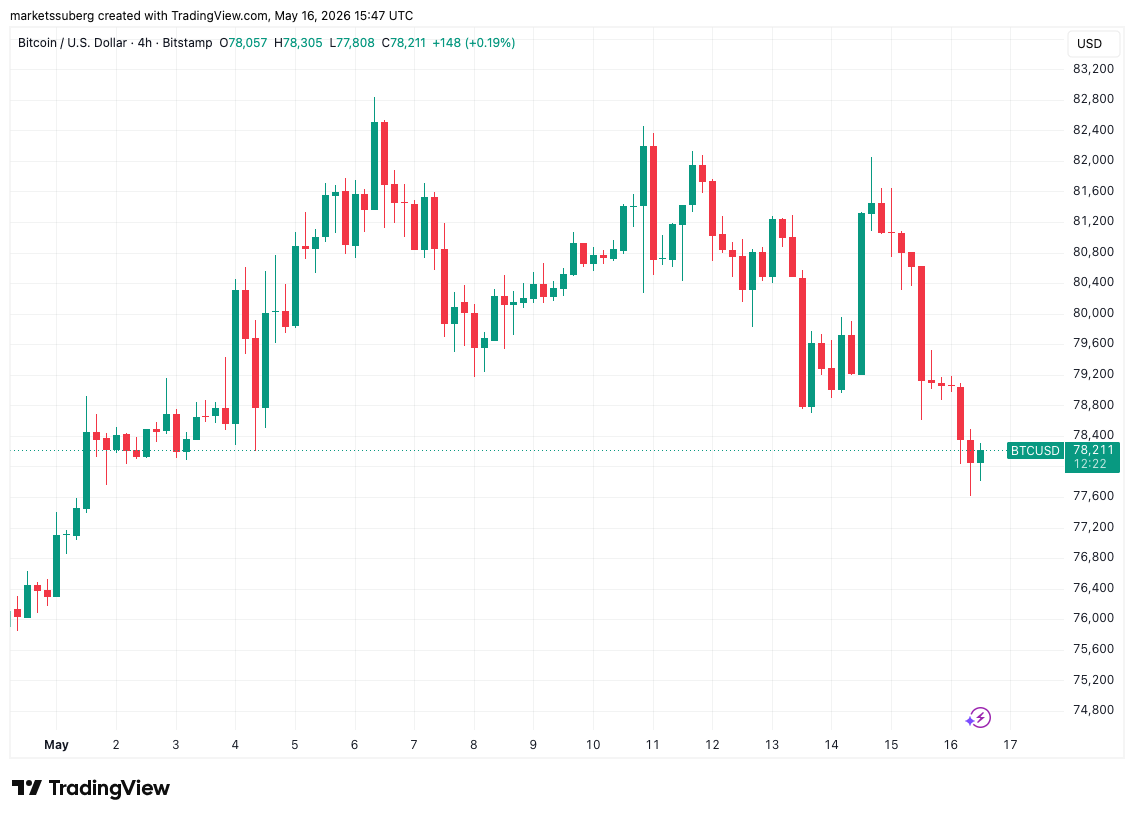
Bitcoin (BTC) circled $78,000 on Saturday after geopolitical headwinds erased most of its May gains.
Key points:
- Bitcoin falls below $78,000 for the first time since the start of May.
- Oil-supply woes combine with existing nerves over US bond markets, adding to headwinds for risk assets.
- Support weakness has traders looking at $75,000 and under next, while optimists see a “bear trap” forming.
Multiple hurdles “coming together” for crypto, risk assets
Data from TradingView confirmed new lows of $77,614 on the day — the lowest levels since May 1.
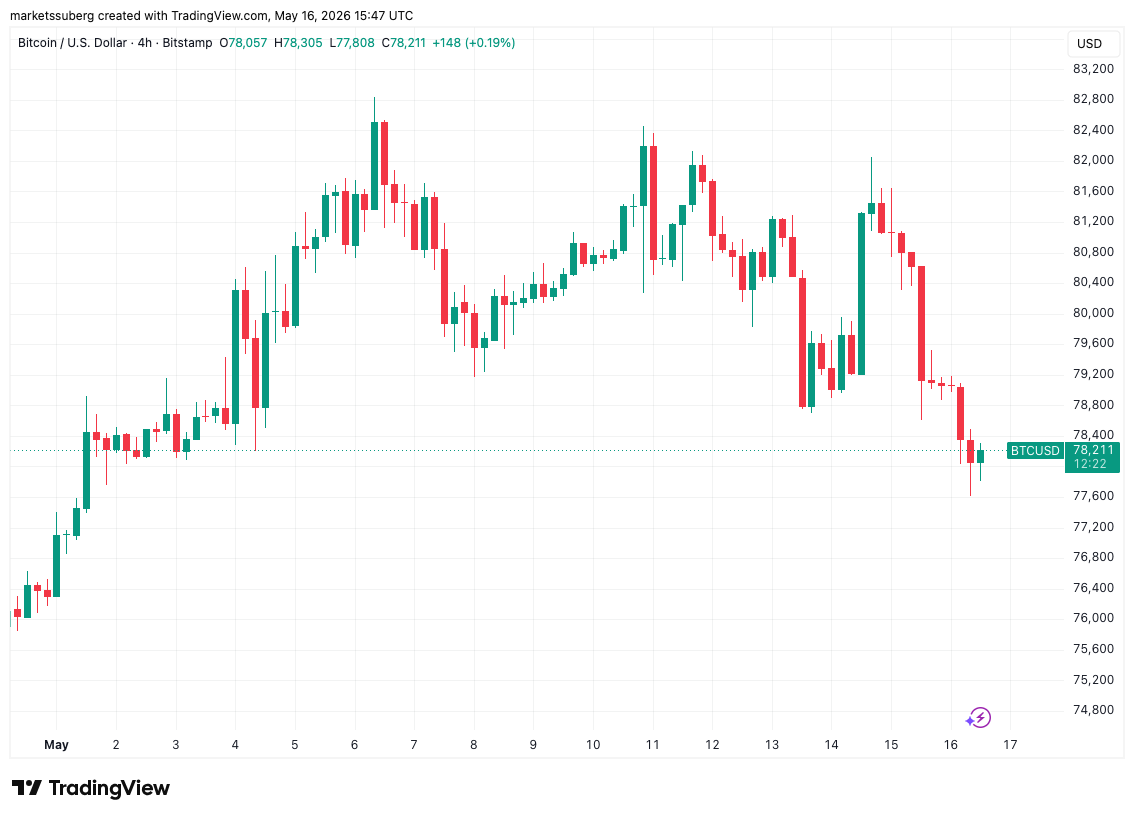
BTC/USD one-hour chart. Source: Cointelegraph/TradingView
Downside pressure stemming from concerns over US government bonds continued, with the US-Iran war also at the forefront of traders’ minds.
Iran appeared to be pressing ahead with a toll system for transit through the Strait of Hormuz — the epicenter of a global oil-supply squeeze — while keeping US traffic out.
As reported by trading resource The Kobeissi Letter among others, Hormuz would reportedly “remain closed to the operators of Project Freedom.”
On Friday, analysis from Mosaic Asset Company spelled out the problems of the current geopolitical and macroeconomic climate for risk assets.
“The prospect for another inflation wave is lining up with similarities to the surge in price levels into mid-2022,” it wrote in its latest Mosaic Chart Alerts blog post.
“Disrupted supply chains from last year’s trade war, impact of war on energy markets, and stimulus via large federal budget deficits are coming together at the same time.”
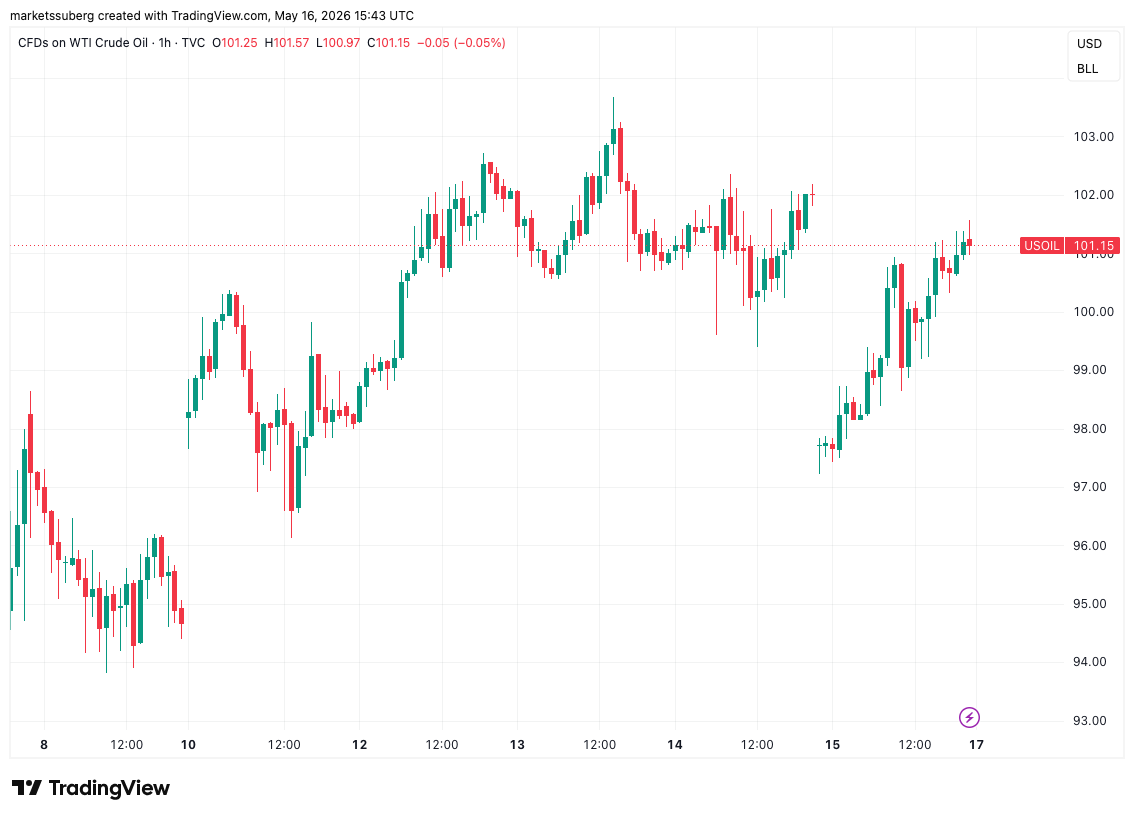
CFDs on US WTI crude oil one-hour chart. Source: Cointelegraph/TradingView
WTI crude oil finished the week trading above $100 per barrel.
Bitcoin price action teases “bear trap”
Among Bitcoin traders, there were ongoing mixed feelings about the bears’ strength below $80,000.
Related: Bitcoin price history suggests 77% odds of new all-time high within a year
“Over the last couple of days, the price has been going down slightly, while the open interest has climbed up. But things become interesting if we correlate this with Funding Rates, which have flipped negative,” X trading account Cryptic Trades wrote on X.
“This shows us that bears are DOUBLING DOWN right now and betting on a breakdown. It also shows that even though the market structure remains intact, bears are shorting as if a breakdown already happened. That’s generally how bear-traps are formed.”
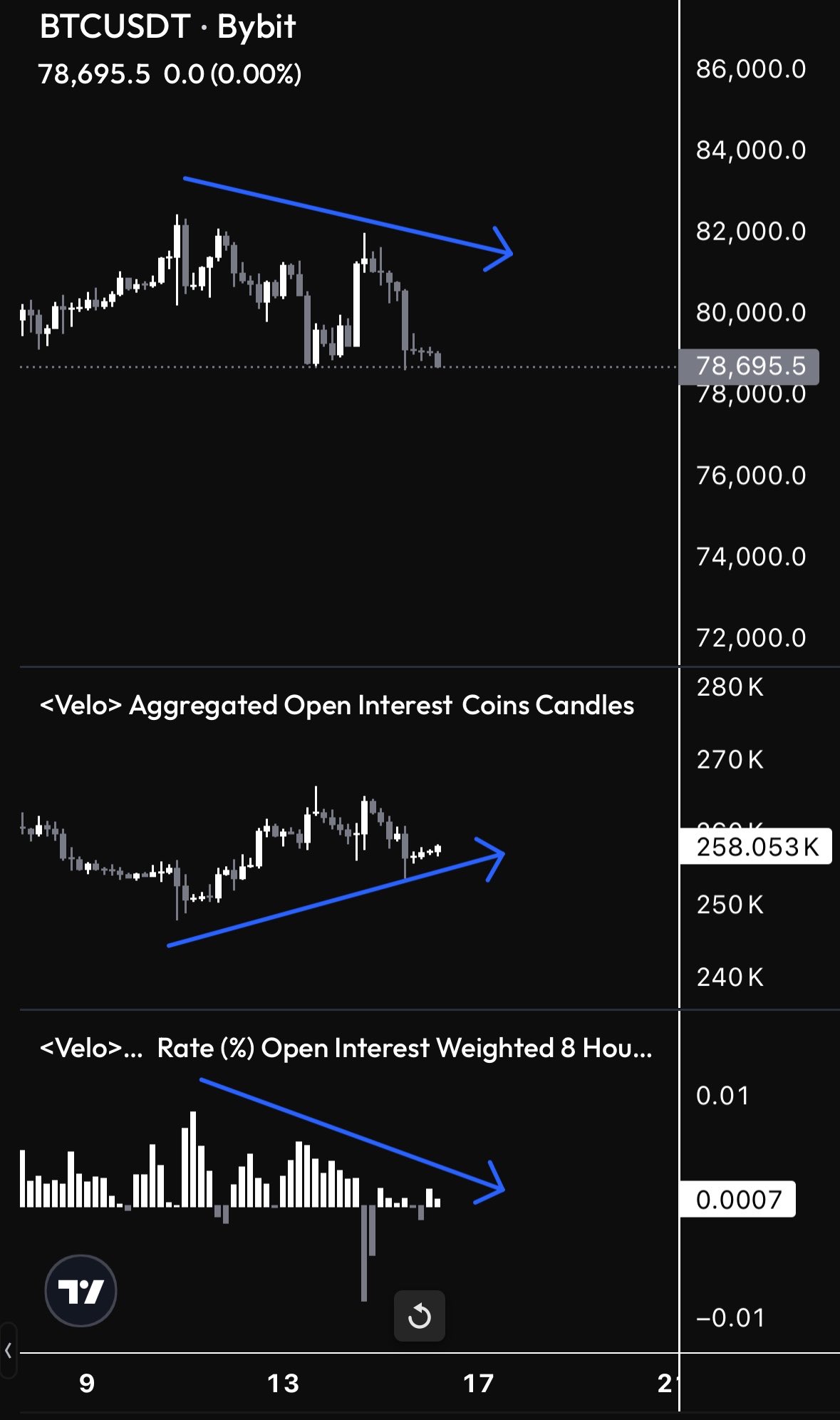
BTC/USDT chart with open interest, funding rate data. Source: Cryptic Trades/X
For analyst Eric Coleman, a target for new local lows lay at around $75,000.
“BTC went down after the breakdown retest of the ascending triangle,” he summarized alongside a chart showing relevant support/resistance flip levels.
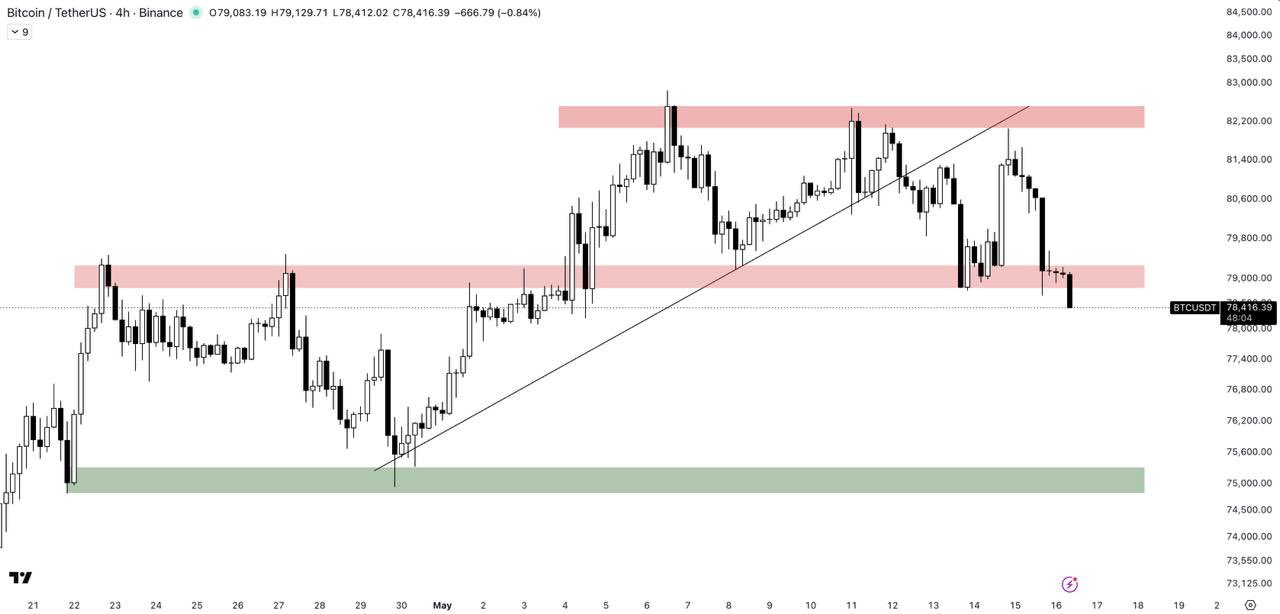
BTC/USDT four-hour chart. Source: Eric Coleman/X
Examining exchange order-book liquidity, Daan Crypto Trades highlighted $71,000 as the nearest zone of interest below price.
“The longer price compresses around this $80K region, the more liquidity will be building up on both sides which should result in a larger more aggressive move at some point,” he told X followers.
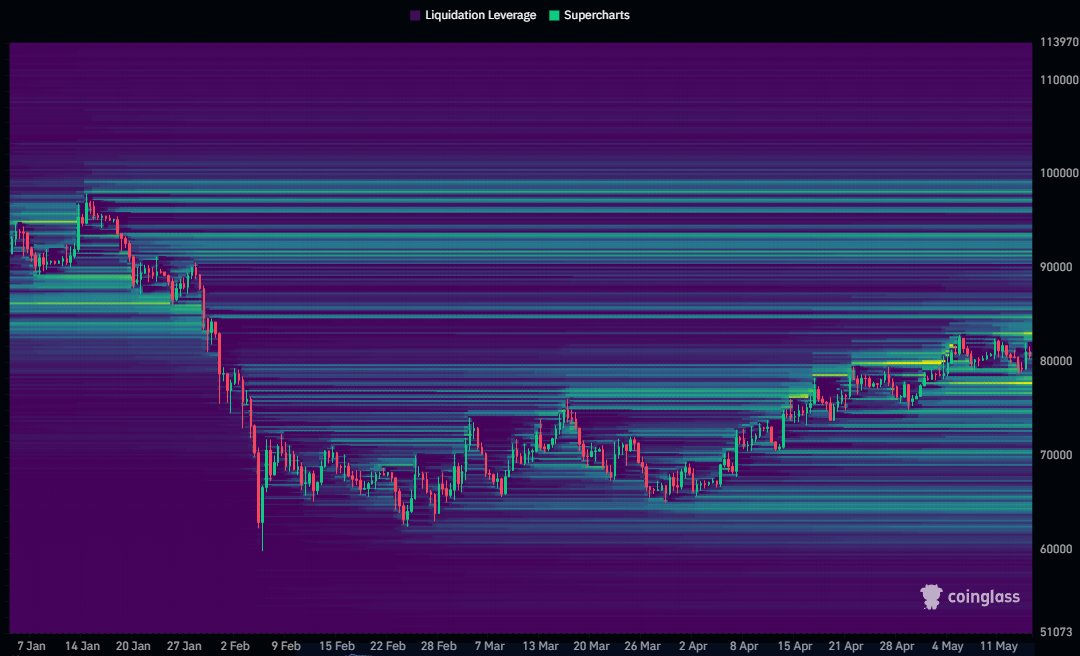
BTC/USDT liquidation heatmap. Source: Daan Crypto Trades/X

OpenAI and the Maltese government have unveiled a world-first partnership to roll out ChatGPT Plus to all Maltese citizens, marking a notable milestone in government-backed AI access. The plan ties free access to a year-long ChatGPT Plus subscription to the completion of a government-supported AI literacy course for residents.
Under the programme, citizens who finish the AI literacy course—developed by the University of Malta—will receive complimentary access to ChatGPT Plus for one year. The course itself covers the basics of what AI is, what it can and cannot do, and how to use it responsibly at home and in the workplace.
“Malta is the first country to launch a partnership of this scale because we refuse to let our citizens stay behind in the digital age,” said Silvio Schembri, Maltese minister for economy, enterprise and strategic projects. “The goal is to turn AI from an unfamiliar concept into practical assistance for our families, students, and workers.”
The Malta Digital Innovation Authority will oversee distribution to eligible participants when the first phase launches this month, with plans to broaden the program as more residents and citizens abroad complete the course.
Key takeaways
- The Maltese government and OpenAI are partnering to provide free ChatGPT Plus access for one year to citizens who complete a government-backed AI literacy course developed by the University of Malta.
- The initiative represents a “world-first” scale in government-AI collaboration and aims to translate AI from a theoretical concept into practical everyday use for families, students, and workers.
- Distribution will be managed by the Malta Digital Innovation Authority, with the first phase starting this month and expansion tied to course completion by more residents and Maltese abroad.
- The partnership sits within OpenAI’s broader “OpenAI for Countries” program, which tailors AI adoption to each nation’s priorities such as education, workforce training and public services.
- OpenAI has signaled a growing global footprint in government partnerships, including work with Estonia on ChatGPT Edu and with Greece under separate country-focused initiatives, as well as defense-related deployments in the U.S. on classified networks.
A first-of-its-kind deal in Malta
At a time when policymakers are weighing how to accelerate AI literacy while managing risks, Malta’s approach pairs education with practical tooling. The University of Malta-led course is designed to demystify AI and provide a framework for responsible usage, a step that could help bridge the gap between theoretical understanding and everyday application. By tying certification and household access to a government-endorsed curriculum, the program signals a deliberate strategy to bake AI familiarity into public life rather than leaving it to private platforms alone.
The one-year ChatGPT Plus subsidy acts as an incentive for citizens to engage with the course and begin integrating AI into daily tasks—from research and writing to workflow automation and problem-solving. The government’s aim is not only to boost digital literacy but to demonstrate how AI can serve as a practical assistant across education, work, and family life. The initial phase is set to roll out this month, with the Malta Digital Innovation Authority charged with ensuring eligible participants receive access and that the rollout scales as more people complete the course, including Maltese residents living abroad.
From a governance perspective, the arrangement underscores a growing willingness among governments to experiment with official AI programs that go beyond mere procurement or pilot projects. It also places a spotlight on how AI access programs can be paired with formal education to produce measurable literacy and usage outcomes rather than ad hoc, platform-centric uptake.
OpenAI for Countries: a tailored, country-by-country approach
The Malta agreement is a notable example within OpenAI’s broader OpenAI for Countries initiative, a programme through which the company collaborates with governments to push AI from early interest to nationwide adoption. Unlike standardized models, this program emphasizes customization aligned with each country’s priorities—spanning education, workforce training and public services. The Malta partnership demonstrates how such a framework can translate into tangible benefits for citizens and institutions alike.
In a broader context, OpenAI has pursued a multi-country strategy designed to fit diverse governance architectures and policy objectives. For example, last year Estonia’s government partnered with OpenAI to provide all secondary school students and teachers with access to ChatGPT Edu, a version tailored to educational needs. Separately, OpenAI has launched an initiative with Greece to expand AI-enabled capabilities within public services. These moves illustrate how governments are experimenting with AI in a structured, policy-aligned manner rather than adopting a one-size-fits-all solution.
The flexibility of the OpenAI for Countries program aligns with a growing trend toward customized public-sector AI tooling, where the focus is not only on how to deploy models but also on how to integrate them into educational curricula, job training, and service delivery. In some arenas, OpenAI’s technology has also found roles beyond civil government—for instance, a reported deal to deploy its models on classified military networks in collaboration with the U.S. defense complex. Such arrangements highlight both the breadth of potential applications and the sensitivities that accompany AI in high-stakes environments.
According to the program’s framing, the goal is to move beyond curiosity about AI to practical, system-wide adoption that can improve efficiency, accessibility and decision-making across public life. The Malta programme signals this broader ambition, illustrating how a national-scale effort can begin with education and access—and scale into ongoing public-sector utility.
What this means for investors, users and builders
From an investor and developer perspective, Malta’s model offers a live-case study in how government partnerships can underpin user onboarding and capability-building around AI tools. For users, the immediate benefit is clear: a structured pathway to use an advanced AI service at no personal cost for a defined period, contingent on completing an educational module that frames safe and responsible use. For builders and policymakers, the initiative tests governance, data governance, privacy protections, and the interoperability of AI services with public-sector workflows. The Malta rollout could inform subsequent programs in other jurisdictions that seek to harmonize AI access with formal education and service delivery standards.
As OpenAI continues to expand country-specific programs, observers will watch how these partnerships navigate issues such as data governance, digital inclusion, and the alignment of AI capabilities with public-interest goals. The Estonia and Greece examples show that governments can tailor AI deployments to educational and administrative ecosystems, potentially creating a blueprint for similar initiatives elsewhere. However, observers will also scrutinize how these programs adapt to different regulatory environments, privacy norms, and financial models as they scale beyond initial pilots.
For developers and platforms building AI-powered tools, Malta’s approach reinforces the importance of establishing clear educational content, public-facing risk disclosures, and governance channels that can handle large-scale adoption. It also underscores the potential for AI literacy to become a prerequisite for broad access to advanced tools, a development that could shape product design, user onboarding, and policy dialogue in the months ahead.
In the broader market context, Malta’s move sits at the intersection of digital literacy, public-sector modernization and AI-enabled public services. While the immediate commercial impact to OpenAI or the University of Malta may be limited by the program’s scope, the symbolic and practical implications could influence how other nations approach AI education and access, potentially accelerating a wave of country-led AI initiatives in the coming years.
Readers should stay tuned to how the first phase unfolds in Malta, including participation rates, user feedback, and any adjustments in eligibility or course content. The evolution of this program will offer important signals about the practical viability of government-backed AI access and its place in a broader strategy to democratize advanced technologies.
OpenAI’s broader strategy to engage with governments remains a developing landscape. As nations explore tailored AI adoption—balancing innovation with safeguards—the Malta initiative adds a concrete data point to the evolving policy and market narrative around AI in the public sector.
For now, the Maltese program marks a notable milestone: a government-backed pathway that connects AI literacy, civic participation and consumer access to a leading AI service, with potential implications that reach far beyond a single country’s borders.
As this initiative unfolds, watchers should monitor not only uptake and satisfaction but also the durability of the model once the year-long free access ends, and how Malta plans to sustain AI-enabled public services in the long term.


OpenAI and the Maltese government have announced a world-first partnership to roll out ChatGPT Plus to all Maltese citizens, marking the first time a government has struck such a deal with the AI company.
Under the programme, citizens who complete a government-backed AI literacy course will receive free access to ChatGPT Plus for one year, OpenAI announced on Saturday. The course, developed by the University of Malta, covers what AI is, what it can and cannot do and how to use it responsibly at home and in the workplace.
“Malta is the first country to launch a partnership of this scale because we refuse to let our citizens stay behind in the digital age,” Maltese minister for economy, enterprise and strategic projects Silvio Schembri said, adding that the goal is to turn AI “from an unfamiliar concept into practical assistance for our families, students, and workers.”
The Malta Digital Innovation Authority will manage distribution to eligible participants when the first phase launches this month, with the programme set to expand as more residents and citizens abroad complete the course.
Related: Robinhood Invests $75M in OpenAI to Provide Equity Tokens for Users
OpenAI partners with governments worldwide
The deal is the latest under OpenAI’s broader OpenAI for Countries initiative, through which the company works with governments to move from early AI interest to national-level adoption. Unlike a standardised model, the programme is tailored to each country’s priorities, including areas like education, workforce training and public services.
Last year, OpenAI partnered with Estonia’s government to provide all secondary school students and teachers with access to ChatGPT Edu, a customized version of ChatGPT built for education systems. The firm has also launched “OpenAI for Greece” in partnership with the Greek government.
As Cointelegraph reported, OpenAI has also struck a deal with the US Department of Defense to deploy its AI models on classified military networks.
Magazine: AI-driven hacks could kill DeFi — unless projects act now

It’s safe to say that the world’s largest altcoin has underperformed in recent weeks as each attempt for a breakout was stopped at $2,400, and the subsequent rejection has pushed it further south. What’s particularly worrying is that ETH dipped below the crucial $2,200 support after today’s drop, and its behavior against bitcoin is even more painful.
In fact, the ETH/BTC pair just dropped to a 10-month low at under 0.028. Recall that ETH traded at over 0.042 BTC in September last year, shortly after its all-time high against the greenback, but it has been mostly downhill since then. Popular analyst Ted Pillows said this decline occurred even as Tom Lee’s BitMine continues to spend millions of dollars each week to accumulate more tokens.
ETH/BTC has hit a new yearly low.
This is despite Tom Lee buying $200M+ in $ETH every week. pic.twitter.com/PpNyUcgACp
— Ted (@TedPillows) May 16, 2026
ETH to Exchanges
Ali Martinez cited data from CryptoQuant, which could result in even more price declines for the altcoin. He noted that over 500,000 ETH had been sent to trading venues in the past week alone. In terms of USD value, this substantial stash is worth over $1.1 billion. Such large transfers could intensify the immediate selling pressure as traders usually send tokens to exchanges if they want to cash out.
Martinez warned recently that the TD Sequential, a popular indicator used to showcase whether an asset has exhausted its move in either direction, had flashed a sell signal for ETH. He believes the altcoin could be on the verge of a more painful decline, and outlined a worst-case scenario of a dump below $1,100.
On The Plus Side…
On the opposite side stands Satoshi Flipper, another popular analyst, who recently said ETH could bounce from the lower boundary of the ascending triangle, diagonal support it’s currently testing on the 8-hour chart.
At the same time, Lookonchain outlined an Ethereum OG who has returned to the scene. The unknown investor had received over 11,000 tokens at prices of under $3.50 (yes) 10 years ago, sold some for more than $30 million last year, and has now started buying again.
The on-chain analytics company said they spent $4.3 million in USDC to buy 1,951 ETH at today’s prices of around $2,180.
The post ETH Hits Yearly Low Against BTC as Investors Flood Exchanges appeared first on CryptoPotato.
Crypto World
Jump Crypto’s ‘Firedancer’ is taking a slow and steady approach to its long-awaited Solana infrastructure rollout


In an interview with CoinDesk, the lead engineer at Firedancer gives an update on how the new client, also known as a software, is fairing in the Solana ecosystem.


The crypto market lost nearly $90.3 billion in value in a single hour on May 16, pushing Bitcoin to $77,678 and triggering mass liquidations across the board.
Summary
- PPI inflation data came in 6% above forecast, killing rate-cut expectations and sending risk assets into a sharp sell-off.
- BlackRock’s IBIT shed $136 million as U.S. spot Bitcoin ETFs posted $290 million in outflows, ending a six-week inflow streak.
- Nearly 154,000 traders were liquidated in 24 hours, wiping out roughly $696 million from the derivatives market.
The crypto market shed $90.3 billion in market cap in under an hour on May 16, with total valuation dropping 3.37% to around $2.59 trillion. Bitcoin (BTC) fell to $77,678 while Ethereum (ETH), XRP (XRP), Solana (SOL), and Dogecoin (DOGE) each posted losses between 3.5% and 6%.
The sell-off was not crypto-specific. It was driven by a macro repricing event that spilled across global risk assets.
New U.S. PPI data released this week came in roughly 6% above analyst forecasts, the highest reading since December 2022, according to official data. April CPI had already printed at 3.8%. Together, the back-to-back inflation prints effectively ended near-term hopes for Federal Reserve rate cuts, with CME FedWatch showing more than 44% probability of a rate hike by December. Traders sold risky assets fast.
Bitcoin has recently tracked the iShares Russell 2000 ETF (IWM), which follows small-cap U.S. stocks that are highly sensitive to rate expectations. As small-caps fell sharply on the inflation data, Bitcoin followed without delay.
Institutional selling compounded the macro hit
U.S. spot Bitcoin ETFs recorded $290 million in outflows on the day, ending a six-week inflow streak. BlackRock’s IBIT led withdrawals with roughly $136 million in redemptions. Total Bitcoin ETF outflows over the past week reached approximately $1.15 billion, according to SoSoValue data.
Analyst Ali Martinez posted on X that Bitcoin miners sold close to 800 BTC worth roughly $64 million over the four days prior, adding further supply pressure at exactly the wrong moment. “This increase in selling pressure could soon impact price action,” Martinez warned.
The combination of macro-driven selling and institutional redemptions removed two major demand layers simultaneously, leaving the market exposed to leveraged long positions built during the recent inflow streak.
Liquidation cascade accelerated the decline
Once spot prices began falling, the derivatives market amplified the move. According to CoinGlass data, nearly 154,000 traders were liquidated over 24 hours, wiping out roughly $696 million from the derivatives market. Bitcoin liquidations alone surged 125% to over $235 million. Total crypto derivatives open interest fell more than 25% as traders rapidly exited leveraged positions.
Crypto trader Ted Pillows warned on X that Bitcoin has broken below a major multi-month ascending channel on the daily timeframe, with two consecutive red candles confirming the breakdown. “If BTC loses the $78,000 level here, it could drop quickly to $74,000–75,000,” he said.
Analysts say the technical break, if sustained, opens the door to a deeper correction, with the $70,000–$68,000 region cited as the next meaningful downside target.
Altcoins took heavier losses than Bitcoin. XRP, Solana, BNB, Hyperliquid, Zcash, Dogecoin, Chainlink, and Cardano all posted steep declines as market sentiment shifted decisively risk-off, consistent with the broader pattern seen each time macro data has turned hawkish this year.
Crypto World
Stablecoin Infrastructure Has Gone Regional: The $400B Map Reshaping Cross-Border Payments

TLDR:
- Stablecoin payment volume reached $400B in 2025, with 60% of transactions driven by B2B activity.
- Bridge covers 35 countries but holds zero local rail presence in APAC, exposing critical coverage gaps.
- Conduit operates at roughly 10 bps on FX, compared to Bridge’s fee of up to 1% per transaction.
- Fasset hit $32B annualized across 50-plus corridors after securing a $51M Series B funding round.
Stablecoin payment volume reached $400 billion in 2025, with 60% driven by B2B transactions. Yet many fintechs still rely on a single US-based provider to cover global corridors.
The reality is that stablecoin infrastructure has splintered into regional specialists, each with deep local rail integrations, mobile money networks, and central bank relationships.
For cross-border operators, knowing who controls each corridor is now more critical than ever.
Regional Players Are Outpacing US-Centric APIs
The stablecoin orchestration landscape has shifted dramatically over the past three years. What once existed as a few US-based APIs has grown into a dense network of regional operators.
Each corridor now has its own pure-play infrastructure, built by teams with firsthand knowledge of local payment realities.
In Europe, MiCA-native providers like BVNK are processing $30 billion annualized. That figure reflects how quickly regulated regional operators have gained ground.
Meanwhile, in Latin America, providers like Bitso and dLocal have built around local systems such as PIX and SPEI.
As industry observer Gaspard Lezin noted on X, “every major payment corridor has its own pure-play, built by people who actually understand local rails, mobile money, central bank relationships, and FX realities on the ground.”
Africa presents a strong case for mobile money-stablecoin integration. Providers like Yellow Card, Conduit, and Kotani Pay are operating where traditional banking infrastructure remains thin. Conduit alone covers 23 African countries, offering substantially lower fees than global competitors.
Cost and Coverage Gaps Are Driving the Shift
Fee structures are one of the clearest reasons businesses are moving away from single-provider models. Bridge charges up to 1% on FX transactions, while Conduit operates at approximately 10 basis points. That difference compounds significantly at scale for B2B treasury teams.
Coverage gaps are equally telling. Bridge, which covers 35 countries, has no local rail presence in APAC. By contrast, StraitsX has processed roughly $30 billion in cumulative volume across Asia.
Fasset recently hit $32 billion annualized across 50-plus corridors in Asia, Africa, and the Middle East following its $51 million Series B.
In the Asia-Pacific region, Reap was acquired by Kraken for $600 million, further validating the region’s growth trajectory. FOMO Pay, Triple-A, and PhotonPay are also operating with deepening local integrations across the region.
For businesses managing multi-corridor supplier payments, the practical answer is a regional stack. A B2B treasury team paying suppliers across Lagos, São Paulo, Jakarta, and Dubai requires different infrastructure in each market.
Aggregation layers like Borderless.xyz are emerging to stitch these regional providers into a single API, reducing operational complexity without sacrificing local depth.


Spot Bitcoin spot exchange-traded funds (ETFs) finished the week with $1.0 billion in net outflows, ending a six-week streak of inflows that had drawn roughly $3.4 billion in total. The week began with faint optimism as funds posted modest inflows, but selling pressure intensified through midweek, culminating in the heaviest outflow on Wednesday. Ether spot ETFs drove a parallel pattern, registering five straight days of red ink and erasing about $254 million from the sector’s assets.
According to SoSoValue, Monday saw a modest inflow of $27.29 million into spot Bitcoin ETFs. On Tuesday, investors pulled $233.25 million, and Wednesday delivered the largest single-day hit with outflows of $635.23 million. A temporary reprieve came on Thursday with inflows of $131.31 million, yet Friday reversed that progress, with another $290.42 million exiting the products. The week closed with net outflows totaling exactly $1 billion. The slide marks a pronounced reversal from the prior six weeks, during which spot BTC ETFs attracted steady inflows, the strongest being the week of April 17 at $996.38 million. By week’s end, total net assets across spot Bitcoin ETFs stood around $104.29 billion, with cumulative net inflows across all products at $58.34 billion.
On the Ether ETF front, the five-day pattern was uniformly negative. Outflows hit every trading day, led by Tuesday’s $130.62 million, followed by $65.65 million on Friday, $36.30 million on Wednesday, $16.89 million on Monday, and $5.65 million on Thursday. The cumulative effect left Ether ETF assets at approximately $12.93 billion by week’s end, with a five-day net decrease of about $254.46 million.
The latest flow data arrives amid broader market shifts that analysts say are shaping risk appetite for crypto products. In a note, the research firm Bitunix described a pronounced capital rotation toward the AI growth narrative and the institutionalization of crypto assets. The backdrop includes a rally in major tech beneficiaries such as NVIDIA, Google, and Apple, with AI-related players like Cerebras spiking intraday on its IPO debut. The dynamic underscores how macro themes are increasingly filtering into crypto allocation decisions, even as spot crypto prices remain volatile.
Key takeaways
- Spot Bitcoin ETFs posted $1.0 billion in weekly net outflows, ending six consecutive weeks of inflows that had accumulated about $3.4 billion.
- Daily flow pattern for BTC ETFs showed modest Monday inflows, heavy midweek outflows peaking Wednesday, a Thursday rebound, and continued Friday selling.
- Total spot BTC ETF assets stood at roughly $104.29 billion, with cumulative inflows across all related products at about $58.34 billion.
- Ether spot ETFs faced a five-day stretch of outflows totaling about $254 million, reducing assets to around $12.93 billion.
- Macro themes—AI-driven capital rotation and evolving crypto regulation—are shaping near-term risk appetite, with regulatory developments and price action providing directional signals.
Markets in the crosswinds of AI and regulation
Beyond the ETF flows, investors have been weighing the interplay between technology-driven narratives and policy shifts. Bitunix’s note highlights a sentiment shift toward AI-related growth and the institutionalization of crypto markets, a combination that could sustain capital inflows or trigger selective reallocation depending on macro data and tech sector momentum. In the broader stock space, several AI-heavy names pushed toward fresh highs, while select AI-chipmakers demonstrated notable intraday strength on debut, illustrating the sector’s capacity to influence crypto risk sentiment through cross-asset dynamics.
On the regulatory front, developments such as the CLARITY Act have been closely watched. The bill is widely viewed as one of the most significant pieces of crypto market structure legislation in the United States. Following the Senate Banking Committee’s movement on the measure, Coinbase shares rallied as investors priced in potential regulatory clarity, and Bitcoin hovered near the $82,000 level. Analysts caution that Bitcoin’s price action remains sensitive to macro liquidity and the ongoing tug-of-war between AI-driven demand themes and regulatory framing. Traders also noted a cluster of short liquidity in the $82,400–$82,600 range with the $80,000 level identified as a critical support anchor to monitor in the near term.
These developments sit alongside ongoing policy debates and market structure reforms that could influence ETF flows and crypto trading volumes in the coming weeks. For instance, coverage of regulatory milestones continues to shape investor expectations and the perceived safety of crypto exposure within diversified portfolios. Related reporting has highlighted how public filings and regulatory chatter can translate into quickly shifting trading dynamics, including moves in large-cap crypto equities alongside the sector’s ETF products.
As traders digest these crosscurrents, the market will be watching for whether inflows resume or outflows intensify, and for more concrete signals about how policymakers intend to balance investor protection with sector growth. The coming weeks could reveal whether current price levels are a temporary pause in a broader uptrend or a prelude to renewed volatility driven by macro data, regulatory decisions, or shifts in the AI narrative that continue to reverberate through risk markets.
Further context on regulatory developments and market reactions can be found in related coverage, which notes ongoing attention to the CLARITY Act and its potential implications for crypto market structure and investor access.
Looking ahead, investors should watch how liquidity dynamics evolve around key support levels for spot BTC and how the evolving regulatory environment affects appetite for crypto exposure within traditional portfolios. The balance of AI-driven demand, geopolitical considerations, and policy clarity will likely continue to shape ETF flows and price action in the weeks ahead.
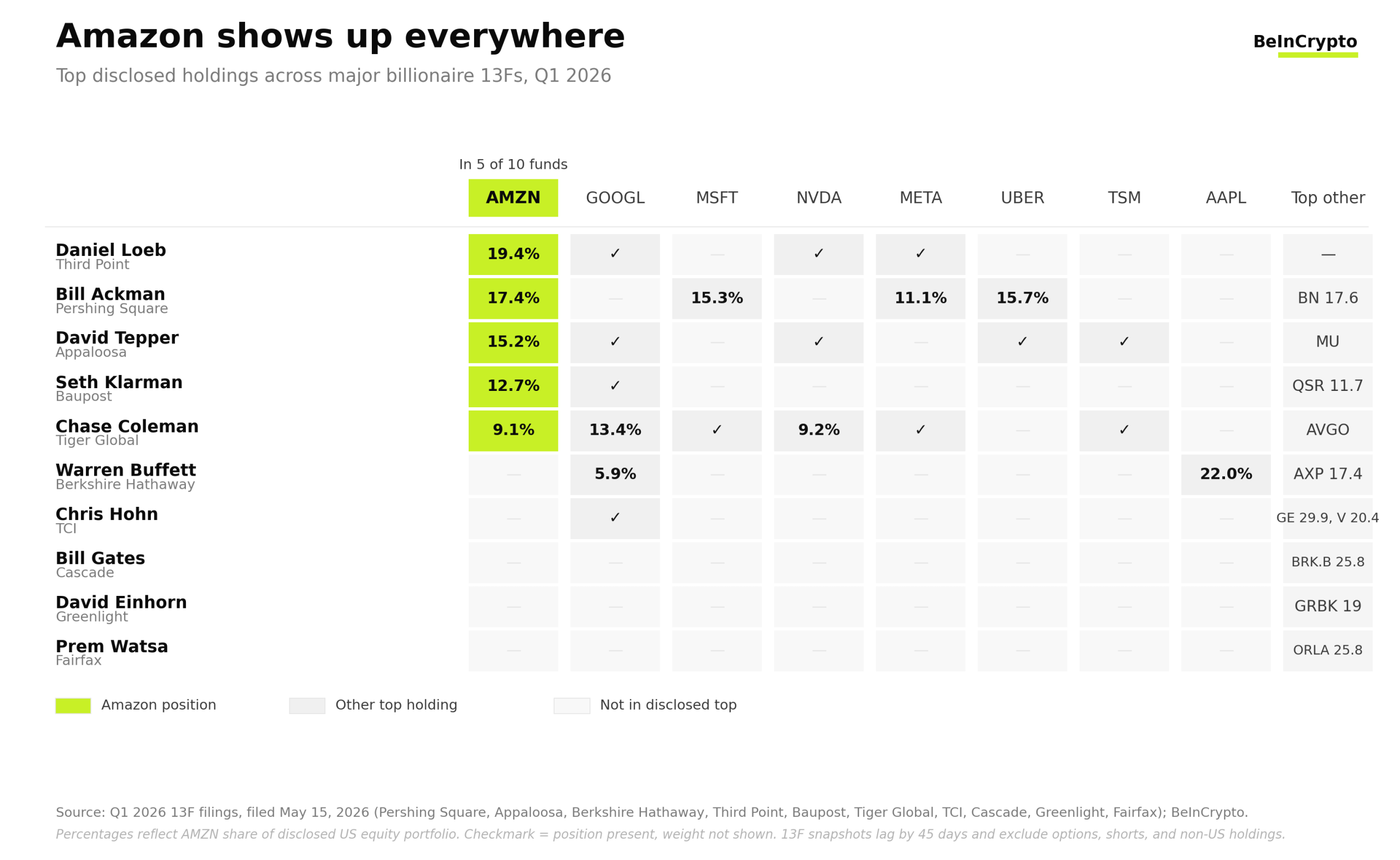
Several of Wall Street’s most-watched billionaires converged on a single conviction trade in their Q1 2026 13F filings. Bill Ackman, David Tepper, and other managers each boosted their stakes in Amazon (AMZN).
The disclosures show the e-commerce and cloud platform topping multiple hedge fund books. Amazon emerged as the most repeated overweight name across major filings.
Ackman and Tepper Lead the Amazon Add
Pershing Square added 1.84 million Amazon shares in the first quarter. The buy lifted Ackman’s position by roughly 19%, according to the fund’s filing.
Amazon now sits among its largest disclosed holdings alongside Brookfield, Uber, and a newly initiated Microsoft stake.
David Tepper’s Appaloosa Management nearly doubled its Amazon position during the quarter. The 98% increase made the stock the firm’s largest disclosed equity holding, valued at roughly $900 million.
The fund also boosted Uber by 242% and added to Taiwan Semiconductor while trimming Nvidia, Alphabet, and Alibaba.
Hedge funds run by Daniel Loeb, Seth Klarman, and Chase Coleman also list Amazon among their top US holdings.

The overlap reinforces a shared positioning theme. Amazon’s appeal rests on resilient e-commerce cash flow, AWS cloud demand tied to AI buildouts, and accelerating digital ad revenue.
AI and Quality Names Anchor the Rest
Beyond Amazon, the filings show a broader tilt toward AI-adjacent platforms and durable compounders. Tepper, Coleman, and Loeb hold Alphabet, Nvidia, Meta Platforms, and Taiwan Semiconductor.
Warren Buffett’s Berkshire Hathaway made an outsized purchase of Alphabet and trimmed its Bank of America stake. Bill Gates and Chris Hohn cluster in industrials, railways, and quality payments names like Visa.
The 13F snapshots lag by 45 days. They also exclude options, short positions, and non-US holdings, so consensus reads should be paired with live price action.
Notwithstanding, the Amazon trade persisting into Q2 hinges on cloud capex guidance and advertising trends. The broader rotation between AI growth and value names also matters.
The post Wall Street Billionaires Make Amazon Their Top AI Trade appeared first on BeInCrypto.
Crypto World
Yaroslav Ivanov at Consensus 2026: Crypto’s Institutional Era Became Impossible to Ignore
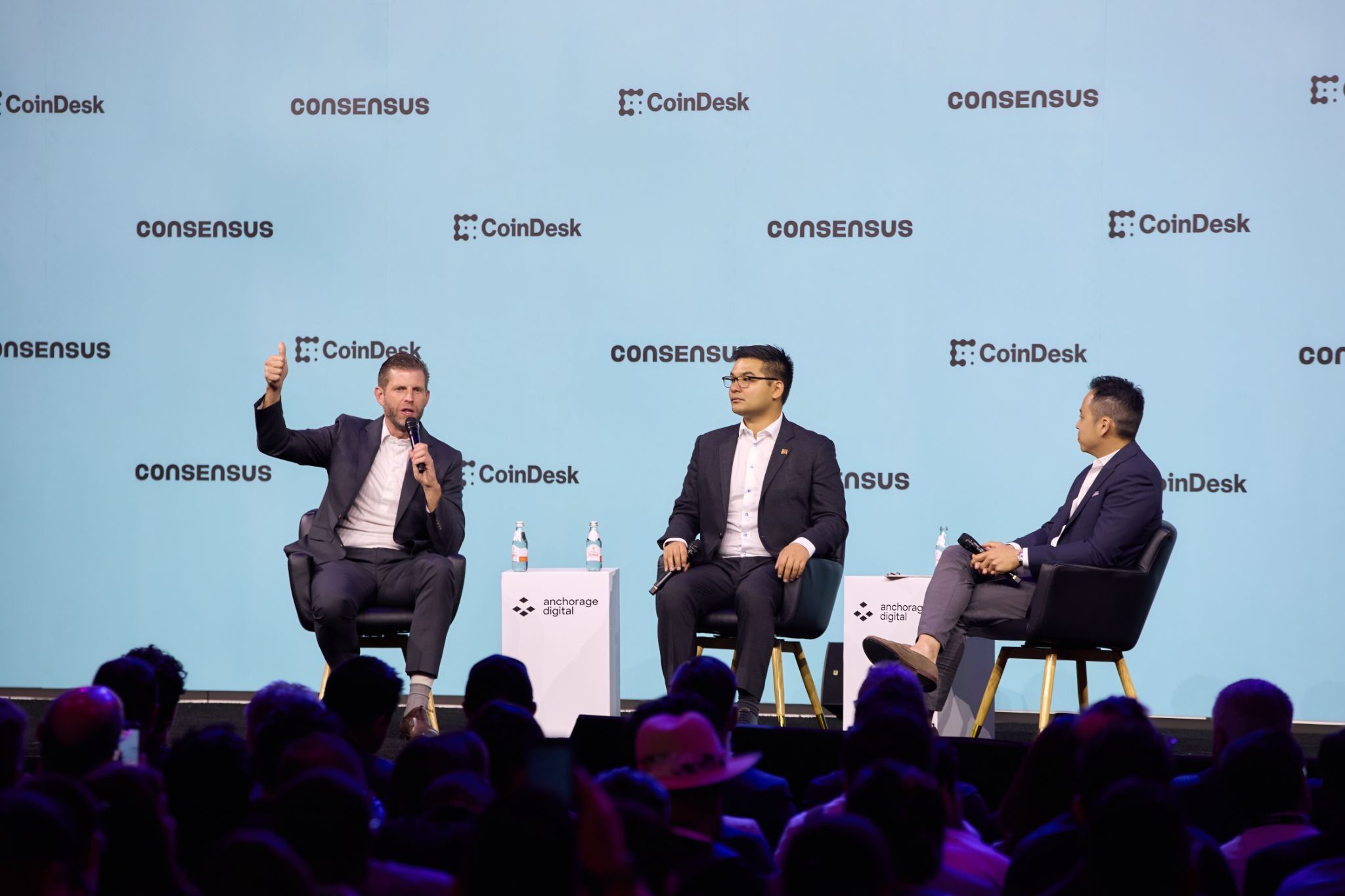
Having worked across blockchain and digital asset ecosystems since 2015, Yaroslav Ivanov, Co-Founder and Chief Visionary Officer of ALTA Blockchain Labs, has witnessed crypto evolve from a niche movement into a sector increasingly intertwined with global finance, a shift that became especially evident at Consensus Miami 2026.
Ivanov is a strategic executive working closely with Web3 founders through ALTA Blockchain Labs, advising on tokenization and liquidity strategy, go-to-market execution, and ecosystem development.
Through his work with both founders and institutional investors, he observes how capital flows and builder sentiment evolve across market cycles. The event brought together senior voices from digital assets, banking, asset management, technology, and policy, with ALTA Blockchain Labs participating as a media and community partner of Consensus 2026.
ALTA sits at the layer where Web3 projects transition into broader liquidity markets.
For Ivanov, the atmosphere showed how much the industry has changed. The early crypto conference image of retail excitement, experimental culture, and chaotic builder energy was still visible, but it no longer defined the room.
The strongest presence came from banks, asset managers, public companies, policy voices, and technology providers speaking about tokenization, regulated settlement, stablecoins, and institutional adoption.
“The scale and institutional presence this year is impressive,” Ivanov said. “It reflects how seriously global finance is beginning to treat digital assets.”

The Rise of Institutional Crypto
Crypto’s new audience is more formal, more corporate, and more connected to existing financial power.
The Wall Street Journal captured this mood in its coverage of Consensus Miami, describing a more corporate atmosphere at the event, with representatives from major banks including JPMorgan Chase and Citigroup.
Its phrase “Lamborghinis Out, Suits In” pointed to a visible cultural change around one of crypto’s biggest annual gatherings.
For Ivanov, this creates a more complicated question than simple “maturity.” Institutional adoption brings capital, legitimacy, liquidity, and a larger market. It also forces the industry to decide which parts of its original culture deserve protection.
Crypto was built around distrust of concentrated financial control. Today, many institutions once skeptical of digital assets are entering the sector with large balance sheets, regulated products, and established client networks.
“Institutional influence over crypto is inevitable,” Ivanov said. “The key is to preserve the authenticity of decentralization and the mission laid out by Satoshi.”
Adoption Brings Pressure
Crypto’s institutional phase can support growth, but adoption alone does not preserve openness, self-custody, or permissionless innovation.
A market can grow while its original purpose becomes less visible.
This tension ran through Consensus 2026, where tokenized securities, stablecoin settlement, bank-grade custody, regulatory alignment, and institutional distribution dominated many discussions.
Meanwhile, at side events, founder meetings, informal gatherings, and community conversations around Miami still focused on networks, applications, user ownership, and mass participation outside traditional finance.
The result was a collision between two versions of the same industry.
Bullish Brings Public Equity Onchain
One of the strongest examples came from Bullish. During Consensus Miami 2026, the company announced plans to let shareholders hold BLSH ordinary shares as tokens on Solana. Bullish described the launch as the first full tokenization of an NYSE-listed company’s equity cap table, administered by Equiniti, its SEC-registered transfer agent.
This gave the institutional conversation a concrete example. Tokenization now reaches public-company ownership records, transfer agents, shareholder visibility, settlement timing, and regulated market operations.
For founders, it validates blockchain as a technology for financial markets. It also shows how quickly crypto language can be absorbed into institutional design.
Solana and the Speed of Open Networks
Solana’s presence at Consensus added another angle to the same discussion. Ivanov met with Anatoly Yakovenko, Co-Founder of Solana Labs, during the event.
Yakovenko’s public comments at Consensus focused on the advantages global blockchain networks may have over companies built around regulated domestic markets. He made the point that crypto-native teams operate globally and can adapt faster than firms tied to legacy market structures.

This idea sits close to the heart of the current debate. Traditional finance is entering crypto because the technology has become too useful to ignore. Crypto-native networks still move faster because they were built with different assumptions from legacy finance.
The next stage of competition may be more about open networks challenging the operating models of traditional markets.
The Builder Spirit Around the Edges
Consensus 2026 showed an industry large enough for major institutions to take seriously, but still young enough for its future to remain unsettled.
Institutional finance wants efficiency, settlement speed, new products, and access to tokenized markets. Crypto-native founders still speak about sovereignty, user ownership, transparency, and global participation.
The risk for crypto is that institutional language becomes the dominant language of success. If the industry measures progress only through ETFs, tokenized cap tables, bank partnerships, and regulated liquidity, the users and builders who carried crypto through earlier years are more easily overlooked.
At the same time, institutional participation brings distribution, compliance experience, and liquidity. These forces can make digital assets easier to use globally. The challenge is accepting institutional growth while preserving crypto’s independent foundation.
Crypto Enters Wall Street’s Room
Consensus Miami 2026 did not resolve the tension between institutional adoption and crypto’s original builder culture, but it did make it harder to ignore.
For Ivanov, the most important lesson came from the contrast between the official program and the surrounding community. Inside the main venue, crypto looked increasingly like a financial market industry.
Around the edges, the original builder spirit remained alive through side events, founder conversations, and communities still focused on open participation.
This contrast may define the next era of digital assets. Crypto has, indeed, entered the room with Wall Street.
The post Yaroslav Ivanov at Consensus 2026: Crypto’s Institutional Era Became Impossible to Ignore appeared first on BeInCrypto.

Brooks Marks Learned This About Himself On ‘Next Gen NYC’

Wayne Rooney names Chelsea star who ‘should’ve done better’ in FA Cup final | Football

Bitcoin Falls Below $78,000 as Analysis Eyes a New Bear Trap

Manchester United reach agreement with Casemiro over contract clause amid transfer speculation

US brings back mandatory military draft registration

Steven Gerrard disagrees with Gary Neville over ‘shock’ Chelsea and Arsenal claim | Football

Your family s total depletion shows your financial weakness. What does it have to do with

Lakhimi Baruah, the Padma Shree awardee, uplifting Assamese women through financial independence!

Japan Created a Generation That Cannot Spend Money
-

 Crypto World16 hours ago
BloFin War of Whales 2026 Grand Prix opens registration for $5M trading championship
-

 Fashion5 days ago
Coffee Break: Travel Steam Iron
-

 Fashion23 hours ago
Weekend Open Thread: Theory – Corporette.com
-

 Politics5 days ago
What to expect when you’re expecting a budget
-

 Fashion6 days ago
What to Know Before Buying a Curling Wand or Curling Iron
-

 Tech6 days ago
Auto Enthusiast Carves Functional Two-Stroke Engine from Solid Metal
-

 Crypto World23 hours ago
E-Estate Announces 1 Year Live: Washington DC Summit as Real Estate Tokenization Enters Its Next Phase
-

 Tech1 day ago
Tech Moves: Microsoft AI leader jumps to OpenAI; former AI2 exec joins Meta; and more
-

 Tech5 days ago
GM Agrees To Pay $12.75 Million To Settle California Lawsuit Over Misuse Of Customers’ Driving Data
-

 Crypto World6 days ago
CZ says US crypto rivals tried to block Trump pardon
-

 Tech5 days ago
GM agrees to $12.75M California settlement over sale of drivers’ data
-
Crypto World3 days ago
Bitcoin Suisse expands with Digital Asset License and Investment Business Act Registration Approval in Bermuda
-

 Politics4 days ago
Pakistan to enter Chinese capital market as war inflation bites
-
 Crypto World2 days ago
Google’s Gemini AI Predicts Incredible Solana Price by the End of 2026
-

 Crypto World4 days ago
Bitcoin Suisse expands with Digital Asset License and Investment Business Act Registration Approval in Bermuda
-

 Politics6 days ago
Sky News Presenter Says Keir Starmer Is Not Waving But Drowning
-
Crypto World7 days ago
Hacker Drains $5.9M From Ethereum Liquidity Provider TrustedVolumes
-

 Business1 day ago
H&R Real Estate Investment Trust (HR.UN:CA) Q1 2026 Earnings Call Transcript
-

 Fashion7 days ago
Amazon Sundays: Spring Glassware & Vases
-
 Entertainment6 days ago
Prime Video’s Forgotten but Brilliant 2-Part Horror Anthology Is a Perfect Binge
You must be logged in to post a comment Login