
Crypto World
Franklin Templeton’s Bitcoin DRIP ETFs explained



A $1.5 trillion asset manager just filed to take the most boring mechanism in investing, the dividend reinvestment plan, and quietly point it at Bitcoin. The filing made no headlines. It may be one of the most structurally interesting crypto products yet proposed.
Summary
- Franklin Templeton filed two ETFs that would reinvest stock dividends into Bitcoin.
- The structure turns a traditional DRIP into an automatic Bitcoin accumulation engine.
- These are equity funds with a Bitcoin feature, not pure Bitcoin funds.
- The idea matters more as product design than as an immediate source of Bitcoin demand.
On June 18, 2026, Franklin Templeton, a roughly $1.5 trillion asset manager that has been in business since 1947, filed paperwork with the Securities and Exchange Commission for two new exchange-traded funds. There were no press conferences, no celebrity fund-manager threads, no countdown clocks on financial television.
The firm simply submitted two registration statements and went about its day. But what those filings describe is one of the more structurally interesting financial products proposed in years, because they take the single most boring, set-it-and-forget-it mechanism in all of investing, the dividend reinvestment plan, and quietly repurpose it to accumulate Bitcoin.
Franklin Templeton is calling them “Bitcoin DRIP” funds, and the idea is strange enough, and clever enough, to be worth understanding in full.
This piece explains what Franklin Templeton actually filed and how the Bitcoin DRIP structure works, why taking the familiar dividend-reinvestment mechanism and pointing it at Bitcoin is a truly novel idea, how this fits into the broader explosion of crypto ETF innovation happening in 2026, what it would mean for ordinary investors and for Bitcoin itself, and the real risks and open questions the filing leaves unanswered.
The funds are not approved yet, tickers and fees are still blank, and they may never launch in their proposed form. But the design points at something larger than two funds: a shift in how Wall Street is packaging Bitcoin, from simple price exposure to structured products that engineer crypto into the machinery of conventional investing.
Understanding the Bitcoin DRIP idea is understanding where the ETF wave is heading next.
What Franklin Templeton actually filed
The mechanics are the heart of the story, so it is worth laying them out precisely, because the cleverness is in exactly how the structure works.
Franklin Templeton filed for two funds, the Franklin US Equity Bitcoin DRIP Index ETF and the Franklin US Innovation Bitcoin DRIP Index ETF, both tracking proprietary indexes built by an index provider called VettaFi. The first tracks a broad large-cap US equity index, and the second a US innovation-and-growth index, so the two differ mainly in which basket of American stocks they hold.
Each fund begins with the same allocation: 95% in US equities and 5% in Bitcoin exposure. That starting point alone is unremarkable, a stock portfolio with a small Bitcoin sleeve.
The novel part is what happens to the dividends. The stocks in the equity portion pay dividends, as dividend-paying stocks do, and instead of reinvesting those dividends back into the same stocks, as a normal dividend reinvestment plan would, the fund automatically routes every dividend into buying more Bitcoin.
Those mechanics are specific. All regular and special dividends from the equity holdings are reinvested into Bitcoin at the market open on the day after each dividend’s ex-date, which steadily increases the fund’s Bitcoin exposure over time.
It gains its Bitcoin exposure through Bitcoin-related instruments, including Bitcoin exchange-traded products, futures, and similar vehicles, and it can hold some of that exposure through a subsidiary structured for the purpose. That is where the three ETF types this builds on matter: spot products, futures products, and income or structured ETF designs are now being recombined into new wrappers.
To keep Bitcoin as a secondary allocation instead of letting it grow without limit, the underlying index caps overall Bitcoin exposure at 20% and applies a smaller cap at each quarterly rebalance. So the design is a stock portfolio that quietly converts its entire dividend stream into a programmatic Bitcoin accumulation engine, starting at a 5% Bitcoin weight and compounding that weight upward over time as dividends flow in, capped at 20%.
The preliminary prospectus is dated June 18, tickers and fees are still blank, the funds cannot be sold until the registration becomes effective, and the earliest possible launch is around September 1, 2026.
Why this is a truly novel idea
The structure is worth pausing on, because it is not just another way to package Bitcoin exposure; it repurposes a mechanism so familiar that its application to Bitcoin is quietly radical.
A dividend reinvestment plan, or DRIP, is one of the oldest and most boringly reliable tools in investing. For decades, ordinary investors have used DRIPs to automatically plow the dividends from their stocks back into buying more of those same stocks.
That compounds their positions over time without lifting a finger, the very picture of patient, conventional, set-it-and-forget-it wealth-building. A DRIP is the opposite of speculative; it is the slow, automatic compounding that has built retirement accounts since the 1960s.
What Franklin Templeton’s filing does is take that exact mechanism, the automatic, disciplined reinvestment of dividends, and redirect its output away from more stock and into Bitcoin. That dividend stream, historically one of the most conservative and predictable components of equity investing, becomes a programmatic Bitcoin-buying machine running on autopilot inside a regulated fund.
What makes this clever is the behavior it creates, not the exposure it provides. A spot Bitcoin ETF gives you a lump of Bitcoin price exposure that rises and falls with the market; you buy in once and your exposure is set.
The Bitcoin DRIP structure instead manufactures a recurring, automatic stream of Bitcoin accumulation funded entirely by equity dividends. Simply holding the fund means you are steadily, mechanically buying Bitcoin every quarter without making any decision to do so.
It is dollar-cost averaging into Bitcoin, except the dollars come from your stock dividends, not from your wallet, and the averaging happens automatically inside the wrapper. For an investor who wants Bitcoin exposure but distrusts their own ability to buy it consistently, or who likes the idea of keeping a core equity portfolio while siphoning its income into Bitcoin, the structure does something a plain spot ETF cannot.
It builds the accumulation discipline into the product itself. That is a fundamentally different idea from one-time price exposure, and it is what makes two quietly filed funds more interesting than their lack of fanfare suggested.
The bigger picture: the ETF innovation wave
The funds did not appear in isolation; they are part of a wave of crypto ETF innovation that defines 2026, and seeing that context explains why this filing matters beyond its own mechanics.
For most of Bitcoin’s ETF history, the story was simple: spot exposure. When the SEC approved spot Bitcoin ETFs in early 2024 after a decade of rejections, the funds attracted tens of billions of dollars, but they all did essentially the same thing: hold Bitcoin and track its price.
Competition was about fees and scale, with the largest funds dominating on size. That has changed.
After the SEC published generic listing standards for crypto-linked funds in late 2025, the floodgates opened, with industry analysts predicting more than 100 crypto ETFs could launch in 2026 and well over 100 filings already in the pipeline. Competition shifted from access to structure.
Issuers can no longer win simply by offering Bitcoin exposure, because everyone offers that. So they compete instead on how they engineer the exposure, on yield, on portfolio design, and on novel mechanisms.
This filing is one expression of this shift, and it sits alongside others that show the same pattern. A recent launch of covered-call Bitcoin income ETFs, which sell options against Bitcoin holdings to generate yield while capping upside, was another, taking Bitcoin’s volatility and engineering it into an income stream.
That is another structured Bitcoin product, and it shows the same direction of travel. Bitcoin is no longer just being listed; it is being sliced, capped, reinvested, hedged, and turned into portfolio machinery.
Franklin Templeton’s own broader push includes tokenizing traditional investment products and partnering with a major crypto exchange to offer a tokenized money-market fund as institutional collateral. The common thread: Bitcoin is being absorbed into the machinery of conventional finance, packaged and re-packaged into structured products that blend it with equities, with income strategies, and with the familiar tools of Wall Street.
The Bitcoin DRIP funds are not a one-off curiosity; they are a data point in a larger story about an industry that has moved past the question of whether Bitcoin belongs in a portfolio and on to the question of how cleverly it can be wrapped, structured, and sold. That is the context that makes a quietly filed pair of funds genuinely significant.
What it would mean for investors
For an ordinary investor, the Bitcoin DRIP structure offers a specific proposition, and understanding who it suits and who it does not is the practical question.
These funds target a particular kind of investor: someone who wants Bitcoin exposure but prefers to keep a conventional equity portfolio as their core, and who likes the idea of accumulating Bitcoin gradually and automatically instead of buying a lump of it directly. For that investor, the Bitcoin DRIP structure is appealing because it does not ask them to choose between stocks and Bitcoin or to time a Bitcoin purchase.
It lets them hold a familiar US equity portfolio while the dividends quietly build a growing Bitcoin position in the background. It is Bitcoin exposure for the equity investor who wants it on autopilot and as a secondary allocation, delivered through the same brokerage account and ETF wrapper they already use for everything else, which removes the wallet, the keys, and the crypto exchange entirely.
For someone intimidated by buying Bitcoin directly but comfortable owning an ETF, the structure is a familiar door into gradual Bitcoin accumulation. It is also another wrapper for crypto exposure, showing how crypto is increasingly delivered through forms investors already understand.
It also has clear limits on who it suits. An investor who wants full, direct exposure to Bitcoin’s price will find the Bitcoin DRIP funds a poor fit, because Bitcoin starts as only 5% of the fund and is capped at 20%.
That means the great majority of the fund’s performance comes from its stock holdings, not from Bitcoin. If your goal is to own Bitcoin’s price movement, a spot Bitcoin ETF or direct ownership gives you that cleanly, while a Bitcoin DRIP fund gives you mostly an equity portfolio with a slowly growing Bitcoin tilt.
These are equity funds with a Bitcoin accumulation feature, not Bitcoin funds. Confusing the two would lead to disappointment in either direction: an equity investor surprised by Bitcoin volatility, or a Bitcoin bull frustrated by muted Bitcoin exposure.
The structure suits the investor who wants the blend, a stock core with an automatic, capped, compounding Bitcoin sleeve. It is precisely wrong for anyone wanting concentrated Bitcoin exposure.
Knowing which you are is the whole decision.
What it would mean for Bitcoin
Beyond individual investors, the Bitcoin DRIP structure, if it succeeds and is copied, has an interesting implication for Bitcoin itself, and it is worth thinking through carefully without overstating it.
This structure creates a different kind of Bitcoin demand than a spot ETF does. A spot ETF generates demand through inflows and outflows: money comes in and the fund buys Bitcoin, money leaves and it sells, so the demand is lumpy and sentiment-driven.
The DRIP structure instead generates a recurring, mechanical stream of Bitcoin buying funded by equity dividends, which arrive on a regular schedule regardless of Bitcoin sentiment. As long as investors hold the funds and the underlying stocks pay dividends, the funds keep buying Bitcoin quarter after quarter.
This is a steadier, more automatic source of demand than sentiment-driven inflows, a programmatic bid that does not depend on anyone feeling bullish about Bitcoin in a given quarter. If such structures grow popular and proliferate, they could create a persistent, dividend-funded layer of Bitcoin demand that behaves differently from the volatile flows of spot products.
The honest caveat: this should not be overstated, because the scale is what matters and it is unproven. Two newly filed funds, starting at a 5% Bitcoin allocation, do not move Bitcoin’s price, and the demand they would generate is small relative to the market unless the structure is widely adopted and the assets grow large.
The significance lies in the model and its potential, not in the immediate impact. If dividend-funded Bitcoin accumulation becomes a popular structure across many large funds, the cumulative recurring demand could become meaningful, but that is a speculative if, not a present reality.
What the filing shows is a new mechanism for generating Bitcoin demand, one that is steadier and more automatic than existing products, and that mechanism is interesting for what it could become. But anyone tempted to read two quietly filed funds as a major new source of Bitcoin buying today is getting ahead of the facts.
The idea is the story; the impact is a question for the future and for adoption.
The risks and open questions
A clear-eyed look requires naming what the filing does not resolve, because the Bitcoin DRIP structure carries real risks and leaves important questions open.
One set of risks is structural and inherent to the design. Because the funds hold Bitcoin, they carry Bitcoin’s volatility, and although Bitcoin is a secondary allocation, a sharp Bitcoin decline still drags on the fund and exposes equity-focused investors to crypto risk they might not fully appreciate.
That matters especially given the Bitcoin backdrop, where Bitcoin has been under pressure even as other major assets have climbed. A product that quietly builds Bitcoin exposure can help disciplined accumulation, but it also quietly imports Bitcoin’s drawdowns.
Routing dividends into Bitcoin also raises tax questions. Routing dividends into Bitcoin purchases inside the fund structure has tax implications that the filing flags as potentially requiring adjustments, and the treatment of these reinvestments is not fully settled.
There is also the complexity of holding Bitcoin exposure through Bitcoin ETPs, futures, and a subsidiary, each layer adding cost and potential tracking imperfection between the fund and Bitcoin’s actual price. These are not fatal flaws, but they are real frictions that a simple spot ETF avoids, and they mean the Bitcoin DRIP structure is more complicated than its elegant concept suggests.
The larger open questions concern approval and adoption. These funds are not approved; tickers, fees, and listing details are still blank, and the SEC has not signed off, so the entire structure remains a proposal that could be changed or rejected.
Even if approved, the funds must attract assets to matter, and whether investors actually want a stock portfolio that converts dividends to Bitcoin is unproven, an untested proposition in the market. Fees, still undisclosed, will shape the funds’ appeal, since a structured product with high fees competes poorly against simply holding a cheap equity ETF and a cheap Bitcoin ETF separately.
And the broader question hangs over the whole crypto-ETF wave: with more than 100 funds potentially launching, many novel structures will fail to gain traction, and the Bitcoin DRIP funds could be a clever idea that simply does not find an audience. That is what makes the leveraged-Bitcoin product under stress relevant: clever Bitcoin-linked structures can still face real market pressure once investors test them.
Realistically, this is an interesting and original proposal whose success depends on approval, fees, and whether investors embrace the blend, none of which is settled. The cleverness of the design is real; its fate is entirely open.
A boring mechanism, pointed at Bitcoin
Franklin Templeton’s two Bitcoin DRIP funds arrived without fanfare, but they describe something more interesting than their quiet filing suggested: the repurposing of the dividend reinvestment plan, the most conventional, set-it-and-forget-it mechanism in investing, into an automatic engine for accumulating Bitcoin.
By holding a portfolio of US stocks and routing every dividend into Bitcoin purchases, the funds turn a conservative income stream into programmatic crypto accumulation, building a growing Bitcoin position on autopilot inside a familiar ETF wrapper. The idea is strange precisely because it weds the most boring tool in finance to the most volatile asset, and clever because it manufactures accumulation discipline that a plain spot ETF cannot.
This filing matters most as a sign of where the crypto ETF wave is heading. An era of simple spot exposure is giving way to one of structured products: covered-call income funds, dividend-to-Bitcoin engines, tokenized blends, as issuers compete on engineering rather than access, with more than 100 crypto ETFs potentially launching in 2026.
The DRIP structure is one expression of that shift, offering equity investors an automatic, capped, compounding Bitcoin sleeve and, if widely adopted, potentially creating a steadier, dividend-funded layer of Bitcoin demand that behaves differently from volatile spot flows.
None of that is settled: the funds are unapproved, their fees blank, their adoption unproven, and their real impact on Bitcoin speculative. But the idea is a genuine innovation, and it captures the moment crypto has reached, no longer fighting to be included in portfolios, but being quietly engineered into their machinery.
Wall Street took its most patient, conventional habit and pointed it at Bitcoin, and whatever becomes of these two funds, that gesture says a great deal about where things are going.
Frequently asked questions
What are Franklin Templeton’s Bitcoin DRIP ETFs?
They are two proposed exchange-traded funds, the Franklin US Equity Bitcoin DRIP Index ETF and the Franklin US Innovation Bitcoin DRIP Index ETF, filed with the SEC on June 18, 2026. Each holds a portfolio of US stocks starting at 95% equities and 5% Bitcoin exposure, and automatically reinvests all dividends from the stocks into buying more Bitcoin, increasing the Bitcoin allocation over time up to a 20% cap. “DRIP” refers to a dividend reinvestment plan, repurposed to accumulate Bitcoin rather than more stock.
How does the Bitcoin DRIP structure actually work?
The funds hold US equities that pay dividends. Instead of reinvesting those dividends back into the same stocks, as a traditional dividend reinvestment plan would, the funds route every regular and special dividend into Bitcoin purchases at the market open the day after each dividend’s ex-date. This steadily increases Bitcoin exposure over time, starting at 5% and compounding upward, capped at 20% of the fund, with a smaller cap applied at each quarterly rebalance. Bitcoin exposure comes through Bitcoin ETPs, futures, and a subsidiary.
Why is this considered a novel idea?
Because it repurposes the dividend reinvestment plan, one of the oldest, most conservative tools in investing, normally used to compound stock positions, and points its output at Bitcoin instead. Rather than giving a one-time lump of Bitcoin exposure like a spot ETF, it manufactures a recurring, automatic stream of Bitcoin accumulation funded by equity dividends. It is effectively dollar-cost averaging into Bitcoin, where the dollars come from your stock dividends and the buying happens automatically inside the fund, building accumulation discipline into the product.
Who are these funds for?
They suit investors who want a conventional US equity portfolio as their core but like the idea of accumulating Bitcoin gradually and automatically as a secondary allocation, delivered through a familiar ETF wrapper with no wallet or crypto exchange needed. They are a poor fit for anyone wanting full, direct Bitcoin price exposure, because Bitcoin starts at just 5% and is capped at 20%, so most of the fund’s performance comes from stocks. They are equity funds with a Bitcoin accumulation feature, not Bitcoin funds.
Could this affect Bitcoin’s price?
Potentially, if the structure is widely adopted, but not in its current small form. Unlike spot ETFs, whose demand is lumpy and sentiment-driven, the DRIP structure generates a recurring, mechanical stream of Bitcoin buying funded by dividends that arrive on schedule regardless of sentiment. If such funds proliferate and grow large, they could create a steadier, dividend-funded layer of persistent Bitcoin demand. But two newly filed funds at a 5% allocation do not move the market; the significance is in the model’s potential, not its immediate impact.
When could these funds launch?
The preliminary prospectus is dated June 18, 2026, with an effective date as early as September 1, 2026, but the funds cannot be sold until the SEC registration becomes effective, and approval is not guaranteed. Tickers, fees, and listing details were still blank in the filing. Even if approved, the funds’ success depends on their undisclosed fees and on whether investors actually embrace a stock portfolio that converts dividends to Bitcoin, both of which remain unproven.
As of June 21, 2026. This concerns an unapproved regulatory filing that may change or be rejected; verify the current status before relying on it. This article is information, not investment advice.

XRP could one day become a $100 trillion asset, with the driver, according to market commentator xrpl_Adam, being institutional demand for the Ripple token as locked collateral.
His argument pushed back against one of the most common claims in the XRP community: that large payment flows alone could justify extremely high valuations.
Instead, he says investors should watch whether major financial firms start accepting XRP as collateral, calling that the only development that would create a structural reason for institutions to hold large amounts of the token and potentially push its price to $100 or even $1,000.
Idle Supply, Not Payment Volume, Is the Key Argument
In a July 29 thread on X, xrpl_Adam started by dismissing the often-cited comparison that because SWIFT moves roughly $5 trillion a day, XRP needs a similar valuation to matter as a bridge currency.
According to him, a bridge asset that settles in three to five seconds gets reused constantly, so turning it over 100 times means $5 trillion in daily flows only needs around $50 billion of float.
“Volume doesn’t set the price. Idle inventory does,” the analyst said.
Using XRP’s supply figure, he noted that there are about 100 billion of them in existence, with 32.4 billion held in escrow, leaving close to 62 billion tokens able to move, a figure that lines up with the 62.533 billion circulating supply cited on the CoinGecko website.
Based on that supply, if XRP were to go to $100, it would imply a market cap of about $10 trillion, while a $1,000 price would value the network at around $100 trillion.
The only force xrpl_Adam sees capable of creating the kind of long-term demand that would push XRP’s value to such levels is collateral, where the asset is pledged against trades and stays locked for the duration of those positions instead of circulating through the market. He compared this with gold, arguing that its worth comes from being held, not from being constantly transacted.
As evidence that Ripple may be moving in that direction, the market watcher pointed to Ripple’s $1.25 billion acquisition of Hidden Road, now renamed to Ripple Prime, a prime broker that decides what counts as acceptable collateral. KBRA, an SEC-registered rating agency, gave it a BBB issuer rating on April 2 and a BBB senior debt rating on July 8.
But he flagged what is missing. Neither Ripple’s published collateral schedule nor KBRA’s reports currently list XRP as eligible collateral. Furthermore, while CEO Brad Garlinghouse spoke in May about making XRP acceptable collateral, it was only as a future goal.
XRP Price Under Pressure Despite Ecosystem Progress
Ripple has been making moves recently, including launching Ripple Mint to simplify RLUSD stablecoin management for institutional clients as well as investing in compliance provider Notabene to widen RLUSD’s reach among regulated payment firms.
However, XRP has barely reflected any of those developments in its performance, with CoinGecko data showing the asset trading around $1.09, a 2% increase in 24 hours but a 5% drop over seven days, having failed to hold gains above $1.16 earlier in the week. It is also more than 70% below its July 2025 all-time high of $3.65.
The post Ripple’s XRP Could Hit $100T if Institutions Use It as Collateral: Analyst appeared first on CryptoPotato.
Bitcoin price recovered 2.8% from an intraday low of $62,850 to around $64,650 on July 29 as traders positioned for the Federal Reserve’s interest rate decision.
Summary
- Bitcoin rebounded 2.8% after buyers defended the 200-day exponential moving average near $62,850.
- $65,000–$65,200 remains the immediate resistance zone, reinforced by the 4-hour Supertrend indicator.
- Traders have purchased $2.5 billion in Bitcoin call spreads targeting a move toward $72,000.
- A rejection below $65,000 could expose $62,000–$62,500 as ETF outflows weaken spot demand.
Bitcoin price recovers before the Fed decision
According to data from crypto.news, Bitcoin (BTC) price rose from $62,850 to an intraday high near $64,775 before settling around $64,650. The recovery followed several sessions of selling across cryptocurrencies and technology stocks.
The $62,850 low aligned with Bitcoin’s 200-day EMA, making the level an important test of its broader market structure. Short-term momentum indicators had also entered oversold territory following BTC’s decline from last week’s high near $66,700.
Buyers entering around the long-term average helped trigger a rapid return toward $64,500. Short sellers who opened positions during the decline may also have contributed to the rebound by closing trades as Bitcoin moved higher.
Bitcoin’s relative strength was notable because Asian technology shares remained under pressure. SK Hynix fell sharply after its earnings missed elevated market expectations, contributing to a wider sell-off in chip and AI-linked stocks. South Korea’s Kospi dropped 6%, while pressure also spread to several US semiconductor names.
BTC had traded closely with AI-related equities during much of July. Its recovery during the latest technology rout suggests that short-term crypto selling pressure may be easing, although one session is not enough to establish a lasting decoupling.
FOMC positioning could decide the $65K breakout
The Federal Reserve’s decision is the main catalyst facing Bitcoin. Markets have mostly priced in an unchanged federal funds rate, but swap pricing indicated roughly a one-in-three chance of a 25-basis-point increase before the announcement.
Citadel Securities has argued that the Fed could raise rates to respond to persistent inflation. Such an outcome would likely strengthen the dollar and Treasury yields, creating another obstacle for Bitcoin and other risk assets.
A rate hold could reduce immediate pressure, but the market will also track the Fed’s statement and Chair Kevin Warsh’s comments. A hold accompanied by warnings about inflation could limit Bitcoin’s upside, while a softer policy outlook may help BTC clear $65,000.
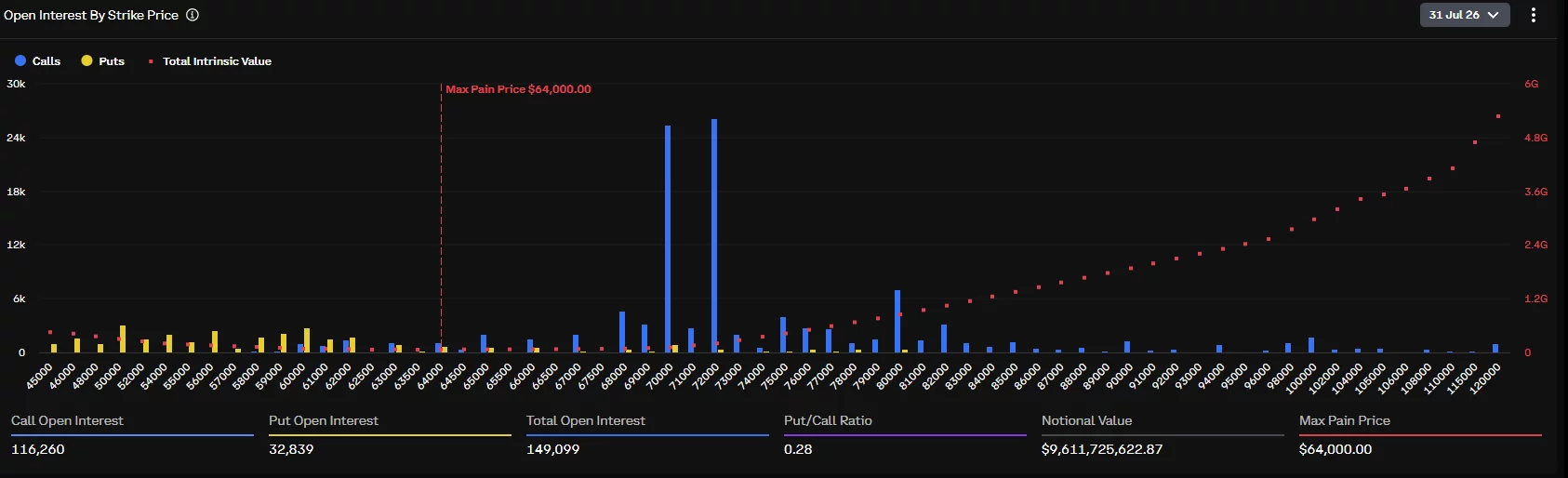
Bitcoin’s July 31 options expiry carries approximately $9.61 billion in notional open interest, with calls accounting for 116,260 BTC and max pain at $64,000.
The call-heavy positioning does not guarantee a rally. However, a break above nearby resistance could prompt dealers to rebalance their hedges and force short sellers to cover, potentially strengthening a post-FOMC move.
Bitcoin must close above $65,200
Bitcoin’s 4-hour chart shows that the recovery has not yet reversed the short-term bearish setup. BTC remains below the Supertrend resistance at approximately $65,198, making the $65,000–$65,200 range the first confirmation level for buyers.
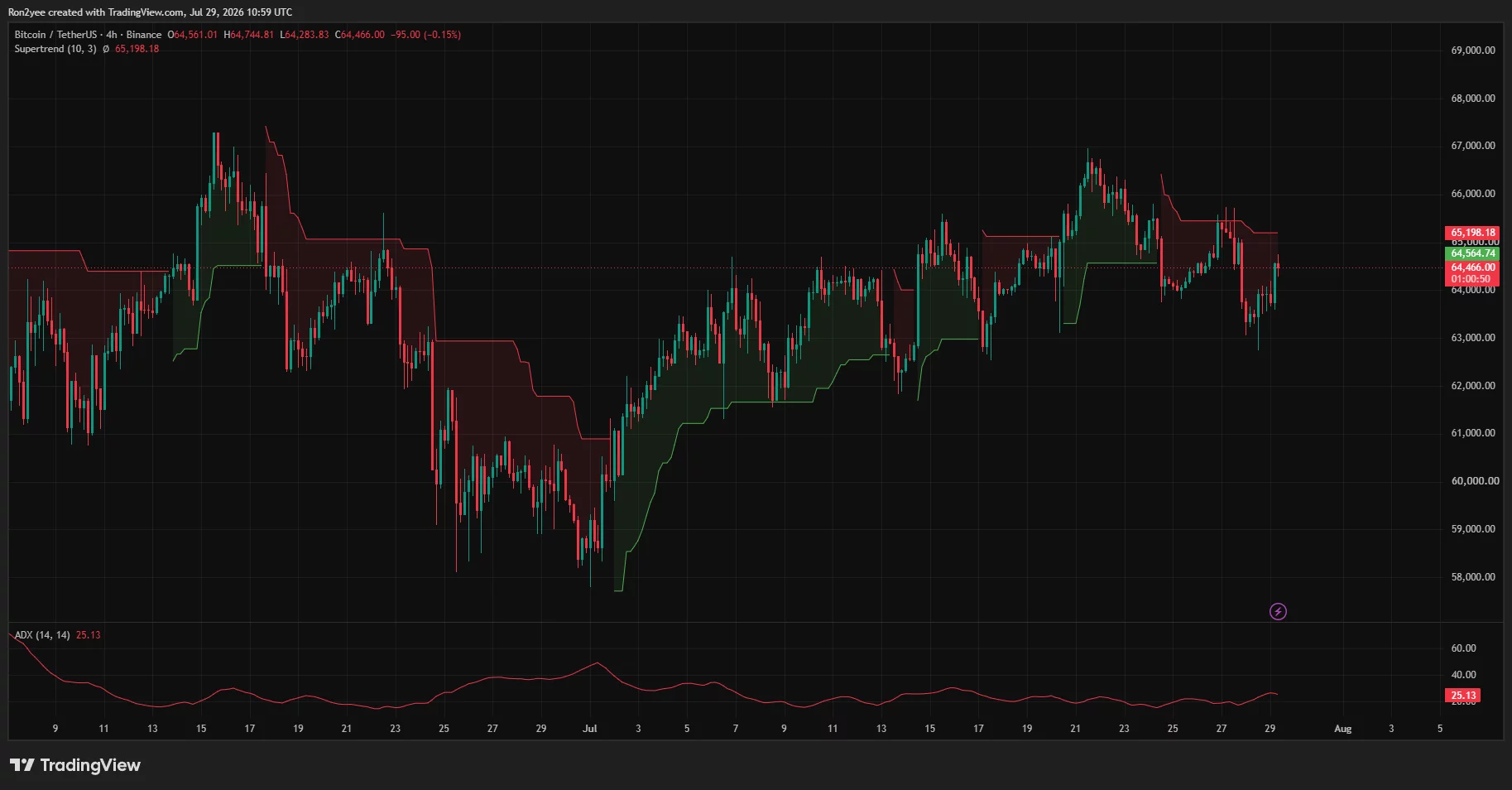
The average directional index stands at 25.13. A reading above 25 indicates that the next directional move could develop enough strength to extend, but the indicator does not determine whether that move will be bullish or bearish.
A 4-hour close above $65,200 would weaken the current sell signal and expose $65,800–$66,200. Bitcoin would then need to clear $66,700, the previous weekly high, to establish a stronger sequence of higher highs.
The daily Ichimoku chart presents another obstacle. Bitcoin is trading near the lower edge of the cloud around $64,490 and below the conversion line near $64,849. A daily close above this area would improve the short-term outlook, but the asset still needs to move through the wider cloud before confirming a sustained trend reversal.
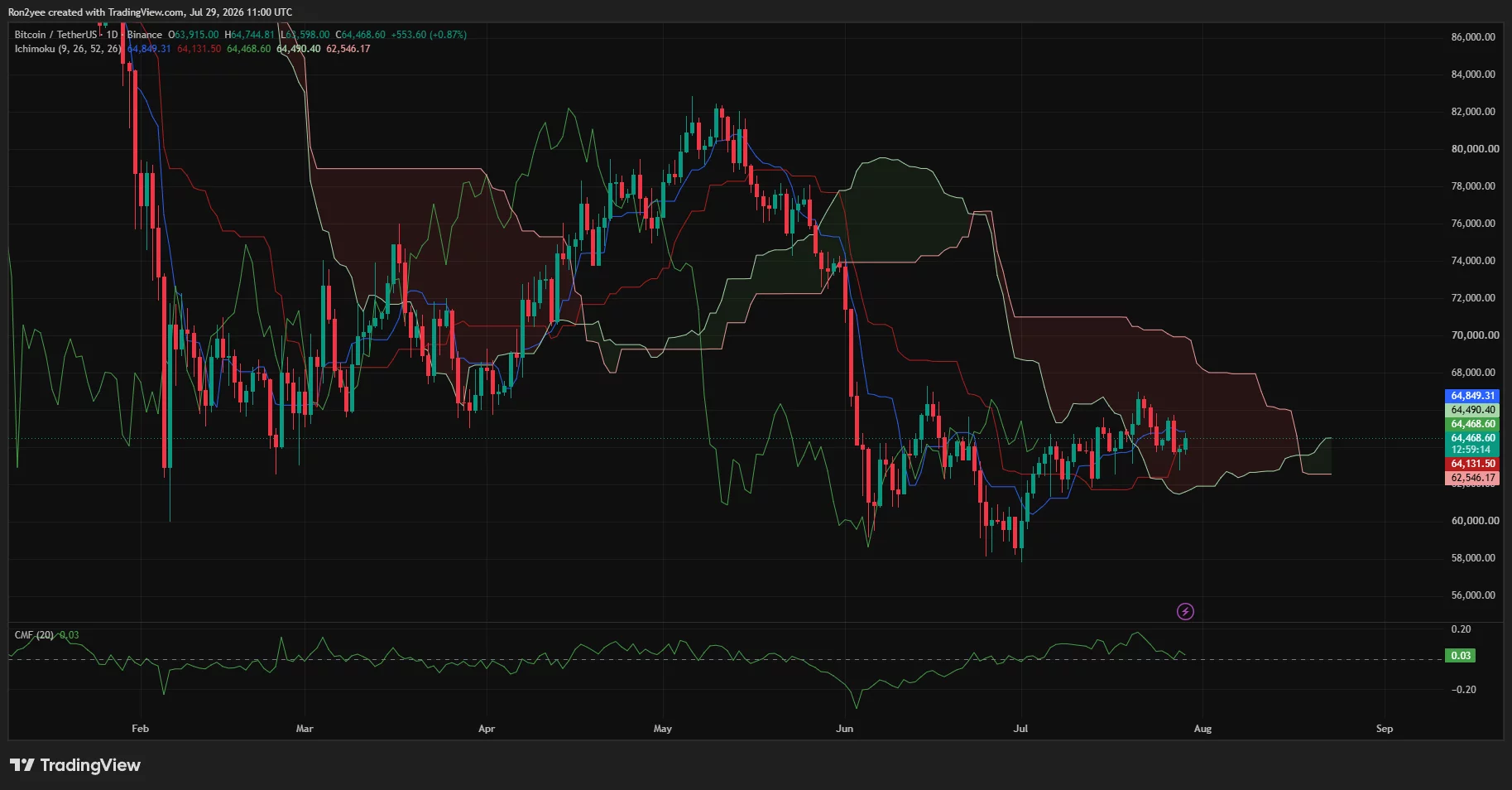
Chaikin Money Flow is positive at 0.03, showing that buying pressure has returned modestly. The reading remains close to zero, however, and does not yet point to strong accumulation.
Liquidation clusters leave BTC exposed in both directions
CoinGlass’ three-day liquidation heatmap shows a dense liquidity band around $64,400–$64,700, where Bitcoin was trading at the time of the chart. This nearby concentration may contribute to volatile price swings before and immediately after the Fed announcement.
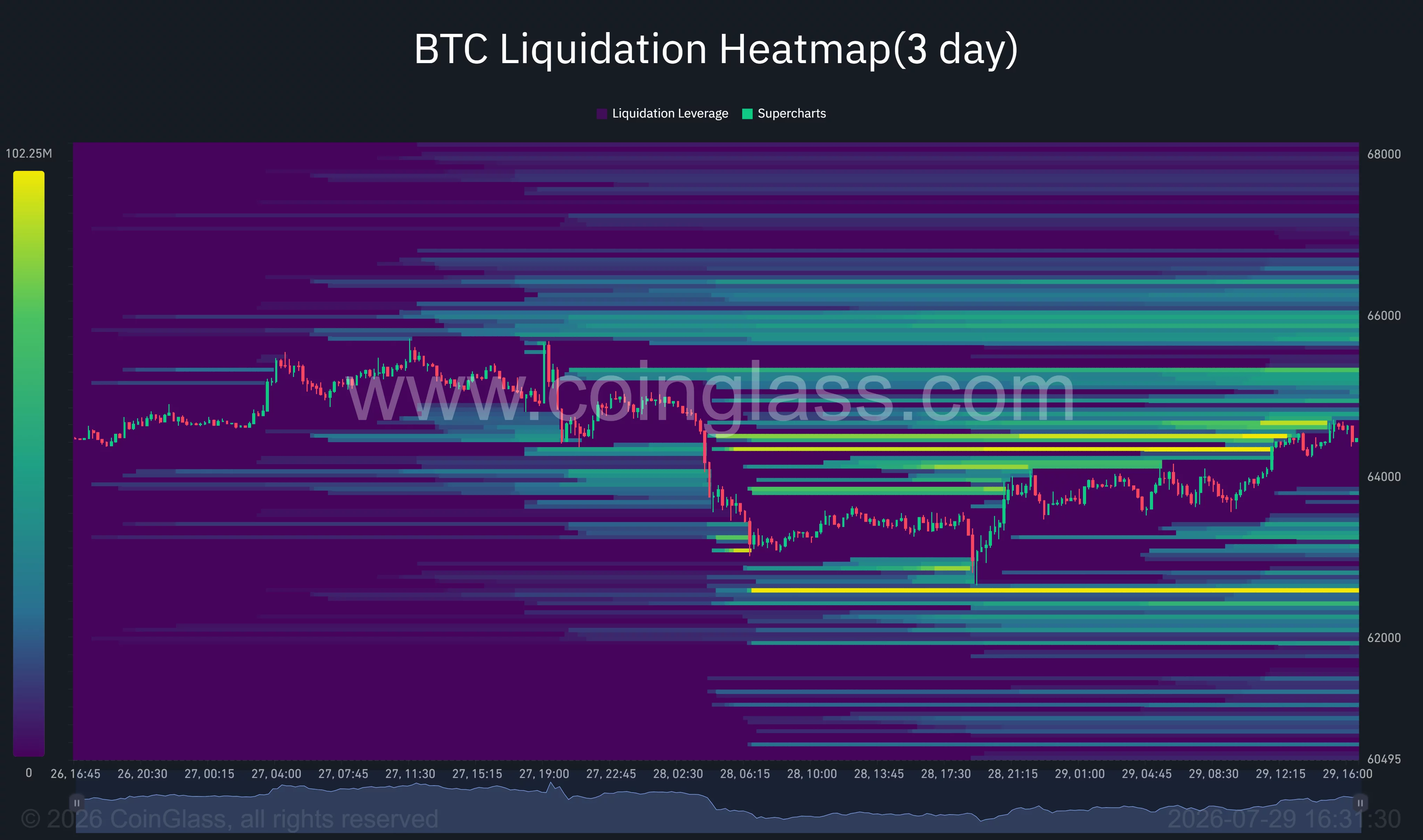
Further liquidity is visible near $65,000–$65,300, followed by a larger group of positions around $65,800–$66,200. A confirmed break above $65,200 could therefore pull Bitcoin toward these higher liquidation levels as bearish positions are forced to close.
The downside contains a similarly important concentration near $62,500. Losing $64,000 would increase the risk of another test of $63,000, followed by the $62,000–$62,500 support area.
Crypto analyst Ted Pillows also identified $65,000 as the decisive near-term level. He warned that failure to reclaim it could send Bitcoin back toward $62,000–$62,500.
Michael van de Poppe offered a more bullish assessment, describing the recovery as a “very solid bounce” and arguing that Bitcoin could continue higher if it maintains its recent strength.
ETF flows and US policy remain downside risks
US spot Bitcoin ETF demand remains an important weakness behind the current setup. More than $500 million reportedly left the products during a 4-day run of outflows, removing a source of spot demand that had supported the previous advance.
The FOMC outcome will directly affect US investors because higher rates increase the relative appeal of cash and short-term government debt. A surprise hike could also raise financing costs and reduce demand for leveraged cryptocurrency positions.
Washington’s stalled crypto legislation adds another source of uncertainty. Polymarket traders recently placed the probability of the CLARITY Act becoming law in 2026 at roughly 34%, down from higher levels earlier in July. The bill has faced disagreements over ethics restrictions and stablecoin-related provisions.
Bitcoin can push through $65,000 if the Fed avoids a hawkish surprise and buyers secure a close above $65,200. Without renewed ETF inflows, however, the move would remain dependent on derivatives positioning and short covering, leaving $62,500 exposed if the breakout fails.
Disclosure: This article does not represent investment advice. The content and materials featured on this page are for educational purposes only.


Russia’s central bank has proposed detailed rules for cryptocurrency exchanges, digital asset depositories and market registration ahead of the country’s regulated crypto market launch in September.
Summary
- Russia’s central bank has proposed operating rules for cryptocurrency exchanges, depositories and digital currency accounts ahead of the Sept. 1 rollout.
- The draft regulations set capital requirements for digital depositories and give exchanges flexibility to establish their own trading procedures.
- The Bank of Russia will maintain official registers for licensed crypto market participants under the new legal framework.
- Retail investors will continue to face limits on cryptocurrency purchases while approved digital assets can be used for certain cross border transactions.
- The proposals have been released for public review before the regulations are finalized.
According to the Bank of Russia, the draft regulations establish the operating framework for cryptocurrency exchanges, digital depositories and digital currency account providers that will function under the country’s new digital currency law, which is scheduled to take effect on Sept. 1.
The proposals, published for regulatory impact assessment, complement the recently adopted federal law “On Digital Currency and Digital Rights,” which passed the State Duma earlier this month and is awaiting approval from the Federation Council before being signed into law by President Vladimir Putin.
The legislation forms the legal foundation for Russia’s regulated cryptocurrency market and places the central bank at the center of oversight.
Bank of Russia sets operating standards for crypto platforms
In a statement announcing the draft regulations, the Bank of Russia said it has created the conditions for organized trading in digital currencies and digital rights. The package includes rules covering cryptocurrency exchanges, digital asset issuers, digital depositories and digital currency accounts.
Under the proposed framework, cryptocurrency exchanges will be allowed to establish their own trading procedures while independently calculating market prices and weighted average values for the digital assets listed on their platforms.
A separate instruction introduces requirements for digital depositories, a newly defined category of institutions responsible for maintaining records of cryptocurrency holdings and transactions.
According to the central bank, digital depositories will need minimum equity ranging from 50 million to 250 million rubles, or about $600,000 to $3 million, depending on the services they provide. Institutions working with open distributed ledger systems or offering post-trade settlement services will face different capital requirements.
The regulator also said the capital backing those businesses must remain liquid and consist of financial assets with high credit quality.
Alongside exchange and custody rules, the proposals establish procedures for opening and maintaining digital currency accounts that licensed market participants will use once the new regulatory framework becomes operational.
Crypto registration powers move to the central bank
One of the draft regulations formally authorizes the Bank of Russia to establish and maintain official registers for cryptocurrency market participants.
According to the regulator, the registration system will cover operators of platforms used to issue, store, and trade cryptocurrencies, as well as digital currency exchange organizations and digital depositories operating under the requirements of the federal law.
Russia’s lower house of parliament approved the digital currency legislation in its second and third readings on July 21 after lawmakers revised several provisions during the legislative process. Earlier committee revisions removed a proposal that would have required cryptocurrency holders to disclose wallet addresses. Instead, users will report balances and transaction volumes, while certain large transfers abroad or to third parties may still face delays of up to 48 hours under the new framework.
The legislation also classifies cryptocurrencies as property for legal purposes while continuing to prohibit their use for domestic payments, leaving the ruble as Russia’s official payment instrument inside the country.
Transition period extends into 2027
Although the main legal framework is expected to begin taking effect on Sept. 1, some technical provisions contained in the central bank’s regulations will only become effective during the second half of 2027.
The law also provides a transition period allowing exchanges, brokers, management companies, clearing organizations and other financial institutions to complete registration, secure approvals and bring their internal systems into compliance before full implementation.
Several Russian financial institutions have already started preparing products for the regulated market. Earlier this month, Sberbank said it plans to launch cryptocurrency wallet and custody services after the framework becomes effective. VTB, T-Bank and Alfa-Bank have also announced work on digital asset custody infrastructure, while Moscow Exchange has expressed interest in launching regulated cryptocurrency services.
Russia’s Finance Ministry has previously estimated that domestic cryptocurrency trading reaches roughly 50 billion rubles, or about $640 million, each day, with much of the activity occurring outside regulated financial channels. The new framework is intended to bring trading, custody and related services under licensed supervision.
Investor access remains limited under the new framework
Retail participation will continue to face restrictions under the digital currency law.
Non-qualified investors will only be permitted to purchase the most liquid and highly capitalized cryptocurrencies, including Bitcoin, Ethereum and Tether’s USDT, through regulated intermediaries.
Earlier versions of the legislation set an annual purchase limit of 300,000 rubles for non-qualified investors, while the latest regulatory framework limits annual purchases to about $4,000 for eligible retail participants.
Qualified investors will be permitted to access a wider range of products under separate rules.
While cryptocurrencies remain prohibited for ordinary domestic payments, the legislation allows approved digital assets to be used in certain cross-border transactions.
Russian authorities have already tested cryptocurrency settlements for international trade under an experimental legal regime, and lawmakers previously said the regulated framework is designed to give companies conducting foreign business a legal route to use digital assets within approved conditions.
The Bank of Russia said all draft regulations have been published for public review as part of the regulatory impact assessment process before they are finalized.


The Senate shelved crypto’s market-structure bill for Russia sanctions and a nominations package. September lands weeks from a midterm election.
Summary
- The Senate set the CLARITY Act aside this week to process a nominations package and a Russia sanctions bill, with Majority Leader John Thune declining to schedule floor action before the recess that begins August 8.
- Prediction markets repriced immediately, with passage odds falling to roughly 34%, down from above 80% in February, and Galaxy’s head of research describing the calendar as no longer an obstacle but the enemy.
- September offers about three weeks of floor time before members leave to campaign, and any Senate-passed version must return to a House that has been running on Republican infighting.
- That leaves one surviving 2026 route: attaching the bill to must-pass year-end legislation, a possibility trade press reports lobbyists have floated and no senator has confirmed on the record.
- The mechanics of that route are specific and largely unexamined: which vehicles exist, what riding one does to a text still missing a bipartisan ethics deal, and why the strategy has a mixed record for contested financial legislation.
That leaves one path nobody has examined: attaching CLARITY to must-pass legislation in December. Here is what that route actually requires, what it would cost the text, and why lobbyists float it while no senator will confirm it.
Bills do not usually die. They get postponed until postponement becomes death, and the distinction is only visible afterward. The Digital Asset Market Clarity Act reached that ambiguous condition this week. The Senate did not vote it down, did not file cloture, and did not schedule floor time. It processed a package of federal nominations, turned to a Russia sanctions bill dedicated to a recently deceased senator, and left crypto’s central policy effort sitting on the Legislative Calendar where it has sat since June. The chamber’s procedures generally permit one contested bill at a time, and the queue will not clear before members leave on August 8. Prediction markets did the arithmetic within hours, marking passage down to roughly a third. What remains is a September window of about three weeks, wedged against a midterm campaign, followed by the only route anyone has left to suggest: bolt the bill onto something Congress cannot afford to fail. That route gets mentioned constantly in trade press and examined almost nowhere. This piece examines it.
What just happened, precisely
The sequence matters because it explains the nature of the delay, and the nature of the delay determines whether the year-end route is realistic or a face-saving story.
The Senate returned from its July 4 recess with roughly three usable weeks. The Majority Leader initiated cloture proceedings on a bundle of federal nominations, then moved toward a Russia sanctions package imposing measures on Russian officials and tariffs on trading partners. Memorial services for a senator who died this month occupied floor time across two days. Against that, the market-structure bill required two full cloture sequences under Senate Rule XXII, each capable of consuming most of a legislative week. That is the procedure that ran out of time.
Thune’s own framing has been consistent and unencouraging. Days before the shelving he told reporters he did not expect the bill to reach a floor vote before recess, adding that he would like to at least get it started and see where the votes are. The White House crypto adviser pushed back publicly, arguing the first week of August remains open and that he was perplexed by the leader’s pessimism, which is the sort of exchange that happens when an administration and a chamber disagree about whether a thing is dead.
Underneath the scheduling sits the substantive problem that scheduling was masking. Senate Republicans released updated text on July 22 containing the ethics provision negotiated with the White House, and Democrats rejected it within hours. Seven Democrats who had been negotiating issued a joint statement calling the text insufficient. One of the only two Democrats who voted the bill out of committee called the current version not a serious effort. Without roughly seven Democratic votes, cloture fails, and the bill was never ready for the floor time it did not get.
So the delay is procedural in form and substantive in cause, which is the worst combination for the year-end theory, because a vehicle solves a calendar problem and not a votes problem.
What the year-end route actually means
The strategy is old, unglamorous, and reasonably well understood by anyone who has watched Congress handle contested financial legislation.
Every December, Congress faces legislation it cannot allow to fail: appropriations to keep the government funded, the annual defense authorization, and periodically a debt-limit measure or a tax extenders package. Those bills attract riders, because a provision that cannot pass on its own merits can sometimes pass as a passenger on something that must move. The mechanism is a straightforward exploitation of leverage: opposing the rider means opposing the vehicle, and opposing the vehicle carries costs most members will not pay.
The crypto industry’s version would attach the market-structure framework, or some negotiated subset of it, to whatever December vehicle is moving. Trade press has reported lobbyists floating exactly this, and the reporting is consistent on one point: no senator has confirmed it. That absence is itself information. Riders of this size are typically pre-negotiated between leadership offices well in advance, and a strategy that lives entirely in lobbyist conversations is a hope, not a plan.
Two features of the approach deserve emphasis because they cut in opposite directions. It genuinely does solve the floor-time problem, which is the constraint that killed the summer window; a rider consumes no separate cloture sequence. And it does nothing whatsoever about the votes problem, because members who object to the ethics provision object to it inside a vehicle just as they do outside one, and objections inside a must-pass bill become leverage instead of obstacles. A senator willing to let market-structure legislation die is a senator willing to demand its removal as the price of a defense authorization.
What riding a vehicle would cost the text
Legislation that travels as a rider arrives smaller and stranger than legislation that passes on its own, and the specific costs here are predictable.
Scope shrinks. Vehicles carry passengers, not cargo. A three-hundred-page market-structure framework with new registration regimes, a certification process, jurisdictional allocation, and a developer shield is not a rider; it is a second bill. What rides is a subset, and the subset is chosen by whoever controls the vehicle. The likeliest survivors are the provisions with the least opposition, which in this case means the classification and grandfather language, and the likeliest casualties are the contested ones, which means the ethics provision the entire summer was spent negotiating.
Leverage inverts. In a standalone bill, the industry needs Democrats to reach sixty. In a must-pass vehicle, opponents need only threaten the vehicle to extract removal, and leadership generally protects the vehicle. That is why controversial riders more often die at the last moment than pass quietly.
Scrutiny falls, and so does durability. Provisions enacted as riders receive less committee attention, less floor debate, and less of the legislative record that courts and agencies later use to interpret them. For a statute whose entire purpose is supplying definitions that agencies will spend years operationalizing, a thin record is a real defect rather than a procedural footnote. Our guide to what passage would and would not change covers how much of this bill’s effect depends on rulemaking, and rulemakings built on ambiguous statutory language take longer and litigate worse.
And the House problem persists regardless. Anything the Senate passes, in any form, must clear a House that passed the original 294 to 134 but has since been consumed by internal Republican conflict. A rider negotiated in the Senate returns to that chamber as part of a package, which helps, but the package still has to move.
The precedents, honestly read
The strategy has a record, and it is genuinely mixed and not uniformly discouraging.
Financial legislation has ridden year-end vehicles successfully before, particularly where the provisions were technical, broadly supported, and pre-cleared by both parties’ leadership. Provisions on securities technicalities, tax treatment, and regulatory adjustments have moved this way for decades precisely because nobody wanted a floor fight over them.
The failures share a profile too, and it is closer to this bill’s. Contested provisions with organized opposition, high public salience, and a partisan valence tend to get stripped in conference or dropped when the vehicle’s managers decide the fight is not worth the delay. Market-structure legislation currently has all three: an ethics dispute that reaches the president’s family business, a New York attorney general publicly arguing it would gut state authority to prosecute crypto fraud, and a bill whose passage odds trade publicly on prediction markets.
The honest read is that CLARITY’s least contested pieces could plausibly ride, and the piece the whole negotiation has been about probably could not. Which raises the question the industry has not answered publicly: whether a classification framework without the ethics provision is worth passing, given that the ethics provision exists to buy the Democratic votes that a standalone bill needs. As a rider, those votes matter less, which is the strategy’s real attraction and the reason its critics will name it plainly.
What happens if nothing moves
Set the vehicle aside and the base case deserves its own accounting, because it is not the status quo.
The industry’s American legal position would rest, into 2027, on the joint SEC-CFTC interpretive release naming sixteen digital assets and placing staking, mining, and airdrops outside securities law. That document is agency policy. A future commission can withdraw it by vote, commissioners serve at presidential pleasure under current removal jurisprudence, and the entire arrangement was constructed by two chairmen whose alignment no statute requires. That is the framework in the meantime.
Beneath it sits the stablecoin statute, which is real law and is not market structure, and whose own implementing agencies missed their one-year rulemaking deadline this month. That is the fallback: one enacted statute covering one product category, plus an interpretive document covering everything else, plus agency initiatives that a change of administration could unwind. It is also the fallback regime, examined.
Meanwhile the comparison the industry has made all year becomes testable. Europe’s MiCA regime reached full enforcement across all twenty-seven member states on July 1, with hundreds of authorized service providers operating under a single framework. The competitiveness argument was always that the United States would cede ground by failing to legislate. In 2026 it did not legislate.
The industry’s own position
One party to this has been unusually quiet about the year-end route, and its silence is worth reading.
The crypto sector spent this cycle building the most expensive political operation of any industry in America, a subject this publication examined in detail: a super PAC network entering the midterms with roughly $193 million, contributions from the largest firms measured in tens of millions each, and a share of total corporate election spending exceeding a third. That machine was built to produce exactly this legislation. It has not produced it. That is the money behind the push.
The strategic problem the year-end route creates for that operation is specific. A rider passes without a public roll call attributable to individual senators, which is precisely what makes it attractive procedurally and precisely what makes it useless as leverage. An industry whose theory of influence rests on the threat of a funded primary challenge needs recorded votes to run against. A provision that appears in a conference report has no votes attached to it.
That tension explains something otherwise puzzling about the current moment: the industry’s public posture remains focused on a standalone Senate vote even as the calendar closes, and its lobbyists reportedly float the vehicle route in private. Both behaviours are rational. The public campaign preserves accountability and therefore leverage into November. The private conversation preserves an outcome if the campaign fails.
Watch which one dominates after the recess. If the sector’s public messaging shifts toward year-end attachment, it will have concluded that passage matters more than accountability, and the November spending will be aimed at 2027 rather than at this bill. If it holds the line on a standalone vote, the calculation is the reverse, and the industry will have decided that a bill passed invisibly is worth less than a fight that identifies its opponents.
What to watch
Whether preliminary action happens in the first week of August. Thune left the door open to getting the bill started, and the White House adviser is pressing for it. Beginning the floor process before recess would carry procedural progress into September rather than restarting from nothing.
Any senator confirming the year-end strategy. The single most informative development available. Lobbyist chatter is not a plan; a leadership office confirming a vehicle is. Watch appropriations and defense authorization negotiations for the first crypto-adjacent language.
Whether the ethics provision moves. Every route, standalone or rider, runs through the same dispute over whether the Justice Department should be the sole enforcer. A hybrid enforcement mechanism remains the visible landing zone, and its appearance would signal the negotiation is alive.
The September calendar. About three weeks of floor time against appropriations deadlines and campaign travel. If market-structure legislation does not get scheduled in that window, the year-end vehicle stops being one option and becomes the only one.
The opponents got louder
One development in the past week has been read as noise and is closer to a structural problem for every route described above.
New York’s attorney general came out publicly against the bill, arguing it would undermine the capacity of state and municipal authorities to prosecute cryptocurrency fraud. That intervention is different in kind from the ethics dispute. The ethics fight is about the president and is therefore partisan, which means it can be settled by a negotiated provision. A state law enforcement objection about preemption of fraud authority is institutional, it travels across party lines, and it aligns with a broader concern several Democratic senators have already raised in demanding that state prosecutors be able to enforce the ethics provision instead of leaving enforcement solely with the Justice Department.
That objection is also the hardest to satisfy inside a year-end vehicle. Ethics language can be renegotiated in a conference room. Federal preemption of state enforcement authority is a structural feature of the bill’s design, running through the jurisdictional allocation that the whole framework rests on, and it cannot be trimmed without unpicking the thing the industry wants most.
The bill’s sponsors have been countering with a different frame, pitching CLARITY as a national security instrument. The lead sponsor has argued it would close financial loopholes exploited by North Korea’s Lazarus Group, citing Treasury estimates of at least $3.4 billion stolen since 2007, and pointing to new sanctions authority and a safe harbour permitting exchanges to freeze suspicious assets. That repositioning is worth noting on its own: a bill sold for two years on regulatory certainty and American competitiveness is now being sold on sanctions enforcement, and that shift generally happens when the original argument has stopped moving votes.
Frequently asked questions
What happened to the CLARITY Act this week?
The Senate set it aside. Majority Leader Thune moved a package of federal nominations and then a Russia sanctions bill, and declined to schedule floor action on the market-structure bill before the recess beginning August 8. No cloture motion was filed and no vote occurred. Prediction market odds for 2026 passage fell to roughly 34%.
Why could the Senate not do both?
Procedure. The chamber generally handles one contested bill at a time, and Senate Rule XXII requires two full cloture sequences to advance legislation past a filibuster, each capable of consuming most of a legislative week. With nominations and sanctions ahead of it in the queue, and memorial services occupying two days, the calendar did not contain another contested bill.
What is the year-end vehicle strategy?
Attaching the legislation, or part of it, to a bill Congress cannot allow to fail, such as appropriations or the annual defense authorization. The mechanism uses leverage: opposing the rider means opposing the vehicle. Trade press reports that lobbyists have floated this route, and no senator has confirmed it on the record.
Would that actually work?
It solves the floor-time problem and not the votes problem. A rider needs no separate cloture sequence, which is what killed the summer window. But members objecting to the ethics provision can demand its removal as the price of supporting the vehicle, and leadership generally protects vehicles. Contested, high-salience provisions have a poor record of surviving as riders.
What would the bill lose as a rider?
Scope, most likely. A full market-structure framework is too large to ride, so a subset would travel, chosen by whoever manages the vehicle. The least contested provisions, principally classification and the grandfather clause, are the likeliest survivors; the ethics provision that consumed the entire negotiation is the likeliest casualty. Riders also generate a thinner legislative record, which matters for a statute agencies must interpret.
What is the fallback if nothing passes in 2026?
The joint SEC-CFTC interpretive release classifying sixteen digital assets, plus the stablecoin statute, plus agency initiatives. The interpretive document is agency policy that a future commission can withdraw by vote, with commissioners serving at presidential pleasure, which is precisely the impermanence the legislation was meant to fix.
Does September offer a real chance?
A narrow one. Congress returns for roughly three weeks before members leave to campaign for November midterms, competing with appropriations deadlines, and legislators historically avoid complex financial votes close to elections. Any Senate passage would also need House concurrence from a chamber consumed by internal Republican conflict.
What should market participants take from this?
That the timeline moved, not that the framework changed. Nothing about the current operating environment shifted this week; the agency framework governing classification and enforcement is the same one that governed it last month. What changed is the probability that the arrangement becomes permanent law in 2026, and that probability now trades near a third. This is educational analysis, not investment advice.
Disclaimer: This article is for information and educational purposes only and does not constitute financial, investment, or legal advice. It describes pending legislation and legislative strategy whose outcomes are unknown and subject to change at any time. Nothing here predicts any legislative result. Always do your own research. Information is accurate as of July 29, 2026.


Disclosure: This article does not represent investment advice. The content and materials featured on this page are for educational purposes only.
Crypto investors are rethinking cold storage as they weigh stronger asset security against earning potential, liquidity, and portfolio flexibility.
Summary
- Cold storage protects crypto assets but may limit flexibility and potential earnings, highlighting the trade-offs of passive holding.
- Investors weighing cold wallets against crypto yield options must balance security, liquidity, and potential returns.
- Crypto cold storage offers strong protection, but inactive assets may miss opportunities for growth through earning strategies.
Cold storage is regarded as the safest place for digital assets because private keys remain isolated from online threats. That protection matters, but safety is only one element of portfolio management. When assets remain inactive for long periods, investors who want to earn interest on crypto may sacrifice returns, liquidity, and flexibility without recognising the trade-off. The costly mistake is not owning a hardware wallet or securing long-term reserves. It is treating complete isolation as the best answer for every asset, regardless of market conditions, investment goals, or cash needs.
The financial cost of leaving digital assets offline
A cold wallet protects ownership, but it does not increase the number of coins held. If the market price rises, the investor benefits from appreciation, while the balance stays unchanged. During flat or positive markets, this distinction can become important. One holder may keep ten units untouched, while another places a limited share into an interest-bearing account and gradually expands the position.
The impact becomes more visible across months. Regular rewards and compounding may produce a difference, particularly when the assets were intended to remain in the portfolio. Coindepo offers interest accounts for cryptocurrencies and stablecoins with several earning periods, allowing users to compare pure storage with a yield-focused approach. Returns involve risk, yet ignoring available income is still an active financial decision.
Why cold storage can reduce portfolio flexibility
Offline protection adds practical steps. The owner must find the device, verify that wallet software and firmware are authentic, connect in a secure environment, and approve each transfer. These precautions are reasonable, but they may slow portfolio adjustments. A sudden market movement, rebalancing opportunity, or unexpected liquidity need can reveal the disadvantage of keeping every asset difficult to access.
Human error creates another layer of exposure. Recovery phrases may be misplaced, damaged, photographed insecurely, copied incorrectly, or discovered by someone who understands their value. Devices can malfunction, and family members may not know how to recover the holdings. Cold storage lowers online risks, but it places responsibility almost entirely on the owner. Without verified backups and inheritance instructions, self-custody can exchange platform risk for operational failure.
The real mistake is often poor asset allocation
The discussion should not be framed as a choice between a cold wallet and an online service. A better approach is to assign each holding a clear role:
- long-term reserves for secure offline storage;
- liquid assets for rebalancing and planned expenses;
- a limited allocation for carefully selected earning strategies.
This division prevents one custody method from controlling the entire portfolio and keeps security, access, and productivity properly aligned overall.
Coindepo may fit into this balanced structure without receiving every holding. Users can examine supported assets, account terms, withdrawal conditions, and estimated returns before committing a limited amount. This makes exposure easier to measure. Investors should also assess custody arrangements, fees, legal restrictions, transparency, and whether market stress or counterparty problems could delay access to funds.
How to avoid a costly cold storage strategy
A practical review starts with understanding why each asset is held. Coins reserved for a multi-year horizon should not be managed like stablecoins intended for shorter-term liquidity. Investors can divide holdings into security, access, and income categories. This exercise shows whether cold storage serves a defined purpose or continues because it once appeared to be a safe option.
Before choosing Coindepo or another interest platform, users should learn how rewards are calculated, whether rates are variable, and how early withdrawals affect accrued income. Chasing the largest advertised percentage without evaluating price volatility and provider risk can create losses that outweigh rewards. Strong passwords, multifactor authentication, withdrawal confirmation, and protected email access remain essential whenever part of the portfolio is managed online.
Conclusion
Cold storage remains effective for safeguarding long-term digital wealth, especially when backups are tested and recovery procedures are documented. However, keeping an entire portfolio offline may create missed income, delayed access, recovery challenges, and years without compounding. The expensive mistake this year may therefore be an inflexible allocation policy rather than the hardware wallet itself.
A stronger structure can preserve a secure reserve while allowing a measured portion of assets to remain liquid or productive. Coindepo offers one way to assess that possibility through interest accounts, but every allocation should match individual objectives, liquidity requirements, and risk tolerance. Digital asset protection works best when security, accessibility, and earning potential are managed together instead of treated as competing priorities.
Disclosure: This content is provided by a third party. Neither crypto.news nor the author of this article endorses any product mentioned on this page. Users should conduct their own research before taking any action related to the company.

Bitcoin whipsawed around the $64,000 level on Wednesday as multiple risk factors collided—weakness in Asian equities, fresh tensions around the US-Iran situation, and an approaching Federal Reserve decision that traders see as a near-term volatility trigger.
According to TradingView, BTC/USD struggled to extend a local rebound after the Wall Street open and was still wrestling with downside pressure following a move to 11-day lows near $62,700 the prior day. The broader selloff atmosphere was reinforced by additional stress in risk assets, including equity weakness tied to the semiconductor and AI complex.
Key takeaways
- BTC paused near $64,000 after dropping to roughly $62,700 on the prior session, suggesting demand has not fully returned.
- Equity weakness linked to Asian chip stocks appears to be spilling into US trading, pressuring crypto alongside traditional markets.
- Oil jumped after renewed US-Iran tensions, raising the risk that inflation expectations could move and complicate rate outlooks.
- Markets are split on the Fed’s next move: CME’s FedWatch Tool showed a majority probability for no change at current target levels.
- Bitcoin’s recent trading behavior looks range-bound between key moving averages, with potential liquidation clusters forming on both sides.
Risk assets stumble ahead of the Fed
Wednesday’s drawdown pressure extended beyond crypto. Trading activity reflected a broader risk-off posture that began with a selloff in Asian chip stocks, then carried into US markets. Cointelegraph previously reported that the cost to insure AI debt had reached new highs amid an Asian semiconductor pullback, framing the backdrop for heightened credit and equity sensitivity in the region.
Alongside the equity-driven drag, geopolitical nerves resurfaced. US President Donald Trump said the US would “be hitting them hard,” referring to tit-for-tat strikes linked to the US-Iran conflict, in an interview with Fox News. The immediate market implication was a rise in energy prices: WTI crude was up 7.6% and Brent crude was up 5.4%, according to the figures cited in the original reporting.
Oil price jumps can matter for crypto indirectly. They often feed into expectations for future inflation, and inflation expectations feed into interest-rate expectations. With the Federal Reserve preparing to deliver its next interest-rate decision, traders are likely to treat energy moves as one more input to a complex rate-volatility equation.
What the Fed decision could mean for BTC
Markets are waiting for the Federal Open Market Committee (FOMC) outcome, which will include a statement and a press conference by Fed Chair Kevin Warsh, according to the details described in the source. The reporting noted Warsh has provided less forward guidance than his predecessor, which increases the importance of any cues about the future path of policy.
According to CME Group’s FedWatch Tool data referenced in the original piece, there was a 66.3% probability that current target levels of 3.5%-3.75% would remain unchanged. A 0.25% hike was priced with 33.7% odds.
The Kobeissi Letter also highlighted that opinions were divided on what the Fed would do. In the same vein, the source described the pricing environment as unusually split, implying that BTC could see sharper-than-usual moves if the outcome or language deviates from what traders expect.
Bitcoin’s range trade: moving averages and liquidation zones
Before the next macro catalyst, BTC price action appeared technically constrained. As described in the original reporting, Bitcoin traded broadly within a range bounded by the 50-day simple moving average (SMA) and the 50-day exponential moving average (EMA). This kind of “between-the-guides” behavior often happens when market participants remain cautious—waiting for confirmation from macro data while liquidity thins.
The source added that the range structure began in mid-July, with breakouts failing as price encountered liquidity zones on both sides. That context helps explain why the market has not decisively moved away from the $63,500 to $64,900 corridor.
CoinGlass data cited in the original article pointed to potential liquidation buildup on both ends of the current range, with notable clusters around $63,500 and $64,900. In practice, these zones can act like magnets during volatile sessions: if price pushes into one side, leveraged positions are forced out, which can accelerate the move and widen the range temporarily.
Liquidity and positioning: why the move may start slowly
Even as liquidation risk builds, the source emphasized that trading activity remained subdued. Trading volumes were described as “conspicuously low,” with spot-market volume at its weakest level since July 2023.
K33 Research, in a bulletin referenced by the original report, attributed this to muted derivatives positioning and softer participation. The piece stated that CME open interest was near multi-year lows, perpetual futures open interest had stalled around 300,000 BTC, and average daily spot volume had fallen to about $2.2 billion for the month.
There’s also a behavioral angle to the current setup. The source noted that retail interest in both Bitcoin and the broader crypto market has been declining since the market’s October 2025 all-time highs, and that investors have increasingly directed attention toward AI stocks. When that rotational behavior persists, crypto can struggle to attract incremental spot demand—making BTC more sensitive to macro shocks and harder to sustain higher breakouts.
With the FOMC decision and press conference approaching, traders should watch whether the Fed’s communication shifts expectations for the rate path—especially given the inflation-sensitive impulse from oil—and whether BTC can hold its range boundaries or instead tests the liquidation clusters around $63,500 and $64,900. Until liquidity and participation improve, the next decisive move may arrive suddenly rather than gradually.
Uniswap price rebounded 8% from its July 29 intraday low as Hayden Adams addressed concerns over v4 protocol fees, helping UNI reclaim the $4 psychological level.
Summary
- UNI recovered from $3.74 to $4.06, producing an intraday rebound of more than 8%.
- Daily RSI reached 66.83, showing strong momentum without entering overbought territory.
- The 4-hour chart places immediate resistance between $4.10 and $4.30.
- A rising wedge and weak 19.77 ADX leave UNI exposed to a short-term pullback.
Uniswap price returns above $4
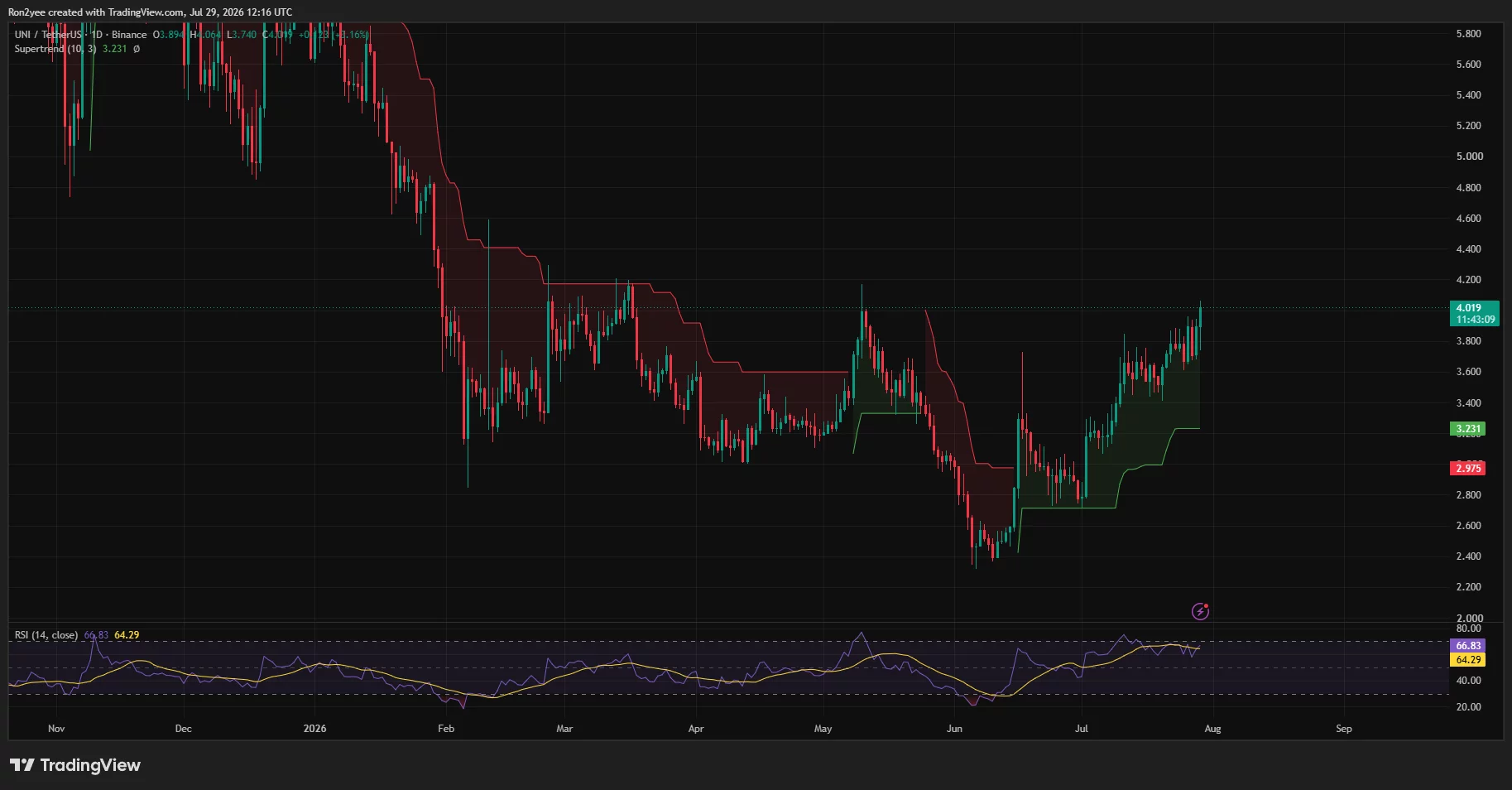
According to data from crypto.news, Uniswap (UNI) price traded at $4.02 at the time of writing after briefly reaching $4.06, according to the Binance daily chart. The intraday rebound from $3.74 amounted to about 8.5%, while the token was up roughly 3% from its daily opening price.
UNI has now recovered more than 70% from its June low near $2.35. The rally has formed a sequence of higher highs and higher lows, allowing the token to return to a price area last tested in May.
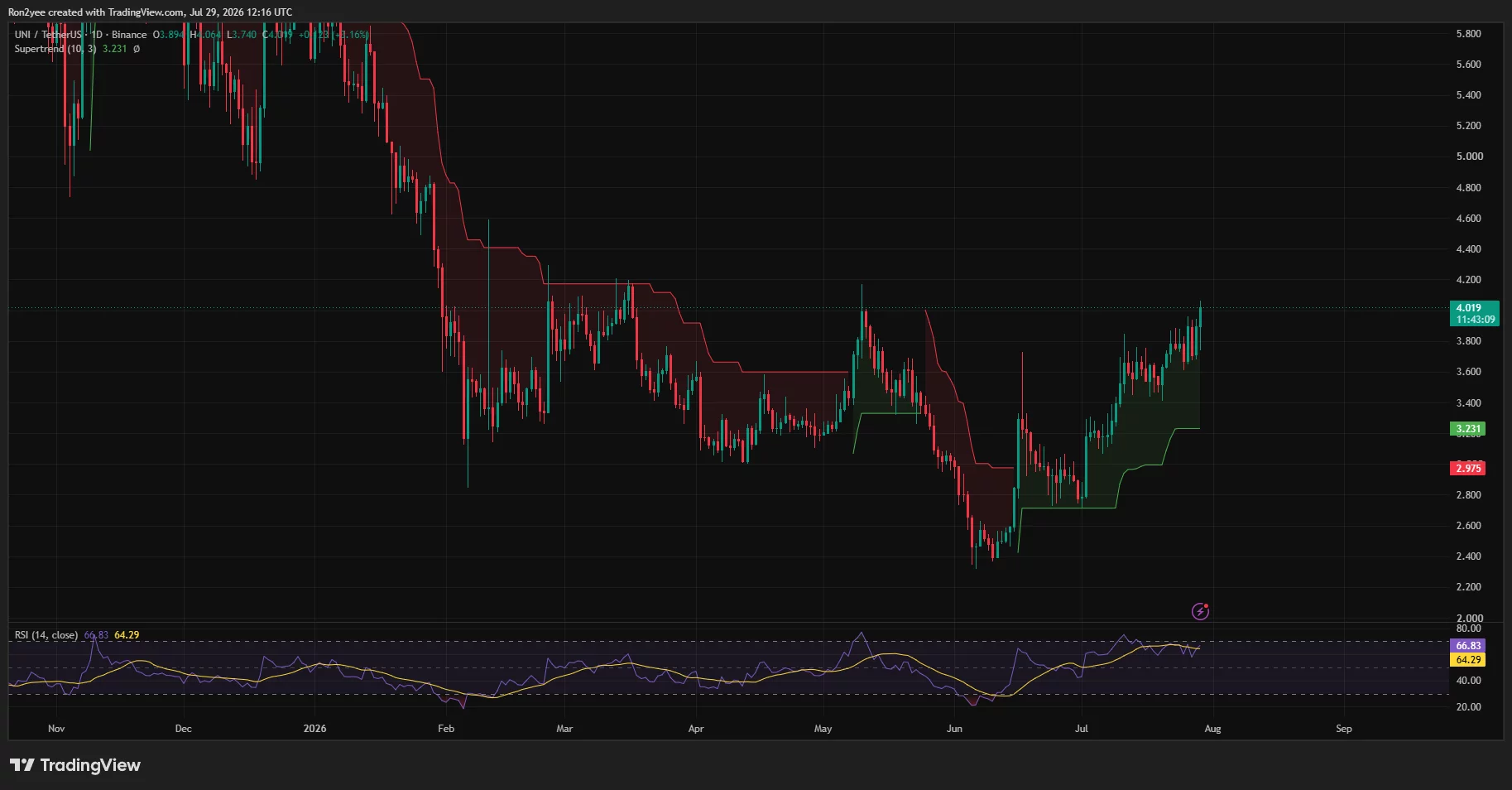
Momentum remains favorable on the daily timeframe. UNI is trading above its Supertrend support at $3.23, while the relative strength index has risen to 66.83. The RSI remains below the standard overbought threshold of 70, although the reading shows that buying conditions are becoming stretched.
The daily candle also approached the May swing high near $4.15. A close above that level would strengthen the case that UNI has moved beyond a temporary relief rally and entered a broader recovery phase.
Hayden Adams addresses Uniswap v4 fee concerns
The immediate move followed comments from Uniswap founder Hayden Adams about the protocol’s v4 fee structure.
Adams said the protocol fee would be added to the liquidity provider fee instead of being deducted from it. Under his example, traders using a pool with a 30-basis-point liquidity provider fee would pay 35 basis points in total. Liquidity providers would continue receiving 30 basis points, while five basis points would go to the protocol.
The clarification addressed concerns that activating protocol fees would lower returns for liquidity providers and potentially push capital toward competing decentralized exchanges.
Uniswap has also submitted governance proposals covering protocol fees from v4 pools and deployments on Robinhood Chain. The proposals would send new protocol revenue into the existing UNI burn mechanism, creating a clearer connection between exchange activity and the token’s circulating supply.
That connection has gained attention since Robinhood Chain launched on July 1. Uniswap generated about $5.16 million in fees during one 24-hour period earlier this month, according to DefiLlama data cited by crypto.news. Roughly $4.38 million came from Robinhood Chain.
Uniswap volume on the network crossed $1 billion within nine days of launch. However, future UNI burns will still depend on governance approval, fee collection and sustained trading activity.
UNI faces resistance between $4.10 and $4.30
The 4-hour chart shows that UNI has moved above the $4.00 top of its recent trading range. The next technical level sits at $4.10, identified by the Murrey Math indicator as a strong reversal pivot.
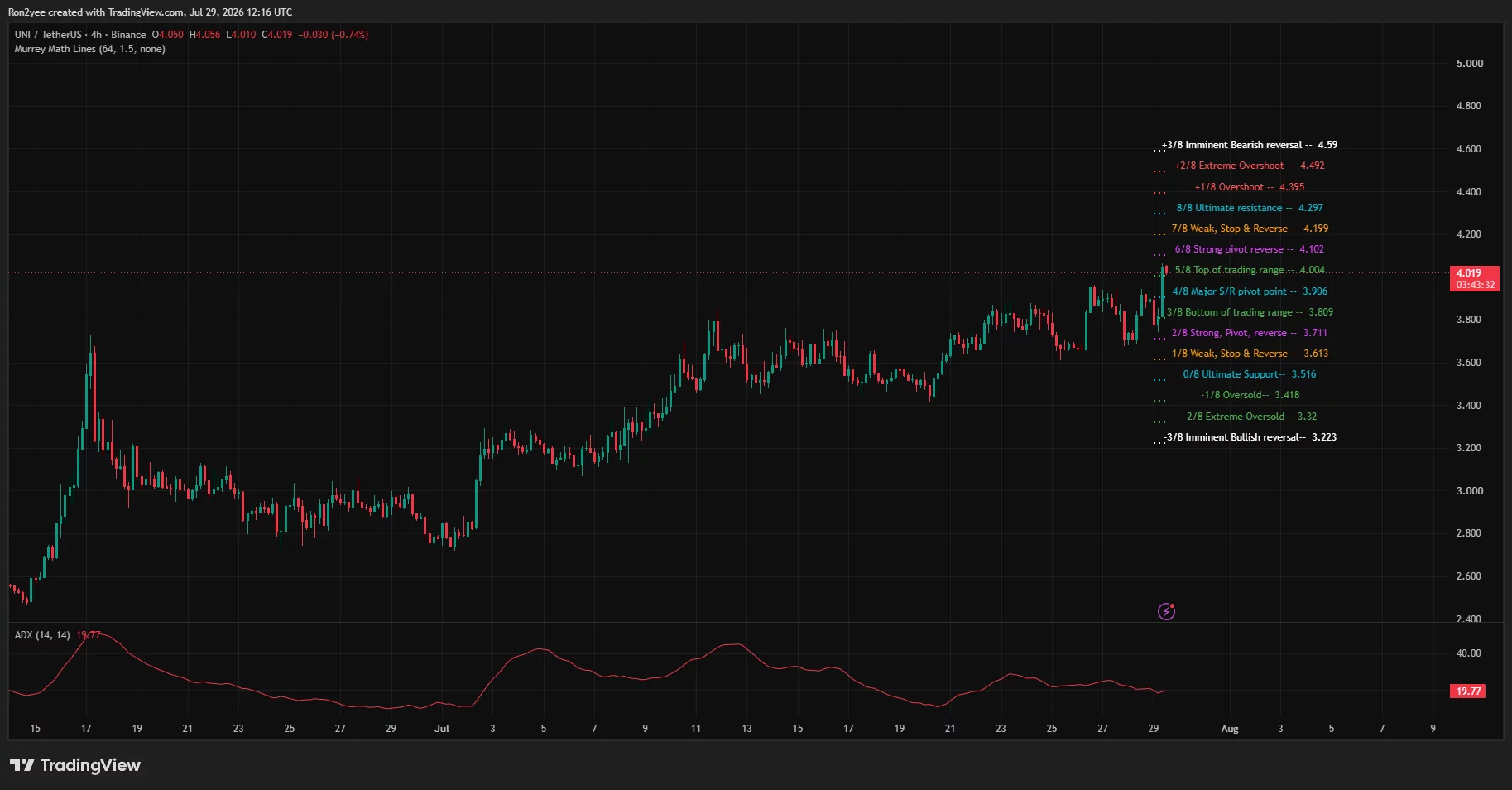
A sustained close above $4.10 could open the path toward $4.20 and $4.30. The latter represents the indicator’s ultimate resistance level. Beyond that, the chart places extended targets at $4.40, $4.49 and $4.59.
However, the average directional index stands at 19.77. An ADX reading below 20 suggests that the current trend has not yet developed strong directional conviction, despite the price breakout.
The one-week CoinGlass liquidation heatmap also shows a dense concentration of leveraged positions around $3.98 to $4.03. UNI’s move through this area likely forced some short sellers to close their positions, adding buy pressure to the rebound.
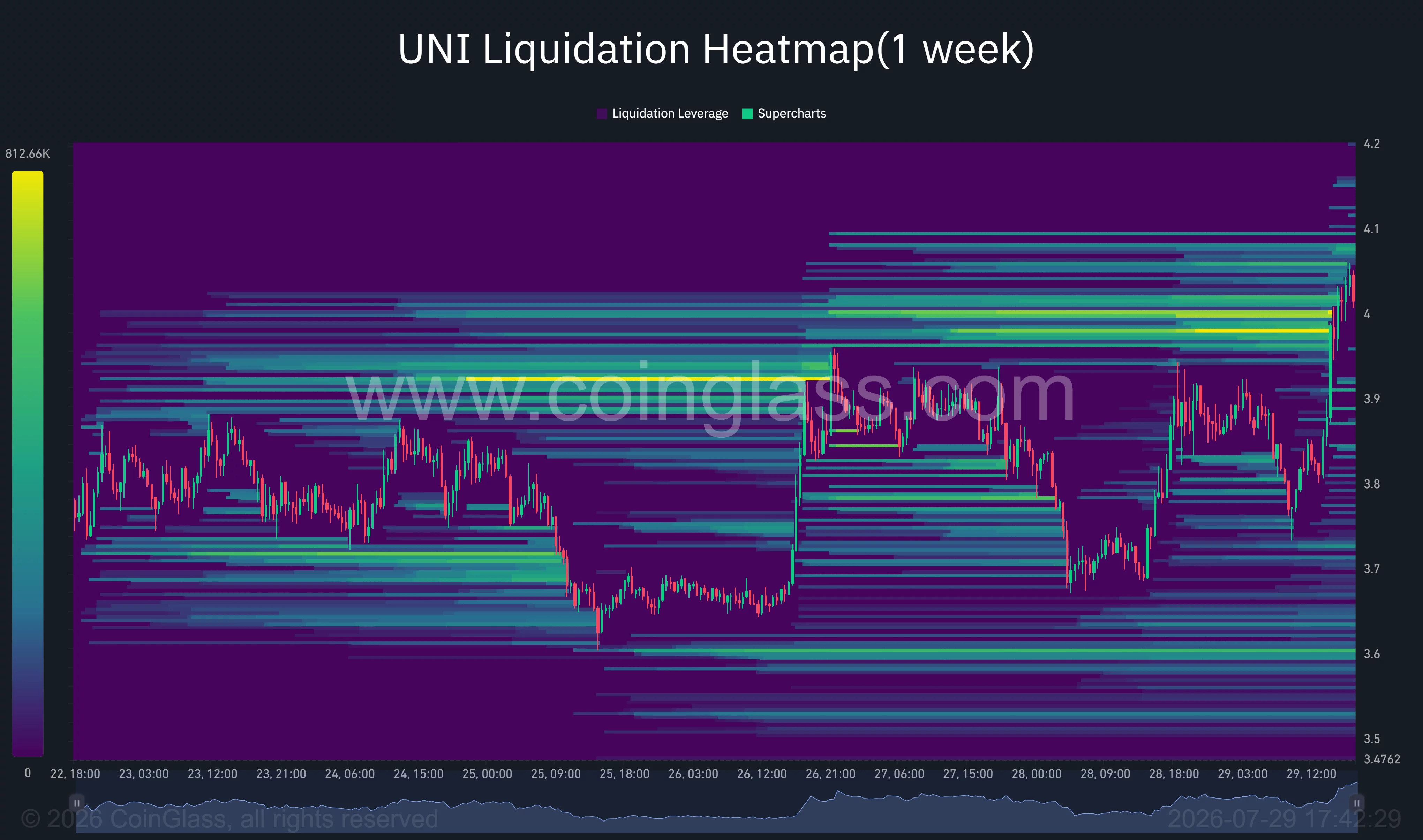
Additional liquidity is visible near $4.07 to $4.10, making that zone a possible short-term price target. On the downside, the main liquidity clusters sit near $3.90, $3.72 and $3.60.
If UNI loses $4.00, the 4-hour chart identifies $3.91 as the first support. Lower levels appear at $3.81 and $3.71. The bullish structure would weaken more clearly below the $3.52 support zone.
Analysts see breakout and pullback scenarios
Analyst Gopal identified a rising wedge on the UNI chart, noting that the token continues to form higher highs and higher lows inside a narrowing structure.
According to the analyst, repeated tests of wedge support suggest that bullish momentum may be losing strength. A confirmed break below the lower trendline could cause a deeper correction, while a breakout above the upper boundary would invalidate the bearish setup.
Nebraska Gooner also described UNI as being at resistance. The analyst said reclaiming the red resistance area on his chart could create a moving-average squeeze and lead to a stronger rally. His setup points toward the $5 region if UNI establishes support above the current barrier.
The two views make the $4.10–$4.30 range central to UNI’s next move. A confirmed breakout would reduce the risk posed by the rising wedge, while rejection could send the token back toward $3.80 or the ascending support line.
US macro conditions remain a risk for UNI
Uniswap’s growth on Robinhood Chain gives the rally a direct US market connection. The network has brought decentralized trading infrastructure closer to Robinhood’s user base, while Uniswap’s Permissioned Pools could support tokenized funds and equities subject to investor eligibility rules.
Uniswap Labs launched Permissioned Pools with Securitize, Superstate and Dowgo as early participants. The v4-based framework allows issuers to control which wallets can trade or provide liquidity, making it more suitable for regulated assets.
Still, UNI’s breakout comes ahead of a Federal Reserve rate decision that could drive volatility across US stocks and crypto. A hawkish policy signal could reduce demand for risk assets, and pressure leveraged UNI positions.
UNI must therefore hold above $4.00 and clear $4.10 to confirm the breakout. Failure to do so would leave the rising-wedge warning active, with $3.81 and $3.71 serving as the next levels to watch.
Disclosure: This article does not represent investment advice. The content and materials featured on this page are for educational purposes only.

The American Arbitration Association (AAA), one of the world’s best-known providers of private dispute resolution, has launched a dedicated panel aimed at blockchain and digital-asset disputes. The move is designed to connect companies with arbitrators who can handle both the legal and technical complexities that increasingly arise in crypto-related commercial relationships.
Announcing the initiative on Wednesday, the AAA said its new Web3 Panel brings together specialists with experience spanning law, technology, academia, litigation, and digital-asset businesses. The panel focuses on disagreements tied to decentralized and highly automated systems as they become more common in day-to-day commerce.
Key takeaways
- AAA’s Web3 Panel is intended to provide arbitrators with blockchain and digital-asset expertise for complex, technical disputes.
- The scope includes contract interpretation, governance questions, asset control, cybersecurity issues, and disputes over transaction records.
- The panel also targets emerging “agentic commerce” cases, where software or AI systems may execute agreements with limited human involvement.
- Arbitration still depends on both parties agreeing to submit a dispute to private arbitration—AAA does not regulate the crypto industry.
Why AAA is building a specialized Web3 arbitration panel
As blockchain networks move from experimental use to more structured commercial workflows, disputes are evolving alongside the technology. According to the AAA, its Web3 Panel is meant to address conflicts arising from “increasingly automated and decentralized commercial systems,” where business arrangements can be influenced by code, on-chain records, and distributed governance mechanisms.
That shift matters because many of the practical friction points in crypto are not purely legal. They can involve how smart contracts behave, what data is recorded on-chain, and how to interpret technical evidence in a dispute. The AAA’s framing suggests that mainstream dispute resolution institutions see demand for arbitrators who can communicate across legal reasoning and technical realities—without treating those domains as separate problems.
The AAA also highlighted the kinds of issues parties may bring to arbitration. The panel is designed to cover disagreements related to:
- Contract interpretation in technical environments, including how automated terms operate in practice.
- Governance questions in systems where decision-making may be decentralized or code-driven.
- Asset control disputes, where access permissions and operational control can be complex.
- Cybersecurity incidents and related responsibility questions.
- Transaction records and disputes over what those records show in evidentiary terms.
- Cross-border enforcement considerations tied to international counterparties.
Who is behind the panel
The AAA said the Web3 Panel assembles arbitrators with experience across multiple disciplines, reflecting the breadth of questions that can appear in crypto cases. It cited initial members including lawyers who specialize in digital-asset and technology disputes, along with University of Pennsylvania law professor David Hoffman and Rich Widmann, identified as Google Cloud’s global head of Web3 strategy.
Beyond specific names, the AAA’s description points to a deliberate blend of perspectives. The institution emphasized experience not only in legal practice and litigation, but also in the technology and academic environments that often influence how smart contracts and blockchain governance are understood.
Eric Dill, the AAA’s senior vice president and head of panel relations, said: “Web3 disputes involve familiar commercial questions in a highly technical environment.” The quote underscores what the AAA appears to be trying to solve: keeping familiar business law issues from getting derailed by gaps in technical comprehension, especially where automated systems produce records and outcomes that become central to the case.
Agentic commerce and disputes involving autonomous transactions
One of the panel’s notable elements is its coverage of disputes involving agentic commerce and autonomous transactions. The AAA describes this as scenarios where software—or artificial intelligence systems—may initiate or carry out agreements with limited human involvement.
This is a meaningful extension of traditional arbitration needs. In conventional contracting, human decision-making and signatures tend to play a direct role in how obligations are formed. In agentic systems, however, the “decision maker” may be code executing according to rules, and the party seeking enforcement may argue the system acted within its programmed authority. Disagreements can quickly become both legal and technical: what the system was designed to do, what it actually did, and who bears responsibility when outcomes are unexpected.
While the AAA did not lay out specific example scenarios, its inclusion of agentic commerce signals that dispute resolution frameworks may have to adapt not only to blockchain-based evidence, but also to the contractual questions raised by automation and AI-driven execution.
What the launch does—and doesn’t—change
The AAA’s Web3 Panel is structured as an arbitration resource, not a regulatory body. The institution said it does not give AAA regulatory authority over the crypto industry. Arbitration typically requires that the parties involved agree to submit their dispute to a private arbitrator, meaning companies must usually opt in through contract terms or other mutual arrangements.
For investors, operators, and companies building onchain or integrating digital assets into commercial workflows, the practical implication is that dispute resolution options are becoming more specialized. A dedicated panel may make it easier to find arbitrators who can evaluate technical claims—such as how a smart contract performed, how governance processes operated, or how transaction evidence should be interpreted—without forcing parties to educate arbitrators from scratch.
At the same time, the existence of a panel doesn’t automatically solve bigger questions about standards for responsibility, liability, and evidence in decentralized systems. Those issues still depend heavily on each case’s facts and the agreement between the parties, including whether arbitration is explicitly chosen.
Related coverage from Cointelegraph noted how AI is being layered into legal workflows as agentic commerce accelerates. The AAA’s panel launch appears aligned with that trend: as autonomous systems become more common, the legal ecosystem—including dispute resolution—may increasingly need subject-matter expertise that spans both code and contract law.
Next steps for companies considering arbitration clauses
Companies using blockchain-based contracting, governance, or automated transaction workflows should watch how arbitrators on the AAA’s Web3 Panel approach technical evidence and cross-border enforcement questions—especially as agentic commerce becomes more mainstream. The immediate uncertainty is less about whether such panels will exist, and more about how parties will incorporate arbitration provisions into agreements and how quickly specialized expertise translates into more predictable outcomes.

In July 2025, a judge sentenced criminology graduate student Bryan Kohberger to life in prison after he pleaded guilty to stabbing four college students to death on Nov. 13, 2022, at a house near the University of Idaho’s Moscow, Id., campus. The students were Ethan Chapin, 20, Kaylee Goncalves, 21, Xana Kernodle, 20, and Madison Mogen, 21.
A year later, Kohberger told the New York Times in a phone call from prison that he’s filed a petition challenging his conviction, arguing that he is innocent and did not mean to confess to the killings. “A lot went wrong in those plea discussions,” he told the Times from a maximum security prison south of Boise. “I really do want that to be heard.”

Filippi explains that the storms created by the pyrocumulonimbus, which loom over the fire, create gusts of wind, which in turn lead the water vapor further into the clouds.
“Then the fire is raging more and propagating at [a] higher speed with more energy, so it injects even more water vapor. The cloud is getting bigger, and then it is sucking air [in a stronger way]. Then you have this feedback loop, making an acceleration,” Filippi says.
Those conditions make fires more difficult to contain because the feedback loop continually strengthens both the fire and the cloud above it.
Additionally, studies have found wildfire smoke can make some clouds denser, making it harder for them to drop rain that could help dampen the fires.
Even when water droplets do fall, if the rain is falling into hot air, “it’s gonna evaporate before it reaches the ground,” Filippi says.
Instead, “you’re gonna have a big downdraft. You’re gonna have thunder. Then you can have some other effects, like lifting ashes up into the stratosphere,” he notes, adding that the ash could later fall onto neighboring areas, raising the need for precautionary evacuation measures.
Ripple’s XRP Could Hit $100T if Institutions Use It as Collateral: Analyst

Forget ‘Game of Thrones,’ These Beloved Books Have the Best Dragons in Fantasy

Major incident declared as firefighters tackle Suffolk coast wildfire at Dunwich Heath


-

 Fashion5 days ago
Weekend Open Thread: Brooks Brothers
-
 Sports3 days ago
Commonwealth Games boxing: Jadumani Singh seals dominant 5-0 win over Pakistan’s Sumama Rehman to enter quarter-finals | Commonwealth Games News
-

 Tech3 days ago
Intel is reversing course and bringing hyper-threading back to its server chips
-

 Business7 hours ago
Why Trees Belong on the Risk Register
-

 Politics3 days ago
Luke Littler dismantles Gerwyn Price to retain title in Blackpool
-

 Crypto World4 days ago
Ripple bought a bank in pieces. The $4 billion audit
-
 Entertainment6 days ago
A New Post-Apocalyptic Gundam Anime Series Blasts Into SDCC
-

 News Videos3 days ago
BITCOIN JUST ENTERED THIS CRITICAL ZONE…
-

 Politics2 days ago
The Part of the Electric Transition Nobody Wants to Discuss
-

 Fashion6 days ago
16 Dresses for the High Summer Event
-

 Sports6 days ago
2026 3M Open leaderboard: Scottie Scheffler finds putter in Round 1, sits three back
-

 News Videos6 days ago
The Peugeot Family: How 200 Years of an “Old Money” Dynasty Died in A Boardroom
-

 Business22 hours ago
Major shareholder moves on Canyon
-

 Crypto World4 days ago
XRP Ledger adds $2.6B as RWA inflows rank second
-

 Politics4 days ago
Spain sweeps the board at 2026 World Cup with individual awards
-

 Crypto World7 days ago
Uniswap (UNI) pushes deeper into tokenized RWAs with permissioned trading pools
-
 Entertainment1 day ago
‘Stargate’ Creator’s New Sci-Fi Series Returns for Season 3 Tomorrow
-
Crypto World7 days ago
SEC Agrees to Overhaul Recordkeeping After Settling Coinbase Lawsuit Over Gensler’s Lost Texts
-

 Tech5 days ago
Anthropic launches Claude Opus 5, a cheaper AI model for coding, agents and enterprise workflows
-

 Entertainment4 days ago
Sara Gilson Killed By Husband After Viral “Pedophile” TikTok Video
You must be logged in to post a comment Login