
Crypto World
Gate 2026 Q1 Spot Listing Key Stats: 35.7% of Exclusive Listings Gained 100%+ in One Week

In the first quarter of 2026, against the backdrop of overall pressure in the crypto market and a more cautious risk appetite among capital, high quality early stage assets remained one of the most attractive structural opportunities in the market.
Gate listed a total of 37 new spot assets in Q1, covering 77.1% of the newly added projects across major exchanges during the same period, of which 27 were first listings, accounting for 73% of Gate’s new listings for the quarter; additionally, 14 were exclusive listings, representing 37.8%.
Amid heightened market volatility, Gate maintained a steady listing pace, strong capability in onboarding high quality projects, and a consistent ability to deliver positive return opportunities.
Overall Overview
From the perspective of total sample size, in the first quarter of 2026, using seven major platforms including Gate as the sample, a total of 48 new projects were listed across leading exchanges.
Among them, Gate listed 37 projects during the quarter, corresponding to a coverage rate of 77.1%, meaning that among the newly added high quality supply competed for by major platforms in Q1, Gate covered more than three quarters of the projects.
For general users, the importance of coverage is self evident. It directly determines whether users can access a sufficiently complete set of core new market listings on a single platform. If a platform has relatively low coverage, even if a few projects perform well, it can still leave users with the impression that important projects are not fully represented.
A coverage rate of 77.1% indicates that at least during Q1, Gate remained closely aligned with the mainstream pipeline of new project supply, allowing users to access most of the new assets worth paying attention to on the platform.
However, what truly defines Gate’s competitiveness is not only the breadth of coverage, but also the structure of that coverage.
Among the 37 new assets listed by Gate in Q1, 27 were first listings, accounting for 73%, while 14 were exclusive listings, representing 37.8%. If calculated based on the overall sample of major exchanges, Gate’s first listing coverage reached 56.3%. In other words, among the 48 new projects listed across major exchanges in Q1, more than half were first listed on Gate.
A high proportion of first listings indicates that Gate has strong attractiveness at the critical stage when projects transition from primary market narratives into secondary market trading. Projects choosing Gate as one of their initial public trading venues essentially reflects recognition of Gate’s user base, liquidity absorption capacity, initial price discovery efficiency, and market distribution capability. A platform that consistently secures first listings is often in a relatively proactive position in competition for project resources.
A meaningful share of exclusive listings reflects another layer of capability with substantial value. First listings demonstrate a platform’s ability to participate in mainstream high quality supply, while exclusive listings indicate whether the platform possesses independent judgment and differentiated sourcing capabilities.
Especially in a weak market environment, the selection difficulty for exclusive projects is higher, as exclusivity implies a lack of sufficient external validation from other platforms, requiring the platform to bear the responsibility of early judgment. If selection proves inaccurate, post listing performance will quickly reflect the issue; if exclusive projects perform well after listing, it not only indicates access to resources but also strong forward looking evaluation capability.
From this overall overview, Gate’s core foundation in Q1 can be summarized in three key characteristics.
(1) Broad coverage, indicating continuous participation in top tier new supply;
(2) High proportion of first listings, indicating strong capability to capture high quality projects at their entry into the market;
(3) A meaningful share of exclusive listings, showing that the platform is not merely following the market, but actively identifying and positioning differentiated assets in advance.
Taken together, these three factors form the foundation of Gate’s spot listing system in Q1. Only when coverage, first listings, and exclusivity all hold simultaneously can a platform’s listing framework be considered complete.
Post Listing Performance: Consistent Positive Return Coverage Across Short Term and 7 Day Windows
The quality of a platform’s listing performance cannot be evaluated solely by whether it secures projects, but also by whether those projects demonstrate stable performance after listing. A key characteristic of Gate in Q1 is that newly listed projects exhibited relatively consistent time series behavior across multiple holding periods, with overall positive return coverage remaining relatively stable.
Figure 1: Share of Gate New Listings With Price Increases Across Timeframes (5m–7d)
From the perspective of the share of price increases, among newly listed projects in Q1, 58.3% rose within the first 5 minutes after listing, 54.1% maintained gains at the 1 hour interval, 56.8% still recorded positive returns after 24 hours, 54.1% were up after 3 days, and 50.0% remained in an upward trend after 7 days. The data shows that the positive return coverage of Gate’s listed projects remained relatively stable across multiple holding periods.
Many new projects are driven by early speculative capital, short term sentiment, and traffic momentum at the opening stage, often leading to rapid initial price surges. However, if the project lacks fundamental support or if the platform’s liquidity absorption is insufficient, such gains tend to fade quickly, resulting in significantly weaker performance after 24 hours.
This is not the case for Gate’s Q1 sample. Across 5 minutes, 1 hour, 24 hours, and 3 days, the share of projects with price increases consistently remains above 50%, indicating that most listed projects did not exhibit a typical pattern of opening high and trending downward during the core price discovery window.
The 24 hour and 3 day intervals are particularly meaningful as reference points. Most participants in new listings are not ultra short term traders, and many operate on intraday, overnight, or short cycle holding strategies.
For these users, the fact that 56.8% of projects are up after 24 hours and 54.1% are up after 3 days reflects a more realistic trading experience. It indicates that positive return opportunities for Gate’s new listings are not limited to the initial opening phase, but show a degree of continuity during the key post listing holding window.
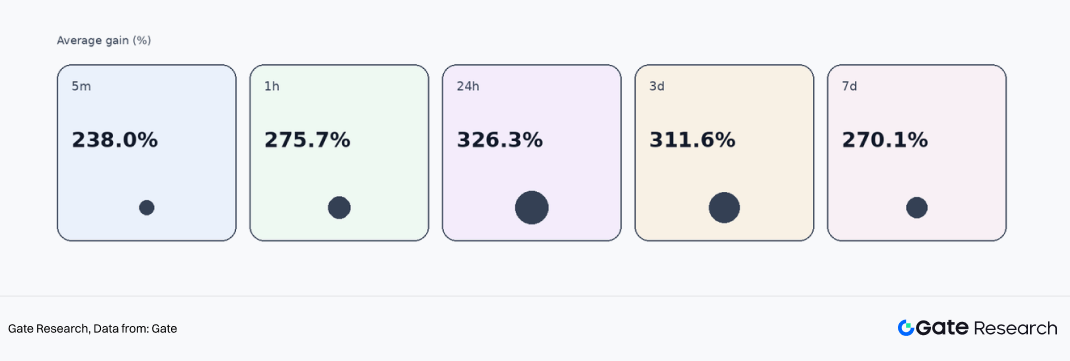
Further examining the average gains of projects that recorded price increases provides a clearer view of return elasticity. In Q1, the average gains for rising projects across the 5 minute, 1 hour, 24 hour, 3 day, and 7 day intervals were 238.0%, 275.7%, 326.3%, 311.6%, and 270.1%, respectively.
This indicates that once high quality new listings on Gate establish early positive momentum, the potential for price expansion remains substantial. Notably, during the 24 hour and 3 day windows, average gains remain around 300%, suggesting that the wealth effect of high quality projects has not disappeared in a weak market, but is instead more concentrated in a subset of carefully selected assets.
Figure 2: Average Gains of Rising Gate New Listings Across Timeframes (5m–7d)
Of course, looking at average gains alone does not provide a complete picture, as averages are easily influenced by extreme outliers, which can obscure the typical performance of most projects. Therefore, the median is particularly important in this context.
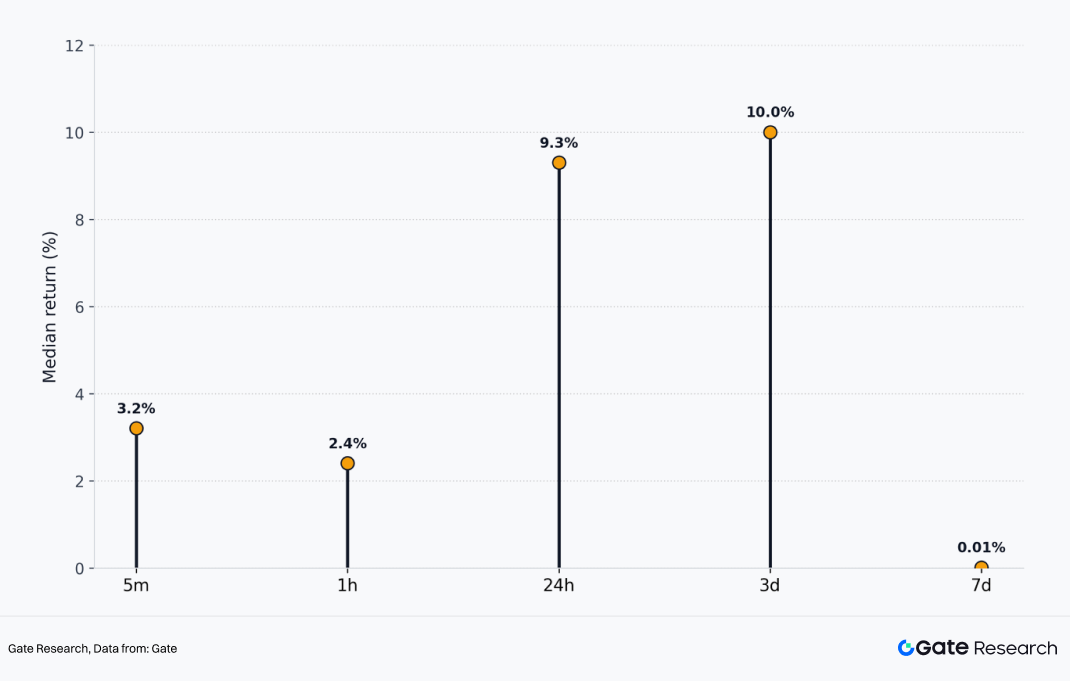
The median gains of newly listed projects in Q1 were +3.2% at 5 minutes, +2.4% at 1 hour, +9.3% at 24 hours, +10.0% at 3 days, and +0.01% at 7 days. Even when excluding the impact of extreme high multiple projects, the typical project performance within the sample still shows clearly positive returns at the 24 hour and 3 day stages.
This indicates that the overall performance of Gate’s spot listings during the quarter was not driven solely by a small number of outliers lifting the average, but rather that most projects maintained a certain level of positive return potential during the core post listing observation window.
Figure 3: Median Price Increase of Gate New Listings Across Timeframes (5m–7d)
For general users, what truly determines the participation experience is not whether there are one or two projects with extremely high returns, but whether the overall quality of new listings on the platform is consistent and whether it demonstrates a certain level of repeatability.
Based on the median data, Gate provided a clear answer in Q1, at least within the 24 hour to 3 day window: its spot listings exhibited strong consistency and a certain level of positive expected returns.
At the same time, the near flat median at 7 days also reflects another fact. The advantage of new listings is primarily concentrated in the early stage of post listing price discovery rather than extending indefinitely.
After 7 days, the market enters a more advanced phase of differentiation and elimination, where disparities between projects expand rapidly. Therefore, for users, not all new listings are suitable for long term holding; instead, within the first 24 hours to 3 day window after listing, the market presents a clearer and more stable density of return opportunities.
First Listings and Non-First Listings: A Dual Track Structure
When discussing a platform’s listing capability, many tend to focus entirely on first listings. While first listings are important, a platform with a truly mature listing system demonstrates its strength not only through first listings, but through the ability of different types of projects to form their own clear return logic. Based on Q1 data, this characteristic is particularly evident for Gate.
First Listings: Dominant in Quantity with Stronger Return Elasticity
In Q1, Gate recorded 27 first listings, accounting for 73% of all new listings. First listings formed the core of Gate’s listing structure in Q1, meaning that in most cases, the platform directly participated in the initial stage when projects entered the secondary market.
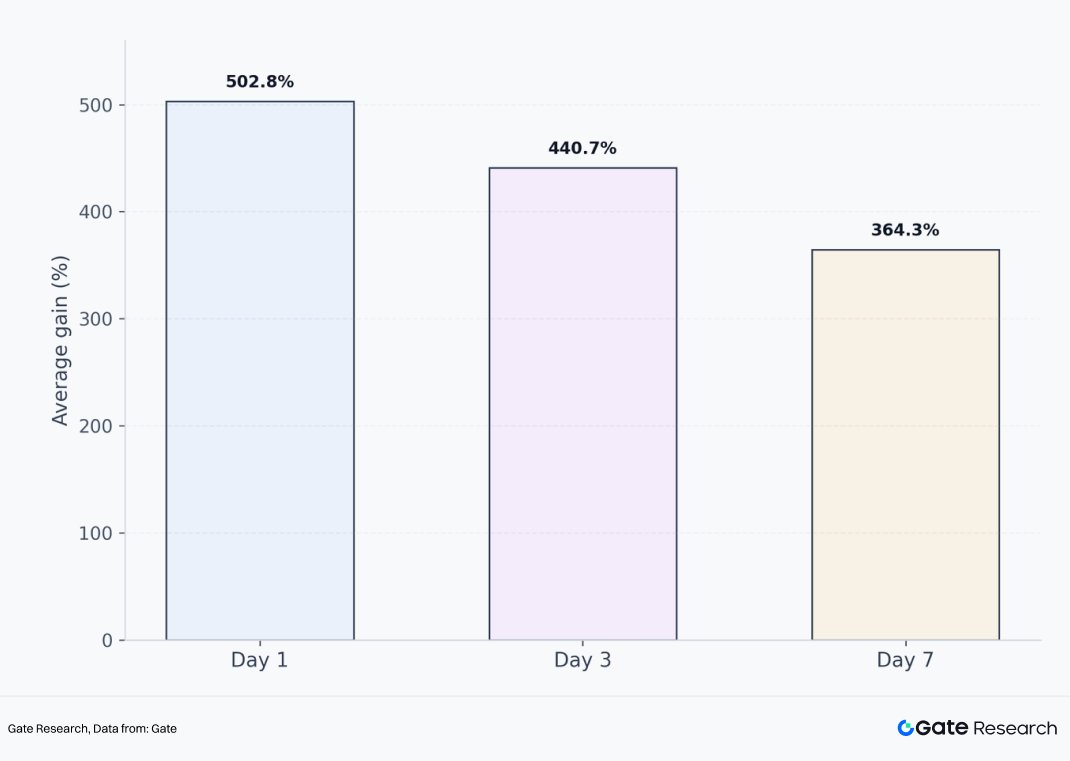
In terms of performance, the most notable characteristic of first listings is their strong return elasticity. Data shows that nearly 46% of first listed projects remained in an upward trend after 7 days; among the projects that increased in price, the average gains reached 502.8%, 440.7%, and 364.3% on the first day, 3 day, and 7 day intervals, respectively.
This indicates that the core advantage of Gate’s first listings lies not only in early access, but in their ability to build market momentum starting from Gate, often resulting in stronger price expansion potential.
Figure 4: Average Returns of Rising Gate Listings Across Holding Periods (1d, 3d, 7d)
From the perspective of extreme return distribution, this high elasticity is further validated. Among first listings in Q1, 7.4% of projects recorded gains exceeding 500% and even 1,000% within 24 hours. This indicates that within Gate’s listing system, the first listing segment serves as an entry point for high payoff opportunities.
Not every project is guaranteed to surge, but once a selected first listing aligns with market attention, narrative strength, and traffic momentum, the resulting price response is often more pronounced.
The underlying logic is straightforward. First listings occur at the earliest stage of public trading, where price discovery is still incomplete, market understanding is rapidly forming, and capital can concentrate more easily within a short period.
For platforms, the ability to secure high quality projects at this stage determines their capacity to provide users with high payoff, high attention early trading opportunities. For users, first listings offer the potential for earlier participation and higher return elasticity, but also come with greater volatility and faster divergence.
Non-First Listings: Smaller in Number but More Stable in Trend
Compared with first listings, Gate recorded 10 non-first listings in Q1, representing a significantly smaller share. However, in terms of performance, these projects demonstrate more stable median returns.
Figure 5: Win Rate and Median Price Increase of Gate Non-Initial Listings Across Timeframes (5m–7d)
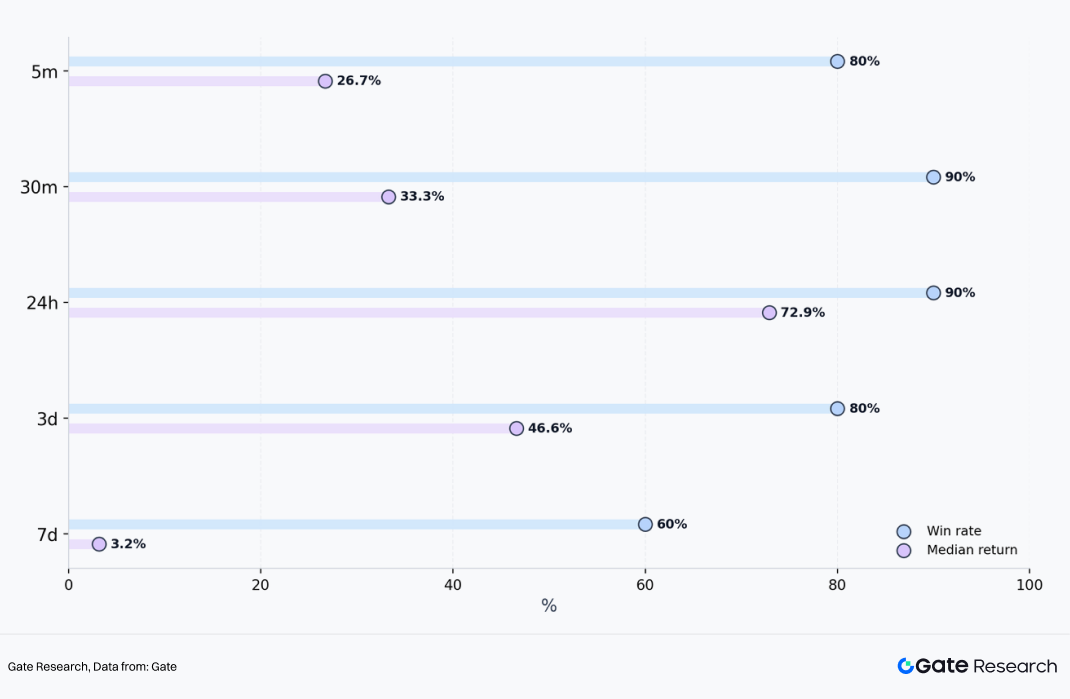
Data shows that non-first listings recorded price increase shares of 80%, 90%, 90%, 80%, and 60% across the 5 minute, 30 minute, 24 hour, 3 day, and 7 day intervals, respectively; the corresponding median gains were +26.7%, +33.3%, +72.9%, +46.6%, and +3.2%. In addition, 40% of non-first listing projects achieved gains exceeding 100% within 24 hours.
The data indicates that although non-first listings do not possess the same initial pricing advantage as first listings, they demonstrate higher success rates of price increases under Gate’s screening mechanism.
This is because non-first listing projects have typically undergone initial market validation, allowing the platform to conduct a second layer of selection based on more comprehensive factors such as price performance, community attention, narrative diffusion, and market absorption conditions, thereby offering greater certainty compared to first listings.
Overall, Gate’s listing structure does not rely solely on first listings to demonstrate its advantage, but instead forms two complementary pathways: first listings provide higher elasticity and stronger wealth effects, while non-first listings deliver more stable median returns.
The former is more aligned with an aggressive approach, while the latter is more aligned with a stable strategy, together enabling the platform to serve different user preferences. From the platform perspective, this dual track structure is more mature than relying solely on first listings.
It shows that Gate is not mechanically pursuing a higher number of first listings, but is also able to continuously provide effective opportunities through the timing and secondary selection of non-first listing projects.
Exclusive Listings: The Segment That Best Reflects Gate’s Proactive Judgment Capability
If first listings reflect a platform’s ability to participate in mainstream high quality supply, exclusive listings reflect a more proactive capability in project selection, resource acquisition, and forward looking judgment. Exclusive listings directly reveal a platform’s project evaluation standards, risk control capability, and execution efficiency.
In Q1, Gate exclusively listed 14 projects, accounting for 37.8% of all new listings. This proportion itself indicates that Gate was not merely passively following the mainstream market listing cycle during the quarter, but instead maintained a differentiated project pipeline to a significant extent. More importantly, these exclusive projects did not underperform after listing; on the contrary, they demonstrated strong competitiveness across multiple key time windows.
Figure 6: Win Rate and Median Price Increase of Gate Exclusive Listings Across Timeframes (24h–7d)
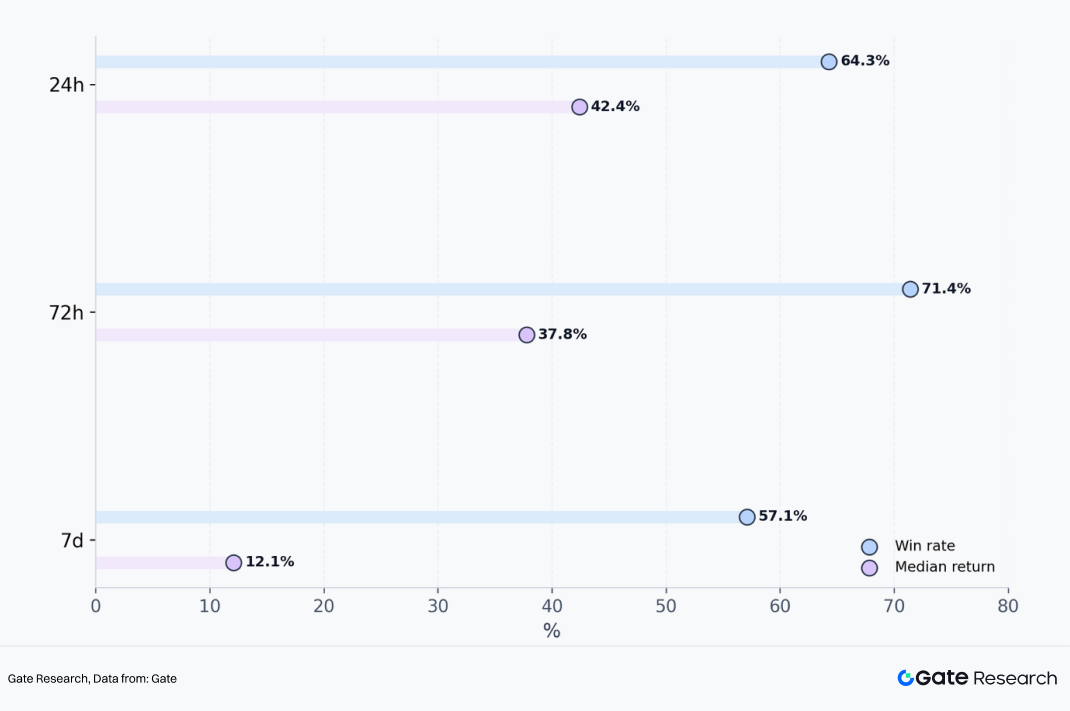
From the perspective of success rate, exclusive listings recorded price increase rates of 64.3%, 71.4%, and 57.1% across the 24 hour, 72 hour, and 7 day intervals, respectively, with the 72 hour window showing the strongest performance. This means that during the period from day 2 to day 3 after listing, Gate’s exclusive projects did not weaken rapidly as initial listing momentum faded, but instead demonstrated clearer capital absorption and upward price momentum.
From the perspective of median returns, exclusive listings achieved +42.4%, +37.8%, and +12.1% across the 24 hour, 72 hour, and 7 day intervals, respectively. This indicates that exclusive projects not only have a relatively high share of price increases, but also deliver median returns that are significantly higher than the overall sample. This suggests that the strong performance of exclusive listings is not driven by a small number of extreme cases, but rather that most projects provide solid return quality within the core observation windows.
Further examining the distribution of extreme returns makes the characteristics of exclusive listings even clearer. From 30 minutes after listing up to 30 days, more than 20% of exclusive projects consistently achieved gains exceeding 100%; during the 3 to 7 day window, the share of projects with gains above 100% reached as high as 35.7%, significantly higher than the 15.4% observed among all first listings; even when extended to a 30 day horizon, 12.5% of exclusive projects still recorded gains exceeding 500% and even 1,000%.
Taken together, these data points indicate that Gate’s exclusive listings do not rely solely on initial scarcity driven momentum at the opening stage, but are able to sustain price discovery and attract consistent buying support across multiple post listing time windows, with a relatively high probability of delivering more pronounced return trajectories.
Case Review
Based on Q1 cases, Gate’s project selection broadly followed three pathways: one category consists of high attention projects where Gate completed early first listings or priority onboarding, followed by validation from other platforms; another category includes exclusive listings on Gate that delivered strong subsequent performance, reflecting the platform’s independent selection capability; the third category consists of narrative driven projects with strong community traction and topic diffusion, demonstrating the platform’s sensitivity to sentiment driven sectors.
Solana Mobile (SKR): Early First Listing Execution on High Attention Projects
Solana Mobile belongs to the DePIN sector, achieving an ATH increase of 2,459% after TGE and a 30 day gain of 715%. As a combination of Solana’s official hardware phone and Web3 applications, Solana Mobile benefits from inherent brand endorsement, a strong community foundation, and significant dissemination advantages. Gate conducted a simultaneous first listing with two other CEXs and went live one day ahead of B*** Alpha to capture market share, indicating that Gate maintained strong responsiveness to globally high attention projects in Q1.
From the SKR listing, it can be seen that Gate is able to enter the key early window for projects with high traffic, strong narratives, and elevated expectations, allowing users to participate before broader market coverage occurs. This capability reflects Gate’s competitive position in accessing mainstream high quality project supply.
CodexField (CODEX): A Representative High Return Exclusive Listing
CodexField belongs to the content creation sector and is one of the most representative exclusive listings on Gate in Q1. It recorded an ATH increase of 4,900% and maintained a gain of 2,566% as of March 25, while B***, B***, and B*** had not yet listed the project.
If exclusive listings best reflect a platform’s proactive selection capability, then CodexField serves as a clear demonstration of Gate’s strength in this area. The project received institutional investment from Gate Labs prior to listing, and Gate provided the initial secondary market pricing venue, ultimately generating a strong wealth effect.
For projects that are not yet widely covered but possess strong growth potential and market imagination, Gate has the ability to establish early positioning and, through its platform liquidity and user base, convert these opportunities into verifiable market outcomes.
Lobster: An Early Positioning Case in AI plus Meme Narratives
The combination of AI and Meme was a high attention yet highly differentiated direction in Q1. Many projects had strong narratives but lacked sustainability, while others demonstrated strong dissemination capability without translating into trading results. Lobster belongs to the AI plus Meme category and was first listed on Gate, achieving an ATH increase of 286% and a 7 day gain of 164%; B*** Alpha followed with a listing the next day after observing Gate’s market signal. This case highlights Gate’s early positioning capability in highly viral narratives, as well as its ability to lead early price discovery.
Overall, these cases show that Gate’s spot listing performance in Q1 was not driven by a single type of project, but rather by a combination of multiple sectors, styles, and narratives. The platform is capable of onboarding high attention mainstream projects while also identifying exclusive growth oriented projects; it covers both technology and product driven projects, as well as community culture and sentiment driven assets. This diversity itself reflects the maturity of Gate’s listing system.
Conclusion
Overall, Gate’s spot listing performance in the first quarter of 2026 can be summarized in one sentence: in a market phase characterized by overall pressure, reduced opportunity density, and intensified project divergence, Gate continued to maintain a relatively high quality pipeline of new listings and convincing post listing performance.
During a period where strong outcomes are not easy to achieve, Gate’s overall sample maintained a relatively high share of price increases across multiple time windows, with median returns at 24 hours and 3 days remaining positive. New listings demonstrated a certain breadth of performance, where first listings provided stronger return elasticity, non-first listings delivered higher success rates, and exclusive listings reflected greater scarcity and stronger mid term performance. The platform’s listing capability is not driven by isolated strengths, but by a systematic and integrated framework.
For users, Gate provides a more complete and structured early stage participation framework. Users seeking higher return elasticity can focus on first listings for higher payoff opportunities; users preferring more stable pathways can look to the higher success rate characteristics of non first listings; users aiming to access differentiated assets before broad market coverage can pay closer attention to Gate’s exclusive listing segment. For project teams, Q1 data also demonstrates that Gate possesses strong capabilities in initial trading support, liquidity organization, and price discovery.
From a longer term perspective, the core competition in spot listing capability among exchanges ultimately lies in whether they can consistently maintain strong project sourcing, selection, and outcome realization across different market cycles. Gate’s Q1 data clearly demonstrates this point: even in a weak market, Gate is able to list accurately, select with stability, and deliver tangible results.
Gate Research is a comprehensive blockchain and cryptocurrency research platform that provides deep content for readers, including technical analysis, market insights, industry research, trend forecasting, and macroeconomic policy analysis.
Disclaimer: Investing in cryptocurrency markets involves high risk. Users are advised to conduct their own research and fully understand the nature of the assets and products before making any investment decisions. Gate is not responsible for any losses or damages arising from such decisions.
The post Gate 2026 Q1 Spot Listing Key Stats: 35.7% of Exclusive Listings Gained 100%+ in One Week appeared first on BeInCrypto.

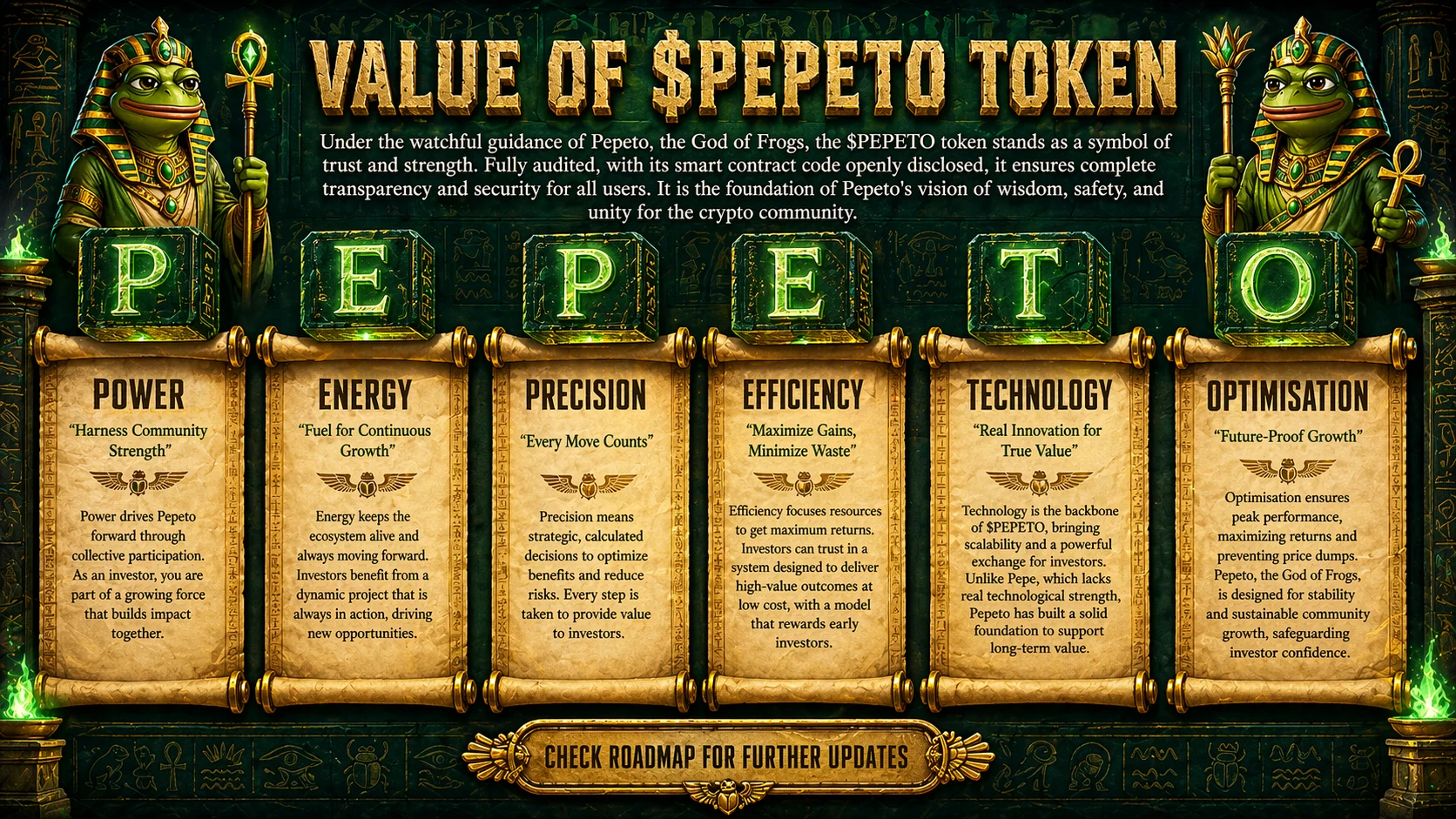
The pepeto price prediction gets sharper this week after Bitcoin tested $80,000 before slipping on oil-linked risk, while more than 100 crypto firms pressed the U.S. Senate to move on the market structure bill per CoinDesk. That pairing of price discovery and Washington pressure is the exact backdrop every past cycle used as its launch pad.
Over a hundred firms signing one Senate letter is not lobbying theater. It is institutional capital demanding a clean legal runway before the next inflow wave lands, and Pepeto enters this window with $9.45 million raised, 178% APY staking live, and the exchange infrastructure the letter is built to protect.
Pepeto Price Prediction Strengthens as Senate Crypto Push Meets the $80K Bitcoin Test
CoinDesk reports the Senate letter names clear demands: defined SEC and CFTC roles, protection for non-custodial developers, cleaner disclosure rules, and no state-by-state legal patchwork.
That direction favors projects sitting on real tools, not promises. Bitcoin pulling back from $80,000 as oil spiked is the short-term tape, but the bigger signal behind every serious pepeto price prediction is regulated liquidity preparing to re-enter crypto at scale. The Fear and Greed Index reads 46 per Blockchain Magazine, the sentiment zone where the largest multiples are quietly earned.
What the Capital Flow Data Reveals About This Window
Extreme sentiment swings are where early wallets lock in the cheapest entries of every cycle, and Pepeto is drawing more capital than any presale in this window because no other token combines the original Pepe cofounder, a former Binance executive, a SolidProof audit, and an approaching Binance listing inside one offering.
The approaching listing turns the numbers below into math, not hope. The gap between the $0.0000001866 presale cost and whatever candle the order book prints on day one is permanent, and once trading opens, that ground floor entry disappears.
Pepeto runs a zero-fee exchange built by a former Binance lead alongside the cofounder who took Pepe to a $7 billion cap on pure meme energy. The AI scanner reads every token contract for buried risks before a trade settles, the cross-chain bridge moves funds across Ethereum, BNB Chain, and Solana at no cost, and 178% APY staking is already live before the first candle prints.
Pepeto Price Prediction 2026 to 2030: Catalysts, Listing Math, and the BNB Parallel
Every strong pepeto price prediction rests on three catalysts. First, the approaching Binance listing compresses presale-to-exchange returns into a single event. Second, PepetoSwap, the zero-fee engine that gives the token its own revenue rails the moment markets open. Third, the exchange-token parallel with BNB, because Pepeto is structurally the same kind of utility asset, the native gas of its own trading venue.
BNB started at $0.15 in its 2017 launch and later printed $858, a climb that carried the market cap past $124 billion. Pepeto enters that category with a live exchange, audited contracts, and 420 trillion tokens. The setup repeats the pattern that made BNB the most rewarded exchange coin in crypto history.
| Year | Target | Pepeto Price | Return from $0.0000001866 |
| 2026 post listing | 50x | $0.0000093 | 50x |
| 2028 cycle peak | 100x | $0.0000187 | 100x |
| 2030 BNB parallel | 500x | $0.0000933 | 500x |
The 2026 target is conservative measured against how prior meme coins moved at listing. The 2028 window lines up with the next full crypto cycle, and 100x is the middle estimate analysts attach to projects that fuse utility with brand. The 2030 number reads ambitious until you remember BNB itself returned over 5,700x from its ICO, which frames 500x across six years as the measured reading of the same thesis.
Conclusion
The pepeto price prediction picture is clear. Bitcoin is testing $80,000, the Senate is moving the market structure bill forward, and this presale keeps pulling capital round after round. The Pepe cofounder’s reach, a live zero-fee exchange, and an approaching Binance listing is the setup that shows up once and never comes back.
The Pepeto site still shows $0.0000001866, and that is the number every future BNB-style chart will be measured against. Buying today locks it in. Waiting turns it into the price you will stare at and wish you had taken the moment the listing bell rings and the order book wipes it out forever.
Click To Visit Pepeto Website To Enter The Presale

FAQs
What is the pepeto price prediction for 2026, 2028, and 2030?
Pepeto targets 50x in 2026 after the approaching Binance listing, 100x by 2028 at the next cycle peak, and 500x by 2030 aligned with BNB’s exchange-token path. Each milestone anchors to the $0.0000001866 presale price, the live PepetoSwap engine, and 178% APY staking already compressing supply.
Why is Pepeto the presale analysts are pricing against BNB right now?
Pepeto is priced against BNB because it runs the same kind of exchange utility BNB carries, and it pairs that utility with meme energy through the original Pepe cofounder plus a former Binance executive. The SolidProof audit, $9.45 million raised during extreme fear, and 178% APY staking match the structural setup BNB showed before its breakout.
Disclaimer: This is a Press Release provided by a third party who is responsible for the content. Please conduct your own research before taking any action based on the content.

Crypto World
Best Crypto To Invest In 2026: Can Pepeto Outrun Chainlink and Sui After Bridgetower Brings $11B On-Chain?
The best crypto to invest in conversation just shifted after Bridgetower sealed a partnership with Chainlink on April 23 to tokenize the $11 billion DOM X Arizona Copper-Gold Project, pushing roughly $25 billion of American natural resources, energy, and metals onto the blockchain through Chainlink’s infrastructure.
But the winning play is not the oracle token already priced for that flow. A presale going viral across crypto communities sits at a fraction of a cent, builds the exchange rails every tokenized asset will need, and the entry stays open only until the Binance listing opens.
Bridgetower Taps Chainlink to Bring $25 Billion of US Resources Onchain
Bridgetower partnered with Chainlink on April 23 to tokenize the $11 billion DOM X Arizona Copper-Gold Project, tapping the oracle network for data feeds, compliance rails, and cross-chain coordination, as reported by PRNewswire.
The broader plan targets $25 billion of US natural resources and metals on-chain, following last week’s OpenAssets deal where Chainlink was picked to power institutional tokenization across ICE, Tether, Fanatics, and Mysten Labs.
The best crypto to invest in sits exactly where this capital rotation begins. When the infrastructure name captures billions, the presale building similar tools at presale pricing becomes the asymmetric trade the open market has not priced yet.
Three Tokens Set to Move Before the Next Cycle Rewards the Wallets That Entered First
Pepeto Price at $0.0000001866 as $9.45M Raised Signals Informed Capital Already Locked In
Pepeto, considered the best crypto to invest in, is where wallets rushing in during this stretch know exactly what they are looking at. A full exchange is being built before a single coin touches public trading, a Pepe cofounder leads alongside a senior Binance executive, and SolidProof audited every line of code. That alone separates the project from every meme token running on hype.
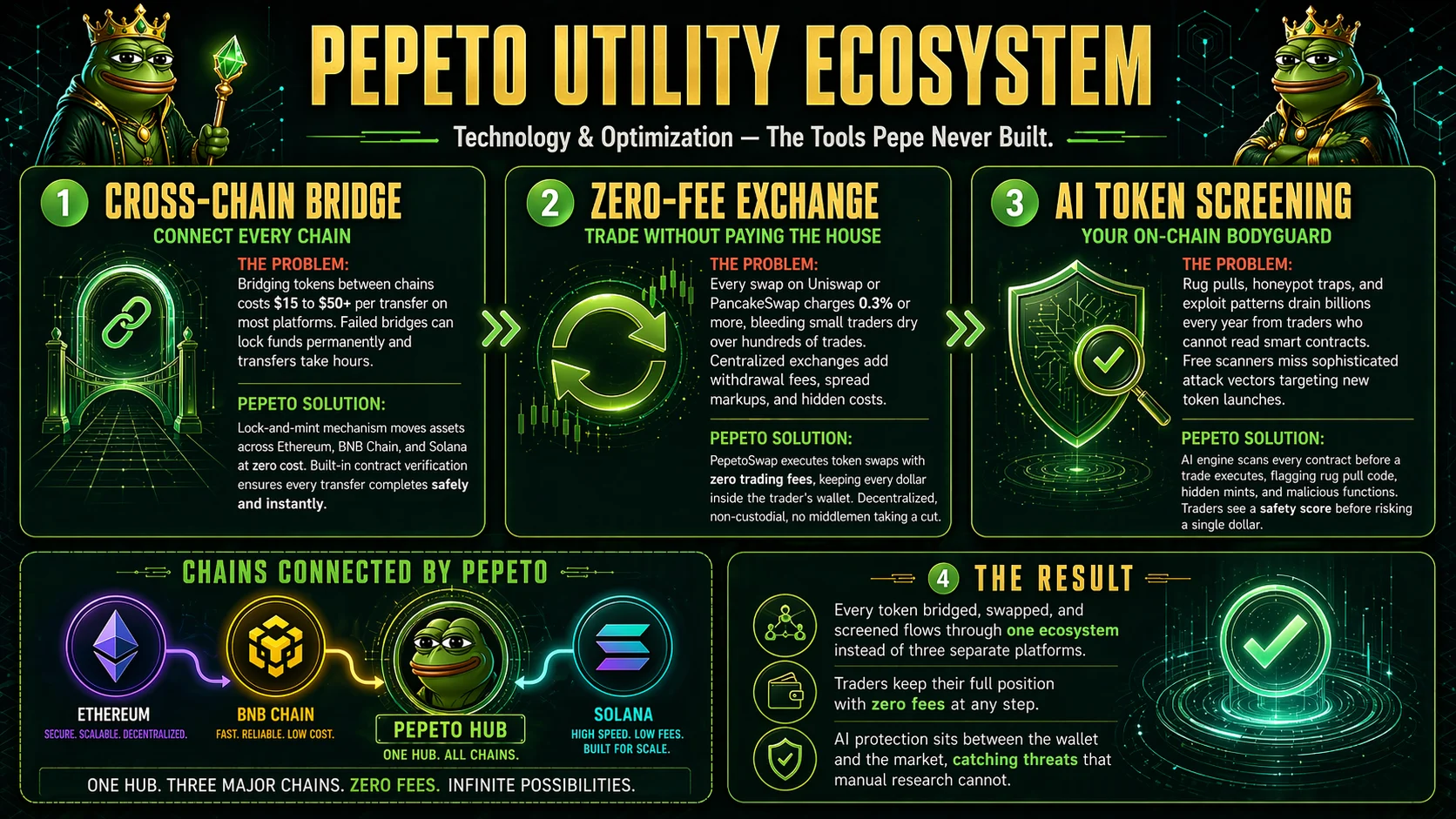
PepetoSwap handles trades at zero fees, the bridge moves tokens across Ethereum, BNB Chain, and Solana without gas, and the AI contract scanner checks every token before capital goes near it. More than $9.45 million has flowed into the presale at $0.0000001866 per token, and holders staking at 178% APY pull supply off the open market every day.
A $10,000 position at 178% APY earns $17,800 per year, roughly $1,483 compounding every month. The CoinMarketCap preview page is live, the Binance listing is approaching, and analysts place Pepeto at 100x once exchange trading opens.
Chainlink (LINK) Price at $9.32 as $11B Bridgetower Deal Extends RWA Lead
Chainlink (LINK) trades at $9.32 per CoinMarketCap, down 1.76% in 24 hours with daily volume near $541 million even as the Bridgetower deal stacks onto a growing list of institutional integrations. Support holds at $8.50 and resistance sits at $9.50, with a clean break opening the $10.50 to $12 range.
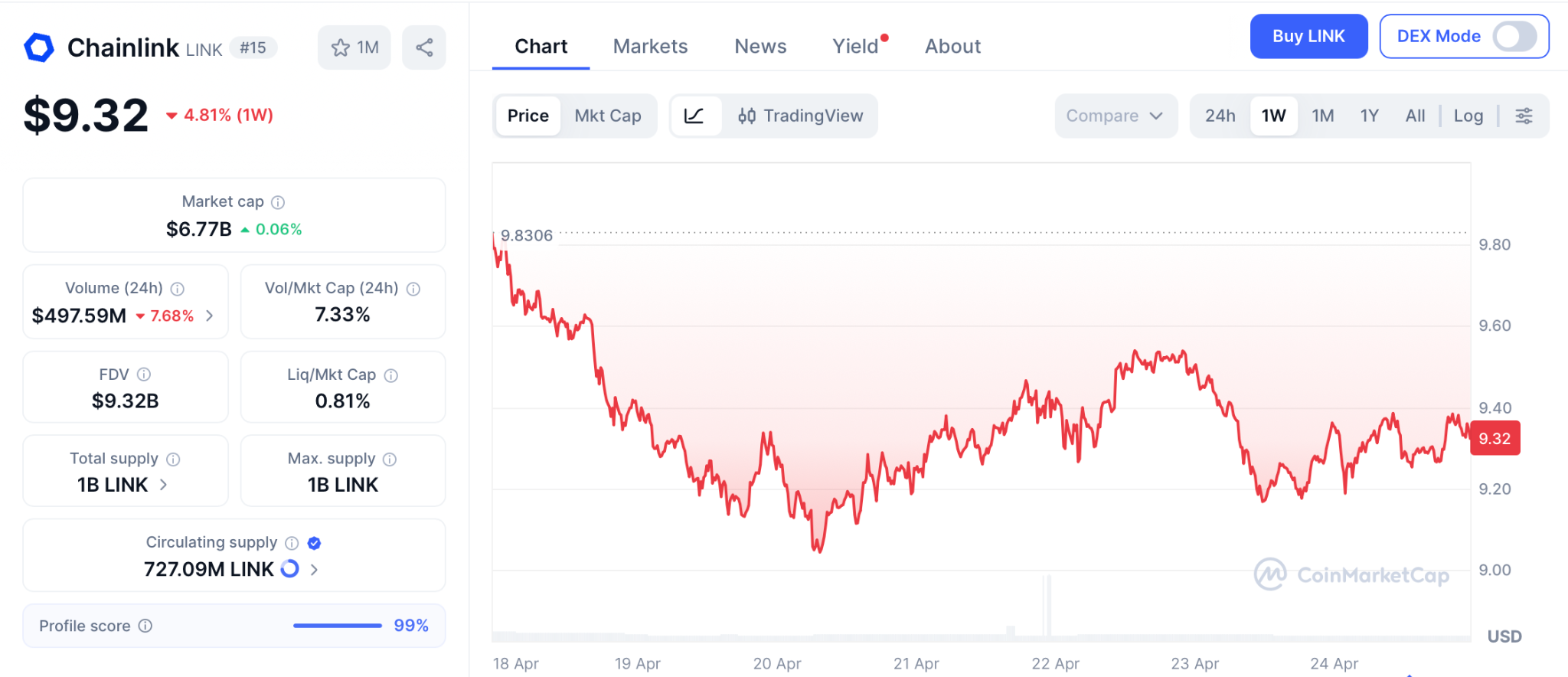
The LINK case strengthens with every RWA partnership, and long term targets on CoinPedia reach $35 to $55 through 2026. But a $6.8 billion cap means even a climb to $15 delivers roughly 60% over many months, nowhere near what a presale before listing produces.
Sui (SUI) Price at $0.94 as Volo Protocol Exploit Tests $0.90 Support
Sui (SUI) trades at $0.94 per CoinMarketCap, down 0.60% in 24 hours after the Volo Protocol exploit on April 22 drained roughly $3.5 million across three vaults, leaving Sui DeFi TVL above $1.2 billion but the confidence narrative bruised. Support sits at $0.90 and resistance at $0.97 with the CME futures launch dated May 4 as the next catalyst.
Analyst targets extend toward $1.75 per BanklessTimes, an 85% move over months. Pepeto at $0.0000001866 compresses that kind of upside into one listing event.
Conclusion
Every cycle rewards the same kind of buyer. The wallet that bought Solana at $260 in November 2021 does not show up in any millionaire story. The one that grabbed SOL at $8 during the 2022 collapse, when the crowd called Solana dead, rode that entry to a 30x by late 2024. Early, before the rally, in names the market is mocking, is where real returns live. Large caps on a green day have never written anyone a life-changing check.
The pattern is repeating. Bridgetower just brought $11 billion of real assets onto Chainlink’s rails, and Pepeto is building the same exchange infrastructure at presale pricing while fear still controls the tape. The regret cycle always ends the same way, people watching the listing candle and wishing they had moved while the price was asleep.
Click To Visit Pepeto Website To Enter The Presale

FAQs
What is the best crypto to invest in April 2026 before the next bull run?
Pepeto is the best crypto to invest in before the next run, backed by $9.45 million raised, a live exchange suite from a Pepe cofounder, and 178% staking yield compounding daily. The April 23 Bridgetower deal with Chainlink tokenizing $11 billion in US resources confirms institutional capital is entering the exchange infrastructure lane.
Is Chainlink (LINK) a stronger buy than Sui (SUI) today at $9.32?
Chainlink (LINK) at $9.32 carries a deeper integration moat after the Bridgetower tokenization deal, while Sui (SUI) at $0.94 still absorbs the Volo Protocol exploit fallout. Pepeto at presale pricing offers a listing-day gap neither mid-cap can match.
Disclaimer: This is a Press Release provided by a third party who is responsible for the content. Please conduct your own research before taking any action based on the content.

The group spent tens of millions of dollars on luxury items and real estate, using funds stolen from crypto users in social engineering scams.

TLDR:
- XRP price outlook improves as price holds above $1.40 after a confirmed breakout retest zone.
- Nearly 35M XRP left exchanges in 24 hours, signaling reduced supply and possible upward pressure.
- Historical outflow spikes earlier this year preceded price rallies between 20% and 50%.
- Resistance remains near $3.00, while sustained support could drive XRP toward higher price levels.
XRP shows renewed market attention after a breakout retest and notable exchange outflows. Recent technical patterns and on-chain data point to growing trader interest, with price structure and supply movement shaping expectations for the asset’s next direction.
Breakout Retest Strength Supports XRP Price Outlook
XRP price action continues to hold above a key breakout zone after retesting former resistance. The multi-year chart structure shows a transition from compression to expansion. Price has remained stable within the $1.40 to $1.60 range after pulling back from recent highs.
A tweet from Javon Marks noted that XRP maintains strength after a clear breakout retest. The post outlined a measured move projection targeting levels above $15.
The chart referenced a historical pattern similar to the 2017 cycle, where consolidation led to a sharp upward move.
The structure shows earlier accumulation between 2014 and 2017, followed by a rapid surge. That rally pushed XRP from fractions of a cent to above $3. After that phase, the asset entered a prolonged consolidation period lasting several years.
Recent price behavior reflects a breakout from that extended range. XRP moved above long-term resistance near the $2 level before pulling back. The current retest zone now acts as immediate support, which traders continue to monitor closely.
The XRP price outlook remains tied to holding this support range. A sustained position above it may allow a move back toward the $3 region. Failure to maintain this level could result in a return to lower consolidation zones.
XRP Outflows Add Momentum to Market Activity
On-chain data has added another layer to the current XRP price outlook. A separate update from Coin Bureau reported that nearly 35 million XRP left exchanges within 24 hours. This marked the sixth-largest outflow recorded this year.
The tweet referenced past outflow spikes in February and March. Those periods were followed by price increases ranging between 20% and 50%. Market participants often view exchange outflows as a sign of reduced selling pressure.
As XRP moves off exchanges, it typically shifts into private wallets. This behavior can reduce available supply for trading, which may support upward price movement. The timing of this outflow aligns with the recent breakout retest phase.
The XRP price outlook now reflects both technical and on-chain alignment. While price holds above key support, supply movement also points toward tightening conditions. These factors together continue to shape short-term expectations.
Even so, resistance remains visible near the $3.00 to $3.50 range. A move above this zone would confirm further strength in the current trend. Until then, XRP may continue trading within a defined range while building momentum.
The XRP price outlook will depend on whether buyers maintain control above support. At the same time, traders are watching to see if the reduced exchange supply continues. These combined signals keep XRP positioned at a critical stage in its cycle.
Crypto World
Dogecoin Price Prediction: DOGE Eyes $0.11 While AlphaPepe Offers the Kind of Early Entry DOGE Made Famous

Dogecoin price prediction is back in focus as DOGE traders watch whether the token can push toward the $0.11 level. That target matters because Dogecoin still holds a special place in crypto. It is one of the clearest examples of how early retail conviction can turn a cheap, ignored asset into a major market winner.
But that is also the point. Dogecoin is no longer the under-the-radar opportunity it once was. It is now a widely known asset with mainstream recognition, exchange access, and years of price history behind it. AlphaPepe is sitting in the earlier part of that cycle, where buyers are still entering before public exchange pricing begins.
Dogecoin Price Prediction Gets Attention as DOGE Eyes $0.11
Dogecoin remains one of the most recognizable retail coins in crypto. Even after its biggest explosive phase has passed, it still attracts attention whenever the market starts to improve. Current forecasts are placing DOGE in the $0.10 to $0.12 range for 2026, with $0.11 often used as the near-term target if momentum keeps building.
That is why DOGE still matters. It remains a signal for retail sentiment. When Dogecoin starts moving, it usually tells the market that traders are becoming more comfortable with speculation again.
There is also a bigger access story behind it now. Grayscale launched a Dogecoin Trust, and DOGE has already seen ETF-style product exposure through DOJE, helping keep the asset in the broader investment conversation.
The Dogecoin Setup, AlphaPepe Presale, and the Early Entry Gap
DOGE reaching $0.11 would still be a positive move. But the math also shows the difference between an established asset and an early-stage entry. If DOGE moved from around $0.095 to $0.11, that is only about a 1.16x move. A $2,000 entry becomes roughly $2,320. That is fine for a short-term trade, but it is not the kind of return that built Dogecoin’s legend in the first place.
That is where AlphaPepe changes the conversation. The project is still in presale, which means buyers are entering before the token has a public chart, before exchange liquidity, and before later money can chase the same setup. Stage 14 is live at $0.01524, with more than $920,000 raised and over 7,900 holders already positioned ahead of listing.
That is the kind of early-entry window Dogecoin became famous for. Not because the projects are the same, but because retail buyers understand the pattern. The biggest gains usually come before a token becomes obvious.
AlphaPepe Builds the Kind of Story Early DOGE Buyers Chased
Most early-stage projects still sell future plans first. AlphaPepe is using a different angle. AlphaSwap, built by a Shibarium dev, is already live before listing and gives the project a working-product story while many rivals are still selling roadmaps.
The platform supports cross-chain swaps and AI-driven contract screening, and the project also carries a 10/10 BlockSAFU audit. That matters because buyers are becoming more selective. They want product, timing, and traction, not just attention.
That timing is the real conversion point. AlphaPepe buyers are entering before the market sets a public exchange price. Once the token lists, the cheapest entry is gone.
Dogecoin Price Prediction: Can DOGE Still Surprise?
DOGE can still surprise on the upside if retail sentiment strengthens and market conditions improve. Its brand is already established, and the token still benefits from broad recognition that most assets never achieve.
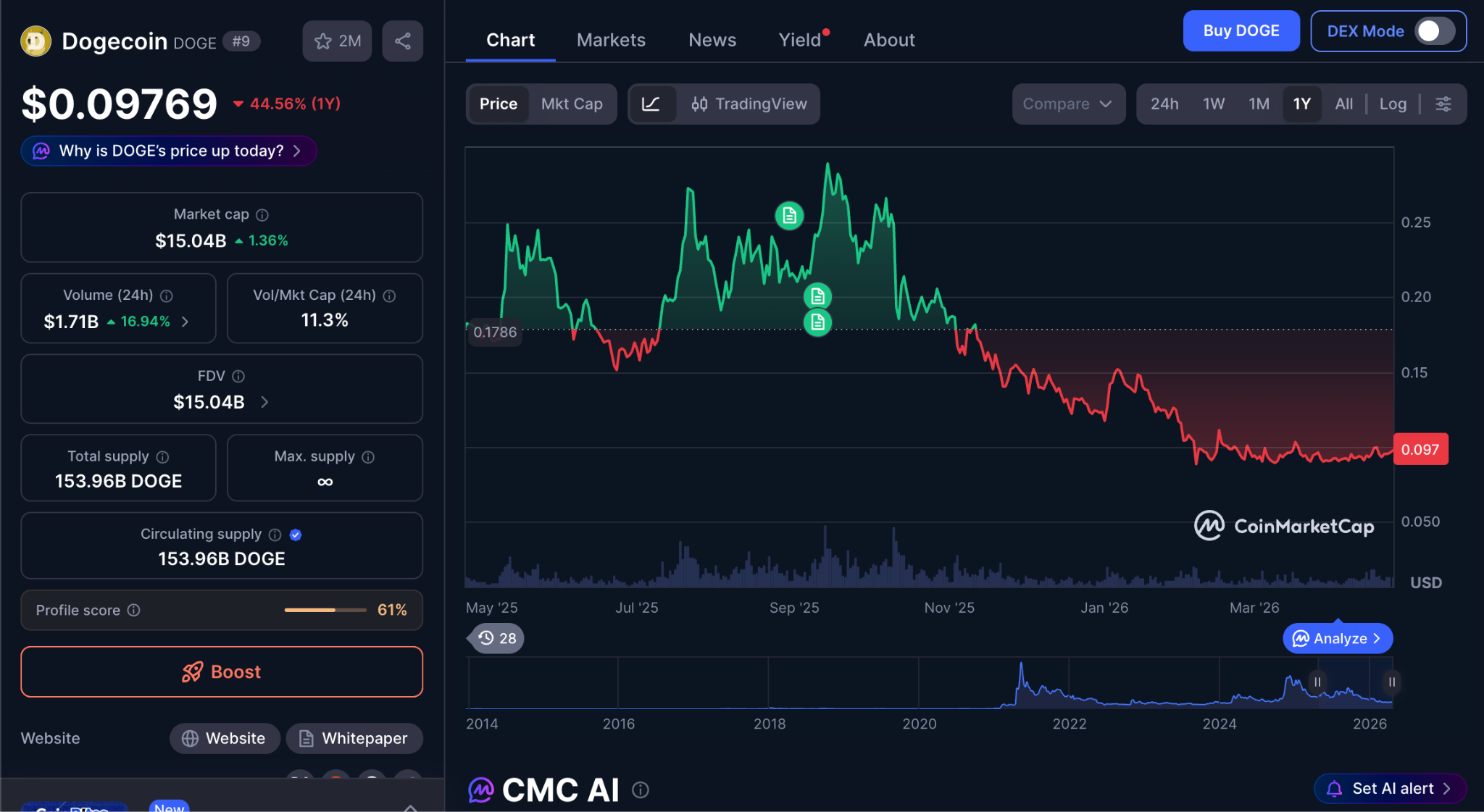
But even if DOGE reaches $0.11 or pushes beyond it, the upside is still established-asset math. AlphaPepe offers something different. It gives buyers a chance to position before exchange trading begins, which is the stage where returns can widen much faster if demand arrives.
That is why the sharper risk-reward story belongs to AlphaPepe. DOGE gives buyers the familiar name. AlphaPepe gives buyers the earlier window.
AlphaPepe Offers the Kind of Early Entry DOGE Made Famous
The main AlphaPepe story is not that DOGE is finished. It is that Dogecoin already taught retail what early entry can do. By the time everyone knows the name, the biggest upside is usually gone.
AlphaPepe is still on the earlier side of that curve. If it were to deliver even a 40x-style early-stage move, a $2,000 entry could become $80,000. That is the kind of asymmetry retail buyers look for before listing, not after.
As DOGE eyes $0.11, the market is splitting into two groups. One is waiting for established assets to grind higher. The other is positioning in earlier-stage setups before the crowd arrives.
Click To Visit The AlphaPepe Official Website
FAQs
What is the current Dogecoin price prediction angle?
The current angle is that DOGE could push toward $0.11, with several 2026 forecasts placing it in the $0.10 to $0.12 range if momentum improves.
Why is Dogecoin still important for retail traders?
Because DOGE remains one of the clearest examples of how early retail conviction can create huge returns over time.
Why are DOGE buyers also watching AlphaPepe?
Because Dogecoin offers the established-name trade, while AlphaPepe offers a pre-listing entry before public exchange pricing begins.
Crypto Press Release Distribution by https://coinfunnel.io
Disclaimer: This is a Press Release provided by a third party who is responsible for the content. Please conduct your own research before taking any action based on the content.
Crypto World
Ethereum Price Eyes Breakout: Can ETH Reclaim $2.8K After Foundation Offloads 10K Coins?
TLDR:
- Ethereum price trades near $2,300 while holding above key $2,000 support during the early recovery phase
- Ethereum Foundation sold 10,000 ETH worth $23.9 million at an average price of $2,387
- Technical signals show a possible shift as the Ethereum price attempts to reclaim key resistance zones
- Market structure shows consolidation between $2,000 and $2,800 before a potential breakout move
Ethereum traded near $2,300 as market structure showed early recovery signs after a prolonged correction phase. At the same time, fresh data confirmed that the Ethereum Foundation executed a large ETH sale to support its operational funding needs.
Market Structure Signals Gradual Ethereum Price Recovery
Recent chart data shared by Ali Charts pointed to a shift in trend momentum. The update noted that a SuperTrend indicator flashed a buy signal for the first time since May last year. This marked a potential end to the extended consolidation phase.
The Ethereum price action now reflects a transition from correction into a base formation phase. The chart showed historical cycles where accumulation zones often precede strong upward moves. Price remained near $2,318, holding above the $2,000 support level.
The structure followed a familiar sequence of expansion, distribution, decline, and accumulation. Earlier rallies delivered gains of over 50% and 170% in previous cycles. These moves occurred after similar buy signals appeared near strong support zones.
At present, the Ethereum price remains below the $2,800 resistance level. However, it has started interacting with a key trend band that previously acted as resistance. Reclaiming this level could support further upward movement toward higher resistance zones.
The chart also indicated that failure to hold $2,000 may lead to a retest of the $1,600 area. As a result, this price zone remains critical for short-term direction. Market participants continue watching whether the Ethereum price can sustain momentum above current levels.
Ethereum Foundation Sale Adds Supply to Market
In a separate update, BSCN reported that the Ethereum Foundation sold 10,000 ETH. The sale generated about $23.9 million at an average price of $2,387 per coin. The funds will support operational activities across various initiatives.
This transaction occurred while the Ethereum price hovered near key resistance. Although such sales are not uncommon, they often draw attention due to their size. The Foundation has previously conducted similar transactions to fund ecosystem development.
The timing of the sale placed additional supply into the market during a recovery phase. Even so, the Ethereum price continued to hold above its recent lows. This suggests that demand remained stable despite the increased supply.
Moreover, the broader structure still points to a consolidation range between $2,000 and $2,800. Price movement within this range indicates an ongoing balance between buyers and sellers. A breakout from this zone may define the next directional move.
The Ethereum price continues to reflect both technical recovery signals and external market activity. As accumulation patterns develop, traders remain focused on confirmation above resistance levels. At the same time, institutional actions such as this sale remain part of the broader market environment.


The European Central Bank (ECB) signed agreements with three European standard-setting bodies to build the digital euro on open, non-proprietary infrastructure, directly challenging the dominance of Visa and Mastercard across the eurozone.
The deals with the European Card Payment Cooperation (ECPC), nexo standards, and the Berlin Group give the digital euro a free, shared technical foundation that any European payment provider can adopt without paying global card scheme fees.
Three standards, three layers of payments
CPACE, developed by ECPC, will handle contactless tap-to-pay transactions over near-field communication. Nexo standards connect merchant systems to the back-ends of payment service providers and acquirers, supporting in-store payment acceptance and ATM transactions. Berlin Group rules cover account-based transfers using identifiers such as mobile phone numbers, plus balance checks and merchant app integrations.
Approximately 80% of the European market already uses Berlin Group’s API framework standards, which underpin PSD2 open banking for banks and fintech apps. ECPC was founded in 2020 by six payment firms from France, Germany, Belgium, Bulgaria, Spain, and Portugal. Nexo is an international non-profit headquartered in Brussels.
Direct hit on Visa and Mastercard
The ECB said Europe lacks a single open standard across payment terminals. This leaves the region dependent on proprietary systems run by global card schemes and digital wallets. Adopting three open standards would allow national card schemes to expand beyond home markets. They could use existing terminals without rebuilding infrastructure.
European payment providers would gain the ability to scale across borders once the digital euro carries legal tender status. The move parallels efforts by Wero, which already operates in France, Germany, and Belgium with the explicit goal of reducing reliance on Visa, Mastercard, and PayPal.
Regulation gates the rollout
Piero Cipollone, ECB board member, called the agreements a step toward freer payment infrastructure.
He said they could give private firms alternatives to proprietary payment rails.
“The open digital euro standards will provide a European free alternative to current proprietary standards, make it easier for new European providers to enter the market and give European payment service providers and merchants the certainty they need to invest, innovate and compete across the euro area.”
Cipollone, ECB Executive Board member
The benefits will not arrive until EU co-legislators adopt the digital euro regulation. Without that legal foundation, the standards remain optional, and providers cannot count on a euro-area-wide scale for their future investments.
The post ECB Picks Open European Standards for Digital Euro, Sidelining Visa and Mastercard appeared first on BeInCrypto.


A California man received a 70-month federal prison sentence Friday for laundering millions of dollars from a $263 million crypto theft, the US Attorney’s Office for the District of Columbia announced.
Evan Tangeman, 22, of Newport Beach, admitted moving at least $3.5 million for a multi-state crew that drained more than 4,100 Bitcoin (BTC) from a single victim and funded an extravagant spending spree.
Inside the $263 Million Crypto Laundering Operation
The enterprise ran from October 2023 through May 2025, growing out of friendships formed on online gaming platforms. It included database hackers, organizers, callers, and residential burglars who targeted hardware wallets, according to court filings tied to the heist.
Tangeman, who used the aliases “E,” “Tate,” and “Evan|Exchanger,” converted stolen Bitcoin into fiat cash. He worked with Los Angeles real estate agents to procure mansions for co-conspirators.
Many were unemployed men under age 20 with no legitimate income. Some properties carried valuations between $4 million and nearly $9 million.
Lamborghinis, Rolexes, and Half-Million Dollar Bar Tabs
Members of the group spent stolen crypto on nightclub services, up to $500,000 per evening; Rolex watches valued between $100,000 and $500,000; and a fleet of exotic cars priced between $100,000 and $3.8 million.
Tangeman received a widebody Lamborghini Urus as compensation. Federal agents searching his home also seized a 2022 Rolls-Royce Ghost and a Porsche GT3 RS. The case echoes a wave of recent federal prosecutions targeting cryptocurrency money laundering networks.
“This criminal enterprise was built on greed so brazen it borders on the cartoonish. They stole millions, spent it on half-million-dollar nightclub tabs, Lamborghinis, and Rolexes,” U.S. Attorney Jeanine Ferris Pirro said in a statement.
Ninth Plea in an Ongoing RICO Case
Tangeman pleaded guilty to RICO conspiracy on Dec. 8, 2025, before U.S. District Judge Colleen Kollar-Kotelly. His admission marked the ninth plea in the investigation.
After co-defendants Malone Lam and Jeandiel Serrano were arrested in September 2024, Tangeman directed Tucker Desmond to destroy the group’s digital devices.
Federal prosecutors continue to pursue additional defendants tied to the social engineering scheme. More sentencings expected in the months ahead.
The post California Man Gets 70 Months in Prison for $260 Million Crypto Scam appeared first on BeInCrypto.
Crypto World
Bitcoin News Fires as $10 Billion Options Expire Above Max Pain and Pepeto Presale Outruns the Clock
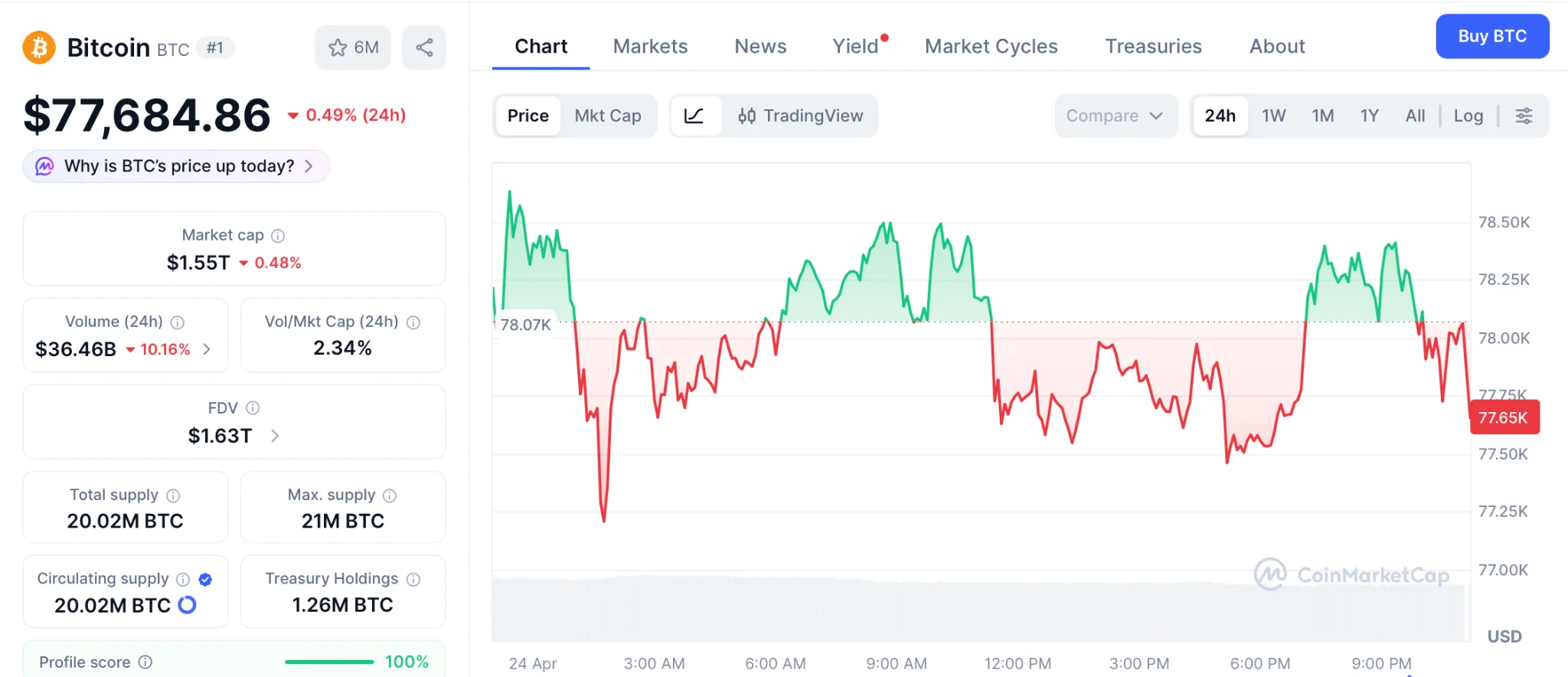
Bitcoin news today points to a turning point that large cap holders and presale buyers should both watch closely. A total of $9.87 billion in Bitcoin (BTC) and ETH options expired on Deribit on April 24, and BTC sat at $77,684, well above the $73,000 max pain level, according to Yahoo Finance.
Solana (SOL) held $85 as Goldman Sachs keeps $108 million in SOL ETFs. But the widest return gap doesn’t sit with either asset today. Pepeto at $0.0000001866 has pulled in $9.45 million with a confirmed Binance listing that turns this entry into a number people remember for the rest of the cycle.
$10 Billion Options Expire as Bitcoin Holds Strong and Solana Posts Weekly Gains
The April 24 settlement cleared 109,000 BTC contracts worth $8.55 billion and 563,000 ETH contracts worth $1.32 billion, with both assets trading above their max pain zones according to BeInCrypto. The put-to-call ratio on BTC came in at 0.93, showing near-balanced positioning, while ETH leaned toward calls at 0.72. Bitcoin news from this expiry confirms that the market isn’t driven by fear. Capital is flowing in steadily.
Solana (SOL) trades at $85 with weekly DEX volume pushing past $11 billion for a second straight week per CoinMarketCap. Goldman Sachs holds $108 million in SOL ETFs and total SOL fund assets cleared $1 billion. BTC ETF weekly inflows crossed $900 million.
The bitcoin news today shows both assets have strong floors, but the biggest percentage move left sits at presale level where a single listing event reprices everything.
Bitcoin News, Solana Data, and the Pepeto Presale Window Closing Fast
Bitcoin (BTC) Price at $77,684 as Options Settle Above Max Pain
Bitcoin (BTC) trades at $77,684 after opening above $78,000 for the first time since early February per CoinMarketCap. Support sits near $76,000 with resistance at $80,000 where the short squeeze zone begins according to CoinDCX. BTC dominance hit 58.1% as capital rotated into safety.
The bitcoin news this week puts BTC on a path toward $80,000 to $82,000 if calls outweigh puts, but even $82,000 from here is a 5% gain. A real gain, but not the kind that changes a portfolio.
Solana (SOL) Price at $85 as DEX Volume Beats Ethereum Again
Solana (SOL) holds $85 after a 2% weekly climb on rising DEX activity and ETF inflows per CoinMarketCap. The Alpenglow upgrade aims for sub-second finality by late 2026. Stablecoin supply on Solana grew 15 times since January 2025 to $3.8 billion.
Resistance sits at $97, and a close above that opens $116 per Coinpedia. Analysts project 2x to 3x for SOL this cycle, a solid return for a $49 billion market cap, but far from the multiples that presale entries create when a listing lands.
Pepeto Presale Hits $9.45 Million With Tools Already Running
A different kind of entry is forming while options traders settle billions in contracts. Pepeto crossed $9.45 million with a running exchange that covers Ethereum, BNB Chain, and Solana. PepetoSwap settles every trade at zero fees, so nothing leaves the position to cover platform costs.
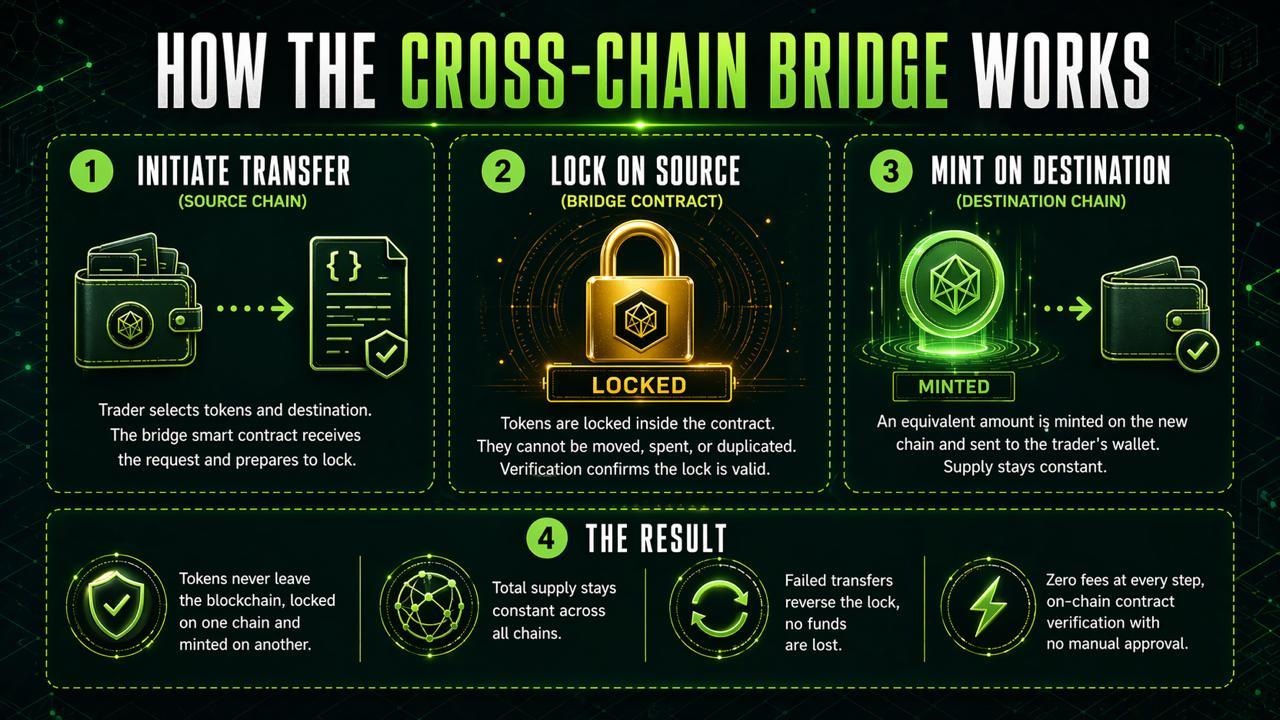
The cross-chain bridge sends tokens between networks without gas charges, delivering every dollar complete. The AI contract scanner reads each token for risks before a wallet puts a single dollar at stake.
Staking at 178% APY adds to token balances every day while the window stays open. SolidProof completed the full audit, and a cofounder who launched the first Pepe token to a $7 billion peak leads alongside a former Binance executive.
The CoinMarketCap preview page went live, the same step that preceded each major listing since 2021. SHIB climbed from under a penny to a $40 billion peak while institutions debated Bitcoin’s direction. Pepeto at $0.0000001866 with verified tools and a confirmed Binance listing follows that setup.
Conclusion
The bitcoin news on April 24 shows $10 billion in options settling with BTC above max pain and Solana posting another week of record DEX volume, but neither gives a new buyer the return that presale entry creates before a listing.
Pepeto at $0.0000001866 with $9.45 million raised, 178% staking, three working products, and a confirmed Binance listing sits where DOGE and SHIB sat before they delivered returns that changed lives, and the stages still open today are the last chance to lock in this price before the exchange goes live and this entry turns into a number people share with regret.
Click To Visit Pepeto Website To Enter The Presale

FAQs
What is the biggest bitcoin news today for April 24 2026?
The biggest bitcoin news today is the $9.87 billion options expiry on April 24, with BTC trading at $77,684 well above the $73,000 max pain level and confirming steady capital inflows. BTC dominance reached 58.1% as the market positions for a move toward $80,000.
What is Pepeto and why does it stand out in the bitcoin news cycle?
Pepeto is a meme coin presale at $0.0000001866 that raised $9.45 million with a zero-fee exchange, cross-chain bridge, AI contract scanner, and 178% APY staking already running. SolidProof audited the contracts and a Pepe cofounder leads the project toward a confirmed Binance listing.
Disclaimer: This is a Press Release provided by a third party who is responsible for the content. Please conduct your own research before taking any action based on the content.
TLDR:
- Stellar XLM maintains higher lows, signaling strength after breakout and ongoing consolidation phase
- Technical setup shows bull flag pattern with targets near $0.681 and extended move toward $1.29
- Visa uses Stellar network for stablecoin settlement, improving speed and reducing backend friction
- Price holds key support near $0.13 while resistance breakout could drive next upward expansion
Stellar’s native token XLM is drawing renewed attention as price structure and real-world payment use cases align.
Recent technical analysis and infrastructure developments point to a shifting market phase, where consolidation follows a breakout while blockchain-based settlement gains traction.
Price Structure Signals Continuation Setup
Market analyst Javon Marks recently shared a detailed chart outlining the evolving structure of Stellar XLM across a multi-year timeframe.
The analysis tracks a transition from a prolonged downtrend into a breakout phase, followed by a controlled correction.
The earlier cycle showed consistent lower highs and lower lows, which later gave way to accumulation during 2023.
In his tweet, Marks states that Stellar XLM continues to hold a breakout structure while forming higher lows. He projects a potential rally toward $0.681, with an extended move near $1.29 if momentum continues.
The chart reflects a corrective channel after a strong upward move, suggesting a continuation setup rather than trend weakness.
The structure shows price stabilizing near $0.17, above a key support range between $0.13 and $0.15. This zone remains critical for maintaining the current trend. Higher lows across this phase indicate that buyers continue to step in during pullbacks.
A move above descending resistance could open the path toward the $0.25 to $0.30 range. From there, the projected targets align with prior resistance zones. The formation resembles a bull flag, where consolidation follows a sharp upward impulse.
At the same time, the setup remains sensitive to downside risk. A break below $0.13 would weaken the structure and could push Stellar XLM toward lower levels near $0.10. Until then, the consolidation phase remains part of a broader upward trend.
Payment Infrastructure Expands With Stellar Integration
Stellar XLM is also gaining attention through its role in payment infrastructure. The network is being used as part of blockchain-based settlement systems, which aim to improve transaction speed and efficiency. This development places Stellar XLM within evolving financial workflows.
A tweet from RudraExchange explains that Visa has integrated Stellar into its stablecoin settlement network. The process allows payments to be handled through Visa while settlement occurs on blockchain rails like Stellar using USDC. This structure reduces delays often seen in traditional backend systems.
Visa continues to operate as the global payment layer, managing transactions across merchants and card networks.
Meanwhile, Stellar XLM supports the settlement process by enabling fast and low-cost transfers. This combination allows financial systems to operate more efficiently without replacing existing infrastructure.
The integration reflects a gradual shift in backend financial processes. Blockchain networks like Stellar are used to improve settlement, while front-end systems remain familiar to users. Stellar XLM plays a role in enabling this transition through its network capabilities.
As these developments continue, Stellar XLM remains positioned across both market structure and real-world usage.
Price action reflects consolidation within a broader trend, while infrastructure adoption introduces additional context to its role in financial systems.

HBO Max’s 7-Part Crime Thriller Is Officially One of Its Best Shows To Binge

Geegees Mistruth clinches 2026 Robert Sangster Stakes in photo finish

5 Clever Finds To Make Oil Changes Easier And Mess-Free

Manchester United reach agreement with Casemiro over contract clause amid transfer speculation

US brings back mandatory military draft registration

Steven Gerrard disagrees with Gary Neville over ‘shock’ Chelsea and Arsenal claim | Football


-

 Business7 days ago
Powerball Result April 18, 2026: No Jackpot Winner in Powerball Draw: $75 Million Rolls Over
-

 Fashion2 days ago
Weekend Open Thread – Corporette.com
-

 Politics7 days ago
Zack Polanski demands ‘council homes not luxury flats for foreign investors’
-
Entertainment6 days ago
NBA Analyst Charles Barkley Chimes in on Ice Spice McDonald’s Fiasco
-

 Politics5 days ago
Gary Stevenson delivers timely reminder to register to vote as deadline TODAY
-
Crypto World6 days ago
Bank of Hawai’i (BOH) Q1 2026: Net Income Drops to $57.4M as Net Interest Margin Expands
-
Crypto World11 hours ago
Hyperliquid $HYPE Rally Builds Momentum as AI Sector Enters Prove-It Phase
-

 Politics3 days ago
Making troops accountable for war crimes threatens US alliance, ex-SAS colonel warns
-

 Politics3 days ago
Disabled people challenge government SEND proposals over segregation concerns
-

 Business4 days ago
Rolls-Royce Voted UK’s Most Iconic Trade Mark as IPO Register Hits 150
-

 Politics4 days ago
Zack Polanski responds to home secretary’s taser threat
-

 Politics4 days ago
Starmer handler McSweeney to be dragged from shadows by Foreign Affairs Committee
-
Politics4 days ago
Wings Over Scotland | How To Get Away With Crimes
-
 Crypto World5 days ago
Five Value Stocks with Recovery Potential in 2026: PayPal (PYPL), Nike (NKE), and More
-

 Politics3 days ago
‘Iran is still a nuclear threat’
-

 Crypto World4 days ago
New York sues Coinbase, Gemini over prediction market offerings
-
 Sports3 days ago
Tim Bradley names the current best in the world: “Better than Inoue and Usyk”
-

 Business4 days ago
The Job Benefits Most Men Don’t Know to Negotiate
-

 Politics7 days ago
Reform investigating candidate who ‘hates’ the NHS
-

 Crypto World4 days ago
Crypto’s great hope in Senate’s Clarity Act still has a path to survive tight calendar
You must be logged in to post a comment Login